The fabulous cabaret singer Sophie Tucker, well known in the mid-20th century, said: “I’ve been rich and I’ve been poor. Believe me, rich is better.”
If children have any say in the matter (they don’t), they should arrange to be born to a rich family. They would get regular medical care, nutritious meals, live in nice houses in safe neighborhoods. And their schools would get high ratings!
Here is this morning’s post with new analysis addedtoday from the Cleveland Plain Dealer’s data wonk, Rich Exner, on the meaning of Ohio’s 2026 School Report Cards.
Leading with a bar graph correlating the Census Bureau child poverty rate with Ohio school districts’ overall school report card rankings, Exner demonstrates that, once again in 2026, Ohio’s ratings of the state’s public school districts on the annual state report card correlate with school districts’ aggregate family income and other factors known to contribute to opportunity gaps. The Ohio Department of Education and the Workforce (Ohio DEW) rates and ranks Ohio school districts based on standardized test scores along with several other factors the state now considers such as graduation rates and the amount of chronic absence among students.
Exner writes: “The 2026 Ohio school report cards released this week not only provided a snapshot of each school district, but they also once again drove home the point that wealthier districts usually do better, a cleveland.com analysis found. Perhaps the relationship is no clearer than in comparing districtwide child poverty rates from the Census Bureau to the overall star ratings issued by the Ohio Department of Education and Workforce. Five-star districts, on average, have a child poverty rate of 6.1%, whereas schools scoring on the low-end with just two stars are nearly six times worse off for child poverty, at 35.1%, cleveland.com found. The trend holds true at each step between, with child poverty averaging 8.5% for 4.5-star districts, 12.8% for four-star districts, 15.6% for 3.5-star districts, 23% for three-star districts and 30.1% for 2.5-star districts.”
Children’s test scores also correlate with related factors. For example, “Within the districts receiving two stars, just 15.6% of the adults age 25 and older have a bachelor’s degree or above. In the five-star districts, the rate is more than three times as high, at 48.5%.”
Exner examines the correlation of a each school district’s aggregate child poverty rate and the percentage of adults with a B.A. or above with the state’s overall ratings, and with rankings in each of the subcategories the state considers: school achievement as measured by test scores; progress; gap closing; graduation rates; early literacy; and college, career workforce, and military readiness. In each case he confirms the years-long trend correlating the state’s ratings of public schools with socioeconomic factors.
—– Here is the original post published this morning —–
Earlier this week, the Ohio Department of Education and the Workforce (Ohio DEW) released state report cards for each Ohio school district and every one of the state’s traditional public schools and charter schools. The Plain Dealer‘s Laura Hancock reports: “Overall, English and math scores inched up statewide. The rate of chronic absenteeism inched downward and remains far from the state’s goal.”
A follow-up from Plain Dealer reporter Rich Exner lists Ohio’s top scoring schools: “Solon was among three Cuyahoga County districts scoring in the top five, and among 10 from the Greater Cleveland area in the top 25 statewide… Following Solon at the top of the list, in order, were Marion schools from western Ohio’s Mercer County, Chagrin Falls, Mariemont from outside Cincinnati, and Rocky River.” The three greater Cleveland districts in that list are Solon, Chagrin Falls and Rocky River, all upper-income suburbs.
Although Ohio DEW releases the school district report cards every fall with lots of hoopla as a kind of race with clear winners and losers, the causes of disparities in standardized test scores from school to school and district to district are far more complicated. Aggregate standardized test scores for any school or any school district are primarily shaped by one set of variables that are rarely named: family income and the overall income of the community. The standardized test score ranking is, in reality, a measure of economic privilege.
For years now, Rich Exner, the Plain Dealer’s data wonk, has followed up the state’s release of the state report cards with a far more nuanced analysis. In 2019, Exner presented a set of bar graphs demonstrating the following: “The latest set of Ohio school report cards not only provided a scorecard for each district statewide – they once again drove home the point that wealthier districts do better on such reports… To get an idea of how closely report card grades from the Ohio Department of Education follow demographic factors, cleveland.com (The Plain Dealer) compared those grades to U.S. Census Bureau community data for household income, child poverty and the education level of the adults. In nearly every key report card category, the trends followed census data closely.” I include one of Exner’s 2019 bar graphs depicting the correlation of Ohio state school report card rankings with family income.
Again last year, in 2025, when Ohio released the state school report cards, Exner reported the same pattern. While he notes a tiny number of encouraging exceptions when impoverished school districts made impressive test score gains, Exner explains: “For probably as long as the state has been issuing school report cards, one trend has held true – wealthier districts score better. Take this year when the richest 14 districts in the state based on the income of their residents all scored the highest available overall grade – five stars – on the new report cards.” And he explains further: “Income, of course, is not the only measure tied to the trends. Where incomes are higher, this often increases the likelihood that parents in the districts have college degrees, or the existence of two-parent households, with two incomes. And there are other factors that raise challenges for individual school districts.”
Decades of Research Confirm the Trend Exner Identifies
The late professor of education and former president of the American Educational Research Association (AERA) and the Division of Educational Psychology at the American Psychological Association (APA), David Berliner explained: “The big problems of American education are not in America’s schools… It’s neither this nations’ teachers nor its curriculum that impede the achievement of our children. The roots of America’s educational problems are in the numbers of Americans who live in poverty. America’s educational problems are predominantly in the numbers of kids and their families who are homeless; whose families have no access to Medicaid or other medical services. These are often families to whom low-birth-weight babies are frequently born, leading to many more children needing special education.”
In Ohio, Douglas Downey, a professor of sociology at The Ohio State University describes academic research showing that evaluating public schools based on standardized test scores is unfair to educators and misleading to the public. In a 2019 book, How Schools Really Matter: Why Our Assumption about Schools and Inequality Is Mostly Wrong, Downey explains: “It turns out that gaps in skills between advantaged and disadvantaged children are largely formed prior to kindergarten entry and then do not grow appreciably when children are in school.” (How Schools Really Matter, p. 9) “Much of the ‘action’ of inequality therefore occurs very early in life… In addition to the fact that achievement gaps are primarily formed in early childhood, there is another reason to believe that schools are not as responsible for inequality as many think. It turns out that when children are in school during the nine-month academic year, achievement gaps are rather stable. Indeed, sometimes we even observe that socioeconomic gaps grow more slowly during school periods than during summers.” (How Schools Really Matter, p. 28)
In 2017, Katherine Michelmore of Syracuse University and Susan Dynarski of the University of Michigan studied data from Michigan to identify the role of economic disadvantage in achievement gaps as measured by test scores: “We use administrative data from Michigan to develop a… detailed measure of economic disadvantage… Children who spend all of their school years eligible for subsidized meals have the lowest scores, whereas those who are never eligible have the highest. In eighth grade, the score gap between these two groups is nearly a standard deviation.” “Sixty percent of Michigan’s eighth graders were eligible for subsidized lunch at least once during their time in public schools. But just a quarter of these children (14% of all eighth graders) were economically disadvantaged in every year between kindergarten and eighth grade… Ninety percent of the test score gap we observe in eighth grade between the persistently disadvantaged and the never disadvantaged is present by third grade.”
In 2011, Stanford University educational sociologist, Sean Reardon reported on growing residential segregation by income—which correlates with segregation by race. Reardon used a massive data set to document the consequences of widening economic inequality for children’s outcomes at school. Reardon showed that while in 1970, only 15 percent of families lived in neighborhoods classified as affluent or poor, by 2007, 31 percent of families lived in such neighborhoods. By 2007, fewer families across America lived in mixed income communities. Reardon also demonstratedthat along with growing residential inequality and residential segregation by income is a simultaneous jump in an income-inequality school test score gap. The gap between the children with income in the top ten percent and the children with income in the bottom ten percent, was 30-40 percent wider among children born in 2001 than those born in 1975, and twice as large as the black-white test score gap.
Then in 2016, Reardon documented: “The socioeconomic profile of a district is a powerful predictor of the average test score performance of students in that district.” “The most and least socioeconomically advantaged districts have average performance levels more than four grade levels apart. Average test scores of black students are, on average, roughly two grade levels lower than those of white students in the same district; the Hispanic-white difference is roughly one-and-a-half grade levels. Achievement gaps are larger in districts where black and Hispanic students attend higher poverty schools than their white peers… and where large racial/ethnic gaps exist in parents’ educational attainment. The size of the gaps has little or no association with average class size, a district’s per capita student spending or charter school enrollment.”
In 2022, Reardon commented on the factors that contribute to opportunity gaps: “We examine… test score gaps because they reflect… differences in access to educational opportunities. By ‘educational opportunities,’ we mean all experiences in a child’s life, from birth onward, that provide opportunities for her to learn, including experiences in children’s homes, child care settings, neighborhoods, peer groups, and their schools. This implies that test score gaps may result from unequal opportunities either in or out of school; they are not necessarily the result of differences in school quality, resources, or experience. Moreover, in saying that test score gaps reflect differences in opportunities, we also mean that they are not the result of innate group differences in cognitive skills or other genetic endowments… (D)ifferences in average scores should be understood as reflecting opportunity gaps….”
When standardized test scores are aggregated and compared from school district to school district, the disparities reflect economic inequality as well as economic segregation across U.S. school districts. Although in a smaller town a school district’s aggregate test scores may reflect the economic range of a diverse community, in any metropolitan area, some schools are filled with rich kids, while others are filled with poor kids. And more important, test scores do not present any picture of what is happening in anybody’s schools. They don’t tell us anything about the richness of the curriculum or the extracurricular offerings for enrichment. They don’t tell us anything about how teachers work with students or whether students come to love learning.
Mike Simpson, known on Twitter as “Big Education Ape,” is known for his brilliant memes and editorial cartoons. Typically, they expose the latest fads and lies that defame teachers and public schools. Every once in a while, he publishes a great post, like this one.
I’M SHOCKED, SHOCKED — HOW 30 YEARS OF BILLIONAIRE-FUNDED “REFORM” MANUFACTURED THE EDUCATION CRISIS IT PROMISED TO FIX
There’s a famous scene in Casablanca where Captain Renault declares he is “shocked, shocked” to find gambling going on — right before a croupier hands him his winnings. That’s essentially the posture of the billionaire reform industrial complex today, clutching its pearls over a Gallup poll showing public satisfaction with American schools has cratered to 32% — an 11-point nosedive in just two years — while quietly pocketing the profits of the crisis they spent three decades engineering.
Shocked. Absolutely shocked.
The Architecture of a Manufactured Crisis
Let’s be precise about the timeline, because precision matters when someone is picking your pocket.
For roughly 30 years, a well-funded constellation of think tanks, philanthropic foundations, hedge fund managers, and tech oligarchs pumped billions of dollars into a single, relentless narrative: public schools are failing. Not “underfunded.” Not “systematically neglected.” Failing — as in, inherently broken, irredeemably incompetent, populated by bad teachers protected by evil unions, and salvageable only by the heroic intervention of the private market.
The messaging was surgical. The money was real. And — surprise! — it worked.
Starve public schools of adequate funding. Declare them “failing.” Ride in on a white charter bus to “rescue” the children.
The chronic underfunding wasn’t fiscal negligence. In many states, it was a feature, not a bug. Squeeze hard enough, the theory went, and disruption would force innovation. What it actually forced was deferred maintenance, teacher shortages, and a generation of kids learning to read in buildings where the roof leaks and the textbooks predate the iPhone.
Now the poll numbers confirm the narrative took hold — and the reformers are citing those same poll numbers as proof they were right all along. The audacity is, genuinely, breathtaking.
The Numbers That Tell Two Very Different Stories
Here’s what the data actually shows — and what it doesn’t show:
Metric: The Headline. What It Actually Means Gallup Public Satisfaction 32% — record low 30 years of “failing schools” messaging worked exactly as intended.
Parent Satisfaction with Their Own School Historically ~2x the national figure People trust what they experience; they fear what they’re told
Math & Reading Scores Declining, especially bottom quartile Tracks directly with funding inequity and screen-time explosion
Top-tier U.S. Student Performance Still globally competitive. The “crisis” is concentrated where disinvestment is concentrated
The gap between how Americans rate schools in general versus their own child’s school is the smoking gun. It has always been the smoking gun. People who actually walk into a public school building — who meet the teachers, see the classrooms, watch their kids come home — consistently rate those schools dramatically higher than the national “failing” narrative suggests.
That gap is the manufactured crisis. It lives entirely in the space between lived experience and media-amplified fear.
$1.8 Billion Worth of Snake Oil, Served Fresh
And just when you thought the reform carousel might slow down, along comes the Science of Reading — the latest Next Big Thing™ in a long line of Next Big Things™ that have collectively cost American taxpayers tens of billions of dollars and produced reading scores that went, as the Big Education Ape’s withering analysis puts it, precisely nowhere.
Remember Common Core? $15.8 billion. A decade of standardized testing theater. Reading scores: unmoved.
Now we have the Science of Reading, $1.8 billion deep and climbing, with the same cast of vendors, the same philanthropic networks, and the same conspicuous absence of a money-back guarantee.
To be scrupulously fair: phonics works. Explicit decoding instruction works. The underlying research on structured literacy is legitimate. But here’s the thing about legitimate research — it doesn’t require a $1.8 billion vendor ecosystem, mandatory state legislation in 40+ states, and the systematic deskilling of teachers who are told to stop thinking and start following the script. When real science gets packaged into proprietary curricula, sold to districts under legislative mandate, and deployed without the trained human educators needed to implement it well, you don’t get science. You get very expensive phonics worksheets.
The question nobody in the reform complex wants to answer remains the same one it’s always been: Where is the money-back guarantee?
The Other Hand: How Tech Bros Broke Kids’ Brains While Selling the Cure
Here is the part of the story that deserves its own criminal investigation — or at minimum, a very uncomfortable congressional hearing.
The same Silicon Valley billionaires who spent decades pushing EdTech into classrooms as the revolutionary equalizer — screens for every student! –are the identical billionaires whose social media platforms have:
Collapsed long-form reading among adolescents at a rate researchers describe as one of the steepest drops in PISA history
Engineered algorithmic doom-scrolling that neurologically rewires 15-year-olds away from the sustained attention that math and reading comprehension require
Distracted over a quarter of students internationally during core academic instruction, by their own PISA survey data
They sold the disease and the cure. They pushed the screens that fragmented attention spans, then sold the adaptive software to remediate the fragmented attention spans, then pointed at the test scores and said: See? Public schools are failing.
None of this is inevitable. None of this is permanent. The No Kings Coalition — the sprawling, nonpartisan civic movement that flooded the streets in March — is now flooding the polls, with a Vote Early Day of Action on October 17 aimed squarely at the November 3, 2026 midterms.
The math is straightforward, even if the billionaires prefer we can’t do it:
Elect candidates who will defend public education funding, not divert it into voucher schemes that enrich private operators at public expense
Overturn the Supreme Court rulings — from Citizens United forward — that transformed American democracy into a billionaire auction
Restore the principle that public money follows public children into public schools, not into the portfolios of private equity firms with a “reform” logo.
The manufactured crisis has a manufactured solution: more billionaire intervention, more privatization, more EdTech, more testing, more disruption. The actual solution is considerably less glamorous and considerably more effective — fund schools equitably, pay teachers competitively, put phones away, and stop letting people who profit from public school failure write public school policy.
The Bottom Line
The 32% satisfaction number is not evidence that public schools have failed. It is evidence that a 30-year, billion-dollar propaganda campaign succeeded. The same people who manufactured the crisis are now selling the cure — at $1.8 billion a pop, no refunds, no guarantees, no accountability.
Meanwhile, the teachers who showed up every day through a pandemic, through chronic underfunding, through a staffing crisis, through the algorithmic dismantling of their students’ attention spans — those people are still in the classroom at 7 AM, doing the work that no EdTech platform, no voucher program, and no think tank white paper has ever actually replaced.
The casino is rigged. Captain Renault is shocked. And the November ballot is the one lever the house can’t control.
Vote like a public school depends on it. Because one does.
All links verified active as of September 9, 2026. Primary polling data sourced from Gallup/Walton Family Foundation. PISA data sourced from NCES/OECD 2025 release.
Eva Moskowitz, founder of Success Academy charter chain, has been everywhere recently, promoting her brand. She has written op-Ed’s for major newspapers, she was interviewed by Margaret Hoover on PBS’ “Firing Line,” she is expanding from New York City to Florida. And just the other day, she published an article in The Washington Post saying that she is suing the New York State Education Department for failing to release the AP scores of her charter schools, which caused her schools’ ranking to plummet in the U.S. News‘ ranking of high schools.
Gary Rubinstein looked at her complaint and dissected it. Gary teaches advanced mathematics at Stuyvesant High School in New York City. Stuyvesant is a highly selective school that accepts only the students who pass a rigorous test. Gary is a crack researcher and examiner of claims, who has repeatedly taken apart the Success Academy marketing brand.
No matter where you go in New York City, you are forced to ponder the Success Academy charter network. On bus stops, in your mailbox, even as a commercial during a YouTube video, the school seems to be everywhere. A Success Academy looking student was even saved by Superman in the recent 2025 Superman movie.
Waiting For Superman? He finally came!
Starting in 2006 with about 170 students, it has grown to encompass about 60 schools and about 22,000 students. They are known for having very strict discipline and very high test scores.
Over the years I have examined pretty much every aspect of this school. I’ve done post after post about how it should be a red flag that they only graduate about 150 seniors a year despite having over 2000 kindergarteners and about 800 ninth graders across several schools. I’ve interviewed former students who say that, yes, the school stops everything and does test prep for several months before the state tests. I’ve interviewed parents who have been pressured to transfer their kids out of Success Academy. And if you do a search on reddit you will find page after page of stories that will break your heart.
But Success Academy does seem to have excellent test scores, at least the 3-8 Math and ELA state test scores. Though there are a lot of students who are pushed out of the school, the 3-8 test scores are even good considering that. But for these 3-8 scores to be more than a mirage, they need to translate into good high school scores, and here is where things get a bit complicated.
One metric that Success Academy has been able to boast about in recent years has been their position on the US News & World Report High School rankings. Last year, for example, they were rated the 11th best High School in New York State along with the big guns like Stuyvesant, Bronx Science, Townsend Harris, and Brooklyn Tech. Having a rating like that makes for a nice item to show to donors at fundraisers and can help them start new franchises in Florida, for example.
But the US News & World Report High School rankings have always been flawed. Here’s how they work: Three of the main categories are ‘college readiness’, state assessment proficiency, and graduation rate. The ‘college readiness’ score has been worth 30% and it is calculated by averaging the percent of seniors who took an AP test and the percent of seniors who got a 3 or higher on at least one of those AP exams. So if there is a school where every senior takes a bunch of APs and as long as everyone passes at least one of those APs, that school can get a full 30 points for that metric. So if there is a school where all the students get 5s on multiple APs, it gets the same score as the school where students get a 3 on exactly one AP. So this one is pretty easy to game because all you have to do is force your students to take a bunch of APs and since getting a 3 isn’t so hard as it is like getting a 60% or less on some of them, you can get the full 30 points if you make that the goal for the school. The same is true for the state assessment proficiency where as long as your students pass, even if they barely pass, they get the same rating as a school where the students get near perfect scores on the test.
It is possible to game the math component of the state assessment proficiency metric by not making your students take the Geometry and Algebra II Regents. Most NYC students take Algebra I in 8th or 9th grade and at a high performing school, they generally take those other two Regents the next two years. But those other ones aren’t needed for graduation so if a school doesn’t want those scores to affect their US News & World Report ratings, they might not have their students take math Regents beyond Algebra I. Success Academy is one of those schools whose math component of the US News ranking is based on just Algebra I. They seem to be the only supposedly high performing school whose students do not take the Geometry and the Algebra II Regents so their math score that US News uses is based on one easy test rather than three tests in which the other two are much more difficult.
In 2025 Success Academy was ranked 11th in New York State (out of about 1200 schools). But the latest ranking came out and Success Academy dropped to 196th. This prompted Success Academy to sue the New York State Education Department for what they felt was an unfair change in the reporting of the data to US News & World Report. I will try to explain why the 196th ranking this year is actually a more fair ranking than the 11th from the previous year and how this lawsuit could backfire on Success Academy.
So the big change from last year to this year is that New York State did not report the AP score data to US News & World report. So what US News did was increase the weight of the other categories to compensate for that. In theory, at least, it shouldn’t affect the rankings by so much. A school with good AP scores will also likely have good state assessment proficiency and a good graduation rate. Those things generally go up and down together.
But there was a strange thing in the new rankings. Most of the top 25 schools by the new ranking were not high performing on last year’s rankings. So 25 schools shot to the top and most of the other schools that used to be at the top of the list ended up moving down around 25 spots or sometimes a little more. This happened because though NY State did not report the AP scores, they did report for IB schools those scores and those IB schools got to use the college readiness metric which meant that they got the advantage of inflating their scores while the AP schools didn’t. Of the top 200 schools, 42 of them were IB schools in the new ranking, including about 25 of the top 30 schools. It would have been more fair for NY State to also not give the IB scores since it did make top performing AP schools lose around 25 spots on average.
But Success Academy did not just drop 25 spots. It dropped the most spots of any school in the state that I was able to find. Dropping 185 spots in a ranking revealed why Success Academy never really deserved to be in spot number 11 the previous year.
When the AP scores got eliminated from the calculation, the other scores got increased in weight including the ‘graduation rate’ statistic. Now of the top 20 schools from last year, they all had nearly a 100% graduation rate so changing the weight of that category didn’t change their ranking by much (other than the 25 spot move from the IB issue). But there was one school, Success Academy, that only had a 73% graduation rate. They have this because only 73% of their students graduate in 4 years. But what happens to the other 27%? Many of those are forced to repeat 11th grade. At the school last year there were about 180 11th graders but only 120 12th graders. So this 73% affected their overall score and brought them down so many places.
But that is just the tip of the iceberg. See, when they don’t promote the 11th graders this accomplishes two things with the old US News formula from last year. Yes, it lowered their graduation rate but that was only a small component last year. More importantly, by not promoting those 11th graders, this served to increase their old AP college readiness score since those 11th graders who were left back did not have to try to pass any APs. So that policy to leave back so many 11th graders brought down their graduation rate but brought up their college readiness rate and overall since graduation rate wasn’t a big part of the grade, they were able to become 11th ranked with the inflated college readiness grade.
The big question I have is: Is that the reason that they leave back so many 11th graders? It would seem really unusual to get left back when you’ve been surviving at this school from kindergarten to 11th grade only to get left back just before becoming a senior. No other school that was high rated last year in US News had such a drop in enrollment from 11th grade to 12th grade, generally they had about the same number of 12th graders as they did 11th graders. I would not put it past Success Academy if they were altering the course of those left back students’ lives just so they would not hurt the US News & World Report ranking.
But it came back to bite Success Academy in the butt as the AP score was eliminated from the ranking and the graduation rate’s weight was increased. And now they are suing. As they are the only school to drop by 185 places, they will not have any other schools joining them. I don’t know why NY State chose not to report the AP data. They have had some recent conflict with the college board selling student information, and I think they won a giant settlement from them. Maybe that affected their decision. I don’t think the state was aware that it would affect the relative rankings and, in general, it didn’t. They probably should have anticipated the IB bump that gave the top 20 spots to IB schools but it will be really hard to prove in court that this choice was deliberate. Success Academy could just as well sue US News & World Report since they could have come up with some other creative way to weigh the remaining categories so that the top 20 spots wouldn’t have been dominated by those schools.
In the op-ed that Eva Moskowitz wrote in The Washington Post, she says “Parents deserve to know how well high schools are preparing their students for college-level work. That’s why U.S. News & World Report is a great tool. For years, it has publicized students’ performance on Advanced Placement exams as part of its widely followed national high school rankings.” She also wrote: “We’ve done so [sued NYSED] to vindicate not only our right to make our results known, but also the rights of parents and policymakers to have accurate, objective data about our state’s schools. Parents can’t demand excellence if government prevents them from seeing it.” So here’s my challenge to Eva Moskowitz and if not to her, then to the New York State Education Department: Let’s see the granular data of the AP scores from Success Academy. Moskowitz writes that “students at Success Academy, the network of public charter schools I lead, perform extraordinarily well on those tests. We value each AP exam as an independent benchmark and require our students to sit for at least 18 of them to graduate.” That is quite a large number of APs. She says that most of them pass 3 exams, but that means they failed 15. I would really like to see all the scores, all the 1s and 2s on the different exams that students are forced to take for no other purpose than to increase the college readiness score that ended up not being calculated anyway.
A post on Yahoo! news misrepresents this story (with information likely from Success Academy themselves) as: “Because NYSED declined to authorize the College Board to release 2026 AP scores, U.S. News calculated the advanced course metrics using only International Baccalaureate (IB) data. Because Success Academy offers AP courses rather than IB programs, the network received zero credit for 40% of the ranking’s weighted criteria, causing its statewide ranking to crater from 11th to 196th.” But no, that is not at all what happened. Just like all the AP schools, the other rankings were weighted to make the top score still 100% — Success Academy is the only school to drop this much even though AP scores were dropped from about 1000 schools. I would love to see their lawyer try to misrepresent the facts this way in court.
If anyone should be filing a law suit, it should be any Success Academy 11th grader who was mysteriously left back just when they were about to enter their senior year. If they could prove that they were discriminated against for the purpose of juicing the US News ranking, that seems like a good class action suit.
Jeff Bryant, prolific education journalist, writes in The Progressive about the efforts by educators to fight back against the failed and punitive policies of No Child Left Behind and Race to the Top. It’s a valuable summary of the past 15 years. Teachers rallied. Teachers sounded alarms about the bipartisan attack is on teachers, teaching and public schools.
Did it make a difference?
Now, 15 years later, there are thousands of charters, and they are no better than the public schools, contrary to their promises. Now, most states have vouchers, and the public is funding religious schools, which was unthinkable in 2011.
But we can’t give up! At last, there are candidates running to fight for public schools. Gina Hinojosa is the most prominent of them. If she defeats Greg Abbott in Texas, expect major changes.
It was a sunny July day in Washington, D.C., the temperature was forecasted to hit 97 degrees Fahrenheit, and when I arrived at the Ellipse on the National Mall for the Save Our Schools march I realized I would need a hat. Among the vendors that lined Constitution Avenue, the least expensive hat I could find was a gaudy, red-white-and-blue affair with an embossed rendering of fireworks going off over the Lincoln Memorial and Washington Monument. “Some hat,” Anne Thompson, my videographer for the day, said when she arrived…
At the time, I was working on a project, partnered with the National Education Association, called “Starving America’s Schools: How Budget Cuts and Policy Mandates Are Hurting Our Nation’s Students.” The project documented how state governments, following the Great Recession, cut funding for schools and rolled out efforts to privatize them with charter schools and voucher programs.
I had read multiple analyses by the Center on Budget and Policy Priorities (CBPP) that found at least thirty-seven states responded to the economic downturn that started in 2007 and extended into 2009 by slashing their education budgets back to pre-recession levels. My Starving America’s Schools project would examine how the cuts caused districts to fire teachers, cancel art and music programs, close libraries and science labs, and cut extracurriculars like athletic programs, field trips, and drama performances.
Teachers turned out to denounce high-stakes testing, NCLB, Race to the Top, budget cuts, privatization, and the attacks on their profession, funded by Bill Gates, Eli Broad, and other billionaires.
….The estimated crowd of 3,000 to 5,000 roared in approval at an array of speakers that included the actor Matt Damon (whose mother is a professor of education), Ravitch, best-selling author Jonathan Kozol, renowned educator Deborah Meier, and policy experts Linda Darling-Hammond and Pedro Noguera. When the speeches were over and we marched to the White House, the line of people stretched for blocks and blocks…
The range of themes the speakers addressed included lack of pay and respect for teachers; the harms caused by poverty and privatization; the continuing racial discrimination and segregation in schools and glaring inequities in their funding; the unbearable class sizes teachers endure, and the injustices that result from using test scores to sanction schools and evaluate teachers.
What also animated the crowd, Anthony Cody tells The Progressive in a text message, was a sense of betrayal on education by the Democratic Party’s leadership. Cody, a fulltime classroom teacher at the time—he’s now retired—was one of the principal organizers of the march. “The great majority of teachers supported the election of Barack Obama in 2008,” he says. “[But] RTTT reinforced the worst elements of NCLB by encouraging states to link teacher pay and evaluations to standardized test scores.”
“A theme that ran through the rally was ‘how could a Democratic administration be so hostile to public schools?’ ” says Ravitch in an email to The Progressive.
“The speakers, me included, hated RTTT and saw it for what it was: encouragement for charters, high-stakes standardized testing, teacher evaluation based on student test scores, and other dreadful policies,” Ravitch continues. “We predicted [the policies] would fail, and they did.”
A particular target for invective at the rally was Obama’s Secretary of Education, Arne Duncan, Ravitch recalls. “He regularly assailed public schools as failing. He attacked public school teachers. He constantly praised charter schools, and whenever national test scores came out, he gleefully pointed to results and made them sound worse than they were.”
“Duncan could have fit in a Republican cabinet,” Ravitch adds.
Fifteen years later, did that outpouring in July 2011 matter?…
The sad truth is that the grievances that motivated people to board buses and gather on the Mall on a hot July day in 2011 continue to dominate the K-12 school landscape today.
For instance, one of NPE’s reports that Cody references, published in 2026, found that states that have been the most aggressive about redirecting public funds for schools to private education operators have been the most neglectful of funding and supporting their public schools.
Although No Child Left Behind was repealed in 2015, it was replaced that year by the Every Student Succeeds Act that still enforces standardized testing. And the legacy of the funding cuts enacted during the Great Recession continues to harm schools.
“In the decade following the Great Recession, students across the United States lost nearly $600 billion from the states’ disinvestment in their public schools,” an analysis by the Education Law Center reported in 2021. Calling the time, from 2008 to 2018, a “lost decade,” the organization noted that while states’ economic activity as measured by gross domestic product increased by 17 percent, state and local revenues for public schools lagged, increasing by only 6 percent.
A 2025 Education Law Center report, “Making the Grade,” assessed states on how they fund public schools and found that not a single state earned an A grade on three crucial measures of funding: whether state and local revenues are adequate, whether funding is fairly distributed, and whether funding lags a state’s economic capacity.
In the meantime, the charter school industry continues to expand, with thirty-nine out of forty-three states experiencing growth in charters in 2025, according to charter industry data. And voucher programs also continue to grow, as fifteen states now operate twenty-three programs, and the Trump Administration is set to roll out a nationwide federal voucher program in 2027. As the right wing’s “long game” to end public education continues apace, prominent centrist Democrats call for a return to the education policies of the Bush and Obama years.
“Democrats [have] walked away from standards and accountability [for schools], and our kids are falling through the cracks,” former Chicago mayor and Obama’s Chief of Staff Rahm Emanuel is telling anyone who will listen. And Arne Duncan is back in the media spotlight, encouraging Democratic governors to embrace the Trump Administration’s voucher program. That the politics of education in 2026 seem so similar to those of 2011 is evidence that a left-right binary over education policy doesn’t really exist.
As I observed all those years ago on the cusp of the march in D.C., there was no middle ground in education debates. Factions on the right wanted to get rid of public schools. Business interests represented by testing companies, charter schools, and tech firms wanted to make money off schools. And a “reform” community led by wealthy foundations and technocrats wanted to mold public schools to their ideological, and often political, agendas.
As I wrote at the time, “Faced with this array of antagonists toward public education, where does the ‘middle ground’ lie? When people openly admit they want to get rid of you, where should the bargaining start? When people have shown you they are more apt to use you for their own profit, and then walk away when the ‘market changes,’ why should you trust them? And when people say they are willing to align with your cause but only when you say and do things how they want you to do them—even when your ideals inform you to do otherwise—why should you simply bend to their will?”
Those questions are still relevant today. They will remain so until a progressive left faction adopts a robust message on education and articulates it repeatedly in advocacy documents and political stump speeches.
“Our battle for public schools is steeper now than it was when the Save Our Schools rally was held,” Ravitch says. “It will be a battle for many years to come.”
But in 2011, for at least a day, it seemed that public school advocates had the power to, as Ravitch put it in her email, “push back and give people a modicum of hope.”
The battle continues, and it’s not over. America needs a strong public school system, not a hodge-podge of pop-up schools.
We need well-prepared teachers who can knowledgeably teach history, science, mathematics, literature, and foreign languages. We need well-funded schools and respected, well-paid professionals. We need equality of opportunity for all children, and we need excellence.
We need the strong public schools that built the Aunited States into a great nation. We need education for democracy, where children are judged by the content of their character, not the color of their skin.
We need an education system that produces engineers, scientists, artists, musicians, athletes, mechanics, lawyers, doctors, pharmacists, teachers, social workers, idealists, scholars, young people eager to use their hands, their brains, and their hearts to make our society better for everyone.
We are now in a period of disruption and dissolution. That way lies disaster. It is the road to elitism, segregation, indoctrination, and decay.
We need to raise our sights and build better public schools that offer a goood education for all children.
Neuroscience confirms what many of us long suspected: Fiction is more powerful for developing the mind, social skills, empathy, and imagination than non-fiction. And yet for nearly two decades, American schools have been encouraged to downplay fiction. Teachers have been told to downplay novels, fewer novels are assigned, and fewer students read whole books.
Instead of reading stories, students read excerpts in preparation for the format of standardized tests. There, students are asked questions about extracts without a beginning, a middle or an end.
Why?
Seventeen years ago, the Common Core State Standards were introduced to the public as the salvation of education. Its sponsors claimed that they would raise scores and close or narrow achieve gaps.
The Common Core standards were funded almost entirely by the Gates Foundation and enthusiastically endorsed by Obama’s Secretary of Education Arne Duncan. The Obama administration gave states a huge incentive to adopt the Common Core standards. States were required to endorse the Common Core to qualify to compete for a large chunk of the $5 billion Race to the Top fund.
Most states adopted the Common Core standards, sometimes without actually reading or reviewing them. Behind the Common Core was the dubious belief that standardization of standards, tests, textbooks, and teacher training would have a dramatic positive effect on student test scores. That turned out not to be true.
But even worse, David Coleman, the architect of the Common Core (and now the President of the College Board, which publishes the SAT tests, the AP tests, and other standardized tests) believed that “informational text” was more valuable than fictional works.
The Common Core recommended that the curriculum be weighted 50-50 between literary and informational texts in fourth grade; 45-55 in eighth grade; and 30-70 in twelfth grade. That is, only 30 percent of reading in twelfth grade would be fiction.
Tom Loveless, then at the Brookings Institution, showed how these ratios, which were literally based on nothing, no research, led to a decline in the assignment of fiction in schools.
In response to the widespread adoption of the Common Core, textbook publishers and test publishing companies de-emphasized fiction. The National Assessment Governing Board, which administers the federal test called NAEP, downgraded fiction in its national tests for fourth, eighth, and twelfth grades.
According to an article by Richard Sima in the The Washington Post, the theory that fiction was of lesser value was wrong.
Sima, a neuroscientist and science journalist, writes that fiction is better for the growing mind than informational text.
He writes:
Reading in general — newspapers, magazines, nonfiction books — has been linked to slower rates of cognitive decline in older adults and even longer lives.
But reading fiction may have unique benefits. For example, the amount of fiction people read seems to be a better predictor of language ability than nonfiction, research finds. And, perhaps even more importantly, research has found that fiction is linked to better social cognition — our ability to think about and interact with other people — and an increased understanding of the world as a complex place.
Why? Fiction forces you to imagine a story’s world and characters. It makes you grapple with different perspectives, mentally inhabiting distinct points of view, according to Nick Buttrick, an assistant professor of psychology at the University of Wisconsin at Madison.
This can help us find “better insight into our own experiences, insight into the experiences of others who are very different from us,” said Raymond Mar, a professor of psychology at York University in Toronto, who recently wrote a review on the benefits of reading narrative fiction. “It just tends to evoke a form of reflection and contemplation, which can only be good for us.”
Why reading is actually social
Social health is important for overall health. And it turns out that reading, though often thought of as a solitary activity, can boost our social abilities.
To understand why, it helps to look at how reading shapes us as we grow.
Between ages 4 and 6, children develop a theory of mind — the ability to understand that others have different beliefs, perspectives and feelings. Studies find that children exposed to more storybooks are further along this developmental milestone than those exposed to fewer ones, Mar said.
A 2025 meta-analysis of 21 studies found that children who read more storybooks had more empathy. And there is evidence that empathy and reading go both ways. Better reading comprehension was a predictor of empathy later in life, while empathy also was a predictor of better reading ability, according to a 2024 study of more than 900 children. And adolescents who read more for fun became more social adults, a 2023 study found…
Reading fiction “presents to us a complex cognitive and emotional simulation of the social world,” which is useful in the real world, Mar said.
The power of storytelling
These benefits may be due, in part, to the power of storytelling.
Neuroimaging studies find that brain networks involved in understanding stories overlap with brain networks needed for theory of mind. This suggests that “while engaging with stories, we’re also pulling online the same kinds of brain networks that we use to understand other people,” said Mar, who wrote a review about these studies.
Other forms of storytelling, such as television and movies, may provide similar benefits, but “one of the things that you do when you read is you have to construct the world” in your head, Buttrick said. “The world is not given to you. You have to do the work of imagining.”
The article goes on in greater detail about why fiction is more important for young people than non-fiction, the exact opposite of the premises of the Common Core.
About a dozen years ago, I heard from Ted Dintersmith. I didn’t know anything about him other than that he was a venture capitalist who was interested in education reform. My hackles went up, because the term “venture capitalist who was interested in education reform” immediately conjured up images of Democrats for Education Reform,” a faux group that is dedicated to charter schools, Teach for America, evaluating teachers by student test scores, and union-busting.
When I thought about the people in this category, I thought about very wealthy men like Ravenal Boykin Curry IV, Whitney Tilson, John Perry, Ken Griffin, Jeff Yass, Daniel Loeb, Arthur Rock, Joel Greenblatt, Bruce Rauner, and Paul Tudor Jones. They are financiers who have committed millions to the cause of privatizing public schools. They are united in their contempt for public schools, teachers, and unions.
So I was wary of Ted and suspicious of his motives. And I pushed him aside, thinking he was part of the cabal of know-it-all entrepreneurs with a zeal to reform (privatize) public schools.
So, I now publicly admit that I was wrong. Ted has traveled the country, visiting schools and listening. He knows how hard teachers work, and he admires them. He has teamed up with some savvy people, like Tony Wagner and the late Sir Ken Robinson, to produce films and write books.
When I recently read his latest article, I realized that I had completely misjudged Ted. He doesn’t want to destroy public schools or privatize them. He wants to make them better. He wants students to love school and learn what they need to know to make informed choices.
He has seen some good charter schools (as I have), but he knows that a few hundred charter schools won’t lead to the transformation of tens of thousands of public schools. And–my thought–to the extent that charter schools defund public schools, they create more problems, more inequities.
So, I hereby apologize to Ted Dintersmith for prejudging him and for lumping him with the Billionaire Boys Club, those who see school transformation as a hobby.
When you read this post you will see that he doesn’t have all the answers, but he is asking the right question.
He writes:
About these notes: Always Monday. Always short. Always free. Always about civil society’s future. At times, interesting. If this was forwarded to you, subscribe here.
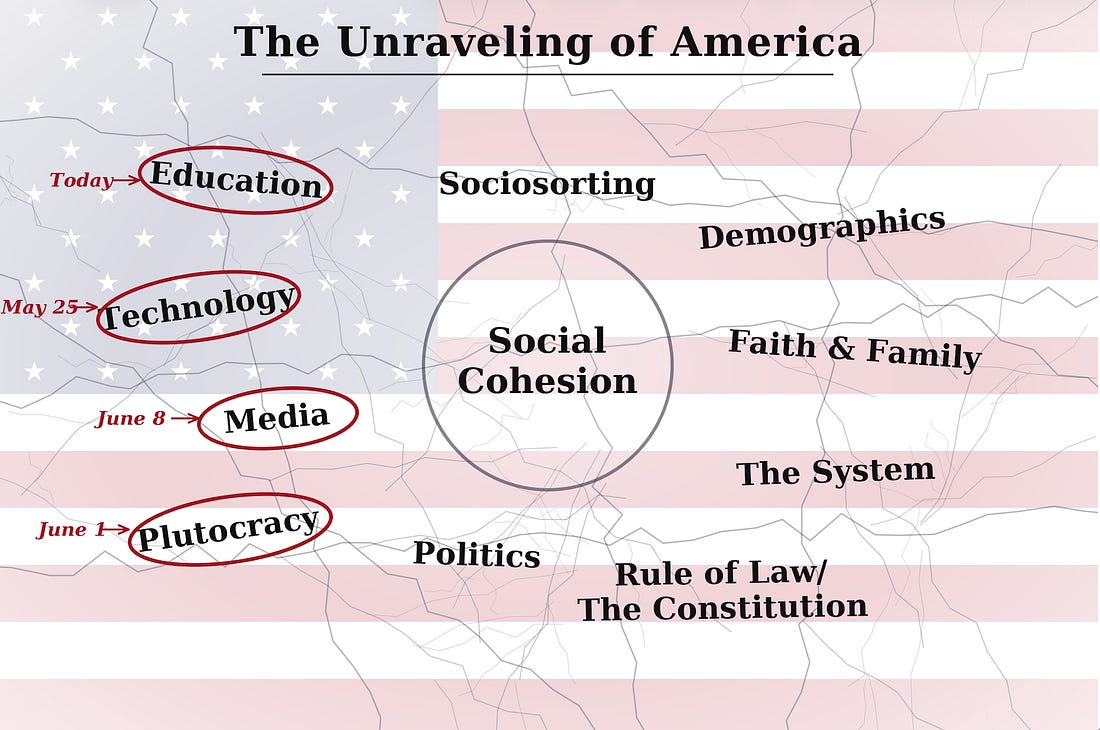
First, thanks for your feedback on my recent posts. My goal of late is to explore the various factors causing America to unravel. Toward a systems model of the forces undermining America’s democracy, moral compass, and social cohesion. Today, education.
For five decades, U.S. education policy has been driven by two goals: test scores and college. The No Child Left Behind Act in 2002. Then in 2010, Common Core. Obama’s rallying cry: “By 2020, the United States will once again lead the world in college completion.” Our all-consuming education focus. With massive collateral damage.
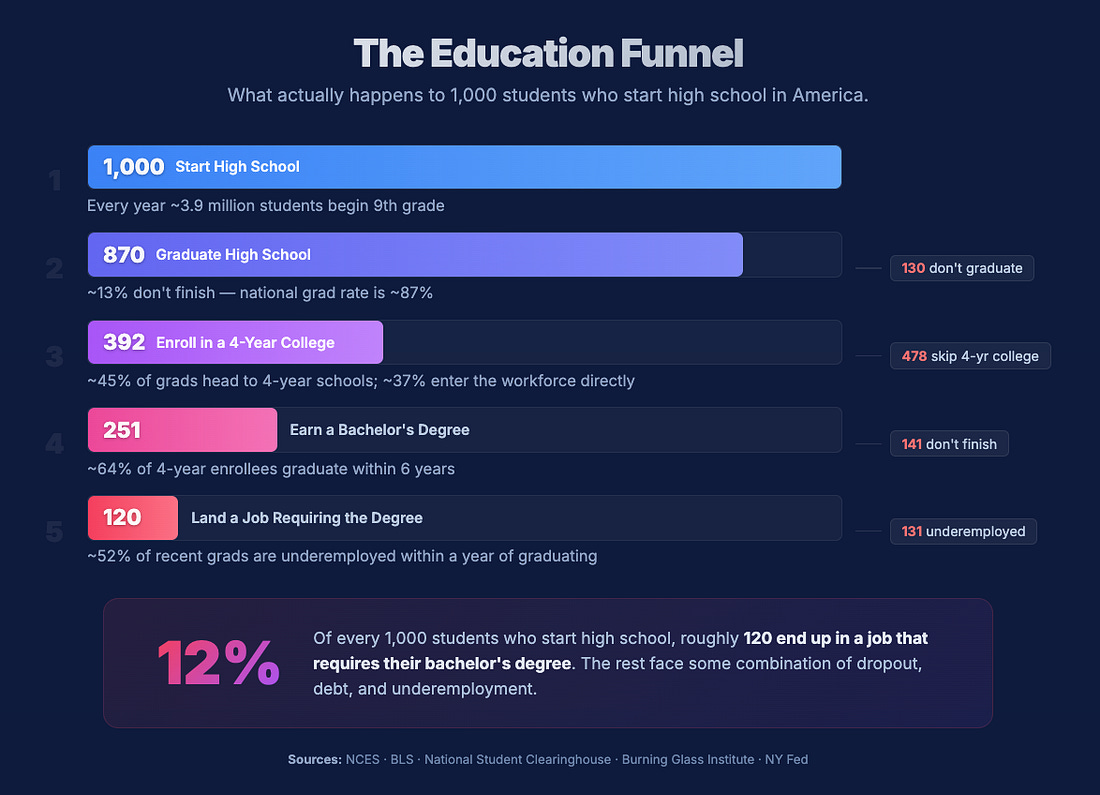
Let’s start with the funnel. While the college path works out well for some, most end up on the wrong side of education’s Bell Curve. Over half go directly to career, lacking a hirable skill and often with gutted self-esteem. Of those heading off to college, half don’t finish. Of those who graduate, half don’t get any kind of dream job. A system that’s produced some 43 million adults burdened by $1.8 trillion of student loan debt.
With a boost from Harvard-educated JFK, America grew to equate a prestigious college degree with human worth. This equivalence worked its way into news stories, movies, television shows, commercials . . . and labor markets. Prestige employers (that’s you, Goldman Sachs and McKinsey) made an elite college degree the essential hiring criterion. Less glamorous companies (that’s you, Sherwin-Williams) made a college degree mandatory for promotions. Rich families push their kids from the womb toward an Ivy+ degree. Poor families want the same for their kids. University research teams (that’s you, Georgetown) produce skewed studies touting a massive $1.2 million earnings lift for college grads. The Federal government opens the spigot for readily-obtained, impossible-to-shake student loans.
We’d like to think that America’s education system levels the playing field, but it does the opposite. The SCOTUS 1973 San Antonio Independent School District v. Rodriguez says it’s just fine for U.S. public schools to be largely funded by local property taxes. Rich kids are showered with resources’; poor kids show up to school hungry. Test scores point to an education ‘achievement gap’ that gets pinned on our teachers – not America’s staggering income inequality. The system’s winners feed elite colleges that educate more students from the richest 1% of families than from the bottom 50%. For more, read Paul Tough’s book The Inequality Machine.
With college placements as the measure of success, America’s K12 schools became college-ready test-prep institutions. Pit kids in dog-eat-dog competitions: class rank, SAT scores, AP scores, college placement. A barrage of state- and Federally-mandated multiple-choice exams that rank kids, teachers, schools, districts, and states. Clear marching orders for K12 schools – train kids to perform well on multiple-choice exams and get them off to some college.
To this day, America relies on two numbers to define the education quality of a school, district, state, nation, and human. Math and reading scores. That’s it. Don’t believe me? Just note what journalists write and what policymakers cite. We’ve pushed generations of young Americans to get those damn test scores up. No worries if we short-change career-based learning, civics, history, and art. No worries if we disenage kids and demoralize teachers. No worries if a relentless focus on rote learning crushes a child’s curiosity, creativity, joy, and agency. No worries if kids get the soul-sucking message that what matters in life is outcompeting others on pointless tasks. Education priorities that encapsulate the classic definition of insanity – doing the same thing over and over, expecting different results.
So many reforms, so little change
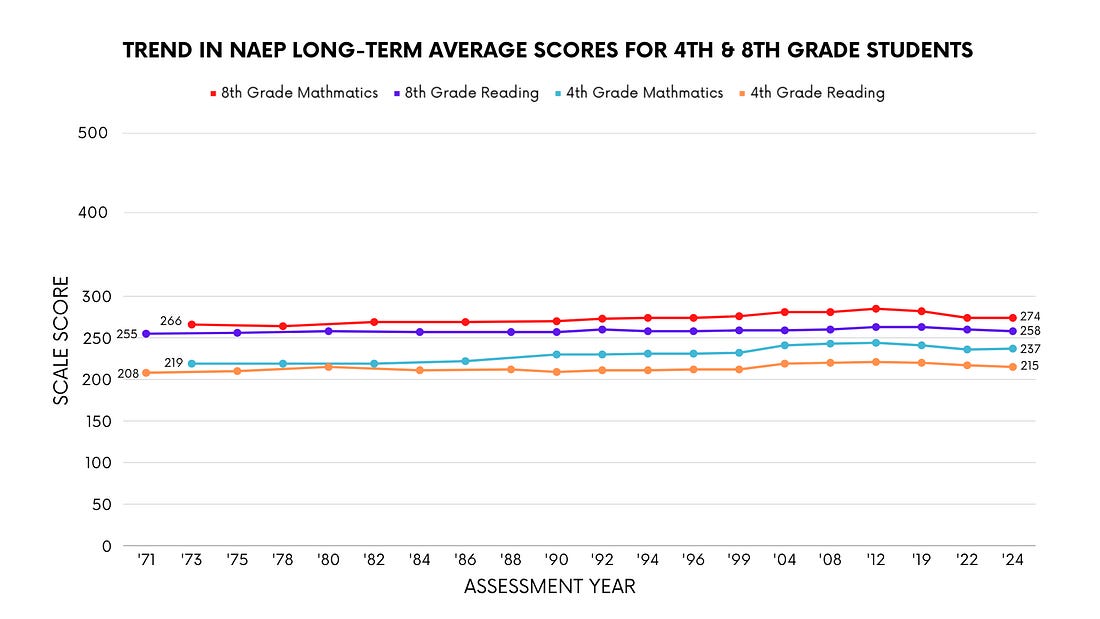
During their formative K12 years, America’s kids take more than 100 standardized exams. These cost-minimizing exams are expressly designed to be graded by a computer. And if a computer can grade a task, it can do that task. In every sense, we push kids to develop rote skills that machines handle flawlessly. Already, AI aces every assignment and exam required to graduate magna cum laude from Harvard. Reading exams call for regurgitating what’s put in front of you – perfect training for conspiracy-absorbing adults. Math exams are tied to esoteric micro-procedures (e.g., factoring polynomials) that adults never use. Yet we chase these scores, for decades, making no progress, ignoring Goodhart’s Law: “Any measure that becomes a target ceases to be a good measure.”
There you have it. America’s colossal education botch. Train kids to perform rote tasks. Crush out the essential human traits of curiosity, audacity, creativity, agency, and joy. Standardize what’s taught and tested to produce data that ranks and sorts — rather than helping each child develop their distinctive human potential. Most get a chronic ‘you lack proficiency’ message in a system that heaps advantage on the affluent. Botched priorities, paving the way to our current nightmare. A populace unable and unwilling to critically analyze the torrent of lies coming from the White House. A populace that holds its nose to vote for a convicted felon who rails on the ‘educated elite.’ A boiling cauldron of resentment, corruption, and anti-science vitriol. As to how this has worked out, read David Brooks’ fascinating How the Ivy League Broke America.
I don’t offer these views on education casually. For the past fifteen years, I’ve immersed myself in this world. I’ve visited hundreds of schools, and convened thousands of conversations, all across America. I celebrate the bright spots in my books (What School Could Be: Insights and Inspiration from Teachers Across America) and films (Most Likely to Succeed and Multiple Choice). But I’ve seen the failure. Failure caused by an obsolete system and failed accountability measures. Our classroom teachers are heroes. It’s not easy to fight the system, but many do. Give special thanks to the teachers in your life, who persevere despite being shortchanged on pay, respect, and trust. They endure in an entrenched system that has churned out generations of young adults ill-prepared for career, citizenship, and life. A system sowing the seeds for democracy’s collapse.
Three Bold Ideas
Career-Based Learning for All: My recent film Multiple Choice showcases a mainstream public school district that immerses all high-school kids in career-based learning across a range of skills (e.g., carpentry, welding, healthcare, cybersecurity, digital media, AI). Better for the career-bound and, a bit surprisingly, better for the college-bound. The key is making career-based learning essential for all kids, not just ‘those’ kids who don’t resonate with academic curriculum.
Finland: America can learn much from Finland. Their remarkable education progress resulted from a budget crisis that forced them to choose between data and educator excellence. They dumped all standardized tests and focused on developing outstanding classroom teachers – better training, more pay, loads of respect. Finnish kids spend comparatively little time on ‘school’; even high-schoolers have just six hours of class time and homework during the school week. Lots of time for play and exploration. A well-educated populace. For more, read Pasi Sahlberg’s Finnish Lessons.
Accountability: Base accountability on a child’s growing ability to create and carry out initiatives that help make their world better. Portfolios of purpose, not a checklist of counterproductive numbers. Check out New York’s Performance Standards Consortium or read Tony Wagner’s Mastery.
Bonus Idea: Long talked about, America would be well-served if every high school graduate engaged in public service — lifting up their community while developing important skills. Those going on to college bring maturity and real-world experience to years often wasted on beer pong. Those eschewing the college path are off and running with purpose and skills. Young Americans across all demographics in a melting pot that bridges our current demographic and political divides.
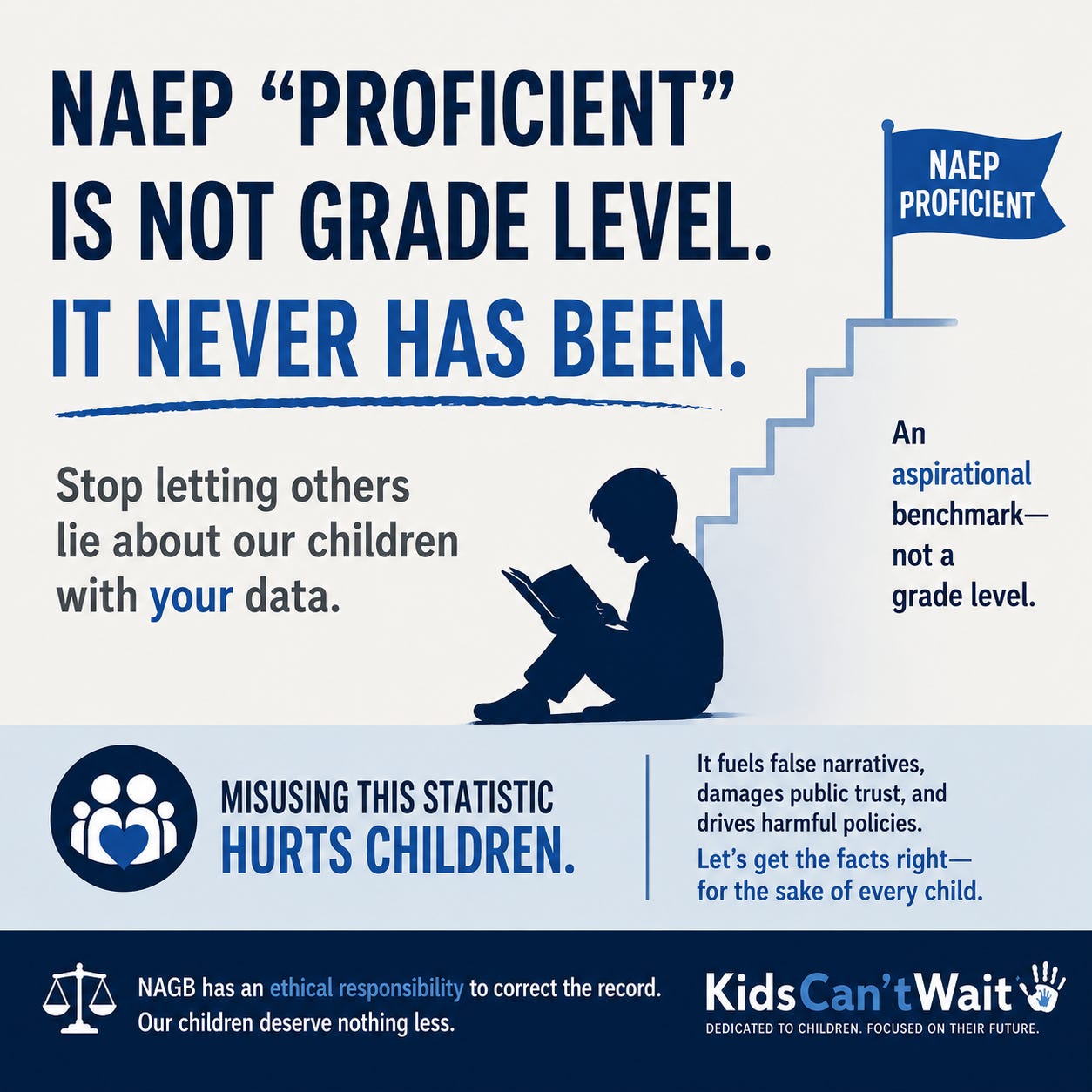
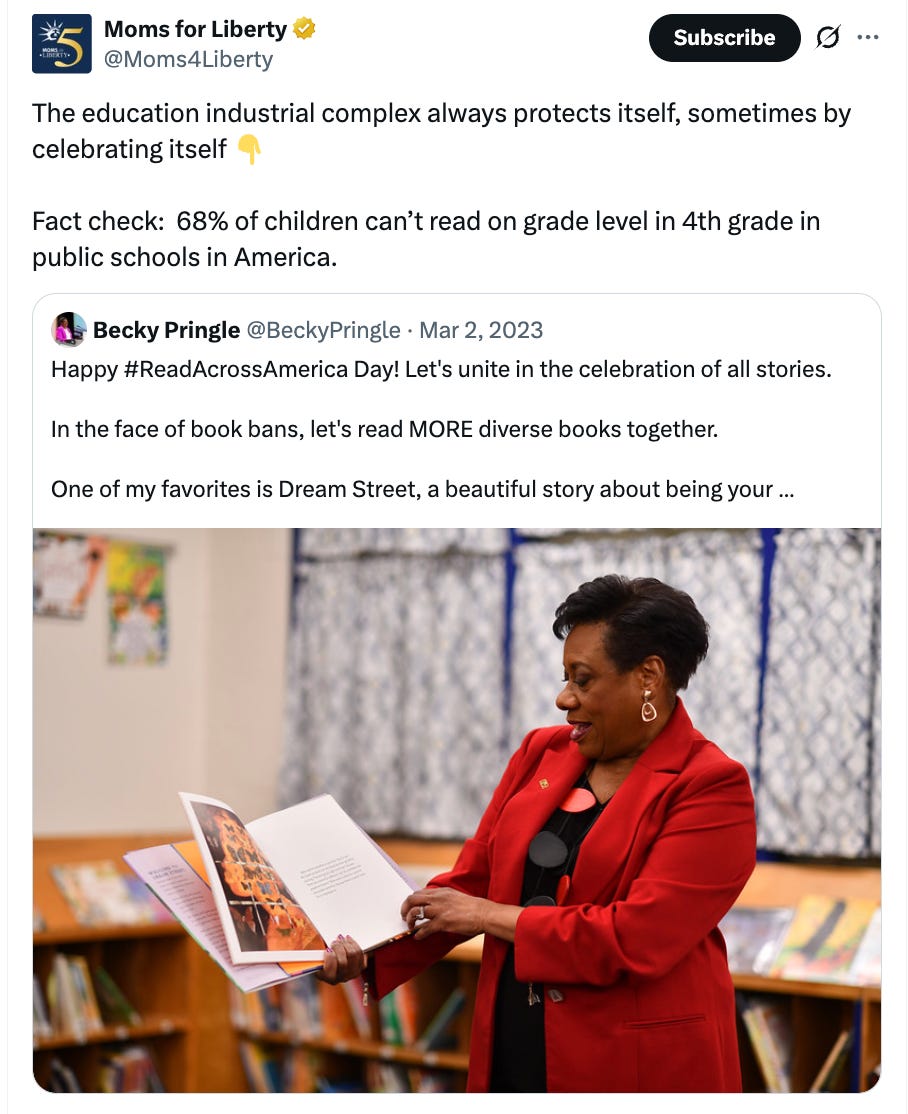
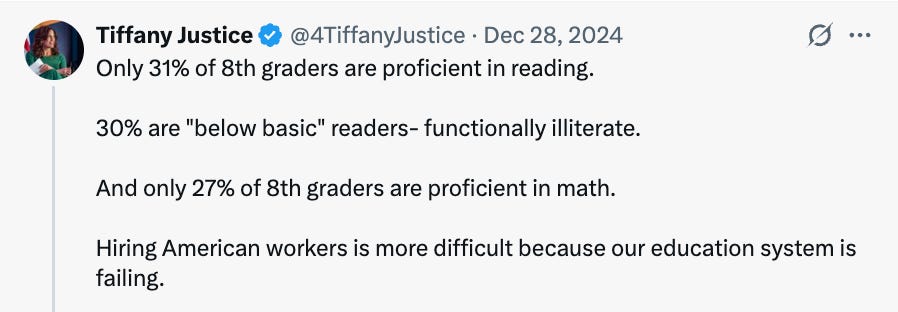
The biggest lie about American school kids is that most are “below grade level.” This lie is repeated so often by prominent figures that it is widely believed. But it’s not true. Those who believe it are wrong. Those who repeat it, knowing it’s not true, are liars.
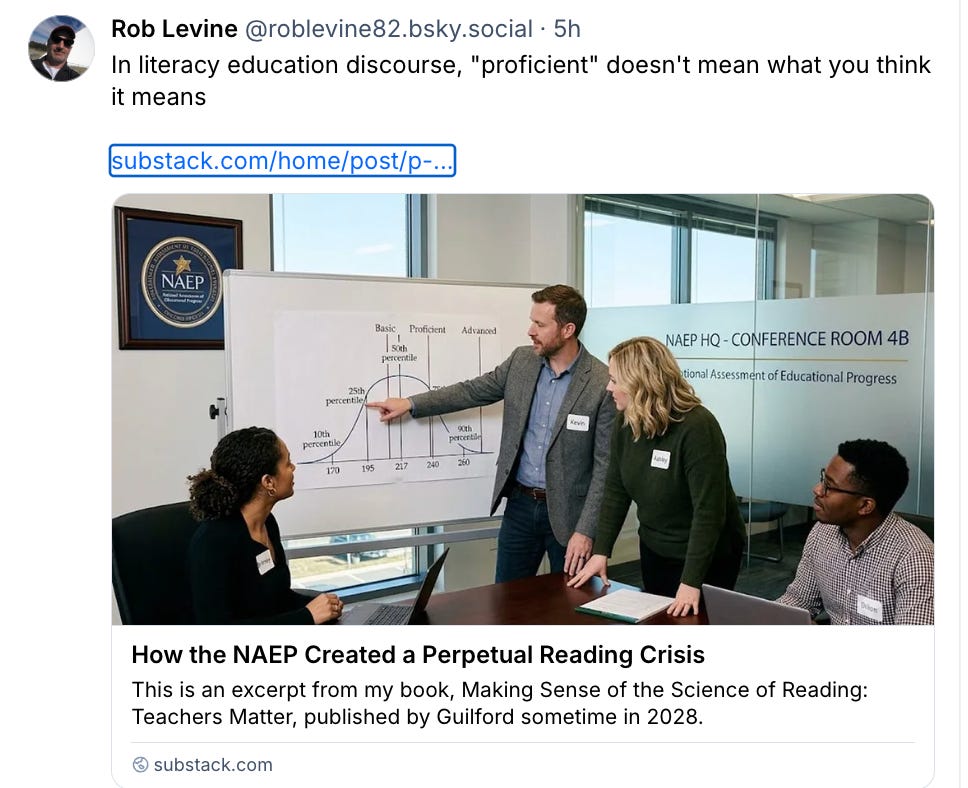
The source of the lie and the confusion is clear: the achievement levels in which NAEP scores are reported. The levels are “advanced,” “proficient,” “basic,” and “below basic.” When the media write about the latest release of NAEP scores, they frequently treat “proficient” as “grade level.”
But “proficient” is NOT “grade level.” It represents solid achievement, a rigorous aspirational goal. “Proficient” is equivalent to a solid A.
Every NAEP report on test scores says clearly in a footnote that “proficiency” is not the same as grade level. For example: “NAEP Proficient does not signify meeting grade-level expectations.” Yet the media and prominent commentators who should know better repeat the lie that most students are below grade level. The fact is that most students will never reach the high bar of “proficient.”
In 2023, as Bruce Lesley points out, Biden’s Secretary of Education–Miguel Cardona–testified to a Congressional committee that only one-third of American students were reading “at grade level.” I was flabbergasted. I couldn’t believe he said something so outrageous. I called Dr. Peggy Carr, who at that time was the Commissioner of Education Statistics. She was as surprised as I was that Secretary Cardona repeated the erroneous statistic. I asked Dr. Carr whether she had ever briefed him on understanding NAEP results; she had not.
I gave her an idea. Propose a change in name for “proficiency.” Change the name to “mastery.” No one would claim that “mastery” was the same as “grade level.” She liked the idea and promised to take it to the board. Whether she did, I don’t know. But nothing changed.
Bruce Lesley wrote this open letter to the National Assessment Governing Board, which oversees NAEP testing. Lesley is president of First Focus on Children and its partner organization First Focus Campaign for Children, bipartisan advocacy organizations dedicated to making children a priority in federal, state, and international policy. He has led both organizations since 2006 and 2009, respectively, building them into recognized national voices on child health, education, early childhood, economic security, budget and tax policy, immigration, children’s rights, and more recently, international child policy.
He wrote:
To the National Assessment Governing Board, the National Center for Education Statistics, and the leadership of the National Assessment of Educational Progress:
Every institution whose work affects children should begin with one question: “Is this good for children?”
By that standard, the National Assessment of Educational Progress (NAEP) has some important issues that deserve to be resolved. First and foremost, your achievement-level labels — “Basic,” “Proficient,” and “Advanced” — are being weaponized against the very children NAEP exists to serve, and you know it, because your own staff has been saying so for twenty-five years.
To be clear, this open letter is not a claim that NAEP’s underlying data is necessarily wrong, and it is not an argument against NAEP. The argument and request is narrower: you have a real and critically important ethical responsibility to correct the public misuse of your own data. NAEP should defend its credibility against those currently diminishing it.
This Week’s House Mark-Up Provides Another Example
On July 15, 2026, the House Education and Workforce Committee marked up a ten-bill package to facilitate the dismantling of the U.S. Department of Education.
In his opening statement, Chairman Tim Walberg (R-MI) argued that “too many children can’t read or do math at grade level,” and used that claim as a central justification for several of the bills. That claim is false.
Chairman Walberg was drawing on NAEP data — the statistic that roughly two-thirds of American fourth-graders do not score “Proficient” in reading, which is wrongly cited as evidence of failing to meet grade-level reading levels. For some, this is done out of confusion and, for others, to promote a political agenda to undermine public schools. In reality, NAEP proficient is aspirational and reflects a standard that is well above grade level.
Unfortunately, during the markup, multiple members of Congress repeated the same error. But again, NAEP Proficient is not grade level. It has never been grade level.
When the public, the press, the administration, and Congress repeatedly miscite this fact, the National Assessment Governing Board (NAGB) must do much more to clarify and correct misstatements about what it means.
The problem is two fold. One part of the problem is that “proficient” is used on many state and local assessments to mean “at grade level,” or what once upon a time would have been called a gentleman’s C; this leads to some honest confusion for some folks. The other part of the problem is folks who are invested in the narrative that public schools are failing and who benefit from the confusion surrounding the term.
Greene adds:
And every time NAEP scores are released, education journalists write piece after piece explaining “proficient” all over again, usually in the wake of some prominent person decrying the large number of students not “at grade level.”
That confusion is NAGB’s responsibility to address, and it has deserved attention for years, but all the more NOW.
This Is Not a Partisan Problem
Chairman Walberg and his colleagues’ misstatements are only the most recent officials to make this mistake (whether unintentionally out of confusion or internationally), and the pattern runs through both political parties.
Secretary Miguel Cardona, testifying before Congress in April 2023 under the Biden Administration, told lawmakers directly that only one-third of students were reading “on Grade level,” treating a NAEP proficiency figure as if it were a grade-level statistic, in nearly identical language.
And Secretary Linda McMahon, in the current Trump Administration, has used more careful wording — noting that nearly 70% of eighth graders are “not proficient” in reading — but has paired that technically accurate phrase with language implying total system failure. A Snopes piece by Rae Deng described this claim as lacking its own level of reading comprehension because, again, it completely mischaracterizes what NAEP’s “proficient” standard means.
Outside advocacy groups have been considerably less careful than any of them.
Corey DeAngelis, a leading advocate for school privatization, vouchers, and against public education, has cited NAEP proficiency figures directly, without qualification, as evidence that public schools are a system-wide “disgrace.”
Greene captures these types of political misuse of NAEP data in this Substack post.
This confusion is intentional by people arguing for both the dismantling of public education and federal investments in children.
Unfortunately, NAGB’s silence has allowed that rhetorical usefulness to go unchecked under Republican and Democratic administrations alike, and it is being used right now, this week, on Capitol Hill to justify eliminating the very agency that funds and safeguards the data NAGB produces.
NAGB’s Own Experts Have Been Saying This for Years
In 2001, Mary Lynne Bourque and Susan Loomis — a staff member and a board member of the National Assessment Governing Board itself — wrote plainly that the Proficient achievement level “does not refer to ‘at grade’ performance,” and that performance at Proficient is not the same as being “proficient” in a subject as any ordinary person would use that word.
Chester “Checker” Finn, Jr., who chaired the panel that adopted the achievement levels in 1992, has been candid that the levels were designed to be aspirational — a description of where students should ideally arrive, not a diagnosis of where most currently stand.
NCES itself has attached a caution to NAEP score reports for years: the Proficient level “does not represent grade level proficiency as determined by other assessment standards.”
If NAEP’s own architects and NAGB’s own website already say this, it is past time to be diligent in correcting the record when people misuse and misstate what it means. It is also on NAGB to stop publishing results in a format that predictably, foreseeably, and repeatedly gets misread as a verdict on grade-level performance, especially when you can see exactly how that misreading gets used again and again.
The clearest confirmation of all of this comes from NCES’s own data. Researchers Gina Cervetti and Kathleen Hinchman mapped every state’s definition of fourth-grade “grade-level” reading proficiency directly onto the NAEP scale and found that, as of the most recent analysis, nearly every state’s own standard for grade-level reading lines up with NAEP’s Basic level, not NAEP’s Proficient level. That means the honest translation of the data runs the opposite direction from how Chairman Walberg and others use it: by the states’ own definitions of grade level, roughly two-thirds of American fourth graders are reading at or above grade level, not below it.
Cervetti and Hinchman are also blunt about what actually is a crisis in the data: not a reading crisis, but an equity crisis. In 2022, only 48% of students eligible for free or reduced-price lunch scored at or above NAEP Basic, compared with 76% of students who were not eligible — a 28-point gap that has persisted, largely unchanged, for decades.
That is a story about generational wealth and unequal access to housing, healthcare, and school resources, not a story about failing classrooms, and NAEP’s own framing continues to let people tell the wrong story with your numbers.
What Education Writers and Researchers Have Been Saying
Diane Ravitch, who served seven years on the National Assessment Governing Board under President Clinton, has called out the confusion between NAEP Proficient and grade level as one of the most damaging and persistent falsehoods in American education discourse, noting that NAEP itself explicitly warns against the equivalence you continue to permit others to make.
Greene has argued that cut scores like “Proficient” function as scaled, curved judgments dressed up as fixed standards — noting that if every child scored above a cut, the establishment reaction would be to declare the cut too easy, not to celebrate the achievement. That is not how a genuine, fixed criterion is supposed to behave, and it is worth NAGB’s honest reckoning.
Mark Weber, a New Jersey teacher and education researcher, has done careful public work mapping state proficiency standards onto the NAEP scale, and his conclusion undercuts a favorite talking point of your critics-turned-allies in this fight: there is no empirical evidence that closing the so-called “honesty gap” between state and NAEP proficiency rates does anything to improve student achievement. If setting state cut scores to match yours were actually the lever for better outcomes, we would expect to see it in the data. We do not. That matters because it means the standard is being imported into state accountability systems on faith, not evidence — exactly the kind of unsupported claim NAGB should be correcting rather than allowing to spread.
The Brookings Institution’s Brown Center on Education Policy has been making this same case for nearly two decades. Tom Loveless, the Brown Center’s longtime director, authored a 2007 report concluding bluntly that NAEP’s cut scores were set too high.
His 2016 Brookings piece, “The NAEP Proficiency Myth,” went further, noting that the achievement levels came under critical review from the U.S. Government Accountability Office, the National Academy of Sciences, and the National Academy of Education shortly after they were adopted — with the National Academy of Sciences review concluding the achievement levels were fundamentally flawed.
Loveless adds:
Advocates of the NAEP proficient standard want it to be for all students. That is ridiculous. Another way to think about it: proficient for today’s eighth graders reflects approximately what the average twelfth grader knew in mathematics in 1990. Someday the average eighth grader may be able to do that level of mathematics. But it won’t be soon, and it won’t be every student.
That is not a stray outside critique. That is respectable experts in the field, writing for decades, about the very categories NASB is still using today without correction.
One Point Should Not Separate “Failing” from “Successful”
NAGB also owes the public an honest accounting of what a cut score actually is. A cut score is a single point on a continuous scale, chosen somewhat arbitrarily by a panel, above which a child is declared “Proficient” and below which the same child, one point lower, is declared “Basic,” which is actually grade level.
Two children who are functionally indistinguishable in what they know and can do are sorted into entirely different public categories — one used as evidence that a school, a state, or a federal agency is failing, the other treated as evidence of success — because of a single point set by a committee, not because of any meaningful difference in the children themselves.
That is not a rounding error. It is the mechanism by which your data gets converted into political ammunition.
If NAGB cannot explain, in terms parents can understand, why the child who scores one point below the line is a different kind of learner than the child one point above it, then the line is doing rhetorical work the data was never built to support.
As the psychiatrist and educator William Glasser warned schools decades ago, chasing a point or two of movement on a test score is precisely the wrong institutional goal — and yet that is the goal NAEP’s cut scores hand every state, district, and school in the country by default.
Researcher Andrew Ho makes a similar point. He has identified proficiency cut scores as arbitrary markers, set through what he calls an “overwrought, judgmental, and ultimately political process,” not derived from any fixed line in human learning.
Ho has also documented a specific illusion that follows from that arbitrariness: because a large cluster of students always sits near the middle of the score distribution, a cut score placed close to that cluster will make small, ordinary shifts in performance look like dramatic gains or losses, purely as an artifact of how many students happen to sit right at the line — not because anything real changed in how much they learned. A researcher with no stake in the politics of this issue is describing the identical mechanism that turns your data into a rhetorical weapon: the closer the line sits to where children actually cluster, the more your data will appear to swing wildly for reasons that have nothing to do with children’s learning.
Criterion-Referenced in Name, Arbitrary in Practice
NAEP describes itself as a criterion-referenced assessment, distinct from norm-referenced tests like the SAT that simply rank students against one another. That distinction matters, and I want to represent it accurately rather than overstate it — NAEP does not “grade on a curve” in the way the SAT’s percentile scoring does.
However, the practical effect on families is not so different as the label suggests. NAEP’s cut scores were set by hand-picked panels making judgment calls about what students “should” know, not derived from an external, agreed-upon standard of competence, and independent evaluators — including a National Academies review in 2017 — have called for stronger evidence connecting NAEP performance levels to any real-world outcome at all.
A test that is criterion-referenced in name but whose criteria were set arbitrarily, and whose results still track family income and race as tightly as any norm-referenced test on the market, produces the same practical harm as the norming bias critics have long raised: it tells us more about a child’s zip code than about a fixed, meaningful standard of what that child knows.
Notably, NAGB has conceded the point this year. The 2026 NAEP reading framework — administered to students for the first time this spring — now explicitly disaggregates racial and ethnic subgroup results by socioeconomic status, on the premise, well documented for decades, that apparent racial differences in test scores largely track socioeconomic differences. That is a welcome and overdue acknowledgment.
But it is also, in effect, NAGB admitting in 2026 what critics have argued for years: that the results have been measuring wealth and family circumstance as much as they measure “proficiency,” all along. If that acknowledgment is real, it should extend backward, to how NAGB talks about every score ever published, not just forward, to a single new breakdown in the data tables.
The Test Itself Is Not Neutral
Even setting the cut scores aside, the content of the test carries its own bias, and NAEP’s own commissioned reviewers have said so. The NAEP Validity Studies Panel — a technical review body NCES itself created and funds — published an analysis by Gerunda Hughes in 2023 documenting that the statistical methods used to build NAEP-style test items can systematically disadvantage the very students the test is supposed to serve fairly.
When an item is answered correctly by nearly every student, it gets treated as a poor “discriminator” between high and low performers and is typically cut from the test in favor of harder items, even though that easy item may represent exactly the content that should be mastered.
In his book, Au cites researchers Kidder and Rosner, who examined more than 300,000 SAT test-takers and the pool of trial questions used to build future exams and found that some trial questions were answered correctly by Black students, or by Latino students, more often than by White students. Those questions were then discarded — not because they were poor measures of the content, but because they failed to reproduce the racial score gap the rest of the test already produced. A question only “counted” as valid if high-scoring test-takers, who are disproportionately White, tended to get it right in pretesting.
My mother has verified the same process when she was asked to be on a panel to evaluate whether the item questions were “fair”. The publishers of the Texas State assessment at the time ran through the questions and kept throwing out questions as biased toward Black or Hispanic children if they scored the same or close to the scores of White children.
In contrast, questions in which there was a substantial gap in favor of White students were not flagged – thus, “norming” the disparity in test score outcomes into subsequent tests. Although my mother repeatedly objected, she was overruled throughout the day and, not surprisingly, never asked back to be a reviewer.
The result, as Au describes it, is a self-reinforcing loop: item selection is calibrated to match existing racial score gaps, which locks those same gaps into every future version of the test, all without anyone ever explicitly considering race in the selection criteria.
NAEP is a different test administered by a different organization, and I am not asserting that NAEP’s item-selection process has been documented to work in the same way. But NAEP uses the same category of item statistics that made this outcome possible on the SAT, and NAGB’s own validity panel has already flagged the risk. Given what is now documented on a test as consequential as the SAT, NAGB owes the public a direct, public answer to a direct question: has anyone checked whether NAEP’s item-selection process does the same thing?
There is also cultural and geographic bias. As the son of an English teacher and a math teacher, it should be no surprise that I did fairly well on standardized tests throughout my life. But I vividly recall a reading passage from the PSAT that focused on nautical issues and the definition of a “flotilla.”
Having grown up in El Paso, Texas, a city located hundreds of miles from any coastline, the passage and vocabulary word were unfamiliar to any of us taking the test in the desert borderlands. On the other hand, we would crush a passage referring to “tortillas.” NAEP’s own reviewers have a name for this: cultural validity, the idea that a test cannot cleanly separate what a child knows from what a child has been exposed to.
Research that NAEP’s own validity panel cites has found that when students are allowed to choose among reading passages on different topics, rather than being assigned a single passage that may be unfamiliar or uninteresting to them, some groups of students — including Black eighth graders and Hispanic twelfth graders in the panel’s own cited study — score much higher. That is evidence that some of what NAEP currently measures is exposure and familiarity, not just reading ability, and it argues for reform in how passages and vocabulary are chosen, not just in how results are labeled.
Again, the validity panel’s report contains proof that this is a design choice, not a fact of nature. In 1972, the psychologist Robert Williams built a test called the Black Intelligence Test of Cultural Hegemony, using vocabulary and content drawn from Black American culture instead of the dominant culture’s frame of reference. When Black and White teenagers took it, Black students substantially outscored White students by substantial margins.
Nothing about the underlying children changed between that test and the SAT. What changed was whose knowledge and cultural fluency the test happened to be built around.
That single fact should end, permanently, any claim that a test’s outcomes reveal some fixed truth about which children “can” or “cannot” read, think, or reason. What these tests reliably measure is often which cultural and economic frame of reference a child was raised in, and how well that frame matches the one test-makers chose to build around — which is another way of describing accumulated wealth, school funding, and generational inequity, not a verdict on a child’s mind.
That is real, and policies that address school finance inequity, child poverty, childhood hunger, and adverse childhood experiences (ACEs) deserve real policy attention. These issues would undoubtedly do more to improve educational outcomes in this country rather than privatization of public schools or the elimination of the Department of Education.
Claims that two-thirds of American children cannot read at grade level are simply false, and their interpretation by policymakers and advocates is harming children. There is an old warning that was popularized by author Mark Twain but attributable to British Prime Minister Benjamin Disraeli about three kinds of falsehood — “lies, damned lies, and statistics.”
In this case, even a true number, presented without its context, can mislead more effectively than an outright fabrication. NAEP’s “proficiency” level is an aspirational one, but the grade-level story built on top of it is doing real harm. NAGB is a position to explain the difference, and the public is not, until you tell them.
The Damage Is Not Abstract: What Gets Tested Is What Gets Taught
This is not a technical quibble.
Every time “below Proficient” gets reported to the public as “can’t read” or “can’t do math,” it becomes ammunition for defunding public schools and for portraying millions of children — disproportionately low-income children and children of color — as failures because of a label your board itself has said should not be read that way.
It also reshapes what happens inside the classroom. When reading and math scores on tests built around NAEP cut points become the metric by which schools, teachers, and even state superintendents are judged, instructional time follows the incentive:
Short, decontextualized passages crowd out real books — my children were taught how to write a brief constructive response (BCR) before they were even taught what a paragraph was.
Science, government, history, the arts, and physical education are pushed to the margins of the elementary school day because they are not tested and therefore not rewarded.
Children end up narrower, not better educated, in the very subjects that make them informed citizens — and NAEP’s own cut-score architecture is a direct contributor to that narrowing, whether or not that was your intent.
NAGB tried a partial fix in 2018, adding the word “NAEP” before each level — “NAEP Proficient” rather than “Proficient” — so people would stop equating your terms with generic ones.
James Harvey, executive director of the National Superintendents Roundtable, was right to call that gesture insufficient at the time. Harvey said:
…the American people should understand that the misleading term “proficient” sets a performance benchmark beyond the reach of most students in the world.
Harvey argued “proficient” should be changed to something like “high” to avoid being “fooled.”
His point has been proven many times, including this week when a sitting congressional committee chairman, citing NAEP-adjacent data to justify eliminating a federal agency, still used the word “grade level” as if it meant what NAEP’s Proficient level does not mean.
The Perverse Incentive NAEP Has Inspired: Grade Retention As Score Manipulation
The clearest evidence that NAEP’s cut scores create perverse incentives and “manufactured” crises, rather than honest information, is what states have started doing in response to them: holding back third-graders who miss an early-literacy cut score, in order to produce a fourth-grade NAEP cohort that looks better on paper.
Education professor and researcher Paul Thomas has documented this closely in states such as Mississippi, where fourth-grade reading gains celebrated as a “Mississippi miracle” tracked closely with a mandatory third-grade retention policy.
A child who is nine years old competing against classmates who are eight will predictably score higher on a test built around the same content; that is a fact about test administration, not about literacy. Furthermore, those same “gains” have been shown to fade by eighth grade, once the retained cohort catches up in age to its peers without having genuinely caught up in learning.
This is worth NAGB’s own honest reckoning, not because the research on retention is unanimous — reasonable analysts, including some closely tied to NAEP’s own governing board, dispute how much of Mississippi’s gain is genuine instructional improvement versus retention’s effect on cohort composition — but because NAEP’s achievement levels are the mechanism creating the incentive either way.
States are not retaining eight-year-olds because it is good for those children. They are retaining them because a single cut score on a single test has been elevated to a measure of whether a state’s education policy is working. The cost of that incentive falls on children: retained students who show a short-term score bump can, over time, experience the opposite of what was intended — greater disengagement, higher rates of dropping out before graduation, and the well-documented psychological toll of being told, at eight or nine years old, that they failed.
William Glasser spent much of his career, in Schools Without Failure, and later in The Quality School, explaining exactly why this backfires. He argued that standardized testing reduces learning to disconnected, memorized facts at the expense of critical thinking and real application — and that the “right answer, wrong answer” format of a multiple-choice test teaches children that education is a hunt for a single predetermined answer rather than a process of genuine understanding.
In the schools Glasser held up as models, closed-book tests were replaced with open-book, collaborative assessments that actually resembled the problems students would face outside school. His deeper claim, grounded in what he called Choice Theory, is that people — including children — are driven by needs for freedom, power, and simple enjoyment in their work, and that using test scores to rank, shame, or coerce students destroys the very motivation that produces quality work in the first place.
Labels matter. When children repeatedly hear that two-thirds of them “cannot read at grade level,” many internalize failure that is not supported by the evidence. Parents lose confidence in neighborhood schools. Teachers become demoralized. Policymakers propose increasingly radical structural changes to fix a crisis that has been inaccurately described.
Glasser also warned explicitly against making small, arbitrary numerical gains — his example was raising a test score by a point or two — the primary institutional goal of a school, insisting instead on building a genuine culture of quality. That is precisely the trap a single-point NAEP cut score sets for states, and it is the trap third-grade retention policies walk students directly into.
That is the opposite of what an assessment meant to serve children should produce, and it deserves your acknowledgment, not your silence.
What We Are Asking You To Do, Now
Issue a direct, public correction each time a federal official misstates NAEP Proficient as “grade level,” the way you would correct any other material misuse of your data. Silence is not neutrality; it is acquiescence in the misuse.
Publish, prominently and alongside every score release, the state-by-state mapping showing that “grade level” as states themselves define it corresponds to NAEP Basic, not NAEP Proficient — the analysis your own data already supports and that outside researchers have had to do on your behalf.
Publish a plain-language document — “What NAEP Proficient Does, and Does Not, Mean” — and require it alongside every score release, every webpage, every press briefing, and every congressional testimony that cites NAEP data. Most of this letter’s argument could be prevented by a single page NAGB.
Stop using “Basic,” “Proficient,” and “Advanced” as headline labels without their NAEP qualifier in every release, chart, and public statement — not as a footnote, but as a mandatory part of the label itself, displayed with the same prominence as the number.
Retire “Basic,” “Proficient,” and “Advanced” altogether in favor of terms that do not already carry a plain-English meaning your data does not support. If the words themselves are the problem, changing a modifier in front of them has not been enough.
Extend the honesty of the 2026 reading framework’s socioeconomic disaggregation backward, not just forward. If you now accept that racial gaps in your data are substantially explained by family socioeconomic status, say so plainly every time a racial achievement gap is reported, and stop letting that gap be cited as evidence of school failure without that context.
Commission and publish the external validity evidence the National Academies asked for in 2017 — a transparent accounting of what your cut scores do and do not predict, so the public can evaluate the standard rather than take your word for its meaning.
Publicly acknowledge the perverse incentive your cut scores have created for third-grade retention policies, and commission independent, longitudinal research — tracking students well past eighth grade, through high school graduation — before any state is permitted to point to NAEP gains as proof that retaining eight-year-olds is good policy.
Act on your own validity panel’s 2023 findings, and answer the question the SAT evidence now raises. Publicly disclose whether NAEP’s item-selection process has ever been audited for the same self-reinforcing bias documented on the SAT — where trial questions that marginalized students answered correctly were discarded for failing to reproduce the existing score gap — and commit to an independent audit if it has not. Explain how tests are “normed” from one year to the next and made comparable in a manner that is understandable to the public.
Kids can’t wait for another year of this same correction being offered and ignored, or for another cohort of eight-year-olds to be held back so a state’s chart can look better. NAGB has the power to end the confusion your own board identified more than two decades ago. Please do so. Kids deserve it.
The assumption behind these questions is test scores are precise indicators of reading ability, like scientific laboratory measurements. But like blood pressure levels — in which there is agreement about what’s being measured — they are variable and open to interpretation.
Despite the subjectivity and lack of agreement in defining reading, grade level and ability, grade-level reading ability is often mistakenly viewed as determined by a precise, stable test score, one that does not take into account factors such as students’ health and hunger in their testing performance. Not everyone agrees on what is salient at a particular grade level, leading to subjectivity in weighting phonics knowledge, vocabulary, comprehension, the ability to synthesize a theme and recognize an author’s point of view in a given passage, or some combination of such things.
Standardized tests are typically the basis for establishing grade level. But test scores themselves don’t indicate grade level, which is a creation of an interpreter. That’s why different tests don’t always produce the same grade level. A student who tests at fourth grade in one state may test at the third or fifth grade when moving to another state using a different test. In short, different tests or standards can produce different grade levels.
David Reinking is a retired professor at Clemson and the University of Georgia. He is an inductee in the Reading Hall of Fame, and a former co-editor of Reading Research Quarterly and Journal of Literacy Research. (Courtesy)
The National Assessment of Educational Progress calls itself “the nation’s report card” even to the point of using the phrase on its website and then having it repeated as if it is an established fact. It is often invoked in commentaries on grade levels. But it wasn’t designed for that purpose. NAEP itself states that “NAEP Proficient achievement level does not represent grade level proficiency as determined by other assessment standards (e.g., state or district assessments). NAEP achievement levels are to be used on a trial basis and should be interpreted and used with caution.”
But that hasn’t stopped many policy makers and journalists from trying to connect a NAEP test score to a grade level. Giving in to political pressure and rejecting recommendations from authorities in developing tests, in 1990 NAEP officials did introduce four tiers of reading achievement: Below Basic, Basic, Proficient and Advanced. These levels were established solely using subjective judgment about what’s expected of children tested at a specific grade level.
Peter Smagorinsky is a retired professor at UGA, an inductee in the Reading Hall of Fame, and a former co-editor of Research in the Teaching of English. (Courtesy)
Then, they set equally subjective cut scores to establish boundaries between these four levels. States often use a parallel model for their own tests. In Virginia, student performance is measured on a 0–600 scale, with proficiency set at 400-499 and advanced at 500 or above. It’s hard to imagine that a meaningful difference exists between a student scoring 499 (proficient) and 500 (advanced).
Much confusion is also centered in interpreting whether “basic” is acceptably normal or if it is reasonable to expect all students to be “proficient.” Many commentators, some of whom have a vested interest in arguing that there is a reading crisis, argue the latter. Some have promoted the false idea that “proficient” is grade-level reading, which it absolutely is not. Then, they wrongly argue that two-thirds of American students are reading below grade level by counting “basic” scores as below grade level.
A number of educators have debunked the conclusions of NAEP misinterpreters. Yet, the dogged belief persists that everything can be reduced to subjective interpretations of test scores divided into hierarchical categories that can be falsely, if conveniently, converted to grade levels.
We are concerned whenever we encounter all-too-common misinformation about grade-level reading ability. When misinformation becomes disinformation offered by those who use grade-level reading ability to advance political, polemical or ideological agendas, we become concerned about how faith in test scores lends them to manipulation and deception to help create the crisis that critics have historically claimed is engulfing schools, only to be saved by their favorite solutions.
David Reinking is a retired professor at Clemson and the University of Georgia, an inductee in the Reading Hall of Fame, and a former co-editor of Reading Research Quarterly and Journal of Literacy Research. Peter Smagorinsky is a retired professor at UGA, an inductee in the Reading Hall of Fame, and a former co-editor of Research in the Teaching of English.
Mike DeGuire, retired Denver educator, warned Coloradans that the usual billionaires are lining up behind Mike Bennett for the Democratic nomination for Governor. Bennett is currently a Senator but previously was Superintendent of Schools in Denver, where he promoted the NCLB agenda of test-and-punish, charters schools, and corporate reform. He never was an educator so he swallowed corporate reform hook, line, and sinker.
Colorado’s Democratic primary for governor between Attorney General Phil Weiser and U.S. Sen. Michael Bennet is heating up. TV ads are everywhere, and social media is abuzz with supporters extolling their favorite candidate’s strengths or the opponent’s weaknesses. Colorado has elected only one Republican governor in 50 years, so many pundits believe whoever wins the Democratic primary will likely win the November election.
Money is becoming a big factor in this campaign. Bennet has a distinct advantage thus far, primarily due to one group of funders: billionaires. More than half of Bennet’s super PAC donations are from billionaires, individuals and groups affiliated with organizations run by billionaires, and from a “dark money” group. Research shows that billionaires “are swaying elections all across America.”
As of the May 18 filing deadline, Bennet had over $11.5 million in total donations compared to Weiser’s $7 million. Over $7 million of Bennet’s money is from his super PAC, Rocky Mountain Way, which includes over $1 million from an independent expenditure dark money organization called Brighter Future for Colorado. Weiser has $1.1 million from his super PAC, Fighting for Colorado, and just over $6 million from individual donations.
Michael Bloomberg is the 18th richest man in the world with a net worth of over $109 billion, and he is the largest individual donor to Bennet’s super PAC, giving $2.5 million thus far. But he is not the only billionaire donor in Bennet’s camp. These billionaires also contributed to Bennet’s super PAC: Steve Mandel and his wife ($175,000,); Tench Coxe and his wife ($100,000); Edythe Broad ($3,000); Marc Heising ($75,000); Eric Mindich ($25,000); Deborah Simon ($25,000); and Robert Fanch ($25,938).
In addition to the billionaires’ money, over a dozen hedge fund managers and venture capitalists contributed between $10,000 and $100,000 each to Bennet’s super PAC. The ultra-wealthy use their donations to gain loyalty from candidates who will enact policies that align with their values and protect their wealth through tax breaks, financial incentives and limited regulations on their corporations. They also use nonprofit foundations to fund organizations they support philosophically.
Tax filings published by ProPublica for the years 2022-24 show that billionaires Reed Hastings and John Arnold used their nonprofit, City Fund, to give money to Denver Families for Public Schools, which contributed $45,000 to Bennet. The former CEO of City Fund, Neerav Kingsland, donated $2,000. The Bloomberg Family Foundation donated millions to the Charter School Growth Fund. That nonprofit also funds the Colorado League of Charter Schools which, along with 50Can and Stand for Children, gave $470,000 to Bennet’s super PAC. Bloomberg’s dark money group, the American Opportunity Action, gave $45,000. The total investment from Bloomberg and other billionaire-funded nonprofits surpasses $3 million.
Bloomberg’s support for Bennet’s candidacy reflects a relationship and shared philosophy on education reform that stretches back nearly two decades. Before Bennet entered the U.S. Senate, he served as Denver’ school superintendent from 2005 to 2009, the same time that Bloomberg was serving as New York mayor, where he had control of the city’s schools. Like Bennet, Bloomberg promoted corporate education reforms, oversaw the expansion of charter schools, test-based accountability systems, and market-oriented policies.
Both Bennet and Bloomberg ran for president in 2020. Bloomberg spent over $37 million of his own money on his unsuccessful campaign. Bennet received money for his candidacy from over 32 billionaires who were hedging their bets on who would eventually win the party’s nomination. Several billionaires supporting Bennet for president included some of the richest people in Colorado: the Ergen family, Pat Stryker and Ken Tuchman.
While Bloomberg often wins when he donates money to candidates, there are exceptions. Last year, Bloomberg joined with 26 other billionaires to support former Gov. Andrew Cuomo in the New York mayoral race, donating $13 million to his campaign. New Yorkers resoundingly said no to the billionaire money and elected Zohran Mamdani.
The money involved so far in this year’s gubernatorial Democratic primary pales in comparison to the $34 million spent in the last contested Colorado Democratic primary, in 2018.Many observers believe that Gov. Jared Polis basically bought the governor’s seat by contributingmore than $22 million of his own money to defeat three other candidates. Bloomberg was also involved in the 2018 gubernatorial race, donating $2 million to Mike Johnston who came in third to Polis. Five years later, Bloomberg helped Johnston win his 2023 race for Denver mayor when he and another billionaire, Reid Hoffman, donated nearly $2 million to Johnston’s election.
Ballots drop June 8 for the June 30 Democratic primary. Will the independent and Democratic voters buck the trend of billionaires swaying elections and elect Weiser, or will this billionaire investment pay off for Bennet?
More than 600 faculty in STEM fields at the University of California signed a letter asking for the restoration of the SAT or ACT for students who want to major in STEM fields, according to the Chronicle of Higher Education. They complained that too many students enroll in STEM classes without adequate preparation.
Absent a test requirement, the faculty said, too many severely unprepared students were choosing STEM majors, where they were certain to fail.
It calls on university leaders to reinstate the requirement that applicants for STEM-intensive majors submit SAT or ACT math scores. In 2020, under legal pressure and equity concerns, the system eliminated that requirement and urged public colleges to start accepting more students from impoverished high schools. Critics said the testing requirement unfairly favored privileged students and wasn’t the best predictor of college success.
“The SAT/ACT mathematics requirement is not an obstacle to equity; rather, it is a prerequisite for it,” the letter, which was distributed by faculty members in the math department at the University of California at Berkeley but signed by faculty members systemwide, said.
“Failing to measure preparation gaps does not remove barriers; it moves them into the classroom, where they become harder to overcome. An admissions process that ignores foundational readiness does a disservice to the most vulnerable students.”
Without standardized-test results or other reliable readiness measures, it’s hard to know which students are actually prepared for STEM majors, the letter says.
For those of us who have criticized standardized tests, based on their inherent flaws and their current overuse, this is a reminder that these instruments are valuable for some purposes. In highly competitive fields, like the STEM subjects, it makes no sense to admit college students whose skills are inadequate to the challenge. College professors should not be expected to teach midddle-school math.
Those colleges that choose an open-admission policy are free to do so.
But where the field of study requires a certain level of preparation, students should demonstrate that they are ready and prepared as a condition of admission.
Universities that don’t like standardized tests could offer their own test.
Which brings us back to the opening of the 20th century, when a large number of colleges created the College Entry Examination Board to devise a common test that would demonstrate whether or not students were ready for college.
The Board administered a test each year that assessed students’ knowledge and ability in courses. The “college boards,” as they were known, required full answers to thoughtful questions. They were not standardized and machine-scored. Students were told in advance which works of literature would be assessed and read them to be prepared.
The “college boards” were read and scored by college and high school faculty.
The hand-written exams were replaced by the standardized exams in 1941, on Pearl Harbor day. The leaders of the CEEB sacrificed the old style exams with the onset of the war. It was a move they had wanted to make, to save money and time.
Ever since, we have struggled with the reality that some kind of test was necessary to demonstrate college readiness, alongside the awareness that the standardized tests are biased in favor of students with higher family incomes. They are also biased in favor of students who attended good schools with experienced teachers, advanced classes, and ample resources.