Kimberly Guilfoyle, ex-fiancée of Donald Trump Jr., current Ambassador to Greece, is embroiled in a scandal. She allegedly pleaded with a Trump donor to pay her American Express bill of $100,000. Not a good move for a federal employee, especially since she was allegedly offering to get favors for him.
Kimberly Guilfoyle, the U.S. ambassador to Greece, pleaded with a Republican donor to send her $100,000 to pay off credit card debt, The Wall Street Journalreported on Wednesday.
The request came as Guilfoyle, the ex-fiancée of Donald Trump Jr., was gearing up for her Senate confirmation hearing last year.
“It won’t show up anywhere if you wire money to American Express,” she wrote on Signal to Eric Deters, a donor to President Donald Trump. “Please.”
The Journal, which reviewed the Signal correspondence, said Guilfoyle and Deters had communicated for months as Deters sought help from the Trump administration on some tax and legal problems. Deters had promised Guilfoyle as much as $1 million if she was able to use her connections to the president to help him. The outlet reported that Guilfoyle relayed Deters messages she had sent to the Internal Revenue Service on his behalf. Guilfoyle also told Deters she was lobbying the Department of Justice for him.
Shortly before her confirmation, Guilfoyle pleaded with Deters to send $100,000 to her American Express account:
“Honey please I need you to get this done for me today,” she texted Deters, adding a prayer hands emoji and a PDF with bill payment instructions from American Express. “You could just send it here,” she wrote on July 3, 2025, just days before her July 9 confirmation hearing.
The Journal added that Deters, a 63-year-old lawyer and former co-owner of Snappy Tomato Pizza, declined to pay Guilfoyle the money, telling her that he would lose his wife if he did. Additionally, the publication noted a recent scandal in which Guilfoyle had promoted a Greek company, a lobbyist from which had traveled with her throughout the Balkans.
Guilfoyle’s attorney disputed the authenticity of the Signal messages, though he did not specify. Meanwhile, a U.S. Embassy official defended the ambassador.
“Guilfoyle’s career in and out of public service is guided by deep and abiding values,” the official told the Journal. “She was fully vetted by the bipartisan Senate Foreign Relations committee and confirmed by the U.S. Senate. The Ambassador remains committed to representing the American people with dedication and integrity.”
Deters told the Journal that Guilfoyle’s inability to help him with his tax and legal issues had soured him on the Trump administration. Specifically, she had been apparently unable to make headway on Deters’ behalf with then-IRS Commissioner Billy Long, who is now U.S. ambassador to Iceland.
“Deters said Guilfoyle told him if he came up with the Amex money, ‘I will be your Trump ride or die, forever and ever,’” the outlet stated. “But, he said, ‘she never came through on anything.’”
Indeed, a message reviewed by the Journal sbowed Deters griping to Guilfoyle.
“I have paid you $300,000 over the years,” he wrote to her on Signal, attaching a photo of a printed memo claiming his consulting firm owed Guilfoyle $50,000. “As of this memo, I have not received one favor. I am not naive or a sucker. I need results.”
During their communications, Guilfoyle became concerned about Deters’ apparent lack of discretion.
“Eric, I really wish you would stop papering all these things,” she wrote to him. “It’s really dangerous and not helpful to you or me while you could simply just call me on [S]ignal.” She also complained that Deters had mentioned their arrangement to a producer on Guilfoyle’s podcast.
“It’s unbelievable when we have a private arrangement with you that you would now CC a producer talking about money,” she said. “Do not say we have any arrangement.”
Guilfoyle added, “What a nightmare you’ll literally cost me my ambassadorship.”
It is reassuring to know that she was acting with “dedication and integrity,” serving the best interests of the American people.
Bruce Baker taught for many years at Rutgers University in New Jersey. He now teaches education policy at the University of Miami. He will have many opportunities to observe and document edu-grifting in Florida.
In this post, he identities the five biggest charter scandals and explains how they worked. Much of what you will read was called “legal graft” by past pundits. In other words, the charter operators collect millions in public funds while providing a dubious education, and they get away scot-free.
In other words, take the money and run. No consequences.
He writes:
Five cases, four mechanisms, one ranking: this post lines up the biggest fraud prosecutions, the biggest company-store combination, and the biggest sweeps contract in the charter sector’s history against the single largest real-estate deal any operator has ever built, and asks which one moved the most money. The answer isn’t the one with an indictment attached.
In The Grift Model I group the ways charter operators route public money into private hands into four repeating types: enrollment inflation (getting paid for students who aren’t really being educated — phantom seats, unverifiable attendance, ghost enrollees); related-party transactions (a school’s own board or executives sitting on both sides of a contract); the company store (a captive vendor a school is required to buy from — curriculum, credentials, back-office services — that happens to be owned by the people running the school); and real estate (buying, or arranging for a related party to buy, the very buildings public dollars already financed, then leasing them back at a markup).
What I hadn’t done before is put the five biggest documented cases — regardless of category — on the same page and rank them by dollar figure. A caveat before I do: these numbers come from different kinds of documents (a criminal restitution order isn’t the same instrument as a municipal bond prospectus), cover different time spans, and in a couple of cases reflect an auditor’s or a prosecutor’s counting choice as much as anyone’s. I’m ranking them anyway, because the comparison itself is the point — and because the single largest number on this list isn’t attached to anyone’s indictment.
Here they are, five to one.
5. White Hat Management, Ohio: about $100 million over a decade
White Hat’s “sweeps” contracts with ten Hope Academy and Life Skills Center campuses in Cleveland and Akron routed roughly 95 percent of each school’s state funding to the management company, which then handled teacher salaries, facilities, and operations with minimal board oversight — company-store logic applied to an entire school’s back office rather than one vendor line. Over a decade that added up to something like $100 million. When several of the nonprofit boards tried to switch management companies, White Hat argued the computers, furniture, and classroom equipment it had bought with that money belonged to White Hat, not the schools — meaning the boards would have to buy back the property their own public funding had already paid for once.
In 2015, a divided Ohio Supreme Court sided with White Hat, 4–3, upholding the buy-back scheme as an enforceable contract term. Justice Paul Pfeifer’s dissent put it about as plainly as a judicial opinion gets: “the contracts require that after the public pays to buy those materials for a public use, the public must then pay the companies if it wants to retain ownership of the materials.” Justice William O’Neill called it, in a dissent The Progressive covered in full, “a fraudulent conversion of public funds into personal profit.” Neither dissent changed the outcome. Nobody broke a law here — a state’s highest court looked at the arithmetic and, on the merits, said it was fine. (Court News Ohio’s case summary has the full procedural history.)
4. ECOT, Ohio: $117 million ordered repaid
Electronic Classroom of Tomorrow was, at its peak, Ohio’s largest online charter school. Ohio funds schools on a formula built around enrollment and documented hours of learning activity — a formula that works fine when “attendance” means a body in a classroom, and considerably less well when it means a login timestamp nobody is verifying. A state audit covering fiscal years 2016 through 2018 found ECOT couldn’t substantiate the participation hours behind a large share of the funding it had claimed. The Ohio Auditor of State’s officeultimately found the school owed $106.6 million to the Ohio Department of Education, plus additional findings against ECOT-affiliated management entities, for a combined total just over $117 million. ECOT shut down in January 2018 rather than pay it back; Ideastream’s coverage of the final audit and the Dayton Daily News both note the state has spent the years since trying to collect. A related judgment against affiliated entities separately reached $161.6 million. It remains the largest attendance-fraud clawback in the sector’s history: virtual schools, virtual kids, real dollars.
3. Chester Community Charter School / CSMI, Pennsylvania: roughly $122 million combined
This is the case I use to show what happens when the company store, related-party real estate, and plain self-dealing all show up in a single school under a single owner. Chester Community Charter, Pennsylvania’s largest brick-and-mortar charter, is managed by CSMI, a company controlled by Vahan Gureghian. A 2009 Philadelphia Inquirer public-records fightestablished that CSMI had been paid roughly $60.6 million in management fees since 1999. In 2010, Gureghian sold the school’s buildings — which he owned personally — to a newly created nonprofit, for the specific and sole purpose of leasing them back to the school, for $50.7 million, financed through municipal bonds and requiring roughly $4 million a year in lease payments; Pennsylvania’s Auditor General found the school had also improperly claimed $1.27 million in state lease reimbursements on buildings the program’s own rules made ineligible, because the “related parties” on both sides of the lease were, functionally, the same person before and after the sale. Then, in 2016, a federal Office of Inspector General audit found that the school’s CEO — Gureghian himself — had written checks to himself totaling $11 million without board approval. Add the pieces up and you get a single owner, across roughly fifteen years, sitting on every side of upward of $122 million in transactions with the school he ran. No criminal charges resulted from any of it.
2. The A3 charter network, California: $400 million generated, about $80 million allegedly diverted
Between 2015 and 2019, Sean McManus and Jason Schrock used a network of 19 online charter schools, partnerships with struggling private schools, and summer athletic programs to enroll thousands of students who, per prosecutors, never took a class. The scheme generated roughly $400 million in California public education funding; investigators alleged about $80 million of it was funneled into companies the two men controlled. Voice of San Diego’s account calls it, by the state’s own description, one of the largest charter-school fraud cases in the country’s history — and yet neither man served a day in prison. McManus, an Australian citizen, was sentenced to four years but served it under house arrest with an ankle monitor in Australia; Schrock’s ankle-monitor time was credited against his sentence. Nine other defendants pleaded to reduced or misdemeanor charges. Both men paid roughly $19 million each in fines and restitution, and the California State Controller’s office says the state has recovered more than $240 million overall — real money back, on a fraud whose architects never spent a night in a cell.
1. National Heritage Academies, Michigan and six other states: $853.6 million
In 2021, National Heritage Academies — the country’s third-largest for-profit charter operator, with more than 90 schools — arranged to sell 69 of its campuses across seven states to Campus Partners 1, a nonprofit newly created for the transaction, with no operating history and, at the time reporters looked, no registration on file with Michigan’s attorney general. NHA’s owner, J.C. Huizenga, controls both the seller’s side (through Charter Development Co., which retained the facility-maintenance and ground-lease contracts) and, through his general counsel installed as the new nonprofit’s president, effectively the buyer’s side as well. The purchase was financed through $853.6 million in tax-exempt municipal bonds, issued by an industrial development authority in La Paz County, Arizona — a jurisdiction with no obvious relationship to any of the seven states where the schools actually sit. The schools then signed 30-year leases back to the very entities that had just “sold” them. Network for Public Education’s account and NCSPE’s coverage at Teachers College, Columbia University both flag the same detail: nothing about this required hiding anything, and no one has been indicted. Local commissions in Michigan raised transparency objections and briefly slowed a few approvals, but the deal closed.
It is, by a wide margin, the largest single dollar figure on this list — more than double the other four cases combined — and it’s the cleanest illustration in the sector of this project’s core argument: the extraction that scales isn’t the kind that needs a prosecutor. It’s the kind a bond market is happy to underwrite.
For as long as I can remember, I have been a strong supporter of Israel. I was ten years old when the state was created as a refuge for the Jewish people, for those who survived the European genocide and for those who were fleeing persecution in Muslim countries across the Middle East.
In Sunday School every week, we children brought pennies, nickels, and dimes to fill up little blue tin cans marked “For Palestine.”
We celebrated the creation of the state of Israel and its triumph when it was attacked by all the neighboring Arab states. And we celebrated every other attempt to extinguish the only Jewish state in the world, the only safe haven for Jews.
But my unwavering faith in Israel has been shattered by Benjamin Netanyahu and his ruthless response to the horrific events of October 7, 2023.
His brutal campaign of violence in Gaza has not only killed tens of thousands of civilians but has made Gaza an uninhabitable wasteland.
Almost as awful is his refusal to stop the violent attacks by Israeli settlers on Palestinians living on the West Bank. The Israeli Defense Forces have failed to intervene as rabid settlers torch the homes of Palestinians and murder them.
Netanyahu is directly responsible for murder, aggression, and brutality. Instead of seeking peace, he is continuing the inhumane treatment of Palestinians and indulging the extremist settlers who want to seize more and more of the West Bank.
Netanyahu justifies whatever he does or condones because of the Hamas attack on October 7.
But there is a disturbing picture emerging about that day, stongly suggesting that Netanyahu was warned about October 7 and failed to take action. Did he decide not to protect the people who lived near the border with Gaza? If he did, he is an accessory to their deaths.
Like many other people, I was appalled by the savagery of October 7. I was obsessed by the accounts of the attacks on young people dancing until dawn at “the Rave.” They were hunted down and slaughtered like animals. They were killed as they hid, as they attempted to flee. Families in the Kibbutzim near the border were mercilessly murdered, even the children. Some 251 hostages were brutally kidnapped and taken to Gaza.
Immediately after that day’s horrifying events, I subscribed to the English-language version of Ha’aretz to learn what was happening from an Israeli perspective. Ha’aretz is a a liberal, anti-Netanyahu publication. Soon after the October 7 massacre, a disturbing story appeared. The story said that trained observers at a military monitoring post called Nahal Oz, near the Gaza-Israeli border, had repeatedly informed their superiors about what they saw every day on the other side of the fence in Gaza. To them, it appeared that Hamas was preparing for an incursion.
The monitors were identified as Combat Intelligence Collection Unit 414. Unit 414 consisted of 25 unarmed young women, trained to watch the border for signs of trouble.
They saw men conducting military exercises, studying maps and the terrain, practicing attacks near the fence, digging positions. All of it looked ominous to them but Israeli intelligence decided that these activities were not hostile. They were nothing more than training exercises.
Unit 414’s many warnings were ignored. On October 7, Unit 414 was defenseless. At least 15 of the young women were murdered, and seven were taken hostage.
Since that fateful day, we have learned that other nations warned Israel that Hamas was planning an attack.
CNN reported that Netanyahu was warned that Hamas was planning an attack, but did not pinpoint the date it would happen.
Two days after the massacre, The Times of Israel reported that Egyptian intelligence warned Israel that Hamas was planning a major attack. “Mounting questions over Israel’s massive intelligence failure to anticipate and prepare for a surprise Hamas assault were compounded Monday when an Egyptian intelligence official said that Jerusalem had ignored repeated warnings that the Gaza-based terror group was planning “something big” — which included an apparent direct notice from Cairo’s intelligence minister to the prime minister.”
Prime Minister Benjamin Netanyahu was directly warned by the president of the United Arab Emirates that Hamas was planning a major offensive just days before the militant group attacked on Oct. 7, 2023, according to an Israeli newspaper report.
UAE President Mohammed bin Zayed spoke with Netanyahu 10 days before the attack and said Yahya Sinwar, the leader of Hamas in Gaza at the time, was planning an operation, the Haaretz daily said.
Bin Zayed said it would lead to bloodshed and could destabilize the region and undermine the Abraham Accords, the normalization agreements between Israel and several Arab and Muslim-majority nations, the newspaper reported.
But Netanyahu “reacted with relative calm,” according to Haaretz, which said he assured bin Zayed that Israel was prepared for any scenario and a possible attack was more likely to come from the occupied West Bank.
Netanyahu denied the story. He denied all the stories. He knew nothing. Yet the border of Gaza was not reinforced. Netanyahu shifted troops to the West Bank. Did he really know nothing?
Put the pieces together. Netanyahu had multiple warnings about a major attack. He did not bolster the military presence. He did not tell the organizers of “the Rave” to move their dance to a safer location. He did not warn the settlers to evacuate.
He continues to use his narrative about October 7 to bomb and destroy what’s left of Gaza and to allow West Bank settlers to harass and attack Palestinians in their homes and to steal their property..
The Israeli elections will be held on October 27. Netanyahu must be ousted. There should be a thorough public investigation of what he knew and when he knew it. In addition to the deaths that he is directly responsible for, he has made Israel a pariah nation. He should be held accountable for his crimes. Israel has a heavy burden to bear for the crimes he committed in Israel’s name. The good people, the generous people, the open-hearted Israelis must act to restore the Israel that so many of us once revered.
PS: As Americans, we should be able to sympathize with Israel’s dilemma. We have an authoritarian President who ignores the Constitution, norms, and laws to show his power. He has killed countless Iranians in a pointless war. He has murdered scores of men on the high seas, claiming they were carrying drugs but offering no evidence. He shut down USAID, which supplies food and medicine to the neediest in the world; this caused the deaths of many thousands of children in sub-Saharan Africa. He repeatedly tells the world that our elections–the centerpiece of our democracy–are rigged (is that a confession?) He has unleashed ICE to terrorize immigrants, some of whom have papers, and to kill people who committed no crime.
Will we ever reclaim our reputation as a nation of laws? Will Israel?
Peter Greene, our brilliant champion of good sense and reason, writes about the specter that energizes the privatization movement. Milton Friedman, leader of unfettered capitalism, encouraged his followers to abandon public schools. We are living with the consequences of this disastrous ideology, funding failing charter schools, funding semi-literate home schools, funding intolerant religious schools, funding grifters and phonies whose only interest is profit.
We’ve discussed, many times (e.g. here and here) Milton Friendman’s ideas for education, pretty simply described as “burn down public schools and replace them with a private free market for education.” Nancy McLean summed it up like this in 2021:
He and his libertarian allies saw vouchers as a temporary first step on the path to school privatization. He didn’t intend for governments to subsidize private education forever. Rather, once the public schools were gone, Friedman envisioned parents eventually shouldering the full cost of private schooling without support from taxpayers. Only in some “charity” cases might governments still provide funding for tuition.
Friedman first articulated this outlook in his 1955 manifesto, but he clung to it for half a century, explaining in 2004, “In my ideal world, government would not be responsible for providing education any more than it is for providing food and clothing.” Four months before his death in 2006, when he spoke to a meeting of the conservative American Legislative Exchange Council (ALEC), he was especially frank. Addressing how to give parents control of their children’s education, Friedman said, “The ideal way would be to abolish the public school system and eliminate all the taxes that pay for it.”
Friedman liked the idea of vouchers, but mostly as a way to get the free market mainlined into the nation’s education system. And to really understand what that means, we need to understand how Friedman saw the free market.
Many public school supporters (including me) have argued that Friedman’s free market love is misplaced because of course a free market would choose winners and losers in a system with multiple tiers. Don’t you get it, we have brayed lustily– A free market education system would result in all sorts in inequality for students in school and society at large.
The ghost of Milton Friedman replies, “Don’t threaten me with a good time.”
For Friedman, the free market was not a magical engine for equality and uplifting one and all. Instead, it was a system that perfectly suits a world that is– and ideally ought to be– filled with inequality between people.
Society is filed with winners and losers, and the free market is an excellent way to sort them out. Society is inevitably, and correctly, hierarchal and unequal. Friedman wrote in Free to Choose, “Life is not fair. It is tempting to believe that government can rectify what nature has spawned,” without any sense that government might have had a hand in creating that unfairness. Nor could Friedman ever really grasp the notion that power imbalances were self-perpetuating by the system and not some sort of natural and just occurrences (Friedman never, ever came up with a convincing free market answer for racist elements of business and society).
That’s only the beginning. Please open the link and read it all. It’s an excellent description of the ideology that is undermining our public schools. Not to make society better, but to make it worse.
You have heard the story by now. Donald Trump Jr. staged a lavish wedding on two small private islands in the Caribbean. Umar Kremlev, a Russian oligarch, paid for a substantial share of the costs. Why? Donnie says he’s a good friend but his brother Eric never heard of this friend.
Why would Don Jr., a man worth hundreds of millions of dollars, rely upon his Russian buddy to pay a large chunk of the costs? Why couldn’t Donnie pay for his own wedding?
He was in his late 20s, with a criminal record for extortion and battery, still going by his birth name, Umar Lutfulloyev, according to the Russian independent news outlet Proekt. But he was about to rapidly ascend in Russia to a position of wealth and influence, with the help of a powerful friend. (“Mr. Kremlev has a completely clean legal record,” his press office said.)
Russian President Vladimir Putin, left, with Umar Kremlev, during an event in Moscow in September 2022SPUTNIK/REUTERS
In 2010, he changed his name to Kremlev. He soon joined a Russian government-backed biker gang called the Night Wolves, eventually taking a leadership role, according to news reports. That is what first brought him close to Alexei Rubezhnoi, who now leads Putin’s presidential security service, Proekt reported. In 2017, Kremlev took over the Russian Boxing Federation, after Rubezhnoi personally intervened to put him at the helm.
In 2020, Kremlev became president of the IBA. The association was something akin to FIFA but for boxing and had long overseen the sport in the Olympics. But it had been beset by corruption allegations and was on the brink of insolvency. Kremlev brought money to the table from Gazprom, the state-owned company that operates as an arm of Putin’s government. Gazprom publicly became the IBA’s financial backer, filling its coffers with tens of millions of dollars.
Former high-level IBA officials said that Kremlev had a clear political agenda. “Umar is guided by Putin. It was using the sport for soft political power,” a former IBA board member told ProPublica. “It’s geopolitics. That it’s boxing is just happenstance.” Kremlev, 43, is also heavily involved in an organization called Healthy Fatherland, run by his 23-year-old wife’s twin sister. The group — which promotes healthy eating and youth sports — is under Ukrainian sanctions for its alleged role in a program of abducting Ukrainian children from occupied territories and relocating them under the guise of “rehabilitation.” (Healthy Fatherland did not respond to a request for comment.)
Kremlev’s cozy relationship with the government has made him rich. Putin used the levers of the state to make Kremlev a dominant player in the Russian sports betting industry, according to Proekt, and one of his companies was chosen to operate the national lottery. After Putin nationalized Russia’s largest car dealership company in 2023, Kremlev became the owner of that too.
Carol Burris, executive director of the Network for Public Education, explains why this NPE conference will be stellar.
She writes:
A community governs its public schools. Neighbors elect a board, set a budget, and decide what their children learn. That is exactly what privatization threatens, and it is what NPE’s national conference is built to defend. Over two days, September 26–27, at the Hyatt Regency Conroe near Houston, more than 40 sessions take on the fight from every angle. Here’s a taste of what’s on the schedule.
Vouchers and charters. In “Beating Vouchers in Court,” Derek Black, Jessica Levin, Fred Jones Jr., and Sharon Krengel will walk through recent wins in Montana, Utah, and Ohio, where voucher programs were declared unconstitutional. They will also review the live challenges in Tennessee, Wyoming, Florida, and Missouri. In “A View from the Trenches,” two Florida school board members and an Arizona teacher offer a candid account of what universal ESA vouchers have already done to how public education is funded and governed. And a session on the federal tax-credit voucher scheme, set to launch in January 2027, lays out what advocates in opt-in and opt-out states can do right now.
In “Taxation Without Representation — Using a Conservative Argument to Combat Charter Schools,” Gregory Walace, Alison Chaplar, Betsy Flanagan, Daniel Marcano Jr., and Jennifer Simões will show how that framing sparked a grassroots movement, moved public opinion, and helped drive proposed legislation. “What’s Next for Charter Schools? A Review of Charter Strategies Across State Lines,” Patti Everitt, Gregory Walace, Carol Burris, and Dave DeMatthews lead an interactive look at how charters keep expanding in key states with few guardrails and little public engagement, which national initiatives fund that growth, and the research and messaging advocates can share across state lines to push back.
Takeovers are where democracy gets stolen outright. Houston high schoolers will describe how they organized against the HISD takeover. Parents from Houston (CVPE) and Fort Worth (FORT) share how they are fighting to win their voice back. An Indianapolis panel will dissect the sharpest trick of all — an elected board left in place, but stripped of control over buildings, transportation, and property taxes. “The Struggle to Govern Ourselves” will confront the research showing takeovers overwhelmingly target majority-Black districts, while organizers from New Orleans share hard-won lessons from years on the front lines. And in “The People’s Board,” presenters will take on Student Outcomes Focused Governance, the corporate model quietly sidelining elected members in board after board.
Follow the money. Maurice Cunningham, Mercedes Schneider, Mike DeGuire and David Armiak teach their best techniques for tracing dark-money networks back to the billionaires and foundations bankrolling privatization in two sessions. Other sessions map the private firms profiteering off vouchers and spotlight Wisconsin’s campaign to get voucher and charter costs printed right on taxpayers’ bills.
The money grabs keep getting more creative. Texas advocates expose SB 1882 “partnership” charters as a fast-track privatization grift. Another panel takes on corporate tax breaks — energy-hungry data centers now the worst offenders — draining billions from schools. And with 17 states cutting or capping property taxes in 2024–25, national and state experts lay out how to defend the local revenue public schools depend on.
Faith, nationalism, and the classroom. Sessions on building school–congregation partnerships and mobilizing faith leaders in hostile states sit alongside a hard look at Christian Nationalism and its playbook for defunding and reshaping public education.
The newest battlegrounds. Randi Weingarten joins experts to debate AI’s role in classrooms — cognition, privacy, mental health, and the environment. A separate panel takes on ed-tech overreach and the lawsuits challenging how it commercializes student data. And student organizers from SEAT share how they’ve carried the fight to school boards, the legislature, Congress, and the Supreme Court.
The skill builder sessions are the reason you will leave with more than notes. Charles Siler, a former Goldwater Institute lobbyist who helped build the privatization playbook before turning on it, joins Manny Garcia to teach what messaging actually moves people. Rachel Coyle and Susan Spicka show how to win over hostile legislators. Others cover new-media strategy, gathering community input at scale, and getting real press traction beyond the press release.
The keynotes anchor it all: Diane Ravitch and Texas AFT’s Zeph Capo open Saturday; Southern Education Foundation CEO Raymond Pierce speaks at lunch; investigative journalist Katherine Stewart headlines Sunday brunch; and Howard University’s Dean Emerita Leslie Fenwick closes us out.
You’ll meet the students, parents, teachers, clergy, researchers, and organizers who are actually winning in courtrooms, at statehouses, and on ballots. Privatizers have the money. We have the people, the passion and the plan. Register now here, book your room here in the hotel block, and join us in Conroe, Texas, right outside Houston.
I can’t promise that hotel rooms are still open but Carol will help you if you made a terrible mistake and forgot to sign up.
It is time for the Trump-appointed members of the Board of the John F. Kennedy Center for the Performing Arts to be fired by Congress or to resign.
They have failed in their most fundamental duty, the duty to protect the function and reputation of the institution they serve.
Being a board member is not a perk. It’s a responsibility.
Above all, board members are responsible to safeguard the institution.
Before Trump, the Center had a bipartisan board and a nonpartisan reputation. It was dedicated to celebrating the best of American art and culture.
One doesn’t become a board member to destroy the reputation of an institution.
One doesn’t become a board member to destroy the finances of an institution.
The Kennedy Center was built as a living memorial to President John F. Kennedy. He had a singular interest in the arts. He frequently invited artists and poets to speak and perform in the White House.
The board of the Kennedy Center appointed by Trump has been slavishly devoted to turning the memorial into a center honoring both Trump and Kennedy.
They violated their oath and their fiduciary duty from the beginning.
Their rank politicization of the Center drove artists and performers away. It drove away the Washington National Opera. It drove the National Symphony Orchestra to financial ruin.
It drove away the audiences who loved the Center and never thought of it as a partisan performance space. Ticket sales plummeted.
The board fought in the courts to keep Trump’s name on memorial, where it did not belong.
The Trump board repeatedly lost in court; a federal judge concluded that Congress named the Center and only Congress could change its name.
So the board has now decided to close the Center, and Trump has said he will block funding for the Center’s renovation unless his name is put on the facade. He wants to share the Kennedy memorial.
It is not his to share, anymore than the Lincoln Memorial or the Jefferson Memorial.
The board has joined Trump in desecrating the Kennedy Center.
The members of the board appointed by Trump are responsible for this mess.
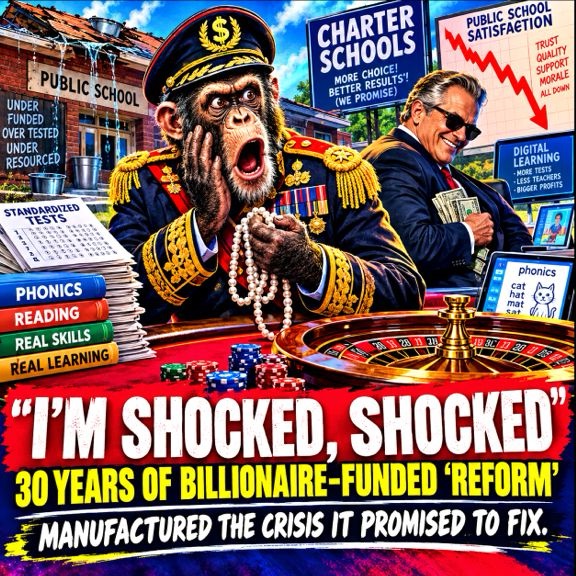
Mike Simpson, known on Twitter as “Big Education Ape,” is known for his brilliant memes and editorial cartoons. Typically, they expose the latest fads and lies that defame teachers and public schools. Every once in a while, he publishes a great post, like this one.
I’M SHOCKED, SHOCKED — HOW 30 YEARS OF BILLIONAIRE-FUNDED “REFORM” MANUFACTURED THE EDUCATION CRISIS IT PROMISED TO FIX
There’s a famous scene in Casablanca where Captain Renault declares he is “shocked, shocked” to find gambling going on — right before a croupier hands him his winnings. That’s essentially the posture of the billionaire reform industrial complex today, clutching its pearls over a Gallup poll showing public satisfaction with American schools has cratered to 32% — an 11-point nosedive in just two years — while quietly pocketing the profits of the crisis they spent three decades engineering.
Shocked. Absolutely shocked.
The Architecture of a Manufactured Crisis
Let’s be precise about the timeline, because precision matters when someone is picking your pocket.
For roughly 30 years, a well-funded constellation of think tanks, philanthropic foundations, hedge fund managers, and tech oligarchs pumped billions of dollars into a single, relentless narrative: public schools are failing. Not “underfunded.” Not “systematically neglected.” Failing — as in, inherently broken, irredeemably incompetent, populated by bad teachers protected by evil unions, and salvageable only by the heroic intervention of the private market.
The messaging was surgical. The money was real. And — surprise! — it worked.
Starve public schools of adequate funding. Declare them “failing.” Ride in on a white charter bus to “rescue” the children.
The chronic underfunding wasn’t fiscal negligence. In many states, it was a feature, not a bug. Squeeze hard enough, the theory went, and disruption would force innovation. What it actually forced was deferred maintenance, teacher shortages, and a generation of kids learning to read in buildings where the roof leaks and the textbooks predate the iPhone.
Now the poll numbers confirm the narrative took hold — and the reformers are citing those same poll numbers as proof they were right all along. The audacity is, genuinely, breathtaking.
The Numbers That Tell Two Very Different Stories
Here’s what the data actually shows — and what it doesn’t show:
Metric: The Headline. What It Actually Means Gallup Public Satisfaction 32% — record low 30 years of “failing schools” messaging worked exactly as intended.
Parent Satisfaction with Their Own School Historically ~2x the national figure People trust what they experience; they fear what they’re told
Math & Reading Scores Declining, especially bottom quartile Tracks directly with funding inequity and screen-time explosion
Top-tier U.S. Student Performance Still globally competitive. The “crisis” is concentrated where disinvestment is concentrated
The gap between how Americans rate schools in general versus their own child’s school is the smoking gun. It has always been the smoking gun. People who actually walk into a public school building — who meet the teachers, see the classrooms, watch their kids come home — consistently rate those schools dramatically higher than the national “failing” narrative suggests.
That gap is the manufactured crisis. It lives entirely in the space between lived experience and media-amplified fear.
$1.8 Billion Worth of Snake Oil, Served Fresh
And just when you thought the reform carousel might slow down, along comes the Science of Reading — the latest Next Big Thing™ in a long line of Next Big Things™ that have collectively cost American taxpayers tens of billions of dollars and produced reading scores that went, as the Big Education Ape’s withering analysis puts it, precisely nowhere.
Remember Common Core? $15.8 billion. A decade of standardized testing theater. Reading scores: unmoved.
Now we have the Science of Reading, $1.8 billion deep and climbing, with the same cast of vendors, the same philanthropic networks, and the same conspicuous absence of a money-back guarantee.
To be scrupulously fair: phonics works. Explicit decoding instruction works. The underlying research on structured literacy is legitimate. But here’s the thing about legitimate research — it doesn’t require a $1.8 billion vendor ecosystem, mandatory state legislation in 40+ states, and the systematic deskilling of teachers who are told to stop thinking and start following the script. When real science gets packaged into proprietary curricula, sold to districts under legislative mandate, and deployed without the trained human educators needed to implement it well, you don’t get science. You get very expensive phonics worksheets.
The question nobody in the reform complex wants to answer remains the same one it’s always been: Where is the money-back guarantee?
The Other Hand: How Tech Bros Broke Kids’ Brains While Selling the Cure
Here is the part of the story that deserves its own criminal investigation — or at minimum, a very uncomfortable congressional hearing.
The same Silicon Valley billionaires who spent decades pushing EdTech into classrooms as the revolutionary equalizer — screens for every student! –are the identical billionaires whose social media platforms have:
Collapsed long-form reading among adolescents at a rate researchers describe as one of the steepest drops in PISA history
Engineered algorithmic doom-scrolling that neurologically rewires 15-year-olds away from the sustained attention that math and reading comprehension require
Distracted over a quarter of students internationally during core academic instruction, by their own PISA survey data
They sold the disease and the cure. They pushed the screens that fragmented attention spans, then sold the adaptive software to remediate the fragmented attention spans, then pointed at the test scores and said: See? Public schools are failing.
None of this is inevitable. None of this is permanent. The No Kings Coalition — the sprawling, nonpartisan civic movement that flooded the streets in March — is now flooding the polls, with a Vote Early Day of Action on October 17 aimed squarely at the November 3, 2026 midterms.
The math is straightforward, even if the billionaires prefer we can’t do it:
Elect candidates who will defend public education funding, not divert it into voucher schemes that enrich private operators at public expense
Overturn the Supreme Court rulings — from Citizens United forward — that transformed American democracy into a billionaire auction
Restore the principle that public money follows public children into public schools, not into the portfolios of private equity firms with a “reform” logo.
The manufactured crisis has a manufactured solution: more billionaire intervention, more privatization, more EdTech, more testing, more disruption. The actual solution is considerably less glamorous and considerably more effective — fund schools equitably, pay teachers competitively, put phones away, and stop letting people who profit from public school failure write public school policy.
The Bottom Line
The 32% satisfaction number is not evidence that public schools have failed. It is evidence that a 30-year, billion-dollar propaganda campaign succeeded. The same people who manufactured the crisis are now selling the cure — at $1.8 billion a pop, no refunds, no guarantees, no accountability.
Meanwhile, the teachers who showed up every day through a pandemic, through chronic underfunding, through a staffing crisis, through the algorithmic dismantling of their students’ attention spans — those people are still in the classroom at 7 AM, doing the work that no EdTech platform, no voucher program, and no think tank white paper has ever actually replaced.
The casino is rigged. Captain Renault is shocked. And the November ballot is the one lever the house can’t control.
Vote like a public school depends on it. Because one does.
All links verified active as of September 9, 2026. Primary polling data sourced from Gallup/Walton Family Foundation. PISA data sourced from NCES/OECD 2025 release.
Heather Cox Richardson sums up the sickening feeling that many of us have about the Trump-Musk alliance and their efforts to torpedo the November midterm elections. Musk has corrupted our politics with the vast amounts of money he spends to elect far-right politicians. Most of his wealth comes from government contracts, and he wants to maintain his friends in office. You have to wonder how a man who celebrated the killing of US AID, leading to the deaths of at least 700,000 people, can sleep at night. Did he enter the U.S. legally?
She writes:
On Sunday, Germany’s far-right Alternative for Germany (Alternativ für Deutschland, or AfD) party won 43.8% of the vote in a legislative election in the small state of Saxony-Anhalt, formerly part of Soviet-dominated East Germany. The AfD is anti-immigrant and pro-Russia and has won the support of both Vice President J.D. Vance and billionaire Elon Musk.
When Musk posted “Well done!” in German to the co-founder of AfD, Alice Weidel, another AfD leader responded with thanks, posting: “If we take on responsibility here, I would very much welcome the opportunity for strong and constructive cooperation. Germany would then once again be a place worth investing in. Best regards from Saxony-Anhalt!”
Jon Henley of the Guardian noted that right-wing leaders across Europe celebrated the outcome, including ousted Hungarian prime minister Viktor Orbán, who called the election results “a huge night for Germany and Europe,” adding: “Buckle up. This is just the beginning.”
Musk was the largest donor to any political committee in the 2024 U.S. elections, putting around $290 million into the 2024 election to help elect President Donald J. Trump and Republicans. On August 28, Andrew Howard, Erin Doherty, and Meredith Lee Hill of Politico reported that Musk was planning to meet with House speaker Mike Johnson (R-LA) as he considered investing at least $100 million to elect Republicans in the midterm elections.
Since that meeting, Musk has plowed money into the Texas Senate race to support Texas attorney general Ken Paxton against Democratic nominee James Talarico. According to Theodore Schleifer of the New York Times, Musk’s investments—many through political action committees—target Senate races in Alaska, Iowa, Maine, Michigan, and Ohio, as well as House races in at least California, Wisconsin, and Washington.
Musk’s open attempt to buy elections for the Republicans should be bigger news, not only because of the political power his money has given to one man, but also because of what his behavior says about the MAGA administration’s ideology and its goals.
After supporting Trump in 2024, Musk appeared to become the head of the Department of Government Efficiency—the administration was coy about who actually held that title—where he worked to slash government spending. On February 3, he posted on his social media: “We spent the weekend feeding USAID into the wood chipper. Could gone [sic] to some great parties. Did that instead.” Musk called USAID—the United States Agency for International Development—“a criminal organization” and “a viper’s nest of radical left-marxists who hate America.”
In July 2026, Ari Daniel, David Augustine, Kazeem Olawale Nasiru, and Lameck Nyagudi of NPR reported on a study by Boston University infectious disease modeler Brooke Nichols that estimated more than 700,000 people had died from the sudden stop in USAID funding, including more than half a million children in developing countries.
And yet, for all his talk about slashing government expenditures, Musk’s DOGE did not appear to save much. Emilio Perez Ibarguen of Politico reported in August, when DOGE officially ended, that a report by the Government Accountability Office found that the savings it claimed were in large part exaggerated or couldn’t be corroborated.
Meanwhile, government contracts continued to flow to Musk’s businesses. As Desmond Butler, Trisha Thadani, Emmanuel Martinez, Aaron Gregg, Luis Melgar, Jonathan O’Connell, and Dan Keating reported in the Washington Post in February 2025, Musk himself has been one of the biggest beneficiaries of taxpayer dollars in history, taking in at least $38 billion in government contracts, loans, subsidies, and tax credits over the course of more than 20 years. Once he was in power in Trump 2.0, government investigations into those businesses ended.
The very public nature of Musk’s antics has helped to wake the public up to the fact that our current system is skewed toward billionaires. In July, economist Paul Krugman noted a growing backlash against those billionaires. A poll by UMass Amherst found that 58% of Americans think billionaires are a threat to democracy, and 45% of them say the U.S. is an oligarchy, “a government in which a small group exercises control especially for corrupt and selfish purposes.” As Krugman noted, only 28% of those polled disagreed.
Krugman pointed out that wealth has been concentrating at the top of the U.S. economy for decades, so the growing wave against that concentration of wealth appears to be driven by those like Musk and Trump himself, who has flaunted his use of taxpayer money for his own interests while dismissing the pain of regular Americans.
This flow of taxpayer dollars to favored businesses rather than to programs that serve the needs of the people seems to be a feature rather than a bug in the Trump administration and reflects its rejection of democracy in favor of the right-wing axis of authoritarianism.
Last night, Tarini Parti, Josh Dawsey, Michelle Hackman, and Summer Said of the Wall Street Journal published a deep investigation into the machinations of Corey Lewandowski when his colleague Kristi Noem was secretary of the Department of Homeland Security. They report that Lewandowski, who was Trump’s campaign manager for part of 2016, appeared to offer aid to foreign countries navigating U.S. bureaucracy in the department for a fee, selling government services for his own gain.
The journalists also report that Lewandowski may have been involved in awarding government contracts improperly, an accusation covered in a November 14, 2025, article by Justin Elliott, Joshua Kaplan, and Alex Mierjeski of ProPublica. The Wall Street Journal reporters note that Congress gave the Department of Homeland Security an additional $75 billion to spend during Trump’s term on deportations, detention facilities, and technology, providing deep pockets for corruption.
While the administration appears to have sidelined Noem and Lewandowski since Noem resigned under pressure in March, the journalists say Lewandowski “has told people close to him he expects the president would pardon him in the event of a criminal case.”
Lewandowski responded on social media that the story was “just another example of the kind of anonymous-source, politically driven reporting that Americans have seen time and again. We’ve lived through the Russia collusion hoax the fake Birthday card and countless other sensational allegations that ultimately failed to withstand scrutiny. I’m tremendously proud of my work as a volunteer in advancing this administration’s agenda and remain confident that the facts and not anonymous accusations will ultimately speak for themselves.”
But, of course, every official investigation into the 2016 election, including the one conducted by the Republican-dominated Senate Intelligence Committee and unanimously adopted, agreed that Russia did work to get Trump elected in 2016. And while Trump claims he did not create the birthday card to child sex offender Jeffrey Epstein apparently bearing Trump’s signature on a drawing of a nude girl that was produced by the Epstein estate, the story was convincing enough that it helped to push Congress to pass the Epstein Files Transparency Act and the first case he brought against the Wall Street Journal for publishing the story was dismissed. A second case is pending.
There is, in fact, increasing pushback against the world Musk and Trump are trying to put into place instead of liberal democracy. In the U.S., the growing opposition to data centers, which seems to represent anger at the very wealthy tech bros who want to call the shots, is perhaps a sign of the direction the wind in the U.S. is blowing.
Whether that popular pressure can withstand the extraordinary amounts of money Musk and other right-wing billionaires are pouring into the midterms is unclear. Judd Legum of Popular Information reported today that Musk is funding an advertising campaign encouraging people in swing states to check their voting registration status at a different website than the one run by the Election Assistance Commission, which is an independent agency of the U.S. government.
Instead, Musk’s campaign urges people to go to “votesafe . org,” which collects their full name, home address, date of birth, email address, cell phone number, IP address and location (which identifies city and zip code), every link clicked, every page looked at, and voter registration status, among other information.
Legum reports that the privacy policy of the website “allows [Musk’s super PAC] America PAC to ‘share’ or ‘sell’ personal information ‘with our business partners,’” including “whether you are registered to vote” and “how you submit your vote… where permitted by law.” America PAC can also sell “inferences” it makes about a user, including “psychological trends, predispositions, behavior, attitudes, intelligence, abilities and aptitude.”
A new documentary about Musk by filmmaker Alex Gibney argues, as Steven Zeitchik of the Hollywood Reporter put it, that Musk is “a dangerous huckster [who] is stealthily aggregating power to exploit us, primarily by centralizing and controlling massive amounts of data.” The documentary, called Musk, notes that, under Musk, DOGE had access to federal IT systems and, as Zeitchik recalls, a whistleblower warned that members of DOGE accessed and shared sensitive data from the Social Security Administration.
Zeitchik reports on the onscreen comments of Nobel Prize-winning scientist Geoffrey Hinton, known as “the godfather of AI,” who said: “It’s fairly clear to me that Trump is hell-bent on corrupting the midterm elections,” he says onscreen. “If you wanted to corrupt those midterm elections and you wanted to use AI, all you needed to do was get detailed information on U.S. citizens. And what DOGE did looked like just what you would do.”
In Europe, in the wake of the rise of the AfD, German defense minister Boris Pistorius said today that Germany will send missiles to Ukraine to help it fight off a winter incursion from Russia.
In Florida, a couple were arrested and charged for keeping their four grandchildren confined in a truck for six years and allowing them to be sexually abused during their long confinement.
The good news (sarcasm) is that they homeschooled the children by enrolling them in Khan Academy online classes.
Did the couple know they were eligible for $32,000 in voucher payments to pay for all their educational expenses from the state of Florida? Maybe they did and were collecting. Why pay for the Khan Academy classes when the state will pick up the bill?
A grandmother and her fiancé are accused of trapping four children for six years inside a semi truck’s cab, where the children endured sexual abuse, malnutrition and neglect, prosecutors in Florida said on Tuesday.
Starting in 2019, the victims, two girls and two boys who now range in age from 11 to 15, slept on a top bunk without all fitting on the mattress, the authorities said in an arrest warrant. They urinated in a plastic cup and defecated in a grocery bag, the warrant said.
One child scarred her hand permanently when hot noodles burned her, and she was not taken to the hospital, the warrant said. One girl contracted a sexually transmitted infection, the warrant said.
“This is just straight evil, and a scourge on our society,” Mark Glass, the commissioner of the Florida Department of Law Enforcement, said during a news conference held on Tuesday.
The ordeal began when Ms. Epps and her fiancé, Tamra Marshon Stewart, 37, of Jacksonville, Fla., traveled with the children from Atlanta to Miami, James Uthmeier, the state’s attorney general, said during the news conference. Ms. Epps was a licensed semi truck driver, Mr. Williams said.
The couple served as primary caregivers for the children, and they all lived inside the truck’s cab.
The cab included two seats for a driver and a passenger, a bunk bed, a refrigerator, a microwave and a space for storage all packed into tight quarters, the authorities said in the arrest warrant.
“This was a prison, a rolling prison,” Mr. Uthmeier said.
One of the girls, who is now 12, said Mr. Stewart had touched her inappropriately every day for two years, the authorities said. She said her grandmother knew what was happening to her, and in one instance pretended to be asleep, according to the arrest warrant.
Mr. Stewart furnished the other girl, now 11, with candy and money after sexual encounters in an effort to keep her quiet, according to the arrest warrant. The victim “said it didn’t work,” the warrant said.
A 15-year-old boy confronted Mr. Stewart, calling him a pedophile and a child molester, according to the arrest warrant from the state’s attorney general office. Mr. Stewart punched the victims after the dispute, according to an arrest warrant filed by the Jacksonville Sheriff’s Office.
The children did not attend school while with Ms. Epps and Mr. Stewart and instead used Khan Academy, a website with educational videos that is not accredited, the authorities said.