Archives for category: Civil Rights

Trump has spent a lot of time rescuing, pardoning and trying to reward the people who joined him in attempting to overturn his election loss in 2020. He is a giant baby. He is a sore loser. He lost decisively, and he refuses to accept it. More than 60 federal and state courts, including the U.S. Supreme Court, rejected his appeals because there was no evidence of election fraud.

Someday, with time, we will look back on Trump’s refusal to accept his defeat as a low point in our history. Of course, we will look at his two terms in office as the absolute nadir of our history, as a time he spent rolling back civil rights, environmental protections, international alliances, access to healthcare, defunding medical and scientific research, bullying universities, and censoring the mass media.

Trump bullied Governor Jard Polis of Colorado to free Tina Peters, and Polis succumbed:

Tina Peters, the former clerk convicted of participating in a scheme to chase election conspiracy theories promulgated by President Donald Trump, was released from prison Monday after the president successfully pressured Colorado’s Democratic governor into commuting her sentence.

Peters’ release was confirmed by the Colorado Department of Corrections. The state agency said it would have no more information about the 70-year-old inmate. Her sentence was shortened by Gov. Jared Polis last month after Trump waged a lengthy pressure campaign against the governor and his state.

Peters served less than a quarter of her nine-year sentence.

Peters was the first local election official to be charged with breaching security after the 2020 election. She snuck in an outside computer expert affiliated with My Pillow Chief Executive Mike Lindell — who himself denied that Trump lost the White House in 2020 — and the person copied the county’s Dominion Voting Systems computer server as it was updated in 2021.

Peters then joined Lindell onstage at a “cybersymposium” that promised to reveal proof that the election was rigged. Video and photos of the computer system upgrade, including passwords, were posted online. The move stoked false claims that voting machines were manipulated to steal the election from Trump.

Peters was convicted in 2024 of attempting to influence a public servant, conspiracy to commit criminal impersonation, violation of duty and other crimes by jurors in Mesa County, a Republican stronghold that supported Trump. An appeals court upheld her conviction in April, but ordered Peters to be resentenced because it said the judge who sent her to prison wrongly punished her for speaking out about election fraud.

Trump had championed Peters’ case, but because she was convicted under state law, he did not have the power to pardon her. Instead, the president pressured Polis to do so, lambasting him on social media and disinviting him to a White House meeting with other governors. The Trump administration also announced plans to dismantle the National Center for Atmospheric Research in Colorado and relocated the U.S. Space Command to Alabama.

Polis commuted Peters’ sentence on May 15. In a letter, he wrote that although Peters was convicted of serious crimes and deserved to spend time in prison, the sentence was “extremely unusual and lengthy” for a first-time non-violent offender.

Colorado Secretary of State Jena Griswold, a Democrat, called the move a “dark day for democracy” and said it amounted to “selling out our state’s justice system for Trump.”

The U.S. Supreme Court was designed to be a separate branch of government, the one that monitored the adherence to the Constitution by the other two branches. The Court disappoints sometimes, but it has never been as nakedly partisan as it is under Chief Justice John Roberts. The far-right wing of the Republican Party has a reliable friend at the Court.

It’s hard to say which of their decisions is the worst.

Some might say it was their recent decision to overturn the Voting Rights Act, which will sharply reduce the number of Black members of Congress.

Some might say it was their decision to overturn Roe v. Wade, despite promises by most of them not to do so.

Some would say it is their decisions that tear down the wall of separation between church and state.

I say it was their decision in Trump v. United States, in which the majority decided that the president was above the law and could not be charged for anything he did while in office as part of his official duties. We can be certain that the same court would claim that whatever he did was part of his official duties, including tearing down the East Wing of the White House without seeking anyone’s approval.

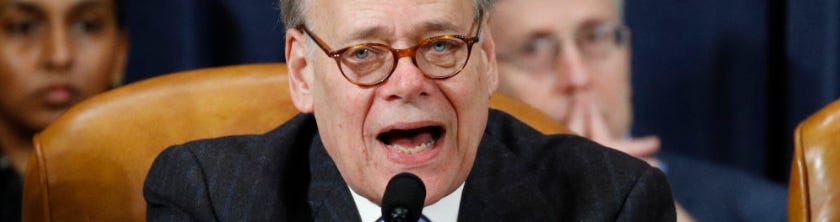
Representative Steve Cohen of Tennessee has had enough. He introduced six articles of impeachment of Chief Justice John Roberts. Good for him!

Scott Dworkin reported on his blog:

Rep. Steve Cohen

Rep. Steve Cohen has represented Memphis, Tennessee, for 19 years. Republicans cut his district into pieces, and he decided to retire—but not without a fight.

Cohen told The Dworkin Report in 2019: “[Trump’s] life has been one crime after another. One misdeed after another. One lie after another.” Now he’s applied that same standard to the man who put Trump above the law.

On May 21, Cohen introduced six articles of impeachment against Chief Justice John Roberts. Charges include allowing the Court to become a partisan weapon, placing the president above the law, endorsing a corrupt campaign finance system, and failing to recuse himself while his wife collected millions recruiting attorneys for law firms with cases before the Court.

Cohen was direct: “Under Chief Justice Roberts’ stewardship, [The Supreme Court] is now understood as biased: with decisions designed to benefit Republicans at the expense of representative government.”

They gerrymandered Cohen’s district to silence him. John Roberts now has six articles of impeachment to his name—an award no other Chief Justice has ever received in US history.

The U.S. Supreme Court recently rendered the Caillais decision, which effectively gutted the historic Voting Rights Act. As soon as the decision was released, the Southern states that once formed the Confederacy began to redraw district lines to eliminate Black representatives from Congress and the state legislature. In some of those former-slave states, there is likely to be no Black representation of the state in Congress.

The Confederacy rises again, thanks to the six members of the Supremr Court appointed by Republicans. Once again, Justice Clarence Thomas votes to strip rights from Black people.

Please read this commentary by teacher Ken Bernstein. He includes a speech by President Lyndon B. Johnson, explaining why the Voting rights Act was necessary for our democracy.

This decision makes the case for Supreme Court reform, either by enacting an age limit, term limits, or enlarging the Court.

Jamelle Bouie, columnist for The New York Times, wrote several columns (see here) about the decision by the U.S. Supreme Court to eviscerate the Voting Rights Act in its Callais decision. This one is titled “The Law They Hate Was a High Point of Our History.” The high court majority, six hard-right Republicans, decided that partisan redistricting is just fine, but redistricting that takes account of race is not. Thus, a state legislature dominated by one party can justly produce a voting map that gives every seat to its own party, but it may not permit districts created to encourage representation of racial minorities.

In the wake of the Callais decision, some states of the Confederacy quickly carved up districts to eliminate seats held by Democrats and by Blacks. Some of these states will have only white Republicans in Congress.

Bouie wrote:

The Voting Rights Act of 1965 wasn’t the top-down dictate of a rogue, liberal Supreme Court — if such a thing has ever existed.

It wasn’t the brainchild of out-of-touch bureaucrats in Washington, nor was it some kind of martial settlement imposed on the states of the former Confederacy.

It was, instead, an achievement of the most effective social movement of the postwar United States. The Voting Rights Act revitalized American democracy and stands as one of its great achievements.

This, somehow, has been lost in the discourse around the Supreme Court’s decision in Louisiana v. Callais. The court’s clear hostility to the law, as well as the glee with which conservative Republicans have dismantled the South’s majority-minority congressional districts in its wake, makes it seem as if the V.R.A. was a handcuff placed on American politics by some outside force.

The truth is that the Voting Rights Act was conceived, crafted and passed in order to further realize American democracy. And it was, itself, the product of an explosion of democratic energy.

The V.R.A. was forced onto the national agenda by the tireless work of the grass roots activists in the Civil Rights Movement, who struggled, bled and put their lives on the line in a fierce fight to secure their fundamental rights as Americans. It was signed into law by a president who had won election in one of the largest landslides in American history. It was subsequently reauthorized by Congress, after Congress, after Congress, after Congress.

The most recent reauthorization in 2006 was nearly unanimous, and there was broad support from the public — so much that to justify the Supreme Court’s attack on the law in Shelby County v. Holder, Chief Justice John Roberts had to fabricate a constitutional doctrine about the “equal sovereignty” of states, and Justice Antonin Scalia had to characterize the reauthorization as an unfair “racial entitlement” that politicians would never remove for fear of backlash.

If there is any single law that you could plausibly say represents the general will of the American people, it might be one that was reaffirmed nearly every decade for 40 years by the people’s representatives.

This isn’t just a historical point or a piece of idle trivia. It is essential. And it gets to what is so egregious about the court’s campaign against the law.

The Voting Rights Act was an attempt by the people of the United States, affirmed across two generations of voters and lawmakers, to make good the 15th Amendment to the Constitution — itself the hard fought product of war and reconstruction. It was an attempt to wield the authority of the federal government to secure the fundamental right to vote as well as the fundamental right to representation. It stood for substantive equal protection — the chance to make democracy real.

The V.R.A. was not, contra John Roberts and the rest, an expression of colorblindness, indifferent to the social realities of the United States. It did not pretend to treat supposed neutrality as truly neutral, nor did it place racial inequality outside the remit of the Constitution. And it was not, as this court would have it, the bland expression of a bloodless commitment to anti-discrimination. In fact, it was the most significant attempt in this country’s history to realize the promise of political equality.

The Voting Rights Act has more — much more — democratic legitimacy than this Supreme Court has ever enjoyed. After all, most of this court’s conservative majority was appointed by presidents who entered office as winners of the Electoral College but not the popular vote.

It is that relative difference in democratic legitimacy that makes this court’s voting rights jurisprudence so offensive.

Those voting rights rulings, from Shelby County v. Holder in 2013 to Callais in 2026, come from a court that has placed itself above the people at large. It is a court that will, according to its whims, ignore the clear commands, directions and intent of Congress. It is a court that treats voters and legislators as errant children to be corralled and disciplined by wise jurists. It is a court that doesn’t answer hard constitutional questions as they arise as much as it imposes constitutional meaning based on its narrow interests and ideological preoccupations.

It is a court that is trying to shape the political system to its liking, despite the claims of the chief justice, with no limits other than its partisan preferences. It is a court, in other words, that is wielding a cramped and parochial vision of the Constitution against American democracy, rather than treating the Constitution as a tool for realizing our democratic aspirations.

There have been many frustrating decisions from this Supreme Court. Louisiana v. Callais may not even be its worst decision — that prize might still go to Trump v. United States, where the chief justice conjured, out of thin air, an anti-constitutional doctrine of criminal immunity for the president.

Callais, however, might be the most emblematic of this court’s decisions: a flashing warning that our democracy is being crushed underneath the imperial authority of an arrogant and reactionary juristocracy. We can either discipline that court — and put it in its place — or accept our fate as its subjects.

Dan Froomkin writes “Press Watch,” a blog that covers the media. In this post, he criticizes the mainstream media for treating the U.S. Supreme Court’s Callais decision as a partisan issue. It is that, but it is at bottom a decision that destroys Black political power. It allows states to divvy up districts in ways that eliminates Black representation. And former Confederate states wasted no time in breaking up districts that elect Blacks to Congress.

He writes:

States across the South are redrawing election maps to eliminate majority-Black congressional districts.

Much of the major-media coverage is casting this in purely political terms – as just another part of the partisan battle for the House in November.

So for example, a May 9 Associated Press article headlined “What to know about the latest wave of changes to congressional districts,” started off this way:

The remaking of the U.S. political map accelerated this week in courts and legislatures, all of it in this round expected to boost Republicans in their attempt to keep control of Congress in November’s elections.

May 13 New York Times article started off like this:

Gov. Brian Kemp of Georgia on Wednesday called lawmakers back to the capital next month to redraw the state’s legislative districts for the 2028 election cycle, and to work on changes to the state’s voting system.

The call for a special session, which will begin on June 17, comes as Southern lawmakers have been rushing to reconfigure congressional maps to be more favorable to Republicans for this year’s midterms in response to the recent Supreme Court decision that weakened the Voting Rights Act of 1965.

But in the South, the significance of redistricting goes far beyond any partisan issue.

So let me rewrite that for you:

In a stunning display of racism, white Republican leaders throughout the South are stripping Black people of their franchise in order to retain political power.

The catalyst was a 6-3 Supreme Court decision on April 29 that gutted the Voting Rights Act of 1965, landmark legislation that gave Black people the opportunity to elect candidates of their choice.

Six right-wing justices insisted that intentional voting discrimination is a thing of the past. Southern legislators immediately responded by redrawing election boundaries to dilute the Black vote, in many cases making it virtually impossible for Black people to be elected to Congress.

What has happened in a matter of days amounts to a wrenching reversal of 60 years of racial progress — a revival of the Jim Crow era when Black people had no political power, no matter their number.

On a personal level, Black voters in the South are struggling with the repercussions of having one of their essential rights being brutally ripped away from them.

In states like Georgia, Louisiana, and Mississippi, where they make up more than 30 percent of the population, Black Americans will have little to no say in who is elected to Congress. And as the effects of the court decision trickle down to the local level, they may get shut out of some of those elections as well.

Meanwhile, the leaders of the white nationalist movement known as MAGA are celebrating. In some cases, their racism is expressed openly. “For too long, Tennessee politics has been dominated by cosmopolitan communists and race hustlers imposing their corrupt will on a deeply rural and conservative state,” Representative Andy Ogles of Tennessee posted on social media.

For the authoritarian leaders of MAGA, the dilution and nullification of Black votes is a crucial step in their quest to remain in power — even as most voters have turned against them.

MAGA’s future depends on suppressing the votes of groups that don’t support its white-male dominated Christian nationalist ideology. Reducing minority representation, to them, is essential to destroying majority rule. Destroying Majority rule is how they win.

Gerrymandering that leads to Southern states being almost entirely represented by white, right-wing elected officials dramatically improves MAGA’s political calculus. In the short run, it improves the odds of retaining Congress in November. MAGA’ strategy to keep the White House in 2028 includes yet more Black disenfranchisement, through voter intimidation, deception and disruption.

So far, MAGA’s plan is working, raising the prospect that Trump and his successors may remain in power for the foreseeable future.

But another way to characterize the current drive to disenfranchise Black voters is that it is the desperate – and maybe final — act of a white nationalist party that is being rejected by increasing number of voters.

For American journalists, this ought to be epic, tectonic stuff, worth aggressive and ongoing coverage.

And keep in mind that in the mid- to late-20th century, the struggle for civil rights was the dominant story in American politics, the subject of vast amount of journalism, some of it heroic. Ultimately it was journalism that brought the civil rights marchers into the American public’s breakfast nooks and living rooms, forcing the country to reckon with a brutal and sordid history of racism, and, eventually, try to move beyond it.

But today, as in the early days of the civil rights movement, too much of the media is averting its eyes from the experience of Black people. Too much coverage treats this extraordinary and consequential display of racism and societal regression as if it were just an ordinary political battle.

Some Reporters Get It

Some mainstream journalists have recognized the racial element of redistricting, and their work provides models of better, more appropriate coverage.

As evidence that you can address both the racial and political nature of the Republican moves in a news article, consider Emily Cochrane’s reporting in the Times about a new Tennessee map “that slices up Memphis to scatter Black voters into neighboring districts, a move intended to eliminate the state’s last Democratic House seat.” After several paragraphs of partisan framing, she wrote:

Democrats, noting that about two-thirds of Memphis voters are Black, said it was a blatant attack on hard-won gains for fair representation in a state shaped by slavery, segregation and the civil rights movement.

She described the scene in the state capitol in Nashville during the special session to pass the new map:

Black lawmakers delivered emotional speeches about family members, friends and colleagues who endured segregation or struggled with barriers to voting in the 1960s. State Senator Charlane Oliver of Nashville, a Democrat, stood on her desk right before the vote, holding a banner reading “No Jim Crow 2.”

And she quoted an attendee:

“My race is who I am and it informs my politics,” said Danyelle Norment, 30, who woke up early to drive in from Memphis. “It’s not something that’s separate or can be left behind.”

She added, “it’s really, really important to have folks who can understand our lived experience.”

In the Washington PostJustin Jouvenal profiled Press Robinson, an 88-year-old civil rights pioneer. “That law passed in 1965 was the bedrock of improvement of life in America for people of color,” Robinson told Jouvenal.

Now, Robinson fears a wipeout of Black political power, much like the one that occurred after Reconstruction.

“History is now repeating itself,” he said.

On PBS Newshour, Liz Landers covered the story as part of the network’s “Race Matters” series, bringing us the voice of Leona Tate, a civil rights activist:

So now we move backwards with the Supreme Court decision that will go down as one of the most racist rulings in our nation’s history.

Tate was 6 years old when she became one of the first students to desegregate a New Orleans school, Landers noted. Then Tate continued:

I had no idea what racism was at that time, but I knew by third grade that it was the color of my skin that made a difference. I just can’t believe that it’s still happening 66 years later. It’s cheating, to me. That’s how I feel. It’s really cheating. And it’s really illegal.

It does bring back that feeling from a long time ago, and it’s not a good feeling.

Read the Black Press

As in the 1950s and 60s, the Black press is revealing what the white press is slow to acknowledge.

Brandon Tensley, writing for Capital B, explained “How One Supreme Court Ruling Is Rewriting 60 Years of Voting Protections.” “Most Black Americans reside in the South,” he wrote. Lawmakers in former slaveholding states dismantling majority-Black districts “could change the balance of power and the complexion of leadership in this country.”

Gerren Keith Gaynor, writing for TheGrio, headlined the fact that “Black legislators lead the resistance as Republicans rush to redraw maps after gutting of Voting Rights Act.” “It’s disturbing and disgusting to see how this administration and the white leadership here are trying to codify white supremacy and dilute Black political voting power because that’s what’s happening,” Tennessee State Rep. Justin J. Pearson told Gaynor. “I think none of us should make any mistake about what is going on. The attempt to remove Black representation and our ability to elect representatives of our choice is one of the most significant attacks on Black voter participation and Black voter representation since the end of Reconstruction.”

TheRoot published a viral video of Louisiana resident Marshan Camese delivering a powerful speech at a state Senate hearing over redistricting. “I believe the country as a whole is rebuking your party. Y’all are in a death spiral,” he said. “That’s why y’all have to redistrict. That’s why y’all have to cheat.” MAGA, he said, “is the last breath of the Confederacy.”

Civil rights leaders are headed to Alabama tomorrow for a rally they’re calling “All Roads Lead to the South.” As I wrote in my Heads Up News newsletter this week, this could be the birth of a movement that combines the battle for voting rights with the battle for democracy.

“Black folks from across the country are gonna be busing in, flying in, to show up and to really begin organizing to turn out in the November election,” Wisdom Cole, the Senior National Director of Advocacy for the NAACP, told TheRoot. “This is such an important moment to activate all of us.”

Note: the rally in Alabama was held last Saturday.

Heather Cox Richardson sums up the struggle for equal rights since the Brown decision of May 17, 1954. The struggle has continued in the years since then, aided especially by the Voting Rights Act of 1965.

The VRA enabled Black Americans to have a voice, representation, and genuine political power. The U.S. Supreme Court decided on April 29, 2026, in Louisiana v. Callais that there is no longer any need for federal protection of voting rights for Black Americans, and they made a decision that is certain to lead to the loss of meaningful representation for Blacks, who–the Court majority decided–no longer needed federal protection. The former Confederacy proceeded to enact redistricting that will wipe out many Black-held seats in Congress. Racism is alive.

Richardson writes:

Seventy-two years ago tomorrow, on May 17, 1954, the Supreme Court unanimously decided Brown v. Board of Education of Topeka, Kansas. That landmark decision declared racial segregation in public schools unconstitutional because segregated schools denied Black children “the equal protection of the laws guaranteed by the Fourteenth Amendment.”

Three years after the Brown v. Board decision, in the face of massive resistance to desegregation in the South, President Dwight D. Eisenhower proposed the Civil Rights Act of 1957 to protect the right of Black Americans to vote, using the federal government to overrule the state laws that limited voter registration and kept Black voters from the polls. To prevent the passage of the first federal civil rights legislation since 1875, South Carolina senator Strom Thurmond launched the longest filibuster in U.S. history, speaking for 24 hours and 18 minutes.

(Senator Cory Booker (D-NJ) broke Thurmond’s record on March 31 through April 1, 2025, speaking for 25 hours, 5 minutes, and 59 seconds, but his speech was not a filibuster.)

Southern Democrats known as “Dixiecrats” managed to weaken the measure, but Senate majority leader Lyndon B. Johnson (D-TX) managed to wrestle the Civil Rights Act of 1957 through Congress, and Black Americans and their white allies began trying to register Black Americans to vote.

But the law proved too weak to force white registrars to allow Black voters onto the rolls, and by 1961, activists with the Student Nonviolent Coordinating Committee (SNCC, pronounced “snick”) were at work in Mississippi to promote voter registration. In 1964 they launched the “Freedom Summer,” bringing college students from northern schools to work together with Black people from Mississippi to educate and register Black voters.

Just as the project was getting underway, three organizers—James Chaney, from Mississippi, and Andrew Goodman and Michael Schwerner from New York—disappeared outside Philadelphia, Mississippi. Lyndon Johnson, president by then, used the popular rage over the three missing voting rights workers to pressure Congress into passing the Civil Rights Act of 1964, designed to try to hold back the white supremacists and to make it possible for Black Americans to register to vote. The measure passed, and on July 2, Johnson signed it into law.

On August 4, investigators found the bodies of the three missing men. Ku Klux Klan members working with local law enforcement officers had murdered them and then buried the bodies in an earthen dam that was under construction.

And still, white officials refused to accept the idea of Black voting. In Selma, Alabama, where the city’s voting rolls were 99% white even though Black Americans outnumbered white Americans among the 29,500 people who lived there, local Black organizers had launched a voter registration drive in 1963, but a judge stopped voter registration meetings by prohibiting public gatherings of more than two people.

Selma voting rights activist Amelia Boynton invited the Reverend Dr. Martin Luther King Jr. to the city to draw national attention to its struggle, and he and other prominent Black leaders arrived in January 1965. For seven weeks, Black residents made a new push to register to vote. County sheriff James Clark arrested almost 2,000 of them on a variety of charges, including contempt of court and parading without a permit. A federal court ordered Clark not to interfere with orderly registration, so he forced Black applicants to stand in line for hours before taking a “literacy” test. Not a single person passed.

Then, on February 18, white police officers, including local police, sheriff’s deputies, and Alabama state troopers, beat and shot an unarmed man, 26-year-old Jimmie Lee Jackson, who was marching for voting rights at a demonstration in his hometown of Marion, Alabama, about 25 miles northwest of Selma. Jackson died eight days later, on February 26. Black leaders in Selma decided to defuse the community’s anger by planning a long march—54 miles—from Selma to the state capitol at Montgomery to draw attention to the murder and voter suppression.

On March 7, 1965, the marchers set out. As they crossed the Edmund Pettus Bridge, state troopers and other law enforcement officers met the unarmed marchers with billy clubs, bullwhips, and tear gas. They fractured the skull of young activist John Lewis and beat Amelia Boynton unconscious. A newspaper photograph of the 54-year-old Boynton, seemingly dead in the arms of another marcher, illustrated the depravity of those determined to stop Black voting.

On March 15, President Johnson addressed a nationally televised joint session of Congress to ask for the passage of a national voting rights act. “Their cause must be our cause too,” he said. “[A]ll of us…must overcome the crippling legacy of bigotry and injustice. And we shall overcome.” Two days later, he submitted to Congress proposed voting rights legislation.

Under the protection of federal troops, the Selma marchers completed their trip to Montgomery on March 25. Their ranks had grown as they walked until they numbered about 25,000 people. That night, Viola Liuzzo, a 39-year-old mother of five who had arrived from Michigan to help after Bloody Sunday, was murdered by four Ku Klux Klan members who tailed her as she ferried demonstrators out of the city.

A bipartisan majority of Congress passed the Voting Rights Act by a vote of 77–19 in the Senate and 333–85 in the House. Dr. King and Mrs. Boynton were guests of honor as President Johnson signed the Voting Rights Act of 1965 on August 6. Recalling “the outrage of Selma,” Johnson said: “This right to vote is the basic right without which all others are meaningless. It gives people, people as individuals, control over their own destinies.”

And yet, on April 29, 2026, the Supreme Court gutted the protections for the Black-majority districts Congress provided for in the Voting Rights Act after years of weakening the law in other ways. In its wake, Republican-dominated southern state legislatures are rushing to redraw their district lines to dilute the votes of Black Democrats.

Today, thousands of Americans, including eighteen members of Congress, traveled to Selma and Mongomery to call Americans to action to protect voting rights. Pastor Kenneth Sharpton Glasgow told Joseph D. Bryant of Alabama news site AL, “This moment is bigger than Democrats or Republicans. This is about democracy itself. This is about whether Black communities, poor communities, rural communities, formerly incarcerated people, and marginalized voices will continue to have representation and political power in America.”

Speakers united around the theme that those trying to gerrymander their way into control of Congress in defiance of voters had reawakened a movement. “They think they can draw us out of power,” Representative Alexandria Ocasio-Cortez (D-NY) told an audience in Montgomery.

“They do not know the sleeping giant that they just awakened. Because it is not a coincidence, and our whole country must understand, that it was not until voting rights were ratified in this country that we got the Great Society. Because when Black Americans have the right to vote and that vote is protected, our schools get funded. When voted rights are protected, healthcare gets expanded. When voted rights are protected, our country moves forward. And Montgomery, that’s what they’re actually afraid of. They’re afraid of us coming together. They’re afraid of us protecting one another.”

Notes:

https://www.eisenhowerlibrary.gov/research/online-documents/civil-rightAs-act-1957

https://www.al.com/news/birmingham/2026/05/mass-mobilization-expected-in-selma-montgomery-this-weekend-after-supreme-court-decision.html

https://www.al.com/news/birmingham/2026/05/church-buses-and-charter-buses-are-heading-to-selma-and-montgomery-for-a-reclamation-of-power.html

https://www.booker.senate.gov/senator-bookers-marathon-speech

Bluesky:

indivisible.org/post/3mlyzqeapbs2g

This a great article that will uplift your spirits!

Jennifer Rubin is a journalist and lawyer who was hired by The Washington Post to be its conservative columnist. But Trump radicalized her, and she became a leading voice for liberal policies. After Jeff Bezos decided to placate and woo Trump, she resigned her job and started a new and wildly popular blog called “The Contrarian,” where she and other brilliant writers gathered to critique the madness of MAGA.

She recently posted an optimistic analysis of American politics. Despite the gerrymandering, despite horrible court decisions, Democrats are in a great position to wash the MAGA stain out of the nation’s government.

It’s the most optimistic piece I’ve read in a long while, and I think you will enjoy it too.

Rubin writes:

In a span of less than two weeks, the U.S. Supreme Court (contravening the text and intent of the post-Civil War amendments and decades of court precedent) and the Virginia State Supreme Court (overturning the will of Virginia voters and inventing a new definition of “election”) have bulldozed through the electoral landscape to slant the 2026 midterm playing field in Republicans’ favor.

In Louisiana v. Callais, the U.S. Supreme Court demolished 60 years of progress in voting rights, robbed Black and Hispanic communities of the power to elect representatives of their own choosing, and aimed to decimate the ranks of non-white U.S. House members, state legislators, and local officials. This is nothing short of an attempt to reimpose white supremacy.

(MicroStockHub/iStock)

Voting rights legal guru Rick Hasen wrote:

This decision will bleach the halls of Congress, state legislatures, and local bodies like city councils, by ending the protections of Section 2 of the act, which had provided a pathway to assure that voters of color would have some rudimentary fair representation. It’s the culmination of the life’s work of Chief Justice John Roberts and Samuel Alito, who have shown persistent resistance to the idea of the United States as a multiracial democracy, and a brazen willingness to reject Congress’ judgment that fair representation for minority voters sometimes requires race-conscious legislation…. It protects Alito’s core constituency: aggrieved white Republican voters.

As infuriating, partisan, and legally unsound as these rulings are, they are not the final word on either the midterms or the future of our multi-racial democracy.

The Midterms

Even with the loss in Virginia, Democrats’ five-seat pick up in California should more than counteract the original Texas re-redistricting (where two of the five seats Republicans sought to steal may well go to Democrats). And despite the Virginia decision, Democrats may still pick up one to two more seats under Virginia’s old map. The net pickup for Republicans currently is less than ten before Democrats pursue their own redistricting in New York, Illinois, Colorado, and Maryland.

However, even with the advantage of, say, a dozen rigged seats, Republicans are unlikely to keep the House majority. Since 2024, Democrats have swung the electorate substantially in their direction, over-performing in comparison to Kamala Harris in 193 of 226 state legislative races, by 20 points in some cases. On average, Democrats are doing more than 10 points better than they did in 2024. (Brookings’ William A. Galston wrote: “In the six special elections for the House conducted in 2025-2026, the swing toward Democratic candidates averaged about 15 points, while the swing toward Democratic gubernatorial candidates in New Jersey and Virginia averaged 14 points.”)

More than 20 Republican House seats were won by less than 10 points in 2024; 43 Republicans won by less than 15%. Given the electoral shift, Democrats’ list of targeted seats expands each week.

The New York Times reported that gerrymandering “tells only part of the story” about the midterms. While “Democrats could end up losing at least half a dozen safe seats, and possibly more,” depending on new maps drawn in Southern states, Republicans face gale-force “headwinds” thanks to Donald Trump’s atrocious approval numbers, his reviled Iran war, soaring gas and other consumer prices, snatching away healthcare coverage from millions, disaffection of Hispanic voters, and rampant corruption.

In short, gerrymandering, however outrageous, will not be enough to save Republicans if Democrats generate huge turnout, especially among those voters enraged that they have been stripped of voting power. (As Hungary demonstrated, a determined opposition can overcome a raft of unfair impediments imposed by a corrupt, unpopular regime.)

Democrats, independents, and disaffected Republicans know that the MAGA cult has no message — which is why MAGA lawmakers and courts must rig the election to cement white supremacy. That’s all they’ve got.

Democrats have their targets

The enormity of reversing 60 years of progress on voting rights necessitates a new era of intense organizing and public education — a new civil right movement to counter MAGA’s court-imposed Jim Crow. That effort kicks off with a grassroots National Day of Action on Saturday, May 16, in Alabama. Organizers declared, “The dismantling of the Voting Rights Act is a reminder that we have unfinished business. The fight is ours and we are going to finish it.” Scores of democracy groups, faith-based organizations, and civil rights organizations will rally to oppose Jim Crow redistricting and to support multi-racial democracy.

The goal: Democrats must win, and win big, in 2026 and 2028. Senate seats, governorships, and other statewide offices cannot be gerrymandered. A massive registration and turnout-the-vote operation must expand deep into Republican areas, appealing to disgruntled independents and Republicans while firing up the base. Democrats will need a broad, inclusive electoral coalition to pursue bold reform. As former attorney general Eric Holder likes to say, progressives “need to be comfortable with acquiring power and using power.”

What then? If Democrats come out of the 2028 election with House and Senate majorities, and the presidency, they will have all the motivation and tools required to reverse the slide into Jim Crow, beginning with substantial reform of the discredited Supreme Court. The MAGA justices’ willful misreading of the Voting Rights Act and the Constitution to concoct a “color blind” interpretation of voting rights (coupled with their monstrous expansion of executive power and abuse of the emergency docket) should unify democracy defenders on the urgency of Supreme Court reform through court expansion, term limits, revised appellate jurisdiction, and ethics reform.

Election law guru Rick Hasen argued:

The Supreme Court itself has shown itself to be the enemy of democracy. If and when Democrats retake control of the political branches, it will be incumbent on them not only to write new voting legislation protecting minority voters and all voters in the ability to participate fairly in elections that reflect the will of all the people. They will also have to consider reform of the Supreme Court itself.

With the election of aggressive Senate Democrats running in 2026 and 2028, Democrats should have little trouble carving out a filibuster exception, especially if they win by large margins that affirm voters’ rejection of MAGA assault on pluralistic democracy.

In addition to reforming the MAGA Supreme Court, a myriad of solid proposals for undoing the damage wrought by Callais include: state voting rights’ protectionsa federal statute that requires nonpartisan redistricting, proportional representation, and a constitutional amendmentguaranteeing the right to vote. Democrats should pursue an “all of the above” approach, not merely to regain but to expand diverse voters’ participation and power.

Though the tools to sustain multi-racial democracy may be different from those employed in the 1960s, Madeleine Greenberg of the Campaign Legal Center reminded us: “Every generation has faced attempts to restrict access to the ballot box, and every generation has pushed back.” If Democrats win elections decisively and fully exercise the power they obtain, they can fix what MAGA white supremacists have broken. Only then can we fulfill the promise of pluralistic democracy.

The midterm elections of 2026 are approaching. Start working now to reclaim our democracy! Our time is now.

The Department of Justice indicted the Southern Poverty Law Center by paying informants to infiltrate extremist groups.

CNN wrote:

The Justice Department alleges in the criminal case brought last month that the Southern Poverty Law Center — which has drawn the ire of President Donald Trump and other Republicans for labeling right-wing organizations as hate groups — defrauded donors by not informing them of secret payments to hate group members to act as informants.

The Justice Department alleges that SPLC has funneled $3 million to hate groups like the KKK, Unite the Right, and the Aryan Nations. SPLC also listed Moms for Liberty as a hate group, and M4L said that SPLC should be shut down.

One of the specialties of SPLC is compiling a list of hate groups and individuals who spread hate.

As an organization that was created to oppose racial injustice in the South, SPLC became a natural target for the GOP vengeance campaign.

The odd thing about the suit is that SPLC paid infiltrators, not the groups themselves.

This is a brazen assault on a significant civil rights group that has tangled with hate-groups for more than 50 years.

It is also a demonstration of the Trump administration’s weaponization of the Justice Department, turning it into a partisan cudgel.

Some large corporations have paused their charitable gifts to SPLC, including a division of Schwab that manages charitable gifts, Fidelity, and vanguard.

It was noted on Twitter that Stephen Miller, Trump’s policy advisor, is in the SPLC list of extremists.

The six conservative-right wing justices on the U.S. Supreme Court gutted the Voting Rights Act of 1965, by striking down Section 2, which requires that minorities have districts in which their voting preferences may be heard. This section led to the creation of districts that elected Black representatives.

We can now expect redistricting of Congressional districts and state legislative districts to sharply reduce the number of Black elected officials.

Richard L. Hasen of Slate wrote that the decision “will go down in history as one of the most pernicious and damaging Supreme Court decisions of the last century. All six Republican-appointed justices on the court signed onto Justice Samuel Alito’s opinion gutting what remained of the Voting Rights Act protections for minority voters, while pretending they were merely making technical tweaks to the act.

This decision will bleach the halls of Congress, state legislatures, and local bodies like city councils, by ending the protections of Section 2 of the act, which had provided a pathway to assure that voters of color would have some rudimentary fair representation. It’s the culmination of the life’s work of Chief Justice John Roberts and Samuel Alito, who have shown persistent resistance to the idea of the United States as a multiracial democracy, and a brazen willingness to reject Congress’ judgment that fair representation for minority voters sometimes requires race-conscious legislation. It gives the green light to further partisan gerrymandering. It protects Alito’s core constituency: aggrieved white Republican voters. It’s a disaster for American democracy.

Future generations of legal scholars will review the Republicans’ retreat from civil rights protections enacted in the 1960s. Perhaps psychologists will figure out why Justice Clarence Thomas consistently opposes laws intended to protect people like him.

Robert Reich has selected the Supreme Court Justice whom he believes is the worst in modern history. The two likeliest nominees are clearly Samuel Alito, who wrote the decision that reversed Roe v. Wade and that is responsible for the deaths of many women who were unjustly denied medical care because of Justice Alito.

But no, he chooses Justice Clarence Thomas. In this post, he explains why.

Friends,

I’ve long assumed that Samuel Alito was the worst. 

Alito — who authored the majority opinion in Dobbs v. Jackson Women’s Health Organization (2022), the case that ended constitutional abortion rights by merely asserting that the high court’s prior opinion in Roe v. Wade (1973) was wrongly decided; who accepted a 2008 luxury fishing trip to Alaska, including private jet travel, from hedge fund billionaire and GOP donor Paul Singer yet failed to disclose it on Alito’s financial forms and didn’t even recuse himself from decisions involving Singer’s subsequent business before the Supreme Court; who hoisted an inverted American flag outside his Virginia home shortly after the January 6 Capitol riot, a symbol of support for Trump’s false claims of a stolen 2020 election — has the moral and intellectual stature of a poisonous toad. 

But I’ve come to revise my view of the court’s worst Justice.

Clarence Thomas is 77 years old. He has now served on the Supreme Court for over 34 years, making him the longest-serving member of the Court. He is a bitter, angry, severe hard-right, intellectually dishonest, ideologue. After reading his latest thoughts on America, I’ve concluded Thomas is even worse than Alito. 

Last Wednesday, Thomas gave a rare public address at the University of Texas in Austin that began as a banal tribute to the Declaration of Independence before degenerating into a misleading screed against progressivism. 

“At the beginning of the twentieth century, a new set of first principles of government was introduced into the American mainstream,” Thomas intoned. “The proponents of this new set of first principles, most prominently among them the twenty-eighth president, Woodrow Wilson, called it progressivism.”

Thomas went on to blame progressives for the worst crimes of the 20th century, insisting that “Stalin, Hitler, Mussolini, and Mao” were all “intertwined with the rise of progressivism,” as was “racial segregation,” “eugenics,” and other evils. 

This is pure rubbish. 

In reality, America’s Progressive era emerged at the start of the 20th century from the corruption and excesses of America’s first Gilded Age (we’re now in the second, if you hadn’t noticed) — its record inequalities of income and wealth, its “robber barons” who monopolized industries and handed out sacks of money to pliant legislators, it’s dangerous factories and unsafe working conditions, its violent attacks on workers who tried to form unions, its corporate control over all facets of government, its widespread poverty and disease, and its corrupt party machines. 

In many ways, the Progressive Era — whose most prominent leader was Republican president Theodore Roosevelt, not Woodrow Wilson, by the way — saved capitalism from its own excesses by instituting a progressive income tax, an estate tax, pure food and drug laws, and America’s first laws against corporate influence in politics.

Then, under Teddy Roosevelt’s fifth cousin (Franklin D.), came Social Security, the 40-hour workweek (with time-and-a-half for overtime), the right to form unions, and laws and regulations that limited Wall Street’s ability to gamble with other people’s money. 

Clarence Thomas got it exactly backwards. Had we not had the Progressive Era and its reforms extending through the 1930s, America might well have succumbed to fascism — as did Germany under Hitler, and Italy under Mussolini, or to communist fascism, as did Russia under Stalin. Progressive and New Deal reforms acted as bulwarks against the rise of fascism in America.

In fact, it’s been the demise of such reforms since Ronald Reagan that have opened the way to Trumpian neo-fascism. 

Over a third of American workers in the private sector were unionized in the 1950s, giving them bargaining leverage to get higher wages and better working conditions. Now, fewer than 6 percent are unionized, which has contributed to the flattening of wages, a contracting middle class, inequalities of income and wealth rivaling the first Gilded Age, and an angry and suspicious working class that’s become easy prey for demagogues. 

Wall Street has been deregulated — allowing it to go on gambling sprees such as the one that produced the financial crisis of 2008, which claimed millions of working peoples’ homes, savings, and jobs. 

America’s social safety nets have become so frayed that almost a fifth of the nation’s children are now in poverty. Yet Reagan, George W. Bush, and Trump have slashed taxes on the rich and on big corporations and have allowed giant corporations to merge into giant monopolies rivaling the trusts of the first Gilded Age. And Trump has ushered in an era of corruption the likes of which America hasn’t seen since that earlier disgraceful era. 

Thomas claims that “The century of progressivism did not go well.” Baloney. It helped America create the largest middle class the world had ever seen, while also extending prosperity to millions of Black and brown people. 

The tragedy is that America turned its back on progressivism and on social progress, in part because of the Supreme Court and Justice Clarence Thomas. 

Flashback: I was in law school in 1973 when the Supreme Court decided Roe, protecting a pregnant person’s right to privacy under the 14th amendment to the Constitution. 

Clarence Thomas was in my law school class at the time, as was Hillary Rodham (later Hillary Clinton) and Bill Clinton.

The professors used the “Socratic method” – asking hard questions about the cases they were discussing and waiting for students to raise their hands in response, and then criticizing the responses. It was a hair-raising but effective way to learn the law.

One of the principles guiding those discussions is called stare decisis — Latin for “to stand by things decided.” It’s the doctrine of judicial precedent. If a court has already ruled on an issue (say, on reproductive rights), future courts should decide similar cases the same way. Supreme Courts can change their minds and rule differently than they did before, but they need good reasons to do so, and it helps if their opinion is unanimous or nearly so. Otherwise, their rulings appear (and are) arbitrary — even, shall we say? — partisan.

In those classroom discussions almost fifty years ago, Hillary’s hand was always first in the air. When she was called upon, she gave perfect answers – whole paragraphs, precisely phrased. She distinguished one case from another, using precedents and stare decisis to guide her thinking. I was awed.

My hand was in the air about half the time, and when called on, my answers were meh.

Clarence’s hand was never in the air. I don’t recall him saying anything, ever.

Bill was never in class.

Only one of us now sits on the Supreme Court. And he has shown no respect for stare decisis. 

Nor has he respected judicial ethics. 

A federal law — 28 U.S. Code § 455 — requires that “any justice, judge, or magistrate judge of the United States shall disqualify himself in any proceeding in which his impartiality might reasonably be questioned.”

In the aftermath of the 2020 election, Thomas’s wife, Ginni, actively strategized with White House chief of staff Mark Meadows on overturning the election results. Between Election Day 2020 and the days following the January 6th attack on the Capitol, she exchanged 29 text messages with Meadows, in which she spread false theories about the election, urged Meadows to overturn the election results, and called for specific actions from the White House to help overturn the election. She also served as one of nine board members of a group that helped lead the “Stop the Steal” movement and called for the punishment of House Republicans who participated in the U.S. House Select Committee investigating the January 6th attack. 

Yet Clarence Thomas has repeatedly participated in cases that have come to the high court directly or indirectly involving the 2020 election results, refusing to disqualify himself. 

In addition, he failed to disclose his wife’s income from her work at the Heritage Foundation, in violation of the Ethics in Government Act. 

Finally, there’s his speech last week in Austin. How can Americans be expected to believe in the impartiality of the Supreme Court in general and Clarence Thomas in particular when he condemns an entire philosophy of government — progressivism — and all the people who continue to call themselves progressives, in effect labeling them neo-fascists? 

At the start of his speech last week in Austin, Clarence Thomas noted that “My wife Virginia and I have many wonderful friends and acquaintances here, and it is so special to have our dear friends Harlan and Kathy Crow join us today.”

He was, of course, referring to the Republican mega-donor who has spent the last twenty years lavishing Thomas with personal gifts, luxury yacht trips, fancy vacations, and funding for Ginni Thomas’s political organization. 

Small wonder that Clarence Thomas prefers the Gilded Age over the Progressive Era. He’s the living embodiment of The Gilded Age’s public-be-damned excesses. 

Hence, he’s my nominee for the worst justice in modern Supreme Court history.