Imagine this scenario: a candidate for Governor of a major state pays for a campaign ad that portrays his opponent as a liar. That in itself is not unusual. But suppose that candidate’s staff has located the mother of his opponent and has persuaded her (paid her?) to make an ad saying that her daughter is a liar, is possibly mentally unstable, and should not be elected Governor.
But this is what’s left out of the story. The context. The target of the ad–Dr. Amy Acton– has not spoken to her mother in more than 40 years. Between the ages of 9 or 10 and 12, she was raped by her stepfather. He was indicted by a grand jury for child rape but fled the state before trial. The candidate’s mother never divorced the man who raped her daughter. The daughter and her brother were removed from their mother’s care.
The mother is a felon, charged repeatedly for non-violent crimes like fraud, writing bad checks, and even animal cruelty.
The ad in which Dr. Amy Acton’s mother attacks her is the dirtiest trick of the midterm elections. It was funded by Vivek Ramaswamy, a billionaire who is running for governor of Ohio. Vivek must have gotten tired of hearing his Democratic opponent, Dr. Amy Acton, talk about living in distressful conditions as a child. Someone on his staff found Acton’s birth mother, who lied on video to hurt her daughter yet again.
How painful for Amy Acton, who suffered through a horrible childhood, was estranged from her negligent mother, and now must endure the pain of being insulted by the mother who failed to intervene to stop the rapes and protect her daughter.
Amy Acton rose above her childhood abuse, went to college, then to medical school and became a doctor. Before she entered the race for Governor, she served Republican Governor Mike DeWine as Ohio’s Director of the state Department of Health.
Governor Mike DeWine urged Ramaswamy to take down the ad; so did other Republican state officials.
But Trump thought it was a terrific ad and urged Ramaswamy to keep running it. Trump tends to side with men accused of sexual assault, never with their victims. Vivek plans to spend $4 million to continue to run the campaign ad.
Trump and JD Vance saw nothing wrong with the ad attacking Acton. Vance said that critics should “stop whining” about the ad and focus on winning.
The one sure conclusion I reach is that these men don’t care if children are sexually assaulted and raped. They side with rapists and pedophiles, not their victims.
To these symbols of “manliness,” women don’t count.
Expanding on the story that Heather Cox Richardson told in the previous post, the following story in The New York Times explained the deal-making arranged by Jard Kushner and Howard Witkoff, two amateurs chosen by Trump to negotiate a peace plan to end the war that Russia started when it invaded Ukraine in 2023.
Now we know why Kushner and Witkoff emerged from their meetings with Putin wreathed in smiles. They got no concessions from Putin about ending the war. Their “peace plan” is to demand that Zelensky give Putin everything has done. Their peace plan is to demand that Zelensky surrender whatever Putin wants.
What they did get was Putin’s commitment to a massive project between the US and Rymussis to drill for liquified natural gas in Alaska.
The New York Times reported:
At first blush, the proposed venture looks like it would further the Trump administration’s goal of global “energy dominance.”
An American energy company intends to buy Russian technology and use it to access a massive supply of natural gas in Alaska, liquefy it and export it to allies abroad.
The Kremlin and the White House were interested in the idea. President Vladimir V. Putin discussed the plan last month with President Trump’s peace envoys, Steve Witkoff and Jared Kushner, people familiar with the negotiations said, speaking on condition of anonymity to discuss sensitive diplomacy. It is one of a series of energy deals White House officials believe could help smooth relations with Moscow and eventually pave the way to end the war in Ukraine.
But it turns out that the company was not an all-American affair. The multibillion-dollar project has received secret funding from the same powerful Russian company that was to provide the technology, according to the energy executive who until last month led the U.S. firm and two others involved in company negotiations.
Joel Riddle, who was chief executive of the company, Polar LNG, until he resigned in September, said he had been misled about the sources of the start-up funding, which ostensibly came from a company in the United Arab Emirates.
Instead, Mr. Riddle said he learned, the true source of at least some of Polar LNG’s money was Novatek, a Russian energy giant under partial U.S. sanctions.
“It’s not only unlawful, but it’s not in the U.S. interest to have Russian technology controlling the commercialization of Arctic gas in the North Slope,” Mr. Riddle said in a brief interview.
These previously unreported tensions were also detailed in legal memos that Mr. Riddle attached to his resignation letter, which was reviewed by The New York Times. The memos, prepared by Baker Botts, an international law firm, said the Treasury Department’s sanctions enforcement unit had raised concerns that Polar LNG had ties to Novatek that might present “potential Russia-related sanctions concerns.”
Polar LNG on Friday issued a statement announcing a new acting chief executive, Tim Talkington, and described Mr. Riddle as a “disgruntled former employee.”
The project, if it happens, is a long way off. In addition to the sanctions issues that would have to be negotiated, the technology envisioned is highly complex and must overcome some of the most brutal weather conditions in the United States. It also is competing with another Alaska gas plan that already has the support of the Trump administration. But that the Polar LNG deal is being discussed at all shows how business deals of almost any stripe are on the table during the talks with the Kremlin.
The sequence of events illustrates the unorthodox, opaque mixture of deal-making and high-stakes diplomacy that has defined Mr. Trump’s attempts to end Europe’s bloodiest conflict since World War II.
There is no indication that Mr. Witkoff and Mr. Kushner were aware of Polar LNG or its ties to Novatek, even as the broad outlines of the deal came up in their talks with Mr. Putin beginning last year. A U.S. official, speaking on condition of anonymity to discuss the closed-door talks, said that the deal had only been broadly mentioned and that no granular discussions had occurred.
The project, should it ever come to fruition, would doubly help Novatek, one of Russia’s biggest energy companies, first by using Novatek’s technology and second because the company would own an equity stake.
The Alaska gas discussions have taken place alongside talks to sell off part of another Russian energy giant, Lukoil, to the U.S. government and other investors, including some with business ties to Mr. Witkoff and Mr. Kushner, causing consternation among some Washington lawmakers and outraging some of Ukraine’s supporters. The pair have also discussed the possibility of U.S. involvement in future Russian gas exports to Europe. (The administration has said that Mr. Kushner and Mr. Witkoff were guided only by U.S. interests.)
Geoffrey R. Pyatt, who served as an assistant secretary of state for energy resources during the Biden administration, said the idea of bringing Novatek into the high north of Alaska is a terrible one. “It is terrible on environmental grounds, it is a terrible idea on economic and geopolitical grounds, and most importantly this feeds the belief that Putin can get an out-of-jail-free card.”
The efforts to bring Novatek equipment to Alaska have also included a businessman, Gentry Beach, with ties to the Trump family. A college friend of Donald Trump Jr., the president’s eldest son, Mr. Beach served as a finance vice chairman for Mr. Trump’s 2017 inauguration. Mr. Beach said in February that he had held negotiations with Novatekabout bringing its natural gas technology to Alaska.
Mr. Beach could not be reached for comment. It was not clear if he remained involved in the project, or whether he was aware of Novatek’s potential ownership stake in Polar LNG.
A spokesman for Donald Trump Jr. said the two men were no longer close, adding that Mr. Trump was not involved in the Polar LNG project. Novatek’s statement said that Mr. Beach had no role in its discussions to take a stake in Polar LNG. The U.S. official said Mr. Beach was not involved in the administration’s discussions related to Novatek.
Mr. Riddle is one of at least three Polar LNG executives who recently resigned. As they departed, Trump officials were notified about their concerns related to the secret Russian financing. Mr. Riddle said the executives had urged administration officials to investigate the matter. The Energy Department, where the warning was sent, did not respond when asked about the matter.
“I felt like I did the right thing to notify authorities at the appropriate time,” Mr. Riddle said.
Buried Riches
The Polar LNG plan called for the company to tap into the giant load of natural gas available in the northern reaches of Alaska, a byproduct of extensive oil extraction underway in the region.
Polar LNG’s proposal calls for it to buy a giant, 640,000-ton concrete-and-steel device from Novatek called a gravity-based structure that would be placed on the seabed just above the northern coast of Alaska, in an area known as Milne Point.
Map locates Milne Point, Alaska.
On top of that platform, equipment will be installed that would refrigerate gas supplied by an area oil producer, transforming it into a liquid that can then be loaded onto ships that travel through icy waters and deliver it to customers in Asia.
Novatek uses a similar approach to export natural gas from the Russian Arctic in a project called Arctic LNG 2. Mr. Putin said publicly last year that “we are discussing with our American partners” the possibility of using Novatek technology to produce liquefied natural gas in Alaska.
Korean-made ships with a special ice-breaking design that Polar LNG plans to use were initially built for Novatek, but delivery was stopped by the manufacturer after the United States imposed sanctions on the Arctic LNG 2 project.
From the start, Novatek was slated to supply the gas liquefaction station. But financing for the project was not supposed to come from Russia, according to executives involved in the effort.
Emphasizing the point, Polar LNG features images of the American flag and a bald eagle on its website, boasting that “Polar LNG helps ensure the United States leads,” adding that the project is “America’s Arctic Advantage.”
The company hired lobbyists in Washingtonand in Alaska to help push the project, according to federal and state records. In Washington alone, the company is spending $380,000 a quarter on lobbying, hiring a former Trump-era Interior Department acting assistant secretary, Adam Suess.
Novatek is already under U.S. sanctions that would require the Treasury Department to issue a license for its equipment to be used in Alaska. Recently passed sanctions legislation named after deceased Senator Lindsey Graham, Republican of South Carolina, makes things even harder: The bill specifically targets Novatek, as well as its Arctic LNG 2 project, because of the company’s ties to Mr. Putin.
However, Mr. Trump temporarily waived the law’s Russia sanctions last week, presenting the move as necessary to keep peace talks going.
During a meeting held at the Four Seasons Hotel in late August in Abu Dhabi between executives of Polar LNG and its parent company, Tech Wave Industrial Projects Management, top executives from Novatek were present. That was when Mr. Riddle began to appreciate that Novatek was directly involved in approving funding to keep the effort going, text messages reviewed by The Times indicate.
Tech Wave is an Abu Dhabi-based company that specializes in managing oil, gas and construction projects. Its chief operating officer is Bjorn Gundersen, who a decade ago was listed in oil industry trade publications as a senior executive at Novatek supervising LNG projects.
Tech Wave, in a statement, confirmed that Mr. Gundersen had worked for Novatek before 2022, the year the war with Ukraine started. It also said Novatek “has no ownership interest” in the company. The statement did not address questions from The Times as to whether Novatek money helped finance the Polar LNG efforts.
Denis Solovyov, Novatek’s deputy chairman, and Leonid Mikhelson, the company’s chief executive, discussed their company’s providing as much as $15 million to Tech Wave to bankroll Polar LNG, the messages say. Asked about the messages and the Abu Dhabi meeting, Novatek said it could not comment on private correspondence, but that the company and Polar LNG had agreed to “provide each other with open communication.”
“All the necessary decisions were made at the meeting in Abu Dhabi,” Mr. Solovyov wrote in one message to Mr. Riddle sent in early September. “The first 5 million were supposed to arrive by today.”
It was several weeks after this exchange that Mr. Riddle resigned. Two other top Polar LNG executives, Dan Chandra, the company’s chief financial officer, and Jim Smith, a former Exxon Mobil executive who served as Polar LNG’s executive vice president, also have left in recent weeks.
Polar LNG, in a statement Friday, said that “Riddle was recently terminated from the company for cause,” adding: “The company is investigating claims concerning Riddle that may result in litigation.”
But Mr. Riddle resigned six days before the company issued him a letter saying it would terminate his employment immediately, in part because he had raised concerns that some of the company’s actions could be “subject to sanctions,” documents obtained by The Times show.
Questions about the potential ties to Novatek had by late this summer already reached Trump administration officials, according to a memo prepared by an outside law firm for Polar LNG, Baker Botts.
“Concerns regarding a perceived connection to Novatek will likely affect licensing or other regulatory approvals,” Baker Botts wrote in a memo to company executives that was shared with The Times.
In addition, the letter said that federal officials had already made clear in communications with the company that they were concerned that an investor in Polar LNG “has ties to Novatek and may be acting on Novatek’s behalf with respect to the project.”
Paul Luther, a Baker Botts lawyer who worked on the matter, declined on Friday to discuss it further.
Polar LNG would need a series of approvals from the federal government before the deal could move ahead, including a sign-off from the Treasury Department authorizing it to acquire the Novatek seabed platform, given that parts of the company are under sanctions. It would also require a permit from the Federal Energy Regulatory Commission to build a gas export facility.
Questions have already emerged about whether the Novatek device will function at the planned Milne Point location because of shallow waters there and the “potential disruption to traditional whaling and local opposition, particularly from the local native Alaskan population,” a lawyer for Polar LNG wrote in an internal company memo.
Certain Trump administration officials had already expressed skepticism about the Polar LNG plan, according to internal company documents seen by The Times and interviews with some of the people involved.
Part of the concern is that the Polar LNG project would be pitted against an even more ambitious plan to build a $50 billion, 800-mile natural gas pipeline to move natural gas from the northern slope to the southern coast of Alaska, where it could be more easily shipped out from existing ports there. That plan would also potentially supply Asian markets.
Both the Biden and Trump administrations enthusiastically embraced the gas pipeline project, which Japan and Korea may help finance to increase their reliable supply of natural gas.
“The pipeline makes far more sense,” said Matthew McManus, who until April 2025 served as a deputy director at the State Department’s Bureau of Energy Resources and is now at the National Center for Energy Analytics. “The Polar LNG project would face years of permitting and concerns about ties to Russia.”
Mr. Talkington, Polar LNG’s acting chief executive, said his company sought to seize “a generational opportunity to advance U.S. energy dominance, unlock profound benefits for the state of Alaska, and strengthen American Arctic navigation.”
The fact that discussions are even going on about using Russian equipment — and potentially a Russian-financed company — to move American natural gas to international markets is a further insult to Ukraine, and should not be a part of talks over a possible end to the war, said Ilya Zaslavskiy, a gas industry consultant who previously worked in Moscow and New York who now does research on Russian sanctions and energy issues out of Washington.
“Any approach by Novatek to transfer technology should be seen as a Kremlin attempt to co-opt U.S. policymakers in order to undermine U.S. foreign policy toward Ukraine and our allies,” Mr. Zaslavskiy said.
Ever since he served on the January 6th committee, along with Liz Cheney, two Republicans who cared more about their country than their party, I have admired Adam Kinzinger and faithfully read his blog.
Here is his roundup of the latest scandals surrounding the Trump administration. To hear his audios and see his videos, please open the link.
Hey everybody. Welcome back. Thanks for being here.
Our top story today: more corruption coming out of the White House. This one centers on a Venezuelan billionaire who needed a pardon. His family gave Alina Habba, Trump’s former personal lawyer, a 50 million dollar job while she was still a U.S. attorney. Or at least still calling herself one. A judge had already ruled she was in that office unlawfully. Two weeks after she started working for the billionaire, he had his pardon. What a coincidence!
We’ll also get into Steve Witkoff calling Vladimir Putin a humanitarian, the president’s new round of election-season bribes, a look inside the obscure DOJ office greenlighting Trump’s worst ideas, and the president’s own son breaking with him over the Iran war.
So do me a favor. Like this video, share it with someone who needs to see it, and subscribe so you never miss an episode.
Let’s get to it.
1. Habba’s $50 Million Pardon Payday
Julio Herrera Velutini is a billionaire banker from one of the oldest families in Venezuela. In 2022, he was charged with felony bribery for trying to get the governor of Puerto Rico to fire the regulator who was investigating his bank. In August 2025, his lawyer, who had been on Trump’s personal legal team, got that knocked down to a single misdemeanor campaign finance count. Career prosecutors were furious. Herrera wasn’t satisfied either. He wanted the record wiped clean.
So his 27-year-old daughter gave 3.5 million dollars to a Trump super PAC. Still no pardon. Then, in late October 2025, she registered a company in Florida called Concord Partners. Nobody seems to know what it does, including people inside the family’s own business empire. Within days, Alina Habba signed on as general counsel with a contract for ten million dollars a year for four years. The New York Times got a look at the terms. Once you add in bonuses, the total was around 50 million dollars. At that moment she was the acting U.S. attorney for New Jersey, a job a federal judge had already ruled she was holding unlawfully.
She started the Concord job January 1st. By then she was a senior adviser to the Attorney General, overseeing U.S. attorneys, with an office at the Justice Department and a Marshals protective detail. So she was working for the Herreras and the Justice Department at the same time. Two weeks later, on January 15th, Trump gave Herrera a full and unconditional pardon. The governor he was accused of bribing and the former FBI agent who worked for him were pardoned the same day, right before they were due to be sentenced.
Habba says any suggestion her job had anything to do with the pardon is “false and defamatory,” and that the DOJ knew about the job and signed off on it. The department says she never spoke to anyone about a pardon. The White House says she had nothing to do with it. People who know the terms of her contract told the Times they believed she was hired to help get the pardon, and were surprised at the size of the number.
Look, maybe a 27-year-old started a company nobody can describe and decided the first thing it needed was a 50 million dollar general counsel who happened to be the president’s former lawyer, and the pardon two weeks later is just luck. That’s what Habba and the White House want you to believe.
But the Times reports there’s now a whole pardon industry in Washington, where wealthy criminals pay fixers big money to get the president’s attention. For Herrera, the person he paid just happened to be working inside the Justice Department when the check cleared. How convenient!
2. Witkoff Calls Putin Humanitarian
Before we get into the shameless flattery, some good news: Stephen Hubbard is free. In 2022, he was living in Ukraine when the Russians invaded. They accused the 74-year-old of being a mercenary and sentenced him to nearly seven years in a Russian jail. The State Department called it what it was: a blatant wrongful detention. But after a phone call between Trump and Putin, he’s finally on his way home.
This is a good thing, but it doesn’t make Putin a good person. It doesn’t erase the four years this man spent locked up. When terrorists release hostages, we breathe a sigh of relief. We don’t praise the captors. But that’s exactly what Steve Witkoff, the president’s point man on Russia, did today in St. Petersburg. Have a listen.
A humanitarian. If you’re a regular listener, you can probably guess what I have to say about that. But I’ll say it anyway. This is the man who constantly bombs Ukrainian cities and civilian infrastructure. This is the man who has kidnapped thousands of Ukrainian children. This is a man who runs a brutal authoritarian regime that captures dozens of Americans just like Hubbard as bargaining chips. And that’s all these people are to Moscow. Just two weeks ago, a top Russian official posted that the Kremlin needed to stock back up.
This time around, there wasn’t a prisoner swap. Trump bragged about that, claiming we gave up nothing. Unless you’ve been living under a rock, you know that couldn’t be further from the truth. Trump has been on a gift-giving spree for Putin lately, and every one of those gifts is worth more to him than a hundred Russian prisoners. This is not a guy who cares about his own people. If he did, he wouldn’t be sending hundreds of thousands of soldiers to die in Ukraine.
This goes deeper than Witkoff. Flattery has been the strategy at every level of this administration from the beginning. If it was getting us somewhere, that would be one thing. But it isn’t. It’s been two years. There’s always just one more meeting. One more trip to Moscow. One more excuse for Witkoff and Kushner to dine at the Kremlin. Peace in Ukraine is always around the corner, but it never comes.
I hope I’m wrong. I hope that peace really is around the corner. But as long as we’re calling Putin a humanitarian, I don’t have high hopes.
3. Trump Holds Veterans Hostage
We’ve already talked about the 5,000 dollar checks, and the 90 dollar bonuses to seniors on Medicare. We also talked about the 500 dollar Obamacare checks that came with letters bragging about Trump’s healthcare record. More recently there was the 8 billion dollar bailout for farmers suffering from the Iran war’s effect on diesel. Last night in North Carolina, Trump indulged in a little more shameless bribery. But this time was a little different. Have a listen.
He then said “We will never abandon the heroes who served America.” Unless the GOP loses, of course. We’re talking about Marines and their families who were poisoned by water contaminated with industrial solvents, and Trump is holding their rightful settlements hostage. It doesn’t get more shameless than that.
He used a similar strategy in Kansas, telling corn farmers he’d approve E15 sales year-round to boost their profits, but only if the Democrat lost. The farm bailout also came with a promise of more “when the Republicans win.”The handouts were bad enough. But now Trump is telling voters he’ll refuse to do his job unless the GOP keeps their majorities.
He’s clearly getting more desperate by the day. Considering the polls that have been coming out, it’s no wonder. The New York Times and Siena had another bruiser for the GOP this morning. Trump’s approval at a record low 36 percent. Democrats up 11 on the generic ballot. And a few very revealing questions.
Which party understands people like me? Democrats 53, Republicans 39. Which party is the party of the working class? 53 to 40. Which party can fix my problems? 51 to 40. Democrats had a small lead on these questions in 2024. In two years, those leads have expanded to huge gaps. On which party keeps its promises, voters flipped altogether. Democrats now lead 46 to 38.
Voters don’t trust Trump any further than they can throw him, which, thanks to those Big Macs, isn’t very far. That lack of trust has trickled down to the GOP at large. Nobody is buying Trump’s promises. But he’ll make them anyway, and disrespect our veterans in the process.
One thing I can promise him: that strategy isn’t going to turn out so well in November.
4. DOJ Rubber Stamp Exposed
Every president has a small team of about two dozen lawyers on the fifth floor of the Justice Department. It’s called the Office of Legal Counsel. And its job is to tell the executive branch whether what it wants to do is legal, especially when it’s never been tried before.
For decades, that office was a real check. Its legal opinions bind the entire executive branch. And since President Kennedy, it has reviewed executive orders before the president signs them.
That changed in Trump’s second term. His team never sent his day-one executive orders to the office for review. In fact, the office went months without anyone even leading it. And when reviews resumed, it could offer comments but no longer had the final word.
Jack Goldsmith, who ran the office under President George W. Bush, said sidelining it was part of a strategy to ensure the president “can do whatever he wants.”
That might as well be true, as far as the office is now concerned. The Washington Post reports that the office is now run by Elliot Gaiser. He’s a lawyer from Trump’s 2020 campaign and, to this day, he refuses to say who won that election. Asked directly, he said Biden was sworn in and certified. What he privately thinks, he said, is privileged legal advice.
That’s the man who decides what’s legal for this White House. And his answer is almost always yes.
According to the Post, his office has signed off on global tariffs, on blowing up boats in international waters, on refusing to spend money Congress appropriated, and on deploying the National Guard.
And that’s just the start. It declared the Presidential Records Act unconstitutional. It said the government can seize state voter rolls and hand them to immigration agents. And in August, it stretched executive privilege to cover outside advisers, shielding people who don’t even work for the government from having to testify.
A former lawyer in the office said its opinions are usually based on shoddy legal arguments. Under previous administrations, the lawyer said, “you have opinions that at least try to grapple with counterarguments.” Not anymore.
We’re two weeks away from the midterms, and the man in the White House has a history of refusing to accept election results he doesn’t like. If that happens again, this is the office that’ll tell him whether he can follow through on whatever crazy idea he comes up with. Which is a problem, because so far this office hasn’t told him no.
5. Don Jr. Splits With Dad
Since the 2024 presidential campaign, Don Jr. has held a simple vision on foreign policy: keep America out of another war in the Middle East. That’s the same promise his father made on the trail. And a promise Don Jr. fully expected him to keep.
When Iran fired missiles at Israel in April 2024, Don Jr. posted on X: “Remember when they said Trump would get us into a full-blown war with Iran?” Then he added, “Times like these should make us all realize how lucky we were to have Trump, his strength and his resolve.” Nearly eight months since it began, President Trump’s war with Iran continues with no end in sight.
And Don. Jr. isn’t happy about it. The Atlantic reports that Don Jr. opposed the war from the beginning and even advised his father against it. One person close to him said, “Don Jr. has kept his views on the subject private, as he would never publicly break with his dad on an issue like this. But I can’t imagine anyone who knows Don would be surprised by his personal views.” Another remarked, “Don Jr. is the most MAGA of them all.”
That’s just the point. This isn’t a Never Trumper. This is the president’s son. The man who helped sell the movement on the idea that his father was the one who’d keep us out of a war. And it’s not just him. The Atlantic says Vance opposed the war privately. Meanwhile, CIA Director John Ratcliffe and Secretary of State Marco Rubio doubted Netanyahu’s pitch that you could change the regime from the air.
Trump didn’t listen. And he broke the campaign promise he made again and again to voters. Now he owns the consequences. A Pew Research survey found that 65 percent of Americans disapprove of how he’s handled the Iran War. Nearly half think it drags on for more than a year. That’s far beyond the administration’s initial estimate of four to six weeks.
And every day it drags on, more of the people who believed his promise will turn against him at the ballot box. Which is bad news for Trump, but good news for the country.
Texas has a legislature with a Republican super-majority. Republicans endorse policies that benefit the wealthiest people and big corporations. That is why Elon Musk moved from California to Texas.
The only way to change the political climate in Texas is to break the hold of MAGA and help Democrats get elected to the legislature. On the education issue, Democrats are strong supporters of public schools. When Texas Governor Greg Abbott wanted school vouchers, he faced strong opposition from moderate Republicans, mostly from rural districts. With the help of Pennsylvania billionaire Jeff Yass, Governor Abbott funded hard-right competitors against the moderate Republicans. He defeated enough of them to get his voucher bill. It is available for all, with no income limit. As usual, most vouchers are now claimed by students who never went to public schools, most of whom are students in religious schools.
This series is called Meet the Candidates. Over the next three months, I’ll spotlight a handful of Democratic races each month, mainly in the Legislature and in Congress. These aren’t endorsements. They’re introductions, a way to understand who’s running, the districts they hope to represent, and what’s at stake for people across Texas.
Who is Cecilia Castellano?
Cecilia Castellano is a third-generation Texan from Atascosa County. Her family’s been on this land since before “flippable seat” was a phrase anybody used, as she watched good people in her community leave because there’s no work.
She runs AZTECA Designs & Construction, has been married for twenty-three years and counting, has two grown kids, three grandkids, and has taught Bible study at New Life Christian Center since 2014. Castellano is a small business owner and a churchgoing grandmother running on public schools, rural hospitals, and property tax relief.
In 2024, weeks before what was supposed to be a competitive election, the Republican AG raided the homes of Democratic candidates, campaign staff, and elderly LULAC volunteers in their seventies and eighties, in one of the poorest areas in Texas. The referral came from a DA photographed campaigning with Castellano’s Republican opponent. Nineteen days out, that Republican opponent’s campaign funded an attack ad starring the sister of a sitting congressman, Rosie Cuellaer. In 2025, Castellano was indicted on two counts of vote harvesting. She pleaded not guilty. The charges are still active.
And she stuck out her chest (and maybe her middle finger), and she put her name on the ballot again in 2026.
That tells us all who Cecilia Castellano is. She’s someone with a spine.
The district.
HD80 is across six counties (Atascosa, Dimmit, Frio, Uvalde, Webb portion, Zavala). Hispanic population is 83.2%, compared to 39.7% statewide. Anglo population is 14.0%. This is one of the most Hispanic districts in the state legislature.
Age skews young. 22.2% of the district is 5-17 years old versus 18.6% statewide, and only 11.7% is 65+ versus 13.4% statewide.
Language matters here more than almost anywhere else in the state. 65.6% of the district speaks a language other than English at home, and 11.2% doesn’t speak English well or at all.
This is one of the poorest districts in Texas. 23.9% of the district lives in poverty versus 13.8% statewide. Per capita income is $22,813 against a state average of $40,752, roughly 56 cents on the dollar.
Housing: 63.8% owner-occupied, average home value $201,508 (about 55% of the state average), average rent $1,033. Cheap housing, low equity, low wealth accumulation. 22.3% of owners are cost-burdened at 35%+ of income, actually worse than the state rate of 17.3%, despite the lower home values, which tells you incomes are dragging harder than housing costs are.
November 2024 results:
Now compare that to the top of the ticket in the same district, same election:
Castellano ran 2.5 points ahead of Harris and roughly in line with the down-ballot judicial Democrats, but 1.9 points behind Allred.
Trump is underwater with Hispanic voters right now, badly. Nationally, Democrats are running ahead on the generic congressional ballot by mid-to-high single digits, depending on the poll. Put that next to a district that’s 83.2% Hispanic, and you have one of the biggest swing opportunities available in this election cycle.
None of that means anything without turnout, and turnout is where HD80 has bled Democrats for a decade. In 2024, a presidential year, the district saw only 48.3% turnout. Turnout is the biggest problem this district faces. Total voter registration in HD80 sits at 116,791, and 73 percent of that roll is Spanish Surname Voter Registration, nearly triple the statewide share. Close even half that turnout gap in a district already trending back toward Democrats nationally, and Castellano’s 9,949-vote loss from 2024 starts looking very different.
Castellano is running into a shift that’s already underway in a district that overlaps TX23 and TX28, both of which are Talarico and DCCC targets (translation: it’s raining money). Castellano’s challenge will be to target the same Democrats and make sure they vote down-ballot.
McLaughlin, then Uvalde’s mayor, stood up and called him “a sick son of a bitch that would come to a deal like this to make a political issue.” McLaughlin later said that it wasn’t the place or the time. But notice what actually offended him. Not the deaths. Not the 77 minutes cops stood in a hallway while kids bled out. The politics of pointing out Republicans’ poor governance leading to that year’s mass death of children.
McLaughlin is the one on the left:
Before being elected, McLaughlin spent a lot of time on Fox News talking about the white supremacist “great replacement theory.”
Once elected, he signed the “Contract on Texas,” a pledge backed by donors with documented ties to Tim Dunn’s Defend Texas Liberty PAC, the same PAC that spent seven hours meeting with Nick Fuentes, promising to strip political power from “Democrats” in the Legislature. Of course, McLaughlin DID vote in favor of the racist mid-districting maps.
McLaughlin spent two years savaging DPS for the Robb Elementary response. But when his own city commissioned a report, and it exonerated local police, he didn’t like that either; he said leadership failed and blamed the acting police chief. Meanwhile, when actual grieving fathers showed up to a city council meeting demanding real answers, he got into a shouting match with one of them, blamed the school board for stuff under his own authority, and dismissed another father with “I don’t know that man’s relationship with his daughter.” He called the slow release of the shooting footage “one of the most chicken things” he’d seen. Families in the room said the real chicken thing was the police response he’d spent two years defending politically while criticizing everyone else.
And nineteen days before the 2024 election, McLaughlin’s campaign funded an attack ad starring Rosie Cuellar, timed to a Paxton-office investigation referred by a DA who’d posed for campaign photos with him. He won by 19 points off the back of that. It happened for him, on schedule, funded by his own campaign, aimed at a district too poor and too worn down by a broken healthcare and education system to fight back at the ballot box the way a wealthier district might.
That’s the case against Don McLaughlin. A pattern of cruelty when it’s politically convenient, absence when it’s not, and a comfortable relationship with whoever’s willing to do his dirty work for him.
In Cecilia Castellano’s own words.
Below are some questions I asked Castellano, based on previous reader polls, along with her answers.
Q: Should Texas end tax subsidies and abatements for large corporations?
Yes. Large corporations should invest in the communities where they do business and pay their fair share. Texas taxpayers and small businesses should not have to subsidize large corporations that have the resources to pay their own way. Economic development should benefit the community, create good-paying jobs, and strengthen local infrastructure—not shift corporate costs onto taxpayers.
Q: Do you oppose school vouchers and efforts to privatize public education?
Yes. I oppose school vouchers and efforts to privatize public education. Public tax dollars should remain in our public schools, where they can support teachers, classrooms, special education, school safety, and student programs. Our priority should be fully funding and strengthening Texas public schools, not diverting limited resources to private institutions.
Q: Should Texas guarantee free school meals to all K–12 students, regardless of income?
Yes. No child should have to learn while hungry. Texas should guarantee free school meals to all K–12 students so every child has access to nutritious food without stigma or unnecessary paperwork. Feeding students helps them focus, learn, and succeed in the classroom.
Q: Do you support closing or downsizing state prisons and redirecting that funding to community-based alternatives like mental health care, housing, and youth programs?
Yes, where appropriate. I support reducing our reliance on incarceration for nonviolent offenses and investing more in mental health care, substance-use treatment, housing stability, and youth programs that can prevent crime before it happens. At the same time, Texas must maintain secure facilities for individuals who pose a serious threat to public safety.
Q: Do you support publicly financed elections to reduce corporate and PAC influence?
Yes. I support reforms that reduce the influence of corporations, PACs, and wealthy special interests in our elections. Public financing can help qualified candidates compete without being dependent on large donors, while giving everyday voters a stronger voice. Any system should be transparent, voluntary, and include strict accountability for how public funds are used.
Bonus Question: What does being a Democrat mean to you in 2026?
Being a Democrat, to me, is not about a party label. I believe people are tired of politics being divided into red versus blue while the issues affecting their families continue to go unresolved. Housing affordability, veterans’ services, water infrastructure, public education, healthcare, wages, and the rising cost of living are not Democratic or Republican issues—they are Texas issues.
I am especially concerned when government decisions benefit powerful interests while communities are left carrying the consequences, whether that involves data centers placing additional demands on our water and electrical infrastructure or BESS facilities being developed without adequate safety protections.
I believe we need to get back to talking about the things that matter to people and creating real pathways to opportunity—quality education, skilled trades, good-paying jobs, affordable healthcare, reliable infrastructure, and stronger communities. My goal is to help build a Texas that works for everyone, regardless of political party, income level, or ZIP code.
That’s the choice in front of HD80.
On one side, a legislator who found his voice in a hallway full of grieving parents and used it to call a concerned citizen a “sick son of a bitch,” who’s spent four years managing the optics of a massacre instead of the aftermath of it, who took the voucher money and signed the pledge and voted for the maps, and who benefited, whether he ordered it or not, from a Republican AG’s office turning a search warrant into a campaign ad nineteen days before an election.
On the other side, a woman who watched her own community get hollowed out for lack of work and decided to run for office anyway. She had her phone taken and her home raided, and her name dragged through an indictment, and she filed for the seat again regardless. You don’t have to guess what Cecilia Castellano is made of. The state already tried to find out, and she’s still standing.
The math says this district is winnable. Trump’s underwater with the exact voters who live here. Democrats are running ahead nationally. HD80 sits inside the same map as TX23 and TX28, both drawing national money and attention this cycle. And the district didn’t lose in 2024 because voters rejected Castellano, it lost because less than half the registered electorate showed up. That’s a door-knocking problem, a ride-to-the-polls problem, a somebody-asking-you-twice problem.
Cecilia Castellano is on the ballot again. Whether HD80 flips depends on whether the rest of us do our part.
Google posted the following unusual warning. The main sources are The New York Times, a YouTube video posted by Bloomberg News, and stories on MSNOW.
The warning asserted that Russian intelligence is deep into a campaign to sway the midterms in Trump’s favor, acknowledging his special relationship with Russian dictator Putin. That relationship was cemented by Trump’s latest deal to eliminate sanctions on Russian oil, to pour billions into the Russian economy, and to turn his back on Ukraine.
Google sent out the following warning:
Russia is deploying a highly sophisticated “army of bots” and generative AI to flood social media networks with fabricated videos, deepfakes, and targeted propaganda aimed at disrupting the upcoming November 3, 2026, U.S. midterm elections. [1, 2]
According to U.S. intelligence officials and recent independent research, Moscow’s primary goals are to inject chaos, undermine faith in democratic institutions, target Democratic candidates in key swing states, and weaken international support for Ukraine. [1, 2, 3]
Key Tactics and Operations
1. The “Matrioska” Drone Warfare Strategy
Automated Bot Swarms: A Russian disinformation network nicknamed Matrioska has been filling platforms like X (formerly Twitter) with fake election content. [1]
The Cycle: When researchers identify these accounts, X suspends them—but the network automatically replaces them with new dormant or artificial profiles. Experts describe this persistent replacement loop as the “disinformation equivalent of drone warfare”. [1]
Artificial Engagement: These bots rapidly inflate view counts on fabricated posts to make fake stories appear as though they are trending naturally. [1, 2]
2. AI-Generated Deepfakes & Impersonations
Celebrity Splice Fakes: Disinformation operators are pushing out AI-fabricated video clips of famous actors and musicians (including Robert De Niro, Julia Roberts, and Cher) appearing to attack political figures under campaigns like #AllDemocratsAreCriminals. [1]
Impersonating Major Media: U.S. intelligence reports that Russian covert campaigns are creating highly accurate clones of reputable Western news outlets like CNN, the BBC, and The New York Times to spread fake news articles and targeted character attacks against Senate candidates. [1, 2]
Commercial AI Misuse: Adversaries are reportedly utilizing commercial generative AI models, such as OpenAI’s ChatGPT and Anthropic’s Claude, to efficiently script and map out massive propaganda pipelines at an unprecedented speed. [1]
3. Integration into State Infrastructure
Cloud Infrastructure Consolidation: Security officials emphasize that Moscow has successfully integrated its state intelligence agencies with commercial cloud computing assets. This marks a shift from isolated “troll farms” (like the old Internet Research Agency) to a consolidated state digital ecosystem capable of massive scale.
Custom Bias Targeting: The Russian Foreign Intelligence Service (SVR) has been linked to programs designed to bypass traditional advertisement blocks by embedding customized, AI-driven propaganda directly into personal communication apps based on an individual voter’s specific biases. [1, 2]
Much of this material was based on a story in The New York Times about Russia’s election interference. This is a gift article. You can read it without a subscription.
Written by veteran intelligence reporters, it begins:
The Russian government has been targeting Americans with covert online disinformation operations seeking to undermine public confidence in November’s midterm elections, using a familiar playbook in an attempt to inject chaos into the voting season, according to U.S. officials familiar with the matter.
Classified U.S. intelligence assessments from recent months have determined that the Kremlin has again authorized a digital influence campaign to peddle content across social media in hopes of seeding or amplifying domestic divisions around the election season, the officials said.
The assessments did not find evidence of attempts to take aim at voting machinery in a way that could compromise the actual voting process, the officials added. The officials, who spoke on the condition of anonymity because they were not authorized to discuss classified information, did not specify the efforts to influence attitudes online. But experts in Russian disinformation have spotted some social media campaigns in recent weeks that use artificial intelligence to create fake videos of Hollywood celebrities talking about key battleground Senate races.
The disinformation campaign appeared to be less extensive or coordinated than at least some of Russia’s prior efforts in American elections, some of the officials said. Since 2016, the Kremlin has initiated online influence operations in every American federal election cycle, according to previously declassified assessments. The officials added that U.S. spy agencies see Moscow as less interested in midterm races than in presidential contests and as distracted by its grinding war with Ukraine.
Still, the push to inflame the electorate comes as President Trump has repeatedly sought to challenge the integrity of American democracy. In July, Mr. Trump gave a televised prime-time address on election security in which he claimed there were severe vulnerabilities in U.S. voting systems and accused American officials of a yearslong “cover-up” to conceal efforts by China and others to influence elections.
He has instructed a task force to declassify documents purporting to support his narratives of rampant voter fraud and foreign tampering, but those files, which were heavily redacted, did not reveal major new weaknesses in the country’s election systems or show that foreign governments had manipulated any votes.
Some of the officials said the main goal of the Russian influence operations appeared to be to sow chaos rather than aid one particular party, though the examples that independent disinformation researchers in recent weeks have attributed to Russia have exclusively attacked Democratic candidates in swing states.
The White House, the Office of the Director of National Intelligence and the Russian Embassy did not respond to requests for comment. Russia has historically denied U.S. allegations of election meddling.
Some intelligence assessments have also found that Iran, too, may engage in influence operations around the November election as well, the officials said, though little activity had been documented in classified channels that traced to Tehran. The country, which has been locked in a war with the United States since February, sought to spread propaganda undermining Mr. Trump in the 2020 and 2024presidential elections, and officials said it was reasonable to expect the regime to do so again….
In 2016, President Vladimir V. Putin of Russia ordered a multipronged interference effort that sought to denigrate Hillary Clinton, the Democratic nominee, and bolster the electoral prospects of her Republican rival, Mr. Trump, U.S. spy agencies concluded. Multiple audits of those intelligence findings, including a multiyear investigation by the Republican-led Senate Intelligence Committee, corroborated those conclusions.
Researchers in Europe and the United States who track Russian disinformation campaigns have seen recent signs of Russian activity. In two separate waves over the past week, a network previously linked to Kremlin trolls posted a series of videos on X and BlueSky that appeared to rely on A.I. to churn out baseless claims against Democrats running for Senate in closely contested races. Elements of the campaign were reported earlier by MS NOW.
The posts attacked the candidates using themes that Mr. Trump and the Republican Party have relied on to disparage Democrats, including accusations of corruption, antisemitism and support for gay and transgender rights.
Please open the article to finish reading this important article.
Michelle H. Davis writes a blog called “Lone Star Left,” where she fights an uphill battle against Republicans who control every statewide office, including the legislature, where they have a super-majority.
For years, many legislative districts were so staunchly Republican that Democrats didn’t bother to field a candidate.
This year is different. The Texas Democrats are fielding a candidate in every district.
Michelle Davis describes one of the rural, poor districts where Democrats didn’t run a candidate for many years.
I wish there were a Michelle Davis in every state. I would like to know more about the candidates. I’m grateful Davis is providing profiles like this one.
Shiloh Salazar is a mom, small business owner, former educator, and lifelong West Texan who’s had enough of watching corporate interests get a seat at the table. In contrast, working families get the short end of the stick.
Salazar spent years organizing and showing up on public schools, early childhood programs, water security, agriculture, healthcare access, economic stability, the unglamorous stuff that actually determines whether a rural community survives. She’s testified about early intervention programs on Capitol Hill. She’s stood up at community meetings packed with residents furious about a data center project. She’s the reason there’s a paper trail on FCI Big Spring’s closure and what it’s doing to the families who depended on those jobs. This campaign is built on a record of actually being in the room.
She’s also a parent of a child with special needs. That’s not a talking point Austin Republicans can fake, no matter how many times they slap “family values” on a bill that guts the programs families actually need.
Her platform reads like a checklist of things Texas Republicans have spent a decade underfunding or ignoring. Protecting public schools, investing in rural healthcare, strengthening agriculture, planning honestly for a water future, and backing paid family leave and affordable childcare.
Salazar’s whole pitch is people-first solutions rooted in West Texas, not culture-war talking points imported from a cable news green room.
The district.
HD72 covers Coke, Coleman, Concho, Glasscock, Howard, Irion, Reagan, Runnels, Sterling, and Tom Green counties, basically the Concho Valley and the ranch and oilfield country around it, anchored by San Angelo (Tom Green County, roughly two-thirds of the district’s population) and Big Spring (Howard County). It is Drew Darby’s seat.
Demographics are 51.8% Anglo and 48.2% non-Anglo. Hispanic residents make up 40.3% of the district. Median household income runs well under the state average. Per capita income is $34,894 versus a state figure of $40,752, and nearly 22% of households earn under $25,000 a year.
It’s an older district. 17.1% are 65 or older versus 13.4% statewide, and it’s a heavily veteran district; over 11,000 veterans call it home. The economy runs on agriculture, ranching, and oil and gas (7.4% of employment versus 2.3% statewide) and on government jobs (18.6% of the workforce versus 14.1% statewide, driven in no small part by FCI Big Spring before the feds gutted it).
Housing is cheap by state standards. The average owner-occupied home value is $221,027 versus $366,039 statewide, but rent burden is brutal. 34% of renters pay more than a third of their income to keep a roof over their heads.
So this is a poorer, older, heavily rural, heavily veteran district with real pockets of Hispanic and Black population concentrated in specific counties, especially Howard and Reagan, sitting inside a state that is trending the other way politically even as its demographics shift.
In 2024, Trump led by 56 points here, Cruz led by 51 points, and Drew Darby ran unopposed. Turnout was only 62.1%. Darby also ran unopposed in 2022.
I’m not going to sit here and tell you this is a swing district, because it isn’t. The biggest goal in this election cycle should be to move the margins as far left as we can and see where we land, but this district would need a fundamental realignment to flip.
To make real gains, Salazar should focus where coalitions already exist, like Howard and Reagan Counties. They’re already majority non-Anglo with heavy Hispanic populations. That’s turnout work, and turnout is exactly where rural Democratic campaigns bleed out.
She has to run on material conditions since this district is poorer than the state average, older, more dependent on government jobs, and just got hit with a federal prison closure that gutted Big Spring’s employment base. That’s the actual local economy that may have a chance of cutting through in a district where “Democrat” has been a slur for two decades.
Democrats would be doing themselves a lot of favors to exploit the local fights the GOP has created. The Dove Creek data center fight, the water transparency mess, the “sanctuary county for the unborn” ordinance. These are all local controversies where the incumbent’s party is on the unpopular side, and where Salazar has already shown up in person.
Salazar’s campaign looks less like a Hail Mary and more like the first real investment anyone’s made in finding out what this district actually looks like when someone bothers to organize it. It’s a really good thing, but it isn’t easy.
The incumbent.
Drew Darby (R), an attorney and businessman, runs Drew Darby and Associates Law Firm and owns Surety Title Company out of San Angelo. He’s held HD72 since 2007. He chairs House Energy Resources, sits on House Administration and State Affairs, and got a seat on the special committee investigating the July 2025 flooding disaster. In a district built on oil, gas, and increasingly on data centers hungry for both power and water, chairing Energy Resources is a savvy bit of self-preservation.
And I didn’t catch on to how much until, in 2025, he had the gall to imply that the oil industry is taxed TOO MUCH.
Before Austin, he chaired the San Angelo Water Advisory Board and the Lake Nasworthy Advisory Board. This is a man who has literally chaired the region’s water planning bodies and now, decades later, is presiding over a district where residents are showing up to town halls furious about opaque data center deals and where Salazar is out there saying West Texas needs “honest water policies now.” Darby’s been the water guy all along.
In Shiloh Salazar’s own words.
Below are some questions I asked Salazar, based on previous reader polls, along with her answers.
Q: Do you support a statewide minimum wage increase to at least $15/hour?
I support this, but I actually think we need more of a sliding scale because in some areas even 15 is not enough. As someone who lives in West Texas, in the rural areas, I’m tired of a one-size-fits-all when it comes to things like the economy.
Q: Do you oppose school vouchers and efforts to privatize public education?
As a former public school educator at a Title I school, I’m against vouchers. I have a daughter who was in special education with a district that had only online therapists because they couldn’t afford to hire someone to keep them in rural West Texas. I’m actually in favor of doing a sales tax on the data that data centers acquire and store, and using that sales tax to fund our schools.
Q: Should higher education in Texas be free or debt-free at public institutions?
100%. As a student whose parents worked in public service and just over the threshold of too much for aid but not enough to help support me through getting a degree, I became an unconventional student who took classes online a little here a little there when I could afford them because we lived in that predicament. It wasn’t that I didn’t want a degree; I’m still a few classes shy of that degree because money got tight, but we were always just over that threshold and never quite made enough to keep going.
Q: Should Texas guarantee free school meals to all K–12 students, regardless of income?
100%. Again, I live in a Title I area where over 69% of the population is below the poverty line. I was pregnant, making only 669 a month working at the ISD, feeding kids some of my pregnancy snacks because lunch wasn’t enough, and they knew dinner would be short-handed. If we are going to force families to send their kids to school 8 hours a day, we better feed those babies.
Q: Should Texas end tax breaks and regulatory loopholes for oil and gas companies, including exemptions from emissions reporting and waste disposal standards?
Yes. We should go one step further and make sure that they are not doing in-house testing, and make sure a third party is testing and sending those results in a way that can be requested as open records if a need should arise. We should also be taxing oil and gas a lot more on the routes they take and helping rural counties that are primarily oil industries keep up with the county roads that were not made to handle that load. For example, in 2019, Howard County had $ 57 million dollars worth of road damage to county roads and had one of the worst safety ratings on those roads in the state of Texas. Many roads were deemed deadly because of their conditions, yet Howard County doesn’t have the tax base to fix those roads.
Bonus Question: What does being a Democrat mean to you in 2026?
Look, I’m running in 10 counties, and only 3 have party chairs; of those 3, they’re very small and not very active. I am in an R+56 area. I don’t have time to worry about the title or the party. To me, I’m a Democrat because I’m pushing to get people back at the kitchen table and talk about what we are going through and how we can work together and fix it. I don’t play party politics, though. I will call out both sides when they aren’t doing the right thing. I have told thousands of voters I don’t need you to become a Democrat; I need you to vote for the person that actually cares. Being a democrat out here means you get hated the moment you open your eyes, until you put the party aside and start talking about an electric bill that’s $500 that we both can’t afford.
Shiloh Salazar is running because the electric bill is $500 and nobody in Austin is losing sleep over it.
Meanwhile, Drew Darby, who’s had nineteen years and a chairmanship over the region’s own water board to actually fix something, spent 2025 arguing the oil industry gets taxed too much while his district’s roads crumble and his constituents ration lunch money.
HD72 isn’t flipping this cycle. That was never the pitch. But somebody finally showed up to find out what happens when you organize a district everyone else wrote off, and that alone is worth paying attention to. Watch this one.
Robert Reich condemns the “both sides” reporting of the debate between the Senate candidates in Michigan, as presented by The New York Times.
Honest reporting, he contends, would comment on the accuracy of the candidates’ remarks, not present them as equivalent.
Reich writes:
Friends,
The venerable New York Times — the “gray lady” of American journalism that not only determines what’s news but sets the standard for how it should be reported — has been describing the upcoming midterms as if it were a competition between two equally passionate and roughly equivalent sides.
For example, in describing the recent debate between the two candidates vying to represent Michigan in the Senate, Republican Mike Rogers and Democrat Abdul El-Sayed, the Times offered its readers an analysis of social media feeds —“one curated for a left-wing audience and one for a right-wing audience.”
The Times did this by collecting more than 13,000 posts from X, and then — using a social media analytics company — categorizing the posts according to their apparent political leanings and whether they were “personal attacks and criticism” or concerned a particular issue area.
Then the Times presented it all in a vertical graph, starting with the beginning of the debate at the top and the end at the bottom, with responses to El-Sayed on the left side and responses to Rogers on the right.
What did the Times report that might be useful to its readers? It turned out that “viewers following the event on social media likely came away with two very different impressions, depending on their own political inclinations.”
Well, duh. People choose social media depending on their political inclinations to begin with.
The Times then suggested that the two very different impressions were roughly equal, both in the degree to which they distorted the truth and in how troubling we should find those distortions.
“An algorithm attuned to Democrats … served up commentary depicting the Democratic candidate, Abdul El-Sayed, as a firebrand who delivered quick-witted attacks that left his Republican opponent, Mike Rogers, scrambling. A feed curated for Republicans … created an impression of Mr. Rogers as calm and composed onstage as he landed blistering critiques of Dr. El-Sayed.”
When the candidates talked about the Iran war, according to the Times, “left-leaning users” praised “Dr. El-Sayed’s opposition to the conflict” while “right-leaning users” posted “personal criticism of Dr. El-Sayed’s Muslim beliefs.” As the debate shifted to the economy, “left-leaning users” posted about affordability, while the posts of “right-leaning users” were “often laden with personal attacks against Dr. El-Sayed.”
As the debate progressed, the Times reported, these “dueling narratives” became more pronounced. When Dr. El-Sayed again referred to the economy, left-leaning accounts “posted about the high cost of living” while Rogers’s supporters posted that “high gas prices are only temporary.” When Dr. El-Sayed talked about improving healthcare, Rogers’s supporters expressed “skepticism about Dr. El-Sayed’s medical background.” (The Times then noted that although Dr. El-Sayed has a medical degree from Columbia University, he has never practiced medicine.)
So what is the average reader or voter supposed to take away from this so-called analysis?
Note for starters that all the responses analyzed by the Times were on Musk’s “X” — which already leans authoritarian.
Beyond this is circular reasoning. People identified as “left-leaning users” were assumed to be “left-leaning” because their comments showed they were for El-Sayed and against Rogers, and “right-leaning users” were “right-leaning” because they were for Rogers and against El-Sayed.
The worst ad populum fallacy is that both sides deserve equal weight. They engaged in “dueling narratives” and they posted about the same number of comments. Even the graph represented a kind of equivalence.
Rubbish. Doesn’t The New York Times have a responsibility to tell readers that Rogers has been a rubber-stamp for Trump, including Trump’s war in Iran; that he voted for the Patriot Act, the Iraq War, and surveillance legislation; that he has a political record of suppressing Black votes in Detroit and across Michigan; and that he has long represented corporate interests over the interests of average working people?
And doesn’t the Times also have a responsibility to tell its readers that El-Sayed takes the opposite position on these — and is pushing for a single-payer healthcare system, breaking up large healthcare monopolies, taxing billionaire wealth and regulating AI and data centers, banning corporate campaign contributions, ending gerrymandering, reforming the Supreme Court, and ending U.S. military aid to Israel?
Two weeks from an election that will determine whether guardrails will be erected against America’s first dictator, and what does The New York Times do? Depict it like any other contest between America’s two major political parties — in which they present “dueling narratives” from their “left-leaning” or “right-leaning” perspectives.
This depiction is irresponsible and dangerously fraudulent. Don’t accept it.
The polls in Texas show a close race between Governor Greg Abbbott and challenger Gina Hinojosa. Abbott has about $91.5 million in campaign funds, Hinojosa has about $21.7 million.
Abbott’s single biggest donor is S. Javaid Anwar, who has given $4,122,086. Anwar is Muslim but supports Abbott despite the Governor’s anti-Muslim rhetoric. Abbott’s top five donors have each donated at least $2 million.
Hinojosa’s biggest donor is the American Federation of Teachers, which appreciates Hinojosa’s strong support for public schools and teachers. The AFT has contributed $345,000.
Abbott is running for his fourth term. Abbott is a hard-hearted MAGA man. He is the favorite of billionaires in Texas and beyond.
Gina is the only candidate in the nation running for governor who has made public schools her number 1 issue. She has pledged to fire Abbott’s State Commissioner of Education Mike Morath and to roll back the billion-dollar “voucher scam.”
Abbott and Hinojosa are one point apart in the polls, a statistical tie.
A few days ago, the biggest newspaper in the state–The Houston Chronicle–endorsed Hinojosa.
In February, when state Rep. Gina Hinojosa visited the Chronicle editorial board as one of six Democrats who imagined themselves taking up residence in the Governor’s Mansion, we were impressed but saw little reason for Gov. Greg Abbott to worry. What we saw in Hinojosa was a capable, experienced lawmaker with a passion for public education, clearly the best candidate among the six but with little name recognition beyond her Austin district. An even more daunting prospect if she happened to prevail in the primary would be campaigning in the general election under the Everest-sized shadow of a $106 million war chest the governor could avalanche onto her effort if he needed to.
We didn’t think he’d need to. In Abbott’s quest for an unprecedented fourth term, we expected Hinojosa to be the next in a line of hapless Democrats willing to take one for the party. Hinojosa herself acknowledged that she decided to run for governor only after it became obvious that none of her fellow Democrats were willing to offer themselves up for the quadrennial double-digit beat-down the party has endured for more than three decades. If the ebullient, well-known and well-funded Beto O’Rourke couldn’t come within single digits of Abbott four years ago, why would Texans expect an earnest, relatively low-key unknown to do any better?
For Governor: Gina Hinojosa
Gina Hinojosa ★★★★ — This Democratic challenger and five-term state representative is running one of the most impressive populist campaigns anywhere in the country. She’s fighting to put everyday Texans back in charge.
Greg Abbott ★★1/2 — After 12 years as governor, this Republican incumbent seems to care only about billionaire donors and partisan extremists.
When Hinojosa visited the editorial board a few weeks ago, the descriptor “low-key” didn’t come to mind. She made a full-throated, confident call for change. As with her Democratic cohort, the now-nationally known U.S. Senate candidate, James Talarico, her campaign is riding a wave of Trump fatigue and economic angst that has spread nationwide like algae in a reflecting pool. The success of her populist economic message — and the fact that Abbott finally deigned to mention her name only recently — suggests that fiery-red Texas might be slipping toward something closer to crimson, or even purple, on the political color spectrum. Despite the incumbent governor’s advantages — money and name recognition, primarily — the 52-year-old Rio Grande Valley native and five-term House member is within striking distance in most polls.
And it’s not just Hinojosa who has changed: There’s also Abbott himself. The GOP candidate Texans first met way back in the mid-’90s when he ran for district judge here in Houston, the office-holder we got to know through his successful campaigns for the Texas Supreme Court, attorney general and three terms as governor, has transmogrified. In the three decades Abbott has held public office, the seemingly moderate, Bush-era Republican — who even attracted Democratic votes when he ran for the state Supreme Court — has become a relentless, hardcore MAGA standard-bearer. This is the governor whose billion-dollar border boondoggle, Operation Lone Star, pleased the true believers but did nothing to resolve the nation’s immigration remorse. The governor who, in the pursuit of absolute and centralized power, trashed any notion of “local control,” long a Republican value. The governor who sneers at urban Texas, including Harris County, despite its function as the economic engine of a growing state.
Perhaps that’s the type of pol he has always been, but he has no interest in disguising it now, as he seeks a fourth term as governor (and perhaps a launching pad for the presidency).
But the biggest change of all — bigger than any individual candidate — is happening all over Texas, where Republicans have dominated statewide elections for the past 30 years. Like a barnacled Moby Dick, parties in power too long grow tired, weighted down, ineffective. Poked and prodded by unrelenting schools of special-interest pilot fish, they lose a sense of a larger public-service mission. They may be politically dominant, but in fact they’re netted and enmeshed by the privileged and powerful. Like an unfree Willy, they come to feel they have no choice but to acquiesce, even as they seek to distract the citizenry with trivialities. (The Furries Act, anyone?) In an ocean of new ideas, new directions and unfamiliar challenges, they founder.
“I will tell you that with 30 years of Democratic rule, it would probably be just as corrupt,” Hinojosa said. “That’s what happens when you have one-party control for so long.”
Those of a certain age will remember the Sharpstown scandal that hastened the demise of Texas Democrats. Now, after decades of near-total dominance by Republicans, a dozen years under one governor, it’s time for a change.
We had an opening question for the candidate who seeks to forge a new approach for the state: Why would we change leadership given how much Texas is growing, how strong our economy is and, overall, how well things are going?
We found Hinojosa’s answer compelling: “That narrative does not match the experience of everyday Texans. Despite the fact that Texans work more hours than the national average, we have the most people without health insurance, we have the most children without health insurance of any state, we have the most people being disconnected from their electricity because they can’t afford to pay their bills, despite the fact that we are the energy powerhouse of this country. We have the most bankruptcies of any state in the union, and that is affecting our small businesses in a big way. Small businesses are really struggling to keep their doors open, and all this despite the fact that our property taxes have skyrocketed under Greg Abbott.”
Hinojosa has a name for those economic burdens those bankrupt businesses and everyday Texans carry constantly. She calls it “the Greg Abbott corruption tax.”
We prefer a Watergate-era cliche: “Follow the money.” Billionaires seem to have an outsized influence on Abbott’s governing priorities. Consider natural gas tycoon Kelcy Warren, whose Energy Transfer vacuumed up $2.5 billion during devastating Winter Storm Uri in 2021. When Abbott showed little interest in determining how the gas industry managed to collect $11 billion in profit during the ensuing blackouts, the Dallas billionaire conveniently showed his appreciation with a $1 million contribution to the governor’s campaign coffers.
Or consider billionaire school-voucher zealot Jeff Yass of Pennsylvania, who donated $12 million to Abbott in apparent appreciation of his unrelenting efforts to establish a billion-dollar school voucher program. The governor got his money from Yass and other political extremists, such as the billionaire Wilks brothers of Cisco, Texas, but public schools, particularly those in rural Texas, lost out: The program siphons much-needed money away from them and into private schools.
Or consider, more recently, AI tech billionairesgetting all manner of tax goodies from our governor — to the tune of $1 billion per year — as gigantic data centers sprawl across acres and acres of the Lone Star State.
Of course, Abbott isn’t the only governor — Democrat and Republican — who fell hard for data centers. He’s also not the only governor who suddenly feels compelled to respond to the growing rumble of unrest. He can’t help but notice that much of the opposition is coming from rural and small-town Texans, likely Abbott/Trump supporters who have legitimate concerns about water and energy use, incessant noise just across the fence line from their properties, or simply a desire to have some local control over their own communities.
The growing grassroots fury at elected officials who initially ignored their concerns is democracy in action. We expect that a respect for a government of, by and for the people of Texas, a respect for their needs and concerns, would be the fundamental governing principle in a Hinojosa administration.
Priorities for what Hinojosa calls her “economic populist agenda” include firing Texas Education Commissioner Mike Morath “and putting an educator in that position;” freezing electricity rates and insisting that corporations and industry — including data centers — pay their fair share; and making sure that every Texas child has access to quality healthcare.
Her most surprising priority is to write a check for $1,500 for every Texas household. The money would come from the state’s Rainy Day Fund, now at $27 billion, although in recent history it’s been closer to $10 billion.
“The economists we talk to say it’s so irresponsible to have $27 billion hoarded in Austin,” Hinojosa said. “That money belongs in the economy, working for the economy, especially at a time when working Texans are really struggling. Not only that, but people don’t believe that government can do anything to make their lives easier.”
We asked how a $1,500 check for every Texas household differs from Trump’s proposal to send every American household a check for $5,000.
“We have the money,” Hinojosa said — wryly, but also accurately.
An offhand remark as Hinojosa prepared to leave the editorial board meeting stayed with us. “I think people are tired of fighting,” she said.
We agree. After a dozen years under the leadership of a governor keenly attuned to the needs of the privileged and the powerful, we look forward to a successor dedicated to serving her fellow Texans.
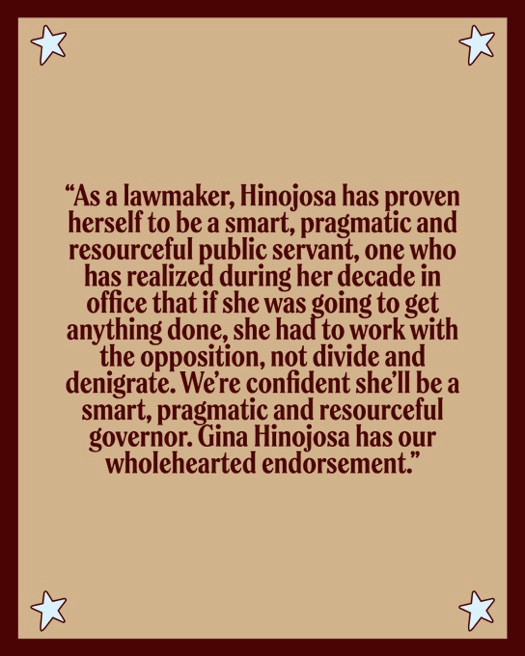
As a lawmaker, Hinojosa has proven herself to be a smart, pragmatic and resourceful public servant, one who has realized during her decade in office that if she was going to get anything done, she had to work with the opposition, not divide and denigrate. We’re confident she’ll be a smart, pragmatic and resourceful governor. Gina Hinojosa has our wholehearted endorsement.
Mary L. Trump is Donald Trump’s niece, the daughter of his late older brother. She knows him well. She is a trained psychologist. She has beeen earning the world about him since early in his first term. It’s safe to say that she loathes Uncle Donald.
Hello, and welcome to this week’s episode of Trump Trolls Trump. It has been 635 interminable days since Inauguration Day, January 20th, 2025. But there’s good news. The midterm elections are just 17 days away. So first up, make sure your voter registration is up to date. And if you can vote early, please do so. As always, we are here to ridicule and mock mercilessly this inept, corrupt, and dangerous regime.
Let’s dive right in with a truism that has become increasingly difficult to deny. Donald lies like most people breathe. In fact, I think in some cases he lies more fluently than I breathe. It’s second nature to him at this point, or maybe it’s just his nature.
Sometimes those lies get us into serious trouble. Earlier we saw Donald promising, as he has done time and time and time again, that he would bring energy prices down by 50 percent. That hasn’t happened. And actually the very opposite has happened because his war on Iran, his war of choice, has helped drive energy prices up across the board.
I think it’s worth remembering that Donald lied about this too, because back in 2024 when he was asking Americans to put him back in the White House, which sadly 78 million of us thought was a good idea, this is what he had to say.
We will expel the war mongers from our government. Look at Trump. Just look at this guy. He’s going to go to war. He’s going to take us. No, no. Look at me. I’m the one that kept us out of war. I’m the only president that didn’t start a war. I didn’t start a war. Started no war. I was the first president in decades who started no new war. There are wars all over. He said, “Bring back Trump. It’ll all end. It all ended. We had no problem. I’m going to keep you out of wars. I kept you out of wars. We had no wars with Donald Trump as your president. Remember when crooked Hillary Clinton used to say, “He’s going to get us into a war. Look at him. Look at his rhetoric.” I said, “No, my rhetoric’s going to keep us out of wars.
Really? Threatening genocide is not going to keep us out of wars. Oh, wait a second. He’s threatening genocide against the country he went to war with, an unprovoked war of choice. No one knows how long this war is going to last because he keeps lying about that too. In fact, he told us it would be a matter of days or a couple of weeks. It’s been over six months.
The truth of the matter is, although we are actively still at war with Iran, a war that is expanding because Donald has completely lost control of it, we lost simply by getting involved. Back in June, Vice President Baby JD Vance told us that a deal with Iran was just around the corner. So it isn’t just Donald who is lying to our faces about how things are going. This is Vance in an interview with Robert Costa on CBS’s Sunday morning recorded on June 9th.
Right now, I feel that we are in a position to get a deal that is good for the United States economically and that really does deal with the Iranian nuclear program, not just now, not just while Donald Trump is president, but for the long term, to where my kids can say when they’re adults, Iran is not going to have a nuclear weapon. That’s the goal of the policy, and I think we’re very close to achieving that goal, but we still got some wood to chop and we’re going to keep doing it. You say very close. How soon could the deal happen before the midterm elections? Oh, absolutely. No, I think we’re going to know a lot before the midterm elections. Look, I think that the deal could happen in the next week, but the deal could also happen months from now.
Well, it’s not like there’s much difference between a week and months from now. Before the midterm elections though, absolutely, which as I mentioned, are only 17 days away. Also, remember the goal of this war is to make sure that Iran doesn’t have nuclear capability. And if that’s really what Donald and his ilk were interested in, then guess what he shouldn’t have done? Rip up the Joint Comprehensive Plan of Action, or the Iran nuclear deal, which actually had Iran agreeing not to develop nuclear weapon capability. These guys cannot win for losing.
Speaking of which, back in April, South Carolina Senator Tim Scott appeared on Fox Business with Maria Bartiromo. Remember her? I mean, I know she is much missed and lamented, but Scott’s message was simple. Sure, the war is raging kind of out of control. Sure, prices are rising, but don’t worry your pretty little heads about that. Everything’s on track. And we of course have Donald to thank for all of that. Scott had another message for the American people though, and this is what it was.
Great news, by the way. The fact of the matter is that all of the cylinders are kicking. It is good news. You can even feel in our environment how good things are getting. Gas prices continue to come down, which means that your groceries will come down a little bit as well. We’ve got a lot of good signs in the economy. We just need to continue to execute and have confidence in the choices the American people have made by making President Trump their president and keeping Republican majorities in both the House and the Senate. Let me just say for the average person in the country, President Trump loves you.
Well, I don’t know. Does he? Considering he doesn’t know what love is, I find that highly suspect and untrue. Gas prices are coming down, aren’t they? Well, no, they’re not, because Brent crude oil is now over 105 dollars a barrel, which translates to diesel, the stuff that trucks need to get around, at 6.27 dollars a gallon. So I don’t think Donald loves you. The economy is not doing well.
As I mentioned, with the midterms this close, I can’t wait until I can actually say the midterms are two weeks away. But Donald, he’s not quite taking in what’s happening. How does he think things are doing? How does he think he’s doing? Because really, that’s the only thing he’s concerned about. Well, let me ask you this question. If Donald were asked to grade his own performance on the economy, what grade do you think he would give himself in the midst of economic catastrophe?
We’re doing an unbelievable job. Costs are coming way down. I inherited very, very high costs and they’re all coming down now. The food, the groceries, it’s all coming down. We’ve done a great job. I think we should be giving an A plus on the economy, but I think it’s coming. People are starting to talk about it.
Interviewer: I do want to talk about the economy, sir, here at home, and I wonder what grade you would give.
A plus, Donald responds.
A plus, the interviewer repeats.
Yeah. A plus, plus, plus, plus, plus, Donald says.
Well, it makes sense that he would give himself a grade that doesn’t exist. Now, Donald is laser focused on the needs of the American people. He’s working day and night to make sure that our lives are improved. I mean, you can tell by the fact that crews are working around the clock to get the ballroom built. That’s not making my life better. He’s making oil deals with Russia to help refill their much depleted coffers to aid them in attacking our ally Ukraine. That’s definitely not making my life better.
Unfortunately though, according to him and his enablers, we’re still dealing with the damage Joe Biden left behind. Donald has a few words for his predecessor. Donald has told us that he is working his considerable ass off.
He has one ability I don’t have. He sleeps. He can sleep. This guy goes on a beach and he lays down on one of those beach chairs. They weigh six ounces and he can’t lift it, but he has an ability to fall asleep while on camera. He can lie down on one of those things and in minutes, he’s stone cold out. How does he do it? And he’s got cameras because he’s in prison, so they have cameras on him. And then they show him sleeping on the beach. You’ll never see me sleeping in front of camera. I have to tell you, he’s a different guy. He looks different than he used to. He acts different than he used to. He’s even slower than he used to be. And I wouldn’t say he’s at the top of his game. Would you think their message is Sleepy Joe because he’s not all there? Right now, I think I’m sharper than I was 25 years ago, but who the hell does? You’ll never see me sleeping in front of Joe.
I mean, that’s the reaction to listening to Donald talk about himself because I have never seen a sleepier person. That hypersomnia is not a good thing, but it’s so much nicer when he’s sleeping, isn’t it? Again, as we’ve talked about before, Donald is a master of projection, and clearly when he’s talking about Sleepy Joe Biden, he’s talking about himself because I have never met such a hypersomnolent person in my life. Although to be fair, sleepy Donald is my favorite mode of Donald.
I want to turn now to Donald’s relentless crusade against corruption. Wait a minute, sorry. Is crusade a synonym for embrace? Embrace of corruption? Well, let’s find out.
We know that Baby JD Vance is in charge of the White House Task Force to Eliminate Fraud, which is fabulous. This was established by executive order back in March. The only thing that surprised me about that is that he didn’t ask Elon Musk or Ken Paxton to head that task force, but we’re talking about criminals here, hardened criminals, and Donald, as is his want, is looking at them very strongly, which is a phrase I still cannot make sense of. I do not know what it means to look at something very strongly. I think Superman was able to do that, but he had laser beams coming out of his eyes.
Now, Donald explains exactly what he has done to crack down on criminality. Before you get excited, it does not mean he’s had himself arrested. As I listen to him describe these criminals, I have a lingering question. You may have the same one, here is what he said:
91 percent of the crime in Washington DC, as an example, was caused by 2.1 percent of the population. These are many career criminals, sick people, mental problems.
Okay. I mean, I know DC’s a small town, but I didn’t think it was so small that Donald comprised 2.1 percent of the population. Oh wait, but it’s not just him. He has a lot of co-conspirators out there. If you add in all of his co-conspirators, then maybe yes, those hardened career criminals, the Vances and the Hegseths and the Musks and the Bessents and all of them might indeed make up 2.1 percent of the DC population, and they are absolutely committing over 90 percent of the crime there.
As we approach the midterms, please, please make sure your voter registration is up to date and know where your polling location is. Check both of those things repeatedly because people can get struck off the voter rolls without their knowing it right before the election, and sometimes polling places change. Republicans are going to pull out all the stops, so we need to stay on top of this.
You don’t want any surprises when you go to vote on election day if you vote in person. A lot of states offer early voting, so check your options and if you can vote early, please do so. I am one of those people. I’m old school. I like to go vote on election day, but vote early, vote by mail in states where you still think that’s the safe thing to do.
And when you step into that voting booth, remember how we got here and who brought us to this very dark time in our history. Encourage other people to vote and remind them that Donald himself said he wants us to pretend he’s on the ballot. So that’s very clear. Vote Democratic up and down the ballot.
“I can always say that the next president will get a lot of credit for what I’ve done. Please remember it was me, not them,” Donald says.
Oh, we will remember. We will remember. And as we’re remembering, we are going to tear down everything on the planet that has your name on it.
Thank you so much for joining us for Trump Trolls Trump week 91. Remember, mockery is our superpower, and we will be here every single week to call out the hypocrisy, the ineptitude, and the outright corruption of this incredibly dangerous and misguided regime.
After almost two years of Trump’s second term, we know he is not wiser or more efficient than a democratically elected leader. Indeed, he is most assuredly less wise and less efficient than any democratically elected leader.
He repeatedly makes decisions that drive up prices and impoverish American citizens, while cutting taxes for the richest Americans.
He launches vendettas to pursue and punish anyone he dislikes.
He has built tributes to himself and hung giant flags on government buildings to celebrate his face.
He has virtually destroyed the John F. Kennedy Center for the Performing Arts.
He has gilded the austere and elegant Oval Office by covering it with gold doodads.
He speaks at public events with crude and vulgar language that demeans the Presidency.
He has alienated our allies and honored our adversaries with his fawning friendship and obsequious admiration.
He has attacked and insulted the free press.
We do not need a king or a dictator.
We need leaders who honor the Constitution and uphold the rule of law.
This Saturday is “No Kings” day across the nation.
Find a group standing up for democracy and the rule of law and stand with them. March with them. Honor the best in our ideals.