Archives for category: Unions

This is one of Randi Weingarten’s best speeches. She delivered it at the 2026 Convention of the American federation of Teachers on July 26 in Washington, D.C.

Not only does she identify income inequality as a dire threat to our democracy, she speaks one of the greatest lines I have ever read:

Mr. President, you don’t own July Fourth. You own Jan. 6.

Randi points out that the dramatic income inequality of our times is destroying the middle class. Unions build a strong middle class. The large increase in the number of billionaires is it a sign of a healthy society; it is a sign of gross inequality.

As more people slip out of the middle class or hang on by their fingertips, our social problems get worse.

How do we restore a thriving middle class? Encourage the growth of strong unions.

She reminds us that today only 1 of every 10 workers belongs to a union. Union workers are paid more, significantly more, than non-union workers. In mid-century America, when 1 in 3 American workers were in a union, we had the largest middle class and the lowest income inequality. And she says, “That’s why, in the long term, growing the union movement is key to solving America’s affordability crisis.”

Rightwingers have done their best to eviscerate unions. And they have won significant victories in the courts.

But, despite the obstacles, the AFT is growing. It now has the largest number of members in its history: 1.875 million members. Al Shanker and Sandy Feldman would be proud of that accomplishment.

Unions are key to a better life.

Randi said in her address:

We plan our conventions years in advance. When we decided to hold this convention in our nation’s capital, to coincide with the celebration of America’s founding 250 years ago, who would have thought that the grievances that led to the American Revolution would be so relevant and relatable today? Or that America would have a new kind of aristocracy based on mind-blowing wealth? 

In the United States, there are now 1,000 billionaires—and the world’s first trillionaire—at a time when nearly half of American households—46 percent—don’t earn enough to make ends meet. 

This wealth imbalance—the top 1 percent having as much wealth as the entire bottom 90 percent of Americans combined—has led to a power imbalance that affects the lives of everyone in our country. These oligarchs influence policy. They have the power to undo social progress. To sway financial markets, monopolize the media, buy elections and undermine democracy.

In an earlier period of extreme wealth inequality, the country elected Franklin D. Roosevelt, and his New Deal programs lifted millions of Americans out of poverty.

This time, the country elected Donald Trump, and well … 

Remember that warning—about the barbarians at the gate? Well, the barbarians aren’t at the gate, they are inside, including at the highest levels of government. 

The president and his cronies are abusing government powers to punish political opponents. Every day they find new ways to attack voting, presumably to entrench themselves. Their war on working-class Americans includes stripping collective bargaining rights from 1 million federal workers, including members of our union, in the biggest act of union-busting in U.S. history. All while engaging in the most blatant corruption in modern American history to enrich themselves. 

The attacks—on unions, on working people, on public education, on higher education, on the public good, on democracy—didn’t start with Trump. They’ve been decades in the making, going back to the 1971 memo by future Supreme Court Justice Lewis Powell that successfully plotted corporate dominance in American politics. And the Supreme Court’s 2010 Citizens United decision that fueled the massive surge of “dark money” in elections—which has now been supercharged by the court’s ruling last month that blew up whatever campaign finance limits were left. And its 2018 Janus decision that anti-union forces hoped would drive a stake through the heart of public sector unions. Project 2025 became the playbook to enact this extremist agenda. This year’s Callais decision not only gutted what remained of the 1965 Voting Rights Act but did so in time to affect the 2026 elections. Then there’s the bare-knuckled crusade to destroy public education and higher education. Just look at Christopher Rufo’s tweets, or his unabashed declaration years ago that “To get to universal school choice, you really need to operate from a premise of universal public school distrust.”

And I haven’t even gotten to Big Tech and artificial intelligence.

Yes, the other side has enormous power. But this is what they don’t have: the power of the people. 

That’s not a mere slogan; it’s the potential to work together, to bargain together, to protest together, to vote together, to act together to bring about change—real, lasting, life-improving change. That is the power and potential of our movement and of the AFT.

Our union stands at the intersection of the ways that regular people gain and exercise power in our democracy—through public education, unions and voting. 

The skills and knowledge people secure through public and higher education expand opportunity—that’s power. Union contracts improve economic well-being—that’s power. Elections—voting for people who answer to their constituents, not wealthy donors—that’s power. 

It’s power not just for ourselves, but for our students, our patients and our communities. Power to build what Martin Luther King Jr. called the “beloved community”—an America where hate has no home. Where the trans nurse, the Palestinian teacher, the Jewish student, and every person regardless of race, religion, ethnicity, gender or place of origin, feels welcome, safe and valued.

We use our power for good—against chaos, cruelty and corruption. We care, we fight and we show up—for a better life for all. Oh, and one more thing: We get shit done! 

We are a fighting union. To quote the president of Texas AFT, Zeph Capo, “Our members will forgive us if we fight and lose, but they’ll never forgive us if we don’t even fight.” 

Look at what we have fought for, and won, in these last two years—despite constant challenges.

Through the AFT’s student debt clinics and our other activism, we have helped more than 1 million borrowers, many of them our members, get $78 billion in student debt forgiven! That is life-changing; people can start a family, buy a home, save for retirement. 

The AFT has filed more than 25 lawsuits against the illegal actions of the Trump administration. If I talked about all of them, I would blow everyone’s bets on the length of the speech. So here are just a few: The Trump administration tried to stop any school—pre-K through college—from doing anything that could be construed as advancing diversity, equity and inclusion, essentially erasing 60 years of civil rights law. And it sought to condition all federal funding for schools on compliance with its dictates. We sued, and we won. We challenged the administration’s policies to detain and deport noncitizen students and faculty for participating in protected political speech. Again, we won. We sued to stop the administration from stripping federal funding from universities and to stop its efforts to control curriculum, hiring and speech. You guessed it—we won.

And then there’s the collective bargaining victories. Like for better wages—from Boston to Kansas City, from Chicago to Los Angeles and so many more. That’s the union difference: Union workers’ wages are 11 percent higher than nonunion workers. Unionized teachers earn 24 percent more in states with collective bargaining, and education support professionals earn 13 percent more.

And as we speak, the city council in New York City is voting to provide every United Federation of Teachers-represented paraprofessional a $10,000 “Respect Check” that the union has relentlessly fought for. 

Life is better with a union.

It goes beyond wages. Take the United Educators of San Francisco, whose successful strike this year led to winning premium-free healthcare not only for members but for their families. 

And paid parental leave. Kudos to our affiliates in Boston, Chicago, Cleveland, Fairfax County (Va.), New York City and Oregon for making great strides to help families thrive. 

And safe staffing. The UFT has had some incredible wins through arbitration. And in New Jersey, our healthcare union, Health Professionals and Allied Employees, has negotiated 14 contracts in a row with enforceable safe-staffing provisions. And now one of our newest affiliates, Hawaii Nurses and Healthcare Professionals, has created a broad coalition to do the same. 

And we have a sacrosanct commitment to retirement security. After a generation-long battle, we won passage of the Social Security Fairness Act that gave millions of public workers the full benefits they had earned but been denied. Our New York unions made great progress this year to fix Tier 6; now younger workers who had inferior pensions can retire in their late 50s. And AFT Massachusetts, AFT Pennsylvania and our Alaska affiliates are making progress on retirement security as well. 

There’s also what we have fended off. The Philadelphia Federation of Teachers reached an agreement to stop the cuts of 340 school-based positions for the coming school year. In Utah, a labor coalition including AFT Utah gathered more than 250,000 signatures and got the Legislature to repeal a ban on public sector bargaining. AFT New Hampshire has a mean game of whack-a-mole—defeating right-to-work, school vouchers and campus carry legislation, and successfully challenging a law that restricted teachers’ rights to teach and students’ access to honest history. In New York, our unions—United University Professions and the Public Employees Federation—and a broad community coalition successfully fought to keep SUNY Downstate hospital open after years of threatened closure, and they secured $1.1 billion to upgrade and expand facilities and services. 

These are fights we’ll have to keep waging. The Republicans’ Big Ugly Bill cuts $1 trillion in Medicaid, makes the largest cuts to nutrition assistance in history, triples the cost of student debt for tens of millions of Americans, and threatens hundreds of rural hospitals with closure—all to give $1 trillion in new tax cuts to the richest 1 percent. State and local budgets are seeing the strain. We’ll keep fighting, school district by school district and hospital by hospital. 

Then there is artificial intelligence—the most seismic industrial revolution of our time. From UUP in New York to the University Professionals of Illinois, we’ve won strong contract language so AI won’t be used to take our jobs, replace our professional judgment, or evaluate or discipline us.

And density matters: Like New York State United Teachers in education, Oregon’s density in healthcare is making a difference. The Oregon Federation of Nurses and Health Professionals secured the largest raises in its history—nearly 35 percent over four years for registered nurses. And OFNHP and HNHP in Hawaii have aligned all their contract expiration dates for the next Kaiser battle. 

And then there is the protection of our students, our patients and our neighbors from brutal immigration tactics, like the recent fatal shootings by ICE agents in Texas and Maine of two men who should be alive today. Healthcare locals in Oregon won legislation to protect healthcare facilities from immigration enforcement. Educators across the country have fought for their students’ release from U.S. Immigration and Customs Enforcement detention centers. Our Twin Cities union family peacefully and courageously stood up to the occupation and harsh immigration enforcement that led to the killing of Renee Good and Alex Pretti and terrified thousands of immigrant families. We were there with mutual aid—food, diapers, rent money, books, toys and safe passage for children to and from school. 

The AFT is always at the ready to help—like with our program for states and locals in crisis. Right now, we are helping our members in Florida, who are in the bull’s-eye of anti-union attacks intended to wipe them out. Let me be clear: We are with you every step of the way. And we’re investing in our affiliates through our MOVE grants, which affiliates are using as fuel to engage members, connect with community and strengthen their power. 

This is what the power of the people looks like: caring, fighting, showing up and getting shit done. 

This administration is waging a war on knowledge, from school voucher schemes, to erasing rather than facing history, to selling the Department of Education off for parts, to its all-out assault on higher education. Here, too, we’re not just fighting back; we’re putting forward big ideas. 

The AFT and the American Association of University Professors have launched a national higher education campaign. We’re fighting to keep vital research funded and against attacks on academic freedom. We won collective bargaining rights for higher education employees in Maryland and made strides toward free college in Connecticut and Pennsylvania. In April, the AFT and AAUP released “A Blueprint for Strengthening and Transforming Higher Education”—and we launched it in Texas, because that is ground zero in the attacks on critical thinking. 

Through AFT Healthcare’s Code Red campaign, we’re working to secure safe staffing limits, enforceable workplace-violence standards, and contracts that help recruit and retain frontline caregivers. That’s good for patients and for healthcare workers.

And on AI, we have a multifaceted plan: from limiting screens and child-facing AI for young students, to a tech tax to hold tech companies accountable for the massive disruptions their products are creating, to contract language, to our National Academy for AI Instruction to help educators master AI so AI doesn’t master us. AI is not going away, so we’re going to fight for the protections that matter to our members, our families and our communities.

And of course, we give out books, 11 million and counting, to children and families through our Reading Opens the World program.

All this is why the AFT is bigger, badder and more big-hearted than ever.

The AFT is the fastest-growing union in the AFL-CIO. Since our last convention, we have organized 173 more units, with close to 60,000 new members in these new locals. New affiliations have deepened our work in states like Hawaii, Michigan, North Carolina and Pennsylvania. And many existing locals have grown as well. 

I am thrilled to announce that, despite everything that’s been thrown at us, we have hit a historic milestone: We proudly represent more members than ever before. Today the AFT is 1.875 million members strong! 

People see the value of belonging. They see that we’re a fighting union—and that we get shit done! It’s amazing. You are amazing. And we are not going to let up. Too few people have the benefit of a union. 

Half of all nonunion workers want to join a union, but only 1 in 10 workers in the U.S. belongs to a union. Americans are 14 times more likely to have an Amazon Prime membership than to be a member of a labor union.

In the mid-20th century, when 1 in 3 American workers were in a union, we had the largest middle class and the lowest income inequality. That’s why, in the long term, growing the union movement is key to solving America’s affordability crisis. 

But what do we do now? We’ve got to win elections. And here’s why. 

As I said, 46 percent of households—55 percent of households of color—did not earn enough to make ends meet in 2024. And inflation has soared since then. That means there’s not enough to put food on the table, gas in the tank and still cover rent. It means constant stress and struggle. 

Our members see it every day in the people they teach, heal and protect. 

And our members feel it.

This winter we surveyed AFT members about the financial issues that keep them up at night, and 7,500 responded. Nearly three-quarters report living paycheck to paycheck, and more than a third say they are unable to cover all of their monthly bills.

There are few things worse than the fear of not being able to provide for your family. Reading our members’ responses took me back to my teenage years when my father was laid off. I remember my parents whispering about which bills they had to pay now and which they could hold off on until he found work. They tried to protect my sister and me from knowing, but there’s no hiding anxiety that deep. 

Millions of Americans believed Trump’s promises to end inflation and make America affordable again on “day one.” It’s “day 542” since he took office. Is anybody paying under $2 a gallon for gas like he promised? What happened to the “DOGE dividend checks”? Or your tariff rebate check? After they got rid of the Obamacare tax credits, have they fixed healthcare? 

Trump isn’t worried about being able to afford healthcare, housing or anything else. Since returning to the White House, he has raked in more than $2.2 billion, through what government watchdogs call unprecedented corruption and self-dealing. 

The president has called the affordability crisis “bullshit.” And he has said, “I don’t think about Americans’ financial situation.” But he has made it worse.

Trump’s tariffs sent the strong economy he inherited into a slump, even with an AI bubble. His trade wars are costing American families $1,000 more every year. He started a costly war against Iran that has left us worse off than when it started. Trump said taxpayers wouldn’t pay “one dime” for his ballroom, but it turns out we’re on the hook for hundreds of millions of dollars. 

We’re not holding our breath for the president to deliver on his promises to lower costs. We’re fighting for economic security and to put more money in our members’ pockets—like the 1 million borrowers we’ve helped get Public Service Loan Forgiveness relief. Our Fight for Affordability builds on that work, with resources to help navigate medical and credit card debt and on other support people are legally entitled to but may not know about. 

And we are working with allies in Congress on bold solutions, like increasing the minimum wage to $25 and passing the Working Americans’ Tax Cut Act, which would exempt 104 million lower-income adults from federal taxes—paid for by millionaires paying a fairer share. We’re pushing for increased funding for public schools and colleges. We’re fighting back against the draconian cuts to Medicaid and to rural hospitals. Millions of children risk going hungry because of the heartless changes to the Supplemental Nutrition Assistance Program in the Big Ugly Bill; we are fighting for every single one of them. 

But we need majorities in statehouses and in Congress this year, and ultimately the White House, to secure the foundational changes we seek.

Threats to Democracy

We face another grave danger: dire threats to democracy. I know, some of you are thinking, here she goes. But really, when is the erosion so much that we can’t get our freedoms back? 

I remember the scoffing when terms like “authoritarian” were first used. And I have been asked repeatedly about why I used the term “fascist” in the book I wrote, Why Fascists Fear Teachers. 

Unfortunately, the answer is clearer every day. 

I don’t actually care what you call it, but I care very much about what Trump is doing. He is weaponizing the justice system to target political opponents, journalists and dissenters. He is sending armed forces trained for war to police American cities, especially to Democrat- and Black-led cities. He is using the presidency for his own benefit and to enrich himself and his family. He is trying to obstruct free and fair elections to maintain power. 

Donald Trump keeps trying to overturn the results of the 2020 election. He urged on the Jan. 6 rioters and pardoned even those who brutally attacked officers bravely protecting the Capitol. 

He is aggressively testing the legal and constitutional limits of presidential power. 

Then there are the lies. It started with crowd size but now he lies about everything—about election results, the economy, his critics, the war in Iran. Even the botched paint job on the Reflecting Pool. 

And sadly, instead of uniting the country to celebrate the great American experiment of democracy, what did Trump do for the 250th? He held what he described as “the most spectacular TRUMP RALLY of them all.” 

Mr. President, you don’t own July Fourth. You own Jan. 6.

I speak and write about democracy a lot because education is vital to understanding, and understanding is vital to acting. If we don’t heed the warnings from the generals who worked for Trump in his first term; if we don’t recognize the hallmarks of authoritarianism—fear, division, isolation and apathy; if we don’t learn the lessons of tyrants, how do we the people have the shared understanding and the urgency to organize and mobilize for democracy to work for working people. 

As I wrote last year, fascists fear teachers because they fear a well-educated citizenry. They fear what educators do—the teaching of critical thinking, of honest history, of pluralism—because their brand of greed, power and privilege cannot survive in a democracy of diverse, educated citizens. We see it in the book bans. In the attacks on DEI. In the efforts to control what schools and universities can and cannot teach. And in the attempts to rewrite and whitewash history. 

To be clear: Fascists don’t just fear teachers—they fear, loath and try to silence all of us who stand up for democracy, dignity, fairness and opportunity for all. 

And stand up we must. 

Americans are losing faith in democracy. Seven in 10 U.S. adults say they are dissatisfied with the way democracy is working in the country. Young Americans in particular feel the country is on the wrong track. 

I understand the disappointment. But we cannot give up on democracy. Winston Churchill was right when he said in 1947, “Democracy is the worst form of government except for all those other forms that have been tried.”

But we must improve it. As John Dewey said, “Democracy has to be born anew every generation, and education is its midwife.”

Look at where democracy is being born anew: In Hungary, where this spring 80 percent of voters turned out to reject Viktor Orbán’s far-right agenda, ending his 16-year grip on power. In South Korea, where labor unions spearheaded mass protests and nationwide “strikes to defend democracy” after the president declared martial law. And here at home, at May Day and “No Kings” protests in small towns, suburbs and cities across America, where millions of people turned out to say we will not stand by while democracy is dismantled. 

We are not helpless to change what is wrong. We can build a better future and a stronger democracy. But that requires winning in November. 

Elections

As big and bad and big-hearted as we are, neither bargaining nor bullhorns alone will get us out of these treacherous times. 

To get a working-class tax cut, to pass living-wage legislation, to get limitless money out of politics, to fix the healthcare system, to strengthen education, and to restore vital safety net and climate programs, we have to win majorities in 2026 and the White House in 2028. We have to elect people who support working people, leaders with real plans to make life better. 

Strengthening public schools and stopping the reckless runaway train that private school vouchers are becoming should not be a partisan issue. Ensuring everyone who works can earn a living wage should not be a political issue. Fighting so everyone has access to high-quality, affordable healthcare should be a human priority, not one party’s priority. Shoring up Social Security to keep seniors out of destitution should have universal support. Addressing the climate crisis that threatens all humanity should unify all humanity.

Perhaps one day these issues will be bipartisan. 

But sadly, the reality is that since Trump’s first term, Republican officeholders’ support for our priority issues averaged just 8 percent, while Democrats averaged 95 percent. Do I wish that was different? Of course. And do I wish Democrats were bolder? I do. But Republican leaders don’t even seem to want to try. 

This election will decide whether we are a country governed by the people or ruled by the powerful. A country of opportunity or oligarchy. A country whose people live in freedom or in fear. 

Do we want a future where billionaires and a trillionaire continue to grow their wealth at the expense of working people? Or one where working people earn a decent wage, support their families and take a vacation once in a while? 

Do we want a future in which classrooms lack resources and life-changing research is abandoned? Or one in which we can nurture the potential of every student and continue to lead the world in bold discoveries? 

Do we want a future where big healthcare corporations put profits over people? Or one in which every person—every person—has access to healthcare, and healthcare professionals have the resources, staffing and power to help their patients? 

Do we want a future ruled by tech bros and robots? Or a future grounded in dignity and humanity? 

Do we want a future in which elections are rigged to maintain one-party control and government is for sale to the highest bidder? Or one in which every person’s vote matters and government serves the people? 

That’s what’s at stake in November 2026. And the future we want is within reach. We can win majorities in the House and in the Senate and in state capitals. Majorities who will act on our priorities. 

But only if we vote, get others out to vote, and protect the vote. That’s why we are committing to our most ambitious election program ever.

Here’s the math: 1.3 million AFT members and their families live in a place where there is a competitive race in November. 600,000 of us are in battleground gubernatorial states. 464,000 live in the states with the seven top U.S. Senate battleground races. We need to flip four seats to win a Senate majority that works for working folks. And we have more than 1,000 members and voting family members in 86 critical, competitive congressional districts. We only need a net gain of three seats to win a working folks’ majority in the U.S. House. Can we do it?

With the AFL-CIO, we have a goal of reaching 2 million new voters. That means the AFT has to turn out about 200,000 more householders than in the last election. That means we need 28,000 volunteers to make calls, knock on doors and get out the vote—28,000 out of 1.875 million. Can we do it?

And it’s not just about getting out the vote in this election but also about protecting the vote. That’s why we are launching a new Democracy Defenders election protection program. We are recruiting 5,000 members to make sure that people can exercise their right to vote free from intimidation. Our Democracy Defenders will be part of the 50,000 people the AFL-CIO is recruiting for this critical work. Can we do it? 

People power can win, but we need to be all in, and that means we need you to be all in. No one can do everything, but each of us can do something to win in November and achieve the better future we fight for. 

So are we going to vote? Are we going to get out the vote? Are we going to protect the vote? 

Conclusion

That’s the energy and commitment we need to achieve the America we dream of: An America where everyone has opportunity and economic security. An America where everyone’s dignity and freedoms are respected. An America whose democracy not only endures but finally lives up to its noble ideals. 

I’ve spoken often this year about Martin Luther King Jr.’s final book, Where Do We Go from Here: Chaos or Community? Since January 2025, we have experienced a lot of chaos, fear and division. 

Lately, I find myself drawn to another piece of King’s wisdom—that the “arc of the moral universe is long, but it bends toward justice.” I still believe that, and I hope you do too. 

But the arc doesn’t bend on its own. It bends toward freedom and opportunity through the work you do every day making a difference in people’s lives—in classrooms, at the bedside, in our communities. You bend the arc. Unions bend the arc. Voting bends the arc. The power of the people bends the arc toward justice.

On this 250th anniversary of our nation, that is our responsibility. That is what I am asking you to do, what I am asking us to do—this bigger, badder, big-hearted union and our 1.875 million members. 

And when we do, when we bend that arc, we will change the trajectory of our nation and secure a better future for all, from sea to shining sea. Thank you. 

Watch the full speech

https://www.aft.org/media/oembed?url=https%3A//youtu.be/oIASmJ3ZO70&max_width=0&max_height=0&hash=Sadl1eN7tbOr37C7SenWNH-Hx34YmVOAuIc7CHYyQyQ

John Thompson, historian and retired teacher in Oklahoma, thought that AFT President Randi Weingarten’s recent speech on the dangers of technology in the classroom was balanced and thoughtful. Yet the Trump administration attacker for raising valid questions. Trump and McMahon have such a knee-jerk aversion to unions, especially the teachers’ unions, that they had to attack her, even if what she said made sense.

Thompson wrote:

Randi Weingarten, the head of the American Federation of Teachers (AFT), gave an impressive speech at the National Press Club, explaining that students are “drowning in tech,” and they “need their teachers, real human beings, not robots and not chatbots.”

As I will explain, Weingarten’s presentation synthesized both – scholarly research and communication with diverse groups of educators and AI users. It was a perfect example of bridging political differences. When I first read the transcript of her plan, I thought it would be hard to understand how anyone who wants to improve education would not want to join her team effort to make life better for young people in the 21st century.   

But, not surprisingly, I was wrong. The Trump administration then attacked Weingarten because early in the Covid pandemic, the AFT pushed for safety measures before reopening schools.  It ignored her research and recommendations, and claimed that Weingarten “is the last person who should be weighing in about what is best for American students.”

When NewsMax interviewed Linda McMahon after Weingarten’s presentation, McMahon first criticized Weingarten for closing schools during the Covid pandemic (although the truth was that she proposed science-based protections to facilitate safe school openings.) Then, McMahon effusively praised AI in classrooms. Then the discussion returned to condemning unions for suposedly placing the good of teachers over that of students.

And Weingarten’s speech on AI was also condemned as a part of an AFT policy that “lines up perfectly with the ‘China First’ agenda.” And the AFT was accused on Substack for “evolving into some type of content-policing organization.

But, getting back to Weingarten’s speech, NBC reported that she called for blocking most students from using computers in class until they reach third grade, and controlling Artificial Intelligence (AI) programs that are designed to act like real people. She would thus prohibit “student-facing AI in elementary schools” and ban “social companion (chatbots) until age 16.”

Weingarten further explained, “I’m  wary of the dangers of AI, but it is here to stay.” 

NBC News also reported that Weingarten proposed an “independent research consortium to study the effects of AI and screens on student learning.” She explained, “I am not calling for an AI ban or a Chromebook bonfire,” … “What I am calling for is getting the balance right to harness the benefits of technology while mitigating the harm.”

NBC further explained that “some states recently began limiting school-issued devices for the youngest students, and a handful of school districts crafted policies this year to scale back technology in the classroom.” But, “many states and districts are also rushing to require AI literacy education for students, and AI in schools is rising.”

That reporting connects with Dana Goldstein’s recent reporting that “across the educational landscape, from suburban districts and urban charter schools to community colleges and the Ivy League,” schools are pushing back against misuse of A.I. Unfortunately, though, “schools serving low-income students … are often under the most pressure to show that they are embracing innovative technology and preparing students for the working world, where it may soon be standard to rely on generative AI.”

Weingarten’s narrative was also consistent with what the Washington Post recently reported, “Most teachers use artificial intelligence, but relatively few — just 18 percent — have received any formal guidance on how to use it.”

Seeking multiple perspectives, Weingarten had recently visited a school where they used Sal Kahn’s AI for teaching. Khan once predicted it would be a “revolution” in learning, but now he acknowledges, “So far, the revolution hasn’t happened,” and AI tutoring “doesn’t necessarily make students motivated to learn or fill in gaps in knowledge needed to ask questions.

Kahn concluded, “I think our biggest lever is really investing in the human systems.”

An educator at that school also explained, “there’s been more enthusiasm for the product among administrators than teachers in her school.” Moreover, some of the “most advanced students have taken advantage of AI to learn new topics. But, as far as she can tell, more students are using it to just find answers, which has created a massive headache for teachers.”

Weingarten  also drew on research funded by the AFT, and supported by Anthropic, Microsoft, and OpenAI showing that:

Critical thinking is directly connected to the content in math, history, and science classes. This is an essential reality often absent from discussions about how schools should respond to the spread of generative AI.

Indeed, the common refrain that teachers should focus on abstract critical thinking skills, disconnected from content, risks de-emphasizing the very thing — fluency with a broad set of facts — that supports critical thinking.

“Domain knowledge is a crucial driver of thinking skill,” wrote University of Virginia cognitive psychologist Daniel Willingham in 2020 for the American Educator, a publication of the American Federation of Teachers. “Critical thinking for open-ended problems is enabled by extensive stores of knowledge.”

And Weingarten challenged a number of Democrats, saying that “too many want to resurrect the failures of high-stakes testing, [and] are pushing privatization.” 

After following the AFT’s footnotes, learning from the evidence Weingarten drew upon, and the insights she gained from educators, I agree with Diane Ravitch, who wrote, “Randi has given many speeches. This is one of her best.” 

I see no way we can deny that AI is dangerous, especially for children, and that we must come together in a nonpartisan way to reduce its harms, while building on its strengths. I see no rationale for seeking simple solutions. And any solutions require listening to a broad spectrum of outlooks.

Regardless of what others see as other causes of the decline of meaningful learning, what sense does it make to attack Weingarten’s efforts to address this rapidly emerging crisis?

I’d argue that today’s attacks make no more sense than the rightwing’s refusal to work with Weingarten’s to build the infrastructure necessary for opening schools during Covid. 

The big money promoting privatization in Denver tried to capture the Denver school board, but was defeated by candidates endorsed by the Denver Classroom Teachers Association.

Chalkbeat Colorado reported:

Denver school board candidates backed by the teachers union won all four open seats Tuesday, unofficial election returns show, making it likely the board’s current balance of power will hold.

Eleven candidates were vying for four seats on the seven-member Denver school board.

Union-backed candidates won by commanding leads in three of the races and a solid lead in the fourth, according to unofficial returns. Two of the three incumbents who ran for reelection, Michelle Quattlebaum and Scott Esserman, lost their seats.

Teachers union-backed board members have controlled the board of Colorado’s largest school district for the past six years. Members who support charter schools and other education reform strategies gained a bigger foothold in 2023 and had a chance to flip the board majority this year.

Now, the board will continue to be composed of four members who were endorsed by the teachers union and three who were backed by reform interests.

Denver Classroom Teachers Association President Rob Gould called the early returns on Tuesday a victory of “people over money.” Like in past elections, reform groups were on track to outspend the teachers union, according to the latest campaign finance reports.

Happy Labor Day!

This is a day to thank working people for their contributions to our society. It’s a day to thank unions for providing a path to the middle class to help those who need pensions, decent wages, and job security.

Trump is celebrating Labor Day by banning unions at several federal agencies.

Government Executive reports:

President Trump on Thursday signed a new executive order targeting unions at more than half a dozen agencies, again under the auspices of national security.

The edict, which was published within minutes of Trump’s proclamation marking Monday’s Labor Day holiday, appends a March edict that seeks to outlaw collective bargaining for two-thirds of the federal workforce, citing a seldom-used provision of the 1978 Civil Service Reform Act allowing the president to exclude agencies from federal labor law if the law “cannot be applied to that agency or subdivision in a manner consistent with national security requirements.”

Thursday’s order would ban collective bargaining at the International Trade Administration and the Patent and Trademark Office within the Commerce Department; the National Oceanic and Atmospheric Administration’s National Environmental Satellite, Data and Information Service and the National Weather Service; as well as NASA and the U.S. Agency for Global Media. It states that all these agencies “have as a primary function intelligence, counterintelligence, investigative or national security work.”

Matt Biggs, national president of the International Federation of Professional and Technical Engineers, whose union represents a portion of NASA’s workforce along with the American Federation of Government Employees, suggested that the administration’s targeting of NASA—IFPTE’s largest union—was in retaliation for its own lawsuit challenging the Spring iteration of the executive order, filed last month.

“It’s not surprising, sadly,” Biggs said. “What is surprising is that on the eve of Labor Day weekend, when workers are to be celebrated, the Trump administration has doubled down on being the most anti-labor, anti-worker administration in U.S. history. We will continue to fight in the courts, on the Hill and at the grassroots levels against this.”

The National Education Association analyzed Trump ‘s proposed budget and finds that it contains deep cuts and massive support for privatization by promoting vouchers and charter schools. The proposal mirrors Project 2025 by turning Titl 1 for low-income students and IDEA funding into block grants that can be converted to vouchers. The overall goal is to undermine public schools and cut funding.

FY2026 Budget Request Slashes Education Funding, Shortchanges Students

…………………………………………………………………….……….

President Trump’s FY2026 “skinny” budget request to Congress, released on May 2, cuts non-defense domestic spending by 22.6%.  The Department of Education sustains a $12 billion reduction, a cut of approximately 15.3%. 

! Since the President’s budget does not list specific funding requests for every federal program, the 46-page document is a “skinny” budget. Congress ultimately has the power of the purse, but the proposal is a clear signal of the White House’s priorities: a massive 24 percent cut to U.S. domestic spending, and, privitazing our nation’s public education system.  


 The narrative says the budget “maintains full funding for Title I,” but the numbers tell a different story. Title I and 18 unidentified programs are combined to create a single block grant, dubbed the “K-12 Simplified Funding Program,” then that block fund is cut by $4.535 billion cut.


 All seven Individuals with Disabilities Education Act (IDEA) programs are combined to create a single block grant called the “Special Education Simplified Funding Program.” The approach perpetuates the current shortfall—the federal government now covers 13% of special education costs, far short of the 40% Congress promised when the law was passed. 


 Programs slated for elimination include English Language Acquisition (Title III) and the Teacher Quality Partnership, which addresses the teacher shortage through deep clinical practice. 


 The budget shifts costs to states and institutions of higher education to reduce the federal investment in today’s students—our nation’s future leaders and workforce—as much as possible.  


 Regrouping specific, separate programs into block grants, in theory gives states more flexibility on how the money is spent. In reality, block grants usually lead to less funding and less accountability for our most vulnerable students. As the strings attached to the funding are cut, many states could maneuver block grant funds over to private school voucher programs. 


 Amidst these cuts, the proposal calls for investing $500 million, an increase of $60 million, to expand the number of charter schools across the country. Charter schools, along with private school vouchers, drain scarce resources for traditional public schools. 


May 2025

Randi Weingarten is president of the American Federation of Teachers. She is my friend.

Randi wrote:

President Donald Trump has declared war on America’s colleges and universities, demanding they bow to his demands on what they can teach and whom they can admit or hire. Trump’s illegal and autocratic actions are tantamount to a war on knowledge intended to force schools to bend the knee to his ideology and chill free speech and academic pursuit.

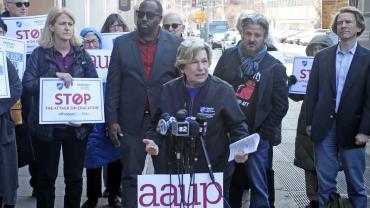
Weingarten announcing a lawsuit to stop the federal funding cuts at Columbia University.
Weingarten announcing a lawsuit to stop the federal funding cuts at Columbia University. CREDIT: AFT

Trump says much of his attack on higher education is in response to antisemitism on campuses. Without a doubt, there was antisemitism before the heinous actions by Hamas on Oct. 7 and the ensuing war, and it has grown since. We need to address antisemitism on campus and ensure Jewish students, and all students, feel safe. But Trump is weaponizing antisemitism investigations to attack disfavored speech and stoke culture wars, distrust and division, and to undermine higher education as a bulwark of democracy and an engine of our economy. It’s wrong, antidemocratic and unconstitutional. The administration is using Jews as an excuse to disappear students who are here legally, with immigration officials arresting and attempting to deport students who have committed no crimes—without due process, a linchpin of American democracy.

This may help Trump’s aim to divide Americans, but it won’t make campuses safer for Jewish students or answer the real issues around antisemitism. That’s one reason that a coalition of Jewish organizations released a statement saying that Trump’s actions make Jewish students and the Jewish community less safe.

Trump has launched investigations into dozens of colleges and universities and stripped billions in research grants from schools. The administration has issued demands ranging from direct government oversight of academic programs—or in the case of Columbia University, oversight of the whole institution—to dictating disciplinary policies and controlling hiring decisions. It is targeting students for exercising their First Amendment rights, and revoking visas for faculty and staff. The administration’s intent is to remake America’s higher education system in its image through blunt force.

The freedom to pursue knowledge, the freedom of expression and the freedom of speech are fundamental American rights that are foundational to a functioning democracy. America’s public schools, colleges and universities cultivate the exploration of knowledge and free expression and empower students to become engaged citizens. One of their hallmarks is that they are a marketplace of ideas where free and open discussion and disagreement is encouraged. That is enabled by ensuring our education institutions are independent from government control or coercion. When a government asserts control over what can be taught, thought or said, democracy itself is at risk.

The free pursuit of knowledge empowers Americans.

Stripping research and innovation funding to force compliance will hurt America’s competitiveness and help our adversaries outpace us in technological and other advancements. America’s university research and innovation centers have long been the envy of the world. The federal government, through federal agencies and grants, is a fundamental powerhouse and supporter of health, scientific, technology and other research. The U.S. is the world leader in this research—research that the private sector cannot and will not do on its own and that leads to discoveries, innovations, cures and advances that benefit the common good and move our society forward. Colleges and universities are also anchors of their local communities, supporting local jobs and small businesses, providing community gathering spaces, and growing industries tied to university research and innovation. 

This war on knowledge and expression must be opposed in the courts, on the streets, and by our colleges and universities.

As the largest union of higher education staff and faculty, the AFT joined our affiliate, the American Association of University Professors, to sue the Trump administration on behalf of our members for unlawfully cutting millions in federal funding for public health research at Columbia.

Last week, Harvard University boldly rejected Trump’s unlawful and unprecedented demands for government control over it. Harvard’s president wrote that “no government … should dictate what private universities can teach, whom they can admit and hire, and which areas of study and inquiry they can pursue.”

Americans have also taken to the streets to oppose this war on knowledge and freedoms. The attacks on higher education were a major focus of the April 5 Hands Off actions that mobilized tens of thousands of Americans across the country to reject Trump’s chaotic and cruel agenda.

The free pursuit and availability of knowledge empowers Americans, strengthens our economy and democracy, and is foundational for opportunity. That’s why we all must take a stand against this war on knowledge.

Only yesterday, I posted a notice about the planned lecture by Dr. Azar Nafisi at Wellesley College on April 15.

Overnight, we agreed that the lecture would be postponed because of a non-tenure track faculty strike on campus. I fervently hoped the strike would be finished before the lecture, but the two sides are currently not close to a settlement.

Non-tenure track faculty voted to unionize as the Wellesley Organized Academic Workers, or WOAW with the United Auto Workers. The strike began March 27.

Dr. Nafisi will not cross a picket line, and neither will I.

The lecture will be rescheduled.

Every once in a while, I read an article that is so important and so powerful that I want to give it as much attention as possible. This is such an article. Please read it and share it. Post the link on every social media site. Send it to school board members and journalists.

The article was written by Dr. Maurice Cunningham, a retired Professor of Political Science at the University of Massachusetts. Cunningham has been studying “dark money” in education for years. It was published by “Our Schools” and “Independent Media Institute.”

If you want to understand the attacks on public schools, on teachers, and on teachers’ unions, read this article. If you want to understand how the organized groups that smear public schools got started, read this article. If you read a story about two or three “moms” sitting around their kitchen table and worrying whether the teachers at the local public school are indoctrinating their children, read this article. If those “moms” raised over $1 million in their first year, read this article.

They have fooled many journalists. Don’t let them fool you!

Cunningham warns:

“These groups are the creation of deep-pocketed conservative networks, not “grassroots” advocates.

By Maurice Cunningham

“If your mother says she loves you, check it out” is a bromide drilled into every journalist. So it is baffling why, if an interest group includes the words “moms” or “parents,” it is just taken at its word, especially when a little digging can reveal that many of these groups are the creations of billionaires out to destroy public education.

As the author of Dark Money and the Politics of School Privatization, I have been following billionaire-backed education interest groups for more than a decade. Since big money lacks public credibility, it often masquerades as organizations claiming to represent the interests of “parents,” “moms,” “educators,” and “families.” The concocted stories about how these groups were created are often repeated by an incurious press, which misses the opportunity to tell its readers a more interesting story: how billionaires and right-wing activists pour money into upbeat-sounding organizations to further their aim of privateering our public school system.

These astroturf operations have been proliferating resulting in serious negative impacts. Consider the havoc wreaked on some school boards by Moms for Liberty (M4L). M4L even got into presidential politics in 2024, boosting Donald Trump, at the behest of the donors, who co-founder Tina Descovich termed as M4L’s “investors.”

Consider a November 2024 Washington Post story on Linda McMahon’s nomination to be secretary of education. The article contrasted remarks from National Education Association (NEA) President Becky Pringle with an alternative view from Keri Rodrigues, founding president of the National Parents Union (NPU), which the reporter Laura Meckler called “a grassroots group,” thus giving the impression that NEA and NPU are similar organizations.

They are not. NEA is a well-established teachers’ union that credibly claims 3 million members and is governed by a democratic structure. NPU appeared on the scene in 2020, surfing in on millions of dollars from the foundations of American oligarchs, including the Walton family, Mark Zuckerberg, and Charles Koch.

In 2024, Rodrigues, a fixture at education privateering groups, told the Boston Globe that NPU could get its message to “250,000 families to vote against” a ballot question sponsored by the teachers’ union and would “put that network to work.”

There is zero evidence that this extensive network exists or that it did anything on the ballot question. There is also no proof to validate Rodrigues’s claimthat the organization has 1.7 million members nationally.

A 2021 Washington Post article introducing Moms for Liberty chronicled its claimed rapid rise without raising questions about how it grew so fast. The story simply provided the M4L narrative of its creation story, centered around former Florida school board members Descovich and Tiffany Justice. It omitted M4L’s third co-founder Bridget Ziegler, though it did quote her husband, Christian Ziegler, about the group’s political potency.

Bridget Ziegler served briefly on the M4L board and was replaced by GOP campaign consultant Marie Rogerson. Christian Ziegler was then the powerful vice-chair of the Florida Republican Party and a key Trump supporter. (In 2023, the Zieglers became famous for a threesome scandal. She quickly resigned from her executive position with the Leadership Institute, an established training institution for right-wing activists. Christian was removed from his perch as chair of the Florida Republican Party.)

The Post October 2021 story featured a photo of Descovich pulling aside, Superman style, a white jacket to reveal the group’s logo t-shirt while posing next to an American flag. The questions about the group’s ties to the Republican Party and suspicious financing were laughed off by the founders of M4L. The Post followed up a month later by printing an op-ed by Descovich and Justice.

NPU, M4L, and similar groups organize as nonprofit corporations under sections 501(c)(3) and 501(c)(4) of the Internal Revenue Service Code. As nonprofits, their Form 990 tax returns are made public but only in November, following the tax year. The information is skimpy but valuable. Journalists can access the Form 990s by requesting them directly from the nonprofits or from the ProPublica Nonprofit Explorer, which helps trace donors as well.

These groups leave clues that no reporter can miss:

  1. Don’t buy the phony origin stories: These organizations all claim to be about moms joining together to improve education. But in no time, they have access to millions of dollars in donations and have the services of elite law firms, pollsters, media consultants, and often, ties to the Republican Party.
  2. Follow the money: It isn’t easy in the first two years of a nonprofit’s existence, but there are signs: easy access to right-wing media, hiring expensive consultants, and big-budget conferences.
  3. Watch how these groups work: The founding leadership usually consists of veteran right-wing operatives or communications professionals with years of experience in privateering organizations.
  4. Get the big picture: Right from the beginning, M4L had obvious ties to Republican and right-wing organizations that often went unreported.
  5. Keep following the money: When nonprofit tax forms finally become public, they’ll reveal how much was donated and can help identify the top contractors and how much they were paid.

Let us expand on these insights to show how these secretive operations can be exposed right from the beginning by using Form 990.

Don’t Buy the Phony Origin Stories

The typical “moms” or “parents” creation story goes something like this: outraged by some aspect of their children’s public school education, two or three “moms” band together to attract other like-minded parents to cure the deficiencies of the system, which are always the fault of the teachers’ unions. In truth, the “moms” are agents of far-right billionaires often tied—like M4L and Parents Defending Education (PDE)—to the secretive Council for National Policy, which seeksto privateer K-12 for profit, expand Christian education, and promote homeschooling.

According to the billionaire-funded online publication the 74, NPU “is the brainchild of two Latina mothers,” Keri Rodrigues and Alma Marquez, who “had disappointing experiences with education, both as parents and students, and with advocacy groups.”

To its credit, the 74 was candid about the funding of NPU: the foundations of billionaires, including Bill Gates, the Walton family, the late Eli Broad, and Michael and Susan Dell, and organizations like the City Fund, which gets its money from Reed Hastings, John Arnold, and Walton family members, inheritors of the Walmart fortune.

Nonetheless, the tenor of the story was of a grassroots moms’ start-up. Other news outlets ignored the 74’s detailing of billionaire funding. An online search through the New York Times website supplemented with a library search through Gale OneFile showed 13 NYT stories or columns that mention the National Parents Union since the group’s public launch on January 1, 2021. Only one column by Michelle Goldberg noted that “The National Parents Union is funded by the pro-privatization Walton Family Foundation.” The Waltons are, however, the only funders Goldberg mentioned.

The New Yorker came closest to the truth in a June 2021 piece: “The Walton foundation set up the National Parents Union in January 2020, with Rodrigues as the founding president.” A review of Form 990s for NPU and the Walton Family Foundation from 2020 through 2023 that I reviewed shows that NPU accepted more than $11 million in contributions. The Walton Family Foundation donated around $3 million of that amount.

The media is failing to cover the single most important fact the public needs to know about “parents” and “moms” groups: who is supplying them with millions of dollars in funding.

As for M4L, although a few media outlets wrote it had three founders, most followed the practice of CNN, which in December 2021 omitted Bridget Ziegler and described “the two women behind Moms for Liberty, a group of conservatives that came together in January,” downplaying the fact that at that time, the state GOP vice-chair’s wife was also one of the co-founders. By January 9, 2021, soon after its incorporation, M4L’s online store was offering magnets, t-shirts, and hats, and a “Madison Meetup” package of right-wing materials.

While mainstream media was valorizing M4L’s origin story, right-wing outlets produced a steady stream of propaganda about the organization. Later in January 2021, Descovich appeared on the Rush Limbaugh Show (guest-hosted by Todd Herman). Media Matters for America found that, by July 2022, M4L “representatives have been regulars on right-wing media, appearing on Fox News at least 16 times and Steve Bannon’s “War Room” at least 14 times.”

Another supposedly grassroots parents’ group that has an origin story grounded in deception is PDE. In lodging a civil rights complaint against the Columbus, Ohio, public schools in May 2021, PDE President Nicole Neily told the Columbus (Ohio) Dispatch, “We just all work from home… We’re all working moms.”

In fact, Neily is a well-compensated political operativein the Koch network. According to the Koch-connected Speech First’s Form 990 for 2019, which was available after November 2020 and thus before PDE was founded in 2021, Neily was paid $150,000 in 2019.

Follow the Money

Due to the barriers to tracing the funding of such groups, it can be hard to follow the money, especially in the first two years of operation. But in 2021, an article in the New Yorker described how the VELA Education Fund, a partnership of the Walton Family Foundation and the Charles Koch Institute, had given NPU $700,000 in 2020 to “help people with fewer resources,” including promoting homeschooling during COVID-19. This is despite the fact that NPU was not familiar with homeschooling.

Press outlets have also overlooked funding sources of M4L. In 2021, co-founder Descovich told CNN that M4L had raised more than $300,000 through t-shirt sales, small donors, and fundraising events. However, one such event was a gala featuring former Fox News personality Megyn Kelly in June 2021, six months into M4L’s first year. The top tickets went for $20,000. The Celebrity Speakers Bureau pegged Kelly’s speaking fee as between $50,000 and $100,000. The event raised at least $57,000.

In July 2021, Descovich appeared at a Heritage Foundation virtual town hall on “Preserving American History in Schools.” By October 29, 2021, M4L was referring members to the Leadership Institute for training and sending members to the Heritage Foundation for events and other resources. Both these organizations have been part of the right-wing political firmament since the 1970s. A bit of digging showedthat M4L was deeply embedded in far-right politics. But most press accounts ignored that evidence and the public remained largely in the dark.

In April 2021, PDE headed by Neily, brought on Elizabeth Schultz as a “senior fellow,” who had worked under Trump’s Education Secretary Betsy DeVos during his first term and was a vocal anti-LGBTQ activist.

Watch How These Groups Work

These groups can be intertwined. PDE, M4L, and another faux-grassroots group, No Left Turn in Education (NLTE), all came on the scene around the same time, with NLTE being founded in 2020. PDE’s website includes a map called “IndoctriNation” with lists of affiliates across the nation. The April 15, 2021, listings (the website appears to have gone live only in March 2021) showed that most of its allies were chapters of M4L and NLTE with few actual members, according to my research in 2021.

Media reports seemed content to accept the “moms working from home” creation story despite the obvious early support from well-resourced groups.

NPU held its organizing meeting, which it claims drew representatives from all 50 states, in New Orleans in January 2020. To promote the event, NPU employedMercury Public Affairs, an international public relations firm. To draw press attention, NPU also commissioned polling from Echelon Insights, a Republican pollster that has also worked for the Walton family.

In the same year of its founding, in 2021, PDE published detailed plans, such as “How to Create ‘Woke At’ Pages,” that instruct parents on how to use secrecy to attack “woke activists” in the education system. PDE also began initiating lawsuits against local school boards, represented by the Republican law firm of Consovoy McCarthy.

William Consovoy, who passed in 2023, was in the Federalist Society, the nationwide network of conservative lawyers that helped form Trump’s picks for the U.S. Supreme Court. Consovoy had been a law clerk to Justice Clarence Thomas and represented Donald Trump during a congressional investigation. The firm also represented Trump in 2020 as he tried to intervene before the Supreme Court to stop the vote count in Pennsylvania. When PDE’s 2021 Form 990became available, it showed PDE paid Consovoy McCarthy $800,000 in legal fees.

Get the Big Picture

The clues kept coming, only to be ignored by the press.

In 2022, M4L held its first national summit in Tampa, Florida. In its reporting of the event, NBC portrayedthe group as a political powerhouse, reporting that attendees “browsed booths set up by conservative groups, including Turning Point USA, the Leadership Institute and Heritage Action, and the evangelical Liberty University” without describing these organizations for what they are—the critical infrastructure of Christian nationalism.

Media reports on the event generally ignored who the sponsors of the summit were or the amounts of their donations. The Leadership Institute donated $50,000. The Heritage Foundation and Heritage Action for America provided $10,000 each. And PDE chipped in $10,000. Meanwhile, Descovich was still peddling the story that M4L was getting by on t-shirt sales, even though an aide to Leadership Institute’s Morton Blackwell bragged about how the institute had provided the relevant training to help the group “become a national force.”

When there were questions raised about how M4L could fund such a lavish event with t-shirt sales, M4L denied any connections to deep-pocketed right-wing groups, and most news reporters presented a simple “he said, she said” account and moved on. Reporters generally missed the bigger story that the institutional right was creating and passing off phony “moms” and “parents” operations.

Keep Following the Money

Once Form 990s were filed, the deception became obvious, but that didn’t mean it got covered by big media outlets.

The 2022 Form 990 for NPU showed that Keri Rodrigues was paid $410,000 from NPU and a sister organization. She paid her husband, the chief operating officer of both organizations, $278,529. Yet, in August 2024, CBS Morning News presented Rodrigues as a typical parent worried about back-to-school shopping.

PDE’s Form 990 for 2021 was even more revealing, as exposed by True North Research’s Lisa Graves and Alyssa Bowen for Truthout in 2023. Graves and Bowen showed that PDE is deeply tied with far-right Supreme Court fixer Leonard Leo, even paying $106,938 to his for-profit consulting firm.

PDE, a brand-new operation, raised $3,178,272 in its first year in 2021. It paid Neily, who is also on the board, a total compensation of $195,688 for her 40-hour work week.

According to Speech First’s Form 990 for 2021, Neily put in an additional 20-hour week for Speech First, earning another $86,117 and a total of $281,805 from both Koch- and Leo-funded operations combined. In 2023, PDE pushed Neily’s base salary and other compensation up to $341,400. This is quite an income for a stay-at-home working mom.

The trail from NPU leads back to the Walton family and billionaire allies who have been working to undermine teachers’ unions and siphon public money to charter schools for years.

Scratch the surface of groups like M4L and PDE, and you find the Heritage Foundation, the Leadership Institute, and Leonard Leo—the elite of far-right politics who work to replace public schools with for-profit schools, religious schools, and homeschooling. These details make for a very important story that most journalists have overlooked.

Stop Being Fooled

Reporters should not be fooled by the techniques used by these fake “mom” and “parent” groups on behalf of their extremist overseers. As Naomi Oreskes and Erik M. Conway show in Merchants of Doubt: How a Handful of Scientists Obscured the Truth on Issues from Tobacco Smoke to Global Warming, these techniques have been used by “scientific” nonprofits created by the same conservative groups, including the Heritage Foundation, to contest climate change.

Many have tracked the origin of these techniques back to the tobacco industry’s fight to protect their profits from the growing body of research linking their products to cancer and other health problems.

In 1994, tobacco giant RJ Reynolds created the industry front group Get Government Off Our Back to advance a “smokers’ rights” campaign to fight against the tsunami of scientific evidence exposing the health risks of tobacco. Reynolds kept its backing a secret while promoting it as a movement of “grassroots” smokers.

Meanwhile, in his farewell address, former President Joseph R. Biden warned about how the wealthy are a big threat to democracy:

“Today, an oligarchy is taking shape in America of extreme wealth, power, and influence that literally threatens our entire democracy, our basic rights and freedoms, and a fair shot for everyone to get ahead.”

For years, the same oligarchy that threatens basic rights has been threatening our freedom to have access to a high-quality system of public education. There is no reason they should be aided by credulous reporters from trusted news sources. If we can question our moms on whether they really love us, we can question the authenticity of these moms and parent groups.

Maurice Cunningham PhD, JD, retired in 2021 as an associate professor of political science at the College of Liberal Arts, University of Massachusetts, Boston, and is the author of Dark Money and the Politics of School Privatization.

In his efforts to purge the civil service of thousands and thousands of employees, labor unions have sued to block Trump’s mass firings. Now he’s striking back by seeking to eliminate the unions of federal workers.

The New York Times reported:

President Trump instructed a broad swath of government agencies on Thursday to end collective bargaining with federal unions, a major escalation in his effort to assert more control over the federal work force.

Mr. Trump framed the order as critical to protect national security. But it targets agencies across the government, including the Departments of Defense, Veterans Affairs, State, Treasury and Energy, most of the Justice Department, and parts of the Departments of Commerce, Homeland Security, and Health and Human Services.

The American Federation of Government Employees, the largest federal workers union, estimated that the order would strip labor protections from hundreds of thousands of civil servants, and said it was preparing legal action.

“This administration’s bullying tactics represent a clear threat not just to federal employees and their unions, but to every American who values democracy and the freedoms of speech and association,” Everett Kelley, the union’s president, said in a statement. “Trump’s threat to unions and working people across America is clear: fall in line or else.”

Unions have been a major obstacle in Mr. Trump’s effort to slash the size of the federal work force and reshape the government to put it more directly under his control. They have repeatedly sued over his blizzard of executive actions, winning at least temporary reprieves for some fired federal workers and blocking efforts to dismantle portions of the government.

To claim authority to cancel the union contracts under the Civil Service Reform Act of 1978, Mr. Trump expanded the list of agencies exempt from provisions of laws governing federal labor relations for national security reasons. In doing so, he adopted an expansive view of national security, one that encompasses agencies like the Environmental Protection Agency, the National Science Foundation, the U.S. International Trade Commission and the Federal Communications Commission.

The American Federation of Government Employees said Mr. Trump’s order was illegal.

Michelle H. Davis follows the sinister machinations of the Texas Legislature, which always pretends to be helping ordinary folks when they are actually hurting them.

She writes on her blog “Lone Star Left”:

Yesterday, the Texas Legislature took another step toward reshaping public education, not necessarily for the better. SB26, a sweeping education bill championed by Conservative lawmakers, passed with promises of boosting teacher pay and improving student outcomes. But beneath the surface, the bill reads more like a Trojan horse for privatization, union busting, and a long-term erosion of public education as we know it.

SB26 shifts teacher compensation from across-the-board salary increases and implements a performance-based pay system. On paper, rewarding high-performing teachers sounds excellent. In reality, this model has been used to justify pay disparities, foster favoritism, and force teachers into a test-score rat race rather than focusing on student development.

Merit and meritocracy are words we hear Conservatives use all too much. They frame these ideas as the backbone of fairness, insisting that success comes purely from hard work and ability. But in practice, “meritocracy” is often just a smokescreen for maintaining existing racial hierarchies. It ignores the systemic barriers that keep marginalized communities from accessing the same opportunities as their wealthier, white counterparts. In education, employment, and economic mobility, so-called “merit-based” systems reward those who already have advantages through generational wealth, access to elite schools, or the benefit of implicit biases in hiring and promotions. 

When conservatives push for “merit” in policies like education funding or hiring practices, they advocate for policies that protect privilege rather than create equity. In reality, meritocracy doesn’t level the playing field. It rigs the game in favor of those already winning. 

Brandon Creighton (R-SB04) used the words “merit” and “meritocracy” yesterday to describe SB26, which was a major red flag 🚩. This bill prohibits school districts from implementing general salary increases for instructional staff, except for inflation adjustments. Instead, funding is funneled into selective incentives that only some teachers will qualify for.

SB26’s move to contract a third party to provide legal assistance and liability insurance for teachers is particularly insidious. 

This might sound like a win, but here’s the catch: this state-controlled insurance provider would replace a key service teachers’ unions offer, weakening their role in advocating for educators’ rights. It’s union-busting in disguise. 

The bill also explicitly bans these contracted entities from engaging in political advocacy. Thus, teachers seeking to oppose harmful education policies will have one less resource. This is a classic conservative strategy: chip away at organized labor under the pretense of “helping” workers.

SB 26 isn’t about helping teachers. It’s about undermining unions, expanding state control over local schools, and pushing a corporate-style pay system that benefits wealthier districts while punishing the most vulnerable. Instead of investing in systemic reforms like universal Pre-K and across-the-board salary increases, the Texas Republicans have chosen to deepen inequities and destabilize an already struggling profession.

If the GOP were serious about education, they’d invest in all teachers, not just a select few. So, when Republicans announce that they’re pushing bills to raise teacher pay, just know that it’s total bullshit.

On top of this bill, which the Senate will claim is “teacher pay raises,” during yesterday’s hearing, Senator Bettencourt (R-SD07) continued his Trump impressions throughout. Weirdly, he does this in every hearing now. 

Please read my book Reign of Error, in which I review the research showing the consistent failure of merit pay.