Archives for category: Teacher Evaluations

Mike Simpson, known on Twitter as “Big Education Ape,” is known for his brilliant memes and editorial cartoons. Typically, they expose the latest fads and lies that defame teachers and public schools. Every once in a while, he publishes a great post, like this one.
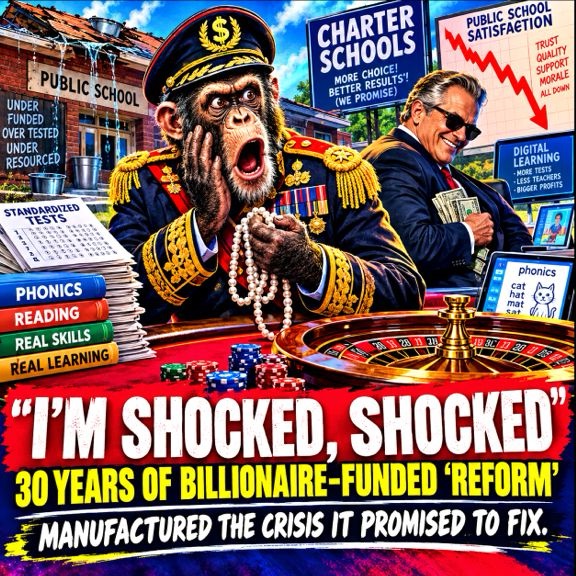
He writes:

I’M SHOCKED, SHOCKED — HOW 30 YEARS OF BILLIONAIRE-FUNDED “REFORM” MANUFACTURED THE EDUCATION CRISIS IT PROMISED TO FIX

There’s a famous scene in Casablanca where Captain Renault declares he is “shocked, shocked” to find gambling going on — right before a croupier hands him his winnings. That’s essentially the posture of the billionaire reform industrial complex today, clutching its pearls over a Gallup poll showing public satisfaction with American schools has cratered to 32% — an 11-point nosedive in just two years — while quietly pocketing the profits of the crisis they spent three decades engineering.

Shocked. Absolutely shocked.

The Architecture of a Manufactured Crisis

Let’s be precise about the timeline, because precision matters when someone is picking your pocket.

For roughly 30 years, a well-funded constellation of think tanks, philanthropic foundations, hedge fund managers, and tech oligarchs pumped billions of dollars into a single, relentless narrative: public schools are failing. Not “underfunded.” Not “systematically neglected.” Failing — as in, inherently broken, irredeemably incompetent, populated by bad teachers protected by evil unions, and salvageable only by the heroic intervention of the private market.

The messaging was surgical. The money was real. And — surprise! — it worked.

As the Big Education Ape’s deep dive into school funding makes devastatingly clear, the playbook was never subtle:

Starve public schools of adequate funding. Declare them “failing.” Ride in on a white charter bus to “rescue” the children.

The chronic underfunding wasn’t fiscal negligence. In many states, it was a feature, not a bug. Squeeze hard enough, the theory went, and disruption would force innovation. What it actually forced was deferred maintenance, teacher shortages, and a generation of kids learning to read in buildings where the roof leaks and the textbooks predate the iPhone.

Now the poll numbers confirm the narrative took hold — and the reformers are citing those same poll numbers as proof they were right all along. The audacity is, genuinely, breathtaking.

The Numbers That Tell Two Very Different Stories

Here’s what the data actually shows — and what it doesn’t show:

Metric: The Headline. What It Actually Means Gallup Public Satisfaction 32% — record low 30 years of “failing schools” messaging worked exactly as intended.

Parent Satisfaction with Their Own School Historically ~2x the national figure People trust what they experience; they fear what they’re told

Math & Reading Scores Declining, especially bottom quartile Tracks directly with funding inequity and screen-time explosion

Top-tier U.S. Student Performance Still globally competitive. The “crisis” is concentrated where disinvestment is concentrated

The gap between how Americans rate schools in general versus their own child’s school is the smoking gun. It has always been the smoking gun. People who actually walk into a public school building — who meet the teachers, see the classrooms, watch their kids come home — consistently rate those schools dramatically higher than the national “failing” narrative suggests.

That gap is the manufactured crisis. It lives entirely in the space between lived experience and media-amplified fear.

$1.8 Billion Worth of Snake Oil, Served Fresh

And just when you thought the reform carousel might slow down, along comes the Science of Reading — the latest Next Big Thing™ in a long line of Next Big Things™ that have collectively cost American taxpayers tens of billions of dollars and produced reading scores that went, as the Big Education Ape’s withering analysis puts it, precisely nowhere.

Remember Common Core? $15.8 billion. A decade of standardized testing theater. Reading scores: unmoved.

Now we have the Science of Reading, $1.8 billion deep and climbing, with the same cast of vendors, the same philanthropic networks, and the same conspicuous absence of a money-back guarantee.

To be scrupulously fair: phonics works. Explicit decoding instruction works. The underlying research on structured literacy is legitimate. But here’s the thing about legitimate research — it doesn’t require a $1.8 billion vendor ecosystem, mandatory state legislation in 40+ states, and the systematic deskilling of teachers who are told to stop thinking and start following the script. When real science gets packaged into proprietary curricula, sold to districts under legislative mandate, and deployed without the trained human educators needed to implement it well, you don’t get science. You get very expensive phonics worksheets.

The question nobody in the reform complex wants to answer remains the same one it’s always been: Where is the money-back guarantee?

The Other Hand: How Tech Bros Broke Kids’ Brains While Selling the Cure

Here is the part of the story that deserves its own criminal investigation — or at minimum, a very uncomfortable congressional hearing.

The same Silicon Valley billionaires who spent decades pushing EdTech into classrooms as the revolutionary equalizer — screens for every student! –are the identical billionaires whose social media platforms have:

  • Collapsed long-form reading among adolescents at a rate researchers describe as one of the steepest drops in PISA history
  • Engineered algorithmic doom-scrolling that neurologically rewires 15-year-olds away from the sustained attention that math and reading comprehension require
  • Distracted over a quarter of students internationally during core academic instruction, by their own PISA survey data

They sold the disease and the cure. They pushed the screens that fragmented attention spans, then sold the adaptive software to remediate the fragmented attention spans, then pointed at the test scores and said: See? Public schools are failing.

As Big Education Ape’s piece on reading struggles frames it with characteristic bluntness: if you’re struggling to read this, you have some very rich friends to thank.

The Exit Ramp Is Marked “November 3”

None of this is inevitable. None of this is permanent. The No Kings Coalition — the sprawling, nonpartisan civic movement that flooded the streets in March — is now flooding the polls, with a Vote Early Day of Action on October 17 aimed squarely at the November 3, 2026 midterms.

The math is straightforward, even if the billionaires prefer we can’t do it:

  • Elect candidates who will defend public education funding, not divert it into voucher schemes that enrich private operators at public expense
  • Overturn the Supreme Court rulings — from Citizens United forward — that transformed American democracy into a billionaire auction
  • Restore the principle that public money follows public children into public schools, not into the portfolios of private equity firms with a “reform” logo.

The manufactured crisis has a manufactured solution: more billionaire intervention, more privatization, more EdTech, more testing, more disruption. The actual solution is considerably less glamorous and considerably more effective — fund schools equitably, pay teachers competitively, put phones away, and stop letting people who profit from public school failure write public school policy.

The Bottom Line

The 32% satisfaction number is not evidence that public schools have failed. It is evidence that a 30-year, billion-dollar propaganda campaign succeeded. The same people who manufactured the crisis are now selling the cure — at $1.8 billion a pop, no refunds, no guarantees, no accountability.

Meanwhile, the teachers who showed up every day through a pandemic, through chronic underfunding, through a staffing crisis, through the algorithmic dismantling of their students’ attention spans — those people are still in the classroom at 7 AM, doing the work that no EdTech platform, no voucher program, and no think tank white paper has ever actually replaced.

The casino is rigged. Captain Renault is shocked. And the November ballot is the one lever the house can’t control.

Vote like a public school depends on it. Because one does.


🔗 Related Reading from Big Education Ape:

Sources & Links

🔵 Public Satisfaction & Gallup Data


🔵 PISA Performance & International Benchmarks


🔵 School Funding, Privatization & the Manufactured Crisis


🔵 Science of Reading & EdTech Accountability


🔵 Democracy, Elections & the No Kings Coalition


All links verified active as of September 9, 2026. Primary polling data sourced from Gallup/Walton Family Foundation. PISA data sourced from NCES/OECD 2025 release.
Back in 2011, Harvard Professor Raj Chetty and two esteemed colleagues (John Friedman at Brown University and Jonah Rockoff at Columbia University) published a dazzling study of teachers, asserting that the best teachers are those whose students get improved scores. Those students have a higher income ($250,000 over their lifetimes), and enjoy a multitude of benefits, all because of that one teacher who induced them to have higher scores. President Obama cited Chetty’s research in his 2012 State of the Union address to show how important it was to find the “best” teachers and fire the “worst’ teachers.

Chetty’s work supported the Obama-Duncan Race to the Top plan to encourage evaluating teachers by the test scores of their students. States that evaluated teachers by their students’ scores were eligible to apply for a share of RTTT funding. Those who did not were not eligible.

Most states, eager for a share of the $5 billion prize, agreed to adopt what was called “value-added modeling” or “value-added measurement.” (VAM)

I posted dozens of times about the flaws of VAM, first of all, because the American Statistical Association said that teachers account for only 1-14% of score changes; most changes were attributable to home life and school system issues. Secondly, because the VAM concept is very unstable and is highly affected by student demographics. Only teachers of reading and math in grades 4-9 could even be assessed by the annual tests, which are mandated only in grades 3-8. Schools started attributing scores to teachers not in those subjects and not in those grades, tied to the work of other teachers in the school.

The Los Angeles Times engaged researchers to calculate VAM scores for the district’s teachers, and the newspaper published them alongside the names of teachers. It was humiliating for teachers, but Arne Duncan thought this disclosure was wonderful.

I happened to be in Los Angeles on the day that a fifth grade teacher committed suicide after he received a poor VAM score. No one knows if that was the reason for his suicide, but it may have been. By all accounts, he was a good teacher in a tough school.

The New York Post did the same for New York City teachers. It listed names and scores. The teacher identified by the newspaper as the city’s “worst” teacher was hounded by Post reporters seeking an interview. It turned out that she taught classes of new immigrants, who moved in and then out of her class as they learned enough English to join regular classes. Her students in September were not the same students by June. The VAM scores for her were meaningless, as they were for other teachers. Teachers of the gifted saw few if any gains because their students were at the top year after year. Expert math teacher Gary Rubinstein noticed that some teachers had high scores in one subject, but not in the other. Should half the teacher get a bonus while the other half was fired?

Freddie deBoer, an independent writer who earned a doctorate in English and education assessment, re-evaluated Raj Chetty’s famous study.

It’s a long review, and I won’t post it all. Please open the link and read it.

He begins:

For a long time I’ve been getting some version of the comment, “What about Chetty!” in response to my perspective on education, as in Raj Chetty, the economist who for the past decade has made a lot of waves asserting that our education problems are straightforwardly the product of bad teachers and that replacing them will have implausibly large economic effects. I tend to try and work from a broader perspective than “this is why I think this guy is wrong,” but I get this request so often, here you go. This is why I think Raj Chetty is wrong.

Few empirical claims in modern education policy have traveled farther than Chetty et al’s findings on teacher “value-added.” In his famous 2014 American Economic Review papers, he and his coauthors reported that students assigned to better (excuse me, higher value-added) teachers were more likely to attend college, earn higher salaries, save for retirement, and avoid teen pregnancy, and that replacing a teacher in the bottom five percent of the distribution with an average teacher would raise the present value of a single classroom’s lifetime earnings by roughly $250,000. Chetty’s research findings in this domain had been floating around for awhile at the time of publication, and President Obama cited the figure in his 2012 State of the Union address, and the judge who decided Vergara v. California leaned on it to strike down California’s teacher tenure laws. Take that, teachers! The findings are arresting, the dataset is impressive – 2.5 million children, linked to IRS tax records! – and the policy implications are clean: identify and remove bad (pardon me, low “value-added”) teachers, watch outcomes improve. It’s exactlythe kind of story our neoliberal policy establishment is desperate to tell, and was clearly catnip to the Obama administration, which was doggedly attached to a simplistic vision of delivery through better education, where the gutting of the uneducated labor market was ameliorated by turning every last child in the United States into a genius, scaling up the Stanford-to-Google pipeline until every American could pass through it.

Unfortunately, the Chetty story is ultimately another neoliberal just-so story, that is to say, a fable, a legend, a myth. The closer you look at what the “value-added” construct actually measures, how stable those measurements are, and how the Chetty results have fared under replication, the more reason there is to doubt both the magnitude of the claimed effects and, more fundamentally, whether “teacher quality” as the literature operationalizes it is a coherent, measurable attribute at all. (Spoiler: it is not.) Let us count the problems.

The construct itself puts the thumb on the scale. The first problem is conceptual. In the Chetty et al. studies, a teacher’s “value-added” is the residual variation in a student’s standardized test scores that remains after controlling for prior achievement and some demographic covariates. It’s not a measure of pedagogical skill, content knowledge, classroom climate, the cultivation of curiosity, or any other property normally meant by “good teaching.” It’s a statistical residual on a narrow set of assessments, usually math and reading tests in grades three through eight. That residual is then defined as quality. I want to be clear about this: any portion of variability in student outcomes that Chetty et al cannot or will not identify otherwise is assumed to be a product of teacher inputs. Since Chetty’s whole project is to argue that educational outcomes are the result of teacher quality, this is what we used to call begging the question – that is, he’s assuming the point he wants to prove, asserting the desired conclusion as a premise, by acting as though any uncaptured variation is necessary evidence of teaching quality. And it gets worse in the telling. When advocates and journalists and politicians summarize his work, the construct expands silently from “the part of test-score gains Chetty cannot otherwise explain” to “good teachers,” and the slippage is rarely flagged. But that’s the whole game, you guys.

Open the link and enjoy!

Jeff Bryant, prolific education journalist, writes in The Progressive about the efforts by educators to fight back against the failed and punitive policies of No Child Left Behind and Race to the Top. It’s a valuable summary of the past 15 years. Teachers rallied. Teachers sounded alarms about the bipartisan attack is on teachers, teaching and public schools.

Did it make a difference?

Now, 15 years later, there are thousands of charters, and they are no better than the public schools, contrary to their promises. Now, most states have vouchers, and the public is funding religious schools, which was unthinkable in 2011.

But we can’t give up! At last, there are candidates running to fight for public schools. Gina Hinojosa is the most prominent of them. If she defeats Greg Abbott in Texas, expect major changes.

Jeff writes:

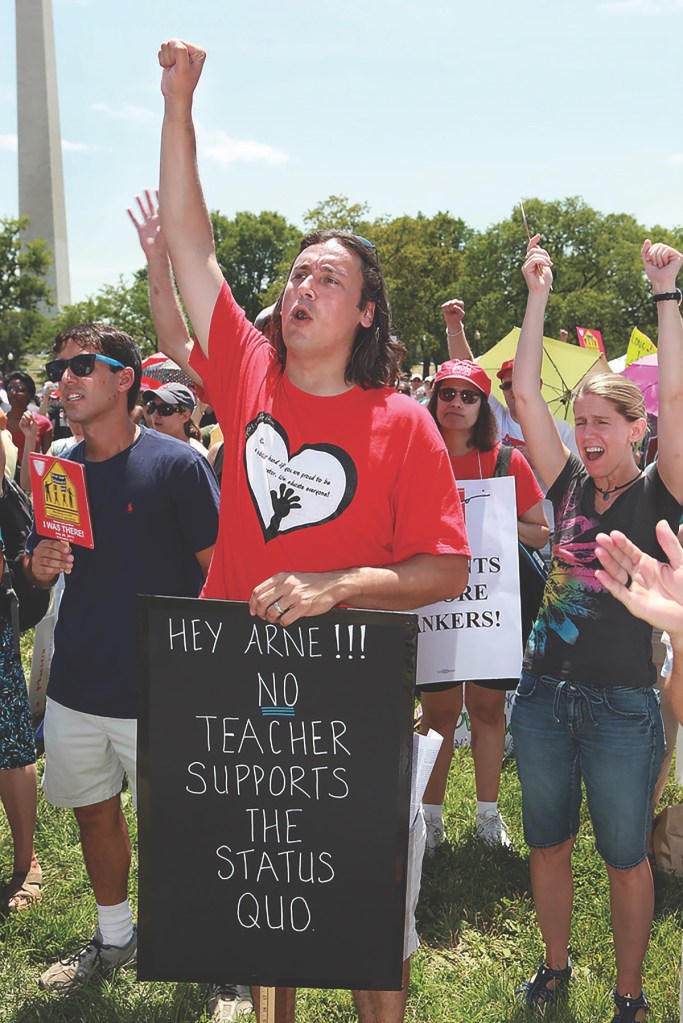
It was a sunny July day in Washington, D.C., the temperature was forecasted to hit 97 degrees Fahrenheit, and when I arrived at the Ellipse on the National Mall for the Save Our Schools march I realized I would need a hat. Among the vendors that lined Constitution Avenue, the least expensive hat I could find was a gaudy, red-white-and-blue affair with an embossed rendering of fireworks going off over the Lincoln Memorial and Washington Monument. “Some hat,” Anne Thompson, my videographer for the day, said when she arrived…

At the time, I was working on a project, partnered with the National Education Association, called “Starving America’s Schools: How Budget Cuts and Policy Mandates Are Hurting Our Nation’s Students.” The project documented how state governments, following the Great Recession, cut funding for schools and rolled out efforts to privatize them with charter schools and voucher programs.

I had read  multiple analyses by the Center on Budget and Policy Priorities (CBPP) that found at least thirty-seven states responded to the economic downturn that started in 2007 and extended into 2009 by slashing their education budgets back to pre-recession levels. My Starving America’s Schools project would examine how the cuts caused districts to fire teachers, cancel art and music programs, close libraries and science labs, and cut extracurriculars like athletic programs, field trips, and drama performances.

Teachers turned out to denounce high-stakes testing, NCLB, Race to the Top, budget cuts, privatization, and the attacks on their profession, funded by Bill Gates, Eli Broad, and other billionaires.

….The estimated crowd of 3,000 to 5,000 roared in approval at an array of speakers that included the actor Matt Damon (whose mother is a professor of education), Ravitch, best-selling author Jonathan Kozol, renowned educator Deborah Meier, and policy experts Linda Darling-Hammond and Pedro Noguera. When the speeches were over and we marched to the White House, the line of people stretched for blocks and blocks…

The range of themes the speakers addressed included lack of pay and respect for teachers; the harms caused by poverty and privatization; the continuing racial discrimination and segregation in schools and glaring inequities in their funding; the unbearable class sizes teachers endure, and the injustices that result from using test scores to sanction schools and evaluate teachers.

What also animated the crowd, Anthony Cody tells The Progressive in a text message, was a sense of betrayal on education by the Democratic Party’s leadership. Cody, a fulltime classroom teacher at the time—he’s now retired—was one of the principal organizers of the march. “The great majority of teachers supported the election of Barack Obama in 2008,” he says. “[But] RTTT reinforced the worst elements of NCLB by encouraging states to link teacher pay and evaluations to standardized test scores.”

“A theme that ran through the rally was ‘how could a Democratic administration be so hostile to public schools?’ ” says Ravitch in an email to The Progressive.

“The speakers, me included, hated RTTT and saw it for what it was: encouragement for charters, high-stakes standardized testing, teacher evaluation based on student test scores, and other dreadful policies,” Ravitch continues. “We predicted [the policies] would fail, and they did.”

A particular target for invective at the rally was Obama’s Secretary of Education, Arne Duncan, Ravitch recalls. “He regularly assailed public schools as failing. He attacked public school teachers. He constantly praised charter schools, and whenever national test scores came out, he gleefully pointed to results and made them sound worse than they were.”

“Duncan could have fit in a Republican cabinet,” Ravitch adds.


Fifteen years later, did that outpouring in July 2011 matter?…

The sad truth is that the grievances that motivated people to board buses and gather on the Mall on a hot July day in 2011 continue to dominate the K-12 school landscape today.

For instance, one of NPE’s reports that Cody references, published in 2026, found that states that have been the most aggressive about redirecting public funds for schools to private education operators have been the most neglectful of funding and supporting their public schools.


Although No Child Left Behind was repealed in 2015, it was replaced that year by the Every Student Succeeds Act that still enforces standardized testing. And the legacy of the funding cuts enacted during the Great Recession continues to harm schools.

“In the decade following the Great Recession, students across the United States lost nearly $600 billion from the states’ disinvestment in their public schools,” an analysis by the Education Law Center reported in 2021. Calling the time, from 2008 to 2018, a “lost decade,” the organization noted that while states’ economic activity as measured by gross domestic product increased by 17 percent, state and local revenues for public schools lagged, increasing by only 6 percent.

A 2025 Education Law Center report, “Making the Grade,” assessed states on how they fund public schools and found that not a single state earned an A grade on three crucial measures of funding: whether state and local revenues are adequate, whether funding is fairly distributed, and whether funding lags a state’s economic capacity.

In the meantime, the charter school industry continues to expand, with thirty-nine out of forty-three states experiencing growth in charters in 2025, according to charter industry data. And voucher programs also continue to grow, as fifteen states now operate twenty-three programs, and the Trump Administration is set to roll out a nationwide federal voucher program in 2027. As the right wing’s “long game” to end public education continues apace, prominent centrist Democrats call for a return to the education policies of the Bush and Obama years.

“Democrats [have] walked away from standards and accountability [for schools], and our kids are falling through the cracks,” former Chicago mayor and Obama’s Chief of Staff Rahm Emanuel is telling anyone who will listen. And Arne Duncan is back in the media spotlight, encouraging Democratic governors to embrace the Trump Administration’s voucher program. That the politics of education in 2026 seem so similar to those of 2011 is evidence that a left-right binary over education policy doesn’t really exist.

As I observed all those years ago on the cusp of the march in D.C., there was no middle ground in education debates. Factions on the right wanted to get rid of public schools. Business interests represented by testing companies, charter schools, and tech firms wanted to make money off schools. And a “reform” community led by wealthy foundations and technocrats wanted to mold public schools to their ideological, and often political, agendas.

As I wrote at the time, “Faced with this array of antagonists toward public education, where does the ‘middle ground’ lie? When people openly admit they want to get rid of you, where should the bargaining start? When people have shown you they are more apt to use you for their own profit, and then walk away when the ‘market changes,’ why should you trust them? And when people say they are willing to align with your cause but only when you say and do things how they want you to do them—even when your ideals inform you to do otherwise—why should you simply bend to their will?”

Those questions are still relevant today. They will remain so until a progressive left faction adopts a robust message on education and articulates it repeatedly in advocacy documents and political stump speeches.

“Our battle for public schools is steeper now than it was when the Save Our Schools rally was held,” Ravitch says. “It will be a battle for many years to come.”

But in 2011, for at least a day, it seemed that public school advocates had the power to, as Ravitch put it in her email, “push back and give people a modicum of hope.”

The battle continues, and it’s not over. America needs a strong public school system, not a hodge-podge of pop-up schools.

We need well-prepared teachers who can knowledgeably teach history, science, mathematics, literature, and foreign languages. We need well-funded schools and respected, well-paid professionals. We need equality of opportunity for all children, and we need excellence.

We need the strong public schools that built the Aunited States into a great nation. We need education for democracy, where children are judged by the content of their character, not the color of their skin.

We need an education system that produces engineers, scientists, artists, musicians, athletes, mechanics, lawyers, doctors, pharmacists, teachers, social workers, idealists, scholars, young people eager to use their hands, their brains, and their hearts to make our society better for everyone.

We are now in a period of disruption and dissolution. That way lies disaster. It is the road to elitism, segregation, indoctrination, and decay.

We need to raise our sights and build better public schools that offer a goood education for all children.

Jeff Bryant, veteran education journalist, writes here about the success of community schools in Chicago, in contrast to the failed ideas of “education reform.” The latter echoed the failed strategies of No Child Left Behind and Race to the Top: testing, competition, privatization, firing staff, closing schools, ranking and rating students, teachers, principals and schools based on test scores. So-called “education reform” created massive disruption and led to massive failure.

Bryant describes the evolution of community schools in Chicago, led by grassroots leaders like Jitu Brown, where parents are valued partners.

Bryant writes:

“Until now, we haven’t even tried to make big-city school districts work, especially for children of color,” Jhoanna Maldonado said when Our Schools asked her to describe what Chicago Mayor Brandon Johnson and his supporters have in mind for the public school system of the nation’s third-largest city.

Johnson scored a surprising win in the 2023 mayoral election against Paul Vallas, a former CEO of Chicago Public Schools (CPS), and education was a key issue in the race, according to multiplenewsoutlets. Maldonado is an organizer with the Chicago Teachers Union (CTU), which is reported to have “bankrolled” Johnson’s mayoral campaign along with other labor groups, and Johnson is a former middle school teacher and teachers union organizer. What Johnson and his supporters are doing “is transforming our education system,” Maldonado said. There’s evidence the transformation is sorely needed.

For the past two decades, Chicago’s schools experienced a cavalcade of negative stories, including recurring fiscal crisis, financial scandals and mismanagement, a long downward slide in student enrollment, persistent underfunding from the state, the “largest mass closing [of schools] in the nation’s history,” and a seemingly endless conflict between the CPS district administration and CTU.

Yet, there are signs the district may be poised for a rebound.

“The people of Chicago have had enormous patience as they’ve witnessed years of failed school improvement efforts,” Maldonado said. “And it has taken years for the community to realize that no one else—not charter school operators or so-called reformers—can do the transformation. We have to do it ourselves.”

“Doing it ourselves” seems to mean rejecting years of policy and governance ideas that have dominated the district, and is what Johnson and his transition committee call, “an era of school reform focused on accountability, high stakes testing, austere budgets, and zero tolerance policies,” in the report, “A Blueprint for Creating a More Just and Vibrant City for All.”

After experiencing more than 10 years of enrollment declines between 2012 and 2022, losing more than 81,000 students during this period, and dropping from its status as third-largest school district in the nation to fourth in 2022, CPS reported an enrollment increase for the 2023-2024 school year. Graduation rates hit an all-time high in 2022. The number of students being suspended or arrested on school grounds has also declined significantly. And student scores on reading tests, after a sharp decline during the COVID-19 pandemic, have improved faster than most school districts across the country. Math scores have also rebounded, but are more comparable to other improving districts, according to a 2024 Chalkbeat article.

Johnson and his supporters have been slowly changing the district’s basic policy and governance structures. They are attempting to redefine the daily functions of schools and their relationships with families and their surrounding communities by expanding the number of what they refer to as “sustainable community schools.” The CPS schools that have adopted the community schools idea stand at 20 campuses as of 2024, according to CTU. Johnson and his transition committee’s Blueprint report has called for growing the number of schools using the sustainable community schools approach to 50, with the long-term goal of expanding the number of schools to 200.

The call to have more CPS schools adopt the community schools approach aligns with a national trend where several school districts, including big-city districts such as Los Angeles and New York City, are embracing the idea.

Community schools look different in different places because the needs and interests of communities vary, but the basic idea is that schools should address the fundamental causes of academic problems, including student health and well-being. The approach also requires schools to involve students and their families more deeply in school policies and programs and to tap the assets and resources available in the surrounding community to enrich the school.

In Chicago—where most students are non-white, more than 70 percent are economically disadvantaged, and large percentages need support for English language learning and learning disabilities—addressing root causes for academic problems often means bringing specialized staff and programs into the school to provide more academic and non-academic student and family services, often called wraparound supports. The rationale for this is clear.

“If a student is taken care of and feels safe and heard and has caring adults, that student is much more ready to learn,” Jennifer VanderPloeg the project manager of CPS’s Sustainable Community Schools told Our Schools. “If [a student is] carrying around a load of trauma, having a lot of unmet needs, or other things [they’re] worrying about, then [they] don’t have the brain space freed up for algebra. That’s just science,” she said.

“Also important is for students to see themselves in the curriculum and have Black and brown staff members in the school,” said Autumn Berg, director of CPS’s Community Schools Initiative. “All of that matters in determining how a student perceives their surroundings.”

“Community schools are about creating a culture and climate that is healthy, safe, and loving,” said VanderPloeg. “Sure, it would be ideal if parents would be able to attend to all the unmet needs of our students, but that’s just not the system we live in. And community schools help families access these [unmet] needs too.”

Also, according to VanderPloeg, community schools give extra support to teachers by providing them with assistance in all of the things teachers don’t have time to attend to, like helping families find access to basic services and finding grants to support after-school and extracurricular programs.

But while some Chicago educators see the community schools idea as merely a mechanism to add new programs and services to a school’s agenda, others describe it with far more expansive and sweeping language.

“Community schools are an education model rooted in self-determination and equity for Black and brown people,” Jitu Brown told Our Schools. Brown is the national director of Journey for Justice Alliance, a coalition of Black and brown-led grassroots community, youth, and parent organizations in more than 30 cities.

“In the Black community, we have historically been denied the right to engage in creating what we want for our community,” Brown said.

In Chicago, according to Brown, most of the schools serving Black and brown families are struggling because they’ve been led by people who don’t understand the needs of those families. “Class plays a big role in this too,” he said. “The people in charge of our schools have generally been taught to believe they are smarter than the people in the schools they’re leading.”

But in community schools, Brown sees the opportunity to put different voices in charge of Chicago schools.

“The community schools strategy is not just about asking students, parents, and the community for their input,” he said. “It’s about asking for their guidance and leadership.”

It Started with Saving a Neighborhood

Chicago’s journey of embracing the community schools movement has been long in the making, and Brown gets a lot of credit for bringing the idea to the attention of public school advocates in the city.

He achieved much of this notoriety in 2015 by leading a hunger strike to reopen Walter H. Dyett High School in Chicago’s predominantly African American Bronzeville community. Among the demands of the strikers—Brandon Johnson was a participant in the protest when he was a CTU organizer—was for the school to be reopened as a “hub” of what they called “a sustainable community school village,” according to Democracy Now.

The strike received prominent attention in national news outlets, including the New York Times and the Washington Post.

But Brown’s engagement with the community schools approach started before the fight for Dyett, going back almost two decades when he was a resource coordinator at the South Shore High School of Entrepreneurship, a school created in 2001 when historic South Shore International College Preparatory High School was reorganized into three smaller campuses as part of an education reform effort known as small schools.

Brown was responsible for organizing educators and community members to pool resources and involve organizations in the community to strengthen the struggling school. He could see that the school was being “set up,” in his words, for either closure or takeover by charter school operators.

“School privatization in the form of charter schools was coming to our neighborhood,” he said, “and we needed a stronger offer to engage families in rallying to the school and the surrounding community.”

Brown pushed for the adoption of an approach for transforming schools that reflected a model supported by the National Education Association of full-service community schools.

That approach was based on five pillars that included a challenging and culturally relevant curriculum, wraparound services for addressing students’ health and well-being, high-quality teaching, student-centered school climate, and community and parent engagement. A sixth pillar, calling for shared leadership in school governance, was eventually added.

After engaging in “thousands” of conversations in the surrounding historic Kenwood neighborhood, where former President Barack Obama once lived, Brown said that he came to be persuaded that organizing a school around the grassroots desires of students, parents, teachers, and community members was a powerful alternative to school privatization and other top-down reform efforts that undermine teachers and disenfranchise families.

Brown and his collaborators recognized that the community schools idea was what would turn their vision of a school into a connected system of families, educators, and community working together.

Open the link to continue reading this important story.

Mike Miles, the state-appointed superintendent of the Houston Independent School District, announced that big layoffs are on the horizon. Miles, a military veteran and a graduate of the Broad Academy, came to Houston to disrupt the district on behalf of Governor Greg Abbott. He’s doing it. He did it previously in Dallas, where his controlling policies drove out record numbers of teachers.

Concurrently, 3,000 members of the Houston Federation of Teachers, which represents slightly more than half of Houston’s 11,465 teachers, overwhelmingly endorsed a resolution of “no confidence” in Miles and called for his ouster. Zeph Capo, president of the Texas AFT, said that Miles “has steadfastly refused to listen to educators, parents and students about what they need, and has likewise refused to accept criticism with anything other than absolute disdain from people he says that he should be serving,”

Megan Menchacha of The Houston Chronicle reported:

An undisclosed number of Houston ISD teachers and principals received notices this week that they will be out of a job, state-appointed Superintendent Mike Miles said Thursday.

Miles said principals have begun making decisions about which teachers to hire back based on certain data points, such as spot observations, performance on the Texas Teacher Evaluation and Support System professionalism domain and performance on the Measures of Academic Progress Growth assessment and other student achievement data.

“We are using data maybe for the first time,” Miles said during a media conference. “At this time of year, when principals assess whether or not a teacher will return, they’re looking not just at the anecdotal information, but they’re also looking at data of all sorts to assess. So that’s what principals have been doing. They’ve been looking at data.”

Miles said he did not know the specific number of teachers or principals who would not be keeping their jobs, but the district would have that information in a few weeks. Multiple teachers reported receiving notices this week to attend a Zoom call to discuss their “future employment for the district” Friday, although the exact nature of the call was not made clear.

Miles said although several teachers will not have their contracts renewed, the district was not cutting the number of teacher positions. He said the district has been hiring people to replace the teachers who would not be renewed, and HISD students would still have an effective teacher and approximately the same class size ratios during the upcoming academic year. 

“Last Saturday, at the job fair, we had about 1,500 to 2,000 teachers apply for about 800 positions. Several hundred where offers were made,” Miles said. “I don’t know the exact number, but it’s … maybe 500 positions in the NES schools out of 5,000 that still are vacant, and those will be filled by the end of May.”

Miles said executive directors and division superintendents were also reviewing instructional, achievement and leadership data for principals and making decisions this week “based on several things” about who would be keeping their positions next year. 

Along with nonrenewals of teachers and principals, Miles said Thursday that almost every department, including custodians and maintenance workers, have to cut positions, although he said he didn’t know the exact number of employees who had learned they were being cut in recent weeks.

“The budget and financial situation has been complicated this year, because of the end of our COVID relief aid, or ESSER, dollars,” Miles said. “So as a result of ESSER dollars, the district had placed a lot of money into recurrent expenses, and that meant we have not only to balance the budget, but we have to find a way to pay for the positions that were funded by ESSER.”

EXCLUSIVE EVENT: Join our private Zoom with HISD Superintendent Miles on May 15

The notices come as the district’s Board of Managers are set to consider approving agenda items during their monthly meeting Thursday allowing the district to make a “reduction in force” before the 2024-25 academic year. The notices, if approved, would allow the district to cut several listed positions or employment areas, but would not require them to do so.

The list of positions facing cuts exceeds 20 pages and includes the vast majority of current campus-level jobs in the district, such as nurses; librarians; counselors; assistant principal; principals; reading, math and science teachers; fine arts and other elective instructors; speech therapists; magnet coordinators; and special education coordinators. 

The planned reduction in force comes as Miles estimates that the district will face an estimated $450 million budget gap during the upcoming school year. Miles has said that widespread cuts are necessary to keep the district from hitting a fiscal cliff amid the expiration of federal COVID-19 relief money and declining student enrollment.

‘NO CONFIDENCE:’ Nearly 3,000 Houston Federation of Teachers members rebuke Miles in vote

I am almost four years late in discovering this review by two scholars for whom I have the greatest respect: David C. Berliner and Gene V. Glass.

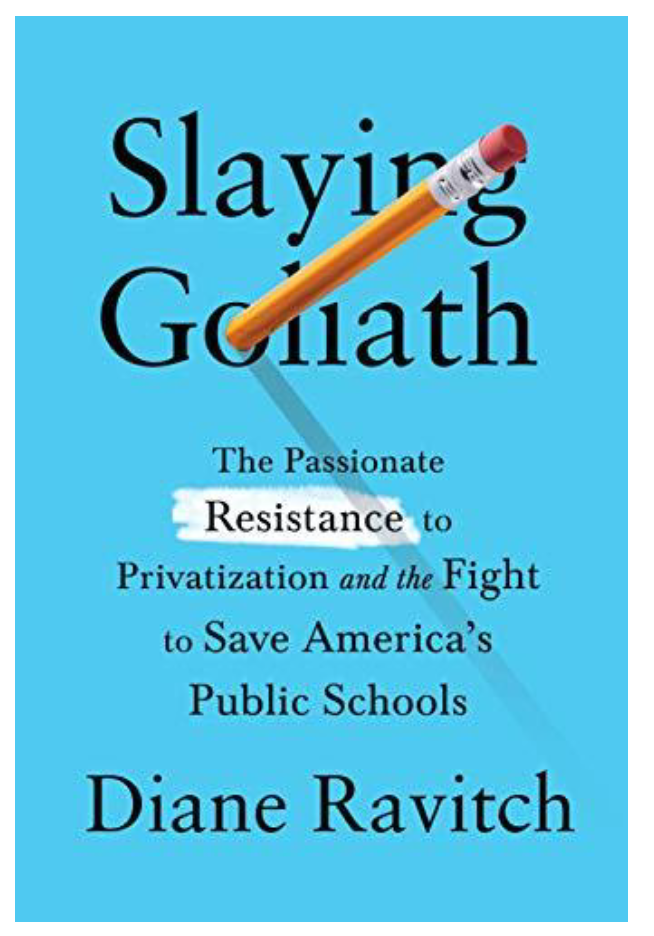
I was happy to read this review because Slaying Goliath had a checkered fate. It was published in mid-January 2020. I went on a book tour, starting in Seattle. By mid-February, I made my last stop in West Virginia, where I met with teachers and celebrated the two-year anniversary of their strike, which shut down every school in the state.

As I traveled, news emerged of a dangerous “flu” that was rapidly spreading. It was COVID; by mid-March, the country was shutting down. No one wanted to read about the fight to save public schools or about its heroes. The news shifted, as it should have, to the panicked response to COVID, to the deaths of good people, to the overwhelmed hospitals and their overworked staff.

To make matters worse, the New York Times Book Review published a very negative review by someone who admired the “education reform” movement that I criticized. I thought of writing a letter to the editor but quickly dropped the idea. I wrote and rewrote my response to the review in my head, but not on paper.

Then, again by happenstance, I discovered that Bob Shepherd had reviewed the review of my book in The New York Times. He said everything that I wish I could have said but didn’t. His review was balm for my soul. Shepherd lacerated the tone and substance of the review, calling it an “uniformed, vituperative, shallow, amateurish ‘review.’” Which it was. His review of the review was so powerful that I will post it next.

Then, a few weeks ago, I found this review by Berliner and Glass.

The review begins:

Reviewed by Gene V Glass and David C. Berliner Arizona State University, United States

They wrote:

In a Post-Truth era, one must consider the source. 

In this case, the source is Diane Rose Silvers, the third of eight children of Walter Silverstein, a high school drop-out, and Ann Katz, a high school graduate. The Silvers were a middle-class Houston family, proprietors of a liquor store, and loyal supporters of FDR.

After graduation from San Jacinto High School, she enrolled in Wellesley College in September, 1956. Working as a “copy boy”for the Washington Post, Diane met Richard Ravitch, a lawyer working in the federal government and son of a prominent New York City family. They married on June 26,1960, in Houston, two weeks after Diane’s graduation from Wellesley. The couple settled in New York City, where Richard took employment in the family construction business. He eventually served as head of the Metropolitan Transit Authority and Lieutenant Governor in the 2000s, having been appointed by Democratic Governor David Paterson.

 Diane bore three sons, two of whom survived to adulthood. Diane and Richard ended their 26-year marriage in 1986. She had not been idle. For a period starting in 1961, Diane was employed by The New Leader, a liberal, anti-communist journal. She later earned a PhD in history of education from Columbia in 1975 under the mentorship of Lawrence Cremin.

Diane was appointed to the office of Assistant Secretary of Education, in the Department of Education by George H. W. Bush and later by Bill Clinton. In 1997, Clinton appointed her to the National Assessment Governing Board (NAGB), on which she served until 2004. 

Ravitch worked “… for many years in some of the nation’s leading conservative think tanks.

Read the full pdf here.

Back in 2010, Secretary of Education Arne Duncan rolled out his Race to the Top program to reform American education. The U.S. Department of Education offered a total of $5 billion to states. To be eligible to compete for a part of the huge prize money, states had to agree to authorize charter schools, to adopt the Common Core (not yet finished), and to evaluate teachers based on the test scores of their students.

The requirement to change teacher evaluation was heated. Duncan scoffed at critics, saying they were trying to protect bad teachers and didn’t want to know the truth.

Debate over this methodology was heated.

I was part of a group of education scholars who denounced this method of evaluating teachers in 2010.

In 2012, three noted scholars claimed that teachers who raised test scores raised students’ lifetime incomes; President Obama cited this study, led by Harvard economist Raj Chetty, in his State of the Union address. It seemed to be settled wisdom that teachers who raised test scores were great, and teachers who did not should be ousted.

In 2014, the American Statistical Association warned about the danger of evaluating teachers by the test scores of their students. The ASA statement said that most studies of this method find that teachers account for 1-14% of the variation in test scores. The greatest opportunity for improvement, they said, was to be found in system-level changes.

The Gates Foundation poured hundreds of millions of dollars into districts willing to test value-added methodology, and eventually gave up. Teachers were demoralized, teachers avoided teaching in low-income districts. Overall improvements were hard to find.

Arne Duncan was a true believer, as was his successor, John King, and they never were willing to admit failure.

Teachers never liked VAM. They knew that it encouraged teaching to the test. They knew that teachers in affluent districts would get higher scores than those in less fortunate districts. Sometimes they sued and won. But in most states, teachers continued to be evaluated in part by their students’ scores.

But in New York state, the era of VAM is finished. Dr. Betty Rosa, the chancellor of the New York State Board of Regents, reached an agreement with Melinda Person, president of New York State United Teachers, to draft a new way of evaluating teachers that moves away from students’ standardized test scores.

New York state education leaders and the teachers’ union have announced an agreement to change how New York school teachers and principals are evaluated, and move away from the mandated reliance on standardized test scores.

State Education Department Commissioner Betty Rosa and New York State United Teachers President Melinda Person hand-delivered their drafted legislation Wednesday to lawmakers to create a new system that doesn’t use students’ test performance to penalize educators. The state teacher evaluation system, known as the Annual Professional Performance Review, or APPR, was modified in the 2015 budget to place a greater importance on scores.

“It’s connecting research to practice and developing strategies to ensure that teachers have the best tools and principals to make sure our young people are getting the best quality education,” Rosa told reporters Wednesday in the Legislative Office Building.

When NYSUT elected president Person last year, she said her first task was to change the teacher evaluation system, and state lawmakers said with confidence Wednesday it will happen this session.

The proposed law, which has not officially been introduced in the Legislature, would remove the requirement to base evaluations on high-stakes tests. School districts would have eight years to transition, but could make the changes faster than the required deadline.

Person argued it will support new teachers who are often burdened by the required paperwork under the current model.

“This would be a fair and a just system that would support them in becoming better educators, which is ultimately what they want to do anyway,” Person said.

The proposal was negotiated in agreement with state superintendents, principals, school boards, the PTA, Conference of Big 5 School Districts and other stakeholders. The issue has been contentious for union and education leaders for years, and both state Education Committee chairs in the Legislature said they’re thrilled with the agreement. 

“That’s such a nice thing in Albany,” said Senate Education chair Shelley Mayer, a Democrat from Yonkers. “Who can do that? Who gets agreement? It’s very hard around here.

“It takes a woman to do it,” Assembly Education chair Michael Benedetto replied with a smile.

Benedetto, a Bronx Democrat, was a classroom teacher for decades and recalled how feedback helps educators develop when done in the proper way.

“It’s like anything else — we want stability in our lives, we want to know where we’re going, how we’re going to be rated and what we’re going to be rated on, as a teacher, as a professional,” the assemblyman said.

Lawmakers will review the proposal and draft legislation in the coming weeks.

Remembering how strident were the supporters of VAM, it’s kind of wonderful to hear the collective sigh of relief in Albany as it fades away.

Jan Resseger understands that legislators don’t know what teachers do all day. This ignorance enables them to echo outlandish insults about teachers and to write laws to solve non-existent problems. Legislators need to spend time in their local public schools to inform themselves and dispel the myths.

She writes:

Political attacks on teachers seem to be everywhere. Fanatical critics charge that teachers destroy white children’s self esteem by honestly acknowledging racism, and worse, they accuse teachers of “grooming” children. Public schoolteachers are the collateral damage in a widespread political campaign to discredit public schooling and promote privatization. As the new year begins, I have been grateful to prominent news commentators for calling out the scapegoating of schoolteachers.

The Cleveland Plain Dealer’s retired editorial page director, Brent Larkin devoted a weekly column to exploring what’s been happening in Ohio politics: “A large number of odious types in elected life are so obsessed with demonizing public schoolteachers that it interferes with these legislators’ ability to deal with real problems.” Larkin quotes Scott DiMauro, president of the Ohio Education Association: “When you have people deliberately fostering distrust, it has a devastating impact on educator morale… There are just so many challenges in terms of inequity of resources, discipline, poverty and culture-war attacks that have been very deliberately orchestrated by people on the right.'” Larkin concludes: “Great teachers are to be treasured. The way they’re treated speaks volumes about where we’re headed.”

The Washington Post’s culture critic, Robin Givhan wonders: “Who will remain when educators tire of picking their way through a political obstacle course of ginned-up outrage over bathrooms and manufactured controversies about racial justice?… Who will educate children when teachers finally become fed up with dodging bullets—or taking bullets—in service to someone else’s child?… It’s no secret that they’re underpaid for all the duties they perform… The United States has lost 370,000 teachers since the start of the pandemic… Critics have been punishing a them from all sides. The country asks public school teachers to carry this nation’s future on their backs, and then we force them to walk through a field of land mines.”

John Merrow, the retired education reporter for the PBS NewsHour recently wrote: “According to the Bureau of Labor Statistics, teachers are about three times as likely as other U.S. workers to moonlight… However, if you factor in part-time jobs within the school system, like coaching, teaching evening classes, or even driving a school bus, then an astonishing 59% of teachers are working part-time to supplement what they earn as full time teachers, according to the Economic Policy Institute… Teacher salaries have not kept up with inflation… and according to Education Week, ‘Teachers are also working under a ‘pay penalty,’ an economic concept meaning they earn lower weekly wages and receive lower overall compensation for their work than similar college-educated peers…'”

Data confirm Merrow’s concerns. In last summer’s most recent report from the Economic Policy Institute on the need to raise teachers’ salaries, Sylvia Allegretto reported the serious and growing disparity in the wages for teachers and other comparably educated college graduates: “Inflation-adjusted average weekly wages of teachers have been relatively flat since 1996. The average weekly wages of public school teachers (adjusted only for inflation) increased just $29 from 1996 to 2021, from $1,319 to $1,348 (in 2021 dollars). In contrast, inflation-adjusted weekly wages of other college graduates rose from $1,564 to $2,009 over the same period—a $445 increase.”

Bloomberg adds that one consequence of low pay on top of a barrage of controversy about what and how teachers teach is the growing shortage of teachers: “Overall, the U.S. job market ended 2022 at a near record for growth but one area in particular underscores how some parts of the economy still lag far behind pre-pandemic levels… The slow crawl is largely due to one industry—education—making up more than half of the jobs lost… (T)here has been a mass exodus of educators, leaving school districts with mounting vacancies to fill.”

There is clearly a tragic disconnect between the needs of America’s public schools and the resources legislators across the states are providing. Why? Part of the cause, of course, is the ideologically driven campaign the news commentators have noticed. Far right groups like the Bradley Foundation, EdChoice, Americans for Prosperity and the Goldwater Institute are pursuing a lavishly funded lobbying campaign—with model laws written and distributed by the American Legislative Exchange Council—to encourage legislators to privatize the whole educational enterprise.

Something else, however, has made our legislators increasingly susceptible to the ideology of the lobbyists and school privatizers. For several hours in December, as I watched a televised hearing of the Ohio House Education Committee, I was struck by so many lawmakers who seemed to define the role of teachers as mechanical producers of standardized test scores—and who conceptualize schools as merely an assembly line turning out workers who will help attract business and manufacturing to Ohio. I listened to a conversation filled with standardized test scores—numbers, percentages, and supposed trends measured by numbers. The only time human beings appeared in the discussion of education was when legislators blamed teachers for the numbers. It is not surprising that the same Ohio legislators are trying to transform the Ohio Department of Education into a new Department of Education and the Workforce.

In Ohio and across every state, aggregate standardized test scores dropped during the school closures and remote learning during COVID-19, but as I watched the televised hearing, the legislators seemed furious that teachers had not quickly come up with a different set of test-score production methods and turned the scores around. They seemed to believe that teachers should have been able to erase students’ emotional struggles during the return to schooling after COVID disruptions. Several declared that putting the governor in charge of education would take care of the problem and make teachers accountable.

As I watched the hearing, I realized again something that I already knew: Many of the people who make public education policy at the state level don’t know what teachers do. Few people on that committee seemed to grasp that teaching school is a complex and difficult job.

Watching the members of the Ohio House of Representatives discuss their concerns about our public schools made me think about David Berliner’s description of teaching. Berliner is Regents’ Professor of Education, Emeritus, at Arizona State University. He has also taught at the Universities of Arizona and Massachusetts, at Teachers College and Stanford University. Berliner comments on the human complexity of teaching as he contrasts the work of teachers and doctors:

“A physician usually works with one patient at a time, while a teacher serves 25, 30 or in places like Los Angeles and other large cities, they may be serving 35 or more youngsters simultaneously. Many of these students don’t speak English well. Typically anywhere from 5-15% will show emotional and/or cognitive disabilities. Most are poor, and many reside in single parent families… Many patients seek out their physicians, choosing to be in their office. On the other hand, many students seek to be out-of-class…. I always wonder how physicians would fare if 30 or so kids… showed up for medical treatment all at once, and then left 50 minutes later, healed or not! And suppose this chaotic scene was immediately followed by thirty or more different kids… also in need of personal attention. And they too stayed about 50 minutes…. Imagine waves of these patients hitting a physicians’ office five or six times a day!”

Berliner continues: “(T)eachers have been found to make about .7 decisions per minute during interactive teaching. Another researcher estimated that teachers’ decisions numbered about 1,500 per day. Decision fatigue is among the many reasons teachers are tired after what some critics call a short work day, forgetting or ignoring the enormous amount of time needed for preparation, for grading papers and homework, and for filling out bureaucratic forms and attending school meetings. In fact, it takes about 10 years for teachers to hit their maximum ability….”

Watching our legislators also made me think about the late Mike Rose’s definition of good teaching. Rose taught college students how to teach and he spent a good part of his career visiting classes to observe and document what excellent teachers do. Rose’s very best book, Possible Lives, is the story of his observations of excellent teaching as he spent three years observing public school classrooms across the United States: “Some of the teachers I visited were new, and some had taught for decades. Some organized their classrooms with desks in rows, and others turned their rooms into hives of activity. Some were real performers, and some were serious and proper. For all the variation, however, the classrooms shared certain qualities… The classrooms were safe. They provided physical safety…. but there was also safety from insult and diminishment…. Intimately related to safety is respect…. Talking about safety and respect leads to a consideration of authority…. A teacher’s authority came not just with age or with the role, but from multiple sources—knowing the subject, appreciating students’ backgrounds, and providing a safe and respectful space. And even in traditionally run classrooms, authority was distributed…. These classrooms, then, were places of expectation and responsibility…. Overall the students I talked to, from primary-grade children to graduating seniors, had the sense that their teachers had their best interests at heart and their classrooms were good places to be.”

I wish the people who make the laws which allocate and distribute state funding for public schools, were required to spend one day every year visiting a public school to watch what teachers do. In fact, I wish every state legislator were required to undertake the challenge of teaching in a public elementary, middle or high school for at least half of one school day every year.

A few days ago, I posted a column by Peter Greene about a dreadful plan in North Carolina to align teacher pay and evaluation with test scores, an approach that has always failed and that always demoralizes teachers.

Peter was relying on the thorough research of Justin Parmenter, a North Carolina teacher who is a National Board Certified Teacher.

Another North Carolina teacher wrote the following comment:

As a North Carolina teacher, I can personally attest to everything that Justin Parmenter has written about this god-awful plan. It has absolutely no support either from teachers or from school districts, where the administrators know full well that it will only increase their already desperate staffing problems. Yet there seems to be almost nothing that we can do to stop it short of the NC State Board of Education. At least there, a majority of the members were appointed by our Democratic Governor Cooper and may balk at a plan so universally opposed by those it will directly affect. We have no real union (NCAE is an “advocacy organization”) since we’re prevented by law from forming unions or collective bargaining. We’re also barred from striking. We have no recourse except to appeal to those few sympathetic political figures (like the Governor) who might be able to stand in the way of this. The DPI and the Legislature, who created PEPSC, are just looking for another way to undercut public education (without just coming out and doing it openly) so that they can move on to the privatizing that they really want to do but that the public at large still opposes. Driving away experienced teachers by undercutting their pay and heaping new burdens on us is just their latest scheme.

Nancy Flanagan is a retired educator who taugh in the schools of Michigan for many years. Her post was reprinted by the Network for Public Education.

She writes:

We need more teachers.

Good teachers. Well-trained and seasoned teachers. Teachers who are in it for the long haul.

Many of the articles floating around about the teacher shortage focus on data—What percentage of teachers really quit, when the data is impenetrably murky at best? And how does that compare with other professions?

In other words, how bad is it? Really?

These articles often miss the truth: Some districts will get through the teacher shortage OK. And most districts will suffer on a sliding scale of disruption and frustration, from calling on teachers to give up their prep time to putting unqualified bodies in classrooms for a whole year, sometimes even expecting the real teachers to keep an eye on the newbies.

The shortage will look different everyplace, but one point is universal: it’s not getting better.

Teachers are not just retiring and leaving for good. They’re part of the great occupational heave happening because of the COVID pandemic—people looking for better jobs, demanding more pay, in a tight labor market.

Public schools are now competing to hire smart and dedicated young people who want to be professionally paid and supported, especially in their early careers. When you’ve got student loans, higher starting pay is a big deal. And loan forgiveness if you teach for a specified number of years might make a huge difference.

Before anybody starts telling us how to make more teachers, as fast and cheaply as possible, to prevent “learning loss,” we should think about Peter Greene’s cynical but spot-on assessment of the underlying goals of folks pushing for a New Concept of who can teach:

Once you’ve filled classrooms with untrained non-professionals, you can cut pay like a hot knife through cheap margarine. It’s really a two-fer–you both erode the power of teachers unions and your Teacher Lite staff cost you less, boosting your profit margin for the education-flavored business that you started to grab some of those sweet, sweet tax dollars. And as an added bonus, filling up public schools with a Teacher Lite staff means you can keep taxes low (why hand over your hard-earned money just to educate Those Peoples’ children).

Several states (and Florida springs to mind here) almost seem to be competing for the best ways to reduce public school teacher quality, thus reducing public school quality in the process. In addition to offering full-time, teacher-of-record jobs to folks without college degrees, they’re trying to brainwash the ones they already have by offering them $700 to be, well, voluntarily indoctrinated about another New Concept around what the Founders really meant in the Constitution.

Attention MUST turn to an overhaul of how we recruit, train and sustain a teaching force.

All three are important—and have been so for decades. We’ve been talking about improving the teacher force, from selection of candidates to effective professional learning, for decades. As Ann Lutz Fernandez notes, in an outstanding piece at the Hechinger Report, there is a surfeit of bad ideas for re-building the teacher workforce, and not enough coherent, over-time plans to put well-prepared teachers into classrooms, and keep them there.

I have worked on a number of projects to assist beginning teachers using alternative routes into teaching. And while there are problems, there’s something to be said for teaching as a second (or fourth) career,with the right candidates and pre-conceptions, and the right professional learning.

That professional learning has to include a college degree, and field experience. Many high-profile charters advertise the percentage of students who are accepted into colleges. There’s been a longtime push to mandate challenging, college-prep courses at public high schools, and send larger numbers of students to post-secondary education.

Teachers need to be credentialed to demand respect from the education community, plain and simple, no matter what Ron DeSantis says. It’s past 50 years since bachelors degrees were the required norm for teachers in all states. Backing away from that is egregiously foolish—and almost certainly politically motivated.

If we were serious about making more *good* teachers, we’d need two core resources: money and time. Money to effect a significant nationwide boost in salaries, loan forgiveness programs, student teaching stipends, scholarships, plus the development of more alternate-entry and Masters in Teaching programs that include both coursework and an authentic, mentored student teaching experience.

This would also take time—but it absolutely could be done. Would-be teachers should have to invest some skin in the game—not because traditionally trained teachers had to jump through hoops, but because teaching involves commitment to an important mission. Done well, it’s professional work. We can argue about teacher preparation programs, but nobody should be going into a classroom, alone, without training and support. It’s bad for everyone—teachers, communities and especially kids.

What are we going to do in the meantime?

Alternative routes have sprung up all over the country, some unworthy, others better. All are stopgaps, but some of those teachers will continue to grow and excel in the classroom. And I agree with Michael Rice, MI State Superintendent of Schools:

“If the question is whether we have a teacher that is certified through (an alternative route) or have Mikey from the curb teaching a child — a person who has no experience whatsoever and is simply an adult substituting in a classroom for a long period of time because there isn’t a math teacher, there isn’t a social studies teacher, there isn’t a science teacher — the teacher that is developed through an alternative route program or expedited program is going to be preferable.”

It’s worth mentioning that this shortage has been visible, coming down the road, for years. The pandemic and that great occupational upheaval have merely brought it into focus.

It’s past time to get the teacher pipeline under control. This will take good policy.