Archives for category: Resistance

The Network for Public Education (NPE) and NPE Action National Conference will take place from September 26 to September 27, 2026, at the Hyatt Regency Conroe in the Greater Houston area (Conroe, Texas). The theme for this year’s event is “Public Schools Build Democracy.”

NPE will gather parents, educators, scholars and citizens concerned about their public schools.

Please join us as we learn about ways to defend, protect and improve our public schools.

Registration cost: $199 (includes meals).

For the agenda and registration, open this link:

https://networkforpubliceducation.org/2026-national-conference/

Heather Cox Richardson is masterful at analyzing the important events of recent days and putting them into perspective. Trump now has firm control of the Justice Department, since his personal defense attorney has been confirmed as Attorney General of the United States. The department will brazenly reflect the President’s agenda and diligently persecute and prosecute his political enemies. Expect that the Justice Department will have a task force devoted to proving that Trump won the election of 2020 and another one seeking ways to exonerate and compensate the insurrectionists who stormed the U.S. Capitol on January 6, 2021.

After his confirmation, Blanche said that there were people who were absolutely harmed by a “weaponized” Department of Justice, and both he and Trump want to “make them whole” to compensate for their sufferings.

I responded on Twitter:

“Is it now legal to break into the U.S. Capitol, beat up police, and disrupt Congressional proceedings?”

At last Trump has his own Roy Cohn.

Richardson writes:

On Monday, August 10, Todd Blanche took the oath of office as attorney general, administered by federal appeals court judge Emil Bove, another of Trump’s defense lawyers before moving to the Department of Justice, where he was Blanche’s top deputy. In that capacity, CNN’s Hannah Rabinowitz recalled, he fired career prosecutors and pushed Trump’s takeover of the department.

Using Bove to swear in Blanche looked like a victory lap for the Trump team. Although the press was excluded, two other Trump loyalists, FBI director Kash Patel and White House deputy chief of staff Stephen Miller, attended Blanche’s swearing-in.

Retired conservative judge J. Michael Luttig told MS NOW: “Todd Blanche now becomes the symbol of Donald Trump’s corruption of the rule of law in America and the actual ruin of the Department of Justice of the United States. This is another shameful act of acquiescence, if not obeisance, by the Senate Republicans; they will bear this badge of shame the rest of their lives.

Never before in American history has an attorney general been confirmed who was as corrupt as Todd Blanche. The Department of Justice is already in shambles.”

“And,” Luttig added, “he will further ruin the Department of Justice.”

As soon as he took office, Blanche issued a memo dramatically expanding executive privilege, which he described as the authority of the president to “withhold certain sensitive information for the public good.” Executive privilege has enabled the president to shield conversations with key advisors from public scrutiny with the logic that a president must be able to get a wide range of advice, given freely, by those in the executive branch.

Now, though, the Department of Justice under Blanche says the president can shield “presidential communications with private advisers so long as the communications relate to official presidential decisionmaking.” The memo defines as a “private adviser” “anyone the President consults outside the Executive Branch.” As John Light of Talking Points Memo notes, this definition would enable the White House to defy congressional subpoenas for anyone to whom the president talks.

As Avery Lotz of Axios reports, Democrats had been planning to begin investigations of Trump’s corruption if they retake control of the House and/or the Senate. Recognizing that the White House would stonewall them, they intended to subpoena companies, college officials, and private citizens to testify. The memo, which is not legally binding but which indicates the administration’s position, would hamper that effort.

Lotz notes that the administration is already fighting a subpoena in a lawsuit filed by the American Bar Association that orders Trump’s senior personal lawyer, Boris Epshteyn, to testify about the deals the Trump administration struck with major law firms early in his second term.

Senator Adam Schiff (D-CA) wrote: “This latest opinion should be seen as a partisan measure to insulate the president and his corrupt activities from Congressional subpoenas when the majority flips.”

Thursday was the day that Judge Emmet Sullivan of the U.S. District Court for the District of Columbia held a status conference in the case of Phang v. Blanche. This is a lawsuit brought by independent journalist Katie Phang to force the Department of Justice to produce unredacted versions of documents from the Epstein files that she says were redacted against the explicit instructions in the Epstein Files Transparency Act. With that law, Congress ordered the Department of Justice to release all the files gathered by the FBI investigation into sex abuser Jeffrey Epstein, with redactions only to protect victims, no later than December 19, 2025.

Almost eight months later, the Department of Justice has refused to do so, probably producing about half the files, with many of the documents heavily redacted at the same time that it released some of the victim’s names, photographs, and identifying information.

As legal analyst Joyce White Vance explained in her Civil Discourse, Phang sued in April for access to an unredacted version of a handful of files, including emails about a “torture video” and sexual activity with girls, as well as notes from FBI interviews with a victim who claims Trump sexually assaulted her when she was 13 and materials in foreign languages, which the Department of Justice has not produced at all. She also asked the Department of Justice to explain why they made the redactions they did, something the law requires but the Justice Department has not done.

In late June, Sullivan granted Phang’s request.

But the Department of Justice under then–acting attorney general Todd Blanche, who interviewed Epstein associate Ghislaine Maxwell shortly before she was transferred to a far less restrictive prison that should have been inaccessible to a sex offender, did not turn over those documents.

So, in July, Sullivan ordered the government to turn over the unredacted documents to him so he could review them himself to see if the decision by the Department of Justice not to release them was correct. Once again, the Department of Justice refused. As for an explanation for why the department hadn’t explained the decisions to redact, the Justice Department lawyer told the judge the process was “underway” but couldn’t say when it would be done or why translating documents in foreign languages wasn’t practical. He claimed the materials the department is withholding are simply duplicates of things that have been released, but offered no proof of that assertion.

Ultimately, as Vance explains, Sullivan asked: ““So you’re saying I’ve learned everything I’m going to learn from the government?” The lawyer for the Department of Justice, Andrew Block, answered: “That’s right.”

Sullivan wasn’t satisfied. “The public has a right to know what the hell is going on in this case. The victims have a right to know. The court has a right to know. The law is still in full force and effect. The court is just ensuring compliance.”

To make it clear he was being reasonable, in expectation of a review from a higher court, Sullivan repeatedly told Block he was willing to work with the department, but warned that he had held prosecutors in contempt of court in the past. Sullivan gave Phang’s lawyers 10 days to propose an order to deal with the failure of the Department of Justice to comply with his orders to produce the files Phang requested.

The administration is also undermining another popular law. This week, under Trump, the Financial Crimes Enforcement Network (FinCEN) in the Treasury Department not only ended the registry Congress set up in 2021 over Trump’s veto to make shell companies identify their owners, but also destroyed all the data it has already collected.

FinCEN combats money laundering. Congress set up the Corporate Transparency Act after documents leaked to BuzzFeed News and the International Consortium of Investigative Journalists in 2020 found that between 1999 and 2017, banks had flagged more than $2 trillion in potentially laundered money, moved by criminals operating out of Russia, China, Iran, and Syria through shell companies. These are legal entities that don’t have physical plants or operations, but can be used for holding and moving money.

Shell companies also meant that the political system in the U.S. was awash in secrecy. “[I]t’s illegal for foreigners to contribute to our campaigns,” one Democrat reminded Congress in a speech for the bill, “but if you launder your money through a front company with anonymous ownership there is very little we can do to stop you.” One of the documents flagged how much Russian money was flowing into the U.S. in 2016 through Deutsche Bank.

The U.S. was the easiest place in the world for criminals to form an anonymous shell company enabling them to launder money, evade taxes, and engage in illegal payoff schemes—Trump’s fixer Michael Cohen used a shell company to pay off adult film actress Stormy Daniels to keep her from taking the story of her sexual encounter with Trump public before the 2016 election. So Congress passed the Corporate Transparency Act to undercut the shell companies that enabled money laundering in America.

The act required the owners of any company that was not otherwise overseen by the federal government (by filing taxes, for example, or through close regulation) to file a report that identifies each person associated with the company who either owns 25% or more of it or exercises substantial control over it. That report, including name, birthdate, address, and an identifying number, would go to FinCEN. The measure also increased penalties for money laundering and streamlined cooperation between banks and foreign law enforcement authorities.

The plan was to pull the rug out from both domestic and international criminals that take advantage of shell companies to hide from investigators. The measure passed on a bipartisan basis; then-senator Marco Rubio of Florida, now secretary of state, co-sponsored it, calling it the “most significant anti-corruption and money laundering law in decades.” 

Now the Treasury Department says it will not collect the information the law requires, raising the question of whether the Trump administration is openly refusing to implement a law.


STAND UP FOR SCIENCE

Thousands of NASEM members have signed and this morning submitted an Open Letter to Congress urging them to demand Trump restore the 22 National Science Board members he illegally fired on April 24th.

Sign up here to join our effort.

OPEN LETTER TO CONGRESS DEMANDING THE RESTORATION OF THE NSB

The following is an Open Letter to Congress concerning the Trump Administration’s recent firing of all 22 seated members of the National Science Board, the entity which, by law, oversees the National Science Foundation and performs other functions. We invite the public to join us by signing below as a supporting endorser of this letter.

Dear Honorable Members of Congress:

We write to express our deep dismay at the abrupt dismissal by the White House of all 22 members of the National Science Board.  This body was created by Congress 76 years ago at the inception of the US National Science Foundation to oversee it, recommend national strategic policy for scientific research, and provide apolitical scientific advice to Congress and the President.  This dismissal comes at a time when the National Science Foundation has been moved from its dedicated facility to a different building, is operating with no Director and a drastically-reduced staff, and a proposed budget cut of more than 50% from FY 26 levels.  In short, the dismissal of the National Science Board members ramps up an alarming attack on the ability of the US to engage in basic and applied research, and to be competitive globally, particularly given that China is now investing more in R&D than the US. This dismantling of a critical national advisory body is but one of many such actions taken by the current administration that deprives our government of independent, apolitical, oversight and expert advice, not only in the sciences but also in healthcare and technology.

We stand with the staff of the National Science Foundation, many of whom have lost job protections, and whose alerts to Congress in July 2025 about the threats to the NSF mission have gone unaddressed.  We stand with the National Science Board, and call on Congress, as an equal branch of government, to rapidly and firmly support science by calling for the reinstatement of terminated National Science Board members and appointment of new ones to fill vacant slots, and that as required by law (NSF Act) the Board members are “eminent in the fields of the basic, medical, or social sciences, engineering, agriculture, education, research management, or public affairs” and chosen “solely on the basis of established records of distinguished service.”  Congress has in the past been a responsible and wise steward of our nation’s scientific infrastructure, and we ask that it once again meets the moment to protect our nation’s scientific competitiveness, economic well-being, and national security.

Respectfully signed by,

Elected members of the National Academies of Sciences, Engineering and Medicine, in their personal capacities, along with our supporters and allies in the science, technology, medical, healthcare and business communities.

[After endorsing below, please view the NASEM signatories and endorsers here.]

Donald Trump’s serial depredations and violations of the law and Constitution inspired a retired educator to write a new Declaration of Indepence, tailored to a new age.

He wrote as follows:

Whereas the people of these United States of America have given their lives in defense of our country, let not the federal usurper attempt to crown himself king and return to the time of George III.

Our populace will rise up and demand a return to the rule of law and civil discourse on issues confronting us. Have no kingly proclamations discourage us from following the traditions and norms of our 249 years. We do not live in the time of the divine right of kings. Our government derives from the will of the people and our rights cannot be dissolved by a false monarch. The strength of our democracy always lies with the hopes of our populace.

In all of our country’s existence we have never faced such an evil. We are not accustomed to a fraud who would besmirch our constitution and attempt to rule with his own pronouncements. He has divided us into many differing camps and beliefs with his lies that he will continue to separate us.

His claims that we are being invaded by groups of nefarious cutthroats that are bent on taking over our country are untrue. He will then be able to declare martial law and use all of the levers of government to suppress all protest activities. Now is the time for all good men and women to come to the aid of their country.

He has not complied with the laws and disregards our judiciary.

He has enriched himself by accepting emoluments from foreign countries, princes and oligarchs.

He has deliberately favored states that voted for him and disavowed those who did not.

He has supported taxes that would enrich the wealthy and deprive the poor.

He has endeavored to make judges bend to his will.

He has plundered our economy and dissolved our relationship with our allies.

He has abducted our people in public places- schools, places of worship, and public buildings.

He has threatened our institutions of higher learning if they did not bend to his will.

He has erected a multitude of new offices in the federal government to dispose of thousands of dedicated public servants.

He has restricted the entry into our country of the brightest young people in the world.

He has aligned himself with our enemies and supports their tyranny.

He has installed a health secretary who is destroying our health system and our capability to do health research.

He has encouraged and pardoned 1500 people who tried to overthrow our government.

His sycophants mock our populace and threaten to jail them if they are not compliant with his wishes.

He is, at this time, transporting armies of masked hoodlums to complete the works of death, desolation and tyranny, already begun with circumstances of cruelty, perfidy, scarcely paralleled in the most barbarous ages, and totally unworthy as the head of a civilized nation.

At every stage of these oppressions, we have petitioned for redress of these grievances. We have asked in a most civilized manner. Our petitions have been answered in only the most desultory and vengeful actions. A president whose character is marked by every act which may define a tyrant is not fit to be the leader of our country.

We have been warning our legislative representatives of the danger of these usurpations. They are fearful of his retributions both political and personal. We have entered the justice system in the highest court of the land to create estoppel. Their decisions do not seem to impede the leader’s desire to remake our democracy into an autocracy. The monied interests have formed a choral group for the president. Their support and their largesse have given him impetus to continue his cruelty. No inhabitants of our land are safe from his reach. Children of any age have felt his sting and have been spirited away.

We, therefore, the people of the United States of America, in Assembly, appealing to the Supreme Judge of the world, and the populace, solemnly publish and declare, that these United States of America are and have a right that our allegiance to the current regime will be absolved if the governing bodies of our federal legislature refuse to restrain the president from his policy of revenge and destruction of our country. And for the support of this Declaration, with a firm reliance on the protection of divine providence, we mutually pledge to each other our lives, our fortunes and our sacred honor.

Attest.

Signed by Order and in behalf of the American People

Charles Bryson

                                                                             Jeremiah Foyle

High school students across the nation have staged walkouts and protests against ICE since the killings and brutality in Minneapolis. This is the story of a protest that went wrong.

Officials have released few details about the arrests, but two people with knowledge of the case who asked not to be identified to discuss an ongoing investigation confirmed the charges. The police department and the district attorney’s office have declined to disclose the teens’ names, ages, or charges they face.

A melee broke out in Quakerstown, Pennsylvania, when the chief of police, out of uniform, plunged into the midst of a group of teens protesting ICE and began beating them. They and their friends responded in kind. The kids were arrested, jailed, and criminally charged.

This is a “which side are you on” moment in Quakerstown.

The Philadelphia Inquirer reported:

Five teenagers arrested during a protest in Quakertown last week face charges of aggravated assault and related crimes after a judge ruled Tuesday that prosecutors had presented sufficient evidence for the case against them to proceed, according to sources.

The teenagers had been held since Friday, when they were taken into custody after a scuffle with Quakertown police officers — including the department’s chief, Scott McElree.

After the more than three-hour hearing in Doylestown, which was closed to the public, prosecutors left the courtroom without answering questions. The teenagers’ parents, speaking through intermediaries, also declined to comment Tuesday.

But Ettore Angelo, a lawyer representing one of the teenagers, said his 15-year-old client had been released to her parents and placed on house arrest. He said she faces an aggravated assault charge — a felony offense that, if sustained in juvenile court, can carry a penalty of up to five years in a detention facility.

The teenagers who were arrested had been taking part in a protest of Immigration and Customs Enforcement that began at Quakertown Community High School and moved off campus to Front Street. Witnesses have said that a confrontation erupted there, in front of Sunday’s Deli and Restaurant.

McElree, the police chief, who was dressed in plain clothes, grabbed a teenage boy and placed a teenage girl in a chokehold, they said, prompting other students to intervene and a larger scuffle to break out.

Angelo said the central allegation against his client is that she struck McElree during the melee, an accusation she denies. He contended that students reacted in confusion and fear when a man rushed into the crowd.

He said McElree “put himself smack in the middle and created a melee” when he charged up to the teenagers while out of uniform and without announcing who he was. “I think he owes the community and these teenagers an apology,” the lawyer said.

He added that, in his view, some of the teenagers had acted instinctively to protect one another. Speaking by phone Tuesday afternoon, a 17-year-old girl who participated in the protest but was not among those arrested described what she said had been a peaceful demonstration even as counterprotesters drove past in vehicles, honking and shouting. The teen, who asked not to be identified for fear of retaliation, said teenagers were gathered on the sidewalk and speaking with a uniformed officer when a man pushed through the crowd and “barged onto the sidewalk.”

The man — whom she later learned was McElree — grabbed a teenage boy by the back of the neck, she said. “All the kids thought he was a counter protester,” she said. “So everyone started to protect their friends.”

The girl said she saw McElree throw one student to the ground and place another in a chokehold. At least three students were injured, she said — one with a broken nose and another who required stitches to his chin. McElree, too, was injured, she said, and left the scene bleeding from his head.

She recorded portions of the confrontation and shared the videos with The Inquirer.“It was really scary, because it was a group of kids versus this really angry man,” the teen said, adding that it took what felt like several minutes for uniformed officers to step in. “It was the kids doing what the police should have.”

The girl said she did not realize that the man at the center of the fight was the police chief until she returned home and showed the footage to her father, who recognized McElree.

Manuel Gamiz, a spokesman for the district attorney’s office, said Monday that the investigation remains ongoing and that no additional information was available.

Police initially said an adult had also been arrested during the confrontation. But the district attorney’s office later said no adults had been charged in the melee.

Outside the courthouse and along the hallway leading to the courtroom of Denise M. Bowman, more than two dozen community members gathered in quiet support Tuesday. Some held handmade signs: “We support Quakertown students” and “Keep families together.”

Among them was Lolly Hopwood, 47, of Doylestown, who held a poster reading, “We stand with you.” She said she and others wanted to counter what she described as harsh online criticism directed at the families.

“There’s a lot of negativity online right now that the parents are seeing,” Ms. Hopwood said. “We wanted to show them the community is really here for them.”

On Monday night, the episode had spilled into borough politics. At a Quakertown council meeting, several residents called for the teenagers’ release and demanded the resignation of McElree, who also serves as the borough manager. After the public session, the council met privately with its attorney. As of Tuesday morning, it was unclear whether any action would be taken against the chief.

Members of the borough council and the borough’s attorney, Peter Nelson, did not respond to requests for comment on Tuesday.

A GoFundMe campaign created to help cover the teenagers’ legal expenses had raised more than $41,000 by Tuesday afternoon. The funds will be divided evenly among the five families, said Heidi Roux, director of immigrant justice at the Welcome Project PA, which organized the drive.

I don’t know about you, but based on what this article shows, I’d say the mess would have never happened if the chief of police had been in uniform. He just into a group of students and started assaulting them. They didn’t know who he was and they defended themselves and their friends. If I were on the grand jury, I would set them free.

According to Dan Froomkin of Press Watch, writing on BlueSky:

3 of the 5 Quakertown high school students arrested for anti-ICE walkout are free–after 4 days! Not sure about 2 others, who are accused of felony assault against the police chief–when it was the chief who actually attacked them, putting one girl in a chokehold!

As of last night at midnight, the GoFundMe had raised $106,000 for the legal defense of the students. If you open the GoFundMe, you will see the Chief of Police pinning a girl in a chokehold. Chokeholds are actually very dangerous; police in NYC are not allowed to use them.

On this day in 2022, Vladimir Putin launched an unprovoked invasion of the sovereign state of Ukraine. He expected to encounter token resistance, but the Ukrainians fought back fiercely. For four years, the brave Ukrainians have held back the Russian onslaught.

Russia aimed its barrage of missiles and drones at apartment buildings, schools, hospitals, train stations, shopping centers, power plants–all civilian targets. The Russian onslaught conquered territory but at a high price in Russian men (about one million) and vast amounts of tanks, airplanes, weapons, and supplies.

Writing on Substack, Marius Didziokas disparaged the view that Russia is winning:

Imagine that, four years after invading Poland, Hitler’s troops were bogged down fighting over unnamed villages 80 kilometres from the border. The Bismarck and half of the German navy would be lying at the bottom of the Baltic Sea. Polish drones and missiles would be raining down on Berlin’s refineries and weapons factories throughout the Reich. This is Russia today.

Some victory!

Paul Krugman is also skeptical about Russia’s “success.” As he notes, Biden made a terrible miscalculation in limiting Ukraine only to defensive measures, not permitting them to strike back at Russian targets. Putin’s threats of nuclear retaliation were a bluff.

Krugman writes:

Vladimir Putin invaded Ukraine on February 24, 2002. Putin expected a quick Russian triumph — reports are that he expected the Ukrainians to fold in days. He never said “three days,” but this meme has become shorthand for his belief that it would be a walkover. Western military analysts who had bought into propaganda about Russia’s military strength shared his assessment.

U.S. right-wingers were especially enthralled with what they perceived as the toughness, masculinity, and anti-wokeness of Russian soldiers.

But Putin’s dream of a short, victorious war has turned — as such dreams usually do — into a long nightmare of blood, destruction and humiliation. Ukrainian courage and Russian incompetence — combined with the effectiveness of British and American man-portable weapons — ensured that the attempt to seize Kyiv became an epic debacle. The three-day war is about to enter its fifth year.

I am not a military expert. But I pay attention to those who are — especially Phillips O’Brien, who has been far more right about this war than anyone else I know. Furthermore, the future of the war will depend greatly on an issue I do know something about, Europe’s ability to provide Ukraine with the support it needs. So I thought I would use the fourth anniversary of the beginning of the war to talk about where we are right now.

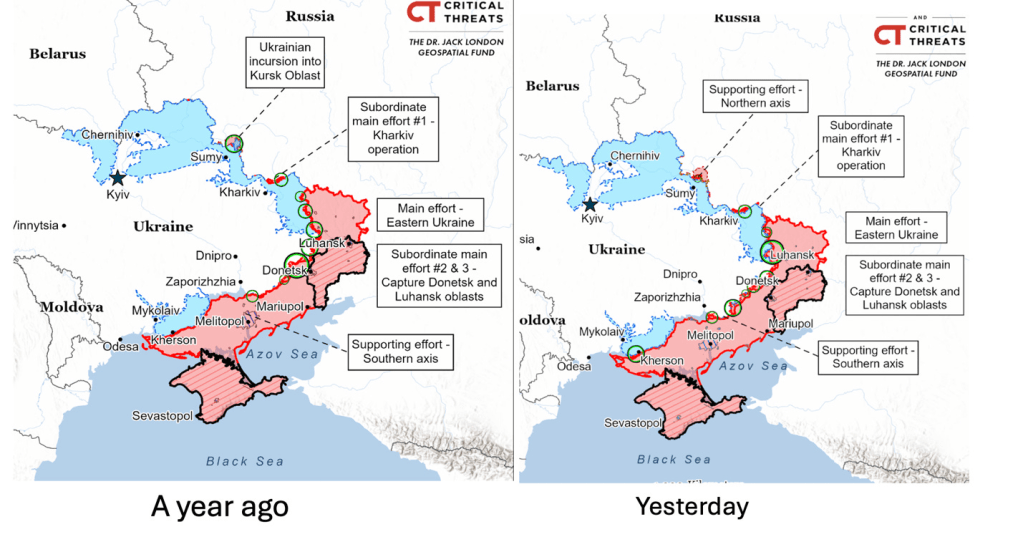
First, about the military situation. The maps at the top of this post show how the area of Ukraine under Russian control — shaded pink — has changed over the past year. You may ask, whatchange? Exactly. The Ukraine war isn’t like World War II, in which breakthroughs could be exploited by armored columns sweeping into the enemy’s rear. It’s a war in which the battlefield is swarming with drones, where there isn’t even a well-defined front line, and the “kill zone” within which even armored vehicles are basically death traps is many kilometers wide.

Some observers still don’t understand how the reality of war has changed. Thus there have been breathless reports about the danger Ukraine would face after Russia seized the “strategic city” of Pokrovsk since July 2024. Russian forces finally entered Pokrovsk late last year and may now occupy most of the rubble. But it made no difference.

This reality shows how idiotic it is for the U.S. Department of Defense — sorry, Department of War — to decide that its mission is to embrace a “warrior ethos.” Bulging biceps and macho posturing won’t help you prevail in modern war, while bombastic stupidity is a good way to get many soldiers killed.

So if modern technology has turned war on the ground into a bloody stalemate — much bloodier for Russia than for Ukraine, but still indecisive — what will determine victory and defeat? The answer, which has been true in most wars, is that it will come down to resources and logistics.

If this were purely a conflict between Russia and Ukraine, the Ukrainians, for all their heroism, would be doomed. Russia, after all, has four times Ukraine’s population and ten times its GDP.

But Ukraine has powerful friends.

For the first three years of the war, the United States was the most important of these friends. Indeed, Ukraine wouldn’t have been able to resist Russia without U.S. aid.

Unfortunately, top Biden officials were too cautious. They didn’t want Putin to win, but they clearly lost their nerve at the prospect of outright Russian defeat. So they slow-walked aid and kept putting restrictions on the use of U.S. weapons. Without those restrictions, Ukraine would have been able to hammer Russian rear areas, and this war might well have ended in its first year.

As it was, Ukraine was able to hang on but not triumph. And now we have a U.S. president who clearly wants to see a Russian victory. He’s unwilling or unable to openly throw America’s weight behind Putin, but he has effectively cut off all U.S. aid to Ukraine. That’s not hyperbole. Here are the numbers:

A graph of different colored bars

AI-generated content may be incorrect.

Source: Kiel Institute

This is a betrayal of everything America used to stand for. We’re witnessing a war between freedom and tyranny, between an imperfect but decent government and a monstrous mass murderer — and the U.S. government is de facto backing the tyrannical monster.

Yet despite Trump’s pro-Putin policy, Ukraine is still standing, while Russia’s year-long offensive has been a bloody failure. While Trump may have thought that he could discreetly hand Ukraine over to Putin, it turns out that he didn’t have the cards.

Crucially, as you can see from the chart above, Europe has for the most part stepped up to the plate, replacing most of the lost aid from the United States. True, some of the military aid takes the form of U.S. weapons purchased by European nations and transferred to Ukraine. In particular, there is still no good alternative to Patriot air defense systems. And the Trump administration has been stalling some military deliveries even though Europe is paying.

But European — and, increasingly, Ukrainian — arms production has been ramping up. One indicator of European potential for arms manufacturing is that U.S. officials have gone ballistic over proposed buy-European provisions in Europe’s ongoing military buildup and threatened retaliation. This is quite rich: America in effect reserves the right to use its control over weapon systems to hobble other countries’ military efforts — on behalf of dictators the president likes — but is furious at any attempt to reduce dependence on those systems.

But does Europe have the resources to ensure Ukrainian victory without the United States? Mark Rutte, a Dutch politician who is currently secretary-general of NATO, made waves last month when he told people who believe that Europe can defend itself against Russia without the United States to “keep on dreaming.” One sees similar declarations of helplessness from some other Europeans. But it’s really difficult to see where this defeatism is coming from. Combined, the economies of the European nations that have strongly supported Ukraine are vastly larger than Russia’s:

A graph of a bar chart

AI-generated content may be incorrect.

Source: International Monetary Fund

It’s true that Europe has in the past had great difficulty acting like the superpower it is. But that may be changing.

So, how will this war end? Russia’s strategy now appears to be to terror-bomb Ukraine into submission, but as far as I know that has never worked. The more likely outcome is that European aid and Ukraine’s own growing prowess in arms production will gradually shift the military balance in Ukraine’s favor, and that Russia’s war effort will eventually collapse.

I hope that’s how it turns out. But even if it does, shame on America, for betraying a valiant ally.

Trump is determined to punish states and cities that didn’t vote for him. So he sent large numbers of masked ICE agents to bully, beat, harass, and intimidate people in blue places, while recklessly killing two protestors.

He unleashed his fury on Minneapolis, sending in 3,000 ICE agents. They must have been trained to act like Brown Shirts because they do. They don’t just arrest people. They grab them, throw them to the ground, punch them, kick them, ziptie them, toss them into a van, picking up people who “look like” immigrants, and disappear them.

The people of Minneapolis resisted. They resisted with such determination that they forced Trump to back down. DHS announced that it will pull its occupying force out of Minneapolis. Everyone is waiting to see if ICE is really leaving. They will believe it when they see it.

Other cities and communities can learn from Minneapolis. The ICE bullies may soon be sent to your city, your community.

The resistance began immediately. People set up an alarm system, letting others know where ICE was operating. People protected their neighborhoods and communities. They turned out to blow whistles, to film ICE actions on their cell phones, and peacefully protest by their presence

Wherever ICE went, volunteers documented what they did. These videos proved to be powerful evidence of ICE brutality and lies.

Renee Good was murdered at one such protest. The White House and Department of Homeland Security called her a domestic terrorist and said she tried to run over an ICE agent, but multiple videos proved that they were lying.

Alex Pretti was murdered when he tried to help a fellow protestor who had been knocked on her back by ICE goons. He was filming with his cellphone. They called him a terrorist and an assassin, but again they were lying.

The people of Minneapolis treated each other as friends and neighbors and organized a powerful resistance. Volunteers organized to deliver food to people afraid to leave home. They drove people who were afraid to take public transit.

Schools protected their students as best they could. Many children from immigrant families were afraid to leave home. The schools went online to keep them learning. Schools stockpiled food for students and their families; volunteers delivered it. Teachers made home visits to check on students.

Columbia Academy, a middle school in Columbia Heights, a Minneapolis suburb, became “a food bank, a counseling hotline, a missing persons task force, an immigration resource center and a refuge.”

Leslee Sheri, the principal of the school in Columbia Heights, a five-school district, said:

“We are the first call,” said Sherk, a first-year principal who has worked in the district for two decades. “They don’t call the police. They don’t even sometimes call their neighbors or different organizations. They call the school.”

Neighbors helped neighbors. Neighbors helped strangers. The people of Minneapolis reacted with surprising solidarity in opposition to the aggressive militarization of their city.

They stood up, often in bitter cold, spoke out, protected the vulnerable, and demonstrated what democracy, courage l, and compassion looks like.

They won.

The big money promoting privatization in Denver tried to capture the Denver school board, but was defeated by candidates endorsed by the Denver Classroom Teachers Association.

Chalkbeat Colorado reported:

Denver school board candidates backed by the teachers union won all four open seats Tuesday, unofficial election returns show, making it likely the board’s current balance of power will hold.

Eleven candidates were vying for four seats on the seven-member Denver school board.

Union-backed candidates won by commanding leads in three of the races and a solid lead in the fourth, according to unofficial returns. Two of the three incumbents who ran for reelection, Michelle Quattlebaum and Scott Esserman, lost their seats.

Teachers union-backed board members have controlled the board of Colorado’s largest school district for the past six years. Members who support charter schools and other education reform strategies gained a bigger foothold in 2023 and had a chance to flip the board majority this year.

Now, the board will continue to be composed of four members who were endorsed by the teachers union and three who were backed by reform interests.

Denver Classroom Teachers Association President Rob Gould called the early returns on Tuesday a victory of “people over money.” Like in past elections, reform groups were on track to outspend the teachers union, according to the latest campaign finance reports.

Don’t lose hope! Don’t give up, no matter how bad it looks today.

That’s the advice of Ian Bassin, the co-founder and executive director of Protect Democracy. In this essay, he explains that the enemies of democracy cultivate despair. They flood the zone with cruel policies. They want us to believe that resistance is futile.

It is not. Don’t help them achieve their goals!

He writes:

Let’s not mince words. It’s a dark time.

If you’re reading this, you feel it. You see federal troops on American streets as a political tool. You see a multi-front assault on our elections. You see the machinery of government — from a supercharged ICE to a weaponized Department of Justice — being wielded against those the regime dislikes. You see courts wavering, Congress cowering, and other institutions choosing accommodation over confrontation. The danger is real, and the exhaustion is profound.

But it’s not just the individual threats that weigh on us. It’s the sheer volume. The autocrat’s playbook isn’t just about single acts of repression; it’s about creating a dozen crises at once. This is not incompetence; it is a strategy. As strategists from Sun Tzu onward have counseled, stretch an opponent’s defenses, exhaust them, and strike where they are then unprepared. By flooding the zone with outrages, they keep us perpetually reactive, divided, and off-balance. Our attention is their battleground, and they are winning by forcing us to fight on a thousand fronts at once.

The goal of this chaos is twofold. First, to spread us thinly so our responses are less effective. Second, to exhaust us and make the defense of democracy feel so futile that its defenders simply give up. Despair is a political weapon.

I’m not writing to tell you that you’re wrong to feel this way. I’m writing to tell you that this feeling is a designed part of the assault we’re facing. And I’m writing to tell you that we are not the first to stand in this spot, staring into what looks like an abyss. In the history of those who came before us, we can find a map not for a specific strategy but for a resilient mindset.

The long defeat as enduring hope

The phrase “the long defeat” comes from J.R.R. Tolkien, who has Galadriel speak of “fighting the long defeat” in The Lord of the Rings. That evil may never be fully vanquished and therefore that even victories against it are temporary. For Tolkien, a devout Catholic, it carried a tragic but defiant realism: History is a process of entropy, yet the fight for beauty, justice, and truth is still worth waging.

Over time, the idea that even in a period of decline doing the right thing remains a strategic and moral imperative has migrated from literature into political and theological commentary. Dissidents under Soviet rule, activists resisting authoritarianism, and modern democratic leaders have invoked versions of this concept to capture the paradox of resistance.

Victory may lie invisibly over some horizon, or may never be final. Setbacks are inevitable, and yet the very act of persevering is itself a form of hope.

To “fight the long defeat” is not to surrender to futility but to locate dignity and meaning in the struggle itself — and to recognize that what feels like defeat in one moment may seed the victories of another. Indeed history is replete with examples.

Lessons from a Polish winter

Consider Poland in the winter of 1981. The vibrant Solidarity movement was met with martial law. (If you don’t know the history of Solidarity, we’re planning to write about it later this week — stay tuned.) Its leaders were jailed; its organization shattered.

The pro-democracy cause appeared utterly defeated by the full weight of a Soviet-backed state.

What did they do when open confrontation became impossible? They didn’t stop. They began a patient, underground campaign — sustained organizing, covert communications, and cultural work that kept civic life alive. They understood that when you cannot win on the state’s terms, you must refuse to let the state define the terms of reality. They focused on keeping the idea of a free Poland alive. Through underground publishing and clandestine lectures — continuing traditions like the “Flying University” — they maintained a shared understanding of truth in the face of a regime dedicated to lies.

For roughly eight years they persisted. They were not just an opposition; they were the custodians of a democratic ideal. When a crack in the regime appeared in 1989 — with the Round Table Talks and semi-free elections — they were ready because they had never surrendered the moral and intellectual foundations of a free society.

Their lesson for us is this: When the machinery of the state is captured, the most critical ground to defend is our shared commitment to truth and democratic values. Doing so is necessary to be ready to seize the opening when it inevitably comes.

Clarity in our own history

We can find a similar lesson in our own history. Think of the lawyers and activists of the Civil Rights Movement in the 1950s and ’60s. They faced a legal and political system built to exclude them. The courts, the police, and the law itself were instruments of a brutal racial hierarchy.

Every institution that was supposed to deliver justice was instead architected to deny it.
Their response was not to meet every injustice with a scattered, reactive defense

It was to maintain an unwavering focus on the core principle at stake: the moral and constitutional bankruptcy of segregation. They possessed profound strategic patience, persistence, and powerful moral clarity. Their fight reminds us that in an environment of institutional failure and constant attack, the most potent weapon is a disciplined focus on the fundamental principles being violated.

But history also shows that change can come with surprising speed. Consider the movement for marriage equality in the immediate aftermath of the 2004 election. Voters approved bans in 11 states that year, amending constitutions to prohibit same-sex marriage, and President George W. Bush — who supported a federal marriage amendment — was reelected. The political consensus was so strong that even in 2008, the Democratic nominee for president recanted his previous support for marriage equality. Yet within just a few years, everything shifted: in 2011 the Obama administration stopped defending the Defense of Marriage Act in court; in 2012 the president endorsed marriage equality; and public opinion moved rapidly until marriage equality was recognized in the Constitution. While we know that victory is now facing its own backlash, that moment is a powerful reminder that political winds can shift with breathtaking speed.

A moment of seeming hopelessness can be the prelude to a breakthrough.

A mindset for a hard moment

The history of these movements does not offer us an easy comfort or a simple to-do list. It offers us a way to think, a framework for how to situate ourselves and endure.

  1. Find the signal in the noise — We must resist the autocrat’s strategy of distraction. We cannot respond en masse to every fire. Instead, we must anchor our work in the foundational principles at stake: the rule of law, the integrity of elections, and the ultimate sovereignty of a free people. By focusing on the core pillars of democracy, we refuse to have our attention fragmented and our energy dissipated.
  2. Cultivate strategic readiness — This isn’t just about passively enduring a long winter. It is about actively preparing for a change in the weather and doing what we can to bring it about. We cannot ultimately control when the political winds will shift or when an unexpected event will create an opportunity. But we can control our readiness. The work of a hard moment is to get the sails ready. It is the time to lay the legal groundwork, build the coalitions, refine the strategies, and organize the resources. Our task is to be so prepared that when a crack of daylight appears, we are ready to sail through it with maximum force and not be caught scrambling.
  3. Uphold a common truth — In an era of rampant disinformation, the simple act of insisting on objective reality is a profound form of resistance. The authoritarian project depends on breaking our collective understanding of facts. By committing ourselves to defending the institutions and norms that discern truth — in journalism, in science, in law — we are defending the very possibility of a self-governing society.
  4. Bolster each other — In moments that feel like we’re spiraling backwards, when the forces of unfreedom are on the march, a common tendency is for the forces of freedom to fall into infighting. Rather than gaining strength from each other, our fears and anxieties and anger lead us to turn on each other. But in that reaction are the seeds of ultimate defeat; whereas movements that come together in times of adversity water the seeds of renewal.

There is no question we are being tested — as a country, as a movement, and as individuals.
But we are not the first to have faced such tests and we will not be the last. Many who preceded us faced tests like this and even harder ones, and we have their example to remind us that whatever happens, no matter how dark the night, the world keeps turning and eventually comes the dawn.

Personally, I’m more optimistic than Tolkien. I don’t think human history bends towards decay. I’m partial to Martin Luther King’s vision that it bends towards justice. But what’s powerful about the idea of the long defeat is that it is agnostic about one’s optimism or pessimism — it simply reminds us that the task of being human (or elf) is to do right and to do good and to embrace beauty where we can find it.

And if I can play my small role in lifting you up in this difficult moment, it’s to remind us all to remember that. And to act on it.

Thousands of people turned out to participate in the #NoKings March, which started at Grand Army Plaza and ended at the southern end of Prospect Park. We were surrounded by people carrying signs and chanting “Hey hey hi ho/Donald Trump has got to go.” Many signs were very clever. I couldn’t photograph them all.

I liked the little girl who had a sign that said, “I should be worried about tests/Not my rights.”