Archives for category: Common Core

Neuroscience confirms what many of us long suspected: Fiction is more powerful for developing the mind, social skills, empathy, and imagination than non-fiction. And yet for nearly two decades, American schools have been encouraged to downplay fiction. Teachers have been told to downplay novels, fewer novels are assigned, and fewer students read whole books.

Instead of reading stories, students read excerpts in preparation for the format of standardized tests. There, students are asked questions about extracts without a beginning, a middle or an end.

Why?

Seventeen years ago, the Common Core State Standards were introduced to the public as the salvation of education. Its sponsors claimed that they would raise scores and close or narrow achieve gaps.

The Common Core standards were funded almost entirely by the Gates Foundation and enthusiastically endorsed by Obama’s Secretary of Education Arne Duncan. The Obama administration gave states a huge incentive to adopt the Common Core standards. States were required to endorse the Common Core to qualify to compete for a large chunk of the $5 billion Race to the Top fund.

Most states adopted the Common Core standards, sometimes without actually reading or reviewing them. Behind the Common Core was the dubious belief that standardization of standards, tests, textbooks, and teacher training would have a dramatic positive effect on student test scores. That turned out not to be true.

But even worse, David Coleman, the architect of the Common Core (and now the President of the College Board, which publishes the SAT tests, the AP tests, and other standardized tests) believed that “informational text” was more valuable than fictional works.

The Common Core recommended that the curriculum be weighted 50-50 between literary and informational texts in fourth grade; 45-55 in eighth grade; and 30-70 in twelfth grade. That is, only 30 percent of reading in twelfth grade would be fiction.

Tom Loveless, then at the Brookings Institution, showed how these ratios, which were literally based on nothing, no research, led to a decline in the assignment of fiction in schools.

In response to the widespread adoption of the Common Core, textbook publishers and test publishing companies de-emphasized fiction. The National Assessment Governing Board, which administers the federal test called NAEP, downgraded fiction in its national tests for fourth, eighth, and twelfth grades.

According to an article by Richard Sima in the The Washington Post, the theory that fiction was of lesser value was wrong.

Sima, a neuroscientist and science journalist, writes that fiction is better for the growing mind than informational text.

He writes:

Reading in general — newspapers, magazines, nonfiction books — has been linked to slower rates of cognitive decline in older adults and even longer lives.

But reading fiction may have unique benefits. For example, the amount of fiction people read seems to be a better predictor of language ability than nonfiction, research finds. And, perhaps even more importantly, research has found that fiction is linked to better social cognition — our ability to think about and interact with other people — and an increased understanding of the world as a complex place.

Why? Fiction forces you to imagine a story’s world and characters. It makes you grapple with different perspectives, mentally inhabiting distinct points of view, according to Nick Buttrick, an assistant professor of psychology at the University of Wisconsin at Madison.

This can help us find “better insight into our own experiences, insight into the experiences of others who are very different from us,” said Raymond Mar, a professor of psychology at York University in Toronto, who recently wrote a review on the benefits of reading narrative fiction. “It just tends to evoke a form of reflection and contemplation, which can only be good for us.”

Why reading is actually social

Social health is important for overall health. And it turns out that reading, though often thought of as a solitary activity, can boost our social abilities.

To understand why, it helps to look at how reading shapes us as we grow.

Between ages 4 and 6, children develop a theory of mind — the ability to understand that others have different beliefs, perspectives and feelings. Studies find that children exposed to more storybooks are further along this developmental milestone than those exposed to fewer ones, Mar said.

A 2025 meta-analysis of 21 studies found that children who read more storybooks had more empathy. And there is evidence that empathy and reading go both ways. Better reading comprehension was a predictor of empathy later in life, while empathy also was a predictor of better reading ability, according to a 2024 study of more than 900 children. And adolescents who read more for fun became more social adults, a 2023 study found…

Reading fiction “presents to us a complex cognitive and emotional simulation of the social world,” which is useful in the real world, Mar said.

The power of storytelling

These benefits may be due, in part, to the power of storytelling.

Neuroimaging studies find that brain networks involved in understanding stories overlap with brain networks needed for theory of mind. This suggests that “while engaging with stories, we’re also pulling online the same kinds of brain networks that we use to understand other people,” said Mar, who wrote a review about these studies.

Other forms of storytelling, such as television and movies, may provide similar benefits, but “one of the things that you do when you read is you have to construct the world” in your head, Buttrick said. “The world is not given to you. You have to do the work of imagining.”

The article goes on in greater detail about why fiction is more important for young people than non-fiction, the exact opposite of the premises of the Common Core.

This is a terrific interview conducted by Nick Covington about my bio, An Education: How I Changed My Mind About Schools and Almost Everything Else.

Please listen.

I have said before that I love Peter Greene. He has turned his four decades of experience as a high school English teacher into a compendium of wisdom. He knows when to listen carefully to new ideas and when to throw them out with the garbage. He usually says what I have been thinking, but writes it up better than I could. This is one of those wonderful pieces that are trademark Peter Greene.

He writes:

Last week I had a bluesky post blow up, a simply referral to Dana Goldstein’s New York Times pieceabout how nobody reads whole books in school any more. It’s a good piece, pretty fairly balanced even as it points out the role of technology, Common Core, and testing in the decline of whole-book reading (and allows some folks to try to defend the not-very-defensible). 

The article itself drew well over a thousand comments, most of them supportive of the idea of reading whole books. The responses to my post were a more mixed bag, with responses that included variations on “Students would read more books if they were assigned good stuff like [insert your fave here] and not crap like [insert author who bugs you and/or Shakespeare here].” Also variations on “Aren’t books over, really?” and its cousin “I didn’t read any books and I am just swell.”

Goldstein gives Common Core a few graphs of defense, because the world still includes people who think it’s great. I am not one of those people, and I have filled up a lot of space explaining why. But in the drop in book reading we can see a couple of the long-term ill effects of the Core (including all the versions hiding in states under an assumed name).

One problem is the Core’s focus on reading as a set of discrete skills that exist in some sort of vacuum absent any content, like waves without water or air. The Core imagined reading as a means of building those skills, and imagined in that context that it doesn’t matter what or how much you read. If today’s lesson is on Drawing Inferences, it doesn’t matter whether you read a scene from Hamlet or a page from a description of 12th century pottery techniques. You certainly don’t need to read the entire work that either of those excerpts came from. Read a page, answer some questions about inferences. Quick and efficient.

And that emphasis on speed and efficiency is another problem.

The Big Standardized Test doesn’t just demand that students get the right answer. It demands that they come up with the right answer RIGHT NOW! And that scaffolds its way backwards through the whole classroom process. The test prep emphasizes picking the One Correct Answer to the question about the one page slice o’writing, and it emphasizes picking it quickly. There is no time allotted for mulling over the reading, no time for putting it in the context of a larger work, certainly no time for considering what other folks have thought about the larger work.

To read and grapple with a whole book takes time. It takes reflection, and it can be enhanced by taking in the reactions of other readers (including both fancy pants scholars and your own peers). I reread Hamlet every year for twenty-some years, each time with a different audience, and I was still unpacking layers of ideas and language and understanding at the end. I taught Nickel and Dimed for years, and the book would lend itself very easily to being excerpted so that one only taught a single chapter from it; but the many chapters taken together add up to more than the sum of their parts. And it takes a while to get through all of it.

If you think there is more value in reading complete works than simply test prep for reading “skills,” then you have to take the time to pursue it.

It is easy as a teacher to get caught up on the treadmill. There is so much you need to cover, and only so much time. There were many times in my career when I had to take a deep breath and walk myself back from hammering forward at breakneck speed. And education leaders tend only to add to the problem and pressure (the people who want you to put something else on your classroom plate rarely offer any ideas about taking something off to make room).

And look– I don’t want to fetshize books here. We English teachers love our novels, but it’s worth remembering that the novel as we understand is a relatively recent development in human history. Some works that we think of as novels weren’t even first published as books; Dickens published his works as magazine serials. And reading novels was, at times, considered bad for Young People These Days. For that matter, complaints about how Kids These Days don’t read full works takes me back to a college class where we learned that pre-literate cultures would sometimes bemoan the rise of literacy– “Kids These Days don’t remember the old songs and stories any more.”

Reading entire works is not automatically magical or transformative. But there is a problem that comes with approaches to comprehending the world that emphasize speed rather than understanding, superficial “skills” over grappling with the ponderable complexities of life. The most rewarding relationships of your life will probably not be the ones that are fast and superficial. And I am reflexively suspicious of anyone who does not themselves want to be seen, heard, or understood on anything beyond a swift and shallow read.

If education is about helping young humans grasp the better version of themselves while understanding what it means to be fully human in the world (and I think it is) then students need the opportunity to grapple with works that mimic the depth and size and complexity of real humans in the real world.

The case has been made for slow school, analogous to the slow food movement, and it can have its problems, like fetishizing a selective view of tradition. But I like the basic idea, the concept of slowing down enough to be able to take in and digest large slices of the world. That should certainly take the form of engaging students with complete works, but I expect that it can take other forms as well.

Test-centric schooling has narrowed and shallowed our concept of education in this country, and while there has never been a reason to stop discussing this issue over the last twenty years, much of the conversation has moved on to other issues, like the current emphasis on culture panic and dismantling the system. But we can do better, dig deeper, tap richer educational veins, if we are just honest about our goals and our obstacles. I hope we’ll get there before my children and grandchildren get too much older.

John Thompson, historian and retired teacher in Oklahoma, wrote this thoughtful review of my memoirs, An Education: How I Changed My Mind About Schools and Almost Everything Else.

He writes:

Diane Ravitch’s An Education: How I Changed My Mind About Schools and Almost Everything Else is dedicated to her wife Mary; her sons, Joe, Michael, and Steven; her grandsons Nico, Aidan, Elijah, and Asher; and her ex-husband Richard. An Education intertwines deeply emotional personal and family experiences with the history of how she became such a transformative education leader. Although Diane denies it, I believe she’s the most influential education advocate of the last century.

I’ve been reading Diane Ravitch’s work for decades, but An Education is my favorite book. And my favorite passage started with Diane’s citation of Robert Hutchins who said, “We have to learn to live with those whose opinions differ from our own. After all, they may turn out to be right.”

Then she wrote about Hutchins statement, “for three decades I didn’t realize that it was intended for me.”

Being from Oklahoma, I was captured by the first part of her book, about growing up in Texas. I especially loved her story about meeting Roy Rogers at the Rodeo when she was 9 years old. After Rogers slapped her hand, Diane said, “I determined on the spot that I would never wash that hand again!”

Diane was a tomboy who loved horses and dogs. But she experienced sexism and trauma. She said she “did not have an idyllic adolescence. No one ever does.”  But her teenage years were “destroyed by my father abusing me.” 

During the middle of her book, she recalled her complicated marriage to Richard Ravitch and, then, her wonderful wife, Mary. Mary worked with the progressive educator Deborah Meier and opened a progressive small school in New York City. 

I was especially impressed by Diane’s communication with Al Shanker. He sought to allow teachers to start schools within schools to turnaround kids “in the back of the classroom with their heads on their desks.” Back in the late 1980s, it seemed like he might be able to bring diverse factions together. But, by 1994, charters had been high-jacked by corporate reformers and their winners and losers ideology.

In the middle of An Education. Diane revealed in so much detail the inside stories of her years as a conservative.  Back then, when I was an academic historian, I learned the most about Diane when reading her 1983 book, “The Troubled Crusade: American Education, 1945 – 1980.” Although I couldn’t yet read her work through the eyes of a teacher, I was exceptionally taken by her calls for teaching background knowledge so students could develop reading comprehension skills so they could “read to learn,” and her placing education pedagogies in a broad historical context.

Diane recalls her support for meritocratic, standardized testing, and color-blind policies, when she questioned bilingual education, and even the benefit of the Equal Rights Amendment. This was the time when she made friends with Bill Bennett, President Reagan’s Secretary of Education, and Chester Finn, and Tennessee Governor Lamar Alexander. I knew she had ties to Daniel Patrick Moynihan, but I too thought that progressives’ criticism of him was too politically correct. And, until I read An Education, I knew little about the two sides of James Coleman’s research, whose earlier research had seemed persuasive to me.

Neither would I have thought that Chester Finn was like a “sibling” to Diane.

When explaining her then-conservative beliefs, I sometimes felt that Diane was too hard on herself. For instance, she was far, far from alone in failing to understand the wisdom of Gov. Ann Richards, who said, “If there ever is school choice in Texas, the hard-right Christians will get the money to indoctrinate children.”

Moreover, as An Education schooled me on the propaganda behind the so-called “Texas Miracle” it did more than foreshadow the “New York City Miracle,” the “Harlem Miracle,” and the “Mississippi Miracle.”  It brought me back to the decades-long Oklahoma reality when our curriculum and policies were based on Texas’ accountability systems.  During most of my career, our policies were informed by one Texas trick after another to jack up accountability metrics.

Diane served as member of the National Assessment Governing Board from 1997 to 2004, and she would dig deeply into the numbers and the methodologies behind NAEP. But, as she explained, few journalists read the fine print of the research and they wrote “breathlessly” about supposedly dismal results in traditional public schools. They certainly didn’t report properly about the way that students’ outcomes were linked to family income.

When serving in the Education Department, Diane took a lead in establishing national standards for every school subject. Drawing upon excellent historians, multicultural History standards were set. She hoped standards like those would remain voluntary and “unify their respective fields and establish a common ground for a curriculum without telling teachers how to teach.” 

But the conservative Lynne Cheney “published a scathing denunciation of them.” Cheney said the History standards focused too much on people like Joe McCarthy and the Ku Klux Klan, and not enough on Ulysses S. Grant, and Robert E. Lee. This launched the modern wars over curriculum that have become especially destructive under President Trump. 

Even so, in 2002, Diane hoped that Mayor Mike Bloomberg and Joel Klein (who knew nothing about education) would succeed in improving New York City Schools. Klein reorganized schools from top to bottom, with multiple schools per building drawing on funding by the Gates Foundation. (By the way, I saw the chaos Klein created when visiting dozens of hurriedly opened school, especially in Bedford–Stuyvesant. Usually, leaders of the new schools didn’t even know how many new schools were being opened in their building.)

And, even worse, Jack Welch CEO of General Electric pushed 20-70-10 “stack ranking,” meaning 70% of teachers would be in the middle in terms of effectiveness, and 10% should be “removed,” even if it took the use of invalid and unreliable metrics to evaluate all teachers.

Especially after Diane engaged in a seven-year debate with Deborah Meier, which further “broadened her perspectives,” she became an invaluable leader of the grass-roots opposition to corporate school reforms. She objected to top-down mandates on teaching reading. Diane was among the first to explicitly link in a detailed manner the reforms to the wider privatization movement. And she nailed it when identifying them as the “Billionaires Boys Club.”

Diane analyzed the public relations campaigns which sold “reforms” as the “New York City Miracle.” Drawing upon her insights from serving on the National Assessment Governing Board, she clearly explained why NYC schools flipped back and forth between A and F grades.  Then, she linked President Obama’s flawed $5 billion RTTT experiment with the problems with Common Core curriculum and tests that were years above students’ reading levels.

Diane then quotes John Maynard Keynes who said, “When the facts change, I change my mind. What do you do, sir?”

Today, Diane changes minds by clearly explaining the interconnections between Free Market ideology, and profits, and the mindsets of elites that push privatization. She also reports daily on the interconnected attacks on schools throughout the nation. And now she’s sharing the same wisdom when spreading the word about Trumpism and today’s attacks on democracy.

I always read Diane’s daily blog posts. And I so very much appreciate An Education, even if it briefly pulled me away from reading everything in the Diane Ravitch Blog.

If you have ever wondered why I am crazy about Peter Greene, wonder no more. Just read this post that appeared on his blog. Peter is consistently smart, funny, wise, and insightful. He has a way with words. He is unerring in spotting phonies. He is fearless. Let me say it out loud: I love Peter Greene!

He wrote about the article that exposed Duncan’s true views. Until now, some of us had only inferred who he is. Now we know. Duncan”political advice” to Democrats–adopt Republican policies– is hilarious in light of Tuesday’s election results: across the nation, Democrats won school board races, and every Moms for Liberty candidate lost.

Peter Greene writes:

Mind you, on education, Duncan was always the kind of Democrat largely indistinguishable from a Republican, but with his latest print outburst (in the Washington Post, because of course it was), he further reduces the distance between himself and his successor as Secretary of Education, Betsy DeVos. 

For this one, he teamed up with Jorge Elorza, head honcho at DFER/Education Reform Now, the hedge fundie group set up to convince Democrats that they should agree with the GOP on education.

It’s yet another example of reformsters popping up to argue that what’s really needed in education is a return to all the failed reform policies of fifteen years ago. I don’t know what has sparked this nostalgia– have they forgotten, or do they just think we have forgotten, or do they still just not understand how badly test-and-punish flopped, how useless the Common Core was, and how school choice has had to abandon claims that choice will make education better in this country.

But here come Duncan and Elorza with variations on the same old baloney.

First up– chicken littling over NAEP scores. They’re dipping! They’re low! And they’ve been dipping ever since 2010s. Whatever shall we do?

Who do Duncan and Elorza think holds the solution? Why, none other than Donald Trump.

Seriously. They are here to pimp for the federal tax credit voucher program, carefully using the language that allows them to pretend that these vouchers aren’t vouchers or tax shelters.

The new federal tax credit scholarship program, passed as part of the One Big Beautiful Bill Act, allows taxpayers to claim a dollar-for-dollar federal tax credit for donations to scholarship-granting organizations, or SGOs. These SGOs can fund a range of services already embraced by blue-state leaders, such as tutoring, transportation, special-education services and learning technology. For both current and incoming governors, it’s a chance to show voters that they’re willing to do what it takes to deliver for students and families, no matter where the ideas originate.

The encourage governors to “unlock these resources” as if these are magic dollars stored in a lockbox somewhere and not dollars that are going to be redirected from the United States treasury to land instead in some private school’s bank account.

Democratic governors are reluctant to get into a program that “could be seen as undermining public schools.” But hey– taking these vouchers “doesn’t take a single dollar from state education budgets” says Duncan, sounding exactly like DeVos when she was pushing the same damned thing. And this line of bullshit:

It simply opens the door to new, private donations, at no cost to taxpayers, that can support students in public and nonpublic settings alike.

“At no cost to taxpayers” is absolute baloney. Every dollar is a tax dollar not paid to the government, so the only possible result must be either reduction in services, reduction in subsidies, or increase in the deficit. I guess believing in Free Federal Money is a Democrat thing.

The “support students in public and nonpublic settings” is carefully crafted baloney language as well. Federal voucher fans keep pushing the public school aspect, but then carefully shading it as money spent on tutors or uniforms or transportation and not actual schools. And they are just guessing that any of that will be acceptable because the rules for these federal vouchers aren’t written yet.

Duncan and Elorza want to claim that this money will, “in essence,” replace the disappearing money from the American Rescue Plan Act. “In essence” is doing Atlas-scale lifting here because, no, it will not. The voucher money will be spent in different ways by different people on different stuff. They are not arguing that this money will help fund public schools– just that it might fund some stuff that is sort of public education adjacent.

But how about some “analysis” from Education Reform Now, which claims that the potential scale is significant.” They claim that “the federal tax credit scholarship program could generate $3.1 billion in California, nearly $986 million in Illinois and nearly $86 million in Rhode Island each year,” drifting ever closer to “flat out lie” territory, because the federal vouchers won’t “generate” a damned cent. Pretending these numbers are real, that’s $3.1 billion in tax dollars that will go to SGOs in the state instead of the federal government. It’s redirected tax revenue, not new money. Will the feds just eat that $3.1 billion shortfall, or cut, say, education funding to California? Next time I get a flat tire, will I generate a new tire from the trunk? I think not.

In classic Duncan, he would like you to know that not following his idea makes you a Bad Person. Saying no to the federal vouchers is a “moral failure.”

Next up: Political advice.

Over the past decade, Democrats have watched our party’s historical advantage on education vanish.

Yeah, Arne, it’s more than a decade, and it has happened because you and folks like you have decided that attacking and denigrating the public education system would be a great idea. You and your ilk launched and supported policies based on the assumption that all problems in school were the sole treatable cause of economic and social inequity in this country, and that those problems were the result of really bad teachers, so a program of tests followed by punishment would make things better in schools (and erase poverty, too).

But now the GOP states are getting higher NAEP scores, so that means… something?

This is Democrats’ chance to regain the educational and moral high ground. To remind the country that Democrats fight to give every child a fair shot and that we’ll do whatever it takes to help kids catch up, especially those left behind for too long.

Yes, Democrats– you can beat the Republicans by supporting Republican policies. And that “we’ll do whatever it takes to help kids catch up” thing? You had a chance to do that, and you totally blew it. Defund, dismantle and privatize public schools was a lousy approach. It’s still a lousy approach.

Opting in to the federal tax credit scholarship program isn’t about abandoning Democratic values — it’s about fulfilling them.

When it comes to public education, it’s not particularly clear what Democratic values even are these days, and my tolerance for party politics is at an all time low. But I am quite sure that the interests of students, families, teachers, and public education are not served by having the GOP offer a shit sandwich and the Democrats countering with, “We will also offer a shit sandwich, but we will say nice things about it and draw a D on it with mayonnaise.”

We have always heard that Arne Duncan is a nice guy, and I have no reason to believe that’s not true. But what would really be nice would be for him to go away and never talk about education ever again. Just go have a nice food truck lunch with Betsy DeVos.

According to three advocates for cursive writing, it is a powerful tool for learning. While many predicted its demise after the widespread adoption of typing and computers, it is indeed making a comeback; some states have mandated it in the elementary years.

Please note that this author learned cursive, with extreme difficulty. I am left-handed, and my pen curled around my hand, smudging my hand with ink. Though we were taught via the Palmer Method, my handwriting today is almost indecipherable. Though I spent hours trying to draw circles, my handwriting is a scrawl. But I think I did get benefits from learning to write “by hand,” including being able to read other people’s handwriting.

The authors–Elizabeth DeWitt, Cheryl Lundy Swift, and Christina Brett–wrote:

In a world where digital devices are everywhere, it’s easy to wonder if handwriting still matters. We’ve all heard the argument that keyboards and screens have made this foundational skill obsolete. But research keeps confirming what many teachers have known for years: Handwriting is more than just penmanship — it’s an important part of a child’s thinking and literacy development, particularly during the formative years of pre-K through fifth grade.

A recent study, “Writing by Hand Helps Children Learn Letters Better,” reinforces this, showing that the physical act of forming letters strengthens memory and accelerates learning. Far from being a relic of the past, handwriting is a powerful tool that prepares young students for reading, improves their cognitive abilities and builds the groundwork for becoming confident, capable writers. Watch: Gen Z Can’t Sign Their Names, Making Mail-In Ballots Invalid.

The power of handwriting comes from the way it engages multiple senses at once. Unlike typing, which relies on a single, repetitive motion, handwriting activates multiple areas of the brain by combining visual, auditory and kinesthetic input. When children form a letter, they’re engaging in a dynamic process that solidifies its identity in their mind. This graphomotor movement — the coordination of hand and eye to produce letters — is key to remembering them. Explicitly teaching children to form letters by hand, even through simple methods like having them copy words from a correctly written letter, word or sentence, helps them learn and better retain letter and word structures.

This practice has a powerful ripple effect. Once letter formation becomes automatic, a child’s brain is freed to focus on higher-level thinking. Instead of struggling to recall how to write a letter, a child can concentrate on building sentences, expressing thoughts and ideas, and crafting coherent narratives. This is how fluent writing develops. And the benefits extend well beyond childhood: One study found college students who took notes by hand remembered more than those who typed, likely because writing by hand forces the brain to process and summarize information, not just copy it.

Forgive me for posting two reviews of my last book, which was published on January 20, 2020.

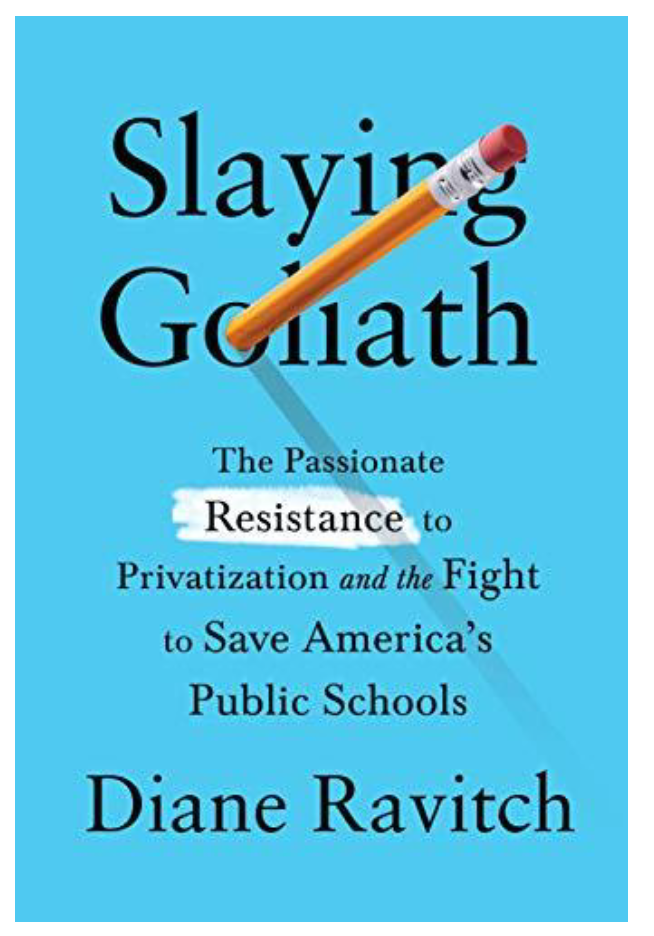
As I explained in the previous post, I did not see either of these reviews until long after they appeared in print. Slaying Goliath appeared just as COVID was beginning to make its mark, only a few weeks before it was recognized as a global pandemic. In writing the book, I wanted to celebrate the individuals and groups that demonstrated bravery in standing up to the powerful, richly endowed forces that were determined to privatize their public schools through charters or vouchers.

America’s public schools had educated generations of young people who created the most powerful, most culturally creative, most dynamic nation on earth. Yet there arose a cabal of billionaires and their functionaries who were determined to destroy public schools and turn them into privately-managed schools and to turn their funding over to private and religious schools.

Having worked for many years inside the conservative movement, I knew what was happening. I saw where the money was coming from, and I knew that politicians had been won over (bought) by campaign contributions.

Publishing a book at the same time as a global pandemic terrifies the world and endangers millions of people is bad timing, for sure.

But the most hurtful blow to me and the book was a mean-spirited review in The New York Times Book Review. The NYTBR is unquestionably the most important review that a book is likely to get. Its readership is huge. A bad review is a death knell. That’s the review I got. The reviewer, not an educator or education journalist, hated the book. Hated it. I found her review hard to read because she seemed to reviewing a different book.

I was completely unaware that Bob Shepherd reviewed the review. I didn’t see it until two or three years after it appeared. He wrote what I felt, but I, as the author, knew that it was very bad form to complain, and I did not.

So I happily post Bob Shepherd’s review of the review here.

I am almost four years late in discovering this review by two scholars for whom I have the greatest respect: David C. Berliner and Gene V. Glass.

I was happy to read this review because Slaying Goliath had a checkered fate. It was published in mid-January 2020. I went on a book tour, starting in Seattle. By mid-February, I made my last stop in West Virginia, where I met with teachers and celebrated the two-year anniversary of their strike, which shut down every school in the state.

As I traveled, news emerged of a dangerous “flu” that was rapidly spreading. It was COVID; by mid-March, the country was shutting down. No one wanted to read about the fight to save public schools or about its heroes. The news shifted, as it should have, to the panicked response to COVID, to the deaths of good people, to the overwhelmed hospitals and their overworked staff.

To make matters worse, the New York Times Book Review published a very negative review by someone who admired the “education reform” movement that I criticized. I thought of writing a letter to the editor but quickly dropped the idea. I wrote and rewrote my response to the review in my head, but not on paper.

Then, again by happenstance, I discovered that Bob Shepherd had reviewed the review of my book in The New York Times. He said everything that I wish I could have said but didn’t. His review was balm for my soul. Shepherd lacerated the tone and substance of the review, calling it an “uniformed, vituperative, shallow, amateurish ‘review.’” Which it was. His review of the review was so powerful that I will post it next.

Then, a few weeks ago, I found this review by Berliner and Glass.

The review begins:

Reviewed by Gene V Glass and David C. Berliner Arizona State University, United States

They wrote:

In a Post-Truth era, one must consider the source. 

In this case, the source is Diane Rose Silvers, the third of eight children of Walter Silverstein, a high school drop-out, and Ann Katz, a high school graduate. The Silvers were a middle-class Houston family, proprietors of a liquor store, and loyal supporters of FDR.

After graduation from San Jacinto High School, she enrolled in Wellesley College in September, 1956. Working as a “copy boy”for the Washington Post, Diane met Richard Ravitch, a lawyer working in the federal government and son of a prominent New York City family. They married on June 26,1960, in Houston, two weeks after Diane’s graduation from Wellesley. The couple settled in New York City, where Richard took employment in the family construction business. He eventually served as head of the Metropolitan Transit Authority and Lieutenant Governor in the 2000s, having been appointed by Democratic Governor David Paterson.

 Diane bore three sons, two of whom survived to adulthood. Diane and Richard ended their 26-year marriage in 1986. She had not been idle. For a period starting in 1961, Diane was employed by The New Leader, a liberal, anti-communist journal. She later earned a PhD in history of education from Columbia in 1975 under the mentorship of Lawrence Cremin.

Diane was appointed to the office of Assistant Secretary of Education, in the Department of Education by George H. W. Bush and later by Bill Clinton. In 1997, Clinton appointed her to the National Assessment Governing Board (NAGB), on which she served until 2004. 

Ravitch worked “… for many years in some of the nation’s leading conservative think tanks.

Read the full pdf here.

Peter Greene, retired teacher, is a regular contributor to Forbes, where this article appeared. It’s heartening to know that a business publication is exposing its readers to a veteran teacher who knows what he is talking about.

In this article, he cautions champions of “the science of reading not to repeat the same mistakes as Common Core, our last overhyped educational panacea.

He writes:

Bills mandating the “Science of Reading” have been passing left and right across the nation.

While some, like the Pennsylvania bill that passed 201-0, provide gentle nudging and support, others, like Indiana’s law, provide strict mandates on what teaching techniques are required and which are forbidden. And that’s a bad idea.

America has seen this movie before.

A bipartisan collection of political leaders, concerned about improving America’s education system, came together to mandate certain education practices, based on the recommendations from advocates located far from actual classrooms. The result was a contentious and controversial mess that did not seem to actually make things a bit better.

That was Common Core. “Science of Reading” fans would do well to learn a few lessons.

Brand identity

Despite widespread discussion, Common Core meant many different things to many different people. The group that wrote the standards disbanded and did not stick around to answer questions (of which there were many). Common Core the brand was open to anyone’s interpretation. This left businesses free to claim their materials were “Common Core aligned” without fear of contradiction.

Likewise, there is no widespread agreement on what “Science of Reading” actually entails. Publishers can slap “Now with more Science of Reading” on materials and hit the marketplace.

Top down

 Tom Loveless pointed out in his excellent Common Core post mortem, pushing programs from the top down leads to implementation issues. Legislators can mandate traffic patterns from 100 miles up, but on the ground, folks have to navigate potholes, hills, valleys, other traffic, and everyday surprises. What look like stripes from far above may turn out to be a staircase…

Response time

Research can course correct quickly. Legislators cannot. Under No Child Left Behind, legislators tried to influence instruction by attaching high stakes to a big standardized test, with the goal that 100% of US students would score above average on that test by 2014. Legislators assured alarmed educators that the law would be rewritten before that unachievable goal came due. The law was rewritten in December of 2015.

Legislators deleted the original goal of 2014 as the date by which all students would magically score above average, but they left in place a harsh series of demands that were disruptive and demoralizing.

Open the link to read Peter’s analysis of ways to avoid making the same mistakes as Commin Core while pushing the goal of reaching new heights of literacy.

Bob Shepherd is a brilliant polymath who has worked in almost every aspect of education, as editor, author, test development and classroom teacher. I invited him to review recent changes in Florida’s testing program.

He writes:

Among the many claims that Ron DeSantis made when running for Governor of Florida was that he would do away with the Common [sic] Core [sic] State [sic] Standards [sic] and their associated high-stakes testing.

Both were, for good reason, in deep disrepute. In fact, the puerile, vague, almost entirely content-free Common Core standards, which Gates and Coleman and Duncan foisted on the United States with no vetting whatsoever, were so hated that at the annual ghouls’ convention of the Conservative Political Action Committee, or CPAC, the oh-so-reverend Mike Huckabee told the assembled Repugnicans to go back home and change their name because “Common Core” had become a “tarnished brand.”

Not change the “standards,” mind you, but change their name. In other words, the good Reverend’s magisterial ministerial advice was TO LIE TO or, most charitably, TO CONFUSE people by implying falsely that the standards had been replaced with local ones like, say, the Florida Higher-than-the-Skyway-Bridge-When-We-Wrote-These Standards. And that’s just what most states did. They barely tweaked the godawful Common Core standards, or didn’t change them at all, renamed them, and then announced their “new” standards.

Hey, check out our new and improved Big Butt Burger!

This looks just like your old Ton o’ Tushy Burger.

It is. Same great burger you know and love!

So, what’s so new about it?

The name! It has a new and improved name!

Enter Ron DeSantis, stage right. Shortly after being elected, he promised to “eliminate all vestiges of the Common Core” and “to streamline the testing.” Then, when DeSantis signed an executive order replacing the Common Core State Standards (C.C.S.S.) with the new Florida B.E.S.T. standards and creating new F.A.S.T. tests to replace the Common-Core-based F.C.A.T., his Department of Education (the FDOE) posted this headline:

GOVERNOR DESANTIS ANNOUNCES END OF THE HIGH-STAKES FSA TESTING TO BECOME THE FIRST STATE IN THE NATION TO FULLY TRANSITION TO PROGRESS MONITORING

See Governor DeSantis Announces End of the High Stakes FSA Testing to Become th (fldoe.org) 

Under the Governor’s new plan, instead of the Common-Core-based F.C.A.T., given in grades 3-8 and 10 in keeping with federal requirements, Florida would now give not one end-of-year test but THREE TESTS at each grade, in each subject area, Math and English, one at the beginning of the year, one at the middle of the year, and one at the end. And far from being the low-stakes progress monitoring that the FDOE headline and the Governor’s PR campaign suggested, these tests would be high stakes as well. Students would have to pass the ELA test in 2nd grade to move on to 3rd grade, and they would have to pass the 10th-grade ELA test, in addition to other state high-stakes assessments, to graduate from high school.

So, there would be MORE, not fewer, assessments. There would be no end to the attached high stakes. And there would be no end to PRETENDING (see below) that these tests measure proficiency or mastery of the state “standards.” And then, as the cherry on top of this dish of dissembling BS served warm, Florida hired AIR, a maker of Common Core standardized state tests given across the country, to write its new F.A.S.T. tests. Same old vinegar in wine bottles with fancy new labels.   

Before I discuss the many problems with the old and new Florida testing regimes, let me just pause to congratulate the state of Florida and the people on its standards team, which, unlike the group that developed Common Core, included a lot of actual teachers and textbook developers. They did a great job with the B.E.S.T. standards. These are a VAST improvement on the idiotic Common Core. They return to grade-appropriate, developmentally appropriate math standards at the early grades. The ELA standards are also much improved. These use broader language generally, thus covering the entire curriculum, as CCSS did not, while allowing for much more flexibility with regard to curricular design than the CCSS did. A curriculum developer could easily create sound, coherent, comprehensive ELA textbook programs based on these new Florida standards as they certainly could not based on the CCSS, which instead led to vast distortions and devolution of U.S. curricula and pedagogy. The Florida B.E.S.T. standards also do not deemphasize literature and narrative writing, as Coleman so ignorantly and so boorishly did in the CCSS.

Now, here is how curriculum development is SUPPOSED to work: A textbook authorship team (or district-or school-based curriculum team) is supposed to sit down and design a coherent, grade-appropriate curriculum with the goal of imparting essential knowledge while at the same time checking the standards from time to time to make sure that those are all being covered. So, the coherence of the curriculum and the knowledge to be imparted are first, and the standards coverage is second—that is, IT COMES ABOUT INCIDENTALLY. STANDARDS ARE NOT SUPPOSED TO BE A CURRICULUM MAP. They are a list of desired educational outcomes based on teaching sequenced according to the curriculum map. So, a group might design a unit for eighth graders on The Short Story and plan to cover first its origins in folk tales and traveler’s tales and then, in turn, such short story elements as setting, character, conflict, plot structure, and theme. Throughout, they might illustrate the main ideas with examples of these elements from orature before moving on to literary examples. They might then conclude with lessons on planning and writing a folk tale and then a full-scale short story. And all along, while writing the unit, the group might examine the curriculum map in light of the standards and tweak the plan to ensure alignment.

That’s not what happened with the Common Core. Instead, because of the high stakes attached to the tests that purported to measure proficiency or mastery of the “standards,” people threw the whole notion of coherent curricula out the window. Instruction devolved into RANDOM EXERCISES BASED ON PARTICULAR STANDARDS—exercises based on the formats of questions on the now all-important tests on the standards. In other words, curricula devolved into test prep. I call this the “Monty Python and Now for Something Completely Different” approach to curriculum development. (BTW, a full monty is full-frontal nudity, so a monty python is a _____. Fill in the blank.) In other words, THE STANDARDS BECAME THE CURRICUM MAP. Every educational publisher in the country started hauling off every textbook development program by making a spreadsheet containing the standards list in the left-most column and the places where these were to be “covered” in the other columns. Having random standards rather than a coherently sequenced body of knowledge drive curricula was a disaster for K-12 education in the United States. Many experienced professionals I knew in educational publishing quit in disgust at this development. They refused to be part of the destruction of U.S. pre-college education. An English Department chairperson told me, “I do test prep until the test is given in April. Then I have a month to teach English.” Her administrators encouraged this approach.

The new Florida standards are broad enough and comprehensive enough to allow for coherent curriculum development in line with, aligned to, them. But will that happen? The high stakes still attached to them incentivize the same sort of disaster that happened with Common Core—the continued replacement of coherent curricula with exercises keyed to particular “standards.” Furthermore, because of the “progress monitoring” aspect of the new Florida program, there will be, under it, EVEN MORE INCENTIVE FOR ADMINISTRATORS TO MICROMANAGE what and how teachers teach—to insist that they do test prep every day based on the standards that students in their classes didn’t score well on.

In Robert Bolt’s play A Man for All Seasons, Sir Thomas Moore, the Chancellor of England, knows that he will lose his head if he doesn’t accede to King Henry’s appointing himself head of a new Church of England, but being a person of conscience, Moore can’t bring himself to do this. There’s an affecting scene in which Moore is taking the ferry across the river Thames and this exchange takes place:

MOORE [to boatman]: How’s your wife?

BOATMAN: She’s losing her shape, Sir.

MOORE: Aren’t we all.

That’s what results from high-stakes testing based on state standards lists. Instead of the curriculum teaching concepts from the standards, the curriculum BECOMES teaching the standards. Instead of giving a lesson on reading “Stopping by Woods on a Snowy Evening,” teachers are pressured by administrators, whose school ratings and jobs depend on the test outcomes, to teach a lesson on Standard CCSS.ELA.R.666, the text becomes incidental, and the actual purposes of reading are ignored. Any text will do as long as the student is “working on the standard,” and the text is chosen because it exemplifies it (for example, the standard deals with the multiple meanings of words and a random text is chosen because it contains two examples of words used with multiple meanings). In this way, curricular coherence is lost, teaching becomes mere test prep, and without a coherent curriculum, students fail to learn how concepts are connected, to fit them into a coherent whole, even though one of the most fundamental principles of learning is that new learning sticks in learners’ minds if it is connected to a previously existing body of knowledge in those learners’ heads. In summary, putting the cart before the horse, the standard before the content, undermines learning. People like Gates and Coleman don’t understand this. They haven’t a clue how much damage to curricula and pedagogy their standards-and-testing “reform” has done. It’s done a lot. They are like a couple drunks who have plowed their cars through a crowd of pedestrians but are so plastered as to be completely oblivious to the devastation they’ve left behind them.

BTW, when he created the egregious Common Core, Coleman made a list of almost content-free “skills” (the “standards”) and then tacked onto it a call for teachers to have students start reading substantive works of literature and nonfiction, including “foundational documents from American history” and “plays by Shakespeare.” At the time when these standards were introduced, and Coleman doesn’t seem to have known this, almost every school in the United States was using, at each grade level, a hardbound literature anthology made up of stories, poems, essays, dramas, and other “classic” works from the traditional canon—substantive works of literature, including foundational documents of American history and plays by Shakespeare. So, Coleman’s big innovation—wasn’t an innovation at all. It was like calling on Americans to start using cars instead of donkey carts for transportation. Coleman was THAT CLUELESS about what was actually going on in the nation’s classrooms. And far from leading to more teaching of substantive works, the actual standards and testing regime led to incoherent curricula and pedagogy that addressed individual standards using random and often substandard texts and deemphasized the centrality of the works read. And so the processes of reading and teaching, in our schools, lost their shape, became monstrous exercises in dull and seemingly pointless scholasticism. Despite the fact that the new B.E.S.T. standards are broader and more comprehensive and therefore allow for more coherent curricula based on them, the persistence of high stakes in the new Florida standards-and-testing plan will lead to precisely the same sort of curricular incoherence that CCSS did.

That’s a problem, but even worse, if you can imagine that, is and will be the problem of the invalidity of the tests themselves, the old ones and the new ones. The governor and the FDOE promised shorter, low-stakes, progress-monitoring tests. We have already seen that the new tests aren’t low stakes, and we’ve seen that progress monitoring means micromanagement to ensure that teachers are doing test prep. So, what about the length? You guessed it. A typical F.A.S.T. test has 30-40 multiple-choice questions. Same as the F.C.A.T.

Now consider this: There are many standards at each grade level. For example, at Grade 8, there are 24 Grade 8 B.E.S.T. ELA standards. So, each standard is “tested,” supposedly, by one or two questions. But the standards, in the cases of both the Common Core and Florida’s B.E.S.T. are VERY broad, VERY GENERAL. They cover enormous ground. For example, here’s one of the new Florida standards, a variant of which appears at each grade level:

ELA.8.C.3.1: Follow the rules of standard English grammar, punctuation, capitalization, and spelling appropriate to grade level.

Here’s an assignment for you, my reader: Write ONE or TWO short multiple-choice questions that VALIDLY measure whether a student has mastered this standard—that’s right, two short multiple-choice questions to cover the entirety of the 8th-grade curriculum in grammar, punctuation, capitalization, and spelling.

That’s impossible, of course. It’s like trying to come up with one question to judge whether a person has the knowledge of French, of French culture, of diplomacy, and of international law and trade to be a good ambassador to France.

Well, OK. Today I am going to ask you to submit to a brief examination to see if you have the knowledge to serve as our ambassador to France. Are you ready?

Ready.

Have you ever eaten gougères?

Oh, yes. Love them.

What is an au pair?

A young person from a foreign country who helps in a house in return for room and board.

Hey, hey! Great. You passed. Congratulations, Madame Ambassador!

This is a problem with the Common Core tests, and the problem ought to be obvious to anyone. In fact, it’s shocking that given the invalidity of the state tests, which I just demonstrated, that so many people—politicians, federal and state education officials, journalists, administrators, and even some teachers actually take the results from these tests seriously, that they report those results as though they were Moses reading aloud from the tablets he carried down the mountain. “This just in: state ELA scores in sharp decline due to pandemic!” Slight problem. The scores from invalid tests don’t tell you anything. They are useless.

The tests clearly, obviously, do not measure validly what they purport to be measuring. They cannot do so, given how broad the standards are and how few questions are asked about any given standard. That you could validly measure proficiency or mastery of the standards in this way is AN IMPOSSIBILITY on the level of building a perpetual motion machine or drawing a round square. And so the tests and their purveyors and supporters should have been laughed off the national stage years ago. It’s darkly (very darkly) humorous that people who claim to care about “data” are taken in by such utter pseudoscience as this state testing is. That emperor has no clothes. It’s long past time to end the occupation of our schools by high-stakes testing.

But Florida isn’t doing that. The new policy has given us the same kinds of invalid high-stakes tests by one of the standards providers of them, but now students in Florida will take EVEN MORE of those tests, thus making them EVEN MORE invasive and EVEN MORE likely to lead to EVEN MORE onerous and counterproductive micromanagement of teachers. No sane person would want to teach under such conditions of micromanagement.

DeSantis has promised to “Make America Florida.” If I were a religious person, I would say, “God help us.” Instead, I’ll just say, “Uh, no thanks.”

Scorecard

Quality of new standards: A

Quality of new tests: D

Plan for implementation of new standards and testing regime: F

Promises kept: C–