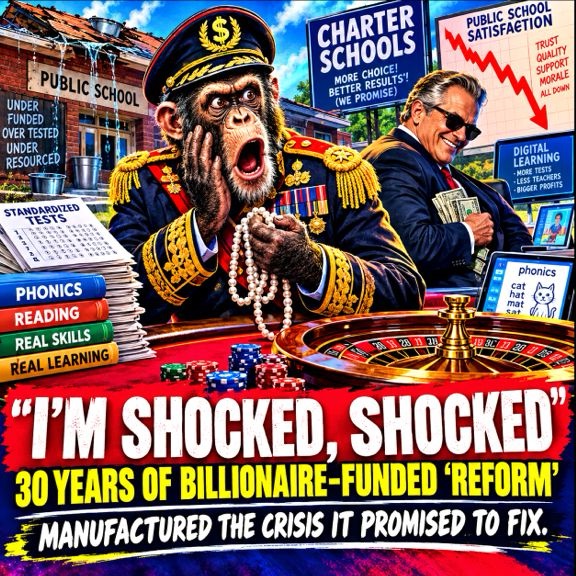
Paul Thomas taught in South Carolina public high schools for many years, then became a professor of education at Furman University. He is an articulate critic of the decades-old “crisis in education.”
If you are confused by the different fonts, please open the link to read the original article.
People try to put us d-down (Talkin’ ’bout my generation) Just because we get around (Talkin’ ’bout my generation) Things they do look awful c-c-cold (Talkin’ ’bout my generation) I hope I die before I get old (Talkin’ ’bout my generation) “My Generation,” The Who
Born in 1961, I am a young boomer, but a boomer none the less.
I began teaching high school English in the ominous year of 1984, my first students having been born at the end of the same decade as I had, the 1960s.
That means across my career as an educator, I have taught most living generations, including my own. My grandchildren as Generation Alpha. It does seem valid to note that humans experience generational shifts that can be identified in fair ways, especially in ways that may help those of us who teach better serve our students.
Those characteristics, however, are not universally defining and the cut off dates we decide are more blur than fact.
Being at the end of the boomer generation makes me often quite similar to Gen X folk I meet, including the first wave of students I taught high school.
What seems less valid, is the historical and current urge older generations have to negatively characterize younger generations, often through never-ending cycles of crying “Crisis!,” especially about education (notably reading and math).
The US has been riding a high tide of crisis rhetoric about reading—both that students can’t read and the students don’t read—for about a decade now.
It seems this cycle of crisis has reached a new stage according to The New York Times:
A report on the new data describes a decade-long “learning recession.”… Students’ test scores had been increasing since 1990 — then abruptly stopped in the mid-2010s. That coincided with two events: an easing of federal school accountability under No Child Left Behind, which was replaced in 2015, and the rise of smartphones, social media and personalized school laptops.
The decade analyze attempts to compare, even with the caveat above, learning using test data that itself has shifted several times and ways even in a relatively brief decade window.
As I have noted about reading proficiency, the US has no standard definition of “reading proficiency” or “grade-level reading,” but instead, we have NAEP achievement levels (that are confusing and misleading) drawn from random sampling about every two years along with annual (except for the Covid blip) testing at the state level, where every state establishes its own cut scores for proficiency (with most state proficiency level overlapping with NAEP “basic”). Analyses such as these also suffer from compelling but questionable metrics such as days, months, or years of learning. What metric researchers choose and then how data is displayed significantly impacts how the conclusions are interpreted.
Unfortunately, most analyses of education are designed to create the appearance of crisis. While this rhetorical shift to “learning recession” is yet another oversell that likely will do more harm than good, the immediate responses should prompt even greater skepticism:
Tweet by David Frum, May 13, 2026:
Seven months ago, the David Frum Show hosted former Education Secretary Margaret Spellings for a discussion of why US K-12 scores are declining. Her answer: the decline in testing and accountability since 2015.
Resurrecting former Secretary of Education Spellings deserves a reminder about her misinformation and misunderstanding concerning tests data, which she used to falsely claim success for NCLB (the testing and accountability she is sad to see gone, although that claim isn’t true either):
During President George W. Bush’s tenure, NCLB was a corner stone of his agenda, and when then-Secretary Spellings announced that test scores were proving NCLB a success, Gerald Bracey and Stephen Krashen exposed one of two possible problems with the data.
Spellings either did not understand basic statistics or was misleading for political gain. Krashen detailed the deception or ineptitude by showing that the gain Spellings noted did occur from 1999 to 2005, a change of seven points. But he also revealed that the scores rose as follows: 1999 = 212; 2000 = 213; 2002 = 219; 2003 = 218 ; 2005 = 219. The jump Spellings used to promote NCLB and Reading First occurred from 2000 to 2002, before the implementation of Reading First. Krashen notes even more problems with claiming success for NCLB and Reading First, including:
“Bracey (2006) also notes that it is very unlikely that many Reading First children were included in the NAEP assessments in 2004 (and even 2005). NAEP is given to nine year olds, but RF is directed at grade three and lower. Many RF programs did not begin until late in 2003; in fact, Bracey notes that the application package for RF was not available until April, 2002.”
This recent claim from Spellings, then, must be taken with a gigantic grain of salt because most politicians see education crisis as an opportunity to score political points, not as a way to better serve students.
That we are really about to have testing and accountability nostalgia sold to us is almost laughable—if it weren’t so insidious.
Reasonable people have noted that our testing obsession has resulted in deforming what and how students read, more passages to answer question and less whole book reading.
But research being ignored, makes the opposite and evidence-based argument from Spellings’s self-serving observation:
Almost 63% of the variance in test performance was explained by social capital family income variables that influence the development of background knowledge. Background knowledge is a known predictor of standardized test results. Family income variables are immutable by schools. Only public policies, outside the control of school personnel, can influence family income…. Policy makers and education leaders should rethink the current reliance on standardized test results as the deciding factor to make decisions about student achievement, teacher quality, school effectiveness, and school leader quality. In effect, policies that use standardized test results to evaluate, reward, and sanction students and school personnel are doing nothing more than rewarding schools that serve advantaged students and punishing schools that serve disadvantaged students.
Crisis rhetoric has never and will never serve even good intentions well in terms of seeking better ways to serve the needs of all students, regardless of the generational differences. But let’s also resist this new push to go back (?) to the good ol’ days of testing and accountability NCLB-style.
Let’s instead recycle an old (and silly then) chestnut from the Reagan era.
When it comes to crisis rhetoric as well as testing and accountability in education reform, just say no.
See Also
The Reading Crisis Paradox: On Moral Crisis and Thought-Terminating Clichés
How to Manufacture Crisis with Line Charts: NAEP Reading Edition
Recommended: Reading educational research: How to avoid getting statistically snookered, Gerald Bracey (2006)
“Kids Today”: Perpetually Dumb and Lazy as a Box of Rocks
Reading Crisis 1961: Tomorrow’s Illiterates 1959: “yet students enter college badly lacking in these fundamental skills”
Reading Full Books in Secondary English Language Arts Classrooms
Ever since Trump decided to go to war in Iran, we have heard only good news from the administration. Trump has said repeatedly that “we won,” but it is not true. Iran still has uranium and now controls the Strait of Hormuz, choking off the world’s supply of oil.
According to news reports, Iranian and U.S. negotiators are closing in on a deal to end Donald Trump’s reckless, unconstitutional war. As the terms revealed that Trump’s war failed to attain his aims (e.g. permanently ending Iran’s nuclear ambitions), Republicans began blasting the deal. A Trump Truth Social post attempted to contain the backlash. He insisted he had told the negotiators to proceed carefully because time was on our side.
It bears repeating that Trump’s overly cheery take that we are on the verge of a deal may be nothing more than Trump spin. (Axios reported the deal could take days to complete.) Negotiations could stall at any time, leaving the Strait of Hormuz closed and no agreement on Iran’s nuclear program.
The agreement reportedly under discussion would simply continue talks about Iran’s nuclear program. A final nuclear deal, if concluded, would require Iran to give up its stockpile of enriched material (or reduce the level of enrichment) and suspend enrichment for a fixed time (as under the Joint Comprehensive Plan of Action). One imagines Iran will be happy to talk and talk and talk. The purported agreement, according to U.S. sources, would permit free shipping through the Strait of Hormuz. That would simply be a return to the status quo.
But most galling for Republicans, Trump’s agreement reportedly would unfreeze $25 billion in Iranian assets, a significant achievement for the economically hobbled Iranian regime. Recall that Republicans and Trump personally excoriated President Barack Obama’s agreement to unfreeze a mere $1.7 billion in conjunction with the JCPOA, which they claim amounted to funding Iran’s nefarious activities.
War hawk Sen. Lindsey Graham (R-SC) freaked out as details of the agreement dribbled out. “If it is perceived in the region that a deal with Iran allows the regime to survive and become more powerful over time, we will have poured gasoline on the conflicts in Lebanon and Iraq,” Graham warned on X. “A deal that is perceived to allow Iran to survive and possess the ability to control the Strait in the future will put Hezbollah in Lebanon and the Shia militias in Iraq on steroids.” Graham was not done with his scathing review:
This combination of Iran being perceived as having the ability to terrorize the Strait in perpetuity and the ability the inflict massive damage to Gulf oil infrastructure is a major shift of the balance of power in the region and over time will be a nightmare for Israel.
Also, it makes one wonder why the war started to begin with if these perceptions are accurate.
He was not alone. “The rumored 60-day ceasefire — with the belief that Iran will ever engage in good faith—would be a disaster. Everything accomplished by Operation Epic Fury would be for naught,” tweeted Sen. Roger Wicker (R-MS), the Senate Armed Services Committee chairman.
Sen. Ted Cruz (R-TX) chimed in as well, saying he was “deeply concerned” about the reported deal, the New York Times reported. “It would be a ‘disastrous mistake’ if an agreement resulted in Iran being able to enrich uranium, develop nuclear weapons, and have effective control over the Strait of Hormuz, he said.” Sen. Thom Tillis (R-NC) on CNN observed, “It doesn’t make sense to me … now we’re talking about a posture where we may accept nuclear material remaining in Iran?”
The deal under discussion would dispel any notion that the United States “won” the war. The Wall Street Journal was quick to conclude: “The agreement, if completed, wouldn’t achieve Trump’s main goal of preventing Iran from ever acquiring a nuclear weapon.”
If this deal holds, there will be no question that Trump’s war amounted to a major strategic failure. Maybe we get an agreement similar to the JCPOA, which would have been in place had Trump not exited the deal. (Getting back in war something you already had is nothing to cheer about.) The agreement would leave the regime (perhaps more radical than ever) in place, deny Israel any permanent end to the Iranian threat, reveal the limits of U.S. influence and power in the region, and, by default, afford China (as evidenced by Trump’s pathetic showing at the summit) increased stature and confidence. Preventing a restart of a war no one wanted and an end to the energy shock Trump provoked can hardly been called “wins.”
The entire episode underscores the utter fecklessness of the Republicans in Congress, who don’t exercise their constitutional authority or conduct even minimal oversight. The deaths and injuries to U.S. troops, the deaths of thousands in the region, the physical destruction in Iran and Lebanon, the damage to the Gulf states’ oil operations, the extensive depletion of U.S. munitions, the tens of billions in costs, and soaring energy costs (and broader inflation spike) have achieved no lasting, positive result for the United States or its allies in the region. At best, we would be back to an agreement akin to the JCPOA but with a much emboldened, more dangerous, and well-funded Iranian regime.
Whether this deal gets finalized or not, Congress must conduct extensive oversight to fully investigate the Trump regime’s malfeasance, incompetence, and lack of honesty. If war crimes were committed, the officials responsible need to be held accountable. And finally, Congress needs to pass legislation to prevent this and future presidents from unilaterally blundering into unnecessary, ill-advised and illegal wars in the future.
On Saturday April 25, the White House Correspondents Association will hold its annual dinner, which honors the First Amendment and raises scholarship funds for journalism students.
This year, for the first time, Trump has accepted the invitation. Trump avoided the dinner in the past, because it’s customary to roast the President and his administration.
Trump likes to hurl insults at others, but he can’t tolerate being laughed at, nor is he capable of making fun of himself. He likes to think that he is the best President in history, smarter than the generals and scientists. Everything he does, he thinks, is an unparalleled success.
Humor is not part of his deck of cards. Insults, boasting, and bullying are his main suits.
As it happens, the online publication STATUS got a copy of an invitation to an “intimate gathering” from billionaire David Ellison, whose father bought CBS and is closing in on CNN. According to Status, CBS invited Pete Hegseth and Stephen Miller to be their guests at the dinner on the 25.
So many ironies! No administration in memory has done more to erode the First Amendment than the current one. No president has done more to insult and belittle the press than Trump. No Cabinet member has stifled First Amendment rights more than Hegseth. The only coverage he tolerates is sycophancy.
And better yet, Ellison is holding his dinner at the U.S. Institute of Peace. The USIP was a private organization that was evicted from its building by DOGE. Trump decided it should bear his name.
So our great “peace” president is now at war with Iran, a war of choice. Our man of peace issued a warning that he would eliminate Iran’s entire civilization if they did not accept his demands. That’s a war crime.
Somewhere in the wings is Trump’s “Board of Peace,” which collected $1 billion each from countries that wanted to join. Trump is chairman of its board forever. There will be no audits. Trump has collected a bushel basket of billions to spread his gospel of peace.
It’s really sick.
The White House Correspondents dinner will not feature a comedian this year. Comedians might make the dire error of ridiculing Trump. So, instead of a comedian, they invited illusionist Oz Perlman to perform. That’s safe!
To show some backbone, I propose that they invite an unannounced guest to perform: Stephen Colbert.
The very idea of honoring Trump at a dinner that also honors the First Amendment is absurd. This president constantly attacks the press and calls them “fake news,” ridicules female reporters, says belligerently that the press is “the enemy of the people.” He does not deserve to be honored.
The best thing for the White Hiuse Correspondents to do is to boycott their dinner; or to hiss when he is introduced; or to withhold any applause at the end of his remarks.
These are not normal times. Trump is not a normal president. He is an ignorant, bitter narcissist, who is declining physicallly and mentally. He can be counted on to lie and spread hatred. He deserves no honor, no applause.
I am reposting this commentary because the original post this morning did not include a link to the full post.
Denny Taylor is an accomplished scholar and author. She is Professor Emeritus of Literacy Studies at Hofstra University and has earned a long list of awards. She now has a Substack blog that is worth your time. In this post, she goes into detail about the origins of the “Science of Reading” and the poor quality of research on which it is based.
Taylor wrote this post to caution against a federal mandate based on flawed claims. Congress is currently considering HR 7890 Science of Reading Act of 2026. As she shows, it would be absurd if it passes. Congress should not tell teachers how to teach, nor should state legislatures.
The Science of Reading Act of 2026 – H. R. 7890is a catastrophic mistake for three reasons. First, it makes early 20th century phonics instruction the law of the land. Second, the NRP “5 pillars of reading instruction” are not based on science. Third, H. R. 7890does not prepare children to live and thrive in a digital society that is filled with unforeseen hazards and dangers. We must think anew and act anew – before it’s too late.
H. R. 7890 “Evidence-Based Literacy Instruction Aligned to the Science Of Reading” is Not Based On Science
The six-year qualitative as well as the quantitative forensic analyses provides evidence that the scientific foundation undergirding the teaching of reading in America’s public schools is irreparably flawed. The “evidence-based literacy instruction aligned to the Science of Reading” that is described in the new federal Science of Reading Act – 2026 (H. R. 7890) is a political construct not a scientific one.
Nevertheless, Congress is in the process of making “fidelity” to the “Science of Reading” the law in all 50 states.
H. R. 7890, the Science of Reading Act – 2026 was unanimously approved by the House Education and Work Force Committee on March 17, 2026. It will amend the Elementary and Secondary Education Act of 1965 to prioritize funds to promote the use of H. R. 7890. The legislation also aligns with U.S. Education Secretary Linda McMahon’s priorities for literacy improvement, but the Right-wing ideologs behind H. R. 7890 are far more formidable than McMahon.
H. R. 7890 Eliminates Reading and Writing Activities which Provide Opportunities for Children to Actively Engage with Meaningful Texts
The Science of Reading Act of 2026 will also officially prohibit the use of the “three-cueing” system in literacy instruction in U.S. public schools. My own pedagogical practices always begin with close observation of children who use many cues to read and write when they are not restricted by authoritarian “Science of Reading” laws that have already been enacted in most states.
H. R. 7890 will have the effect of eliminating reading and writing activities which provide opportunities for children to think. In such circumstances their thinking can be divergent and/or convergent, linear or lateral, abstract or concrete. Often it is meta-cognitive as they discuss with their teachers how they arrived at the meaning of a word. Often the clues are phonetic, and the sentence confirms their reasoning. All these pedagogical opportunities for teachers to support the learning of children are not understood by the public or by Congress. If they were, people would rally against passing the Science of Reading Act of 2026, and Congress would not pass H. R. 7890.
The Research Evidence for H. R. 7890 was Established Based on the False Findings of the 2000 National Reading Panel Report
Through dog whistles, lies, and tropes, the Right convinced people in many sectors of U.S. society that the “five pillars” of reading instruction that the NRP presented to Congress provided solid scientific evidence on how children should be taught to read. The publishers of reading programs that now call themselves technology companies, most prominently McGraw-Hill and HMH, marketed the findings of the NRP creating a bonanza in profits so large that Platinum Equity now owns McGraw-Hill and Veritas Capital now owns HMH.
Draw back the curtain and it is possible to document in minute detail how a false narrative about the National Reading Panel came to be accepted as the unquestionable scientific evidence for the massive changes in reading instruction that has taken place in U.S. public schools.
The “five pillars of reading instruction” and the Science of Reading have become embedded in the knowledge base of people in every sector of U.S. society. I asked AI “what are the five pillars of reading instruction?” AI responded:
The 5 pillars of reading instruction—phonemic awareness, phonics, fluency, vocabulary, and comprehension—are essential, evidence-based components for developing proficient readers. Defined by the National Reading Panel, these pillars provide a structured framework for teaching decoding, accuracy, and understanding in reading instruction.
The AI response is an accurate rendition of the official narrative that the nation has been deceived into believing through an Right wing initiatives gaining traction in the 1990s that have gaslighted the public through the use of dog whistles, lies and tropes. One of the think tanks on the Right that has had an unprecedented influence of how children are taught to read in public schools is the Thomas B. Fordham Institute (then the Thomas B. Fordham Foundation) advocated for a shift toward scientifically based reading research and explicit phonics instruction in 2002. The Fordham Institute established the National Council of Teacher Quality (NCTQ) that I have written about in previous Substack posts. NCTQ states that it is a “nonpartisan research and advocacy group.” Nothing could be further than the truth. NCTQ’s evaluations of U.S. teacher preparation programs, are flawed, unscientific, and ideologically driven.
Enforced by State Laws, the Five Pillars have Become the Structural Framework of Reading Instruction in Public Schools Across America
Once the Science of Reading Act of 2026 is signed into federal law one of the education goals of the Heritage Foundation will have been achieved. It is relevant that Mike Pence has been accused of “abandoning its principles” and transforming the Heritage Foundation from a traditional conservative organization into an enforcer for “big-government populism” and “America First” extremism. The forensic analysis has documented the initiative undertaken by the Right to control reading instruction in U.S. public schools, especially how Lindsey Burke has led the Right’s initiative to “reshape” public education. Burke spent 17 years at the Heritage Foundation where she was a principal author of the Education Section of Project 2025. She transitioned to the Department of Education where she serves as McMahon’s Deputy Chief of Staff for Policy and Programs. Burke is attributed by leaders on the Right with “reshaping” – her word — reading instruction in public schools. Parenthetically, Burke is also associated with the Thomas B. Fordham Institute and NCTQ. She is featured on the Fordham Institute website in a podcast entitled, “Trump’s education agenda, with Lindsey Burke” (January 31, 2024). NCTQ is the focus of the October 19, 2025, Substack post entitled, “NCTQ Pressures State Governments, Rejects Teacher Preparation Programs, Dictates To School Districts, Discredits Reading Researchers, Bans Their Books, And Vilifies Teachers.“
Thom Hartmann is a veteran journalist who write The Hartmann Report, where this article appeared:
Dear MAGA voter,
I’m not writing this to mock you. I’m writing because you were lied to. And it wasn’t by the people you were told to hate, but by the man you trusted the most.
You were pissed off when you voted in 2024. Honestly, rightfully angry. Your town lost its factory. Your kids can’t afford the house they’ve been dreaming of for years. The politicians in Washington kept promising you things and delivering nothing; in fact, Republicans even took away your Medicaid and food stamps as well as your kids’ school lunches. You wanted someone who’d finally blow the whole damn thing up and put regular people first.
So did I and millions of other Americans. The difference is who we trusted to do it. Let’s talk about what actually happened.
You were told Trump would “drain the swamp” of corruption in Washington DC. Instead, as Marjorie Taylor Greene can tell you, Donald Trump has built the most corrupt, billionaire-stuffed cabinet (13 of them!) in American history. Epstein-buddy Howard Lutnick. Billionaire hustler Scott Bessent. Hedge fund managers and Wall Street insiders as far as the eye can see.
And then he handed the core agencies of the federal government — with no vote, no vetting, no accountability to anyone — over to Elon Musk, the single richest human being on the planet. Not a populist or a Washington outsider: the most powerful oligarch alive, whose source of wealth came from Obama bailing out Tesla and who now gets tens of billions in annual government contracts.
Musk’s teenage hackers then stole your Social Security information and destroyed America’s soft power by gutting USAID: as Bill Gates said, “The picture of the world’s richest man killing the world’s poorest children is not a pretty one.” This is your swamp now, one that’s already literally killed at least a million children around the world while handing our nation’s soft power over to Putin.
He also said there would be no more “stupid wars.” Yet he’s spending $1 billion a day and has already destroyed six American lives in Iran and still can’t explain to us why he attacked them or what actual threat that country represented to America. It appears he just did it because Putin, Netanyahu, and Kushner all encouraged him to.
And now The Washington Post is reporting that Putin is giving Iran “targeting information” so they can kill American troops, just like when Putin put a bounty on US soldiers in Afghanistan and that was fine with Trump during his first term. Is that the kind of war you want? Somehow I doubt it.
You were also promised lower drug prices. Remember that? Trump made it a centerpiece of his campaign pitch. He looked straight into the camera and said he’d take on Big Pharma. But the pharmaceutical industry is making more money than ever before, and now the same Republican Congress that cheers Trump’s every move has cut a trillion dollars out of Medicaid (the cuts come later this year).
That’s the national healthcare program that covers roughly one in five Americans, the majority of them in rural, working-class communities that voted for the same Republicans who gutted it on Trump’s orders. Your neighbors. Your family members. People who believed in him. Cuts made simply to pay for a trillion dollars of Trump’s $5 trillion tax break for himself, Mark Zuckerberg, Elon Musk, Jeff Bezos, Larry Ellison, and the other billionaires who put him into office.
And then there’s the tariffs, which he told you China would pay. But China isn’t paying: you are. Tariffs are taxes collected at the border and paid by American importers, that are then passed on to American consumers like you and me.
The people most exposed to rising prices on clothes, appliances, groceries, and cars are working-class families who spend a higher share of their income on the necessities of life. That’s you. The billionaires in his cabinet can absorb and even profit from Trump’s inflation; you can’t.
And while all this is happening, the national debt keeps exploding. It ballooned by $7 trillion during his first term. His second-term tax proposals are deficit-financed giveaways that only benefit corporations and the ultra-wealthy.
Trump talks about “no taxes on tips” and “no taxes on Social Security” but those cuts are very, very limited and expire in a few years; the tax breaks on billionaires are deep and last forever. Your grandchildren will spend their lives paying off Trump’s tax cuts for people who summer in the Hamptons. This isn’t fiscal conservatism: it’s looting dressed up in a red hat.
Remember the wall? Mexico was going to pay for it. Mexico didn’t pay for a single inch of it. And remember when Elon Musk publicly defended keeping H-1B visas, the program Trump uses to import European workers for his shabby golf motels and that let corporations import cheaper foreign labor and hold down American wages? That caused a genuine civil war inside MAGA world for about a week, before the Murdoch/Ellison Epstein-class billionaire media moguls changed the subject. Trump sided with the billionaires; being one himself, he always sides with the billionaires.
Don’t forget Social Security and Medicare. He swore — repeatedly, explicitly — that he’d never cut them. Watch what the fine print says, particularly since he fired over 7,000 Social Security workers to make it really hard on people who are trying to sign up. That’s about encouraging people to move to the Medicare Advantage scam plans that are so profitable to his insurance industry donors.
Watch what DOGE is circling. Watch the budget proposals coming out of his own party’s Congress. The cuts aren’t coming for the people at Mar-a-Lago: they’re coming for you.
And perhaps the cruelest irony of all: the communities hit hardest by Trump’s policies are the communities that supported him most. Farmers crushed by retaliatory tariffs from trading partners. Rural hospitals dependent on federal funding now facing existential pressure. FEMA cuts hurting people in bright red Southern states. The economic pain is landing heaviest on the people who believed in him the most.
None of this is an accident. This is what happens when you elect a pathological liar who talks like a populist but governs for the donor class. Your anger was real. His betrayal is real.
I’m not asking you to become a Democrat. I’m not asking you to agree with me about anything except this: a man who fills his cabinet with hedge fund managers, hands power to the world’s richest oligarch, lets Big Pharma walk, starts a war to distract us from news he raped 13-year-old girls, and watches your grocery bill climb while calling it “victory” is not on your side.
He never was.
The swampy system you were furious at? It’s still there. It just has a new Dear Leader.
You deserve better than this. Heck, we all deserve better than this.
The Century Foundation published an analysis of Trump’s federal voucher program, which explains why it is a hoax and a fraud. The authors are Kayla Patrick and Loredana Valtierra.
The promise it makes is that families and students will choose schools that are just right for them, but the reality is that schools choose the students they want.
The promise is that school choice will benefit black and brown children, as well as children with disabilities, but children abandon all civil rights protections when they enroll in private schools.
The promise is that schools of choice will produce better academic outcomes but typically they produce worse outcomes (see Josh Cowen, The Privateers).
The promise is that school choice represents accountability but it usually means no accountability at all, because nonpublic schools don’t take national or state tests.
Kayla Patrick and Loredana Valtierra write:
Modern school voucher programs are often framed as a response to declining academic achievement and a way to expand “parent choice” by enabling private educators to operate within the public system. But in practice, vouchers operate quite differently than advertised. It’s the private schools, not families, who ultimately decide who enrolls, and they do so outside the accountability systems that govern public education and public dollars and ensure every student has equal opportunity to learn.
The Federal Tax Credit Scholarship Program (FTCS), passed as part of the Republican Party’s “One Big Beautiful Bill” (OBBBA), scales this model for camouflaged privatization to the national level. Though branded as a tax incentive, it functions as a nationwide voucher system that diverts public dollars to private schools while allowing those schools to play by different rules than public providers—evading civil rights protections, academic oversight, and any requirement to provide meaningful evidence to the public of their students’ outcomes.
A National Voucher Program Disguised as a Tax Credit
The FTCS nationalizes a model that at least twenty states and counting –including Arizona, Georgia, Louisiana, and Pennsylvania – have already adopted, one which functions by siphoning public dollars through scholarship granting organizations (SGOs). Under this law, individual taxpayers can donate up to $1,700 annually to SGOs in exchange for a 100 percent federal tax credit, effectively turning private donations into reimbursed public expenditures.
SGOs then will distribute “scholarships” to K–12 students to use toward private school tuition, books, curriculum materials, tutoring or other educational classes, and educational therapies provided by licensed providers. While the program is optional for states, at least twenty-seven have already signaled their intent to participate.
[To see which states have expressed their intent to participate, open the link.]
Despite its branding, this design drains public revenue that would otherwise support public schools—which still educate roughly 90 percent of American students—and redirects it to private, religious, and largely unregulated providers.
The program model also ignores what parents time and again have told us they want for their children. When given a direct choice at the ballot box, voters have repeatedly rejected school vouchers and related private-school subsidy measures. In the 2024 election, proposals to authorize or expand voucher-style programs in Colorado, Kentucky, and Nebraska were defeated, and historical ballot measure data show that voters have rejected every statewide private voucher or education tax credit initiative placed before them since 1970. This opposition is reflected in polling that shows nearly 70 percent of voters say they would rather increase federal funding for public schools than expand government-funded vouchers, including majorities across party lines.
[Open the link to see which states have held referenda on vouchers.]
Broad Eligibility, Few Quality Controls, and Limited Public Benefit
Even measured against its stated goal of affordability, the FTCS program misses the mark. But if the goal is to make education more affordable for families under real financial strain, this program is also ineffective. Private K–12 tuition averages nearly $13,000 per year nationwide, placing private schooling out of reach for many families even with a modest subsidy. Yet the tax credit is not targeted to families facing affordability pressures. It allows households earning up to 300 percent of area median income to qualify, a threshold that would make roughly 90 percent of U.S. households eligible. In high-income regions, families earning as much as $500,000 per year could receive publicly subsidized support for private education, while in a city like New York—where median income is about $81,000—families earning nearly $244,000 would qualify. At a time when families are struggling to afford groceries, housing, and child care, this program directs public dollars toward a limited use—private education subsidies for households that largely do not need the financial help—rather than toward measures that would help most families, like lowering child care or housing costs.
At a time when families are struggling to afford groceries, housing, and child care, this program directs public dollars toward a limited use—private education subsidies for households that largely do not need the financial help—rather than toward measures that would help most families, like lowering child care or housing costs.
At the same time, the program imposes no meaningful accountability requirements on participating schools. There are no academic performance standards, no transparency obligations, and no requirement to evaluate outcomes. In contrast to nearly every other federal program serving children, from Title I to Head Start, this is public spending without public oversight. Federal programs historically are monitored for fiscal, quality, and sometimes for safety compliance by the agency with charge over the program. In this case, U.S Department of Education (ED) expertise plays no role in oversight of new national policy for education.1
What State Leaders Can and Cannot Control
FTCS offers a tempting hook for well-intentioned state policymakers as well: Some governors and state legislatures may view the tax credit as a way to unlock new resources for priorities like tutoring or after-school programs. In practice, however, it offers no new, flexible funding for states and gives them little control over how public dollars are used. The law defines “scholarship-granting organizations” so broadly that states cannot meaningfully restrict eligibility, set standards, or influence whether funds flow primarily to high-cost private schools rather than unmet public needs.
Once a state opts in, its role is largely administrative and unfunded. States receive no resources to carry out oversight, cannot impose safeguards, and must submit eligible organizations to the U.S. Treasury without authority to shape program design or accountability. Far from being additional education funding that states need, opting in requires that states absorb the fiscal, administrative, and equity consequences of a federal program they are unable to direct or correct. It is not “free money” for states. The opt-in decision is therefore the only meaningful leverage states have—and governors should use their right to refuse to play along in order to protect their public education systems.
Why Oversight and Accountability Matters
Public funding should never function on a good-faith system. It’s very simple: in good policymaking, whenever taxpayer dollars are allocated, oversight measures are put in place to make sure those dollars are spent in the way intended. We already know from numerous examples in the school choice policy space itself that no accountability means that those who need the help the least receive the most benefit.
Eighteen states have a universal private school choice program. Unfortunately, states that have expanded vouchers or education savings accounts with minimal oversight have already seen waste, fraud, and abuse. Arizona’s universal Empowerment Scholarship Account (ESA) program, for instance, has minimal controls, audit practices that automatically approve reimbursements, and has been linked to purchases of non-educational items like diamond rings, televisions, and even lingerie with taxpayer funds, prompting investigations by the state attorney general. Rather than lowering costs for families, the program has generated ballooning expenses for the state and contributed to a growing budget crisis—with no measurable benefit to students at all.
Similarly, the federal Charter Schools Program has repeatedly been shown to lack meaningful accountability, with investigations and audits documenting hundreds of millions of dollars wasted on schools that never opened or closed prematurely, and charter networks facing conservatorship over financial mismanagement and self-dealing. These outcomes are the predictable result of public dollars flowing to private operators without meaningful oversight.
Decades of research on voucher programs show mixed or negative academic outcomes, particularly in math and reading, and no evidence that vouchers close opportunity gaps. In Louisiana, Indiana, and Ohio, studies found declines in student achievement following expansions in voucher programs. Students in Louisiana’s voucher program experienced drops in both math and reading in their first two years, while voucher students in Indiana and Ohio performed worse than comparable peers who remained in public schools.
The program nationalizes an unproven experiment while insulating it from the very safeguards that exist to protect students and taxpayers alike.
Taken together, these examples underscore why oversight and accountability are not optional when public dollars are at stake. The FTCS program includes no meaningful accountability, evaluation, or research requirements to justify an estimated $26 billion cost to taxpayers. Without data on student learning, fiscal integrity, or long-term outcomes, the public has no way to assess whether this investment is helping students or simply reshuffling them across systems while diverting resources away from the public schools that serve most children and toward unknown corporate interests.2 In effect, the program nationalizes an unproven experiment while insulating it from the very safeguards that exist to protect students and taxpayers alike.
Who Profits When Public Dollars Become Private Subsidies?
Another consequence of turning public education dollars into private subsidies is that it creates a lucrative marketplace for the companies that manage these voucher systems. A handful of firms have seized on state voucher expansions to secure multimillion-dollar contracts, turning what was pitched as a cost-saving policy into a business opportunity for tech and finance intermediaries. These companies often have limited experience running education programs, and in some states have faced scrutiny over operational problems, questionable spending controls, and high administrative costs.
This track record raises questions about whether families truly benefit from FTCS’s model. It would seem the opposite: it diverts taxpayer dollars into private profit streams instead of lowering education costs for struggling families. Instead of more wasteful government contracts, these dollars should be used to improve neighborhood schools by hiring high-quality educators, increasing after school programs, expanding pre-K, and hiring mental health professionals.
A Tax Policy Not Designed to Support Education
Congress gave sole interpretive authority for this program to the U.S. Treasury Department, deliberately excluding the U.S. Department of Education and its education-specific expertise. As a result, a major national education policy will be implemented through the tax code, with limited attention to accountability, equity, or educational impact. While advocates have urged the Treasury Department to include stronger transparency, safeguards, and state authority, it is unlikely those measures will be adopted to address the program’s core design flaws.
This use of the tax code stands in sharp contrast to prior policies that successfully supported children and families. The 2021 expanded Federal Child Tax Credit helped to lift more than 2 million childrenout of poverty and reduced the country’s child poverty level to a historic low of 5.2 percent. This program will likely do the opposite. Research shows that private school voucher programs disproportionately benefit wealthy families. Consistent with many other provisions in the law, Congressional Republicans have chosen to prioritize a tax break that disproportionately benefits the wealthy, over nearly every other form of charitable giving, such as donations to food pantries, hospitals, or community services.
By incentivizing families to exit public schools, the voucher tax credit also undermines the financial stability of those schools, particularly in rural and high-need communities. Because education funding is largely enrollment-based, even modest shifts can lead to school closures, consolidations, and reduced services. This leaves behind those families who don’t have the time or resources to navigate private systems, and asks taxpayers to reimburse private donations on top of existing public education costs.
Civil Rights Protections Are Excluded
Public schools that receive federal funding are required to comply with federal civil rights laws, including Title VI and Title IX of the Civil Rights Act, the Individuals with Disabilities Education Act (IDEA), and Section 504 of the Rehabilitation Act. In 2024, ED received 22,687 civil rights complaints, including about 8,400 related to disability discrimination, reflecting just how often students and families rely on these protections.
These laws require schools to take corrective action to prevent and respond to discrimination, provide accommodations and services to students, investigate complaints, and offer families meaningful avenues for recourse. This is what public accountability looks like in practice, and its success depends on ED’s legal authority and the staff capacity to respond when families ask for help.
By contrast, the OBBA does not require scholarship-granting organizations or the private schools and programs they fund to comply with these federal civil rights protections, even though they benefit from publicly subsidized dollars. This means that if a student experiences harassment or discrimination based on race, national origin, sex, religion, or disability, families may have little or no ability to hold private schools accountable or seek remedies comparable to those guaranteed in public schools.
Evidence from state voucher programs shows why this gap matters. An investigation in North Carolina found that voucher funds flowed to private schools that were significantly whiter than the communities they serve, reinforcing racial segregation rather than expanding opportunity. In the absence of enforceable civil rights guardrails, public funding supports exclusionary practices that would be unlawful in public schools.
The Cost to Public Schools and Communities
Ultimately, this voucher/tax credit perpetuates a broader pattern of states, in addition to the federal government, stepping back from their responsibility to fully fund and strengthen public schools. Rather than address the systemic problems that perpetuate low-performing schools, it treats educational inequity as a series of individual problems to be solved by sending public dollars to private education. No matter how the administration spins it, these programs fail to prioritize students from lower-income families while simultaneously subsidizing private education for higher-income families. It invites taxpayers to feel as though they are helping children access opportunity, while leaving the underlying inequities in public education unresolved and, in many cases, deepened.
[Open the link to see data on source of insurance.]
This tax credit is projected to cost $26 billion, which is a high price tag that instead could be doing real good in public schools. If Congress instead invested this through Title I, that money would amount to roughly $1,238 per student in schools serving low-income communities. Research shows that investments of this size improve reading and math outcomes. In other words, we know how to use public dollars to help students succeed. This policy chooses not to.
Imagine putting that $26 billion, the lowest estimated cost of the tax credit over ten years, toward Title I, the federal program that benefits most public schools. That would more than double Title I’s current funding at $18.4 billion. Title I’s flexibility allows schools to meet their specific needs to improve student achievement: more teachers, aides, professional development, wraparound services, and more.
IDEA is supposed to fund 40 percent of each student’s special education each year, but the federal government has never met that promise. Current funding at $14.2 billion amounts to less than 12 percent of the promise. However, adding $26 billion to IDEA would almost triple current funding and completely close the gap.
We know that the unprecedented funding from the American Rescue Plan and other COVID relief packages will make a major return on investment: every $1,000 invested per student will be worth $1,238 in future earnings. That funding also required states to at least maintain their education budgets at prior funding so that the federal investment would not replace their responsibility and effort, but work together. The FTCS model completely disregards these precedents, and their values.
The Federal Tax Credit Scholarship Is a Heist Taken Straight from the Right’s Privatization Playbook
The Federal Tax Credit Scholarship program follows a familiar privatization strategy. It routes public dollars to private actors while stripping away the oversight, transparency, and civil rights protections that normally accompany public investment. Framed as generosity and choice, it instead creates a system in which taxpayers assume the cost while private schools and intermediaries operate largely beyond public accountability.
The program recreates many risks at a national scale. The schools and organizations receiving these publicly subsidized funds are not required to demonstrate academic results, comply with federal civil rights law, or provide transparency about how dollars are spent. Families are left without protections, taxpayers without accountability, and policymakers without evidence that the investment is improving student outcomes.
When public dollars are transformed into lightly regulated private subsidies, they invite exploitation. The Federal Tax Credit Scholarship is not an isolated policy choice: it follows a pattern of policies that weaken, and normalize weakening, public education while insulating private actors from responsibility. History shows where this path leads: higher costs, weaker safeguards, and fewer assurances that public investments serve the public good.
Notes
The Trump administration has taken multiple actions to reduce the role of the U.S. Department of Education, including firing staff and reassigning education programs and staff to other agencies through interagency agreements (IAAs) without congressional authorization. Such actions raise legal and governance concerns and further erode the education-specific expertise, oversight, and accountability that Congress has historically vested in ED.
Under the OBBA, the federal tax credit for contributions to SGOs applies to individual taxpayers. The law does not provide separate federal tax credit rules for corporate contributions; whether and how corporations might participate or benefit may depend on future Treasury and IRS regulations and state tax policies. Many states currently allow corporate contributions to SGOs.
The introduction of vouchers for private and religious schools is accompanied by certain lies.
Vouchers won’t cost much
Vouchers will save poor kids from failing public schools.
Voucher schools will be more accountable than public schools.
Vouchers won’t hurt public schools.
Every one of those claims is a lie. Vouchers always cost far more than was predicted. In every state, most vouchers are claimed by students who are already in enrolled nonpublic schools. Voucher schools typically are completely unaccountable for their use of public funds.
West Virginia passed a law to allow taxpayer-funded school vouchers in 2021, and they’ve been tweaking it ever since. They opened it up to more and more students. Consequently, the costs of the program are ballooning: when the law was passed, supporters declared it would cost just $23 million in its first year, and now the estimate for the coming school year is $245 to $315 million.
With that kind of money on the line, you’d think that the state might want to put some accountability and oversight rules in place. You know– so the taxpayers know what they’re getting for their millions of dollars.
But you would be backwards. Instead, the legislature is considering a bill to reduce accountability for private and religious schools. SB 216, the Restoring Private Schools Act of 2026, is short and simple. It consists of the current accountability rules for private, parochial or church schools, or schools of a religious order– with a whole lot of rules crossed out.
What are some of the rules that the legislation proposes to eliminate for private and religious schools? Here’s the list of rules slated for erasure:
The requirement for a minimum number of hours of instruction.
The requirement to maintain attendance and disease immunization records for each enrolled student.
The requirement to provide, upon request of county superintendent, a list of the names and addresses of all students in the school between ages 7 and 16.
The requirement to annually administer a nationally normed standardized test in the same grades as required for public schools. Ditto the requirement to assess the progress of students with special needs.
Since there’s no test requirement, there is also no requirement to provide testing data to parents and the state department of education.
The requirement to establish curriculum objectives, “the attainment of which will enable students to develop the potential for becoming literate citizens.” Scrap also the requirement for an instructional program to meet that goal.
So under this bill, private schools would not have to have a plan for educating students, would not have to spend a minimum amount of time trying to educate students, and would not have to provide the state with any evidence that they are actually educating students.
The bill does add one bit of new language:
As autonomous entities free of governmental oversight of instruction, private, parochial, or church, schools may implement such measures for instruction and assessment of pupils as leadership of such schools may deem appropriate.
In other words, private religious schools accepting taxpayer-funded vouchers may do whatever the hell they want.
The bill is sponsored by Senator Craig Hart. Hart calls himself a school teacher, and is mentioned as an agriculture/FFA teacher, though I could find no evidence of where he teaches. He was elected in 2024 after running as a hardcore MAGA. He has pushed for requiring Bibles in school, among other MAGA causes.
Said Eric Kerns, superintendent of Faith Christian Academy, “It just gives private schools a lot more flexibility in what they would be able to do as far as assessment and attendance and school days. Our accountability is that if people aren’t satisfied with the education they’re receiving, then they go to another private school or back to the public school or they homeschool.” Also known as “No accountability at all.” A school is not a taco truck.
As reported by Amelia Ferrell Knisely at West Virginia Watch, at least one legislator tried to put some accountability back in the bill. GOP Sen. Charles Clements tried to put back a nationally-recognized testing requirement and share results with parents. Said Clements
I want to see private schools survive, but I think we have to have guardrails of some sort. There’s a lot of money around, and it’s a way for people to come in and not produce a product we need … I think it just leaves the door open for problems.
Exactly. And his amendment was rejected. The School Choice Committee chair said the school could still use a real test if they wanted to, but the bill would allow more flexibility to choose newer test options; I’m guessing someone is pulling for the Classical Learning Test, the conservative unwoke anti-SAT test.
Democrat Mike Woelfel tried to put the immunization record back; that was rejected, too.
Look, the Big Standardized Test is a terrible measure of educational quality, and it should be canceled for everyone. But for years the choice crowd promised that once choice was opened up, we’d get a market driven by hard data. Then it turned out that the “hard data” showed that voucher systems were far worse than public schools, and the solution has not been to make the voucher system work better, but to silence any data that reveals a voucher system failure.
The goal is not higher quality education. The goal is public tax dollars for private religious schools– but only if the private religious schools can remain free of regulation, oversight, or any restrictions that get in the way of their power to discriminate freely against whoever they wish to discriminate against.
This is not about choice. It’s about taxpayer subsidies for private religious schools, and it’s about making sure those schools aren’t accountable to anyone for how they use that money. It’s another iteration of the same argument we’ve heard across the culture–that the First Amendment should apply because I am not free to fully exercise my religion unless I can unreservedly discriminate against anyone I choose and unless I get taxpayer funding to do it.
We’ve been told repeatedly that the school choice bargain is a trade off– the schools get autonomy in exchange for accountability, but that surely isn’t what’s being proposed here. If West Virginia is going to throw a mountain of taxpayer money at private schools, those schools should be held accountable. This bill promises the opposite; may it die a well-deserved death.
Paul Thomas was a classroom teacher for many years in South Carolina. He decided to become a professor of education, and eventually joined the faculty at Furman University, first class liberal arts institution in South Carolina.
He writes here about the improbability of miracles. I disagree with Paul Thomas on one point: Miracles are not only unlikely or improbable. There are NO miracles in education. My friend Mike Klonsky of Chicago said to me years ago. “If you are looking for a miracle, go to church, not to school.”
In all my years, I have found no reason to doubt this wisdom.
My entire career in education, begun in the fall of 1984, has been during the accountability era of education that is primarily characterized by one reality—perpetual reform.
The template has been mind-numbingly predictable, a non-stop cycle of crisis>reform>crisis>reform, etc.
Another constant of that cycle is that the crisis-of-the-moment has almost always been overblown or nonexistent, leading to reforms that fall short of the promised outcomes. Reforms, ironically, just lead to another crisis.
But one of the most powerful and damning elements in the crisis/reform cycle has been the education miracle. [1]
Two problems exist with basing education reform on education miracles. First, and overwhelmingly, education miracles are almost always debunked as misinformation, misunderstanding of data, or outright fraud. Research has shown that statistically education miracles are so incredibly rare that they essentially do not exist.
Second, even when an education miracle is valid, it is by definition an outlier, and thus, the policies and practices of how the miracle occurred are likely not scalable and certainly should not be used as a template for universal reform.
Those core problems with education miracles have prompted the attention of Howard Wainer, Irina Grabovsky and Daniel H. Robinson, who have analyzed the reading reform miracle claims linked to Mississippi:
In 1748, famed Scot David Hume defined nature. He elaborated such a law as “a regularity of past experience projected by the mind to future cases”. He argued that the evidence for a miracle is rarely sufficient to suspend rational belief because a closer look has always revealed that what was reported as a miracle was more likely false, resulting from misperception, mistransmission, or deception….
A careful examination confirms that enthusiasm to emulate Mississippi should be tempered with scepticism….
In short, the authors followed a key point of logic: If something seems too good to be true, then it is likely not true.
In their analysis, On education miracles in general (and those in Mississippi in particular), they focused on two of the key problems with the story about Mississippi’s outlier grade 4 reading scores (in the top quartile of state scores) on NAEP: What is the cause of the score increases? And, why are Mississippi’s grade 8 reading scores remaining in the bottom quartile of state scores?
They found, notably, that Mississippi’s instructional reform, teacher retraining, additional funding, and reading program changes were not the cause of the score increases, concluding:
But it was the second component of the Mississippi Miracle, a new retention policy, perhaps inspired by New Orleans’ Katrina disaster a decade earlier, that is likely to be the key to their success….
Prior to 2013, a higher percentage of third-graders moved on to the fourth grade and took the NAEP fourth-grade reading test. After 2013, only those students who did well enough in reading moved on to the fourth grade and took the test.
It is a fact of arithmetic that the mean score of any data set always increases if you delete some of the lowest scores (what is technically called “left truncation of the score distribution”)….
In short, Mississippi has inflated grade 4 NAEP scores, but that is unlikely evidence that student reading proficiency has improved. This is not a story about reading reform, but about “gaming the system”:
It is disappointing, but not surprising, that the lion’s share of the effects of the “Mississippi miracle” are yet another case of gaming the system. There is no miracle to behold. There is nothing special in Mississippi’s literacy reform model that should be replicated globally. It just emphasises the obvious advice that, if you want your students to get high scores, don’t allow those students who are likely to get low scores to take the test. This message is not a secret….
Wainer, Grabovsky and Robinson’s analysis also needs to be put in context of two other studies.
First, their analysis puts a finer point on the findings by Westall and Cummings, whose comprehensive review of contemporary reading reform found the following: Third grade retention (required by 22 states) is the determining factor for increased test scores (states such as Florida and Mississippi, who both have scores plummet in grade 8), but those score increases are short-term.
Next is a recent study on grade retention. Jiee Zhong concluded:
[T]hird-grade retention significantly reduces annual earnings at age 26 by $3,477 (19%). While temporarily improving test scores, retention increases absenteeism, violent behavior, and juvenile crime, and reduces the likelihood of high school graduation. Moreover, retained students exhibit higher community college enrollment but lower public university attendance, though neither estimate is statistically significant.
Grade retention masquerading as reading reform, then, is fool’s gold for inflating test scores, but it is also harming the very students the reform purports to be helping.
The evidence now suggests that reading reform should not be guided by miracle claims; that no states should be looking to a miracle state for reading reform templates; that the so-called “science of reading” movement is mostly smoke and mirrors, and should be recognized as the “science of retention”; and that grade retention policies are distorting test scores at the expense of our most vulnerable students in life changing ways.
Last Friday, Mary and I took our oldest grandson, who is now 32, to The Morgan Library and Museum in Manhattan. The Morgan is a small but breath-taking collection of books and manuscripts that belonged to the personal collection of J.P. Morgan. The building is breathtaking, as are the books, which include an original Gutenberg Bible.
We began by seeing an exhibition of illustrated Bibles and other religious books that were over 1,000 years old. I kept thinking of the Hebrew scribes and Christian monks who spent years writing and illustrating these gorgeous volumes. Every letter, every line was perfect. How did they do it?
Then we visited the main library, a magnificent room with three layers of leather-bound books.
Mr. J.P. Morgan’s LibraryAnother view of this magnificent room
The room included a jewel-encrusted Bible, made in France and Austria in the 9th century
Mr. Morgan’s jewel-encrusted Bible
All of this splendor reminded me of the poverty in the streets outside his library and home, but I doubt that he thought much about the people outside.
In an exhibition case, there were several unusual printed documents. One was about a woman named Mary Toth or Toths, an English woman who pulled off an elaborate hoax in 1726, when she was 23 years old. She told doctors that she had given birth to bunnies. The illustration showed her, a few doctors, and many bunnies. The story spread rapidly, and many people believed that she had in fact given birth to bunnies. She was eventually discredited, briefly jailed, and eventually the charges against her were dismissed.
I said to my grandson, if that happened today, it would spread like wildfire on the internet and many people would swear it was true. My grandson said, “Some people will believe anything because they are ignorant.”
The stranger standing next to us interjected, “Some things never change.”
On the same day that we visited The Morgan Library, our frequent commenter Bob Shepherd left the following observation about why people are so gullible:
Three of the most powerful and important experiments ever performed were Stanley Milgram’s electric shock experiment, Solomon Asche’s line length determination experiment, and Philip Zimbardo’s prison experiment. I won’t go into the details of these here. You can look them up in a quick Google search if you are fuzzy on their details. What these experiments, which have been repeatedly replicated, show conclusively is that about two thirds of people are so driven by desire to be accepted by the group that they will conform to and actively participate in the most egregious behavior toward others in order to be themselves accepted by a perceived “authority.” Next time you are in a public place–at a game, in a restaurant, in a club–look around you. Two thirds of the people you see are potential collaborators–people capable of extreme evil, which, as Hannah Arendt pointed out, is TYPICALLY characterized by mediocrity.
Years ago, when I was a baby editor, I went to work for McDougal, Littell. Ms. Littell–the co-founder’s wife–was the editor of their literature program at the time, and she had chosen for the 12th-grade book an essay by the English historian Hugh Trevor-Roper about what an “evil genius” Hitler was. Well, I risked my job by objecting to this piece because Hitler was not a genius. He was a common thug and a psychopath, and people are sheep, easily led, easily bullied into submission and acquiescence. Or consider John Gotti–the psychopathic criminal Mafia thug. The press created an image of the brilliant “Dapper Don,” who could constantly evade punishment. But after he was finally imprisoned, tapes of wire taps on Gotti were released, and these showed that he was the lowest sort of ignorant thug, incapable of clear reasoning or speech, driven by the basest motivations, and unable to say anything without accompanying it with a string of curses that stood in for the words lacking in his fourth-grade vocabulary.
People want to belong. They want to get along. They want Daddy to tell everyone what to do. And they will idolize absolute monsters if they get that from them.
Bob is a polymath—an author, editor, guitarist, teacher, and humorist–who seems to have read deeply in every field.
Oh, we stopped in the gift shop, and I bought a couple of delightful books. One was titled Rejected Books: The Most Unpublishable Books of All Time.
Some of those unpublishable books:
Famous People in Owl MasksUnalphabetized DictionaryTerrible Drawings of Horses