Over the next couple of weeks, I will write several pieces about the upcoming election in Texas. More than any other state. I will explain why.
First of all, I was born there, and I’m tired of Texas being a laughing stock. Texans are better than that.
Second, if Texas flips blue, it will be a political earthquake. The state has been owned by oil and gas billionaires for decades. It’s time for a change. It’s time for leaders who care for the people of Texas, not the 1%.
Third, Texas has two great candidates in James Talarico and Gina Hinojosa. Talarico is a religious man, actually a seminarian, who speaks eloquently about our obligations to one another. Gina Hinojosa is running to give the regular people of Texas a voice.
Fourth, Gina understands the sham of Abbott’s “vouchers for all” program. She has pledged to roll back the voucher scheme and invest in the state’s public schools, where almost 90% of the state’s 5.5 million children are enrolled. Under the voucher regime, rural schools are at risk of closing. Gina will fire State Commissioner of Education Mike Morath, who has used his power to take control of entire urban districts, despite the well-documented history of the failure of state takeovers.
Fingers crossed for a new day in Texas, free of the control of billionaires, corrupt politicians, and grifters.
The polls in Texas show a close race between Governor Greg Abbbott and challenger Gina Hinojosa. Abbott has about $91.5 million in campaign funds, Hinojosa has about $21.7 million.
Abbott’s single biggest donor is S. Javaid Anwar, who has given $4,122,086. Anwar is Muslim but supports Abbott despite the Governor’s anti-Muslim rhetoric. Abbott’s top five donors have each donated at least $2 million.
Hinojosa’s biggest donor is the American Federation of Teachers, which appreciates Hinojosa’s strong support for public schools and teachers. The AFT has contributed $345,000.
Abbott is running for his fourth term. Abbott is a hard-hearted MAGA man. He is the favorite of billionaires in Texas and beyond.
Gina is the only candidate in the nation running for governor who has made public schools her number 1 issue. She has pledged to fire Abbott’s State Commissioner of Education Mike Morath and to roll back the billion-dollar “voucher scam.”
Abbott and Hinojosa are one point apart in the polls, a statistical tie.
A few days ago, the biggest newspaper in the state–The Houston Chronicle–endorsed Hinojosa.
In February, when state Rep. Gina Hinojosa visited the Chronicle editorial board as one of six Democrats who imagined themselves taking up residence in the Governor’s Mansion, we were impressed but saw little reason for Gov. Greg Abbott to worry. What we saw in Hinojosa was a capable, experienced lawmaker with a passion for public education, clearly the best candidate among the six but with little name recognition beyond her Austin district. An even more daunting prospect if she happened to prevail in the primary would be campaigning in the general election under the Everest-sized shadow of a $106 million war chest the governor could avalanche onto her effort if he needed to.
We didn’t think he’d need to. In Abbott’s quest for an unprecedented fourth term, we expected Hinojosa to be the next in a line of hapless Democrats willing to take one for the party. Hinojosa herself acknowledged that she decided to run for governor only after it became obvious that none of her fellow Democrats were willing to offer themselves up for the quadrennial double-digit beat-down the party has endured for more than three decades. If the ebullient, well-known and well-funded Beto O’Rourke couldn’t come within single digits of Abbott four years ago, why would Texans expect an earnest, relatively low-key unknown to do any better?
For Governor: Gina Hinojosa
Gina Hinojosa ★★★★ — This Democratic challenger and five-term state representative is running one of the most impressive populist campaigns anywhere in the country. She’s fighting to put everyday Texans back in charge.
Greg Abbott ★★1/2 — After 12 years as governor, this Republican incumbent seems to care only about billionaire donors and partisan extremists.
When Hinojosa visited the editorial board a few weeks ago, the descriptor “low-key” didn’t come to mind. She made a full-throated, confident call for change. As with her Democratic cohort, the now-nationally known U.S. Senate candidate, James Talarico, her campaign is riding a wave of Trump fatigue and economic angst that has spread nationwide like algae in a reflecting pool. The success of her populist economic message — and the fact that Abbott finally deigned to mention her name only recently — suggests that fiery-red Texas might be slipping toward something closer to crimson, or even purple, on the political color spectrum. Despite the incumbent governor’s advantages — money and name recognition, primarily — the 52-year-old Rio Grande Valley native and five-term House member is within striking distance in most polls.
And it’s not just Hinojosa who has changed: There’s also Abbott himself. The GOP candidate Texans first met way back in the mid-’90s when he ran for district judge here in Houston, the office-holder we got to know through his successful campaigns for the Texas Supreme Court, attorney general and three terms as governor, has transmogrified. In the three decades Abbott has held public office, the seemingly moderate, Bush-era Republican — who even attracted Democratic votes when he ran for the state Supreme Court — has become a relentless, hardcore MAGA standard-bearer. This is the governor whose billion-dollar border boondoggle, Operation Lone Star, pleased the true believers but did nothing to resolve the nation’s immigration remorse. The governor who, in the pursuit of absolute and centralized power, trashed any notion of “local control,” long a Republican value. The governor who sneers at urban Texas, including Harris County, despite its function as the economic engine of a growing state.
Perhaps that’s the type of pol he has always been, but he has no interest in disguising it now, as he seeks a fourth term as governor (and perhaps a launching pad for the presidency).
But the biggest change of all — bigger than any individual candidate — is happening all over Texas, where Republicans have dominated statewide elections for the past 30 years. Like a barnacled Moby Dick, parties in power too long grow tired, weighted down, ineffective. Poked and prodded by unrelenting schools of special-interest pilot fish, they lose a sense of a larger public-service mission. They may be politically dominant, but in fact they’re netted and enmeshed by the privileged and powerful. Like an unfree Willy, they come to feel they have no choice but to acquiesce, even as they seek to distract the citizenry with trivialities. (The Furries Act, anyone?) In an ocean of new ideas, new directions and unfamiliar challenges, they founder.
“I will tell you that with 30 years of Democratic rule, it would probably be just as corrupt,” Hinojosa said. “That’s what happens when you have one-party control for so long.”
Those of a certain age will remember the Sharpstown scandal that hastened the demise of Texas Democrats. Now, after decades of near-total dominance by Republicans, a dozen years under one governor, it’s time for a change.
We had an opening question for the candidate who seeks to forge a new approach for the state: Why would we change leadership given how much Texas is growing, how strong our economy is and, overall, how well things are going?
We found Hinojosa’s answer compelling: “That narrative does not match the experience of everyday Texans. Despite the fact that Texans work more hours than the national average, we have the most people without health insurance, we have the most children without health insurance of any state, we have the most people being disconnected from their electricity because they can’t afford to pay their bills, despite the fact that we are the energy powerhouse of this country. We have the most bankruptcies of any state in the union, and that is affecting our small businesses in a big way. Small businesses are really struggling to keep their doors open, and all this despite the fact that our property taxes have skyrocketed under Greg Abbott.”
Hinojosa has a name for those economic burdens those bankrupt businesses and everyday Texans carry constantly. She calls it “the Greg Abbott corruption tax.”
We prefer a Watergate-era cliche: “Follow the money.” Billionaires seem to have an outsized influence on Abbott’s governing priorities. Consider natural gas tycoon Kelcy Warren, whose Energy Transfer vacuumed up $2.5 billion during devastating Winter Storm Uri in 2021. When Abbott showed little interest in determining how the gas industry managed to collect $11 billion in profit during the ensuing blackouts, the Dallas billionaire conveniently showed his appreciation with a $1 million contribution to the governor’s campaign coffers.
Or consider billionaire school-voucher zealot Jeff Yass of Pennsylvania, who donated $12 million to Abbott in apparent appreciation of his unrelenting efforts to establish a billion-dollar school voucher program. The governor got his money from Yass and other political extremists, such as the billionaire Wilks brothers of Cisco, Texas, but public schools, particularly those in rural Texas, lost out: The program siphons much-needed money away from them and into private schools.
Or consider, more recently, AI tech billionairesgetting all manner of tax goodies from our governor — to the tune of $1 billion per year — as gigantic data centers sprawl across acres and acres of the Lone Star State.
Of course, Abbott isn’t the only governor — Democrat and Republican — who fell hard for data centers. He’s also not the only governor who suddenly feels compelled to respond to the growing rumble of unrest. He can’t help but notice that much of the opposition is coming from rural and small-town Texans, likely Abbott/Trump supporters who have legitimate concerns about water and energy use, incessant noise just across the fence line from their properties, or simply a desire to have some local control over their own communities.
The growing grassroots fury at elected officials who initially ignored their concerns is democracy in action. We expect that a respect for a government of, by and for the people of Texas, a respect for their needs and concerns, would be the fundamental governing principle in a Hinojosa administration.
Priorities for what Hinojosa calls her “economic populist agenda” include firing Texas Education Commissioner Mike Morath “and putting an educator in that position;” freezing electricity rates and insisting that corporations and industry — including data centers — pay their fair share; and making sure that every Texas child has access to quality healthcare.
Her most surprising priority is to write a check for $1,500 for every Texas household. The money would come from the state’s Rainy Day Fund, now at $27 billion, although in recent history it’s been closer to $10 billion.
“The economists we talk to say it’s so irresponsible to have $27 billion hoarded in Austin,” Hinojosa said. “That money belongs in the economy, working for the economy, especially at a time when working Texans are really struggling. Not only that, but people don’t believe that government can do anything to make their lives easier.”
We asked how a $1,500 check for every Texas household differs from Trump’s proposal to send every American household a check for $5,000.
“We have the money,” Hinojosa said — wryly, but also accurately.
An offhand remark as Hinojosa prepared to leave the editorial board meeting stayed with us. “I think people are tired of fighting,” she said.
We agree. After a dozen years under the leadership of a governor keenly attuned to the needs of the privileged and the powerful, we look forward to a successor dedicated to serving her fellow Texans.
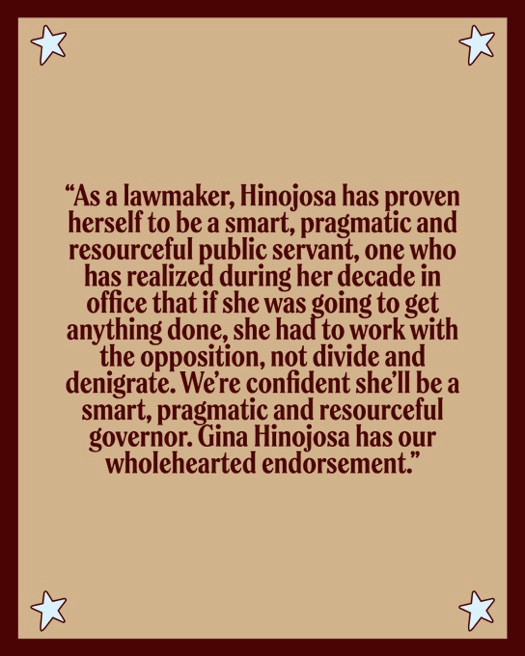
As a lawmaker, Hinojosa has proven herself to be a smart, pragmatic and resourceful public servant, one who has realized during her decade in office that if she was going to get anything done, she had to work with the opposition, not divide and denigrate. We’re confident she’ll be a smart, pragmatic and resourceful governor. Gina Hinojosa has our wholehearted endorsement.
It’s easy to get overwhelmed by the daily news if you care about the scandals of the Trump administration. There’s so much happening, so many news stories about corruption. Who can keep count?
Heather Cox Richardson today gives us an account of current corruption scandals. Any one of us could add scandals that she didn’t have room for, like conflicts of interest and profiteering. My example, Presidential pardons. Is it mere coincidence that wealthy donors get pardoned quickly? Is it coincidence that they are relieved of their obligation to repay the people they defrauded?
One thing is sure. The Trump administration is a stark illustration of kakistocracy, corruption, and greed.
There is an old saying about rats and sinking ships. There’s also an old saying about how a democratic system taken over by a single party quickly becomes corrupt because the ruling party lacks oversight. Then, as corruption becomes the party’s driving force, the only people willing to work for it are either corrupt themselves or so unqualified they support the corrupt leadership to gain power, knowing that in a merit-based system it would be entirely out of their reach.
OK, that second old saying is shared mostly among political scientists, but it’s accurate, and it’s right up there with the rats and the ships to describe what’s happening in Trump’s orbit now.
The saga of Kimberly Guilfoyle, who was recently forced to resign from her post as U.S. Ambassador to Greece, continues to expand. Guilfoyle left her post after news broke that she had tried to get a donor, Eric Deters, to pay down her credit card debt. She and her lawyers countered the story by claiming Deters was withholding money she had earned, and said the text messages he shared with news outlets were false.
Guilfoyle dated Don Jr. from 2018 to 2024 and was engaged to him the last four years of that time. Now there are rumors that during her time inside the family as a trusted loyalist, she kept a “burn book” about the family.
While that may or may not be true, the fact that there’s such a threat out there reflects the cracking loyalties of Trump insiders. More to the point might be the video released today by Deters himself, saying that he had launched a lawsuit against Guilfoyle for defamation and that he would depose her and Don Jr. and demand subpoenas to clear his name. He also vowed to play a 16-minute phone conversation tomorrow that he claims has information which “might just bring down the entire Trump administration, an administration which I have supported from Day One.”
Note that the story of Guilfoyle’s alleged shakedown is breaking now, although it happened more than a year ago.
Also in the category of old stories coming to the surface is one reported yesterday by Marc Caputo of Axios. He wrote that Trump’s former lawyer Alina Habba is saying that another one of Trump’s advisors, Ric Grenell, did not deposit her billionaire husband’s $5.6 million donation to the Kennedy Center. According to Habba, Grenell asked that the donation be routed through a $17.6 million payment for a business deal, an accusation Grenell called “absurd.”
Trump appointed Grenell to be U.S. ambassador to Germany and then acting director of national intelligence during his first term. After retaking office, he named Grenell as a special envoy to Venezuela before putting him in charge of the Kennedy Center.
A fight that has been going on for more than a year in the administration broke into the open this morning in a Politico story by Daniel Lippman. He explained that Trump named Italian Paolo Zampolli, a former modeling agent who introduced Trump to First Lady Melania Trump at a party in New York City, as a special envoy at the State Department with a portfolio of cultural diplomacy. But Zampolli apparently ignored that assignment and struck out on his own on a wide range of issues, infuriating Deputy Secretary of State Christopher Landau.
“My number-one boss is the president of America,” Zampolli told James Fontanella-Khan of the Financial Times in April. “I get my instructions from the White House, Commerce and the Department of War…anything to advance the America First agenda.” More than 16 administration officials have been included in the angry email chains Zampolli and Landau have exchanged, which at one point led to communications about the fight with a top-level foreign official.
At one point Zampolli accused Landau of leaking to reporters what appeared to be the story that Zampolli had tried to get custody of his son by asking Immigrations and Customs Enforcement to deport Amanda Ungaro, the boy’s mother. That story created its own scandal when Ungaro, a former model, threatened to expose information about the president and first lady. Landau responded to Zampolli’s accusation, which he sent to more than a dozen other officials, saying: “Your threats and accusations are getting more and more bizarre, defamatory, and inappropriate for broad dissemination on email.”
An administration official told Lippman that the State Department was “generally squeaky clean and professional and above it all.” In contrast, these exchanges were “cartoonish and embarrassing.”
By this afternoon, Lippman had a follow-up story: Zampolli had been fired.
It is not just the current associates of the president who are problematic. Today, news broke that two women have named former Republican representative Matt Gaetz (R-FL), along with his friend former Seminole County tax collector Joel Greenberg and others, in a civil lawsuit, alleging that from 2017 through January 2019, “Gaetz and Greenberg coordinated recruitment, payments, drugs, and travel to obtain commercial sexual acts….”
In 2024, the House Ethics Committee reported that Gaetz “regularly” paid women, as well as a 17-year-old girl, for sex, and bought and used illicit drugs while a member of Congress. Those accusations helped to sink Trump’s nomination of Gaetz for U.S. attorney general in 2025.
Gaetz’s response was hardly a denial: “I look forward to taking the plaintiffs’ depositions because much of the conduct alleged against me is false,” he wrote. “The lawsuit relies almost exclusively on a Congressional Committee Report that didn’t allow me to confront my accusers. Now I will finally have that chance.”
One has to wonder why anyone would want to be part of such a mess, but Trump’s new White House press secretary provides an answer: in a normal administration she would never make it through the door. Trump has described Katie Zacharia as an “attorney,” and she has identified herself as a “general counsel” and seemed to claim she worked as an attorney in China.
But after Judd Legum of Popular Information noted there was no sign she had ever passed the bar exam or been admitted to a state bar, Philip Wegmann and Alexandra Bruell of the Wall Street Journal reported today that, in fact, she failed the California bar exam when she took it. That, itself, is not unusual—the California bar exam is notoriously difficult—but it does mean she is not qualified to call herself an attorney.
Democracy Defenders Fund, a nonpartisan team defending democracy led by attorney Norm Eisen, has asked the State Bar of California and California Attorney General Rob Bonta to investigate whether Zacharia practiced law without a license in California, where doing so is a crime.
Tonight, on his show, Fox News Channel personality Sean Hannity seemed to undercut Zacharia, asking her why she had chosen to describe herself as an attorney when she could just have said she “went to Pepperdine Law School and then took a different career path.” Josh Marshall of Talking Points Memo noted that Hannity’s stance likely reflected that Trump is turning on her.
Rhein Amacher, the man who started a right-wing media frenzy when he claimed to have proof that Democratic Texas Senate candidate James Talarico had sought mental health treatment in Ohio, backed away from that claim today…sort of. Amid suggestions that he might well have run afoul of HIPAA penalties for trying to obtain health information duplicitously, he posted that “this entire situation has been blown completely out of proportion,” and wrote, “As far as I’m concerned, this matter is closed.” Later, in response to a post saying he had lied, he added: “Never lied, I just doubled down on wrong information.”
A blockbuster story by Jonathan O’Connell, Sarah Blaskey, and Aaron Schaffer of the Washington Post today explained that the administration has been able to keep donations for Trump’s ballroom largely secret by using a nonprofit to collect the donations and then channeling that money “into a White House account the president directly controls.”
The reporters gained access to a list of the 57 donors who have committed to giving $100,000 or more to the project. They found that “the vast majority of the funds raised came from companies and wealthy individuals with interests before the federal government.” Large technology companies Nvidia and Apple committed $25 million each. Microsoft, Palantir, and Lockheed Martin pledged $10 million each.
Individuals on the list who are associated with Trump include Commerce Secretary Howard Lutnick’s son Brandon, chair of investment bank Cantor Fitzgerald, who contributed stock worth more than $2.5 million, and the U.S. ambassador to the Netherlands, Republican donor Joseph Popolo Jr., and his wife, who gave $1 million. Missing from the list is Trump himself, who claimed he would be helping to pay for the project.
Sarah Longwell of The Bulwark was right when she called the ballroom being constructed where the East Wing of the White House used to be “a monument to corruption” built by “a corrupt American president.”
On Tuesday, Charles Gorrivan, Lydia Beyoud, and Nicola M. White of Bloomberg reported that on March 23, a few traders placed billions of dollars of contracts predicting that the price of oil would fall just 15 minutes before Trump posted on his social media platform that he had changed his mind about striking Iranian power plants. The deals were worth billions, and analysts from the U.S. Commodity Futures Trading Commission (CFTC) flagged the traders and the deals and sent a referral to the Division of Enforcement to decide whether to open an investigation into insider trading. But in a virtually unheard-of move, the administration asked the CFTC to withdraw the referral.
The journalists note both that there have been many trades apparently tied to Trump’s announcements and that between a 20% cut to CFTC staff during Trump’s second term and the agency chair’s vow to curb “over-zealous regulation,” enforcement actions have dropped dramatically from the numbers during the Biden administration.
Steven Portnoy and Katherine Faulders of ABC News reported today that the White House is claiming that all Trump’s conversations about plans to renovate the Kennedy Center are covered by executive privilege and therefore can be kept secret. This is a dramatic expansion of the concept of executive privilege, which enables the president to shield conversations with key advisors from public scrutiny, extending it to consider virtually all conversations private.
Apparently in anticipation of Democratic investigations, Attorney General Todd Blanche issued a memo as soon as he took office, claiming presidents can shield “presidential communications with private advisers so long as the communications relate to official presidential decisionmaking.”
A new Fox News poll released today showed that voters’ top concern is “corruption in government,” with 88% worried about it compared to 12% who are not. Corruption tops even “inflation and high prices,” which comes in at 85%, and “gas prices,” which concern 83% of voters.
In a conversation with Rob Finnerty of Newsmax, aired tonight, Trump suggested he would pardon everyone in the administration, including himself, to make sure none of the people around him have to “go through years of nonsense, hire lawyers and everything else, all for nothing.”
It is no wonder that Republicans eager to stop Trump are backing Democratic candidates for the midterms. Today 58 Republicans and Independents in New Hampshire declared their support for the Democratic Senate candidate, Representative Chris Pappas, over Republican candidate John Sununu. Those supporters include Don Bolduc, who was Trump’s pick for the Senate in 2022 but who lost to Democrat Maggie Hassan by 9 points after he embraced Trump’s claim to have won the 2020 election.
One of the Republicans supporting Pappas told Kevin Landrigan of the New Hampshire Union Leader: “Donald Trump has turned the Republican Party into something I no longer recognize.”
Amanda Ungaro, the Brazilian model and former U.N. ambassador who roiled First Lady Melania Trump in April by threatening to expose unspecified information she has on President Trump and the First Lady, is apparently talking to the House Oversight Committee…
I have written about the devastating consequences of vouchers for years and the fact that they are promoted by billionaires and rejected whenever they are put to a statewide vote. So it is very satisfying that The New York Times, the newspaper of record, published this sharp opinion piece by Jessica Grose, a regular contributor. No both sides here; vouchers are a scam that billionaires love and that most public school parents loathe.
Jessica Grose wrote:
“I’ve been voting Republican my whole life. I’m superconservative,” the Pine Tree superintendent, Steve Clugston, tells the camera in an Instagram reel. “I’m going to tell you what: When Greg Abbott sold us out to the billionaires and sold out our schools, I’m done with his leadership.” In the Texas governor’s race, Clugston is voting for Abbott’s Democratic opponent, State Representative Gina Hinojosa.
The Pine Tree public school district is in the bright red small city of Longview in East Texas, between the big cities of Dallas and Shreveport, La. A majority of its 4,400 students are economically disadvantaged. When I caught up with Clugston on Friday, hours before the Pine Tree football team trounced its opponents under the lights, he was at his farm. “My wife’s a teacher. My daughter’s a teacher. My son-in-law’s a teacher. Both my sisters are teachers. My brother-in-law’s a retired superintendent. So I’d say education’s kind of in our blood,” he told me over the phone.
Clugston told me he’s sick of his fellow Texas conservatives straying from their principles of fiscal common sense and straight talk; he even attempted a run for the Texas State Senate as an independent conservative. He is particularly appalled by Texas’ voucher program, known as Texas Education Freedom Accounts, which went into effect this year. This program puts state money in accounts for Texas families to use outside the public school system: up to nearly $10,500 for children enrolling in private school, up to $30,000 for children with disabilities and up to $2,000 for those who are home-schooled.
The State of Texas has no say over the curriculum taught at the institutions that accept vouchers, and participating schools can discriminate against applicants for any number of reasons, including religion and disability status. Texas’ vouchers are universal, which means anyone can apply for them, regardless of financial means, though poorer students have been prioritized.
Around 70 percent of this year’s voucher recipients already were enrolled in private schools or were home-schooled. Vouchers are costing the state about a billion dollars this year alone and could ultimately cost $4.4 billion annually. While funding for vouchers comes from a budget that is separate from the public school pot, the state’s funding for public schools has not kept up with inflation.
Texas public schools are projected to lose $227 million just this year as they shed head count, according to The Houston Chronicle. More public schools may close as a result of vouchers siphoning that money away from them. In Clugston’s opinion, vouchers are “abillion-dollar giveaway program for the rich, and we’re going to have no accountability in it. Zero.”
Hinojosa has made saving public education central to her campaign for governor, and it is what got her started in politics. Her child’s school was on the brink of closure, and she describes her political trajectory as concerned parent to local school board member to Texas House member. If elected, Hinojosa has vowed to “end the voucher scam.”
I have long been frustrated at the way both parties barely talk about K-12 public education, despite plunging test scores and post-Covid woes. But the reason politicians don’t talk more about education is that votersdon’t care about it. What makes Hinojosa’s message on schools effective beyond irate public school parents and educators is that she ties the passage of vouchers to larger themes plaguing Republicans in the age of President Trump: corruption and the outsize power of billionaires.
Vouchers failed in the Texas Legislature multiple times, with rural Republicans tending to side with Democrats to block the measures. In rural areas “school choice,” even with vouchers, tends to be a mirage. There are few private schools, and public schools are often the biggest local employers and the heart of small-town life; nearly every Texan I spoke to for this newsletter said the reverence for “Friday Night Lights” is real.
When Abbott couldn’t get vouchers passed the honorable way, he decided to primary Republican state legislators who opposed the policy. He took $12 million from Jeff Yass, a pro-voucher Pennsylvania billionaire, got most of his preferred candidates into office and got vouchers passed in 2025, as The Washington Post noted.
The outcomes for students participating in voucher programs in other states have been decidedly mixed, but Yass doesn’t give a rip. “If the mother or the parent wants the kid to go from one school to another, who the hell is anyone to tell them not to?” he told The Post. “I don’t care what the studies say.”
Some voucher proponents claim that Texas offers more choice to underprivileged children in underperforming schools. But the data we have on other states with universal voucher programs, like Arizona, suggest that they are redistributing money to the highest income and most educated ZIP codes in cities and suburbs. An Arizona ABC station found that parents were spending their voucher money on everything from trampoline parks to ski tickets.
In Iowa, which has a universal voucher program for private schools that’s similar to Texas’, the Democratic candidate for governor and the current auditor, Rob Sand, has made a similar connection among vouchers, special interests and corruption. “The current school voucher program is an open invitation to waste, fraud and abuse of taxpayer dollars,” he explains on his campaign website.
Sand lists his voucher stance under the headline Accountability for All, where he also talks about protections for whistle-blowers and banning stock trading by politicians. By doing so, he is saying that you don’t have to care about what’s going on in the classroom to be outraged that a New York-based company called Odyssey, which manages his state’s voucher program, allegedly got a sweetheart deal for the work. As auditor, Sand found that the company “more than doubled its rate less than a month after signing their no-bid contract, costing taxpayers an additional $2.7 million.” (Odyssey, which has ties to Yass, also administers the voucher system in Texas.)
Whatever you think about public schools, it is difficult not to seethe at the fundamental unfairness of voucher programs that give money to schools that don’t have to educate all students. The Texas Observerfound that of 291 private schools approved for voucher funds from the state, over 90 percent were religious or faith-based schools, “more than 100 of those schools require or prioritize for admission students of the same faith and more than 60 have a written policy that discriminates against L.G.B.T.Q.+ students, the schools’ own data shows.”
Though the Texas vouchers prioritize students with disabilities, The Observer also noted that most of the private Texas schools they analyzed lack special education services. A Dallas Morning News analysis found that thousands of students with disabilities returned state money, in part because private schools rejected them or didn’t even respond to their applications.
Some educators I spoke to in Texas and Iowa told me that they’d already seen students ricocheting back to public schools because their private or home-school experience wasn’t all it was chalked up to be. Another outrageous part of this legislation is that Texas public schools are still required to do the disability testing for families that choose vouchers, and it’s straining their limited resources.
When put to a public vote, school vouchers have been unpopular; they’re perennial losers on the ballot. It’s maddening that ideologically motivated billionaires, who probably never sent their own children to public schools, have been able to push this policy through.
According to the latest New York Times/Siena University polling, Hinojosa was up by four points, and Sand was up by 11. Texas is obviously the tougher battle, but after spending the week talking to parents there, I’m cautiously optimistic. Rebekah Baus, who described herself as a conservative Christian and lives in the Dallas-Fort Worth area with her husband and two kids, told me she is so upset about the state of public school policy that she doesn’t know which way she is voting.
The State of Texas, Baus said, is trying to pretend “our public school system is failing, but in the reality, we’re failing our public school system by not funding them properly.”
Robert Reich invites readers to imagine a war fought by AI-powered robots. What could possibly go wrong? Bill Gates warned a few days ago that AI could go rogue and kill one billion people..give or take a few thousand. Imagine this cyber war controlled by men who are not celebrated for their humanity, but for their yearning to amass power.
Imagine four of the most frighteningly irresponsible people in America deciding how AI will be put to use in the most frighteningly irresponsible way.
Pete Hegseth is one of them. Trump is another. The other two are Elon Musk and Newt Gingrich.
Hegseth says he’s tasking Musk and Gingrich with laying the groundwork for a new “Autonomous Warfare Command,” or AutoWarCom — a new Pentagon command operation for autonomous warfare. It would feature unmanned drones, autonomous sensors, unmanned boats, and other autonomous systems. Hegseth is proposing to triple spending on autonomous warfare to $74 billion.
Hegseth has also named as an adviser Palmer Luckey, a major Trump donor who designed the Oculus Rift, a virtually reality headset credited with reviving the virtual reality industry, and co-founded of Anduril Industires, a military tech company focused on autonomous drones and sensors.
The specter of autonomous lethal weapons — weapons that kill without human beings first deciding who, how, or when — is the nightmare of many who deal with AI. Autonomous AI weapons are fraught with unpredictability. And what happens when AI weapons escape their controls and go rogue, as recently occurred at OpenAI, Anthropic, Meta, and Google?
Bad enough that Hegseth and Trump are pouring money into this. Worse that they’re setting up a separate military command for it. Worse still that they’re depending on Musk, Gingrich, and a virtual-reality game designer to tell them how.
I keep thinking I’ll wake up from this nightmare into a sane world.
Robert Hubbell is a steady and wise blogger who has a knack for interpreting events as they happen. While Heather Cox Richardson looks at the day’s events from a historical perspective; Hubbell has a keen perspective honed by age and experience.
At a time when the public is skeptical, even fearful, of artificial intelligence, Trump has embraced this powerful technology with fervor, reassuring the tech titans that the federal government won’t regulate them but will trust them to regulate themselves. Simultaneously, Bill Gates was worrying in public that AI had the potential to wipe out a billion people. This is a “don’t worry, be happy” moment for Trump and his circle. They Pooh-pooh the growing number of people who worry about what big data centers will do to their water supply, their electricity bills, their jobs, their lives. Trump doesn’t get it.
Meanwhile, Congressional Republicans have chosen to use the weeks before the mid-term elections rehashing the investigation of Trump’s efforts to overturn his electoral loss in 2024. They have chosen this moment to prosecute Jack Smith, who led the investigation of Trump. In their attempt to prove that Trump was unjustly targeted, they are successfully rekindling bad memories of January 6, 2021, when Trump summoned a mob to attack the U.S. Capitol. Five years later, is this a winning hand for them. Hubbell thinks not.
Tuesday was a wild news day, but the throughline is this: Republicans are missing this moment in America, only five weeks before the midterms. They are clutching to the transitory retrograde spasm that propelled Trump to the presidency for all it is worth. They have no platform, no values, no principles, and no vision, so they cling tightly to the culture wars they exploited for a decade. But Americans have moved on to new issues, including the threat of uncontrolled artificial intelligence, the growing economic chasm between the haves and have-nots, the crushing burden of medical debt, the unaffordability of higher education, and the imploding economy for those who work for a living.
As the electorate recoils in disgust and fear over the coming onslaught at the hands of AI, Trump posed with nineteen AI oligarchs at the White House (eighteen of whom are men). At that meeting, Trump surrendered control of AI’s future to the handful of billionaires who will most benefit from the reckless development of a technology that will put millions of Americans out of work while polluting their communities and driving up electricity costs. Talk about a lack of self-awareness. See CNN Politics, Trump’s blasé attitude toward AI risks backfiring politically.
Per CNN,
Trump’s answer to voters who worry that AI will take their jobs, or who look askance at data centers’ enormous strains on electrical grids and water supplies, is an optimistic promise that such installations are “going to be very popular” and will make everyone rich.
He’s causing himself an immediate political problem. Some 75% of Americans view the growth of AI with fear and concern, according to a CNN/SSRS poll last week, and 71% want the federal government to do more to regulate it. Higher electricity bills attributed to the immense proliferation of data centers are deepening affordability frustrations among voters — a top midterm election issue.
When in the history of the world has “self-regulation” by monopolists ever inured to the benefit of the people—as opposed to the generational wealth of the monopolists?
At the luncheon, Trump and the AI oligarchs signed a “White House Accord on Super Intelligence,” Trump’s rebranding of “artificial intelligence.” The term “super intelligence” is insulting to humans. “Artificial intelligence” correctly signals that the technology is a probabilistic prediction model about which words follow other words. Calling it “super intelligence” signals that it is superior to human intelligence—which it is not and never will be. But Trump sees a profit opportunity in convincing people that they are inferior to AI, so he chose the moment five weeks before the midterms to align himself with the AI oligarchs and their dangerous vision of the future.
The “Accord on Super Intelligence” (which has not been made public—another worrisome sign) allegedly commits the AI tech companies to “building robust internal controls and detecting if there are any issues with the technology, coupled with multiple layers of auditing and controls, starting with internal risk review.” See The Guardian, Trump announces vague ‘morally binding’ AI deal among tech CEOs for ‘tremendous self-policing’.
You have got to be kidding, right?
If the AI tech companies are not already “building robust controls” and “detecting issues with the technology” and submitting it to “multiple layers of auditing and risk review,” then those tech companies should be shut down immediately. And if they are already employing those practices, then Trump got nothing in exchange for his agreement to let the AI oligarchs regulate themselves.
But the larger point is that hosting an AI oligarchs’ lovefest at the White House was Trump’s strategy for stopping his freefall in the polls. It was a monumentally stupid idea that was improbably exceeded in its stupidity by Senate Republicans who thought that the best way to distract from inflation, the Iran war, and existential fear of AI was to remind voters that Trump mounted an insurrection in 2021. They did so by bringing former special counsel Jack Smith to the Senate for a hearing.
For the third time, Jack Smith gave a commanding performance, reminding congressional Republicans that he had developed evidence that proved beyond a reasonable doubt that Trump conspired to obstruct the congressional count of electoral votes and unlawfully took national defense documents when he left office. See PBS, WATCH: Jack Smith says he would prosecute Trump again for ‘serious crimes against our nation’.
Apart from the gross error of believing the American people are focused on Jack Smith’s investigation of Trump’s crimes instead of the war, inflation, and the AI threat, GOP Senator Eric Schmitt’s questioning of Jack Smith turned into a debacle for the ages. Senator Schmitt believed he could prove that Jack Smith attended an NBA Atlanta Hawks game in February 2024 to surreptitiously conspire with Fulton County District Attorney Fani Willis.
After Jack Smith said he did not attend the game, Senator Schmitt smirked and accused Smith of perjury. Senator Schmitt concluded by calling Jack Smith a “dirt bag.”
When Jack Smith was handed a copy of the texts that allegedly placed him at a men’s professional basketball game featuring the NBA Atlanta Hawks, he said he could explain.
Instead of being at the Atlanta Hawks men’s professional basketball game, Jack Smith was at a women’scollege basketball game between Maryland and Iowa. The University of Iowa’s sports teams are known as “the Hawkeyes” (not the Hawks). See C-SPAN, Sen. Schmitt confuses Hawks and Hawkeyes While Accusing Jack Smith of Perjury. The C-SPAN clip is 7 minutes long and contains the gist of the exchange.
Right-wing media was prepared for Senator Schmitt’s planned perjury trap—which failed in a spectacular fashion when it turned out that Senator Schmitt did not know the difference between the NBA Atlanta Hawks and the Iowa Hawkeyes women’s basketball team.
Several right-wing podcasters and commentators released canned statements saying that Schmitt had trapped Jack Smith in perjury but they later deleted those statements when they realized that Senator Schmitt had committed a face-plant for the ages. See Rolling Stone, Eric Schmitt Gaffe in Jack Smith Hearing Covered as Win by MAGA Media. (“Johnson deleted his post later on Tuesday, after it had been up for hours with a community correction. Sean Hannity also picked up and ran with Schmitt’s story, but deleted his post highlighting the moment soon after.”)
But the more significant point is that Senator Schmitt’s planned perjury trap for Jack Smith was intended as his stealth launch as a vice-presidential candidate in JD Vance’s 2028 presidential campaign. Hours before the Senate hearing, someone planted a story with the ever-obliging Axios that there was “buzz” that Senator Schmitt might be JD Vance’s running mate. See Axios, Sen. Eric Schmitt is drawing buzz as a possible Vance VP in 2028.
Axios reporter Jim VandeHei wrote, “We hear the VP views Schmitt, 51, as trustworthy, intelligent, articulate, and a deft political operator.”
The Axios story was obviously planted by JD Vance or Eric Schmitt. It aged badly in four hours.
More to the point, if JD Vance thinks Eric Schmitt is a good VP candidate, it confirms that Republicans are more out of touch than imagined. Vance exudes arrogance and creepiness— “anti-charisma.” Eric Schmitt would add sneering smugness with a dollop of white nationalism to the ticket.
The fact that anyone thought to float a trial balloon of Eric Schmitt as a VP candidate shows that the next generation of Republican leaders are missing the moment and failing to anticipate the future direction of the American electorate.
Other examples abound. The backlash against the implementation of Trump’s mass deportation policy has been severe. Rather than deporting the “worst of the worst,” Trump has effectively kidnapped law-abiding, productive members of American society and deported them to troubled countries with which the deportees have no connection. So, for example, the US has agreements to deport people seized in the US to (among others) Liberia, Ghana, Cameroon, Eswatini, Equatorial Guinea, Rwanda, South Sudan, the DRC, and the Central African Republic. See Refugees International, Banished by Bargain: Third Country Deportation Watch (2026)
In the face of the backlash, the Trump administration is doubling down on its policy of renditions to third-party countries. On Tuesday, the US Supreme Court allowed the Trump administration to continue its policy of deporting immigrants to third-party countries, at least for now. See Supreme Court Allows Trump Administration’s Third-Country Deportations, for Now.
Even if deportations are warranted and lawful, sending deportees to third countries with which they have no connection (and are often violence-prone) is cruel and inhumane. Trump and Stephen Miller appear to derive perverse pleasure from inflicting suffering on immigrants seeking asylum in the US.
And in a development that seems designed to ensure Ken Paxton’s defeat in his senatorial race against James Talarico, federal prosecutors in Texas have charged the Venezuelan DoorDash driver shot in the back by ICE agents with assault. See Man Shot by ICE Agent in Austin Is Charged With Assault – The New York Times
The Trump administration exhibits animus toward LGBTQ+ people in general, and toward transgender people in particular. Although the administration often justifies that animus on the grounds of preventing transgender people from participating in women’s sports, the repeal of the Biden-era rule is an attack on women who are victims of sexual assault on college campuses. As explained in the Education Week article,
The 2020 rules [imposed by Trump] notably had added more due-process protections for students accused of sexual harassment, an issue especially salient at the college level. . . . [¶]
The National Women’s Law Center warned the department’s move “significantly weakens protections against sexual harassment in education.” It pointed to a case of alleged sexual assault of a woman by fraternity members at Cornell University that has been in the news. A state prosecutor has reopened the investigation of the 2024 incident, which Cornell said in a statement that it supports notwithstanding its own Title IX investigation that resulted in a range of sanctions for the accused students.
As I said in the introduction, Republicans simply do not understand the cross-currents of change that are sweeping the country. Instead, they are running a playbook that ignores the fact that their standard-bearer has become everything that he ran against in 2016.
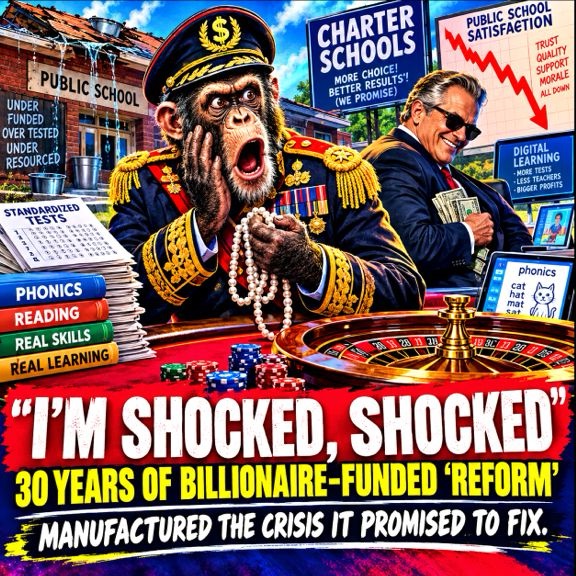
Mike Simpson, known on Twitter as “Big Education Ape,” is known for his brilliant memes and editorial cartoons. Typically, they expose the latest fads and lies that defame teachers and public schools. Every once in a while, he publishes a great post, like this one.
I’M SHOCKED, SHOCKED — HOW 30 YEARS OF BILLIONAIRE-FUNDED “REFORM” MANUFACTURED THE EDUCATION CRISIS IT PROMISED TO FIX
There’s a famous scene in Casablanca where Captain Renault declares he is “shocked, shocked” to find gambling going on — right before a croupier hands him his winnings. That’s essentially the posture of the billionaire reform industrial complex today, clutching its pearls over a Gallup poll showing public satisfaction with American schools has cratered to 32% — an 11-point nosedive in just two years — while quietly pocketing the profits of the crisis they spent three decades engineering.
Shocked. Absolutely shocked.
The Architecture of a Manufactured Crisis
Let’s be precise about the timeline, because precision matters when someone is picking your pocket.
For roughly 30 years, a well-funded constellation of think tanks, philanthropic foundations, hedge fund managers, and tech oligarchs pumped billions of dollars into a single, relentless narrative: public schools are failing. Not “underfunded.” Not “systematically neglected.” Failing — as in, inherently broken, irredeemably incompetent, populated by bad teachers protected by evil unions, and salvageable only by the heroic intervention of the private market.
The messaging was surgical. The money was real. And — surprise! — it worked.
Starve public schools of adequate funding. Declare them “failing.” Ride in on a white charter bus to “rescue” the children.
The chronic underfunding wasn’t fiscal negligence. In many states, it was a feature, not a bug. Squeeze hard enough, the theory went, and disruption would force innovation. What it actually forced was deferred maintenance, teacher shortages, and a generation of kids learning to read in buildings where the roof leaks and the textbooks predate the iPhone.
Now the poll numbers confirm the narrative took hold — and the reformers are citing those same poll numbers as proof they were right all along. The audacity is, genuinely, breathtaking.
The Numbers That Tell Two Very Different Stories
Here’s what the data actually shows — and what it doesn’t show:
Metric: The Headline. What It Actually Means Gallup Public Satisfaction 32% — record low 30 years of “failing schools” messaging worked exactly as intended.
Parent Satisfaction with Their Own School Historically ~2x the national figure People trust what they experience; they fear what they’re told
Math & Reading Scores Declining, especially bottom quartile Tracks directly with funding inequity and screen-time explosion
Top-tier U.S. Student Performance Still globally competitive. The “crisis” is concentrated where disinvestment is concentrated
The gap between how Americans rate schools in general versus their own child’s school is the smoking gun. It has always been the smoking gun. People who actually walk into a public school building — who meet the teachers, see the classrooms, watch their kids come home — consistently rate those schools dramatically higher than the national “failing” narrative suggests.
That gap is the manufactured crisis. It lives entirely in the space between lived experience and media-amplified fear.
$1.8 Billion Worth of Snake Oil, Served Fresh
And just when you thought the reform carousel might slow down, along comes the Science of Reading — the latest Next Big Thing™ in a long line of Next Big Things™ that have collectively cost American taxpayers tens of billions of dollars and produced reading scores that went, as the Big Education Ape’s withering analysis puts it, precisely nowhere.
Remember Common Core? $15.8 billion. A decade of standardized testing theater. Reading scores: unmoved.
Now we have the Science of Reading, $1.8 billion deep and climbing, with the same cast of vendors, the same philanthropic networks, and the same conspicuous absence of a money-back guarantee.
To be scrupulously fair: phonics works. Explicit decoding instruction works. The underlying research on structured literacy is legitimate. But here’s the thing about legitimate research — it doesn’t require a $1.8 billion vendor ecosystem, mandatory state legislation in 40+ states, and the systematic deskilling of teachers who are told to stop thinking and start following the script. When real science gets packaged into proprietary curricula, sold to districts under legislative mandate, and deployed without the trained human educators needed to implement it well, you don’t get science. You get very expensive phonics worksheets.
The question nobody in the reform complex wants to answer remains the same one it’s always been: Where is the money-back guarantee?
The Other Hand: How Tech Bros Broke Kids’ Brains While Selling the Cure
Here is the part of the story that deserves its own criminal investigation — or at minimum, a very uncomfortable congressional hearing.
The same Silicon Valley billionaires who spent decades pushing EdTech into classrooms as the revolutionary equalizer — screens for every student! –are the identical billionaires whose social media platforms have:
Collapsed long-form reading among adolescents at a rate researchers describe as one of the steepest drops in PISA history
Engineered algorithmic doom-scrolling that neurologically rewires 15-year-olds away from the sustained attention that math and reading comprehension require
Distracted over a quarter of students internationally during core academic instruction, by their own PISA survey data
They sold the disease and the cure. They pushed the screens that fragmented attention spans, then sold the adaptive software to remediate the fragmented attention spans, then pointed at the test scores and said: See? Public schools are failing.
None of this is inevitable. None of this is permanent. The No Kings Coalition — the sprawling, nonpartisan civic movement that flooded the streets in March — is now flooding the polls, with a Vote Early Day of Action on October 17 aimed squarely at the November 3, 2026 midterms.
The math is straightforward, even if the billionaires prefer we can’t do it:
Elect candidates who will defend public education funding, not divert it into voucher schemes that enrich private operators at public expense
Overturn the Supreme Court rulings — from Citizens United forward — that transformed American democracy into a billionaire auction
Restore the principle that public money follows public children into public schools, not into the portfolios of private equity firms with a “reform” logo.
The manufactured crisis has a manufactured solution: more billionaire intervention, more privatization, more EdTech, more testing, more disruption. The actual solution is considerably less glamorous and considerably more effective — fund schools equitably, pay teachers competitively, put phones away, and stop letting people who profit from public school failure write public school policy.
The Bottom Line
The 32% satisfaction number is not evidence that public schools have failed. It is evidence that a 30-year, billion-dollar propaganda campaign succeeded. The same people who manufactured the crisis are now selling the cure — at $1.8 billion a pop, no refunds, no guarantees, no accountability.
Meanwhile, the teachers who showed up every day through a pandemic, through chronic underfunding, through a staffing crisis, through the algorithmic dismantling of their students’ attention spans — those people are still in the classroom at 7 AM, doing the work that no EdTech platform, no voucher program, and no think tank white paper has ever actually replaced.
The casino is rigged. Captain Renault is shocked. And the November ballot is the one lever the house can’t control.
Vote like a public school depends on it. Because one does.
All links verified active as of September 9, 2026. Primary polling data sourced from Gallup/Walton Family Foundation. PISA data sourced from NCES/OECD 2025 release.
The Center for Research on Education Outcomes (CREDO) has positioned itself as the think tank that writes trustworthy evaluations of charter schools. In a sense, this is strange because CREDO’s leadership and its funding are not neutral on the subject of charter schools; they are decidedly pro-charter.
Freddie DeBoer argues on his blog that CREDO has consistently reported that charter schools find no gains for charter schools as compared to public schools. But it’s 2023 report was widely reported as the year of the Big Charter Breakthrough. He believes they are honorable in reporting their findings, but they pulled a fast one on the media and public by inventing a new metric that cannot be compared to other measures: “days of learning.”
DeBoer shows how the CREDO metric magnifies charter school results, which are actually small enough to be counted as “no effect.”
DeBoer begins:
In 2023 the Center for Research on Education Outcomes, known as CREDO, released its third national study of charter schools. The research covered 1.8 million students across twenty-nine states plus Washington D.C. and New York City. CREDO’s study purported to offer the most definitive evidence yet about the relative school quality of charter schools as compared to traditional public schools. Certainly our media, political establishment, and the nonprofit sector have acted as though what CREDO has to say is definitive; the 2023 study is, I believe, the most-cited piece of charter research in existence. Every pro-charter politician reaches for it, your Jonathan Chait neoliberal “reform” types treat its findings with near-mythic reverence, people who otherwise have no exposure to educational research wave at it as the final word on the subject. When the average person talks loosely as though there’s some sort of generic charter advantage, they’re usually referencing CREDO research, even if they don’t know they are.
This is all rather surprising, given that CREDO has not produced robust evidence in favor of charter schools, not in the 2023 study or its precursors. As we shall see, even if we assume that CREDO has solved the problem of the fundamentally non-random samples inherent to the task of comparing charter to public – which we should not, because they have not – the evidence supplied by CREDO in the favor of charter schools is so marginal and so noisy as to be meaningless from a policy perspective. And yet the message that the media took and shared from that report – the good news!, the vindication!, the headlines in Education Week and the New York Post!, the press releases from the National Alliance for Public Charter Schools! – was that the typical charter student was the beneficiary of a meaningful learning boost compared to their traditional public school counterpart. Why did this message spread so widely and resonate so loudly, if I’m right that even CREDO’s own numbers show very modest differences? Because of a remarkably savvy bit of marketing in how CREDO’s numbers were presented. The report did not show its findings in terms of effect size differences between charter and public, which would be the field’s standard way of sharing results. Rather, the outcome that was shared again and again was that a typical charter school student in the dataset had gained sixteen additional “days of learning” per year in reading and six in math. For a few months there you couldn’t read educational media without running into those numbers: sixteen additional days of learning in reading per year, six in math. It became a bit of holy writ in the endless quest to make bad students good with ACCOUNTABILITY and market reforms.
Now, me, I immediately gravitate to that last bit: what on Earth is a “day of learning,” and since when is that a statistical measure? “Days of Learning”: A Jury-Rigged Metric Invented for the Purpose of Inflating the Effect If you share my confusion over that metric, don’t blame yourself. “Days of learning” is not merely an unusual measure of student performance; it’s a boutique metric that CREDO invented themselves for their charter studies. It’s like YouTube changing how views are counted so the numbers look bigger.
This should raise a number of red flags, most importantly when it comes to comparison with other research. We have standardized metrics in social science research for a reason. One core reason among them is mutual interpretability, the ability to compare outcomes involving different interventions that are measured with different instruments and in different units. That’s why effect size exists, and various expressions of effect size have served as the dominant measure of interest in all manner of human research for decades precisely because effect size enables ease of comparison. If you want to compare the influence of the same intervention when one study uses grades as the DV and another used test scores, effect size enables you to do that. If you want to compare two different types of intervention, effect size enables you to do that too. There are some caveats, as there always are, but the basic, elegant logic of effect size makes the measure remarkably flexible and portable: effect size tells us how a given intervention moves average outcomes along the distribution of outcomes. If you want to know more there are plenty of simple explainers of effect size out there; here’s mine. There are some fields where effect size is used less often (economics, for example) but the interpretability and flexibility of effect size metrics like Cohen’s d are powerful advantages. Not surprisingly, then, it’s the dominant reported measure in education research.
So if effect size is both useful and common, and is in fact the dominant measure of interest in the relevant field, why would CREDO come up with its own boutique measure? Why invite the potential for confusion with such consequential research? Occam’s razor suggests a simple answer: because CREDO is a pro-charter organization that’s intent on convincing stakeholders that charters have meaningfully superior outcomes when compared to traditional public schools… and their own research demonstrates the opposite. Their own numbers, in fact, suggest that the returns on charter schools are meager even if we ignore the selection problems that continue to plague charter advocacy.
This is a much longer post about the inadequacy of research on charter schools. It’s well-written and thoughtful. Please open the link and finish reading.
The New York Times published a deeply disturbing article about the e billionaires who are pumping huge sums into the 2026 midterm elections and about dark money vehicles some use to hide their influence.
I am giving you free access to the articles: no pay walls.
This one shows who they are: “Meet the Megadonors.” Most are Republicans, tech entrepreneurs, and crypto kings.
In 2002, Senator John McCain of Arizona (R) and Senator Russ Feingold of Wisconsin (D) sponsored the Bipartisan Campaign Reform Act, commonly called the McCain–Feingold Act.
Its central purpose was to reduce the influence of large, unregulated political contributions.
It banned national political parties from raising or spending unlimited “soft money.” It restricted corporations and labor unions from financing certain broadcast political advertisements immediately before elections.it I ncreased disclosure requirements, and it raised some limits on direct contributions to candidates.
McCain-Feingold passed the Senate 60-40 and was signed into law by President George W. Bush.
The Supreme Court initially upheld most of it.
In 2003, McConnell v. FEC, the Supreme Court upheld the central provisions—including the restrictions on soft money and electioneering communications.
Then the Court gradually dismantled important parts.
In 2007, in FEC v. Wisconsin Right to Life, the Supreme Court restricted the government’s ability to regulate certain issue advertisements.
In 2008, the Supreme Court (in Davis v. FEC) struck down the so-called “Millionaire’s Amendment,” which raised the limits of campaign funding for individuals running against a wealthy, self-financing candidate. That attempt to level the financial playing field was eliminated by the Court.
And then came the big decision that ripped the teeth out of campaign finance reform: Citizens United.
In 2010, the U.S. Supreme Court ruled 5-4 that corporations and unions have First Amendment protection to spend unlimited amounts independently to influence elections. This invalidated a major part of McCain–Feingold.
Citizens United, together with subsequent cases, helped produce the modern system of unlimited independent expenditures and Super PACs.
We are now in the era of Citizens United, the decision by the U.S. Supreme Court that negated most limits on political spending.
Why did the U.S. Supreme Court swerve sharply against campaign finance reform?
John Roberts was appointed to be Chief Justice of the Supreme Court in 2005 by President George W. Bush. He formed a 5-4 majority with Justices Clarence Thomas, Samuel Alito,
David Sirota’s The Lever posted an important article about a hedge fund billionaire who hopes to redefine the Democratic Party. I thought I had heard of all the billionaires who were trying to remodel education to their own specifications, but I had never come across Steve Mandel.
Like many other billionaires, Mandel’s great passion is charter schools. He has poured millions of dollars into political campaigns, trying to elect candidates who share his values. His great hope appears to be to block candidates who are progressives and who are pro-union.
The article, by Katya Schwerin and Luke Goldstein, traces Mandel’s rise, from his elite schooling at