Archives for category: Literacy

John Merrow was the education correspondent for the PBS Newshour for many years. Some people never forgave him for his many episodes lionizing Michelle Rhee. I forgave him when he filmed a final episode thoroughly exposing her cruel methods and her indifference to allegations of cheating.

John’s latest post seeks to correct the record, with reference to Dana Goldstein’s article in The New York Times blaming AI (artificial intelligence) for killing the teaching of writing.

No, says John, AI didn’t do it. Our hyper-focus on standardized testing and standardized writing and standardized thinking did it.

He writes:

This week the New York Times turned over a significant portion of its front page to a long piece headlined “How A.I. Killed Student Writing (And Revived It).”

In the piece, the usually reliable Dana Goldstein puts forth sweeping generalizations based on what about 400 teachers volunteered. This, in a nation with nearly 4 million public school teachers and another 1.5 million college faculty! Granted, most of these 5.5 million teachers probably aren’t teaching writing, but relying on self-selected sources seems dubious, especially for the front page. What we learn is that a few creative and dedicated teachers, frustrated by their students’ reliance on A.I., are having the kids write in class, on paper, with pens or pencils. That’s not really news, although Goldstein, a very good writer, brings their stories to life…and may make you wish you could be in their classes.

More than a year earlier Ben Cohen reported about the dramatic rise in the sale of ‘blue books’ on college campuses: Sales of blue books this school year were up more than 30% at Texas A&M University and nearly 50% at the University of Florida. The improbable growth was even more impressive at the University of California, Berkeley. Over the past two academic years, blue-book sales at the Cal Student Store were up 80%.

Both of these news reports hang on the same premise: Student writing is dead, and A.I. is the killer. I think that’s flat out false. Our obsession with test scores and our prioritizing quantity over quality are the culprits. Most education systems stopped trying to teach writing back when Artificial Intelligence was the stuff of science fiction, unfortunately. Playing up to politicians, the education bureaucrats (who generally don’t trust teachers) decided to ‘raise standards,’ which to them meant having students write more papers and read more books and plays. Any suggestion that writing one outstanding paper would be better than six or a dozen so-so papers fell on deaf ears.

And because writing skills can’t be tested by a machine, why bother? Since we don’t trust teachers, it would be foolish to rely on their evaluation of their students’ writing skills.

Happily, I know in my bones that lots of teachers have not given up. A quick Google search turns up a treasure trove of ideas for improving student writing, starting in the elementary years. Writing thank you notes, keeping a journal, and so on. Here’s one I think you will enjoy (and might want to share with teachers in your world).

It’s not semantics to assert that the goal is to develop writers, not “teach writing.” That’s an important distinction.

So what can teachers who want to develop writers in their classes do in 2026? First of all, take a deep breath because we’ve been through this before–back when the internet emerged. Soon some students discovered that they could download papers and submit them as their own. Next came profit-making companies offering papers written to order. While small-minded bureaucrats thought they could win that struggle by spending millions on technology that supposedly could scan papers and detect plagiarism, thoughtful teachers won that struggle by 1) reducing the number of papers assigned, and 2 )working with individual students as they developed their ideas and wrote drafts. It’s harder to cheat when the teacher is overseeing the process and when kids are writing about something they genuinely care about.

What’s called for now is emulating what my high school English teacher, William Sullivan, did nearly 70 years ago. Two or three times every week he would tell us to clear our desks of everything except for a single sheet of paper and a pencil. What followed was what he called a “2-8-2,” meaning that we had two minutes to think–no writing allowed–followed by eight minutes to write, and then two more minutes to read what we had written and correct any errors. He would put our writing assignment on the blackboard. Sometimes we would have to include a certain sentence, such as “I wish I had missed that train.” Or “I still wish I hadn’t missed that flight.”

Even today I still remember one particular assignment: “Turn out the light; I don’t want to go home in the dark,” which Mr. Sullivan told us were the dying words of William Sydney Porter and challenged us to explain the contradiction. After we turned in our papers, Mr. Sullivan told us that we knew William Sydney Porter as the writer O. Henry.

(Fun fact: Some forty or fifty years later I discovered that Porter actually did not contradict himself. His dying words were “Turn up the lights. I don’t want to go home in the dark.” Apparently Mr. Sullivan changed his words to create a challenging paradox for us to try to explain.)

Although I went to a private school with small classes and privileged students, Mr. Sullivan’s approach can work at all levels. I know this to be true because I taught working-class kids in a public high school, first generation African American college students in an HBCU, and young men serving sentences in a federal prison.

I used Mr. Sullivan’s “2-8-2” all the time. I got to know my students’ writing, and I’m convinced that their writing skills improved. They became writers, confident in their voices.

Frequent in-class writing worked then, and it should work in the age of Artificial Intelligence and with all the other ‘advances’ in our future.

However, policymakers and administrators have to behave sensibly and understand that ‘less is more.’ That means smaller classes, fewer students per teacher, and heightened trust in teachers. Those shouldn’t be a bridge too far, if we really want our young people to be thoughtful and capable citizens.

You can stop here if you wish. What follows is the story of my own dabbling in A.I., printed in my blog in April 2023, more than three years ago.

If you’re at all like me, you’re curious about Artificial Intelligence and new applications like ChatGPT and Bard. The brilliant Thomas Friedman of the New York Times says the world will never be the same again, but my interest is narrower: If students can simply ask Bard or ChatGPT to write their papers for them, how can teachers prevent this?

So, naturally, I turned to Bard, which told me (within seconds) that, while it can help students generate ideas, do research, improve their writing, and learn about different writing genres, it’s not supposed to be a substitute for original research and writing. Then it warned me to “Monitor students’ use of Bard to make sure that they are not plagiarizing or engaging in other forms of academic misconduct.”

Yeah, right. If I’m teaching English in a public high school, I probably have between 100 and 125 students! There aren’t enough hours in the day….

Second question: Can Bard help identify cheaters and plagiarists? Within seconds, I received an answer:

“There are a few things you can look for to tell the difference between original writing and prose provided by Bard.

  • Original writing is typically more creative and original than prose provided by Bard. Bard is trained on a massive dataset of text, so it can be very good at generating text that is grammatically correct and factually accurate. However, it is not always able to generate text that is creative or original.
  • Original writing is typically more personal and engaging than prose provided by Bard. Bard is a machine learning model, so it does not have the same level of understanding of human emotions and experiences as a human writer. As a result, its writing can be dry and impersonal.
  • Original writing is typically more nuanced and complex than prose provided by Bard. Bard is a large language model, but it is still under development. As a result, it can sometimes struggle to understand the nuances of human language. This can lead to writing that is simplistic or even nonsensical.

……

  • Ask yourself if the writing sounds like it was written by a human. Bard-generated text can sometimes sound robotic or unnatural. Original writing should sound like it was written by a human.

To put this the test, I gave Bard the following task:

I am one of six children, the second oldest and the first-born son. We grew up on a small farm with chickens, a few cows, a few pigs, and one goat. I’m now 81. Please write a short memoir of no more than 200 words about my childhood.

Within seconds, Bard spit out this:

“I was born in 1942, the second oldest of six children. We grew up on a small farm in the Midwest. My father worked hard to provide for our family, and my mother took care of the house and the children. We didn’t have much money, but we were happy.

I loved growing up on the farm. I spent my days playing with my siblings, helping my father with the chores, and exploring the woods behind our house. We had chickens, a few cows, a few pigs, and one goat. I loved taking care of the animals, and I learned a lot about hard work and responsibility.

I also learned a lot about nature on the farm. I spent hours watching the birds and the animals, and I learned to identify all the different plants. I loved being surrounded by nature, and it helped me to appreciate the beauty of the world.

I had a wonderful childhood on the farm. It was a time of innocence and discovery, and I will always cherish those memories.

Now that I am 81 years old, I still look back on my childhood with fondness. I am grateful for the opportunities I had, and I am proud of the person I have become. I know that my experiences on the farm helped to shape me into the man I am today.

Boring, and also wrong, and so I responded:

This is inaccurate. I was born in 1941, and our farm was in Connecticut. Worse, however, it does not capture either the small pleasures of collecting the eggs every morning or learning to milk cows, and it also does not capture the deep pain of watching a pig or steer that I raised being slaughtered. Please rewrite.

In just a few seconds, Bard responded by adding a few paragraphs, highlighted below to make it easier for you to read: “Sure, here is a more accurate and detailed memoir:

I was born in 1941, the second oldest of six children. We grew up on a small farm in Connecticut. My father worked hard to provide for our family, and my mother took care of the house and the children. We didn’t have much money, but we were happy.

I loved growing up on the farm. I spent my days playing with my siblings, helping my father with the chores, and exploring the woods behind our house. We had chickens, a few cows, a few pigs, and one goat. I loved taking care of the animals, and I learned a lot about hard work and responsibility.

I also learned a lot about nature on the farm. I spent hours watching the birds and the animals, and I learned to identify all the different plants. I loved being surrounded by nature, and it helped me to appreciate the beauty of the world.

One of my favorite things to do was collect the eggs every morning. I would wake up early and go to the chicken coop, where I would find a dozen or so eggs waiting for me. I would carefully collect the eggs and put them in a basket, then bring them back to the house. My mother would use the eggs to make breakfast, and I would always get to eat one of the freshest eggs in the world.

Another thing I loved to do was milk the cows. I would go to the barn in the evening and bring the cows into the milking parlor. I would sit on a stool and milk each cow in turn, collecting the milk in a bucket. The milk would then be used to make butter, cheese, and ice cream.

Of course, there were also some challenges growing up on a farm. One of the hardest things was watching the animals being slaughtered. I knew that it was necessary to eat meat, but I still felt bad for the animals. I would often cry when I saw them being killed.

Overall, though, I had a wonderful childhood on the farm. It was a time of innocence and discovery, and I will always cherish those memories. I am grateful for the opportunities I had, and I am proud of the person I have become. I know that my experiences on the farm helped to shape me into the man I am today.

OK, but even with this information, the writing remains pedestrian and without emotion. Human writers would know not to begin with their birthday, for one thing. They might lead with a sentence designed to keep the reader’s interest. Something like, “70 years later, at age 81, I can still hear the terrified squealing of the hog as it was strung up by its hind feet to be slaughtered….”

John Merrow

former Education Correspondent, PBS NewsHour

My blog: themerrowreport.com

“I don’t want to BE old when I am old.”  Jack LaLanne

Retired teacher Nancy Bailey wrote on her blog about significant figures in the evolution of the history of reading. In this post, she focuses on the role of Robert Sweet, an important figure in the Department of Edication during the Reagan-Bush era.

Bailey writes:

Today’s Science of Reading (SOR) was born of a right-wing conservative phonics focus. A Nation at Risk helped advance that messaging, and one of the messengers was Robert Sweet, Jr.

As the country mandates the Science of Reading (SOR) and invests heavily in unproven programs, marketing disputes flourish over which best align with so-called evidence. These programs control teachers’ instruction through one-size-fits-all directives, delivered with manuals or online. It’s easy to see where this is going. States could spend millions more on reading programs that don’t appear to improve learning as teachers are driven out with tech.

During the Reagan administration, A Nation at Risk raised unfounded negativity towards public schools and teachers (See Biddle and Berliner, The Manufactured Crisis). Reading, already controversial, became a vehicle for attacking teachers, their teacher colleges, and public schools, furthering a school privatization agenda that continues to this day. Schools weren’t doing badly, but those who wanted to privatize them worked to make them fail.

The obituary of Robert Sweet, Jr. is glowing. I don’t doubt that, like many SOR enthusiasts, he believed he was doing the right thing. He became instrumental in the phonics movement, working later with the Science of Reading and Reading First promoter Reid Lyon to create No Child Left Behind and Reading First. Yet he’s rarely mentioned today.

Sweet wasn’t a qualified reading teacher. He taught physics, coached, and sold textbooks. He arrived in DC as a member of the US House of Representatives staff during the Reagan administration. He supported Reagan initiatives such as tuition tax credits, low-income voucher programs, student self-help reforms, education savings accounts, and other conservative school initiatives.

He met Dr. Onalee McGraw, a PhD political scientist and a Heritage Foundation representative. McGraw, unrelated to the publishing company, was a Reagan appointee to the National Council on Educational Research (See Robert Sweet interview 4.17 below).

The Heritage Foundation is behind today’s Project 2025. Lindsey Burke, who wrote the education part, works with Education Secretary Linda McMahon. Neither are educators.

McGraw wrote “Family Choice in Education: The New Imperative,” arguing that public schools were in decline, academics had been replaced by social engineering, and humanistic curricula and subjective values had taken over. She believed education was inherently religious, not value-free. She promoted vouchers, minimum competency requirements, and moral education classes.

Sweet initially didn’t see reading as a problem. He and his children learned to read. But McGraw introduced him to Michael Brunner, who convinced Sweet otherwise.

Brunner wasn’t a reading teacher either. He had a degree in library science becoming the director of Title I in Idaho. He connected with the Reading Reform Foundation, created after Rudolph Flesch’s Why Johnny Can’t Read. Brunner wrote Vowelectomy. He believed in the work of well-known reading expert Jeanne Chall, but didn’t think vowel and mixed digraph instruction took place early enough, waiting until the end of first grade.

Both Sweet and Brunner repeatedly claim that students aren’t learning to read and teachers and especially their colleges are failing to teach phonics.

But Berliner and Biddle in The Manufactured Crisis pointed to media claims as being distorted and hostile, describing reporters failing to address cited study details, indicating that research really showed that poverty was the leading cause of reading difficulties (see p. 10-11).

Sweet became the director of the National Institute of Education and later the US Department of Education, bringing Brunner to DC to work on reading. They commissioned a report, Becoming a Nation of Readers. It’s informative, covering phonics importance, but also comprehension, meaning, and environmental influences. Sweet complained it was unfocused (8.45 video below).

He commissioned another report by Marilyn Jaeger Adams Beginning to Read: Thinking and learning about Print. The book, still popular today, stresses the importance of phonics and whole language. I could not find what Sweet thought about Jaeger’s book.

Both Bruner and Sweet favored Spaulding, a reading program spun from Orton-Gillingham (OG). Sweet criticizes Reading Recovery, praising Spaulding at the end of this interview. OG remains popular in the Science of Reading, despite common knowledge that it has lacked high-quality, peer-reviewed studies of its efficacy for 50 years!

Brunner and Sweet traveled the country observing teachers, without being reading experts. They blamed colleges for failing teachers on how to teach phonics. While teacher colleges can always improve, generalizing the same criticism towards all is dangerous. I knew of excellent teacher college programs at that time. Brunner created his own reading program, Phonics Made Plain.

He authored numerous articles on reading, including a Republican policy paper “Illiteracy: An Incurable Disease or Educational Malpractice?” Sweet’s paper was supported by the U.S. Department of Education and the Center for the Study of Reading at the University of Illinois. It called for enlarging the restoration of the instructional practice of intensive, systematic phonics in every primary school in America.

Next, under President George H.W. Bush, Sweet became administrator for the Juvenile Justice Department. Brunner writes Retarding America: The Imprisonment of Potential, highlighting that juvenile crime is due to current reading methods (i.e. little phonics), while ignoring other variables. A good thing is that they establish reading programs in some detention facilities.

Sweet learns of the National Institute of Health and Human Development and met Reid Lyon. He seemed then to form the idea that reading must be based on scientific principal and one assumes he’s talking about phonics (11.58 video below).

In 1993, Sweet became co-founder and president of the now defunct National Right to Read Foundation which focuses again on phonics (12:41 video below). He still implied that teachers didn’t know about phonics.

Brunner criticizes the All Handicapped Children’s Act (PL 94-142) throughout the book listed above implying children simply lack phonics instruction.

But, public schools were working to accommodate children with reading difficulties in schools using phonics in resource classes especially after the 1975 passage of PL94-142. And phonics may have been taught later.

Sweet eventually helps pass the Reading Excellence Act in 1998 under President Clinton, although he doesn’t care for Clinton’s America Reads program where college students read to students (14.18 video below).

Under President G.W. Bush he collaborates with Reid Lyon, an advisor to the president, crafts language for the No Child Left Behind Act. Sweet becomes the primary author of the Reading First initiative which saw “scientifically based research” noted more than 100 times. Reading First turned out controversial.

Lyon immensely disliked educational schools, stating in 2002, a year after 9/11, You know, if there was any piece of legislation that I could pass, it could be to blow up colleges of education. He supports today’s Science of Reading initiative.

Around this time Reid, according to the NYTs, advised his former boss, Dr. Duane Alexander, about candidates for the National Reading Panel (Schemo, 2007). No early childhood teachers who teach reading were included on the panel. It’s controversial findings are still promoted by SOR enthusiasts, including some whom were on the panel. [I mention the lack of early childhood teachers but one teacher/principal was selected for the panel. Joanne Yatvin wrote many reports about her concerns about the panel itself. Minority View]

Robert Sweet and those described here were given much clout over teachers and how they teach. Yet after all these years, focusing heavily on phonics, and adding billions in technology often for SOR online programs, teachers, and their teacher colleges are still blamed as failing.

References

Berliner, D. C., & Biddle, B. J. (1995). The manufactured crisis : myths, fraud, and the attack on America’s public schools. Addison-Wesley.

Gursky, D. (1981, August 1). After The Reign Of Dick And Jane. Education Week, Retrieved from https://www.edweek.org/education/after-the-reign-of-dick-and-jane/1991/08

Schemo, D. J. (2007, March 9). In War Over Teaching Reading, a U.S.-Local Clash. The New York Times, Retrieved from https://www.nytimes.com/2007/03/09/education/09reading.html

This post is adapted from my panel presentation at the 2025 Network for Public Education meeting.

Denny Taylor, a distinguished scholar in the teaching of literacy, has done impressive research to identify the origins of the “science of reading.” The roots of this latest fad are deeply entwined in the work of behaviorist Edward Thorndike. She explains how one view of literacy got embedded in the report of the National Reading Panel. Other views, other research was excluded.

It’s a fascinating article.

She writes:

This Substack post documents how George Bush and the Texas Business Council took control of how children are taught to read through their alignment with Reid Lyon and reading researchers on the Thorndike-Skinner-Engelmann-Carnine, stimulus-response, operant conditioning continuum, and delivered American children to technology companies, owned by hedge funds and private equity firms that capitalize on the profits of adaptive AI technology that constantly evaluates a child’s performance to adjust their instruction in real-time.

The post provides the historic foundations of how the integration of real-time adaptive AI into K-3 reading programs marks a shift from education as a social exchange to a closed-loop feedback system between child and machine. In future Substack posts I will focus on how this dynamic reshapes the learning process into a form of “distributed cognition,” where the boundaries between human and artificial thought – the child and the machine begin to blur.

**

Taylor then goes on to document the relationship between Reid Lyon and George W. Bush in the late 1990s. From 1992 to 2005, Lyon served as  the Chief of the Child Development and Behavior Branch within the National Institute of Child Health and Human Development at the National Institutes of Health. He met up with Texas Governor George W. Bush and persuaded him that he had the key to reading success. Bush became a true believer in Lyon’s ideas and embedded them in No Child Left Behind after he was elected President in 2000.

In 1997, Lyon created the National Reading Panel, whose research leaned strongly towards one side of the “reading wars.”

Taylor narrates a historical account that should interest anyone interested in the origins of the “science of reading.”

She concludes:

The damage to the American public school system is extreme and for children the Science of Reading laws are catastrophic. The state laws that have been passed mandate beginning reading instruction in public schools that is developmentally inappropriate, and children’s health and wellbeing, as well as their academic development are at risk. The digitization of reading instruction exponentially compounds the risks.

For children in crisis in America the situation is dire, and we must respond. There is substantial evidence that between 60%and 70% of children in U.S. public schools have had Adverse Childhood Experiences and many of these children are coping with ongoing toxic stress which is compounded by 45 state lawswhich mandate state approved “Science of Reading” programs and excessive standardized assessments developed by technology companies owned by hedge funds and private equity firms….

The six year forensic analysis has provided extensive evidence that the experimental research studies that form the four cornerstones of the “Science of Reading” have no scientific validity. Of particular concern are the dog-whistles and lies that have been “sold” to policy makers and the public about the National Reading Panel Report, which has no scientific legitimacy. A compelling case can be made for the removal of the NRP Report from all documents that policy makers have used to require by law the fundamentally flawed “evidence-based reading instruction” in U.S. public schools. Such an action would remove the ban on cueing and the requirement of direct instruction in the “five pillars,” and thus, nullify the 45 state laws that mandate the Science of Reading. It would also mean that universities would be able to base reading courses on the peer-reviewed articles and books of reading researchers whose scholarship has been banned, and curriculum decision-making would be returned to teachers, parents, and local school districts.

Tom Ultican, retired teacher of advanced mathematics and physics in California, says that all the bright and shiny fads have actually harmed students and teachers. I have not posted the entirety of his commentary. To finish reading it, open this link.

He writes:

Trump’s billionaire education leader, Linda McMahon, claimed on Fox News, “We’re doing terribly, I mean, our education system’s failed our kids.” Like a typical oligarch, she bolstered her point by mischaracterizing NAEP assessment levels stating, “only about 30% of high school and eighth graders can read proficiently or do math proficiently.” Maybe that sounds bad, but the reality is those numbers indicate that 30% of students are achieving at a high B or low A grade-level which sounds pretty good to me.

McMahon was promoting her nonpartisan “History Rocks!” tour. The sponsors of the tour are certainly not nonpartisan. They include America 250 Civics Education Coalition, led by pro-Trump America First Policy Institute which is composed of right-wing organizations such as Turning Point USA, Moms for Liberty and the Heritage Foundation.

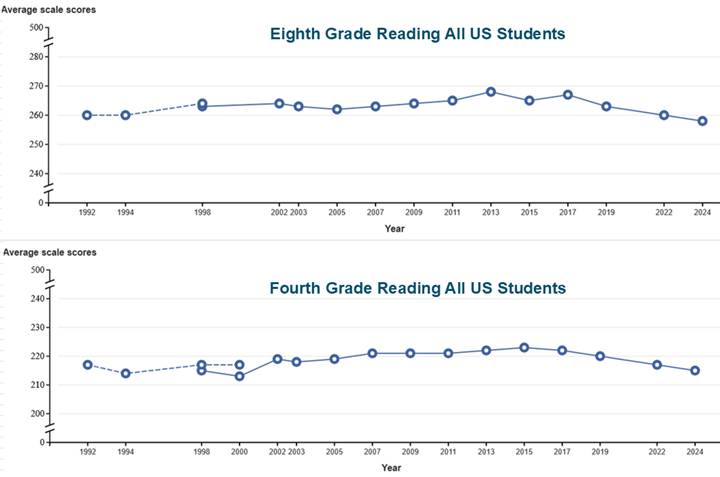
However, even though standardized testing is a terrible method for evaluating schools and students, it is notable that the National Assessment of Education Progress (NAEP) results have been falling since 2013.

The NAEP data plotted above is for all tested US students in 8th grade and 4th grade reading. Around 2013, results started dropping. Data for math also shows this same trend. Because education has so many variables, establishing a solid cause and effect relationship for this decline is impossible.

Based on my personal experience in the classroom and my years of observing education outcomes, I have developed a theory that at least partially explains the decline.

Education Technology

In the 1990s, I worked in Silicon Valley researching friction problems associated with computer equipment. Part of my assignment was to develop software that ran testing devices, gathered massive data sets and loaded them into a Microsoft data base which created reports that I shared with customers. Once the testing was setup and started, everything from then on was automated. I loved pushing technology and making it do things no one else had.

In 1999, I got tired of Silicon Valley. That is when I returned to San Diego and sought a teaching credential. At the time, I imagined being able to use my technology expertise in future classrooms. I had become genuinely excited about education technology (edtech).

I wish I could say my expectations were met but I cannot.

I discovered that instead of edtech driving exploration, it was aimed at controlling and replacing teachers.

As part of the master of education program at UCSD, we were sent to local schools to work with students. I went to a local high school to work with struggling math students in a recovery class. Students were assigned to work on computer presented math problems which were then graded by the computer.

As the education technology critic Audre Watters has observed:

“Just because it’s a worksheet on an iPad doesn’t mean it’s transformational or exciting. It’s still a worksheet.”

In retrospect, this experience was an early effort to replace teachers with computer screens. Instead of working on making edtech an exciting addition to education, the effort was pointed toward putting kids at screens instead learning from teachers. The technology industry was promising to reduce the need for costly teachers.

Physics Lab Class

This picture shows an example of using technology to engage students in authentic learning. Two photogates affixed to the ramp were accurate to + or – 0.001 seconds. Here the students were adjusting the ramp to achieve constant velocity when a marble rolled down the ramp. The photogates provided data including the time for test object to roll through the gate and the time between gates. Since students new the diameter of the test ball and the distance between the gates, they were able to calculate three velocities. Once the three velocities were all equal, they changed to a test ball with identical geometry but significantly less mass. They were then able to observe that the mass of the ball did not change the velocity which accords with Galileo Galilei’s 1589 experiment testing mass and gravity.

Unfortunately, only small companies were working to develop engaging technology for learning. Larger companies were developing school management systems that gathered large data sets on all students and teachers. Or they were creating schemes where teachers created lessons on their platforms which then claimed ownership of the lessons.

The school district I was in bought every student an I-pad and then three years later replaced those I-pads with laptop computers. Because these devices were such a classroom distraction, teachers often required students to put them in their backpacks and store them under their desks.

It was worse than a waste of money. It was undermining learning.

 In my AP physics classes, students were not working through the assigned problems. They discovered that almost all physics problems had a worked-out example on line. I was getting the most beautiful work I had ever seen but the students were clueless when tested.

It seems fair to identify edtech as a possible cause for declining test scores. Artificial intelligence will likely make — not working or thinking — an even bigger problem.

Science of Reading

The Orwellian labeled science of reading (SoR) is not based on sound science. In 1997, congress passed legislation calling for a reading study. Establishment of the National Reading Panel (NRP) was a doomed effort from the beginning. It was a massive undertaking, conducted by twenty-one unpaid volunteers over 18-months. NRP fundamentally did a meta-analysis in five reading domains, ignoring 10 other important domains. They did not review everything and there was no new research. Their report is the basis for SoR.

To finish reading the post, open this link.

A reader who identifies as “Retired Teacher” explains the best way to teach reading. The best way is to start by understanding that there is no single way to teach reading. The best way is to assess what’s right for the students in front of you. Some need help in phonics; some don’t. Some are already fluent readers and need challenging and engaging stuff to read.

RT writes:

Most competent reading teachers are effective when they diversify instruction based on the needs of the learner. Generally, the first step in effective reading instruction is to assess students. What often results in elementary classrooms is that teachers often end up placing students into a group with other students with similar needs. Some students arrive in kindergarten reading fluently. They have clearly mastered phonics so there is no need to spend time on phonics lessons the student does not need. Both Diane Ravitch and myself grew up in the “See, Say” era of reading instruction. We didn’t learn phonics. We deduced the sound system from reading it. This method will not work for many students, but there are some that would be successful with this approach. 

All learners have strengths and weaknesses. Other students may have other issues like a difficulty with auditory discrimination, and teachers should have the freedom to adjust instruction based on the needs of students. By the way a student with auditory discrimination or memory problems will struggle and flounder in a science of reading environment. This student may have to write the word in order to basically memorize it.

I am a certified reading teacher. I have taught many struggling students, most of whom were English language learners, to read successfully and fluently in English. Part of the reason for positive results was due to the assessing and addressing what the student needed to understand and apply the skill and become a good reader. There is no magic to this process. It is called diversifying instruction, and many competent teachers adjust teaching to meet student needs. Whatever method is used, it needs to meet students’ needs, offer the student a degree of success through application, and be engaging. Professional teachers should have the freedom to adjust instruction without government interference.

I am reposting this commentary because the original post this morning did not include a link to the full post.

Denny Taylor is an accomplished scholar and author. She is Professor Emeritus of Literacy Studies at Hofstra University and has earned a long list of awards. She now has a Substack blog that is worth your time. In this post, she goes into detail about the origins of the “Science of Reading” and the poor quality of research on which it is based.

I provide only a small excerpt from a deeply researched post.

Taylor wrote this post to caution against a federal mandate based on flawed claims. Congress is currently considering HR 7890 Science of Reading Act of 2026. As she shows, it would be absurd if it passes. Congress should not tell teachers how to teach, nor should state legislatures.

Denny Taylor writes on her blog “Teaching in Dangerous Times”:

The Science of Reading Act of 2026 – H. R. 7890 is a catastrophic mistake for three reasons. First, it makes early 20th century phonics instruction the law of the land. Second, the NRP “5 pillars of reading instruction” are not based on science. Third, H. R. 7890 does not prepare children to live and thrive in a digital society that is filled with unforeseen hazards and dangers. We must think anew and act anew – before it’s too late.

H. R. 7890 “Evidence-Based Literacy Instruction Aligned to the Science Of Reading” is Not Based On Science

The six-year qualitative as well as the quantitative forensic analyses provides evidence that the scientific foundation undergirding the teaching of reading in America’s public schools is irreparably flawed. The “evidence-based literacy instruction aligned to the Science of Reading” that is described in the new federal Science of Reading Act – 2026 (H. R. 7890) is a political construct not a scientific one.

Nevertheless, Congress is in the process of making “fidelity” to the “Science of Reading” the law in all 50 states.

H. R. 7890, the Science of Reading Act – 2026 was unanimously approved by the House Education and Work Force Committee on March 17, 2026. It will amend the Elementary and Secondary Education Act of 1965 to prioritize funds to promote the use of H. R. 7890. The legislation also aligns with U.S. Education Secretary Linda McMahon’s priorities for literacy improvement, but the Right-wing ideologs behind H. R. 7890 are far more formidable than McMahon.

H. R. 7890 Eliminates Reading and Writing Activities which Provide Opportunities for Children to Actively Engage with Meaningful Texts

The Science of Reading Act of 2026 will also officially prohibit the use of the “three-cueing” system in literacy instruction in U.S. public schools. My own pedagogical practices always begin with close observation of children who use many cues to read and write when they are not restricted by authoritarian “Science of Reading” laws that have already been enacted in most states.

H. R. 7890 will have the effect of eliminating reading and writing activities which provide opportunities for children to think. In such circumstances their thinking can be divergent and/or convergent, linear or lateral, abstract or concrete. Often it is meta-cognitive as they discuss with their teachers how they arrived at the meaning of a word. Often the clues are phonetic, and the sentence confirms their reasoning. All these pedagogical opportunities for teachers to support the learning of children are not understood by the public or by Congress. If they were, people would rally against passing the Science of Reading Act of 2026, and Congress would not pass H. R. 7890.

The Research Evidence for H. R. 7890 was Established Based on the False Findings of the 2000 National Reading Panel Report

Through dog whistles, lies, and tropes, the Right convinced people in many sectors of U.S. society that the “five pillars” of reading instruction that the NRP presented to Congress provided solid scientific evidence on how children should be taught to read. The publishers of reading programs that now call themselves technology companies, most prominently McGraw-Hill and HMH, marketed the findings of the NRP creating a bonanza in profits so large that Platinum Equity now owns McGraw-Hill and Veritas Capital now owns HMH.

Draw back the curtain and it is possible to document in minute detail how a false narrative about the National Reading Panel came to be accepted as the unquestionable scientific evidence for the massive changes in reading instruction that has taken place in U.S. public schools.

The “five pillars of reading instruction” and the Science of Reading have become embedded in the knowledge base of people in every sector of U.S. society. I asked AI “what are the five pillars of reading instruction?” AI responded:

The 5 pillars of reading instruction—phonemic awareness, phonics, fluency, vocabulary, and comprehension—are essential, evidence-based components for developing proficient readers. Defined by the National Reading Panel, these pillars provide a structured framework for teaching decoding, accuracy, and understanding in reading instruction.

The AI response is an accurate rendition of the official narrative that the nation has been deceived into believing through an Right wing initiatives gaining traction in the 1990s that have gaslighted the public through the use of dog whistles, lies and tropes. One of the think tanks on the Right that has had an unprecedented influence of how children are taught to read in public schools is the Thomas B. Fordham Institute (then the Thomas B. Fordham Foundation) advocated for a shift toward scientifically based reading research and explicit phonics instruction in 2002. The Fordham Institute established the National Council of Teacher Quality (NCTQ) that I have written about in previous Substack posts. NCTQ states that it is a “nonpartisan research and advocacy group.” Nothing could be further than the truth. NCTQ’s evaluations of U.S. teacher preparation programs, are flawed, unscientific, and ideologically driven.

Enforced by State Laws, the Five Pillars have Become the Structural Framework of Reading Instruction in Public Schools Across America

Once the Science of Reading Act of 2026 is signed into federal law one of the education goals of the Heritage Foundation will have been achieved. It is relevant that Mike Pence has been accused of “abandoning its principles” and transforming the Heritage Foundation from a traditional conservative organization into an enforcer for “big-government populism” and “America First” extremism. The forensic analysis has documented the initiative undertaken by the Right to control reading instruction in U.S. public schools, especially how Lindsey Burke has led the Right’s initiative to “reshape” public education. Burke spent 17 years at the Heritage Foundation where she was a principal author of the Education Section of Project 2025. She transitioned to the Department of Education where she serves as McMahon’s Deputy Chief of Staff for Policy and Programs. Burke is attributed by leaders on the Right with “reshaping” – her word — reading instruction in public schools. Parenthetically, Burke is also associated with the Thomas B. Fordham Institute and NCTQ. She is featured on the Fordham Institute website in a podcast entitled, “Trump’s education agenda, with Lindsey Burke” (January 31, 2024). NCTQ is the focus of the October 19, 2025, Substack post entitled, “NCTQ Pressures State Governments, Rejects Teacher Preparation Programs, Dictates To School Districts, Discredits Reading Researchers, Bans Their Books, And Vilifies Teachers.

Paul Thomas is a professor at Furman University. He has taken a leading role in refuting claims for the “science of reading.”

There are many successful ways to teach reading. some children arrive at school knowing how to read, because a parent read with them every day. Phonics is important. The joy of reading is important. Comprehension is important. Legislatures should not mandate one way to teach.

In his latest post, he writes:

If you pay attention to the non-stop moral panicking around reading fanned by mainstream media, you may have seen this click-bait headline: Did New York blow $10 million on reading instruction that doesn’t work?

The article repeats tired and misleading (often false) stories about the failures of balanced literacy, NAEP reading scores, the “success” of Mississippi and Louisiana, the promise of structured literacy, and the National Reading Panel as well as the one research study on phonics that is linked.

Let’s consider these:

*No scientific studies identify a reading crisis in the US causally linked to balanced literacy, reading programs, lack of phonics instruction, or inadequacy of teacher education. (Aydarova, 2025; Reinking, Hruby, & Risko, 2023).

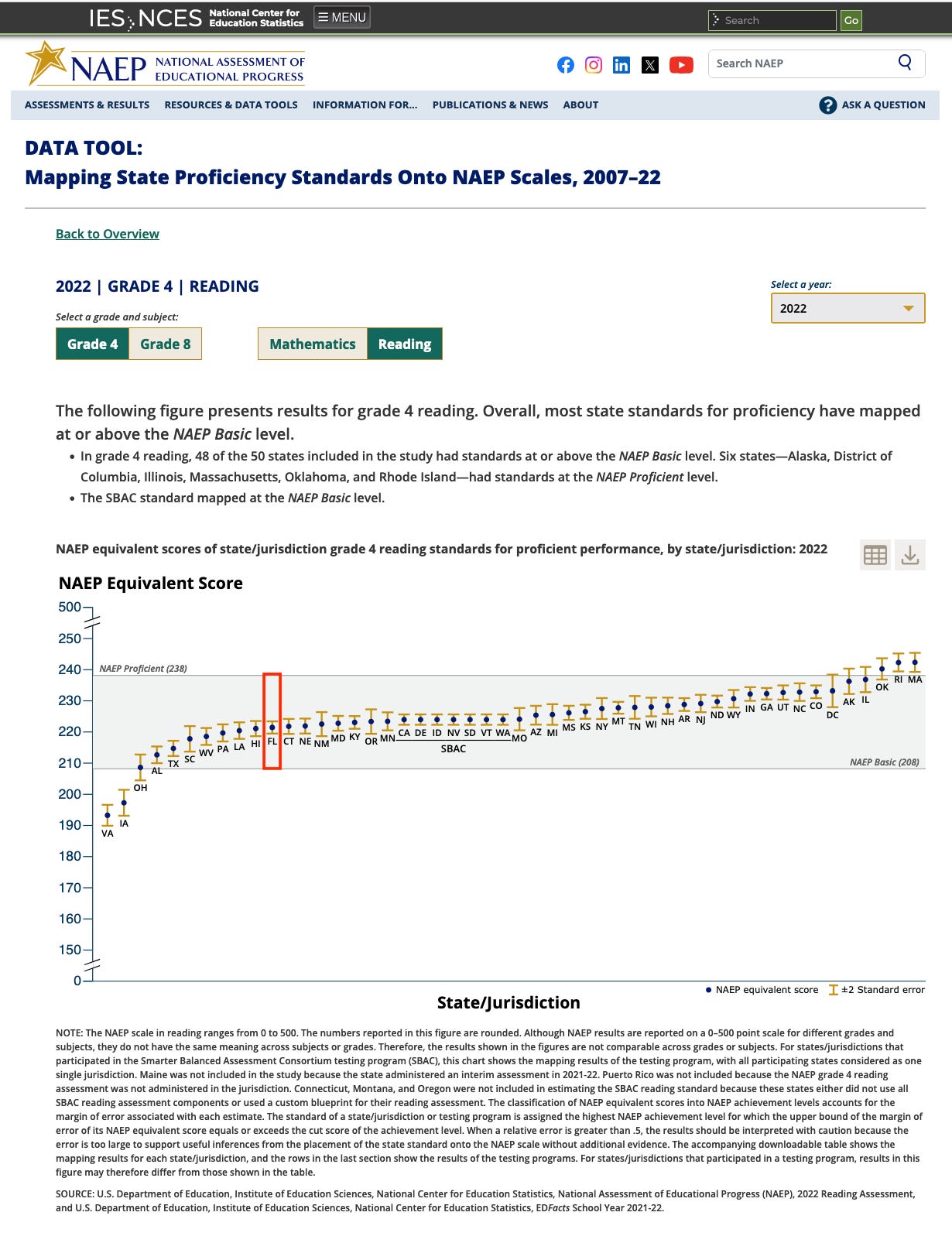
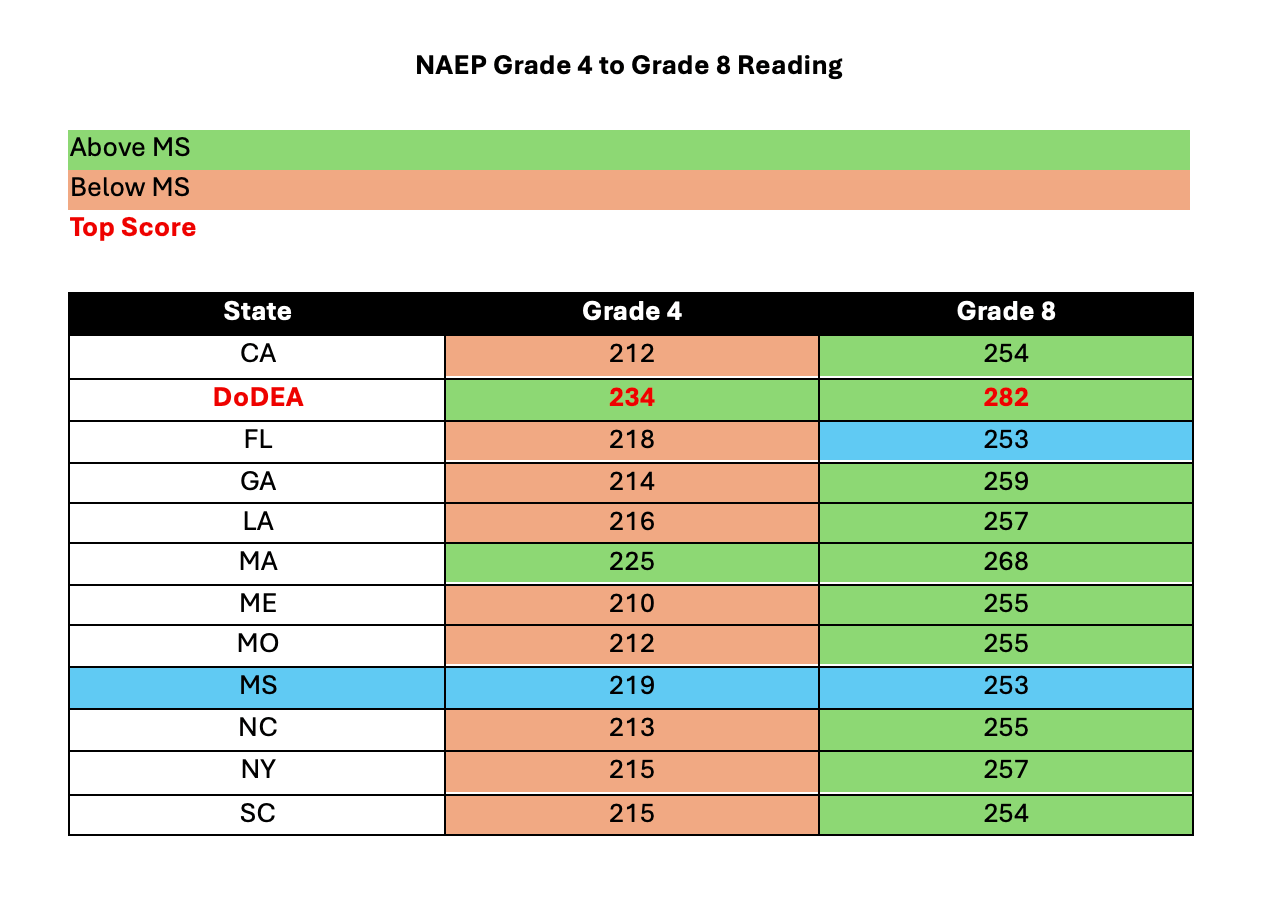
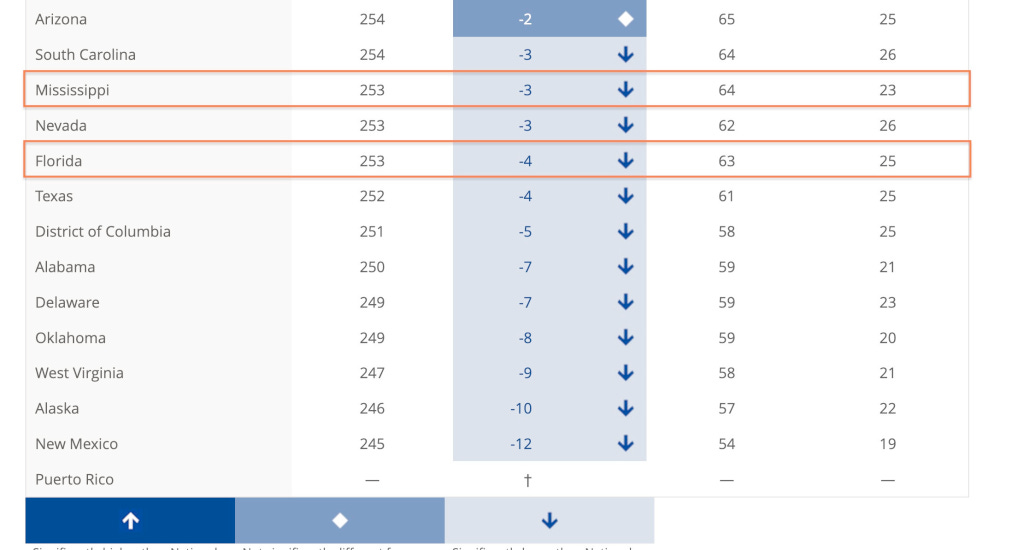
*The media hyper-focuses only on grade 4 NAEP reading scores, but notice how the story changes once we consider grade 8—states behind MS in grade 4 catch and pass MS by grade 8 (primarily because MS inflates their grade 4 scores by excessive grade retention, like FL):

*Structured literacy (scripted curriculum) is whitewashing the reading curriculum and restricting teacher autonomy and professionalism. (Khan, et al., 2022; Parsons, et al., 2025; Rigell, et al., 2022).

*The linked research suggests it replicates findings of the NRP; however, the NRP did not prove systematic phonics outperformed whole language or was a silver bullet. As Diane Stephens explains about the findings on phonics: “Minimal value in kindergarten; no conclusion about phonics beyond grade 1 for ‘normally developing readers’; systematic phonics instruction in grades 2-6 with struggling readers has a weak impact on reading text and spelling; systematic phonics instruction has a positive effect in grade 1 on reading (pronouncing) real and nonsense words but not comprehension; at-risk students benefit from whole language instruction, Reading Recovery, and direct instruction.” Further, while the article quotes from the research report, it doesn’t include this much more tentative hedge: “These findings suggest that SL approaches may yield larger positive effects on student learning compared to BL approaches.” At best, structured literacy is no better or worse than whole language or balanced literacy, but to be clear, there is no “settled science” that is works.

But the bigger problem is not that mainstream media continues to repeat misinformation, but that it fails to offer the full story.

Note that the “literacy experts” quoted in the article are supporting structured literacy programs (scripted curriculum), and some of those experts are co-authors of those programs.

Further, these experts are promoting a different teacher training program than the one being attacked in the article, and many states are spending 10s of millions of dollars on that program—LETRS. (My home state of SC a few years ago allocated $11 million for one year, for example.)

What’s missing in this story?

There are two high-quality studies that were released in 2025 on the effectiveness of LETRS, but so far, there have not been click-bait scare headlines about those findings:

*A review (Rowe & Thrailkill, 2025) of reading policy in North Carolina concludes:

Despite LETRS’ claim that it helps educators “distinguish between the research base for best practices and other competing ideas not supported by scientific evidence” (Lexia Learning, 2022, p. 4), we noticed a pattern of misinterpretation, selective inclusion, and omission of literacy research. LETRS is a prime example of a common problem with the deployment of research for educational policy and instructional decision-making, in that multiple claims are not substantiated by a close reading of the original research cited (cf. Hodge et al., 2020).

*And Gearin, et al. (2025) found:

[Abstract] We investigated whether Language Essentials for Teachers of Reading and Spelling: 3rd Edition (LETRS) was related to student reading ability by comparing the average third-grade reading achievement of schools that used LETRS to that of schools that used exclusively other professional development experiences in the context of Colorado’s Read Act. Guided by What Works Clearinghouse Standards, we conducted a quasi-experiment with propensity score matching and an active comparison group. We supplemented our primary intent-to-treat analysis with three sensitivity analyses designed to demonstrate the robustness of our claims. Effect estimates for completing a LETRS volume on educator knowledge ranged from 0.82 to 0.94. Students’ third-grade reading achievement did not statistically differ for schools that adopted LETRS compared with other professional development experiences in any model, suggesting that LETRS was comparable to the other programs at improving third-grade reading achievement at the school level.

The “science of reading” movement is a political, ideological, and market-based attack on teachers and public education, and the only people profiting off yet another moral panic are the media, political leaders, education reformers, entrepreneurs, and of course, the education market place.

The full story is never covered, because the real story about reading simply isn’t that profitable.

To get the links to research, open the article.

Given the fact that about half the states have now mandated that teachers teach “the science of reading,” it seems to be a good time to repost what I wrote on November 1, 2023.

Some things never change.

I wrote:

One of my grandsons sent me an article about the national rush to mandate “the science of reading,” and it caused me to explain briefly (without boring him) the background of the latest panacea.

I didn’t tell him the history of the “reading wars,” which I researched and wrote about in Left Back (2000). I didn’t tell him that reading instruction has swung back and forth between the phonetic method and the “whole word” method since the introduction of public schooling in the first quarter of the 19th century. Horace Mann opposed phonics. But the popular McGuffey readers of that century were phonetic and included examples of good literature.

In 1930, the Dick-and-Jane readers were introduced, and they swept the country. Unlike the McGuffey readers, they featured pictures of children (white and suburban), they used simple words that could be easily recognized, and they were bright and colorful. By the 1950s, Dick and Jane style readers were used in about 80% of American schools. They relied on the whole word method, also known as look-say. 

In 1955, this national consensus was disrupted by the publication of Rudolf Flesch’s wildly popular book, Why Johnny Can’t Read, which castigated the look-say method and urged a revival of phonics. The fervor for phonics then is similar to the fervor now. 

But the debate about which method was best quickly became politicized. “Bring back phonics” was the battle cry of very conservative groups, who lambasted the whole-word method as the conspiratorial work of liberal elites. Phonics thus was unfairly tarnished as a rightwing cause.

The definitive book about the teaching of reading was written in 1967 by Harvard literacy expert Jeanne Chall: Learning to Read: The Great Debate. Chall wrote about the importance of phonics as part of beginning reading instruction, followed up by wonderful children’s literature. She warned against going to extremes, a warning that has been ignored with every pendulum swing.

The 1980s began the dominance of whole language, which brought back whole-word sight reading and de-emphasized phonics. Textbook companies boasted that their programs were whole language. Literacy conferences were focused on whole language. Phonics was out. Many reading teachers held on their phonics books, even though phonics was out of style. 

There is always a crisis in reading, so in the late 1990s, the pendulum began to move again. As it happened, a very influential supporter of phonics held a key position at the National Institutes of Health. Dr. Reid Lyon was director of the NIH’s National Institute of Child Health and Development. His field of expertise was learning disabilities. 

From Wikipedia: 

From 1992 to 2005, Lyon served as a research neuropsychologist and the chief of the Child Development and Behavior Branch of the NICHD at the National Institutes of Health; in this role he developed and oversaw research programs in cognitive neuroscience, learning and reading development and disorders, behavioral pediatrics, cognitive and affective development, School Readiness, and the Spanish to English Reading Research program. He designed, developed and directed the 44-site NICHD Reading Research Network.

Lyon selected the members of the National Reading Panel. Like him, most were experimental researchers in higher education. Only one—Joanne Yatvin— was experienced as an elementary school teacher and principal. She wrote a “minority view” dissenting from the report, and she worried that the report would be misused. 

President George W. Bush signed No Child Left Behind into law on January 8, 2002. This law was the single largest intrusion of the federal government into education in American history. Before NCLB, education was a state responsibility. Since passage of NCLB, the federal government established mandates that schools had to obey. 

One of the components of this law was the Reading First program. RF was based on the report of the National Reading Panel, which emphasized the importance of phonemic awareness, phonics, decoding, and fluency. 

The Reading First program allocated $6 billion over six years to encourage districts to adopt the “science of reading,” as established by the National Reading panel. 

There were two reasons that the program ended. 

First, there were financial scandals. Google “Reading First Program Scandals”). The New York Times reported here about conflicts of interest and steering of contracts to favored textbook publishers. “In a searing report that concludes the first in a series of investigations into complaints of political favoritism in the reading initiative, known as Reading First, the report said officials improperly selected the members of review panels that awarded large grants to states, often failing to detect conflicts of interest. The money was used to buy reading textbooks and curriculum for public schools nationwide.”

Second, the final evaluation of the program found that it taught what it aimed to teach but there was no improvement in students’ comprehension. 

Here is the summary of the final evaluation: 

The findings presented in this report are generally consistent with findings presented in the study’s Interim Report, which found statistically significant impacts on instructional time spent on the five essential components of reading instruction promoted by the program (phonemic awareness, phonics, vocabulary, fluency, and comprehension) in grades one and two, and which found no statistically significant impact on reading comprehension as measured by the SAT 10. In addition to data on the instructional and student achievement outcomes reported in the Interim Report, the final report also presents findings based upon information obtained during the study’s third year of data collection: data from a measure of first grade students’ decoding skill, and data from self-reported surveys of educational personnel in study schools.

Analyses of the impact of Reading First on aspects of program implementation, as reported by teachers and reading coaches, revealed that the program had statistically significant impacts on several domains. The information obtained from the Test of Silent Word Reading Fluency indicates that Reading First had a positive and statistically significant impact on first grade students’ decoding skill.

The final report also explored a number of hypotheses to explain the pattern of observed impacts. Analyses that explored the association between the length of implementation of Reading First in the study schools and reading comprehension scores, as well as between the number of years students had been exposed to Reading First instruction and reading comprehension scores were inconclusive. No statistically significant variation across sites in the pattern of impacts was found. Correlational analyses suggest that there is a positive association between time spent on the five essential components of reading instruction promoted by the program and reading comprehension measured by the SAT 10, but these findings appear to be sensitive to model specification and the sample used to estimate the relationship.

The study finds, on average, that after several years of funding the Reading First program, it has a consistent positive effect on reading instruction yet no statistically significant impact on student reading comprehension. Findings based on exploratory analyses do not provide consistent or systematic insight into the pattern of observed impacts.

After the disgrace of the Reading First program, support for phonics dissipated. But in the past few years, journalists (led by Emily Hanford) have trumpeted the idea that the report of the National Reading Panel established the “science of reading.” New York Times columnist Nicholas Kristof wrote about the “Mississippi Miracle,“ claiming that the “science of reading” had lifted fourth grade reading scores, and no new spending was needed in a very poorly resourced state. Kristof did not explain why the SOR did not cause a rise in eighth grade scores in Mississippi, nor did he understand that retaining low-scoring third graders raises the percentage of fourth graders who get high test scores. State after state is now mandating the “science of reading.” 

And so the cycle begins again. 

As I have said repeatedly, I do not believe that any legislature should mandate teaching methods. They get swept along by fads, they are not experts, they have no business telling teachers how to teach.

Legislating “how to teach” makes as little sense as legislating how to perform open heart surgery.

Yet, some are hoping that Congress makes it a national law to teach the “science of reading.”

The Hill published the following article:

For decades, Congress has largely waited for the reauthorization of the Elementary and Secondary Education Act before making sweeping changes to federal education policy. That restraint now appears to be fading. 

Quietly, but consequentially, Congress is stepping into one of the most contentious debates in American education: how we teach children to read.

Since 1965, Congress has provided funding without controlling curriculum. But over time, that line has begun to blur. With the Every Student Succeeds Actmarking a notable shift, federal dollars are increasingly positioned to influence not just what schools prioritize but also how they teach — and now, how they teach children to read.

Until now, the Science of Reading has been advanced primarily by states and local school leaders willing to navigate the long-running “reading wars” on their own, with support from national organizations such as ExcelinEd and The Reading League. But that is beginning to change. In recent weeks, Congress has taken steps to assert federal influence over reading instruction, an unexpected move at a time when the Trump administration is simultaneously calling for a return of education authority to the states. The contradiction is hard to ignore: decentralize education, except when it comes to how children learn to read.

States, for their part, have not been standing still. Across the country, state education agencies have leveraged their authority to push districts toward Science of Reading aligned practices. Mississippi stands as the clearest example. Once near the bottom of national rankings, the state has drawn national attention for the “Mississippi Miracle” making dramatic gains in reading through literacy policy on the National Assessment of Educational Progress by anchoring its literacy strategy in the Science of Reading.

States like Mississippi may no longer be acting alone. Rep. Erin Houchin (R-Ind.) is proposing that the federal government step in, not just as a funder, but as a signal-setter. 

But this raises a fundamental question: Is this the beginning of the end of the reading wars?

The Science of Reading is not a new idea; it is the product of decades of research on how children actually learn to read. At its core, it emphasizes explicit, systematic phonics instruction over approaches that ask students to guess at words based on context or visual cues. Yet for years, this seemingly straightforward question of how to teach children to read has been anything but settled. 

The so-called “reading wars” have played out in academic journals and conference rooms, with scholars such as Mark SiedenbergLucy Calkins and David Kilpatrick shaping the debate, while local school leaders have been left to translate dense research into real classroom practice.

Now, Congress is stepping in to settle the debate once and for all.

The House Committee on Education and the Workforce recently unanimously passed the Science of Reading Act. The bill filed by Houchin, would, for the first time, establish a federal definition of evidence-based literacy instruction grounded in the Science of Reading. Just as notably, it would draw a clear line in the sand by prohibiting the use of the three-cueing model in federally supported literacy programs.

And while the bill stops short of a federal mandate, its intent is unmistakable. By prioritizing funding for states and districts that align with research-based practices, Congress is using the power it knows best, money, to drive change. The message is clear: local control remains intact, but the expectation is alignment. In other words, districts can choose their path, but the federal government is making it increasingly clear which path it believes works.

Congress, for its part, is attempting to put its foot on base as it relates to how kids should learn to read. In February, the House Appropriations Subcommittee on Labor, Health and Human Services, Education, and Related Agencies convened a hearing on “The Science of Reading,” placing the issue squarely on the federal agenda for appropriators, the ones who direct federal spending.

For educators and leaders working on the front lines of literacy, this moment represents a notable and encouraging shift. The growing federal embrace of the Science of Reading signals long-awaited national alignment around what works in reading instruction. More importantly, it underscores the urgency of ensuring that every child, regardless of zip code, has access to high-quality, evidence-based literacy experiences.

Still, as with many proposals in Washington, unanimous passage in committee does not guarantee a full vote on the floor, and certainly does not guarantee full passage by both chambers. In fact, there has been no companion bill filed in the Senate. So, the bill must navigate both chambers of Congress. Yet early signals suggest something increasingly rare in Washington, D.C. these days: bipartisan support.

Should that support hold, the implications would be far-reaching. For the first time, federal literacy funding would be explicitly aligned with the Science of Reading, reshaping not only policy but also classroom practice across the nation.

Phelton C. Moss is an Assistant Professor of Educational Leadership and Policy at Virginia Commonwealth University and leads federal advocacy for the National School Boards Association. He is also a former teacher, school principal and congressional staffer.

Nancy Bailey taught for many years. She writes a blog that is a source of wisdom, gleaned from experience and love of children.

She wrote recently that the debate about retention should be a dead issue. We know that it hurts the kids who are flunked. We know there are better alternatives.

She wrote:

The permanency of retention and the message it sends students may have long-term effects on self-esteem and school attachment that may override even short-term academic benefits (1995).

~Melissa Roderick, the Hermon Dunlap Smith Professor at the Crown Family School of Social Work, Policy, and Practice, the University of Chicago

Sometimes failing at a task or endeavor might be instructive. Most of us will experience failure, maybe often, and learning to be resilient in the face of it can create stamina and character. But being retained in school is a failure that many students may never overcome. It’s time to end retention and focus on solutions that work, that lift children!

There has been much debate about this over the years, yet it seems increasingly unnecessary, as there are enough child-friendly alternatives that render retention outdated and ill-informed. Retention simply isn’t necessary!

Many alternatives exist to support students without failing them. Summer school, smaller class sizes, small group instruction, looping two classes with the same teacher, a mixed-grade class, tutoring, and assistance with resource classes can help children catch up.

That hasn’t stopped some educators and non-educators from promoting third-grade retention as a major reform since 2003. It has persisted despite extensive research showing it doesn’t work.

Sadly, as of 2025, 17 states and the District of Columbia require third graders to repeat a year if they fail tests. English language learners and students who use alternative assessments may be exempt.

Students from lower socioeconomic backgrounds have always been retained at higher rates.

Middle School Hell

Melissa Roderick, a well-regarded expert on this issue, whose bio is linked above, has numerous studies and a book on retention, its effects on retained students, and the dropout effect.

Roderick points out that retention becomes a major issue in middle school because retained students are overage. This leads children to become disengaged, and that stigma they’ve carried since being retained may push them to drop out (1994).

Imagine middle school students who tower over their peers and who have already developed into students who look like they should be in high school.

If you still aren’t convinced, Matt Barnum of Chalkbeat reports on a new and unique study, Early Grade Retention Harms Adult Earnings, by economist Jiee Zhong of Miami University, which demonstrates that children who are retained might show initial progress but will eventually face significant employability problems, including lower earnings as adults.

The study  should be taken seriously and aligns with many studies, like Roderick’s, that have been considered for decades, showing that children are more likely to drop out of school after being retained. Research has consistently and strongly shown this connection over the years.

The author of the new study found that third-grade retention deepened existing inequality.

She states:

Third graders who had to repeat a grade in Texas were far less likely to graduate from high school or earn a good living as young adults, nearly two decades later. The harmful effects were quite large and came despite initial improvements in test scores.

Mississippi Deception

Mississippi has been given accolades for student improvement, with students making early test gains, partly credited to retention, although there’s controversy over this and concern about comprehension and the later decline in 8th-grade scores.

Carey Wright, the state superintendent behind the changes to Mississippi’s schools, which included retention, claims in Barnum’s Chalkbeat report that students there received small-group instruction and they never focused on retention

But they did retain students. The New York Times presented a flattering report about the Mississippi gains, How Mississippi Transformed Its Schools From Worst to Best, reporting that they hold back 6 to 9 percent of third graders each year (2026). Students take the test the following year after intense reading instruction. This has been controversial as well.

Also, Mississippi’s children may have been held back earlier. Oklahoma Watch found in 2024-25, Mississippi held back 8.2% of kindergarteners, 7.8% of first-graders, fewer than 5% of second graders and 6% of third graders, according to the latest report on the state’s Literacy Based Promotion Act. It’s unclear how many children, if any, have been retained twice.

Retention always raises questions about whether children may need more time between kindergarten and third grade to learn, perhaps being pushed to read too soon. What if they hadn’t been retained and had received intensive reading instruction throughout? Fourth grade is not an insignificant year for learning to read better.

While reading success is noteworthy by third grade, it doesn’t have to be the pressured year for students to prove their reading skills; that’s another issue.

Focus on Support

Wright is right that small groups might help children who are behind, but why do children need to be retained to make that happen?

Retention believers often argue that it’s wrong to simply promote students. They’re also right. The learning difficulties students bring to school should never be ignored. Students are entitled to critical assistance when they aren’t making progress in school.

But Shane Jimerson from the University of California, Santa Barbara showed in a Meta-analysis of Grade Retention Research: Implications for Practice in the 21st Century that children who are promoted, without extra help, still do better than those who are retained. Jimerson called for an end to the debate and stressed that neither retention nor social promotion of a student with difficulties was good. Children need help with their school difficulties.

As I pointed out earlier, there are various solutions to retention. Children don’t have to leave school with such a stigma. My favorite is looping. I’ve seen it work wonderfully!

Looping two years with one teacher is one great solution. Teachers get to know students for two years, understand their progress in reading and math, and bring them up to speed. Unlike retention, which funds another school year for a child, there’s no extra cost to this. The child would be in the next grade anyway and is never made to feel like a failure! A well-qualified teacher, in tune with this process, is critical for this class.

Scores of research studies show that retention harms students in the long term, and no child deserves to be demeaned because they have learning difficulties.

The retention debate is old and stodgy, perpetuated over the years by those doing studies to try to prove it works, who refuse to think outside of the box for better alternatives.

We should know better now! There’s no need to retain children and undermine their self-belief. It’s time to focus on solutions that lift students, like looping, rather than leaving children feeling like they’ve failed.

References

Roderick, M. (1994). Grade Retention and School Dropout: Investigating the Association. American Educational Research Journal31(4), 729–759. https://doi.org/10.3102/00028312031004729

Mervosh, S. (2026, January 11). How Mississippi Transformed Its Schools From Worst to Best. The New York Times. Retrieved at: https://www.nytimes.com/2026/01/11/us/mississippi-schools-transformation.html

Jimerson, S. R. (2001). Meta-analysis of Grade Retention Research: Implications for Practice in the 21st Century. School Psychology Review30(3), 420–437. https://doi.org/10.1080/02796015.2001.12086124

Addendum

I have written about this topic many times. It’s disappointing to see there have been few, if any, changes concerning this serious issue. Here are a few other posts.

13 Reasons Why Grade Retention is Terrible, and 12 Better Solutions

Why Do Science of Reading Advocates Accept Unscientific Third-Grade Retention?

Michigan fortunately no longer retains third graders but the points in this post are important.

For You Michigan!—You Are WRONG about Retention!

FORCE & FLUNK: Destroying a Child’s Love of Reading—and Their Life

Comment