Archives for category: Florida

In Florida, a couple were arrested and charged for keeping their four grandchildren confined in a truck for six years and allowing them to be sexually abused during their long confinement.

The good news (sarcasm) is that they homeschooled the children by enrolling them in Khan Academy online classes.

Did the couple know they were eligible for $32,000 in voucher payments to pay for all their educational expenses from the state of Florida? Maybe they did and were collecting. Why pay for the Khan Academy classes when the state will pick up the bill?

The New York Times reported:

A grandmother and her fiancé are accused of trapping four children for six years inside a semi truck’s cab, where the children endured sexual abuse, malnutrition and neglect, prosecutors in Florida said on Tuesday.

Starting in 2019, the victims, two girls and two boys who now range in age from 11 to 15, slept on a top bunk without all fitting on the mattress, the authorities said in an arrest warrant. They urinated in a plastic cup and defecated in a grocery bag, the warrant said.

One child scarred her hand permanently when hot noodles burned her, and she was not taken to the hospital, the warrant said. One girl contracted a sexually transmitted infection, the warrant said.

“This is just straight evil, and a scourge on our society,” Mark Glass, the commissioner of the Florida Department of Law Enforcement, said during a news conference held on Tuesday.

The victims are the biological grandchildren of Keysha Monique Epps, 51, of Atlanta, according to Jae Williams, a spokesman for the state attorney general’s office, which filed charges against the suspects.

The ordeal began when Ms. Epps and her fiancé, Tamra Marshon Stewart, 37, of Jacksonville, Fla., traveled with the children from Atlanta to Miami, James Uthmeier, the state’s attorney general, said during the news conference. Ms. Epps was a licensed semi truck driver, Mr. Williams said.

The couple served as primary caregivers for the children, and they all lived inside the truck’s cab.

The cab included two seats for a driver and a passenger, a bunk bed, a refrigerator, a microwave and a space for storage all packed into tight quarters, the authorities said in the arrest warrant.

“This was a prison, a rolling prison,” Mr. Uthmeier said.

One of the girls, who is now 12, said Mr. Stewart had touched her inappropriately every day for two years, the authorities said. She said her grandmother knew what was happening to her, and in one instance pretended to be asleep, according to the arrest warrant.

Mr. Stewart furnished the other girl, now 11, with candy and money after sexual encounters in an effort to keep her quiet, according to the arrest warrant. The victim “said it didn’t work,” the warrant said.

A 15-year-old boy confronted Mr. Stewart, calling him a pedophile and a child molester, according to the arrest warrant from the state’s attorney general office. Mr. Stewart punched the victims after the dispute, according to an arrest warrant filed by the Jacksonville Sheriff’s Office.

The children did not attend school while with Ms. Epps and Mr. Stewart and instead used Khan Academy, a website with educational videos that is not accredited, the authorities said.

Corey DeAngelis hates public schools. He has spent his professional life attacking and demeaning them. I tried to identify the source of his contempt for these great engines of democracy, but was unsuccessful.

Corey graduated from the University of Texas at San Antonio, then received a Ph.D. in education policy at the University of Arkansas’ Department of Educational Reform. This is a program funded by the Walton Foundation, dedicated to the proposition that public schools are illegitimate and the government should give every family vouchers to escape them. Gene Glass, one of the giants of education research, described this program as one of the strangest in academia, because of its decided slant towards school choice.

Corey attended public schools in San Antonio. When he started high school, he applied and was accepted to a public magnet school on the campus of his zoned high school.

DeAngelis attended Communications Arts High School (CommArts), a magnet school operated by Northside ISD. It was founded in 1995 and was located inside the William Howard Taft High School campus. CommArts had high admissions standards, small classes, and an enrollment of about 500. Taft accepted all students and enrolled about 2,800 students.

Having enjoyed the privileges and perks of an elite public school, Corey must have been contemptuous of the large public school he avoided.

Taft was not a failing school. It accepted everyone, so of course its student body included all kinds of youth, including students who were low-performing, students with disabilities, students who were rebellious. The magnet school Corey attended screened out students who did not have high test scores or high grades and were not highly motivated. 100% of its students graduated from high school.

His life experience might have made him a supporter of public school choice, but he somehow evolved into a far-right hater of public schools who is certain that students would be better off if they received a voucher for religious schools, private schools, homeschooling, or anything else.

Corey doesn’t care that some religious schools teach racism, have no certified teachers, and are unaccountable for meeting any state standards. He doesn’t care that some homeschoolers are poorly educated. He doesn’t care that a sizable number of students attend for-profit charters that care more about profits than learning.

In this article, which appeared in The Washington Post, he argues that public schools are unconstitutional, despite having been treasured by most Americans for two centuries, and despite the Founding Fathers having included provision for them in the Northwest Ordinance of 1785 (also called the Land Ordinance of 1785), which set aside land specifically for a public school in every town in the newly created states.

The Land Ordinance of May 20, 1785 established the federal township survey system: each township was divided into 36 one-square-mile sections, and Section 16 (640 acres) was reserved “for the maintenance of public schools within the said township.”

The specific provision of land for public schools should end any doubt about their constitutionality, unless you think that today’s far-right zealots know more about the Constitution than the men who wrote it.

As a graduate of Houston public schools, none of them selective, I strongly reject the claim that public schools are inherently evil. Unlike Corey, I will always be grateful to the public schools that educated me: Montrose Elementary School (six years, including kindergarten); Sutton Elementary School (one year); Albert Sidney Johnson Junior High School (three years); and San Jacinto High School (4 years). They gave me a solid foundation in every subject; i became friends with a wide variety of students; I had some spectacular teachers; and I was able to gain admission to an elite women’s college.

Think about it. Ninety percent of Americans went to public schools, and most graduated from public schools. These are the very people who turned the United States into a successful nation. If you spit on public schools, you are spitting on the engine of American success. That’s crazy.

DeAngelis writes:

In 2021, Columbia University law professor Philip Hamburger argued that the U.S. public school system violates the First Amendment. “Education,” he wrote, “consists mostly in speech, and parents have a right under the First Amendment to exercise authority over what their children hear.” Forcing families to accept government messaging — or pay a steep price to escape it — amounts to unconstitutional pressure.

A lawsuit filed in Nebraska on Aug. 13 brings that argument into court — and could open a path toward universal school choice.

Justin Jacobsen and Timothy and Joanna Menter, parents in the Lincoln Public Schools district, are suing state and local officials in Lancaster County District Court. Represented by the New Civil Liberties Alliance, they are challenging Nebraska’s combination of compulsory education and public-school-only funding.

Nebraska law requires parents to enroll children in a “public, private, denominational or parochial school” or to home-school them. Noncompliance is a Class 3 misdemeanor punishable by up to three months in jail and a $500 fine.

Yet the state offers educational benefits — roughly $19,000 per student statewide in 2024-25, and about $17,400 in Lincoln — only to families that enroll their children in public schools, thus accepting the government’s preferred viewpoints. Nebraska ranks near the bottom nationally on school-choice indexes and provides no scholarships, tax credits or charter schools. (Gov. Jim Pillen has opted Nebraska into the new federal tax credit scholarship program, effective Jan. 1, 2027).

Families that opt out of the public system shoulder the full cost of their children’s education themselves. Average private school tuition in Nebraska runs about $7,800 a year. The resulting penalty, over a K-12 career, exceeds $100,000.

The Menters now home-school their school-age children after pulling the two oldest out of Lincoln Public Schools. The Jacobsen family home-schools one child, sends the two youngest to a private religious school and has another trying public high school. It would send all four to private schools if it could direct its tax dollars to the education providers of its choice.

Both families withdrew most of their children because remaining in public schools meant adopting educational speech they reject. The Menters’ elementary school displayed a classroom door sticker promoting alternative sexuality and transgender ideologies and pressed climate-change views the parents found fear-based. The Jacobsens’ school taught transgender ideology; the children were also exposed to divisive narratives suggesting certain races were victims and others were oppressors because of their skin color.

The parents’ complaint rests on three theories. First, the combination of a criminal education mandate and funding limited to government viewpoints directly abridges parents’ free-speech rights under the First Amendment. Education is inherently speech, and parents hold the primary right to speak or to choose who speaks on their behalf. Second, the same facts violate the Nebraska Constitution’s free speech clause, which state courts treat as mirroring the federal guarantee. Third, the arrangement creates an unconstitutional condition: that is, the state may not condition a valuable public benefit on the surrender of a constitutional right.

This combination of a compulsory mandate and exclusive public school funding is viewpoint discrimination, not a neutral funding decision. Nebraska mandates educational speech, then funds only the government’s perspective and withholds support from any other. That arrangement fails strict scrutiny. The state has no compelling interest in government-run education specifically, as opposed to education generally, and less-restrictive alternatives exist. The government could still fund education with taxpayer dollars, for example, while allowing the money to follow the child to the school or program that aligns with the family’s values.

The lawsuit does not ask the court to invent a new system or order the legislature to adopt any particular program. It seeks only a declaration that the current structure is unconstitutional as applied to these plaintiffs, an injunction against continuing the unconstitutional conditions, and prospective damages from the city of Lincoln and Lancaster County equal to the per-pupil value of local benefits directed to Lincoln Public Schools, continuing until the violation ends or each child graduates from high school, earns a GED or turns 19. The plaintiffs do not challenge the content of any specific curriculum — the claim is structural, concerning funding and compulsion.

Universal school choice resolves the constitutional problem while preserving public support for education. Nebraska can keep its compulsory-education laws and continue to provide education with taxpayer funding. The difference is that families, not the state, would direct that money to the schools or programs that best align with their values — public, private, religious or home-based. Funding would follow the child rather than force every family to be indoctrinated in a single government viewpoint.

This approach respects free speech. Parents who prefer the public system’s messaging can remain there. Parents who do not can exit without financial penalty. Every child still receives an education funded by the public, and no family is compelled to underwrite or accept speech it rejects for its own children. Force gives way to freedom.

The Nebraska case makes plain that the status quo cannot stand. Universal school choice is the path that honors both education and the Constitution.

Corey DeAngelis is a research fellow at the Heritage Foundation and a senior fellow at Americans for Fair Treatment. He also worked for Betsy DeVos’s American Federation for Children. He is known as an evangelist for vouchers.
The blogger who identifies as “Accountabaloney” wrote to report on his/her political fortunes in a deep red county in Florida. It’s no secret that the blogger is a Democrat, but gets re-elected as a strong supporter of public schools. Trump, DeSantis, and the Florida legislature love charter schools, vouchers, homeschooling, and other alternatives, but Accountabaloney wins as a forthright supporter of teachers and public schools.

Accountabaloney writes:

In case you didn’t know, in my “spare time” I am an elected member of the Monroe County School Board and, unless expressly stated, the views stated here reflect my own opinions and should not be construed to represent the views of the Monroe County School Board.


I have been told that I am a unicorn: a registered Democrat who has repeatedly won countywide in an increasingly Republican county.

I was first elected to the Monroe County School Board without opposition in 2018. By then, I was already well known in my district as a passionate advocate for our public schools. Before filing to run, I reached out to virtually everyone I thought might be interested in the seat, told them I planned to run and asked for their support. One by one, I received it. In the end, no one filed to run against me.

In 2022, that support was tested at the ballot box. I faced a well-financed, politically savvy Republican opponent who had been recruited and endorsed by Moms for Liberty and Gov. Ron DeSantis.

I didn’t respond by running away from public education or by trying to out-partisan my opponent. I ran on my record and on my belief that strong public schools are essential to strong communities.

I won.

This year, the partisan question became even more explicit.

My opponent prominently displayed the word “CONSERVATIVE” on her campaign signs and made her political and religious identity an important part of her campaign. She attended churches encouraging voters to support a candidate who shared their Conservative Christian values and promoted publicly funded homeschooling and tuition vouchers. She even accused me of “hiding behind the nonpartisan label.”

But nonpartisan wasn’t a label I chose. Florida school board elections are nonpartisan by law.

And I wasn’t hiding.

People knew I was a Democrat.

So rather than fight an election over partisan identity, I made a different bet. I trusted voters to care more about what I stood for than the letter next to my name in other elections.

And I made what I stood for unmistakable.

I ran unabashedly for public education.

I talked about our successful schools and the extraordinary people who work in them. I talked about putting great teachers in every classroom—and paying and supporting them well enough that they can afford to stay. I talked about expanding opportunities for students through the arts, athletics, career and technical education, advanced academics, dual enrollment and field trips.

I talked about responsible stewardship of taxpayer dollars and protecting classrooms when budgets get tight.

Most of all, I refused to accept the premise that our public schools are failing institutions from which children need to escape. I talked about them as valuable community institutions worth protecting, investing in and making even better.

The voters responded.

I received 64 percent of the vote and won every precinct in Monroe County—including precincts that had voted overwhelmingly for Donald Trump just two years earlier.

The voters didn’t suddenly become Democrats.

They knew I was a Democrat, and they voted for me anyway.

They chose a public education advocate for School Board.

And that makes me wonder whether the real lesson of this election has much to do with unicorns at all.

For years, education politics has been dominated by the language of “school choice”—vouchers, education savings accounts, publicly funded homeschooling and the growing movement of public dollars into private education. Advocates for public schools have too often allowed themselves to be put on the defensive, as though supporting the public system that educates the overwhelming majority of American children is somehow the politically risky position.

Maybe we have that backward.

My election certainly doesn’t prove that every person who voted for me opposes vouchers or publicly funded homeschooling. Elections aren’t referenda on a single issue. Many people who strongly support public schools also support a parent’s right to choose another option for their own child.

But there is an important difference between respecting individual choice and abandoning our collective commitment to public education.

And perhaps candidates have underestimated how many voters understand that distinction.

Supporting public schools is popular.

Supporting teachers is popular.

Giving children more opportunities is popular.

Believing every community should have an excellent public school is popular.

Those aren’t Democratic values or Republican values. They are community values.

So perhaps I’m not a unicorn after all.

Perhaps candidates don’t need to attack school choice to win the education debate.

Perhaps they simply need to stop being afraid to champion public schools.

Florida has become a very weird state. There’s hardly a conspiracy theory that Governor Ron DeSantis is not championing, especially when the subject is public health. DeSantis hired Dr. Joseph Ladapo as the state’s surgeon general, putting the lives of Floridians at risk.

Dr. Ladapo doesn’t believe in vaccinations. Disregarding science, he has sought to make all vaccines a matter of choice, not the protection of public health. Thus, no matter what other medical professionals may say, Dr. Ladapo wants to ban all vaccines mandates.

It’s an odd time to take a stand against vaccinations. Florida is experiencing an uptick in measles cases: As July 2026, Florida has reported 154 confirmed measles cases. Florida ranks among the states with the highest measles case counts in the country this year. 

Nationally, the CDC reports 2,371 confirmed measles cases in the U.S. so far in 2026—the highest annual total in more than 30 years.

Now Florida’s state attorney general has threatened to withhold public funding from Catholic schools unless they allow their students to opt out of vaccines.

The Independent reported:

Florida’s attorney general has threatened to pull funding from Catholic schools unless they allow their students to opt out of vaccine requirements. 

James Uthmeier, the attorney general, revealed on X that he had sent a letter to the Florida Conference of Catholic Bishops (FCCB) expressing concern that schools within the faith may refuse to grant religious exemptions for vaccinations for the upcoming school year.

The letter, which was sent on July 31, is the latest in a series of pushes by lawmakers to change Florida’s vaccine mandates.

According to Uthmeier, at least one diocese appears to have “embraced” a position raised by the National Catholic Bioethics Center that the schools cannot offer exemptions on religious grounds because the Catholic Church does not teach that use of vaccinations produced in cell lines derived from the tissue of an aborted fetus is “intrinsically evil.”

Uthmeier, a Catholic himself, says that such a position is “concerning” as state law requires public and private schools to offer exemptions if parents have religious objections.

“I therefore urge Catholic schools to comply with Florida law and grant religious exemptions to school vaccine policies,” Uthmeier wrote. “Failure to comply could jeopardize eligibility for state educational scholarship programs.”

The Archdiocese of Miami says that over 95 percent of students attending the city’s Catholic schools are on some kind of state scholarship, according to The Miami Herald. Many receive around $6,500 with which to pay for their tuition.

Uthmeier has demanded an answer to his letter by August 7.

Michele Taylor, a spokesperson for the FCCB, told CBS News that the conference is reviewing the letter and will respond to the attorney general. 

“Be assured, Florida’s Catholic schools are operating in accord with the law and Church teaching,” Taylor said.

Under state law, students attending both public and private schools must be vaccinated against diseases including polio, chickenpox and measles. Schools, including Catholic institutions, do permit medical exemptions from vaccines with a valid doctor’s note. 

Vaccination mandates have increasingly come under attack in Florida, with Joseph Ladapo, the state’s surgeon general, likening the mandates to “slavery” late last year.

“Who am I to tell you what your child should put in your body?” he said. “I don’t have that right. Your body is a gift from God.”

Ladapo also pledged to end “every last one” of the mandates. 

However, experts slammed his claims, with Democratic state Representative Anna Eskamani branding the plans a “public health disaster in the making.”

The Florida Education Association also said that reducing vaccinations puts “children’s health and education at risk.”

Article IX, Section 1 of the Florida constitution:

a) The education of children is a fundamental value of the people of the State of Florida. It is, therefore, a paramount duty of the state to make adequate provision for the education of all children residing within its borders. Adequate provision shall be made by law for a uniform, efficient, safe, secure, and high quality system of free public schools that allows students to obtain a high quality education and for the establishment, maintenance, and operation of institutions of higher learning and other public education programs that the needs of the people may require. 

Article I, Section 3;

Religious Freedom

There shall be no law respecting the establishment of religion or prohibiting or penalizing the free exercise thereof. Religious freedom shall not justify practices inconsistent with public morals, peace or safety. No revenue of the state or any political subdivision or agency thereof shall ever be taken from the public treasury directly or indirectly in aid of any church, sect, or religious denomination or in aid of any sectarian institution.

The Florida state constitution explicitly requires that the state provide a free public education for all children. It explicitly forbids the use of any public funds for religious schools. In 2012, then Governor Jeb Bush promoted a referendum to change the constitution and allow vouchers for religious schools. Florida voters resoundingly said NO. But the voice of the people did not dissuade Bush and his friends.

Florida now has a full/blown universal voucher system where the state funds children who attend religious schools, private schools, even home schools, regardless of family income. Most of the children who use vouchers were already in nonpublic school.

The state now spends billions of dollars every year on charter schools and vouchers. Many charter schools operate for profit. Their lobbyists work in tandem with the legislature, which seems eager to defund public schools.

Ironically, Jeb Bush used to boast that Florida was successful because of its toughs count ability. Yet this is the same governor who pushed through vouchers, even though voucher schools have NO accountability.

Go figure.

Stephanie Vanos wrote the following article for the Orlando Sentinel. She is a member of the Orange County School Board, where her children are enrolled.

She wrote:

There is an alarming misuse of public funds in Florida that isn’t just unfair and irresponsible, it undermines our state’s constitutional obligation to provide a high-quality, uniform education for every child and erodes trust in the very system meant to serve all of Florida’s children.

The taxpayer-funded voucher program has created a shadow educational system, one where billions in taxpayer funds move with little oversight, leaving families and communities in the dark about how their money is spent. This lack of accountability and transparency has created a fractured, unequal  education landscape, robbing students of stability and opportunity no matter where they go to school.

Approximately $5 billion in taxpayer money is being siphoned away from our traditional public schools into voucher systems. Private schools that accept vouchers are held to a tiny fraction of the standards our public schools must meet, if any at all. Nearly a quarter of all state funding for education is now drained by voucher programs that serve only 15.3% of Florida’s students and overwhelmingly benefit families who were already paying to send their child to private school. How is this fiscally responsible?

The consequences of this system are clear in Orange County, where my kids go to school.

This year, our county was forced to close seven public schools and cut hundreds of positions despite the district earning high grades. An estimated $315 million of education money will be diverted from Orange County Public Schools to vouchers just this year. These closures and loss of funding are a direct result of a state system that puts politics and profits ahead of students.

Traditional public schools across the state are held to incredibly high standards on how and what they teach students, who they hire, how they report grades and more. However, the taxpayer-funded voucher program and charter schools are not held to the same standards and measures of accountability despite receiving public tax dollars.

Charter schools, deemed public schools by law, sometimes serve an unmet need in a community, and may operate transparently under a fully nonprofit model. In some cases, they can benefit our larger communities. However, charter schools operate with far fewer requirements and accountability measures than traditional public schools, and far too many are franchise operations, run by for-profit management companies that benefit affiliated for-profit entities with our tax dollars.

The Miami Herald reported on the burgeoning demand for boutique schools by billionaires moving to Florida. Why Florida? Because the state has no state income tax.

Where should a billionaire send his or her children to school? Surely not the public schools, where they would rub shoulders with kids who are from all kinds of backgrounds.

The arrival of wealth has encouraged the opening of new schools for the super-rich.

Will the super-rich be satisfied with an AI-driven school at a time when educators are becoming skeptical of the educational value of AI?

Will elite families line up to enroll their privileged children in a charter chain designed originally for impoverished children in Harlem? Will their progeny flourish in a “no excuses” setting where test scores are king?

The story says:

A controversial billionaire-backed artificial intelligence school is planting a new flag in Miami Beach.

Alpha School, which has no traditional teachers, only two hours of core learning per school day and $65,000 annual tuition, just paid $19 million for the former one-acre home of the Papillon Montessori campus at 1021 Biarritz Drive in Normandy Isle, according to Miami-Dade property records and the city of Miami Beach. Without teachers, students take part in workshops led by adults called “guides.”

The transaction closed in June. By August, Alpha Miami Beach, a K-8 school with one of the highest tuitions in Miami-Dade, is scheduled to open for the 2026-27 school year. For comparison, annual tuition at Ransom Everglades School is about $54,300, while Gulliver Prep charges about $56,000.

The three-building campus, which can accommodate as many as 250 students, has operated as a Montessori school since 1999. Property records indicate the school sold the campus after facing a foreclosure lawsuit. The complex comes with a swimming pool, hydroponic garden, koi pond and outdoor classrooms.

Alpha School Miami, which already operates a campus across from Tropical Park in west Miami-Dade, now brings its educational model to one of South Florida’s wealthiest communities.

“We are very excited and happy to support this new school,” Miami Beach Planning Director Deborah Tackett told an Alpha representative during a city meeting where the school pledged it would comply with all existing restrictions governing the property. For Miami Beach, the acquisition represents more than a real estate transaction. It also reflects a broader trend in which wealthy newcomers are fueling demand for elite schools, concierge healthcare, private clubs and other services catering to high-income families.

The school did not respond to requests for comment.

The driving force behind Alpha is billionaire software entrepreneur and principal investor Joe Liemandt of Austin, Texas, who says the company’s mission is nothing less than reinventing education through artificial intelligence. Liemandt, founder of Trilogy Software and ESW Capital, is worth $6 billion, according to Forbes.

Influx of wealth drives private school demand

The purchase of the old Montessori campus is another sign that the influx of affluent families into South Florida is reshaping not only the luxury real estate market but also the institutions that serve it.

Many of the billionaires relocating themselves or their company headquarters to the region have chosen Miami Beach as home. Finding upscale private schooling for their children has become an issue.

Ken Griffin, the billionaire founder and CEO of the hedge fund Citadel, has said South Florida needs more top-tier schools to continue attracting wealthy families to the area. He has been a leading voice in encouraging other billionaires and business leaders to move to South Florida.

Griffin, who moved from Chicago to Miami along with Citadel’s global headquarters in 2022, has donated $50 million to expand the New York-based Success Academy charter school network into South Florida.

Andy Ansin, a real estate developer and the owner of WSVN/Channel 7, is another wealthy South Floridian looking to expand private schooling in Miami-Dade.

Ansin told the Miami Herald he is in the process of purchasing land in the northeastern part of the county. He plans to work with a school operator to turn the parcel into the site of a new private school on par with Ransom Everglades and Gulliver Prep.

“We really need a top private school in the northeastern part of the county,” Ansin said. “There’s tremendous demand.”

An alum of Ransom Everglades, Ansin served on the school’s board for 15 years. During that time, Ansin said families from New York would tell him, “‘Well, we’re only going to move to Miami if our kids can get into Ransom.’” He realized Miami-Dade needed more private schools, he said.

Ansin said he cannot disclose the exact location of the site, and he does not yet know which school will operate on the site. He said he wants to partner with a well-regarded school operator, and he would be interested in a school that focuses on “modern-day learning practices,” like teaching with AI.

To the north, real estate billionaire and Miami Dolphins owner Stephen M. Ross is getting involved in private education in Palm Beach County.

Related Ross, a West Palm Beach-based real estate firm founded by Ross, recently announced it is backing a West Palm Beach campus of the prestigious Pine Crest School. The private school already has campuses in Fort Lauderdale and Boca Raton.

Alpha’s AI curriculum raises eyebrows

Alpha’s arrival in Miami Beach comes as the controversial school rapidly expands nationwide. The hallmark of Alpha’s curriculum is its use of artificial intelligence to help students master the required academic curriculum in about two hours a day, co-founder MacKenzie Price said in a school podcast on YouTube.

Price is an Austin, Texas, mother who grew disenchanted with public schools and joined forces with Liemandt to open Alpha School.

Liemandt says Alpha is unique. It combines AI with learning science to teach students about 10 times faster than traditional instruction. Under the model, students spend roughly two hours each day working with an AI tutor on core academics before shifting not to the 3Rs, but the 4Cs — critical thinking, communication, collaboration and creativity. The school does not require an admissions test.

Students take part in workshops on leadership, entrepreneurship, financial literacy, public speaking and teamwork led by their “guides.”

Ultimately, Liemandt says he hopes to create an AI-powered learning platform that can be delivered on a tablet costing less than $1,000 and reach 1 billion children worldwide. He says he has committed $1 billion to the effort.

Education experts say AI has the potential to personalize instruction. Critics, however, argue that students still benefit from traditional classroom interaction, teacher-led instruction and social learning.

Read more at: https://www.miamiherald.com/news/local/community/miami-dade/miami-beach/article316497031.html#storylink=cpy

Paul Thomas taught in public high schools for many years, before becoming a professor at Furman College in South Carolina. He is a persistent critic of the “Mississippi Miracle.” He uses data to check on state claims. In this post, he fact-checks Florida.

He wrote:

Reading proficiency is a powerful data point despite it being a moving target.

When anyone refers to “reading proficiency,” that usually means a percentage of students who have met or exceeded an established score on a standardized test of reading.

However, “proficiency” is not a standard term. States tend to use “proficient” as grade level expectations while NAEP uses “proficient” as an aspirational achievement level (and “basic” more closely correlates with state grade-level proficiency).

To further complicate “reading proficiency,” not only does the measurement vary from state to state, but also the expectations for what percentage of students should be proficient at any grade is more a debate than an established fact.

How many students should be proficient in reading? Sometimes it is 90%sometimes it is 95%—and then there are state goals, for example, in Florida, as reported by Aldeman:

A 10-part video series produced by the Children’s Literacy Project tells what happened. It makes a compelling case that these results are attributable to a distinctive public-private partnership between the district and a nonprofit called The Learning Alliance. The story starts with two moms, Liz Woody-Remington and Barbara Hammond, whose children were struggling to read. In 2010, they asked themselves: What would it take to get 90% of the district’s children reading on grade level by the end of third grade?

I find these statistics troubling, similar to concerns raised by Hansford:

Over the years, I have on numerous occasions seen the claim that 95% of students can learn how to read proficiently, so long as they are provided adequate tier 1/2 instruction. Truthfully, it has always stuck out to me as a strange figure, for three reasons. First, most academic research does not typically use percentages in this sort of manner. Second, I often see this figure unaccompanied by a citation. And third, it seems low; I find it hard to believe that 5% of students just cannot learn how to read. …For this figure to have scientific validity, it would need experimental research demonstrating it to be true. Ideally, I would want to see multiple large scale studies, due to the universality of the claim. Intrigued by the discussion, I put out a public call on twitter asking if anyone had a citation for the figure.

Hansford walks us through the research (thin at best) and reaches an interesting conclusion:

This all said, it does seem there is some level of support for 96% being a benchmark goal, for reading proficiency rates. While some might argue, this is too high, I worry it’s too low, as it is clearly possible to achieve better than 96%. For example, in the Torgesen 2003 paper, 98.4% of students were able to read at grade level. When I asked for research on this topic, I was given an anecdote about a school using EBLI that went from 87% proficiency rates to 100%, within a matter of years. Well this is just an anecdote. I do think 100% proficiency is—in many cases—possible and should always be the goal.

I think the points here that must not be missed are the role of “anecdote” in claims about reading proficiency as well as claims about surprising gains and outlier “miracle” evidence, such as, again, Aldeman highlights:

Even more impressively, low-income third graders at Indian River schools scored better than the statewide average for all students. And, perhaps not surprisingly, when we went looking for high-poverty schools that were nevertheless getting good outcomes in reading, we identified three of the district’s schools — Rosewood Magnet, Fellsmere Elementary and Pelican Island Elementary — for our “Bright Spots” list. Fellsmere in particular stood out: Based on its 99% poverty rate, our calculations predicted that it would have a third grade reading rate of just 29%. But its actual rate was much higher, at 53%.

Indian River County was never exactly a failing district, but a decade ago it was performing a bit worse than the state as a whole. It has since begun to pull away, especially in third grade. Coming out of the pandemic, 60% of district third graders scored proficient in reading in 2023. That figure rose to 63% in 2024 and then jumped again, to 69%, in 2025.

This reporting fits into a “beating the odds”approach that frames outlier evidence as the normfor an entire population.

The evidence [1] is overwhelming in education that outlier “miracle” evidence is usually misleading or false, and even more problematic, outlier success, when valid, is rarely scalable.

In short, “beating the odds” stories make for compelling journalism and politics but not for effective or reasonable education reform.

These stories from Florida also raise some red flags.

The organization promoting this reform, Children’s Literacy Project, is faith-based.

Like other Republican states such as Oklahoma and Texas, Florida is seeking ways to erode the separation of church and state, specifically in public schools.

Schools partnering with organizations to promote and support reform is not necessarily a problem, but the outside help does create tensions about ideology as well as erodes the likelihood reforms are scalable.

Another few aspects of Florida are not highlighted in the reporting but deserve attention.

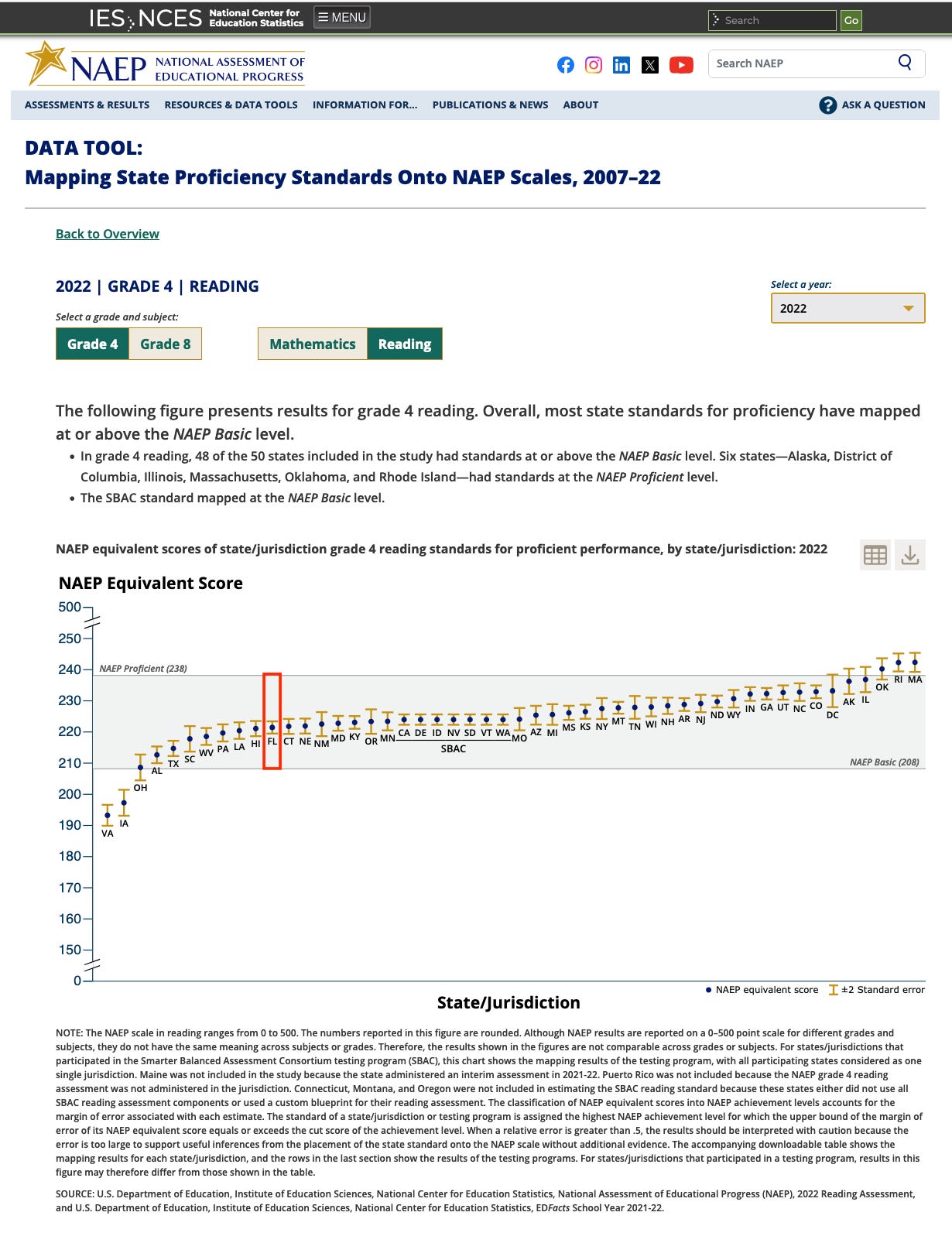
Returning to measurements of reading proficiency, Florida is in the bottom quartile of states in terms of the standard for “proficient”:

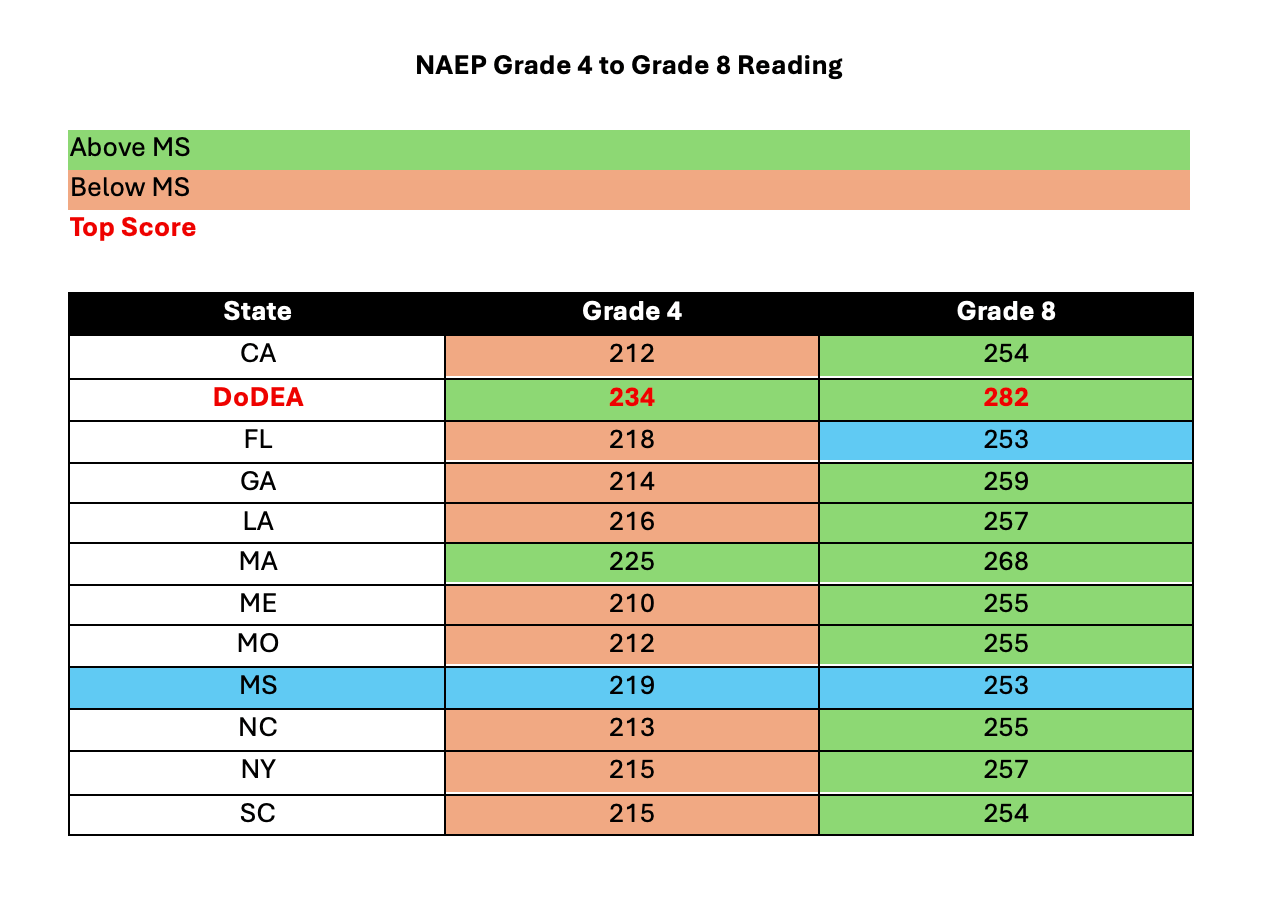
Florida, like Mississippi, is also a state where relative success in grade 4 reading quickly evaporates by grade 8:

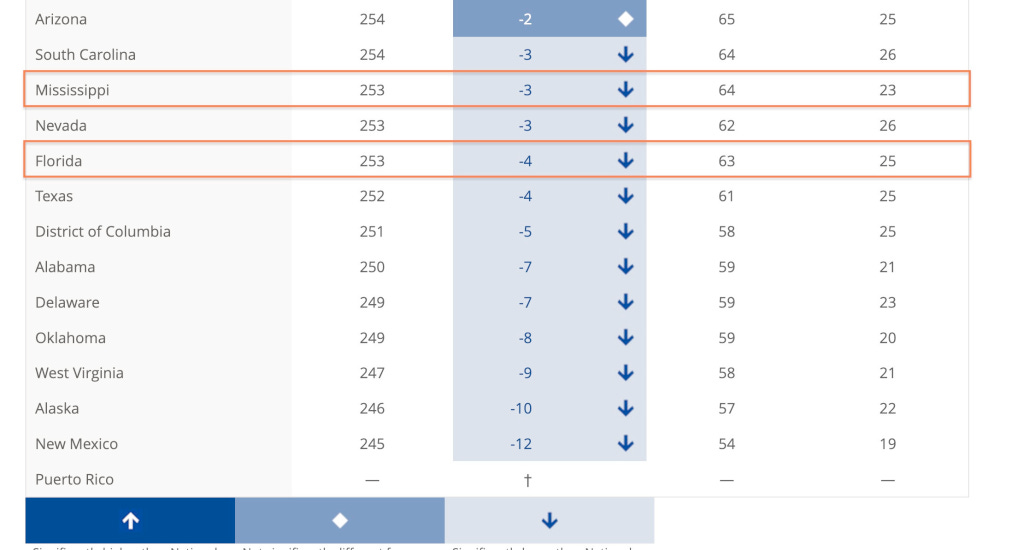
Again like Mississippi, Florida is in the top of states for grade 4 reading on NAEP, but drops to the bottom quartile in grade 8:

https://radicalscholarship.com/wp-content/uploads/2025/06/image-6.png

Finally, the media and political story most often focuses on reforms in reading programs, teacher training, school leadership, and school expectations; however, outlier and surprising gains in grade 4 reading are likely driven by grade retention (a harmful punishment) and not the celebrated reforms.

Notably, high-grade retention states like Florida and Mississippi are also the states with significant decreases from grade 4 to grade 8.

Florida has a long history of aligning itself with “miracle” education reform that proves to be a mirage.

Beware the current numbers game about reading proficiency—a measurement that changes with the political wind.


[1] Thomas, P.L. (2016). Miracle schools or political scam? In W.J. Mathis & T.M. Trujillo, Learning from the Federal Market-Based Reforms: Lessons for ESSA. Charlotte, NC: IAP.


When it comes to supporting its public schools, Florida ranks dead last in the nation. Not only was it dead last of all states, it was at the very bottom in 2024 and 2025.

Florida betrays its state constitution, which contains a clear mandate to create and protect strong public schools.

Article IX, Section 1(a) states:

“The education of children is a fundamental value of the people of the State of Florida. It is, therefore, a paramount duty of the state to make adequate provision for the education of all children residing within its borders. Adequate provision shall be made by law for a uniform, efficient, safe, secure, and high quality system of free public schools that allows students to obtain a high quality education…”

Under the misleadership of Republican politicians like Jeb Bush and Ron DeSantis, Florida has diverted billions of dollars to privately governed charter schools and unaccountable vouchers for private and religious schools and home schooling. Bush and DeSantis have ignored and abandoned Florida’s state constitution.

And among all the states, Florida’s school rank dead last.

Based on the NPE report Public Schooling in America 2026, Carol Burris, executive director of the Network for public Education, wrote:

This is the third consecutive year that Florida’s statehouse has earned last place when it comes to supporting public schools. Florida’s lawmakers don’t merely encourage privatization through charters, vouchers, and homeschools; they actively engineer conditions that undermine public schools and worsen the environment for teaching and learning.

The damage from Florida’s universal voucher program is staggering. Close to four billion dollars in state education funding now flows annually to voucher programs — nearly one in four state education dollars diverted away from public schools, including to families whose children never set foot in a public school. And the funding mechanism puts the burden directly on school districts, which must absorb the loss.

Meanwhile, Florida continuously revises its school rating standards to ensure more public schools are labeled as failing, while simultaneously incentivizing and subsidizing charter expansion. Its Schools of Hope program even allows charters to colonize unused space inside public school buildings. Success Academy’s Eva Moskowitz teamed up with a Florida billionaire to help draft the enabling legislation, then used it to muscle her chain into the Miami charter market with generous public funding in tow.

Fifty percent of Florida’s charter sector is run by for-profit operators — one of the highest shares in the nation. Only Michigan has more. Florida is home to Academica, the largest for-profit charter chain in the country, and to Charter Schools USA. Both profit from the real estate they build and lease back to their own branded schools.

Charter schools claim to be equally open to all students. That is not the case in Florida, which lost points for the numerous enrollment privileges its laws permit. Florida is one of a small number of states that allow company-based charter schools. The Villages, the largest retirement community in the country, has its own charter school, and it functions less like a school of choice than a company store. The school was created by the community’s developer, and at least one parent must be employed by The Villages or a company that services it. If that parent quits or is fired, the child must leave immediately. For a low-wage service worker who might want to change jobs, the school becomes a trap — a reason to stay put rather than pursue something better.

Florida sinks to the bottom not only because of its weak charter and voucher laws and the financial incentives it offers to expand privatization, but because it actively undermines its public schools through policy and funding decisions at every turn. Florida lost every possible point on school funding — whether measured by cost-of-living-adjusted teacher salaries, equitable funding distribution, or funding based on capacity to pay. It has low teacher satisfaction, high student-to-teacher and student-to-counselor ratios, weak anti-bullying laws, and it still permits corporal punishment.

Of 102 possible points, Florida disgracefully earned only 14. You can read our full NPE 2026 report card here.

In a stunning victory for the First Amendent’s guarantee of free speech, a federal appeals court overturned Florida Governor Ron DeSantis’s “Stop WOKE” act. A district court judge had previously issued a preliminary injunction on the law, calling it “positively dystopian.”

The state contended that it paid the professors’ salaries and had the authority to tell them what to teach. The appeals court decision disagreed, by a 2-1 vote. The dissenting judge–Barbara Lagoa– was appointed by Trump.

The opinion said:

“Florida’s salary-for-speech rule is a breathtaking assertion of power to ban unpopular ideas from public discourse in the very places the state’s own statutes recognize as centers of inquiry — classrooms where students are trusted to puzzle through ideas that are good and bad, easy and hard, ideally getting ever closer to the truth,”

The dissenting judge wrote:

“We need not agree or disagree with Florida that the viewpoints at issue here constitute racial discrimination,” Lagoa wrote. “We need only acknowledge that the state is allowed to decide what is endorsed by its professors in its own classrooms.”

The American Civil Liberties Union announced:

TALLAHASSEE, FL – The U.S. Court of Appeals for the 11th Circuit today struck down the higher education provisions of the Stop W.O.K.E. Act, a classroom censorship law in Florida that severely restricted educators from teaching about race and gender in schools and workplaces. The court ruled the higher education provision of the law was unconstitutional, saying: “Florida’s salary-for-speech rule is a breathtaking assertion of power to ban unpopular ideas from public discourse in the very places the State’s own statutes recognize as centers of inquiry—classrooms where students are trusted to puzzle through ideas that are good and bad, easy and hard, ideally getting ever closer to the truth.”

The court goes on to say it does not matter if the State of Florida agrees or disagrees with the ideas. “Either way, in this context the First Amendment trusts students to figure it out for themselves.”

“This ruling sets a strong precedent that higher education cannot be limited to the whims of politicians,” said Leah Watson, senior staff attorney with the ACLU’s Racial Justice Program. “All students and educators deserve to have a free and open exchange about ideas without government control. Students can’t fight racial discrimination that they don’t see; training and instruction is key to empowering future leaders to pursue racial justice.”

The decision comes in Pernell v. Lamb, a 2022 lawsuit filed by the American Civil Liberties Union, ACLU of Florida, the Legal Defense Fund (LDF), and the law firm Ballard Spahr on behalf of a group of Florida professors at public universities whose teaching has been impacted by this law.

“We are thrilled the court has stopped the erasure of topics that have real implications for our students, allowing them to learn, discuss, and develop tools for combatting the complex issue of racism in our country without being gagged by those who would dictate that only state-approved thought may be promoted,” said LeRoy Pernell, a Florida A&M University College of Law professor and the named plaintiff in this lawsuit.

Championed by Gov. Ron DeSantis, this overreaching law specifically targeted and placed vague restrictions on educators’ ability to teach concepts such as racism, sexism, privilege, and unconscious bias. It also imposed harsh penalties, including ineligibility for millions of dollars in performance funding from the state for colleges and universities and termination for educators who had been found to violate the law.

The court concluded, “[i]f the First Amendment oers any boundary of protection at all for public university classrooms, this statute crosses it.”

“The Stop W.O.K.E Act is an egregious example of widespread efforts across the country, most notably in Florida, to force the public higher education system to adopt the viewpoints of those in power. Thankfully, we have a judicial system to protect First Amendment rights and ensure that professors have the academic freedom to foster the type of learning environment where all students can learn and thrive,” said Jin Hee Lee, Director of Strategic Initiatives at the Legal Defense Fund. “It is no coincidence that this state law aimed to censor the perspectives of Black people and LGBTQ+ people, the very same people who are currently under attack. With this decision, the federal appeals court has made clear that Florida cannot actively erase their history of discrimination or their lived experiences without running afoul of our Constitution.”

This decision marked the first time an appellate court has considered the constitutionality of this censorship movement, and it will have implications for students and educators across the country who are subject to related laws. Since the Stop W.O.K.E Act went into effect, more than 30 states have moved to introduce and pass higher education classroom censorship bills. In May 2024, a federal court struck down a law in another ACLU lawsuit in New Hampshire, holding that the law’s vagueness violated the 14th Amendment. A similar higher education classroom censorship law was struck down in an ACLU lawsuit in Oklahoma, ruling that many of its provisions were so vague that it was difficult for teachers to know what they could and could not teach in the classroom.

“By upholding the district court’s ruling, the Eleventh Circuit ensured that our system of higher education is guided by the principle of free speech, not government censorship,” said Carrie McNamara, senior staff attorney at the ACLU of Florida. “Our classrooms are meant to be rooms of curiosity, creativity, and learning. When we stifle this kind of critical thinking, we risk losing our education system as we know it.”

“The recent legislative efforts to undermine academic freedom and limit the rights of marginalized communities are incredibly harmful,” said Emmy Parsons, a litigator at Ballard Spahr who was a member of the legal team. “We are proud to be part of this historic case and will keep fighting to protect the First Amendment rights of those teaching the next generation of leaders.” 

The opinion can be viewed below.

Documents


Jul 7, 2026

Pernell v. Lamb – Court Order

Scott Maxwell, opinion columnist for The Orlando Sentinel, wrote about the state’s effort to silence speech, even a silent protest. It is heartening to know that there are students in Florida willing to dissent. It is disheartening to learn that state officials never heard of the First Amendment to the Constitution.

Back in March, a handful of students at Florida International University stood up at an event where the school president was speaking and showed off their T-shirts.


They didn’t say anything to interrupt the program or speakers.


Instead, they simply revealed shirts that said they wanted the state school to stop coordinating with ICE on immigrant crackdowns on campus via the slogan: “ICE OFF FIU.”


Now, months later, the school is trying to discipline the students — even threatening to withhold their diplomas — if they don’t apologize for expressing their opinions.


In one of the creepiest twists, the school told the students that the only way they can escape punishment and “receive a diploma” would be to make a two-minute “video reflection” swearing they now understand what they did wrong.


It sounds like a hostage video. Except in this case, the hostages are being forced to apologize for free thought and expression.


Such is life in the “Free State of Florida.”


Once upon a time, college students were encouraged to be free-thinkers. That is, in fact, what Gov. Ron DeSantis and Florida’s other GOP leaders claim to believe … when they’re renaming roads after Charlie Kirk anyway.


But what they really mean is that Florida students should think the way they do or else shut the hell up.


And this is just the latest attack on speech by DeSantis and his fellow Republican lawmakers.
There was also the state’s infamous “Stop WOKE” bill where the governor and lawmakers tried to make it illegal for private companies to hold diversity training sessions that offended these bro-flakes’ fragile sensibilities. (That part of the law was, of course, ruled unconstitutional.)


There have been multiple cases where the state tried to fire employees who said things the politicians disliked about Charlie Kirk. (The firings have been repeatedly challenged, with the state already agreeing to pay one fired biologist $485,000 for her wrongful termination.)

And a few years ago, DeSantis signed a law that would’ve allowed the state to actually imprison Floridians who donated more than $3,000 to citizen-led efforts to get amendments on the state ballot. Yes, imprison. (A federal judge appointed by Donald Trump struck down that law as well, declaring the politicians’ attempt to arrest citizens who donated to causes the governor disliked as “wholly foreign to the First Amendment.”)


It’s tempting to go numb to this constant and casual assault on your rights. And to the steady stream of public money spent on these losing legal battles with attorney bills at $675 and $725 an hour.


But this Independence Day weekend seems like a good time to remember that truly patriotic Americans don’t support government trying to suppress speech.

You don’t have to agree with the FIU students’ anti-ICE sentiments. Many Floridians certainly don’t.


But if you claim to call yourself a patriot, you’d damn well better support their right to express it.
As Supreme Court Justice Oliver Wendell Holmes Jr. famously said, the First Amendment wasn’t created to protect viewpoints everyone likes, but specifically for “freedom for the thought that we hate.”


In the FIU case, Community Justice Project attorney Adam Saper, who’s representing the students pro bono, said: “This prosecution is the most clear violation of the constitution’s constitutional rights. They’re trying to silence these particular students who were speaking up against a policy of this school.”

That sentiment was echoed by the national free speech group, the Foundation for Individual Rights and Expression (FIRE), which honed in on the fact that the targeted “speech” involved words on a T-shirt — which the university obviously doesn’t crack down on with any regularity.


“Since this case involves clothing, would a student be prohibited from wearing a Malcolm X T-shirt in a university building under the same policy?” asked FIRE attorney Garrett Gravley.

“What about a Palestinian keffiyeh or an Israeli flag lapel pin? If a student wore purple for Domestic Violence Awareness Month, would that be actionable?”


Of course not. Even if the students had the audacity to … um … stand.


According to emails from university officials obtained by Axios and other news outlets, even school officials conceded that the students’ actions “did not disrupt the event.”


Basically, as far as protests go, this one seemed about as tame as it gets. Just a thoughtful, brief and silent statement of opinion. But apparently that was too much for Florida.


The school has said little about the case. But in correspondence with the students, FIU cited its policies on “student conduct” and “expression.”
Those rules are a lengthy, self-contradicting mess. They attempt to place a bevy of restrictions on students expressing their viewpoints while also stressing that none of the school’s rules “should be interpreted” as abridging anyone’s Constitutional rights, including “the freedom of expression protected by the First Amendment.”

It’s like a prosecutor telling you that you’re not entitled to a speedy trial or access to an attorney … while acknowledging that the United States Constitution says you’re guaranteed to precisely that.


Interestingly, the students staged their silent protest in March without much hubbub. It wasn’t until weeks later that the school told the kids they were in trouble.


It almost looks like someone told school president Jeanette Nuñez — DeSantis’ former lieutenant governor, one of many DeSantis allies rewarded with cushy, high-paying university jobs — that she’d better get these critically thinking kids in line.


I sent Nuñez and some of her staffers an email this past week, asking if anyone in Tallahassee had told her she needed to crack down on the students. She did not respond.


She also didn’t answer another question I posed: Whether she’d ever attended her own school’s class on the First Amendment — one that says it explains why “the rights of conscience” are protected in this nation.