The board of the John F. Kennedy Center for the Performing Arts may go bankrupt as soon as tomorrow. The only way to avoid bankruptcy, the board says, is to put Trump’s name back on the building so he will save it.
The board was hand-picked by Trump right after he returned to office.
This is the definition of chutzpah. He destroyed the Kennedy Center by taking personal control of it, naming it for himself, and driving it into the ground, as he has repeatedly done to multiple businesses before he became president. He bankrupted six casinos, as well as Trump Airlines, Trump University, and a long list of Trump–branded items, like Trump wines, Trump steaks, Trump vodka, Trump magazine, and various other failed ventures.
Make no mistake. No other president has packed the board with his cronies, who named him chair of the board. The board immediately put his name on the Center, making it the Trump-Kennedy Center.
As soon as he politicized the Kennedy Center, its reputation was tarnished. Artists and performers canceled, ticket sales plummeted, the National Opera moved out, the National Symphony went into financial crisis.
A federal judge ordered the board to remove Trump’s name. Congress named it; only Congress could change its name. The board reluctantly removed his name but has not removed the tarps covering the Center’s original name.
And now, the board says the Center will be bankrupt unless Trump’s name is restored!
He destroyed it. Only he can save it.
With the billions of dollars he and his family have friends have profited from crypto and other deals in the past year, maybe they will.
But as long as his name is attached to the Center and his board controls it, it will be shunned by the nation’s leading performers. It can’t buy back its tarnished reputation.
Mike Simpson, known on Twitter as “Big Education Ape,” is known for his brilliant memes and editorial cartoons. Typically, they expose the latest fads and lies that defame teachers and public schools. Every once in a while, he publishes a great post, like this one.
I’M SHOCKED, SHOCKED — HOW 30 YEARS OF BILLIONAIRE-FUNDED “REFORM” MANUFACTURED THE EDUCATION CRISIS IT PROMISED TO FIX
There’s a famous scene in Casablanca where Captain Renault declares he is “shocked, shocked” to find gambling going on — right before a croupier hands him his winnings. That’s essentially the posture of the billionaire reform industrial complex today, clutching its pearls over a Gallup poll showing public satisfaction with American schools has cratered to 32% — an 11-point nosedive in just two years — while quietly pocketing the profits of the crisis they spent three decades engineering.
Shocked. Absolutely shocked.
The Architecture of a Manufactured Crisis
Let’s be precise about the timeline, because precision matters when someone is picking your pocket.
For roughly 30 years, a well-funded constellation of think tanks, philanthropic foundations, hedge fund managers, and tech oligarchs pumped billions of dollars into a single, relentless narrative: public schools are failing. Not “underfunded.” Not “systematically neglected.” Failing — as in, inherently broken, irredeemably incompetent, populated by bad teachers protected by evil unions, and salvageable only by the heroic intervention of the private market.
The messaging was surgical. The money was real. And — surprise! — it worked.
Starve public schools of adequate funding. Declare them “failing.” Ride in on a white charter bus to “rescue” the children.
The chronic underfunding wasn’t fiscal negligence. In many states, it was a feature, not a bug. Squeeze hard enough, the theory went, and disruption would force innovation. What it actually forced was deferred maintenance, teacher shortages, and a generation of kids learning to read in buildings where the roof leaks and the textbooks predate the iPhone.
Now the poll numbers confirm the narrative took hold — and the reformers are citing those same poll numbers as proof they were right all along. The audacity is, genuinely, breathtaking.
The Numbers That Tell Two Very Different Stories
Here’s what the data actually shows — and what it doesn’t show:
Metric: The Headline. What It Actually Means Gallup Public Satisfaction 32% — record low 30 years of “failing schools” messaging worked exactly as intended.
Parent Satisfaction with Their Own School Historically ~2x the national figure People trust what they experience; they fear what they’re told
Math & Reading Scores Declining, especially bottom quartile Tracks directly with funding inequity and screen-time explosion
Top-tier U.S. Student Performance Still globally competitive. The “crisis” is concentrated where disinvestment is concentrated
The gap between how Americans rate schools in general versus their own child’s school is the smoking gun. It has always been the smoking gun. People who actually walk into a public school building — who meet the teachers, see the classrooms, watch their kids come home — consistently rate those schools dramatically higher than the national “failing” narrative suggests.
That gap is the manufactured crisis. It lives entirely in the space between lived experience and media-amplified fear.
$1.8 Billion Worth of Snake Oil, Served Fresh
And just when you thought the reform carousel might slow down, along comes the Science of Reading — the latest Next Big Thing™ in a long line of Next Big Things™ that have collectively cost American taxpayers tens of billions of dollars and produced reading scores that went, as the Big Education Ape’s withering analysis puts it, precisely nowhere.
Remember Common Core? $15.8 billion. A decade of standardized testing theater. Reading scores: unmoved.
Now we have the Science of Reading, $1.8 billion deep and climbing, with the same cast of vendors, the same philanthropic networks, and the same conspicuous absence of a money-back guarantee.
To be scrupulously fair: phonics works. Explicit decoding instruction works. The underlying research on structured literacy is legitimate. But here’s the thing about legitimate research — it doesn’t require a $1.8 billion vendor ecosystem, mandatory state legislation in 40+ states, and the systematic deskilling of teachers who are told to stop thinking and start following the script. When real science gets packaged into proprietary curricula, sold to districts under legislative mandate, and deployed without the trained human educators needed to implement it well, you don’t get science. You get very expensive phonics worksheets.
The question nobody in the reform complex wants to answer remains the same one it’s always been: Where is the money-back guarantee?
The Other Hand: How Tech Bros Broke Kids’ Brains While Selling the Cure
Here is the part of the story that deserves its own criminal investigation — or at minimum, a very uncomfortable congressional hearing.
The same Silicon Valley billionaires who spent decades pushing EdTech into classrooms as the revolutionary equalizer — screens for every student! –are the identical billionaires whose social media platforms have:
Collapsed long-form reading among adolescents at a rate researchers describe as one of the steepest drops in PISA history
Engineered algorithmic doom-scrolling that neurologically rewires 15-year-olds away from the sustained attention that math and reading comprehension require
Distracted over a quarter of students internationally during core academic instruction, by their own PISA survey data
They sold the disease and the cure. They pushed the screens that fragmented attention spans, then sold the adaptive software to remediate the fragmented attention spans, then pointed at the test scores and said: See? Public schools are failing.
None of this is inevitable. None of this is permanent. The No Kings Coalition — the sprawling, nonpartisan civic movement that flooded the streets in March — is now flooding the polls, with a Vote Early Day of Action on October 17 aimed squarely at the November 3, 2026 midterms.
The math is straightforward, even if the billionaires prefer we can’t do it:
Elect candidates who will defend public education funding, not divert it into voucher schemes that enrich private operators at public expense
Overturn the Supreme Court rulings — from Citizens United forward — that transformed American democracy into a billionaire auction
Restore the principle that public money follows public children into public schools, not into the portfolios of private equity firms with a “reform” logo.
The manufactured crisis has a manufactured solution: more billionaire intervention, more privatization, more EdTech, more testing, more disruption. The actual solution is considerably less glamorous and considerably more effective — fund schools equitably, pay teachers competitively, put phones away, and stop letting people who profit from public school failure write public school policy.
The Bottom Line
The 32% satisfaction number is not evidence that public schools have failed. It is evidence that a 30-year, billion-dollar propaganda campaign succeeded. The same people who manufactured the crisis are now selling the cure — at $1.8 billion a pop, no refunds, no guarantees, no accountability.
Meanwhile, the teachers who showed up every day through a pandemic, through chronic underfunding, through a staffing crisis, through the algorithmic dismantling of their students’ attention spans — those people are still in the classroom at 7 AM, doing the work that no EdTech platform, no voucher program, and no think tank white paper has ever actually replaced.
The casino is rigged. Captain Renault is shocked. And the November ballot is the one lever the house can’t control.
Vote like a public school depends on it. Because one does.
All links verified active as of September 9, 2026. Primary polling data sourced from Gallup/Walton Family Foundation. PISA data sourced from NCES/OECD 2025 release.
On the morning of September 11, 2001, I was sitting at my dining table, enjoying a cup of coffee. I lived in Brooklyn Heights, about two blocks from New York Harbor. I heard a loud crash, and my first thought was that there had been a terrible automobile accident on the Brooklyn-Queens Expressway, a highway bordering the harbor. Nothing I could do about it. I kept sipping my coffee.
A few minutes later, my partner Mary called to say that a small plane had crashed into the top of the World Trade Center. “Turn on the TV,” she said. She thought it was not an accident. She thought it was terrorism.
I turned on CNN and saw the smoke billowing from the top floors of the north building of the World Trade Center. I grabbed one of our two dogs–(our rescue girl, Lady, a big white Cocker Spaniel)–and headed for the waterfront, some three or four minutes away.
As I got to the waterfront at Grace Court Alley. a tiny block that leads to the harbor, I looked up and saw the second airplane slice into the second WTC building. This was not a small plane. It was not an accident. It was terrorism. I stood there speechless, alongside a couple of others who were there for the same reason as I. We wanted to see for ourselves. And in an instant, we all knew that hundreds and thousands of people were dying as we silently watched.
I ran back home to see what CNN was saying. I could see what was happening with my own eyes, but needed to know more to put it in perspective. CNN filled out the picture. Two large jets hit the two buildings, minutes apart. We did not know at that moment that another jet was on its way to hit the Pentagon and that a fourth jet would crash in Shanksville, Pennsylvania, when brave passengers fought the terrorists and sacrificed their lives.
At the WTC, fire fighters were on the scene, racing up the stairs to try to save people. People in both buildings were told to stay in their offices and wait for help. Most did, assuming that the fires would be put out. The elevators were out of service.
Those on the highest floors had no exit. The elevators weren’t available, and the stairs were filled with smoke. After it was over, word came out that one stairway was not blocked but I don’t know if that was true or if there was time to run down more than 100 flights before the building collapsed.
Some people on the high floors jumped to their deaths, not wanting to die of fire or smoke inhalation. Thank God I was too far away to see them jump to their deaths. People in the buildings were calling their families to say goodbye. So many phones were in use that cell service was intermittent.
But one after the other, the buildings collapsed, pancaked. Almost 3,000 people died, people of many different nationalities, including about 60 Muslims. So did 343 fire fighters, racing up to high floors to try to save those who were trapped. Since 9/11, more than 400 other firefighters died of injuries sustained that day or cancers related to the site.
The first person to die was Father Mychal Judge, a beloved Fire Department chaplain, who was outside the first building to be hit. He was crushed by the body of someone who had jumped. Father Judge was a saintly man.
After the two buildings collapsed, Mary came home from work, and we went to the nearest hospital, hoping to donate blood. The hospital would not accept it. No victims were brought in. None. Blood was not needed.
All transportation came to a halt. Subways stopped. Public buses stopped. The bridges connecting Manhattan to other places were closed to vehicular traffic. The only sound was the intermittent roar of military jets.
Our friend Bernadette attended a meeting that morning on a low floor of the WTC. She tipped the attendant at the garage to leave her car near the entrance, so she could leave quickly. After the attack, she pulled out of the WTC garage, picking up as many people as she could carry, and was the last car to cross the Brooklyn Bridge before it was closed.
We walked past the Brooklyn Bridge and saw scores, hundreds of people crossing it, from Manhattan to Brooklyn. They looked shell-shocked. They were covered in ash, which floated everywhere. Some were barefoot. Some carried sooty briefcases.
We watched the smoke pour out of the tops of the buildings before they collapsed. After they collapsed, there was a thick plume of smoke from the places where the buildings had stood. The wind blew steadily from south to north, away from us.
After a while, the wind shifted to the east, where we were. We could no longer see “the pile,” as the gigantic burning hole was called. What had been a brilliant blue sky turned dark and smoky. We could no longer see anything. Not the sun, not the clear blue sky.
The next morning, there were ashes everywhere in the neighborhood, ashes blown in our direction after the winds turned east. Cars and streets coated with ashes.
In our small backyard we found papers–memos, documents, letters, reports–a day earlier, they had been on someone’s desk. Now they coated our yard, unremarkable except for the tiny burn holes in them.
The pile burned for weeks afterward. We could see the smoke curling up towards the sky. We could smell it–a strange and acrid amalgam of burnt plastic, burnt metal, burnt lives.
We wanted to get out of town, drive far away. But the lines at the gasoline stations were long, and many stations had no gasoline. The city was silent, an eerie silence, not the usual hum.
For months afterwards, I couldn’t fall asleep at night. I imagined the terror of those trapped on the high floors. I felt their terror and panic.
I remembered the wonderful events I had attended at Windows on the World, the spectacular restaurant on top of one of the buildings. No one on those floors–the 106th and 107th–survived.
I will never forget those days, weeks, months. It didn’t happen to me. I was spared. It happened to all of us. Violence begets violence. Hate begets hate.
As W. H. Auden wrote almost a century ago, “We must love one another or die.” He wrote in another version of the same poem, “We must love one another and die.”
Both versions are right. More hate means more violence and death.
This is one you should read. Consider subscribing.
There are 56 days to the midterms.
My apologies for the late delivery. “Life” got in the way.
Monday morning, as if Sunday’s scheduled daylong Adderall overdose posting memes that could only come from a raving lunatic – one of which resulted in Iceland summoning the U.S. ambassador on Monday after Sundowning Gramps shared a doctored map of the American flag covering Iceland as well as Greenland, Canada, Central America, and the Caribbean in which Iceland’s foreign minister, Thorgerdur Gunnarsdottir, said she demanded answers from Ambassador Billy Long over Trump’s “completely inappropriate” post – wasn’t enough, Doddering Dilbert had his sweet little Natalie post a Lie Anti-Social in which he claimed: “Oil prices will drop precipitously, like everything else is dropping (but more!), when we WIN the war with Iran. Three Dollars a gallon, but ultimately, below Two Dollars a gallon. It will all happen quickly, and Iran will never have a Nuclear Weapon. MAGA!” Interestingly, the shitpost revealed he knows he hasn’t won any part of his war with Iran.
As part of his celebration of Labor Day, Delusional Doddering Dilbert went on Lies Anti-Social to attack a months-old report by the Center for American Progress that found his costly National Guard deployments did not curb crime, going so far as to threaten a lawsuit. He wrote, “The report is just another Radical Left SCAM, as are the people who fund this gaggle of Lunatics.” He went on to name George Soros, Bill and Melinda Gates, Google, Apple, Visa, Goldman Sachs, Citigroup, Wells Fargo, Bank of America, Walmart, Toyota, T-Mobile, NBCUniversal, the Embassy of Japan, the Korea Foundation, Taipei Economic and Cultural Representative Office, and even the Embassy of the United Arab Emirates as fellow perpetraors of the CAP’s “lie,” continuing, “The Dumocrats love it, and are against anything ‘TRUMP.’ These people, and others like them, are so bad for our Country. Their stated course is anything to hate or demean ‘TRUMP.’ This will be met with a lawsuit, which is being drawn now. I am also strongly considering adding some of the contributors to this Fake Organization.”
After posting 24 other equally-demented posts between 0950-1045 Monday, he concluded with his official Labor Day message: “Happy Labor Day to all, including the Radical Left Lunatics, Communists, and Dumocrats who will do anything possible to destroy our Country. These Deranged People, after fighting for 10 years, should finally acknowledge that your Favorite President (ME!), knows how to WIN! They should be exhausted by now but, sadly, they’re not. They’re going to give it one last shot at ruining America, but we’re not going to let that happen. We’re going to win the Midterms, BIG, and SAVE AMERICA!”
Yes – He. Is. Delusional.
Among the delusional droppings on Lies Anti-Social yesterday was one in which Doddering Cilbert unveiled a mockup of proposed Space Force uniforms, which he acknowledged are based on ones worn by fictional fascists, saying that the gray and black look was “inspired by the discipline of the Starship Trooper uniform,” while being “modernized for the guardians of the space domain.” Starship Troopers, the 1997 science fiction film, was intended to undermine what Dutch director Paul Verhoeven interpreted as fascist themes in the 1959 novel of the same name by Robert A. Heinlein. Verhoeven told the Guardian in 2018, “I decided to make a movie about fascists who aren’t aware of their fascism.” Nazi-inspired iconography is prevalent throughout the film. Even Jonah Goldberg had a reaction: “I liked the movie, which was very different from the book. My concern is whether these guys understand the point Verhoeven intended in Starship Troopers. The thing is I don’t know what would be worse: whether they got it or didn’t.” Menswear writer Derek Guy added: “this is the kind of design costume designers make to tell you who are the bad guys in a space movie.” Another user responded: “If the costume designer on Star Wars had suggested this for the Empire uniforms George Lucas would have told them to dial back the Nazi.”
Canada’s retaliatory tariffs against the U.S. went into effect at midnight last night, affecting hundreds of goods, including steel and aluminum, appliances and electronics and wood, pulp and paper products. There are no reports of any negotiations. Maladministration II levied 50 percent tariffs on $27.6 billion worth of Canadian goods two weeks ago, raising tensions between the neighboring countries.On Monday, Trump threatened Canadian aircraft maker Bombardier, posting on Lies Anti-Social that it must start building in the U.S. to access the American market, otherwise he demanded that Bombardier be barred from doing business in the United States altogether, claiming the company’s products “aren’t good enough.” He seemed to have forgotten (assuming he ever knew) that the company has a U.S. headquarters in Wichita, Kansas, where it employs more than 1,000 people. In the meantime, the Canadian Energy Minister said he’s ready to cut off all Canadian electical suply to the U.S. if Doddering Dilbert keeps pushing his crazy trade war.
Bastet
Republican Senator Jerry Moran has represented Kansas since 2011. Trump’s threat to eliminate over 1,000 jobs in the “Air Capital of the World” sent Moran and his team scrambling. He posted to his official social media account that he’d already reached out to the White House to make sure the president understands how significant Bombardier is to Kansas’ economy. In his X post, Moran noted the company’s local workforce includes more than a thousand of his constituents whose skills help the country’s aerospace and defense capabilities. He also promised he’d not only keep working to make sure Bombardier stays in Kansas, but that its presence continues to expand. In its own statement, Bombardier praised its American workers not only in Kansas, but in more than 20 states including Arizona, California, Connecticut, Florida, Illinois and Texas. Delusional Dilbert’s dumbassed trade war is threatening American jobs, to the point a loyal Republican senator is begging him to call off his attack.
Back in 1911, Canada and the United States had a free trade deal on the table until House Speaker Champ Clark boasted that he hoped to see the American flag flying over every square foot of British North America. Canadian voters heard that, threw out the government that negotiated the deal, and killed reciprocity for decades, which is the lesson Dilbert apparently never learned about telling your neighbor you plan to swallow them whole.
Sunday, the Alternative fur Deutschland Party (AfD) won 43.8% of the vote, falling three seats short of the majority necessary to form a government by itself. AfD, a party whose regional branch in Saxony-Anhalt is considered a right-wing extremist group by Germany’s domestic intelligence agency, finished well ahead of the other parties in the regional election. It would need partners from other parties to form a governing coalition. That would normally be difficult, as Germany’s mainstream parties have refused to work with AfD as part of a so-called “firewall” to prevent the party from gaining power. But AfD may reach out to the far-left BSW party. The two parties are on opposing sides of the political spectrum, but AfD and BSW both share anti-immigration and Russia-friendly sentiments. Ulrich Siegmund, AfD’s candidate in the race for governor, responded to Elon Musk’s X post in which the Afrikaner Nazi wrote “Gut gemacht,” which translates to “good job” in English, posting: “Thank you, @elonmusk, for your support and for your clear and highly important perspective on the political developments of our time – including here in Germany.”
Rudy Giuliani, the former mayor of New York City who is the son of a Mafia “button man,” and later worked as Trump’s personal lawyer, publicly criticized current Mayor Zohran Mamdani for planning to attend a 9/11 commemoration ceremony at Ground Zero on Friday. In an interview with Newsmax on Sunday, Giuliani – whose decision to locate the city’s emergency responce HQ in the World Trade Center so he could use the bedroom in the facility for his “nooners” – said: “Frankly, whatever he’d like to say, he doesn’t agree that Sept. 11 was an Islamic terrorist attack on the United States of America. Having lost friends there, and being very close to many of the families, it offends me that he’s coming.” Mamdani has said nothing like that. Most New Yorkers would appreciate it if Giuliani dropped off the face of the earth.
Back in 2023, Ron DeSantis’ short-lived presidential campaign employed Nate Hochman, who was fired that year after posting a video that included the Sonnenrad, a symbol used by neo- Nazis and white supremacists. Before joining the DeSantis campaign, Hochmann worked at the National Review and the Claremont Institute. He eventually lost a journalism fellowship after publicly praising white supremacist Nick Fuentes. Now, the New York Times is reporting Hochman has been hired as deputy director of the State Department’s policy planning office. According to Hochman’s email signature, he’s also serving as Rubio’s chief speechwriter. The policy planning office is a big deal, as it directly advises the Secretary of State on broad strategic priorities. The State Department both confirmed and defended hiring Hochmann, calling him a trusted staffer who has helped advocate for Maladministration II’s foreign policy agenda. It’s amazing how people with a documented history of racist and extreme rhetoric keep getting hired and/or promoted into influential roles in Maladministration II.
Israeli newspaper Haaretz is reporting In the days leading up to Hamas’ deadly attack on Israel on October 7, 2023 – in which, let us remember, 1,200 people were killed – United Arab Emirates President Mohamed bin Zayed Al Nahyan warned Netanyahu that Hamas’ leader in Gaza was planning the deadly attack. According to Haaretz, Netanyahu failed to inform Israeli security agencies of the impending attack. Netanyahu’s office called the report an “absolute lie” and denied speaking to the UAE. Of course he would – what’s 1,200 of his own dead? It was the perfect excuse to start his long-planned genocide of the Palestinians in Gaza. Israeli opposition leaders demanded Netanyahu’s removal from office. Former Prime Minister Naftali Bennett, a candidate in the upcoming vote, said Netanyahu “bears personal and direct responsibility” for the deaths on Oct. 7 and “cannot continue to serve in his position for even one more minute.”
Maladministration II administration must hand over the names of the people who devised the structure of the $1.776 billion “anti-weaponization” slush fund that was of the bogus settlement of President Trump lawsuit against the IRS, a federal magistrate judge in the Eastern District of Virginia ruled in a case challenging the slush fund.
Brian Jose Morales Garcia was born in Denver, Colorado. Thispast spring he was installing air conditioners in Texas. On April 3, his boss got pulled over near Fredericksburg over the car’s window tint. Brian was in the passenger seat. Troopers called in local police to translate, because he speaks Spanish. Then they called ICE. Brian’s birth certificate was sitting at his house. His family drove it over, but agents wouldn’t even look at it. Agents told him he’d go to prison if he kept insisting he was American. He signed their papers rather than disappear for months. On April 7 – four days after the traffic stop – they deported him to Mexico. Then Brian hired lawyers who got him a hearing on Judge Robert Pitman’s calendar. Days before that, the government agreed he could walk back in if he presented his birth certificate and a photo ID at the border. The same birth certificate the government refused to look at in April. On August 30, he walked back across the border into Texas. Nobody had to look at his citizenship until a federal judge was about to make them explain. His damages case is ongoing.
Republicans suffered yet another blow in their legal war against mail-in voting, this time in Delaware. A Delaware court has once again upheld the state’s 16-year-old permanent absentee voting law, dealing a fresh defeat to Republican state Sen. Gerald Hocker in his years-long crusade against the program. Hocker, who is running for re-election, as well as fellow Senate candidate Steven Washington, argued Delaware’s Permanent-Absentee Statute unconstitutionally lets voters receive absentee ballots indefinitely, without reaffirming their eligibility each election, violating the state constitution’s specific list of qualifying reasons for absentee voting. Vice Chancellor David disagreed, ruling the law does no such thing. The court found the law only allows a narrower slice of voters, those with qualifying illnesses, disabilities, military service, or caregiving duties, to skip reapplying every cycle, while still requiring them to notify the state the moment their situation changes. If a voter’s reason for needing absentee status stops applying, the state must cancel it immediately. “’Permanent’ is therefore a misnomer,” the court wrote, explaining the label doesn’t mean what plaintiffs claimed.
Missouri’s redistricting war has spiraled into chaos, and observers say the state’s own emergency filing to the U.S. Supreme Court hints that county officials could defy the courts to keep the Republican map alive. In a reply brief to the justices, Attorney General Catherine Hanaway argued that the Missouri Supreme Court “derailed an imminent federal congressional election” when it threw out the GOP’s “Missouri First” map for November. Buried in that same filing is a line that political reporter Mark Maxwell warned should worry anyone who cares about orderly elections. Now, her brief concedes, “local election officials in counties are now left to make individual decisions” on whether to follow the order or stick with the map used in the primary while they wait on a federal court. Maxwell warned that the filing signals officials could defy the state Supreme Court and keep the Republican map anyway, “which would be absolute chaos. The state court explicitly forbade this.” People Not Politicians attorney Chuck Hatfield has called the state’s position “open defiance of the court.” Meanwhile, candidates don’t know which district they are running in, and lawsuits are piling up.
The Talarico campaign in Texas just rolled out one of its most eye-catching endorsements yet .
The huge development, which comes as Talarico’s Democratic campaign seeks to be the first to win Texas in over 30 years, was revealed in a brief political ad on Tuesday. The ad said: “This is Ken Paxton, and this is Ken Paxton firing an honest Texas Ranger. David Maxwell spent five decades in law enforcement and was inducted into the Texas Ranger Hall of Fame. The best of the best. Let’s just say he knows a bad guy when he sees one. So when he saw his boss, Ken Paxton, trading favors with a convicted felon, he had to speak up. He reported Ken Paxton to the FBI and Ken Paxton fired him for it. Ranger Maxwell testified in Ken Paxton’s impeachment trial. Ken Paxton was impeached by his own party. But Ranger Maxwell isn’t done speaking up against bad guys.” Ranger Maxwell concludes the commercial:”My name is David Maxwell. Ken Paxton ended my five-decade career because I blew the whistle on his corruption. I am supporting James Talarico for the U.S. Senate … He’s one of the good guys.”
Don’t worry, there will be far more presidential looney toonies to come this week.
Remember, you are not the crazy ones, and we were made for these times. Regardless of what you may feel right now, act as if you believe that and redouble your efforts.
“Neither let us be slandered from our duty by false accusations against us, nor frightened from it by menaces of destruction to the Government, nor of dungeons to ourselves. Let us have faith that right makes might; and in that faith, let us, to the end, dare to do our duty, as we understand it.” – Abraham Lincoln
Heather Cox Richardson sums up the sickening feeling that many of us have about the Trump-Musk alliance and their efforts to torpedo the November midterm elections. Musk has corrupted our politics with the vast amounts of money he spends to elect far-right politicians. Most of his wealth comes from government contracts, and he wants to maintain his friends in office. You have to wonder how a man who celebrated the killing of US AID, leading to the deaths of at least 700,000 people, can sleep at night. Did he enter the U.S. legally?
She writes:
On Sunday, Germany’s far-right Alternative for Germany (Alternativ für Deutschland, or AfD) party won 43.8% of the vote in a legislative election in the small state of Saxony-Anhalt, formerly part of Soviet-dominated East Germany. The AfD is anti-immigrant and pro-Russia and has won the support of both Vice President J.D. Vance and billionaire Elon Musk.
When Musk posted “Well done!” in German to the co-founder of AfD, Alice Weidel, another AfD leader responded with thanks, posting: “If we take on responsibility here, I would very much welcome the opportunity for strong and constructive cooperation. Germany would then once again be a place worth investing in. Best regards from Saxony-Anhalt!”
Jon Henley of the Guardian noted that right-wing leaders across Europe celebrated the outcome, including ousted Hungarian prime minister Viktor Orbán, who called the election results “a huge night for Germany and Europe,” adding: “Buckle up. This is just the beginning.”
Musk was the largest donor to any political committee in the 2024 U.S. elections, putting around $290 million into the 2024 election to help elect President Donald J. Trump and Republicans. On August 28, Andrew Howard, Erin Doherty, and Meredith Lee Hill of Politico reported that Musk was planning to meet with House speaker Mike Johnson (R-LA) as he considered investing at least $100 million to elect Republicans in the midterm elections.
Since that meeting, Musk has plowed money into the Texas Senate race to support Texas attorney general Ken Paxton against Democratic nominee James Talarico. According to Theodore Schleifer of the New York Times, Musk’s investments—many through political action committees—target Senate races in Alaska, Iowa, Maine, Michigan, and Ohio, as well as House races in at least California, Wisconsin, and Washington.
Musk’s open attempt to buy elections for the Republicans should be bigger news, not only because of the political power his money has given to one man, but also because of what his behavior says about the MAGA administration’s ideology and its goals.
After supporting Trump in 2024, Musk appeared to become the head of the Department of Government Efficiency—the administration was coy about who actually held that title—where he worked to slash government spending. On February 3, he posted on his social media: “We spent the weekend feeding USAID into the wood chipper. Could gone [sic] to some great parties. Did that instead.” Musk called USAID—the United States Agency for International Development—“a criminal organization” and “a viper’s nest of radical left-marxists who hate America.”
In July 2026, Ari Daniel, David Augustine, Kazeem Olawale Nasiru, and Lameck Nyagudi of NPR reported on a study by Boston University infectious disease modeler Brooke Nichols that estimated more than 700,000 people had died from the sudden stop in USAID funding, including more than half a million children in developing countries.
And yet, for all his talk about slashing government expenditures, Musk’s DOGE did not appear to save much. Emilio Perez Ibarguen of Politico reported in August, when DOGE officially ended, that a report by the Government Accountability Office found that the savings it claimed were in large part exaggerated or couldn’t be corroborated.
Meanwhile, government contracts continued to flow to Musk’s businesses. As Desmond Butler, Trisha Thadani, Emmanuel Martinez, Aaron Gregg, Luis Melgar, Jonathan O’Connell, and Dan Keating reported in the Washington Post in February 2025, Musk himself has been one of the biggest beneficiaries of taxpayer dollars in history, taking in at least $38 billion in government contracts, loans, subsidies, and tax credits over the course of more than 20 years. Once he was in power in Trump 2.0, government investigations into those businesses ended.
The very public nature of Musk’s antics has helped to wake the public up to the fact that our current system is skewed toward billionaires. In July, economist Paul Krugman noted a growing backlash against those billionaires. A poll by UMass Amherst found that 58% of Americans think billionaires are a threat to democracy, and 45% of them say the U.S. is an oligarchy, “a government in which a small group exercises control especially for corrupt and selfish purposes.” As Krugman noted, only 28% of those polled disagreed.
Krugman pointed out that wealth has been concentrating at the top of the U.S. economy for decades, so the growing wave against that concentration of wealth appears to be driven by those like Musk and Trump himself, who has flaunted his use of taxpayer money for his own interests while dismissing the pain of regular Americans.
This flow of taxpayer dollars to favored businesses rather than to programs that serve the needs of the people seems to be a feature rather than a bug in the Trump administration and reflects its rejection of democracy in favor of the right-wing axis of authoritarianism.
Last night, Tarini Parti, Josh Dawsey, Michelle Hackman, and Summer Said of the Wall Street Journal published a deep investigation into the machinations of Corey Lewandowski when his colleague Kristi Noem was secretary of the Department of Homeland Security. They report that Lewandowski, who was Trump’s campaign manager for part of 2016, appeared to offer aid to foreign countries navigating U.S. bureaucracy in the department for a fee, selling government services for his own gain.
The journalists also report that Lewandowski may have been involved in awarding government contracts improperly, an accusation covered in a November 14, 2025, article by Justin Elliott, Joshua Kaplan, and Alex Mierjeski of ProPublica. The Wall Street Journal reporters note that Congress gave the Department of Homeland Security an additional $75 billion to spend during Trump’s term on deportations, detention facilities, and technology, providing deep pockets for corruption.
While the administration appears to have sidelined Noem and Lewandowski since Noem resigned under pressure in March, the journalists say Lewandowski “has told people close to him he expects the president would pardon him in the event of a criminal case.”
Lewandowski responded on social media that the story was “just another example of the kind of anonymous-source, politically driven reporting that Americans have seen time and again. We’ve lived through the Russia collusion hoax the fake Birthday card and countless other sensational allegations that ultimately failed to withstand scrutiny. I’m tremendously proud of my work as a volunteer in advancing this administration’s agenda and remain confident that the facts and not anonymous accusations will ultimately speak for themselves.”
But, of course, every official investigation into the 2016 election, including the one conducted by the Republican-dominated Senate Intelligence Committee and unanimously adopted, agreed that Russia did work to get Trump elected in 2016. And while Trump claims he did not create the birthday card to child sex offender Jeffrey Epstein apparently bearing Trump’s signature on a drawing of a nude girl that was produced by the Epstein estate, the story was convincing enough that it helped to push Congress to pass the Epstein Files Transparency Act and the first case he brought against the Wall Street Journal for publishing the story was dismissed. A second case is pending.
There is, in fact, increasing pushback against the world Musk and Trump are trying to put into place instead of liberal democracy. In the U.S., the growing opposition to data centers, which seems to represent anger at the very wealthy tech bros who want to call the shots, is perhaps a sign of the direction the wind in the U.S. is blowing.
Whether that popular pressure can withstand the extraordinary amounts of money Musk and other right-wing billionaires are pouring into the midterms is unclear. Judd Legum of Popular Information reported today that Musk is funding an advertising campaign encouraging people in swing states to check their voting registration status at a different website than the one run by the Election Assistance Commission, which is an independent agency of the U.S. government.
Instead, Musk’s campaign urges people to go to “votesafe . org,” which collects their full name, home address, date of birth, email address, cell phone number, IP address and location (which identifies city and zip code), every link clicked, every page looked at, and voter registration status, among other information.
Legum reports that the privacy policy of the website “allows [Musk’s super PAC] America PAC to ‘share’ or ‘sell’ personal information ‘with our business partners,’” including “whether you are registered to vote” and “how you submit your vote… where permitted by law.” America PAC can also sell “inferences” it makes about a user, including “psychological trends, predispositions, behavior, attitudes, intelligence, abilities and aptitude.”
A new documentary about Musk by filmmaker Alex Gibney argues, as Steven Zeitchik of the Hollywood Reporter put it, that Musk is “a dangerous huckster [who] is stealthily aggregating power to exploit us, primarily by centralizing and controlling massive amounts of data.” The documentary, called Musk, notes that, under Musk, DOGE had access to federal IT systems and, as Zeitchik recalls, a whistleblower warned that members of DOGE accessed and shared sensitive data from the Social Security Administration.
Zeitchik reports on the onscreen comments of Nobel Prize-winning scientist Geoffrey Hinton, known as “the godfather of AI,” who said: “It’s fairly clear to me that Trump is hell-bent on corrupting the midterm elections,” he says onscreen. “If you wanted to corrupt those midterm elections and you wanted to use AI, all you needed to do was get detailed information on U.S. citizens. And what DOGE did looked like just what you would do.”
In Europe, in the wake of the rise of the AfD, German defense minister Boris Pistorius said today that Germany will send missiles to Ukraine to help it fight off a winter incursion from Russia.
He came to the United States in 2024 to reunite with his parents, who had fled Haiti three years earlier fearing for their lives. Living in Springfield, Ohio, he had temporary protected status and a pending asylum case. Bel took quickly to life in the United States. He was a member of the Marine Corps Junior Reserve Officer Training Corps. He played soccer. He graduated from high school with honors and recently started as a freshman at Wright State University, just a half-hour drive from his home.
Not too long after Pierre Damas Bel arrived in the United States, Ohio’s junior senator, JD Vance — then running to be vice president of the United States — accused the Haitian community in Springfield of stealing and eating the pets of their neighbors. “Reports now show that people have had their pets abducted and eaten by people who shouldn’t be in this country,” he said on X. These “reports” were false but, as Vance would explain later, they were useful: “If I have to create stories so that the American media actually pays attention to the suffering of the American people, then that’s what I’m going to do.”
After Vance created his story, Donald Trump amplified the charge to a prime-time audience of 67 million people during his debate with Kamala Harris. “They’re eating the dogs, the people that came in, they’re eating the cats.”
The conservative media apparatus then went to work. Fox News broadcast the smear far and wide. Christopher Rufo of the Manhattan Institute, a professional provocateur and propagandist known for his gleeful race baiting, offered a “$5,000 cash bounty” to anyone who had evidence that Haitian immigrants were eating pets in Springfield. He later posted a video purporting to show just that. It was a lie; the people in the video were eating chicken.
Building on the frenzy, Trump spun a new tale. “Twenty thousand illegal Haitian immigrants have descended on a town of 58,000 people, destroying their way of life,” he said at a rally in Tucson, Ariz. “Residents are reporting that the migrants are walking off with the town’s geese. They’re taking the geese. You know where the geese are, in the park. And even walking off with their pets.”
Trump had long disparaged Haiti as a country that is “filthy, dirty” and “disgusting.” He has said that Haitians “probably have AIDS” and that Haitian immigration is “like a death wish for our country.” If elected president again, he promised, he would start his mass deportations in Springfield.
In July, the Trump administration revoked the temporary protected status of hundreds of thousands of Haitians, including Pierre Damas Bel. Bel was ordered, like many others, to a local ICE office to receive an ankle monitor, which is one way the agency tracks immigrants it seeks to remove from the country.
Ankle monitors are heavy and uncomfortable. They constrict movement and wearing one can be painful. They’re also easy to see — a visible stigma and a mark that, in the eyes of the government, you are a suspect person.
Bel felt that stigma. Hobbled by the monitor, he could not play soccer as he used to. His peers mocked him. When his R.O.T.C. instructor handed students their uniforms, he did not receive one. His father, Pierre Ronal Bel, believes it was because of the device. On Instagram, Bel shared a picture of the ankle monitor. “I came to this country to pursue my education. I didn’t come here to commit a crime or hurt anyone,” he wrote. “Yet now I’m walking through the streets of the United States with a GPS monitor on my leg, carrying a feeling of shame and humiliation that I never imagined I would experience.”
On Monday morning, Pierre Damas Bel called his father. “I’m not feeling OK,” he said. His father told him to come home so they could talk.
That afternoon, Vice President Vance was in Michigan to campaign for Mike Rogers, the Republican candidate running for Senate. During his speech, Vance accused Abdul El-Sayed, Rogers’s Democratic opponent, of dividing the country. “If you look at his politics, it is all about saying, ‘This group of people is good, this ethnicity is bad, and I’m going to fight to give from the bad group of people to the good group of people.’ I think that’s a despicable way to think about your fellow Americans.”
Vance is right: This is a despicable way to think about your fellow Americans. But then the vice president has a narrow view of what it means to be an American. For him, it is defined by blood, soil and heritage. It does not apply, for example, to the Haitians of Springfield. They can be smeared and libeled and hounded and hunted. They can be treated as less than human. They can live under a miasma of hate brought on by him, his boss and their enablers.
Sometime before 8:45 a.m., but after the call to his father, Pierre parked his car on the shoulder of the Interstate in Springfield. Hours later, police officers arrived at Pierre Ronal Bel’s home to tell him that his son “threw himself under a truck.” He was pronounced dead at the scene.
In Florida, a couple were arrested and charged for keeping their four grandchildren confined in a truck for six years and allowing them to be sexually abused during their long confinement.
The good news (sarcasm) is that they homeschooled the children by enrolling them in Khan Academy online classes.
Did the couple know they were eligible for $32,000 in voucher payments to pay for all their educational expenses from the state of Florida? Maybe they did and were collecting. Why pay for the Khan Academy classes when the state will pick up the bill?
A grandmother and her fiancé are accused of trapping four children for six years inside a semi truck’s cab, where the children endured sexual abuse, malnutrition and neglect, prosecutors in Florida said on Tuesday.
Starting in 2019, the victims, two girls and two boys who now range in age from 11 to 15, slept on a top bunk without all fitting on the mattress, the authorities said in an arrest warrant. They urinated in a plastic cup and defecated in a grocery bag, the warrant said.
One child scarred her hand permanently when hot noodles burned her, and she was not taken to the hospital, the warrant said. One girl contracted a sexually transmitted infection, the warrant said.
“This is just straight evil, and a scourge on our society,” Mark Glass, the commissioner of the Florida Department of Law Enforcement, said during a news conference held on Tuesday.
The ordeal began when Ms. Epps and her fiancé, Tamra Marshon Stewart, 37, of Jacksonville, Fla., traveled with the children from Atlanta to Miami, James Uthmeier, the state’s attorney general, said during the news conference. Ms. Epps was a licensed semi truck driver, Mr. Williams said.
The couple served as primary caregivers for the children, and they all lived inside the truck’s cab.
The cab included two seats for a driver and a passenger, a bunk bed, a refrigerator, a microwave and a space for storage all packed into tight quarters, the authorities said in the arrest warrant.
“This was a prison, a rolling prison,” Mr. Uthmeier said.
One of the girls, who is now 12, said Mr. Stewart had touched her inappropriately every day for two years, the authorities said. She said her grandmother knew what was happening to her, and in one instance pretended to be asleep, according to the arrest warrant.
Mr. Stewart furnished the other girl, now 11, with candy and money after sexual encounters in an effort to keep her quiet, according to the arrest warrant. The victim “said it didn’t work,” the warrant said.
A 15-year-old boy confronted Mr. Stewart, calling him a pedophile and a child molester, according to the arrest warrant from the state’s attorney general office. Mr. Stewart punched the victims after the dispute, according to an arrest warrant filed by the Jacksonville Sheriff’s Office.
The children did not attend school while with Ms. Epps and Mr. Stewart and instead used Khan Academy, a website with educational videos that is not accredited, the authorities said.
Jeff Bryant, prolific education journalist, writes in The Progressive about the efforts by educators to fight back against the failed and punitive policies of No Child Left Behind and Race to the Top. It’s a valuable summary of the past 15 years. Teachers rallied. Teachers sounded alarms about the bipartisan attack is on teachers, teaching and public schools.
Did it make a difference?
Now, 15 years later, there are thousands of charters, and they are no better than the public schools, contrary to their promises. Now, most states have vouchers, and the public is funding religious schools, which was unthinkable in 2011.
But we can’t give up! At last, there are candidates running to fight for public schools. Gina Hinojosa is the most prominent of them. If she defeats Greg Abbott in Texas, expect major changes.
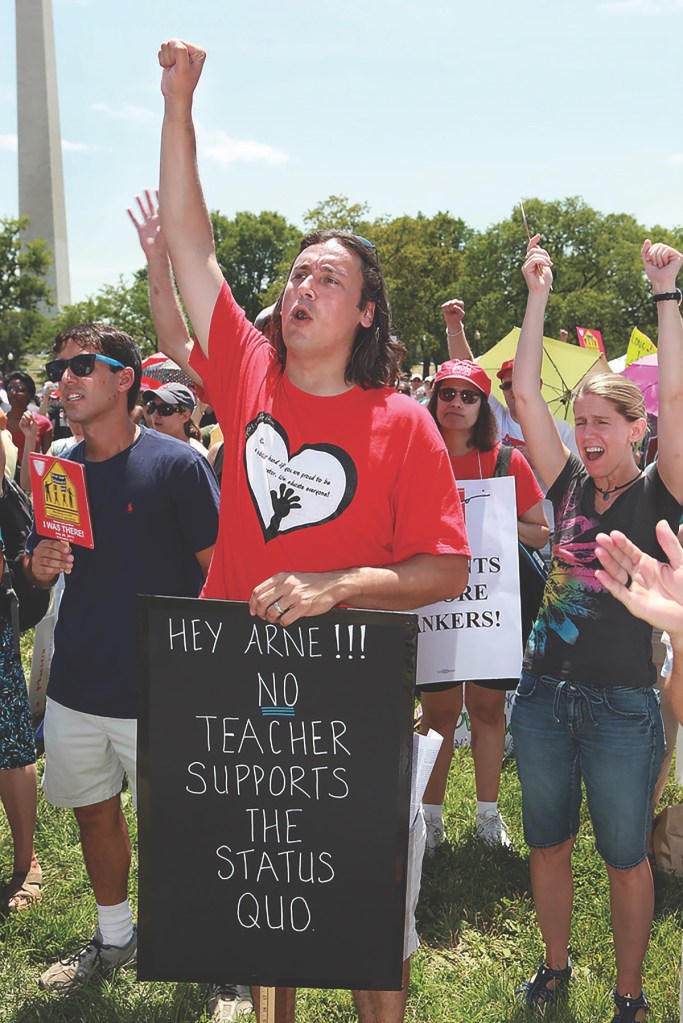
It was a sunny July day in Washington, D.C., the temperature was forecasted to hit 97 degrees Fahrenheit, and when I arrived at the Ellipse on the National Mall for the Save Our Schools march I realized I would need a hat. Among the vendors that lined Constitution Avenue, the least expensive hat I could find was a gaudy, red-white-and-blue affair with an embossed rendering of fireworks going off over the Lincoln Memorial and Washington Monument. “Some hat,” Anne Thompson, my videographer for the day, said when she arrived…
At the time, I was working on a project, partnered with the National Education Association, called “Starving America’s Schools: How Budget Cuts and Policy Mandates Are Hurting Our Nation’s Students.” The project documented how state governments, following the Great Recession, cut funding for schools and rolled out efforts to privatize them with charter schools and voucher programs.
I had read multiple analyses by the Center on Budget and Policy Priorities (CBPP) that found at least thirty-seven states responded to the economic downturn that started in 2007 and extended into 2009 by slashing their education budgets back to pre-recession levels. My Starving America’s Schools project would examine how the cuts caused districts to fire teachers, cancel art and music programs, close libraries and science labs, and cut extracurriculars like athletic programs, field trips, and drama performances.
Teachers turned out to denounce high-stakes testing, NCLB, Race to the Top, budget cuts, privatization, and the attacks on their profession, funded by Bill Gates, Eli Broad, and other billionaires.
….The estimated crowd of 3,000 to 5,000 roared in approval at an array of speakers that included the actor Matt Damon (whose mother is a professor of education), Ravitch, best-selling author Jonathan Kozol, renowned educator Deborah Meier, and policy experts Linda Darling-Hammond and Pedro Noguera. When the speeches were over and we marched to the White House, the line of people stretched for blocks and blocks…
The range of themes the speakers addressed included lack of pay and respect for teachers; the harms caused by poverty and privatization; the continuing racial discrimination and segregation in schools and glaring inequities in their funding; the unbearable class sizes teachers endure, and the injustices that result from using test scores to sanction schools and evaluate teachers.
What also animated the crowd, Anthony Cody tells The Progressive in a text message, was a sense of betrayal on education by the Democratic Party’s leadership. Cody, a fulltime classroom teacher at the time—he’s now retired—was one of the principal organizers of the march. “The great majority of teachers supported the election of Barack Obama in 2008,” he says. “[But] RTTT reinforced the worst elements of NCLB by encouraging states to link teacher pay and evaluations to standardized test scores.”
“A theme that ran through the rally was ‘how could a Democratic administration be so hostile to public schools?’ ” says Ravitch in an email to The Progressive.
“The speakers, me included, hated RTTT and saw it for what it was: encouragement for charters, high-stakes standardized testing, teacher evaluation based on student test scores, and other dreadful policies,” Ravitch continues. “We predicted [the policies] would fail, and they did.”
A particular target for invective at the rally was Obama’s Secretary of Education, Arne Duncan, Ravitch recalls. “He regularly assailed public schools as failing. He attacked public school teachers. He constantly praised charter schools, and whenever national test scores came out, he gleefully pointed to results and made them sound worse than they were.”
“Duncan could have fit in a Republican cabinet,” Ravitch adds.
Fifteen years later, did that outpouring in July 2011 matter?…
The sad truth is that the grievances that motivated people to board buses and gather on the Mall on a hot July day in 2011 continue to dominate the K-12 school landscape today.
For instance, one of NPE’s reports that Cody references, published in 2026, found that states that have been the most aggressive about redirecting public funds for schools to private education operators have been the most neglectful of funding and supporting their public schools.
Although No Child Left Behind was repealed in 2015, it was replaced that year by the Every Student Succeeds Act that still enforces standardized testing. And the legacy of the funding cuts enacted during the Great Recession continues to harm schools.
“In the decade following the Great Recession, students across the United States lost nearly $600 billion from the states’ disinvestment in their public schools,” an analysis by the Education Law Center reported in 2021. Calling the time, from 2008 to 2018, a “lost decade,” the organization noted that while states’ economic activity as measured by gross domestic product increased by 17 percent, state and local revenues for public schools lagged, increasing by only 6 percent.
A 2025 Education Law Center report, “Making the Grade,” assessed states on how they fund public schools and found that not a single state earned an A grade on three crucial measures of funding: whether state and local revenues are adequate, whether funding is fairly distributed, and whether funding lags a state’s economic capacity.
In the meantime, the charter school industry continues to expand, with thirty-nine out of forty-three states experiencing growth in charters in 2025, according to charter industry data. And voucher programs also continue to grow, as fifteen states now operate twenty-three programs, and the Trump Administration is set to roll out a nationwide federal voucher program in 2027. As the right wing’s “long game” to end public education continues apace, prominent centrist Democrats call for a return to the education policies of the Bush and Obama years.
“Democrats [have] walked away from standards and accountability [for schools], and our kids are falling through the cracks,” former Chicago mayor and Obama’s Chief of Staff Rahm Emanuel is telling anyone who will listen. And Arne Duncan is back in the media spotlight, encouraging Democratic governors to embrace the Trump Administration’s voucher program. That the politics of education in 2026 seem so similar to those of 2011 is evidence that a left-right binary over education policy doesn’t really exist.
As I observed all those years ago on the cusp of the march in D.C., there was no middle ground in education debates. Factions on the right wanted to get rid of public schools. Business interests represented by testing companies, charter schools, and tech firms wanted to make money off schools. And a “reform” community led by wealthy foundations and technocrats wanted to mold public schools to their ideological, and often political, agendas.
As I wrote at the time, “Faced with this array of antagonists toward public education, where does the ‘middle ground’ lie? When people openly admit they want to get rid of you, where should the bargaining start? When people have shown you they are more apt to use you for their own profit, and then walk away when the ‘market changes,’ why should you trust them? And when people say they are willing to align with your cause but only when you say and do things how they want you to do them—even when your ideals inform you to do otherwise—why should you simply bend to their will?”
Those questions are still relevant today. They will remain so until a progressive left faction adopts a robust message on education and articulates it repeatedly in advocacy documents and political stump speeches.
“Our battle for public schools is steeper now than it was when the Save Our Schools rally was held,” Ravitch says. “It will be a battle for many years to come.”
But in 2011, for at least a day, it seemed that public school advocates had the power to, as Ravitch put it in her email, “push back and give people a modicum of hope.”
The battle continues, and it’s not over. America needs a strong public school system, not a hodge-podge of pop-up schools.
We need well-prepared teachers who can knowledgeably teach history, science, mathematics, literature, and foreign languages. We need well-funded schools and respected, well-paid professionals. We need equality of opportunity for all children, and we need excellence.
We need the strong public schools that built the Aunited States into a great nation. We need education for democracy, where children are judged by the content of their character, not the color of their skin.
We need an education system that produces engineers, scientists, artists, musicians, athletes, mechanics, lawyers, doctors, pharmacists, teachers, social workers, idealists, scholars, young people eager to use their hands, their brains, and their hearts to make our society better for everyone.
We are now in a period of disruption and dissolution. That way lies disaster. It is the road to elitism, segregation, indoctrination, and decay.
We need to raise our sights and build better public schools that offer a goood education for all children.
Trump is clearly bitter that his name is not on the Kennedy Center facade. The tarp that covers the original name still hangs, hiding the humiliation of Trump’s name removal.
Last week he cut down 40 weeping willow trees on the Center grounds, which symbolized a grieving nation, grieving for the assassinated President Kennedy.
This week, the Kennedy Center is removing a piece of outdoor art called “Blue,” which was installed in 2019. The artist, Joel Shapiro, thought it was a permanent installation.
The John F. Kennedy Center for the Performing Arts began removing a major outdoor sculpture from the center’s grounds on Wednesday. The work, installed in 2019, was targeted for elimination after President Trump’s takeover of the center, according to internal documents obtained by The New York Times.
The Kennedy Center made no advance announcement of its plans to remove the towering, vivid blue metal sculpture of a stick-like human figure, called “Blue.”
On Wednesday morning, the limbs and torso of the figure were wrapped in protective material; an arm was the first to be removed.
The Kennedy Center confirmed in a statement on Tuesday that the sculpture was being deinstalled and that a foundation dedicated to the artist would determine its next location. It did not say the reason for the removal but noted that the deinstallation of artworks that had been donated or lent was common practice for conservation or preservation purposes.
A news release from around the debut of “Blue” describes it as a permanent sculpture for the grounds.
“We are deeply grateful to Joel Shapiro for the years ‘Blue’ has spent animating our campus and connecting visitors to his vision,” the statement said. “We are honored to have been stewards of his vibrant work and a part of his enduring legacy.”
Mr. Shapiro died in 2025. His daughter, Ivy Shapiro, who is president of his foundation, said in an interview that she thought her father would have been “alarmed” that the sculpture was being taken down from its intended location.
“In Joel’s mind, it was one of his greatest site-specific commissions, which celebrated joy, freedom and creativity,” she said.
Ms. Shapiro declined to discuss what she was told about the Kennedy Center’s reasoning for removing the sculpture. Her father had given it to the center as a gift, but she said that it was now owned by the foundation, and that she would like to see it installed at another public site.
The White House did not respond to a request for comment.
Josef Palermo, who was laid off in March as the curator of visual arts and special programming at the Kennedy Center, wrote in an essay for The Atlantic that he had been instructed to remove works from the center’s permanent art collection, and told that Mr. Trump’s renovations would include new art.
In an interview on Tuesday, Mr. Palermo recalled that “Blue” had been “targeted early on” and said he took issue with the lack of an announcement.
“The Kennedy Center,” he said, “is in effect holding these pieces in trust for the American people, and there should be a lot more transparency.”
The sculpture is on the grounds of the Reach, an addition to the Kennedy Center that opened in 2019. The sculpture was completed that same year by Mr. Shapiro, whose public art is found in cities around the world. One of his most prominent works is a tree-like bronze sculpture, called “Loss and Regeneration,” that is situated outside the U.S. Holocaust Memorial Museum in Washington.
“Blue,” which is visible from the Potomac and roads traversing the Kennedy Center, has become a local landmark. In a video about the work that was posted by the Kennedy Center around the time of its debut, Mr. Shapiro said he designed it so the figure would appear in different positions depending on the vantage point of the viewer.
“It’s about action and risk and performance and energy,” he said of the work. “It’s a celebration of possibility.”
Of course, Trump had to remove a sculpture that celebrated “Joy, freedom, and creativity.” These are qualities that Trump has never experienced and does not appreciate.
Will it be replaced by a statue of Trump? Gold, of course.
The cruelest of Trump’s policies is his determination to deport millions of immigrants. Stephen Miller, the man without a heart, wants to deport one million immigrants every year. The new head of the Department of Himrland Security, Markwayne Mullen, wants to meet that goal. So now the numbers of people detained has risen sharply, but most of them have never committed a violent crime.
Remember when Trump said he would deport “the worst of the worst”? Remember when he said he would expel the rapists and murderers?
I remember. You probably remember too.
Some are married to American citizens. Some are waiting for their green card to arrive.
That’s who he is deporting. Most of those detained have never committed a violent crime. Most are hardworking people who are contributing to society. Most are running small businesses or working on farms or in construction or landscaping. They need to get their papers, and they want them, but there is no path to legal citizenship.
Some of the deportees have lived here for twenty years or more.
No matter. The door to American citizenship is closed, except for white South Africans. For those whose skin is not white, go away.
Albert Sun and Alison McCann of The New York Times reported:
A surge in immigration arrests this summer has swept up thousands of people who had not previously been the focus of President Trump’s mass deportation campaign. They included people married to U.S. citizens, people who had entered legally and were pursuing an asylum claim, and others with a temporary legal status that the administration pushed to revoke.
The red line on the bottom are those with violent convictions. The soaring green line on top are people with no convictions.
A majority of the immigrants arrested in July were people who were accused of violating civil immigration laws but who had not been charged with or convicted of a crime, an analysis of newly released federal data shows. The share with a past violent criminal conviction fell to less than 4 percent.
Overall, immigration arrests rose to record highs with 43,000 ICE arrests in June and 49,000 in July. Two fatal shootings involving Immigration and Customs Enforcement agents, in Texas and Maine, drew outrage but did not meaningfully slow the pace of arrests.
A spokesperson for the Department of Homeland Security said that the administration was keeping its promises to arrest and deport criminals and that anyone in the country illegally was a target for enforcement.
The new data contains details on every ICE arrest through Aug. 5 and offers the fullest picture yet of how the agency’s activities have shifted since public backlash forced a retreat from the aggressive tactics seen in Minneapolis early this year. It was obtained by the Deportation Data Project, an academic group, through a public records lawsuit and analyzed by The New York Times.
After his confirmation this spring, the secretary of homeland security, Markwayne Mullin, promised quieter but more effective enforcement. ICE now appears closer than ever to meeting a recent goal of 2,000 daily arrests.
“They have more officers, more money, more detention space, more local partners and better systems,” said Claire Trickler-McNulty, a former senior ICE official. “And they’re finally putting all the pieces together to build out this deportation machine.”
A wider focus
Immigration arrests are near all-time highs in almost every state. Even sparsely populated Montana and Vermont saw spikes, with arrest rates more than doubling.
But the surge was strongest in Florida and Texas, two states with large unauthorized immigrant populations and leaders friendly to the Trump administration’s crackdown.






 Diane Ravitch's blog