Archives for category: Freedom to Learn

We live in strange and dangerous times. For the first time in memory, maybe ever, the rule of law itself is under attack. Our Dear Leader has threatened judges who rule against his wishes. He and his lawless administration ignore decisions they don’t like. He installed a Supreme Court majority who were vetted by the far-right Federalist Society. That majority proceeded to overturn Roe v. Wade, despite their repeated pledges not to do so, and to gut the Voting Rights Act, terminating guarantees of equal rights for Black Americans.

At this time when the rule of law itself is disregarded by the President, who is himself ruled only by whim and self-aggrandizement, two retired judges expressed their concern in The Guardian.

Judge Michael P. Connelly and Judge Robert F. Orr wrote:

Last October, US lawyers, judges and rule-of-law advocates traveled to Warsaw as guests of the Carter Center. Neither of us was among them. But when our colleagues returned, their stories inspired us.

They told us about judges and lawyers across central Europe who had been surveilled, smeared, prosecuted and sometimes jailed for standing between political power and courts meant to remain independent.

And they kept going.

Poland’s example was especially compelling. When its government sought greater control over the judiciary, Polish judges put on their robes and marched through Warsaw. Judges from across Europe joined them in what became the March of 1,000 Robes.

Then they left their courthouses and traveled through towns and villages, explaining what an independent judiciary means to a farmer, shopkeeper, parent or business owner. They talked about law not as an abstraction, but as protection against arbitrary power.

They understood a truth Americans can no longer overlook: judicial independence cannot survive merely because judges believe in it. The public must understand why it matters.

That lesson brought us on to a bus.

Last month, shortly after the United States celebrated its 250th birthday, the Justice in Motion tour traveled from western Pennsylvania through Ohio and into Michigan. Thirty sitting and retired judges, lawyers and advocates handed out pocket constitutions, met students and asked a question Americans do not consider often enough: what does the rule of law mean in everyday life, and what happens when we take it for granted?

In Columbus, we did something neither of us imagined during our years on the bench. We put on our robes and marched from the federal courthouse toward the supreme court of Ohio, carrying purple flowers, an international symbol of judicial independence.

American judges do not ordinarily march in the streets. Nor should they. The judiciary derives much of its legitimacy from restraint. Judges do not campaign for particular outcomes or answer criticism with press conferences. They speak through their decisions. But these are no ordinary times.

And our Polish colleagues taught us that silence can carry its own risk.

Our march was not about Democrats or Republicans, nor about defending particular judges or decisions. It was about defending the system that allows legal disagreements to be resolved according to law rather than political power.

One of us was elected to the supreme court of Ohio as a Democrat. The other was elected to the supreme court of North Carolina as a Republican and is now an independent. Through two long careers, we have disagreed about plenty.

That is precisely the point.

The rule of law is not a partisan possession.

Both sides enter a courtroom with the right to be heard. Judges must apply the law to the facts without regard to which party is more powerful, popular or politically useful.

Sometimes judges get it wrong. That is why we have appellate courts. Sometimes courts issue decisions that elected officials or citizens strongly dislike. That is unavoidable in a constitutional democracy.

The answer is appeal, legislation where constitutionally permissible, or constitutional amendment. It cannot be intimidation, retaliation for unpopular rulings or the suggestion that compliance with lawful court orders is optional.

Once adherence to judicial decisions depends upon whether the politically powerful agree with them, we have left the rule of law behind.

In Wooster, Ohio, about 150 people gathered across from the historic courthouse. The discussion was not about red America or blue America. It was about ordinary life.

The rule of law is why you can deposit money in a bank and expect it to be there tomorrow. It is why contracts mean something, property can be protected and an individual citizen can enter a courthouse and challenge the government.

These protections seem ordinary only because generations before us built institutions strong enough to make them ordinary. When the rule of law works, it is almost invisible.

Judges are trained – rightly – to exercise restraint. During our years on the bench, we spoke through our rulings. That tradition is essential to maintaining confidence in an impartial judiciary.

But restraint should not be confused with silence about the survival of the institution itself.

When judges are threatened because of their rulings; when an adverse decision is answered not with an appeal but with demands for retaliation; when courts are judged legitimate only when they produce politically desired outcomes, those who understand the system have an obligation to explain what is being lost.

Our Polish friends understood this before we did. Their circumstances differ from ours, and comparisons should be made carefully. But the lesson travels well.

The rule of law does not defend itself. Neither does an independent judiciary. Constitutions are pieces of paper unless citizens and public officials possess the courage and habits necessary to honor them.

Four days on a bus will not persuade a nation. The purpose was more modest: to begin conversations, one community and one citizen at a time, about institutions Americans have been fortunate enough to take for granted.

That work belongs not only to judges and lawyers, but to all of us.

The rule of law is not something judges possess. It is something citizens inherit.

And every generation must decide whether to preserve it.

What’s giving us hope now

Justice Robert F Orr (retired): What gives me hope is the scope of individuals and groups now focusing and talking about the rule of law and the independence of our judiciary. Our bus trip had a great mix of backgrounds and experience both in the judges participating and meeting us at stops as well as the young people who amplified the message across various media platforms. It’s genuinely a national movement.

Justice Michael P Donnelly (retired): What gives me hope is the genuine appreciation we encountered during the bus tour for the role of an independent judiciary in protecting individual rights and civil liberties. The people we met understood that these freedoms, defended at great sacrifice throughout our history, cannot be taken for granted – and that each generation must be willing to stand up for them.

  • Michael P Donnelly is a retired justice of the supreme court of Ohio
  • Robert F Orr is a retired justice of the supreme court of North Carolina. Both participated in the Justice in Motion tour organized by the Democracy Rising Collaborative and Keep Our Republic

This is one of Randi Weingarten’s best speeches. She delivered it at the 2026 Convention of the American federation of Teachers on July 26 in Washington, D.C.

Not only does she identify income inequality as a dire threat to our democracy, she speaks one of the greatest lines I have ever read:

Mr. President, you don’t own July Fourth. You own Jan. 6.

Randi points out that the dramatic income inequality of our times is destroying the middle class. Unions build a strong middle class. The large increase in the number of billionaires is it a sign of a healthy society; it is a sign of gross inequality.

As more people slip out of the middle class or hang on by their fingertips, our social problems get worse.

How do we restore a thriving middle class? Encourage the growth of strong unions.

She reminds us that today only 1 of every 10 workers belongs to a union. Union workers are paid more, significantly more, than non-union workers. In mid-century America, when 1 in 3 American workers were in a union, we had the largest middle class and the lowest income inequality. And she says, “That’s why, in the long term, growing the union movement is key to solving America’s affordability crisis.”

Rightwingers have done their best to eviscerate unions. And they have won significant victories in the courts.

But, despite the obstacles, the AFT is growing. It now has the largest number of members in its history: 1.875 million members. Al Shanker and Sandy Feldman would be proud of that accomplishment.

Unions are key to a better life.

Randi said in her address:

We plan our conventions years in advance. When we decided to hold this convention in our nation’s capital, to coincide with the celebration of America’s founding 250 years ago, who would have thought that the grievances that led to the American Revolution would be so relevant and relatable today? Or that America would have a new kind of aristocracy based on mind-blowing wealth? 

In the United States, there are now 1,000 billionaires—and the world’s first trillionaire—at a time when nearly half of American households—46 percent—don’t earn enough to make ends meet. 

This wealth imbalance—the top 1 percent having as much wealth as the entire bottom 90 percent of Americans combined—has led to a power imbalance that affects the lives of everyone in our country. These oligarchs influence policy. They have the power to undo social progress. To sway financial markets, monopolize the media, buy elections and undermine democracy.

In an earlier period of extreme wealth inequality, the country elected Franklin D. Roosevelt, and his New Deal programs lifted millions of Americans out of poverty.

This time, the country elected Donald Trump, and well … 

Remember that warning—about the barbarians at the gate? Well, the barbarians aren’t at the gate, they are inside, including at the highest levels of government. 

The president and his cronies are abusing government powers to punish political opponents. Every day they find new ways to attack voting, presumably to entrench themselves. Their war on working-class Americans includes stripping collective bargaining rights from 1 million federal workers, including members of our union, in the biggest act of union-busting in U.S. history. All while engaging in the most blatant corruption in modern American history to enrich themselves. 

The attacks—on unions, on working people, on public education, on higher education, on the public good, on democracy—didn’t start with Trump. They’ve been decades in the making, going back to the 1971 memo by future Supreme Court Justice Lewis Powell that successfully plotted corporate dominance in American politics. And the Supreme Court’s 2010 Citizens United decision that fueled the massive surge of “dark money” in elections—which has now been supercharged by the court’s ruling last month that blew up whatever campaign finance limits were left. And its 2018 Janus decision that anti-union forces hoped would drive a stake through the heart of public sector unions. Project 2025 became the playbook to enact this extremist agenda. This year’s Callais decision not only gutted what remained of the 1965 Voting Rights Act but did so in time to affect the 2026 elections. Then there’s the bare-knuckled crusade to destroy public education and higher education. Just look at Christopher Rufo’s tweets, or his unabashed declaration years ago that “To get to universal school choice, you really need to operate from a premise of universal public school distrust.”

And I haven’t even gotten to Big Tech and artificial intelligence.

Yes, the other side has enormous power. But this is what they don’t have: the power of the people. 

That’s not a mere slogan; it’s the potential to work together, to bargain together, to protest together, to vote together, to act together to bring about change—real, lasting, life-improving change. That is the power and potential of our movement and of the AFT.

Our union stands at the intersection of the ways that regular people gain and exercise power in our democracy—through public education, unions and voting. 

The skills and knowledge people secure through public and higher education expand opportunity—that’s power. Union contracts improve economic well-being—that’s power. Elections—voting for people who answer to their constituents, not wealthy donors—that’s power. 

It’s power not just for ourselves, but for our students, our patients and our communities. Power to build what Martin Luther King Jr. called the “beloved community”—an America where hate has no home. Where the trans nurse, the Palestinian teacher, the Jewish student, and every person regardless of race, religion, ethnicity, gender or place of origin, feels welcome, safe and valued.

We use our power for good—against chaos, cruelty and corruption. We care, we fight and we show up—for a better life for all. Oh, and one more thing: We get shit done! 

We are a fighting union. To quote the president of Texas AFT, Zeph Capo, “Our members will forgive us if we fight and lose, but they’ll never forgive us if we don’t even fight.” 

Look at what we have fought for, and won, in these last two years—despite constant challenges.

Through the AFT’s student debt clinics and our other activism, we have helped more than 1 million borrowers, many of them our members, get $78 billion in student debt forgiven! That is life-changing; people can start a family, buy a home, save for retirement. 

The AFT has filed more than 25 lawsuits against the illegal actions of the Trump administration. If I talked about all of them, I would blow everyone’s bets on the length of the speech. So here are just a few: The Trump administration tried to stop any school—pre-K through college—from doing anything that could be construed as advancing diversity, equity and inclusion, essentially erasing 60 years of civil rights law. And it sought to condition all federal funding for schools on compliance with its dictates. We sued, and we won. We challenged the administration’s policies to detain and deport noncitizen students and faculty for participating in protected political speech. Again, we won. We sued to stop the administration from stripping federal funding from universities and to stop its efforts to control curriculum, hiring and speech. You guessed it—we won.

And then there’s the collective bargaining victories. Like for better wages—from Boston to Kansas City, from Chicago to Los Angeles and so many more. That’s the union difference: Union workers’ wages are 11 percent higher than nonunion workers. Unionized teachers earn 24 percent more in states with collective bargaining, and education support professionals earn 13 percent more.

And as we speak, the city council in New York City is voting to provide every United Federation of Teachers-represented paraprofessional a $10,000 “Respect Check” that the union has relentlessly fought for. 

Life is better with a union.

It goes beyond wages. Take the United Educators of San Francisco, whose successful strike this year led to winning premium-free healthcare not only for members but for their families. 

And paid parental leave. Kudos to our affiliates in Boston, Chicago, Cleveland, Fairfax County (Va.), New York City and Oregon for making great strides to help families thrive. 

And safe staffing. The UFT has had some incredible wins through arbitration. And in New Jersey, our healthcare union, Health Professionals and Allied Employees, has negotiated 14 contracts in a row with enforceable safe-staffing provisions. And now one of our newest affiliates, Hawaii Nurses and Healthcare Professionals, has created a broad coalition to do the same. 

And we have a sacrosanct commitment to retirement security. After a generation-long battle, we won passage of the Social Security Fairness Act that gave millions of public workers the full benefits they had earned but been denied. Our New York unions made great progress this year to fix Tier 6; now younger workers who had inferior pensions can retire in their late 50s. And AFT Massachusetts, AFT Pennsylvania and our Alaska affiliates are making progress on retirement security as well. 

There’s also what we have fended off. The Philadelphia Federation of Teachers reached an agreement to stop the cuts of 340 school-based positions for the coming school year. In Utah, a labor coalition including AFT Utah gathered more than 250,000 signatures and got the Legislature to repeal a ban on public sector bargaining. AFT New Hampshire has a mean game of whack-a-mole—defeating right-to-work, school vouchers and campus carry legislation, and successfully challenging a law that restricted teachers’ rights to teach and students’ access to honest history. In New York, our unions—United University Professions and the Public Employees Federation—and a broad community coalition successfully fought to keep SUNY Downstate hospital open after years of threatened closure, and they secured $1.1 billion to upgrade and expand facilities and services. 

These are fights we’ll have to keep waging. The Republicans’ Big Ugly Bill cuts $1 trillion in Medicaid, makes the largest cuts to nutrition assistance in history, triples the cost of student debt for tens of millions of Americans, and threatens hundreds of rural hospitals with closure—all to give $1 trillion in new tax cuts to the richest 1 percent. State and local budgets are seeing the strain. We’ll keep fighting, school district by school district and hospital by hospital. 

Then there is artificial intelligence—the most seismic industrial revolution of our time. From UUP in New York to the University Professionals of Illinois, we’ve won strong contract language so AI won’t be used to take our jobs, replace our professional judgment, or evaluate or discipline us.

And density matters: Like New York State United Teachers in education, Oregon’s density in healthcare is making a difference. The Oregon Federation of Nurses and Health Professionals secured the largest raises in its history—nearly 35 percent over four years for registered nurses. And OFNHP and HNHP in Hawaii have aligned all their contract expiration dates for the next Kaiser battle. 

And then there is the protection of our students, our patients and our neighbors from brutal immigration tactics, like the recent fatal shootings by ICE agents in Texas and Maine of two men who should be alive today. Healthcare locals in Oregon won legislation to protect healthcare facilities from immigration enforcement. Educators across the country have fought for their students’ release from U.S. Immigration and Customs Enforcement detention centers. Our Twin Cities union family peacefully and courageously stood up to the occupation and harsh immigration enforcement that led to the killing of Renee Good and Alex Pretti and terrified thousands of immigrant families. We were there with mutual aid—food, diapers, rent money, books, toys and safe passage for children to and from school. 

The AFT is always at the ready to help—like with our program for states and locals in crisis. Right now, we are helping our members in Florida, who are in the bull’s-eye of anti-union attacks intended to wipe them out. Let me be clear: We are with you every step of the way. And we’re investing in our affiliates through our MOVE grants, which affiliates are using as fuel to engage members, connect with community and strengthen their power. 

This is what the power of the people looks like: caring, fighting, showing up and getting shit done. 

This administration is waging a war on knowledge, from school voucher schemes, to erasing rather than facing history, to selling the Department of Education off for parts, to its all-out assault on higher education. Here, too, we’re not just fighting back; we’re putting forward big ideas. 

The AFT and the American Association of University Professors have launched a national higher education campaign. We’re fighting to keep vital research funded and against attacks on academic freedom. We won collective bargaining rights for higher education employees in Maryland and made strides toward free college in Connecticut and Pennsylvania. In April, the AFT and AAUP released “A Blueprint for Strengthening and Transforming Higher Education”—and we launched it in Texas, because that is ground zero in the attacks on critical thinking. 

Through AFT Healthcare’s Code Red campaign, we’re working to secure safe staffing limits, enforceable workplace-violence standards, and contracts that help recruit and retain frontline caregivers. That’s good for patients and for healthcare workers.

And on AI, we have a multifaceted plan: from limiting screens and child-facing AI for young students, to a tech tax to hold tech companies accountable for the massive disruptions their products are creating, to contract language, to our National Academy for AI Instruction to help educators master AI so AI doesn’t master us. AI is not going away, so we’re going to fight for the protections that matter to our members, our families and our communities.

And of course, we give out books, 11 million and counting, to children and families through our Reading Opens the World program.

All this is why the AFT is bigger, badder and more big-hearted than ever.

The AFT is the fastest-growing union in the AFL-CIO. Since our last convention, we have organized 173 more units, with close to 60,000 new members in these new locals. New affiliations have deepened our work in states like Hawaii, Michigan, North Carolina and Pennsylvania. And many existing locals have grown as well. 

I am thrilled to announce that, despite everything that’s been thrown at us, we have hit a historic milestone: We proudly represent more members than ever before. Today the AFT is 1.875 million members strong! 

People see the value of belonging. They see that we’re a fighting union—and that we get shit done! It’s amazing. You are amazing. And we are not going to let up. Too few people have the benefit of a union. 

Half of all nonunion workers want to join a union, but only 1 in 10 workers in the U.S. belongs to a union. Americans are 14 times more likely to have an Amazon Prime membership than to be a member of a labor union.

In the mid-20th century, when 1 in 3 American workers were in a union, we had the largest middle class and the lowest income inequality. That’s why, in the long term, growing the union movement is key to solving America’s affordability crisis. 

But what do we do now? We’ve got to win elections. And here’s why. 

As I said, 46 percent of households—55 percent of households of color—did not earn enough to make ends meet in 2024. And inflation has soared since then. That means there’s not enough to put food on the table, gas in the tank and still cover rent. It means constant stress and struggle. 

Our members see it every day in the people they teach, heal and protect. 

And our members feel it.

This winter we surveyed AFT members about the financial issues that keep them up at night, and 7,500 responded. Nearly three-quarters report living paycheck to paycheck, and more than a third say they are unable to cover all of their monthly bills.

There are few things worse than the fear of not being able to provide for your family. Reading our members’ responses took me back to my teenage years when my father was laid off. I remember my parents whispering about which bills they had to pay now and which they could hold off on until he found work. They tried to protect my sister and me from knowing, but there’s no hiding anxiety that deep. 

Millions of Americans believed Trump’s promises to end inflation and make America affordable again on “day one.” It’s “day 542” since he took office. Is anybody paying under $2 a gallon for gas like he promised? What happened to the “DOGE dividend checks”? Or your tariff rebate check? After they got rid of the Obamacare tax credits, have they fixed healthcare? 

Trump isn’t worried about being able to afford healthcare, housing or anything else. Since returning to the White House, he has raked in more than $2.2 billion, through what government watchdogs call unprecedented corruption and self-dealing. 

The president has called the affordability crisis “bullshit.” And he has said, “I don’t think about Americans’ financial situation.” But he has made it worse.

Trump’s tariffs sent the strong economy he inherited into a slump, even with an AI bubble. His trade wars are costing American families $1,000 more every year. He started a costly war against Iran that has left us worse off than when it started. Trump said taxpayers wouldn’t pay “one dime” for his ballroom, but it turns out we’re on the hook for hundreds of millions of dollars. 

We’re not holding our breath for the president to deliver on his promises to lower costs. We’re fighting for economic security and to put more money in our members’ pockets—like the 1 million borrowers we’ve helped get Public Service Loan Forgiveness relief. Our Fight for Affordability builds on that work, with resources to help navigate medical and credit card debt and on other support people are legally entitled to but may not know about. 

And we are working with allies in Congress on bold solutions, like increasing the minimum wage to $25 and passing the Working Americans’ Tax Cut Act, which would exempt 104 million lower-income adults from federal taxes—paid for by millionaires paying a fairer share. We’re pushing for increased funding for public schools and colleges. We’re fighting back against the draconian cuts to Medicaid and to rural hospitals. Millions of children risk going hungry because of the heartless changes to the Supplemental Nutrition Assistance Program in the Big Ugly Bill; we are fighting for every single one of them. 

But we need majorities in statehouses and in Congress this year, and ultimately the White House, to secure the foundational changes we seek.

Threats to Democracy

We face another grave danger: dire threats to democracy. I know, some of you are thinking, here she goes. But really, when is the erosion so much that we can’t get our freedoms back? 

I remember the scoffing when terms like “authoritarian” were first used. And I have been asked repeatedly about why I used the term “fascist” in the book I wrote, Why Fascists Fear Teachers. 

Unfortunately, the answer is clearer every day. 

I don’t actually care what you call it, but I care very much about what Trump is doing. He is weaponizing the justice system to target political opponents, journalists and dissenters. He is sending armed forces trained for war to police American cities, especially to Democrat- and Black-led cities. He is using the presidency for his own benefit and to enrich himself and his family. He is trying to obstruct free and fair elections to maintain power. 

Donald Trump keeps trying to overturn the results of the 2020 election. He urged on the Jan. 6 rioters and pardoned even those who brutally attacked officers bravely protecting the Capitol. 

He is aggressively testing the legal and constitutional limits of presidential power. 

Then there are the lies. It started with crowd size but now he lies about everything—about election results, the economy, his critics, the war in Iran. Even the botched paint job on the Reflecting Pool. 

And sadly, instead of uniting the country to celebrate the great American experiment of democracy, what did Trump do for the 250th? He held what he described as “the most spectacular TRUMP RALLY of them all.” 

Mr. President, you don’t own July Fourth. You own Jan. 6.

I speak and write about democracy a lot because education is vital to understanding, and understanding is vital to acting. If we don’t heed the warnings from the generals who worked for Trump in his first term; if we don’t recognize the hallmarks of authoritarianism—fear, division, isolation and apathy; if we don’t learn the lessons of tyrants, how do we the people have the shared understanding and the urgency to organize and mobilize for democracy to work for working people. 

As I wrote last year, fascists fear teachers because they fear a well-educated citizenry. They fear what educators do—the teaching of critical thinking, of honest history, of pluralism—because their brand of greed, power and privilege cannot survive in a democracy of diverse, educated citizens. We see it in the book bans. In the attacks on DEI. In the efforts to control what schools and universities can and cannot teach. And in the attempts to rewrite and whitewash history. 

To be clear: Fascists don’t just fear teachers—they fear, loath and try to silence all of us who stand up for democracy, dignity, fairness and opportunity for all. 

And stand up we must. 

Americans are losing faith in democracy. Seven in 10 U.S. adults say they are dissatisfied with the way democracy is working in the country. Young Americans in particular feel the country is on the wrong track. 

I understand the disappointment. But we cannot give up on democracy. Winston Churchill was right when he said in 1947, “Democracy is the worst form of government except for all those other forms that have been tried.”

But we must improve it. As John Dewey said, “Democracy has to be born anew every generation, and education is its midwife.”

Look at where democracy is being born anew: In Hungary, where this spring 80 percent of voters turned out to reject Viktor Orbán’s far-right agenda, ending his 16-year grip on power. In South Korea, where labor unions spearheaded mass protests and nationwide “strikes to defend democracy” after the president declared martial law. And here at home, at May Day and “No Kings” protests in small towns, suburbs and cities across America, where millions of people turned out to say we will not stand by while democracy is dismantled. 

We are not helpless to change what is wrong. We can build a better future and a stronger democracy. But that requires winning in November. 

Elections

As big and bad and big-hearted as we are, neither bargaining nor bullhorns alone will get us out of these treacherous times. 

To get a working-class tax cut, to pass living-wage legislation, to get limitless money out of politics, to fix the healthcare system, to strengthen education, and to restore vital safety net and climate programs, we have to win majorities in 2026 and the White House in 2028. We have to elect people who support working people, leaders with real plans to make life better. 

Strengthening public schools and stopping the reckless runaway train that private school vouchers are becoming should not be a partisan issue. Ensuring everyone who works can earn a living wage should not be a political issue. Fighting so everyone has access to high-quality, affordable healthcare should be a human priority, not one party’s priority. Shoring up Social Security to keep seniors out of destitution should have universal support. Addressing the climate crisis that threatens all humanity should unify all humanity.

Perhaps one day these issues will be bipartisan. 

But sadly, the reality is that since Trump’s first term, Republican officeholders’ support for our priority issues averaged just 8 percent, while Democrats averaged 95 percent. Do I wish that was different? Of course. And do I wish Democrats were bolder? I do. But Republican leaders don’t even seem to want to try. 

This election will decide whether we are a country governed by the people or ruled by the powerful. A country of opportunity or oligarchy. A country whose people live in freedom or in fear. 

Do we want a future where billionaires and a trillionaire continue to grow their wealth at the expense of working people? Or one where working people earn a decent wage, support their families and take a vacation once in a while? 

Do we want a future in which classrooms lack resources and life-changing research is abandoned? Or one in which we can nurture the potential of every student and continue to lead the world in bold discoveries? 

Do we want a future where big healthcare corporations put profits over people? Or one in which every person—every person—has access to healthcare, and healthcare professionals have the resources, staffing and power to help their patients? 

Do we want a future ruled by tech bros and robots? Or a future grounded in dignity and humanity? 

Do we want a future in which elections are rigged to maintain one-party control and government is for sale to the highest bidder? Or one in which every person’s vote matters and government serves the people? 

That’s what’s at stake in November 2026. And the future we want is within reach. We can win majorities in the House and in the Senate and in state capitals. Majorities who will act on our priorities. 

But only if we vote, get others out to vote, and protect the vote. That’s why we are committing to our most ambitious election program ever.

Here’s the math: 1.3 million AFT members and their families live in a place where there is a competitive race in November. 600,000 of us are in battleground gubernatorial states. 464,000 live in the states with the seven top U.S. Senate battleground races. We need to flip four seats to win a Senate majority that works for working folks. And we have more than 1,000 members and voting family members in 86 critical, competitive congressional districts. We only need a net gain of three seats to win a working folks’ majority in the U.S. House. Can we do it?

With the AFL-CIO, we have a goal of reaching 2 million new voters. That means the AFT has to turn out about 200,000 more householders than in the last election. That means we need 28,000 volunteers to make calls, knock on doors and get out the vote—28,000 out of 1.875 million. Can we do it?

And it’s not just about getting out the vote in this election but also about protecting the vote. That’s why we are launching a new Democracy Defenders election protection program. We are recruiting 5,000 members to make sure that people can exercise their right to vote free from intimidation. Our Democracy Defenders will be part of the 50,000 people the AFL-CIO is recruiting for this critical work. Can we do it? 

People power can win, but we need to be all in, and that means we need you to be all in. No one can do everything, but each of us can do something to win in November and achieve the better future we fight for. 

So are we going to vote? Are we going to get out the vote? Are we going to protect the vote? 

Conclusion

That’s the energy and commitment we need to achieve the America we dream of: An America where everyone has opportunity and economic security. An America where everyone’s dignity and freedoms are respected. An America whose democracy not only endures but finally lives up to its noble ideals. 

I’ve spoken often this year about Martin Luther King Jr.’s final book, Where Do We Go from Here: Chaos or Community? Since January 2025, we have experienced a lot of chaos, fear and division. 

Lately, I find myself drawn to another piece of King’s wisdom—that the “arc of the moral universe is long, but it bends toward justice.” I still believe that, and I hope you do too. 

But the arc doesn’t bend on its own. It bends toward freedom and opportunity through the work you do every day making a difference in people’s lives—in classrooms, at the bedside, in our communities. You bend the arc. Unions bend the arc. Voting bends the arc. The power of the people bends the arc toward justice.

On this 250th anniversary of our nation, that is our responsibility. That is what I am asking you to do, what I am asking us to do—this bigger, badder, big-hearted union and our 1.875 million members. 

And when we do, when we bend that arc, we will change the trajectory of our nation and secure a better future for all, from sea to shining sea. Thank you. 

Watch the full speech

https://www.aft.org/media/oembed?url=https%3A//youtu.be/oIASmJ3ZO70&max_width=0&max_height=0&hash=Sadl1eN7tbOr37C7SenWNH-Hx34YmVOAuIc7CHYyQyQ
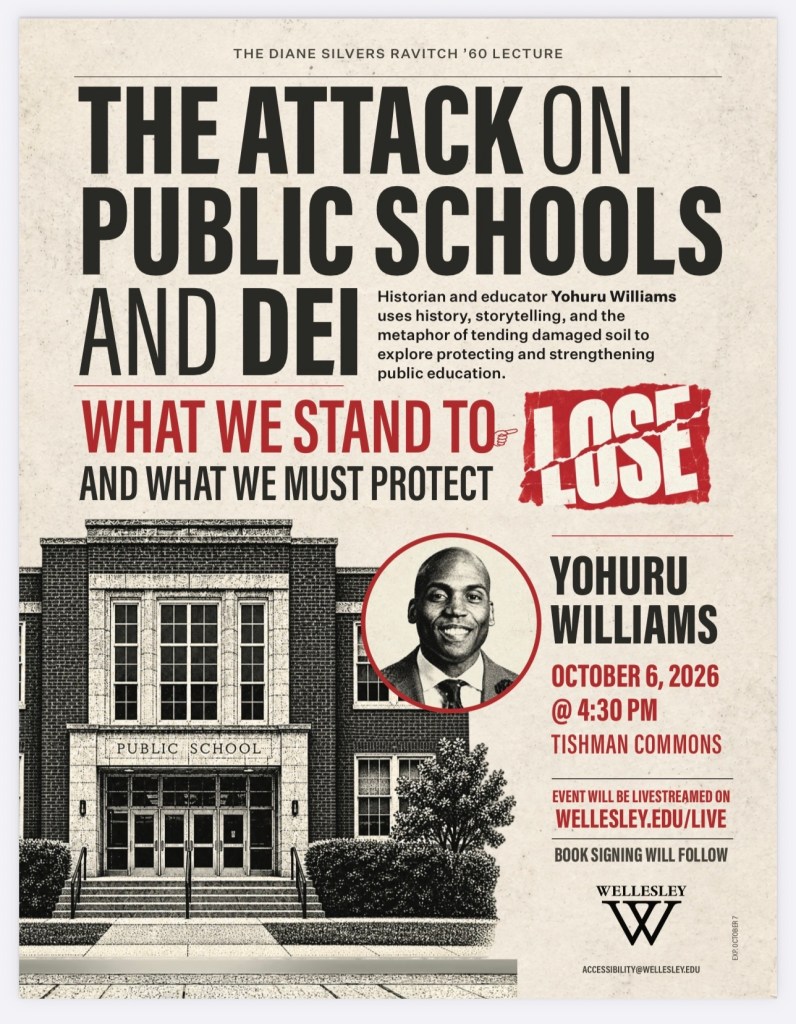
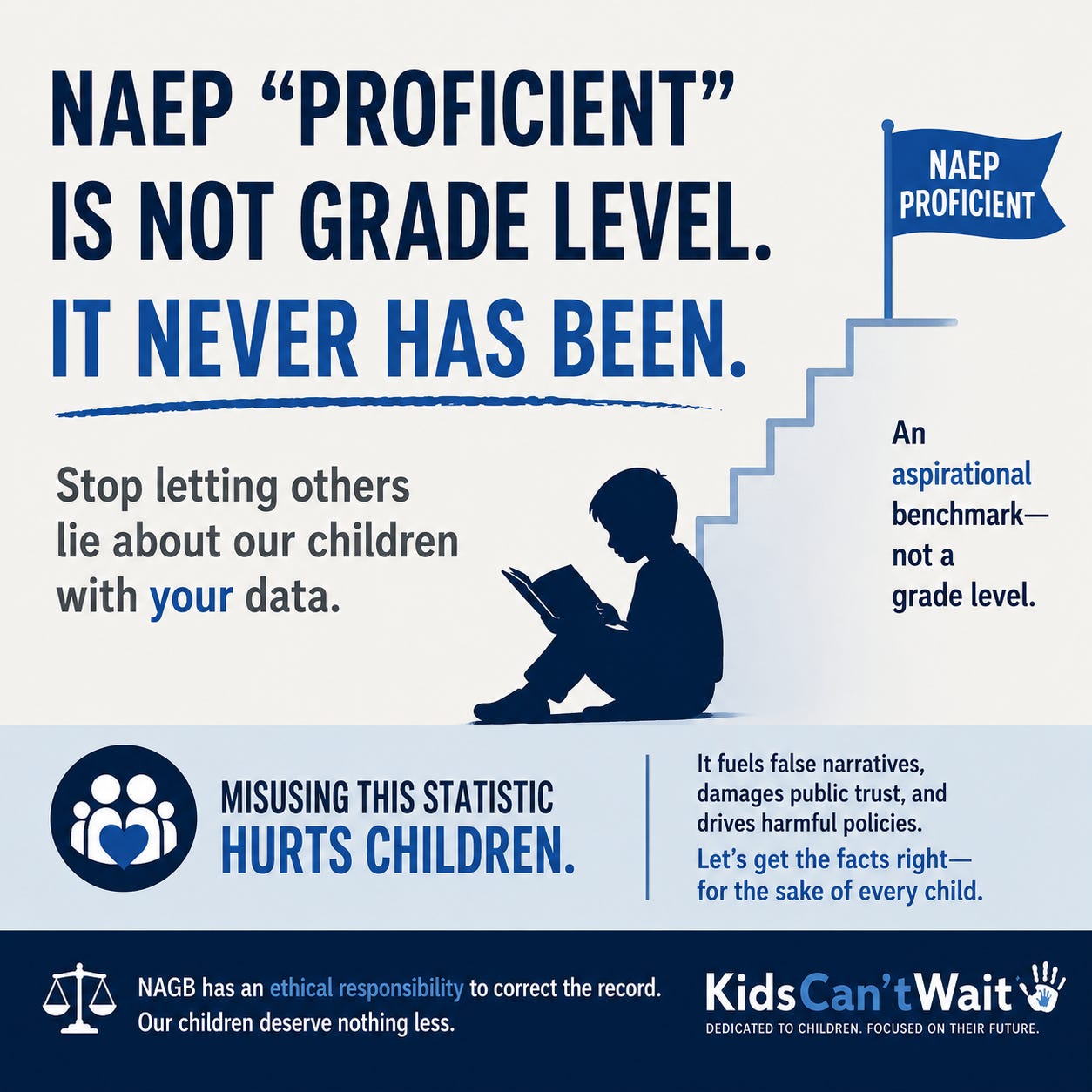
The biggest lie about American school kids is that most are “below grade level.” This lie is repeated so often by prominent figures that it is widely believed. But it’s not true. Those who believe it are wrong. Those who repeat it, knowing it’s not true, are liars.

The source of the lie and the confusion is clear: the achievement levels in which NAEP scores are reported. The levels are “advanced,” “proficient,” “basic,” and “below basic.” When the media write about the latest release of NAEP scores, they frequently treat “proficient” as “grade level.”

But “proficient” is NOT “grade level.” It represents solid achievement, a rigorous aspirational goal. “Proficient” is equivalent to a solid A.

Every NAEP report on test scores says clearly in a footnote that “proficiency” is not the same as grade level. For example: “NAEP Proficient does not signify meeting grade-level expectations.” Yet the media and prominent commentators who should know better repeat the lie that most students are below grade level. The fact is that most students will never reach the high bar of “proficient.”

In 2023, as Bruce Lesley points out, Biden’s Secretary of Education–Miguel Cardona–testified to a Congressional committee that only one-third of American students were reading “at grade level.” I was flabbergasted. I couldn’t believe he said something so outrageous. I called Dr. Peggy Carr, who at that time was the Commissioner of Education Statistics. She was as surprised as I was that Secretary Cardona repeated the erroneous statistic. I asked Dr. Carr whether she had ever briefed him on understanding NAEP results; she had not.

I gave her an idea. Propose a change in name for “proficiency.” Change the name to “mastery.” No one would claim that “mastery” was the same as “grade level.” She liked the idea and promised to take it to the board. Whether she did, I don’t know. But nothing changed.

Bruce Lesley wrote this open letter to the National Assessment Governing Board, which oversees NAEP testing. Lesley is president of First Focus on Children and its partner organization First Focus Campaign for Children, bipartisan advocacy organizations dedicated to making children a priority in federal, state, and international policy. He has led both organizations since 2006 and 2009, respectively, building them into recognized national voices on child health, education, early childhood, economic security, budget and tax policy, immigration, children’s rights, and more recently, international child policy.

He wrote:

To the National Assessment Governing Board, the National Center for Education Statistics, and the leadership of the National Assessment of Educational Progress:

Every institution whose work affects children should begin with one question: “Is this good for children?”

By that standard, the National Assessment of Educational Progress (NAEP) has some important issues that deserve to be resolved. First and foremost, your achievement-level labels — “Basic,” “Proficient,” and “Advanced” — are being weaponized against the very children NAEP exists to serve, and you know it, because your own staff has been saying so for twenty-five years.

To be clear, this open letter is not a claim that NAEP’s underlying data is necessarily wrong, and it is not an argument against NAEP. The argument and request is narrower: you have a real and critically important ethical responsibility to correct the public misuse of your own data. NAEP should defend its credibility against those currently diminishing it.

This Week’s House Mark-Up Provides Another Example

On July 15, 2026, the House Education and Workforce Committee marked up a ten-bill package to facilitate the dismantling of the U.S. Department of Education.

In his opening statement, Chairman Tim Walberg (R-MI) argued that “too many children can’t read or do math at grade level,” and used that claim as a central justification for several of the bills. That claim is false.

Chairman Walberg was drawing on NAEP data — the statistic that roughly two-thirds of American fourth-graders do not score “Proficient” in reading, which is wrongly cited as evidence of failing to meet grade-level reading levels. For some, this is done out of confusion and, for others, to promote a political agenda to undermine public schools. In reality, NAEP proficient is aspirational and reflects a standard that is well above grade level.

Unfortunately, during the markup, multiple members of Congress repeated the same error. But again, NAEP Proficient is not grade level. It has never been grade level.

When the public, the press, the administration, and Congress repeatedly miscite this fact, the National Assessment Governing Board (NAGB) must do much more to clarify and correct misstatements about what it means.

Education expert Peter Greene explains:

The problem is two fold. One part of the problem is that “proficient” is used on many state and local assessments to mean “at grade level,” or what once upon a time would have been called a gentleman’s C; this leads to some honest confusion for some folks. The other part of the problem is folks who are invested in the narrative that public schools are failing and who benefit from the confusion surrounding the term.

Greene adds:

And every time NAEP scores are released, education journalists write piece after piece explaining “proficient” all over again, usually in the wake of some prominent person decrying the large number of students not “at grade level.”

That confusion is NAGB’s responsibility to address, and it has deserved attention for years, but all the more NOW.

This Is Not a Partisan Problem

Chairman Walberg and his colleagues’ misstatements are only the most recent officials to make this mistake (whether unintentionally out of confusion or internationally), and the pattern runs through both political parties.

Secretary Betsy DeVos, in the first Trump Administration, told the public that two-thirds of American students could not read at grade level— the same inaccurate conflation Chairman Walberg and his colleagues made yesterday.

Secretary Miguel Cardona, testifying before Congress in April 2023 under the Biden Administration, told lawmakers directly that only one-third of students were reading “on Grade level,” treating a NAEP proficiency figure as if it were a grade-level statistic, in nearly identical language.

Potential Democratic Party presidential candidate Rahm Emanuel is doing it as part of his tour of early primary states

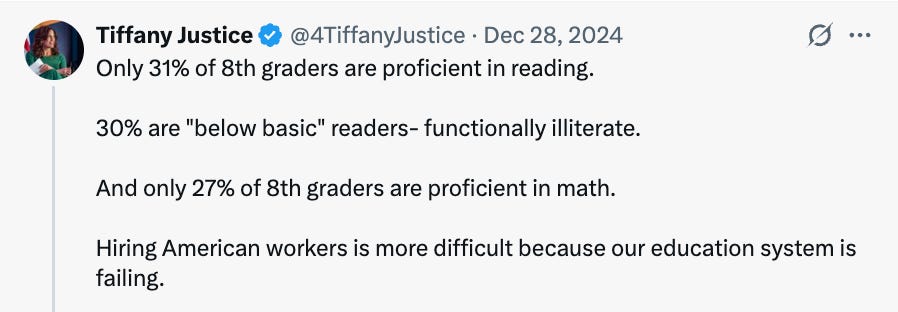
And Secretary Linda McMahon, in the current Trump Administration, has used more careful wording — noting that nearly 70% of eighth graders are “not proficient” in reading — but has paired that technically accurate phrase with language implying total system failure. A Snopes piece by Rae Deng described this claim as lacking its own level of reading comprehension because, again, it completely mischaracterizes what NAEP’s “proficient” standard means.

Outside advocacy groups have been considerably less careful than any of them.

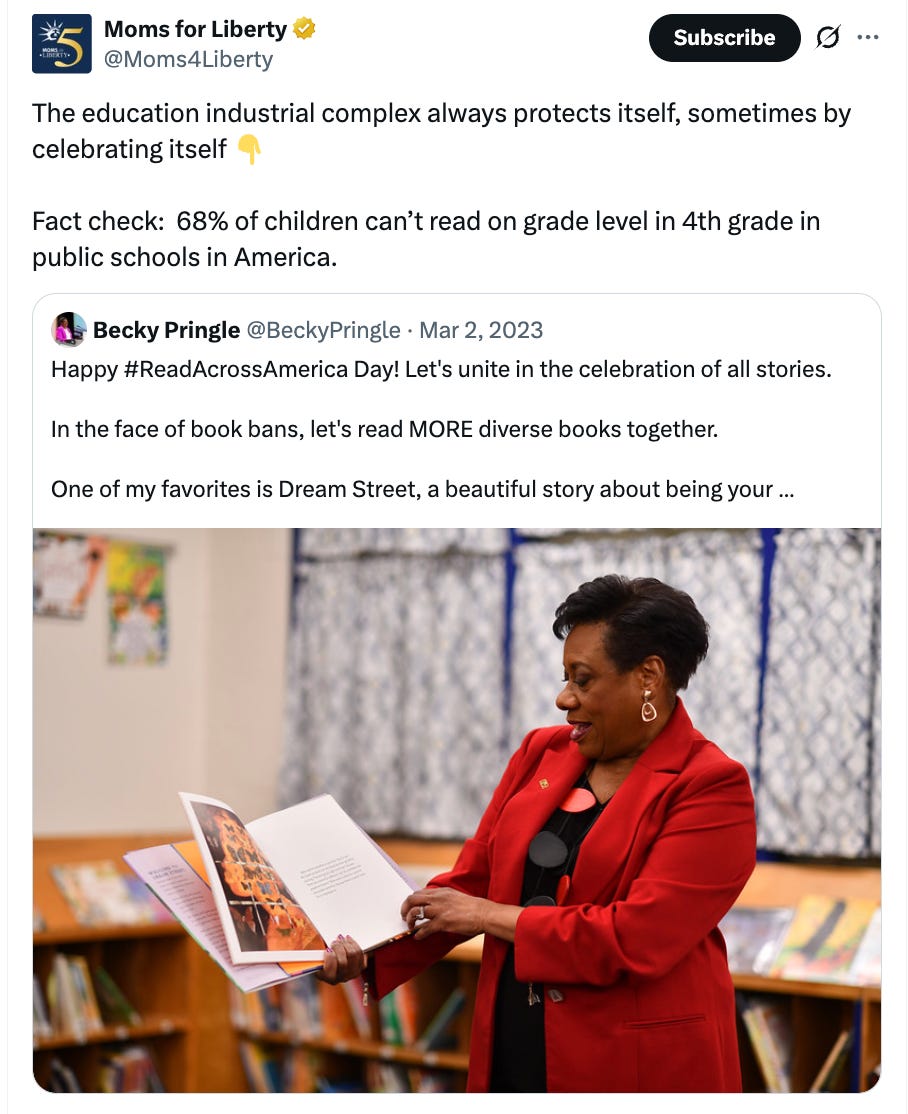
Moms for Liberty has publicly proclaimed that 68% of children cannot read at grade level, a direct misstatement of NAEP data. Here is just one of many examples. 

Furthermore, one of the organization’s co-founders has separately misread a state’s NAEP proficiency rate as that state’s overall literacy rate. Wrong again.

Corey DeAngelis, a leading advocate for school privatization, vouchers, and against public education, has cited NAEP proficiency figures directly, without qualification, as evidence that public schools are a system-wide “disgrace.”

Greene captures these types of political misuse of NAEP data in this Substack post.

Curmudgucation The Most Misused Statistics In Education.If someone is telling you that some extraordinary percentage of students can’t read at grade level, they’re probably wrong…Read more3 years ago · 2 likes · 1 comment · Peter Greene

This confusion is intentional by people arguing for both the dismantling of public education and federal investments in children.

Unfortunately, NAGB’s silence has allowed that rhetorical usefulness to go unchecked under Republican and Democratic administrations alike, and it is being used right now, this week, on Capitol Hill to justify eliminating the very agency that funds and safeguards the data NAGB produces.

NAGB’s Own Experts Have Been Saying This for Years

In 2001, Mary Lynne Bourque and Susan Loomis — a staff member and a board member of the National Assessment Governing Board itself — wrote plainly that the Proficient achievement level “does not refer to ‘at grade’ performance,” and that performance at Proficient is not the same as being “proficient” in a subject as any ordinary person would use that word.

Chester “Checker” Finn, Jr., who chaired the panel that adopted the achievement levels in 1992, has been candid that the levels were designed to be aspirational — a description of where students should ideally arrive, not a diagnosis of where most currently stand.

NCES itself has attached a caution to NAEP score reports for years: the Proficient level “does not represent grade level proficiency as determined by other assessment standards.”

If NAEP’s own architects and NAGB’s own website already say this, it is past time to be diligent in correcting the record when people misuse and misstate what it means. It is also on NAGB to stop publishing results in a format that predictably, foreseeably, and repeatedly gets misread as a verdict on grade-level performance, especially when you can see exactly how that misreading gets used again and again.

The clearest confirmation of all of this comes from NCES’s own data. Researchers Gina Cervetti and Kathleen Hinchman mapped every state’s definition of fourth-grade “grade-level” reading proficiency directly onto the NAEP scale and found that, as of the most recent analysis, nearly every state’s own standard for grade-level reading lines up with NAEP’s Basic level, not NAEP’s Proficient level. That means the honest translation of the data runs the opposite direction from how Chairman Walberg and others use it: by the states’ own definitions of grade level, roughly two-thirds of American fourth graders are reading at or above grade level, not below it.

Cervetti and Hinchman are also blunt about what actually is a crisis in the data: not a reading crisis, but an equity crisis. In 2022, only 48% of students eligible for free or reduced-price lunch scored at or above NAEP Basic, compared with 76% of students who were not eligible — a 28-point gap that has persisted, largely unchanged, for decades.

That is a story about generational wealth and unequal access to housing, healthcare, and school resources, not a story about failing classrooms, and NAEP’s own framing continues to let people tell the wrong story with your numbers.

What Education Writers and Researchers Have Been Saying

Diane Ravitch, who served seven years on the National Assessment Governing Board under President Clinton, has called out the confusion between NAEP Proficient and grade level as one of the most damaging and persistent falsehoods in American education discourse, noting that NAEP itself explicitly warns against the equivalence you continue to permit others to make.

Greene has argued that cut scores like “Proficient” function as scaled, curved judgments dressed up as fixed standards — noting that if every child scored above a cut, the establishment reaction would be to declare the cut too easy, not to celebrate the achievement. That is not how a genuine, fixed criterion is supposed to behave, and it is worth NAGB’s honest reckoning.

Mark Weber, a New Jersey teacher and education researcher, has done careful public work mapping state proficiency standards onto the NAEP scale, and his conclusion undercuts a favorite talking point of your critics-turned-allies in this fight: there is no empirical evidence that closing the so-called “honesty gap” between state and NAEP proficiency rates does anything to improve student achievement. If setting state cut scores to match yours were actually the lever for better outcomes, we would expect to see it in the data. We do not. That matters because it means the standard is being imported into state accountability systems on faith, not evidence — exactly the kind of unsupported claim NAGB should be correcting rather than allowing to spread.

The Brookings Institution’s Brown Center on Education Policy has been making this same case for nearly two decades. Tom Loveless, the Brown Center’s longtime director, authored a 2007 report concluding bluntly that NAEP’s cut scores were set too high. 

His 2016 Brookings piece, “The NAEP Proficiency Myth,” went further, noting that the achievement levels came under critical review from the U.S. Government Accountability Office, the National Academy of Sciences, and the National Academy of Education shortly after they were adopted — with the National Academy of Sciences review concluding the achievement levels were fundamentally flawed.

Loveless adds:

Advocates of the NAEP proficient standard want it to be for all students. That is ridiculous. Another way to think about it: proficient for today’s eighth graders reflects approximately what the average twelfth grader knew in mathematics in 1990. Someday the average eighth grader may be able to do that level of mathematics. But it won’t be soon, and it won’t be every student.

That is not a stray outside critique. That is respectable experts in the field, writing for decades, about the very categories NASB is still using today without correction.

One Point Should Not Separate “Failing” from “Successful”

NAGB also owes the public an honest accounting of what a cut score actually is. A cut score is a single point on a continuous scale, chosen somewhat arbitrarily by a panel, above which a child is declared “Proficient” and below which the same child, one point lower, is declared “Basic,” which is actually grade level.

Two children who are functionally indistinguishable in what they know and can do are sorted into entirely different public categories — one used as evidence that a school, a state, or a federal agency is failing, the other treated as evidence of success — because of a single point set by a committee, not because of any meaningful difference in the children themselves.

That is not a rounding error. It is the mechanism by which your data gets converted into political ammunition.

If NAGB cannot explain, in terms parents can understand, why the child who scores one point below the line is a different kind of learner than the child one point above it, then the line is doing rhetorical work the data was never built to support.

As the psychiatrist and educator William Glasser warned schools decades ago, chasing a point or two of movement on a test score is precisely the wrong institutional goal — and yet that is the goal NAEP’s cut scores hand every state, district, and school in the country by default.

Researcher Andrew Ho makes a similar point. He has identified proficiency cut scores as arbitrary markers, set through what he calls an “overwrought, judgmental, and ultimately political process,” not derived from any fixed line in human learning.

Ho has also documented a specific illusion that follows from that arbitrariness: because a large cluster of students always sits near the middle of the score distribution, a cut score placed close to that cluster will make small, ordinary shifts in performance look like dramatic gains or losses, purely as an artifact of how many students happen to sit right at the line — not because anything real changed in how much they learned. A researcher with no stake in the politics of this issue is describing the identical mechanism that turns your data into a rhetorical weapon: the closer the line sits to where children actually cluster, the more your data will appear to swing wildly for reasons that have nothing to do with children’s learning.

Criterion-Referenced in Name, Arbitrary in Practice

NAEP describes itself as a criterion-referenced assessment, distinct from norm-referenced tests like the SAT that simply rank students against one another. That distinction matters, and I want to represent it accurately rather than overstate it — NAEP does not “grade on a curve” in the way the SAT’s percentile scoring does.

However, the practical effect on families is not so different as the label suggests. NAEP’s cut scores were set by hand-picked panels making judgment calls about what students “should” know, not derived from an external, agreed-upon standard of competence, and independent evaluators — including a National Academies review in 2017 — have called for stronger evidence connecting NAEP performance levels to any real-world outcome at all.

A test that is criterion-referenced in name but whose criteria were set arbitrarily, and whose results still track family income and race as tightly as any norm-referenced test on the market, produces the same practical harm as the norming bias critics have long raised: it tells us more about a child’s zip code than about a fixed, meaningful standard of what that child knows.

Notably, NAGB has conceded the point this year. The 2026 NAEP reading framework — administered to students for the first time this spring — now explicitly disaggregates racial and ethnic subgroup results by socioeconomic status, on the premise, well documented for decades, that apparent racial differences in test scores largely track socioeconomic differences. That is a welcome and overdue acknowledgment.

But it is also, in effect, NAGB admitting in 2026 what critics have argued for years: that the results have been measuring wealth and family circumstance as much as they measure “proficiency,” all along. If that acknowledgment is real, it should extend backward, to how NAGB talks about every score ever published, not just forward, to a single new breakdown in the data tables.

The Test Itself Is Not Neutral

Even setting the cut scores aside, the content of the test carries its own bias, and NAEP’s own commissioned reviewers have said so. The NAEP Validity Studies Panel — a technical review body NCES itself created and funds — published an analysis by Gerunda Hughes in 2023 documenting that the statistical methods used to build NAEP-style test items can systematically disadvantage the very students the test is supposed to serve fairly.

When an item is answered correctly by nearly every student, it gets treated as a poor “discriminator” between high and low performers and is typically cut from the test in favor of harder items, even though that easy item may represent exactly the content that should be mastered.

This is not a hypothetical risk. Education researcher Wayne Au, in Unequal by Design: High Stakes Testing and the Standardization of Inequality, documents exactly how this mechanism has played out on the SAT, a test built using the same basic pretesting logic NAEP relies on.

In his book, Au cites researchers Kidder and Rosner, who examined more than 300,000 SAT test-takers and the pool of trial questions used to build future exams and found that some trial questions were answered correctly by Black students, or by Latino students, more often than by White students. Those questions were then discarded — not because they were poor measures of the content, but because they failed to reproduce the racial score gap the rest of the test already produced. A question only “counted” as valid if high-scoring test-takers, who are disproportionately White, tended to get it right in pretesting.

My mother has verified the same process when she was asked to be on a panel to evaluate whether the item questions were “fair”. The publishers of the Texas State assessment at the time ran through the questions and kept throwing out questions as biased toward Black or Hispanic children if they scored the same or close to the scores of White children

In contrast, questions in which there was a substantial gap in favor of White students were not flagged – thus, “norming” the disparity in test score outcomes into subsequent tests. Although my mother repeatedly objected, she was overruled throughout the day and, not surprisingly, never asked back to be a reviewer.

The result, as Au describes it, is a self-reinforcing loop: item selection is calibrated to match existing racial score gaps, which locks those same gaps into every future version of the test, all without anyone ever explicitly considering race in the selection criteria. 

NAEP is a different test administered by a different organization, and I am not asserting that NAEP’s item-selection process has been documented to work in the same way. But NAEP uses the same category of item statistics that made this outcome possible on the SAT, and NAGB’s own validity panel has already flagged the risk. Given what is now documented on a test as consequential as the SAT, NAGB owes the public a direct, public answer to a direct question: has anyone checked whether NAEP’s item-selection process does the same thing?

There is also cultural and geographic bias. As the son of an English teacher and a math teacher, it should be no surprise that I did fairly well on standardized tests throughout my life. But I vividly recall a reading passage from the PSAT that focused on nautical issues and the definition of a “flotilla.” 

Having grown up in El Paso, Texas, a city located hundreds of miles from any coastline, the passage and vocabulary word were unfamiliar to any of us taking the test in the desert borderlands. On the other hand, we would crush a passage referring to “tortillas.” NAEP’s own reviewers have a name for this: cultural validity, the idea that a test cannot cleanly separate what a child knows from what a child has been exposed to.

Research that NAEP’s own validity panel cites has found that when students are allowed to choose among reading passages on different topics, rather than being assigned a single passage that may be unfamiliar or uninteresting to them, some groups of students — including Black eighth graders and Hispanic twelfth graders in the panel’s own cited study — score much higher. That is evidence that some of what NAEP currently measures is exposure and familiarity, not just reading ability, and it argues for reform in how passages and vocabulary are chosen, not just in how results are labeled.

Again, the validity panel’s report contains proof that this is a design choice, not a fact of nature. In 1972, the psychologist Robert Williams built a test called the Black Intelligence Test of Cultural Hegemony, using vocabulary and content drawn from Black American culture instead of the dominant culture’s frame of reference. When Black and White teenagers took it, Black students substantially outscored White students by substantial margins.

Nothing about the underlying children changed between that test and the SAT. What changed was whose knowledge and cultural fluency the test happened to be built around.

That single fact should end, permanently, any claim that a test’s outcomes reveal some fixed truth about which children “can” or “cannot” read, think, or reason. What these tests reliably measure is often which cultural and economic frame of reference a child was raised in, and how well that frame matches the one test-makers chose to build around — which is another way of describing accumulated wealth, school funding, and generational inequity, not a verdict on a child’s mind.

That is real, and policies that address school finance inequity, child poverty, childhood hunger, and adverse childhood experiences (ACEs) deserve real policy attention. These issues would undoubtedly do more to improve educational outcomes in this country rather than privatization of public schools or the elimination of the Department of Education.

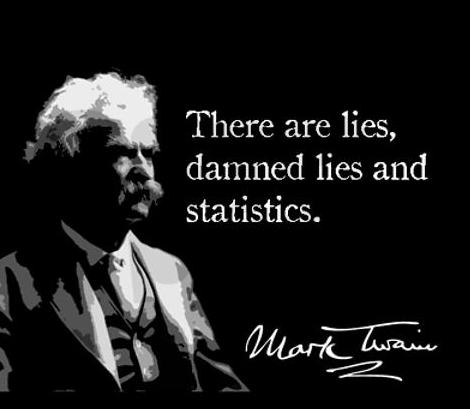
Claims that two-thirds of American children cannot read at grade level are simply false, and their interpretation by policymakers and advocates is harming children. There is an old warning that was popularized by author Mark Twain but attributable to British Prime Minister Benjamin Disraeli about three kinds of falsehood — “lies, damned lies, and statistics.”

In this case, even a true number, presented without its context, can mislead more effectively than an outright fabrication. NAEP’s “proficiency” level is an aspirational one, but the grade-level story built on top of it is doing real harm. NAGB is a position to explain the difference, and the public is not, until you tell them.

The Damage Is Not Abstract: What Gets Tested Is What Gets Taught

This is not a technical quibble.

Every time “below Proficient” gets reported to the public as “can’t read” or “can’t do math,” it becomes ammunition for defunding public schools and for portraying millions of children — disproportionately low-income children and children of color — as failures because of a label your board itself has said should not be read that way.

It also reshapes what happens inside the classroom. When reading and math scores on tests built around NAEP cut points become the metric by which schools, teachers, and even state superintendents are judged, instructional time follows the incentive:

  • Short, decontextualized passages crowd out real books — my children were taught how to write a brief constructive response (BCR) before they were even taught what a paragraph was.
  • Science, government, history, the arts, and physical education are pushed to the margins of the elementary school day because they are not tested and therefore not rewarded.

Children end up narrower, not better educated, in the very subjects that make them informed citizens — and NAEP’s own cut-score architecture is a direct contributor to that narrowing, whether or not that was your intent.

NAGB tried a partial fix in 2018, adding the word “NAEP” before each level — “NAEP Proficient” rather than “Proficient” — so people would stop equating your terms with generic ones.

James Harvey, executive director of the National Superintendents Roundtable, was right to call that gesture insufficient at the time. Harvey said:

…the American people should understand that the misleading term “proficient” sets a performance benchmark beyond the reach of most students in the world.

Harvey argued “proficient” should be changed to something like “high” to avoid being “fooled.”

His point has been proven many times, including this week when a sitting congressional committee chairman, citing NAEP-adjacent data to justify eliminating a federal agency, still used the word “grade level” as if it meant what NAEP’s Proficient level does not mean.

The Perverse Incentive NAEP Has Inspired: Grade Retention As Score Manipulation

The clearest evidence that NAEP’s cut scores create perverse incentives and “manufactured” crises, rather than honest information, is what states have started doing in response to them: holding back third-graders who miss an early-literacy cut score, in order to produce a fourth-grade NAEP cohort that looks better on paper.

Education professor and researcher Paul Thomas has documented this closely in states such as Mississippi, where fourth-grade reading gains celebrated as a “Mississippi miracle” tracked closely with a mandatory third-grade retention policy.

Paul ThomasCounter-Narratives: Mississippi Reading ReformEmily Hanford has profited from two very compelling stories…Read more2 days ago · 1 like · Paul Thomas

A child who is nine years old competing against classmates who are eight will predictably score higher on a test built around the same content; that is a fact about test administration, not about literacy. Furthermore, those same “gains” have been shown to fade by eighth grade, once the retained cohort catches up in age to its peers without having genuinely caught up in learning.

This is worth NAGB’s own honest reckoning, not because the research on retention is unanimous — reasonable analysts, including some closely tied to NAEP’s own governing board, dispute how much of Mississippi’s gain is genuine instructional improvement versus retention’s effect on cohort composition — but because NAEP’s achievement levels are the mechanism creating the incentive either way.

States are not retaining eight-year-olds because it is good for those children. They are retaining them because a single cut score on a single test has been elevated to a measure of whether a state’s education policy is working. The cost of that incentive falls on children: retained students who show a short-term score bump can, over time, experience the opposite of what was intended — greater disengagement, higher rates of dropping out before graduation, and the well-documented psychological toll of being told, at eight or nine years old, that they failed.

William Glasser spent much of his career, in Schools Without Failure, and later in The Quality School, explaining exactly why this backfires. He argued that standardized testing reduces learning to disconnected, memorized facts at the expense of critical thinking and real application — and that the “right answer, wrong answer” format of a multiple-choice test teaches children that education is a hunt for a single predetermined answer rather than a process of genuine understanding.

In the schools Glasser held up as models, closed-book tests were replaced with open-book, collaborative assessments that actually resembled the problems students would face outside school. His deeper claim, grounded in what he called Choice Theory, is that people — including children — are driven by needs for freedom, power, and simple enjoyment in their work, and that using test scores to rank, shame, or coerce students destroys the very motivation that produces quality work in the first place.

Labels matter. When children repeatedly hear that two-thirds of them “cannot read at grade level,” many internalize failure that is not supported by the evidence. Parents lose confidence in neighborhood schools. Teachers become demoralized. Policymakers propose increasingly radical structural changes to fix a crisis that has been inaccurately described.

Glasser also warned explicitly against making small, arbitrary numerical gains — his example was raising a test score by a point or two — the primary institutional goal of a school, insisting instead on building a genuine culture of quality. That is precisely the trap a single-point NAEP cut score sets for states, and it is the trap third-grade retention policies walk students directly into.

That is the opposite of what an assessment meant to serve children should produce, and it deserves your acknowledgment, not your silence.

What We Are Asking You To Do, Now

  1. Issue a direct, public correction each time a federal official misstates NAEP Proficient as “grade level,” the way you would correct any other material misuse of your data. Silence is not neutrality; it is acquiescence in the misuse.
  2. Publish, prominently and alongside every score release, the state-by-state mapping showing that “grade level” as states themselves define it corresponds to NAEP Basic, not NAEP Proficient — the analysis your own data already supports and that outside researchers have had to do on your behalf.
  3. Publish a plain-language document — “What NAEP Proficient Does, and Does Not, Mean” — and require it alongside every score release, every webpage, every press briefing, and every congressional testimony that cites NAEP data. Most of this letter’s argument could be prevented by a single page NAGB.
  4. Stop using “Basic,” “Proficient,” and “Advanced” as headline labels without their NAEP qualifier in every release, chart, and public statement — not as a footnote, but as a mandatory part of the label itself, displayed with the same prominence as the number.
  5. Retire “Basic,” “Proficient,” and “Advanced” altogether in favor of terms that do not already carry a plain-English meaning your data does not support. If the words themselves are the problem, changing a modifier in front of them has not been enough.
  6. Extend the honesty of the 2026 reading framework’s socioeconomic disaggregation backward, not just forward. If you now accept that racial gaps in your data are substantially explained by family socioeconomic status, say so plainly every time a racial achievement gap is reported, and stop letting that gap be cited as evidence of school failure without that context.
  7. Commission and publish the external validity evidence the National Academies asked for in 2017 — a transparent accounting of what your cut scores do and do not predict, so the public can evaluate the standard rather than take your word for its meaning.
  8. Publicly acknowledge the perverse incentive your cut scores have created for third-grade retention policies, and commission independent, longitudinal research — tracking students well past eighth grade, through high school graduation — before any state is permitted to point to NAEP gains as proof that retaining eight-year-olds is good policy.
  9. Act on your own validity panel’s 2023 findings, and answer the question the SAT evidence now raises. Publicly disclose whether NAEP’s item-selection process has ever been audited for the same self-reinforcing bias documented on the SAT — where trial questions that marginalized students answered correctly were discarded for failing to reproduce the existing score gap — and commit to an independent audit if it has not. Explain how tests are “normed” from one year to the next and made comparable in a manner that is understandable to the public.

Kids can’t wait for another year of this same correction being offered and ignored, or for another cohort of eight-year-olds to be held back so a state’s chart can look better. NAGB has the power to end the confusion your own board identified more than two decades ago. Please do so. Kids deserve it.

If you are a long-time reader of this blog, you know that I have a strong friendship with and great respect for the Rev. Charles Foster Johnson, executive director of Pastors for Texas Children. Charlie comes to every conference of the Network for Public Education and is a strong advocate for public schools and the 5.4 million children who attend them. He believes deeply in separation of church and state, as do the 2,000 faith leaders in Texas who are part of Pastors for Texas Children. PTC was deeply involved in the voucher battle, on the side of public schools and church-state separation.

PTC has encouraged the creation of similar groups in other states. One of these groups is in North Carolina. I received this notice and thought some of you might want to participate in their zoom conversation about “Christian nationalism.”

People of Faith for Public Schools

Dear Advocates,

Though it’s still summer, our advocacy doesn’t stop! Have you been hearing about “Christian nationalism” but maybe don’t know quite what it is or why it matters to public education advocacy?

People of Faith For Public Schools, a project of Pastors for NC Children

Christian Nationalism: 

What is it? 

Why should we care?

How To End Christian Nationalism Zoom Book Discussion

Pastors for NC Children and Christians Against Christian Nationalism-North Carolina are co-sponsoring a 2 part zoom book discussion of Amanda Tyler’s “How To End Christian Nationalism”. 

It will take place on Thursday, July 23 and Thursday, July 30 from 7-8:30pm. July 23 will look at the Introduction and Steps 1-4. July 30 will look at Steps 5-8 and the Conclusion. While we hope you read the book, you are invited to join in even if you haven’t. The discussion will include discussing the steps and how it intersects with our own experiences and life. The discussion will be led by Executive Director Rev. Suzanne Parker Miller.

ACTION ITEM: Register for the link at http://bit.ly/HTECNJuly2026

Support Our Work Today!

Thank you to everyone who has made a donation to PNCC’s ministry. WE ARE SO GRATEFUL! Would you consider becoming a monthly donor or make a one time contribution to our goal? Could your church include PNCC in their mission giving? THANK YOU!

ACTION ITEM: Donate to PNCC’s Ministry Today!

Know of congregational, denominational, or community grants or opportunities to support our work? Let us know at Fundraising@PastorsForNCchildren.org

919.346.6114

Rev. Suzanne Parker Miller, Director

Director@PastorsForNCchildren.org

PastorsForNCchildren.org

DONATE HERE!

Copyright (C) 2026 Pastors for NC Children. All rights reserved.

Our mailing address is:
Pastors for NC Children P. O. Box 37241 Raleigh, NC 27627 USA

In a stunning victory for the First Amendent’s guarantee of free speech, a federal appeals court overturned Florida Governor Ron DeSantis’s “Stop WOKE” act. A district court judge had previously issued a preliminary injunction on the law, calling it “positively dystopian.”

The state contended that it paid the professors’ salaries and had the authority to tell them what to teach. The appeals court decision disagreed, by a 2-1 vote. The dissenting judge–Barbara Lagoa– was appointed by Trump.

The opinion said:

“Florida’s salary-for-speech rule is a breathtaking assertion of power to ban unpopular ideas from public discourse in the very places the state’s own statutes recognize as centers of inquiry — classrooms where students are trusted to puzzle through ideas that are good and bad, easy and hard, ideally getting ever closer to the truth,”

The dissenting judge wrote:

“We need not agree or disagree with Florida that the viewpoints at issue here constitute racial discrimination,” Lagoa wrote. “We need only acknowledge that the state is allowed to decide what is endorsed by its professors in its own classrooms.”

The American Civil Liberties Union announced:

TALLAHASSEE, FL – The U.S. Court of Appeals for the 11th Circuit today struck down the higher education provisions of the Stop W.O.K.E. Act, a classroom censorship law in Florida that severely restricted educators from teaching about race and gender in schools and workplaces. The court ruled the higher education provision of the law was unconstitutional, saying: “Florida’s salary-for-speech rule is a breathtaking assertion of power to ban unpopular ideas from public discourse in the very places the State’s own statutes recognize as centers of inquiry—classrooms where students are trusted to puzzle through ideas that are good and bad, easy and hard, ideally getting ever closer to the truth.”

The court goes on to say it does not matter if the State of Florida agrees or disagrees with the ideas. “Either way, in this context the First Amendment trusts students to figure it out for themselves.”

“This ruling sets a strong precedent that higher education cannot be limited to the whims of politicians,” said Leah Watson, senior staff attorney with the ACLU’s Racial Justice Program. “All students and educators deserve to have a free and open exchange about ideas without government control. Students can’t fight racial discrimination that they don’t see; training and instruction is key to empowering future leaders to pursue racial justice.”

The decision comes in Pernell v. Lamb, a 2022 lawsuit filed by the American Civil Liberties Union, ACLU of Florida, the Legal Defense Fund (LDF), and the law firm Ballard Spahr on behalf of a group of Florida professors at public universities whose teaching has been impacted by this law.

“We are thrilled the court has stopped the erasure of topics that have real implications for our students, allowing them to learn, discuss, and develop tools for combatting the complex issue of racism in our country without being gagged by those who would dictate that only state-approved thought may be promoted,” said LeRoy Pernell, a Florida A&M University College of Law professor and the named plaintiff in this lawsuit.

Championed by Gov. Ron DeSantis, this overreaching law specifically targeted and placed vague restrictions on educators’ ability to teach concepts such as racism, sexism, privilege, and unconscious bias. It also imposed harsh penalties, including ineligibility for millions of dollars in performance funding from the state for colleges and universities and termination for educators who had been found to violate the law.

The court concluded, “[i]f the First Amendment oers any boundary of protection at all for public university classrooms, this statute crosses it.”

“The Stop W.O.K.E Act is an egregious example of widespread efforts across the country, most notably in Florida, to force the public higher education system to adopt the viewpoints of those in power. Thankfully, we have a judicial system to protect First Amendment rights and ensure that professors have the academic freedom to foster the type of learning environment where all students can learn and thrive,” said Jin Hee Lee, Director of Strategic Initiatives at the Legal Defense Fund. “It is no coincidence that this state law aimed to censor the perspectives of Black people and LGBTQ+ people, the very same people who are currently under attack. With this decision, the federal appeals court has made clear that Florida cannot actively erase their history of discrimination or their lived experiences without running afoul of our Constitution.”

This decision marked the first time an appellate court has considered the constitutionality of this censorship movement, and it will have implications for students and educators across the country who are subject to related laws. Since the Stop W.O.K.E Act went into effect, more than 30 states have moved to introduce and pass higher education classroom censorship bills. In May 2024, a federal court struck down a law in another ACLU lawsuit in New Hampshire, holding that the law’s vagueness violated the 14th Amendment. A similar higher education classroom censorship law was struck down in an ACLU lawsuit in Oklahoma, ruling that many of its provisions were so vague that it was difficult for teachers to know what they could and could not teach in the classroom.

“By upholding the district court’s ruling, the Eleventh Circuit ensured that our system of higher education is guided by the principle of free speech, not government censorship,” said Carrie McNamara, senior staff attorney at the ACLU of Florida. “Our classrooms are meant to be rooms of curiosity, creativity, and learning. When we stifle this kind of critical thinking, we risk losing our education system as we know it.”

“The recent legislative efforts to undermine academic freedom and limit the rights of marginalized communities are incredibly harmful,” said Emmy Parsons, a litigator at Ballard Spahr who was a member of the legal team. “We are proud to be part of this historic case and will keep fighting to protect the First Amendment rights of those teaching the next generation of leaders.” 

The opinion can be viewed below.

Documents


Jul 7, 2026

Pernell v. Lamb – Court Order

As a citizen of New York City, I am pleased to have voted for Zohran Mamdani. I am not a Democratic Socialist. I am a Democrat.

I like his determination to deliver on his promises. I like his zestfulness. I like his idealism and his determination to protect the weak and vulnerable.

The other day, he jumped into a public swimming pool, fully clothed, in Harlem, surrounded by children. No shoes, but a suit and tie. He makes people happy. He has a great smile.

I don’t agree with him about everything, but I have never agreed with any elected official about everything.

I feel that he is a good man who wants to keep his promises and make life affordable.

He’s a Muslim, I’m a Jew.

Remember during the Knicks championship series, someone posted on social media:

“My mayor is Muslim,

My bagel is Jewish,

My Christian’s Dior,

The Knicks win in four.”

Okay, they won in five but the point is that we all live together. We work together. Today we will watch dozens of Tall Ships from all over the world parade up the Hudson River. And we cheer together.

That’s New York City. That’s America.

Happy Fourth of July!

Mayor Zohran Kwame Mamdani: Good morning, my fellow Americans. Season after season, year after year, the tides have come in and out of New York Harbor. Long before the name “New York” had ever been spoken, Lenape dugouts crossed these currents. It was on these waters that tall masts crested the horizon, captained by explorers like Verrazzano and Hudson after whom we’ve named our bridges and rivers. And ever since, ships full of travelers weary from long journeys have passed through the Narrows, the winds of the Atlantic at their backs.  

When those passengers lifted their heads to glimpse what lies just beyond the waves, what did they see? They saw land, lush and teeming with life. They saw men waiting at the docks to take them into bondage. They saw tenements rife with squalor. They saw industry rumbling with activity, steam and smoke rising, a city on the move. They saw a towering monument to freedom, her torch glowing world-wide welcome. They saw New York City. They saw America.  

Tomorrow, our nation marks 250 years since we declared our independence. Two hundred and fifty years of a grand experiment in self-governance — an experiment so audacious that some in 1776 doubted it would last more than a few years, let alone a quarter of a millennium. From Lexington to Los Angeles, Selma to Seneca Falls, Morrisania to Midwood, Americans will come together for a day, just as we do each year. Families will gather around the grill. Fireworks will fill the night sky. This will be no ordinary day of celebration. Two hundred and fifty years presents a rare opportunity for more than 340 million people to turn together — both towards one another and towards ourselves, to take measure of who we are as a nation. When we look at America, what do we see?  

Here at City Hall, as I sit behind George Washington’s desk, alongside new Americans who came to this country, I cannot see all of America. But like so many who came before, I can see New York City.  

The city I see today looks very different than the one that greeted George Washington. In July of 1776, our city simmered under the yoke of oppression. The British had imposed a colonial rule so repressive that 250 years ago, 80 miles south, a small group of newspaper editors, farmers, and soldiers signed their names on a document declaring truths that feel self-evident now but were revolutionary then, establishing the ideals our nation still strives to fulfill.  

The British did not take it well. War broke out. And that August, as the largest battle of the Revolutionary War unfolded in Brooklyn, batteries on Governors Island took aim at British ships anchored just offshore. We were outgunned, we were outmanned and we were soundly defeated. After only a few months, it appeared our fledgling attempt at democracy was on the precipice of collapse.  

But that night, with the moon overhead, thousands of our soldiers silently climbed into ferries and flat-bottomed boats and escaped to Manhattan. The Continental Army survived to fight another day. Independence may have been declared in Philadelphia, but it was rescued in New York City. George Washington was the last to leave Brooklyn. As he waited at the river’s edge, the sun beginning its rise, he would have looked out over New York City’s waters and seen what so many have seen in the 250 years since — an opportunity to begin anew. Those opportunities — like everything in New York City — are not given. They are won.  

In 1838, 11 years after New York outlawed slavery, a recently emancipated Black man by the name of James Weeks sought to begin anew as well — and to help hundreds of others do the same. He bought property in Brooklyn, won himself the right to vote, and sold lots to others newly freed. When they landed in New York Harbor, they knew they had something waiting for them that they had never had before: a home. Weeksville still stands today — a living, breathing testament to what we know America to be: a place each of us has the power to make.  

The Harbor was busy those years, as ships poured in from around the world. Hundreds of thousands of Irish immigrants arrived with stomachs aching from a famine manufactured by imperial cruelty. Chinese sailors settled in what is today, Chinatown. Millions more traveled under the Statue of Liberty and through Ellis Island — Jewish people escaping pogroms, Italians fleeing poverty, Syrians seeking economic opportunity.  

Each of these new arrivals peered through portholes onto a city that was changing as fast as the nation. They saw merchants peddling their wares on the docks, streets being laid out on a grid, buildings rising into the clouds. They could not yet see the nativism they would face — the jobs they would be refused, the landlords who would not rent to them, and the abject labor and living conditions they would withstand. But no matter how much smog hung over the harbor, they still saw an opportunity to begin anew.  

Over the years that followed, despite laws enacted by the federal government to bar their entry, despite sweatshop fires that killed hundreds of women, despite riots aimed at their very existence, immigrants made homes here in New York City, and they helped to make New York City. That legacy of every generation of Americans insisting that the right to life, liberty and the pursuit of happiness extends to them, too, is no relic of the past. It carried millions of Black Americans north during the Great Migration; it drew hundreds of thousands of Puerto Ricans to New York City after the Second World War; it invited countless others from the West Indies, and South Asia, and West Africa, and across the world. And it is what brought my family to this city when I was seven years old.  

My family did not arrive by boat, although we saw the Statue of Liberty from the window of the plane. Even from the air, we could make out the promise of America — the promise of the beautiful, patriotic work of rendering America, year after year, a little more faithful to its founding ideals. There is a term so often used to describe our nation and those who have shaped it: American exceptionalism. American exceptionalism, the conventional wisdom tells us, makes our freedom a little more free, is how we dug the Erie Canal and irrigated the West, is why children in faraway lands grow up dreaming of one day moving here.  

And yet the irony is that the story of America has so often been written by those who were told by others with power and influence and wealth that they were anything but exceptional. For generation after generation, we have been told that when the world has sent its people to our shores, it has not sent its best. It sent Puritans and Sikhs and Quakers and Muslims and Jewish people who were banished for praying the wrong way, worshipping the wrong Gods, angering the wrong people. It sent peasants and serfs from slums and shtetls who were treated as less because they hardly owned clothes, let alone land. It sent immigrants for whom power was something someone else had. We are told that America is exceptional because we are richer, stronger, more powerful than everyone else.  

The truth, my friends, is that America is exceptional because here, nothing is fixed into place. The frontier may be closed, we may have walked on the moon, but the work of fulfilling the values first enshrined in the Declaration of Independence — that work endures, my friends, and it belongs to us all. It belongs too to our newest Americans, those standing here with me today, all of whom were recently naturalized. Nearly a decade ago, I too felt what you feel — the joy of no longer being just a New Yorker, but an American too. You each hold a special power. The power to determine what America means.  

The powerful have always known their answer. America, in their view, is an arena of supremacy, where only a select few are allowed freedom, where not all are created equal. America, if you ask them, becomes less the more people it welcomes. America, they will tell you, belongs only to those with the right accent or the right shade of skin. The rest of us, they insist, should be grateful for merely being allowed to visit.  

How small they are, how weak, how unoriginal. At every moment in our past, those who led through exclusion and isolation have tried to win power and enrich themselves by turning us against one another. Division is the oldest trick in politics, and the cheapest. But time and again — including 250 years ago — those forces of division have been vanquished by the forces of progress. As Thomas Paine once wrote, “this new world hath been the asylum for the persecuted lovers of civil and religious liberty […] hither have they fled.” And yet today, too many of our leaders do not believe in a vision of this nation as an asylum for the persecuted — but rather as one that persecutes those seeking asylum. As we mark 250 years, what do we see?  

We see a city of contradictions within a nation of contradictions. We see the wealthiest country in the history of the world — one where children go to sleep hungry while the world’s first trillionaire hungers for more. We see monopolies that dominate every industry and oligarchs who buy elections. We see masked agents terrorizing our streets, eating food cooked by our undocumented neighbors before spiriting them away in unmarked vans. We see a nation whose immense wealth has been built by those with calloused, dirt-streaked hands — those who toil on factory floors and chisel into stone — and we see a nation that has allowed so much of that wealth to be held instead in the soft hands of a precious few.  

Yes, we see America in a health insurance industry that exploits the sick, but that is not all I see when we look for America. We see it too in the nurse who works a double shift and then stops on her way home to check on an ailing neighbor.  

Yes, we see America in corporate landlords for whom negligence is a business model. We see it too in the father who tucks his children into bed beneath a ceiling stained with leaks, who wakes before dawn to go to work and still believes his country can do better by his family.  

Yes, we see America when we spend our tax dollars on bombs and bailouts, when we sell our elections to the highest bidder. Yet we see it just as clearly in every American who still believes this country belongs to we, the people.  

We see America each time neighbors link arms with neighbors — without asking how long they have lived here, or what papers they have — as ICE invades our neighborhoods.  

We see America each time those young and old stand in the beating rain or the stifling heat to cast their ballots.  

We see America each time working people demand more — not just for themselves, but for their fellow Americans.  

There are some who respond to those who ask for more from America with a simple refrain: “Love it or leave it,” they say. But patriotism has never been about pretending our nation is without flaws. Patriotism is every act of righteous dissent, it is every march led under the heavy sun, it is every protest held a decade before its time. It is precisely because we love this nation that we will not leave it. After all, who loves America more than those who have sacrificed so much to make it free?    

Today, I think not only of the Fourth of July — I think too of the ninth of July. Five days after the Declaration of Independence was signed, it arrived here in New York City. Redcoats had disembarked on Staten Island. More than a hundred British ships loomed just offshore. Across this city, the Continental Army prepared for an invasion. George Washington commanded his brigades to assemble just a few feet from this building. It was known then as the Commons — today, we call it City Hall Park.  

There, within range of British guns, Washington ordered his generals to read the Declaration aloud. And with the world’s mightiest empire poised to attack, Washington told the people of New York City what we will celebrate tomorrow — that we had declared our independence. That freedom was within reach. That evening, danger loomed. Conflict was not a question but a certainty. And yet when those early New Yorkers marched toward the statue of King George III that stood in Bowling Green, a statue they would melt down into bullets for their young army, they walked in unison — grounded not in the pursuit of plunder, but in ideals that for the first time had a name: America.  

Those ideals upon which our nation was built — they are strong enough to endure any authoritarian regime, but only if we reach for them. Ours is a nation working each day towards the perfection in which it was conceived. A nation striving each day to better itself. Therein lies the work of America — the striving, the bettering, the reaching towards perfection.  

What a privilege each of us has, to live in a nation that every one of its inhabitants can shape. What a responsibility each of us possesses, to prove ourselves worthy of all those who came before. What power each of us holds, to bring America ever-closer to the greatness so many have seen when they looked upon these shores — the greatness that, for 250 years, has been America.  

Thank you. God Bless America, God Bless New York City, and happy Fourth of July.  

### 

Trump has spent a lot of time rescuing, pardoning and trying to reward the people who joined him in attempting to overturn his election loss in 2020. He is a giant baby. He is a sore loser. He lost decisively, and he refuses to accept it. More than 60 federal and state courts, including the U.S. Supreme Court, rejected his appeals because there was no evidence of election fraud.

Someday, with time, we will look back on Trump’s refusal to accept his defeat as a low point in our history. Of course, we will look at his two terms in office as the absolute nadir of our history, as a time he spent rolling back civil rights, environmental protections, international alliances, access to healthcare, defunding medical and scientific research, bullying universities, and censoring the mass media.

Trump bullied Governor Jard Polis of Colorado to free Tina Peters, and Polis succumbed:

Tina Peters, the former clerk convicted of participating in a scheme to chase election conspiracy theories promulgated by President Donald Trump, was released from prison Monday after the president successfully pressured Colorado’s Democratic governor into commuting her sentence.

Peters’ release was confirmed by the Colorado Department of Corrections. The state agency said it would have no more information about the 70-year-old inmate. Her sentence was shortened by Gov. Jared Polis last month after Trump waged a lengthy pressure campaign against the governor and his state.

Peters served less than a quarter of her nine-year sentence.

Peters was the first local election official to be charged with breaching security after the 2020 election. She snuck in an outside computer expert affiliated with My Pillow Chief Executive Mike Lindell — who himself denied that Trump lost the White House in 2020 — and the person copied the county’s Dominion Voting Systems computer server as it was updated in 2021.

Peters then joined Lindell onstage at a “cybersymposium” that promised to reveal proof that the election was rigged. Video and photos of the computer system upgrade, including passwords, were posted online. The move stoked false claims that voting machines were manipulated to steal the election from Trump.

Peters was convicted in 2024 of attempting to influence a public servant, conspiracy to commit criminal impersonation, violation of duty and other crimes by jurors in Mesa County, a Republican stronghold that supported Trump. An appeals court upheld her conviction in April, but ordered Peters to be resentenced because it said the judge who sent her to prison wrongly punished her for speaking out about election fraud.

Trump had championed Peters’ case, but because she was convicted under state law, he did not have the power to pardon her. Instead, the president pressured Polis to do so, lambasting him on social media and disinviting him to a White House meeting with other governors. The Trump administration also announced plans to dismantle the National Center for Atmospheric Research in Colorado and relocated the U.S. Space Command to Alabama.

Polis commuted Peters’ sentence on May 15. In a letter, he wrote that although Peters was convicted of serious crimes and deserved to spend time in prison, the sentence was “extremely unusual and lengthy” for a first-time non-violent offender.

Colorado Secretary of State Jena Griswold, a Democrat, called the move a “dark day for democracy” and said it amounted to “selling out our state’s justice system for Trump.”

This a great article that will uplift your spirits!

Jennifer Rubin is a journalist and lawyer who was hired by The Washington Post to be its conservative columnist. But Trump radicalized her, and she became a leading voice for liberal policies. After Jeff Bezos decided to placate and woo Trump, she resigned her job and started a new and wildly popular blog called “The Contrarian,” where she and other brilliant writers gathered to critique the madness of MAGA.

She recently posted an optimistic analysis of American politics. Despite the gerrymandering, despite horrible court decisions, Democrats are in a great position to wash the MAGA stain out of the nation’s government.

It’s the most optimistic piece I’ve read in a long while, and I think you will enjoy it too.

Rubin writes:

In a span of less than two weeks, the U.S. Supreme Court (contravening the text and intent of the post-Civil War amendments and decades of court precedent) and the Virginia State Supreme Court (overturning the will of Virginia voters and inventing a new definition of “election”) have bulldozed through the electoral landscape to slant the 2026 midterm playing field in Republicans’ favor.

In Louisiana v. Callais, the U.S. Supreme Court demolished 60 years of progress in voting rights, robbed Black and Hispanic communities of the power to elect representatives of their own choosing, and aimed to decimate the ranks of non-white U.S. House members, state legislators, and local officials. This is nothing short of an attempt to reimpose white supremacy.

(MicroStockHub/iStock)

Voting rights legal guru Rick Hasen wrote:

This decision will bleach the halls of Congress, state legislatures, and local bodies like city councils, by ending the protections of Section 2 of the act, which had provided a pathway to assure that voters of color would have some rudimentary fair representation. It’s the culmination of the life’s work of Chief Justice John Roberts and Samuel Alito, who have shown persistent resistance to the idea of the United States as a multiracial democracy, and a brazen willingness to reject Congress’ judgment that fair representation for minority voters sometimes requires race-conscious legislation…. It protects Alito’s core constituency: aggrieved white Republican voters.

As infuriating, partisan, and legally unsound as these rulings are, they are not the final word on either the midterms or the future of our multi-racial democracy.

The Midterms

Even with the loss in Virginia, Democrats’ five-seat pick up in California should more than counteract the original Texas re-redistricting (where two of the five seats Republicans sought to steal may well go to Democrats). And despite the Virginia decision, Democrats may still pick up one to two more seats under Virginia’s old map. The net pickup for Republicans currently is less than ten before Democrats pursue their own redistricting in New York, Illinois, Colorado, and Maryland.

However, even with the advantage of, say, a dozen rigged seats, Republicans are unlikely to keep the House majority. Since 2024, Democrats have swung the electorate substantially in their direction, over-performing in comparison to Kamala Harris in 193 of 226 state legislative races, by 20 points in some cases. On average, Democrats are doing more than 10 points better than they did in 2024. (Brookings’ William A. Galston wrote: “In the six special elections for the House conducted in 2025-2026, the swing toward Democratic candidates averaged about 15 points, while the swing toward Democratic gubernatorial candidates in New Jersey and Virginia averaged 14 points.”)

More than 20 Republican House seats were won by less than 10 points in 2024; 43 Republicans won by less than 15%. Given the electoral shift, Democrats’ list of targeted seats expands each week.

The New York Times reported that gerrymandering “tells only part of the story” about the midterms. While “Democrats could end up losing at least half a dozen safe seats, and possibly more,” depending on new maps drawn in Southern states, Republicans face gale-force “headwinds” thanks to Donald Trump’s atrocious approval numbers, his reviled Iran war, soaring gas and other consumer prices, snatching away healthcare coverage from millions, disaffection of Hispanic voters, and rampant corruption.

In short, gerrymandering, however outrageous, will not be enough to save Republicans if Democrats generate huge turnout, especially among those voters enraged that they have been stripped of voting power. (As Hungary demonstrated, a determined opposition can overcome a raft of unfair impediments imposed by a corrupt, unpopular regime.)

Democrats, independents, and disaffected Republicans know that the MAGA cult has no message — which is why MAGA lawmakers and courts must rig the election to cement white supremacy. That’s all they’ve got.

Democrats have their targets

The enormity of reversing 60 years of progress on voting rights necessitates a new era of intense organizing and public education — a new civil right movement to counter MAGA’s court-imposed Jim Crow. That effort kicks off with a grassroots National Day of Action on Saturday, May 16, in Alabama. Organizers declared, “The dismantling of the Voting Rights Act is a reminder that we have unfinished business. The fight is ours and we are going to finish it.” Scores of democracy groups, faith-based organizations, and civil rights organizations will rally to oppose Jim Crow redistricting and to support multi-racial democracy.

The goal: Democrats must win, and win big, in 2026 and 2028. Senate seats, governorships, and other statewide offices cannot be gerrymandered. A massive registration and turnout-the-vote operation must expand deep into Republican areas, appealing to disgruntled independents and Republicans while firing up the base. Democrats will need a broad, inclusive electoral coalition to pursue bold reform. As former attorney general Eric Holder likes to say, progressives “need to be comfortable with acquiring power and using power.”

What then? If Democrats come out of the 2028 election with House and Senate majorities, and the presidency, they will have all the motivation and tools required to reverse the slide into Jim Crow, beginning with substantial reform of the discredited Supreme Court. The MAGA justices’ willful misreading of the Voting Rights Act and the Constitution to concoct a “color blind” interpretation of voting rights (coupled with their monstrous expansion of executive power and abuse of the emergency docket) should unify democracy defenders on the urgency of Supreme Court reform through court expansion, term limits, revised appellate jurisdiction, and ethics reform.

Election law guru Rick Hasen argued:

The Supreme Court itself has shown itself to be the enemy of democracy. If and when Democrats retake control of the political branches, it will be incumbent on them not only to write new voting legislation protecting minority voters and all voters in the ability to participate fairly in elections that reflect the will of all the people. They will also have to consider reform of the Supreme Court itself.

With the election of aggressive Senate Democrats running in 2026 and 2028, Democrats should have little trouble carving out a filibuster exception, especially if they win by large margins that affirm voters’ rejection of MAGA assault on pluralistic democracy.

In addition to reforming the MAGA Supreme Court, a myriad of solid proposals for undoing the damage wrought by Callais include: state voting rights’ protectionsa federal statute that requires nonpartisan redistricting, proportional representation, and a constitutional amendmentguaranteeing the right to vote. Democrats should pursue an “all of the above” approach, not merely to regain but to expand diverse voters’ participation and power.

Though the tools to sustain multi-racial democracy may be different from those employed in the 1960s, Madeleine Greenberg of the Campaign Legal Center reminded us: “Every generation has faced attempts to restrict access to the ballot box, and every generation has pushed back.” If Democrats win elections decisively and fully exercise the power they obtain, they can fix what MAGA white supremacists have broken. Only then can we fulfill the promise of pluralistic democracy.

The midterm elections of 2026 are approaching. Start working now to reclaim our democracy! Our time is now.

JD Vance traveled to Hungary last week to help right-wing leader Viktor Orban, whose Presidency is being decided today by the voters.

Orban is the hero of the MAGA cult, because he has cracked down on universities, free speech, the judiciary, and the LGBT community. Hard-right conservatives in the U.S. admire Orban because of his success in curbing people and institutions who disagree with him. He is the successful template for curbing freedom and democracy. Orban has a close relationship with Putin and has strongly opposed aid to Ukraine in repelling the Russian invasion.

Today, his party is being challenged by a new party formed by Peter Magyar, a former ally of Orban. The polls predict that Magyar’s party, Tisza, is likely to beat Orban’s party, Fidesz.

Opponents of Orban’s authoritarianism fear that he will rig the election, or like Trump, refuse to accept a loss.

JD Vance arrived last week and spent a few days boosting Orban’s campaign and endorsing his anti/democratic accomplishments. Vance did not mention the hundreds of thousands of Hungarians who have left the country or the country’s low economic growth.

Vance denounced interference in the Hungarian election by EU nations and Ukraine. This foreign interference, he said, was deplorable.

Did it occur to Vance that his vigorous campaigning for Orban was precisely the foreign interference of which he accused other nations? Imagine how Americans would feel if top officials from other nations showed up in the closing days of a major election to campaign for their favored candidate? Not good, I suspect.

It’s odd to see Trump and Putin coalescing behind the same candidate. And ominous. It will be a healthy sign if Hungarian voters toss out this authoritarian bully, this champion of censorship and repression.

I am reposting this commentary because the original post this morning did not include a link to the full post.

Denny Taylor is an accomplished scholar and author. She is Professor Emeritus of Literacy Studies at Hofstra University and has earned a long list of awards. She now has a Substack blog that is worth your time. In this post, she goes into detail about the origins of the “Science of Reading” and the poor quality of research on which it is based.

I provide only a small excerpt from a deeply researched post.

Taylor wrote this post to caution against a federal mandate based on flawed claims. Congress is currently considering HR 7890 Science of Reading Act of 2026. As she shows, it would be absurd if it passes. Congress should not tell teachers how to teach, nor should state legislatures.

Denny Taylor writes on her blog “Teaching in Dangerous Times”:

The Science of Reading Act of 2026 – H. R. 7890 is a catastrophic mistake for three reasons. First, it makes early 20th century phonics instruction the law of the land. Second, the NRP “5 pillars of reading instruction” are not based on science. Third, H. R. 7890 does not prepare children to live and thrive in a digital society that is filled with unforeseen hazards and dangers. We must think anew and act anew – before it’s too late.

H. R. 7890 “Evidence-Based Literacy Instruction Aligned to the Science Of Reading” is Not Based On Science

The six-year qualitative as well as the quantitative forensic analyses provides evidence that the scientific foundation undergirding the teaching of reading in America’s public schools is irreparably flawed. The “evidence-based literacy instruction aligned to the Science of Reading” that is described in the new federal Science of Reading Act – 2026 (H. R. 7890) is a political construct not a scientific one.

Nevertheless, Congress is in the process of making “fidelity” to the “Science of Reading” the law in all 50 states.

H. R. 7890, the Science of Reading Act – 2026 was unanimously approved by the House Education and Work Force Committee on March 17, 2026. It will amend the Elementary and Secondary Education Act of 1965 to prioritize funds to promote the use of H. R. 7890. The legislation also aligns with U.S. Education Secretary Linda McMahon’s priorities for literacy improvement, but the Right-wing ideologs behind H. R. 7890 are far more formidable than McMahon.

H. R. 7890 Eliminates Reading and Writing Activities which Provide Opportunities for Children to Actively Engage with Meaningful Texts

The Science of Reading Act of 2026 will also officially prohibit the use of the “three-cueing” system in literacy instruction in U.S. public schools. My own pedagogical practices always begin with close observation of children who use many cues to read and write when they are not restricted by authoritarian “Science of Reading” laws that have already been enacted in most states.

H. R. 7890 will have the effect of eliminating reading and writing activities which provide opportunities for children to think. In such circumstances their thinking can be divergent and/or convergent, linear or lateral, abstract or concrete. Often it is meta-cognitive as they discuss with their teachers how they arrived at the meaning of a word. Often the clues are phonetic, and the sentence confirms their reasoning. All these pedagogical opportunities for teachers to support the learning of children are not understood by the public or by Congress. If they were, people would rally against passing the Science of Reading Act of 2026, and Congress would not pass H. R. 7890.

The Research Evidence for H. R. 7890 was Established Based on the False Findings of the 2000 National Reading Panel Report

Through dog whistles, lies, and tropes, the Right convinced people in many sectors of U.S. society that the “five pillars” of reading instruction that the NRP presented to Congress provided solid scientific evidence on how children should be taught to read. The publishers of reading programs that now call themselves technology companies, most prominently McGraw-Hill and HMH, marketed the findings of the NRP creating a bonanza in profits so large that Platinum Equity now owns McGraw-Hill and Veritas Capital now owns HMH.

Draw back the curtain and it is possible to document in minute detail how a false narrative about the National Reading Panel came to be accepted as the unquestionable scientific evidence for the massive changes in reading instruction that has taken place in U.S. public schools.

The “five pillars of reading instruction” and the Science of Reading have become embedded in the knowledge base of people in every sector of U.S. society. I asked AI “what are the five pillars of reading instruction?” AI responded:

The 5 pillars of reading instruction—phonemic awareness, phonics, fluency, vocabulary, and comprehension—are essential, evidence-based components for developing proficient readers. Defined by the National Reading Panel, these pillars provide a structured framework for teaching decoding, accuracy, and understanding in reading instruction.

The AI response is an accurate rendition of the official narrative that the nation has been deceived into believing through an Right wing initiatives gaining traction in the 1990s that have gaslighted the public through the use of dog whistles, lies and tropes. One of the think tanks on the Right that has had an unprecedented influence of how children are taught to read in public schools is the Thomas B. Fordham Institute (then the Thomas B. Fordham Foundation) advocated for a shift toward scientifically based reading research and explicit phonics instruction in 2002. The Fordham Institute established the National Council of Teacher Quality (NCTQ) that I have written about in previous Substack posts. NCTQ states that it is a “nonpartisan research and advocacy group.” Nothing could be further than the truth. NCTQ’s evaluations of U.S. teacher preparation programs, are flawed, unscientific, and ideologically driven.

Enforced by State Laws, the Five Pillars have Become the Structural Framework of Reading Instruction in Public Schools Across America

Once the Science of Reading Act of 2026 is signed into federal law one of the education goals of the Heritage Foundation will have been achieved. It is relevant that Mike Pence has been accused of “abandoning its principles” and transforming the Heritage Foundation from a traditional conservative organization into an enforcer for “big-government populism” and “America First” extremism. The forensic analysis has documented the initiative undertaken by the Right to control reading instruction in U.S. public schools, especially how Lindsey Burke has led the Right’s initiative to “reshape” public education. Burke spent 17 years at the Heritage Foundation where she was a principal author of the Education Section of Project 2025. She transitioned to the Department of Education where she serves as McMahon’s Deputy Chief of Staff for Policy and Programs. Burke is attributed by leaders on the Right with “reshaping” – her word — reading instruction in public schools. Parenthetically, Burke is also associated with the Thomas B. Fordham Institute and NCTQ. She is featured on the Fordham Institute website in a podcast entitled, “Trump’s education agenda, with Lindsey Burke” (January 31, 2024). NCTQ is the focus of the October 19, 2025, Substack post entitled, “NCTQ Pressures State Governments, Rejects Teacher Preparation Programs, Dictates To School Districts, Discredits Reading Researchers, Bans Their Books, And Vilifies Teachers.