Every day, as I read the political news, I think to myself “This is not America.” A country where masked men assault people on the streets, drag them out of their cars and homes, run them over with their cars, even kill them. A country where authorities deport people to lands they never lived in. A land where casual cruelty is tolerated. A land where the President insults the free press daily. A land of obscene wealth at the top and a shrinking middle class. This is not the country to which I pledged my heart every day in school and for many years afterwards.
Rev. Benjamin R. Cremer of Idaho was raised and home-schooled by his strict fundamentalist parents, but he came to think differently as he reconciled the world with Jesus’s words.
On October 12th, during a Trump rally at Youngstown, Ohio, several men physically assaulted a woman as the crowd chanted “USA! USA! USA!”
The woman was wearing a t-shirt that said “Release the Epstein files!” and was loudly calling Trump a fascist. She was exercising her first amendment rights. Peacefully protesting at a public event.
Several men then began to push, punch, slap, and pull her to the ground. They even bragged about it later online.
The police came and instead of taking the men who were attacking her away, they removed her from the rally.
And the president of the United States was watching it all unfold. Instead of demanding them to stop. Instead of acting honorable and presidential. Instead of acting like a man. He called her “terrible” and a “big fat guy” as the police drug her away. “These are the people who want to destroy our country!” he said.
All while the crowd continued to chant “USA! USA! USA!”
This is just days after the president weaponized ICE to go after a sitting representative, Ilhan Omar and raided her home. A person he’s continued to target with overtly racist and bigoted rhetoric.
This is just days after the secretary of defense announced the live streamed execution of a prisoner confined to a wheelchair by firing squad.
This is in the wake of continued dehumanization and mistreatment of migrants and their children.
This is in the wake of barring journalists from the White House, book bans, eroding women’s rights, rounding up people in our streets, and making student read the Bible in schools, and so much more cruelty, all in the name of “patriotism” and “Christianity.”
All while people chant “USA! USA! USA!”
This is where we are as a country right now. It shouldn’t matter where we align ourselves politically or theologically. This dynamic should deeply disturb us all and drive us to oppose it.
History warns us time and time again that moral collapse in a society and the rise of authoritarian regimes rarely begins with a population openly declaring itself evil. It begins when people persuade themselves that their cruelty is necessary, their prejudice is justified, their enemies deserve what happens to them, and it is someone else’s responsibility to speak out.
That is why we must pay attention when dehumanizing language becomes ordinary, when humiliation becomes entertainment, when injustice is excused because the victims belong to the wrong group, and when religious leaders bless the very attitudes that the teachings of Jesus should compel them to confront.
The question is not simply whether we call ourselves Christians, patriots, conservatives, liberals, or defenders of freedom. The question is what those identities are producing in us. Are they making us more truthful, more merciful, more courageous, and more protective of human dignity? Or are they teaching us whom we are permitted to despise?
When the name of Jesus is invoked to excuse contempt, when political loyalty overrides mercy, when the vulnerable are treated as disposable, and when cruelty toward an out-group is celebrated as righteousness enmeshed with patriotism, Christ followers must ask whether they are bearing witness to Christ or merely baptizing the prejudices of their surrounding culture.
Cruelty, bigotry, corruption, and greed our masquerading themselves around as the definition of patriotism and Christian virtue.
While sitting in a concentration camp, awaiting his sham trial and execution, German theologian, pastor, and anti-Nazi dissident Dietrich Bonhoeffer wrote:
“If we look more closely, we see that any violent display of power, whether political or religious, produces an outburst of folly in a large part of mankind; indeed, this seems actually to be a psychological and sociological law: the power of some needs the folly of others. It is not that certain human capacities, intellectual capacities for instance, become stunted or destroyed, but rather that the upsurge of power makes such an overwhelming impression that people are deprived of their independent judgment, and-more or less unconsciously give up trying to assess the new state of affairs for themselves. The fact that the fool is often stubborn must not mislead us into thinking that he is independent. One feels in fact, when talking to him, that one is dealing, not with the man himself, but with slogans, catchwords, and the like, which have taken hold of him. He is under a spell, he is blinded, his very nature is being misused and exploited. Having thus become a passive instrument, the fool will be capable of any evil and at the same time incapable of seeing that it is evil. Here lies the danger of a diabolical exploitation that can do irreparable damage to human beings.”
As a Christian in America today, I refuse to be silent as this same mentality and evil continues rise among us.
May we raise our voices in solidarity together, not in mindlessly chanting “USA!” as blatant harm takes place before our eyes, but in speaking out against injustice and for liberty, freedom, and love to lead us.
The polls in Texas show a close race between Governor Greg Abbbott and challenger Gina Hinojosa. Abbott has about $91.5 million in campaign funds, Hinojosa has about $21.7 million.
Abbott’s single biggest donor is S. Javaid Anwar, who has given $4,122,086. Anwar is Muslim but supports Abbott despite the Governor’s anti-Muslim rhetoric. Abbott’s top five donors have each donated at least $2 million.
Hinojosa’s biggest donor is the American Federation of Teachers, which appreciates Hinojosa’s strong support for public schools and teachers. The AFT has contributed $345,000.
Abbott is running for his fourth term. Abbott is a hard-hearted MAGA man. He is the favorite of billionaires in Texas and beyond.
Gina is the only candidate in the nation running for governor who has made public schools her number 1 issue. She has pledged to fire Abbott’s State Commissioner of Education Mike Morath and to roll back the billion-dollar “voucher scam.”
Abbott and Hinojosa are one point apart in the polls, a statistical tie.
A few days ago, the biggest newspaper in the state–The Houston Chronicle–endorsed Hinojosa.
In February, when state Rep. Gina Hinojosa visited the Chronicle editorial board as one of six Democrats who imagined themselves taking up residence in the Governor’s Mansion, we were impressed but saw little reason for Gov. Greg Abbott to worry. What we saw in Hinojosa was a capable, experienced lawmaker with a passion for public education, clearly the best candidate among the six but with little name recognition beyond her Austin district. An even more daunting prospect if she happened to prevail in the primary would be campaigning in the general election under the Everest-sized shadow of a $106 million war chest the governor could avalanche onto her effort if he needed to.
We didn’t think he’d need to. In Abbott’s quest for an unprecedented fourth term, we expected Hinojosa to be the next in a line of hapless Democrats willing to take one for the party. Hinojosa herself acknowledged that she decided to run for governor only after it became obvious that none of her fellow Democrats were willing to offer themselves up for the quadrennial double-digit beat-down the party has endured for more than three decades. If the ebullient, well-known and well-funded Beto O’Rourke couldn’t come within single digits of Abbott four years ago, why would Texans expect an earnest, relatively low-key unknown to do any better?
For Governor: Gina Hinojosa
Gina Hinojosa ★★★★ — This Democratic challenger and five-term state representative is running one of the most impressive populist campaigns anywhere in the country. She’s fighting to put everyday Texans back in charge.
Greg Abbott ★★1/2 — After 12 years as governor, this Republican incumbent seems to care only about billionaire donors and partisan extremists.
When Hinojosa visited the editorial board a few weeks ago, the descriptor “low-key” didn’t come to mind. She made a full-throated, confident call for change. As with her Democratic cohort, the now-nationally known U.S. Senate candidate, James Talarico, her campaign is riding a wave of Trump fatigue and economic angst that has spread nationwide like algae in a reflecting pool. The success of her populist economic message — and the fact that Abbott finally deigned to mention her name only recently — suggests that fiery-red Texas might be slipping toward something closer to crimson, or even purple, on the political color spectrum. Despite the incumbent governor’s advantages — money and name recognition, primarily — the 52-year-old Rio Grande Valley native and five-term House member is within striking distance in most polls.
And it’s not just Hinojosa who has changed: There’s also Abbott himself. The GOP candidate Texans first met way back in the mid-’90s when he ran for district judge here in Houston, the office-holder we got to know through his successful campaigns for the Texas Supreme Court, attorney general and three terms as governor, has transmogrified. In the three decades Abbott has held public office, the seemingly moderate, Bush-era Republican — who even attracted Democratic votes when he ran for the state Supreme Court — has become a relentless, hardcore MAGA standard-bearer. This is the governor whose billion-dollar border boondoggle, Operation Lone Star, pleased the true believers but did nothing to resolve the nation’s immigration remorse. The governor who, in the pursuit of absolute and centralized power, trashed any notion of “local control,” long a Republican value. The governor who sneers at urban Texas, including Harris County, despite its function as the economic engine of a growing state.
Perhaps that’s the type of pol he has always been, but he has no interest in disguising it now, as he seeks a fourth term as governor (and perhaps a launching pad for the presidency).
But the biggest change of all — bigger than any individual candidate — is happening all over Texas, where Republicans have dominated statewide elections for the past 30 years. Like a barnacled Moby Dick, parties in power too long grow tired, weighted down, ineffective. Poked and prodded by unrelenting schools of special-interest pilot fish, they lose a sense of a larger public-service mission. They may be politically dominant, but in fact they’re netted and enmeshed by the privileged and powerful. Like an unfree Willy, they come to feel they have no choice but to acquiesce, even as they seek to distract the citizenry with trivialities. (The Furries Act, anyone?) In an ocean of new ideas, new directions and unfamiliar challenges, they founder.
“I will tell you that with 30 years of Democratic rule, it would probably be just as corrupt,” Hinojosa said. “That’s what happens when you have one-party control for so long.”
Those of a certain age will remember the Sharpstown scandal that hastened the demise of Texas Democrats. Now, after decades of near-total dominance by Republicans, a dozen years under one governor, it’s time for a change.
We had an opening question for the candidate who seeks to forge a new approach for the state: Why would we change leadership given how much Texas is growing, how strong our economy is and, overall, how well things are going?
We found Hinojosa’s answer compelling: “That narrative does not match the experience of everyday Texans. Despite the fact that Texans work more hours than the national average, we have the most people without health insurance, we have the most children without health insurance of any state, we have the most people being disconnected from their electricity because they can’t afford to pay their bills, despite the fact that we are the energy powerhouse of this country. We have the most bankruptcies of any state in the union, and that is affecting our small businesses in a big way. Small businesses are really struggling to keep their doors open, and all this despite the fact that our property taxes have skyrocketed under Greg Abbott.”
Hinojosa has a name for those economic burdens those bankrupt businesses and everyday Texans carry constantly. She calls it “the Greg Abbott corruption tax.”
We prefer a Watergate-era cliche: “Follow the money.” Billionaires seem to have an outsized influence on Abbott’s governing priorities. Consider natural gas tycoon Kelcy Warren, whose Energy Transfer vacuumed up $2.5 billion during devastating Winter Storm Uri in 2021. When Abbott showed little interest in determining how the gas industry managed to collect $11 billion in profit during the ensuing blackouts, the Dallas billionaire conveniently showed his appreciation with a $1 million contribution to the governor’s campaign coffers.
Or consider billionaire school-voucher zealot Jeff Yass of Pennsylvania, who donated $12 million to Abbott in apparent appreciation of his unrelenting efforts to establish a billion-dollar school voucher program. The governor got his money from Yass and other political extremists, such as the billionaire Wilks brothers of Cisco, Texas, but public schools, particularly those in rural Texas, lost out: The program siphons much-needed money away from them and into private schools.
Or consider, more recently, AI tech billionairesgetting all manner of tax goodies from our governor — to the tune of $1 billion per year — as gigantic data centers sprawl across acres and acres of the Lone Star State.
Of course, Abbott isn’t the only governor — Democrat and Republican — who fell hard for data centers. He’s also not the only governor who suddenly feels compelled to respond to the growing rumble of unrest. He can’t help but notice that much of the opposition is coming from rural and small-town Texans, likely Abbott/Trump supporters who have legitimate concerns about water and energy use, incessant noise just across the fence line from their properties, or simply a desire to have some local control over their own communities.
The growing grassroots fury at elected officials who initially ignored their concerns is democracy in action. We expect that a respect for a government of, by and for the people of Texas, a respect for their needs and concerns, would be the fundamental governing principle in a Hinojosa administration.
Priorities for what Hinojosa calls her “economic populist agenda” include firing Texas Education Commissioner Mike Morath “and putting an educator in that position;” freezing electricity rates and insisting that corporations and industry — including data centers — pay their fair share; and making sure that every Texas child has access to quality healthcare.
Her most surprising priority is to write a check for $1,500 for every Texas household. The money would come from the state’s Rainy Day Fund, now at $27 billion, although in recent history it’s been closer to $10 billion.
“The economists we talk to say it’s so irresponsible to have $27 billion hoarded in Austin,” Hinojosa said. “That money belongs in the economy, working for the economy, especially at a time when working Texans are really struggling. Not only that, but people don’t believe that government can do anything to make their lives easier.”
We asked how a $1,500 check for every Texas household differs from Trump’s proposal to send every American household a check for $5,000.
“We have the money,” Hinojosa said — wryly, but also accurately.
An offhand remark as Hinojosa prepared to leave the editorial board meeting stayed with us. “I think people are tired of fighting,” she said.
We agree. After a dozen years under the leadership of a governor keenly attuned to the needs of the privileged and the powerful, we look forward to a successor dedicated to serving her fellow Texans.
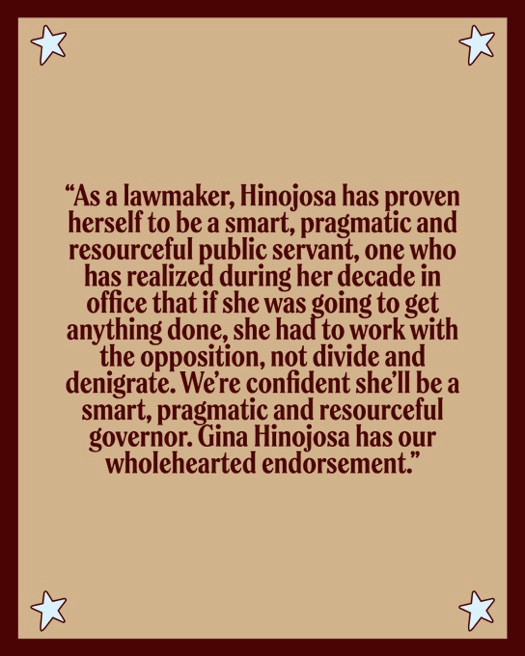
As a lawmaker, Hinojosa has proven herself to be a smart, pragmatic and resourceful public servant, one who has realized during her decade in office that if she was going to get anything done, she had to work with the opposition, not divide and denigrate. We’re confident she’ll be a smart, pragmatic and resourceful governor. Gina Hinojosa has our wholehearted endorsement.
After almost two years of Trump’s second term, we know he is not wiser or more efficient than a democratically elected leader. Indeed, he is most assuredly less wise and less efficient than any democratically elected leader.
He repeatedly makes decisions that drive up prices and impoverish American citizens, while cutting taxes for the richest Americans.
He launches vendettas to pursue and punish anyone he dislikes.
He has built tributes to himself and hung giant flags on government buildings to celebrate his face.
He has virtually destroyed the John F. Kennedy Center for the Performing Arts.
He has gilded the austere and elegant Oval Office by covering it with gold doodads.
He speaks at public events with crude and vulgar language that demeans the Presidency.
He has alienated our allies and honored our adversaries with his fawning friendship and obsequious admiration.
He has attacked and insulted the free press.
We do not need a king or a dictator.
We need leaders who honor the Constitution and uphold the rule of law.
This Saturday is “No Kings” day across the nation.
Find a group standing up for democracy and the rule of law and stand with them. March with them. Honor the best in our ideals.
Tom Ultican, retired teacher of physics and advanced mathematics, writes powerful columns about the value of public schools and the misguided efforts of those who vilify public schools.
In this post, he wonders why Ohio adopted an expansive voucher program without bothering to get the consent of the public. He writes, “Even though vouchers are very unpopular, residents in Ohio will never have the opportunity to vote against them. “
He writes:
At NPE Houston, a woman from Ohio gave me the book Right Down the Drain. It is a product of the Department of Education graduate school at Miami University Oxford, Ohio. In 2023, the state created the EdChoice Expansion Voucher Program which takes more than $1 billion a year away from public education with no audits. I have visited Ohio a few times and really liked what I saw but do not believe it is immune to corruption. Having no oversight for a billion dollars of taxpayer money is bizarre. As Education Professor Thomas Poetter wrote, “… the EdChoice Expansion Voucher Program feels to us like throwing Public money right down the drain?” (Right Down the Drain [RDTD] page 13)
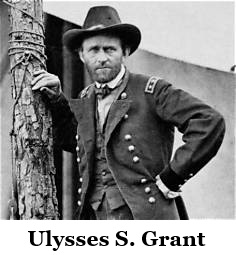
President Ulysses S. Grant saw the Common Schools as a tool to enhance democracy. In his 1875 address to the Army of Tennessee, He stated, “Encourage free schools, and resolve that not one dollar of money appropriated for their support, no matter how raised, shall be appropriated to the support of any sectarian school.” He concluded:
“Leave the matter of religion to the family circle, the church, and the private school, supported entirely by private contribution. Keep the Church and State forever separate. With these safeguards I believe that battles which create us ‘The Army of Tennessee,’ will not have been fought in vain.”
Grant Ignored in Ohio
Curiously, Grant was a Republican born in Ohio. Strikingly, the Ohio GOP of today completely rejects Grant’s admonition. In 1995, Republicans in Ohio’s legislature passed the Cleveland Scholarship and Tutoring Program. A coalition of parents and teachers sued to stop the program because among other reasons it allowed for taxpayer money going to religious institutions. This turned into a protracted legal struggle that saw victories for both sides. Finally, on June 27, 2002, the United States Supreme Court in a 5-4 decision declared that vouchers were constitutional. This opened the door for sectarian institutions to receive taxpayer money.
2023 saw Matt Huffman, one of the most powerful politician in Ohio, push through the billion dollar a year EdChoice Expansion Voucher Program. Huffman comes from the small isolated and shrinking old city of Lima, Ohio. An illustration of his political power is for the first time since the 19th century this politician was able to serve first as president of the Ohio senate and then became speaker of the house with no interruption between positions. The change was forced on him by term limits.
EdChoice’s adoption is an example of authoritarian government in action. Ohio is deeply gerrymandered and even though vouchers are very unpopular, residents will never be given the opportunity to vote against them.
The top 100 schools receiving the most cash for vouchers in Ohio are religious institutions. (RDTD page 51) In fact, 90% of Ohio voucher money is going to religious schools. (RDTD page 75) Even if Ohioans are not Catholic or Hindu, they are sending tax dollars to those institutions. So, the modern Ohio GOP supports sectarian schools and is unconcerned with the separation of church and state.
Maybe we should send taxpayer funds to religious schools but shouldn’t the public have some say in this?
What is the GOP Motive?
In 1955, economist Milton Friedman wrote an essay calling for the creation of a voucher system in America. The political establishment including President Eisenhower, the GOP and Democrats ignored what they perceived as a crackpot. It was Ronald Reagan who gave Friedman credibility in the 1980s which for the first time gave the voucher movement legs. In the early 2000’s, Friedman told the American Legislative Exchange Council that parents should pay for educating of their own children. Today, voucher zealots following Friedman’s lead are working to end taxpayer supported public education. (RDTD page 67) This appears to be the Ohio GOP motive.
Vouchers are a state-designed mechanism for channeling public dollars to private education providers. For the GOP, it is important that this money is provided without state oversight. For example, in June, Democrats put forward the Take the Dough, We Gotta Know Act that calls for state audits and monitoring enrollment, capacity, student demographics, tuition, services offered, and accreditation. This bill is probably already dead because House Speaker Huffman has contended that the fact parents enroll their kids in private schools constitutes accountability, and he is concerned that the bill might infringe on a private business. (RDTD page 77)
A Privatization Outcome
In their essay, Elijah L. Fenwick-Sanders and Anthony W. Rose state:
“When large amounts of public money are permitted to flow through private systems with limited transparency, the risk of corruption increases.”
“Public trust requires more than good intentions. It requires rules, records, audits, transparency and consequences.” (RDTD pages 84 and 85)
If a school does not want public audits, public reporting, nondiscrimination requirements, academic transparency or fiscal oversight it can opt not to accept public funds. That is a reasonable choice.
Support or opposition to vouchers is not a Left-Right situation. Many conservatives support public schools and some liberals support privatization. Emma Errang, who grew up in traditionally conservative Kentucky, bolstered this point in her essay when writing about the 2024 constitutional amendment vote that would have allowed school privatization in her state:
“The coalition against Amendment 2 was not liberal or conservative, nor was it Democrat or Republican. It included progressive voters like me and conservative voters like my father, who believe that choosing private education is a right but not something that should be funded at the expense of public education.” ( page 128)
Conclusion
I side with President Grant when he advised, “Encourage free schools, and resolve that not one dollar of money appropriated for their support, no matter how raised, shall be appropriated to the support of any sectarian school.” I would go a step farther and say that all private schools, not just those from religious institutions, be on their own and receive no taxpayer funding. Of course, the public has the right to support private schools if it desires, but that choice has the potential to undermine public schools and that would be a tragedy.
Reagan’s fraudulent A Nation at Risk report claimed, “We report to the American people that while we can take justifiable pride in what our schools and colleges have historically accomplished and contributed to the United States and the well-being of its people, the educational foundations of our society are presently being eroded by a rising tide of mediocrity that threatens our very future as a Nation and a people.” SAT scores were cited to defend this statement. Seven years later, the Sandia Laboratories in New Mexico found that using proper statistical techniques all groups disaggregated by race and gender showed improved scores in 1983. This is where the ongoing attack on public schools began in earnest and it was based on a fraud.
In America, public education has been a great bulwark for democracy. It is a shared democratic obligation that must be defended from greedy entrepreneurs and misguided social theorists.
It’s easy to get overwhelmed by the daily news if you care about the scandals of the Trump administration. There’s so much happening, so many news stories about corruption. Who can keep count?
Heather Cox Richardson today gives us an account of current corruption scandals. Any one of us could add scandals that she didn’t have room for, like conflicts of interest and profiteering. My example, Presidential pardons. Is it mere coincidence that wealthy donors get pardoned quickly? Is it coincidence that they are relieved of their obligation to repay the people they defrauded?
One thing is sure. The Trump administration is a stark illustration of kakistocracy, corruption, and greed.
There is an old saying about rats and sinking ships. There’s also an old saying about how a democratic system taken over by a single party quickly becomes corrupt because the ruling party lacks oversight. Then, as corruption becomes the party’s driving force, the only people willing to work for it are either corrupt themselves or so unqualified they support the corrupt leadership to gain power, knowing that in a merit-based system it would be entirely out of their reach.
OK, that second old saying is shared mostly among political scientists, but it’s accurate, and it’s right up there with the rats and the ships to describe what’s happening in Trump’s orbit now.
The saga of Kimberly Guilfoyle, who was recently forced to resign from her post as U.S. Ambassador to Greece, continues to expand. Guilfoyle left her post after news broke that she had tried to get a donor, Eric Deters, to pay down her credit card debt. She and her lawyers countered the story by claiming Deters was withholding money she had earned, and said the text messages he shared with news outlets were false.
Guilfoyle dated Don Jr. from 2018 to 2024 and was engaged to him the last four years of that time. Now there are rumors that during her time inside the family as a trusted loyalist, she kept a “burn book” about the family.
While that may or may not be true, the fact that there’s such a threat out there reflects the cracking loyalties of Trump insiders. More to the point might be the video released today by Deters himself, saying that he had launched a lawsuit against Guilfoyle for defamation and that he would depose her and Don Jr. and demand subpoenas to clear his name. He also vowed to play a 16-minute phone conversation tomorrow that he claims has information which “might just bring down the entire Trump administration, an administration which I have supported from Day One.”
Note that the story of Guilfoyle’s alleged shakedown is breaking now, although it happened more than a year ago.
Also in the category of old stories coming to the surface is one reported yesterday by Marc Caputo of Axios. He wrote that Trump’s former lawyer Alina Habba is saying that another one of Trump’s advisors, Ric Grenell, did not deposit her billionaire husband’s $5.6 million donation to the Kennedy Center. According to Habba, Grenell asked that the donation be routed through a $17.6 million payment for a business deal, an accusation Grenell called “absurd.”
Trump appointed Grenell to be U.S. ambassador to Germany and then acting director of national intelligence during his first term. After retaking office, he named Grenell as a special envoy to Venezuela before putting him in charge of the Kennedy Center.
A fight that has been going on for more than a year in the administration broke into the open this morning in a Politico story by Daniel Lippman. He explained that Trump named Italian Paolo Zampolli, a former modeling agent who introduced Trump to First Lady Melania Trump at a party in New York City, as a special envoy at the State Department with a portfolio of cultural diplomacy. But Zampolli apparently ignored that assignment and struck out on his own on a wide range of issues, infuriating Deputy Secretary of State Christopher Landau.
“My number-one boss is the president of America,” Zampolli told James Fontanella-Khan of the Financial Times in April. “I get my instructions from the White House, Commerce and the Department of War…anything to advance the America First agenda.” More than 16 administration officials have been included in the angry email chains Zampolli and Landau have exchanged, which at one point led to communications about the fight with a top-level foreign official.
At one point Zampolli accused Landau of leaking to reporters what appeared to be the story that Zampolli had tried to get custody of his son by asking Immigrations and Customs Enforcement to deport Amanda Ungaro, the boy’s mother. That story created its own scandal when Ungaro, a former model, threatened to expose information about the president and first lady. Landau responded to Zampolli’s accusation, which he sent to more than a dozen other officials, saying: “Your threats and accusations are getting more and more bizarre, defamatory, and inappropriate for broad dissemination on email.”
An administration official told Lippman that the State Department was “generally squeaky clean and professional and above it all.” In contrast, these exchanges were “cartoonish and embarrassing.”
By this afternoon, Lippman had a follow-up story: Zampolli had been fired.
It is not just the current associates of the president who are problematic. Today, news broke that two women have named former Republican representative Matt Gaetz (R-FL), along with his friend former Seminole County tax collector Joel Greenberg and others, in a civil lawsuit, alleging that from 2017 through January 2019, “Gaetz and Greenberg coordinated recruitment, payments, drugs, and travel to obtain commercial sexual acts….”
In 2024, the House Ethics Committee reported that Gaetz “regularly” paid women, as well as a 17-year-old girl, for sex, and bought and used illicit drugs while a member of Congress. Those accusations helped to sink Trump’s nomination of Gaetz for U.S. attorney general in 2025.
Gaetz’s response was hardly a denial: “I look forward to taking the plaintiffs’ depositions because much of the conduct alleged against me is false,” he wrote. “The lawsuit relies almost exclusively on a Congressional Committee Report that didn’t allow me to confront my accusers. Now I will finally have that chance.”
One has to wonder why anyone would want to be part of such a mess, but Trump’s new White House press secretary provides an answer: in a normal administration she would never make it through the door. Trump has described Katie Zacharia as an “attorney,” and she has identified herself as a “general counsel” and seemed to claim she worked as an attorney in China.
But after Judd Legum of Popular Information noted there was no sign she had ever passed the bar exam or been admitted to a state bar, Philip Wegmann and Alexandra Bruell of the Wall Street Journal reported today that, in fact, she failed the California bar exam when she took it. That, itself, is not unusual—the California bar exam is notoriously difficult—but it does mean she is not qualified to call herself an attorney.
Democracy Defenders Fund, a nonpartisan team defending democracy led by attorney Norm Eisen, has asked the State Bar of California and California Attorney General Rob Bonta to investigate whether Zacharia practiced law without a license in California, where doing so is a crime.
Tonight, on his show, Fox News Channel personality Sean Hannity seemed to undercut Zacharia, asking her why she had chosen to describe herself as an attorney when she could just have said she “went to Pepperdine Law School and then took a different career path.” Josh Marshall of Talking Points Memo noted that Hannity’s stance likely reflected that Trump is turning on her.
Rhein Amacher, the man who started a right-wing media frenzy when he claimed to have proof that Democratic Texas Senate candidate James Talarico had sought mental health treatment in Ohio, backed away from that claim today…sort of. Amid suggestions that he might well have run afoul of HIPAA penalties for trying to obtain health information duplicitously, he posted that “this entire situation has been blown completely out of proportion,” and wrote, “As far as I’m concerned, this matter is closed.” Later, in response to a post saying he had lied, he added: “Never lied, I just doubled down on wrong information.”
A blockbuster story by Jonathan O’Connell, Sarah Blaskey, and Aaron Schaffer of the Washington Post today explained that the administration has been able to keep donations for Trump’s ballroom largely secret by using a nonprofit to collect the donations and then channeling that money “into a White House account the president directly controls.”
The reporters gained access to a list of the 57 donors who have committed to giving $100,000 or more to the project. They found that “the vast majority of the funds raised came from companies and wealthy individuals with interests before the federal government.” Large technology companies Nvidia and Apple committed $25 million each. Microsoft, Palantir, and Lockheed Martin pledged $10 million each.
Individuals on the list who are associated with Trump include Commerce Secretary Howard Lutnick’s son Brandon, chair of investment bank Cantor Fitzgerald, who contributed stock worth more than $2.5 million, and the U.S. ambassador to the Netherlands, Republican donor Joseph Popolo Jr., and his wife, who gave $1 million. Missing from the list is Trump himself, who claimed he would be helping to pay for the project.
Sarah Longwell of The Bulwark was right when she called the ballroom being constructed where the East Wing of the White House used to be “a monument to corruption” built by “a corrupt American president.”
On Tuesday, Charles Gorrivan, Lydia Beyoud, and Nicola M. White of Bloomberg reported that on March 23, a few traders placed billions of dollars of contracts predicting that the price of oil would fall just 15 minutes before Trump posted on his social media platform that he had changed his mind about striking Iranian power plants. The deals were worth billions, and analysts from the U.S. Commodity Futures Trading Commission (CFTC) flagged the traders and the deals and sent a referral to the Division of Enforcement to decide whether to open an investigation into insider trading. But in a virtually unheard-of move, the administration asked the CFTC to withdraw the referral.
The journalists note both that there have been many trades apparently tied to Trump’s announcements and that between a 20% cut to CFTC staff during Trump’s second term and the agency chair’s vow to curb “over-zealous regulation,” enforcement actions have dropped dramatically from the numbers during the Biden administration.
Steven Portnoy and Katherine Faulders of ABC News reported today that the White House is claiming that all Trump’s conversations about plans to renovate the Kennedy Center are covered by executive privilege and therefore can be kept secret. This is a dramatic expansion of the concept of executive privilege, which enables the president to shield conversations with key advisors from public scrutiny, extending it to consider virtually all conversations private.
Apparently in anticipation of Democratic investigations, Attorney General Todd Blanche issued a memo as soon as he took office, claiming presidents can shield “presidential communications with private advisers so long as the communications relate to official presidential decisionmaking.”
A new Fox News poll released today showed that voters’ top concern is “corruption in government,” with 88% worried about it compared to 12% who are not. Corruption tops even “inflation and high prices,” which comes in at 85%, and “gas prices,” which concern 83% of voters.
In a conversation with Rob Finnerty of Newsmax, aired tonight, Trump suggested he would pardon everyone in the administration, including himself, to make sure none of the people around him have to “go through years of nonsense, hire lawyers and everything else, all for nothing.”
It is no wonder that Republicans eager to stop Trump are backing Democratic candidates for the midterms. Today 58 Republicans and Independents in New Hampshire declared their support for the Democratic Senate candidate, Representative Chris Pappas, over Republican candidate John Sununu. Those supporters include Don Bolduc, who was Trump’s pick for the Senate in 2022 but who lost to Democrat Maggie Hassan by 9 points after he embraced Trump’s claim to have won the 2020 election.
One of the Republicans supporting Pappas told Kevin Landrigan of the New Hampshire Union Leader: “Donald Trump has turned the Republican Party into something I no longer recognize.”
Amanda Ungaro, the Brazilian model and former U.N. ambassador who roiled First Lady Melania Trump in April by threatening to expose unspecified information she has on President Trump and the First Lady, is apparently talking to the House Oversight Committee…
Voter suppression is active in Texas. In Tarrant County, where the city of Fort Worth is located, the Republican members of the county election commission voted to close 92 polling places. Many are located in districts that are black, Hispanic, or low-income. The vote of the commission was 3-2 to cut the number of polling places, with three Republicans outvoting two Democrats.
Tarrant County will not be required to restore nearly 100 polling places that county officials cut, a judge ruled Tuesday, dealing a setback to voting rights advocates and minority groups weeks before a high-stakes midterm election.
District Judge Patrick Gallagher did not provide a reason in his one-page decision, handed down after a day of testimony from voters and county officials.
The ruling was in response to a lawsuit filed earlier this month that argued the cuts disenfranchise Tarrant County voters, with the heaviest burden falling on Black and Hispanic communities.
Four women — city councilwoman Deborah Peoples, former city councilwoman Kathleen Hicks, and retired judge Maryellen Hicks, who are all Black, and Fort Worth ISD trustee Camille Rodriguez, who is Hispanic — filed the suit.
“Tarrant County is eroding the right to vote,” Susan Hutchison, an attorney for the plaintiffs, told the judge Tuesday.
After the ruling, attorneys for the plaintiffs noted the judge denied the request but did not dismiss the lawsuit outright as requested by the county. That means the case could return to court, albeit after the election. The judge also did not weigh in on whether the cuts were discriminatory.
“We have to redouble our efforts to make sure everybody votes,” they said in a statement.
Tarrant County officials did not immediately respond to requests for comment from The Dallas Morning News.
The four women told the judge Tuesday they worried the cuts would mean longer commutes and waits to cast a ballot and lower voter turnout on Election Day, particularly in low-income and minority neighborhoods.
For example, in 2022, the 76103 ZIP Code, a predominantly Black and Hispanic neighborhood in East Fort Worth, had three polling places. All three were cut this November. [Emphasis added]
In the 76115 ZIP Code, which is largely Black and Hispanic in south Fort Worth, four of the five polling places were cut. [Emphasis added.]
Maryellen Hicks, 77, said she has mobility issues and worries she will be unable to stand in a long line. Her longtime voting site was among those cuts. Asked where she planned to vote, Hicks replied, “I have no earthly idea, quite seriously.”
Tarrant County Election Administrator Clint Ludwig, who drafted the list of polling placesto cut, acknowledged that he did not assess how the reductions would affect Black and Hispanic or low-income voters, who are less likely to have reliable transportation. He also testified that he did not seek input from Black or Hispanic organizations about the reduction.
Ludwig said he considered several factors, such as site availability, previous voter turnout, distance from other polling places and handicap accessibility.
The elections official repeatedly said it would be impossible to add polling places at this point, although he did say the county keeps five to 10 back-up options that could be added if necessary.
Early voting starts Oct. 19, and Election Day is Nov. 3.
County commissioners voted last month 3-2 over the objections of dozens of residents to cut 92 Election Day voting sites, from 316 in 2022 to 224 on Nov. 3. It also cut early voting sites from 50 to 47.
Yet Ludwig said he expects roughly 40% more voters this year than in 2022.
Tarrant County Judge Tim O’Hare and commissioners Matt Krause and Manny Ramirez, all Republicans, voted for the proposal. Democratic commissioners Alisa Simmons and Roderick Miles voted against the proposal. O’Hare and Simmons are both running for county judge.
Republicans said the move saves money and improves efficiency. O’Hare called the plan sensible and said that “no Tarrant County voter should feel they don’t have enough time to vote.”
Recently, superstar journalist Nikole Hannah-Jones wrote a long essay for The New York Times Magazine regretting her decision a decade earlier to put her daughter into a local public school in New York City. Not only was the school segregated, it had a disengaged principal, indifferent teachers, and low-quality academics. She came to realize that she was imposing her ideas on her daughter at the cost of her education. Now that her daughter is in high school, she is attending a highly desirable high school with high standards. Hannah-Jones told her daughter to make her own choice within the public school system. She chose an excellent public school.
There’s hardly a commentator who has not passed judgment on the essay. Right-wingers praised it as an endorsement of school choice or a condemnation of public schools. Former NYC Chancellor wrote in The Wall Street Journal that the persistence of bad public schools was the fault of Randi Weingarten and the teachers’ unions. His article was titled “Nikole Hannah-Jones Vs. Randi Weingarten.” He maintained that it was the unions that preserved bad schools. The solution, he argued, was non-union charter schools.
But his argument dodged the responsibility of school leaders like himself to weed out incompetent principals and replace them with good principals who set high expectations for staff and students. And, of course, he neglected the failure of thousands of charter schools, due to academic failure, misappropriation of funds, or low enrollment.
In the following essay posted on his blog,Cloaking Inequity, scholar Julian Vasquez Heilig presents a different argument. In addition to his professorship at Western Michigan University, he is a founding member of the Network for Public Education.
He writes:
Nikole Hannah-Jones’s essay about her daughter’s education is heartbreaking because it poses a question almost every parent understands: Did I make the right choice for my child?
Hannah-Jones made the choice more publicly and politically than most. A decade ago, she and her husband sent their daughter, Najya, to a predominantly Black, high-poverty public school in Brooklyn. They could afford other options. Instead, they wanted their own choices to reflect their belief that privileged families help reproduce educational inequality when they abandon schools serving poor Black children. Then their daughter grew old enough to judge that decision for herself.
“Did you know my school was bad like this when you decided to put me here?” Najya asked her mother after discovering how her middle school compared with New York City’s most prestigious public schools. Later, she put the question even more painfully: If her parents had the resources to get her a better education, why hadn’t they? That is not really a question about school choice. It is a question about parenthood.
Every parent makes these tradeoffs, although few of us have to explain them in The New York Times. Families choose schools because of academics, income, housing, sports, religion, culture, race, language, safety, disability services, discipline, transportation, friendships, family traditions and often simply what they can afford. Rarely does one school maximize everything a family values.
A parent might choose a Seventh-Day Adventist school with fewer Advanced Placement courses because faith formation matters deeply. Another might choose a suburban school for its academics but watch a Black child struggle culturally. A family might remain in a less prestigious district because grandparents live nearby. An athlete may choose a school because of a coach or a starting opportunity. A parent of a child with disabilities may value services more than test scores. Another family may choose a culturally affirming school where their child feels known. None of those choices can be reduced to a ranking on GreatSchools.
That is partly what makes Hannah-Jones’s conclusion so complicated. Najya did experience serious academic failures. Her elementary school sometimes failed to assess her properly, return graded work or even recognize substantial gaps in her mathematics preparation. Her mother eventually discovered assignments riddled with mistakes that had never been corrected. Those are not imaginary problems created by standardized tests or middle-class expectations. Children deserve competent teachers, rigorous instruction and honest feedback.
My own research has found that teacher preparation and teacher quality matter (Darling-Hammond et al., 2005). Defending public education should never require pretending otherwise. But an educator responding to Hannah-Jones’s essay on Facebook raised the concern that has stayed with me: the article can leave readers “to blame structural problems on the usual scapegoats who never had the power to create them.” That is where I think we need to be careful.
Hannah-Jones herself provides the evidence for a more structural conclusion. Najya’s middle-school principal explains that her school enrolled everyone, including children arriving years behind academically, while selective schools concentrated students already prepared to succeed. More than one-third of students at Najya’s middle school had identified learning disabilities, compared with 17 percent at her selective high school. The school was simultaneously expected to remediate years of lost learning, teach grade-level material, manage social and behavioral needs and prepare its strongest students for elite high schools.
That is not simply a teacher-quality problem. It is institutional sorting. My research has documented versions of this dynamic for two decades. Jennifer Holme and I found persistent racial, economic and linguistic segregation long after Jim Crow formally ended (Vasquez Heilig & Holme, 2013). My colleagues and I later found intense racial segregation in charter schools as well, reminding us that giving families more choices does not automatically dismantle inequality (Vasquez Heilig et al., 2019). Research on accountability similarly showed how schools serving marginalized students can be punished for outcomes produced partly by unequal opportunities to learn (Vasquez Heilig & Darling-Hammond, 2008; Vasquez Heilig et al., 2018).
School finance matters too. Davíd Martínez and I have argued that educational opportunity is fundamentally a civil-rights question because children cannot be held equally accountable when they have not been provided comparable opportunities to learn (Martínez & Vasquez Heilig, 2022). This does not absolve the adults who failed Najya. It changes the scale of the indictment. So Hannah-Jones’s story ultimately demonstrates why the parental decision is harder than “choose the better school.”
Najya eventually chose one of New York City’s highly selective public high schools. Academically, she initially struggled because her previous schooling had left gaps. But there was another cost. She had gone from Black schools where, as Hannah-Jones writes, nobody questioned whether Black children could be smart to an environment where classmates used racial slurs and questioned her intelligence. She briefly wanted to leave.
By the end of the essay, Najya herself recognizes the tradeoff. She tells her mother she is glad she did not spend her early childhood in predominantly white schools because her Black schools helped give her a strong racial identity and the confidence to challenge racism. She had also discovered something important about her more privileged classmates: They were not necessarily smarter or better behaved. “They just had more.” That may be the most important sentence in the essay.
Parents make choices. Systems distribute what there is to choose from. Honestly, I personally understand Hannah-Jones’s regret. When your child says, “I never really got the education I wanted,” intellectual arguments about the common good become painfully inadequate. I have heard that same argument from my children. Parents have a special obligation to their own children, and there is no shame in acknowledging that. But we must resist those who are turning this deeply personal story into another argument that the solution to educational inequality is for parents to make better individual choices via vouchers and charter schools. That road leads exactly where we already are.
Families with money purchase tutoring. Families with information navigate admissions systems. Families with mobility purchase homes near preferred schools. Families with social capital advocate successfully. Families without those advantages receive whatever the system leaves behind. The problem is not that parents love their own children too much. The problem is that we have constructed a competitive education system where high-quality education is rationed and doing the best for one’s own child can require leaving other children behind.
The goal should therefore not be to tell parents which sacrifice to make. Choose academics over culture. Choose integration over belonging. Choose religion over coursework. Choose athletics over proximity. Choose the collective over your child. Those are family decisions, and reasonable parents can weigh them differently. Our public responsibility is different. It is to make the consequences of those choices less brutal.
Conclusion
I should also say that I have long admired Nikole Hannah-Jones and her work. I first met her in Oakland in 2017 at the Network for Public Education conference, and I have been a fan of her scholarship and journalism (see photo). That is part of why her essay stayed with me. I read it not as an argument to defeat, but as an extraordinarily difficult question posed by a parent whose choices illuminate the choices millions of families are forced to make.
A Black child should not have to choose between cultural affirmation and rigorous academics. A poor child should not have to attend school with less because her parents earn less. A student should not need admission to a selective school to encounter advanced mathematics. And teachers in high-poverty schools should not be expected to repair years of accumulated inequality while working with fewer resources and then be blamed when they cannot perform miracles.
Hannah-Jones asks whether fighting for every Black child meant betraying her own. I think her essay points to this conclusion: There was never a perfect choice available. That is the real indictment. And it is not an accident. For generations, American education policy has created and maintained systems in which access to rigorous coursework, experienced teachers, enrichment, safety, social capital, and opportunity too often follows race, wealth, and geography. Parents are then asked to make intensely personal choices inside inequalities they did not create.
The question, then, is not whether Hannah-Jones made the right choice for her daughter, or whether another family would have been more virtuous for choosing differently. The harder question is why we continue to tolerate the American education system that makes families choose among things every child should receive together.
Reverend Benjamin R. Hegseth recoiled when he heard that Secretary of Defense Pete Hegseth planned to create a new religious agency within the military.
Here is why:
Hello my friends,
Given recent events, I wanted to send out this newsletter to you today and reflect on them.
On September 30th during his “State of the Force” address, Defense Secretary Pete Hegseth announced the creation of the Pentagon’s new Office of Religious Affairs. As of the writing of this post, no individual has been publicly named or announced to head this office.
According to Hegseth, the office will give military chaplains a “direct line” to him without “staff filters” and “bureaucratic dilution” that he characterized as an impediment to meeting service members’ religious needs.
“The experts, our chaplains, will finally have an advocate at the highest levels,” he said. “Policy and resources will serve the mission, not smother the mission.” “Accordingly, our department, therefore, has a sacred duty, first class religious support wherever we send our warriors,” he said.
He ended this announcement by saying, “as Psalm 33:12 extols us, “blessed is the nation whose God is the Lord.”
Mikey Weinstein, founder and president of the Military Religious Freedom Foundation, told USA TODAY on Oct. 1 his organization “condemns in the strongest terms” what he called Hegseth’s “immoral, unethical and unconstitutional actions” that, in his view, violate the First Amendment ban on the government “respecting an establishment of religion, or prohibiting the free exercise thereof.”
He said his organization would continue working to combat what he alleged was “Christian nationalist bigotry, hatred and prejudice” in the military until “fundamentalist Christian religious extremism is forever eradicated.”
I think it’s easy to shrug off Pete Hegseth for many, or even see this as a good move for “religious freedom,” but I just want to put this move in the context of Christian history, which causes me to agree with Mikey Weinstein.
When nationalist political leaders in the past have created a position that oversees the religious aspects of the military that answers directly to that leader, the goals are often deeply disturbing.
Let me give you just a few examples.
Under the Romanov autocracy, the Russian Tsar ruled by “divine right”. In 1721, Peter the Great abolished the independent patriarchate of the Russian Orthodox Church and replaced it with The Most Holy Synod, a government department headed by a secular government official who was appointed directly by the Tsar.
This effectively turned the clergy into a branch of the state bureaucracy. The Tsar appointed a Protopresbyter of the Army and Navy to oversee all military chaplains. These chaplains were tasked with preaching absolute loyalty to the Tsar, ensuring soldiers took their holy oaths of allegiance, and reporting any political subversion within the ranks directly back to the autocracy.
While the Soviet Union was officially an atheist state, it provides one of the most explicit example of an authoritarian regime appointing officials to manage the “spiritual” and ideological affairs of the military. After the 1917 revolution, Leon Trotsky and the Bolshevik leadership established political commissars. These commissars were unified under the Main Political Directorate of the Soviet Army and Navy.
Historians often note that commissars acted as a direct substitute for military chaplains. Instead of theology, they enforced Marxist-Leninist ideological purity.
However, during World War II, facing an existential threat from Nazi Germany, Joseph Stalin temporarily reversed his harsh anti-religious policies. He personally met with church leaders and sanctioned a revival of the Russian Orthodox Church to boost wartime morale. He permitted the church to collect funds for tank columns and bless troops, intentionally co-opting religious fervor to serve state military goals.
When Adolf Hitler consolidated power, his regime sought to co-opt and control Germany’s fragmented religious landscape. In 1935, Hitler appointed Hanns Kerrl as the Minister for Church Affairs, tasked with forcibly aligning the Protestant and Catholic churches with Nazi ideology, a process known as Gleichschaltung (coordination). Within the military, the regime kept a tight grip on religious personnel.
Hitler also appointed Franz Justus Rarkowski as the Catholic Field Bishop of the Wehrmacht. Rarkowski was a fanatical supporter of the regime who used his office to issue pastoral letters telling German soldiers that fighting for the Führer was a holy duty blessed by God, ensuring that religious service members did not develop a crisis of conscience while carrying out aggressive warfare.
Following his victory in the Spanish Civil War, General Francisco Franco established a highly centralized, right-wing authoritarian regime deeply intertwined with the Catholic Church, a system often termed “clerical fascism”.
Franco secured a concordat with the Vatican that granted him the right to nominate Spanish bishops, ensuring only politically loyal clergymen were appointed. He revived the Military Vicarate, appointing a Military Archbishop to run the spiritual affairs of the armed forces. Under Franco’s oversight, military chaplains held officer ranks and were integrated into the command structure to ensure the military remained a staunchly conservative, nationalist, and religious pillar of the state.
A foundational pillar of American democracy is a civilian led apolitical military. Service members swear an oath to support and defend the Constitution, rather than a specific leader, political party, or religious text.
Just as historical regimes used religion or political commissars to bind the military’s loyalty directly to the ruler’s ideological vision, our concern should be that the explicit Christian nationalist and fundamentalist views Hegseth adheres to could be used to redefine military loyalty. If defending the nation is conflated with defending a specific cultural or religious identity, the military, full of people with different beliefs, could be a place of infringement of religious liberty, causing deep division, impeding military readiness. Military promotions could be based on ideological loyalty rather than qualifications, which is ironic given Hegseth’s consistent comments about “merit based” institutions. And most disturbingly, the military could be weaponized for domestic political, ideological, and religious purposes, undermining its historical role as a neutral defender of the entire populace. Time will tell what course this move will take us.
Given this administration’s continued push for consolidating power in every sector of government and society, this move within the department of defense should be deeply troubling for every American and Christian in America.
As a Christian in America myself, I unequivocally believe that Christianity doesn’t need political privilege or military power.
It needs less arrogance.
It needs less entitlement.
It needs less animosity towards those who are different.
It needs more humility.
It needs more generosity.
It needs more compassion and understanding.
It needs more Jesus.
It needs to be vocal about the separation of church and state rather than any selfish insistence that our country must favor our religious group above all else.
The reason I don’t want a “Christian nation” isn’t because I’m against Christianity. It’s because I’ve studied church history and learned about the horrors caused by the church crawling into bed with the empire. Separation of church and state doesn’t just help protect religious freedom, it helps keep Christianity Christian rather than becoming an empire.
Nationalism keeps telling us Christians to take up our swords and make our nation “Christian” by any means necessary.
Jesus keeps calling us Christians to take up our crosses and be like him, serving the world through grace, humility, compassion, and self sacrificial love.
In the Public Interest is an organization devoted to protecting the public interest. We live in an era when the public sector is at risk of being privatized, so that private sector organizations can extract profits. This project is reflected in the privatization of hospitals, vegetarian practices, nursing homes, retirement communities, private homes, and any other opportunity to turn a profit. All too often, the private owners drain their prize of profit, bankrupt them and move on.
This is happening in public schools, where entrepreneurs have persuaded many cereal and state officials that they can run schools better and for lest cost than educators.
The public has NEVER approved a voucher program yet they are being passed by state legislatures, adopted despite parents’ opposition. Now comes a federal voucher program, which mainly subsidizes the tuition of students in private and religious schools. Some public schools kids take a voucher, but whatever comparable data exist, the children lose ground compared to those who attend the public school they abandoned.
For every student who leaves public schools, the school must make cuts. Will it be sports, recess, the arts, or larger class size?
It’s basically a lose-lose situation: the public schools lose students and funding. The voucher achools hire uncertified teachers and are unable to match the certified teachers in the public school.
New proposed regulations released for public comment regarding the federal tax credit school voucher program have done nothing to alleviate concerns that the federal program—a tax program administered through the Treasury department—will further undermine public education in the United States.
“Not only is the program not in the best interest of the nation’s school children, it’s not in the best interest of the nation itself,” says Shar Habibi, executive director and research director of In the Public Interest, a national research and advocacy organization that explores the role of privatization of public things, including education.
“To our school children we owe the best possible education, and this lets them down,” she says. “Nothing about this program suggests that supporting and improving academic and educational outcomes for children–especially our most vulnerable children–were considered in its development. The fact that it is—as even supporters state—“a tax law…not an educational program” tells you what this legislation was always about: a subsidy for wealthy families who already send their children to private schools.”
In the Public Interest has long been opposed to school vouchers at every level.
“School vouchers have never been in the public interest,” says Leigh Dingerson, senior fellow at In the Public Interest. “They offer taxpayer dollars to private and religious schools, draining resources for our public schools. Where public schools are and have always been ‘the great equalizer,’ vouchers only divide us.”
Habibi points out that the problems with vouchers go beyond the schoolhouse.
“Vouchers put the nation as a whole at risk. A strong, nationwide system of public schooling is essential to a thriving democracy and a robust economy.”
While President Trump promised to “return education to the states,” this program in fact denies states the ability to choose how to ensure — as every state constitution requires — that all children have access to a quality education, free of charge.
Under this program, multi-million-dollar organizations can collect donations and hand out school vouchers in virtually any state in the country that agrees to participate, with little oversight from state policymakers or voters and with no regard to the state’s history or vision for providing public education to its children.
This federal school voucher program will, over time, lead to the decimation of our nation’s system of public schools. ITPI’s already-stated position that all states decline to participate in the program has not changed with the release of these new regulations.
The Network for Public Education is dedicated to the preservation and improvement of public schools. Public schools are a foundation stone of our democracy. Nearly 90% of American students are enrolled in public schools.
Every community needs high-quality public schools but diverting public money to private alternatives weakens public schools.
Public money should be spent in public schools.
The Trump administration does not like public schools. It encourages public funding for religious schools, vouchers, charter schools, for-profit schools, and home schools. Research and experience teach that these alternatives choose their students and they discriminate. And they get worse academic results than public schools.
Voucher schools are free to reject students with disabilities. Unlike public schools, students in special education have no rights.
Do not fall for the machinations of the Trump regime against public schools. Their intentions are not good. They loathe public schools, the schools that educated 90% of all Americans and created the greatest nation in the world.
From NPE executive director Carol Burris:
October 2, 2026
The Network for Public Education Urges Governors Not to Opt-in to the Federal Voucher Program
On October 1, the U.S. Treasury Department released regulations for the federal tax creditvoucher program that was slipped into the One Big Beautiful Bill Act and pushed through reconciliation.
The rules confirm that this program will advantage sending public dollars to private and religious schools, including schools that freely discriminate. Governors must decide whether to opt-in by January 1.
We make our recommendation that states not opt-in based on the following:
Opting in allows federal tax dollars to fund discrimination against children.
When a state opts in, federal tax dollars can flow to private and religious schools and other providers that discriminate against students based on disability, academic challenges, LGBTQ status, or religion. States are expressly forbidden from adding protections of their own.
Opting in pushes cash-strapped public schools toward “pay to play.”
The regulations allow scholarships for public school students to cover services such as tutoring or extra special education services. However, nothing in the regulations stops public schools from turning programs they now fund into paid services that would require families to scramble to cover with scholarships.
A struggling district could convert elementary band, middle school art, or high school SAT prep into programs paid for with these vouchers. Here is the catch: to do that, the district must first charge parents. Some students will get a voucher. Others will not. Children whose parents cannot pay will be shut out.
This moves us one step closer to libertarian Milton Friedman’s vision, in which parents pay to educate their children and public education disappears. Make no mistake. This has been the far right’s goal for decades.
Opting in now creates a blind commitment to a program designed by those who actively undermine public schools.
At this point, the regulations are not final nor has Treasury released its Guidance regarding what expenses will be eligible under the program. That Guidance is expected “by the end of the year,”according to Kevin Salinger at Treasury. Without the Department’s Guidance for what qualifies as an eligible expense, a governor may opt-in, only to find out that virtually any spending that makes its way to public schools or districts has been disallowed. And then they’re stuck, because it’s clear that once in, states cannot back out until the following year.
Opting in fuels the growth of schools without rules.
As privatization has expanded, NPE has documented the fraud, abuse, and chaos that charter and voucher programs have produced. Dangling more tax dollars with few restrictions will draw more bad actors into education, opening low-cost, experimental schools that mislead parents and shortchange children.
States cannot block money from flowing to schools with poor fiscal or academic records. They cannot require public reporting on how funds are used or which students are served. They cannot add safeguards against waste and fraud.
Opting in adds to an unsustainable federal deficit.
Treasury projects that by 2030 the program could cost $26 billion a year in lost federal revenue.
That is more than Title I or IDEA, the largest federal programs supporting public schools.
Opting in will drain donations from charities American families depend on.
Large, respected charities like St. Jude Children’s Research Hospital, and smaller ones that fund suicide prevention centers and domestic violence shelters, will now compete with a program that offers a dollar-for-dollar tax credit instead of a deduction. In an affordability crisis, donors will be drawn to giving that returns their entire contribution.
We encourage friends of public education to act today. Write your governor with a simple message: Do not opt our state into the federal voucher program. Then urge your members of Congress to repeal it. Join the millions of Americans who treasure public education and recognize this voucher program for what it is—a stealth attempt to destroy our beloved public schools.