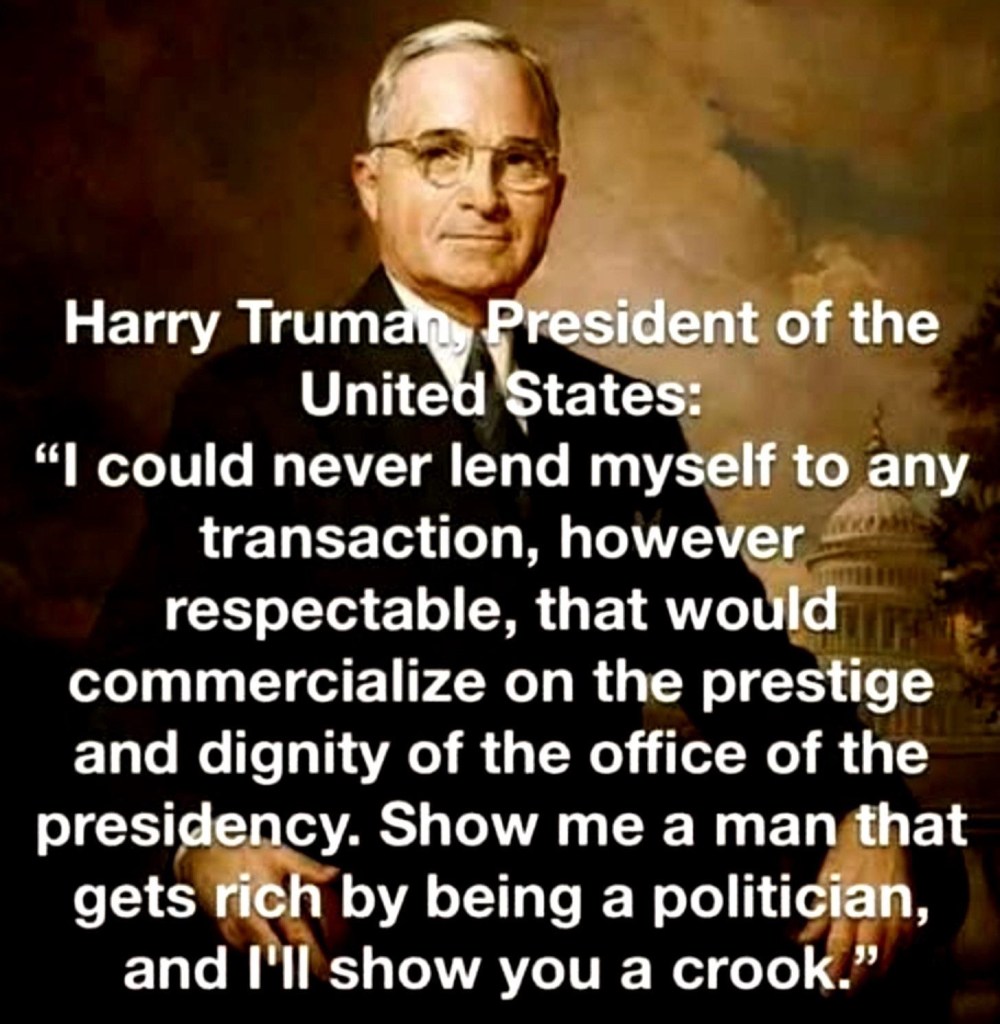
Tim Dickinson, senior political writer for The Contrarian, compiled a list of things and places on which Trump has plastered his name: public buildings, our currency, and much more. Before he became President, he sold Trump steaks, Trump airlines, Trump vodka, Trump University, Trump hotels, Trump golf clubs, and much more. His ego is a giant hole that can never be sated.
Dickinson wrote:
Like fragile strongmen everywhere, Donald Trump wants to plaster his name and likeness in as many official places as possible.
Toxic narcissism has led Trump on a crusade to rebrand navy ships, federal buildings, and international airports in his own honor, as well as to splash his face on everything from immigration documents to national park passes to banners draped outside of federal department headquarters. If Trump gets his way, he’ll soon get his face on a gold coin, his signature on U.S. currency, and — who knows — maybe even an NFL stadium named for him.
Below, we survey Trump’s precedent-busting exercise in egocentric excess.
Trump has just unveiled plans for a new monument in Washington, D.C. — a 250-foot-tall “Triumphal Arch” that would sit across the Potomac from the Lincoln Memorial. The gaudy, ginormous arch has been pilloried as the Arc de Trump (a play off the Arc de Triomphe in Paris). When asked by a reporter in October who the monument is for, Trump replied simply: “Me.” The arch will reportedly be financed with at least $15 million in taxpayer funds.
In December, Trump appended his name to what is now The Donald J. Trump and the John F. Kennedy Memorial Center for the Performing Arts. Trump’s cronies on the Kennedy Center board approved the clunky name change; and the institution’s signage and website have been updated to reflect the cultural vandalism. (After high profile artists began boycotting the venue, the Tump-Kennedy Center has now shuttered for a two-year, $275 million overhaul.)
After initially seeking to dismantle the nation’s peace institute, and sending DOGE goons there to seize the building, Trump decided in December to rebrand the “bloated, useless entity” as the Donald J. Trump Institute of Peace. Trump took this action shortly before he made a hard pivot to war, launching an unprovoked regime-change strike on Venezuela in January and then an illegal war with Iran in March.
In a preview of his bellicose streak, Trump announced the development of a new type of guided-missile battleship in December — branded as the “Trump Class” and billed as “the most lethal warship to ever be built.” Plans call for launching as many as two dozen of these ships, which would comprise what Trump touts as a “Golden Fleet.”
PORTS
Palm Beach International Airport
(White House photo of Air Force One in Palm Beach)
The airport closest to Trump’s compound at Mar a Lago will now be known as President Donald J. Trump International Airport. Florida’s loyalist GOP governor Ron DeSantis signed legislation in March directing the name change to go into effect in July. Separately, a road leading to the airport has also been rebranded President Donald J. Trump Boulevard.
Trump wants richer immigrants, and the administration has rolled out a red-carpet path to citizenship — in exchange for a cool $1 million contribution to the Treasury. These immigrants obtain a gilded document known as the Trump Gold Card with Trump’s face and signature on it, and a promise that it will enable holders to “unlock life in America.” (A platinum card is supposedly under development.)
Seeking to put his brand on healthcare, Trump launched Trump Rx, a discount program that touts “most favored nation” pricing for pharmaceuticals — purporting to make them as cheap as what foreign countries pay. The New York Times has found that when it comes to Trump Rx, “the reality does not match his hyperbole,” and the program has been criticized for pushing brand-name drugs for which cheap generics already exist, while providing little improvement over existing private-sector discount programs like GoodRx.
Through his “Big Beautiful Bill,” Trump slapped his name on a new retirement account for infants. With Trump Accounts the federal government will put $1,000 in seed money into an IRA created on behalf of children born from 2025 through 2028.
PARKS
National Parks Pass
If you want to vacation a America’s crown jewel national parks you’ll now have to contend with Trump scowling at you every time you flash your America the Beautiful annual pass. (Trump also announced free admission to parks on his birthday, while revoking free admission on Martin Luther King Jr. day and Juneteenth, because racism.)
Trump wants to put his autograph on American currency. In March, the Treasury Department announced a plan to print Trump’s signature on legal U.S. tender. “There is no more powerful way to recognize the historic achievements of our great country and President Donald J. Trump than U.S dollar bills bearing his name,” said Treasury Secretary Scott Bessent.
Gold Coins
Flattering a president whose love for gold has seen him transform the Oval Office into a gilded fever dream, the U.S. Mint has unveiled a design for a gold Trump coin, that features a joyless likeness of Trump looking like he needs more fiber in his diet.
BANNERS
Adding to the official cult of personality around Washington, D.C., banners of Trump’s visage have been hung at the Department of Justice…
Trump recently unveiled the design for his skyscraper, the Trump library — billed to be the tallest high-rise in Miami. The “library” may also double as a hotel.
The naming spree may have only just begun. Trump has also lobbied to have the following renamed for his glory:
New York Penn Station
Washington Dulles Airport
The new stadium for the NFL’s Washington Commanders. (That would surely be a beautiful name,” said Trump spokesperson Karoline Leavitt.)
Tim Dickinson is the senior political writer for The Contrarian.
Robert Reich has selected the Supreme Court Justice whom he believes is the worst in modern history. The two likeliest nominees are clearly Samuel Alito, who wrote the decision that reversed Roe v. Wade and that is responsible for the deaths of many women who were unjustly denied medical care because of Justice Alito.
But no, he chooses Justice Clarence Thomas. In this post, he explains why.
Friends,
I’ve long assumed that Samuel Alito was the worst.
Alito — who authored the majority opinion in Dobbs v. Jackson Women’s Health Organization (2022), the case that ended constitutional abortion rights by merely asserting that the high court’s prior opinion in Roe v. Wade (1973) was wrongly decided; who accepted a 2008 luxury fishing trip to Alaska, including private jet travel, from hedge fund billionaire and GOP donor Paul Singer yet failed to disclose it on Alito’s financial forms and didn’t even recuse himself from decisions involving Singer’s subsequent business before the Supreme Court; who hoisted an inverted American flag outside his Virginia home shortly after the January 6 Capitol riot, a symbol of support for Trump’s false claims of a stolen 2020 election — has the moral and intellectual stature of a poisonous toad.
But I’ve come to revise my view of the court’s worst Justice.
Clarence Thomas is 77 years old. He has now served on the Supreme Court for over 34 years, making him the longest-serving member of the Court. He is a bitter, angry, severe hard-right, intellectually dishonest, ideologue. After reading his latest thoughts on America, I’ve concluded Thomas is even worse than Alito.
Last Wednesday, Thomas gave a rare public address at the University of Texas in Austin that began as a banal tribute to the Declaration of Independence before degenerating into a misleading screed against progressivism.
“At the beginning of the twentieth century, a new set of first principles of government was introduced into the American mainstream,” Thomas intoned. “The proponents of this new set of first principles, most prominently among them the twenty-eighth president, Woodrow Wilson, called it progressivism.”
Thomas went on to blame progressives for the worst crimes of the 20th century, insisting that “Stalin, Hitler, Mussolini, and Mao” were all “intertwined with the rise of progressivism,” as was “racial segregation,” “eugenics,” and other evils.
This is pure rubbish.
In reality, America’s Progressive era emerged at the start of the 20th century from the corruption and excesses of America’s first Gilded Age (we’re now in the second, if you hadn’t noticed) — its record inequalities of income and wealth, its “robber barons” who monopolized industries and handed out sacks of money to pliant legislators, it’s dangerous factories and unsafe working conditions, its violent attacks on workers who tried to form unions, its corporate control over all facets of government, its widespread poverty and disease, and its corrupt party machines.
In many ways, the Progressive Era — whose most prominent leader was Republican president Theodore Roosevelt, not Woodrow Wilson, by the way — saved capitalism from its own excesses by instituting a progressive income tax, an estate tax, pure food and drug laws, and America’s first laws against corporate influence in politics.
Then, under Teddy Roosevelt’s fifth cousin (Franklin D.), came Social Security, the 40-hour workweek (with time-and-a-half for overtime), the right to form unions, and laws and regulations that limited Wall Street’s ability to gamble with other people’s money.
Clarence Thomas got it exactly backwards. Had we not had the Progressive Era and its reforms extending through the 1930s, America might well have succumbed to fascism — as did Germany under Hitler, and Italy under Mussolini, or to communist fascism, as did Russia under Stalin. Progressive and New Deal reforms acted as bulwarks against the rise of fascism in America.
In fact, it’s been the demise of such reforms since Ronald Reagan that have opened the way to Trumpian neo-fascism.
Over a third of American workers in the private sector were unionized in the 1950s, giving them bargaining leverage to get higher wages and better working conditions. Now, fewer than 6 percent are unionized, which has contributed to the flattening of wages, a contracting middle class, inequalities of income and wealth rivaling the first Gilded Age, and an angry and suspicious working class that’s become easy prey for demagogues.
Wall Street has been deregulated — allowing it to go on gambling sprees such as the one that produced the financial crisis of 2008, which claimed millions of working peoples’ homes, savings, and jobs.
America’s social safety nets have become so frayed that almost a fifth of the nation’s children are now in poverty. Yet Reagan, George W. Bush, and Trump have slashed taxes on the rich and on big corporations and have allowed giant corporations to merge into giant monopolies rivaling the trusts of the first Gilded Age. And Trump has ushered in an era of corruption the likes of which America hasn’t seen since that earlier disgraceful era.
Thomas claims that “The century of progressivism did not go well.” Baloney. It helped America create the largest middle class the world had ever seen, while also extending prosperity to millions of Black and brown people.
The tragedy is that America turned its back on progressivism and on social progress, in part because of the Supreme Court and Justice Clarence Thomas.
Flashback: I was in law school in 1973 when the Supreme Court decided Roe, protecting a pregnant person’s right to privacy under the 14th amendment to the Constitution.
Clarence Thomas was in my law school class at the time, as was Hillary Rodham (later Hillary Clinton) and Bill Clinton.
The professors used the “Socratic method” – asking hard questions about the cases they were discussing and waiting for students to raise their hands in response, and then criticizing the responses. It was a hair-raising but effective way to learn the law.
One of the principles guiding those discussions is called stare decisis — Latin for “to stand by things decided.” It’s the doctrine of judicial precedent. If a court has already ruled on an issue (say, on reproductive rights), future courts should decide similar cases the same way. Supreme Courts can change their minds and rule differently than they did before, but they need good reasons to do so, and it helps if their opinion is unanimous or nearly so. Otherwise, their rulings appear (and are) arbitrary — even, shall we say? — partisan.
In those classroom discussions almost fifty years ago, Hillary’s hand was always first in the air. When she was called upon, she gave perfect answers – whole paragraphs, precisely phrased. She distinguished one case from another, using precedents and stare decisis to guide her thinking. I was awed.
My hand was in the air about half the time, and when called on, my answers were meh.
Clarence’s hand was never in the air. I don’t recall him saying anything, ever.
Bill was never in class.
Only one of us now sits on the Supreme Court. And he has shown no respect for stare decisis.
Nor has he respected judicial ethics.
A federal law — 28 U.S. Code § 455 — requires that “any justice, judge, or magistrate judge of the United States shall disqualify himself in any proceeding in which his impartiality might reasonably be questioned.”
In the aftermath of the 2020 election, Thomas’s wife, Ginni, actively strategized with White House chief of staff Mark Meadows on overturning the election results. Between Election Day 2020 and the days following the January 6th attack on the Capitol, she exchanged 29 text messages with Meadows, in which she spread false theories about the election, urged Meadows to overturn the election results, and called for specific actions from the White House to help overturn the election. She also served as one of nine board members of a group that helped lead the “Stop the Steal” movement and called for the punishment of House Republicans who participated in the U.S. House Select Committee investigating the January 6th attack.
Yet Clarence Thomas has repeatedly participated in cases that have come to the high court directly or indirectly involving the 2020 election results, refusing to disqualify himself.
In addition, he failed to disclose his wife’s income from her work at the Heritage Foundation, in violation of the Ethics in Government Act.
Finally, there’s his speech last week in Austin. How can Americans be expected to believe in the impartiality of the Supreme Court in general and Clarence Thomas in particular when he condemns an entire philosophy of government — progressivism — and all the people who continue to call themselves progressives, in effect labeling them neo-fascists?
At the start of his speech last week in Austin, Clarence Thomas noted that “My wife Virginia and I have many wonderful friends and acquaintances here, and it is so special to have our dear friends Harlan and Kathy Crow join us today.”
He was, of course, referring to the Republican mega-donor who has spent the last twenty years lavishing Thomas with personal gifts, luxury yacht trips, fancy vacations, and funding for Ginni Thomas’s political organization.
Small wonder that Clarence Thomas prefers the Gilded Age over the Progressive Era. He’s the living embodiment of The Gilded Age’s public-be-damned excesses.
Hence, he’s my nominee for the worst justice in modern Supreme Court history.
I first met Vivian Connell in 2012 at a conference for legislators in Raleigh, North Carolina. She was part of a panel of North Carolina teachers who spoke about the challenges and needs of their classrooms. She was brilliant and articulate. I later learned that she was both a lawyer and a teacher. I was impressed by her candor, her insight, her passion, and her deep connection to her students.
That happened to be the same year that the Network for Public Education was founded.
Four years later, the Network decided to hold its annual conference in North Carolina. The decision was controversial because the state legislature (the General Assembly) had just passed a bathroom bill requiring that everyone must use the bathroom aligned with their assigned gender at birth. HB2 was known as Hate Bill 2. Some thought we should avoid North Carolina, others said we should show up.
We decided to stay in North Carolina (had we canceled at the last minute, we would have gone bankrupt), and our decision was reinforced when our dear friends in the state were able to persuade the Reverend William Barber to be our keynote speaker.
Rev. Barber was indeed eloquent, and we were glad we decided to stand by our original decision to meet in Raleigh. Funnily enough, the major hotel we stayed in had three kinds of bathrooms: women’s, men’s, and gender neutral. I wondered if the General Assembly knew. Had it occurred to them that HB 2 was unenforceable unless they had an inspector at every public bathroom to visually inspect either birth certificates or genitalia.
One prominent North Carolinian was missing from our conference: Vivian Connell.
Vivian lived about an hour away but she couldn’t travel. She had ALS, Lou Gehrig’s disease, which causes physical degeneration and has no cure.
At the end of the last session, on April 17, 2016, several of us joined Bertis Downs to pay a visit to Vivian. Bertis is from Georgia; Colleen Wood is from Florida; Phyllis Bush, now deceased from cancer, was from Indiana; and I am from New York.
Surrounding Vivian at her home, Mr, Bertis Downs, Colleen Wood and Phylis Bush. Vivian, in her wheelchair, holds a first edition of one of her favorite books.
When we arrived at Vivian’s home, we met her husband Paul, her children Hadley and Hagan, and her aide. Vivian was in a wheelchair. She had no physical mobility and could not speak. She was able to communicate via an amazing device. She “typed” by looking at letters on a computer screen, which then expressed words. A member of our group gave her a first edition of To Kill a Mockingbird, one of her favorite books. Her husband announced that he was taking the kids to see Hamilton, their favorite show (they had memorized the lyrics.)
Soon after she received her diagnosis of ALS, she began writing a blog called “finALS.” When she began, she was still fully mobile. She documented her activities, checking off the items on her bucket list, and describing her deteriorating condition.
What follows is her final blog, which she wrote after we visited. We know that every word was laboriously written in a transfer from her eyes to the machine.
I hope you read it. You wil get a sense of her beautiful soul, which could conquer any obstacle but ALS.
One Last Time
[Prelude: It is June 24th, and I have at last finished my final post for finALS. It is not the masterpiece I dreamed of writing, but I am not a writer, and it is from my heart. This Monday, my medical team, husband and I will explore palliative sedation to manage the terrible choking and gagging that now dominate my waking hours. Some people adapt; some never wake up.
Before I go, I must spotlight my husband, Paul Connell, who has, from the beginning, eschewed any limelight. Never has a spouse been more constant or devoted. And though we each have big personalities that clash, he has never wavered in his devotion or care.
I dedicate all I have accomplished in law school and after my diagnosis to Paul, without whose selflessness, I could have done little.
VRC]
Well, I am back at last.
My doctor has called in hospice and used the phrase “last few months.”
And I have been paralyzed by the composition of this post.
You should all thank my writer friend David Klein that you are not reading my original idea. It involved stories of seeing Ken Burns speak in 2008–a version replete with quotations and commentary, I assure you–of how I wove segments from my beloved TV favorite, Aaron Sorkin’s West Wing, into my teaching (again, with no shortage of inspirational anecdotes) and of how I discovered that the author and star of Hamilton, Lin-Manuel Miranda, shares my love for the show.
But this is not to be an artful feature delineating again the ideals that inspired my teaching or the late-life leap to law school that validated my life’s work and filled the 27 months since I was diagnosed with ALS with wonder and opportunity. And I would love to regale you with the story of my Network for Public Education friends and colleagues visiting my home with both a signed first edition of To Kill a Mockingbird ( I know, right?) and my education policy hero, Diane Ravitch. I want to describe the tears of joy I cried when they left and the tears of joy my family enjoyed when we were gifted tickets to Hamilton! My husband wept because I couldn’t go. I bawled like a baby because they could.
And I want to tell you how my daughter ended up with an older script of Hamilton that Miranda had given to a journalist!
But this is not another post about serendipitous meetings and virtually miraculous joy that have so fully packed my life since I was diagnosed with this heinous, degenerative, and terminal disease.
I have covered my blessings pretty well.
These are to be my final words. Not a lesson from a dying teacher. Not an argument from a dying lawyer.
But one last time to attempt candor and artless honestly about my passions, my regrets, and wishing that this cup could be taken from me.
A LAST LITERARY LESSON
It feels important as well that I not leave anyone thinking too highly of me.
I was blessed to accomplish much I am proud of, mainly because I genuinely bought in to the best ideals of those before me and found the courage to follow my callings–to strive always to do more and do better.
Deepest thanks to my teachers and heroes.
I would be terribly remiss, however, if I failed to share at least a few of my representative fears and failings.
I’ve thought often of Hawthorne’s exhortation in The Scarlet Letter:
“Be true! Be true! Be true! Show freely to the world, if not your worst, yet some trait whereby the worst may be inferred!”
While I will not spend this post mimicking the poor guilty minister’s self-flagellation (you’re welcome), I will be sharing some of my less admirable choices. In retrospect, in fact, I am certain that my shame and regret–my failures–motivated me to keep striving to do better.
A loud conscience is a benefit, I think. At long as it brings about striving to do better rather than paralysis via self-loathing.
I diverge from many of my progressive parent friends because I take to heart that a reasonable and loving authority figure is healthy and character building.
I have no regrets about that aspect of my parenting: I think my kids knew that we rode them because we love them.
And I think this model is more effective when I ride myself equally.
And I encourage you not to procrastinate or ignore an urge to change or do better. Following these feelings brought all the most rewarding experiences of my life. And though I am far from done–though I have more public ( political) and private ( personal) battles to wage and improvements to make, I am out of time. And terribly sad about it.
So emulate the best of the heroes in Hamilton, our flawed founding fathers–yes, many of whom were paternalistic slave owners, but–who genuinely wanted to do better. The tireless work of Diane Ravitch, who once embraced the errant ideology of the failed Bush education mandate, No Child Left Behind (newsflash: many of our most vulnerable populations were “left behind”) but who now is standard-bearer for Valerie Strauss of The Washington Post, hundreds of leading education researchers, and hundreds of thousands of teachers and parents who are committed to the civic imperative of excellence and equity in public education.
And maybe even me: a self-absorbed, working-class only child who grew up oblivious to her privilege, pursuing only middle-class self-interest, but who learned through education and experience to change…
… To strive to be better, and in so doing, lived an adult life that makes it much less difficult to face death.
ON FAITH
I know my redeemer lives.
I did not embrace this belief until I was 28. And it is and has been the greatest gift of my life. I thank G-d for making him/herself real to me.
Every worthwhile accomplishment of my life–especially my love for my students and my passion for justice and tolerance–came from my faith.
My worst failings–especially my impatience, a hardness on others to live up to my (unjustified) expectations, and my intolerance for the intolerant–come from my failures to live out my faith.
I am grateful for forgiving friends and a forgiving G-d.
Regrets: Though I raised my children in church and strove to find churches that reflected the love of Jesus of Nazareth rather than the rules of so much organized religion, I never really prioritized participation in my church communities.
We moved several times when my kids were small, and I never fought hard enough to find the right church–a place that worked for social justice and where I could be confident that any person I invited would feel welcomed and loved for who they were.
For a couple of years, I asked my husband for us to tithe on our net, but I worried too much about birthday parties, vacations, activities, and home lifestyle to put giving first.
No Regrets: I did keep trying though, and about a year before leaving Charlotte, I bit the bullet and began shlepping my family to Warehouse 242, a place where I once saw one of my gay/trans high school students visit, and knew I had made the right decision! And when we moved to Chapel Hill, I at last found United Church of Chapel Hill, an open and affirming church community that focuses on serving “the least of these,” is active in the North Carolina Moral Monday movement for social justice, and actively promotes racial equity.
Despite my failures to live out my faith as I would have hoped, I was gifted lifelong friendship with several teens I led in a small group at a church in Charlotte that was much too legalistic for my comfort. I think I won these friendships because I never lied to the girls. I acknowledged the dissonance they perceived between the Jesus they knew or wanted to know and the legalism of our church and /or the politics of their parents.
Somehow I always respectfully challenged those I believe misrepresented the G-d who made himself real to me.
And for that, no regrets.
I do apologize to those with whom I disagreed, but failed to always love or respect. For example, the three arrogant social conservatives who poisoned my law school class: I held my ground against you in public, but I’m afraid I also referred to you surreptitiously as the unholy trinity.
And Andrew Brown, if you wonder why you practically had to rewrite your Law Review piece in which you demonized homosexuals and their rights as adoptive parents, well, that was me spending over twenty hours to eviscerate your pseudo-academic arguments and discredit your sources.
Oh, and Andrew, if you were my student and had used brackets to skew a quote to dishonestly promote your argument, I would have disciplined you to the outer boundaries of academic protocol.
Did you see what I did there?
I showed you that I enjoy kicking over the moneylenders’ tables in the temple a bit too much.
I think I was called to be a fighter, but I don’t think I always fought with love and humility.
May we all seek truth and justice while simultaneously striving to love our enemies as they are loved.
G-d help us all. S/he loves when we try and shows us unlimited forgiveness. This I know, and for this I am grateful.
ON RACE
It’s been a major issue in my life. And one I hate to leave on the table. Along with money in politics, corporate personhood, and the future of public education.
And so I find myself thinking of Greensboro.
The legendary lunch counter sit-ins.
This North Carolina city is now home to the Racial Equity Institute. My principal at Phoenix Academy, the alternative high school, sagely invested in each of his employees by sending us to the two-day introductory seminar of REI. The main reaction of attendees is “life-changing.” No guilting or emotional manipulation in sight, but two days of systematic realities steeped in history and taught by a diverse and largely dispassionate team. They are not crusading, but if you are interested in the statistics–the outcomes for people of color in health care, financial services, law enforcement, education, and other social structures, then they have the facts.
If you are ready and willing to face the not-so-just realities.
And Greensboro is also the home of my former law school classmate and honors writing scholar, Jessica. She married an African-American man, and they have three of the most beautiful biracial children I have ever seen. And though she has been busy with three children under five, she has come to Chapel Hill and fed me and my family on multiple occasions, and today she drove round-trip from Greensboro so that I could meet her two-month-old daughter before she had to pick up her toddler boys … or be charged a dollar a minute.
When I see the videos of those bad apples in law enforcement dragging black teenage girls in swimsuits to the ground or toppling one out of her school desk, or arresting Sandra Bland, I think of Jessica’s daughter. When I see the statistics and remember the stories of everything from violence to injustice to mere humiliation endured by my former students and my friends, I think of all our citizens of color and the ugly truth of Americans who must raise their children in fear.
And I hurt for white America, too many of whom deny the reality of our country’s latent and simmering injustice to so many people of color.
A child of the Deep South born in 1964 to parents raised on farms and in rental shacks around Vidalia, Georgia, I was lucky.
My parents taught me the right words:
Don’t judge people by skin color.
Everyone should be treated equally.
Don’t use the N-word.
But there were no black kids in my Mississippi elementary school and no black families in my neighborhoods… ever.
And the bulk of my south Georgia relatives never got the N-word memo.
By high school, I was passively non-racist but had never had a non-white friend.
Regrets : My worst memories…
When I was a high school sophomore, some popular girls I longed to befriend me asked me to go out after the football game. We got sundaes at the McDonald’s, and one had a hair in it. And so we circled round to request a replacement. Four privileged white girls in nice clothes carrying their generous allowances and riding in a parent’s new sedan. When we returned to the drive-thru, my new friend spoke into the speaker to the African-American girl at the window: “We need another sundae, and this time, hold the ni–er hair.”
I alone didn’t laugh, but I also didn’t speak up or get out of the car. And I still burn with shame at the memory.
No regrets: Junior year University, I brought my roommate home for Thanksgiving. I did not even think to tell my parents she was black. But when my poor mother said that she was afraid of what the neighbors would think, I stood up.
Dr. Anne Sharp, Dr. Albert Somers, Dr. Zach Kelehear and the wonderful English and Education professors unmasked the systematic racism of our education systems and even our very linguistics.
Never in my teaching career could I say “with liberty and justice for all” without adding “someday, if we all work for it.”
I am proud to have passed these lessons to my students and to reap the harvest of watching them work for a more just society. And of course, the root of the problem is not race alone, but the evil human propensity to divide ourselves by skin color, religion, gender, sexual orientation, social class, and myriad other traits. We declare our own group best or righteous, then marginalize and scapegoat “the other.” And in doing so, we undermine the promises of equality in both our Declaration and Constitution. We also fail to love our brothers as ourselves. As shared before, here is the story of my finest hour. Which I pray will counter the all-too-prevalent voices of evil flourishing in our political, and even religious arenas.
I have celebrated the election of our first biracial president only to witness a stunning political backlash and obstruction. I have witnessed racial attacks on President Obama and even his family. I witnessed the police attacks on black men and women, and the overtly racist slaughter in a Charleston church.
And now I have seen the most openly racist candidate become the GOP nominee for the upcoming presidential election. Ken Burns shares my concerns.
But:
I go with hope.
My children mirror my generational progress. My professors at UNC Law and the leaders in my church are standing up… and long have been. And oh, my amazing law school classmates, at so many centers and organizations, working for true equality for all.
I am so grateful to know them all. And to see Ta-Nehisi Coates win a genius grant. And to see Hamilton become the greatest Broadway sensation with a predominantly non-white cast portraying our crusty white founding fathers.
My hope is that America’s majority culture can admit that it is harder to be a person of color here and that this reality does not comport with our ideals.
For soon after that tipping point, this ugly reality will cease to be part of our identity.
“Someday… If we all work for it.”
ON LAW & POLITICS
I am failing fast: my abilities to swallow and breathe are plummeting. I will therefore need to be succinct and, hopefully compelling in this potentially off-putting yet crucial section.
REGRETS:
In 1981 I told my A.P. English teacher that I was apolitical. Though I doubt I knew that term. I’m sure my arrogance was less articulate.
I believe I made this claim because she asked me a question about politics, and I was far too self-involved to watch even the evening news, and so I could not give a knowledgeable answer to her question.
But I remember her upbraiding, partly because she was right, and partly because this truth haunted me and grew in me for decades.
She called bullshit like only a legendary, scholarly, and terrifying old English teacher who has been setting entitled little snots straight for decades can.
She looked me in the eyes and told me not delude myself. For we are all political. She described how almost all of our choices–where we shop, what we buy, where we live, where we educate our children–are all political actions. The only question, she assured me, was whether these choices would be informed decisions or whether I would be too lazy to become informed.
I am loath to admit how slow I was on this curve.
No regrets: During college, life abroad, graduate school, and almost two decades of teaching, I never forgot the clarion truth of Ms. Braswell’s words. I only wish that I had been more informed and much more civically active sooner.
Two tough truths I learned along the way:
“Washing one’s hands of the conflict between the powerful and the powerless means to side with the powerful, not to be neutral.” ― Paulo Freire
“Allowing the ratio of time we spend enjoying our freedom, wealth, and justice to materially surpass the time we spend preserving those blessings virtually guarantees they will diminish, or even be lost while we are not looking.” – Vivian Connell
When I came to UNC Law in 2010, North Carolina was a moderate state, considered progressive for the South. The Triangle of Raleigh-Durham-Chapel Hill topped lists of best places to live in America.
But then moderates and progressives busy enjoying this status looked away, and paid a disastrous price when dark money flipped our General Assembly to the radical right. It hadn’t happened in a century, but it happened the moment citizens disengaged from civic attentiveness. We have seen national model education programs dismantled, and our voter suppression laws, gerrymandering, and, most recently HB2,”the Bathroom Bill,” have pitted us against federal authorities and made us a national laughingstock.
Of course, these developments are no joke to the poor without health care, to minorities facing all kinds of discrimination, or to public school teachers and advocates who have seen their resources and rankings plummet.
Here are a few of the fights that must be fought when citizens in a democracy cannot be bothered with the work of politics:
It is really this simple: you are political whether you knowingly control the influence you wield or whether you cede your power to others through superficial participation or non-participation.
Informed participation, though. How the hell does one manage it?
Where can one find the truth untainted by special interests?
Obviously, by reading and viewing a variety of sources, some of which do not rely upon special interests for funding.
And if you become frustrated by how “they” have made terrible laws or skewed public policy in a way in which you disapprove, you might want to become one of “them.” I did, and I sought to get to the heart of the democratic process by attending law school.
Now would be a good time to be succinct.
The gravamen of almost every issue demands that we prioritize either our ideals or our economy. And while we need to maintain our economy, there are two essential ways that we have prioritized money to an extent that it is undermining our democracy.
money in politics
quarterly capitalism
Money in politics
Because of a Supreme Court decision called Citizens United–often named along with Dred Scott, Plessy, and Bush v. Gore as the potentially worst Court decision ever–uber-wealthy entities can buy elections.
We must support campaign finance reform so that ideas determine victors. We must find, recruit, and elect representatives who will govern for the greater good. We must recognize and reject empty rhetoric in superficial, soundbite ads.
When one of our most conservative representatives challenged Democratic senator Kay Hagan in 2014, I agreed to act as spokesperson in a $3 million ad buy for the NEA. I loathed the simplistic script because I knew Thom Tillis’s record on education and would have vastly preferred an hour-long, fact-based debate on a website that would not have cost the educators I represented a penny.
But the National Rifle Association outspent the teachers, and Tillis won by roughly a percentage point. I wrote about it for Salon.
I pray that with Citizens United‘s author, Justice Antonin Scalia, deceased and the legion of young Sanders supporters, the coming years will see true campaign finance reform. The reality of special interests and corporations disproportionately deciding ought to horrify anyone who loves this country and the truly democratic ideals for which it stands.
Or consider the words of the inimitable Andy Borowitz.
Quarterly capitalism
My Business Associations class–a course called Corporations at some law schools– enlightened me as to the core legal atrocity that undermines the ability of American companies to contribute to not only our economy but also to the greater good of our society.
Do you wonder why so few corporate officers or companies ever pay for their bad, or virtually fraudulent choices? It’s because our laws protect them from virtually any risk they take. If they can concoct any rationale that their risk was a potential money maker for share holders, then they are protected.
Worst, this singular focus on immediate profit means that corporate leaders face not only disincentive but potential lawsuits should they wish to take a longer and broader view of corporate citizenship. The law prevents them from investing in worker training, more research and development, community betterment, education enhancement, programs to reward and protect their consumer base, or other forward-looking ideas that would enrich all of the corporation’s constituents.
Please listen to this indictment of this system, in which corporate officers decline to consider actions for the long-term benefit of their companies and their constituents–investors, workers, clients, neighbors, and their habitat–if doing so might mean dropping even one penny off their stock price for the quarter.
Thus, we have codified greed and outlawed wisdom.
Our companies should make more than money. They should enrich their communities, workers, business, and society.
Even our Judeo-Christian tradition tells us of a year of jubilee in which debts were forgiven and indentured servants freed. And while I suggest nothing so radical, I insist that we must reform our corporate law AND adhere to financial reforms in Dodd-Frank if we are to retain a robust middle class and remain a society in which business serves people, and not vice versa.
It is funny–not “ha-ha” funny, of course–that I wanted this to be the richest section, a big finale, but it is likely to be the most truncated. I am sleeping more each day and struggling to swallow and breathe during the hours I am awake. And as much as I might write about various policy initiatives, like charter schools, vouchers, merit pay, and especially the insidious philosophy of market-based reform (that would have us apply profit-making principles to the complex, subtle, and sacred art of educating our populace), I want to get to the core.
REGRETS:
I have spent over three hours this morning working with my hospice nurse, my saint of a caregiver husband, my tireless and loyal assistant, to clear my secretions and stop this horrific gagging and choking, so I regret leaving this section for last!
But seriously, folks…
I regret failing to integrate the promotion of civic engagement during the early years of my teaching. It certainly distinguished the final years of my career, and I am grateful to have lived to see so many of my students become teachers, lawyers and activists.
No Regrets:
The hundred-plus emails and messages from students, the tens of visits ( most from Charlotte to Chapel Hill) made by students and even a couple of parents who helped unpack from my move (Jodi Brown) and even execute a plethora of retirement and insurance documents to assure our children’s trust would be the beneficiary (Hallie Hawkins) are major blessings. A couple of weeks ago, two young women visited– including one who feels a profound connection with my daughter, for which I am so delighted – – and when we had a nurse cancel, they cared for me like I was their own mother.
I hope this means that they know I really loved them.
Even when overworked, underpaid, underappreciated, and demeaned by many who genuinely believe that “those who can’t, teach, ” I regret not even one day I spent in the classroom.
Closing comments about education policy:
First, in lieu of embarking upon a treatise on education policy, I’ll let a passionate young history teacher who just marched to Raleigh to practice civil disobedience tell the story in a much more engaging manner.
And if You wish to remain informed about public education and align yourself with one of the most important social movements of the age, follow Diane Ravitch and support The Network for Public Education. They will be on the right side of history.
I am most concerned with all schemes to create “for-profit” charters for K-12 education. A quick Google search of charter school and fraud yields over 1 million results. Which makes sense: as you will remember from our discussion of quarterly capitalism, businesses exist to serve their owners. (If anyone wants to read my rather prescient Law Review note eviscerating corruption in for-profit higher education.
Can any first-rate, moral country exist and thrive without providing its citizenry with quality education?
I want my final commentary to address the purpose of education, a topic which ought be at the heart of every education debate yet which too often parents, businessmen, and the general populace presume to be settled.
But is the goal of education to produce a workforce or enlightenment? Should it indoctrinate children to sustain and succeed within the status quo or to challenge what is and strive ever for progress, even if change is painful?
As a country born of revolution and the Enlightenment, our answer must be the latter. Every educated citizen should have a working understanding of our government, as well as a belief that their civic engagement is essential to maintaining our democracy and that they can make a profound difference in their worlds.
Children in our best schools already come away with this understanding. Unfortunately, many of today’s education reformers are powerful business entities and politicians who would defund the liberal arts.
North Carolina governor Pat McCrory made the following telling remark: Liberal arts Programs, he said, ought to continue, but not receive government subsidies.
Let me translate: If you are wealthy enough to attend a prestigious private university, then you may study whatever you like: anthropology, minority Literature, developing political systems, gender studies, dance. But if not, you ought to be required to study subjects that promote the economic interests of those in power–business, technology, and skill majors. The goal of the education haves can be enrichment; the education have-nots will be herded into a compliant labor force.
Governor McCrory did not mention that his undergraduate degree from a private school is in philosophy.
Or that the majority of U.S. senators majored in the liberal arts. So did the majority of lawyers.
The study of history, Literature and the arts inspires and empowers, and it must remain accessible to all. And all of our public schools must equitably prepare every child to pursue his or her calling, whatever it may be.
And as long as there exist schools in our communities that are not considered good enough for some children, yet which remain the only option for other kids, we must acknowledge that the playing field of the American dream is not level.
And that until it is, we continue to fall short of justice for all.
Finally, most of you will have heard of “the achievement gap”–the disparity in educational outcomes between the predominantly successful students and those who fail to thrive or become functional members of society. Researchers have long (and largely accurately) identified poverty as the key demographic of “failing schools.”
But about a year ago, a Gallup poll found a more specific predictor of academic success: hope. And the miracle of Tangelo Park has born out the truth of this finding.
These poor minority students–kids many middle-class and affluent parents don’t want their kids to have to go to school with–suddenly began graduating at over 95 percent, one of the best in the country. Why?
Because they knew that if they got into college, they could go. It would be paid for. They were given the power to win in a system stacked against them.
They were given hope.
And none of us should rest until every American child has that hope.
GOODBYE
I have arrived at the end time of this disease, and it is horrific as they say. As I struggle not to choke and gag, I do wish that I had fewer regrets. Of course, these wishes that I had been a better wife, mother, and friend are tempered by all the love and mercy with which I have been blessed.
I want to thank the many amazing and generous people who have helped us in too many ways to innumerate. And thank the thousands of you who have read and shared my blog ; I am deeply honored that anyone has found value, comfort, or inspiration in my words.
May G-d bless and keep you all.
As I often told my students, few of us will be a Mother Teresa or a Hitler, but we will each make the world a little better or worse.
May we all strive to make it better. May we engage responsibly in the miraculous gift of our democracy and support public-interest lawyers and entities working for social justice. It feels so much better than following thoughtlessly in consumerism and self-interest.
History has its eyes on us all.
And as for death, I will quote Grandpa Blakeslee from Olive AnnBurns’s novel, Cold Sassy Tree: “Hit’s what you get for living.”
And though ALS is one of the worst demises imaginable, I’ll take the trade.
Love,
Vivian
P. S. I will be listening to the beautiful Gilead, the Harry Potter audio books as well as all my favorite playlists. (As Dumbledore says, “Ah music. A magic beyond all we do.”) My whole family will be listening to Hamilton–and how lucky I was to be alive right now. And I made it through The West Wing and The Newsroom again. Bless all of you who listened and watched with me, especially my patient and loving husband and my wonderful and Sorkin-savvy children! Thanks also kids for sharing Doctor Who. I would not have missed it for the world.
Judge J. Michael Luttig has always been considered a conservative Republican. He worked in the Reagan administration and clerked for Justice Antonin Scalia and Chief Justice Warren Burger. In 1991, he was appointed to the Fourth District Court of Appeals by President George H.W. Bush. Luttig resigned his judgeship in 2006 to work as general counsel for Boeing.
Although a stalwart conservative, Luttig was appalled by Trump’s attempt to overturn the election he lost in 2020. He testified to the House January 6 committee that Trump and his allies were “a clear and present danger to American democracy.” In 2023, he co-wrote an article with liberal legal scholar Laurence Tribe arguing that Trump should be barred from running for the Presidency because of his role in the 2021 insurrection (Section 3 of the 14th Amendment).
When Trump was leading the field in 2024, Luttig predicted that Trump’s election would be “catastrophic” for the United States, and he subsequently endorsed Kamala Harris.
Luttig has continued to put the Constitution and the rule of law over partisan politics.
Judge Luttig wrote this article on his Substack blog. I reposted about half of it. To read it in full, open the link or subscribe.
Judge Luttig wrote:
On January 11, 2026, with America and the world anxiously watching — and hoping — Federal Reserve Board Chairman Jerome “Jay” Powell fearlessly stood up to the President of the United States, and his truth put the lie to Donald Trump.
For their honorable and courageous stands against the President of the United States, Chairman Powell and Judge Boasberg may have earned Donald Trump’s eternal enmity, but they have earned the nation’s and the world’s eternal gratitude.
On that day, Chairman Powell became the first elected or appointed public official to stand in the breach in America’s time of testing and confront the President of the United States, man to man. The first public figure in over five years who Donald Trump has been unable to insult, harass, threaten, or persecute into silence, bludgeon into submission, or politically destroy, the Chairman of the Federal Reserve Board became the first man to stand up to the wannabe king of the United States.
History will record that Chairman Powell’s courageous televised statement in defiance of the President of the United States marked the beginning of the end of Donald Trump’s presidency, and history will richly reward Jerome Powell with its favor.
It could just well be that this honorable humble public servant single-handedly saved America’s Democracy, Constitution, and Rule of Law, if only the others of America’s institutions of government, democracy, and law will finally summon the same courage and follow Jay Powell’s noble and courageous lead before it’s too late.
Jay Powell was always the one man in the world who could stand up to Donald Trump, and Trump knew it, which is why, despite his false bravado, he feared the Reserve Board Chairman. Trump forced the latest confrontation with Jay Powell in one last desperate attempt to force Powell from office so that he could finally seize control over the independent Federal Reserve Bank in the eleventh hour and manipulate the interest rates to disguise the crippling economic impact of his sweeping, unconstitutional global tariffs and his unconstitutional war in Iran. It turned out to be the worst miscalculation of his life.
Donald Trump considered his years-long effort to fire Powell or force his resignation and to gain control over the independent Federal Reserve Bank to be the decisive showdown of his presidency. His face-off with the Federal Reserve was always to be Donald Trump’s Armageddon in which he victoriously vanquished his archnemesis Jay Powell and took the victor’s spoil of control over the Federal Reserve Bank.
When, not if, he succeeded, his conquest was to be the crowning achievement of his presidency — the conquest that assured the success of his entire presidency, because he would control the monetary policy of the United States and, along with it, interest rates, and thereby the economies of the world, to do with them whatever he pleased.
But Donald Trump’s gloriously imagined victory over Jay Powell and the Federal Reserve Bank was never to be and, like the Greek tragedy that it was, everyone in the world knew it, except Donald Trump.
When the day of the world heavy-weight championship finally arrived, the favored heavy-weight Reserve Board Chairman knocked out the reigning light-weight President of the United States in the opening round. The President was TKO’d in the championship fight of his life by the man he had insulted, tormented, and belittled for years.
Donald Trump had finally crossed the wrong man. It was the demure, universally respected Jay Powell who finally called Trump’s bluff, revealing that the humiliated emperor embarrassingly has no clothes.
Both America and the world had longed for a David to slay America’s Goliath and save the nation and the world from the giant’s tyrannical rampage. On January 11, As he spoke clearly, plainly, and truthfully about his ludicrously corrupt pretextual prosecution by the bully president, the entire world cheered on their new David-hero.
America and the world at last had their longed-for hero in the pitched battle for the heart and soul of America, The Honorable Jerome Powell, the courageous Chairman of the Federal Reserve Board.
History is written by the victor, Winston Churchill is (mis)reported to have said. On January 11, 2026, Jay Powell wrote the victor’s history of the 47th President of the United States before the would-be victor even got the chance.
It poetically fell to The Honorable James Boasberg to mop up after Donald Trump’s humiliating defeat at the hands of the Fed Chairman. Judge Boasberg’s swift and withering judicial confirmation of the president’s utter contempt for the Constitution and Rule of Law officially ratified the beginning of the end of Donald Trump’s presidency that Jay Powell had wrought. For his distinguished service to the country and to the Constitution, The Honorable James Boasberg is America’s other Profile in Courage and Hero in the battle for America and its future.
Heather Cox Richardson reviews Trump’s erratic behavior since he started a war against Iran. He repeatedly announces that he has won the war, that negotiations are going well, and then threatens Iran with obliteration. Is this incoherence “the art of the deal” or is something else going on?
Remember the days when foreign policy was debated by experienced diplomats of the National Security council behind closed doors? When policies were the result of deliberation, not announced at 3 am on social media by the President, acting alone to vent his grievances? Remember when negotiations were led by the Secretary of State, not the President’s son-in-law?
That’s the way it used to be done. That’s the way it’s done in other countries. In the U.S., today, in the Trump era, one man makes policy in the middle of the night, depending on his whim.
At 8:03 this morning, Easter Sunday, President Donald J. Trump’s social media account posted: “Tuesday will be Power Plant Day, and Bridge Day, all wrapped up in one, in Iran. There will be nothing like it!!! Open the F*ckin’ Strait, you crazy b*stards, or you’ll be living in Hell—JUST WATCH! Praise be to Allah. President DONALD J. TRUMP”
There are many things that could be going on with this ultimatum, which actually doesn’t sound like Trump’s usual style, in the same way the post of yesterday morning didn’t.
The post appears to be threatening to commit war crimes by attacking civilian infrastructure, and it appears to suggest Trump is considering using tactical nuclear weapons. He emphasized the production of such weapons in his first administration. He seemed to encourage this interpretation in an interview with Rachel Scott of ABC News today. She said Trump “told me the conflict should be over in days, not weeks but if no deal is made he’s blowing up the whole country with ‘very little’ off the table. ‘If [it] happens, it happens. And if it doesn’t, we’re blowing up the whole country,’ he said. I asked if there’s anything off limits. ‘Very little,’ he said.”
In 2023 a book by New York Times Washington correspondent Michael Schmidt alleged that in 2017, when Trump was warning North Korean leader Kim Jong-un on social media that North Korea would be “met with fire and fury and frankly power, the likes of which this world has never seen before,” behind closed doors he was talking about launching a preemptive strike against North Korea and of using a nuclear weapon against the country and blaming someone else for the strike .
Schmidt reports that Trump’s White House chief of staff at the time, retired U.S. Marine Corps General John Kelly, brought military leaders to try to explain to Trump why that would be a bad idea and finally got him to move away from the plan by telling him he could prove he was the “greatest salesman in the world” by finding a diplomatic solution to his fight with the North Korean leader.
In his own book about that period, journalist Bob Woodward wrote: “The American people had little idea that July through September of 2017 had been so dangerous.”
But Trump’s secretary of state Mike Pompeo told Woodward: “We never knew whether it was real or whether it was a bluff.”
And that is another way to look at the post from Trump’s social media account: that he is panicked that he has not been able to bully other countries into fixing the mess he created by attacking Iran and precipitating the closure of the Strait of Hormuz, and is now simply trying to bully Iran. In The Guardian last Monday, Sidney Blumenthal noted that Trump “has declared ‘victory’ more than eight times,” says he has “won” more than ten times, and said Iranian forces have been “obliterated” or suffered “obliteration” more than six times. Blumenthal noted Trump is now threatening to “obliterate” Iran’s power grid and has used the words “decimate” or “decimation” at least six times.
Trump’s crazy post does, after all, push back yet again the deadline for his threats to rain destruction on Iran, which he then extended again in another post at 12:38 P.M. saying: “Tuesday, 8:00 P.M. Eastern Time!”
This dynamic was not lost on Allison Gill of Mueller, She Wrote, who noted: “It was March 23rd. Then March 27th. Then March 30th. Then he gave that weird address on April 1st. [N]ew deadline April 4th. Then April 6th at 7 AM. Then April 7th at 8 PM. And now another address tomorrow at 1 PM. The chaos is intentional.” She also noted that his deadlines and his abandonment of them often seem tied to the rhythms of the stock market.
In an interview with Barak Ravid of Axios today shortly after this morning’s post, Trump reiterated that “if they don’t make a deal, I am blowing up everything over there” but also said the U.S. is “in deep negotiations” with Iran and that he thinks a deal can be reached. Trump told Ravid that his envoys Steve Witkoff and Jared Kushner—not Secretary of State Marco Rubio—are talking with the Iranians. Sources told Ravid that mediators from Pakistan, Egypt, and Türkiye are facilitating the talks.
But Iranian officials are refusing to deal with Witkoff and Kushner after they apparently misunderstood earlier negotiations and instead told Trump the talks weren’t going well before he launched strikes. Neither Witkoff nor Kushner is a trained diplomat, and both have deep financial ties to the Middle East. Notably, Saudi Arabia’s Crown Prince Mohammed bin Salman (MBS), who urged Trump to start the Iran war, has invested at least $2 billion in Kushner’s private equity firm.
On March 13, Rob Copeland and Maureen Farrell of the New York Times reported that Kushner is trying to raise $5 billion or more for his private equity firm from Middle East governments at the same time as he is also supposed to be negotiating peace in the region.
But Stephen Kalin, Eliot Brown, and Summer Said of the Wall Street Journal reported today that the closure of the Strait of Hormuz has already cost the Saudis about $10 billion, and the grand plans of MBS were already falling short of money. Some of those plans were U.S. investments. The reporters note that even before the war, the Saudi’s sovereign-wealth fund, the same one that invested in Kushner’s private equity firm, had sold much of its U.S. stock portfolio. Last year, MBS promised to invest up to $1 trillion in the U.S. Those investments are now under review.
Regardless of the inspiration for Trump’s post, by itself it tells a very clear story. The Federal Bureau of Investigation’s former assistant director for counterintelligence Frank Figliuzzi posted: “The American president has lost his mind.”
Journalist Steven Beschloss wrote: “This is an actual post. This is not funny. This is beyond desperate. This is a deeply unwell man who doesn’t belong anywhere near the levers of power. Every member of his cabinet and Congress is complicit in not demanding his removal now.”
Senator Chris Murphy (D-CT) posted: “If I were in Trump’s Cabinet, I would spend Easter calling constitutional lawyers about the 25th Amendment. This is completely, utterly unhinged. He’s already killed thousands. He’s going to kill thousands more.”
The 25th Amendment establishes a process through which a majority of the Cabinet and the Vice President, or another body Congress designates, can remove a president deemed “unable to discharge the powers and duties of his office.”
Murphy was not the only one thinking along those lines. Hollie Silverman of Newsweekreported that on the prediction market platform Kalshi, which allows traders to buy “yes” or “no” shares on the question “Will the 25th Amendment be used during Trump’s presidency?” “yes” has moved in recent days from 28.6% to 35.1%.
You’re currently a paid subscriber to Letters from an American. If you need help receiving Letters, changing your email address, or unsubscribing, please visit our Support FAQ. You can also submit a help request directly.SHARELIKECOMMENTRESTACK
Trump’s MAGA base became obsessed with him because they thought he was a strong man. They were impressed that he was a billionaire, a very successful businessman who had achieved financial success because of his brilliance. Even better, this billionaire expressed their grievances. He was on their side. Like Trump, his followers believed that the rest of the world was cheating them, treating them unfairly.
Many evangelical Christians believed that Trump was God’s instrument, the one who would end abortion and make America a Christian nation. Those who hated blacks and immigrants, who believed that these groups were stealing their jobs and destroying their white Christian homeland, thrilled to his rhetoric about ending DEI and getting rid of immigrants.
They were willing to overlook his moral flaws because they believed his promises. He was the ultimate film-flam man, the carnival barker who could sell ice to Eskimos. There was a time when divorce or even infidelity could ruin a man’s chances to be president. Not any more. Trump was forgiven his undisguised lust and sexual escapades. His MAGA cult didn’t care that he had been married three times. They didn’t care that he slept with other women while he was married. Strong men did that. They weren’t bothered by his boast that he could have any woman he wanted by simply grabbing their private parts.
The fact that he was a close friend–maybe even the best friend–of the notorious pedophile Jeffrey Epstein did not disillusion his fanatical followers. None of that dimmed their adoration for Trump. If Trump said he knew nothing about Epstein’s activities, that was good enough for the cult.
If he was a philanderer and a sexual predator, well, that just proved that he was a strong man, untouched by political correctness.
They believed he was a brilliant businessman because they saw him on “The Apprentice,” playing a brilliant businessman. Having that deeply rooted belief in his business success, they refused to believe that he had gone bankrupt six times.
His image as a strong man impressed both men and women who longed for a rough, tough guy in the White House. Nothing he did, nothing he said, no vulgarity that he uttered, could dissuade them from their idolatry. No matter how many times they heard that Trump had dodged the draft six times by presenting a letter from a podiatrist claiming he suffered from bone spurs, they simply didn’t believe it.
When Trump’s former Chief of Staff John Kelly, who had been a Marine general, said that Trump had called fallen service members “suckers” and “losers,” Trump denied it, and his devoted followers believed him.
His MAGA base believed that Trump was sent by Jesus to lead them, to protect their gun rights and stop abortion. He alone would save them from the others. He cared about them.
Trump’s rise to the Presidency is an amazing riches-to-riches story. I have lived in New York City since 1960, with a one-year detour in Georgia (when my then-husband was called to active duty after the Berlin Wall crisis) and a sojourn in D.C. from 1993-1994 (first as Assistant Secretary of Education in the George H.W. Bush administration, then as a Senior Fellow at the Brookings Institution).
During the 1980s, the 1990s, and until he annnounced his entry into the Republican presidential campaign in 2015, Trump was viewed as a clown by leaders of the business community. They laughed at him. They knew he was not a successful businessman. It was no secret that he frequently didn’t pay his bills and that banks would not finance his deals.
Trump achieved notoriety as a playboy who took beautiful women to high-end nightclubs. He made sure to get his name in the gossip columns by calling them, pretending to be his own publicist, and giving out the details of where he was seen and which gorgeous woman was with him.
After other banks refused to deal with Trump, he established a relationship with Deutsche Bank, which was documented in 2019 by David Enrich in The New York Times.
In 2003, he borrowed money from Deutsche Bank to pay off loans he owed for his failing casinos. However, “Mr. Trump’s company defaulted in 2004, leaving Deutsche Bank’s clients with deep losses. The bank’s investment division that sold the bonds vowed to not do business again with Mr. Trump.
A year later, though, Mr. Trump approached another part of the investment division for a $640 million loan to build a skyscraper in Chicago. It made the loan — and in 2008, Mr. Trump defaulted and sued Deutsche Bank. That prompted the whole investment division to sever ties with Mr. Trump.
And then, three years after his previous default, Deutsche Bank started lending to him again, this time through the private-banking division that catered to the superrich. In fact, it lent Mr. Trump money that he used to repay what he still owed Deutsche Bank’s investment division for the Chicago loan.
One of Trump’s most successful ventures was selling apartments to wealthy Russians. He got the riches he longed for by selling condos at very high prices to Russian gangsters and oligarchs who needed to “launder” money from their various enterprises.
Craig Unger wrote about Trump and his “Russian laundromat” in The New Republic in 2017.
The magazine, knowing of Trump’s extreme litigiousness, preceded the article with this disclaimer:
The questions began the moment Donald Trump announced his candidacy for president in 2015: What were the extent of his financial ties with Russia, and was he compromised? While some on the left conjectured wildly that Trump was a Russian “asset,” Craig Unger did the hard work of connecting the dots—while resisting the temptation to overreach. “To date, no one has documented that Trump was even aware of any suspicious entanglements in his far-flung businesses, let alone that he was directly compromised by the Russian mafia or the corrupt oligarchs who are closely allied with the Kremlin. So far, when it comes to Trump’s ties to Russia, there is no smoking gun,” he wrote. And yet, there was a lot of smoke in the public record showing that “Trump owes much of his business success, and by extension his presidency, to a flow of highly suspicious money from Russia.” Trump may have simply been “a convenient patsy for Russian oligarchs and mobsters” and “an easy ‘mark’ for anyone looking to launder money.” But there’s no question that the trail of dirty money from Russia to Trump is long and wide—and no doubt continuing to this day.
—Ryan Kearney, executive editor, The New Republic
When he descended the escalator at Trump Tower in 2015 to announce that he was running for President, those who knew his history thought it was a joke. The Huffington Post announced that it would not cover his campaign because he was not a serious candidate.
He won in 2016 because FBI Director James Comey announced that he was reopening an investigation of Hillary Clinton’s emails, only days before the election. A few days later, the investigation was closed. But the damage was done.
A cult was born and Trump continued to burnish his image as a savior and a man of strength.
Historians will sort this out in years to come. And we will know someday whether the nation can recover from the damage he has done to our institutions, our institutions of education, the rule of law, the career civil service, scientific research, the environment, and our international alliances. Whatever he touched has made him wealthier and impoverished our ideals and our standing in the world.
You should give serious thought to subscribing to the Meidas Report. It is a citizen-driven media site that has six million subscribers, putting it into competition with major cable outlets.
From its website:
In just a few short years, MeidasTouch Network has grown into one of the most-watched news platforms in the world, with over 9 billion views on YouTube and more than 6.1 million subscribers, regularly surpassing traditional corporate and cable news networks in reach and engagement. We are deeply honored to have also received the iHeart Award for News Podcast of the Year last week and the Webby Award for Podcast of the Year.
Meidastouch.com is a progressive media outlet formed in 2020, during the pandemic, by the Meiselas brothers: Ben, Brett, and Jordan. They cover politics intensely, with videos, blogs, podcasts, and other forms of social media.
They created a PAC to oppose Donald Trump and help Democratic candidates. Ben Meiselas is an attorney. Brett Meiselas is an Emmy-award winning video editor. Jordan Meiselas works in marketing.
With these skills, they have built a media powerhouse.
Here is a recent example, written by editor-in-chief Ron Filipowski. Filipowski is an attorney, having been both a criminal defense attorney and a prosecutor. When Robert Mueller died last week, Trump immediately posted a vile comment expressing his pleasure about Mueller’s death. Mueller, of course, led the investigation of Russian efforts to help Trump win the election of 2016.
Filipowski wrote:
Trump made another disgusting post celebrating the death of former FBI Director Robert Mueller: “Robert Mueller just died. Good, I’m glad he’s dead. He can no longer hurt innocent people!”
… His post received widespread condemnation from people in both parties, although his hard core MAGA supporters backed up their hero by trashing Mueller for his report on Russia’s attempt to influence the 2016 US presidential election.
… As a Marine platoon leader in Vietnam, Mueller was shot and later returned to lead his platoon after his recovery. He received a Bronze Star for valor, a Purple Heart, two Navy/Marine Commendation medals, Republic of Vietnam Cross of Valor, and numerous other medals.
… Fox chief political analyst Brit Hume: “This is the kind of stuff Trump does that makes people not just oppose him but hate him. There was no need to say anything.”
… Rep. Jason Crow (D-CO): “The President is a petty, sick, and vile man. Robert Mueller volunteered for Vietnam – at the same time Trump avoided serving. His decades of military and public service to our nation represents everything Trump is not.”
… Rep. Don Bacon (R-NE) to Politico: “It is clearly wrong and unchristian behavior. The vast majority of Americans want better.”
… Sen. Chris Murphy (D-CT) on NBC: “It’s just disgusting, it’s so heartbreaking that we have a president who is cheerleading the death of American citizens. Mueller is amongst many who have been trying to hold this president to account. He’s the most corrupt president in the history of the country.”
… Gavin Newsom: “Trump despises anyone with a deep sense of duty, discipline, and patriotism. Rest in peace, Robert Mueller.”
… Rep. Jasmine Crockett (D-TX): “It is completely tasteless and unacceptable for the sitting President of the US to celebrate anybody’s death – let alone someone who served this country. Trump continues to show us time and time again that there are no limits to how low he is willing to go.”
… Democratic activist Jamie Bonkiewicz got over 44,000 likes on X for this post: “I better not hear A SINGLE FUCKING WORD about the tweets I’ll be posting after he goes.”
… Many contrasted Trump’s statement with those from other presidents. Barack Obama: “Bob Mueller was one of the finest directors in the history of the FBI, transforming the bureau after 9/11 and saving countless lives. But it was his relentless commitment to the rule of law and his unwavering belief in our bedrock values that made him one of the most respected public servants of our time. Michelle and I send our condolences to Bob’s family, and everyone who knew and admired him.”
… George W. Bush: “Laura and I are deeply saddened by the loss of Robert Mueller. As a Marine in Vietnam, he proved he was ready for tough assignments. He earned a Bronze Star and a Purple Heart before returning home to pursue law. In 2001 only one week into the job, Bob transitioned the FBI’s mission to protecting the homeland after Sept 11. He led the agency effectively, helping prevent another terrorist attack on US soil. Laura and I send our heartfelt sympathy to his wife of nearly 60 years, Ann, and the Mueller family.”
… Journalist Aaron Rupar: “Incredible – Fox & Friends completely ignored Trump’s batshit post celebrating Mueller’s death during their brief news hit about Mueller’s passing, and instead highlighted the more normal response of George W Bush.”
… Treasury Secretary Scott Bessent on NBC: Q – “Do you think it’s appropriate for the president to celebrate the death of a Bronze Star, Purple Heart recipient who served in Vietnam? Bessent: Neither one of us can understand what has been done to the president and his family. Q – So you don’t think there’s anything wrong with a post saying, ‘Good. Robert Mueller’s dead’? Bessent: We should have empathy for what’s been done to the president and his family.”
… WaPo: “In the run-up to Hungary’s pivotal election in April, a unit of Russia’s foreign intelligence service last month began sounding the alarm over plummeting public support for PM Viktor Orban, whose friendly ties to Moscow have long given the Kremlin a strategic foothold inside NATO and EU. Officers from the intel service suggested that drastic action might be necessary – a strategy they called ‘the Gamechanger.”
… The Russian report said one thing could “fundamentally alter the entire paradigm of the election campaign – the staging of an assassination attempt on Viktor Orban. Such an incident will shift the perception of the campaign out of the rational realm of socioeconomic questions into an emotional one, where the key themes will become state security and the stability and defense of the political system.”
… The Russians staging an assassination attempt of a key foreign political candidate to boost their standing? I’m sure they would never try that in the US.
Former Marine, U.S.Attorney, FBI Director and Special Counsel Robert Mueller passed away Friday evening. He was a giant of a man whose commitment to justice and fairness was staunch. I met him for the first time during the investigation into the murder of my Father-in-Law shortly before I went to DOJ. His, was one of the good examples. Every prosecutor who came in contact with him was better off for it.
When the Mueller report was finished during Trump’s first term in office, Trump‘s Attorney General, Bill Barr, claimed it was a total exoneration. That, of course, was not the case. Once the entire, albeit redacted, report became available, it was clear that it was a stunning indictment of a sitting president—but one that respected constraints on prosecutors that prevented an actual indictment of a sitting president. It should’ve been a roadmap for Congress to impeach and convict, but they did not take up Muller’s invitation.
Trump shared his comments on the passing of an American hero this morning: “Robert Mueller just died. Good, I’m glad he’s dead.”
Trump is not a decent person and we should not expect decency from him.
Across the country, people who knew and worked with Mueller will be honoring his service to our nation as they remember him. But it’s not just a great man and a loss for the country that we should mourn today. It is also a loss of decency, honor, and integrity. We should have a president who is better than this.
After decades of bashing public schools and advocating for privatization, charters, and vouchers, grumpy education reformers should familiarize themselves with the grand successes of Sahli Negassi.
Sahli is a remarkable young man who recently learned that he scored a perfect 1600 on the SAT in reading and math.
He is a senior at West Orange High School in West Orange, New Jersey.
He didn’t go to a charter school or a fancy private school or a religious school, nor was he homeschooled. He went to public schools in West Orange.
Sahli was born in the U.S. to a family of Eritrean immigrants.
During his four years at West Orange High School, Sahli Negassi balanced two sports, served as president of two clubs and excelled in multiple Advanced Placement classes.
And as if that weren’t impressive enough, he recently achieved another milestone — one that fewer than a 1,000 students nationwide reach each year.
He received a perfect score on both the reading and math sections of the SAT. He hopes to be admitted to Harvard and eventually become a lawyer.
Negassi earned a near-perfect score on his first attempt, one that most would be happy with. But, he then took the test again and answered every question correctly, earning a 1600.
“I came into class and I was like, ‘I can do better,’” Negassi said.
Between classes and extracurriculars, he somehow found time to prepare for the test on his own, using free online resources….
His strategy, Negassi said, was all about preparation. Through practice questions, he learned that the SAT isn’t a test of intelligence — it’s about pattern recognition, memorization and time management, Negassi said.
“Preparation for the test fell on me, it was no tutor … it was me and whatever website I could find,” he said Thursday. “I was comfortable applying the skills I had trained and when the time came, it was no pressure.”
Negassi was born in New York City and raised in West Orange.
He credits his father, who taught him to read before he even entered grade school, with laying the foundation for his success. It was the love and sacrifice of his parents that instilled in him the unwavering determination he carries today, Negassi said.
Beyond academics, Negassi is deeply involved in extracurricular activities at West Orange High School. He has been a dedicated member of the cross-country and track teamssince seventh grade and spent two seasons on the color guard. He is also the president of the math team, chapter president of the National Honor Society, a varsity chess team member and part of the Royal Strings ensemble. His involvement in multiple honor societies speaks to his well-rounded excellence.
Sahli played in the String Quartet of the West Orange Music Departnent and was inducted into its honor society two years ago. At the induction ceremony, The String Quartet (Theo Brinkerhoff, Andrew Chan, Alexa Dias, Maya Kirton, Sahli Negassi, Henry Pfeifer) performed “Air” from “The Water Music Suite” by Handel.
I would like to know more about his family, but little is said about them in the coverage. Nothing has been reported about when they immigrated to the U.S. or their occupations.
Andy Borowitz is America’s humorist. More than that, he is incisive and brilliant. He used to write for The New Yorker, but now has his own Substack blog called The Borowitz Report. I subscribe, and I recommend that you do so as well.
In this post, he gives insight into our notorious Attirney General, Pam Bondi, who has turned the Department of Justice into Trump’s personal law firm.
It’s important to remember that she was Attorney General of Florida from 2011 to 2019. She claimed that human trafficking was her #1 issue but somehow overlooked Jeffrey Epstein. As Attorney General, she is still shielding his crimes. Could it be that she is doing this to protect Trump?
Her obnoxious, aggressive, pugnacious appearance before the House Judiciary Committee showed the real Pam Bondi.
Can the attorney general of the United States go to prison?
The answer, of course, is yes: John Mitchell, who served under Richard M. Nixon, later served 19 months behind bars for crimes related to the Watergate cover-up.
Will the toxin known as Pam Bondi follow in his footsteps?
It’s worth considering in light of her appearance before Congress on Wednesday, a performance that Kimberly Guilfoyle might call “too shouty.”
Her testimony was unquestionably obnoxious. But was it criminal?
When you examine the evidence, it doesn’t look good for Pam.
This was the pivotal moment: responding to a question from California Rep. Ted Lieu about the Epstein scandal, Bondi snapped, “There is no evidence that Donald Trump has committed a crime. Everyone knows that.”
Lieu, who must have been tickled that Bondi was dumb enough to step into the weasel trap he set for her, responded that the attorney general might have just committed perjury. Which, as every Watergate superfan knows, is exactly what earned her Republican predecessor, John Mitchell, a trip to the pokey.
When the Trump shitshow is finally over, two things must happen. First, there must be a solid month of dancing in the streets. Second, there must be a reckoning: ideally, Nuremberg-style trials of the corrupt quislings who enabled this unprecedented crime spree. With those enjoyable tribunals in mind, let us now consider the case of Pam Bondi.
Remember when Trump nominated Matt Gaetz to be attorney general? We were so much younger then—although, it should be added, not young enough for Matt Gaetz.
At the time, I observed that Gaetz’s nomination was not what QAnon had in mind when they said they wanted to bring pedophiles to justice. In the end, Matt turned out to be as reckless with Venmo as he was about the age of consent, and Trump quickly withdrew his name.
Pundits claimed that Trump never expected Gaetz to pass muster with the Senate. By their reckoning, he was a “sacrificial lamb”—an odd way to describe a man who, in his personal life, had consistently behaved like a wolf. But by shitcanning Gaetz, the theory went, Trump was sending a signal to his Senate toadies that they’d better confirm all his other nominees, no matter how idiotic, incompetent, or drunk. When it came to Pete Hegseth, Robert F. Kennedy, Jr., Tulsi Gabbard, Dr. Oz, Kash Patel, and myriad other passengers in Trump’s clown Cybertruck, the gambit seemed to pay off.
Matt Gaetz, peering into the gates of Hell. (Erin Scott-Pool via Getty Images)
As for the job of attorney general, Democrats and Republicans alike seemed relieved that it would not be filled by a summer-stock version of Jeffrey Epstein. Surely, whoever Trump named as Gaetz’s replacement would be an improvement.
Instead, Trump picked Pam Bondi.
In 2016, when she was Florida attorney general, Bondi secured her place in Trump’s heart with a speech at the Republican National Convention. Her bloodcurdling attack on Hillary Clinton inspired the GOP mob to break into a familiar chant, which prompted Bondi to comment, “Lock her up? I love that.” And so, by approving the incarceration of a woman who had never been charged with a crime, Bondi displayed an attitude towards due process that would someday serve her splendidly as the nation’s top law enforcement officer.
She would, of course, have another opportunity to assert her preference for imprisoning innocent people with the case of Kilmar Armando Abrego Garcia. On April 14, 2025, El Salvador’s President Nayib Bukele, Trump’s accomplice in the world’s most notorious administrative error, joined him in the Oval Office, receiving a much warmer welcome there than was offered Ukrainian President Volodymyr Zelenskyy. After chummily congratulating each other on the abduction and deportation of a non-criminal, the two men started workshopping how their brilliant strategy might be applied to innocent American citizens.
“The homegrowns are next, the homegrowns,” Trump told Bukele, who calls himself “the world’s coolest dictator”—a stroke of branding so cringe, it’s amazing it didn’t come from Elon Musk. “You’ve got to build about five more places,” Trump advised him.
Where did America’s attorney general stand on this flagrant nullification of a basic right enshrined in the Constitution? Trump added, “Pam is studying. If we can do that, it’s good.”
Pam, apparently, is a quick study. On Fox that evening, she was all in on Trump’s blatantly illegal idea, asserting, “These are Americans who he [Trump] is saying who have committed the most heinous crimes in our country, and crime is going to decrease dramatically.”
It’s not that Bondi is bad at her job—it’s that she’s outstanding at the exact opposite of her job, that is, using the DOJ to subvert justice whenever possible. Bondi’s Department of Injustice, a mutant creation worthy of George Orwell and Lewis Carroll, has proven inhospitable to career DOJ lawyers, who have struggled in court to defend the indefensible.
One such staffer, senior immigration attorney Erez Reuveni, committed what Bondi apparently considers a cardinal sin: uttering a truthful statement within earshot of a judge. After acknowledging what was obvious to any thinking person (but seemingly elusive to Messrs. Trump and Bukele)—that Abrego Garcia’s deportation was a mistake—Reuveni was put on indefinite leave and then fired.
Meanwhile, Liz Oyer, a longtime DOJ pardon attorney, was fired for refusing to restore gun rights to the actor Mel Gibson, who lost them after pleading no contest to domestic battery charges in 2011. Apparently, Trump believes Mel Gibson needs lethal weapons more urgently than Ukraine.
We shouldn’t be surprised to see Trump standing up for the rights of domestic abusers, since a sizable number of the January 6 rioters he pardoned fit that description. He doubled down on his support for this cohort by appointing a crony accused of domestic violence, Herschel Walker, ambassador to the Bahamas.
But what makes the Mel Gibson case particularly rich is that Trump has repeatedly claimed he is punishing universities for their “failure to combat antisemitism.” If Trump is serious about spanking antisemites, he need look no further than his pal Mel.
After the actor’s 2006 drunk driving arrest in Malibu, the police report indicated, “Gibson blurted out a barrage of anti-semitic remarks about ‘fucking Jews’. Gibson yelled out: ‘The Jews are responsible for all the wars in the world.’ Gibson then asked: ‘Are you a Jew?'”
Mel Gibson after his 2006 drunk driving arrest (L) and his 2011 domestic violence arrest (R).
In the upside-down world of Pam Bondi, highly regarded DOJ lawyers are fired and Mel Gibson is rearmed. But do such perversions of justice make Bondi a candidate for worst attorney general ever? They most certainly do, when one considers how decisively and repeatedly she has violated her oath of office:
“I will support and defend the Constitution of the United States against all enemies, foreign and domestic; that I will bear true faith and allegiance to the same; that I take this obligation freely, without any mental reservation or purpose of evasion; and that I will well and faithfully discharge the duties of the office on which I am about to enter. So help me God.”
Rather than defend the Constitution, Bondi has used her time in office to tirelessly protect pedophiles—which should come as no surprise to anyone familiar with her tenure as Florida’s AG. The following campaign ad from that era, in which she vowed to “put human trafficking monsters where they belong—behind bars,” hasn’t aged well:
As Bloomberg’s Mary Ellen Klas wrote, “Bondi kept her distance from the state’s most prominent sex-trafficking case, even as Epstein’s victims pleaded with the courts to invalidate provisions of his non-prosecution agreement and filed lawsuits alleging that he abused them when he was on work release from jail.”
I am confident that Bondi’s misdeeds—including but not limited to her role in the Epstein cover-up—have more than earned her a Nuremberg-style tribunal. I am not, however, suggesting we chant, “Lock her up.” Unlike our current attorney general, I believe in due process.