Archives for category: Evil

Masha Gessen, columnist for The New York Times, describes the Trump administration’s latest effort to dehumanize immigrants and to desensitize U.S. to Trump’s inhumane treatment of them.

Gessen writes:

“They walk among us.” The glowing green letters emerge ominously against a dark backdrop. Above them hover the words “aliens” and “declassified,” suggesting the release — long awaited in some corners of the internet — of secret government files concerning extraterrestrials. Slowly, tantalizingly, more text appears: “For 60 years, the U.S. government has kept a closely guarded secret.” Then the big reveal: It’s not the trailer for a horror film; it’s a White House web page, posted last Thursday. And the scary creatures in question aren’t extraterrestrials; they’re the other kind of aliens — the immigrant kind, the kind hunted by ICE.

“Aliens have been walking among us, living in our neighborhoods, and interacting with us in our daily lives,” the page announces. “They’ve shopped in the same stores, attended the same classes as our children, and lived seemingly normal human existences.” That’s the joke: Human beings are described as nonhuman invaders. Fascism, but make it a troll.

This web page, which invites users to look up the number of immigrants supposedly arrested on charges of criminal activity in American cities and towns, belongs to a subgenre of Trumpian gestures that are menacing and sophomoric at the same time. “Grotesque and terrifying and juvenile,” is how Ernesto Verdeja, a genocide-prevention expert at the University of Notre Dame, described it to me. These gestures are hard to write about: The ugliness is undisguised, so what is there to say? And yet, these statements, step by preposterous step, change the world we live in.

With phrases like, “They do not belong here” and, “Deport them all,” the page struck me as an incitement for Americans to commit acts of violence against immigrants. But Benjamin Valentino, a professor of government at Dartmouth College, thinks that the purpose of the page is not to get Americans to do anything: It’s to get them to do nothing, while the government commits its campaign of cruelty against millions of people just trying to live in peace. “They want a majority of the population to turn their backs,” he said. “That’s all that’s necessary.”

Who are they? Elon musk? Peter Thiel? Dangerous immigrants!

We continue to see stories about American military attacks on small boats in the Caribbean or the Pacific. We read that our planes destroyed a boat carrying drugs and drug dealers. How do we know whether the boat was carrying drugs? No evidence is presented. How do we know that the men killed were drug dealers, not fishermen? We don’t. We have to trust Pete Hegseth.

Dominic Preziosi, editor of Commonweal, says that without evidence, the attacks on small craft might be “simply murder.” Commonweal is a liberal Catholic journal that is thoughtful and definitely worth reading.

He writes:

Now that his appeals have been denied, former Philippines president Rodrigo Duterte faces trial for crimes against humanity at the International Criminal Court. Duterte is charged with killing alleged drug addicts and dealers during his terms as mayor of Davao City and as president from 2016 to 2022—about six thousand people, though some estimates put the total closer to thirty thousand. Duterte dispatched police death squads to carry out his campaign of extrajudicial executions, which was condemned at the time by rights groups around the world and by Catholic leaders in the Philippines, who called it a “reign of terror.” Duterte once bragged of having stabbed someone to death, and while president said he would “be happy to slaughter” three million drug addicts in the country if he could.

Donald Trump was an early admirer of Duterte. In April 2017, three months into his first term, Trump called Duterte to praise him for his murderous crackdown. “I just wanted to congratulate you because I am hearing of the unbelievable job on the drug problem,” he enthused. “Many countries have the problem, we have a problem, but what a great job you are doing.” Just a month before that, the U.S. State Department had criticized Duterte in its annual human-rights report, citing “apparent governmental disregard for human rights and due process.”

There are unmistakable echoes of Duterte’s “unbelievable job” in the Trump administration’s campaign of boat strikes in the Caribbean and eastern Pacific, which was launched last September under the pretext of protecting the “American homeland” from drug cartels and so-called narcoterrorists. In fifty-eight attacks by drone and aircraft—the most recent on May 26—nearly two hundred people have been killed. In at least one instance, U.S. forces returned to kill survivors clinging to the wreckage of a vessel already struck. The U.S. military has also used aircraft painted like a civilian plane to carry out some of the attacks. Both of these would qualify as war crimes. Wary of being linked to human-rights violations, allies like Canada, the United Kingdom, and the Netherlands have stopped sharing intelligence that they think could be misused by the United States to target vessels. Shortly after the attacks began, Arizona senator Mark Kelly and several other Democratic lawmakers—all of whom served in the military or intelligence community—issued a joint statement reminding service members that they do not have to obey illegal orders. 

In none of the boat strikes has the military seized drugs or produced evidence that those it killed were involved in the drug trade. Many of the victims appear to have been fishermen or other laborers. This hasn’t stopped Trump from demonizing those killed or members of his administration from releasing celebratory video clips of vessels being destroyed from high above. Vice President J. D. Vance has cracked that he “wouldn’t go fishing right now in that part of the world.” In defending the campaign, called “Operation Southern Spear,” Hegseth uses bizarre theocratic rhetoric, warning that “Christian nations, under God” cannot be led astray by “radical narco-communists.” 

Trump, meanwhile, spouts nonsense about the targeting program’s effectiveness. He has claimed that the strikes have prevented twenty-five thousand cocaine-related deaths in one year, though experts say that there have not been that many such deaths over the past fifty years in total. He has baselessly declared that “98.2% of Drugs coming into the U.S. by Ocean or Sea have STOPPED!” since the killing spree began. He has failed (repeatedly) to distinguish between cocaine and fentanyl—which has taken a deadly toll on Americans, but which enters the country via land routes and is not transported by sea. Meanwhile, traditional interdiction—stopping suspicious vessels, confiscating drugs, arresting traffickers, all while refraining from indiscriminate killing—continues to be the most effective means of disrupting shipments

But in many ways that is all beside the point. The strikes are wrong on legal, ethical, and moral grounds. The administration’s contention that the United States is at war with “narcoterrorists”—an argument that builds on the spurious reasoning of the Bush administration to justify its use of torture in the “global war on terror”—doesn’t permit it to launch lethal attacks on civilians. Even John Yoo, the former Bush official who devised that reasoning, has qualms about the Trump administration’s rationale for killing people in international waters. “Never before in the country’s history has the government asserted this type [of] power,” Seton Hall law school professor Jonathan Hafetz told The Guardian. “This is a clear example of unlawful killing by the United States.” 

The Pentagon’s internal watchdog recently announced it will investigate the boat strikes, but that it will only evaluate “the joint process for targeted vessels”—how the military conducts the attacks, leaving aside the matter of their legality. While Duterte may have to answer for his crimes, no American official involved in killing civilians at sea—from Trump and Hegseth on down—will face trial in an international court, since the United States does not recognize the jurisdiction of the ICC. The families of two Trinidadian fishermen killed by the United States have filed suit against the administration in a Massachusetts court, but it’s hard to know how their case will fare given that foreign nationals are not protected by federal law. Yet their charge seems beyond dispute: “[The attacks] were simply murder, ordered at the highest levels of government and obeyed by military officers in the chain of command.” 

Dominic Preziosi is Commonweal’s editor.

Despite appearances, the most powerful person in the Trump administration is not Donald Trump: it’s Russell Vought, Director of Office of Management and Budget. He is the brains of this administration. Vought was at the Heritage Foundation and was one of the writers of project 2025. He controls the budget and makes the decisions about which government programs should live or die. Trump has impulses, whims, and passing fancies; Vought is methodical and determined to impose his rightwing views on the entire federal government. Every federal grant, Vought believes, should align with Trump’s anti-woke, anti-DEI agenda.

Tony Romm wrote about Vought’s strategy in The New York Times:

The White House is seeking to exert more control over billions of dollars in annual government grants, aiming to restrict a vast swath of funding — in health, housing, science and transportation — so that it primarily serves the purposes and organizations politically aligned with President Trump.

While the administration says that its primary goal is to safeguard taxpayer money, its proposal amounts to a major escalation in its attempt to reimagine the nation’s spending, even as Congress and the courts continue to rebuke the president for abusing such powers.

Mr. Trump’s ambitions were made clear in a roughly 400-page blueprint that was released to little fanfare on Friday. If finalized, it would require all federal grants to be approved by the president’s political appointees, who must ensure that the money would “demonstrably advance the president’s policy priorities.”

For the agencies that issue those awards and the nonprofit groups, local governments, universities and other entities that receive the money, the Trump administration would also impose a set of highly prescriptive and political criteria.

The government could not issue grants to projects or groups that “deny the biological reality of sex or the sex binary in humans,” for example. Nor could it seek to fund initiatives that “promote anti-American values,” contribute to illegal immigration, advance diversity, equity and inclusion or assist in voter registration.

The rules would further limit the ability of grant recipients to engage in some “issue advocacy.” Those that are funded would be scrutinized for their compliance with “religious liberty laws” and their “memberships and affiliations” with outside groups. And they could face the outright termination of their grants if the Trump administration someday determines that their actions are not in the “public interest.”

The restrictions echo the string of executive orders that Mr. Trump signed shortly after returning to office, many of which have been challenged or blocked in court. This time, however, the White House has pursued its restrictions by proposing a regulation, which is expected to become final after the government solicits public comment. The result could be applied far more broadly, and perhaps in ways that are harder to fight legally or undo later, according to budget experts.

The consequences could fall hardest on health and science, a field in which Mr. Trump has pursued some of the steepest cuts in his second term.

In exchange for federal assistance, researchers would face limits on the subjects that they can explore, the foreign labs with which they may collaborate and even the conferences at which they can appear. Dr. Georges C. Benjamin, the chief executive of the American Public Health Association, a professional organization and advocacy group, said the policy could “devastate innovation, science and research” in the United States.

The New York Times broke a story about how tech companies have quietly pushed kids to be dependent on social media. The link takes you to a gift article, which you can open and read for free.

The article was written by Jennifer Valentino-DeVries, an investigative reporter who covers technology.

The Times opened the article with this overview: Internal documents show how tech giants grabbed children’s attention throughout the day, a strategy that schools say has undermined education.

The article begins:

Snapchat sent phone alerts to adolescents during school hours, urging them to share what was going on in their classrooms.

Meta paid “teen ambassadors” to promote Instagram and hand out swag to their friends at school.

TikTok gave the National PTA millions of dollars, in part to throw school events about online safety and provide favorable comments to journalists.

Again and again, the world’s leading social media companies have targeted students, even as complaints have mounted that they are hurting teenagers’ mental health and academic performance, according to a New York Times review of internal documents that lay bare for the first time these tactics to hook young users.

The documents emerged from lawsuits filed by more than 1,400 school districts against Meta, Snap, TikTok and YouTube amid a rising backlash against social media, with parent movements and best-selling books blaming the platforms for loneliness, bullying, eating disorders and sexual exploitation.

The outcry, long focused on social media’s harm to mental health, has now shifted to its upending of the classroom. Many school districts are banning smartphones, and some are re-evaluating their reliance on devices like Chromebooks, the inexpensive laptops made by YouTube’s parent company, Google.

The companies’ push to keep children glued to their screens has overshadowed concerns from parents, teachers and even their own trust and safety teams about interfering with school, according to the documents and interviews with dozens of parents, teachers and former tech company employees.

TikTok’s leaders decided not to disable notifications during school hours, rejecting a change that its safety teams had pushed for years. A Snapchat strategy document referred to classroom phone use as “under the desk” time. Google managers knew YouTube was recommending videos to students during the school day that had nothing to do with their lessons.

The school districts contend that the apps’ addictive designs made teachers’ jobs more difficult. “It is so constantly tempting to these kids to be on a platform that promises endless, infinite, varied entertainment rather than actually focusing on what they should be at school to do,” said Previn Warren, one of the lead lawyers for the schools.

The companies argue that the Covid pandemic and other factors have harmed adolescents’ mental health, and that parents, schools and cellphone makers bear responsibility for children’s phone habits. They also say that they have made their platforms safer with parental-control features and account restrictions for minors.

All four companies recently settled with Breathitt County Schools, a small district in rural Kentucky that served as a test case for the litigation nationwide. The district, which has about 1,500 students, had sought $3 million in damages and about $60 million that it had planned to put toward a long-term education and mental health plan. The companies agreed to pay Breathitt $27 million: $9 million from Meta, $8 million each from Snap and TikTok and $2 million from Google, according to documents released on Friday and first reported by Bloomberg.

While it’s hard to say how the ongoing litigation might ultimately affect classrooms, it poses a substantial financial risk to the companies, possibly costing billions of dollars, said Alexandra Lahav, a civil litigation professor at Cornell Law School. She noted that the companies were also facing a barrage of claims from families and state attorneys general.

Message to Big Tech: Leave our kids alone!

Timothy Snyder is an expert on European history. He taught for many years at Yale University and held a prestigious chair in European history. In 2025, he accepted a chair at the University of Toronto. His Substack blog is titled “Thinking About…” This important essay appeared in May 9. Nothing Snyder says here has changed.

He wrote:

The United States has just spent billions of dollars to lose a war that enriches its oligarchs, impoverishes the citizenry, sabotages its alliances, and strengthens its enemies. As justification for the self-destructive mindlessness, the White House gestures towards Jesus and genocide.

On April 20th I was asked to speak in New York about ethics and power. My thinking, which I expressed in a conversation at the Council on Foreign Relations, on this little video, and in the media, was that our utterly unethical war was also utterly self-destructive. The war, a catastrophe in itself, suggests the guiding principle of Trump foreign policy: superpower suicide. The term was since come into more general use, and readers have been asking me to spell it out.

Empires have risen and failed before, but to my knowledge no state has ever chosen to kill its own power, and succeeded with such rapidity.

It is hard to see this clearly. Even as we oppose individual Trump adventures, we hope that in some way they are based on some understanding of the national interest. They are not. To get the perspective we need to see the nature of this anti-strategic self-slaughter, it will help to consider thirteen traditional bases of state power.

1. Statehood. A superpower must, at a minimum, be a modern state. This means that it must be an arrangement that includes, via law and other institutions, a larger body of citizens within a common endeavor. There is no sign that the Trump administration regards the United States of America as a state. It treats the existence of the United States as a commercial opportunity for a select few people, American and otherwise.

2. National interest. Another minimal requirement of superpower would be a sense of why that power must be used. The Trump administration exhibits no interest in the good of the people. Theorists of international relations have differed as to how leaders understand national interests; we are intellectually unprepared, however, for a situation in which the leader simply does not care about either the state or the nation.

3. Succession. Again, for a state to maintain itself as a superpower, it must maintain itself over time. The basic requirement of such continuity is a succession principle, a means by which authority is transferred from some people to other people while institutions continue to function. In the United States, democracy enables succession. Historically, there are means of succession, for example by dynasty (or dynastic adoption, as in second-century Rome) or by the decision of a politburo, as in China or the USSR (in the US this would be a capitalist politburo, the sort of oligarchical coven that got us JD Vance). Getting from democracy to such different arrangements would end the American republic. Trump aspires to stay in power indefinitely, and says so. By putting the vote in question, he puts America in question, and thus American power.

4. Elites. For states to thrive and to accumulate and maintain power, the right people have to be in charge. There is no perfect means to achieve this, and there is the inevitable tension, as the Roman Stoics and others have noted, between the skills needed to rise to the top and those suited to serving some general interest. And those who rise to a position of authority will try to pass it on to their children; the Roman Catholic Church went to the extreme of insisting on priestly celibacy to block this tendency. Historically, powerful states seek ways to enable qualified people to serve in positions of authority, regardless of birth. Ancient China had an examination system. Napoleon established the principle of merit in both civilian and military life. The United States had a civil service that was the envy of the world as well as a military that was its most meritocratic institution. The Trump administration has chosen to disable the civil service and to purge the military command of people of quality. This process has been carried out by people who are themselves wildly unqualified to hold any sort of office, let along cabinet positions. To see where we are, we must understand that people such as Tulsi Gabbard, Kash Patel, and Pete Hegseth, about whom one might raise other objections, had no business accepting their nominations, since they lack any qualifications. The fact that such people could be considered, let alone appointed, is a marker of superpower suicide.

5. Education. In a deeper sense, a superpower must have a mechanism to refresh its society, and thus its politics and administration, by preparing its population to understand the challenges of the world. This administration has done the contrary. University students are forbidden to gather and to speak their minds; university administrations are threatened with retaliation if they allow their faculty to teach freely; libraries around the country, including in military academies, are purged of useful books; public education generally is replaced with scams whereby tax money is transferred from the poorer to the richer while schools themselves are starved; an unregulated internet is allowed and indeed encouraged to transform the public sphere into a realm of emotions and recriminations.

6. Science. The rise of great powers often involves an alliance between politics and science. The ancient Mesopotamians were astronomers whose systems of describing the heavens still mark our ways of thought; so were the Mayans. The Romans managed to operationalize Greek science to build, defend, and cure. The Renaissance was, by no coincidence, also the age of exploration. Modern imperial powers built state institutions to fund science and attract scientists; the United States from the 1940s was the outstanding example of this trend, and science (often as practiced by immigrants) was the most important basis of American superpower. Current American policy is to fund science on the basis of primitive ideological taboos, and to discourage young scientists from immigrating to the United States. Senior scientists are also leaving; a colleague in a central position in US science just told me that he is leaving the country in part because the overall environment is better in other places. It is also US policy to cast doubt on basic scientific observations, such as that of human-caused climate change.

7. Energy. Human groups that pioneer new forms of energy technology rise; those that do not fall. This might be the most profound truth of our history; a magnificent forthcoming bookdemonstrates the significance of energy transitions at the most profound level, that of the history of life on earth itself. Humans who mastered fire could consume more energy themselves. Humans who domesticated dogs could use their energy to hunt mammoths. Humans who domesticated plants could turn solar energy to their own purposes. Humans who understood weather and climate could turn wind energy to the purpose of exploration and conquest, as did the Vikings. The United States was established on the cusp of a transition to hydrocarbon energy: coal, oil, natural gas. These forms of energy are now becoming obsolete, not only in ecological but also in economic terms. And yet this administration has chosen to cancel America’s energy transition and subsidize technologies that have no future. This is superpower suicide in perhaps the most basic form. And nothing could benefit America’s chief rival, China, more than this choice.

8. Technology. It requires little effort to associate technology with the rise of great powers. Military achievement is associated intimately with innovation; from the spur to the machine gun, the causal relationship is not really contestable. While the United States spends gigantic amounts of money on weaponry, the Trump administration has chosen to focus on weapons from the past rather than of the future. Trump’s idea is battleships named after himself based on what he remembers of a movie. The plans for “Trump-class” battleships are a mixture of the fictional and the vulnerable, which does reflect the man. The notion is to invest untold amounts of money into a kind of weapon has been understood to be obsolete since 1943, and which if somehow built would be highly vulnerable to weapons other countries now have. This strategic atavism draws the United States away from national security in its most basic sense. The shape of modern warfare is revealed by the high-tech war between Russia and Ukraine, especially in Ukraine’s successful self-defense. The Trump administration chose to ignore the lessons of that war and to demean and defund America’s Ukrainian ally, to the detriment of American interests and American warfighting.

9. Diplomacy. This art, celebrated by great powers, has been trashed by the United States. It cannot be practiced without understanding other countries, as the most focused American diplomats have stressed (for example, Henry Kissinger, who can hardly be excused of softheartedness). It has rested, in the American and other cases, on the deliberate construction of a diplomatic corps where people train in languages and trade in knowledge. Under the Trump administration, the foreign service has been trashed. The principle of diplomacy, such as it is, is that other countries will do what we want because we are big and bad. This has not worked. The bizarre notion that the president can himself “make deals” is the sign of a religious cult; like most cults, its activity is the generation of ever more creative excuses for the lack of performance. There is no evidence that Trump knows how to negotiate, and abundant evidence that he does not: for example, defeat in trade wars with China; personal vulnerability to the preferences of Russian leaders, and the disaster of Iranian nuclear enrichment, of which Trump himself is the chief sponsor. In practice, critical negotiations, with Iran and elsewhere, have been put in the hands of two people, Steve Witkoff and Jared Kushner, with close personal relationships with the president and obvious economic stakes in the relevant conflicts. The diplomacy of the Huns was far more sophisticated than this. It is hard to overstate how primitive the current American approach is, and how much joy it brings to America’s enemies.

10. Alliances. Great powers have allies. To be sure, they might change these alliances rapidly for reasons of interest, as the East Roman (Byzantine) Empire famously did. The whole history of the Roman Empire, for that matter, was one of active diplomacy with neighboring barbarians (as the Romans saw matters); archaeology bears witness to the arrangements that were made. The history of modern European empires was also one considered alliances, as the architects of American superpower understood. Under the Trump administration, useful allies are mocked and marginalized for no reason other than personal whimsy and a sense of grievance. Because there is no sense of state or national interest, there can be no understanding that alliances are of service. Trump feels annoyed because he is losing a war and removes US troops from Germany; those troops are there to enable the United States to win wars. I personally cannot think of any other example in which the leaders of a great power behaved in this way, presumably because these kinds of choices are inconsistent with the maintenance of power. The United States now seems to be treating as “allies” middle eastern countries that have nothing to offer except their own interests in the use of American armed forces in their own region, permanent engagement in the disastrous politics of oil, and financial opportunities for people personally close to Trump.

11. The international system. Postwar America did something far more impressive than build a system of alliances; it essentially created a set of laws, rules, and norms that allowed American power to maintain itself and to expand. The European Union and NATO, so abused by the Trump people today, were indirect and direct results of American policies intelligently designed to maximize American trade and security interests. But the achievement was far broader than that, and indeed historically unprecedented: the construction of laws and conventions that kept one country in the center of the world. Today, the Trump people make themselves at the World Economic Forum, the Munich Security Conference and similar gatherings and complaining that the rules are against them — the exact opposite was the case, because America made the rules. In deliberately destroying its own international system, this American government is improving the position of its rivals China and Russia, who have been calling for exactly this to happen, but who lacked the ability to make it happen.

12. The idea of victory. A superpower wins in confrontations, at least some of the time. This administration loses again and again, and is seen to lose by others. Trump announced that his main weapon of influence would be tariffs, but then lost his trade war with China, leaving Beijing more powerful and more emboldened. The Russo-Ukrainian war is a curious case. It would serve the interests of the United States in prosperity and stability for Ukraine to win; but under Trump the United States has switched its policy to one of support for Ukraine to support for Russia. So it has lost in that way. But since the United States has made that pivot, Ukraine has performed ever better in the war, and Russia has performed worse. And so the United States, amazingly, has managed to be the loser in the same war a double sense: by failing to see its own interests, and then by failing to fail. The Iranian war is an obvious strategic defeat in every traditional sense; insofar as there were any American objectives, they were not achieved. Trump’s policies have left Iran with more enriched uranium in the hands of a more radical regime which holds new sources of economic power in the world. In the current situation, in which military options have been self-humiliatingly exhausted, the useful instruments would be those that involved communicating with the Iranian people or influencing Iranian society. Those institutions existed until very recently; they were willfully demolished, to great fanfare, in early 2026.

The United States is now governed by people who celebrate defeat in symbolic terms characteristic of states in disastrous decline. Consider Defense Secretary Hegseth’s description of the rescue of a US pilot as the resurrection of Jesus. The screaming blasphemy of this might distract us from its strategic helplessness. Christological images of this sort are used as propaganda to transform defeat in the real world into victory in some imaginary one. The US lost the war in Iran. Among other things it was not able to sustain an air campaign. The downing of a US fighter meant than an individual mission failed. It is happy news, of course, that the pilot survived. But the notion that this was a “literal miracle,” as Hegseth claimed, brings the United States, sadly, into the tradition of losers who use Jesus to claim to be winners. An historical example of this was Polish Romanticism, with its idea that the collapse of a republic (chiefly due to wealth inequality) made of Poland the “Christ of Nations.” Donald Trump’s own self-deification has to be seen in similar terms: a president who could assert power in this world would not have to claim that his real authority comes from another one. His fantasies of the total destruction of Iranian civilization are part of an apocalyptic panorama that is inconsistent with decent politics.

13. Finances. Though not the most interesting historical subject, budget disaster stands behind many of the most notable collapses of state power, ancient and modern. Under Trump our national debt now approaches $40 trillion. National debt is higher than GDP of the country for the first time since the end of the Second World War. That is a notable point of comparison: it is normal to run big deficits when facing the challenge of the scale of a world war. We are running huge deficits for an entirely different reason: because we decline to tax wealthy individuals and corporations. That is not an approach that is consistent with fighting and winning wars, nor with maintaining the social services that allow a modern society to function. More profoundly: it reflects an approach to politics — government as customer service to the very wealthy — that leads us from power to ethics.

The war can lead us to a diagnosis of superpower suicide. Wars cannot be won by people who have no idea what they are doing, because they have no frame of reference (such as the nation or the state) beyond their own feelings. They cannot be fought well when the wrong people are making the daily decisions and the wrong weapons are being deployed. They cannot be reasonably brought to an end when there is no practice of diplomacy and no notion of the value of alliances and no concern about corruption.

But even a strict focus on power will lead us back to justice. But just as the war is only a symptom of superpower suicide, so superpower suicide is only a symptom of a still deeper condition, the one that must be addressed.

Even if all we cared about were American power, we would have to ask ourselves how to undo the distortions of democracy and the drastic inequalities of that enabled world-historical levels of strategic buffoonery. After a year of Trump, we face a situation where reform and repair are not the relevant categories. And, in a certain sense, this is useful. The fact that we reached this point, the fact that just a year of Trump could bring superpower suicide, shows us that the prior status quo was unsustainable.

The systems that made the United States a superpower cannot be rebuilt as they were, nor should they be: they involved structural injustices that made the present attempt at self-annihilation possible. From where we stand now there are two ways forward: one is the self-induced downfall of the American republic; the other is to reconsider American ideals and to restructure American politics so as to bring the people greater power over a more just future.

*****

PS. If you would like to help Ukrainians defend themselves from Russia’s criminal war of aggression, please consider contributing to the Sky Defense campaign. For worse but also for better, as the Ukrainians have shown us, this is a time when civil society campaigns can contribute to general security.

Trump has spent a lot of time rescuing, pardoning and trying to reward the people who joined him in attempting to overturn his election loss in 2020. He is a giant baby. He is a sore loser. He lost decisively, and he refuses to accept it. More than 60 federal and state courts, including the U.S. Supreme Court, rejected his appeals because there was no evidence of election fraud.

Someday, with time, we will look back on Trump’s refusal to accept his defeat as a low point in our history. Of course, we will look at his two terms in office as the absolute nadir of our history, as a time he spent rolling back civil rights, environmental protections, international alliances, access to healthcare, defunding medical and scientific research, bullying universities, and censoring the mass media.

Trump bullied Governor Jard Polis of Colorado to free Tina Peters, and Polis succumbed:

Tina Peters, the former clerk convicted of participating in a scheme to chase election conspiracy theories promulgated by President Donald Trump, was released from prison Monday after the president successfully pressured Colorado’s Democratic governor into commuting her sentence.

Peters’ release was confirmed by the Colorado Department of Corrections. The state agency said it would have no more information about the 70-year-old inmate. Her sentence was shortened by Gov. Jared Polis last month after Trump waged a lengthy pressure campaign against the governor and his state.

Peters served less than a quarter of her nine-year sentence.

Peters was the first local election official to be charged with breaching security after the 2020 election. She snuck in an outside computer expert affiliated with My Pillow Chief Executive Mike Lindell — who himself denied that Trump lost the White House in 2020 — and the person copied the county’s Dominion Voting Systems computer server as it was updated in 2021.

Peters then joined Lindell onstage at a “cybersymposium” that promised to reveal proof that the election was rigged. Video and photos of the computer system upgrade, including passwords, were posted online. The move stoked false claims that voting machines were manipulated to steal the election from Trump.

Peters was convicted in 2024 of attempting to influence a public servant, conspiracy to commit criminal impersonation, violation of duty and other crimes by jurors in Mesa County, a Republican stronghold that supported Trump. An appeals court upheld her conviction in April, but ordered Peters to be resentenced because it said the judge who sent her to prison wrongly punished her for speaking out about election fraud.

Trump had championed Peters’ case, but because she was convicted under state law, he did not have the power to pardon her. Instead, the president pressured Polis to do so, lambasting him on social media and disinviting him to a White House meeting with other governors. The Trump administration also announced plans to dismantle the National Center for Atmospheric Research in Colorado and relocated the U.S. Space Command to Alabama.

Polis commuted Peters’ sentence on May 15. In a letter, he wrote that although Peters was convicted of serious crimes and deserved to spend time in prison, the sentence was “extremely unusual and lengthy” for a first-time non-violent offender.

Colorado Secretary of State Jena Griswold, a Democrat, called the move a “dark day for democracy” and said it amounted to “selling out our state’s justice system for Trump.”

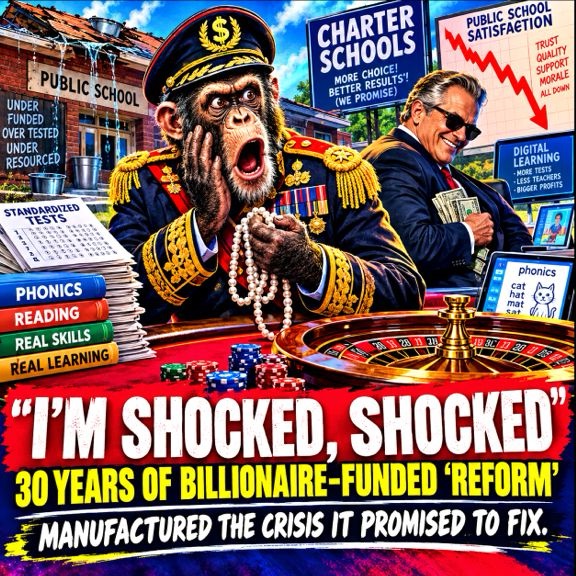
A group of activists in Colorado speaks out against standardized tests. Angela Engels’ article was printed in the Colorado Times Recorder.


A Message from Judy Solano, Chair, A4PEP (Advocates for Public Education Policy).

“It takes courage to speak out about the injustices in the world, especially when policy-makers funded by wealthy education reform organizations hold the power.  May we all be warriors in the battle for truth.”

COLORADO TIMES RECORDER

Test-Based Accountability Is Failing Colorado’s Children

by Angela Engel                                                       May 15, 2026

As the Colorado General Assembly wraps up the 2026 session, lawmakers once again failed to confront one of the most costly and disruptive features of public education: high-stakes standardized testing.

Key legislative proposals that would have addressed the burden of high-stakes testing were defeated again. SB26-068would have reduced CMAS standardized tests to the minimum extent possible, and HB26-1291 would have reduced teacher evaluations for non-probationary teachers from annually to every three years. Both had bipartisan sponsorship and were supported by teachers, parents, and community members, but opposed by billionaire-backed education reform lobbyists.

memorial backed by the Advocates for Public Education Policy (A4PEP), urging Congress to return authority to locally elected school boards, as provided in the eww hearing.

These decisions deserve more than a procedural explanation.

The issue of high-stakes testing is neither marginal nor new. Since the passage of No Child Left Behind in 2002, policymakers have imposed lengthy and expensive criterion-referenced standardized tests on students, then incorrectly used that data to make high-stakes decisions about teacher pay and school closures. Because test scores are most closely correlated with income, policymakers have tolerated the practice of closing schools in low-income neighborhoods at the expense of our most vulnerable students.

A 2014 study showed that Colorado’s testing requirements cost up to $78 million annually in combined state and district expenditures. Adjusting for inflation, that would equal more than $100 million today. Approximately 450,000 students spend an average of 20 hours of classroom instruction each year on these assessments — more than 9 million hours diverted away from teaching and learning.

Meanwhile, the number of students identified as at-risk has increased by 118%, more than doubling since 2000. After more than two decades, the results of this approach are clear. Achievement gaps have not closed. Teacher attrition continues to rise. Families increasingly question a system that prioritizes testing over learning, with many choosing to opt out altogether.

This is not a policy in need of minor adjustment. It is an accountability structure that has failed to deliver on its core promises — and it deserves fundamental sreplacement. And yet, it remains firmly in place. Not because the evidence is unclear, but because the accountability system itself is protected.

Standardized testing is no longer just an educational tool. It is embedded in a network of contracts, compliance requirements, testing vendors, consulting firms, and political interests backed by well-funded lobbying efforts. There are real financial and political incentives to preserve it, regardless of outcomes.

Spending more than $100 million annually on a system that continues to produce the same disparities while costing students millions of hours of learning time reinforces a governance model that rewards compliance and discourages challenge.

This climate — where profits and political interests are prioritized before children — did not emerge on its own. It has been shaped over time by a campaign finance system that rewards candidates who support policies centered on test-based school accountability.

When you see something wrong, something inhumane, don’t just say something. Do something. It’s time policymakers stop protecting harmful practices and confront the consequences of policies that continue to waste taxpayer dollars, diminish learning opportunities, and drive many of our most talented and experienced teachers from the profession. After twenty-five years, the ramifications of inaction are impossible to ignore.

Public education should not revolve around protecting systems, contracts, corporate profits, or political interests. It should revolve around children. Colorado students deserve a well-rounded education that values critical thinking, creativity, and civic engagement over excessive testing and data collection. For too long, corporate education groups and privatizers have robbed students of a meaningful education and carefree childhood. This accountability model offers the illusion of control while costing Colorado a future of empowered, well-educated leaders.  

To view the planned Senate memorial, click here.  

Angela Engel is a mother, educator, and facilitator. Learn more on her website, www.angelaengel.comDon Perl, Judy Solano, Mike DeGuire, and Manuel Solano contributed to this article.  https://coloradotimesrecorder.com/2026/05/test-based-accountability-is-failing-colorados-children/79032/

Republicans Against Trump posted this video on Twitter.

It was released by the White House yesterday.

It opens with a picture of a smiling Stephen Colbert.

Trump comes up to him, grabs him by his jacket, and throws him into an empty dumpster.

Trump closes the dumpster.

Then Trump starts doing that odd dance he does with both arms waving in the air.

Trump is a vicious, vengeful man. He operates like a Mafia Don. He has no dignity, no class, no decency. He is a bully, a low-life, a man who is so insecure that he can’t take a joke. Beneath all that bluster is a deeply insecure man who requires total loyalty from his sycophants.

He’s like Dr. Seuss’s “Yertle the Turtle.” Vain, arrogant, insatiable.

Trump just pulled of his biggest heist of taxpayer money by settling a bogus lawsuit. He had sued the Treasury Department/IRS for the unauthorized release of his tax return, then agreed to settle if the Department of Justice created a fund to compensate anyone who had been injured by the “weaponization” of the law under President Biden.

Trump was projecting. Biden did not “weaponize” the Department of Justice. Trump did, directing his Attorney General to prosecute his political enemies, like Leticia James, James Comey, and John Brennan.

If anything, Merrick Garland was too timid in prosecuting the insurrectionists who tried to overturn the 2020 election and far too slow to appoint Special Prosecutor Jack Smith, whose investigation ran out of time.

Andrew Egger of The Bulwark describes the details of Trump’s political slush fund.

Basically, he has full control of the money. And he dies not have to disclose the recipients.

Egger wrote:

When I wrote Friday about the news that Donald Trump was about to drop his $10 billion IRS lawsuit in exchange for the creation of a $1.776 billion taxpayer-cash slush fund for his allies who claim the Biden administration “weaponized” the law against them, I noted that nothing was yet set in stone. At that moment, it still seemed possible that this obscene settlement—Trump’s biggest, most lawless, most brazen theft of taxpayer cash yet—might yet give them cold feet.

But no: Yesterday, they made the thing official. In fact, it’s somehow even worse than advertised.

It’s impossible to overstate this basic fact: Everything about the settlement fund, from the circumstances of its creation to the claims it makes about its own enforcement, is deliberately structured to short-circuit all outside accountability, government oversight, or judicial review. As I wrote Friday, there was a reason Trump’s guys (who happened to be both the plaintiffs and the defendants in the case) were hustling to reach the settlement quickly: The judge in the IRS case had been signaling her suspicion that Trump and his government were not actually on opposite sides of the claim, suggesting she was considering throwing out the case altogether. If they wanted to carry out the heist, time was of the essence.

The Justice Department’s enforcement order, released yesterday, and the settlement terms released last night carry on in this dubious fashion. According to Acting Attorney General Todd Blanche, the United States loses custody and control of the $1.776 billion the minute it hits the settlement account created for the purpose: “Once the funds are deposited into the Designated Account,” he wrote in the order, “the United States has no liability whatsoever for the protection or safeguarding of those funds, regardless of bank failure, fraudulent transfers, or any other fraud or misuse of the funds.”

Meanwhile, the terms of the settlement fund make clear that the money’s disbursement—which, again, Trump’s United States government is trying to wash its hands of any liability for—will be a complete black box. “The Anti-Weaponization Fund shall have the power to determine its own procedures for submitting, receiving, processing, and granting or denying claims,” the settlement reads. “The Anti-Weaponization Fund may make those procedures public in whole or in part, at its discretion.”

Not only can the fund’s members keep secret how they’re making disbursement decisions, they can also keep a lid on who’s getting paid. The requirements for this are astonishingly open-ended: “To be eligible for relief,” the settlement states, a claimant must merely “assert at least one legal claim stating that the claimant was a victim of Lawfare and/or Weaponization.” Meanwhile, the only person the fund’s administrations will be required to brief on who got how much money is the attorney general—in a “confidential written report,” and even then only quarterly.

The cherry on top of this shit settlement sundae is this claim: “Because the claims process is voluntary, there shall be no appeal, arbitration, or judicial review of claims, offers, or other determinations made by the Anti-Weaponization Fund,” which is stated to be “enforceable and challengeable solely by Plaintiffs, Defendants, and the United States”—in other words, by Trump, Trump, and Trump.

The first opportunity to head off this disaster seems already to have passed. Nearly a hundred Democratic lawmakers signed an amicus brief filed in court Monday urging the judge not to dismiss the case as the parties requested, but to insist on weighing in on the terms of the settlement. But Judge Kathleen Williams ruled in a brief order yesterday that she lacked the power to do this—the settlement agreement was never docketed in the case, she said, so she had no authority to adjudicate it.

Once again, then, Trump’s aptitude for unprecedented shamelessness seems to have exposed yet another piece of our government that ultimately runs on the honor system: If a corrupt president wants to dip into the Treasury for literally any purpose whatsoever, all he has to do is sue the government, then settle with himself outside of court to create a payout fund for whatever purpose he might desire.

“It is Congress who appropriates money and it is the executive who spends it,” Matt Platkin, the former attorney general of New Jersey who is representing the Democratic lawmakers in the suit, told The Bulwark yesterday. “Put aside all of the potential corruption with this case—if the president can just sue himself and then settle with himself . . . and then spend huge amounts of money outside of that appropriations process, why would any president ever go to Congress for money ever again?”

It’s a great point—and one that reminds us that, ultimately, the responsibility for reining in this rampaging president falls not with the courts, but with Congress. It is not just the courts but Congress as well that Trump is cutting out of the loop with his obscene and indefensible settlement. Even here, Trump requires at least the legislature’s tacit permission to spend this money: They could pass a bill today to block a penny of that money from going out the door. Because of the funhouse-mirror world we live in and the villainous, power-hungry president we have, that bill would need to have the supermajority support required to overcome a presidential veto, but they do still have the power, if only they were to choose to exercise it.

But that funhouse-mirror reality is enough to prove on its own that just blocking the money wouldn’t go far enough. Trump is not merely asserting the power to jailbreak $1.8 billion from the Treasury to parcel out to his fans and allies. He is trying to create an upside-down new status quo where his single say-so is enough to overturn the will of two thirds of Congress minus one on all spending matters that really, really matter to him. It’s utterly un-American. It’s emperor stuff. If they had a shred of dignity left, they’d impeach the son of a bitch today.

Governor Jared Polis stunned defenders of democracy and fair elections by commuting the prison sentence of Tina Peters, the Mesa County clerk who was serving a nine-year sentence for her actions. She was sentenced in October 2024.

Peters first certified the 2020 elections as fair, then allowed fellow election deniers access to the voting machines in her county. She was tried by a jury of her peers in a Republican county by a Republican prosecutor and found guilty.

Trump pressured Polis to release Peters, even threatening to cut off federal funds to Colorado if Peters was not freed. Trump gave her a federal pardon, but it had no effect on her state conviction.

Last week, Governor Polis commuted Peters’ nine-year sentence. She will be free in a matter of days. He says he thought her sentence was too harsh.

Democracy Docket, a site established by attorney Marc Elias to monitor and report on voting rights and fair elections, denounced Polis’s decision to free Peters. His decision is a win for election deniers and Trump. It makes light of her dereliction of duty. She is likely to win a big reward from Trump’s slush fund of $1.7 billion for his allies, if that grift is approved by the Treasury Departnent and allowed to stand by the courts.

Democracy Docket released this statement:

Colorado Gov. Jared Polis (D) announced Friday he is granting clemency to Tina Peters — the former election official convicted for her role in a voting system breach — cutting her sentence and making her eligible for parole as soon as next month.

The move marks a dramatic and controversial intervention in one of the most closely watched election interference cases to emerge after the 2020 election — and comes after months of sustained pressure from President Donald Trump and his far-right allies to secure Peters’ release.

“We condemn Governor Polis’ clemency grant. It is a gross injustice to our elections, election workers and democracy with far-reaching consequences,” Colorado Secretary of State Jena Griswold (D) said in a statement. “This is a dark day for democracy.”

According to local reports, Polis is reducing Peters’ nine-year prison sentence, saying her guilt was not in dispute but that the punishment itself was excessive.

“She got a sentence that was harsh. It was a 9 year sentence,” Polis said in March. “So we always look at people’s sentences. And when you have people that are elderly, and we’re looking at this across a number of many people — people in their 70s or 80s in our system — how much of a threat to society are they and how do we balance that in a way that makes sure they can spend their last year few years at home?”

The decision leaves intact Peters’ felony conviction — but significantly shortens the consequences for a case that election officials and democracy advocates have pointed to as a clear example of accountability for tampering with election systems.

“It’s unfortunate to see the Governor of Colorado succumbing to the bullying tactics of election conspiracy theorists. He has thrown state and county election officials, Republicans and Democrats, under the bus after they resisted the corruption Ms. Peters engaged in and withstood attacks for many years as a result,” David Becker, executive director of Center for Election Innovation & Research, said. “Ms. Peters continues to express no remorse about her crimes and will likely now be a featured performer on the election grift circuit. It is a sad day for the rule of law and accountability.”

Peters was convicted in 2024 after prosecutors showed she facilitated unauthorized access to Mesa County voting equipment and helped expose sensitive system data, actions driven by false claims that the 2020 election was stolen from Trump. A jury found her guilty on multiple counts, and she was sentenced to nine years in prison.

“Tina Peters’ actions have made life harder, not only for election officials here in Colorado, but make no mistake, for election officials all across the country. Her conduct became a rallying point for election conspiracy movements that fueled hostility and distrust towards the very people responsible for administering free and fair elections,” Matt Crane, a former Republican clerk and executive director of the Colorado County Clerks Association, said. “Rather than standing with public service servants and defending one of our nation’s most cherished rights, the right to vote, Governor Polis is bending the knee to the same political forces and conspiracy movements that are actively undermining confidence in our democratic institutions. That choice carries consequences far beyond this single case.”

Polis’ clemency order follows an April ruling from a Colorado appeals court that upheld Peters’ conviction but ordered her to be resentenced.

Polis said he agreed that her political beliefs — including her promotion of election conspiracy theories — should not factor into the length of her punishment.

“Clerks have been intimidated. We’ve had clerks have their lives threatened. We had a clerk who was pregnant in 2022 have her unborn child threatened. We had an office in Colorado fire bombed last year,” Crane added. “So whether it’s Tina or somebody else who’s spreading false rumors and inciting people to do violent things, unfortunately, we have to spend a lot of time preparing for that.”

After Colorado officials refused to release Peters, Trump escalated his campaign on her behalf, issuing a symbolic presidential pardon that carries no legal force over state convictions and repeatedly attacking Colorado leaders. The administration also took punitive actions against the state, including moves affecting federal funding and the relocation of key federal assets.

At the same time, far-right figures and election deniers have increasingly framed Peters as a political prisoner, with some escalating to threats of violence and calls for direct intervention to free her — rhetoric that alarmed state officials and democracy watchdogs.

Polis had previously rejected any suggestion that Peters’ case would be influenced by political pressure.

“Tina Peters was convicted by a jury of her peers, prosecuted by a Republican District Attorney and in a Republican county of Colorado and found guilty of violating Colorado state laws including criminal impersonation,” Polis said in December. “No President has jurisdiction over state law nor the power to pardon a person for state convictions. This is a matter for the courts to decide, and we will abide by court orders.”

Matt Cohen contributed to this reporting.