The Reverend Benjamin R. Cremer has an unusual personal history. He grew up in a strict evangelical family in Idaho. He was home-schooled. He became a pastor, following in the path of his faith.
But somewhere along the way, he had an epiphany. He began to change his views. He became tolerant of those who did not share his faith. He began questioning his beliefs. He accepted LGBT people. His views and his life changed. He somehow developed a democratic disposition, an understanding that people of different races, religions, and ethnic groups can live in peace together, solving problems by discussion, collaboration, and mutual respect.
In this post, he deplores the extreme cruelty of Trump’s zeal to deport immigrants. Children are going to court to plead their case–without a lawyer.
This is wrong. When I first read about children under five in court, without a lawyer, I was shocked. Is this still America? Maybe we should call ourselves “Trumplandia” until we once again have national leaders who know and respect the Constitution and who have a heart, a brain, and a soul.
Rev. Cremer writes:
More and more migrant children all over the nation, some as young as two years old, are having to represent themselves in immigration court.
On Monday, September 28th, 25 children sat in an immigration court in Harlingen, Texas awaiting their hearing before a judge. A caseworker sat and quietly explained to the children who everyone was in the room, from the interpreter to the judge behind the bench.
According to a reporter present, among the first to appear before the judge was a 13-year-old Honduran boy named Angel. He didn’t have an attorney.
Asked whether there was a reason he couldn’t return to Honduras, Angel told the judge, “My mom and almost my entire family are here. It’s too dangerous to go back.”
But that wasn’t enough for the judge, who told the boy he did not qualify for asylum. “Would you like to request voluntary departure, or should I issue a removal order?” The judge asked.
“I don’t know,” Angel replied before bursting into tears. He stared ahead stoically and continued to cry, eventually saying: “I have no one. I have nothing.”
“I understand, but based on your answers, US immigration laws are very strict,” the judge concluded, and gave Angel until the end of the month to appeal his deportation order.
Hundreds of unaccompanied migrant children who were detained trying to cross the southern border or whose families were picked up by Immigration and Customs Enforcement are being held in shelters operated by the Department of Health and Human Services’ Office of Refugee Resettlement, which is tasked with the care of unaccompanied migrant children, the reporter said.
In March 2025, the Trump administration terminated most of the federal Legal Services for Unaccompanied Children Program, which funded organizations providing legal representation and legal orientation to unaccompanied migrant children. The American Bar Association says that action put representation for roughly 26,000 children at risk.
More recently, the situation became even more serious. In November 2025, according to the Senate Finance Committee and immigrant-rights organizations, the administration began withholding payments to organizations representing unaccompanied children. By July 2026, the Senate committee said more than $65 million was being withheld for legal services already provided, and the federal contract supporting the network expired July 31.
The government had a federally funded system specifically designed to provide these children legal representation, and the Trump administration substantially disrupted and ultimately replaced that system.
All while claiming to “uphold Christianity” and “uphold family values.”
Our country is treating children this way. In the name of Christianity. In the name of patriotism. It is inhumane, cruel, and has absolutely nothing to do with human dignity let alone Jesus, who said “whatever you do unto the least of these, you do unto me.
Whenever I write on this subject, I will always have a few callous comments that come up, so I want to address them here.
The first I’ll hear is, “Blame the parents, not our government! They never should have brought them here!”
A toddler didn’t decide to cross a border or choose the circumstances that brought them here. Yet children can end up in immigration proceedings where they are expected to understand an extraordinarily complicated legal system.
The Department of Justice explicitly says that immigration judges cannot appoint an attorney or guardian ad litem for an unaccompanied child. The child can therefore be left to obtain representation through private or pro bono resources or proceed without a lawyer.
Making a child bear the consequences of a situation they had no control over and forced to navigate a complex legal system is inhumane. It is callous to blame people you don’t know for circumstances you can’t even fathom.
The second comment I’ll receive often is, “If they just self deport they wouldn’t have to go through the legal system and get deported.”
That heartless logic just skips over the fact that these are children who can’t simply decide where they will live and arrange their own return.
An immigration removal proceeding is a legal proceeding against the individual child. Where is a child supposed to go when the country of citizenship may be a place they barely remember, where they may have no parent, guardian, home, meaningful support network, or be incredibly unsafe and violent?
The United States can have immigration laws. It can enforce its borders. It can also retain human dignity and recognize that a two-year-old should not have to advocate for themselves in a complex removal proceeding in unfamiliar circumstances they are already experiencing.
For me, it isn’t just that our government is treating children this way. It is that those who claim to follow Jesus continue to support the government treating children this way and even cheer them on as they do, treating all immigrants as if they are subhuman creatures that need to be eradicated from our society.
It’s not just the callus cruelty of our government, it’s the callous cruelty of the hearts that continue to cheer it on.
If we can’t even unite around the issue of children never deserving to be treated this way, then I’m at a loss of how we will ever find common ground.
This isn’t a matter of a “political opinion.” This is just inhumane.
“Woe to those who make unjust laws, to those who issue oppressive decrees, to deprive the poor of their rights and withhold justice from the oppressed of my people, making widows their prey and robbing the orphan.” -Isaiah 10:1-2
“The photograph of his leg, posted on Instagram, documents his sense of shame at having to wear the device, at being branded somehow a criminal. His short life had followed the same arc as hundreds of millions of Americans, immigrants or descendants of immigrants, who came here seeking hope, opportunity and a chance for dignity. He wanted to grow and prosper and be free of tyranny — in this case, the tyranny of crime and instability.”
Kennicott says we all share responsibility for his death. I disagree. Pierre’s death belongs to Stephen Miller, who wants to expel as many dark-skinned immigrants as possible. His death belongs to Donald Trump, who knew that racism and hatred was a good political issue for him, who told Republicans in the Senate not to pass a bipartisan immigration bill in 2024 because he wanted to run in the issue. His death belongs to the Republican elected officials who bowed to Trump’s wishes and have failed to rein in the heartlessness of ICE. His death belongs to all those who turn a blind eye to the reign of brutality and violence imposed on anyone who is swept up in the un-American crusade against immigrants, especially those who are black and brown.
Kennicott wrote:
The most haunting photo of the past week shows not a whole human, just part of one. Sometime in the past few weeks, a 20-year-old college kid named Pierre Damas Bel took a photograph of the lower part of one of his legs. He’s wearing black pants and gleaming, thick-soled, black-and-white brogues, the toe so polished it reflects the light. Around his ankle is a heavy plastic GPS tracking device, with a red, LED status light glaring like a demonic eye
Bel was one of about 350,000 Haitian immigrants who lost temporary protected status after a Supreme Court ruling in June. He fled Haiti, a country racked by gang violence and crime, in 2024, and he apparently despaired at the thought of having to return. On Monday morning, he stepped in front of a tractor-trailer on Interstate 70 in Springfield, Ohio, and now he is dead. His family believes he died by suicide, but that doesn’t seem quite the right word. He was desperate and depressed, but that misery was forced on him. No matter how he died, his life was taken from him.
Bel, who is seen in an earlier image in a blue tuxedo jacket beaming as he receives his high school diploma, entered the country legally to rejoin his family and request asylum. He graduated from high school, matriculated at university, joined the ROTC program, and he had a pending asylum hearing. But just after 8 a.m. Monday, he called his father and said, “I’m not feeling okay.” Less than an hour later he was dead.
The photograph of his leg, posted on Instagram, documents his sense of shame at having to wear the device, at being branded somehow a criminal. His short life had followed the same arc as hundreds of millions of Americans, immigrants or descendants of immigrants, who came here seeking hope, opportunity and a chance for dignity. He wanted to grow and prosper and be free of tyranny — in this case, the tyranny of crime and instability.
“I came to this country to pursue my education. I didn’t come here to commit a crime or hurt anyone,” he wrote on Instagram in late July. “Yet now I’m walking through the streets of the United States with a GPS monitor on my leg, carrying a feeling of shame and humiliation that I never imagined I would experience.”
Likely, the GPS device made his leg feel foreign to him, just as this young asylum seeker, perhaps an aspiring American, had suddenly been branded foreign to the country he hoped to serve. The weight of the device made it impossible for him to play soccer, a sport he loved; according to his father, it also made him an object of ridicule to his classmates, who mimicked on an interpersonal level what has become the basic tool of this country’s domestic politics and foreign policy: bullying.
No administration in my lifetime has used imagery and narrative more effectively than the Trump administration. A White House webpage called “Aliens” uses “X-Files” music and text to suggest that we have been secretly invaded, and that President Donald Trump alone can repel the enemy living among us.
“Millions arrived under the cover of darkness and embedded themselves directly into our society,” reads the scrolling text, with a spooky electronic, sci-fi soundtrack suggesting the invaders are extraterrestrials. “They’ve shopped in the same stores, attended the same classes as our children, and lived seemingly normal human existences,” the site also says. “With one exception — they do not belong here.”
From emphasizing the supposed criminality of immigrants, the administration moves on to stressing their normality. The very things that are, for so many Americans, definitive markers of being American — living peacefully, shopping, learning — become markers of suspicion. And so we are invited to look at ourselves as Bel looked at his leg, the normal as abnormal. Even people who abhor this cruelty face what is essentially an existential question: If I am American, and America does this, what am I? To remain within this ugliness is insufferable; to flee would only make it worse.
“I do not know how long it will still physically be possible to breathe this European air,” wrote critic Walter Benjamin in 1938, as the Nazi’s made life unlivable for Jews. He killed himself in 1940, in a small border town in Spain, where he was denied entry after fleeing France. That, too, was an act of desperation.
The loss of temporary protected status for Haitians means that the U.S. will have to find tens of thousands of new health care workers to staff an already overburdened system. A recent study by the Yale Budget Lab found that even if immigration returned to normal after the Trump administration, by the 2030s there will be thousands fewer new businesses than would be expected, and the economy will be smaller than it could be, with effects lasting as far as 2075.
And thus, another metaphor travels through the body, upward and outward, from the death of a young man on a highway in Ohio to include all of us. Bel was desperate, and his death is a kind of murder, but what the U.S. is doing to itself is simply suicide.
The cruelest of Trump’s policies is his determination to deport millions of immigrants. Stephen Miller, the man without a heart, wants to deport one million immigrants every year. The new head of the Department of Himrland Security, Markwayne Mullen, wants to meet that goal. So now the numbers of people detained has risen sharply, but most of them have never committed a violent crime.
Remember when Trump said he would deport “the worst of the worst”? Remember when he said he would expel the rapists and murderers?
I remember. You probably remember too.
Some are married to American citizens. Some are waiting for their green card to arrive.
That’s who he is deporting. Most of those detained have never committed a violent crime. Most are hardworking people who are contributing to society. Most are running small businesses or working on farms or in construction or landscaping. They need to get their papers, and they want them, but there is no path to legal citizenship.
Some of the deportees have lived here for twenty years or more.
No matter. The door to American citizenship is closed, except for white South Africans. For those whose skin is not white, go away.
Albert Sun and Alison McCann of The New York Times reported:
A surge in immigration arrests this summer has swept up thousands of people who had not previously been the focus of President Trump’s mass deportation campaign. They included people married to U.S. citizens, people who had entered legally and were pursuing an asylum claim, and others with a temporary legal status that the administration pushed to revoke.
The red line on the bottom are those with violent convictions. The soaring green line on top are people with no convictions.
A majority of the immigrants arrested in July were people who were accused of violating civil immigration laws but who had not been charged with or convicted of a crime, an analysis of newly released federal data shows. The share with a past violent criminal conviction fell to less than 4 percent.
Overall, immigration arrests rose to record highs with 43,000 ICE arrests in June and 49,000 in July. Two fatal shootings involving Immigration and Customs Enforcement agents, in Texas and Maine, drew outrage but did not meaningfully slow the pace of arrests.
A spokesperson for the Department of Homeland Security said that the administration was keeping its promises to arrest and deport criminals and that anyone in the country illegally was a target for enforcement.
The new data contains details on every ICE arrest through Aug. 5 and offers the fullest picture yet of how the agency’s activities have shifted since public backlash forced a retreat from the aggressive tactics seen in Minneapolis early this year. It was obtained by the Deportation Data Project, an academic group, through a public records lawsuit and analyzed by The New York Times.
After his confirmation this spring, the secretary of homeland security, Markwayne Mullin, promised quieter but more effective enforcement. ICE now appears closer than ever to meeting a recent goal of 2,000 daily arrests.
“They have more officers, more money, more detention space, more local partners and better systems,” said Claire Trickler-McNulty, a former senior ICE official. “And they’re finally putting all the pieces together to build out this deportation machine.”
A wider focus
Immigration arrests are near all-time highs in almost every state. Even sparsely populated Montana and Vermont saw spikes, with arrest rates more than doubling.
But the surge was strongest in Florida and Texas, two states with large unauthorized immigrant populations and leaders friendly to the Trump administration’s crackdown.
Brint Jindra was a true MAGA patriot. He voted for Trump three times and was especially appreciative of Trump’s crackdown on illegal immigrants.
The New York Times recently told the story of how Jindra was disillusioned by a close encounter with reality.
In July, Brint Jindra had an experience that upended his political views. He took his wife to wine country in California to celebrate her 40th birthday.
His wife was a Russian immigrant. They married in March 2025. They applied for a marriage-based green card. Their application was accepted, and they were waiting for the green card to arrive.
When the couple deplaned in Burbank, the wife was pulled aside by an ICE officer and arrested.
She spent 16 days in a detention center. While they are awaiting trial, they can’t go home to Ohio. Brint’s wife Galina Bobteneva must wear an electronic ankle monitor and can’t go more than 75 miles from their location in California.
Their lawyer, Patrick Valdez, requested a bond hearing, scheduled for July 28. Ms. Bobreneva was released July 29 on a $35,000 bond with an ankle monitor and an order to report to ICE in San Francisco Aug. 5.
Over dinner at a seafood restaurant in Redwood City the night before her appointment, Ms. Bobreneva barely touched her crab cakes. She had been struggling to sleep and was terrified of being detained again.
“I never thought that it was so easy to take freedom from anyone,” she said.
Mr. Jindra, too, was nervous.
“We are living in fear in my own country,” he said.
Early the next morning, they joined a line outside the immigration building that wrapped around the block. Ms. Bobreneva entered with her lawyer more than two hours later.
They emerged with instructions from ICE to report back on Sept. 7.
The couple returned to Redwood City, where unopened birthday gifts and deflating balloons sat on their dining room table, alongside a vase of two dozen wilted roses.
Her first court appearance is Oct. 22, but her case will take months to be resolved.
The Trump administration is trying to fill a quota of apprehending 2,000 immigrants every day. This means that more people who are not illegal are ensnared, even including some American citizens.
This is Trump’s America. No longer the home of the free.
Here is a country song about Trump’s most avid associate, Stephen Miller. Miller is the chief architect of Trump’s immigrant deportation policies. He has pushed Homeland Security to reach a goal of one million immigrants deported each year.
Those who are arrested and detained are not “the worst of the worst.” They are not “rapistd and killers.” Though it may be that some of those arrested are criminals, many are hard-working people who are raising their children and contributing to their communities.
Why doesn’t ICE focus on the undocumented immigrants who are in prison and leave law-abiding people alone. Congress should create a path for those who entered the country illegally to work towards citizenship.
Deport the worst of the worst. Deport murderers and rapists. Encourage and help good people to participate in our society and to become loyal citizens.
Adam Kinzinger, former Republican member of Congress, writes an always interesting blog. He wrote yesterday that the Trump administration is harassing legal immigrants by failing to process their applications for green cards and work permits. The immigrants affected come from those countries on Trump’s restricted travel list. They have done nothing wrong. They are here legally. U.S. District Judge Algenon Marbley in Columbus, Ohio, ordered the administration to resume processing their paper work.
Yesterday, a federal judge ordered the Trump administration to restart green card and work permit applications it had frozen. The freeze targeted immigrants from countries on the President’s travel restriction list. These are people already living here, many of them for years.
The case was brought by 25 of them. A hospital pharmacist. A nurse doing cancer research on federal funding. College graduates with job offers in science and engineering. Young couples raising kids. They all followed the process, and they all watched their paperwork freeze with no end date.
The Judge wrote that the administration was treating a person’s home country as a “significant and negative factor” in whether their case moved at all. He even named the President and the Vice President, writing that both men have “publicly and repeatedly expressed outright hostility toward immigrants.”
This is the second time in a month a federal judge has thrown out these freezes. A court in Rhode Island did the same in June.
The ruling does not hand anyone a green card. It forces the government to make a decision instead of leaving people in the dark. And the administration could not tell the court how making a nurse who already lives here wait longer keeps a single American safer. Because it can’t.
Here’s what I know after spending more than a decade in Congress. The Republican talking point was always the same. We are not anti-immigrant, we are anti-illegal immigration. Come the right way. Get in line. Well, these people got in line. They did everything my old party claimed to want. And this administration is trying to get rid of them anyway. The talking point was never true. It was just cover. They never wanted any immigrants here at all.
As a citizen of New York City, I am pleased to have voted for Zohran Mamdani. I am not a Democratic Socialist. I am a Democrat.
I like his determination to deliver on his promises. I like his zestfulness. I like his idealism and his determination to protect the weak and vulnerable.
The other day, he jumped into a public swimming pool, fully clothed, in Harlem, surrounded by children. No shoes, but a suit and tie. He makes people happy. He has a great smile.
I don’t agree with him about everything, but I have never agreed with any elected official about everything.
I feel that he is a good man who wants to keep his promises and make life affordable.
He’s a Muslim, I’m a Jew.
Remember during the Knicks championship series, someone posted on social media:
“My mayor is Muslim,
My bagel is Jewish,
My Christian’s Dior,
The Knicks win in four.”
Okay, they won in five but the point is that we all live together. We work together. Today we will watch dozens of Tall Ships from all over the world parade up the Hudson River. And we cheer together.
That’s New York City. That’s America.
Happy Fourth of July!
Mayor Zohran Kwame Mamdani: Good morning, my fellow Americans. Season after season, year after year, the tides have come in and out of New York Harbor. Long before the name “New York” had ever been spoken, Lenape dugouts crossed these currents. It was on these waters that tall masts crested the horizon, captained by explorers like Verrazzano and Hudson after whom we’ve named our bridges and rivers. And ever since, ships full of travelers weary from long journeys have passed through the Narrows, the winds of the Atlantic at their backs.
When those passengers lifted their heads to glimpse what lies just beyond the waves, what did they see? They saw land, lush and teeming with life. They saw men waiting at the docks to take them into bondage. They saw tenements rife with squalor. They saw industry rumbling with activity, steam and smoke rising, a city on the move. They saw a towering monument to freedom, her torch glowing world-wide welcome. They saw New York City. They saw America.
Tomorrow, our nation marks 250 years since we declared our independence. Two hundred and fifty years of a grand experiment in self-governance — an experiment so audacious that some in 1776 doubted it would last more than a few years, let alone a quarter of a millennium. From Lexington to Los Angeles, Selma to Seneca Falls, Morrisania to Midwood, Americans will come together for a day, just as we do each year. Families will gather around the grill. Fireworks will fill the night sky. This will be no ordinary day of celebration. Two hundred and fifty years presents a rare opportunity for more than 340 million people to turn together — both towards one another and towards ourselves, to take measure of who we are as a nation. When we look at America, what do we see?
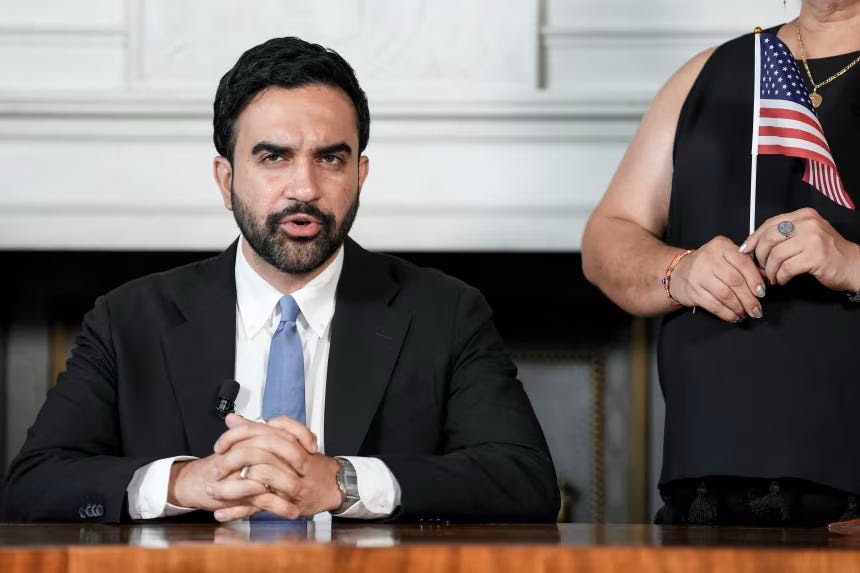
Here at City Hall, as I sit behind George Washington’s desk, alongside new Americans who came to this country, I cannot see all of America. But like so many who came before, I can see New York City.
The city I see today looks very different than the one that greeted George Washington. In July of 1776, our city simmered under the yoke of oppression. The British had imposed a colonial rule so repressive that 250 years ago, 80 miles south, a small group of newspaper editors, farmers, and soldiers signed their names on a document declaring truths that feel self-evident now but were revolutionary then, establishing the ideals our nation still strives to fulfill.
The British did not take it well. War broke out. And that August, as the largest battle of the Revolutionary War unfolded in Brooklyn, batteries on Governors Island took aim at British ships anchored just offshore. We were outgunned, we were outmanned and we were soundly defeated. After only a few months, it appeared our fledgling attempt at democracy was on the precipice of collapse.
But that night, with the moon overhead, thousands of our soldiers silently climbed into ferries and flat-bottomed boats and escaped to Manhattan. The Continental Army survived to fight another day. Independence may have been declared in Philadelphia, but it was rescued in New York City. George Washington was the last to leave Brooklyn. As he waited at the river’s edge, the sun beginning its rise, he would have looked out over New York City’s waters and seen what so many have seen in the 250 years since — an opportunity to begin anew. Those opportunities — like everything in New York City — are not given. They are won.
In 1838, 11 years after New York outlawed slavery, a recently emancipated Black man by the name of James Weeks sought to begin anew as well — and to help hundreds of others do the same. He bought property in Brooklyn, won himself the right to vote, and sold lots to others newly freed. When they landed in New York Harbor, they knew they had something waiting for them that they had never had before: a home. Weeksville still stands today — a living, breathing testament to what we know America to be: a place each of us has the power to make.
The Harbor was busy those years, as ships poured in from around the world. Hundreds of thousands of Irish immigrants arrived with stomachs aching from a famine manufactured by imperial cruelty. Chinese sailors settled in what is today, Chinatown. Millions more traveled under the Statue of Liberty and through Ellis Island — Jewish people escaping pogroms, Italians fleeing poverty, Syrians seeking economic opportunity.
Each of these new arrivals peered through portholes onto a city that was changing as fast as the nation. They saw merchants peddling their wares on the docks, streets being laid out on a grid, buildings rising into the clouds. They could not yet see the nativism they would face — the jobs they would be refused, the landlords who would not rent to them, and the abject labor and living conditions they would withstand. But no matter how much smog hung over the harbor, they still saw an opportunity to begin anew.
Over the years that followed, despite laws enacted by the federal government to bar their entry, despite sweatshop fires that killed hundreds of women, despite riots aimed at their very existence, immigrants made homes here in New York City, and they helped to make New York City. That legacy of every generation of Americans insisting that the right to life, liberty and the pursuit of happiness extends to them, too, is no relic of the past. It carried millions of Black Americans north during the Great Migration; it drew hundreds of thousands of Puerto Ricans to New York City after the Second World War; it invited countless others from the West Indies, and South Asia, and West Africa, and across the world. And it is what brought my family to this city when I was seven years old.
My family did not arrive by boat, although we saw the Statue of Liberty from the window of the plane. Even from the air, we could make out the promise of America — the promise of the beautiful, patriotic work of rendering America, year after year, a little more faithful to its founding ideals. There is a term so often used to describe our nation and those who have shaped it: American exceptionalism. American exceptionalism, the conventional wisdom tells us, makes our freedom a little more free, is how we dug the Erie Canal and irrigated the West, is why children in faraway lands grow up dreaming of one day moving here.
And yet the irony is that the story of America has so often been written by those who were told by others with power and influence and wealth that they were anything but exceptional. For generation after generation, we have been told that when the world has sent its people to our shores, it has not sent its best. It sent Puritans and Sikhs and Quakers and Muslims and Jewish people who were banished for praying the wrong way, worshipping the wrong Gods, angering the wrong people. It sent peasants and serfs from slums and shtetls who were treated as less because they hardly owned clothes, let alone land. It sent immigrants for whom power was something someone else had. We are told that America is exceptional because we are richer, stronger, more powerful than everyone else.
The truth, my friends, is that America is exceptional because here, nothing is fixed into place. The frontier may be closed, we may have walked on the moon, but the work of fulfilling the values first enshrined in the Declaration of Independence — that work endures, my friends, and it belongs to us all. It belongs too to our newest Americans, those standing here with me today, all of whom were recently naturalized. Nearly a decade ago, I too felt what you feel — the joy of no longer being just a New Yorker, but an American too. You each hold a special power. The power to determine what America means.
The powerful have always known their answer. America, in their view, is an arena of supremacy, where only a select few are allowed freedom, where not all are created equal. America, if you ask them, becomes less the more people it welcomes. America, they will tell you, belongs only to those with the right accent or the right shade of skin. The rest of us, they insist, should be grateful for merely being allowed to visit.
How small they are, how weak, how unoriginal. At every moment in our past, those who led through exclusion and isolation have tried to win power and enrich themselves by turning us against one another. Division is the oldest trick in politics, and the cheapest. But time and again — including 250 years ago — those forces of division have been vanquished by the forces of progress. As Thomas Paine once wrote, “this new world hath been the asylum for the persecuted lovers of civil and religious liberty […] hither have they fled.” And yet today, too many of our leaders do not believe in a vision of this nation as an asylum for the persecuted — but rather as one that persecutes those seeking asylum. As we mark 250 years, what do we see?
We see a city of contradictions within a nation of contradictions. We see the wealthiest country in the history of the world — one where children go to sleep hungry while the world’s first trillionaire hungers for more. We see monopolies that dominate every industry and oligarchs who buy elections. We see masked agents terrorizing our streets, eating food cooked by our undocumented neighbors before spiriting them away in unmarked vans. We see a nation whose immense wealth has been built by those with calloused, dirt-streaked hands — those who toil on factory floors and chisel into stone — and we see a nation that has allowed so much of that wealth to be held instead in the soft hands of a precious few.
Yes, we see America in a health insurance industry that exploits the sick, but that is not all I see when we look for America. We see it too in the nurse who works a double shift and then stops on her way home to check on an ailing neighbor.
Yes, we see America in corporate landlords for whom negligence is a business model. We see it too in the father who tucks his children into bed beneath a ceiling stained with leaks, who wakes before dawn to go to work and still believes his country can do better by his family.
Yes, we see America when we spend our tax dollars on bombs and bailouts, when we sell our elections to the highest bidder. Yet we see it just as clearly in every American who still believes this country belongs to we, the people.
We see America each time neighbors link arms with neighbors — without asking how long they have lived here, or what papers they have — as ICE invades our neighborhoods.
We see America each time those young and old stand in the beating rain or the stifling heat to cast their ballots.
We see America each time working people demand more — not just for themselves, but for their fellow Americans.
There are some who respond to those who ask for more from America with a simple refrain: “Love it or leave it,” they say. But patriotism has never been about pretending our nation is without flaws. Patriotism is every act of righteous dissent, it is every march led under the heavy sun, it is every protest held a decade before its time. It is precisely because we love this nation that we will not leave it. After all, who loves America more than those who have sacrificed so much to make it free?
Today, I think not only of the Fourth of July — I think too of the ninth of July. Five days after the Declaration of Independence was signed, it arrived here in New York City. Redcoats had disembarked on Staten Island. More than a hundred British ships loomed just offshore. Across this city, the Continental Army prepared for an invasion. George Washington commanded his brigades to assemble just a few feet from this building. It was known then as the Commons — today, we call it City Hall Park.
There, within range of British guns, Washington ordered his generals to read the Declaration aloud. And with the world’s mightiest empire poised to attack, Washington told the people of New York City what we will celebrate tomorrow — that we had declared our independence. That freedom was within reach. That evening, danger loomed. Conflict was not a question but a certainty. And yet when those early New Yorkers marched toward the statue of King George III that stood in Bowling Green, a statue they would melt down into bullets for their young army, they walked in unison — grounded not in the pursuit of plunder, but in ideals that for the first time had a name: America.
Those ideals upon which our nation was built — they are strong enough to endure any authoritarian regime, but only if we reach for them. Ours is a nation working each day towards the perfection in which it was conceived. A nation striving each day to better itself. Therein lies the work of America — the striving, the bettering, the reaching towards perfection.
What a privilege each of us has, to live in a nation that every one of its inhabitants can shape. What a responsibility each of us possesses, to prove ourselves worthy of all those who came before. What power each of us holds, to bring America ever-closer to the greatness so many have seen when they looked upon these shores — the greatness that, for 250 years, has been America.
Thank you. God Bless America, God Bless New York City, and happy Fourth of July.
William Kristol had a storied career as a conservative and neoconservative. His father Irving Kristol (a friend of mine) was considered “the father of neoconservativism,” that is, disillusioned liberals. Bill Kristol was chief of staff to Vice-President Dan Quayle. He founded The Weekly Standard, a magazine of cutting-edge neoconservative commentary.
But he couldn’t tolerate Trump. When Trump was elected in 2020, Bill changed his party registration from Republican to Independent. In 2026, he registered as a Democrat. He is now an editor and writer at The Bulwark. What a transformation! As you will read in this article, his change of mind is more than skin-deep.
He wrote, in the same post that carried Jim Swift’s piece, the following about the indifference and arrogance of the elites:
America today has lots of hard-working immigrants, and plenty of native-born citizens who accept and respect them. But there are also plenty of Americans these days who were born on third base and think they hit a triple.
I hasten to say there’s no fault in being born on third base. Indeed, all of us, whether rich or poor, who were born in today’s America might be said, in the grand historical scheme of things, to have been born on third base. A healthy American patriotism begins with acknowledgment of our good fortune, and with gratitude for what our forebears—most of whom were not born on third base—did to make our privileged lives today possible.
Of course there’s nothing wrong with also taking pride in what we and our contemporaries have accomplished. And if we sometimes overestimate our own achievements and underrate those of our predecessors—and therefore underrate our simple good fortune in being born here—well, that’s human nature, and it’s probably not worth getting all worked up about.
But what is worth getting worked up about is those who have no sympathy for others who didn’t happen to enjoy good fortune. What’s worth getting worked up about is those who have contempt for and who revel in cruelty toward the less fortunate.
There are lots of those people in America today. They include our president. They include many in his administration. They include many in the world of MAGA.
And they include Megyn Kelly, who was so proud of what she said on her show yesterday after the Supreme Court’s TPS decision that she then posted the clip on X:
Megyn sends a message to the Haitians who lost their TPS today:
“Go home! Get out! We know our country is better than yours. That’s because we filled it with our work ethic, culture, and values. You being here only dilutes it for us . . . GO BACK TO FUCKING HAITI!”
Kelly thinks that “we” made America great with “our work ethic, culture, and values.” But most Americans of Kelly’s generation—and, to be clear, of mine—have had to do little in the way of heavy lifting to make America great. And is it clear that today’s culture and values are so exceptionally wonderful?
It was our forebears who made America great. Many of them were immigrants and refugees, whom earlier generations of nativists treated with hostility, bigotry, and cruelty.
The rhetoric of yesterday’s Court ruling is not itself bigoted or cruel. But the policies it permits are bigoted and cruel. They are the policies of people who found themselves, mostly by good fortune, standing on third base. Many of them aren’t particularly good hitters or fast runners. But they’ve decided to protect their status by making sure no one else—especially no one else of a different skin color or background—will have a chance to get up to bat.
Dan Froomkin writes a blog called Press Watch. He calls out reporters who fudge the facts or distort the story by omission or commission. In this post, he critiques the press for refusing to acknowledge that Trump is racist and wants to expel 350,000 Haitians because they are Black.
This issue is important because it played an important role in the Supreme Court decision about whether to cancel the Haitians’ Temporary Protected Status. Lawyers for Haitians argued that his actions were motivated by his racism. The Supreme Court disagreed.
Froomkin believes that the press took the familiar stance of bothsiderism. Some think he’s racist, others think he’s not.
Justice Elena Kagan, who wrote the dissent for the three liberal judges, argued that Trump’s racism was undeniable, and she cited numerous vile and racist statements he had made.
The legal and moral question at the heart of Thursday’s 6-3 Supreme Court opinion giving Donald Trump the go-ahead to deport over 350,000 mostly Haitian immigrants was a simple one: Was Trump’s decision motivated even in part by racial animus?
And that, in turn, came down to the question: Were Trump’s past statements about Haiti racist?
That is not a tough one.
Trump has accused Haitians of eating their neighbor’s pets. He has called Haiti a “shithole” country and has said he preferred immigrants from “nice” predominantly white countries. He has said that most Haitian immigrants “probably have AIDS.” He has said nonwhite immigrants are “poisoning the blood of our country.”
Even the mainstream political journalists who bend over backwards not to call Trump a racist outright have acknowledged that some of his comments about Haiti in particular qualify as racist smears and as elements of a racist and inflammatory narrative.
But after Justice Samuel Alito wrote in the majority opinion that none of Trump’s statements about Haiti were “overtly racial,” I had a bad feeling that our top political journalists would wimp out and treat Alito’s assertion as debatable –- as one of two plausible sides of a political argument –- rather than as the bald-faced, ridiculous lie that it is.
I was worried that rather than state the obvious, they would throw up their hands and say, effectively, “You decide whether what Trump said is racist or not. You decide whether his statements on race represent reasonable, legitimate political discourse. We’re not going to judge.”
Readers, I was right to worry.
Our elite political media is now bothsidesing racism.
Most of the coverage of Thursday’s Supreme Court decision -– to the extent that it raised the issue of racial animus at all — consisted of, literally, both sides. Reporters briefly quoted Alito’s opinion, briefly quoted Justice Elana Kagan’s blistering dissent, and left it at that. Jump ball.
The Supreme Court on Thursday confronted two questions that have also confounded many Americans for the past decade: How seriously should people take President Trump’s wild, coarse and ugly statements? And are some of them marred by racial animus?
Like the country itself, the court was deeply divided on both.
This is pure poppycock. The question about Trump’s racial animus has not “confounded” many Americans. His animus is on display almost daily.
Who thinks Trump’s “wild, coarse and ugly statements” are some sort of joke? Nobody.
Indeed, everybody in touch with reality knows very well that Trump holds “racial animus.” Even Alito and the five other Trump acolytes on the high court know that, they just choose to lie about it.
To the extent that the country is “deeply divided,” it is between a minority of people who share Trump’s views and an overwhelming majority (I hope) who don’t.
And that shouldn’t be a “both sides” issue. Journalists should have the integrity to call out racist language and racist acts by name, and to cast racism as a societal ill.
The coverage should have made it clear that Alito was making an indefensible argument.
Here’s what the top of my “news analysis” would have looked like:
The six hard-right justices who control the Supreme Court on Thursday gave Donald Trump the go-ahead to deport hundreds of thousands of legal Haitian and Syrian immigrants, insisting – against a mountain of evidence – that Trump’s decision-making was not even slightly motivated by racial animus.
The Opinion
If you haven’t read the key sections of Alito’s opinion and Kagan’s dissent, they are really worth your time. The opinion approves the termination of Temporary Protected Status (TPS) for immigrants from Haiti and Syria, taking away their legal status and making them subject to deportation.
In his discussion of Trump’s comments, Alito split hairs:
The President’s comments fall into four main categories. First, many express strong objections to the immigration that this country has experienced in recent decades and to many of the immigrants who have come here, particularly those who have come to or stayed in the United States illegally. These statements associate these immigrants with crime and other social ills. Second, some statements express great displeasure with TPS. They note, among other things, that TPS designations have often been far from temporary and that aliens who are allowed to stay in the United States under the program are not vetted like other aliens who seek admission. Third, some statements broadly denigrate the countries for which TPS designations have been granted—including Haiti—portraying them as hellish places in which to live. And fourth, some statements malign Haitians who have come to the United States.
Then he concluded:
None of the cited statements by either the President or the Secretary was overtly racial, and in substance all expressed policy views that could rest on race-neutral justifications. For example, one may oppose TPS and favor tighter restrictions on immigration for economic or other reasons that have nothing to do with race. And a person without racial bias can provide a harshly unfavorable description of living conditions in some of the countries with TPS designations. The criteria for TPS designations guarantee that many, if not most, designated countries have such characteristics.
Alito casually shrugged off Trump’s “heated language” as the new normal. (The case, Mullin v. Doe, was formerly known as Trump v. Miot):
In offering the cited statements as proof that the termination of Haiti’s TPS termination was motivated by race, Miot respondents seek to capitalize on the statements’ heated language. Political discourse by prominent public figures is increasingly couched in terms that would have scandalized the public just a short time ago, and the statements cited by Miot respondents—especially those concerning Haiti and Haitian immigrants to this country—exemplify this development. But whatever one may think of the cited statements, they are insufficient to show that the termination of Haiti’s TPS designation was based on the race of the Haitian people.
Interestingly enough, Alito personally distanced himself from Trump’s statements, expressing empathy for Haitians and writing that “there is no justification for denigrating the character of Haitians who suffer from and bear no responsibility for their country’s ills.”
I agree that there is no justification. But there is an explanation. And that explanation is that Trump is racist.
The Dissent
Kagan, in dissent, wrote that the Haitian plaintiffs had provided clear evidence that race played a role in Trump’s decision:
The evidence they have offered includes statements by the President so repellent and racially inflected that the majority declines to put them in print. (Indeed, one measure of the President’s way of speaking about Haitians is to compare it with the majority’s, which is unfailingly respectful.)
So here are some of those statements. Haitians are “eating the dogs . . . . They’re eating the cats. They’re eating—they’re eating the pets of the people that live [in Springfield, Ohio].” And: Haitians are also eating “other things too that they’re not supposed to be.” And: Haitians in the United States “probably have AIDS.” And:Haiti is a “shithole country,” which is “filthy, dirty, [and] disgusting.” And: Haitian immigration is “like a death wish for our country.” And: Haitians, along with some others, are “poisoning the blood” of our country. And: “Why is it we only take people from shithole countries” like “Haiti [and] Somalia”? “Why cannot we have some people from Norway [and] Sweden?”
The majority briefly replies that those remarks are not “overtly racial,” but it is hard to know what that means. Haitians are Black. (Norwegians and Swedes not so much.) The references—of filth, disease, and primitiveness—are shot through with racial stereotypes and tropes. It is hard to imagine the statements being made today of any White community. No very “sensitive inquiry” …. is needed to see them for what they are; judges, as we often say, are “not required to exhibit a naiveté from which ordinary citizens are free.”
The statements fairly shout, in their racial undertones and overtones alike, that race entered into the President’s resolve to remove Haitians from this country.
No reasonable person could read Kagan’s dissent and take Alito’s opinion at face value.
Alito and the other Republicans on the Supreme Court have given constitutional protection to the openly racist and white supremacist policies of the Trump administration.
And he concluded:
The decision to ignore Trump’s racism means that the Republicans on the Supreme Court are racist. I don’t claim to know what’s in their hearts, but more to the point, I don’t care. I can see their racist actions. And their actions affirm, time and again, Trump’s own overt racial biases. It has been clear for a long time that that affirmation must be interpreted as an endorsement.
He wrote that “the court effectively blessed Trump’s bigotry toward Haitians and dealt potentially catastrophic damage to federal civil rights laws.” He called attention to the “echoes of Nazi Germany when the president says that a minority group is ‘poisoning the blood’ of our country.” And he concluded:
In the end, it comes as no real surprise that the Supreme Court’s conservative majority takes no issue with Trump’s description of Haiti as a “shithole country,” nor that it finds no racist motivation in describing Haitians as eating people’s pets or poisoning the blood of the American Volk. They don’t see Trump’s remarks or actions as racist because they apparently agree with him.
It’s the Whole Party
If you’re going to write about politics and racism, one of the most important stories to tell is that not just Trump, but the entire Republican Party – inspired and liberated by Trump — is becoming more and more overtly racist. And that includes the Republicans on the high court.
As I wrote in October, “It’s becoming increasingly clear that white supremacy is one of the core animating principles of the Republicans who control all three branches of government.”
Case in point, Rep. Tom Emmer of Minnesota, who as majority whip is the third-ranking Republican in the House, proudly acknowledgedovertly racist views on Thursday at a Faith and Freedom Coalition event on Capitol Hill.
“Minnesotans are so afraid that you’re gonna call us a racist, you’re gonna call us an Islamophobe…. You know what?… I’m done being careful, even the least bit careful,” he said. Somalis “don’t assimilate,” he said, “And if they don’t assimilate, then they should go the hell back to where they came from.”
This is a change. Ten years ago, Emmer was bragging about how quickly Somalis assimilated and saying he supported them “wholeheartedly.”
Racism is now rampant in one of our two political parties. But that’s not an excuse for journalists to treat it like an issue with two legitimate sides -– or to cover it up.
Today was a good day at the U.S. Supreme Court for Donald Trump and Stephen Miller: the Court gave them permission to deport hundreds of thousands of Haitians, Syrians, and others who hold Temporary Protected Status. Some 350,000 Haitians are affected. Under the same program, Trump has welcomed white South Africans. The Court’s vote was 6-3.
Among those now subject to deportation are engineers, doctors and thousands of health care workers.
The program was established in 1990 with bipartisan support.
In a different 6-3 decision, the Court’s rightwing majority struck down a law in Hawaii that allowed private businesses open to the public, like retail shops, grocery stores, coffee shops, and gas stations to bar patrons carrying guns. The majority said the Second Amendment protects gun owners and they should be allowed to enter these places carrying their guns. The rest of us are not protected from them.
AFT’s Weingarten on US Supreme Court Ruling Ending Protection for Hundreds of Thousands of Haitians and Syrians
WASHINGTON—AFT President Randi Weingarten issued the following statement in response to the U.S. Supreme Court decision allowing the Trump administration to end temporary protected status protections for thousands of workers from Haiti and Syria who live and work legally in the United States:
“This country has been a beacon of hope for people around the world who seek a safe haven from violence and persecution. Immigrants with temporary protected status pour billions into the economy each year, pay taxes and fill essential jobs across industries including healthcare, agriculture and manufacturing. Losing their right to work and live here will push them into poverty and leave our country weaker, poorer and more vulnerable.
“When darker forces—like those in the White House today—closed our borders in the 1920s, millions of people who needed shelter were slaughtered abroad. We said “never again,” yet now we have a Supreme Court that’s closed its eyes to that history.
“It is ironic that the six justices who issued this ruling would likely never visit or live in Haiti or Syria because of the extreme and ongoing instability there. Yet they somehow feel constitutionally compelled to send others back based on an administration policy rooted in discrimination and hate. History will not be kind to those who joined this warped opinion—and it is now incumbent on Congress to reverse it.”