Archives for category: Freedom of Speech

L.C. Francis authors the blog “L.C. Francis Open Society for History and Civics.” In this post, he imagines how Benjamin Franklin would react if he could time-travel to the present day. He titled this one “A Republic in a Costly Costume.”

His subtitle is:

Benjamin Franklin visits Washington and finds the experiment alive, wounded, witty, dangerous, and leaning toward the very monarchy it was built to resist.

“Whoever would overthrow the Liberty of a Nation, must begin by subduing the Freeness of Speech; a Thing terrible to Publick Traytors.”
— Benjamin Franklin, writing as Silence Dogood, No. 8, published in The New-England Courant, July 1722.

Dear Friends,

Yesterday, I wrote about Adams and Jefferson, two bitter friends who died on the Fourth of July, fifty years after the Declaration. But for weeks, another question has been on my mind: what would one founder think if he returned for America’s 250th birthday?

On this Sunday morning, after the fireworks have quieted and the crowds have gone home, I did not want to hand you another stack of bad news. I did not want to build another time machine just for cleverness. I chose Benjamin Franklin because, of all the Founders, he might be the least surprised by what he found in Washington in 2026.

Franklin was intimately aware of monarchial tendencies because he had known kings, ministers, courtiers, printers, mobs, frauds, scientists, diplomats, and men who mistook applause for wisdom. He would not arrive appalled by our foolishness. He would arrive amused, worried, and already reaching for his pen, because sometimes a Republic needs to hear the truth from a man who understood both human weakness and the strange miracle of self-government.

I visualized him observing the ruined East Wing, the ballroom adjacent to the People’s House, the painted Reflecting Pool, attacks on the press, a craving for royal attention, and an occupant of the People’s House who is more eager to be admired than to serve our Republic.

Then Franklin writes home…Hope you find this insightful & enlightening.


Dispatch on the Status of Our Republic

Washington City
July 5, 2026

My Esteemed Friends,

Having been conveyed, by means I cannot explain, into a future age that corresponds to 250 years from our time, and finding myself in the city your posterity has raised for the administration of the Republic, I have thought it prudent to send you a few observations before I am returned, if I am permitted to be returned to our time.

Mr. Adams and Mr. Jefferson will be pleased to hear that our Republic still exists in form. Elections take place, courts at the national, state, and local levels continue to interpret the law, newspapers continue to publish, and the public debates with such fervor that I almost thought the entire nation was a printing press.

Yet I confess that the condition of the Executive office gave me pause.

We once quarreled with George III because no free people should be governed by the vanity of one man. I now find, to my astonishment, a chief magistrate who appears to regard that monarch not as a warning but as an interior decorator. He favors ceremony, obedience, personal loyalty, public flattery, and buildings large enough to persuade small minds that greatness has occurred.

I had hoped your descendants would remember that we rejected monarchy not because crowns were uncomfortable, but because men wearing them became so.

The President’s residence, also called the People’s House and meant as a duty-bound home, has been significantly transformed. A wing was removed, and a ballroom was added. Donors gather nearby, contractors appear pleased. The words reflect public service, but the atmosphere feels like courtly flattery. I’ve strolled through Versailles and seen men bow so deeply they could pick pockets unnoticed. Now, even the Potomac seems to have acquired a touch of French elegance.

I am told this is all done for greatness. I have found that when a man must constantly proclaim his greatness, the evidence is usually still under construction.

As a printer, I paid especially close attention to the press, and this issue grew more serious the longer I spent in this era. The current President doesn’t just dislike criticism; all public figures dislike it, though some handle it more gracefully. This gentleman, with a countenance the color of an apricot or a persimmon, seems to believe himself to be the reincarnation of the courts of France and, therefore, the press should praise him, obey him, change geography in his favor, and apologize whenever inconvenient facts emerge.

One news service was punished for refusing to rename the Gulf of Mexico on command, as though a president could improve geography by signing it in a larger hand. Broadcasters have been threatened. Reporters are treated as enemies when they ask questions rather than bring incense. Lawsuits are brandished like royal decrees. It reminded me of old George III, though fairness requires this confession: George was born into a monarchy. He did not have to assemble one from wounded vanity, public entertainments, donor money, and several coats of gold paint.

Permit an old printer to be plain: a free press is not an ornament of liberty. It is one of its tools. A government that fears printers has already confessed more than printers have written.

I also observed that nearly every citizen carries a small glowing glass into which he may speak a question and receive an answer before his own judgment has had time to put on its shoes. This instrument is astonishing. It fetches a fact, composes a letter, translates a tongue, summarizes a book, and offers counsel with the confidence of a lawyer who has not yet found the statute. Much of what it provides is helpful, though some is incorrect. Its rapid delivery might lead a lazy mind to equate speed with wisdom.

I say this as one who loved invention: no machine, however clever, can spare a Republic the burden of discernment. A device may gather the lightning, but only judgment can make the rod.

Nevertheless, I do not lose hope.

I observed citizens carefully counting votes. I saw judges trying to keep the law from becoming a command. I saw teachers, librarians, clerks, veterans, reporters, and ordinary Americans doing the quiet work no ballroom can replace. They receive little applause, which may be why their service remains valuable.

When we gave the people a Republic, I warned that keeping it would be their burden. Upon further reflection, after visiting our Republic for the first time in 250 years, I would only add this: beware the man who loves the symbols of our country more than its restraints. Beware the patriot who attacks the press, flatters himself with marble, and treats public office as family property. George III lost America by misunderstanding Americans. It would be a poor anniversary indeed if Americans returned the favor by misunderstanding George III.

Tell our friends in Philadelphia that the Republic has not failed. The forms remain: elections, courts, printers, laws, and that blessed American habit of arguing with everyone within reach.

But the balance has shifted toward one man’s office in a manner that would please Mr. Hamilton, satisfy much of Mr. Adams, send Mr. Jefferson searching for ink and a quill, and prompt Paul Revere to get back on horseback. The President now stands so enlarged that many citizens seem less interested in restraining him than in being near enough to admire the glow.

This is the warning I carry home: a Republic may keep its papers and still lose its posture. If the people do not soon pull power back toward Congress, the courts, the press, the states, and themselves, they may wake to find they have not crowned a king but have trained themselves to obey one.

Our democratic experiment continues, but it now dangerously leans toward the very thing we crossed an ocean of trouble to resist.

I remain, as ever,
Your affectionate friend and humble servant,
B. Franklin

P.S. I hope this dispatch finds you in good health and, if possible, in better shade than I presently enjoy, for the heat here is dreadful. I am told the current chief magistrate has intellectual doubts that the climate itself can change, which is a curious position in an age that can weigh the stars, split the atom, and yet still offends itself by consulting a thermometer.

Vivat Constitution!

The Texas Monthly reported on the aftermath of the murder of Charlie Kirk. Texas legislators wanted to punish public employees that posted “inappropriate” responses to his death. Their scrutiny ensnared 350 teachers who had not responded in a way that expressed sympathy. Eventually almost all the teachers were cleared of wrongdoing, but in the near term, they lived under a cloud of fear, fear that they would be fired, fear that they would lose their license. The hero in this story was the Texas AFT, the union, which stepped in to defend the teachers, few of whom could afford to pay for legal defense.

Naina Srivastava of The Texas Monthly wrote:

In her 28 years as a teacher working at schools in the Harris County area, Jennifer Courtemanche felt most at home at Lee High School. That changed for the 54-year-old English teacher on September 10. Hours after conservative influencer Charlie Kirk’s assassination, Courtemanche made a series of posts on Facebook about the right-wing influencer’s death and was met with dozens of comments, texts, and voicemails from strangers attacking her positions. Someone—it’s unclear who—reported her to the Goose Creek Consolidated Independent School District, while others attacked her directly. “I hope you’re next,” one read. “I hope you die by violence in front of your family,” said another. “Kill yourself,” said a third. 

Courtemanche, who was born in Dallas and has lived in Texas for her whole life, had made four posts about Kirk that day. The first, in response to Utah Governor Spencer Cox’s statement that Kirk’s assassination was a tragedy, read, “I’ll bet if the victim had been Black or Brown or a Democrat influencer he’d have been singing a different tune. Could Kirk have baited just ONE too many people? Could this have been the consequences of his actions catching up with him?” The second was a repost of a friend’s post, containing a list of controversial statements on civil rights, the LGBTQ community, and gun deaths that Kirk had made throughout the years. The third was another repost, this time from Occupy Democrats, a progressive advocacy group, that quoted Kirk— “I can’t stand the word empathy, actually,”—with the caption “#karma.” And the last was another Occupy Democrats repost about President Donald Trump and other Republicans’ silence after Melissa Hortman, a former speaker of the Minnesota House of Representatives, was assassinated in her home last June. 

At some point, Courtemanche’s posts reached the attention of Texas State Representative Briscoe Cain, a Republican from Deer Park who represents her district. On X, he called for her immediate termination for “celebrating the news of Kirk’s assasination.” That post now has over 550,000 views. 

That night, Courtemanche recalls furiously searching for the settings to make her account private. A half hour before midnight, she received another voicemail. “I found your address. Someone is going to come to your house and f— you up, bitch,” an anonymous caller said. As messages continued to pour in, she worried about how people in the community might react. Courtemanche said she and her husband didn’t even go to church that Sunday, despite being regulars. Scared, Courtemanche reached out to her school principal, asking what she should do. He told her to call her local police department and to contact the district’s Human Resources. She did. 

The next morning, the HR department rang her back. The district told her not to come in and that she was being put on administrative leave. By the next Monday, Courtemanche received an email from the district notifying her that it had reported her to the Texas Education Agency.

In the wake of Kirk’s assassination, there was a wide push by the Texas GOP to discipline teachers who’d made posts about his passing that it deemed offensive. Two days after Kirk died, TEA Commissioner Mike Morath instructed ISDs to report instances of educators sharing inappropriate content online to his agency. In total, 350 complaints were levied, including those against Courtemanche. According to documents obtained by Texas Monthly via public-records requests, some school districts, like Goose Creek, chose to terminate employees after conducting investigations. Others simply reported the complaint for a state investigation into the matter. But more than six months after Kirk’s death, it appears the discipline Texas politicians promised hasn’t gone very far. All but two of the 350 complaints against teachers had been dismissed as of April, according to the testimony of Keith Ingram, an attorney with the Office of the Attorney General.  

Courtemanche’s case is an instructive one outlining how the state attempted to crack down on anti-Kirk speech. On September 22, less than two weeks after her original posts, the Goose Creek school board voted to terminate her contract by a vote of 2–0 with four abstentions. Mercedes Renteria III, one of the two members who voted for Courtemanche’s termination, gave an interview with the town’s local paper, TheBaytown Sun. “[S]he is an incompetent teacher, and she shouldn’t have crossed the line and spoken publicly on social media and every other venue to say bad things about Charlie Kirk,” he said. “I think she should be fired, and karma’s a bitch. How about that?”

Courtemanche immediately sought legal representation via the Texas American Federation of Teachers, a statewide labor union. By November, she had reached a settlement with the school that cleared her of wrongdoing. She chose to retire, but per the settlement, she waited until December 31 to resign, giving her an additional year’s worth of credit—worth $200 each month—under the teacher-retirement system.

Courtemanche was not alone. In January, the Texas AFT,  which has more than 66,000 members, filed a lawsuit against the TEA, arguing Morath’s instructions for districts to report teachers violated teachers’ First Amendment right to speech and “unleashed a wave of retaliation and disciplinary actions against teachers.” The AFT contends that simply being placed under investigation—even if the probe leads nowhere—negatively impacts an educator’s reputation. When the state opens an investigation, it places a flag on the educator’s certification and can even include them on the agency’s public registry listing employees “Not Eligible For Hire,” according to the TEA’s website. Such investigations can result in the sanction or revocation of their teaching certificate.

AFT President Zeph Capo estimates that thirty to forty educators reached out to the AFT regarding discipline about Kirk posts. Some ended up being part of the litigation, while the AFT offered verbal counseling and individual representation to others. Capo said the organization’s biggest concern was for educators who were unable to renew their certificates while under investigation. If an educator’s certificate lapses, the school district could fire him or her automatically, he said. 

“Just imagine you’ve went to school, you’ve paid a lot of money, you are now at risk of not being able to renew your certification to keep your job, all because of something you said on a Facebook post that had nothing to do with kids or anyone else,” Capo said. “That has an absolute chilling effect on those individuals.”


The Texas AFT’s lawsuit is supported by six anonymous teachers’ experiences, though filed on behalf of all its members. One teacher was placed on the “do not hire” registry for three months, preventing them from finding work, according to the lawsuit. Another was unable to renew her certification because she was under investigation and may lose her job this month as a result. 

Texas Monthly’s investigation found that some teachers were reported for fairly tame posts, including reposts of popular progressive infographics regarding Kirk’s statements and gun violence. An educator who wrote, “He was ok with children dying in schools. I am not saying he should have been shot. He defended guns above all else,” received a complaint. Another educator posted a screenshot of a Newsweek article with the headline, “Charlie Kirk Says Gun Deaths ‘Unfortunately’ Worth It To Keep 2nd Amendment,” with the caption, “First Amendment meets Second Amendment.” That educator also received a complaint. To some observers, these posts, in particular, seem to squarely fall under the protection of the First Amendment.  

Because teachers are public employees, however, their free speech rights are limited in some contexts. There have not been any notable Supreme Court rulings that directly address teachers and students’ social media usage, but the landmark 1969 Supreme Court ruling in Tinker v. Des Moines established that if speech outside the classroom “materially and substantially disrupt(s) the work and discipline of the school,” it can be restricted. 

Daxton “Chip” Stewart, a Texas Christian University professor and First Amendment expert, said that the question at the heart of the Kirk cases is whether speech outside of the classroom may have affected lessons within it. “Posts about Charlie Kirk are undoubtedly a matter of public concern,” Stewart said. “That’s core First Amendment-protected speech. People should be able to comment about that kind of thing. So really, it comes down to, does that speech interfere with teachers’ [abilities] to do their jobs.”

This question has come up repeatedly in the complaints to the TEA obtained via records request. For example, in an email to an educator with the district who received a complaint for her posts, the Eagle Mountain–Saginaw ISD superintendent wrote, “You do not get to stop being a teacher off contract hours. You continue to be seen as a public service provider that is entrusted to take care of a vulnerable, impressionable community of children. It is expected that you conduct yourself in a manner at all times that is conducive to earning and maintaining the trust of the community, parents, students and coworkers.” 

Stewart believes this standard is unfair. If a teacher spoke about Charlie Kirk in the classroom, it would be a different story, a “no-brainer,” he said. But in teachers’ private time, the state must prove that the speech is something outrageous for it to be punishable. (Ultimately, both Eagle Mountain–Saginaw and the TEA declined to take action against the educator.) 

In the past, the TEA has protected teachers’ right to speech that is controversial. In 2019, a Fort Worth English teacher asked president Trump for help removing the “illegals” from Fort Worth’s school system. She was fired. Morath said that her tweet was protected by the First Amendment, that the school district had overstepped, and that she should be reinstated. Later, courts upheld her firing.

That Morath is now taking a different stance strikes Capo, who agreed the Fort Worth teacher should not have been fired, as evidence of viewpoint discrimination in the TEA when it comes to free speech. “At least be consistent,” he said. “If you’re going to fire people for speech, then fire them for speech no matter which political direction it runs, and if you’re not going to fire them for speech, then you should be doing the same regardless of [the] political direction it comes from.”

The case between the TEA and Texas AFT hinges on the interpretation of Morath’s directive: whether it constituted a policy that school districts were required to follow. The letter sent to superintendents noted that if superintendents were made aware of “additional instances of inappropriate content being shared,” they should report it to the agency. In a September media statement, Morath said, “While all educators are held to a high standard of professionalism, there is a difference between comments made in poor taste and those that call for and incite further violence — the latter of which is clearly unacceptable.”

Capo said Morath has failed to define what would be considered “poor taste” or “inciting violence,” leading many districts to report teachers improperly out of caution. Indeed, some districts, like Cypress-Fairbanks ISD, reported they were influenced to submit complaints to the TEA because of the letter, even though they believed their employees’ speech fell within their rights. In an email to the TEA, the general counsel for Cy-Fair ISD, for one, wrote, “The District reviewed each instance of reported misconduct related to the death of Charlie Kirk individually and in light of the legal standards applicable to the specific situations. Because none of the posted comments were determined to violate District policies and to fall within the First Amendment rights of each employee, the complaints do not fall within the reporting requirements of Chapter 22A of the Texas Education Code.” However, the district still chose to report the complaint, it said, because of the notice letter. 

So far, the courts have sided with the TEA. At an April preliminary injunction hearing in the U. S. District Court for the Western District of Texas, Alan Albright, appointed by Donald Trump in 2018, said he failed to see how Morath’s letter infringed upon the First Amendment. “He’s not recommending punishment here,” Albright said. “He’s recommending that if the superintendents determine that inappropriate statements, in their view, were made, that there might be, you know, one of these investigations. I don’t understand how that’s chilling.” 

The Texas AFT now has the option to appeal the ruling, but Capo said it likely will not, owing to the dismissal of most of the complaints against teachers. He said every AFT member who was terminated has now reached a favorable settlement or returned to work without disciplinary action. “Ultimately, what I was really looking for, it has been accomplished,” Capo said. He told me the union now believes that its other members won’t have to worry about state sanctions or issues that could impact their teaching certifications.

For Courtemanche, however, even reaching a settlement felt like a bittersweet resolution. She told me she’s just starting to heal from what happened. Some people she went to church with unfriended her, she said. “And so I guess if they weren’t friends to begin with, I could still go and worship with them. But if they pass judgment on me, that’s on them,” she told me.

Initially, when the social media firestorm started, Courtemanche feared she’d be pushed out of the classroom before she was ready to stop teaching. But after the investigation, she was eager to retire. She’s eligible to find work at a different school next year, but she told me it’s unlikely she’ll go back.She said the environment for educators has gotten worse in Texas, and she doesn’t want to subject herself to further difficulties. 

In a stunning victory for the First Amendent’s guarantee of free speech, a federal appeals court overturned Florida Governor Ron DeSantis’s “Stop WOKE” act. A district court judge had previously issued a preliminary injunction on the law, calling it “positively dystopian.”

The state contended that it paid the professors’ salaries and had the authority to tell them what to teach. The appeals court decision disagreed, by a 2-1 vote. The dissenting judge–Barbara Lagoa– was appointed by Trump.

The opinion said:

“Florida’s salary-for-speech rule is a breathtaking assertion of power to ban unpopular ideas from public discourse in the very places the state’s own statutes recognize as centers of inquiry — classrooms where students are trusted to puzzle through ideas that are good and bad, easy and hard, ideally getting ever closer to the truth,”

The dissenting judge wrote:

“We need not agree or disagree with Florida that the viewpoints at issue here constitute racial discrimination,” Lagoa wrote. “We need only acknowledge that the state is allowed to decide what is endorsed by its professors in its own classrooms.”

The American Civil Liberties Union announced:

TALLAHASSEE, FL – The U.S. Court of Appeals for the 11th Circuit today struck down the higher education provisions of the Stop W.O.K.E. Act, a classroom censorship law in Florida that severely restricted educators from teaching about race and gender in schools and workplaces. The court ruled the higher education provision of the law was unconstitutional, saying: “Florida’s salary-for-speech rule is a breathtaking assertion of power to ban unpopular ideas from public discourse in the very places the State’s own statutes recognize as centers of inquiry—classrooms where students are trusted to puzzle through ideas that are good and bad, easy and hard, ideally getting ever closer to the truth.”

The court goes on to say it does not matter if the State of Florida agrees or disagrees with the ideas. “Either way, in this context the First Amendment trusts students to figure it out for themselves.”

“This ruling sets a strong precedent that higher education cannot be limited to the whims of politicians,” said Leah Watson, senior staff attorney with the ACLU’s Racial Justice Program. “All students and educators deserve to have a free and open exchange about ideas without government control. Students can’t fight racial discrimination that they don’t see; training and instruction is key to empowering future leaders to pursue racial justice.”

The decision comes in Pernell v. Lamb, a 2022 lawsuit filed by the American Civil Liberties Union, ACLU of Florida, the Legal Defense Fund (LDF), and the law firm Ballard Spahr on behalf of a group of Florida professors at public universities whose teaching has been impacted by this law.

“We are thrilled the court has stopped the erasure of topics that have real implications for our students, allowing them to learn, discuss, and develop tools for combatting the complex issue of racism in our country without being gagged by those who would dictate that only state-approved thought may be promoted,” said LeRoy Pernell, a Florida A&M University College of Law professor and the named plaintiff in this lawsuit.

Championed by Gov. Ron DeSantis, this overreaching law specifically targeted and placed vague restrictions on educators’ ability to teach concepts such as racism, sexism, privilege, and unconscious bias. It also imposed harsh penalties, including ineligibility for millions of dollars in performance funding from the state for colleges and universities and termination for educators who had been found to violate the law.

The court concluded, “[i]f the First Amendment oers any boundary of protection at all for public university classrooms, this statute crosses it.”

“The Stop W.O.K.E Act is an egregious example of widespread efforts across the country, most notably in Florida, to force the public higher education system to adopt the viewpoints of those in power. Thankfully, we have a judicial system to protect First Amendment rights and ensure that professors have the academic freedom to foster the type of learning environment where all students can learn and thrive,” said Jin Hee Lee, Director of Strategic Initiatives at the Legal Defense Fund. “It is no coincidence that this state law aimed to censor the perspectives of Black people and LGBTQ+ people, the very same people who are currently under attack. With this decision, the federal appeals court has made clear that Florida cannot actively erase their history of discrimination or their lived experiences without running afoul of our Constitution.”

This decision marked the first time an appellate court has considered the constitutionality of this censorship movement, and it will have implications for students and educators across the country who are subject to related laws. Since the Stop W.O.K.E Act went into effect, more than 30 states have moved to introduce and pass higher education classroom censorship bills. In May 2024, a federal court struck down a law in another ACLU lawsuit in New Hampshire, holding that the law’s vagueness violated the 14th Amendment. A similar higher education classroom censorship law was struck down in an ACLU lawsuit in Oklahoma, ruling that many of its provisions were so vague that it was difficult for teachers to know what they could and could not teach in the classroom.

“By upholding the district court’s ruling, the Eleventh Circuit ensured that our system of higher education is guided by the principle of free speech, not government censorship,” said Carrie McNamara, senior staff attorney at the ACLU of Florida. “Our classrooms are meant to be rooms of curiosity, creativity, and learning. When we stifle this kind of critical thinking, we risk losing our education system as we know it.”

“The recent legislative efforts to undermine academic freedom and limit the rights of marginalized communities are incredibly harmful,” said Emmy Parsons, a litigator at Ballard Spahr who was a member of the legal team. “We are proud to be part of this historic case and will keep fighting to protect the First Amendment rights of those teaching the next generation of leaders.” 

The opinion can be viewed below.

Documents


Jul 7, 2026

Pernell v. Lamb – Court Order

Scott Maxwell, opinion columnist for The Orlando Sentinel, wrote about the state’s effort to silence speech, even a silent protest. It is heartening to know that there are students in Florida willing to dissent. It is disheartening to learn that state officials never heard of the First Amendment to the Constitution.

Back in March, a handful of students at Florida International University stood up at an event where the school president was speaking and showed off their T-shirts.


They didn’t say anything to interrupt the program or speakers.


Instead, they simply revealed shirts that said they wanted the state school to stop coordinating with ICE on immigrant crackdowns on campus via the slogan: “ICE OFF FIU.”


Now, months later, the school is trying to discipline the students — even threatening to withhold their diplomas — if they don’t apologize for expressing their opinions.


In one of the creepiest twists, the school told the students that the only way they can escape punishment and “receive a diploma” would be to make a two-minute “video reflection” swearing they now understand what they did wrong.


It sounds like a hostage video. Except in this case, the hostages are being forced to apologize for free thought and expression.


Such is life in the “Free State of Florida.”


Once upon a time, college students were encouraged to be free-thinkers. That is, in fact, what Gov. Ron DeSantis and Florida’s other GOP leaders claim to believe … when they’re renaming roads after Charlie Kirk anyway.


But what they really mean is that Florida students should think the way they do or else shut the hell up.


And this is just the latest attack on speech by DeSantis and his fellow Republican lawmakers.
There was also the state’s infamous “Stop WOKE” bill where the governor and lawmakers tried to make it illegal for private companies to hold diversity training sessions that offended these bro-flakes’ fragile sensibilities. (That part of the law was, of course, ruled unconstitutional.)


There have been multiple cases where the state tried to fire employees who said things the politicians disliked about Charlie Kirk. (The firings have been repeatedly challenged, with the state already agreeing to pay one fired biologist $485,000 for her wrongful termination.)

And a few years ago, DeSantis signed a law that would’ve allowed the state to actually imprison Floridians who donated more than $3,000 to citizen-led efforts to get amendments on the state ballot. Yes, imprison. (A federal judge appointed by Donald Trump struck down that law as well, declaring the politicians’ attempt to arrest citizens who donated to causes the governor disliked as “wholly foreign to the First Amendment.”)


It’s tempting to go numb to this constant and casual assault on your rights. And to the steady stream of public money spent on these losing legal battles with attorney bills at $675 and $725 an hour.


But this Independence Day weekend seems like a good time to remember that truly patriotic Americans don’t support government trying to suppress speech.

You don’t have to agree with the FIU students’ anti-ICE sentiments. Many Floridians certainly don’t.


But if you claim to call yourself a patriot, you’d damn well better support their right to express it.
As Supreme Court Justice Oliver Wendell Holmes Jr. famously said, the First Amendment wasn’t created to protect viewpoints everyone likes, but specifically for “freedom for the thought that we hate.”


In the FIU case, Community Justice Project attorney Adam Saper, who’s representing the students pro bono, said: “This prosecution is the most clear violation of the constitution’s constitutional rights. They’re trying to silence these particular students who were speaking up against a policy of this school.”

That sentiment was echoed by the national free speech group, the Foundation for Individual Rights and Expression (FIRE), which honed in on the fact that the targeted “speech” involved words on a T-shirt — which the university obviously doesn’t crack down on with any regularity.


“Since this case involves clothing, would a student be prohibited from wearing a Malcolm X T-shirt in a university building under the same policy?” asked FIRE attorney Garrett Gravley.

“What about a Palestinian keffiyeh or an Israeli flag lapel pin? If a student wore purple for Domestic Violence Awareness Month, would that be actionable?”


Of course not. Even if the students had the audacity to … um … stand.


According to emails from university officials obtained by Axios and other news outlets, even school officials conceded that the students’ actions “did not disrupt the event.”


Basically, as far as protests go, this one seemed about as tame as it gets. Just a thoughtful, brief and silent statement of opinion. But apparently that was too much for Florida.


The school has said little about the case. But in correspondence with the students, FIU cited its policies on “student conduct” and “expression.”
Those rules are a lengthy, self-contradicting mess. They attempt to place a bevy of restrictions on students expressing their viewpoints while also stressing that none of the school’s rules “should be interpreted” as abridging anyone’s Constitutional rights, including “the freedom of expression protected by the First Amendment.”

It’s like a prosecutor telling you that you’re not entitled to a speedy trial or access to an attorney … while acknowledging that the United States Constitution says you’re guaranteed to precisely that.


Interestingly, the students staged their silent protest in March without much hubbub. It wasn’t until weeks later that the school told the kids they were in trouble.


It almost looks like someone told school president Jeanette Nuñez — DeSantis’ former lieutenant governor, one of many DeSantis allies rewarded with cushy, high-paying university jobs — that she’d better get these critically thinking kids in line.


I sent Nuñez and some of her staffers an email this past week, asking if anyone in Tallahassee had told her she needed to crack down on the students. She did not respond.


She also didn’t answer another question I posed: Whether she’d ever attended her own school’s class on the First Amendment — one that says it explains why “the rights of conscience” are protected in this nation.

As a citizen of New York City, I am pleased to have voted for Zohran Mamdani. I am not a Democratic Socialist. I am a Democrat.

I like his determination to deliver on his promises. I like his zestfulness. I like his idealism and his determination to protect the weak and vulnerable.

The other day, he jumped into a public swimming pool, fully clothed, in Harlem, surrounded by children. No shoes, but a suit and tie. He makes people happy. He has a great smile.

I don’t agree with him about everything, but I have never agreed with any elected official about everything.

I feel that he is a good man who wants to keep his promises and make life affordable.

He’s a Muslim, I’m a Jew.

Remember during the Knicks championship series, someone posted on social media:

“My mayor is Muslim,

My bagel is Jewish,

My Christian’s Dior,

The Knicks win in four.”

Okay, they won in five but the point is that we all live together. We work together. Today we will watch dozens of Tall Ships from all over the world parade up the Hudson River. And we cheer together.

That’s New York City. That’s America.

Happy Fourth of July!

Mayor Zohran Kwame Mamdani: Good morning, my fellow Americans. Season after season, year after year, the tides have come in and out of New York Harbor. Long before the name “New York” had ever been spoken, Lenape dugouts crossed these currents. It was on these waters that tall masts crested the horizon, captained by explorers like Verrazzano and Hudson after whom we’ve named our bridges and rivers. And ever since, ships full of travelers weary from long journeys have passed through the Narrows, the winds of the Atlantic at their backs.  

When those passengers lifted their heads to glimpse what lies just beyond the waves, what did they see? They saw land, lush and teeming with life. They saw men waiting at the docks to take them into bondage. They saw tenements rife with squalor. They saw industry rumbling with activity, steam and smoke rising, a city on the move. They saw a towering monument to freedom, her torch glowing world-wide welcome. They saw New York City. They saw America.  

Tomorrow, our nation marks 250 years since we declared our independence. Two hundred and fifty years of a grand experiment in self-governance — an experiment so audacious that some in 1776 doubted it would last more than a few years, let alone a quarter of a millennium. From Lexington to Los Angeles, Selma to Seneca Falls, Morrisania to Midwood, Americans will come together for a day, just as we do each year. Families will gather around the grill. Fireworks will fill the night sky. This will be no ordinary day of celebration. Two hundred and fifty years presents a rare opportunity for more than 340 million people to turn together — both towards one another and towards ourselves, to take measure of who we are as a nation. When we look at America, what do we see?  

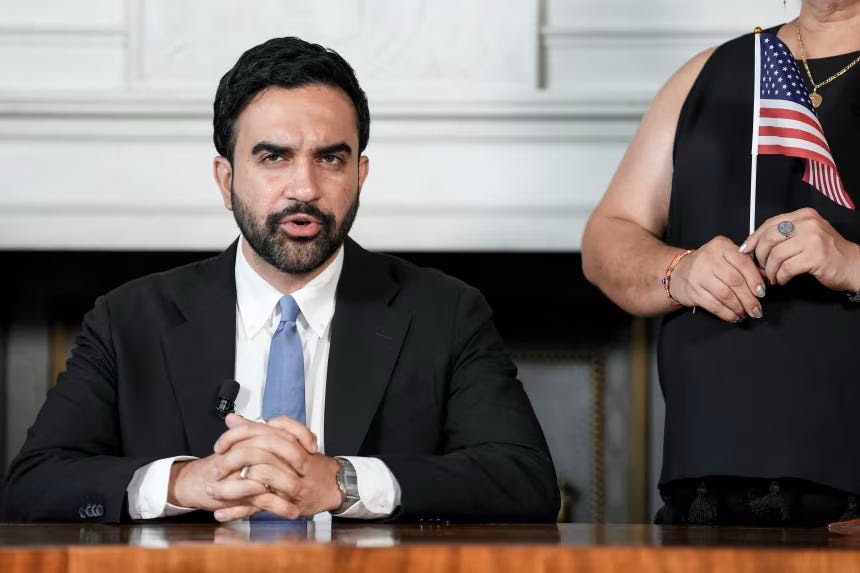
Here at City Hall, as I sit behind George Washington’s desk, alongside new Americans who came to this country, I cannot see all of America. But like so many who came before, I can see New York City.  

The city I see today looks very different than the one that greeted George Washington. In July of 1776, our city simmered under the yoke of oppression. The British had imposed a colonial rule so repressive that 250 years ago, 80 miles south, a small group of newspaper editors, farmers, and soldiers signed their names on a document declaring truths that feel self-evident now but were revolutionary then, establishing the ideals our nation still strives to fulfill.  

The British did not take it well. War broke out. And that August, as the largest battle of the Revolutionary War unfolded in Brooklyn, batteries on Governors Island took aim at British ships anchored just offshore. We were outgunned, we were outmanned and we were soundly defeated. After only a few months, it appeared our fledgling attempt at democracy was on the precipice of collapse.  

But that night, with the moon overhead, thousands of our soldiers silently climbed into ferries and flat-bottomed boats and escaped to Manhattan. The Continental Army survived to fight another day. Independence may have been declared in Philadelphia, but it was rescued in New York City. George Washington was the last to leave Brooklyn. As he waited at the river’s edge, the sun beginning its rise, he would have looked out over New York City’s waters and seen what so many have seen in the 250 years since — an opportunity to begin anew. Those opportunities — like everything in New York City — are not given. They are won.  

In 1838, 11 years after New York outlawed slavery, a recently emancipated Black man by the name of James Weeks sought to begin anew as well — and to help hundreds of others do the same. He bought property in Brooklyn, won himself the right to vote, and sold lots to others newly freed. When they landed in New York Harbor, they knew they had something waiting for them that they had never had before: a home. Weeksville still stands today — a living, breathing testament to what we know America to be: a place each of us has the power to make.  

The Harbor was busy those years, as ships poured in from around the world. Hundreds of thousands of Irish immigrants arrived with stomachs aching from a famine manufactured by imperial cruelty. Chinese sailors settled in what is today, Chinatown. Millions more traveled under the Statue of Liberty and through Ellis Island — Jewish people escaping pogroms, Italians fleeing poverty, Syrians seeking economic opportunity.  

Each of these new arrivals peered through portholes onto a city that was changing as fast as the nation. They saw merchants peddling their wares on the docks, streets being laid out on a grid, buildings rising into the clouds. They could not yet see the nativism they would face — the jobs they would be refused, the landlords who would not rent to them, and the abject labor and living conditions they would withstand. But no matter how much smog hung over the harbor, they still saw an opportunity to begin anew.  

Over the years that followed, despite laws enacted by the federal government to bar their entry, despite sweatshop fires that killed hundreds of women, despite riots aimed at their very existence, immigrants made homes here in New York City, and they helped to make New York City. That legacy of every generation of Americans insisting that the right to life, liberty and the pursuit of happiness extends to them, too, is no relic of the past. It carried millions of Black Americans north during the Great Migration; it drew hundreds of thousands of Puerto Ricans to New York City after the Second World War; it invited countless others from the West Indies, and South Asia, and West Africa, and across the world. And it is what brought my family to this city when I was seven years old.  

My family did not arrive by boat, although we saw the Statue of Liberty from the window of the plane. Even from the air, we could make out the promise of America — the promise of the beautiful, patriotic work of rendering America, year after year, a little more faithful to its founding ideals. There is a term so often used to describe our nation and those who have shaped it: American exceptionalism. American exceptionalism, the conventional wisdom tells us, makes our freedom a little more free, is how we dug the Erie Canal and irrigated the West, is why children in faraway lands grow up dreaming of one day moving here.  

And yet the irony is that the story of America has so often been written by those who were told by others with power and influence and wealth that they were anything but exceptional. For generation after generation, we have been told that when the world has sent its people to our shores, it has not sent its best. It sent Puritans and Sikhs and Quakers and Muslims and Jewish people who were banished for praying the wrong way, worshipping the wrong Gods, angering the wrong people. It sent peasants and serfs from slums and shtetls who were treated as less because they hardly owned clothes, let alone land. It sent immigrants for whom power was something someone else had. We are told that America is exceptional because we are richer, stronger, more powerful than everyone else.  

The truth, my friends, is that America is exceptional because here, nothing is fixed into place. The frontier may be closed, we may have walked on the moon, but the work of fulfilling the values first enshrined in the Declaration of Independence — that work endures, my friends, and it belongs to us all. It belongs too to our newest Americans, those standing here with me today, all of whom were recently naturalized. Nearly a decade ago, I too felt what you feel — the joy of no longer being just a New Yorker, but an American too. You each hold a special power. The power to determine what America means.  

The powerful have always known their answer. America, in their view, is an arena of supremacy, where only a select few are allowed freedom, where not all are created equal. America, if you ask them, becomes less the more people it welcomes. America, they will tell you, belongs only to those with the right accent or the right shade of skin. The rest of us, they insist, should be grateful for merely being allowed to visit.  

How small they are, how weak, how unoriginal. At every moment in our past, those who led through exclusion and isolation have tried to win power and enrich themselves by turning us against one another. Division is the oldest trick in politics, and the cheapest. But time and again — including 250 years ago — those forces of division have been vanquished by the forces of progress. As Thomas Paine once wrote, “this new world hath been the asylum for the persecuted lovers of civil and religious liberty […] hither have they fled.” And yet today, too many of our leaders do not believe in a vision of this nation as an asylum for the persecuted — but rather as one that persecutes those seeking asylum. As we mark 250 years, what do we see?  

We see a city of contradictions within a nation of contradictions. We see the wealthiest country in the history of the world — one where children go to sleep hungry while the world’s first trillionaire hungers for more. We see monopolies that dominate every industry and oligarchs who buy elections. We see masked agents terrorizing our streets, eating food cooked by our undocumented neighbors before spiriting them away in unmarked vans. We see a nation whose immense wealth has been built by those with calloused, dirt-streaked hands — those who toil on factory floors and chisel into stone — and we see a nation that has allowed so much of that wealth to be held instead in the soft hands of a precious few.  

Yes, we see America in a health insurance industry that exploits the sick, but that is not all I see when we look for America. We see it too in the nurse who works a double shift and then stops on her way home to check on an ailing neighbor.  

Yes, we see America in corporate landlords for whom negligence is a business model. We see it too in the father who tucks his children into bed beneath a ceiling stained with leaks, who wakes before dawn to go to work and still believes his country can do better by his family.  

Yes, we see America when we spend our tax dollars on bombs and bailouts, when we sell our elections to the highest bidder. Yet we see it just as clearly in every American who still believes this country belongs to we, the people.  

We see America each time neighbors link arms with neighbors — without asking how long they have lived here, or what papers they have — as ICE invades our neighborhoods.  

We see America each time those young and old stand in the beating rain or the stifling heat to cast their ballots.  

We see America each time working people demand more — not just for themselves, but for their fellow Americans.  

There are some who respond to those who ask for more from America with a simple refrain: “Love it or leave it,” they say. But patriotism has never been about pretending our nation is without flaws. Patriotism is every act of righteous dissent, it is every march led under the heavy sun, it is every protest held a decade before its time. It is precisely because we love this nation that we will not leave it. After all, who loves America more than those who have sacrificed so much to make it free?    

Today, I think not only of the Fourth of July — I think too of the ninth of July. Five days after the Declaration of Independence was signed, it arrived here in New York City. Redcoats had disembarked on Staten Island. More than a hundred British ships loomed just offshore. Across this city, the Continental Army prepared for an invasion. George Washington commanded his brigades to assemble just a few feet from this building. It was known then as the Commons — today, we call it City Hall Park.  

There, within range of British guns, Washington ordered his generals to read the Declaration aloud. And with the world’s mightiest empire poised to attack, Washington told the people of New York City what we will celebrate tomorrow — that we had declared our independence. That freedom was within reach. That evening, danger loomed. Conflict was not a question but a certainty. And yet when those early New Yorkers marched toward the statue of King George III that stood in Bowling Green, a statue they would melt down into bullets for their young army, they walked in unison — grounded not in the pursuit of plunder, but in ideals that for the first time had a name: America.  

Those ideals upon which our nation was built — they are strong enough to endure any authoritarian regime, but only if we reach for them. Ours is a nation working each day towards the perfection in which it was conceived. A nation striving each day to better itself. Therein lies the work of America — the striving, the bettering, the reaching towards perfection.  

What a privilege each of us has, to live in a nation that every one of its inhabitants can shape. What a responsibility each of us possesses, to prove ourselves worthy of all those who came before. What power each of us holds, to bring America ever-closer to the greatness so many have seen when they looked upon these shores — the greatness that, for 250 years, has been America.  

Thank you. God Bless America, God Bless New York City, and happy Fourth of July.  

### 

An anthropology professor at the University of Tennessee-Knoxville wrote a comment on her private Facebook page after Charlie Kirk was murdered. She was not sorry. Her post was forwarded to university officials, and she was fired.

She sued and said that the University had punished her for exercising her First Amendment rights. She won in court and was awarded $1.9 million. She did not get her job back. The university board approved the settlement. It must now be approved by the Governor and Attorney General.

The Washington Post reported:

The University of Tennessee at Knoxville reached a $1.9 million settlement with a former professor who was fired after she criticized slain conservative activist Charlie Kirk.


Tamar Shirinian, who had been an anthropology professor at the university, sued the university’s chancellor, the state university system president and the faculty senate president, claiming that the school violated her constitutional rights by retaliating against her. Her lawsuit said her speech was protected by the First Amendment.

The settlement, which was approved Monday night in a meeting of the University of Tennessee Board of Trustees Audit and Compliance Committee, does not restore her faculty position. Some other people have prevailed in similar First Amendment cases.

A Reuters investigation found that more than 600 people were “suspended, fired, disciplined or investigated in a sweeping backlash.”

Shirinian wrote a very uncharitable comment on her Facebook page, assuming that it would be read by her circle of friends:

Shirinian wrote in a private Facebook post after the shooting, “The world is better off without him in it. Even those who are claiming to be sad for his wife and kids …. like, his kids are better off living in a world without a disgusting psychopath like him and his wife, well, she’s a sick f*#k for marrying him so I don’t care about her feelings.”


Someone forwarded her post to a state representative who had lashed out at people in higher education who were critical of Kirk’s views. Within days of the shooting, campus Chancellor Donde Plowman began termination proceedings.

Professor Shirinian promptly wrote a letter of apology to the Chancellor, saying that her comments were “ineloquent and heartless.” She said she condemned political violence; her letter was insensitive, she said, but she did not advocate political violence.

Timothy Snyder is an expert on European history. He taught for many years at Yale University and held a prestigious chair in European history. In 2025, he accepted a chair at the University of Toronto. His Substack blog is titled “Thinking About…” This important essay appeared in May 9. Nothing Snyder says here has changed.

He wrote:

The United States has just spent billions of dollars to lose a war that enriches its oligarchs, impoverishes the citizenry, sabotages its alliances, and strengthens its enemies. As justification for the self-destructive mindlessness, the White House gestures towards Jesus and genocide.

On April 20th I was asked to speak in New York about ethics and power. My thinking, which I expressed in a conversation at the Council on Foreign Relations, on this little video, and in the media, was that our utterly unethical war was also utterly self-destructive. The war, a catastrophe in itself, suggests the guiding principle of Trump foreign policy: superpower suicide. The term was since come into more general use, and readers have been asking me to spell it out.

Empires have risen and failed before, but to my knowledge no state has ever chosen to kill its own power, and succeeded with such rapidity.

It is hard to see this clearly. Even as we oppose individual Trump adventures, we hope that in some way they are based on some understanding of the national interest. They are not. To get the perspective we need to see the nature of this anti-strategic self-slaughter, it will help to consider thirteen traditional bases of state power.

1. Statehood. A superpower must, at a minimum, be a modern state. This means that it must be an arrangement that includes, via law and other institutions, a larger body of citizens within a common endeavor. There is no sign that the Trump administration regards the United States of America as a state. It treats the existence of the United States as a commercial opportunity for a select few people, American and otherwise.

2. National interest. Another minimal requirement of superpower would be a sense of why that power must be used. The Trump administration exhibits no interest in the good of the people. Theorists of international relations have differed as to how leaders understand national interests; we are intellectually unprepared, however, for a situation in which the leader simply does not care about either the state or the nation.

3. Succession. Again, for a state to maintain itself as a superpower, it must maintain itself over time. The basic requirement of such continuity is a succession principle, a means by which authority is transferred from some people to other people while institutions continue to function. In the United States, democracy enables succession. Historically, there are means of succession, for example by dynasty (or dynastic adoption, as in second-century Rome) or by the decision of a politburo, as in China or the USSR (in the US this would be a capitalist politburo, the sort of oligarchical coven that got us JD Vance). Getting from democracy to such different arrangements would end the American republic. Trump aspires to stay in power indefinitely, and says so. By putting the vote in question, he puts America in question, and thus American power.

4. Elites. For states to thrive and to accumulate and maintain power, the right people have to be in charge. There is no perfect means to achieve this, and there is the inevitable tension, as the Roman Stoics and others have noted, between the skills needed to rise to the top and those suited to serving some general interest. And those who rise to a position of authority will try to pass it on to their children; the Roman Catholic Church went to the extreme of insisting on priestly celibacy to block this tendency. Historically, powerful states seek ways to enable qualified people to serve in positions of authority, regardless of birth. Ancient China had an examination system. Napoleon established the principle of merit in both civilian and military life. The United States had a civil service that was the envy of the world as well as a military that was its most meritocratic institution. The Trump administration has chosen to disable the civil service and to purge the military command of people of quality. This process has been carried out by people who are themselves wildly unqualified to hold any sort of office, let along cabinet positions. To see where we are, we must understand that people such as Tulsi Gabbard, Kash Patel, and Pete Hegseth, about whom one might raise other objections, had no business accepting their nominations, since they lack any qualifications. The fact that such people could be considered, let alone appointed, is a marker of superpower suicide.

5. Education. In a deeper sense, a superpower must have a mechanism to refresh its society, and thus its politics and administration, by preparing its population to understand the challenges of the world. This administration has done the contrary. University students are forbidden to gather and to speak their minds; university administrations are threatened with retaliation if they allow their faculty to teach freely; libraries around the country, including in military academies, are purged of useful books; public education generally is replaced with scams whereby tax money is transferred from the poorer to the richer while schools themselves are starved; an unregulated internet is allowed and indeed encouraged to transform the public sphere into a realm of emotions and recriminations.

6. Science. The rise of great powers often involves an alliance between politics and science. The ancient Mesopotamians were astronomers whose systems of describing the heavens still mark our ways of thought; so were the Mayans. The Romans managed to operationalize Greek science to build, defend, and cure. The Renaissance was, by no coincidence, also the age of exploration. Modern imperial powers built state institutions to fund science and attract scientists; the United States from the 1940s was the outstanding example of this trend, and science (often as practiced by immigrants) was the most important basis of American superpower. Current American policy is to fund science on the basis of primitive ideological taboos, and to discourage young scientists from immigrating to the United States. Senior scientists are also leaving; a colleague in a central position in US science just told me that he is leaving the country in part because the overall environment is better in other places. It is also US policy to cast doubt on basic scientific observations, such as that of human-caused climate change.

7. Energy. Human groups that pioneer new forms of energy technology rise; those that do not fall. This might be the most profound truth of our history; a magnificent forthcoming bookdemonstrates the significance of energy transitions at the most profound level, that of the history of life on earth itself. Humans who mastered fire could consume more energy themselves. Humans who domesticated dogs could use their energy to hunt mammoths. Humans who domesticated plants could turn solar energy to their own purposes. Humans who understood weather and climate could turn wind energy to the purpose of exploration and conquest, as did the Vikings. The United States was established on the cusp of a transition to hydrocarbon energy: coal, oil, natural gas. These forms of energy are now becoming obsolete, not only in ecological but also in economic terms. And yet this administration has chosen to cancel America’s energy transition and subsidize technologies that have no future. This is superpower suicide in perhaps the most basic form. And nothing could benefit America’s chief rival, China, more than this choice.

8. Technology. It requires little effort to associate technology with the rise of great powers. Military achievement is associated intimately with innovation; from the spur to the machine gun, the causal relationship is not really contestable. While the United States spends gigantic amounts of money on weaponry, the Trump administration has chosen to focus on weapons from the past rather than of the future. Trump’s idea is battleships named after himself based on what he remembers of a movie. The plans for “Trump-class” battleships are a mixture of the fictional and the vulnerable, which does reflect the man. The notion is to invest untold amounts of money into a kind of weapon has been understood to be obsolete since 1943, and which if somehow built would be highly vulnerable to weapons other countries now have. This strategic atavism draws the United States away from national security in its most basic sense. The shape of modern warfare is revealed by the high-tech war between Russia and Ukraine, especially in Ukraine’s successful self-defense. The Trump administration chose to ignore the lessons of that war and to demean and defund America’s Ukrainian ally, to the detriment of American interests and American warfighting.

9. Diplomacy. This art, celebrated by great powers, has been trashed by the United States. It cannot be practiced without understanding other countries, as the most focused American diplomats have stressed (for example, Henry Kissinger, who can hardly be excused of softheartedness). It has rested, in the American and other cases, on the deliberate construction of a diplomatic corps where people train in languages and trade in knowledge. Under the Trump administration, the foreign service has been trashed. The principle of diplomacy, such as it is, is that other countries will do what we want because we are big and bad. This has not worked. The bizarre notion that the president can himself “make deals” is the sign of a religious cult; like most cults, its activity is the generation of ever more creative excuses for the lack of performance. There is no evidence that Trump knows how to negotiate, and abundant evidence that he does not: for example, defeat in trade wars with China; personal vulnerability to the preferences of Russian leaders, and the disaster of Iranian nuclear enrichment, of which Trump himself is the chief sponsor. In practice, critical negotiations, with Iran and elsewhere, have been put in the hands of two people, Steve Witkoff and Jared Kushner, with close personal relationships with the president and obvious economic stakes in the relevant conflicts. The diplomacy of the Huns was far more sophisticated than this. It is hard to overstate how primitive the current American approach is, and how much joy it brings to America’s enemies.

10. Alliances. Great powers have allies. To be sure, they might change these alliances rapidly for reasons of interest, as the East Roman (Byzantine) Empire famously did. The whole history of the Roman Empire, for that matter, was one of active diplomacy with neighboring barbarians (as the Romans saw matters); archaeology bears witness to the arrangements that were made. The history of modern European empires was also one considered alliances, as the architects of American superpower understood. Under the Trump administration, useful allies are mocked and marginalized for no reason other than personal whimsy and a sense of grievance. Because there is no sense of state or national interest, there can be no understanding that alliances are of service. Trump feels annoyed because he is losing a war and removes US troops from Germany; those troops are there to enable the United States to win wars. I personally cannot think of any other example in which the leaders of a great power behaved in this way, presumably because these kinds of choices are inconsistent with the maintenance of power. The United States now seems to be treating as “allies” middle eastern countries that have nothing to offer except their own interests in the use of American armed forces in their own region, permanent engagement in the disastrous politics of oil, and financial opportunities for people personally close to Trump.

11. The international system. Postwar America did something far more impressive than build a system of alliances; it essentially created a set of laws, rules, and norms that allowed American power to maintain itself and to expand. The European Union and NATO, so abused by the Trump people today, were indirect and direct results of American policies intelligently designed to maximize American trade and security interests. But the achievement was far broader than that, and indeed historically unprecedented: the construction of laws and conventions that kept one country in the center of the world. Today, the Trump people make themselves at the World Economic Forum, the Munich Security Conference and similar gatherings and complaining that the rules are against them — the exact opposite was the case, because America made the rules. In deliberately destroying its own international system, this American government is improving the position of its rivals China and Russia, who have been calling for exactly this to happen, but who lacked the ability to make it happen.

12. The idea of victory. A superpower wins in confrontations, at least some of the time. This administration loses again and again, and is seen to lose by others. Trump announced that his main weapon of influence would be tariffs, but then lost his trade war with China, leaving Beijing more powerful and more emboldened. The Russo-Ukrainian war is a curious case. It would serve the interests of the United States in prosperity and stability for Ukraine to win; but under Trump the United States has switched its policy to one of support for Ukraine to support for Russia. So it has lost in that way. But since the United States has made that pivot, Ukraine has performed ever better in the war, and Russia has performed worse. And so the United States, amazingly, has managed to be the loser in the same war a double sense: by failing to see its own interests, and then by failing to fail. The Iranian war is an obvious strategic defeat in every traditional sense; insofar as there were any American objectives, they were not achieved. Trump’s policies have left Iran with more enriched uranium in the hands of a more radical regime which holds new sources of economic power in the world. In the current situation, in which military options have been self-humiliatingly exhausted, the useful instruments would be those that involved communicating with the Iranian people or influencing Iranian society. Those institutions existed until very recently; they were willfully demolished, to great fanfare, in early 2026.

The United States is now governed by people who celebrate defeat in symbolic terms characteristic of states in disastrous decline. Consider Defense Secretary Hegseth’s description of the rescue of a US pilot as the resurrection of Jesus. The screaming blasphemy of this might distract us from its strategic helplessness. Christological images of this sort are used as propaganda to transform defeat in the real world into victory in some imaginary one. The US lost the war in Iran. Among other things it was not able to sustain an air campaign. The downing of a US fighter meant than an individual mission failed. It is happy news, of course, that the pilot survived. But the notion that this was a “literal miracle,” as Hegseth claimed, brings the United States, sadly, into the tradition of losers who use Jesus to claim to be winners. An historical example of this was Polish Romanticism, with its idea that the collapse of a republic (chiefly due to wealth inequality) made of Poland the “Christ of Nations.” Donald Trump’s own self-deification has to be seen in similar terms: a president who could assert power in this world would not have to claim that his real authority comes from another one. His fantasies of the total destruction of Iranian civilization are part of an apocalyptic panorama that is inconsistent with decent politics.

13. Finances. Though not the most interesting historical subject, budget disaster stands behind many of the most notable collapses of state power, ancient and modern. Under Trump our national debt now approaches $40 trillion. National debt is higher than GDP of the country for the first time since the end of the Second World War. That is a notable point of comparison: it is normal to run big deficits when facing the challenge of the scale of a world war. We are running huge deficits for an entirely different reason: because we decline to tax wealthy individuals and corporations. That is not an approach that is consistent with fighting and winning wars, nor with maintaining the social services that allow a modern society to function. More profoundly: it reflects an approach to politics — government as customer service to the very wealthy — that leads us from power to ethics.

The war can lead us to a diagnosis of superpower suicide. Wars cannot be won by people who have no idea what they are doing, because they have no frame of reference (such as the nation or the state) beyond their own feelings. They cannot be fought well when the wrong people are making the daily decisions and the wrong weapons are being deployed. They cannot be reasonably brought to an end when there is no practice of diplomacy and no notion of the value of alliances and no concern about corruption.

But even a strict focus on power will lead us back to justice. But just as the war is only a symptom of superpower suicide, so superpower suicide is only a symptom of a still deeper condition, the one that must be addressed.

Even if all we cared about were American power, we would have to ask ourselves how to undo the distortions of democracy and the drastic inequalities of that enabled world-historical levels of strategic buffoonery. After a year of Trump, we face a situation where reform and repair are not the relevant categories. And, in a certain sense, this is useful. The fact that we reached this point, the fact that just a year of Trump could bring superpower suicide, shows us that the prior status quo was unsustainable.

The systems that made the United States a superpower cannot be rebuilt as they were, nor should they be: they involved structural injustices that made the present attempt at self-annihilation possible. From where we stand now there are two ways forward: one is the self-induced downfall of the American republic; the other is to reconsider American ideals and to restructure American politics so as to bring the people greater power over a more just future.

*****

PS. If you would like to help Ukrainians defend themselves from Russia’s criminal war of aggression, please consider contributing to the Sky Defense campaign. For worse but also for better, as the Ukrainians have shown us, this is a time when civil society campaigns can contribute to general security.

Trump has spent a lot of time rescuing, pardoning and trying to reward the people who joined him in attempting to overturn his election loss in 2020. He is a giant baby. He is a sore loser. He lost decisively, and he refuses to accept it. More than 60 federal and state courts, including the U.S. Supreme Court, rejected his appeals because there was no evidence of election fraud.

Someday, with time, we will look back on Trump’s refusal to accept his defeat as a low point in our history. Of course, we will look at his two terms in office as the absolute nadir of our history, as a time he spent rolling back civil rights, environmental protections, international alliances, access to healthcare, defunding medical and scientific research, bullying universities, and censoring the mass media.

Trump bullied Governor Jard Polis of Colorado to free Tina Peters, and Polis succumbed:

Tina Peters, the former clerk convicted of participating in a scheme to chase election conspiracy theories promulgated by President Donald Trump, was released from prison Monday after the president successfully pressured Colorado’s Democratic governor into commuting her sentence.

Peters’ release was confirmed by the Colorado Department of Corrections. The state agency said it would have no more information about the 70-year-old inmate. Her sentence was shortened by Gov. Jared Polis last month after Trump waged a lengthy pressure campaign against the governor and his state.

Peters served less than a quarter of her nine-year sentence.

Peters was the first local election official to be charged with breaching security after the 2020 election. She snuck in an outside computer expert affiliated with My Pillow Chief Executive Mike Lindell — who himself denied that Trump lost the White House in 2020 — and the person copied the county’s Dominion Voting Systems computer server as it was updated in 2021.

Peters then joined Lindell onstage at a “cybersymposium” that promised to reveal proof that the election was rigged. Video and photos of the computer system upgrade, including passwords, were posted online. The move stoked false claims that voting machines were manipulated to steal the election from Trump.

Peters was convicted in 2024 of attempting to influence a public servant, conspiracy to commit criminal impersonation, violation of duty and other crimes by jurors in Mesa County, a Republican stronghold that supported Trump. An appeals court upheld her conviction in April, but ordered Peters to be resentenced because it said the judge who sent her to prison wrongly punished her for speaking out about election fraud.

Trump had championed Peters’ case, but because she was convicted under state law, he did not have the power to pardon her. Instead, the president pressured Polis to do so, lambasting him on social media and disinviting him to a White House meeting with other governors. The Trump administration also announced plans to dismantle the National Center for Atmospheric Research in Colorado and relocated the U.S. Space Command to Alabama.

Polis commuted Peters’ sentence on May 15. In a letter, he wrote that although Peters was convicted of serious crimes and deserved to spend time in prison, the sentence was “extremely unusual and lengthy” for a first-time non-violent offender.

Colorado Secretary of State Jena Griswold, a Democrat, called the move a “dark day for democracy” and said it amounted to “selling out our state’s justice system for Trump.”

This a great article that will uplift your spirits!

Jennifer Rubin is a journalist and lawyer who was hired by The Washington Post to be its conservative columnist. But Trump radicalized her, and she became a leading voice for liberal policies. After Jeff Bezos decided to placate and woo Trump, she resigned her job and started a new and wildly popular blog called “The Contrarian,” where she and other brilliant writers gathered to critique the madness of MAGA.

She recently posted an optimistic analysis of American politics. Despite the gerrymandering, despite horrible court decisions, Democrats are in a great position to wash the MAGA stain out of the nation’s government.

It’s the most optimistic piece I’ve read in a long while, and I think you will enjoy it too.

Rubin writes:

In a span of less than two weeks, the U.S. Supreme Court (contravening the text and intent of the post-Civil War amendments and decades of court precedent) and the Virginia State Supreme Court (overturning the will of Virginia voters and inventing a new definition of “election”) have bulldozed through the electoral landscape to slant the 2026 midterm playing field in Republicans’ favor.

In Louisiana v. Callais, the U.S. Supreme Court demolished 60 years of progress in voting rights, robbed Black and Hispanic communities of the power to elect representatives of their own choosing, and aimed to decimate the ranks of non-white U.S. House members, state legislators, and local officials. This is nothing short of an attempt to reimpose white supremacy.

(MicroStockHub/iStock)

Voting rights legal guru Rick Hasen wrote:

This decision will bleach the halls of Congress, state legislatures, and local bodies like city councils, by ending the protections of Section 2 of the act, which had provided a pathway to assure that voters of color would have some rudimentary fair representation. It’s the culmination of the life’s work of Chief Justice John Roberts and Samuel Alito, who have shown persistent resistance to the idea of the United States as a multiracial democracy, and a brazen willingness to reject Congress’ judgment that fair representation for minority voters sometimes requires race-conscious legislation…. It protects Alito’s core constituency: aggrieved white Republican voters.

As infuriating, partisan, and legally unsound as these rulings are, they are not the final word on either the midterms or the future of our multi-racial democracy.

The Midterms

Even with the loss in Virginia, Democrats’ five-seat pick up in California should more than counteract the original Texas re-redistricting (where two of the five seats Republicans sought to steal may well go to Democrats). And despite the Virginia decision, Democrats may still pick up one to two more seats under Virginia’s old map. The net pickup for Republicans currently is less than ten before Democrats pursue their own redistricting in New York, Illinois, Colorado, and Maryland.

However, even with the advantage of, say, a dozen rigged seats, Republicans are unlikely to keep the House majority. Since 2024, Democrats have swung the electorate substantially in their direction, over-performing in comparison to Kamala Harris in 193 of 226 state legislative races, by 20 points in some cases. On average, Democrats are doing more than 10 points better than they did in 2024. (Brookings’ William A. Galston wrote: “In the six special elections for the House conducted in 2025-2026, the swing toward Democratic candidates averaged about 15 points, while the swing toward Democratic gubernatorial candidates in New Jersey and Virginia averaged 14 points.”)

More than 20 Republican House seats were won by less than 10 points in 2024; 43 Republicans won by less than 15%. Given the electoral shift, Democrats’ list of targeted seats expands each week.

The New York Times reported that gerrymandering “tells only part of the story” about the midterms. While “Democrats could end up losing at least half a dozen safe seats, and possibly more,” depending on new maps drawn in Southern states, Republicans face gale-force “headwinds” thanks to Donald Trump’s atrocious approval numbers, his reviled Iran war, soaring gas and other consumer prices, snatching away healthcare coverage from millions, disaffection of Hispanic voters, and rampant corruption.

In short, gerrymandering, however outrageous, will not be enough to save Republicans if Democrats generate huge turnout, especially among those voters enraged that they have been stripped of voting power. (As Hungary demonstrated, a determined opposition can overcome a raft of unfair impediments imposed by a corrupt, unpopular regime.)

Democrats, independents, and disaffected Republicans know that the MAGA cult has no message — which is why MAGA lawmakers and courts must rig the election to cement white supremacy. That’s all they’ve got.

Democrats have their targets

The enormity of reversing 60 years of progress on voting rights necessitates a new era of intense organizing and public education — a new civil right movement to counter MAGA’s court-imposed Jim Crow. That effort kicks off with a grassroots National Day of Action on Saturday, May 16, in Alabama. Organizers declared, “The dismantling of the Voting Rights Act is a reminder that we have unfinished business. The fight is ours and we are going to finish it.” Scores of democracy groups, faith-based organizations, and civil rights organizations will rally to oppose Jim Crow redistricting and to support multi-racial democracy.

The goal: Democrats must win, and win big, in 2026 and 2028. Senate seats, governorships, and other statewide offices cannot be gerrymandered. A massive registration and turnout-the-vote operation must expand deep into Republican areas, appealing to disgruntled independents and Republicans while firing up the base. Democrats will need a broad, inclusive electoral coalition to pursue bold reform. As former attorney general Eric Holder likes to say, progressives “need to be comfortable with acquiring power and using power.”

What then? If Democrats come out of the 2028 election with House and Senate majorities, and the presidency, they will have all the motivation and tools required to reverse the slide into Jim Crow, beginning with substantial reform of the discredited Supreme Court. The MAGA justices’ willful misreading of the Voting Rights Act and the Constitution to concoct a “color blind” interpretation of voting rights (coupled with their monstrous expansion of executive power and abuse of the emergency docket) should unify democracy defenders on the urgency of Supreme Court reform through court expansion, term limits, revised appellate jurisdiction, and ethics reform.

Election law guru Rick Hasen argued:

The Supreme Court itself has shown itself to be the enemy of democracy. If and when Democrats retake control of the political branches, it will be incumbent on them not only to write new voting legislation protecting minority voters and all voters in the ability to participate fairly in elections that reflect the will of all the people. They will also have to consider reform of the Supreme Court itself.

With the election of aggressive Senate Democrats running in 2026 and 2028, Democrats should have little trouble carving out a filibuster exception, especially if they win by large margins that affirm voters’ rejection of MAGA assault on pluralistic democracy.

In addition to reforming the MAGA Supreme Court, a myriad of solid proposals for undoing the damage wrought by Callais include: state voting rights’ protectionsa federal statute that requires nonpartisan redistricting, proportional representation, and a constitutional amendmentguaranteeing the right to vote. Democrats should pursue an “all of the above” approach, not merely to regain but to expand diverse voters’ participation and power.

Though the tools to sustain multi-racial democracy may be different from those employed in the 1960s, Madeleine Greenberg of the Campaign Legal Center reminded us: “Every generation has faced attempts to restrict access to the ballot box, and every generation has pushed back.” If Democrats win elections decisively and fully exercise the power they obtain, they can fix what MAGA white supremacists have broken. Only then can we fulfill the promise of pluralistic democracy.

The midterm elections of 2026 are approaching. Start working now to reclaim our democracy! Our time is now.

King Charles III came to Washington, D.C. to smooth over some rough patches in Britain’s relationship with the United States, all of it driven by Trump’s egotism and insults.

The King might have addressed those differences directly, but instead he chose to highlight the values and history we share. In his speech, he appealed for a revival of our strong partnership.

What was most interesting was not what he said, but what he implied. He referred to General George Washington. He mentioned Abraham Lincoln’s “Gettysburg Address.” He said that an acre of land at Runnymede, where Magna Carta was signed, was designated as American soil, as a tribute to President Kennedy. I don’t recall anything he said about Trump, unless it was a perfunctory thank you at the opening.

On the issues, he took a strong stance against Trump, clearly but obliquely. Charles saluted our Christian heritage but then spoke of respecting all people of every religion and no religion.

He made strong comments about protecting the environment, in contrast to Trump’s hostility to the very idea of climate change.

When he spoke about NATO, which Trump berates, the audience applauded loudly.

When Charles spoke of the importance of protecting Ukraine, the audience leap to their feet and gave sustained applause.

Gracious, literate, articulate–everything that Trump is not–Charles was applauded by both sides of the aisle.

Why can’t we have a President like that?