Jason Garcia is an investigative reporter who focuses on Florida politics. His blog Seeking Rents should be read by every Floridian, as well as anyone who cares about government ethics.
In this post, he shows how corporations buy the votes they need to pass bills that hurt the public interest.
The votes are for sale. The public can’t compete with the corporations. Except at the ballot box.
Question: Why does the public re-elect these scoundrels?
Garcia writes:
Florida lawmakers banked $14 million in campaign contributions on the day before the start of the 2026 legislative session, according to a Seeking Rents review of first-quarter campaign finance reports.
The avalanche of donations recorded on Jan. 12was, in part, the result of an annual fundraising orgy that takes place in Tallahassee on the eve of every lawmaking session. Legislators are forbidden from raising money during their 60-day session, which means they — and the special interests seeking to buy access and influence in the state Capitol — must scramble to beat the opening gavel.
Much of that last-minute money was essentially laundered through intermediaries — like political committees controlled by lobbyists or campaign consultants — that make it difficult to the trace the true origins of many donations.
For example, one of the biggest session-eve spenders this year was “A Stronger Florida,” a political committee linked to the lobbying firm Rubin Turnbull & Associates, which records show doled out more than $500,000 to more than three dozen legislators. Recent large donors to the lobbyist-controlled committee include the billionaire-run insurance firm Ryan Specialty, for-profit hospital owner HCA, online casino operator ARB Interactive, and Outpost Brands, which sells loosely regulated products infused with an opioid-like extract.
But two companies stand out for the amount of last-minute money they dropped on Florida’s Republican-controlled Legislature: Gun manufacturer Sig Sauer Inc. and home insurer Slide Insurance, both of whom, records show, showered nearly $500,000 on legislators on the final day of pre-session fundraising.
More than 30 lawmakers deposited a combined $480,000 in donations from Sig Sauer on Jan. 12— including House Speaker Danny Perez (R-Miami), Senate President Ben Albritton (R-Wauchula), incoming House Speaker Sam Garrison (R-Fleming Island), incoming Senate President Jim Boyd (R-Bradenton) and Sen. Jay Trumbull (R-Panama City), each of whom took $50,000 apiece via various fundraising committees they control.
The mass cash infusion came as Sig Sauer was lobbying those same lawmakers to pass a bill shielding the company from legal exposure related to a company-made pistol that can allegedly “ghost fire” without anyone pulling the trigger.
Emails and text messages obtained by Seeking Rents show lobbyists for Sig Sauer gave the original draft of the legislation to Trumbull and Rep. Wyman Duggan (R-Jacksonville), who received a $50,000 donation from the company in December.
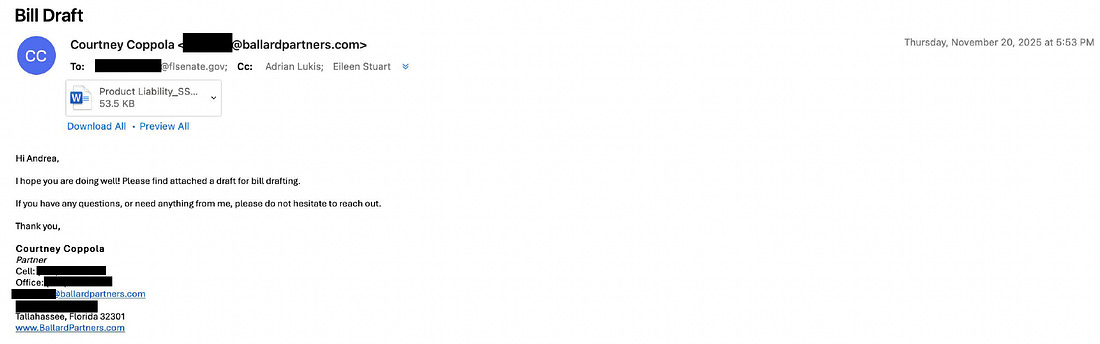
Lobbyists for Sig Sauer emailed an aide to Sen. Jay Trumbull a draft of the legislation that became Senate Bill 1748.
The Sig Sauer bill passed the House of Representatives by a 75-29 vote but was unable to get through the Senate. The legislation could be resurrected in the future, though, particularly with the support of a legislator like Trumbull, who is in line to become president of the Senate after the 2028 elections.
Another text message obtained by Seeking Rents — sent by Eileen Stuart, a lobbyist for Sig Sauer, to Duggan, the House bill sponsor — shows that Sig Sauer representatives dined with Trumbull shortly before the session began. The lobbyist described the future Senate president as “firmly committed” to the legislation.
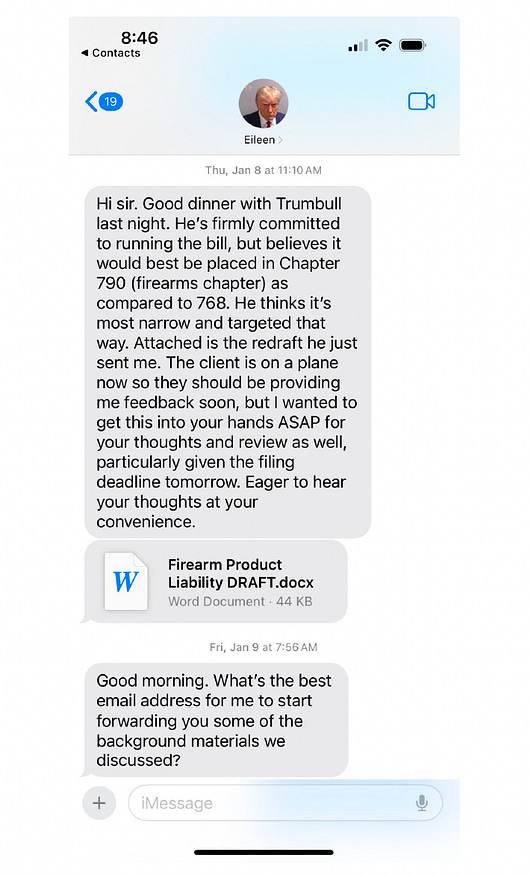
A text message from Sig Sauer lobbyist Eileen Stuart to Rep. Wyman Duggan.
Meanwhile, more than 40 lawmakers reported a combined $469,000 on Jan. 12 from Tampa-based Slide Insurance, which has become one of Florida’s more infamous insurance companiessince launching in 2021.
It’s not clear what specific bills or issues the now-publicly traded company lobbied lawmakers on this session.
But the House of Representatives attempted tolimit the ability of insurance companies to shift money between affiliates and subsidiaries in order to avoid state laws prohibiting excess profits. And Slide has been particularly aggressive in the past when it comes to using internal transactions to move money across its corporate structure.
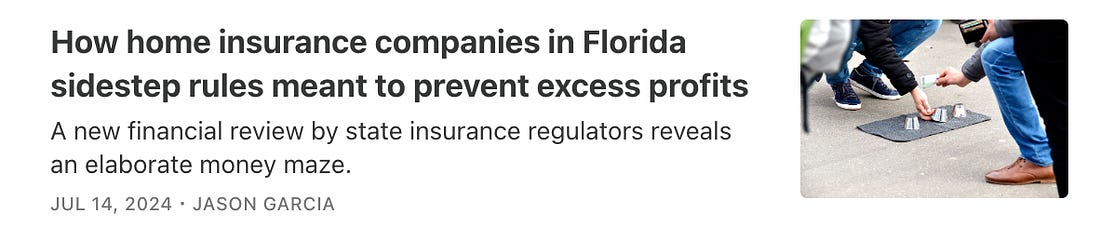
The profit-stripping legislation breezed through the House by a 106-3 vote. But it was never given a single hearing in the Senate.
Senate leaders were, it turns out, the biggest beneficiaries of Slide’s session-eve contributions.
Records show that a fundraising committee chaired by Boyd, the incoming Senate president, took $170,000 from Slide — more than a third of all the money the company donated on Jan. 12.
The No. 2 recipient? Trumbull, who will follow Boyd as Senate president and who took $45,000 from Slide Insurance the day before session began.
Now, all the contributions that Sig Sauer and Slide made the day before session went to Republicans — which makes sense, since Republicans hold supermajorities in both chambers of the Legislature (as well as the Governor’s Office and all three statewide elected Cabinet posts) and have complete control over the agenda in the Capitol.
But to be very clear, plenty of corporate interests buying access in Tallahassee also make sure to spend a bit of money currying favor with some Democrats, too.
A particularly interesting example: The new campaign-finance reports show that the giant landowner behind the “Blue Ribbon Projects” bill gave $10,000 on Jan. 12 to a committee controlled by Rep. Christine Hunschofsky (D-Parkland), the incoming House Democratic Leader.
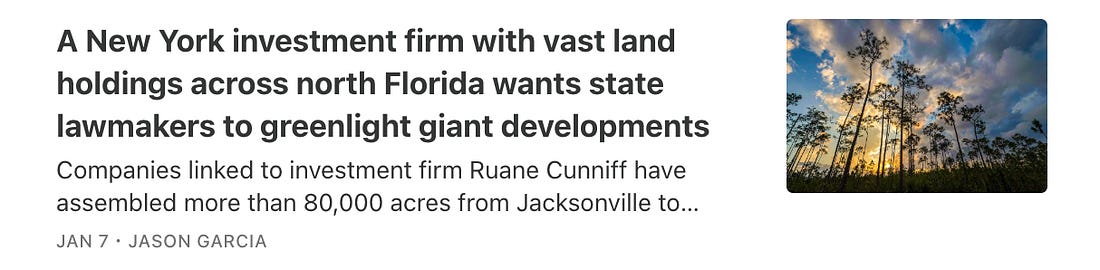
It could perhaps help explain how the legislation — which would have enabled the largest landowners in Florida to develop city-sized projects on rural tracts of land with minimal local oversight — managed to pick up a handful of Democratic votes in each of the three House committees it passed this session, despite opposition from environmental groups and local governments.
The Blue Ribbon Projects bill ultimately failed in the Senate — but just barely.


So far, the low information voters in Florida have not discovered that their politicians do not work for them. Many residents in the GOP are lead to believe that the GOP is golden, even when they do not agree with many of their policies. They drink the Kool-Aid, head off to their job at the dollar store and continue to reject liberal politics.
The latest big scam in Florida is to eliminate property tax so the GOP will be able to trample on home rule and consolidate power in Tallahassee. Lots of billionaires moving to Miami don’t want to pay the bill for the large estates they enjoy so they intend to pass it off on the public when the state has to enact a bunch of regressive taxes to compensate for lost revenue. Then, politicians will be able to deliver a fatal blow to public education, which is what they dream about every night.
LikeLike
Culture war issues distract low information voters
LikeLike
The sad thing is that there are plenty of public school teachers STILL voting for Republicans. My hunch is that these are the teachers who put a lot of blame for the current state of things on the districts when the districts are there merely to enforce the laws of the state. I see it in local teacher private Facebook groups all the time.
Same deal with the general public. They place blame on schools and districts for things when the reality is that they act as messengers and implementers of the laws the state passes. You’re taking your kid out of public school to dodge the Big Test, but you voted for governors and legislators who pushed this “test-based accountability” thing going back to Jeb Bush.
LikeLike
FL,
That’s sad. Notice that Jeb wants test-based accountability for public schools but not for voucher schools.
LikeLike