When DeSantis first became governor of Florida, a legislator told him about this little bed of radicalism, and DeSantis admitted that he had never heard of it. But then he realized that attacking it and remodeling it would help build his resume for his bid for the Presidency.
New College was, like Hampshire College, a progressive institution where there were no grades and students could design their own courses. It attracted free-thinking students and professors, and this was intolerable to people like DeSantis. The fact that it was funded by the state made it vulnerable to political interference.
DeSantis decided that New College’s inclusion of gender studies and its welcoming of LGBT students was, in fact, a pretext for indoctrinating students into a Communist, socialist, anti-American way of thinking.
New College was woke, and the governor had to take control. He ousted the president and the board of trustees and replaced them with rightwing allies and political buddies. The new president of New College had no experience in higher education but had been Republican Speaker of the House in Florida.
One new board member, Chris Rufo, was an anti-woke crusader who wanted to turn New College into a model for how to take control of progressive colleges and turn them into rightwing colleges.
It’s a harrowing story. Set aside some time and watch it. The best part might be the new Dean at comedy night telling a story about exposing himself to a 7-year-old girl. He thought it was funny.
Scott Maxwell is a columnist for the Orlando Sentinel. In this column, he argues that voucher schools in Florida should not be allowed to dodge accountability. And, he explains, they are completely unaccountable. The state Constitution requires that the state provide high-quality education, which voucher schools do not. He neglects to notice that the state Constitution states that no public money should go to religious schools. Not a penny, but most vouchers go to religious schools.
What is more, the voters of Florida rejected an effort to strip that language from the state Vonstitution in 2012.
Scott Maxwell wrote:
Teachers and parents have filed a landmark lawsuit challenging the legality of Florida’s billion-dollar school voucher system
The argument at the heart of their suit is that Florida’s constitution requires tax dollars be spent on “high-quality” education. Yet Florida’s voucher system is a black-hole of accountability, sometimes paying for kids to go to “schools” that are total disasters — where teachers lack degrees, inflate grades and use curriculum that is rubbish.
I’m not convinced the teachers and parents will win this lawsuit. In fact, I doubt they will. Similar challenges have been unsuccessful. And Gov. Ron DeSantis has done a pretty thorough job of stacking the courts with political allies, especially at the appellate level.
But I know for a fact the teachers and parents have a point. In fact, It’s inarguable. This newspaper has spent nearly a decade documenting voucher schools that failed children.
Often, the parents themselves were shocked and outraged to learn that schools were failing their kids and that there was little to no accountability.
The Sentinel’s multi-year “Schools Without Rules” investigation into voucher (or “scholarship”) schools found some schools employed teachers that lacked any teaching credentials or college degrees.
Some were such financial disasters, they shut down in the middle of the year, stranding families. (One in Orlando was evicted from a commercial complex where a neighboring tenant was “Drug Tests R Us.”)
Some refused to serve children with disabilities, whether it was autism or reliance on a wheelchair. Even more refused to teach children who are gay or had gay parents. These were schools eager for the public money but unwilling to serve all the public. None of this was discreet. Some had written policies saying that they wouldn’t serve children with Down’s syndrome or who uttered the sentence: “I am gay.”
Some schools taught junk science and bogus history, suggesting that dinosaurs and humans roamed the earth together and downplaying slavery and segregation.
And at some schools, parents were so appalled at what they found that they reported to the state things like “Cleaning lady substituting for teacher” and “I don’t see any evidence of academics.”
If you think any of that represents “high quality” education, you might also believe the mini tacos at 7-Eleven are five-star dining.
Many private schools that accept vouchers do stellar jobs and fill niche needs that public schools have historically struggled to meet. But too many taxpayer-funded schools are total trainwrecks. And the reason is that Florida has very few standards for voucher schools.
That is, in fact, the crux of the lawsuit, which lists about 20 different things that public schools are required to do by state law, but which all voucher schools are not.
Like providing certain levels of school safety staffing and having threat-management plans in place. Offering vetted curriculum and providing transportation. Hiring qualified teachers. And publicly posting test scores from state assessments that show whether students are actually learning anything. Public schools must do all of that.
The argument from choice-without-standards supporters is that parents should be able to choose any education they want for their kids without exception.
There are two problems with that argument. One is that no other government-funded voucher program works that way — and for good reason. We don’t let recipients of food vouchers use them on Twinkies and Mountain Dew. This is public money meant to provide nutritional sustenance. So there are guidelines. The same way there is for Medicaid and Medicare. You don’t get to spent public money that’s meant to fulfill a public purpose on anything you like just because you invoke cries of “freedom” or “choice.”
The other problem is that using this money to provide “high quality” education isn’t optional. It’s part of the Florida Constitution — a point the lawsuit addresses when it says: “… choice does not change the Constitution. When public funds are used to educate a child, that child is entitled to the same level of educational opportunities, the same quality standards, and the same basic protections.”
You can certainly make the argument that some public schools have failed some students. Do you know how we know that? Because these schools were required by law to disclose their test scores, standards, hiring practices and curriculum. In fact, newspapers in Florida were often the ones that exposed problems at public schools.
And most anytime we did, public officials would spring to action and agree reform was needed. Yet most every time we’ve exposed problems in taxpayer-funded voucher schools, state lawmakers leaders looked the other way. The most pathetic part of all this is that it’s easily fixable.
Florida could still offer “choice,” but also demand that any schools that receive public money meet basic standards. Hire qualified teachers. Post the results of nationally-normed standardized test scores and graduation rates. And ban discrimination.
“To me, this is just common sense,” said Stephanie Vanos, an Orange County School Board member who also happens to be an Orlando mom and joined the lawsuit as a plaintiff in that capacity. “I’m not saying they need the thousands of pages of rules that apply to us, but we need a common-sense set of rules that should apply to everybody.”
She is, of course, right. Schools that do good jobs shouldn’t be afraid of accountability and transparency. Most aren’t.
In fact, ask yourself these basic questions: Why shouldn’t parents and students be guaranteed qualified teachers?
Why shouldn’t taxpayers be able to see what kind of test scores are being produced at all the schools they’re funding?
And why shouldn’t taxpayers be assured that the money they’re spending is actually providing “quality” education, as the Constitution requires? Better yet, ask those who defend the status quo.
Florida, under the thumb of its rightwing extremist Governor Ron DeSantis, has had a hard time hiring a new president for its state university.
Last year, the search committee selected Santo Ono, the president of the University of Michigan, as its candidate. However, the university’s Board of Governors voted against the nomination of Ono because of his work to diversify the University of Michigan, which was contrary to the anti-DEI policies that DeSantis championed.
Now the search committee has selected Stuart Bell, the president of the University of Alabama, to be the president of the University of Florida.
Under Bell’s decade-long tenure at the University of Alabama, Black and Latino enrollment doubled after he launched an aggressive diversity campaign in response to a series of racist incidents…
Opposition to Stuart Bell’s nomination to be president of the University of Florida grew this week with several prominent conservative activists, a Trump appointee, and a U.S. senator weighing in.
Activists from the Manhattan Institute argued that Bell is an ideologue who during his tenure as president of the University of Alabama discriminated against white people in his efforts to diversify the student body and faculty.
Even the Secretary of Education Linda McMahon suggested that the University of Florida should pick a different president, not Bell, tainted by DEI.
Trying to retain control of the House of Representatives, Trump urged states to redraw their Congressional districts, although this redistricting usually happens every 10 years, after the census is reported. Texas, led by ultra-MAGA Governor Greg Abbott, was first to redistrict, creating a likely four additional Republican seats. California countered with a referendum, in which voters approved a temporary redistricting. Other states followed.
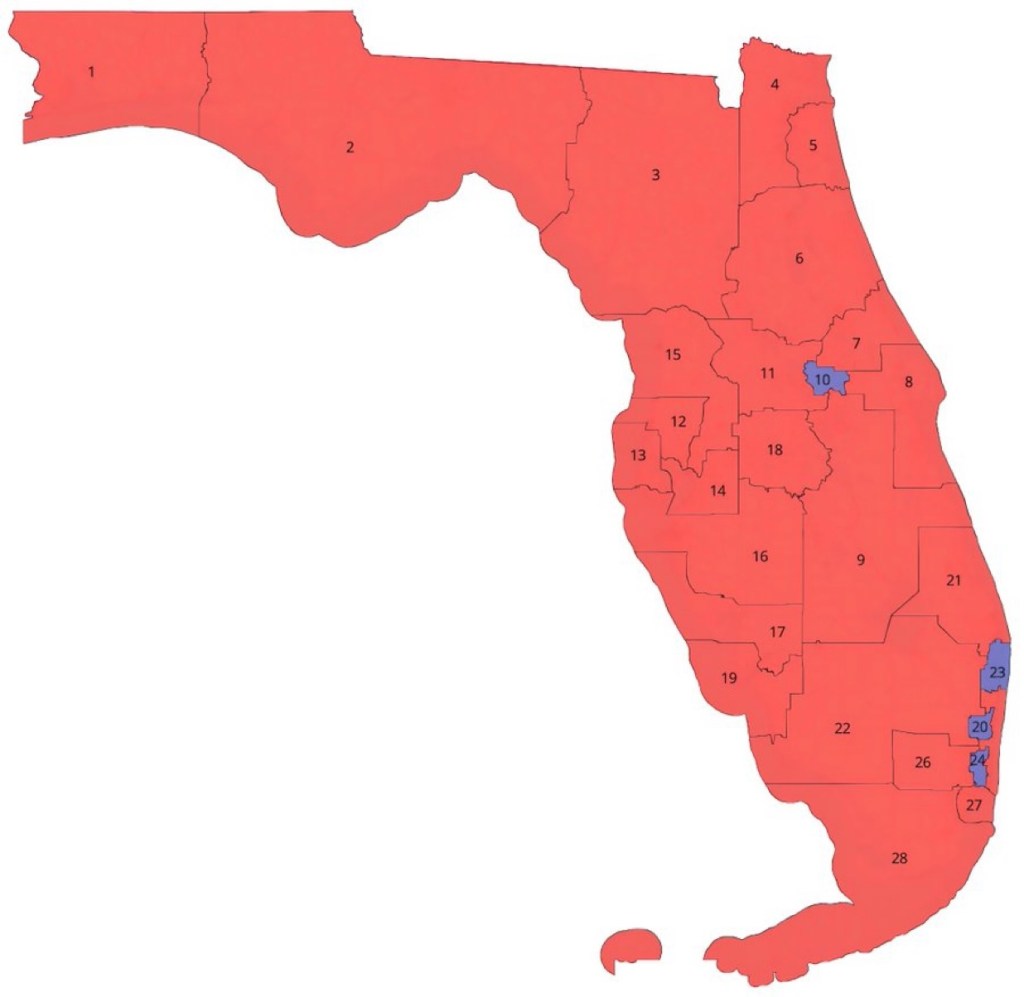
Now Florida Governor Ron DeSantis has produced a new map, drawn to eliminate four Democratic members of Congress. If his map is approved (which is likely since Republicans have a supermajority in both legislative houses), the Florida delegation to Congress will have 24 Republicans and only 4 Democrats.
Forget the fact that Florida voters passed a state constitutional amendment to ban partisan gerrymanders in 2010. The State Constitution also bans funding for religious schools, which was reaffirmed by voters in 2008. Now, billions of dollars are spent by the state for religious schools. The State Constitution. Just a piece of paper.
Please note that DeSantis gave his new map to FOX News before sharing it with the legislature.
Gov. Ron DeSantis of Florida proposed a redraw of the state’s congressional districts on Monday that could give Republicans as many as four new seats, an aggressive gambit that could also set the party up for some losses in the November midterms.
The map appears to eliminate two Democratic-held districts in South Florida, a third in the Tampa area and a fourth in the Orlando area, leaving Democrats with perhaps only four of the state’s 28 congressional seats. There are currently seven Florida Democrats in Congress; an eighth, former Representative Sheila Cherfilus-McCormick, resigned last week after being charged with embezzlement.
Florida, which does not hold primary elections until August, is the last state aiming to redraw congressional maps ahead of the midterms. A Supreme Court decision expected soon on a key provision of the Voting Rights Act could provide opportunities for other states to do so, but with many holding primaries in the next month or two, time is running out.
Mr. DeSantis’s map, initially made public without detailed county borders or other critical information, was first reported by Fox News, which received the map before the State Legislature did Monday morning. Lawmakers are scheduled to meet in a special redistricting session starting Tuesday, which means they have less than 24 hours to examine the proposal before they convene.
The short turnaround is likely to upset some state lawmakers, few of whom have expressed much interest in redistricting, as well as many members of the Florida congressional delegation, who will have to introduce themselves to new voters between now and the midterms. State lawmakers are not expected to propose any maps of their own, but rather to vote on Mr. DeSantis’s redraw as early as Wednesday. It is almost certain to pass, given the Republican supermajorities in the State House and Senate.
Should the map pass, it could give Republicans nationwide an edge of roughly two to four seats heading into the midterms. That would hardly be the multiseat advantage that President Trump and national Republicans envisioned when they kicked off the national redistricting battle in Texas last summer.
But should the fight for the U.S. House come down to a few districts, any seat that flips from Democrat to Republican could prove critical. Republicans currently control the chamber by just a handful of seats.
Any redistricting effort in Florida faces a significant legal hurdle. In 2010, voters in Florida passed the Fair Districts amendments, which effectively ban partisan gerrymandering in the state. Mr. DeSantis told Fox News that his proposed map — colored red and blue to indicate the expected political leanings of new districts — “more fairly represents the makeup of Florida today.”
Here is the current party registration in Florida, according to Florida government data:
Current proportions (≈ February–March 2026)
Republican: ~41%
Democrat: ~30%
No Party / Independent (plus minor parties): ~29%
But DeSantis’ gerrymander awards 85% of Congressional seats to Republicans.
Success Academy (originally called Harlem Success Academy) wil open five charter schools in Miami. The board had the paperwork for only one day, but were pressured to make a decision or have the decision made by a special magistrate.
SA is run by Eva Moskowitz, a former New York City Council member. She has nearly 60 charter schools in NYC. The chain is amply funded by billionaires, including several Wall Street titans.
Her debut in Miami is facilitated by a gift of $50 million by billionaire Ken Griffin.
Under a law passed recently, SA is authorized to move into any school with empty classrooms. In NYC, this is called co-location. It inevitably creates bad feelings between the public school and the charter school, because the charter school–especially SA–is better funded than the public school and has better everything.
Moskowitz hopes to enroll 8,000-10,000 in Miami and then expand into other parts of Florida.
Board member Luisa Santos, who represents the district Homestead Senior High is in, expressed concern for what the co-location would mean for students with disabilities.
“ On paper it may look like we have the seats, but in reality, once I started looking at how you implement this year one and year two, at the specific school in my district, the reality would be that you’re doubling and tripling up some of those highest need students into environments that frankly will become very chaotic,” Santos said.
SA is a “no-excuses” charter chain, which has strict rules about student behavior. It retains the power to oust students who don’t conform to its rules.
It has been controversial in NYC for multiple reasons. For high student attrition; for high teacher turnover; for accepting only students with the mildest disabilities; for ousting students who can’t comply or keep up; for bringing students to legislative meetings at the city or state levels to lobby for more funding for charter schools; for Moskowitz’s compensation (close to $1 million a year including bonuses); and for using a powerful, wealthy campaign PAC to support candidates who back charter expansion.
The students who survive 12-13 years of SA get very high test scores.
Jason Garcia, investigative reporter, explains how giant for-profit charter chain Academica plans to grab a bigger share of local property taxes. Academica long ago figured out the importance of working with the right lobbyists and contributing generously to the right politicians. Their efforts have paid off in bigger profits.
In late February, toward the end of this year’s regular legislative session, Republican leaders in the state Senate introduced a measure to make public school districts across Florida give a bigger share of local property taxes to privately run charter schools. The idea seemed to catch some senators by surprise when it was presented to the Senate Finance & Tax Committee as part of a larger package of proposed tax cuts and changes. The charter school provision prompted an extended round of sometimes-confused questioning during the hearing; Sen. Ed Hooper, a Republican from Clearwater who is a part of the Senate GOP leadership team, confessed that even he did not fully understand it. But there was someone who knew about the property tax plan in advance: Academica Corp., the charter school management giant that stands to profit from the change. Records obtained by Seeking Rents show that the sponsor the Senate tax package shared a draft of the charter school language with a lobbyist for Academica the week before it was filed for the rest of the public to see. An aide to Sen. Bryan Avila (R-Miami Springs) emailed the still-secret tax-sharing scheme to Academica lobbyist Andreina Figueroa with a one-word subject line: “Review.”
Jason Garcia is an investigative reporter who focuses on Florida politics. His blog Seeking Rents should be read by every Floridian, as well as anyone who cares about government ethics.
In this post, he shows how corporations buy the votes they need to pass bills that hurt the public interest.
The votes are for sale. The public can’t compete with the corporations. Except at the ballot box.
Question: Why does the public re-elect these scoundrels?
Garcia writes:
Florida lawmakers banked $14 million in campaign contributions on the day before the start of the 2026 legislative session, according to a Seeking Rents review of first-quarter campaign finance reports.
The avalanche of donations recorded on Jan. 12was, in part, the result of an annual fundraising orgy that takes place in Tallahassee on the eve of every lawmaking session. Legislators are forbidden from raising money during their 60-day session, which means they — and the special interests seeking to buy access and influence in the state Capitol — must scramble to beat the opening gavel.
Much of that last-minute money was essentially laundered through intermediaries — like political committees controlled by lobbyists or campaign consultants — that make it difficult to the trace the true origins of many donations.
For example, one of the biggest session-eve spenders this year was “A Stronger Florida,” a political committee linked to the lobbying firm Rubin Turnbull & Associates, which records show doled out more than $500,000 to more than three dozen legislators. Recent large donors to the lobbyist-controlled committee include the billionaire-run insurance firm Ryan Specialty, for-profit hospital owner HCA, online casino operator ARB Interactive, and Outpost Brands, which sells loosely regulated products infused with an opioid-like extract.
But two companies stand out for the amount of last-minute money they dropped on Florida’s Republican-controlled Legislature: Gun manufacturer Sig Sauer Inc. and home insurer Slide Insurance, both of whom, records show, showered nearly $500,000 on legislators on the final day of pre-session fundraising.
More than 30 lawmakers deposited a combined $480,000 in donations from Sig Sauer on Jan. 12— including House Speaker Danny Perez (R-Miami), Senate President Ben Albritton (R-Wauchula), incoming House Speaker Sam Garrison (R-Fleming Island), incoming Senate President Jim Boyd (R-Bradenton) and Sen. Jay Trumbull (R-Panama City), each of whom took $50,000 apiece via various fundraising committees they control.
The mass cash infusion came as Sig Sauer was lobbying those same lawmakers to pass a bill shielding the company from legal exposure related to a company-made pistol that can allegedly “ghost fire” without anyone pulling the trigger.
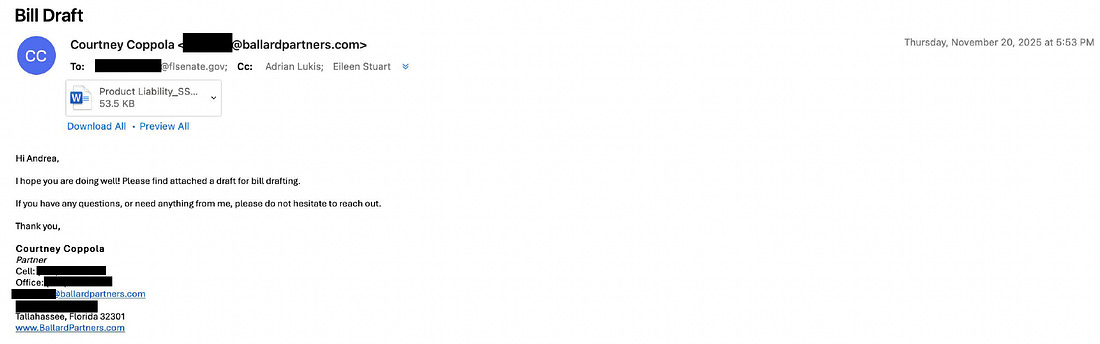
Emails and text messages obtained by Seeking Rents show lobbyists for Sig Sauer gave the original draft of the legislation to Trumbull and Rep. Wyman Duggan (R-Jacksonville), who received a $50,000 donation from the company in December.
Lobbyists for Sig Sauer emailed an aide to Sen. Jay Trumbull a draft of the legislation that became Senate Bill 1748.
The Sig Sauer bill passed the House of Representatives by a 75-29 vote but was unable to get through the Senate. The legislation could be resurrected in the future, though, particularly with the support of a legislator like Trumbull, who is in line to become president of the Senate after the 2028 elections.
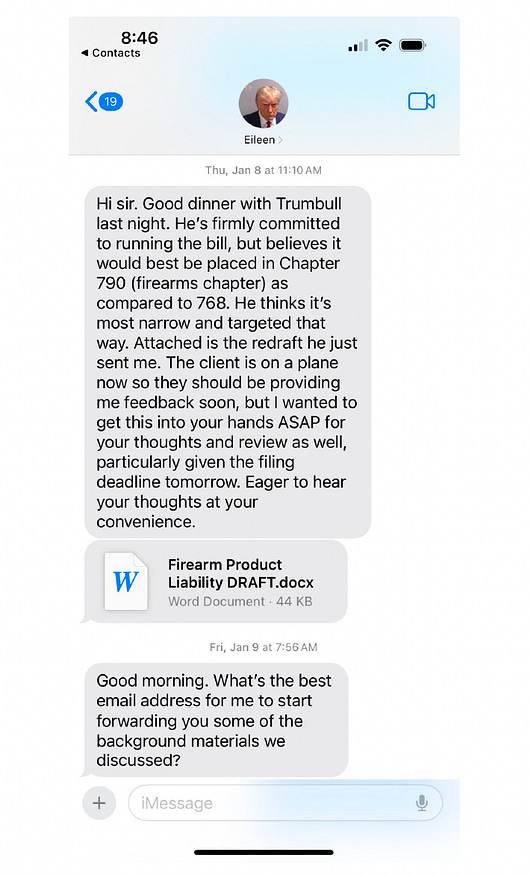
Another text message obtained by Seeking Rents — sent by Eileen Stuart, a lobbyist for Sig Sauer, to Duggan, the House bill sponsor — shows that Sig Sauer representatives dined with Trumbull shortly before the session began. The lobbyist described the future Senate president as “firmly committed” to the legislation.
A text message from Sig Sauer lobbyist Eileen Stuart to Rep. Wyman Duggan.
Meanwhile, more than 40 lawmakers reported a combined $469,000 on Jan. 12 from Tampa-based Slide Insurance, which has become one of Florida’s moreinfamousinsurancecompaniessince launching in 2021.
It’s not clear what specific bills or issues the now-publicly traded company lobbied lawmakers on this session.
But the House of Representatives attempted tolimit the ability of insurance companies to shift money between affiliates and subsidiaries in order to avoid state laws prohibiting excess profits. And Slide has been particularly aggressive in the past when it comes to using internal transactions to move money across its corporate structure.
The profit-stripping legislation breezed through the House by a 106-3 vote. But it was never given a single hearing in the Senate.
Senate leaders were, it turns out, the biggest beneficiaries of Slide’s session-eve contributions.
Records show that a fundraising committee chaired by Boyd, the incoming Senate president, took $170,000 from Slide — more than a third of all the money the company donated on Jan. 12.
The No. 2 recipient? Trumbull, who will follow Boyd as Senate president and who took $45,000 from Slide Insurance the day before session began.
Now, all the contributions that Sig Sauer and Slide made the day before session went to Republicans — which makes sense, since Republicans hold supermajorities in both chambers of the Legislature (as well as the Governor’s Office and all three statewide elected Cabinet posts) and have complete control over the agenda in the Capitol.
But to be very clear, plenty of corporate interests buying access in Tallahassee also make sure to spend a bit of money currying favor with some Democrats, too.
A particularly interesting example: The new campaign-finance reports show that the giant landowner behind the “Blue Ribbon Projects” bill gave $10,000 on Jan. 12 to a committee controlled by Rep. Christine Hunschofsky (D-Parkland), the incoming House Democratic Leader.
It could perhaps help explain how the legislation — which would have enabled the largest landowners in Florida to develop city-sized projects on rural tracts of land with minimal local oversight — managed to pick up a handful of Democratic votes in each of the threeHousecommittees it passed this session, despite opposition from environmental groups and local governments.
The Blue Ribbon Projects bill ultimately failed in the Senate — but just barely.
John Thompson, retired teacher and historian in Oklahoma, was stunned by some survey results released about parents’ opinions on education. He took a deep dive, read the raw data, and discovered that the survey was conducted by ExcelInEd, Jeb Bush’s organization. Excel promotes high-stakes accountability for public schools but no accountability whatsoever for voucher schools, which they also promote.
ExcelinEd has familiar game plan: they use inaccurate NAEP statistics to defame public schools, demand more accountability to crush the morale of principals, teachers, and parents, then insist that vouchers and charters are the way forward. As Josh Cowen showed in his book The Privateers, voucher schools get far worse results than public schools, and numerous studies have shown that charter schools are usually no better than public schools and often much worse.
Thompson writes:
Patricia Levesque, the executive director of ExcelinEd, recently wrote a commentary about a survey of 500 Oklahoma parents, claiming that more than 80% of them want “a state testing and accountability system to measure student achievement, and they expect honesty and accuracy about their children’s grade level performance.”
So, I took a dive into the survey. My reading of it was very different than Levesque’s.
In some ways, the survey she described is consistent with the Education Department parent survey that State Superintendent Lindel Fields released. But Levesque’s interpretation of the results was very different than Fields’ analysis of the state’s parent feedback.
The survey Levesque cited found that 74% of parents want a pay raise for teachers, and another 74% say we spend too little on education. Her study found that 80% of parents were very or somewhat satisfied with their school but, for some reason, it adds, “While overall positive, this fails to hit the common 95% satisfaction sought in commercial endeavors.”
While 78% of parents support retention by 3rd grade of students who don’t read on “level,” parents estimate that about 83% students read at or above grade level; and 78% are confident in the way their schools teach reading.
FYI, in 1998, 80% of Oklahoma 8th graders read at that level, but now about 59% do. My reading of the research, and classroom experience, attributes the subsequent decline to the way that No Child Left Behind and the Race to the Top undermined the teaching of History, Science, Arts, and of the background knowledge that is essential for reading comprehension; huge funding cuts; COVID; and Ryan Walters; as well as the rise of social media.
Yes, 83% of the survey are supportive of student testing, which is no surprise. But, the study doesn’t dig into the difference between testing for tracking student progress, as opposed to high-stakes testing. After all, there is great support for testing for diagnostic purposes, as opposed to the reward-and-punish testing that has been rampant since the NCLB was enacted.
Conversely, the Education Departments’ parent survey seems to be calling for schools to tackle the crucial issues that they were forced to ignore, as districts invested in high-stakes test-prep.
When Superintendent Fields explained that the results of statewide surveys of educators and parents, informed the budget priorities he is seeking. Superintendent Fields reported, “Early literacy, support systems to improve behavior and mental health resources and teacher recruitment and retention are among the top three concerns for all groups surveyed.”
The parents survey included repeated calls for teaching critical thinking skills, and media literacy; identifying misinformation; and early grade emphasis on literacy.
It explained that parents “highlighted the importance of both academic and life skills, emphasizing the need for students to be well-prepared for real-world challenges.”
Parents said that misinformation is very prevalent, and children need to be taught how to tell fact from fiction. They understand that learning how to be critical consumers of information is “literally the foundation of a successful life.” They know that social media and A.I. can make kids “susceptible to conspiracy theories and propaganda.”
What I didn’t see in the parents’ responses was calls for data-driven accountability; online, as opposed to personal tutoring for 3rd graders; or simple “miracles.”
What I saw was a desire to return to personal connections. I saw goals that would require more support for educators, as well as requiring cooperation with social workers, health providers, and mentors that are necessary for preparing children for a full life in the 21st century.
Jason Garcia, an investigative reporter who writes, a blog called “Seeking Rents” uncovered a new Republican plan to shovel taxpayers’ money to charter schools. Under Ron DeSantis and a Republicanncontrolled legislature, Florida is determined to crush public schools by sending public money to charter schools and vouchers.
Here is a new twist: Republicans want school districts to share their funding with charter schools they did not authorize.
Garcia reports:
Five years ago, Republican leaders in Tallahassee gave the charter school industry something it had been seeking for years: A way around local voters.
The change — obscured inside larger education legislation that also included restrictions on the participation of transgender students in school sports — gave state colleges and universities the power to authorize new charter schools.
In other words, it enabled charter schools — public schools run by private management entities rather than public school districts — to bypass locally elected School Boards and work instead through the governor-appointed boards that control state colleges and universities.
The industry now wants to make local voters help pay for these state-imposed charters, too.
The idea is contained inside a package of tax cuts and tax-policy changes proposed last week by the Florida Senate. It would require school districts to split revenue from what’s sometimes called the “additional millage” — an optional property tax that county voters can levy via referendum in order to raise extra funding for their local schools — with every charter school in the area.
A school district currently only has to share proceeds from the additional millage with charters that the school district itself approved.
The immediate impact would be minor: There are currently only 12 charter schools across Florida that have been approved by an “alternate authorizer” like a college or a university.
But it could escalate quickly.
Just last month, for instance, the board of trustees at Miami Dade College signed off on six new charter schools — doubling, in one meeting, the number of charters in Florida approved without permission from the local school board.
They are the first of what could become a wave of new charters unleashed by the Miami college, which just launched a new authorization program late last year, according to WLRN Public Radio and Television.
WLRN reported in December that Dade College had begun pitching its authorization services to prospective charter operators. During one webinar, a college administrator told attendees that they could expect friendlier treatment from governor-appointed college boards than voter-elected school boards.
“I think one of the benefits of going to a college authorizer is that colleges are wanting to do this,” he said. “We’re going to be looking at the same types of things that the districts look at, but with the mindset that we really do want to make this a partnership, and we want to make it successful.”
It’s not the only potential accelerant that could lead to more charters sidestepping school boards.
Florida lawmakers last year approved a major expansion of the state’s “Schools of Hope” program, an incentive program through which charter school operators can get lucrative cash grants and low-interest loans if they open up new campuses in certain locations. The law was pushed through Tallahassee in part by lobbyists for Success Academy, the New York charter network that plans to open new schools in Miami.
The new law enables Schools of Hope charters to work through college and universities rather than solely through school districts.
Miami, Florida’s most populous county, certainly seems to be the focal point of this latest legislative proposal, too.
Additional millage property taxes expire every four years unless extended by voters through. And Miami’s tax, which generates more than $400 million a year, is currently set to lapse on June 30, 2027 — which means the School Board may soon schedule another countywide referendum.
The provision requiring local school districts to share money with state-imposed charters would take effect just before that vote could happen.
Andy Borowitz is America’s humorist. More than that, he is incisive and brilliant. He used to write for The New Yorker, but now has his own Substack blog called The Borowitz Report. I subscribe, and I recommend that you do so as well.
In this post, he gives insight into our notorious Attirney General, Pam Bondi, who has turned the Department of Justice into Trump’s personal law firm.
It’s important to remember that she was Attorney General of Florida from 2011 to 2019. She claimed that human trafficking was her #1 issue but somehow overlooked Jeffrey Epstein. As Attorney General, she is still shielding his crimes. Could it be that she is doing this to protect Trump?
Her obnoxious, aggressive, pugnacious appearance before the House Judiciary Committee showed the real Pam Bondi.
Can the attorney general of the United States go to prison?
The answer, of course, is yes: John Mitchell, who served under Richard M. Nixon, later served 19 months behind bars for crimes related to the Watergate cover-up.
Will the toxin known as Pam Bondi follow in his footsteps?
It’s worth considering in light of her appearance before Congress on Wednesday, a performance that Kimberly Guilfoyle might call “too shouty.”
Her testimony was unquestionably obnoxious. But was it criminal?
When you examine the evidence, it doesn’t look good for Pam.
This was the pivotal moment: responding to a question from California Rep. Ted Lieu about the Epstein scandal, Bondi snapped, “There is no evidence that Donald Trump has committed a crime. Everyone knows that.”
Lieu, who must have been tickled that Bondi was dumb enough to step into the weasel trap he set for her, responded that the attorney general might have just committed perjury. Which, as every Watergate superfan knows, is exactly what earned her Republican predecessor, John Mitchell, a trip to the pokey.
When the Trump shitshow is finally over, two things must happen. First, there must be a solid month of dancing in the streets. Second, there must be a reckoning: ideally, Nuremberg-style trials of the corrupt quislings who enabled this unprecedented crime spree. With those enjoyable tribunals in mind, let us now consider the case of Pam Bondi.
Remember when Trump nominated Matt Gaetz to be attorney general? We were so much younger then—although, it should be added, not young enough for Matt Gaetz.
At the time, I observed that Gaetz’s nomination was not what QAnon had in mind when they said they wanted to bring pedophiles to justice. In the end, Matt turned out to be as reckless with Venmo as he was about the age of consent, and Trump quickly withdrew his name.
Pundits claimed that Trump never expected Gaetz to pass muster with the Senate. By their reckoning, he was a “sacrificial lamb”—an odd way to describe a man who, in his personal life, had consistently behaved like a wolf. But by shitcanning Gaetz, the theory went, Trump was sending a signal to his Senate toadies that they’d better confirm all his other nominees, no matter how idiotic, incompetent, or drunk. When it came to Pete Hegseth, Robert F. Kennedy, Jr., Tulsi Gabbard, Dr. Oz, Kash Patel, and myriad other passengers in Trump’s clown Cybertruck, the gambit seemed to pay off.
Matt Gaetz, peering into the gates of Hell. (Erin Scott-Pool via Getty Images)
As for the job of attorney general, Democrats and Republicans alike seemed relieved that it would not be filled by a summer-stock version of Jeffrey Epstein. Surely, whoever Trump named as Gaetz’s replacement would be an improvement.
Instead, Trump picked Pam Bondi.
In 2016, when she was Florida attorney general, Bondi secured her place in Trump’s heart with a speech at the Republican National Convention. Her bloodcurdling attack on Hillary Clinton inspired the GOP mob to break into a familiar chant, which prompted Bondi to comment, “Lock her up? I love that.” And so, by approving the incarceration of a woman who had never been charged with a crime, Bondi displayed an attitude towards due process that would someday serve her splendidly as the nation’s top law enforcement officer.
She would, of course, have another opportunity to assert her preference for imprisoning innocent people with the case of Kilmar Armando Abrego Garcia. On April 14, 2025, El Salvador’s President Nayib Bukele, Trump’s accomplice in the world’s most notorious administrative error, joined him in the Oval Office, receiving a much warmer welcome there than was offered Ukrainian President Volodymyr Zelenskyy. After chummily congratulating each other on the abduction and deportation of a non-criminal, the two men started workshopping how their brilliant strategy might be applied to innocent American citizens.
“The homegrowns are next, the homegrowns,” Trump told Bukele, who calls himself “the world’s coolest dictator”—a stroke of branding so cringe, it’s amazing it didn’t come from Elon Musk. “You’ve got to build about five more places,” Trump advised him.
Where did America’s attorney general stand on this flagrant nullification of a basic right enshrined in the Constitution? Trump added, “Pam is studying. If we can do that, it’s good.”
Pam, apparently, is a quick study. On Fox that evening, she was all in on Trump’s blatantly illegal idea, asserting, “These are Americans who he [Trump] is saying who have committed the most heinous crimes in our country, and crime is going to decrease dramatically.”
It’s not that Bondi is bad at her job—it’s that she’s outstanding at the exact opposite of her job, that is, using the DOJ to subvert justice whenever possible. Bondi’s Department of Injustice, a mutant creation worthy of George Orwell and Lewis Carroll, has proven inhospitable to career DOJ lawyers, who have struggled in court to defend the indefensible.
One such staffer, senior immigration attorney Erez Reuveni, committed what Bondi apparently considers a cardinal sin: uttering a truthful statement within earshot of a judge. After acknowledging what was obvious to any thinking person (but seemingly elusive to Messrs. Trump and Bukele)—that Abrego Garcia’s deportation was a mistake—Reuveni was put on indefinite leave and then fired.
Meanwhile, Liz Oyer, a longtime DOJ pardon attorney, was fired for refusing to restore gun rights to the actor Mel Gibson, who lost them after pleading no contest to domestic battery charges in 2011. Apparently, Trump believes Mel Gibson needs lethal weapons more urgently than Ukraine.
We shouldn’t be surprised to see Trump standing up for the rights of domestic abusers, since a sizable number of the January 6 rioters he pardoned fit that description. He doubled down on his support for this cohort by appointing a crony accused of domestic violence, Herschel Walker, ambassador to the Bahamas.
But what makes the Mel Gibson case particularly rich is that Trump has repeatedly claimed he is punishing universities for their “failure to combat antisemitism.” If Trump is serious about spanking antisemites, he need look no further than his pal Mel.
After the actor’s 2006 drunk driving arrest in Malibu, the police report indicated, “Gibson blurted out a barrage of anti-semitic remarks about ‘fucking Jews’. Gibson yelled out: ‘The Jews are responsible for all the wars in the world.’ Gibson then asked: ‘Are you a Jew?'”
Mel Gibson after his 2006 drunk driving arrest (L) and his 2011 domestic violence arrest (R).
In the upside-down world of Pam Bondi, highly regarded DOJ lawyers are fired and Mel Gibson is rearmed. But do such perversions of justice make Bondi a candidate for worst attorney general ever? They most certainly do, when one considers how decisively and repeatedly she has violated her oath of office:
“I will support and defend the Constitution of the United States against all enemies, foreign and domestic; that I will bear true faith and allegiance to the same; that I take this obligation freely, without any mental reservation or purpose of evasion; and that I will well and faithfully discharge the duties of the office on which I am about to enter. So help me God.”
Rather than defend the Constitution, Bondi has used her time in office to tirelessly protect pedophiles—which should come as no surprise to anyone familiar with her tenure as Florida’s AG. The following campaign ad from that era, in which she vowed to “put human trafficking monsters where they belong—behind bars,” hasn’t aged well:
As Bloomberg’s Mary Ellen Klas wrote, “Bondi kept her distance from the state’s most prominent sex-trafficking case, even as Epstein’s victims pleaded with the courts to invalidate provisions of his non-prosecution agreement and filed lawsuits alleging that he abused them when he was on work release from jail.”
I am confident that Bondi’s misdeeds—including but not limited to her role in the Epstein cover-up—have more than earned her a Nuremberg-style tribunal. I am not, however, suggesting we chant, “Lock her up.” Unlike our current attorney general, I believe in due process.


 Diane Ravitch's blog