Archives for category: Democracy

This article by Dominick Anthony Walsh in Houston Public Media is an excellent, even-handed description of the voucher debate in Texas. The issues and arguments could apply to any other state. He interviewed Josh Cowen, who spent close to 20 years as a voucher researcher but has since become a voucher critic. He also interviewed several voucher researchers who continue to support them.

Joshua Cowen is a Professor of Education Policy with Michigan State University. He’s spent years studying vouchers, and eventually announced that he opposes the policies.

“They were small programs — a couple thousand kids at the most,” he said. “Those studies did tend to show some small benefit to kids academically.”

As vouchers expanded, research results began to expose problems.

“Once you got to the real ballgame and created the fully scaled up voucher programs, the results were really catastrophic,” Cowen said.

Researchers found that voucher programs in some states led to worse test score results than natural disasters like Hurricane Katrina and even the COVID-19 pandemic.

To sum it up: early voucher studies with small sample sizes showed mostly positive results, while the past decade or so of statewide results have largely shown poor outcomes, especially around test scores.

School choice research can be difficult to parse because there’s a lot of money and ideology involved.

Cowen worked on some of the early studies with Patrick Wolf, Distinguished Professor of Education Policy and the 21st Century Endowed Chair in School Choice in the Department of Education Reform at the University of Arkansas.

The former collaborators disagree about how to interpret findings.

Wolf has found some positive results around high school graduation and college completion. He also pointed to the effects of competition in Florida, where he said public schools’ test scores improved after they were forced to compete for students. But he has also observed negative impacts on test scores, including in Louisiana.

It’s worth noting that Patrick Wolf’s department and chair are funded by the Walton Family Foundation, the biggest private funder of school choice programs. when he cites high school graduation rates, he fails to mention the very high attrition rates in voucher schools. If 100 students enter a voucher program but only remain to 55 graduate from high school and 45 go to college, is the graduation rate 45/55 or 45/100?

Governor Greg Abbott’s voucher proposal would cost the state hundreds of millions, perhaps billions. And most of the money will fund students already enrolled in private and religious schools, as it does in every other state that has a voucher/ESA program.

Towards the end of the month, Governor Greg Abbott clarified for the first time what he means by school choice.

He spoke in Corpus Christi at a “parent empowerment night” hosted by Annapolis Christian Academy, where the high school tuition is almost $11,000 per year.

“Schools are for education, not indoctrination,” he said, to a round of applause.

“Now is the time to expand ESAs to every child in the state of Texas,” he continued.

He put his stamp of approval on a specific form of vouchers — education savings accounts, where families who pull students out of public education receive money. One bill in the legislature would give families about $10,000 a year that they can spend or hold on to.

The policy would mean that the Annapolis Christian Academy parents Abbott was speaking to could use taxpayer dollars for their kids’ religious private school tuition.

Now, where do you think students are more likely to be indoctrinated? At the Annapolis Christian Academy or the local public school?

Steve Hinnefeld reports on a recent Gallup Poll that shows high patent satisfaction with public schools. Parents are not seeking “choice,” yet the legislature keeps enhancing legislation to create more school choice.

He reports:

  • Indiana parents are happy with their children’s schools. A remarkable 88% said they were satisfied with the quality of their child’s school. Figures were even higher for some groups: 90% for parents of elementary children and 96% in rural areas and small towns.
  • Parents know what schools are teaching and support it: 81% say they know what their children are learning in school, and 78% say they agree with it.
  • Those who disagree with what schools are teaching are a tiny minority of parents. Only 7% don’t approve of what the schools teach, and two-thirds of those admit they don’t know what that is. In other words, “I don’t know what they’re teaching but, whatever it is, I don’t like it.”

Yet a tiny and uninformed minority – much of it unconnected to schools — seems to have the ear of Republicans, who keep pushing legislation to restrict what schools can teach about race, gender, sexuality and other made-up controversies. They’ve also promoted “curriculum transparency” bills, apparently in the idea that schools are keeping parents in the dark.

Oklahoma State Superintendent Ryan Walters seems to have absorbed all his talking points from ALEC, the rightwing bill mill or he may just be trying to duplicate whatever Florida Governor Ron DeSantis is doing. All the talking points are there about critical race theory, “diversity, equity, and inclusion,” the “science of reading,” the fear of students turning transgender or being recognized as such, the readiness to censor anything that mentions sexuality or gender, and of course, vouchers for home schoolers and religious schools.

Superintendent Walters adds another item to his “reform” agenda: pay for performance, which has been tried for a century and never worked anywhere. It is hard to find an educational program that has been more thoroughly discredited, especially in the past dozen years. Performance these days equals test scores, and the teachers in the most affluent schools always come out in top, while those who teach the most vulnerable children are always on the bottom. No need to reinvent that broken wheel. Even Republican legislators know instinctively that “performance,” defined as test scores favors those in the whitest, most advantaged schools.

John Thompson, historian and former teacher, writes:

Last week, rightwing Oklahoma Secretary of Education Ryan Walters tried to “Shove ‘Choice’ Down the Throats of Unwilling Schools and Parents,” but he received serious pushback by influential Republicans for ignoring legislative norms in budget-making. This week, Walters’ revealed more of his plans to divide and conquer public schools, while ramping up the stakes for educators who don’t comply with ambiguous and weird mandates. The response by numerous Republicans, however, seems to indicate that a bipartisan effort against Walters’ and Gov. Kevin Stitt’s extremism is growing.

Walters started the Board of Education meeting, where his budget was presented with a prayer, which included a “reference to his school choice goals.” He then condemned “a loud and vocal crowd, a minority for sure, that say that all that is needed to fix the problems in education is to toss more money and to leave everything alone.” Walters then promised:

“There will be school choice. We will ensure that indoctrination and CRT (critical race theory) are eliminated in our state. We will also make sure that our kids are safe. There will be no boys in the girls bathrooms. There will be no pornography in our schools. We will make sure all of our vendors and the schools are focused on education and not diversity, equity and inclusion.”

Then, Walters met with rural superintendents in Atoka, the home of the Republican Speaker of the House Charles McCall, who has opposed voucher expansion. Walters explained that his “incentive pay plan that would reward a select few highly rated teachers in each school with up to $10,000 on top of their salaries.”

Walters then complained that:

“Tulsa has done so poor that if you took Tulsa Public Schools out of what we’re doing, we’re in the top half nationally. If you take Tulsa and OKC out, we’re in the top 15.”

So, the Tulsa World reported that Walters said:

“He would be open to pushing for Tulsa Public Schools to be broken up into smaller schools because of academic results there he says are dismal and parents who complain they are locked in because they can’t afford private school tuition and suburban schools bursting at the seams.”

At the same time, Walters’ allies are revealing more options for punishing educators who don’t comply with confusing mandates. While Walters seems to be backing off from his suggestion that all federal education funds be rejected, Sen. David Bullard filed a bill to “develop a ten-year plan to phase out the acceptance and use of federal funds for the support of K-12 education.” Sen. Shane Jett would “add seven more prohibited topics to House Bill 1775, which bans eight race and gender concepts from K-12 schools.” Jett and Rep. Terry O’Donnell seek to ban “teaching about sexual orientation and gender identity to elementary-age children,” And Jett “would outlaw any school policies that respect or promote ‘self-asserted sex-based identity narratives,’” as well as hosting “drag queen story time.”

Moreover, Sen. Cody Rogers “would prohibit school employees from calling students by names or pronouns that differ from the students’ birth certificates, unless having received written consent from the child’s parent.” Rep. Danny Williams would completely ban sex education from public schools.

Then, it was learned, Walters fired the Oklahoma State Department of Education’s Assistant general counsel Lori Murphy. The veteran attorney was “known for her support of transgender people and objections to the state’s rulemaking on classroom race and gender discussions.”

And the Tulsa World reported, the Oklahoma State Regents for Higher Education responded to Walters’ “urgent request” to audit spending on diversity, equity and inclusion, or DEI, programs. The Regents, “scrambled hundreds of employees to compile a 10-year review of its spending history on and current materials used for … DEI programs.” They found that DEI spending was “a third of 1%” of the budget.

But, on the eve of submitting his budget to the legislature, Walters, as well as his ally Gov. Stitt, faced more bad news. As the Oklahoman reports, Attorney General Gentner Drummond, who defeated Stitt’s appointee, John O’Conner, announced an “investigation into misspent education funds” which “hung over the state Capitol on Wednesday.” As an investigation by Oklahoma Watch and The Frontier found, Connors’ lawsuit led “some critics to question whether the lawsuit was an honest attempt to recoup the funds.” Consequently, The Oklahoman reported, “some high-ranking lawmakers appeared hesitant to heed funding requests from Oklahoma’s new state superintendent because of his alleged part in the controversy.” The reason was it was “a mix of Walters’s and Gov. Kevin Stitt’s staff, not a state agency [that] was overseeing the program.”

The Republican Chair of the House Appropriations and Budget subcommittee for Education, Mark McBride, said (and Speaker Charles McCall confirmed) he had been authorized to investigate the lawsuit, and was wrong in not doing so. But now, as Nondoc reports, A.G. Drummond said he “would pursue accountability for state officials, potentially including Walters owing to his prior role as director of an organization tasked with dispersing the funds.” (for what it’s worth McCall, a likely candidate for governor, attended the budget presentation.)

The Tulsa World added that Stitt had blamed the parent company of ClassWallet for the “unflattering audit of federal pandemic relief funds under Stitt’s control.” But, the audit was critical of how the Stitt administration spent $31 million to provide pandemic relief for students’ educational needs.”

Nondoc further explained that Walters’ presentation to the committee “took the opportunity with some of the lawmakers’ questions to expound on campaign rhetoric, including addressing questions regarding his ‘liberal indoctrination’ comments and past declarations to get federal funding out of Oklahoma public education.” And, his two-point plan, funding “science of reading” and pay-for-performance, drew plenty of criticism.

Republican Rhonda Baker, chair of the Common Education Committee, told Walters, “We have, as a legislative body, voted on the science of reading.” She added, “We’ve been very supportive of that, and we have made sure that there has been funding for that, so none of that is new. What is challenging, though, … is that we are not keeping teachers.”

Moreover, Democrat Rep. Andy Fugate said Walters performance pay plan would backfire by drawing teachers away from high-challenge schools and finding schools where “it’s easiest to teach.” Similarly, McBride said:

“Merit pay, I’m OK with it if you work in the oil field or some industry, but in education I just don’t see it working. … If you’ve got a classroom of troubled youth, how do you compare that to the classroom over here where the teacher’s got all the A and B students? It’s just almost impossible to me to evaluate that.”

I’ve heard mixed appraisals as to whether Walters really believes his own words. Regardless, as his ideology-driven claims become more extreme, it seems more likely that there will be more bipartisan pushback against Walters, Stitt, and MAGA true-believers. And, who knows, maybe it will open the door to Republican Adam Pugh’s bill, based on discussions with hundreds of superintendents and education leaders and over a thousand educators, that “would spend $241 million on teacher pay raises, guarantee 12 weeks of maternity leave for teachers and offer $15 million in scholarships to future educators who pledge to work in high-poverty schools,” while bestowing respect on teachers.

This report was released about a major court decision in Pennsylvania that will affect millions of children:

For immediate release: Feb. 7, 2023
Contact: Jonathan McJunkin, Public Interest Law Center, 570-337-1969, jmcjunkin@pubintlaw.org;                        Paul Socolar, Education Law Center-PA, 215-372-1650, psocolar@elc-pa.org

A Historic Victory for Petitioners in School Funding Lawsuit

Today, Commonwealth Court Judge Renée Cohn Jubelirer ruled that Pennsylvania’s school funding system is unconstitutional and must be reformed.

In a 786-page decision, the court found that “All witnesses agree that every child can learn. It is now the obligation of the Legislature, Executive Branch, and educators, to make the constitutional promise a reality in this Commonwealth.”

The court order calls for the “respondents, comprised of the Executive and Legislative branches of government and administrative agencies with expertise in the field of education, the first opportunity, in conjunction with Petitioners, to devise a plan to address the constitutional deficiencies identified herein.”

The court rebuffed respondents’ argument that the current system is adequate, saying “In the 21st century, students need more than a desk, chair, pen, paper, and textbooks.”

The Education Law Center and Public Interest Law Center issued the following joint statement earlier today:

“Today’s decision declaring Pennsylvania’s school funding system unconstitutional is a historic victory for Pennsylvania’s public school children. It will change the future for millions of families, so that children are no longer denied the education they deserve. The court recognized that our schools require adequate funding to meet our constitution’s mandate. It’s time for our state legislature to fund public schools in every corner of Pennsylvania so all students, whether or not they live in a wealthy community, can receive the quality public education guaranteed in our state constitution.”

“The court’s decision recognizes what we showed during trial: Every year, hundreds of thousands of children in public schools in lower-wealth communities across Pennsylvania are being denied the basic resources needed for a quality education because the state is not adequately or equitably funding our schools,” said ELC legal director Maura McInerney. “The court’s order directs the state to change the way it funds our public schools from the current two-tiered system divided by local wealth to one that provides sufficient resources for all children.”

“This is a huge victory. Educators know that every child can learn, and they know the kinds of support that their students need to reach their potential,” said Dan Urevick-Ackelsberg, senior attorney at the Public Interest Law Center. “Our clients and others in low-wealth districts in Pennsylvania also know that for too long, they have had to triage their students’ needs, leaving some students behind because of the state’s failure to provide adequate funding for public education. Today’s decision makes it clear that this inequitable status quo cannot continue, and that every child in Pennsylvania has a fundamental right to receive a comprehensive, effective, and contemporary public education.”

“Education is the great equalizer — the key that opens the door to life-changing opportunities and world-changing ideas,” said Katrina Robson, partner at O’Melveny & Myers LLP. “No child should be left with their hand up, begging for but denied that opportunity. We are gratified by the judge’s ruling, which will help ensure that all children in Pennsylvania have equitable access to quality education. And we are proud of the legal team that worked tirelessly—for years—to help achieve this critically important result.”

Here is the language of the court order:

1. The Education Clause, article III, section 14 of the Pennsylvania Constitution, requires that every student receive a meaningful opportunity to succeed academically, socially, and civically, which requires that all students have access to a comprehensive, effective, and contemporary system of public education;

2. Respondents have not fulfilled their obligations to all children under the Education Clause in violation of the rights of Petitioners;

3. Education is a fundamental right guaranteed by the Pennsylvania Constitution to all school-age children residing in the Commonwealth;

4. Article III, section 32 of the Pennsylvania Constitution imposes upon Respondents an obligation to provide a system of public education that does not discriminate against students based on the level of income and value of taxable property in their school districts;

5. Students who reside in school districts with low property values and incomes are deprived of the same opportunities and resources as students who reside in school districts with high property values and incomes;

6. The disparity among school districts with high property values and incomes and school districts with low property values and incomes is not justified by any compelling government interest nor is it rationally related to any legitimate government objective; and

7. As a result of these disparities, Petitioners and students attending low-wealth districts are being deprived of equal protection of law.

The case William Penn School District et al. v. Pennsylvania Department of Education et al. was filed in 2014 by six Pennsylvania school districts (William Penn, Greater Johnstown, Lancaster, Panther Valley, Shenandoah Valley, and Wilkes-Barre Area), the Pennsylvania Association of Rural and Small Schools, the NAACP-PA State Conference, and a group of public school parents. They filed suit in Pennsylvania Commonwealth Court against state legislative leaders, state education officials, and the governor for failing to uphold the General Assembly’s constitutional obligation to provide a “thorough and efficient” system of public education. Petitioners also assert that the massive inequality this system fuels between poor and wealthy school districts discriminates against students in low-wealth communities, violating their right to equal protection in the state Constitution.

The school districts and other petitioners in the case are represented by the Education Law Center – PA, the Public Interest Law Center, and O’Melveny. During a four-month trial before Judge Cohn Jubelirer that concluded in March, witnesses explained in detail the deficiencies of the current system and the extreme, egregious disparities between school districts in Pennsylvania.

For more on the case, William Penn School District et al. v. PA Dept. of Education et al., visit FundOurSchoolsPA.org, a joint online project of the Education Law Center-PA and the Public Interest Law Center.


The Public Interest Law Center uses high-impact legal strategies to advance the civil, social, and economic rights of communities in the Philadelphia region facing discrimination, inequality, and poverty. We use litigation, community education, advocacy, and organizing to secure their access to fundamental resources and services in the areas of public education, housing, health care, employment, environmental justice and voting. For more information, visit www.pubintlaw.org or follow on Twitter @PubIntLawCtr.

The Education Law Center-PA (ELC) is a nonprofit, legal advocacy organization with offices in Philadelphia and Pittsburgh, dedicated to ensuring that all children in Pennsylvania have access to a quality public education. Through legal representation, impact litigation, community engagement, and policy advocacy, ELC advances the rights of underserved children, including children living in poverty, children of color, children in the foster care and juvenile justice systems, children with disabilities, English learners, LGBTQ students, and children experiencing homelessness. For more information, visit elc-pa.org or @edlawcenterpa on Twitter.


Jonathan McJunkin

Communications Manager (he/his)

1500 JFK Boulevard, Suite 802

Philadelphia, PA 19102

P: 267.546.1305

jmcjunkin@pubintlaw.org

www.pubintlaw.org

Facebook LinkedIn @PubIntLawCtr
The Network for Public Education posted this article about the billionaires behind the voucher legislation that recently passed. None of the billionaires live in Idaho.

New post on Network for Public Education.

Kelcie Moseley-Morris: Records show powerful, wealthy funders outside Idaho back school choice campaign

Reporting for the Idaho Capital Sun, Kelcie Moseley-Morris explains how Idaho’s big voucher push is the product of carpetbagger astroturf. What has been presented as a grassroots movement is fueled by other players.

The national special interests groups who have poured millions of dollars into efforts to make education savings account programs a reality in states like Arizona, Utah, Wyoming, Wisconsin and New Hampshire are the same donors who spent hundreds of thousands of dollars during Idaho’s midterm election to ensure school choice-friendly legislators occupied as many seats as possible in the Idaho Legislature, records show.

The American Federation for Children and the State Policy Network are two of those groups that are coordinated and funded by millionaires and billionaires dedicated to conservative policy positions across the U.S. — and now in Idaho. Sen. Tammy Nichols, R-Middleton, introduced an education savings account bill Tuesday for parents to use per-pupil funding from state funds at the institution of their choice.

The Federation is focused on school choice, while State Policy Network’s affiliates also demonstrate opposition to unions, a reduction in public services, opposition to climate change efforts and advocate for school choice.

The State Policy Network’s donors are largely not known to the public, but investigations have determined donors include foundations run by David and Charles Koch and large corporations such as Microsoft, Verizon, GlaxoSmithKline and Kraft Foods.

[One of the players is one of the DeVos family’s favorite charities.]

During the 2022 primary election in Idaho, a group called the American Federation for Children Action Fund gave $200,100 to an entity called the Idaho Federation for Children. It gave the entity another $140,500 in contributions between September and Dec. 28.

It is unclear how much the entity is connected to Idaho. It is not registered as an entity with the Idaho Secretary of State, and campaign finance records do not indicate any Idaho individuals or companies have donated to the PAC. Records show the Idaho Federation for Children’s street address is the same as the American Federation for Children’s offices in Washington, D.C., although the “state” section of the address says “ID” rather than D.C.

The group’s chairman as listed on Idaho’s campaign finance portal is Tommy Schultz, CEO of the D.C.-based organization.

[The piece also quotes Charles Siler, a former conservative operative who became disenchanted with the anti-public school workings. He places this advocacy in a larger context.]

Siler said his job often involved meeting with legislators to persuade them to support a certain policy ideal, which included welfare reform, efforts to fight subsidies for public transportation and ballot access restrictions, along with education programs.

Siler said the policies are aimed at disrupting the political power of regular people.

“It’s all funded by people who have a world view that’s really in opposition to any kind of collective action to resolve inequities in our society,” Siler said. “It’s all about undermining and destroying collective power, because it’s the only opposition that wealthy people actually face.”

Read the full piece here. 

You can view the post at this link : https://networkforpubliceducation.org/blog-content/kelcie-moseley-morris-records-show-powerful-wealthy-funders-outside-idaho-back-school-choice-campaign/

Sara Stevenson was a librarian in an Austin, Texas, middle school. The following opinion piece was published in the Fort Worth Telegram.

When schools went remote at the beginning of the coronavirus era, parents were briefly in awe at teachers’ patience and skills.

As schools remained closed and parents grew angry, educators quickly fell from grace, and 370,000 have left the profession since the beginning of the pandemic.

Even at that, school librarians experienced the steepest fall.

During my 15 years as a public middle-school librarian, I frequently received affirmation for my vocation to encourage young people to read.

But ever since then-Rep. Matt Krause of Fort Worth published a list of 750 questionable books in fall 2021, Texas librarians have been put on the defensive.

School librarians fully support parents’ rights to monitor their children’s reading choices. In fact, some parents use the selection of library books as a way to facilitate conversations and even read books together.

Problems arise when particular parents try to usurp this role from the professionally trained librarians and decide which books belong or don’t belong in the library — not just for their kids but for all children.

School librarians in Texas are required to hold master’s degrees (or be working towards them) as well as teaching certificates and are charged with curating their library collections.

Each school population has different age levels, interests, needs and community standards, and the librarian’s duty is to choose suitable titles while making sure many points of view are represented.

A book’s inclusion in a library is not a librarian’s endorsement of the content. The book is there to provide access and choice.

Now, several Texas House members have introduced bills that would directly affect school libraries.

House Bill 338, filed by Republican Rep. Tom Oliverson of Cypress, would skip the role of the librarian altogether by putting the onus directly on the book publishers. Under this measure, publishers would have to rate every book for age appropriateness and display these ratings on their covers.

The labels wouldn’t just rate for sexual content; they would even warn if a book might be too scary for a child younger than 7.

How can anyone possibly decide this for all children? How would Maurice Sendak’s “Where the Wild Things Are” be rated? It has monsters, yes, but it’s also adorable.

The consequence for a publisher’s failure to include the rating would be that its books will not be available for school libraries to purchase.

This demand on private companies certainly seems like overreach, and it would significantly slow down the process of getting new books into the hands of eager readers.

And once again, we are faced with the question of who decides. Is it the publisher, who may be quite liberal or overly strict in standards? Will the publisher hire readers to count “dirty words” and “inappropriate” or “scary” scenes, or will the book be judged as a whole? Will every parent in every Texas community agree with these ratings? And why bypass the professional librarian in this process?

At the other end of the pendulum, we have House Bill 552 from Republican Rep. Ellen Troxclair of Austin. This law would remove the education protection clause, “repealing the affirmative defense to prosecution for the criminal offense of sale, distribution, or display of harmful material to a minor.”

This stems from the accusation that certain librarians are “groomers” for sexual deviancy.

This threat will affect the contents of libraries, causing librarians to self-censor and limit books with mature or controversial themes, LGBT characters or racial conflict.

Librarians cannot possibly read through every book acquired, so they will err on the side of safety and limit the choices of their students, especially when threatened with arrest.

During the last year and a half, I’ve watched clips of school board meetings that have been hijacked by Moms for Liberty and other organizations that ironically seek to curtail the liberty of students to select and parents to monitor their children’s reading choices.

When schools have to compete with Tik Tok and every new app that comes along to get children to read in the first place, this manufactured fight against libraries is not just misdirected but harmful.

If you want to protect kids from bad influences, take away their phones, not their library books.

Read more at: https://www.star-telegram.com/opinion/opn-columns-blogs/other-voices/article271647162.html#storylink=cpy

Christopher Lubienski is Professor of Education Policy and director of the Center for Evaluation and Policy Analysis at Indiana University. Among his publications is The Public School Advantage: Why Public Schools Outperform Private Schools. In this article, which appeared in The Tennessean, he points out that vouchers are unpopular as well as ineffective. So unpopular are they that they are usually sold another another name, like “education scholarships.”

He writes:

Recently, a panel of judges dismissed lawsuits against Tennessee’s private school voucher program passed by the General Assembly back in 2019. A month before that decision, the West Virginia Supreme Court ruled in favor of its legislature’s efforts to implement a universal voucher program. These types of legal victories may seem like good news for parents’ rights, but they are also a reminder that the school choice movement is missing a key source of support: the voters.

School choice is continuing to expand across the United States. New Hampshire implemented a statewide voucher program in 2021, and this year Arizona legislators also adopted a universal voucher program.

But these successes often come in spite of overwhelming voter opposition to school choice programs. Arizona lawmakers had passed a similar measure in 2018, only to see the initiative soundly rejected by a 2-to-1 margin at the ballot box. This time around, policymakers successfully undercut an effort to put their initiative back before the electorate.

In Michigan, school choice advocates appeared to have ignored a deadline to place their proposal for a voucher program on the ballot. Since such measures had been overwhelmingly rejected by Michigan voters twice before, voucher proponents instead exploited a quirk in state law that allowed them to put the issue directly before the GOP-run legislature while preempting any veto from the Democratic governor. (Unfortunately for their plan, Michigan voters then flipped the legislature to Democratic control.)

This voter-avoidance strategy is clear with school choice programs across the U.S. According to the pro-voucher organization EdChoice.org, the U.S. has over 75 publicly funded private school choice programs, including vouchers and education savings accounts, as well as another 45 charter school programs. But all of these programs have been implemented by legislators, not the electorate. Following these legislative actions, judges, not voters, can get their say.

In fact, voters have been allowed to weigh in on school choice programs only nine times since 2000, and they almost always reject them, often by overwhelming margins. Only twice did school choice programs pass through the ballot box. In 2012 Georgia voters empowered their legislature with the ability to create charter schools. That same year, although they had clearly rejected it twice before, Washington voters passed a charter school referendum by the slimmest of margins following financial support from Bill Gates and associates for the measure.

This reflects an interesting conflict. Parents seem to like choice programs. Perhaps that’s not surprising, since people are often happy to receive public subsidies. But when asked, voters consistently and overwhelmingly reject these programs.

Policymakers and choice advocates have largely come down on the side of parent rights in endorsing school choice. Since this puts them in opposition to voters, they largely avoid the electorate on the issue.

But policymakers would do well to remember that this is not just a question of who controls education decision-making. After all, they are entrusted with the wise use of taxpayers’ dollars. And recent research is repeatedly showing that the voters may be on to something: that vouchers are not a good investment. Although publicly funded vouchers may be propping up some private schools that might otherwise go out of business, they are not really helping the people they purport to help. In fact, despite parent satisfaction, study after study shows that students using vouchers are falling behind where they would have been if they had remained in public schools. Thus, policymakers might think twice about defying voters on initiatives that actually cause harm to children.

It’s a curious approach for a movement that claims to be working for the grass roots.

You can view the post at this link : https://networkforpubliceducation.org/blog-content/christopher-lubienski-the-school-choice-movement-has-a-voter-problem/

Over the past few days, I have received a number of hostile tweets, comments on my blog, and Instagram comments, accusing me of hypocrisy because I support public schools but sent my own sons (now ages 60 and 55) to private school. I am touched, even baffled, that anyone is upset by decisions that I made half a century ago.

It was easy to see who inspired these denunciations of me: Christina Pushaw, who is one of Ron DeSantis’ closest aides, and Chris Rufo, the man who led the phony crusade against critical race theory. They seem to think they unearthed a dark secret. That’s absurd. I’m guessing that Governor DeSantis doesn’t like what I write about him in my posts and tweets. I’m flattered.

The question of where my middle-aged sons went to schools is a nothing-burger. For the past decade, my blog bio has said that my two sons went to private school.

Pushaw and Rufo were outraged that I tweeted during “school choice week”:

“The best choice is your local public school. It welcomes everyone. It unifies community. It is the glue of democracy.”

They tweeted their “discovery” that my sons went to private school. The outrage of these two prominent right wingers generated two articles attacking me as a hypocrite.

One appeared on a news site called MEAA.com, titled:

“Who is Diane Ravitch? ‘Hypocrite’ NYU prof who sent her children to private school urges parents to pick public schools”

The article quotes Pushaw’s tweets, as well as tweets from others responding indignantly to my alleged hypocrisy.

The Daily Mail in the U.K. published an unintentionally hilarious article with this title:

“NYU education professor tells parents to send their kids to public school – before being forced to admit she send hers to private schools

It was never a secret that my sons went to private school. I was never “forced to admit” that fact.

Why did I send them to a private school?

After college, I married a New Yorker in 1960 whose family had a long tradition of attending private schools. My husband enrolled in the private Lincoln School in 1936! Like him, our sons went to private schools. When I started my career as a writer, I was conservative. I wrote articles in publications like The Wall Street Journal, Commentary, and The Public Interest. I opposed affirmative action, identity politics, and the Equal Rights Amendment. I believed, like Governor DeSantis, that the law should be colorblind.

However, I was never a racist. I was never contemptuous of public schools, because I had graduated from them and was grateful for the education and teachers I had, and the opportunities they opened for me.

In 1975, I earned a Ph.D. In the history of American Education from Columbia University. I was an adjunct professor at Teachers College from 1976 to 1991, when I left to work in the first Bush administration as Assistant Secretary of Education for Research and serve as Counselor to Secretary of Education Lamar Alexander.

After my stint in the Bush administration, I rejoined the board of the conservative Thomas B. Fordham Foundation and was invited to be a Senior Fellow at the Manhattan Institute (which now employs Chris Rufo) and at the Hoover Institution. All three are very conservative and support school choice, as did I. I even went to Albany on behalf of the Manhattan Institute and testified on behalf of charter legislation in 1998.

When I came back to New York City, Teachers College asked me not to return because of my conservative views. I was hired as an adjunct at New York University, where I was a faculty member from 1995 to 2020, when I retired.

In 2007, after a long and deep immersion in the conservative education world, I began to change my views. I began to realize, based on frank conversations within the conservative think tanks, that charters were no better and possibly worse than public schools unless they cherrypicked their students; that clever entrepreneurs and grifters were using some of them to make millions; that voucher schools were usually ineffective, had uncertified staff, and did not save poor kids; that standardized tests are not valid measures of learning; that the emphasis on tests was actually ruining education by narrowing the curriculum and encouraging teaching to the tests.

The more I reflected on the poor outcomes of conservative policies, the more I doubted the ideas I had long espoused. In 2008, I began writing a book in which I renounced my conservative views. I rejected high-stakes testing, school choice, merit pay, evaluating teachers by their students’ test scores, and the entire corporatist school “reform” agenda.

The book—The Death and Life of the Great American School System: How Testing and Choice Are Undermining Education (Basic Books)—was published in 2010, and it became a national bestseller. My change of mind and change of heart were widely reported in the national media.

Today, I am no longer a conservative. I support equal opportunity and equal justice for all Americans. I am sensitive, as I always have been, to the unjust and inhumane treatment that Black Americans have suffered. I endorse critical race theory, because it is a way of studying and evaluating why racism persists in our society and devising ways to eliminate it. Racism and other forms of hatred are a cancer in our society, and we must end them.

And so, Ms. Pushaw and Mr. Rufo, I hope I have answered your question. I enrolled my youngest child in a private school in 1965 and my second child in 1970 because I was a conservative. A lot happened to me in the years between 1965 and 2023, more than I can put into a tweet. I hope you understand why today I am a passionate advocate for public schools and an equally passionate opponent of public funding for private choices.

From my life experiences and many years as a scholar of education, I have concluded that the public school teaches democracy in a “who sits beside you” way; it teaches students to live and work with others who are different from them. The public school, I realized, is the foundation stone of our diverse society. It deserves public support and funding.

Robert Hubbell writes a thoughtful, informative blog. I’m posting this as part of my personal project to understand the new face of white supremacy. White supremacy has always been there, simmering below the surface. Trump invited them to show their faces and step into the daylight. They did, and DeSantis is sending them signals that he wants to be their champion.

Florida Governor Ron DeSantis has set his anti-education sites on Florida’s state colleges. Through a series of political and legal maneuvers, he has ceded control over Florida’s state colleges to ultra-conservative culture warriors like Christopher Rufo. In short order, DeSantis has announced that he will rid Florida state colleges and universities of curricula not “rooted in Western tradition” or that “compels belief in critical race theory or related concepts such as intersectionality.”

Amid the torrent of reporting on Ron DeSantis’s attack on critical race theory and intersectionality, the quiet part is often left unsaid. So let me say it: DeSantis’s educational agenda is code for racism and white supremacy. (Other parts of his agenda seek to erase the dignity and humanity of LGBTQ people.) DeSantis’s invocation of “Western tradition” is meant to suppress knowledge regarding the people (and contributions) of Asia, Africa, South America, Oceania, and the Indigenous Peoples of the Americas. See Talking Points Memo, DeSantis Makes 2024 Ambitions Clear As He Pours Gasoline On His ‘Woke’ Education Fire.

Given DeSantis’s generalized ignorance, his call to focus on “Western tradition” is a slippery slope that will inevitably lead to the discussion of unpleasant truths about America. For example, the enslavement of Black people was a “tradition” in North America for 246 years—and the abolition of that evil practice is relatively recent (155 years ago). So, a college course that honestly addresses the Western “traditions” of North America should include an examination that the role of slavery played in the economic, social, and political development of America.

But DeSantis isn’t stopping at converting Florida’s colleges and universities into re-education camps in the worst traditions of the USSR. He is seeking to up-end centuries of “Western tradition” embodied in the Constitution and the English common law: the requirement of a unanimous jury to impose capital punishment. DeSantis has floated the idea that a less-than-unanimous jury verdict can impose a sentence of death—an unconstitutional proposal designed to inflict the death penalty on more Black and Latino Americans. See Vox, Ron DeSantis wants to make it much easier for the state to kill people.

DeSantis is willing to do all this because he wants to capture Trump’s loyal base—which is the only hope that DeSantis has of becoming a credible candidate. As Trump becomes mired in criminal prosecutions, DeSantis will become emboldened and radicalized beyond his already extremist views. Doing so ignores the lessons of the 2022 midterms: persuadable Americans are done with Trump and his MAGA extremism. Like all military generals, Ron DeSantis is fighting the last war (the presidential election of 2020) and has failed to heed the tectonic shift that occurred in the midterms.

Charlie Sykes used to be a conservative Republican. Then Trump became President, and Sykes became a Never Trumper (maybe before the election, I’m not sure). Charlie and other Never Trumpers and their friends created a website called The Bulwark. It is consistently interesting. Charlie wrote the following post.

He wrote:

When Twitter banned neo-Nazi Nick Fuentes back in December 2021, the site’s Head of Safety and Integrity, Yoel Roth said, “Hateful conduct has no place here.”

But Roth is gone, Elon Musk is in charge, and the Nazis are back.

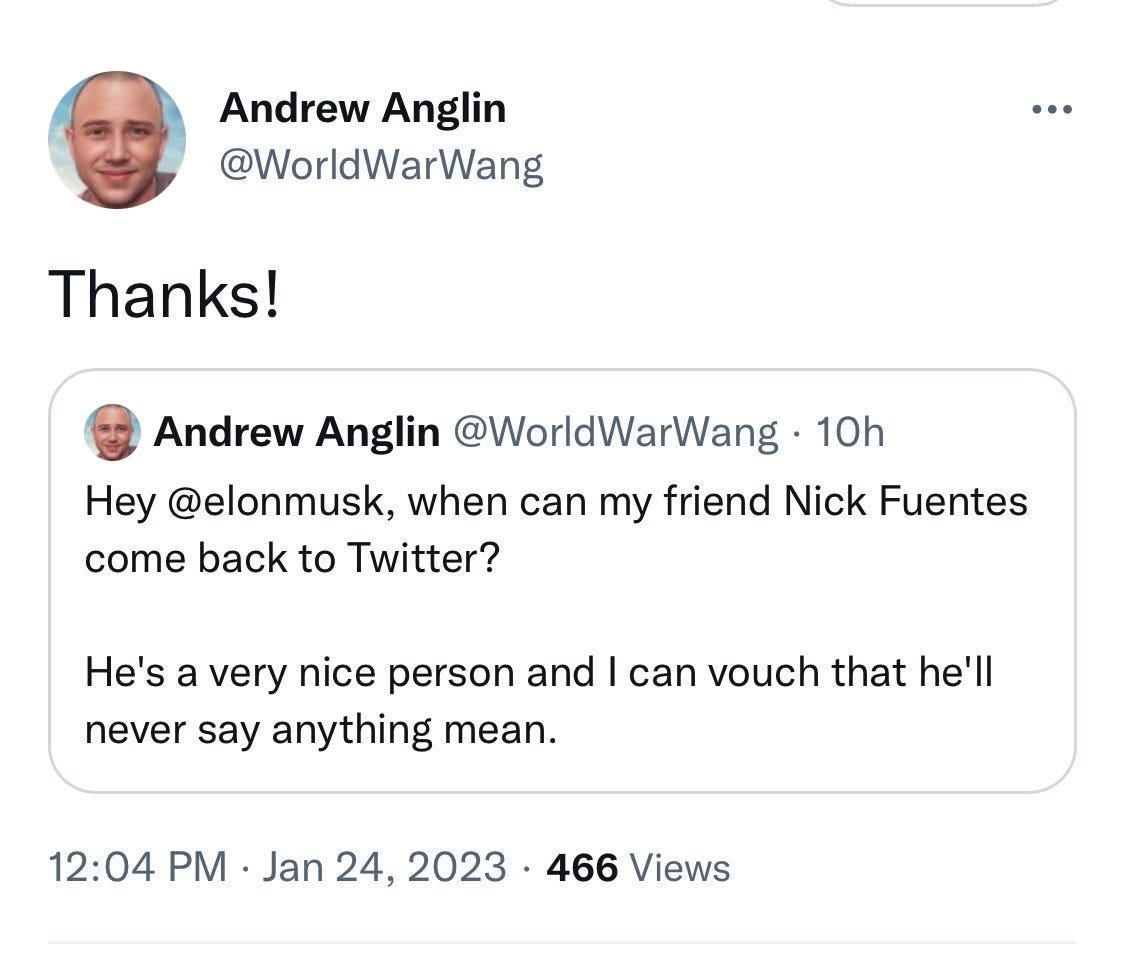
Fuentes, last seen here as Donald Trump’s dinner guest, was reinstated just hours after another actual Nazi, Andrew Anglin— who once described his approach as “Non-ironic Nazism masquerading as ironic Nazism” — asked Musk to bring his friend back on Twitter.

Anglin tweeted Musk that the Holocaust-denying, Jew-baiting Fuentes is “a very nice person and I can vouch that he’ll never say anything mean.”

Leah McElrath @leahmcelrathThe reinstatement of the Twitter account of Nick Fuentes came hours after Andrew Anglin—editor of the neo-Nazi website the Daily Stormer—publicly asked Elon Musk to let Fuentes back on Twitter: 2:51 PM ∙ Jan 24, 202393Likes66Retweets

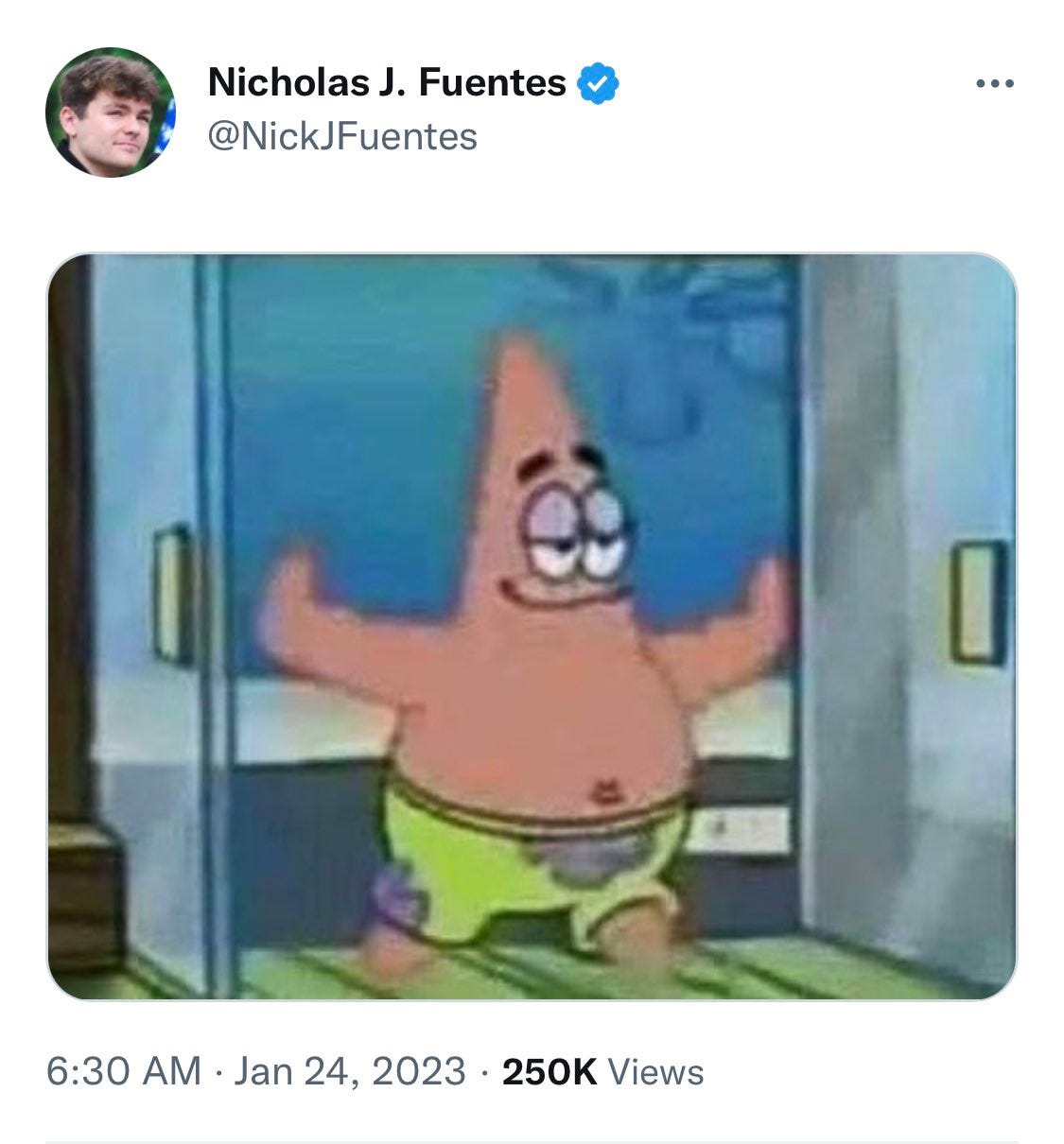
Musk, apparently took him at his word, and Fuentes made his triumphant return, with his usual restraint, dignity, and class.

Image

**

Who is this new Musk-whisperer?

Back in 2017, The Atlantic profiled Anglin: “The Making of An American Nazi.”

Anglin is an ideological descendant of men such as George Lincoln Rockwell, who created the American Nazi Party in the late 1950s, and William Luther Pierce, who founded the National Alliance, a powerful white-nationalist group, in the 1970s. Anglin admires these predecessors, who saw themselves as revolutionaries at the vanguard of a movement to take back the country. He dreams of a violent insurrection.

But where Rockwell and Pierce relied on pamphlets, the radio, newsletters, and in-person organizing to advance their aims, Anglin has the internet. His reach is exponentially greater, his ability to connect with like-minded young men unprecedented.

Since then, Anglin has tried to rebrand himself as just a garden-variety American Nationalist, but this is mostly eye-wash for clueless billionaires. Notes the Anti-Defamation League:

In an effort to validate their leap from neo-Nazis to flag-waving American patriots, he and his followers equate American nationalism to white nationalism by claiming America was founded on anti-Semitic and racist principles.

**

Anglin is also one of the most vicious trolls on the far-right. I wrote about him in my book, “How the Right Lost Its Mind,” describing the explosion of harassment aimed at Jewish critics of Donald Trump at the time.

Many of the worst instances of harassment were connected to a website known as the Daily Stormer and its founder, a neo-Nazi activist named Andrew Anglin.

I first became aware of the site when I received, via email, a photoshopped image of my picture inside a gas chamber. A smiling Donald Trump wearing a German military uniform is poised to press the red “gas” button. The photoshopping tool had been created by the website and was widely used to troll both Jewish and non-Jewish critics of the Trump campaign.

The site takes its name from the German Nazi newspaper Der Stürmer,which was notorious for the viciousness of its anti-Semitic caricatures of Jews. After World War II, Der Stürmer’s publisher, Julius Streicher, was executed for crimes against humanity.

Anglin created the site in 2013 as an updated version of his previous website, which he called Total Fascism. As of this writing, the new website features pictures of Ronald Reagan and Donald Trump and the slogan “Daily Stormer— The World’s Most Goal-Oriented Republican Website.”

It is important to emphasize again that the Alt Right is a mansion with many rooms and some very real divisions. Anglin, for example, is not a fan of Milo Yiannopoulos, who is depicted on the Daily Stormer with a cartoon of the Jewish nose superimposed on his face and is referred to as “Filthy Rat Kike Milo.”

But Anglin is also interested in emphasizing the common ground among the various disparate groups and interests that make up the white nationalist movement. In his own guide to the Alt Right, Anglin notes that the movement included various factions, but that they had all been led “toward this center-point where we have all met. The campaign of Donald Trump is effectively the nexus of that centerpoint.”

Impressed by Trump’s rhetoric on illegal immigrants, Anglin endorsed Trump in 2015 and urged the readers of the Daily Stormer to “vote for the first time in our lives for the one man who actually represents our interests.”

After Trump called for barring Muslims from the country, the site declared: “Heil Donald Trump— The Ultimate Savior.” But Anglin’s greatest accomplishment was the creation of what he calls his “Troll Army,” which he uses to attack political opponents, deployed to great effect in early 2016.

After GQ magazine published a profile of Melania Trump by writer Julia Ioffe, the future First Lady took to Facebook to denounce the piece as “yet another example of the dishonest media and their disingenuous reporting.” Anglin quickly mobilized his Troll Army, posting an article headlined: “Empress Melania Attacked by Filthy Russian Kike Julia Ioffe in GQ!”

The post featured a picture of Ioffe wearing a Nazi-era yellow star with the word “Jude” and a call to action from Anglin:

“Please go ahead and send her a tweet and let her know what you think of her dirty kike trickery. Make sure to identify her as a Jew working against White interests, or send her the picture with the Jude star from the top of this article.”

The result was a torrent of abuse, including death threats against the journalist.

On Twitter, she was sent pictures of Jews being shot in the head and pictures of her wearing concentration camp stripes. When she answered her phone, a caller began playing a recording of a speech by Adolf Hitler.

“The irony of this is that today,” Ioffe told the British newspaper the Guardian, “I was reminded that 26 years ago today my family came to the US from Russia. We left Russia because we were fleeing antisemitism. It’s been a rude shock for everyone.”

The response from the GOP nominee was also troubling. When Trump was asked by CNN’s Wolf Blitzer about the anti-Semitic attacks and death threats, the future president pointedly refused to condemn them, pleading ignorance and saying, “I don’t have a message to the fans. A woman wrote an article that was inaccurate.”

Trump’s refusal to denounce the Troll Army was greeted with delight by Anglin, who immediately posted: “Glorious Leader Donald Trump Refuses to Denounce Stormer Troll Army.” He exulted:

“Asked by the disgusting and evil Jewish parasite Wolf Blitzer to denounce the Stormer Troll Army, The Glorious Leader declined. The Jew Wolf was attempting to Stump the Trump, bringing up Stormer attacks on Jew terrorist Julia Ioffe. Trump responded to the request with “I have no message to the fans” which might as well have been “Hail Victory, Comrades!”

**

Fast-forward to 2023:

Image