Archives for category: Personal

I have. Three times. But fortunately I was skeptical enough not to take the bait.

A widow in Minnesota was not so lucky, although she prevailed in the end. Someone got her credit card number (a Costco-branded Visa card) and charged more than 1,700 small transactions to her account. An article in The Washington Post described her persistence in pressing Citibank to remove the charges.

Imagine you receive your credit card statement and find 32 pages of more than 1,700 unauthorized charges, made one right after another over three days. The majority of the debits are for $4.38, with about a dozen for $2.19, all to the same vendor, totaling close to $8,000.
Simple to fix, right?

Well, for one 66-year-old widow from Minnesota’s Twin Cities, getting those transactions removed became an odyssey. Her story is a warning for anyone — and that’s many of us — who ever has to dispute fraudulent activity on a credit card.

She was persistent, encountered foot-dragging, and eventually got the charges removed.

As for me, I was on the receiving end of three attempts to fall for a scam.

In the first one, I’m sitting at my desk working, and the phone rings. I pick up, and a teen boy says, “Grandma?” I say, “yes.” He says “It’s your grandson.” I’m not sure about the voice, so I say, “Which one?” He says, “Guess.” I have four grandsons. So I guess: “Alden?” He says, “you got it.” I say, “Are you okay?” He says, “Not really, I ran a red light and hit a car driven by a pregnant woman. I’m in trouble. Right now, I’m at a police station. I need bail, cash bail. $7,000.”

I said, “Did you call your mother?” He said, “I tried, she didn’t answer. Please help me. Here’s the number of the police officer who arrested me,” and he gave me a number.

Instead of calling the police officer, I called his mother. She answered right away. I told her what happened, and she said, “That’s ridiculous. Alden is in his dorm, studying for finals.”

That ended that.

The second scam occurred when I was a passenger in a car. The caller ID said that my bank was calling. I picked up, and a secretary answered. She transferred my call to a customer service representative. He asked me if I had transferred $5,000 by Zelle to someone I never heard of. I said no. He said I had been the victim of a scam, and I should follow his instructions to reverse the payment. He gave me a “case number,” which I wrote down. Then he told me to open Zelle and follow his instructions. He gave me the name of a person and a phone number. Then he said, “Write in $5,000 and press send.”

I stopped and wondered, “Why is the bank telling me to send someone $5,000? How will that help me get my money back?” I opened my bank account and saw no evidence that anyone had withdrawn $5,000, though I was on the verge of sending that amount to a stranger. A light bulb turned on, and I said to the “customer service representative,” that this call was a scam, and I would not send money to anyone.

End of that scam.

Third scam was very recent. I got an online ad for a non-prescription supplement that supposedly had a dramatic effect on cognition. The supplement reversed the tolls of aging and enabled you to improve your memory. The real inducement in the ad was that the research for the supplement was funded by Bill Gates. He spoke at length about his pursuit of this “fountain of youth” supplement. It involved honey sourced from Sardinia and other natural ingredients. At one point in the 30-minute video, Dr. Sanjay Gupta spoke enthusiastically about the product.

The product is called Memopezil.

I intended to try one bottle but the more you ordered, the lower the price, so I ordered more. When I finished ordering, another supplement popped up that was a multiplier for the first one. Etc.

As soon as I placed the order, I googled Bill Gates and Memopezil. Half a dozen websites warned that the video was a fake, that Gates had nothing to do with the supplement, and that the pitch was a scam. I immediately wrote trying to cancel my order. No response. The next day I called Amex, my credit card company, and alerted them.

Eventually, a large box was delivered to me, which I promptly returned. Eventually I got full credit. American Express is super-good in protecting its cardholders.

Three scams. Three escapes from the consequences. Have you been scammed!?

Now, I have learned to check carefully for scams before ordering. Online is loaded with alluring offers that are fake. While writing this, I came across a claim that appeared to be on the AARP website. It said that a Japanese scientist had discovered a way to reverse dementia. Bill Gates was cited. Clint Eastwood used it and came back. But I asked Google whether it was a scam. The answer was yes.

https://youtu.be/WPDKgv5UCwU?is=wD7_ceeFDFosBvY8

A basic rule of thumb for the Internet. If you are enticed into watching a 30-minute video; if the video promises miraculous results; if the video features a trusted celebrity; if the video says that a multibillion dollar industry is threatening to take down the video because the product will bankrupt the industry: it’s a scam.

Don’t believe anything until you have thoroughly vetted it.

One source I like for vetting: Trust Pilot.

Or ask AI or Google: “Is this product a scam.”
When I first started blogging in 2012, the number of people reading the blog astounded me. Every day, between 15,000-25,000 people read what I wrote.

Most of the referrals to the blog were coming through Facebook.

Then, in 2016 or so, there was a precipitous and inexplicable drop. Something happened but I don’t know what. I know I offended some powerful people, but that was my job. I still have had more than 43 million page views since 2012, so I shouldn’t complain.

But something similar happened to Judd at Popular Information.

He writes:

“Here are the facts:

In 2021, 34,594 people subscribed to Popular Information after seeing our reporting on Google, Facebook, and Twitter (now X).

We are more than halfway through 2026, and just 932 people have subscribed to Popular Information from those same platforms.

“Our work is better than it was five years ago. (We were recently awarded the David Nyhan Prize for Public Policy Journalism by Harvard’s Shorenstein Center.)

“But the billionaires who control Google, Facebook, and X have made the decision to choke off traffic to independent outlets like Popular Information. They are not interested in building an audience for stories like the one you are about to read.”

The algorithm changed. Someone knows, but I don’t. It changed for my blog, around the time that I began opposing Trump. Now the algorithm has changed for Judd.

Here is Judd’s latest post.

https://open.substack.com/pub/popularinformation/p/the-truth-about-the-viral-911-petition?r=rls8&utm_medium=ios

I am a proud alumna of Wellesley College, class of 1960. Wellesley literally changed my life. My best friends today are classmates; we meet monthly on Zoom to compare notes. We confess our deepest hopes and fears and stand by one another. I have returned for Reunion every five years since graduation. I love the campus and the memories.

I have supported an annual lecture series at Wellesley that has brought terrific thinkers to the campus.

Not long ago, my sons endowed a Professorship in my name, the first endowed chair in the education department. It is called The Diane Silvers Ravitch ’60 Chair in Public Education and the Common Good. The first person to hold the chair is a brilliant young scholar named Soo Hong.

Last night, after midnight, one of my dear classmates sent this review, just published. It made me very happy.

About-Face

Books and media by the Wellesley community

Image credit: Agata Nowicka

AUTHOR Catherine O’Neill Grace

PUBLISHED ON February 24, 2026

ISSUE WINTER 2026

“I was wrong” is one of the most difficult things for a human being to say. Imagine saying it when you have been a conservative public intellectual and expert on public education for decades. Yet that is exactly what Diane Silvers Ravitch ’60 does in her engaging new memoir, An Education: How I Changed My Mind About Schools and Almost Everything Else.

The author of numerous books about the history of American education and education policy, Ravitch turns to the personal in this volume, describing in depth her childhood in Houston, her experience at a segregated public high school, and her journey to Wellesley College in the fall of 1956.

At Wellesley, Ravitch learned not what to think, but how. She arrived on campus feeling, by her own account, like a “fish out of water.” But the College provided her with brilliant peers, gifted teachers, lively debate, and enriching friendships—including with “Maddy,” Madeleine Korbel Albright ’59. She recounts the hilarity of writing the junior show, Call It Red, and the excitement of seeing Fidel Castro speak at Harvard while she was working as a reporter for the Wellesley News.

A political science major at Wellesley, Ravitch went on to earn a Ph.D. in history from Columbia. As her memoir unfolds, she writes openly of loss—the anguish of the death of her 2-year-old son from leukemia, the painful dissolution of her first marriage. And she writes of love—at an education conference in 1984, she met teacher Mary Butz, who became her wife.

She also writes about intellectual transformation. As an education reformer, Ravitch believed deeply in standards, accountability, high-stakes testing, and school choice. Woven through the book is an account of her transition from outspoken supporter of conservative, market-driven policies in public education to one of their most forceful critics. Like many policymakers of the late 20th century, she saw competition, data, and pressure as levers that could fix public education. Serving in senior government roles, including assistant secretary of education during the George H. W. Bush administration, she helped advance reforms rooted in these assumptions, convinced they would raise achievement and close gaps.

But watching these policies unfold in real schools forced her to confront their consequences. High-stakes testing narrowed curricula and hamstrung teachers. Charter expansion and privatization failed to deliver promised gains while draining critical resources from public systems. Most troubling, education reformers increasingly blamed educators for failures that Ravitch now sees as driven by poverty and inequality. Children—especially poor children—were being left behind.

By the end of An Education, Ravitch emerges as a committed advocate for public schools, professional teachers, and democratic accountability. She followed the facts where they led and changed her mind. In this open-hearted, expansive memoir, she explains why.

A former classroom teacher, Grace is senior associate editor of this magazine

Diane Silvers Ravitch ’60
An Education: How I Changed My Mind About Schools and Almost Everything Else
Columbia University Press, 248 pages, $24.95


Mercedes Schneider is an amazing person, a keen-eyed researcher, and a gifted writer. She has a Ph.D. in applied statistics and research. She could have been a college professor, but she preferred to be a high school teacher. She understands the work, and she understands the students. That’s way different from journalists, who write best-selling books about schools based on their cursory experience, or scholars, who write their books based on data, not the lives of teachers or students.

I met Mercedes in the early days of the corporate reform movement, the one led by billionaires. With her sharp intellect, she saw through the hoax immediately. She saw what happened in New Orleans; she observed the influx of TFA teachers to staff the new charter schools. She was never taken in by the grandiose rhetoric of the reformers. She understood that the real goal of the so-called movement was not to improve public schools but to privatize public funding of schools.

In a remarkable burst of energy, she wrote three books in three years:

A Chronicle of Echoes: Who’s Who in the Implosion of American Public Education (2014).

Common Core Dilemma: Who Owns Our Schools (2015).

School Choice: The End of Public Education? (2016).

And she is still in the classroom.

I am now honored that Mercedes has reviewed my memoir. As you would expect, the review is insightful. She understood what I was trying to do: to pull away whatever artifice or cover there might be, and to lay my life bare. It’s not easy to do. She understood.

I urge you to open the link and read her perceptive review. It’s vintage Mercedes.

Our dog Mitzi died on August 1, 2025.

I couldn’t write about it then because it was too painful. Let me say from the outset that nothing I write here will be as beautiful as Peter Greene’s farewell to his beloved dog two years ago.

But I need to tell you about our wonderful girl.

Mary and I got Mitzi in 2013 when she was three months old. She was already 30 pounds and growing fast. She eventually reached 100 pounds.

She was born in 2012. She was a mutt. She came from a shelter in Hayward, California. When I asked the rescuer who found her what her breed was, she said: “Think of it this way. Her mother was a mutt. Her father was a mutt. They met once.” When we tested her DNA, we learned she was a mix of German Shepherd, Siberian Husky, Alaskan Malamute, and lots of others. We liked to say her eyelashes were Chihuahua.

A sweeter dog never lived. Little dogs often barked at her, and she ignored them. She was a gentle giant. She pulled me over a couple of times because she was frightened and took off like a bullet. The first time, I was walking her to the groomer, and when she saw his shop, she yanked me over trying to escape. The second time, we were taking a walk after dinner on July 3, and she heard a firecracker; she started running home and I fell over, determined not to lose control of her leash.

Her greatest fear was the sound of firecrackers and thunder. July 4 and New Year’s Eve were times of terror for this big girl. In her last years, I finally cracked the problem by taking Mitzi into a bathroom with no windows, closing the door, and playing loud music on my cellphone. It worked like a charm. She learned to appreciate Hank Williams.

Mitzi loved everyone and everyone loved Mitzi. Except for our cat, Dandelion, who was about the same age as Mitzi but weighed 15 pounds. Mitzi loved to chase Dandy but she never caught him. Never. He lived in constant fear, although once in a blue moon he would smack her, and she would back off.

Mitzi developed benign tumors in 2021 and 2022. They were surgically removed from her stomach. And one was cut off her eyelid.

Then in 2023, Mitzi developed a malignant tumor in one of her haunches. More surgery, followed by a referral to an oncologist. She took a pill every day, and a year later, in June 2024, the oncologist declared her cancer free.

One year without cancer, then it returned as a trigeminal nerve sheath tumor, a malignant, inoperable tumor in her head.

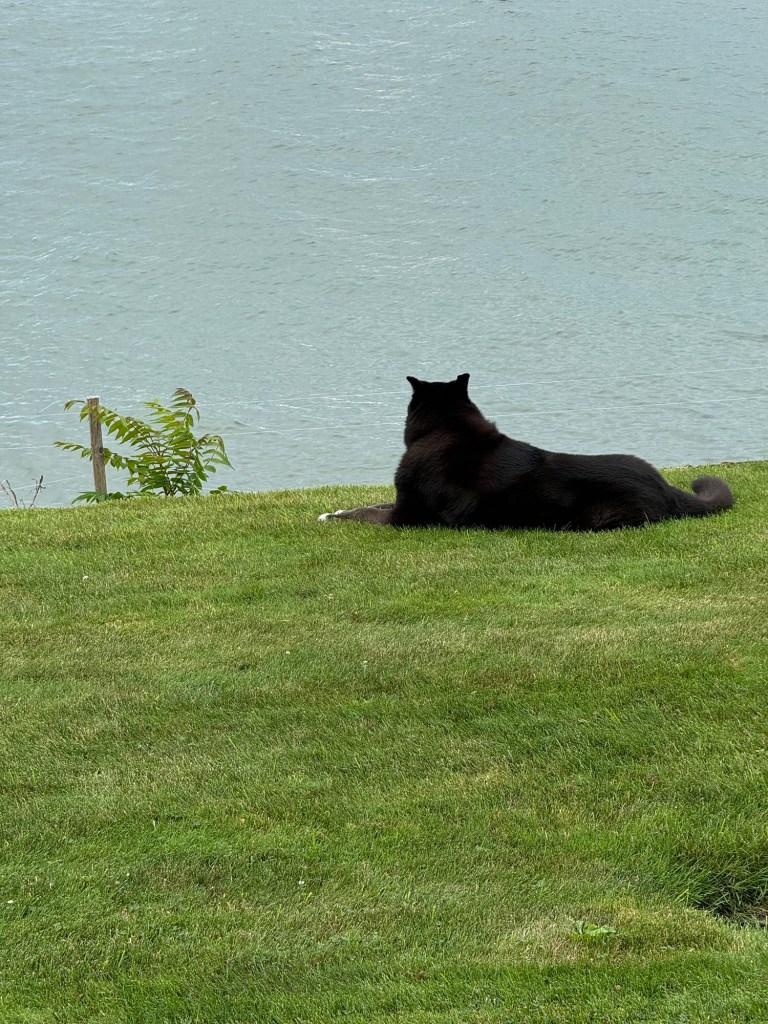
There was nothing we could do but wait. Kiss her and hug her a lot. Her favorite activity was sitting by the water and watching the boats, watching the water.

At 2 am on August 1, she woke us, as she was gasping for air. We took turns holding her, giving her ice chips. I called the vet when they opened at 8 and asked him to come to our place as soon as possible. She died at 9 am, in Mary’s arms. The vet arrived 15 minutes later.

We think of her very often. We miss her. Dogs are wonderful animals who give us unconditional love.

Here are some pictures of our girl:

Mitzi as a baby

This beautiful soul was an integral part of our lives for a dozen years. I can’t let this year end without paying tribute to her. I hope all of you experience a Mitzi in your lives.

The Network for Public Education sponsored a conversation between me and Carol Burris about my new book: AN EDUCATION: HOW I CHANGED MY MIND ABOUT SCHOOLS AND ALMOST EVERYTHING ELSE.

I think you will enjoy it!

https://vimeo.com/1137499967

https://share.google/OUhluBgNodmED08UF

Tom Ultican had a successful career in the private sector when he made a decision that changed his life: He became a teacher of physics and advanced mathematics in California. After he retired, he became blogging about education. He became one of the most perceptive investigators of the powerful people and dark money behind the organized attacks on public schools.

I am delighted to present his review of my just-published memoir, titled AN EDUCATION: HOW I CHANGED MY MIND ABOUT SCHOOLS AND ALMOST EVERYTHING ELSE (Columbia University Press).

I am posting a portion of his review here. I encourage you to open the link and finish his fine commentary.

He wrote:

An Education; How I Changed My Mind About Schools and Almost Everything Else, is highly recommended especially for the thousands of us who consider her a friend. Diane is a very generous person with both her time and resources. I first met Diane through her blog in 2014, then in person at the 2015 NPE conference in Chicago. It was in this time period that she started posting some of my articles on her blog while simultaneously informing me about who was working to destroy public education. At the time, I did not realize what a privilege this was. Her latest book is an intimate memoir that introduces us to Diane Rose Silverstein of Houston, Texas born July 1, 1938. It tells the story of a Jewish Texan from of large struggling family becoming politically influential and a national treasure.

On a page following the dedication page, she quotes Ralph Waldo Emerson:

“Foolish consistency is the hobgoblin of little minds, adored by little statesmen and philosophers and devines.”

I knew that Diane had made a big change and reversed herself on test based accountability and other school reform agendas driven by conservatives and neoliberals. However, the courage this change took and the depth of her reversal were profoundly illuminated by reading this book.

Although growing up in a Roosevelt supporting family and being a registered Democrat, she became deeply conservative. Diane served on the board of the Thomas B. Fordham foundation, contributed to the Manhattan Institute and was a member of the Koret Task Force with the likes of Eric Hanushek and E. D. Hirsch Jr. Her best friends personally and politically all supported the ideas she abandoned. By reversing herself, she walked away from professional security and long held personal friendships. It was courageously principled but must have been a personally daunting move.

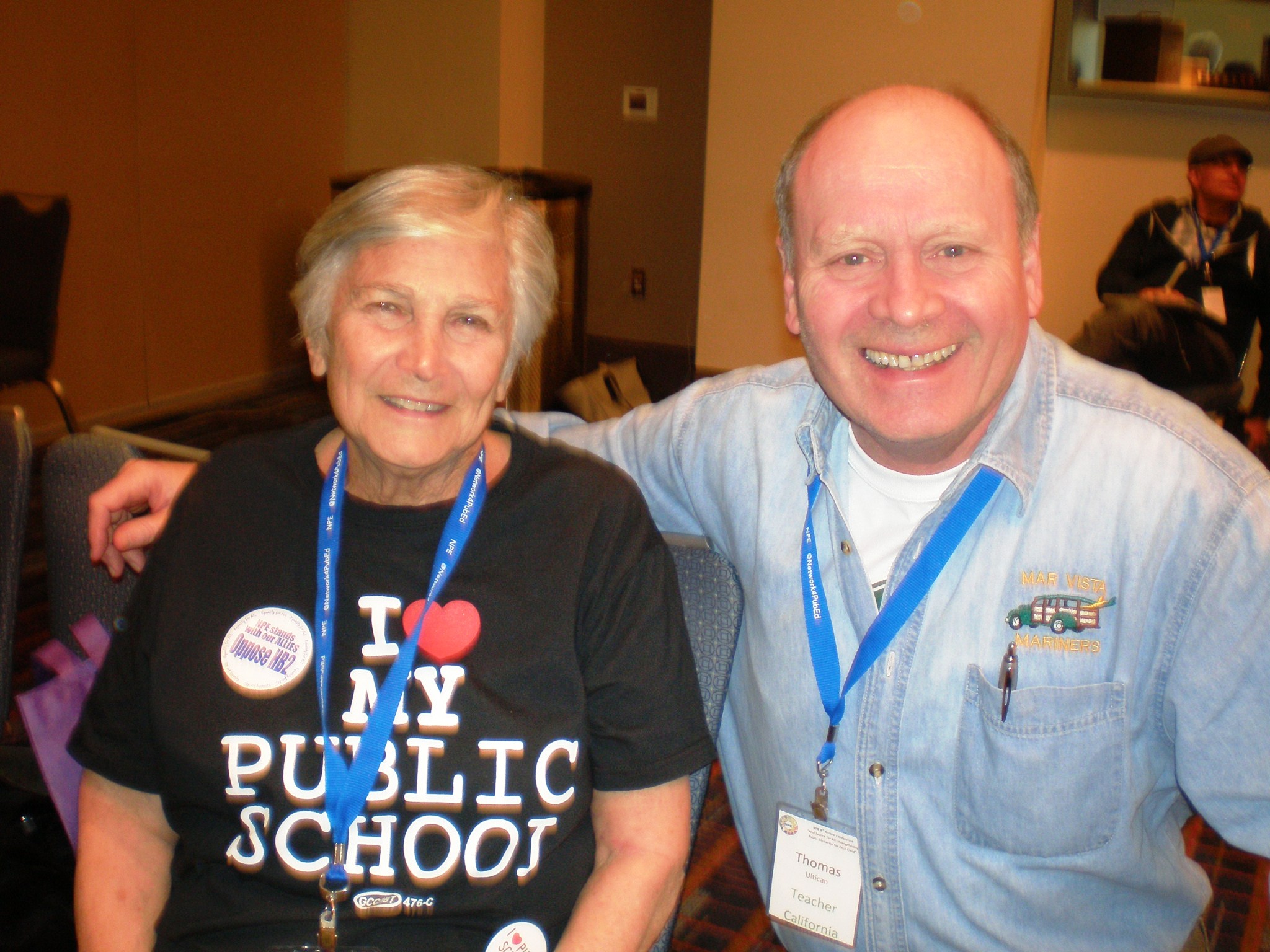
Me and Diane

The best part of “An Education” for me was Diane’s recounting growing up in Houston and going to a segregated public school. Her experience was just so relatable. She liked all the music my oldest sister liked. Cheating was rampant in her school just like mine and like her; I let my classmates copy my work. My rural Idaho school was kind of segregated but that was because only white people and a few Mexican families lived in the community. The Mexican kids were very popular in our school. I never met a Black person until I was a senior in high school and had only seen a few through a car window when vacationing in Kansas City. It was wonderful to find some commonalities.

I had studied engineering, worked in Silicon Valley and pretty much ignored education. But I did hear from Diane and her friends about what a failure public education had become. By 1999, I became tired of hearing about people becoming rich off their stock options, working on the next greatest hard drive or dealing with the atrocious San Jose traffic. I decided to return to San Diego and do something to help public education by enlisting in a master of education program at the University of California San Diego (UCSD).

The UCSD program was oriented toward constructivist education which I really liked. I read books by Alfie Kohn and papers by Lisa Delpit and was ready to revolutionize public education. Then I got to my first job at Bell Jr. High School and discovered that the teachers there were well informed pros with lots of experience. By comparison, I was not nearly as competent as most of them.

It was then that I started to see that I had been bamboozled about how bad public schools were and started looking for like minded people. Two books, David Berliner’s and Eugene Glass’s “50 Myths and Lies that Threaten America’s Public Schools” and Diane Ravitch’s “The Death and Life of the Great American School System” were like water for the thirsty. Soon after that, I found Diane’s blog and joined the Network for Public Education (NPE) along with many other public school advocates.

I saw Diane at the 2015 NPE conference in Chicago’s Drake Hotel. It was an absolutely inspiring event with a keynote by the amazing Yong Zhao. Although we started communicating a little by email, I did not meet Diane personally until NPE 2016 in Raleigh, North Carolina. It was there that the Reverend William Barber gave a truly inspiring speech.

Tom Ultican and Diane Ravitch in Raleigh (by Ultican)

Please open the link and keep reading this excellent review!

Josh Cowen interviewed me by email about my life, after reading my book An Education: How I Changed My Mind About Schools and Almost Everything Else.

I think you will enjoy reading the interview.

He asks important questions about me and changes in my life.

Today is the official publication date of my memoirs. This evening, October 21, I will be in dialogue with Leonie Haimson at the Brooklyn Heights branch of the Brooklyn Public Library, at 286 Cadman Plaza.

I wrote stuff about my personal life that I have never shared with anyone. It seemed to be the right time; easier to write about than to say, even to my closest friends and relatives.

The Network for Public Education posted this information:

Diane’s new book, charter scandals, and more…

Diane Ravitch’s memoir is a moving chronicle of intellectual courage and deep care for public education. Once a leading conservative voice advocating testing, standards, charters, and vouchers, she had the humility to acknowledge when her beliefs failed in practice, recognizing that poverty—not “bad teachers” or “failing schools”—was the real crisis. With honesty and grace, Diane retraces her journey from her Houston childhood to her service in the government, including a stint in the conservative Department of Education, and her eventual transformation into one of our fiercest defenders of public schools. Blending personal reflection with a historian’s rigor, Diane explains how she came to embrace equity, professional teachers, and democratic public education, becoming an inspiring activist whose life’s work continues to uplift the promise of our public schools.

You can purchase An Education at your local independent bookstore, on Amazon, or directly from Columbia University Press. 

My memoirs will be officially published on October 20! But the book is available now in stores and online!

The book is titled AN EDUCATION: HOW I CHANGED MY MIND ABOUT SCHOOLS AND EVERYTHING ELSE.

Please join me as I discuss the book with Leonie Haimson at the Brooklyn Heights branch of the Brooklyn Public Library.

Diane Ravitch on “An Education,” with Leonie Haimson

Tue, Oct 21 2025

6:00 pm – 7:30 pm

Brooklyn Heights Library, Multipurpose Room


Join us to hear Diane Ravitch discuss her new book, An Education, with Leonie Haimson.

For many years, Diane Ravitch was among the country’s leading conservative thinkers on education. The cure for what ailed the school system was clear, she believed: high-stakes standardized testing, national standards, accountability, competition, charters, and vouchers. Then Ravitch saw what happened when these ideas were put into practice and recanted her long-held views. The problem was not bad teachers or failing schools, as conservatives claimed, but poverty. She denounced privatization as a hoax that did not help students and that harmed the public school system. She urged action to address the root causes of inequality.

In this intimate and timely memoir of her life’s work as a historian and advocate, Ravitch traces her ideological evolution. She recounts her personal and intellectual journey: her childhood in Houston, her years among the New York intelligentsia, her service in government, and her leftward turn. Ravitch shares how she came to hold conservative views and why she eventually abandoned them, exploring her switch from championing standards-based curriculum and standardized testing to arguing for greater investment in professional teachers and in public schools. Bringing together candid reflections with decades of research on education, Ravitch makes a powerful case for becoming, as she calls herself, “an activist on behalf of public schools.”

Books will be available for purchase from Greenlight Bookstore.


Diane Ravitch was a Research Professor of Education at New York University from 1995-2020 and is a historian of education. She worked on education policy in both George H. W. Bush’s and Bill Clinton’s administrations. She is the Founder and President of the Network for Public Education (NPE) and she is the author of two dozen books including Slaying Goliath: The Passionate Resistance to Privatization and the Fight to Save America’s Public Schools, The Troubled Crusade: American Education, 1945– 1980 (1983), Reign of Error: The Hoax of the Privatization Movement and the Danger to America’s Public Schools (2013). Ravitch posts regularly about American education policy on her widely read blog.

Leonie Haimson is the founder and Executive Director of Class Size Matters, a non-profit organization that advocates for smaller classes in NYC and the nation as a whole. In June 2022, in part because of the organization’s advocacy, NY State passed a law requiring that NYC schools phase-in smaller classes in all grades. She serves on the board of the Network for Public Education, is a member of the New York State Data Privacy Advisory Committee and was appointed to NYC Department of Education Working Groups on class size, student privacy and AI. She has appeared on CNN, Fox News, MSNBC, Good Day NY, CBS, WNBC News, NPR, and Democracy Now, has written op-eds for numerous publications, and co-hosts a weekly WBAI radio show and podcast called “Talk Out of School.”

diane ravitch
Brooklyn Heights Library

286 Cadman Plaza WestBrooklyn, NY 11201

Get Directions