Archives for category: Democracy

Governor Ron DeSantis hates the fact that there is a progressive public college called New College that openly teaches diversity, equity, inclusion, feminist studies, ethnic studies, and gay studies. That’s WOKE, and he vowed to crush anything WOKE.

He named 6 conservatives to the 13-member board, and the board of the state university system added another, meaning that Rightwingers are in charge. A hard-right board needs a hard-right president, and they got one.

Their first meeting was this afternoon, and they are expected to appoint former State Commissioner of Education Richard Corcoran as the new president. From the following story, it appears that no one bothered to let the current president of the New College know that she was being shown the door.

DeSantis is showing how to stamp out ideas he doesn’t like, with power, not subtlety. Is he a fascist or is he pretending?

A new board of trustees at New College of Florida intends to name Richard Corcoran as its next President.

Corcoran, a former House Speaker, served as Gov. Ron DeSantis’ first Education Commissioner.

Carlos Trujillo, president and founder of Continental Strategy, revealed the plans in a letter to clients and colleges.

“We are beyond excited to announce that one of our Partners, former Department of Education Commissioner Richard Corcoran, will be returning to higher education to serve as the Interim — and hopeful permanent — President of the New College of Florida, in Sarasota,” Trujillo wrote.

“This move comes as part of Gov. DeSantis ongoing work to refocus the university on providing the most value to its students and their parents.”

Corcoran was a founding partner for the consulting firm.

The news comes hours before the first board meeting since DeSantis appointed six new trustees on the 13-member board. The State University System Board of Governors also appointed a new trustee with a similar conservative think tank background.

Of note, work of Corcoran’s apparent hire comes before any news of current President Patricia Okker’s future with the school. Eddie Speir, co-founder of Inspiration Academy, wrote a blog post this weekend promising to call for Okker to be renamed as interim President and to terminate all faculty and staff before deciding who still fit in the new vision for the college.

While Florida’s Sunshine Law requires all decisions by the board to be made in publicly noticed meetings, Trujillo treats the matter like a done deal.

“The selection of Richard distinguishes our firm as a leader in innovation and strategic solutions for the clients we serve. We look forward to finding new synergies that can better serve our current clients and ensure their goals are made a reality,” his letter reads.

The Miami Herald reported today on Governor DeSantis’ plans to cleanse higher education in the state. Conservatives are creating “civics” institutes as a vehicle for patriotic indoctrination, not as a means to think critically about how to improve democracy. Censorship, which DeSantis practices, would be condemned in any genuine civics class.

Gov. Ron DeSantis on Tuesday announced a package of major reforms to Florida’s higher education system, including tighter controls on faculty tenure, the establishment of “civics institutes” at three universities and prohibitions on diversity, equity and inclusion programs.

Speaking at a news conference in Bradenton, the governor unveiled a plan that would allow university boards of trustees and presidents to conduct reviews of tenured faculty members “at any time,” in addition to the periodic reviews that now take place. Regarding university presidents in particular, he proposes “reestablishing their authority over the hiring process.”

Currently, according to a flier distributed by the governor’s staff, “faculty committees can tie the hands of university presidents and bind them to only consider a small pool of recommended candidates.”

And under a heading in the flier that reads “Education not indoctrination,” he proposes changes in standards and course content “to ensure higher education is rooted in the values of liberty and western tradition.” His plan would require schools to “prioritize graduating students with degrees that lead to high-wage jobs, not degrees designed to further a political agenda.”

The proposal also would prohibit state schools from “supporting campus activities or programs that promote divisive concepts like DEI and CRT.” The letters refer to diversity, equity and inclusion programs and critical race theory.

In addition, he proposes establishing “world-class civics institutes” at the University of Florida, Florida International University and Florida State University. The institutes, according to the flier, would develop courses and curricula “that can be used to educate the next generation on the values of liberty and constitutionalism.”

The flier included information on the governor’s higher education budget proposals as well. He proposes $100 million for “recruitment and retention of highly qualified faculty at state universities” and $15 million for faculty and student recruitment at New College of Florida, where he recently appointed six conservative members to the board of trustees.

The New College board meets Tuesday for the first time since the appointments.

Read more at: https://www.miamiherald.com/article271870522.html#storylink=cpy

John Thompson, a retired teacher and historian in Oklahoma, has written frequently about events in his state for this blog. Here, he describes the political coercion that determined right-wingers are promoting in Oklahoma and calling it “choice.” From his description, some Republican legislators are worried about “liberal indoctrination,” transgender students using the “wrong” bathroom, litter boxes for children who think they are cats (this seems to be a QAnon idea), and the danger of “social-emotional learning.” Apparently students in Oklahoma have no social or emotional issues.

Ryan Walters, Oklahoma’s newly elected, extreme rightwing Secretary of Education, first says that “the state should have the ‘most comprehensive school choice in the country.’” Secondly, Walters pushes the rightwing Michigan-based Hillsdale College curriculum; he doesn’t want to allow schools to choose to retain research-based curriculums that he identifies as “liberal indoctrination.” As Clark Frailey, executive director of Pastors for Oklahoma Kids, says, Walters seems to be pushing for “Christian Dominionism,” which is “based on the philosophy that Christianity is at the core of America’s foundation and all institutions need to align with that viewpoint. If people won’t convert, then a government religion must be forced upon them.”

Two voucher programs for private schools and homeschools have been filed. The most interesting one is Sen. Shane Jett’s Oklahoma Parent Empowerment Act for Kids (PEAK). Even extremely conservative Republicans legislators worry that vouchers would undermine the finances of their rural schools. Jett seems to be offering a carrot and a stick to those vulnerable constituencies. He would impose vouchers only in counties with a population of more than 10,000 people. But, vouchers would be offered in counties with fewer than 10,000 residents if they are served by a “trigger district.”

The Oklahoman then reports:

Jett defined a “trigger district” as a public school system that allows or tolerates House Bill 1775 violations, use of school bathrooms according to gender identity, anthropomorphic behavior known as “furries,” disparagement of the oil and gas industry, lesson plans promoting social-emotional learning and animal rights activism, among other topics.

In other words, the bill would coerce schools into “choosing” to comply with the entire extremist agenda. But that begs the question about how educators would choose to deal with today’s threats to public education. Republican Sen. Adam Pugh’s newly revealed plan for school improvement was based on meetings with 200 public school superintendents; every college president in Oklahoma; and “hundreds, if not thousands” teachers and parents and advocacy groups.  Based on these listening sessions, Pugh did not propose vouchers.

Pugh’s plan would raise teacher pay so the minimum starting salary was $40,000, “with graduated raises to the minimum salary schedule based on longevity.” The estimated cost would be $241 million, which is less than the cost of Sen. Julie Daniels’ voucher bill ($275 million). They would  also create an “Oklahoma Teacher Corps” and a teacher mentoring system;  provide certain teachers at least 12 weeks of maternity leave; update the school funding formula, and pass Pugh’s seven other constructive reforms. 

As Pugh explained, “I hope this plan will demonstrate to teachers that we’re serious about the work that you do, and we appreciate how you pour your heart and your soul into educating kids, as we need you to stay in the classroom, and we need more of you.”

But, the Stillwater News Press offers an equally important response:

While that offers us a bit of a sigh of relief, Oklahomans should be aware that the push [to] move taxpayer money into private schools isn’t going anywhere. It’s a well-funded campaign and the state’s administrators and board members have been handpicked to make that a top priority.

I’m afraid I agree with the Stillwater News. Pugh’s bills raise hope. But Oklahoma Republicans will continue to coerce schools into compliance with their extremist privatization and Christian Dominionism ideologies – and call it “choice.”

On the other hand, more Republicans sound like they are getting fed up by Walters and his minions. This week, the Secretary of Education was supposed to present a budget to a legislative subcommittee for planning purposes, but a letter obtained by the Tulsa World shows that Walters seems to be prioritizing “ridding public education of ‘liberal indoctrination.’” Walters’ “spokesman” said he “has requested additional information on diversity, equity, inclusion programs (DEI) to fully understand the extent of indoctrination happening in higher education.”

The letter said:

Please provide a full outline and review of every dollar that has been spent over the last 10 years on diversity, equity, inclusion. Additionally, I want an overview of your staffing and the colleges underneath your oversight as the Chancellor of Oklahoma Higher Regents within every DEI program … and expenditures,” Walters wrote on letterhead of the Office of the Secretary of Education. “Lastly, please provide a copy of the materials that are being used in any of these programs.”

Neither has Walters followed legislative norms for presenting a public education budget. As Nondoc reported, Walters said he instituted a hiring freeze and a spending freeze for the State Department of Education when he took office and all related decisions require his approval. And, in addition to demanding vouchers, he has insisted on any teacher pay raise being performance-based. Above all, Walters said he would be bringing a completely different budget than the one his predecessor drafted. 

Republican Toni Hasenbeck (R-Elgin) responded saying, “district superintendents had expressed concern for ‘the next four years’” because of Walters’ campaign comments. Rep. Dell Kerbs, (R-Shawnee) commented, “I don’t need elevator speeches. I need details.” Subcommittee Chairman Mark McBride (R-Moore) understood the argument that performance pay could be a part of teacher pay, but he said that Walters’ plan went too far. And then he tried to get Walters back to the normative procedures which the subcommittee follows for helping craft funding priorities.

McBride “interrupted Walters,” and asked, “Are you saying the budget will totally change — you’re presenting a budget that’s not going to be the same budget, and you’re going to totally change it?”

Nondoc reported that “McBride seemed confused and paused for a moment.” When Walters tried to change the subject, [McBride] interrupted him and asked why Walters was presenting a budget that would not exist in a week. Walters again changed the subject and, as Nondoc reported, “McBride interrupted him again, asking him to stay on topic presenting monetary figures rather than discussing policy and slipping into “campaign rhetoric.” McBride said, “With all due respect, I need the performance review for last year. That’s what you’re here to present.” Then, after that interruption, Walters stopped his presentation.

 After the meeting, Matt Langston, Walters’s “spokesman” (a paid GOP consultant based in Texas) said, “Not one person in Oklahoma is surprised that Democrats are unhappy with the political theater that was orchestrated today.” According to Langston:

They do not want transparency, accountability or even basic reform because they are used to playing in the shadows. Union bosses, whining and liberal tears will not stop education reform, and the superintendent is looking forward to next week’s actual budget hearing.

Stay tuned! When Walters reveals his budget, chaos and vitriol will increase, and we’ll see whether Walters really believes he can implement his promise or “suggestion,” that “received some pushback from lawmakers in 2022,” a ten-year plan to reject all federal spending on education

Keith Benson is a teacher in Camden, New Jersey. He is also President of the Camden Educators Association, an author, and a member of the board of the Network for Public Education. He wrote the following article for the Newark Star-Ledger. He reminds us that when Republican governors and ideologues talk about “parental rights,” they assume that only white parents have parental rights. Black parents too have parental rights, and black and white and Latino and Asian students—all students— have the right to learn accurate, factual history.

To make sense of America’s fixation with the (non)existence of critical race theory (CRT) in schools and the ways by which CRT became a partisan flashpoint, we must consider this phenomenon as a contemporary manifestation of what Emory University professor Carol Anderson calls, “white rage.”

With corporate news media refusing to unequivocally point out that CRT, a complex legal theory, is not taught in K-12 schools but is taught in some graduate schools of education and law schools, allowed predominantly white grievants and Republican politicians to shapeshift CRT into anything American history-adjacent that offended their whitewashed sensibilities.

Republican lawmakers like Ron DeSantis and Glen Youngkin, along with a host of conservative pundits, Greg Abbott (Texas), and Sarah Huckabee Sanders (Arkansas), and astroturf “parent groups,” don’t want American children – which does include Black children – to learn, and in some cases making it illegal to be taught this history at all.

The decrying of CRT is part of a long American tradition of white backlash that is aided by a well-funded conservative messaging apparatus skilled in amplifying white rage for political gain based on misinformation in efforts to protect whiteness and the societal benefits it provides white Americans.

By exhaustively covering anti-CRT rallies at suburban school board meetings following President Joe Biden’s convincing defeat of Donald Trump in 2020, mass media platformed white grievance in response to an imaginary issue.

A complicit media apparatus, however, is not the only bad actor advancing CRT propaganda. As the organized effort attacking CRT is also bolstered by some of the same education reform advocates who champion school choice as the answer for, ironically, urban Black parents to receive a “better” education.

White backlash, the concept that greater equity achieved through increased political representation or economic opportunity for non-white ethnic groups results in a loss of social status among white Americans, has been ubiquitous throughout our nation’s history.

The passing of the Second Amendment, the amendment conservatives hold so dear – that they are willing to sacrifice the lives of students and school staff to preserve it in its entirety – was passed to pacify slave states by permitting them to arm militias consisting exclusively of white men, to crush efforts by enslaved Black people, if they chose to fight for their freedom as exhibited in the Stono Rebellion (1739) and Haitian Revolution (1791).

The enacting of Black Codes immediately following Emancipation and the formation of the Ku Klux Klan, the nation’s first terrorist organization, founded soon after Black Americans gained access to the franchise; the establishment of school choice resulting from the Brown (1954) decision where white parents refused to integrate southern public schools, and instead began an alternative schooling system in protest of white tax dollars going toward educating Black children are not examples of CRT, but historic examples of how white rage impacts our society today.

In its place, Republican lawmakers are calling for the teaching of white supremacist “classical” “patriotic” history and social studies curriculum that uncritically celebrates American history that lionizes the “founding fathers,” and uncritically champions capitalism.

Aside from conservatives and lawmakers’ commitment to derail students’ understanding of history, is the collection of individual groups like the Center on Educational Excellence, National Charter School Alliance, and National Parents Union who supported those Republican governors’ rise to power in advocacy, or in their silence against lawmakers’ campaign of miseducation

For decades, education reform advocates, consisting primarily of wealthy ideologues and representatives from the business community, publicly lamented the shortcomings in public education as evidenced by test scores and graduation rates.

They argued that privatizing education in the form of school vouchers, charter schooling, online education, and now homeschooling are answers to “underperforming” public schools — a message targeted principally toward Black parents.

While much could be unpacked regarding the nonsensical nature of that argument, through massive funding of “think tanks” and foundations, combined with sustained lobbying of lawmakers of both parties, the goal of shifting collective responsibility of educating all of America’s children through its public schools to that of a private endeavor where parents focus only on what impacts their child directly, has been achieved.

Significant expanses of the country see their public institutions deliberately dismantled and replaced with more voucher and corporate charter schools.

Where is the prominent pushback from the reform community from the likes of KIPP, Teach For America, the Broad Foundation, Democrats for Education Reform, and National Charter Schools Conference, to the deliberate miseducation of America’s students, including the Black students to whom these organizations appealed for decades?

As Republican lawmakers endeavor to pass more choice legislation while simultaneously mandating the whitewashing of American history, we have to ask: Do Black parents have a choice in the type of history their child will learn, or is the concern for Black parents’ choice matter only to conservatives and reformers when weaponized to attack public education?

Keith E. Benson is the author of Education Reform and Gentrification in the Age of #CamdenRising: Public Education and Urban Redevelopment in Camden, NJ (2018) available on Peter Lang Publishing at www.peterlang.com. He is the President of the Camden Education Association, a board member of the Network for Public Education and co-founder of Working Together, LLC.

Now that Florida is a red state, the legislature plans to offer vouchers to every student. The legislators expect to do maximum damage to public schools, which will inexorably lose funding and students. Nothing has been said about how to pay for the proposal. Voucher schools in the state are mostly religious and are completely unregulated. Neither their principals nor their teachers need to be credentialed. They are also free to discriminate on any grounds.

The Miami Herald reports:

Florida Republican lawmakers this year will consider offering every K-12 student thousands of dollars each year for their families to spend on education.

Parents would have access to state-funded accounts and use them to pay for private school tuition plus a wide variety of school-related expenses.

The proposal, if approved, would make the state’s school voucher program bigger than ever. But one key fact about the pitch remains elusive: its cost. It could total billions of dollars.

House Speaker Paul Renner said last week he plans to make the proposal, House Bill 1, a priority during the annual legislative session, which starts March 7.

The measure is already being fast-tracked. It will have its first committee hearing Thursday morning in Tallahassee.

So far, the measure carries no financial impact statement. That’s despite the knowledge that hundreds of thousands more children would be eligible for annual payments of about $8,000 each.

The cost, according to the staff analysis, is “indeterminate.” And that “is not reasonable,” said Norín Dollard, a senior research analyst at Florida Policy Institute, a nonpartisan organization that focuses on quality of life issues for Floridians. The group issued a report on voucher funding in September.

HUNDREDS OF THOUSANDS NEW STUDENTS WOULD BE ELIGIBLE

About 266,000 Florida children attend private schools without using any current state scholarship or voucher, Dollard notes. All would be eligible for education savings accounts under the proposal. In addition, approximately 150,000 children receive home schooling.

HB 1 would provide accounts to as many as 10,000 of them in the first year, with more to come in following years. Conservative back-of-the-napkin math suggests that if just 25% of the newly eligible students participate, and those currently in the program remain, the added cost would reach $600 million, Dollard said.

As participation grows, the total could approach $4 billion or more within five years, she added. If that’s the policy decision in leadership, so be it, Dollard said. But it needs to be funded somehow.

A RECURRING FINANCIAL OBLIGATION

State Rep. Anna Eskamani, D-Orlando, focused on that issue during a hastily called Monday evening Zoom meeting to discuss the measure with public education advocates.“

“We have very, very serious concerns,” Eskamani said during an interview. “This is an annual shift of money. Where is it coming from?”

When unveiling the measure at a news briefing, Renner said it was too early to know how much money might be needed. Much depends on how many children want to avail themselves of the vouchers, he said, and where the Legislature sets per-student funding for the year.

At the same time, Renner stressed his goal is to further open school choice so “no one is left out.” The bill would eliminate most eligibility restrictions, though it would prioritize children whose family income is at or below 185% of the federal poverty level — or $55,500 for a family of four.

It also would broaden uses of the money beyond private school tuition to include education expenses such as tutoring, testing and college courses. It would allow students to bank up to $24,000 for those uses, and further permit children already attending private schools without state support to request a share of the funds.

“To effectively deliver a quality education, policy makers and education advocates must accept that every student has unique learning needs, that education dollars belong to the student and not a system, and that public school choice offers every student an opportunity to customize their own education,” Renner said Tuesday, when asked about the associated costs.

A SPIKE IN PARTICIPATION IS EXPECTED

Dollard and others said they anticipate wide interest in participation, with much of it coming from families already paying for private schools. In Arizona, which has a similar education savings account program, the state reported 80% of applicants never attended public schools.

That flips the idea of money following the student on its head, Dollard suggested, because those students never had their education covered by state money in the first place.

School district finance officers said they understood the leadership’s position that the details aren’t firm enough to know the full financial impact.

But using the state’s most recent voucher expansion plan as a guide, they had concerns that this initiative would take money away from district budgets and leave them little ability to plan.

That’s what happened the last time the state expanded vouchers in 2021 with the taxpayer-funded Family Empowerment Scholarship. Officials touted the program as adding $200 million for vouchers, allowing 61,000 more children to afford private school.

Districts saw some money go out the door, but nothing like what happened in 2022. Halfway through the 2021-22 school year, school budget officers across the state learned that three times the amount of money they had set aside to send to voucher programs would be required, based on updated attendance figures from the state.

In some counties, such as Pasco, efforts to provide employee raises were derailed as the money officials expected to use was diverted to the vouchers. All told, the cost had grown to $1 billion.

The current year has provided similar sticker shock. The Legislature approved a budget with no specific amount set for the scholarships. By the second education funding calculation in July, the price tag had increased to $1.3 billion.

That meant the Miami-Dade County school district would have to send $225 million from its budget to the voucher program, for example, and the Hillsborough County school district would send $75 million.

When the third calculation came out this week, districts learned they would be losing even more. If the state lifts the eligibility restrictions, Pinellas County Schools chief finance officer Kevin Smith predicted, it will become even more difficult to predict the financial impact.

He suggested the state should at least consider taking the money out of the public education funding program and create a separate line item.

That way, schools would know what to expect and they could budget appropriately. In recent years, the DeSantis administration has taken the position that unexpected changes in enrollment can pose a financial strain on local school districts.

Read more at: https://www.miamiherald.com/news/local/education/article271630112.html#storylink=cpy
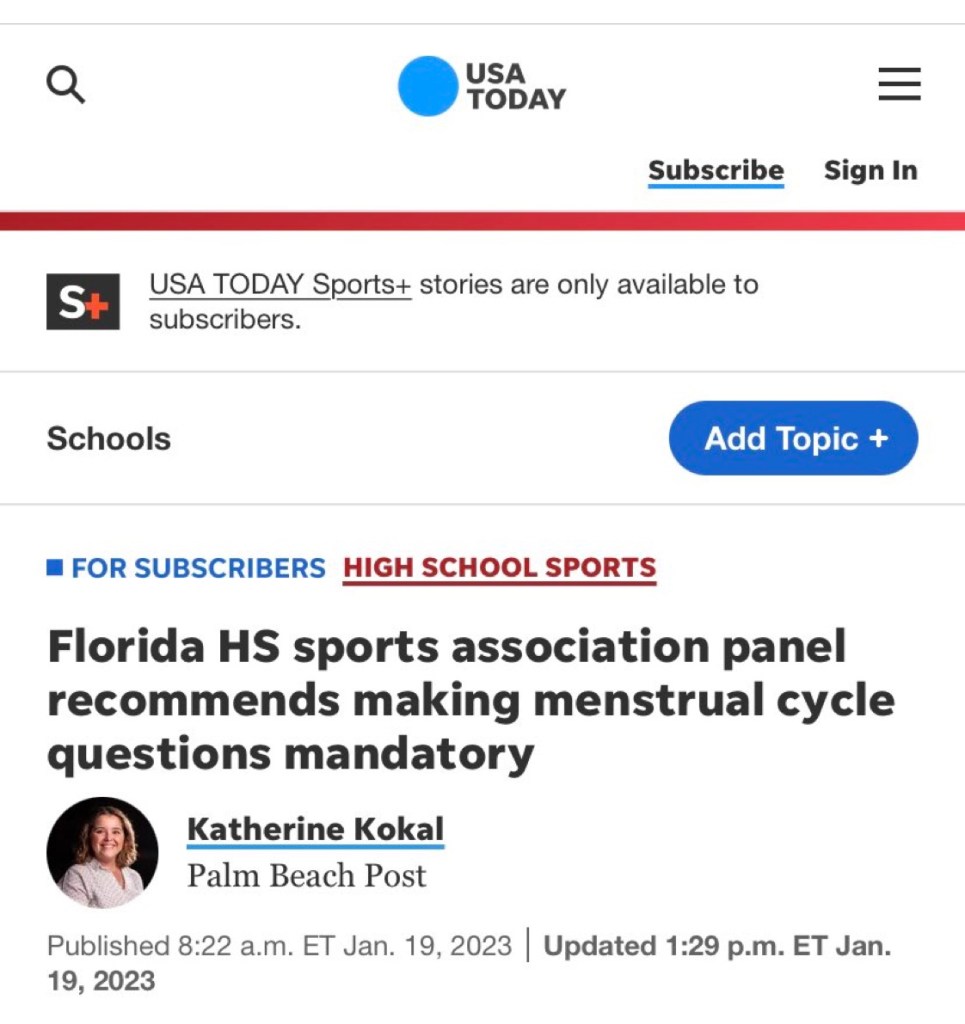
No freedom in Florida! The state where personal privacy goes to die! Soviet-style mind & body control! I’m guessing the purpose of this diktat is to check to make sure no trans women are competing in women’s sports. But there are worse things at stake her. Privacy. Freedom. An intrusive state, a government that counts your menstrual cycle. Gross!

#DictatorDeSantis

Jan Resseger looks behind the daily news and ties together fast-moving events in the red states. The sudden proliferation of voucher programs is no accident, she writes, nor is it a response to public demands. It is a carefully crafted, well-funded strategy to defund public schools, to smash teachers’ unions, and to implement a rightwing ideology that does not benefit students or improve education.

She writes:

This week in Iowa, Governor Kim Reynolds signed an Education Savings Account, universal voucher program into law. And last week in Utah, the same kind of voucher plan took the first step toward adoption when it was passed by Utah’s House of Representatives.

The Des Moines Register reports on Iowa’s new vouchers. The program will “phase in over three years and eventually allow all Iowa families to use up to $7,598 a year in an ‘education savings account’ for private school tuition. If any money is left over after tuition and fees, families could use the funds for specific educational expenses, including textbooks, tutoring, standardized testing fees, online education programs and vocational and life skills training. The $7,598 per private school student is the same amount of funding the state provides to public school students and is expected to rise in future years… The bill allows the Iowa Department of Education to contract with a third party to administer the education savings accounts, but the state has not yet issued a request for proposals from companies seeking to manage the funds.”

It would appear that the Iowa Legislature tried to calm the fears of the public school community by promising that, “Public school districts would also receive an additional $1,205 in funding for students receiving education savings accounts who live within the public school district’s boundaries.” But despite that promise, a drop in overall public school funding is expected: “By the fourth year, the (Legislative Services) agency estimates public school districts will receive $49.8 million in new per-student funds for private school students within the public district’s boundaries. The agency also expects a net decrease of $46 million in public school funding as a result of more students attending private schools.”

It is hard to keep track of all the states that now have school vouchers or are considering voucher programs and to know which states have the latest flavor of vouchers—Education Savings Accounts (ESAs). Most ESA programs, unlike Iowa’s, don’t even require that families use the vouchers at private schools. In most places, ESA’s can be used for educational programs, for educational tools and materials like books and computers, and for homeschooling. In some states families can use the money for so-called micro-schools in which families come together and hire a teacher to work with children in someone’s home.

Why is there so much so much legislative activity about expanding vouchers? Several factors are important to consider, and many of them were the subject of economist Gordon Lafer’s analysis in The One-Percent Solution. Lafer’s book focused on the public policy that flowed from state legislatures after the Tea Party wave election in 2010, but his observations are still on point as we begin 2023. Lafer enumerates all the reasons why far-right ideologues and big corporate moneyed interests seek to undermine and privatize public schools: “At first glance, it may seem odd that corporate lobbies such as the Chamber of Commerce, National Federation for Independent Business, or Americans for Prosperity would care to get involved in an issue as far removed from commercial activity as school reform. In fact, they have each made this a top legislative priority… The campaign to transform public education brings together multiple strands of the agenda… The teachers’ union is the single biggest labor organization in most states—thus for both anti-union ideologues and Republican strategists, undermining teachers’ unions is of central importance. Education is one of the largest components of public budgets, and in many communities the school system is the single largest employer—thus the goals of cutting budgets, enabling new tax cuts for the wealthy, shrinking the government, and lowering wage and benefit standards in the public sector all coalesce around the school system… There are always firms that aim to profit from the privatization of public services, but the sums involved in K-12 education are an order of magnitude larger than any other service, and have generated an intensity of corporate legislative engagement unmatched by any other branch of government. Finally, the notion that one’s kids have a right to a decent education represents the most substantive right to which Americans believe we are entitled, simply by dint of residence… (F)or those interested in lowering citizens’ expectations of what we have a right to demand from government, there is no more central fight than around public education. In all these ways, then, school reform presents something like the perfect crystallization of the corporate legislative agenda.” (The One-Percent Solution, pp 128-129)

It is hard for public school advocates to mobilize nationally against the expansion of vouchers. Voucher battles are fought state by state because public education and the funding of public education is a state-by-state issue. Advocates are likely to focus on public education legislation in their own state and not to pay attention to what’s happening elsewhere. And citizens are not likely to pay much attention to what is happening in the legislature. Once again, Gordon Lafer identifies the problem: “(M)any of the factors that strengthen corporate political influence are magnified in the states. First, far fewer people pay attention to state government, implying wider latitude for well-funded organized interests… Apart from labor unions and a handful of progressive activists, the corporate agenda… encounters little public resistance at the state level because hardly anyone knows about or understands the issues… So, too, corporate lobbies’ financial advantage is magnified in the states. Citizens United marked a sea change in state as well as federal politics.” (The One Percent Solution, pp. 34-36)

Christopher Lubienski, a professor of education policy at Indiana University who has studied the impact of school privatization and the politics around privatizing public schools, recently published a reminder that school privatization is driven by the power of the corporate agenda. Expansion of vouchers has never been an expression of voters’ overall preference: “School choice is continuing to expand across the United states…. But these successes often come in spite of overwhelming voter opposition to school choice programs… According to the pro-voucher organization EdChoice.org, the U.S. has over 75 publicly funded private school choice programs, including vouchers, and education savings accounts, as well as another 45 charter school programs. But all of these programs have been implemented by legislators, not the electorate… In fact, voters have been allowed to weigh in on school choice programs only nine times since 2000, and they almost always reject them, often by overwhelming margins. Only twice did school choice programs pass through the ballot box. In 2012, Georgia voters empowered their legislature with the ability to create charter schools. That same year… Washington voters passed a charter school referendum.”

Who are the far-right advocacy groups and think tanks powerfully promoting Education Savings Account vouchers? They include the usual suspects: the American Legislative Exchange Council and a state- by-state group of think tanks that are ALEC’s partners in the State Policy Network, EdChoice, the Goldwater Institute, the Heritage Foundation, and the Institute for Justice, which provides two model laws—“Education Savings Account Act: Publicly Funded,” and “Education Savings Account Act: Tax-Credit Funded“—so that state legislators can merely adapt a canned statute to their own state’s particular needs. SourceWatch reports corporate funding streams for these and other far-right think tanks that promote vouchers—funding from the Koch Brothers, the Bradley Foundation, and investments from the Donor’s Capital Fund, a powerful investor of corporate dark money since the 2010, U.S. Supreme Court ruling in Citizens United.

In the past two years, the campaign to undermine public schooling and promote the expansion of vouchers has developed a new strategy to convince parents that their children in public schools are being brainwashed by critical race theory and surrounded by discussion of gender and sexual orientation. In a new report published by the Network for Public Education this week, political scientist Maurice Cunningham traces the money behind what may appear to be a spontaneous emergence of parents’ groups—Parents Defending Education, Moms for Liberty, and No Left Turn in Education. Cunningham points to clues that these are not local grassroots groups of parents; their websites, for example, betray a big investment in communications. And while, for example, the founders of Parents Defending Education (PDE) claim to be a bunch of working moms, Cunningham explains: “PDE took in $3,178,272 in contributions and grants in 2021… Donor’s Trust, a dark money donor associated with the Koch network donated $20,250 to PDE in 2021. The Achelis & Bodman Foundation which funds voucher and charter school programs and targets public education, contributed $25,000. Searle Freedom Trust, another right-wing donor with ties to Donors Trust, contributed $250,000 in 2021. We don’t know all the names on the checks, but we do know that those checks had to be pretty large, that the attorneys and consultants sit at the hierarchy of right-wing operatives, and that the board members and staffers are connected to the highest levels of conservative donors including the Koch network.”

The same people who are promoting vouchers are working to scare parents with the huge, culture war campaign driven by identifiable funders and a mass of dark money supporting an education marketplace and undermining parents’ confidence in public schools. But as Christopher Lubienski, the scholar who has studied the effect of the privatization of public education reminds us, expanding vouchers has not improved the outcomes for our children: “(R)ecent research is repeatedly showing that… vouchers are not a good investment. Although publicly funded vouchers may be propping up some private schools that might otherwise go out of business, they are not really helping the people they purport to help. In fact… study after study shows that students using vouchers are falling behind where they would have been if they had remained in public schools. Thus, policymakers might think twice about defying voters on initiatives that actually cause harm to children.”

The political theorist Benjamin Barber warns that school choice does not really provide freedom for families: “We are seduced into thinking that the right to choose from a menu is the essence of liberty, but with respect to relevant outcomes the real power, and hence the real freedom, is in the determination of what is on the menu. The powerful are those who set the agenda, not those who choose from the alternatives it offers. We select menu items privately, but we can assure meaningful menu choices only through public decision-making.” (Consumed, p. 139)

Erin Aubrey Kaplan writes in the Los Angeles Times about a successful public school—Baldwin Hills Elementary—that wants a co-located charter school to leave their space. Kaplan notes that there is a long history of feuding between public schools and charters, but this conflict is a first. The public school has parent and community support for reclaiming its space.

She writes that the fight is forcing a question:

Will the Los Angeles Unified School District find a way to support — even magnify — that rarest of success stories: a high achieving predominantly Black neighborhood school?

For the last seven years, Baldwin Hills Elementary School, a nearly 80-year-old campus in the Crenshaw district, has had to share digs with a charter, New Los Angeles Elementary.

New L.A. has about 200 students; Baldwin Hills twice that, but the neighborhood school’s sense of infringement isn’t just about the comparative sizes of the two student bodies.

BHE features ambitious programs. It houses a gifted magnet and serves as a “community school,” with “wraparound” healthcare and family support services. It’s also a so-called pilot school, which gives it the autonomy to offer unique classes such yoga, chess and orchestra. And it’s a designated STEAM campus — science, technology, engineering, the arts and math. In 2020, the state Department of Education designated Baldwin Hills, where 82% of the student body is Black, a distinguished school.

Not surprisingly, BHE parents and teachers tend to be organized, involved and deeply committed to growing what is regarded as an unqualified school success. To do that, they say, the school needs to get back space that was deemed nonessential and ceded to New L.A.: The charter, they say, must be relocated.

Back in October, members of Neighbors in Action for Baldwin Hills Elementary, a BHE parent-community-teacher coalition, sent a letter to LAUSD outlining their colocation complaints.

Sharing the campus, they wrote, “has greatly diminished the school’s ability to meet students’ social-emotional needs and mental health wellness, and hampered access to the academic programs that the school has been tasked with providing.”

Because of space constraints, Baldwin Hills is out a computer and robotics lab. Orchestra classes have been conducted on the playground blacktop. Students have to eat lunch hurriedly in a time-shared cafeteria. The bathrooms are overcrowded and sometimes unsafe.

In short, Baldwin Hills is an unfolding success story, in spite of colocation. “If we can do this in a stifled environment, imagine what we could do in a regular environment,” says Love Collins, a parent who switched her third-grader from a private school to Baldwin Hills.

The BHE coalition insists the district could find a way within the rules to relocate New L.A. (For it’s part, New L.A. claims to be looking elsewhere for a “permanent” school site.)

Community schools, for example, are supposed to be exempt from colocation, a rule the parents believe should apply at BHE despite the fact that Baldwin Hills wasn’t designated a community school until after New L.A. had moved in.

It’s a point that feels strengthened by recent developments. Two years ago, a new state law, AB 1505, gave school districts — charter school “authorizers” — expanded criteria in deciding whether to deny space to new charters or renew the leases of existing ones.

So far, LAUSD’s response has been underwhelming. Half a dozen district representatives came to Baldwin Hills for a town hall after the October letter, but as a second letter the coalition organizers sent to the district points out, none of their specific complaints or proposed solutions were addressed.

For months, the BHE group has solicited the support — or simply a call-back — from their LAUSD District 1 board member, George McKenna. When he was principal at Washington Prep, McKenna had a well-earned reputation for advocating for students of color and instituting a culture of high expectation. But neither he nor his staff has met with Neighbors in Action for Baldwin Hills Elementary.

“I very much support the parents and programs at Baldwin Hills Elementary, and always have,” McKenna says. “It’s a wonderful school.” What he doesn’t say is anything about the colocation conflict.

But the coalition is not scaling back the pressure for more definitive support.

“All we’re asking district to do is find another place to house [New L.A.], and don’t renew their contract at Baldwin,” says Jacquelyn Walker, a longtime teacher at Baldwin Hills who became its community school coordinator last year.

Underlying the many practical arguments here is a philosophical one: If Black lives truly matter, Baldwin Hills deserves — is, in fact, entitled to — as much space as possible.

With BHE, LAUSD has an organic model of Black success that the district should be nurturing, not stunting. In Walker’s words: “Allow us to thrive, give us the opportunity to do what we can do.”

The stakes for students of color are simply too high to do anything less.

You knew this was going to happen. A few days ago, Florida Governor DeSantis persuaded the presidents of the state’s 28 colleges and community colleges to pledge not to “compel belief in critical race theory” or to violate the state’s ban on WOKE thought. Now, his lieutenant governor says, the administration will stamp out diversity, equity, and inclusion in the state’s public universities. Forget about academic freedom. The state belongs to this tin hat dictator. You are free to believe what he believes and free to think what he wants you to think.

Florida will be looking to “curb” diversity, equity and inclusion efforts at the state’s colleges and universities, Lt. Gov. Jeanette Nuñez said Tuesday, offering a preview of what higher education leaders can expect from lawmakers during the upcoming legislative session.

Her statements, delivered at state Board of Governors meeting in Miami, marked the first time the DeSantis administration has explained why its budget office this month requested a detailed accounting of how much colleges and universities spend on such efforts.

Nuñez began, saying “I can give you a few insights as to what we’re working on coming this session,” then referenced a recent statement from the presidents of Florida’s 28 state colleges. It pledged to root out any policy or practice that “compels belief in critical race theory or related concepts.” The lieutenant governor suggested that effort would soon extend to the 12 schools in the university system.

Read more at: https://www.miamiherald.com/news/local/education/article271590247.html#storylink=cpy

Tom Ultican, who was a teacher of advanced math and physics in San Diego, wrote a terrific post about the results of school board elections in his area of California. The new front of rightwing cranks and anti-vaxxers ran for school boards promising to save children from public health measures, along with the usual religious zealots who were exercised about CRT and teachers turning children gay.

Tom’s description of the contenders and the races is fascinating. I urge you to read it.

He was invited to make endorsements in many school board elections, and he did. His candidates racked up some impressive victories.

If you read his post, you will learn who El Guapo is.

I found his post very encouraging in what is often a tide of bad news. know I would sleep better at night if I knew that Tom Ultican’s stamp of approval was a decisive factor in school board elections.

These are the closing lines in his post:

Some Final Thoughts

We are a society being buried in lies.

“The election was stolen; everybody knows I won in a landslide.” This lie is still believed by 60% of Republicans because they watch Fox News which blatantly lies.

School choice is based on Milton Friedman’s lie that Public Schools are government monopolies. There are about 19,000 school districts in the United States each with their own governing bodies the vast majority of which are elected. That is not a monopoly and in reality school choice is about not having to go to school with those peoples children. It’s a racist agenda.

Well financed propagandist Christopher Rufo has widely spread the lie that CRT is being taught in K-12 Schools. He claims it is making white children uncomfortable; another lie.

A lot of people believe the lie that public schools are grooming students to “turn them” gay. The result is censorship and a small minority of LGBTQ+ students being tormented for who they are. They are people and they deserve respect. Prejudice is a social disease.

These lies have been used to divide us and distract us from billionaires grabbing more and more for themselves. Economic inequality has reached heights never before witnessed in this country and putting up with lies is a root cause. If we lose our Democracy then there will be no choice but to put up with lies. Look at what is going on in Russia, China and Hungry.

The American public school system is a treasure and must be protected from liars and their paymasters. If someone tells you that voucher schools and charter schools are superior to public schools, they are lying.

I agree with every word!