Archives for category: Corruption

Oklahoma State Superintendent Ryan Walters seems to have absorbed all his talking points from ALEC, the rightwing bill mill or he may just be trying to duplicate whatever Florida Governor Ron DeSantis is doing. All the talking points are there about critical race theory, “diversity, equity, and inclusion,” the “science of reading,” the fear of students turning transgender or being recognized as such, the readiness to censor anything that mentions sexuality or gender, and of course, vouchers for home schoolers and religious schools.

Superintendent Walters adds another item to his “reform” agenda: pay for performance, which has been tried for a century and never worked anywhere. It is hard to find an educational program that has been more thoroughly discredited, especially in the past dozen years. Performance these days equals test scores, and the teachers in the most affluent schools always come out in top, while those who teach the most vulnerable children are always on the bottom. No need to reinvent that broken wheel. Even Republican legislators know instinctively that “performance,” defined as test scores favors those in the whitest, most advantaged schools.

John Thompson, historian and former teacher, writes:

Last week, rightwing Oklahoma Secretary of Education Ryan Walters tried to “Shove ‘Choice’ Down the Throats of Unwilling Schools and Parents,” but he received serious pushback by influential Republicans for ignoring legislative norms in budget-making. This week, Walters’ revealed more of his plans to divide and conquer public schools, while ramping up the stakes for educators who don’t comply with ambiguous and weird mandates. The response by numerous Republicans, however, seems to indicate that a bipartisan effort against Walters’ and Gov. Kevin Stitt’s extremism is growing.

Walters started the Board of Education meeting, where his budget was presented with a prayer, which included a “reference to his school choice goals.” He then condemned “a loud and vocal crowd, a minority for sure, that say that all that is needed to fix the problems in education is to toss more money and to leave everything alone.” Walters then promised:

“There will be school choice. We will ensure that indoctrination and CRT (critical race theory) are eliminated in our state. We will also make sure that our kids are safe. There will be no boys in the girls bathrooms. There will be no pornography in our schools. We will make sure all of our vendors and the schools are focused on education and not diversity, equity and inclusion.”

Then, Walters met with rural superintendents in Atoka, the home of the Republican Speaker of the House Charles McCall, who has opposed voucher expansion. Walters explained that his “incentive pay plan that would reward a select few highly rated teachers in each school with up to $10,000 on top of their salaries.”

Walters then complained that:

“Tulsa has done so poor that if you took Tulsa Public Schools out of what we’re doing, we’re in the top half nationally. If you take Tulsa and OKC out, we’re in the top 15.”

So, the Tulsa World reported that Walters said:

“He would be open to pushing for Tulsa Public Schools to be broken up into smaller schools because of academic results there he says are dismal and parents who complain they are locked in because they can’t afford private school tuition and suburban schools bursting at the seams.”

At the same time, Walters’ allies are revealing more options for punishing educators who don’t comply with confusing mandates. While Walters seems to be backing off from his suggestion that all federal education funds be rejected, Sen. David Bullard filed a bill to “develop a ten-year plan to phase out the acceptance and use of federal funds for the support of K-12 education.” Sen. Shane Jett would “add seven more prohibited topics to House Bill 1775, which bans eight race and gender concepts from K-12 schools.” Jett and Rep. Terry O’Donnell seek to ban “teaching about sexual orientation and gender identity to elementary-age children,” And Jett “would outlaw any school policies that respect or promote ‘self-asserted sex-based identity narratives,’” as well as hosting “drag queen story time.”

Moreover, Sen. Cody Rogers “would prohibit school employees from calling students by names or pronouns that differ from the students’ birth certificates, unless having received written consent from the child’s parent.” Rep. Danny Williams would completely ban sex education from public schools.

Then, it was learned, Walters fired the Oklahoma State Department of Education’s Assistant general counsel Lori Murphy. The veteran attorney was “known for her support of transgender people and objections to the state’s rulemaking on classroom race and gender discussions.”

And the Tulsa World reported, the Oklahoma State Regents for Higher Education responded to Walters’ “urgent request” to audit spending on diversity, equity and inclusion, or DEI, programs. The Regents, “scrambled hundreds of employees to compile a 10-year review of its spending history on and current materials used for … DEI programs.” They found that DEI spending was “a third of 1%” of the budget.

But, on the eve of submitting his budget to the legislature, Walters, as well as his ally Gov. Stitt, faced more bad news. As the Oklahoman reports, Attorney General Gentner Drummond, who defeated Stitt’s appointee, John O’Conner, announced an “investigation into misspent education funds” which “hung over the state Capitol on Wednesday.” As an investigation by Oklahoma Watch and The Frontier found, Connors’ lawsuit led “some critics to question whether the lawsuit was an honest attempt to recoup the funds.” Consequently, The Oklahoman reported, “some high-ranking lawmakers appeared hesitant to heed funding requests from Oklahoma’s new state superintendent because of his alleged part in the controversy.” The reason was it was “a mix of Walters’s and Gov. Kevin Stitt’s staff, not a state agency [that] was overseeing the program.”

The Republican Chair of the House Appropriations and Budget subcommittee for Education, Mark McBride, said (and Speaker Charles McCall confirmed) he had been authorized to investigate the lawsuit, and was wrong in not doing so. But now, as Nondoc reports, A.G. Drummond said he “would pursue accountability for state officials, potentially including Walters owing to his prior role as director of an organization tasked with dispersing the funds.” (for what it’s worth McCall, a likely candidate for governor, attended the budget presentation.)

The Tulsa World added that Stitt had blamed the parent company of ClassWallet for the “unflattering audit of federal pandemic relief funds under Stitt’s control.” But, the audit was critical of how the Stitt administration spent $31 million to provide pandemic relief for students’ educational needs.”

Nondoc further explained that Walters’ presentation to the committee “took the opportunity with some of the lawmakers’ questions to expound on campaign rhetoric, including addressing questions regarding his ‘liberal indoctrination’ comments and past declarations to get federal funding out of Oklahoma public education.” And, his two-point plan, funding “science of reading” and pay-for-performance, drew plenty of criticism.

Republican Rhonda Baker, chair of the Common Education Committee, told Walters, “We have, as a legislative body, voted on the science of reading.” She added, “We’ve been very supportive of that, and we have made sure that there has been funding for that, so none of that is new. What is challenging, though, … is that we are not keeping teachers.”

Moreover, Democrat Rep. Andy Fugate said Walters performance pay plan would backfire by drawing teachers away from high-challenge schools and finding schools where “it’s easiest to teach.” Similarly, McBride said:

“Merit pay, I’m OK with it if you work in the oil field or some industry, but in education I just don’t see it working. … If you’ve got a classroom of troubled youth, how do you compare that to the classroom over here where the teacher’s got all the A and B students? It’s just almost impossible to me to evaluate that.”

I’ve heard mixed appraisals as to whether Walters really believes his own words. Regardless, as his ideology-driven claims become more extreme, it seems more likely that there will be more bipartisan pushback against Walters, Stitt, and MAGA true-believers. And, who knows, maybe it will open the door to Republican Adam Pugh’s bill, based on discussions with hundreds of superintendents and education leaders and over a thousand educators, that “would spend $241 million on teacher pay raises, guarantee 12 weeks of maternity leave for teachers and offer $15 million in scholarships to future educators who pledge to work in high-poverty schools,” while bestowing respect on teachers.

Dave Dewitt, editor-in-chief of the Ohio Capital Journal, wrote a blistering critique of the state’s political leadership, who place the interests of the private sector above the common good of the public.

Many Ohioans pay taxes for schools but don’t have school-age children. Their taxes are meant to fund quality public schools because having educated citizens is a public good. Sending their money to unaccountable for-profit, private, and religious schools is a terrible abuse.

Compelling taxpayers to support private interests at the expense of public ones is not only unethical, but unconstitutional when those private interests intertwine with religion. American taxpayers should never be forced to fund the efforts of religious institutions of any kind. Not one red cent.

The very first clause in the First Amendment of our Bill of Rights is couched firmly in that defining principle. The entire basis for making “no law respecting an establishment of religion” the first clause was “Father of the Constitution” James Madison’s takedown of anti-Constitution Patrick Henry’s proposal to send taxpayer money to support religious institutions.

Nevertheless, Ohio Gov. Mike DeWine has put forward a budget proposal to expand school voucher subsidies that would send money to private, for-profit, and religious ventures. Prominent Ohio Republican Statehouse leaders appear to be on board.

From Cleveland.com’s Laura Hancock:

“Families are eligible for EdChoice scholarships by either living in the boundaries of a low-performing school or by household income. Currently, a family of four can qualify for state money if the household income is at or below $69,375, or 250% of the Federal Poverty Guidelines. The limit would increase to 400% of the Federal Poverty Guidelines, which would be $111,000 for a family of four, under DeWine’s proposal. …”

EdChoice vouchers are distributed as checks given to private schools to help cover a student’s tuition. The scholarship amount is currently $5,500 for students in grades k-8 and $7,500 for grades 9-12. Republicans who control the legislature expanded vouchers in 2012, 2020, and 2021.

So vouchers are already available to low-income households and in low-performing districts, which means the only reason to increase the voucher threshold to 400% is for a massive sweetheart giveaway to private interests.

DeWine’s budget also would increase per-student building funding for all charter schools from $500 to $1,000 per student — a 100% bump — and provide an extra $3,000 for each economically disadvantaged student, or a student who qualifies for free or reduced lunch — up from $1,750 currently.

DeWine, Hancock notes, did not propose any extra per-student money for traditional public education.

Sadly, American public education was marked as a $500 billion a year opportunity for private profiteering some time ago, and Ohio has been leading the way.

 Getty Images.

Over the past several decades, Ohio’s seen one boondoggle after another.

Ohio taxpayers were ripped off by hundreds of millions of dollars, and nearly 12,000 Ohio schoolchildren and their families left in the lurch, when the ECOT schemedreamed up on a Waffle House napkincrashed and burned in 2018.

Another for-profit charter school operator called White Hat Management drained $67 million a year away from Ohio public schools before low test scores and soaring high school dropout rates led to a lawsuit from school boards and its eventual demise.

Dayton Daily News’ Josh Sweigart has uncovered a smattering of cases the past decade, including nepotistic hiring, undocumented purchasing, and charter school board members overpaying themselves.

Meanwhile, Ohio Capital Journal’s Zurie Pope revealed in reporting this past summer that the proposed “Backpack Bill” legislation last General Assembly to send public education money to private schools by the head was written with help from religious lobbying group the Center for Christian Virtue (CCV) and a think tank that promotes charter schools.

Promotion for the so-called “Backpack Bill” law featured CCV President Aaron Baer speaking at a press conference for it, and documents obtained by OCJ also revealed behind-the-scenes advice and promotion by outside groups like Heritage Action and the American Legislative Exchange Council (ALEC).

ALEC even held a luncheon for lawmakers at the Statehouse promoted as a “Backpack Bill Briefing.”

All of this has come amid a decades-long right-wing assault on public education itself, only becoming more venomous and destructive in recent years.

But by wide margins, parents express satisfaction with their kids’ schools, and educational outcomes over the past 50 years in America have only steadily improved. From Education Next:

Contrary to what you may have heard, average student achievement has been increasing for half a century. Across 7 million tests taken by U.S. students born between 1954 and 2007, math scores have grown by 95 percent of a standard deviation, or nearly four years’ worth of learning. Reading scores have grown by 20 percent of a standard deviation during that time, nearly one year’s worth of learning.

The narrative of “failing public schools” has been manufactured by corrupt private school bloodsuckers looking to wet their beaks in the public school money pot.

Aside from its false pretenses, it undercuts funding and saps the ability of public schools to address real problems.

The biggest achievement gap in American education is directly tied to poverty. Exacerbating this situation is the fact that Ohio has had unconstitutional property tax-based school funding for 25 years. Wealthy districts do great, while low-income districts suffer mightily.

We have ample empirical evidence to prove that the way to address the poverty achievement gap is by robustly funding public schools to institute best practices: early childhood education; a well-rounded school experience including culture, sports, and the arts; extra-curricular activities that give students a sense of purpose; community-minded and community-building schools; cooperative learning.

But initiatives like these are the very things money-strapped districts are forced to cut first, alongside practical necessities like busing or the teachers themselves.

DeWine’s proposed budget does include money for things such as early childhood education, and he has already awarded significant grants for it, which is commendable.

But he seems to want to balance this politically with a massive giveaway of public dollars to private school interests and the religious zealots aligned with CCV, which is unacceptable.

Many Ohio taxpayers — even those who don’t have children or whose children are no longer school-age — are happy to help fund public schools.

We understand that quality public schools increase property values and make our communities attractive places to live, which helps them thrive.

We want our communities and our public schools to thrive.

What most Ohio taxpayers do not want is our public schools to continue to suffer as money and resources are siphoned away from them to prop up private, for-profit, and religious interests.

But when it comes to funding those interests, or fully and fairly funding Ohio’s public schools, Republican Statehouse leaders have continually legislated for the private interests.

The vultures have poll-tested their messaging, so they love to talk about “school choice,” “parents’ rights,” and “funding the students, not the system.”

This is a smooth evasion that attempts to elide the fact that the question isn’t about whether parents have a choice where to send their kids for schooling; everybody already does.

What these interests are asking for are endless direct state subsidies to their private enterprises and religious institutions.

And that’s what DeWine and these lawmakers stand prepared to keep giving them, on our dime and at the expense of our public schools.

Every Ohio public school faces a yearly audit, but no such requirement exists for private schools receiving public vouchers. Why not? If public money is continually funneled into these schools, why are they not subjected to the same auditing standards as public schools to make sure that money is actually going toward appropriate education of students?In an analysis of one proposed bill, the nonpartisan Legislative Services Commission found that two-thirds of kids getting vouchers in Ohio’s expansion program have never been in public schools.

So that means that these kids aren’t being “rescued” from public schools; they were never going to public schools in the first place. This is pure state subsidy of private school tuition. As the LSC puts it, these are “existing nonpublic school students that represent a new state responsibility.”

Do the private schools lead to greater academic success?

A Cincinnati Enquirer analysis of nearly 2.5 million test scores from schools in more than 150 Ohio cities during the 2017-18 and 2018-19 school years found that in 88% of the cities, the public district achieved better state testing results than the private schools.

Given all this, what assurances are Ohioans being given that our money will not be misused as it has been in the past? If this money is coming out of public school funding, what guarantees do we have that our public schools will be fully funded under the new Fair Funding plan?

 COLUMBUS, OH — JANUARY 31: Ohio Senate President Matt Huffman (R-Lima) takes questions from the press following State of the State Address, Jan. 31, 2023, in the Warren G. Harding Briefing Room at the Statehouse in Columbus, Ohio. (Photo by Graham Stokes for Ohio Capital Journal. Republish photo only with original story.)

Ohio Senate Republicans led by President Matt Huffman have made clear they want the full “Backpack Bill” pushed by the CCV. That would be the biggest win possible for the private interests. As this DeWine proposal is brought and negotiated between the House and Senate, it looks likely to become, essentially, “Backpack Bill Light.”

I’m not holding my breath for full, fair public school funding. Legislators repeatedly steamroll DeWine and there’s no reason to think they won’t on this. There’s only one pot. It’s meant for high-quality public schools. But they always turn their backs on our public schools in favor of the private interests.

I come from a family of educators: My mom, a longtime teacher and junior high school principal; my sister, a primary school special education teacher; my grandmother, a high school teacher; my other grandmother, a school librarian; my grandfather, a school teacher and later the dean of a Kent State University branch.

I grew up surrounded by public educators, both at school and at home. I grew up generally believing that we as a society agreed about the importance and value of public education.

It came as a great shock to me when I entered adulthood that there are incredibly well-funded private interests working every day to undermine and rob our public schools.

Then I started seeing one for-profit school scam after another in Ohio, and realized that our state government was actively stoking the grift.

When I ask the public educators I know for their thoughts, many tell me there’s a definite role for traditional charters and private schools for the maybe 10% of students best off at them, but it’s unconscionable to rob the other 90% of public school students and prioritize the 10%.

That seems reasonable.

Traditional charter and private schools have a place, but they must face just as much scrutiny and accountability and auditing as our public schools if they are to receive our money.

And propping up private schools should never, ever come at the expense of our already woefully unsupported public schools.

We need to dedicate ourselves to a positive vision of the wonderful beacons our public schools can be when we invest in them, when we support them, when we encourage them to be creative, and when we give them the resources and opportunity to thrive.

Public education is not failing. Ohio politicians are failing to prioritize and invest in public education.

Joshua Q. Nelson wrote a story for FOX News, saying that I was a hypocrite for sending my sons to private schools (more than 50 years ago) and ignoring the fact that I turned against school choice publicly in 2010. His source was Corey DeAngelis, who works for Betsy DeVos. He has attacked me so often on Twitter that I blocked him.

A little bit of research would have shown that I supported school choice from the late 1980s (when charters first emerged) until 2008 (when I started writing a book about my disavowal of conservative education ideology—charters, vouchers, standardized testing, merit pay, and high-stakes accountability).

My change of mind and heart was well covered, not only in The New York Times, but in The Wall Street Journal and other publications). And the book became a national bestseller.

Christina Pushaw, a close aide to Ron DeSantis, amplified the story in her Twitter account, as did the notorious Chris Rufo.

Since the story came out, I have received numerous death threats. Yesterday, I got another one, a long and garbled message with religious allusions, which ended by saying “Yes, we will be ‘slaying Goliath.’ You are Goliath.”

I think Joshua Q. Nelson should be aware that he was played by DeAngelis and correct his story.

Meanwhile, I am flattered that Ron DeSantis and Betsy DeVos and their minions read my tweets and perhaps my blog. I would like to recommend that they read my last three books, where I demonstrate the importance of public schools and the hoax of school choice, which originated as the battle cry of segregationists after the Brown decision.

In a diverse society like ours, public schools bring children from different backgrounds together. They are essential for our democracy. They are the best choice.

Of course, parents are free to make private choices but they should not expect taxpayers to pay for their choice to send their child to a private school that discriminates against others.

Meanwhile, here is a reading assignment for Corey DeAngelis, Christina Pushaw, Chris Rufo, Ron DeSantis, and Betsy DeVos:

https://www.nybooks.com/articles/2021/01/14/the-dark-history-of-school-choice/

And three books:

The Death and Life of the Great American School System: How Testing and Choice Are Undermining Education (2010)

Reign of Error: The Hoax of the Privatization Movement and the Danger to America’s Public Schools (2013)

Slaying Goliath: The Passionate Resistance to Privatization and the Fight to Save America’s Public Schools (2020)

On a personal note: I am 84. I do not fear your threats. I write what I choose. I will not be intimidated.

Robert Hubbell writes a thoughtful, informative blog. I’m posting this as part of my personal project to understand the new face of white supremacy. White supremacy has always been there, simmering below the surface. Trump invited them to show their faces and step into the daylight. They did, and DeSantis is sending them signals that he wants to be their champion.

Florida Governor Ron DeSantis has set his anti-education sites on Florida’s state colleges. Through a series of political and legal maneuvers, he has ceded control over Florida’s state colleges to ultra-conservative culture warriors like Christopher Rufo. In short order, DeSantis has announced that he will rid Florida state colleges and universities of curricula not “rooted in Western tradition” or that “compels belief in critical race theory or related concepts such as intersectionality.”

Amid the torrent of reporting on Ron DeSantis’s attack on critical race theory and intersectionality, the quiet part is often left unsaid. So let me say it: DeSantis’s educational agenda is code for racism and white supremacy. (Other parts of his agenda seek to erase the dignity and humanity of LGBTQ people.) DeSantis’s invocation of “Western tradition” is meant to suppress knowledge regarding the people (and contributions) of Asia, Africa, South America, Oceania, and the Indigenous Peoples of the Americas. See Talking Points Memo, DeSantis Makes 2024 Ambitions Clear As He Pours Gasoline On His ‘Woke’ Education Fire.

Given DeSantis’s generalized ignorance, his call to focus on “Western tradition” is a slippery slope that will inevitably lead to the discussion of unpleasant truths about America. For example, the enslavement of Black people was a “tradition” in North America for 246 years—and the abolition of that evil practice is relatively recent (155 years ago). So, a college course that honestly addresses the Western “traditions” of North America should include an examination that the role of slavery played in the economic, social, and political development of America.

But DeSantis isn’t stopping at converting Florida’s colleges and universities into re-education camps in the worst traditions of the USSR. He is seeking to up-end centuries of “Western tradition” embodied in the Constitution and the English common law: the requirement of a unanimous jury to impose capital punishment. DeSantis has floated the idea that a less-than-unanimous jury verdict can impose a sentence of death—an unconstitutional proposal designed to inflict the death penalty on more Black and Latino Americans. See Vox, Ron DeSantis wants to make it much easier for the state to kill people.

DeSantis is willing to do all this because he wants to capture Trump’s loyal base—which is the only hope that DeSantis has of becoming a credible candidate. As Trump becomes mired in criminal prosecutions, DeSantis will become emboldened and radicalized beyond his already extremist views. Doing so ignores the lessons of the 2022 midterms: persuadable Americans are done with Trump and his MAGA extremism. Like all military generals, Ron DeSantis is fighting the last war (the presidential election of 2020) and has failed to heed the tectonic shift that occurred in the midterms.

Governor Ron DeSantis hates the fact that there is a progressive public college called New College that openly teaches diversity, equity, inclusion, feminist studies, ethnic studies, and gay studies. That’s WOKE, and he vowed to crush anything WOKE.

He named 6 conservatives to the 13-member board, and the board of the state university system added another, meaning that Rightwingers are in charge. A hard-right board needs a hard-right president, and they got one.

Their first meeting was this afternoon, and they are expected to appoint former State Commissioner of Education Richard Corcoran as the new president. From the following story, it appears that no one bothered to let the current president of the New College know that she was being shown the door.

DeSantis is showing how to stamp out ideas he doesn’t like, with power, not subtlety. Is he a fascist or is he pretending?

A new board of trustees at New College of Florida intends to name Richard Corcoran as its next President.

Corcoran, a former House Speaker, served as Gov. Ron DeSantis’ first Education Commissioner.

Carlos Trujillo, president and founder of Continental Strategy, revealed the plans in a letter to clients and colleges.

“We are beyond excited to announce that one of our Partners, former Department of Education Commissioner Richard Corcoran, will be returning to higher education to serve as the Interim — and hopeful permanent — President of the New College of Florida, in Sarasota,” Trujillo wrote.

“This move comes as part of Gov. DeSantis ongoing work to refocus the university on providing the most value to its students and their parents.”

Corcoran was a founding partner for the consulting firm.

The news comes hours before the first board meeting since DeSantis appointed six new trustees on the 13-member board. The State University System Board of Governors also appointed a new trustee with a similar conservative think tank background.

Of note, work of Corcoran’s apparent hire comes before any news of current President Patricia Okker’s future with the school. Eddie Speir, co-founder of Inspiration Academy, wrote a blog post this weekend promising to call for Okker to be renamed as interim President and to terminate all faculty and staff before deciding who still fit in the new vision for the college.

While Florida’s Sunshine Law requires all decisions by the board to be made in publicly noticed meetings, Trujillo treats the matter like a done deal.

“The selection of Richard distinguishes our firm as a leader in innovation and strategic solutions for the clients we serve. We look forward to finding new synergies that can better serve our current clients and ensure their goals are made a reality,” his letter reads.

Christopher Mathias wrote at Huffington Post about a group called Dissident Homeschool that provides resources for parents who want to teach their children to be Nazis. Through research and inquiry, he found the names of the couple who administer the site. Many of the states enacting voucher plans include payments for homeschooling. If you live in one of those states, your tax dollars might be subsidizing the training of Nazis.

Please read the entire article. It’s too long to repost in its entirety. It is awful that parents would do this, and worse that it is subsidized by public funds in many state voucher plans.

Mathias writes:

On Nov. 5, 2021, a married couple calling themselves “Mr. and Mrs. Saxon” appeared on the neo-Nazi podcast “Achtung Amerikaner” to plug a new project: a social media channel dedicated to helping American parents home-school their children.

“We are so deeply invested into making sure that that child becomes a wonderful Nazi,” Mrs. Saxon told the podcast’s host. “And by home-schooling, we’re going to get that done.”

The Saxons said they launched the “Dissident Homeschool” channel on Telegram after years of searching for and developing “Nazi-approved material” for their own home-schooled children — material they were eager to share.

The Dissident Homeschool channel — which now has nearly 2,500 subscribers — is replete with this material, including ready-made lesson plans authored by the Saxons on various subjects, like Confederate Gen. Robert E. Lee (a “grand role model for young, white men”) and Martin Luther King Jr. (“the antithesis of our civilization and our people”).

There are copywork assignments available for parents to print out, so that their children can learn cursive by writing out quotes from Adolf Hitler. There are recommended reading lists with bits of advice like “do not give them Jewish media content,” and there are tips for ensuring that home-schooling parents are in “full compliance with the law” so that “the state” doesn’t interfere.

The Saxons also frequently update their followers on their progress home-schooling their own children. In one since-deleted post to Telegram, they posted an audio message of their kids shouting “Sieg Heil” — the German phrase for “hail victory” that was used by the Nazis.

Over the past year, the Dissident Homeschool channel has become a community for like-minded fascists who see home schooling as integral to whites wresting control of America. The Saxons created this community while hiding behind a fake last name, but HuffPost has reviewed evidence indicating they are Logan and Katja Lawrence of Upper Sandusky, Ohio. Logan, until earlier this week, worked for his family’s insurance company while Katja taught the kids at home.

The Anonymous Comrades Collective, a group of anti-fascist researchers, first uncovered evidence suggesting the Lawrences are behind Dissident Homeschool. HuffPost has verified the collective’s research.

The Lawrences did not respond to repeated requests for comment made via phone calls, text messages and emails. A HuffPost reporter also left a message in the Dissident Homeschool channel asking Mr. and Mrs. Saxon for comment about the Anonymous Comrades Collective’s research. That message was immediately deleted by the channel’s administrators, who then disabled the channel’s comment and chat functions.

A short time later, Katja Lawrence deleted her Facebook page.

Although the Lawrences will now surely face some public scorn and accountability, it’s likely their neo-Nazi curriculum is legal. A concerted, decades-long campaign by right-wing Christian groups to deregulate home schooling has afforded parents wide latitude in how they teach their kids — even if that means indoctrinating them with explicit fascism.

Meanwhile major right-wing figures are increasingly promoting home schooling as a way to save children from alleged “wokeness” — or liberal ideas about race and gender — in public and private schools. As extreme as the Dissident Homeschool channel is, the propaganda it shares targeting the American education system is just a more explicit and crass articulation of talking points made by Fox News hosts or by major figures in the Republican Party.

“Without homeschooling our children,” Mrs. Saxon once wrote, “our children are left defenseless to the schools and the Gay Afro Zionist scum that run them….”

Nazi Groomers

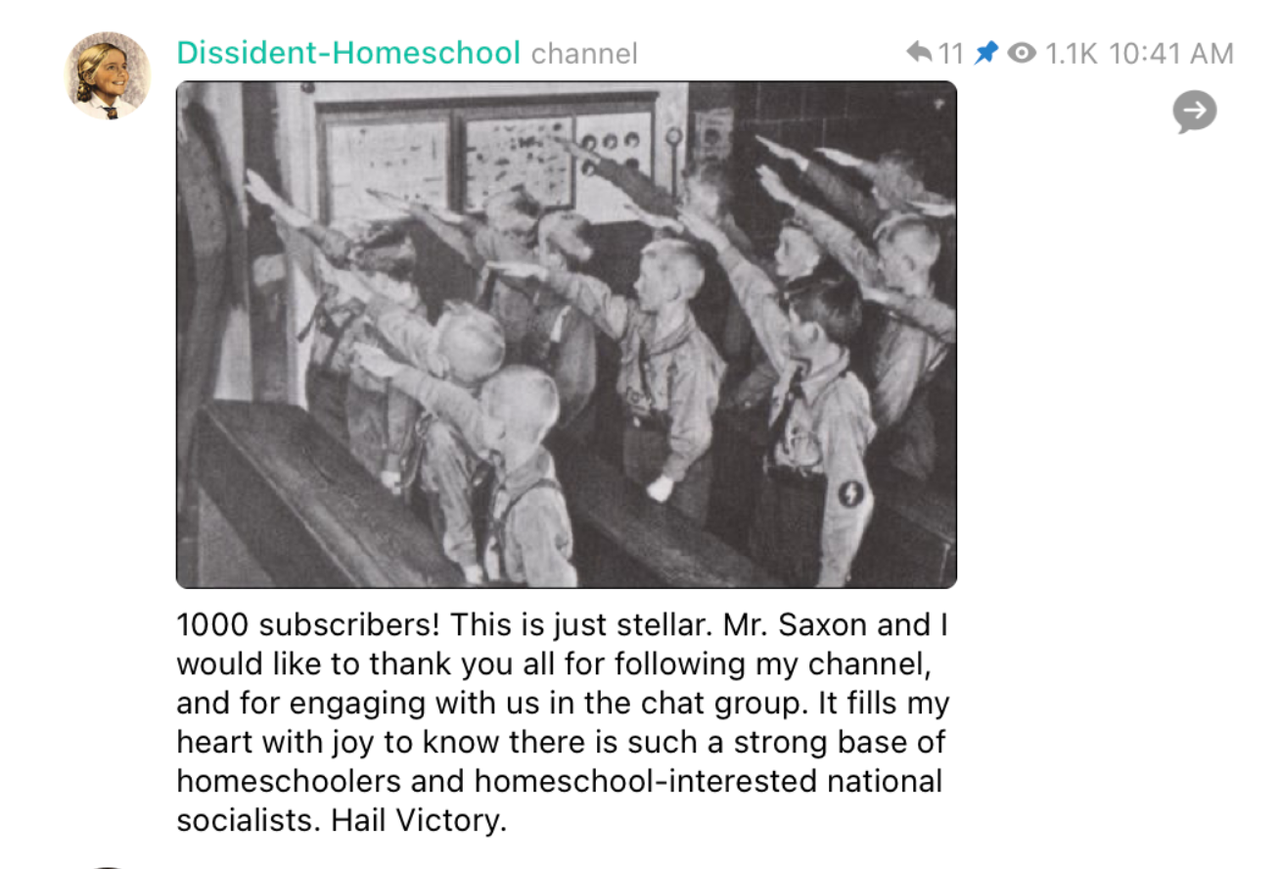
A post from Dissident Homeschool, a channel on Telegram where neo-Nazis learn to indoctrinate their children.

Mr. and Mrs. Saxon appeared to be thrilled to see their Dissident Homeschool channel gain a larger following. When the channel reached 1,000 subscribers, Mrs. Saxon posted a Nazi-era photo from Germany of uniformed schoolchildren throwing up fascist salutes. “It fills my heart with joy to know there is such a strong base of homeschoolers and homeschool-interested national socialists,” she wrote to mark the occasion. “Hail victory.”

Mrs. Saxon does the bulk of the posting in Dissident Homeschool, and developed extensive lesson plans that other neo-Nazi parents could use for their children. These lesson plans — about Christopher Columbus, the history of Thanksgiving and German Appreciation Day, as well as a “math assignment” about “crime statistics” that is meant to teach kids which “demographics to be cautious around” — are deeply racist.

One lesson plan about Martin Luther King Jr. tells parents to teach their kids that the revered civil rights leader was “a degenerate anti-white criminal whose life’s work was to make it impossible for white communities to protect their own way of life and keep their people safe from black crime.”

“Typically speaking,” Mrs. Saxon wrote in a post, “whites build societies whereas blacks destroy them.”

Included in the lesson plan is a copywork assignment for parents to print out, so that their kids can practice cursive while writing out a racist quote by George Lincoln Rockwell, the infamous American neo-Nazi.

This is one of Peter Greene’s finest posts. He explains the real reason that Republicans have fallen in love with vouchers. They want to eliminate public schools and in time shift the financial burden of schools to parents, not taxpayers. One of the loudest voucher advocates, who got his doctorate from the University of Walton….the University of Arkansas’s so-called Department of Educational Reform, where they teach the doctrine of school choice, posted a photograph of himself and a woman whom I assume was his wife at a funeral, celebrating the death of public schools. When we go high, they go low.

Greene writes:

The new wave of voucher bills being rammed through red state legislatures all demonstrate a truth about school voucher policies– vouchers are not about choice. They’re about peeling people away from the public school system in order to defund and dismantle that system.

What makes me think so? Here it is. Sometimes it’s not about what people say, but about what they don’t say.

If the concern were really and truly choice for every student, then voucher fans would be addressing some of the real obstacles to school choice.This door doesn’t lead where they told you it would.

For one, they would be addressing discriminatory and exclusionary policies. Yet when have we ever heard a voucher supporter say, “These discriminatory policies have to stop. LGBTQ+ students deserve just as much school choice as any other students.”

The closest thing we ever get is “Well, then they can start an LGBTQ-friendly school of their own.” Yet when that happens, pro-voucher politicians target that school with terms like “perversion.” And of course in some states, such a school can never happen because talking about LGBTQ students or Black history has been outlawed. And voucher laws are written to hold the private school right to discriminate as it wishes inviolable.

If someone were serious about voucher based choice, they would also address cost. Vouchers are typically far too small to pay for tuition to top schools in the state. If voucher supporters were really interested in making sure that, as Jeb Bush says, “each and every…student can access the education of their choice,” there would be a robust discussion about how to bridge the gap between meager vouchers and expensive schools.

Yet we never hear voucher advocates saying, “We need to find the way to fully fund vouchers so that they provide a real choice to students.” Choice advocates like to point at the inequity of the public system–parent choice is limited by their ability to buy an expensive house in a wealthy neighborhood. But the current crop of voucher programs doesn’t change that a bit–a voucher offers little to change the fact that how much “freedom” you get depends on how wealthy you are.

It has been done. But when Croydon, NH set up a school choice program, a voucher-like system that bore the full cost of sending a student to the school of their choice, local libertarians tried to shut it down because they wanted lower taxes.

Voucher fans love the idea of school choice; they just don’t want to actually pay for it.

If these folks were serious about school choice via vouchers, we would have calls for oversight and accountability. It would make a choice system that much more attractive for parents to know that all the available options have been vetted and screened and will be held to some standards, just like shopping in a grocery store where you can rest easy in near-certainty that whatever you pick, it’s not going to actually poison your family.

And yet not only do voucher fans not call for oversight and accountability, but they actively block it with language that hammers home that nobody can tell vendors what to do or how to do it.

Voucherphiles like to call their system child-centered, but in fact it is vendor-centered, with “protections” for the service providers written into the law, and protections for the students non-existent. Parents are left to navigate an unregulated system of asymmetrical information that favors the businesses– not the families.

Please open the link and finish the post. And while you are at it, subscribe to Peter’s wonderful blog.

Jan Resseger looks behind the daily news and ties together fast-moving events in the red states. The sudden proliferation of voucher programs is no accident, she writes, nor is it a response to public demands. It is a carefully crafted, well-funded strategy to defund public schools, to smash teachers’ unions, and to implement a rightwing ideology that does not benefit students or improve education.

She writes:

This week in Iowa, Governor Kim Reynolds signed an Education Savings Account, universal voucher program into law. And last week in Utah, the same kind of voucher plan took the first step toward adoption when it was passed by Utah’s House of Representatives.

The Des Moines Register reports on Iowa’s new vouchers. The program will “phase in over three years and eventually allow all Iowa families to use up to $7,598 a year in an ‘education savings account’ for private school tuition. If any money is left over after tuition and fees, families could use the funds for specific educational expenses, including textbooks, tutoring, standardized testing fees, online education programs and vocational and life skills training. The $7,598 per private school student is the same amount of funding the state provides to public school students and is expected to rise in future years… The bill allows the Iowa Department of Education to contract with a third party to administer the education savings accounts, but the state has not yet issued a request for proposals from companies seeking to manage the funds.”

It would appear that the Iowa Legislature tried to calm the fears of the public school community by promising that, “Public school districts would also receive an additional $1,205 in funding for students receiving education savings accounts who live within the public school district’s boundaries.” But despite that promise, a drop in overall public school funding is expected: “By the fourth year, the (Legislative Services) agency estimates public school districts will receive $49.8 million in new per-student funds for private school students within the public district’s boundaries. The agency also expects a net decrease of $46 million in public school funding as a result of more students attending private schools.”

It is hard to keep track of all the states that now have school vouchers or are considering voucher programs and to know which states have the latest flavor of vouchers—Education Savings Accounts (ESAs). Most ESA programs, unlike Iowa’s, don’t even require that families use the vouchers at private schools. In most places, ESA’s can be used for educational programs, for educational tools and materials like books and computers, and for homeschooling. In some states families can use the money for so-called micro-schools in which families come together and hire a teacher to work with children in someone’s home.

Why is there so much so much legislative activity about expanding vouchers? Several factors are important to consider, and many of them were the subject of economist Gordon Lafer’s analysis in The One-Percent Solution. Lafer’s book focused on the public policy that flowed from state legislatures after the Tea Party wave election in 2010, but his observations are still on point as we begin 2023. Lafer enumerates all the reasons why far-right ideologues and big corporate moneyed interests seek to undermine and privatize public schools: “At first glance, it may seem odd that corporate lobbies such as the Chamber of Commerce, National Federation for Independent Business, or Americans for Prosperity would care to get involved in an issue as far removed from commercial activity as school reform. In fact, they have each made this a top legislative priority… The campaign to transform public education brings together multiple strands of the agenda… The teachers’ union is the single biggest labor organization in most states—thus for both anti-union ideologues and Republican strategists, undermining teachers’ unions is of central importance. Education is one of the largest components of public budgets, and in many communities the school system is the single largest employer—thus the goals of cutting budgets, enabling new tax cuts for the wealthy, shrinking the government, and lowering wage and benefit standards in the public sector all coalesce around the school system… There are always firms that aim to profit from the privatization of public services, but the sums involved in K-12 education are an order of magnitude larger than any other service, and have generated an intensity of corporate legislative engagement unmatched by any other branch of government. Finally, the notion that one’s kids have a right to a decent education represents the most substantive right to which Americans believe we are entitled, simply by dint of residence… (F)or those interested in lowering citizens’ expectations of what we have a right to demand from government, there is no more central fight than around public education. In all these ways, then, school reform presents something like the perfect crystallization of the corporate legislative agenda.” (The One-Percent Solution, pp 128-129)

It is hard for public school advocates to mobilize nationally against the expansion of vouchers. Voucher battles are fought state by state because public education and the funding of public education is a state-by-state issue. Advocates are likely to focus on public education legislation in their own state and not to pay attention to what’s happening elsewhere. And citizens are not likely to pay much attention to what is happening in the legislature. Once again, Gordon Lafer identifies the problem: “(M)any of the factors that strengthen corporate political influence are magnified in the states. First, far fewer people pay attention to state government, implying wider latitude for well-funded organized interests… Apart from labor unions and a handful of progressive activists, the corporate agenda… encounters little public resistance at the state level because hardly anyone knows about or understands the issues… So, too, corporate lobbies’ financial advantage is magnified in the states. Citizens United marked a sea change in state as well as federal politics.” (The One Percent Solution, pp. 34-36)

Christopher Lubienski, a professor of education policy at Indiana University who has studied the impact of school privatization and the politics around privatizing public schools, recently published a reminder that school privatization is driven by the power of the corporate agenda. Expansion of vouchers has never been an expression of voters’ overall preference: “School choice is continuing to expand across the United states…. But these successes often come in spite of overwhelming voter opposition to school choice programs… According to the pro-voucher organization EdChoice.org, the U.S. has over 75 publicly funded private school choice programs, including vouchers, and education savings accounts, as well as another 45 charter school programs. But all of these programs have been implemented by legislators, not the electorate… In fact, voters have been allowed to weigh in on school choice programs only nine times since 2000, and they almost always reject them, often by overwhelming margins. Only twice did school choice programs pass through the ballot box. In 2012, Georgia voters empowered their legislature with the ability to create charter schools. That same year… Washington voters passed a charter school referendum.”

Who are the far-right advocacy groups and think tanks powerfully promoting Education Savings Account vouchers? They include the usual suspects: the American Legislative Exchange Council and a state- by-state group of think tanks that are ALEC’s partners in the State Policy Network, EdChoice, the Goldwater Institute, the Heritage Foundation, and the Institute for Justice, which provides two model laws—“Education Savings Account Act: Publicly Funded,” and “Education Savings Account Act: Tax-Credit Funded“—so that state legislators can merely adapt a canned statute to their own state’s particular needs. SourceWatch reports corporate funding streams for these and other far-right think tanks that promote vouchers—funding from the Koch Brothers, the Bradley Foundation, and investments from the Donor’s Capital Fund, a powerful investor of corporate dark money since the 2010, U.S. Supreme Court ruling in Citizens United.

In the past two years, the campaign to undermine public schooling and promote the expansion of vouchers has developed a new strategy to convince parents that their children in public schools are being brainwashed by critical race theory and surrounded by discussion of gender and sexual orientation. In a new report published by the Network for Public Education this week, political scientist Maurice Cunningham traces the money behind what may appear to be a spontaneous emergence of parents’ groups—Parents Defending Education, Moms for Liberty, and No Left Turn in Education. Cunningham points to clues that these are not local grassroots groups of parents; their websites, for example, betray a big investment in communications. And while, for example, the founders of Parents Defending Education (PDE) claim to be a bunch of working moms, Cunningham explains: “PDE took in $3,178,272 in contributions and grants in 2021… Donor’s Trust, a dark money donor associated with the Koch network donated $20,250 to PDE in 2021. The Achelis & Bodman Foundation which funds voucher and charter school programs and targets public education, contributed $25,000. Searle Freedom Trust, another right-wing donor with ties to Donors Trust, contributed $250,000 in 2021. We don’t know all the names on the checks, but we do know that those checks had to be pretty large, that the attorneys and consultants sit at the hierarchy of right-wing operatives, and that the board members and staffers are connected to the highest levels of conservative donors including the Koch network.”

The same people who are promoting vouchers are working to scare parents with the huge, culture war campaign driven by identifiable funders and a mass of dark money supporting an education marketplace and undermining parents’ confidence in public schools. But as Christopher Lubienski, the scholar who has studied the effect of the privatization of public education reminds us, expanding vouchers has not improved the outcomes for our children: “(R)ecent research is repeatedly showing that… vouchers are not a good investment. Although publicly funded vouchers may be propping up some private schools that might otherwise go out of business, they are not really helping the people they purport to help. In fact… study after study shows that students using vouchers are falling behind where they would have been if they had remained in public schools. Thus, policymakers might think twice about defying voters on initiatives that actually cause harm to children.”

The political theorist Benjamin Barber warns that school choice does not really provide freedom for families: “We are seduced into thinking that the right to choose from a menu is the essence of liberty, but with respect to relevant outcomes the real power, and hence the real freedom, is in the determination of what is on the menu. The powerful are those who set the agenda, not those who choose from the alternatives it offers. We select menu items privately, but we can assure meaningful menu choices only through public decision-making.” (Consumed, p. 139)

Crooks & Liars found this story from Tennessee in Law & Crime about the principal of a Christian school who has been arrested twice for allegations of sex with minors.

This is of interest because Governor Bill Lee has made it a priority to bring charter schools and vouchers to his state, which would reduce public oversight of school employees. In the case of vouchers,there are typically no state regulations for certification or background checks.

Law&Crime reports:

A 47-year-old principal at a Christian private school in Tennessee was arrested for the second time in less than a year over allegations that he engaged in illegal sexual activity with multiple minors. Jason Kennedy was taken into custody last week and charged with four counts of sexual battery by an authority figure, two counts of continuous sexual abuse of a child, one count of aggravated sexual battery, and one count of solicitation of a minor to observe sexual conduct, records reviewed by Law&Crime show.

Kennedy was the principal and a teacher at Liberty Christian School when he was initially arrested in August and charged with two counts of sexual assault by an authority figure and one count of solicitation of a minor.

Brittney Branham, a 28-year-old secretary and homeschool coordinator at Liberty, was also arrested in August and charged with one count of solicitation of a minor in connection with the same series of incidents that allegedly took place inside Kennedy’s home, where Branham was also a resident, according to a report from Knoxville NBC affiliate WBIR-TV.

It really is better for all if teachers and principals are educated, certified, and subject to background checks.

Numerous states controlled by Republicans want to “let the money follow the child” to any place, without regulation or oversight or accountability. This is not in the best interest of children, society, or education.

Independent researchers have demonstrated repeatedly that charter schools in Texas do not get better academic outcomes than public schools. The average charter school ranks below the average public school. Yet charter schools continue to proliferate, for two reasons: one, the governor, lieutenant governor and legislature firmly believe that the private sector is better than anything public; two, charter schools are a honey pot for entrepreneurs, who see a chance to get public money with minimal accountability or oversight.

Will Dobbie and Roland Fryer reported in 2016:

We estimate the impact of charter schools on early-life labor market outcomes using administrative data from Texas. We find that, at the mean, charter schools have no impact on test scores and a negative impact on earnings. No Excuses charter schools increase test scores and four-year college enrollment, but have a small and statistically insignificant impact on earnings, while other types of charter schools decrease test scores, four-year college enrollment, and earnings. Moving to school-level estimates, we find that charter schools that decrease test scores also tend to decrease earnings, while charter schools that increase test scores have no discernible impact on earnings.

This article appeared in the San Antonio Express-News. The business community in San Antonio has been very supportive of turning public money over to private-managed charter schools.

Just over two years ago, Universal Academy, a Texas charter school with two campuses in the Dallas area, made a surprising move.

In November 2020, a nonprofit foundation formed to support the school bought a luxury horse ranch and equestrian center from former ExxonMobil Chairman Rex Tillerson. The 12-building complex features a show barn “designed with Normandy-style cathedral ceilings,” a 120,000 square foot climate-controlled riding arena and a viewing pavilion with kitchen and bathrooms.

RELATED: IDEA Public Schools signed $15M lease for luxury jet despite being under state investigation

Last summer the Texas Education Agency granted Universal Academy permission to create a new elementary campus on the horse property’s manicured grounds. It will offer students riding lessons, according to a brochure, for $9,500.

Sales prices aren’t public in Texas, but the 100-acre property had been listed for $12 million when Tillerson, who also served as secretary of state under former President Donald Trump, bought it in 2009. Because of the foundation’s nonprofit status and its plans to offer equine therapy, the parcel has been removed from the tax rolls.

School board President Janice Blackmon said Universal hopes to use the facility to start a 4H chapter and Western-style horsemanship training, among other programs that take advantage of its rural location. “We’re trying to broaden the students and connect them to their Texas roots,” she said.

Splashy purchases like the horse arena are receiving increasing public scrutiny as charter schools continue to expand aggressively across Texas. Under state law, charter schools are public schools — just owned and managed privately, unlike traditional school districts.

An analysis by Hearst Newspapers found cases in which charter schools collected valuable real estate at great cost to taxpayers but with a tenuous connection to student learning. In others, administrators own the school facilities and have collected millions from charging rent to the same schools they run.

In Houston, the superintendent and founder of Diversity, Roots and Wings Academy, or DRAW, owns or controls four facilities used by the school, allowing him to bill millions to schools he oversees. DRAW’s most recent financial report shows signed lease agreements to pay Fernando Donatti, the superintendent, and his companies more than $6.5 million through 2031.

In an email, superintendent Donetti at DRAW said the property transactions were ethical, in the best interest of DRAW’s students and properly reported to state regulators. He said his school was “lucky” he was able to purchase the property because of challenges charters can face finding proper facilities.

Also in the Houston area, at ComQuest Academy Charter High School, the superintendent and her husband also own the company to which the school pays rent.

And Accelerated Learning Academy, a charter school based in Houston, is still trying to get a tax exemption on one of the two condominiums it bought just over a decade ago in upscale neighborhoods in Houston and Dallas. The school claims it has used the condos for storage, despite a nearby 9,600 square foot facility.

The battles between school districts and charter networks have become increasingly pitched, as they are locked in a zero-sum battle for public dollars.

Last year in Houston, about 45,000 students transferred from the ISD to charter schools, resulting in a loss to the district of a minimum of $276 million. That figure includes only the basic allotment received by the districts, excluding special education funding or other allotments.

In San Antonio, the two largest school districts are Northside ISD and North East ISD. More than 12,000 Northside students transferred to charter schools in the 2021-2022 school year, as did just under 8,000 from North East ISD. That means Northside lost at least $75 million, while North East lost $50 million, using the same basic allotment figures.

Each side cries foul about the other’s perceived advantages: charters are able to operate with less government and public scrutiny, while school districts benefit from zoning boards and can lean on a local tax base for financing.

Georgina Perez, who served on the State Board of Education from 2017 until this year, noted arrangements such as these would never be permitted at traditional school districts.

“If it can’t be done in (school districts), they probably had a good reason to disallow it,” she said. “So why can it be done with privately managed charter franchises?”

Lawmaker: ‘Sunshine’ is best cure

The largest charter network in Texas was a catalyst for the increased public scrutiny of charter school spending.

IDEA Public Schools faces state investigation for its spending habits, including purchases of luxury boxes at San Antonio Spurs games, lavish travel expenditures for executives, the acquisition of a boutique hotel in Cameron County for more than $1 million, plans to buy a $15 million private jet and other allegations of irresponsible or improper use of funds. The allegations date back to 2015 and led to the departure of top executives — including CEO and founder Tom Torkelson, who received a $900,000 severance payment.

Over the years lawmakers have steadily tightened rules for charter governance. A 2013 bill included provisions to strengthen nepotism rules; a 2021 law outlawed large severance payments. That bill was sponsored by Rep. Terry Canales, a South Texas Democrat whose district has some of the highest rates of charter school enrollment in the state.

“There’s a lot of work to be done for the people of Texas when it comes to charter schools,” Canales said. “Sunshine is the best cure for corruption. And the reality is it seems to be sanctioned corruption in charter schools.”

Considering the increased scrutiny, “It’s a myth that charter schools today are unregulated,” said Joe Hoffer, a San Antonio attorney who works on behalf of many charter schools. “Every session, more and more laws get passed.” If anything, he said, charter schools often have to jump through more regulatory hoops than local schools.

Yet acquiring property remains a gray area.

Charter schools that can’t purchase their own property typically must lease it and pay taxes. A 2021 state law authored by Rep. Barbara Gervin-Hawkins, a San Antonio Democrat who operates a charter, made such arrangements tax-free. But the Texas Supreme Court later blocked parts of the law, and it has been applied differently by counties across the state.

It’s unusual for school districts to lease their facilities; typically they are publicly owned or constructed. Local school districts are governed by nonpartisan elected boards, and when the board decides to purchase real estate, it must notify the public of the contract and voters can petition the district to block it. If a project requires bonding or new taxes, it must be put on the ballot.

At charters, by comparison, the governing board is appointed, not elected, so it does not answer to local voters. The main public scrutiny comes later, when the information about the sale must be disclosed in annual required filings with the Texas Education Agency.

The state education agency has the authority to review charter real estate transactions and sometimes does. In Dallas, Golden Rule Charter School is under state investigation for a real estate deal and possible nepotism. The school declined to release details because the investigation is pending.

But such reviews are often cursory, if they happen at all.

When charters report a real estate transaction to the education agency, Hoffer said, they typically just receive a letter back saying it has been recorded, with a clause reminding the schools that state regulators have the authority to return for an audit or demand the deal be re-done.

Critics say it isn’t enough. “The problem that a lot of us have had with charters is that they are considered public schools and they are taxpayer-funded, but they don’t have taxpayer scrutiny,” said state Rep. Donna Howard, an Austin Democrat and former trustee at Eanes ISD. “It’s a real lack of accountability.”

Some deals benefit administrators

According to its website, Horizon Montessori Public School operates four campuses in the Rio Grande Valley, one on Sugar Cane Drive in Weslaco. Until recently, records show, the property and its two commercial buildings were owned by Superintendent Alim Ansari.

Hidalgo County appraisal records show Ansari also apparently lived in a 4,800-square-foot home at the back of the 2.85-acre parcel, a portion of which was granted a homestead limitation on its taxes.

In addition to serving as Ansari’s home, records from the Texas Education Agency show that between 2015 and 2020, the superintendent leased his Weslaco property to Horizon for classroom and office space, collecting $118,000 a year in rent during the period. In 2020, Ansari-the-landlord signed a new five-year contract with his school for the property, for $168,000 annually, according to education agency records.

A home can be seen on the same piece of property as the Horizon Montessori Public School on Sugarcane Drive in Weslaco on Thursday, Jan. 19, 2023. The home belonged to the superintendent of the public charter school who leased his Weslaco property to Horizon for classroom and office space, collecting $118,000 a year in rent from 2015-2020. State and local records show Ansari sold the campus and residence last June. The buyer was a nonprofit organization called South Texas Educational Technologies, which according to its tax records conducts business as Horizon Montessori. Ansari is its chairman. State and local records show the foundation purchased the property from Ansari for $1.9 million, or more than twice the $840,000 at which Hidalgo County appraised it. Records show the foundation used a private appraiser to value the parcel.James Hord/Contributor

State and local records show Ansari sold the campus and residence last June. The buyer was a nonprofit organization called South Texas Educational Technologies, which conducts business as Horizon Montessori, according to its tax records. Ansari is its chairman.

State and local records show Ansari’s foundation purchased the property from Ansari for $1.9 million — or more than twice the $840,000 at which Hidalgo County appraised it. The foundation used a private appraiser to value the parcel.

Ansari did not respond to multiple phone and email messages. James Hayes, a CPA who sits on Horizon’s board and who also is paid $48,000 a year by the charter for accounting services, declined to comment.

Related-party arrangements are rare among modern charters, said Hoffer, the attorney who represents some of them. In some cases, he said, new schools might be forced to make such deals temporarily because they did not have the creditworthiness to borrow money to purchase facilities.

Pioneer Technology and Arts Academy, which has several campuses in the Dallas area, paid about $5 million in rent in the 2021 fiscal year to two companies, one a nonprofit and one a for-profit. Records show Superintendent Shubham Pandey has stakes in both.

Just under $3.5 million went to the nonprofit controlled by two board members of Pioneer, including Pandey. Another $1,296,418 went to Pandey’s for-profit business, PNC Partners, with more than $3 million total reported in the previous three years.

In an email, Pandey said that Pioneer’s goal all along was to transfer the school buildings from his for-profit ownership to a nonprofit. Three campuses were taken over by the nonprofit in 2019, while three others were transferred last year. Future campuses will be owned by the nonprofit, he said, and he no longer collects rent checks from the school.

But the nonprofit did not exist when Pioneer was given its charter, and its initial application did not mention future plans to transfer assets to a nonprofit.

At ComQuest Academy Charter High School, the Houston-area charter, Superintendent Tanis Stanfield and her husband, Glenn, said they don’t earn a profit from the rent it pays their company, Peachwood Station LLC

Peachwood collected $91,000 in rent in 2021. Documents also say the company provided an additional $117,000-worth of rent for free.

Tanis Stanfield said the couple followed the law and provided the needed space at a steep discount to the school she ran. “State charter funding for facilities was not available for the campus acquisition,” the superintendent wrote in an email.

School-owned condos?

In 2017, the Chronicle reported on Accelerated Learning Academy’s purchase of a 1,119-square-foot condo unit in the 22-story Cosmopolitan, a glassy high rise near Memorial Park, for $427,000. The school then bought a 1,340-square-foot condo in downtown Dallas’s Metropolitan Club the same year, appraisal records show.

The school claimed both of the residential units were needed for storage space. The Dallas Appraisal District accepted that explanation, though the school already had a 9,600-square-foot, nearly empty campus in nearby Lancaster, and granted the condo a full property tax exemption. Records show Accelerated sold the condo in 2021.

The Cosmopolitan condominium building at 1600 Post Oak Blvd where Accelerated Learning Academy purchased a 1,119-square-foot condo unit, claiming they needed the space for storage, photographed Thursday, Jan. 19, 2023, in Houston.

Harris County appraisal officials have been more skeptical about the school’s use of the unit for educational purposes: “Personally, I cannot imagine that the state of Texas would allow the use of state funds to purchase this property,” the agency’s exemptions coordinator wrote in 2013, noting the Cosmopolitan’s deed restrictions prohibited condos from being used for businesses.

Accelerated has continued to seek a tax exemption. The appraisal district’s 2018 field inspection showed some plastic totes scattered throughout the unit.

“Very nice condo with granite and hardwoods,” the inspector noted. The exemption was again denied because the property did “not meet the tests prescribed by the tax code.” Records show Accelerated paid about $9,000 in property taxes on the unit last year.

Another example is the A.W. Brown Leadership Academy, which has two campuses in the Dallas area that serve about 1,000 students. Property records show it owns eight properties, several worth millions that have sat unused — even as taxpayer money has gone to repay the loans used to buy them.

Records show A.W. Brown’s real estate holdings include nearly 50,000 of commercial office space purchased with bonds in 2017. Appraised at more than $4 million, the property has been tax-free since 2018 and is vacant. Taxpayers pay for the bonds. A.W. Brown spokesman Charles Roberts said the school is still deciding how to use it.

The charter also owns a 3,400-square-foot house with an in-ground pool on 6 acres in Duncanville, identified as an office and valued at $630,000, plus 99 acres next to it, valued at more than $4 million by the appraisal district. Those were purchased more than a decade ago from professional basketball player Larry Demetric Johnson, records show.

The school has paid no taxes on either since 2014, according to appraisal records. In the fall of 2022, the school announced its plan to turn the more-than 100 acres of land into a community garden and farm for students “to learn more about agriculture and entrepreneurship,” said Roberts, the school spokesman.

In response to questions from Hearst, Roberts said the charter would be starting “an internal audit of facility purchases.” He declined to comment further.

edward.mckinley@chron.com

eric.dexheimer@chron.com