Archives for category: Censorship

In the past few years, we have seen the rise of something called the “parental rights” movement. This movement consists of angry white parents, mostly women, like “Moms for Liberty” and “Parents Defending Freedom,” who insist that they as parents have the “right” to decide what their children are taught in school and what books they read. They strenuously object to teaching about race and racism, which they say makes their children “uncomfortable.” They believe that teachers are “grooming” their children to be gay or transgender by teaching them about gender or sexuality. Of course, if the last were true, almost everyone would now be transgender, since most students have taken a sex-ed course at some point, focused mainly on health.

In response to the outcry from these groups, a number of states, led by Florida and Virginia, have passed laws they describe as “parental rights” laws, which ban the teaching of “divisive concepts” because they make students “uncomfortable.” The most “divisive” concept of all is “critical race theory,” which states ban. Since legislators don’t know what critical race theory is, their laws are meant to remove any teaching about race and racism from the curriculum.

Bottom line: only white parents have parental rights.

But what about Black parents? Do they have rights? Apparently not.

What about other parents who do not identify with angry white parents? Don’t their children have the right to learn an accurate history of the state, the U.S., and the world?

Why do Moms for Liberty get to define what all parents want?

Shouldn’t Black children learn about the history of race and racism?

Why shouldn’t all students learn accurate history, even if it makes them “uncomfortable”?

Why should a small subset of far-right fringe white parents get the power to censor what everyone else is taught and is allowed to read?

These “parental rights” laws are a paper-thin veneer for censorship, gag orders, lies and propaganda. They are the product of arrogant racists who can’t be bothered to hide their venomous racism.

They prefer ignorance to knowledge. They should not be allowed to impose their hateful ideology on others.

The Houston Chronicle reports that a participant in the January 6 assault on the U.S. Capitol is likely to be elected to the Texas State Board of Education. She has pledged to fight “critical race theory” (i.e. teaching about racism) and to support charter schools.

Underscoring Texas lawmakers’ rightward lurch on education issues in recent years, the candidate likely to replace a moderate Republican on the State Board of Education in a district outside Houston is a right-wing activist who participated in protests at the U.S. Capitol on Jan. 6, 2021.

After winning the primary in March, the front-runner in the District 7 race is Julie Pickren, a former trustee for Alvin Independent School District. Pickren was voted off that board last year after her participation in the protest at the U.S. Capitol was revealed — the basis of a campaign against her by the Brazoria County NAACP.

Pickren is a former delegate to the GOP’s national and state conventions, her LinkedIn says, and on Facebook she blamed antifa, rather than Trump supporters, for violence during the Capitol riot, a claim that other Republicans have made without proof. She declined a request for an interview….

Republicans have moved further to the right on education issues in Texas over the past 18 months. Earlier this summer, Gov. Greg Abbott announced his support for private school vouchers and endorsed a “Parental Bill of Rights” to give parents more power over what and how their kids are taught in schools. Last year, the Legislature passed and Abbott signed a slew of conservative bills relating to education, including restrictions on how social studies can be taught and on transgender children playing school sports.

At the local level, school board politics have become increasingly heated, with often angry discussions over diversity and equity policies in the schools. Parent groups have organized PACs in opposition to what they view as progressive activism in education, raising substantial amounts of money to reshape local school boards around the state.

Next year’s State Board of Education is set to be more conservative, with Robinson leaving as well as two other Republicans who lost their March primaries to opponents supported by right-wing PACs. There are currently nine Republicans and six Democrats serving on the board.

The board’s core responsibilities include writing Texas’ public school curriculums, managing the permanent fund that backs debt taken out by schools, and deciding whether to allow new charter schools in the state; Pickren has said she supports adding more of them.

Moderate pushed out

The District 7 seat opened up last year, when the Legislature during redistricting moved incumbent Matt Robinson into a different district so he couldn’t run for re-election. Robinson, a doctor from Friendswood, has said he feels Republican political leaders in the state did this intentionally because they did not believe he was sufficiently supportive of charter schools and other conservative policy goals.

In a rare move in today’s increasingly polarized politics, Robinson is endorsing the Democrat in the race, Galveston ISD teacher Dan Hochman, to be his successor.

Why?

“Because he’s running against Julie Pickren. And she will be bad for public education,” Robinson said.

In lists of the most important issues to her campaign, Pickren has named ridding public schools of critical race theory, an academic theory that critics use as a catchall term to describe diversity and equity initiatives as well as discussion of systemic or historical racism. Pickren is also supportive of “parents rights” initiatives such as those espoused by Abbott.

“She is leading a fight, an assault on public education that’s going on right now. It’s not among all Republicans, but it’s among a good number and she’s kind of leading that fight. And the idea that critical race theory is going on in most schools and most districts, which is entirely false. So her overall approach is, in my view, anti-public education,” Robinson said…

‘ Soul of public education ’

Hochman acknowledged that he’s facing an uphill climb in the race, as the district leans conservative. Pickren’s campaign has spent about $40,000 so far, while Hochman’s has spent about $10,000. Hochman said his campaign bank account currently had less than $100 in it…

“It really, truly is a fight for the soul of public education in the state of Texas, which is failing right now,” Hochman said of the race. Hochman added that he would oppose expansion of charter schools.

“I’m up against a woman who is clearly anti-public education. She’s being funded by the far right, whose agenda has been publicly clear that they want to dismantle public education and replace it with private schools and charter schools so they can push through a far-right Christian agenda in schooling. And that’s not like a conspiracy, that’s been pretty much out in the open.”

edward.mckinley@chron.com

The Miami-Dade School Board voted to reject a sex-education textbook for middle- and high school students. The district will have no textbook for this subject for several months—until a new one is located or until the current one is stripped of all offending content.

In a narrowly divided vote, the Miami-Dade School Board Wednesday reversed its decision to adopt a new sex education textbook for the 2022-23 school year — a move that leaves the district with no sexual education curriculum for at least four to eight months.

The 5-4 vote followed an emotionally charged public comment period that included community members being escorted out of the building and a multi-hour board discussion that strongly paralleled the discussion it previously had in April, when members initially adopted the material in a 5-3 vote….

The book, “Comprehensive Health Skills,” which comes with a version for middle school and one for high school classes and offers research-based health education with topics such as nutrition, physical activity and sexually transmitted diseases, would have addressed the district’s units of study for Human Reproduction and Disease Education for grades six through 12.

But the materials soon came under fire from some parents and community members who argued the lessons were not age appropriate and violated the state’s parental rights law, which Gov. Ron DeSantis signed into law in March and which critics have dubbed the ‘Don’t say gay’ bill. They also argued the district’s process lacked transparency.

The pushback included the filing of 278 petitions objecting to the materials and resulted in Miami-Dade Superintendent José Dotres selecting a hearing officer to conduct a public hearing to review the concerns and the materials in question…

That hearing, which was conducted on June 8, resulted in the hearing officer recommending the board “deny the petitions and proceed with the adoption process,” according to the district.

This is not the first time school textbooks have been questioned. Earlier this year, the Florida Department of Education announced it was rejecting 54 math textbooks in the state’s public schools, claiming the books contained “prohibited topics,’’ including critical race theory.

“I’m deeply disappointed by today’s decision. I hoped that Miami’s School Board would step up to protect youth in times of crisis,” said Kat Duesterhaus, a board member of Florida NOW and Miami Coalition to Advance Racial Equity. Not only does providing comprehensive sexual education help prevent sexually transmitted diseases, sexually transmitted infections and unwanted teen pregnancy, it’s also important to “building bodily autonomy,” which is important for teens to prevent and identify instances of sexual assault, Duesterhaus said. “We need to equip youth with the ability to navigate their own bodies and consensual situations,” Duesterhaus added. “We’re leaving them ill equipped to have agency of their sexuality and bodies.”

For those who opposed the adoption, the content under question was either inappropriate or “not scientifically factual,” such as vaccinations being the only proven method from viral disease, a notion they would challenge, Alex Serrano, the county director for County Citizens Defending Freedom, told reporters before the meeting Wednesday. Serrano has no children in the district and sends his children to Centner Academy, the Miami private school that last year said teachers and students who got vaccinated for COVID-19 could not interact with students and would risk losing their job.

“We are not against sexual education or human reproduction and sexual education books,” Serrano said. “We are for statutory compliance and age appropriateness in the content … and compliance with parental rights law.” Discussions regarding gender ideology “do not belong” in the books. “That is ideology,” he said. Others who spoke against the adoption also cited their contempt with the books’ discussion of gender identity and sexual orientation as reasons to oppose the materials. But in the board’s decision in April, members agreed to remove the chapter called “Understanding Sexuality” from both middle and high school textbooks, which would have discussed those topics.

More than 40 people — parents, students and community members — signed up to speak on Wednesday. Of those, 38 asked the board to adopt the recommendation given by the hearing officer, according to Vice Chair Steve Gallon III’s count. Just four urged against doing so. “That’s 90% of the speakers that spoke today. You do the math,” he said on the dais. “That data for me provides a greater opportunity to debunk and denounce this narrative that there’s this broad opposition to the board’s adoption of these materials.”

Most people in favor of the textbooks cited the urgent need to provide this information to students. Some pointed to research that found students who receive quality sexual health education choose abstinence longer and have fewer rates of unplanned pregnancies. Others said the materials provide a safe environment for students to learn factual, scientific information and give them the understanding to prevent instances of sexual violence.

Read more at: https://www.miamiherald.com/article263649763.html#storylink=cpy

The school board will meet again to reconsider the issue because the district is now out of compliance with state requirements.

The Miami-Dade County School Board is meeting on Thursday to “assess the potential impact” of its decision to reject the adoption of a comprehensive health and sex-education textbook for middle and high school students. The 5-4 vote effectively removed sexual education curriculum for middle and high school students for at least four to eight months and left the school district out of compliance with curriculum requirements and standards set by the Florida Department of Education….

“The issue at hand, as reflected in the item, is compliance with the Florida Department of Education,” Chairwoman Perla Tabares Hantman said in a statement. The requirements are different for each grade level and everything must be “grade-appropriate.”

Still, she added, “above everything, we must respect parental rights. Parents play an essential role in the education of their children. Parental rights are the bedrock of our school district. Rest assured that this School Board is committed to respecting the rights of parents to make decisions regarding the education of their children.”

The special meeting — scheduled for Thursday at noon — is expected to draw many more parents and community members than last week, said Gina Vinueza, a district parent and one of the organizers behind a petition, Save Sex-Ed in Miami-Dade.

Last week, more than 40 parents, community members and organization representatives flocked to the meeting to speak on the curriculum adoption. Of those who spoke, 38 urged the board to adopt the recommendation given by the hearing officer, according to Vice Chair Steve Gallon III’s count; just four spoke against doing so.

Here is the puzzle: which parent voices count? The board listened to parents opposed to the textbook. The board did not listen to the parents who support the textbook.

Why does the board decide to side with some parents while ignoring others?

Read more at: https://www.miamiherald.com/news/local/education/article263887237.html#storylink=cpy

Hello, Democrats! Wake up!

Journalist Jennifer Berkshire and historian Jack Schneider report that voters in school board elections are not falling for rightwing slanders of their public schools and teachers!

Democrats: your best strategy for the fall elections is to campaign aggressively for public schools.

Berkshire and Schneider write that Democrats were panicked by Glenn Youngkin’s election as Governor in Virginia, which they attributed to his attacks on “critical race theory” in the schools and his pandering to far-right fake parents’ groups. Steve Bannon (and Chris Rufo) claimed that the road to a takeover was by seizing control of local school boards and destroying public schools.

Berkshire and Schneider say that their campaign is failing. Even in Trump territory, voters are supporting their public schools and rejecting the crazies.

They write:

As it turns out, GOP candidates running on scorched-earth education platforms have fared quite poorly in school board elections. In places like Georgia, Montana, New Hampshire and New York, voters have rejected culture warriors running for school board, often doing so by wide margins. A recent Ballotpedia review of more than 400 school board contests in Missouri, Oklahoma and Wisconsin found that race, gender and COVID were indeed influential in determining election outcomes, but not in the way one might expect. As they found, candidates who ran in opposition to a “conflict issue” — sexual education curricula, for instance, or a focus on race in the district — were more likely to lose their races.

Cherokee County, Ga., a rural county northwest of Atlanta, offers an instructive example. The county’s schools made national headlines recently after ProPublica reported on a group of white parents protesting the hiring of a Black educator brought on to serve as the first Diversity, Equity and Inclusion officer. Yet voters in the county, which Trump won by nearly 70 percent in 2020, overwhelmingly rejected hardline candidates for school board. A self-proclaimed family values slate, backed by the national 1776 Project PAC, and which ran in opposition to critical race theory and school district equity plans, failed to pick up a single seat.

Voters in Coweta County, Ga., sent a similar message to another slate of candidates endorsed by the 1776 Project. All four challengers were bested by board incumbents in the May primary, while a fifth — a controversial incumbent who participated in the Jan. 6 insurrection and claimed that students were being indoctrinated with critical race theory through district-provided Chromebooks — was unseated by a landslide in a runoff election in June.

It isn’t that these deep red countries have suddenly begun to turn blue. Instead, the culture war approach is falling short because Americans have direct experiences that contradict what they’re hearing from candidates.

Please open the link and read the good news for yourself.

Ruth Ben-Ghiat writes a post on her blog about threats to democracy. One of this is described in this post: the threats to libraries and librarians by extremists who want to ban books.

This essay is dedicated to librarians and library staff across America, and to a family member who worked as a library clerk in an elementary school for many years.

“It felt like a knife in my heart,” said Audrey Wilson-Youngblood, a Texas library services coordinator, of the flood of accusations from parents that she and other library staff in the Keller Independent School District harmed students by having books on LGBTQ themes in their collections.

Across the country, librarians in school and municipal libraries feel that knife being turned. Activist parents, sometimes working in conjunction with GOP politicians or right-wing groups such as Moms for Liberty, are waging an authoritarian-style assault on libraries and librarians.

When illiberal forces are on the march, the education system and any public institution that encourages independent thinking and pluralism become targets. In Texas and elsewhere, the spread of censorship, and harassment meant to silence library workers –including by labeling them as pedophiles — models the authoritarian culture the right is trying to install in America school by school and town by town.

It’s not surprising that libraries and librarians trigger the enemies of our democracy. Public libraries are places where community members of all backgrounds, political beliefs, and economic situations gather, and where elderly and lonely people can find a sense of companionship. This is why social scientists single out libraries as antidotes to the conditions that harm civic life and ultimately degrade democracy: political polarization, disinformation, economic inequality, and isolation.

School and public libraries also have long provided refuge to people of all ages with difficult home situations, and librarians can become trusted mentors and guides.

My weekly visits as a child to my own town library set me on a path of learning. The library also became a personal anchor for me when I went through a difficult period as a teenager, to the point where I took a job there as a messenger clerk, as did a close friend (who is now a member of the Lucid community).

Shelving and straightening the books, and seeing how they were treated with such care, instilled a lifelong respect for the craft of writing and a commitment to intellectual freedom that sustain me today. As my friend notes, the library was “a safe space to think and dream.”

Of course, thinking and dreaming are activities that run counter to authoritarianism: “Believe, Obey, and Fight” was the Fascist slogan. Books become threatening objects, as centuries of bookburnings by repressive political and religious entities attest.

In the US, myriad state laws and book bans seek to remove the history of White racism, slavery, and Fascist genocides from view, along with writings about LGBTQ identities and experiences. In the Keller, Texas, school system alone, as of March almost three dozen books had been sent for review by a district-formed book committee on the grounds that they are “pornographic” or will create “emotional distress.”

Florida Governor Ron DeSantis, an expert in authoritarian double-speak, calls his version of such censorship “curriculum transparency.” Yet there is nothing transparent about the process by which books are removed. As Carolyn Foote, a retired Texas librarian and co-founder of the advocacy group FReadom Fighters notes, these aggressions are about “breaking that contract of trust” between librarians and the public and degrading professional ethics.

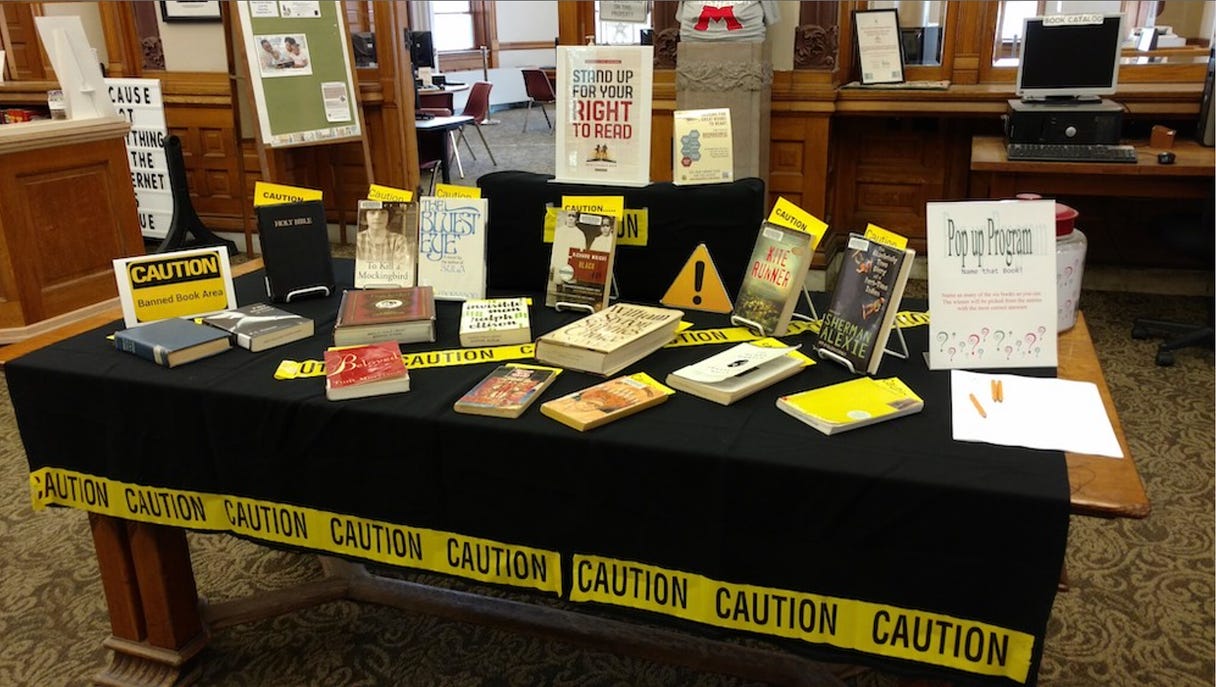
A display protesting book bans and restrictions at a local library. Charles Hickley/CC BY 2.0

The goal is not just to create a hostile work environment for library staff, but also to pressure administrators to submit to corrupt tactics such as banning books on spurious grounds and accepting slanderous speech used against their colleagues.

For right-wing parents and politicians aren’t just going after books. They are also personally attacking library employees as “groomers” who encourage inappropriate behaviors and relationships with children.

Associating LGBTQ individuals and their allies with pedophilia is an established strategy among the global right, including in Viktor Orban’s Hungary. And Vladimir Putin uses fake sex-crime charges to imprison researchers who are writing about things he wants buried.

Ideological fanaticism spurs attempts to dig into librarians’ private lives and harass them so they will resign. In Virginia Beach, GOP state representative Tim Anderson filed a FOIA Act request in May 2022 to learn the identities of librarians at schools that had materials some parents saw as sexually explicit.

It also lies behind attempts to criminalizelibrarians. In Clinton Township, NJ, the police department received a request for criminal charges to be made against librarians whose institutions had books with “obscene” content. And some states are challenging laws that shield teachers, researchers and librarians from prosecution. An Oklahoma law removed exemptions for teachers and librarians “from prosecution for willful violations of state law prohibiting indecent exposure to obscene material or child pornography.”

Unsurprisingly, many librarians have left their jobs. Some have resigned, others have been fired for refusing to remove books from their collections. Wilson-Youngblood, a 19-year veteran of the Keller school district, resigned due to the stress of working in a hostile environment. In small towns such as Vinton, Iowa, the library itself has had to close for lack of staffing.

Vinton’s fate may portend the future, since the number of groups targeted for censorship is bound to expand. In Vinton, right-wing activists not only objected to the presence of LGBTQ staff and LGBTQ-themed books, but displays of books by Vice President Kamala Harris and First Lady Jill Biden. For radicalized Republicans, Democrats are not just people with different opinions, but political enemies whose ideas should be banned.

Luckily, the digitization of books makes it hard for total bans on content for children to stick. The Brooklyn Public Library’s Books UnBannedprogram offers a free library card to people aged 13 to 21 across the U.S. so they can check out books digitally.

Yet libraries and librarians urgently need our support. Contacting your town or school administration to express solidarity and approval with current policies is one way you can push back. Another is to step up as a volunteer or even run for office on a town or school board that has oversight on library issues.

What Amanda Litman, executive director and co-founder of Run For Something, said about school boards in our interview is also true of libraries. They play “a foundational role in determining the kinds of citizens that kids ultimately become.” Libraries, and librarians, are essential to a healthy democratic society.

CNN posted an important article about two billionaires in Texas who are spending heavily to push state politics to the extreme right fringes on social issues. Tim Dunn and Farris Wilks despise gays, love guns, and preach a version of Christianity that is suffused with hate, not love or charity or kindness. Above all, they aim to destroy public education, which they see as the root of America’s cultural decline.

If you read one article today, make it this one. It explains the drive for vouchers for religious schools. What Dunn and Wilks want is not “choice,” but indoctrination into their selfish, bumigored world view.

CNN’s investigative team writes:

Gun owners allowed to carry handguns without permits or training. Parents of transgender children facing investigation by state officials. Women forced to drive hours out-of-state to access abortion.

This is Texas now: While the Lone Star State has long been a bastion of Republican politics, new laws and policies have taken Texas further to the right in recent years than it has been in decades.

Elected officials and political observers in the state say a major factor in the transformation can be traced back to West Texas. Two billionaire oil and fracking magnates from the region, Tim Dunn and Farris Wilks, have quietly bankrolled some of Texas’ most far-right political candidates — helping reshape the state’s Republican Party in their worldview…

Critics, and even some former associates, say that Dunn and Wilks demand loyalty from the candidates they back, punishing even deeply conservative legislators who cross them by bankrolling primary challengers. Kel Seliger, a longtime Republican state senator from Amarillo who has clashed with the billionaires, said their influence has made Austin feel a little like Moscow.

“It is a Russian-style oligarchy, pure and simple,” Seliger said. “Really, really wealthy people who are willing to spend a lot of money to get policy made the way they want it — and they get it…”

Former associates of Dunn and Wilks who spoke to CNN said the billionaires are both especially focused on education issues, and their ultimate goal is to replace public education with private, Christian schooling. Wilks is a pastor at the church his father founded, and Dunn preaches at the church his family attends. In their sermons, they paint a picture of a nation under siege from liberal ideas…

Dunn and Wilks have been less successful in the 2022 primary elections than in past years: Almost all of the GOP legislative incumbents opposed by Defend Texas Liberty, a political action committee primarily funded by the duo, won their primaries this spring, and the group spent millions of dollars supporting a far-right opponent to Gov. Greg Abbott who lost by a wide margin.

But experts say the billionaires’ recent struggles are in part a symptom of their past success: Many of the candidates they’re challenging from the right, from Abbott down, have embraced more and more conservative positions, on issues from transgender rights to guns to voting.

“They dragged all the moderate candidates to the hard right in order to keep from losing,” said Bud Kennedy, a columnist for the Fort Worth Star-Telegram newspaper who’s covered 18 sessions of the Texas legislature…

People who’ve worked with Wilks and Dunn say they share an ultimate goal: replacing much of public education in Texas with private Christian schools. Now, educators and students are feeling the impact of that conservative ideology on the state’s school system.

Dorothy Burton, a former GOP activist and religious scholar, joined Farris Wilks on a 2015 Christian speaking tour organized by his brother-in-law and said she spoke at events he attended. She described the fracking magnate as “very quiet” but approachable: “You would look at him and you would never think that he was a billionaire,” she said.

But Burton said that after a year of hearing Wilks’ ideology on the speaking circuit, she became disillusioned by the single-mindedness of his conservatism.

“The goal is to tear up, tear down public education to nothing and rebuild it,” she said of Wilks. “And rebuild it the way God intended education to be.”

In sermons, Dunn and Wilks have advocated for religious influence in schooling. “When the Bible plainly teaches one thing and our culture teaches another, what do our children need to know what to do?” Wilks asks in one sermon from 2013.

Dunn, Wilks and the groups and politicians they both fund have been raising alarms about liberal ideas in the classroom, targeting teachers and school administrators they see as too progressive. The billionaires have especially focused on critical race theory, in what critics see as an attempt to use it as a scapegoat to break voters’ trust in public schooling.

In the summer of 2020, James Whitfield, the first Black principal of the mostly White Colleyville Heritage High School in the Dallas suburbs, penned a heartfelt, early-morning email in the wake of George Floyd’s murder, encouraging his school to “not grow weary in the battle against systemic racism.”

The backlash came months later. Stetson Clark, a former school board candidate whose campaign had been backed by a group that received its largest donations from Dunn and organizations he funded, accused Whitfield during a school board meeting last year of “encouraging all members of our community to become revolutionaries” and “encouraging the destruction and disruption of our district.” The board placed Whitfield on leave, and later voted not to renew his contract. He agreed to resign after coming to a settlement with the district. Clark did not respond to a request for comment.

Whitfield said he saw the rhetoric pushed by Dunn and Wilks as a major cause of his being pushed out.

“They want to disrupt and destroy public schools, because they would much rather have schools that are faith-based,” Whitfield said. “We know what has happened over the course of history in our country, and if we can’t teach that, then what do you want me to do?”

Meanwhile, the legislature has also been taking on the discussion of race in classrooms, passing a bill last year that bans schools from making teachers “discuss a widely debated and currently controversial issue of public policy or social affairs.” The legislation was designed to keep critical race theory out of the classroom, according to Abbott, who signed the bill into law.

Some of the co-authors and sponsors of the bill and previous versions of the legislation received significant funding from Dunn and Wilks.

The billionaires “want to destroy the public school system as we know it and, in its place, see more home-schooling and more private Christian schools,” said Deuell, the former senator.

By the power of their money, these two billionaires are reshaping public policy in Texas to make it as narrow-minded and bigoted as they are. Their reactionary vision will indoctrinate students and crush the freedom to teach and the freedom to learn.

If you live in Texas, vote for Beto O’Rourke for Governor, Mike Collier for Lt. Governor, and for legislators who support public schools.
Maureen Downey of the Atlanta Journal-Constitution posted a guest column by two university scholars in Georgia, warning about the dangerous legislation now under consideration.

T. Jameson Brewer is an assistant professor of social foundations of education at the University of North Georgia. Brandon Haas is an associate professor of social foundations and leadership education at the University of North Georgia.

Brewer and Haas write:

At present, several bills in the state Legislature — including House Bill 1084 and Senate Bill 377 — weaponize grievance politics in the culture wars during a Georgia election year. These bills are our state’s iteration of “anti-critical race theory” proposals across the nation.

In Florida, lawmakers are seeking to make it illegal for white students to feel discomfort. In Oklahoma, a recent proposed bill would allow parents to sue teachers for $10,000 per day if they discuss any topic that does not perfectly align with a student’s closely held religious belief.

The House and Senate bills here in Georgia do not mention critical race theory by name. But they are part of this growing ideological trendto manufacture and capitalize on outrage as it relates to what students are taught or not taught in schools — the front line, as it were, of the nation’s culture war.

While there have long been efforts from the political right to censor curriculum and ban books in U.S. schools, these efforts have reached a fever pitch over the past two years. First, parents shouted at local school boards to ignore medical science and reopen schools as well as remove mask mandates during the height of the pandemic. Then, concerns over the teaching of CRT began to spring up across the country.

The simmering perception that K-12 schools and universities are engaged in teaching students to hate the United States or themselves was captured in the Trump administration’s 1776 Report. That report, not penned by historians, is full of inaccuracies in its attempt to promote fascist-like indoctrination that the United States is without historical or contemporary issues. Among many concerns, the 1776 Report attempts to suggest that George Washington freed his slaves and, thus, the United States does not have a legacy of racial oppression. Those with an accurate understanding of history know Martha Washington freed one of approximately 123 slaves.

Recently, the Heritage Action group tweeted about “uncovering” the teaching of CRT in Gwinnett County Public Schools despite K-12 districts suggesting that they do not teach CRT. Yet, this tweet was not the “gotcha” that Heritage may think it was for a few reasons: (1) The course in question was an Advanced Placement language and research course (that is, a college-level course), (2) students learn myriad frameworks for examining and critiquing issues, and (3) this type of critical thinking is precisely what we should want education to teach our students. All of that said, Superintendent Calvin Watts, noted that the syllabus in question was never used in classes. A district spokeswoman said it was a sample syllabus submitted to the organization that provides AP curriculum.

Georgia’s proposed bills seek to establish that racial injustice is an artifact of the past that no longer exists. They state that educators cannot suggest that the United States or Georgia is fundamentally biased based on race. Yet, any examination will clearly show that racial bias was a fundamental component of our legal, social, and educational system — from slavery to Jim Crow to mass incarcerations. The question, then, is whether or not these inequalities still persist. For this, students need to develop the ability to examine, evaluate and critique myriad forms of data and generate their own fact-based conclusion.

While part of any learning process is extending beyond our comfort zones, that discomfort is not what is at stake with these bills in Georgia, Florida and a dozen other states. It is uncomfortable to admit that white schools receive so much more in funding than nonwhite schools. Admitting this reality begs action. If we claim that the U.S. affords all children with a level playing field, the receipts showing that the field is structurally uneven suggests that we either forfeit the claim of equality or seek to remedy the inequality…

The larger problem created by SB 226 is that it creates a slippery slope of giving power to those who lack training in curriculum, instruction, and library media. This trend should alarm anyone who does not fancy a Nazi Germany-style authoritarian government over a democratic republic. In fact, one of the initial steps taken in Nazi Germany was banning of books, control of school curriculum and requirements of “loyalty oaths” and coerced patriotism as we are seeing in a variety of proposed laws across the country.

The United States has a checkered past that is troubling for all citizens. This is known as difficult history and provides students with an opportunity to understand how the past shapes the present so that they can be thoughtful and effective citizens. As novelist and essayist James Baldwin said, “I love America more than any other country in the world and, exactly for this reason, I insist on the right to criticize her perpetually.”

Will Georgia codify lying to students? Will we ban or burn books? While the next political outrage may find another arena to target and destroy for political gain, there are real harmful implications of the one currently targeting schools and books in an effort to satiate the public’s broad ignorance about buzzwords such as critical race theory. These bills are not anti-CRT, whatever that may mean. They are explicitly anti-education.

Lloyd Lofthouse, author, former Marine, and former teacher, explains what it means to be woke. Some Republican politicians—notably Ron DeSantis— are trying to suppress “wokeness.”

Lloyd writes:

Anyone that attacks what’s known as “woke ideology” is supporting zombie thinking and belongs to a fascist cult of ignorance.

Wokeness means someone that is highly literate, well educated, well read, is a life long learner, questions claims and uses critical thinking, problem solving and rational logic to find out if there is any truth to what these fascist zombies are shouting.

Question: Are you woke?

Dr. Charles Foster Johnson is hosting a conversation with Beto O’Rourke in Lubbock, Texas, on Zoom this Thursday.

4:30-6:00 pm CDT (central time).

They will discuss the future of public education in Texas.

https://www.eventbrite.com/e/a-conversation-about-public-education-with-beto-orourke-tickets-384095880117

The event is free.

The New York Times brings news that is not new to anyone who reads this blog. A movement is rising to revive Christian domination of public and private life, and it is a movement fueled by racists. It is specifically opposed to the separation of church and state, and it seeks to destroy public education, ban abortion, censor teaching about race and racism, as well as gender and sexuality.

This movement was behind Trump’s election and used this irreligious man as their instrument to gain power and control of the Supreme Court.

The article begins:

Three weeks before he won the Republican nomination for Pennsylvania governor, Doug Mastriano stood beside a three-foot-tall painted eagle statue and declared the power of God.

“Any free people in the house here? Did Jesus set you free?” he asked, revving up the dozens before him on a Saturday afternoon at a Gettysburg roadside hotel.

Mr. Mastriano, a state senator, retired Army colonel and prominent figure in former President Donald J. Trump’s futile efforts to overturn the state’s 2020 election results, was addressing a far-right conference that mixed Christian beliefs with conspiracy theories, called Patriots Arise. Instead of focusing on issues like taxes, gas prices or abortion policy, he wove a story about what he saw as the true Christian identity of the nation, and how it was time, together, for Christians to reclaim political power.

The separation of church and state was a “myth,” he said. “In November we are going to take our state back, my God will make it so.”

Mastriano, the Republican candidate for Governor of Pennsylvania, participated in the January 6 Insurrection.

Mr. Mastriano’s ascension in Pennsylvania is perhaps the most prominent example of right-wing candidates for public office who explicitly aim to promote Christian power in America. The religious right has long supported conservative causes, but this current wave seeks more: a nation that actively prioritizes their particular set of Christian beliefs and far-right views and that more openly embraces Christianity as a bedrock identity.

Many dismiss the historic American principle of the separation of church and state. They say they do not advocate a theocracy, but argue for a foundational role for their faith in government. Their rise coincides with significant backing among like-minded grass-roots supporters, especially as some voters and politicians blend their Christian faith with election fraud conspiracy theories, QAnon ideology, gun rights and lingering anger over Covid-related restrictions.

Their presence reveals a fringe pushing into the mainstream.

“The church is supposed to direct the government, the government is not supposed to direct the church,” Representative Lauren Boebert, a Republican representing the western part of Colorado, said recently at Cornerstone Christian Center, a church near Aspen. “I’m tired of this separation of church and state junk.” Congregants rose to their feet in applause.

Some states may become inhospitable for non-Christians and for Christians who don’t believe in compelling everyone else to worship their way.

The Founding Fathers most certainly believed in separating church and state. They most certainly wanted a secular, non-religious state. They were well aware of the carnage in Europe that resulted from religious wars and persecution. This new nation was meant to be free of state-sponsored religion.

Those who now seek to obliterate the separation of church and state and to impose their religion on others are rejecting the inheritance and wisdom of the Founding Fathers.