Archives for category: Accountability

The statehouse in Nashville, Tennessee, was surrounded by parents and students demonstrating in favor of gun control and against the GOP-controlled legislature’s protection of guns. The protest follows the murder of three children and three staff members at the Coventry School in Nashville.

Three Democratic members of the legislature joined the protest, chanting with the protestors.

The GOP leadership threatened to expel the Democrats. The speaker of the House absurdly claimed that the three Democrats were encouraging an insurrection.

Parents and children held signs and shouted chants during a large protest at the Tennessee capitol last week following a deadly school shooting. And while no one was arrested or injured, Republican House Speaker Cameron Sexton is comparing the demonstration to the Jan. 6 insurrection.

During the House Floor session on Thursday — days after the Covenant School shooting — Reps. Gloria Johnson, D-Knox, Justin Pearson, D-Memphis, and Justin Jones, D-Nashville, stood up and chanted with protestors in the gallery.

Pearson and other Democrats attempted to acknowledge the large group of protesters during session, but were told to stick to the subject of the bill by Speaker Cameron.

“We listened to them and helped to elevate the issue that they are demanding justice for,” said Pearson.

House Speaker Cameron Sexton said their actions were more than a breach of decorum, comparing it to the January 6th insurrection in remarks to outlets.

“Two of the members; Representative Jones and Representative Johnson, have been very vocal about Jan. 6 and Washington, D.C., about what that was,” said Sexton. “What they did today was equivalent, at least equivalent, maybe worse depending on how you look at it, to doing an insurrection in the State Capitol.”

Sexton warned that there will likely be consequences for the trio.

“It could be removal of committees; it could be censorship; it could be expulsion from the General Assembly. Anywhere in between,” said Sexton.

Leaders in the Democratic caucus are defending their colleagues. Nashville Democrat John Ray Clemmons says he believes Speaker Sexton is exaggerating.

“You show me the broken windows, you show me anyone who went into the speaker’s office and put their chair up on his desk and trashed his office, you show me where a noose was hanging anywhere on the legislative plaza,” said Clemmons, citing damage committed during the Capitol riot, which resulted in five deaths before and after the event.

The three rebellious Democrats were stripped of their committee assignments. Their member badges were deactivated. Their telephones were disconnected.

In a press conference Monday, Jones says Sexton is more focused on politics than addressing last week’s mass shooting.

“We are members, who are standing in the well, telling our speakers and our colleagues that kids should not be murdered in school,” Jones said, “and rather than address that issue, the speaker has spent more time on Twitter this weekend talking about a fake insurrection than he did about the deaths of six people including 9-year-old children.”

It is not yet clear if the lawmakers will face expulsion. Sexton has not commented on whether they will face further discipline.

A tweet:

Three Tennessee Democrats have been stripped of their committee and subcommittee assignments by the Republican dominated legislature for speaking out against gun violence in the wake of the Nashville shooting that killed three children.

Democracy is dead in Tennessee.

@Sethaweitz

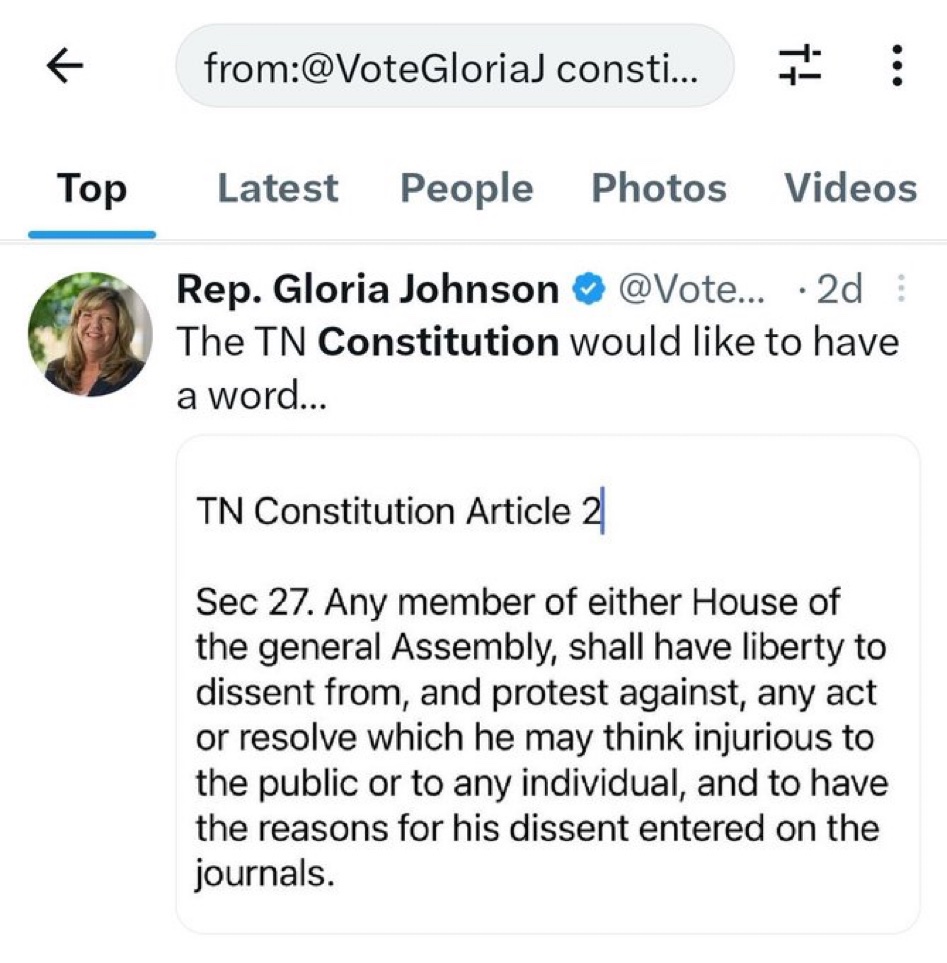
Rep. Gloria Johnson, one of the three Democrats, tweeted:

Governor Ron DeSantis should be careful whom he picks on. Not only did Disney outsmart DeSantis and retain control of DisneyWorkd, but its CEO announced at a shareholder meeting in California that Disney plans to grow in Florida. He also rapped DeSantis for trying to punish Disney for exercising its constitutional right to free speech.

The Orlando Sentinel reported:

The Walt Disney Co. plans to invest $17 billion in Walt Disney World over the next 10 years and create 13,000 new jobs, CEO Bob Iger said Monday, as he accused Gov. Ron DeSantis of being vindictive over Disney’s response to the so-called “don’t say gay” law last year….

Disney World will host 50 million visitors this year, and its planned expansion will bring even more guests and employees to the state in the years to come, along with generating more taxes, Iger said.

“Our point on this is that any action that thwarts those efforts, simply to retaliate for a position the company took, sounds not just anti-business, but it sounds anti-Florida, and I’ll just leave it at that,” he said….

During the company’s annual meeting, Iger also said Disney loves Florida and has heavily invested in the state over the past 50 years in its expansion of the Disney World resort, as the state’s largest taxpayer and through its charitable actions.

The state’s relationship with Florida has “kind of been a two-way street,” Iger said.

But that changed last year when former CEO Bob Chapek spoke out against Florida’s Parental Rights in Education legislation, which restricts discussion of sexual orientation and gender identity in early-grade classrooms. That drew DeSantis’ ire and led to a law dissolving of the company’s special land use, utilities and public service district, Reedy Creek.

“And while the company may have not handled the position that it took very well, a company has a right to freedom of speech just like individuals do,” Iger said.

He said DeSantis dissolved Reedy Creek “in effect to seek to punish a company for its exercise of a constitutional right.”

“And that just seems really wrong to me, against any company or individual but particularly against the company that means so much to the state that you live in,” he added.

Virginia Governor Glen Youngkin sends his own children to an elite private school that never bans books and teaches critical race theory, But the governor ran on a platform of “parental rights,” which has unleashed censorship and book banning in the state’s public schools.

The schools of Spotsylvania have posted a list of 14 books that will be withdrawn to protect children from ideas their parents don’t like. Among the 14 are two by Nobel-prize winning author Toni Morrison.

The books were challenged for having “sexually explicit material” in them, according to a message to families from superintendent Mark Taylor.

The superintendent of Spotsylvania public schools has no prior experience in education. His appointment was made after hard-right conservatives won control of the school board. Aside from his lack of experience, Mark Taylor was controversial because of incendiary comments he made on social media. “They allegedly include memes mocking trans people and school shootings, racist innuendos and calls for parents to pull their children out of public schools.”

By the end of the week, the school district will remove:

“All Boys Aren’t Blue” by George M. Johnson

“Like a Love Story” by Abdi Nazemian

“Dime” and “America” by E.R. Frank

“Sold” by Patricia McCormick

“Out of Darkness” by Ashley Hope Perez

“Beloved” and “The Bluest Eye” by Toni Morrison

“Looking for Alaska” by John Green

“The Perks of Being a Wallflower” by Stephen Chbosky

“Water for Elephants” by Sara Gruen

“Neanderthal Opens the Door to the Universe” by Preston Norton

“More Happy Than Not” by Adam Silvera

“Nineteen Minutes” by Jodi PicoultSpotsylvania superintendent floats elimination of all school libraries

In a statement, Taylor pointed to a Virginia lawthat requires school districts to establish parental notification policies for instructional materials with sexually explicit materials, saying the 14 books fall under that category.

Taylor added that the division doesn’t have the resources to review whether the roughly 390,000 books in all school libraries have similar materials, so purging the 14 books from the shelves would be the only way to ensure they aren’t accessible….

Taylor noted in his message to families that the decision won’t stop teachers from including the pulled books in classroom assignments, which would have to be shared with parents under the law. According to the district, the books will be stored until they are donated.

What teacher will be brave enough or foolish enough to assign a banned book?

While traveling in the Midwest, I visited Illinois State University, which has an excellent teacher education program. A leader of that program recently wrote me while in a state of distress. One of her best students, she said, was just fired by her district. Why? One parent objected to a book in her classroom.

Who will want to teach when teachers’ lives and reputations can be jeopardized by one angry parent? Maybe that is the point: Demonize public schools and their teachers to build support for vouchers, where uncertified teachers are hired and the Bible is the beginning and end of all knowledge.

Here is an excerpt from the letter I received:

Tonight, I’m writing to you to share the story of the most amazing teacher I have ever worked with in my nearly 25 years in education–except she is no longer a teacher as of last Thursday. I know you have committed your career to fighting injustices like hers, so it is my hope that you might amplify her story in the fight against misinformation and teacher defamation.

As a teacher educator at Illinois State University, I met Sarah Bonner 10 years ago when she was in my action research capstone class as the final requirement for her master’s degree. During the year I worked with her, I was struck by her approach to education, and I encouraged her to continue working toward a doctorate degree. Since that time, I have had the opportunity to work closely with her, co-designing a framework that paired literature and inquiry as a way to expand 8th grade students’ in rural Illinois worldviews; co-teaching alongside her to maintain my connection to the classroom and to continue to evolve our work; guiding her in her dissertation work where she connected with teachers who were interested in transforming their own teaching; watching her mentor emerging, new, and experienced teachers; and witnessing the blossoming of students under her guidance–especially those who are often marginalized in largely conservative, small schools. I can honestly say that I have never had the opportunity to work with a more compassionate, innovative, and thought-provoking teacher. She’s by far a better teacher than I was when I was still in the middle school classroom, and working alongside her has pushed me to be an even better teacher educator than I was before.

For this reason, I cannot begin to describe the devastation that I experienced when I learned less than two weeks ago that not only was she being attacked by our local conservative “news” station, but that her district advised that she seek union representation to represent her while they investigated the story. She received this news on Wednesday, March 15. By Friday March 17 she learned that she was being put on paid leave the next week so they could investigate–and they hadn’t even talked with her yet.

What was the story? As a part of a book tasting day, Sarah consulted NCTE, ALA, and Good Reads to find award-winning and notable books that would reflect her students’ interests–and checked out nearly 100 books from the public library. One of those books was Juno Dawson’s “This Book Is Gay.” A student picked up the book, a sex education book for LGBTQ+ youth, snapped some pictures of its pages, and sent those pages home. Rather than approaching Sarah with questions or concerns, this child’s parents alerted the media outlet, and a witch-hunt began.

Suddenly, the wild and false allegations began: Sarah was requiring this book; the book was a regular part of her classroom library; she was sharing pornography with children; she was grooming children. And then, they went to her class website, which shared a link to Common Sense Media’s Netflix Documentary page, which so happened to feature Moneyshot, and now she was encouraging students to watch and learn about porn. Ironically, this film hadn’t even been released when she was last in the classroom. The story just kept growing until this award-winning teacher realized that she could not go back to that community again. And so, by this past Thursday, she had officially resigned. In just over a week, a teacher’s reputation, livelihood, and life was completely upended.

Sarah is fortunate brcause she’s got the deep knowledge and experience to bounce back and counter the current narrative. Unfortunately, this kind of experience is not unique, and too often teachers who aren’t equipped to handle it take huge hits. It’s impacting their mental health, their careers, their entire livelihoods. We have a narrative around a teacher shortage. We don’t have a teacher shortage—we have a shortage of respect and support for teachers. And we live in Illinois, a liberal state that requires LGBTQ+ history and contributions to be taught by 8th grade. Too many people are watching the antics happening in states like Florida and thinking those are outliers. They are not. Sarah is an award-winning teacher. She is a leader in and on the executive board of the National Council Teachers of English. And yet, she will no longer impact the lives of so many students.

Democracy is in peril as we continue to bow to pressures to restrict the books students can read. We cannot normalize allowing a few loud voices’ the power to destroy careers and lives. I have attached the statement she wrote and read to her board upon her resignation.

Here is Sarah Bonner’s statement to her school board:

Thank you to the Heyworth Board and Administrative team for allowing me to speak this evening. If you know anything about me as a professional, you know that this is not the way I would have chosen to be here tonight. Twenty years ago when I was given the keys to my very first classroom, I knew teaching was my calling. And, while I’ve taught in previous school districts over the years, Heyworth was the place that allowed me to become the professional I was meant to be.

Throughout my time here, I earned both my Masters and Doctorate degrees with the help of district tuition waivers. I became the National Council of Teachers of English (or NCTE) Media Literacy Teacher of the Year in 2018 along with the national Outstanding Middle Level Educator award the following year. I wrote and published a book through Teachers College Press to further the teaching field. Additionally, I hosted and supported numerous future teachers from Illinois State University as they began their journey into the classroom. Lastly – most importantly – I had the opportunity to connect with the best kids I’ve ever worked with in my career.


Our community – or even our nation – may never know the gravity of what teachers bear on a regular basis. For me, I not only worked tirelessly on designing and cultivating meaningful learning experiences for my students, but I also worked hard to maintain healthy relationships with students and families, upheld weekly and transparent communication among all shareholders, contributed regularly to the junior high teacher team, worked a second teaching job at Illinois State University to better support my family, served as the Middle Level Section Steering Committee Chairperson for NCTE, wrote a doctoral dissertation, published a book for teachers, along with being a partner, a mother, and a human wrestling with being newly diagnosed with multiple sclerosis.

With all of this weighing heavily on my plate, I depended on national communities like the American Library Association and NCTE as well as reading communities like Goodreads to help generate texts that engage all readers with a vast collection of interests. The activity my students and I participated in last week was made up of close to 100 different books recommended from these spaces. Given the nature of the lesson compressed with a heavy list of responsibilities, vetting each and every single text for explicit details was impossible. Should the book in question be available to students? Yes. However, should this specific book have been a part of the 100 choices during this class activity? No. Simply put, the title was on the ALA Rainbow Reading Awardee list and I picked it along with a few others because I knew students in my class had interests. To make students, families, community members feel unsafe was never the intention of my decision making.

While I’m saddened by how the events have played out over the last week, there’s a piece of me that isn’t surprised. Being an innovator in teaching means that boundaries, perspectives, and ideas need to be pushed. When I realized years ago that our kids who would receive these amazing scholarships to these Big 10 schools were coming back the following year because they couldn’t adjust to life outside of a rural small town, I knew I needed to do something. I knew I needed to disrupt traditional learning practices to embody the needs of today’s world. Our kids deserve learning experiences that prepare them for our world and not just our town. However, being a changemaker often comes with a cost…especially if you’re one of the only ones willing to take risks and think differently.


London’s favorite soccer coach, Ted Lasso – the man who makes us all believe in the power of believe – said it best ”You know, people have underestimated me my entire life. And for years, I never understood why. It used to really bother me. But then one day, I saw this quote by Walt Whitman. It said, “Be curious, not judgmental.” All of a sudden it hits me. Of all those that used to belittle me, not a single one of them was curious. They thought they had everything all figured out. So they judged everything, and they judged everyone. And I realized that their underestimating me… who I was had nothing to do with it. ‘Cause if they were curious, they would’ve asked questions.”
As I leave here tonight, I hope you will remember a few things:

  1. Sometimes things need to break in order to rebuild it stronger. Encourage
    curiosity. As you enter a space of healing, I hope the district and Heyworth community can find a place to listen and understand that you all want the best for our kids. Our teachers especially deserve to be heard and questioned in responsible ways.
  2. Remember to support your teachers moving forward. If I were them at this point, I would feel scared, unsafe, and paralyzed knowing that I could be next. Our teacher community needs reassurance that innovation is still supported and protected as time moves on.
  3. And, remember the good I brought to our kids and community by taking innovative risks in Language Arts. While I’ve been here, I have witnessed students stand up for other students with disabilities, fight against racism, organize trash clean ups, create documentaries that tell the untold stories of their community, advocate for safe spaces, strengthen their own beliefs, shape their own personal identities, and critically think about the world around them. With the work I’ve been able to do with students, I’m reminded on a daily basis that our kids will be the hope our future needs.

The Heyworth school district has lost a teacher who is dedicated to their children and her profession.

The New York Times published an article about a tenured professor at the University of Pennsylvania Law School, Amy Wax, who has frequently made statements that are racist, homophobic, sexist, xenophobic, the whole range of prejudices, not what you expect of someone who supposedly teaches students that everyone is equal in the eyes of the law.

Amy Wax, a law professor, has said publicly that “on average, Blacks have lower cognitive ability than whites,” that the country is “better off with fewer Asians” as long as they tend to vote for Democrats, and that non-Western people feel a “tremendous amount of resentment and shame.”

At the University of Pennsylvania, where she has tenure, she invited a white nationalist to speak to her class. And a Black law student who had attended UPenn and Yale said that the professor told her she “had only become a double Ivy ‘because of affirmative action,’” according to the administration.

Professor Wax has denied saying anything belittling or racist to students, and her supporters see her as a truth teller about affirmative action, immigration and race. They agree with her argument that she is the target of censorship and “wokeism” because of her conservative views.

All of which poses a conundrum for the University of Pennsylvania: Should it fire Amy Wax?

The university is now moving closer to answering just that question. After long resisting the call of students, the dean of the law school, Theodore W. Ruger, has taken a rare step: He has filed a complaint and requested a faculty hearing to consider imposing a “major sanction” on the professor…

For years, Mr. Ruger wrote in his 12-page complaint, Professor Wax has shown “callous and flagrant disregard” for students, faculty and staff, subjecting them to “intentional and incessant racist, sexist, xenophobic and homophobic actions and statements.”

The complaint said she has violated the university’s nondiscrimination policies and “standards of professional competence.”

The article goes on to cite the many times that Professor Wax has offended women, Blacks, gays, foreign students, or anyone else who does not agree with her idyllic view of the culture of the 1950s. Implicitly she means an era when Blacks were subservient, women were compliant wives, gays were in the closet, and foreigners were tourists.

What should the university do?

…many free speech groups, including the Academic Freedom Alliance, PEN America and the Foundation for Individual Rights and Expression, have criticized the dean and said that Professor Wax should not be fired because of her public statements.

My view: She should not be fired. Perhaps she should be admonished for behavior that is insulting to students, but her academic freedom and tenure protect her job.

Academic freedom protects not just the views that one likes, not just the views of the majority, but the views you hate. I might wish that Professor Wax were open-minded and wish that she had a keener sense of humanity, but I defend her right to be offensive, inconsiderate, and obnoxious. Students are not required to take her courses. Those who take her courses should challenge her views if they disagree.

But academic freedom must prevail.

Voltaire: “I may not agree with what you have to say, but I will defend to the death your right to say it.”

Julie Vassilatos, a parent activist and blogger in Chicago, writes here about the case for Brandon Johnson. She and others have written passionately against Paul Vallas, but here she explains why Brandon Johnson is well prepared to serve as Mayor. Because of his knowledge and experience, he not only knows the city’s budgetary issues well, but he is able to address the root causes of crime and the real needs of students.

She writes:

Friends, so many of us have been carrying on about the dangers of Paul Vallas so incessantly, you’d be forgiven for thinking that he’s running for mayor of Chicago unopposed.

But Vallas does have an opponent—one who is talented, thoughtful, experienced, and a real true Chicagoan raising his family on the west side: Brandon Johnson.

Johnson is getting a lot of heat from Vallas and his supporters right now. No lesser a personage than Darren Bailey, defeated far-right candidate for IL governor and unofficial endorser of Vallas, has announced that if Johnson is elected, it will be a “dark day” for Chicago. Yes. A dark day indeed. Get it?

I’m pretty sure Darren Bailey fans get it.

Then there’s FOP president/disgraced cop John Catanzara, who foresees that 1000 cops will walk off the job if Johnson wins, and there will be blood in the streets.

Vallas himself, who routinely speaks of Johnson in kind of Godzilla terms, has called him and the CTU a destructive force wreaking devastation on the city.

In addition to its coded race language, this election has rather inflated rhetoric.

I’m trying to keep mine toned down, or at least backed up by evidence. While it’s hard to pin “generational” devastation on Johnson or the CTU, it’s actually possible to do this for Vallas. He has set many destructive policies in motion in urban areas globally that have left decades of harm in their wake. Also financial calamity. But I and many others have told you all this over and over again. And this post is not about that guy.

This post is about Brandon Johnson.


Truth to tell, at the outset of the race I was slow to warm up to Johnson the candidate. But then I remembered that he was at the front lines of a struggle I will never forget—the 2013 mass school closures. So many folks did all we could do to try and stop that, well, generationally damaging policy. And those who led the way in that effort? I’d probably follow them into a fire.

But what about Brandon Johnson now? What are his credentials? Haven’t you, like me, read all that stuff about how he has no experience? How he’s never managed a budget? How he seems (unfathomably) to like crime and together with CTU wants our city to be unsafe, because….because….well, because reasons?

Well, maybe we need to look a little deeper than the media/social media blah blah blah.

In a recent mayoral forum Vallas asserted that “Brandon has run nothing.” Since Vallas hasn’t really lived here much I guess he may not know that Johnson has served on the Cook County Board of Commissioners since 2018 and has managed a great deal, including the $8.75B Cook County budget. The Cook County Board has wide ranging responsibilities, and if you’ve always wondered but never known what the Board does, you should take this time to educate yourself, starting at the Cook County Board website. Here’s a basic summary:

The Cook County Board of Commissioners oversees County operations and approves the budget of elected County officials including the Assessor, Board of Review Commissioners, County Clerk, Clerk of the Circuit Court, Recorder of Deeds, Sheriff, States Attorney and Treasurer.

The Commissioners also serve as the Board of the Cook County Forest Preserve District, a special purpose taxing district. The Board also sets policy, levies taxes, passes ordinances, approves all county purchases over $10,000, and adopts the annual budget for the entire county government.

That 2023 Cook County Budget was praised by the Civic Federation:

The Civic Federation supports the Cook County FY2023 Executive Budget Recommendation of $8.75 billion because it reflects strong financial management and puts the County in a good position moving forward post-pandemic. The County’s FY2023 proposed budget includes a strong level of reserves and positive revenue projections, without any increases in taxes or fees.

The budget gap is smaller than it’s been in years, supplemental payments to the pension fund have been made for the eighth year in a row, and the County’s fiscal position is “strong…following robust revenue performance and built-up reserves.” And observe that there are in this budget, no tax increases. (Here I note we can be grateful to Board President Toni Preckwinkle who has shepherded this budget for 13 years. And I note further, she has endorsed Johnson.)

Now let’s review the budgets Vallas has overseen.

In Philadelphia, Vallas managed a $2B budget and left a surprise $73M deficit on his way out the door. In the Louisiana Recovery District his budget was $176M. He got an extra $1.8B to work with from FEMA, and before he was done with the NOLA job he wandered repeatedly over to Haiti, missing weeks at a time of work in New Orleans (that’s beside the point, but I just thought you should know). And in Bridgeport CT, his budget was $232M. Of course he was pushed out of that job before he could really do much financial damage there.

For those of you keeping score, Vallas hasn’t ever drafted, managed, or implemented a budget even close to the size that Brandon Johnson has worked with as a member of the Cook County Board.

Before his County Board days, Johnson was a teacher. He taught middle school social studies at Jenner from 2007 to 2010 (years when most of his students were able to watch, right from school windows, wrecking balls demolishing their homes as the city brought down public housing), and then at Westinghouse for a year. He then became a CTU organizer and the leader of its Black Caucus. In those years he had a front row view on lots of turmoil in the district: school closures and turnarounds via the failed Renaissance 2010 initiative, the loss of Black teachers in the classroom as a result of closures and CPS policy choices, the 2012 teacher strike, the 2013 mass school closures, a churn of district CEOs, some of whom ended up in prison, illegal special education cuts, and rapid charter expansion.

While Johnson was organizing teachers and collaborating with parents in response to district policies that were crushing schools and services (and I do mean that literally, with at least one occasion of bulldozers bringing down a school library on a day when parents were instead expecting a meeting), he lived the experience of the folks who’ve been at the mercy of “education reform” for decades. He saw first hand what disinvestment has done to CPS students—resulting in teacher cuts, special ed cuts, after-school cuts, nursing cuts, and the whittling away of libraries, down to only 90 remaining in a total of 513 schools. He’s seen the violent legacy of closing the community anchor that is a public school. He’s watched, along with all of us, poor choices at the top—everything from grifting, self-dealing, and bribery, to no-bid contracts and cronyism—and how those things bust budgets and destroy trust. He stood with community members on a hunger strike to save a school, then joined in it himself. He’s seen the negative academic and social impacts of excessive testing, privatization, and vouchers. He’s seen these things from the perspective of 25,000 teachers and hundreds of thousands of public school families.

Vallas, meanwhile, has been the man who set those policies. He set them in motion right here in Chicago in 1995, and traveled the country and globe continuing to implement them from then until now.

He may talk a good game about Doing It All For The Children, but the fact of the matter is, Vallas has never had to stick around and watch the long term impacts of his policy decisions on The Children. Those impacts have caused years of student protests in Chile. Have kept special ed kids struggling for spots in schools in New Orleans. Have left Philadelphia in “constant crisis mode.” Led directly to our own CPS budget crisis.

Brandon Johnson has large scale urban management experience with a Board that’s closing budget gaps and overseeing a vast array of county services. He manages a bigger budget right now than Vallas ever has. And Johnson has face-to-face, personal experience with the folks who live and work and raise their children in Chicago. His years as a teacher and with CTU have given him the perspective of individuals and families on a hyper-local basis. His work has encompassed both the broad span of countywide planning and management, and the particular lens on particular people and particular struggles.

Brandon Johnson is obviously qualified for the job.

You can check out how his qualifications and vision work themselves into a platform on his website. It’s practical and passionate and outlines a vision for the city that benefits everyone, even those struggling folks who never seem to catch a break from city leaders.

Johnson understands we cannot solve violence without dealing with its root causes; more policing, surveilling, and arresting alone won’t do the trick. We can’t fix the schools without listening to communities, parents, and educators; we must reject the failed status quo of Vallas’s “education reform.” And we can’t expect our teachers and police to solve poverty and homelessness all on their own.

The choice we have before us, it seems to me, is whether we’re going to listen to the incessant hype about a “fix-it man”—who has never fixed anything. Or dig a little deeper ourselves and see that the mayor we need has been here all along, working to make our city better for his entire career, with poise and passion.

Are we going to listen to voices that allude to “dark days” and blood baths in the streets? Or are we going to listen to a man who has a vision for his city rooted in love and practical experience?

You pick, Chicago.
Historian and retired teacher John Thompson updates us on the toxic MAGA politics that is undermining the state’s economy and the future of the state.

Republican politicians are competing to see who can be more extremist, more MAGA than the other far-right zanies. Although an unreleased poll conducted by a Republican pollster found that Oklahomans are overwhelmingly opposed to vouchers, the Governor, the state commissioner of education, and legislators are competing to see who can offer the biggest voucher and who is most indifferent to public schools. Quality of education is a lure for corporations; indifference is not.

Similarly, MAGA Republicans are competing to denounce corporations that are committed to socially responsible policies regarding ESG (environmental, social, and corporate governance). Corporations don’t usually like government interfering in their internal policy making, especially those attempting to present a public face of social responsibility.

Thompson writes:

Monday marked the beginning of the second half of the Oklahoma legislative session. The first half was largely dominated by the MAGAs rhetoric, and led by Gov. Kevin Stitt, Secretary of Education Ryan Walters, and the House leader Charles McCall, as they tried to be tougher than Ron DeSantis and the other extremists. But the top headlines, recently, have shifted to the state’s failure to persuade Panasonic and Volkswagen to make major investments in Oklahoma.

On National Public Radio, Sen. Pro Temp Greg Treat sounded like a timid version of old school, adult Republicans. Treat seemed to be pushing back on the $300 million House voucher bill (called a tax credit), saying we need to protect funding for the 90% of students who will remain in public schools. But, the House bill then advanced in the Senate Education Committee with 100% of Republican votes. Perhaps the timid nature of Treat’s comments about pushing back on the House’s demands foreshadowed the Senate increase in the size of tax credits (vouchers) by 50% per student.

Although the Senate committee increased the size of the teacher pay raise, it also provided steps towards Ryan Walters’ merit pay for 10% of educators, which would promote even more of a reward and punish school culture.

Democrat Sen. Julia Kirt explained that the private school tax credit cap is $250,000 which is almost ten times as great as the average Oklahoma wage. Only 3% of taxpayers would hit that limit, so “almost any Oklahoman could claim $7,500 tax credit for private school.”

Moreover, education supporter Greg Jennings gave examples of two private religious schools that are being constructed which could undermine the survival of two rural districts (serving 3,800 students combined). Even when the goal was $5,000 vouchers, these religious schools showed how private schools could be replicated, with serious negative consequences, in rural areas. The plan is to expand from pre-k to 8th grade by 2024. Students would be taught a “Christian Based Education.”

In other words, the MAGA culture wars may have undermined corporate investments seeking to create good-paying, 21st century jobs, but vouchers could spark a boom in Christian Nationalism.

Then, Treat addressed the loss of the Volkswagen plant to Canada and called for a study as to why it happened. He compared it to the bipartisan study which launched Oklahoma City’s growth in the 1990s after United Airlines rejected the city’s bid because of our lack of social, cultural and educational institutions. As the Oklahoman’s Ben Felder reported, despite a $700 million incentive, Volkswagen chose to invest in Canada with its “strong ESG practices,” rather than the mindset expressed by Jonathan Small, the Oklahoma Council of Public Affairs’president:

Not only do ESG policies penalize energy production to prop up “green’ companies, but they also pressure businesses to take stances on non-economic issues such as redefining gender, promoting Critical Race Theory, and abortion tourism.

Surely, even the most extreme MAGAs know that those beliefs would make investors cautious about coming to Oklahoma after the state’s “Legislature and governor banned state investment funds from working with companies that utilize ESG policies.” After all, Stitt had said, “don’t expect support from us unless you reject ESG.”

Neither would investors be encouraged by State Treasurer Todd Russ, who “issued letters to more than 160 companies giving them an April 1 deadline to confirm they don’t ‘boycott energy companies.’” Russ further explained:

I took office on January 9 and began compiling a list of companies, banks, and other entities that act against Oklahoma’s interests because of their ESG stance. … It is my responsibility to ensure Oklahomans’ tax dollars will not be used to enrich organizations that act counter to our taxpayers’ interests and our values.

Getting back to Monday’s education debate, Democratic Sen. Carri Hicks said, “We’re asking taxpayers to fund a second school system when we haven’t funded the first.” She then explained, “Struggling schools mirror struggling communities. Oklahoma legislature has ignored the urgent need to address the 60 percent of Oklahoma’s children who live in poverty in our public schools.” Then she closed with a message that Treat should understand. “When we are looking at removing additional funding that could be invested in all of our kids’ futures — I think this is a misstep.”

And this brings back Treat’s call for remembering the lessons learned in the 1990s after Oklahoma City lost in the effort to attract 1,000 United Airlines jobs. During the deindustrialization spurred by the Reagan administration’s Supply Side Economics, Oklahoma received national and international attention for scandals ranging from the bank and saving and loans collapses; the Housing and Urban Development and County Commissioners scandals; and corruption in juvenile justice, prison, and county jails. Even the CEO of the Chamber of Commerce acknowledged that Oklahoma City “was a really destitute place to live.”

It took a two-pronged, collective response to turn Oklahoma City around. The first was bipartisan campaigns to raise taxes and rebuild abandoned neighborhoods; invest in parks, libraries, and sports and cultural institutions; and invest in public schools. As Sam Anderson of the New York Times Magazine explained:

After all of that sacrifice — the grind of municipal meetings and penny taxes and planning boards, the dust and noise and uncertainty of construction, the horror of 1995 — the little city in the middle of No Man’s Land has finally arrived on the world stage.

I would add in regard to the horror of the Murrah Building bombing on the second anniversary of the Waco tragedy, with the loss of 86 lives, nobody bought Timothy McVeigh’s justification for terrorism as a response to federal intervention in Waco.

Finally, I guess it’s is too much to ask of Treat et.al, but if we want to thrive in the 21stcentury, don’t we need a bipartisan rejection of Trump’s beginning his presidential campaign on the 30th anniversary of Waco with dog whistle calls for violence? Why can’t Republicans distance themselves from Trump’s supporters like the Proud Boys who cite Waco as justification for more violence? And why do they support a candidate who has “vowed retribution;” proclaimed, “PROTEST, TAKE OUR NATION BACK!;” and warned of “potential death & destruction” if he is prosecuted?

So, when Republican leaders like Treat are reluctant to speak out against ideology-driven policies that they know will fail, the damage from that timidity – though significant – is not the biggest problem. It’s their silence in the face of attacks on our democratic systems that should be the #1 concern.

Jan Resseger spent her waking years as a warrior for social justice in her church. Now she writes a brilliant and thoughtful blog.

Her recent post made me reflect on the fact that groups like “Moms for Liberty” and “Parents Defending Education” create turmoil and chaos over the issue of the day (masking, vaccines, school closings, trans kids, books about race or gender identity), then use the issues and conflict they created to demand vouchers to send their kids to schools with like-minded parents.

These Astroturf groups are funded handsomely by the Walton Family Foundation, Charles Koch, Betsy DeVos, and other billionaires to act as shock troops for their paymasters.

Jan Resseger wrote recently:

I cannot even keep track of all the press coverage I have seen in the past couple of weeks about school privatization proposals under discussion in the state legislatures. And in almost all of the articles I read, the move to privatize schools is accompanied by descriptions of culture war fights about book banning, interference with curricular standards, and elimination of programs that encourage “diversity, equity, and inclusion” in public schools and public universities. I have a stack of very recent articles about Florida, Ohio, Virginia, Texas, Missouri, Iowa, Kansas, Nebraska, and New Hampshire, and I am sure I have missed others.

What is the cause of today’s attack on public schools and the kind of programming that many of us believe is essential to help our children live well in our diverse society?

In her Washington Post piece about a battle between two parent groups, Concerned Taxpayersand Support Education, in Mentor, Ohio——Hannah Natanson blames COVID for the controversy: COVID Changed Parents’ View of Schools—and Ignited the Education Culture Wars.

And in a powerful report from the Network for Public Education, Merchants of Deception, political scientist Maurice Cunningham identifies the role of Astroturf parents’ groups that present themselves as though they are a spontaneous welling up of parent outrage. Even though financial support for these groups is untraceable dark money, here is how Cunningham tracks evidence that these supposedly local groups are well connected from place to place and supported by powerful, far-right political interests: “First we should watch for groups that have “grown at a pace that only a corporation’s monetary resources could manage.” Then we should identify the group’s allies to “get a better idea of the real powers behind” the organization. Additionally: “We’ll use another tool to draw telling inferences about these fronts: identification of their key vendors, such as law firms, pollsters, and public relations firms, which we’ll see are often instruments of conservative… networks… Another recurring clue… is the ‘creation story.’ A new non-profit group bursts forth with some version of claiming that two or three moms began talking over what they see as problems in schools and resolve to start a nonprofit to take on the teachers’ unions, administration, or school board. By some form of miracle, they almost immediately receive hundreds of thousands, if not millions, of dollars in funding from billionaires. Next, they find themselves gaining favorable coverage on right-wing media—Daily Caller, Breitbart, and Fox News…. ”

Of course both the disruption COVID thrust upon our communities and the use of parents by far-right groups trying to ban “WOKE” policies represent what many of us have been watching in the past couple of years. But on a deeper level, it is not a coincidence that the outrageous school board disruptions and the attempts by the far right to scrub the textbooks, and the legislatures considering parents’ bill of rights legislation also seem to be happening in places where slate lawmakers are also pushing vouchers, and not merely the old-fashioned tuition vouchers for private schools, but the new Education Savings Account universal programs to provide wider parental “freedom” and lack of oversight of the public dollars being diverted to these plans. These new vouchers are being designed to give parents the ultimate latitude in school choice—homeschooling and micro-schools where parents put their vouchers together to pay for a teacher for several families. Lack of regulation is a key ingredient in most of these plans. In every case the worldview underneath the proposals involves extreme individualism along with marketplace consumerism.

In her new book, The Teachers: A Year Inside America’s Most Vulnerable, Important Profession, Alexandra Robbins describes parents who view themselves and their children as the customers teachers must please: “At a candidate forum during the COVID pandemic, a Maryland school board member called students the ‘customers in our school system,’ as if teachers existed to satisfy students rather than to educate them… On a broader level, the student-as-customer attitude has contributed to a growing politicized movement pushing for parents to have authority over what is taught in schools.” (pp. 66-67) Believing your child is the client who must be pleased by services rendered is a very different conception of the parent-teacher relationship than believing that the teacher is a professional whose expertise and cooperation you can and should consult for guidance about your child’s education.

Please open the link and read the remainder of this very important post.

March for Our Lives is the organization created by students at Marjory Stoneman Douglas High School in Parkland, Florida, after the massacre of 14 students and three staff members on February 14, 2018. The students organized massive rallies demanding gun control. Florida Governor Rick Scott signed gun control legislation: however, in the past few days the Florida legislature rolled back the post-Parkland gun control and made it legal to carry a gun without so much as a permit.

Please note that Rep. Andy Ogles, pictured below with his family, brandishing guns, represents the district in Nashville where the Coventry School is located. His district was created as a result of a gerrymander when the legislature split Nashville in two.

This Monday, we lost three children and three adults to gun violence in yet another school shooting in Nashville, Tennessee: Cynthia Peak, 61, Katherine Koonce, 60, Michael Hill, 61, Evelyn Dieckhaus, 9, Hallie Scruggs, 9, and William Kinney, 9.

The perpetrator used an AR-15 rifle to kill three children and school staff, including a substitute teacher, custodian, and school head. Instead of using their power to act, two Tennessee Congressmembers are treating calls for gun safety legislation as a joke. Rep. Andy Ogles represents the district in Nashville where the Covenant School shooting occurred. Do you know what his response was? Thoughts and prayers. This is the same congressman who glorified guns with his family in this holiday photo:Photo of Rep Ogles' family holding assault weapons in front of a holiday treeWhen reporters asked him if he regrets even sharing that photo, he doubled down by saying, “Why would I regret a photograph with my family exercising my rights to bear arms?”

Another Tennessee lawmaker, Rep. Tim Burchett, told reporters, “We’re not gonna fix it. Criminals will be criminals.” In other words, get used to it. Of course, both of these elected officials have accepted campaign contributions from the NRA.

When corrupt, pro-NRA legislators throw their hands up and claim there’s nothing they can do to stop this country’s rampant gun violence crisis, we call BS. It’s their JOB to come up with solutions to our country’s problems — especially the number one cause of death amongst children and teenagers.

Any politician who cares more about protecting the gun lobby’s profits than saving our children from gunfire does NOT belong in Congress.

We’re calling on these two clowns— Rep. Burchett and Rep. Ogles — to resign immediately. If you agree that failure and incompetence have no place in Congress, sign our petition today →SIGN PETITION

Politicians like Rep. Burchett and Rep. Ogles have grown too comfortable repeating thoughts and prayers instead of actually delivering solutions. But we’re paying attention to their empty words, and we are prepared to do the work to elect gun safety champions to replace them in office.Thank you for all your support.In solidarity,

March For Our Lives


(P.S. Our movement is powered by grassroots supporters committed to ending gun violence. Chip in to fuel our year-round organizing work→) DONATE NOWLike on FacebookFollow on TwitterFollow on InstagramMarch For Our LivesContributions will benefit March For Our Lives Action Fund, a 501(c)(4) social welfare organization. Contributions or gifts to March For Our Lives Action Fund are not deductible for federal income tax purposes as charitable contributions.

Update your donation information here.

March For Our Lives
P.O. Box 3417
New York, NY 10008


You received this email because you signed up for communications from March For Our Lives. Copyright (C) 2021 March For Our Lives. All Rights Reserved.

Maureen Reedy is a former Ohio Teacher of the Year and Upper Arlington City School District Teacher of the Year, retired after a 30-year career as a public-school teacher. She wrote this article for the Columbus Dispatch.

The “public” must be put back into public education in Ohio.

Instead of pushing current legislation like Senate Bill 11 that could take one billion dollars from public schools to fund private and religious school vouchers, Ohio’s lawmakers need uphold Ohio’s constitutional promise to keep public tax dollars out of private schools.

We Ohioans love our public schools.

Most of us attended neighborhood public schools, which continue to be the schools of choice for our children and grandchildren. Our public schools are community hubs that educate over 90% (1.7 million) of Ohio’s children; students come together from all backgrounds to learn and build understanding and acceptance of others.

Public education in Ohio is a 172-year-old promise, created on the constitutional belief that public schools are the fundamental foundation for the public good; a necessary tool to build an educated democracy and sustainable futures for our children in these challenging times.

Why then, are Ohio lawmakers churning out private school voucher legislation that takes hundreds of millions of public-school tax dollars per year from our neighborhood schools to pay for private and religious school education?

School vouchers violate the Ohio Constitution. That is why over 210 public school districts have filed the “Vouchers Hurt Ohio” lawsuit challenging EdChoice Vouchers for their unconstitutional use of state school funds for private school tuition.

Public dollars should not fund private and religious school tuition.

Ohio’s constitution has some of the strongest language in the country specifying that state funds are for public (common) schools only.

“The General Assembly … will secure a thorough and efficient system of common schools throughout the state; but no religious or other sect, or sects, shall ever have any exclusive right to, or control of, any part of the school funds of this state,” Article VI, Section 2 of the Ohio Constitution reads.

Just as Ohio’s founders intended, there is not one single word in the Ohio Constitution that allows the use of state dollars for private and religious school tuition.

Ohio’s first attempt at school vouchers began as a temporary pilot in 2006, and is now a refund and rebate school privatization program that reimburses families who never intended to send their children to public schools.

Runaway train must be stopped

Private school vouchers have ballooned out of control, initially taking away $42 million of public-school funding in 2008 and expanding to $350 million in 2022.

Senate Bill 11 has been introduced to make every child in Ohio eligible for a private EdChoice school voucher, which could immediately take a billion dollars out of the finite supply of state school funds for over 90% of Ohio’s children whose families choose public schools.

When we let vouchers siphon funds from our public schools, our kids do not have the resources they need to succeed, and that hurts us all. EdChoice Vouchers for private schools means more school levies and higher property taxes. State funding for private schools is not only unconstitutional, it is unsustainable for Ohio taxpayers.

This brings us full circle to the crucial choice for the future of public education in Ohio. Public schools open their doors to children of all ability levels; welcoming students from diverse religions, cultures and nationalities.

Overall, Ohio’s public schools continue to outperform private voucher schools.

Public schools mirror the rising challenges of society today. Teachers are not just teaching, but also taking care of rising numbers of children in crises with mental and physical health challenges, which prevent them from learning. Instead of divesting in public education, Ohio needs to re-invest in our public schools.

Let’s face it. The only way to stop this runaway school voucher train is through a lawsuit.

Thousands of Ohio citizens have tried to get legislators to put the brakes on EdChoice vouchers and fulfill their oath to the state’s constitution: state school funding is solely for Ohio’s public-school districts.

The majority of Ohio’s legislators continue to steer our children and families in the wrong direction.

Vouchers hurt Ohio. The numbers are growing.

The movement is strong.

Maureen Reedy is a founding member of Public Education Partners, the largest nonprofit, all-volunteer Public Education advocacy group in Ohio.