Archives for category: Accountability

Stuart Egan teaches in North Carolina and blogs about the state’s politics. North Carolina has a Democratic Governor, Roy Cooper, but Republicans control both houses of the General Assembly. In the State Senate, they were one vote shy of a super-majority. And then—BOOM—a Democratic legislator switched parties, giving Republicans a super-majority, meaning they can override any vetoes by Governor Cooper.

Egan writes about the defector, Tricia Cotham, here and here.

Cotham was a teacher of the year. Her family was long involved in Democratic politics. She campaigned as a Democrat. She said she supported abortion rights. She said she was a strong supporter of public schools.

Yet now she has joined a party that is determined to ban abortion. That has spent the past dozen years attacking public schools, demonizing teachers, and introducing charter schools and vouchers.

Egan wrote in his open letter to Cotham:

Five previous terms in the NC General Assembly before running on a 2022 platform of pro-public education, pro-choice, and protections for all North Carolinians that got you elected in a heavily blue district and you…sold out.

And before you talk about that “well I had to go with my heart and my convictions” excuse, the very things you said you would champion on your campaign website just months ago seem not to be important any longer.

Many of us remember what you said on that campaign website. You seem to want to forget about it. In fact, just today that same website which talked about your “priorities” after five previous terms terms was gone. Erased.

Just like your integrity.

In an interview concerning the switch with abc11.com, you stated:

“The party wants to villainize anyone who has free thought, free judgement, has solutions and wants to get to work to better our state. Not just sit in a meeting and have a workshop after a workshop, but really work with individuals to get things done. Because that is what real public servants do. If you don’t do exactly what the Democrats want you to do they will try to bully you. They will try to cast you aside.”

Did you see whom you were standing with when you made your switch from those “bullies” to the NCGOP?

Ma’am, you just went to a party that is run by two people who happen to be right next to you: Sen. Phil Berger and Rep. Tim Moore. If you do not do what those two expect of you, then you don’t remain in Raleigh.

And you know that. You’ve been in the NC General Assembly long enough to know that you must “toe the line” with that party to remain in that party. You know exactly what is expected of you now.

You now become the vote that almost ensures that another 1.5 billion dollars goes to unproven school choice “reforms” that take more money away from traditional public schools. Remember your tenure as an educator in public schools? Sure you do. It was on your website before you erased it.

Tricia Cotham has betrayed her voters and her profession. She should be ashamed of herself.

There is a popular stereotype of librarians: Mild-mannered, quiet, unassuming, and of course, bookish. But the Republicans in the Texas legislature seem to think that behind that compliant demeanor lies a sinister purveyor of dangerous ideas and books. What other explanation can there be for proposed legislation that would place book selection in the hands of a parent committee? And why strip away the legal protections accorded to librarians doing their job?

Sara Stevenson, a retired middle school librarian in Austin, wrote the following article, which was published in the Dallas Morning News.

As a former school librarian and mother, I have always believed parents have total control over what their children select to read from the school library.

However, Senate Bill 13 goes too far. Between July 2021 and June 2022, only 22 of 1,650 Texas school districts experienced formal book challenges in the past school year, less than 2%. All school districts already have formal challenge and reconsideration policies in place.

SB 13 transfers the decisions for acquiring library materials into the hands of a council of parents, the majority of whom do not work for the district but only have children attending. What possible experience or credentials or rights does this committee have to make decisions on what children can and can’t read in an entire school district? After a long, convoluted process spelled out in the bill, the school board must then approve the list of library books before they may be purchased.

First of all, it is clear the authors of this bill have a poor understanding of school library programs. In Austin ISD, there are 116 schools. This Local School Library Advisory Council, appointed by the school board, is required to meet only twice a year to decide on the library collections for all 116 schools. A single campus librarian purchases materials throughout the year. It’s not a one and done process.

This bill will greatly delay the timeline between ordering books and getting them into the hands of children. The additional 30-day waiting period further impedes the process. As a librarian, I had the freedom to pre-order the next book in a popular series so that I could add it to our collection the very day it was published. Kids clamoring for the next book in a beloved series will now have to wait for months if not all year.

The bill also invites parents to opt in to a program in which the librarian emails them each time their child checks out a book, including the book’s title and author. One elementary school in south Austin averages 196 checkouts per day. How is it possible for the librarian to send these emails while also running her library program? Instead, why not integrate the library catalog information into the parent portal, the website which parents already access to see their child’s grades? Parents can then look up their students’ library records. It would even help librarians with the bane of our existence: long overdue books.

The portion of the bill that enables anyone to prosecute individual librarians for distributing “harmful material” under the Texas penal code (Sec. 43.24) is the most shocking and destructive piece in this bill. It removes affirmative defenses for educational purposes. Does this also remove legal protections from members of the advisory council if a “bad” book slips through the cracks?

I can’t believe the state of Texas wants to allow frivolous lawsuits against librarians, school boards, principals, and teachers. We are already experiencing a teacher shortage, with at least 59 districts switching to four-day weeks.

If passed, this bill will bring a culture of fear and intimidation to our schools.

The men and women who choose to serve as school librarians are among the most intelligent and ethical people I know. They are not just serving the children of the five parents on the Local School Advisory Committee; they are representing the interests of all children and the parental rights of all families at their schools, upholding their First Amendment Rights to read.

If the Senate Public Education Committee had only consulted in good faith with the vast majority of school librarians whose patrons are extremely satisfied with the library collections they curate, this bill would have been able to find a balance between respecting parental rights and ensuring better oversight in purchasing materials without adding unwieldy, impractical layers of bureaucracy and red tape that will prevent children from having ready access to the books they want and need to read.

Sara Stevenson is a former school librarian in Austin ISD. She wrote this column for The Dallas Morning News.

Two of three rebellious Democratic legislators were expelled from the Tennessee legislature. The two who were expelled are Black. The third, who survived, is a white woman. This is an unprecedented sanction for defying the majority and speaking without permission, on behalf of gun control. Expulsion in the past was reserved for criminal behavior or sex scandals, not dissidence. The two legislators were expelled for breaking House rules of decorum.

It was an outrageous, undemocratic decision.

The vote to expel the second legislator, Gloria Johnson, a special education teacher, failed by one vote. When asked why Rep. Jones was expelled but she was not, she responded, “It might have something to do with the color of our skin.”

The Republican Party in Tennessee gerrymandered legislative districts to give themselves a supermajority. Democrats are powerless. Governor Bill Lee is a hard right ideologue.

After the murder of three children and three staff members at the Coventry School in Nashville, parents and students surrounded the Statehouse demanding gun control, which will never happen in this state so long as the state is solidly owned by the GOP.

Instead of enacting gun control, the legislators passed a law to arm teachers and “harden” schools.

NASHVILLE, Tennessee — Voting has begun in Nashville, where the Republican-controlled Tennessee state House of Representatives have already agreed to oust one of the three Democratic lawmakers in what marks the first partisan expulsion in the state’s modern history.

State Rep. Justin Jones, the first lawmaker expelled when lawmakers voted to adopt HR65, called the resolution “a spectacle” and “a lynch mob assembled to not lynch me, but our democratic process.”

“We called for you all to ban assault weapons and you respond with an assault on democracy,” Jones said during his 20-minute opening statement.

Earlier in the Thursday session, the legislature passed HB322, a bill that requires schools to implement a number of safety plans and security systems, over the objections of the three members who face expulsion.

“This bill is not about school safety that will not make our students safer,” Jones said, adding the move to “make our schools militarized zones” is borne out of refusal “to address the real issue, which is easy access to military grade weapons, which is easy access to weapons of war on our streets.”

State Rep. Gloria Johnson, a former teacher, decried the possibility of “gun battles at our schoolhouse door,” and state Rep. Justin Pearson, the last of the trio, argued that “the root cause that each of us have to address is this gun violence epidemic do the due to the proliferation of guns.”

“We don’t need a solution that says if you don’t lock a door or get someone with a gun, we need a solution that says people shouldn’t be going to schools and to houses and to neighborhoods with weapons of war,” Pearson added.Protesters gathered both inside — in the gallery, where they were told to remain silent — and in large groups outside, in apparent support of the three Democratic lawmakers.

Jones, Johnson and Pearson are facing expulsion resolutions for allegedly violating the chamber’s rules of decorum by participating in a gun control protest at the state Capitol last week. The demonstration came in the wake of the deadly Covenant School shooting in Nashville on March 27, where a former student fatally shot three children and three adults, police have said.

Republican leaders said that by siding with the large crowd of peaceful parents and students the three legislators had encouraged an “insurrection,” and some (the House Speaker) said it was even worse than the January 6 events when thousands of people broke into the Capitol and sent members of Congress hiding for their lives.

The courageous “Tennessee Three” were subject to expulsion for defending the lives of the innocent while the Republicans cower before the NRA.

The Tennessean reported:

Moments after voting to expel Jones, the House took up a resolution to expel Rep. Gloria Johnson.

Johnson brought two attorneys, former state Reps. John Mark Windle and Mike Stewart, to represent her. Windle spoke first on her behalf, pointing out specific accusations in the resolution of actions that Johnson specifically did not commit.

“It is an absolute falsehood that has been perpetuated on this body,” Windle said. “This woman did not shout – and that’s the first particular that they charged.” 

Windle noted that Johnson did not bang on the House podium or become disorderly.

“Do you know who Gloria Johnson is? Does anybody know her? Is she a boogie man?” Windle asked. “Gloria Johnson is a school teacher. A special education teacher.”

“Today is Maundy Thursday, the day of betrayal,” he said. “Isn’t it fitting these allegations are made during Holy Week?” 

During his remarks, Stewart argued that expulsion of a member for decorum violations is unprecedented in the House body.

“I haven’t heard anybody on this floor cite a single example of somebody being expelled from a legislative body based on these sort of flimsy charges,” Stewart said. “This is not just unprecedented in the state of Tennessee, and has no precedent in the United States of America.”

Rep. Gloria was not expelled, although she acted in concert with the other two legislators, both of whom are Black men, the youngest in the legislature at 27.

Then the legislature took up the case of the 3rd Democrat—Rep. Justin Pearson—who protested inaction on gun control. Like Rep. Jones, Rep. Pearson was expelled.

The two representatives can run for their seats again, but their districts will currently have no representation.

The GOP is a party that opposes democracy. In state after state, it is going full fascist.

ProPublica is a valuable investigative website that regularly shines the light of day on scandals. This one is shocking, yet not surprising. For years, Suprene Court Justice Clarence Thomas has enjoyed expensive vacations at the expense of a Texas billionaire. He has not reported these gifts.

In late June 2019, right after the U.S. Supreme Court released its final opinion of the term, Justice Clarence Thomas boarded a large private jet headed to Indonesia. He and his wife were going on vacation: nine days of island-hopping in a volcanic archipelago on a superyacht staffed by a coterie of attendants and a private chef.

If Thomas had chartered the plane and the 162-foot yacht himself, the total cost of the trip could have exceeded $500,000. Fortunately for him, that wasn’t necessary: He was on vacation with real estate magnate and Republican megadonor Harlan Crow, who owned the jet — and the yacht, too.

Clarence Thomas and his wife, Ginni, front left, with Harlan Crow, back right, and others in Flores, Indonesia, in July 2019.(via Instagram)

For more than two decades, Thomas has accepted luxury trips virtually every year from the Dallas businessman without disclosing them, documents and interviews show. A public servant who has a salary of $285,000, he has vacationed on Crow’s superyacht around the globe. He flies on Crow’s Bombardier Global 5000 jet. He has gone with Crow to the Bohemian Grove, the exclusive California all-male retreat, and to Crow’s sprawling ranch in East Texas. And Thomas typically spends about a week every summer at Crow’s private resort in the Adirondacks.

The extent and frequency of Crow’s apparent gifts to Thomas have no known precedent in the modern history of the U.S. Supreme Court.

These trips appeared nowhere on Thomas’ financial disclosures. His failure to report the flights appears to violate a law passed after Watergate that requires justices, judges, members of Congress and federal officials to disclose most gifts, two ethics law experts said. He also should have disclosed his trips on the yacht, these experts said.

Aren’t there ethics laws for Supreme Court Justices? Guess not.

Robert Hubbell is cheerful and optimistic in the aftermath of the huge win in Wisconsin for an open seat on the State Supreme Court. This outcome will have a profound effect on the state. He reviews the Republican threats to impeach the winner and sees them as a hollow, self-defeating strategy. He looks at the wave of handwringing articles that were published yesterday worrying about New York DA Alvin Bragg’s case against Trump and he sides with those who trust Bragg.

He writes:

Before all votes were counted in Justice Janet Protasiewicz’s commanding win in Wisconsin, Democrats began to worry that the GOP supermajority in the legislature would impeach and remove the newly elected justice from office. The panic was created by the election of a Republican to the Wisconsin senate on Tuesday, a victory that gives the GOP enough votes to convict Justice Janet Protasiewicz in an impeachment trial.

The details of the threat are described by The Guardian, as follows:

[Dan Knodl] has said he would consider impeaching Protasiewicz, who is currently a circuit court judge in Milwaukee, if she remained on the bench there. He did not say whether he would consider impeaching Protasiewicz as a supreme court justice.

Should we take the threat seriously? Of course, we would be fools not to! Should we live in fear of that prospect? Absolutely not! In the immortal words of Brendan Sullivan, “We are not potted plants.” If the Wisconsin GOP decides to disenfranchise the one million plus citizens of Wisconsin who voted for Justice Janet Protasiewicz, those one million voters will have something to say about that development—and it will not be good for Republicans. Indeed, it would be electoral suicide for Wisconsin Republicans.

Justice Janet Protasiewicz’s election demonstrated that Republicans in Wisconsin are hemorrhaging support in major suburbs, a previous GOP stronghold. See this discussion by Steve Kornacki on MSNBC. Disenfranchising the voters in the suburbs of Madison and Milwaukee will do nothing to bolster GOP prospects in those former strongholds.

And then there is this: Imagine for a moment that the Wisconsin GOP decides to overturn the mandate of the people by removing Justice Janet Protasiewicz. Would those voters “go gently into that good night?” Or would they, for example, call for a general strike? Or walk out of state, county, and municipal offices to shut down the government? Or hold continuous massive demonstrations in front of the state Capitol? Or all the above?

(Hint to Wisconsin Republicans about your future if you remove Justice Janet Protasiewicz: Look at ongoing protests in Tennessee over the GOP legislature’s callous and underwhelming response to the mass shooting in Tallahassee last week.)

If Republicans in Wisconsin want to tell Democrats they have no voice in running the state in accordance with democratic rules, there is no reason for Democrats to support an institution that exists merely to oppress them. Do I think it will come to that? I don’t.

But it doesn’t matter what I believe about the likelihood that the threat will materialize. My point is that we cannot live in fear. We are not powerless, we are not potted plants, and Wisconsin Democrats are shifting the electoral landscape by championing reproductive liberty, protection from gun violence, and fair elections. That is a powerful combination of issues on which Democrats have the high ground—politically and morally.

We should resist every effort and all talk of impeaching Justice Janet Protasiewicz. But no one should live in fear of that development. Indeed, post-Dobbs, Democrats have been on a winning streak in which reproductive liberty has been front and center. See NYTimes, Wisconsin Rout Points to Democrats’ Enduring Post-Dobbs Strength.

But even if Republicans remove Justice Janet Protasiewicz, the Democratic Governor Tony Evers fills the vacancy by appointment. Article VII, Wisconsin Constitution – Ballotpedia(“The vacancy shall be filled by appointment by the governor, which shall continue until a successor is elected and qualified.”)

Details aside, if Republicans decide that we must have a political fight over whether elections matter in Wisconsin, then we must not shrink from that fight or live in fear. Indeed, if Republicans insist on forcing the issue, the sooner the better. They will lose; we will win.

And the same logic applies to the indictment of Donald Trump, where similar angst is driving public handwringing and second-guessing by commentators. Republican prosecutors in red-state counties across the nation are grumbling about indicting President Biden. Should we take the threat seriously? Of course! We would be fools not to. Should we live in fear of that happening? Absolutely not!

The lunatic conspiracy theories on which Biden might be indicted would be litigated through the US Supreme Court—which, as of this writing, still recognizes Article II of the Constitution. The theories being bandied about include a ludicrous allegation that Biden has “opened” the southern border when, in fact, he has (unfortunately) reimposed many of the Trump-era policies. See, e.g., Los Angeles Times, Biden’s new immigration strategy expands on Trump border policy and continues Title 42.

What about “Hunter Biden’s laptop? Be my guest! Or claims that Biden runs an international pedophilia ring? GOP prosecutors couldn’t do more to drive persuadable Independents away from their fringe political leader, Donald Trump. Or a claim that private citizen Joe Biden was (allegedly) on a single conference call with his son in 2017 that discussed a Chinese energy investment? Last time I checked, “conducting business” is not a crime.

So, we cannot permit ourselves to be dissuaded from upholding the law because Republicans threaten to break the law. This point is made in a brilliant essay by Josh Marshall in his Editor’s Blog,

But let’s address the argument head on. Will all future presidents now face a gauntlet of post-presidential judicial scrutiny?

It’s worth remembering that Donald Trump is the first and only president in American history to attempt a coup d’etat to remain in office illegally and that was before any history of presidential prosecutions. The problem isn’t incentives. It’s Donald Trump.

It amounts to the same specious argument . . . “Don’t follow the law because we’ll break the law”.

We have no choice but to enforce the law; indeed, it is our duty if we want to maintain a civilized society governed by laws rather than brute force. So, can we please stop the collective handwringing about prosecuting Trump for something that every other American would be prosecuted for if they engaged in the same conduct? I, too, regret that the Manhattan indictment was first, but that is not Alvin Bragg’s fault.

After the rash of articles on Tuesday explaining how weak the case against Donald Trump is, supporters of the case made strong arguments that it is no different than other cases successfully prosecuted by Bragg. And on the key question of whether state or federal election crimes can be used to leverage misdemeanors into felonies, commentators with extensive experience in New York responded, “Of course, they can!” SeeKaren Friedman Agnifilo and Norman Eisen op-ed in NYTimes, We Finally Know the Case Against Trump, and It Is Strong.

With the release of the indictment and accompanying statement of facts, we can now say that there’s nothing novel or weak about this case. The charge of creating false financial records is constantly brought by Mr. Bragg and other New York D.A.s. In particular, the creation of phony documentation to cover up campaign finance violations has been repeatedly prosecuted in New York. That is exactly what Mr. Trump stands accused of.

So, depending on which legal commentator you cite, the case is “novel” and “weak,” or “routine” and “strong.” Here’s my advice: Let Alvin Bragg do what prosecutors do and stop worrying about bad faith attacks on the prosecution. Will Kevin McCarthy succeed in forcing Alvin Bragg to appear before a House committee? Maybe, but I doubt it. If he does, my money is on Alvin Bragg being able to handle himself.

But, as in Wisconsin, if House Republicans believe their path to victory in 2024 involves “defunding the FBI and DOJ” to rescue an indicted, twice-impeached, failed coup plotter who is raging against the trial judge, his family, and the prosecutor, Republicans have made the wrong bet. We should be confident in that assessment. After all, Trump lost in 2018, 2020, and 2022 using the same grievance-based script he repeated at Mar-a-Lago after his indictment.

So, let’s not obsess over the bad-faith, self-defeating tactics Republicans are using. If Republicans decide that we must have a political fight over whether former presidents are above the law, then we must not shrink from that fight or live in fear. Indeed, if Republicans insist on forcing the issue, the sooner the better. They will lose; we will win.

The Florida legislature passed a universal voucher plan, meaning that the state will subsidize the tuition of every student, no matter their family income, Rich or poor. The state will hand out subsidies to rich families whose children go to elite private schools. All money deducted from public schools. Short-sighted and stupid, a giveaway to families who can afford private schools.

Currently, there are more than 400,000 students enrolled in private schools. About 80,000 may already have a voucher. Now, even those attending an exclusive school will be subsidized by the state. Homeschoolers will also be subsidized by the state, at least 20,000 in the fumigation year.

Most of the schools that take vouchers are religious and most are not accredited.

Likely new cost: 320,000 students already enrolled in private schools without a voucher plus 20,000 homeschooled kids x $7,800=$2.65 billion. And that’s without a single student now in public school asking for a voucher. A realistic estimate for the annual cost of Florida’s universal voucher would be at least $3 billion a year.

The Center for Budget and Policy Priotities notes that the Florida voucher funding is designed to reduce the funding of public schools, which currently enroll about 80-85% of the state’s children:

While voucher programs are often funded as line-item appropriations in state budgets or through private donations (which over time reduces the revenues available for education and other state priorities), this Florida voucher is actually designed to take money away from the state K-12 funding formula designated for public school districts.

Scott Maxwell of the Orlando Sentinel says that Florida’s universal voucher program is likely to blow a billion-dollar hole in the state budget. As I pointed out above, $1 billion is a low estimate. That hole in the budget will be closer to $3-4 billion, when you include the students whose parents can already afford to pay tuition.

He writes:

Florida lawmakers are about to take the biggest educational gamble in American history — financed with your tax dollars.

They want to offer every child in Florida the chance to use publicly funded vouchers at private schools that have virtually no regulation and offer no guarantee that the students will get educated.

Florida’s existing network of voucher schools is so infamously unchecked that the Orlando Sentinel has found schools employing teachers that don’t have high-school diplomas themselves. Some refuse to serve children with disabilities or gay parents. Others were such financial wrecks that they shut down in the middle of the school year, stranding students.

Flaw #1:

Voucher schools in Florida are unregulated. They can hire teachers who are not certified. They can hire teachers who never finished college. Voucher schools do not take state tests. They need not disclose their graduation rate or their curriculum. They are not overseen by state officials. Some voucher schools ignore safety codes, because they are not required to comply with them. The Orlando Sentinel conducted an investigation called “Schools Without Rules,” demonstrating that voucher schools take tax money without any oversight, transparency or accountability.

Flaw #2:

Voucher schools operate in secrecy. They are not required to report anything to the state.Not test scores, graduation rates, SAT scores, or anything else. Florida is operating on the principle of “Trust But Don’t Verify.” Public schools are held to tight accountability requirements. Voucher schools, none at all. If accountability is good for public schools, why is it unnecessary for voucher schools?

Flaw #3:

Voucher schools can discriminate against any group. Unlike public schools, voucher schools can discriminate on any grounds. They don’t have to accept students with disabilities, gay students, students who don’t speak English, or students from a religion they don’t like.

Flaw #4:

Legislators think that choice is the only accountability needed. If a parent is unhappy, make a different choice. The only choice that parents do not have is to stop paying their tax dollars to fund this sector.

There is another grievous flaw:

The Florida voucher program reduces funding for the schools that the overwhelming majority of students attend. Why does this make sense?

Maxwell says there are good voucher schools, and they should have no objection to accountability, transparency, and oversight. Maxwell recommends the following fixes for the state voucher program.

All voucher-eligible schools should be required to:

  1. Publish graduation rates and nationally accepted test scores.
  2. Hire teachers who are certified or at least have a college degree.
  3. Disclose all the curriculum being taught.
  4. Ban discrimination. (If discrimination is a key tenet of a religious organization’s belief system, they should fund that discrimination with their own money. Any group that receives public dollars should serve all the public.)

Maxwell does not address the two glaring defects of the voucher program:

1. 75-80% of the students who take vouchers already attend private schools. Why is it in the interest of Florida to pay their tuition?

2. About 60% of the students who switch from a public school to a voucher school will drop out within two years. The vast majority of voucher studies conclude that students lose ground academically when they take a voucher. Shouldn’t parents be warned of the risk that they are taking by accepting a voucher?

Republicans have gone stark raving mad. They are terrified that their children might read a book that will turn them gay or transgender or might make them feel bad about racism. of course, their children have access to the internet, where they can see stuff far more sensational than anything in a book.

Somebody has to be punished for the racy books in the libraries.

In Idaho, parents will be able to sue libraries and school districts if they find an inappropriate book on their shelves. The fine would be $10,000 for each time a dangerous book is accessed.

A bill that would allow parents to sue libraries and school districts for allowing books containing material considered “obscene” on their shelves is one step closer to becoming law.

The “Children’s School and Library Protection Act” passed the Idaho House on a 40-30 vote Monday afternoon.

The bill lays out a proposed definition for what it calls material that is “harmful to minors,” including material that contains description or representation of nudity, sexual conduct, sexual excitement or “sado-masochistic abuse.”

The bill also specifically mentions representations of “intimate sexual acts, normal or perverted” along with descriptions of “masturbation, excretory functions, or lewd exhibition of the genitals or genital area.”…

One legislator made a good point:

A representative from Latah County says libraries are not the main place where kids are being exposed to mature content.

“This telephone and this computer has more damage than any library is ever going to have to our children,” Lori McCann (R), representative of Legislative District Six, said.

How many of those voting went home to watch porn on their phone or computer?

Governor Gregg Abbott has pushed very hard for vouchers to fund religious schools, homeschooling, and anything else that calls itself a school. Texas has a state constitution that requires public schools, but voucher advocates abandon the language of state constitutions when they get in the way of their goal.

We know from experience that most vouchers will be used by students already enrolled in private or religious schools. We know that the cost of funding kids already in private schools will be enormous. More than 300,000 students attend private schools in Texas. Add in home schoolers, and you are looking at an annual cost of nearly $3 billion before any public school student has asked for a voucher.

We know from research studies that most of the public school kids who take vouchers will drop out of their religious school and return to their public school far behind their peers.

No group has been more effective in fighting to preserve public schools than Pastors for Texas Children. They have mobilized rural Republicans to stand strong for their public schools, which are the hub of their community.

PTC released the following report today:

Call and Write Your Senator and Representative TODAY!

The SB 8 education savings account voucher bill will likely pass out of the Senate Education Committee today or tomorrow, then go to the Senate floor for a vote. It’s been astonishing that the bill has been stalled in the Senate for the past week! As you know, the Texas Senate, under the leadership of Lt. Gov. Dan Patrick, has long supported private school vouchers. Contact your State Senator anyway! Our job is to influence and educate them!

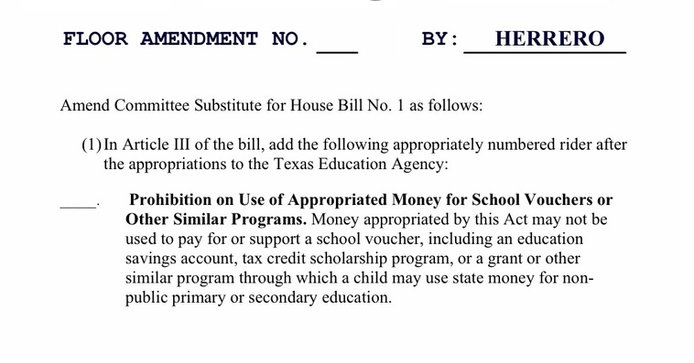
Vouchers stop and die in the Texas House of Representatives. They will vote on Thursday on an amendment to the budget bill preventing public money from funding private schools. Here it is:

Call and email your State Representative before Thursday and urge him or her to support the Herrero Amendment prohibiting private school voucher funding.

You can find their Austin office numbers here.

PTC pastor Rev. Julio Guarneri, the pastor of Calvary Baptist Church in McAllen, has written a powerful letter to his state senator. It gives us all a good, succinct script for our talking points as we contact our policymakers.

It’s our job before God to speak truth to power. God bless us all as we bear witness to God’s truth and justice this week!


Senator Hinojosa,

I hope you had a good weekend. I attempted to call you on the phone this morning but you were in a meeting and I know this is a busy week for you. I hope to still be able to talk to you over the phone but in the meantime, let me share with you what I am calling about.

I am the Lead Pastor at Calvary Baptist Church in McAllen. I am also currently serving as president of the Baptist General Convention of Texas (Texas Baptists), to whom the Christian Life Commission relates. And I am with Pastors for Texas Children as well.

I am writing you in regard to SB 8 (Education savings account/school voucher bill). As a Baptist, as a pastor, and as a religious leader, I am opposed to SB 8 for several reasons. My conviction is that church and state should be separate. A free church in a free state is our ideal. Thus, I do not believe tax dollars should be used to fund religious education. Public tax dollars should be used for public schools. Religious causes should be supported by donations from private individuals.

There are only two choices for religious schools who receive help from tax credits. They either receive oversight from the government, which violates the separation of church and state, or they receive the benefit without accountability, which is wrong.

Furthermore, this measure seems to mostly benefit middle to upper class families, leaving lower income families either without enough of a tax credit to afford a private school or with an underfunded public school system. We will do a disservice to Texas if we leave lower income families at an educational disadvantage.

I know you have historically opposed school vouchers and I am thankful for that. I respectfully ask you to hold your position. As a religious leader I believe it is the right thing.

Please do not hesitate to call me or email me.

May you have a blessed Holy Week and a Happy Easter!

For our Texas children and our Texas future,

Julio S. Guarneri, Ph.D.

Calvary Baptist Church

McAllen, Texas

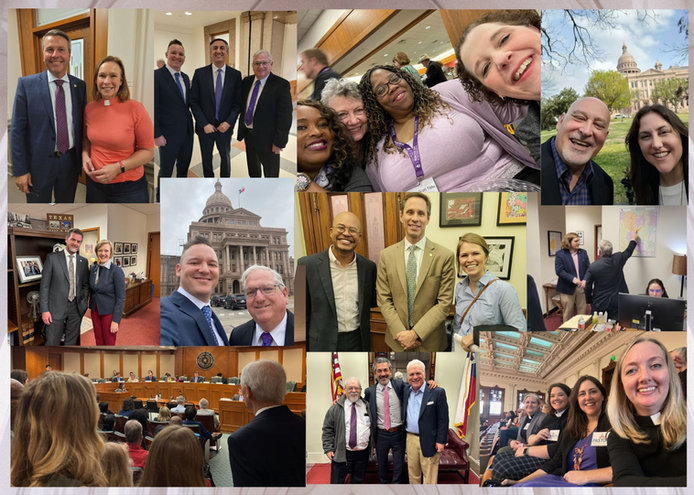
Pastors at the Capitol

DONATE TO PTC


PO Box 471155, Fort Worth, Texas, 76147

Check out our website  


The superintendents in 29 districts near Philadelphia joined to call for charter funding reform and an end to unfunded mandates.

With a new governor, state budget hearings underway and a court ruling on their side, superintendents from 29 urban school districts held press conferences Tuesday to call attention to the need for charter reform, inequities and school safety in urban schools.

Five Philadelphia-area superintendents spoke at Upper Darby High School as part of the caucus of Pennsylvania League of Urban Schools press conference, to call attention to the need for charter reform and funding inequities that are dramatically impacting children who attend urban schools.

The 29 districts teach over 300,000 students in the state.

Christopher Dormer, superintendent of Norristown Area School District and president of the PLUS caucus, said superintendents were speaking for students who have been underfunded and underserved for far too long.

Putting a face to one of those students, Dormer spoke about first grader Estefania, one of 140 students identified as an English learner. Her school has only three English language development teachers to help in 25 classrooms.

Dormer said his district has more than 1,550 English learners, a population that has grown by 104% in the past 10 years. The district has 31 professional staff members, with 50 students for each certified teacher.

Dormer said the district has been funded in an unconstitutional manner and districts like his have had to make difficult financial choices over the past 20 years. He said those choices have led to cutting staff, curtailing programs and raising local property taxes just to survive.

Dormer noted that when districts do receive funding outcomes are different. Over the past two years, his district has received $8 million in additional funding through the program Level Up.

“This has allowed us to significantly reverse the trend of cutting positions over the decade,” Dormer said. “Just these past two years we’ve added back 60 new staff positions … to reduce class size at all levels and we were able to hire reading specialists for the first time to serve our elementary schools.”

His district has seen an increase in reading proficiency thanks to the increased funding, but it is still shortchanged by $10 million a year.

Dormer also took aim at charter school funding and noted that more than 92% of the 500 school boards statewide have adopted resolutions supporting reform to Pennsylvania’s charter school law.

“If that doesn’t say bipartisan support, I don’t know what does,” Dormer said. “This isn’t about choice, this isn’t about competition, and this is about a charter funding formula that boosts the payment of cyber charter tuition and special education tuition significantly above the real costs that are incurred by charter and cyber charter schools to provide educational and specialized services.”

Unfunded mandates

Dr. Dan McGarry, Upper Darby superintendent agreed, saying forced cuts and reduction of public education, an increase in unfunded mandates along with the rise and expansion of cyber charter schools significantly altered public education in the state beginning in the mid-2000s.

McGarry said at one point districts were reimbursed by the state for the tuition cost of charter schools but that was changed. He said that the cost is over $8 million in Upper Darby to the budget and the district sends out $11 million to charter schools.

The overwhelming majority of students in Pennsylvania are enrolled in public schools, but the legislature lavishes funding on charters and Cybercharters.

Either the legislators don’t care about the future of their state or they got big campaign donations from the billionaire charter funders or Cybercharter lobbyists.

This article by three scholars—Pauline Lipman, Camika Royal, and Adrienne Dixson—closes the book on Paul Vallas’ record in education. It was published in Truthout.

Vallas’s solution for struggling schools was a corporate-style, top-down accountability system of high-stakes tests, test-prep teaching and punishment for failure — an experiment on Chicago’s Black and Brown children that set the stage for national education policy under George W. Bush. Schools that failed to meet test score targets were put on a warning list, on probation, or reconstituted by Vallas’s central office.

Counter to research consensus, based on their scores on a single test, tens of thousands of students were sent to summer school, held back a grade for as long as three years, prevented from 8th grade graduation, or assigned to remedial transition high schools where a pared-down curriculum of math, English and world studies revolved around intensive test preparation.

It was typical for schools, particularly in Black communities, to spend up to one quarter of the school year drilling for tests in reading and math. Music and art were cancelled and social studies began in May — after testing. Engaging, culturally relevant classes were turned into test prep. In some schools, Test Best and Test Ready booklets were the curriculum for weeks. CPS Office of Accountability staff told me that when Vallas left in 2001, 59 schools — mostly Black — were using mandated Direct Instruction, in which teachers read scripts and students respond with scripted answers. Not surprisingly, under this regime test scores went up. However, a 1999 National Research Council assessment expert “concluded that Chicago’s regular year and summer school curricula were so closely geared to the [standardized test] that it was impossible to distinguish real subject mastery from mastery of skills and knowledge useful for passing this particular test.”

Turning schools into test prep factories — and punishing and publicly shaming “failing” schools, students, teachers and parents in Black communities — took a toll. Some of the most dedicated and revered teachers left the system. For example, in one Black elementary school Lipman worked with, from 1997-2000, 26 of 37 teachers left, to be replaced by a succession of inexperienced teachers and interns. An award-winning teacher at the school explained that they couldn’t live with the ethical crisis of Vallas’s policies; for both teachers and students “it’s like a hammer just knocking them down.” A 2000 University of Chicago study reported nearly one-third of eighth graders retained in 1997 dropped out by fall 1999. In 2000, Parents United for Responsible Education won a civil rights complaint against CPS under Vallas for adverse discriminatory impact of the retention policy on Black and Latinx students. Expulsions, particularly of Black students, also surged, as documented in a 2001 Chicago Reporter article titled “Alternative education: Segregation or solution?”

When test scores flattened in 2001, Vallas left. But the system he set up of ranking and sorting schools based on an inappropriate use of standardized tests, and disregarding the historical disinvestment and racism schools had suffered, laid the foundation for almost 200 school closings and turn-arounds and the education market that followed. These school closings, 90 percent predominantly Black, devastated Black communities in particular. Vallas’s electoral campaign focuses on fighting crime, but the disruptions from the school closings that were a major factor in the destabilization of Black communities can be traced back to Vallas’s reign at CPS.

Please open the link and read the full article.

If Vallas should win, the students and teachers of Chicago will endure the failed policies of the past two decades.