Archives for category: Democracy

Republicans have gone stark raving mad. They are terrified that their children might read a book that will turn them gay or transgender or might make them feel bad about racism. of course, their children have access to the internet, where they can see stuff far more sensational than anything in a book.

Somebody has to be punished for the racy books in the libraries.

In Idaho, parents will be able to sue libraries and school districts if they find an inappropriate book on their shelves. The fine would be $10,000 for each time a dangerous book is accessed.

A bill that would allow parents to sue libraries and school districts for allowing books containing material considered “obscene” on their shelves is one step closer to becoming law.

The “Children’s School and Library Protection Act” passed the Idaho House on a 40-30 vote Monday afternoon.

The bill lays out a proposed definition for what it calls material that is “harmful to minors,” including material that contains description or representation of nudity, sexual conduct, sexual excitement or “sado-masochistic abuse.”

The bill also specifically mentions representations of “intimate sexual acts, normal or perverted” along with descriptions of “masturbation, excretory functions, or lewd exhibition of the genitals or genital area.”…

One legislator made a good point:

A representative from Latah County says libraries are not the main place where kids are being exposed to mature content.

“This telephone and this computer has more damage than any library is ever going to have to our children,” Lori McCann (R), representative of Legislative District Six, said.

How many of those voting went home to watch porn on their phone or computer?

The Florida legislature passed a universal voucher plan, meaning that the state will subsidize the tuition of every student, no matter their family income, Rich or poor. The state will hand out subsidies to rich families whose children go to elite private schools. All money deducted from public schools. Short-sighted and stupid, a giveaway to families who can afford private schools.

Currently, there are more than 400,000 students enrolled in private schools. About 80,000 may already have a voucher. Now, even those attending an exclusive school will be subsidized by the state. Homeschoolers will also be subsidized by the state, at least 20,000 in the fumigation year.

Most of the schools that take vouchers are religious and most are not accredited.

Likely new cost: 320,000 students already enrolled in private schools without a voucher plus 20,000 homeschooled kids x $7,800=$2.65 billion. And that’s without a single student now in public school asking for a voucher. A realistic estimate for the annual cost of Florida’s universal voucher would be at least $3 billion a year.

The Center for Budget and Policy Priotities notes that the Florida voucher funding is designed to reduce the funding of public schools, which currently enroll about 80-85% of the state’s children:

While voucher programs are often funded as line-item appropriations in state budgets or through private donations (which over time reduces the revenues available for education and other state priorities), this Florida voucher is actually designed to take money away from the state K-12 funding formula designated for public school districts.

Scott Maxwell of the Orlando Sentinel says that Florida’s universal voucher program is likely to blow a billion-dollar hole in the state budget. As I pointed out above, $1 billion is a low estimate. That hole in the budget will be closer to $3-4 billion, when you include the students whose parents can already afford to pay tuition.

He writes:

Florida lawmakers are about to take the biggest educational gamble in American history — financed with your tax dollars.

They want to offer every child in Florida the chance to use publicly funded vouchers at private schools that have virtually no regulation and offer no guarantee that the students will get educated.

Florida’s existing network of voucher schools is so infamously unchecked that the Orlando Sentinel has found schools employing teachers that don’t have high-school diplomas themselves. Some refuse to serve children with disabilities or gay parents. Others were such financial wrecks that they shut down in the middle of the school year, stranding students.

Flaw #1:

Voucher schools in Florida are unregulated. They can hire teachers who are not certified. They can hire teachers who never finished college. Voucher schools do not take state tests. They need not disclose their graduation rate or their curriculum. They are not overseen by state officials. Some voucher schools ignore safety codes, because they are not required to comply with them. The Orlando Sentinel conducted an investigation called “Schools Without Rules,” demonstrating that voucher schools take tax money without any oversight, transparency or accountability.

Flaw #2:

Voucher schools operate in secrecy. They are not required to report anything to the state.Not test scores, graduation rates, SAT scores, or anything else. Florida is operating on the principle of “Trust But Don’t Verify.” Public schools are held to tight accountability requirements. Voucher schools, none at all. If accountability is good for public schools, why is it unnecessary for voucher schools?

Flaw #3:

Voucher schools can discriminate against any group. Unlike public schools, voucher schools can discriminate on any grounds. They don’t have to accept students with disabilities, gay students, students who don’t speak English, or students from a religion they don’t like.

Flaw #4:

Legislators think that choice is the only accountability needed. If a parent is unhappy, make a different choice. The only choice that parents do not have is to stop paying their tax dollars to fund this sector.

There is another grievous flaw:

The Florida voucher program reduces funding for the schools that the overwhelming majority of students attend. Why does this make sense?

Maxwell says there are good voucher schools, and they should have no objection to accountability, transparency, and oversight. Maxwell recommends the following fixes for the state voucher program.

All voucher-eligible schools should be required to:

  1. Publish graduation rates and nationally accepted test scores.
  2. Hire teachers who are certified or at least have a college degree.
  3. Disclose all the curriculum being taught.
  4. Ban discrimination. (If discrimination is a key tenet of a religious organization’s belief system, they should fund that discrimination with their own money. Any group that receives public dollars should serve all the public.)

Maxwell does not address the two glaring defects of the voucher program:

1. 75-80% of the students who take vouchers already attend private schools. Why is it in the interest of Florida to pay their tuition?

2. About 60% of the students who switch from a public school to a voucher school will drop out within two years. The vast majority of voucher studies conclude that students lose ground academically when they take a voucher. Shouldn’t parents be warned of the risk that they are taking by accepting a voucher?

Florida is the state where freedom goes to die. The state university system intends to eliminate tenure and replace it with a five-year evaluation system. Theoretically, the review won’t include political views, but all professors will be expected to comply with state laws. Anyone who teaches courses about race, racism, gay studies, or inequality is unlikely to get a favorable evaluation because those subjects are banned by state law. Anyone who teaches or defends critical race theory is likely to be ousted.

Florida’s state university system is making major changes to long-time tenure protections, meaning that established professors would have to undergo a review every five years to determine the faculty members’ “productivity.”

However, Florida-based professors and other advocates say that the new rule, approved by the Florida Board of Governors Wednesday, could hurt academic freedom and impact a faculty members’ livelihood.

The issue of Florida’s five-year post-tenure evaluations, among other changes to the state’s universities, is getting nationwide criticism from multiple organizations, including American Association of University Professors, the American Psychological Association, Modern Language Association, and American Historical Association and a dozen others.

Faculty in other states are even voicing their opposition to Florida’s new higher education policies, such as the University of Rhode Island Faculty Senate and the Professional Staff Congress of the City University of New York.

“Over the past two years, Florida elected officials have attacked the independence and integrity of the state’s public higher education institutions…introducing a requirement for five-year post-tenure reviews, they have undermined tenure and academic freedom,” the Professional Staff Congress said in a written statement.

The American Association of University Professors explains that tenure serves as a “safeguard” for a professor’s academic freedom.

“A tenured appointment is an indefinite appointment that can be terminated only for cause or under extraordinary circumstances such as financial exigency and program discontinuation,” the AAUP explains on its website.

It continues: “When faculty members can lose their positions because of their speech, publications, or research findings, they cannot properly fulfill their core responsibilities to advance and transmit knowledge.”

But new rules adopted Wednesday by the Florida Board of Governors tasks each university board of trustees to adopt policies that evaluate tenured professors on a handful of unified goals from a statewide standpoint.

The rule adoption is due to a new law from the 2022 legislative session, which was pushed by then-Sen. Manny Diaz Jr., who added in a last-minute amendment calling for the 5-year tenure review. Then Sen. Ray Rodrigues was a co-sponsor. Diaz is now the Florida Education Commissioner. Rodrigues is the Chancellor of the university system.

Under this new rule, faculty are to be evaluated on “productivity,” “meeting the responsibilities and expectations associated with assigned duties,” and “compliance with state laws, Board of Governors’ regulations, and university regulations and policies.”

The chief academic officer of the university, often referred to as the ‘provost,’ would make the final call on a professor’s performance, according to the rule.

But the Florida higher education system has experienced an overhaul by the DeSantis administration, facing a mountain of changes that cater to Gov. Ron DeSantis’ conservative views regarding a variety of concerns, including tenure protections. That’s why some Florida professors are concerned that the state is becoming a hostile environment for current and prospective faculty.

The rule says that a professor evaluation “shall not consider or otherwise discriminate” based on a professor’s “political or ideological viewpoints,” but some are skeptical on whether that provision will be adhered to.

“The way that many of our faculty are looking at it is that this is intentionally designed from the ground up to allow bad actors to cull faculty from departments with whom they personally disagree or who have politics that are inconvenient to the institution,” Andrew Gothard, president of United Faculty of Florida, told the Phoenix.

“Or, as we’ve seen with the narrative that’s been coming out of Tallahassee, who have politics that disagree with those of the governor,” he added.

The Koch brothers funded the Republican takeover of Wisconsin in 2010 and the election of Scott Walker as governor. Walker quickly cracked down on unions and stripped them of their rights. He pushed vouchers. He attacked Wisconsin’s great public university system. Meanwhile, the Republican legislature gerrymandered the state to guarantee control of the legislature. The state is evenly divided between Republicans and Democrats, but Republicans control both houses of the legislature.

That is why many observers considered the election of a new State Supreme Court to be the most important election in the nation. After the retirement of a Republican justice, the Court was split 3-3.

A liberal—Janet Protasiewicz—ran against a conservative—Dan Kelly. The liberal won. This means that the Court will have a Democratic majority.

The two biggest issues likely to be resolved by the Court are abortion rights and gerrymandering. The new Court now has the votes to restore abortion rights that were withdrawn by the U.S. Supreme Court in the Dobbs decision. It is likely that a lawsuit will challenge the deeply unfair gerrymandering of the state, and the new majority is sure to insist on a fair reapportionment.

A great day for democracy!

The statehouse in Nashville, Tennessee, was surrounded by parents and students demonstrating in favor of gun control and against the GOP-controlled legislature’s protection of guns. The protest follows the murder of three children and three staff members at the Coventry School in Nashville.

Three Democratic members of the legislature joined the protest, chanting with the protestors.

The GOP leadership threatened to expel the Democrats. The speaker of the House absurdly claimed that the three Democrats were encouraging an insurrection.

Parents and children held signs and shouted chants during a large protest at the Tennessee capitol last week following a deadly school shooting. And while no one was arrested or injured, Republican House Speaker Cameron Sexton is comparing the demonstration to the Jan. 6 insurrection.

During the House Floor session on Thursday — days after the Covenant School shooting — Reps. Gloria Johnson, D-Knox, Justin Pearson, D-Memphis, and Justin Jones, D-Nashville, stood up and chanted with protestors in the gallery.

Pearson and other Democrats attempted to acknowledge the large group of protesters during session, but were told to stick to the subject of the bill by Speaker Cameron.

“We listened to them and helped to elevate the issue that they are demanding justice for,” said Pearson.

House Speaker Cameron Sexton said their actions were more than a breach of decorum, comparing it to the January 6th insurrection in remarks to outlets.

“Two of the members; Representative Jones and Representative Johnson, have been very vocal about Jan. 6 and Washington, D.C., about what that was,” said Sexton. “What they did today was equivalent, at least equivalent, maybe worse depending on how you look at it, to doing an insurrection in the State Capitol.”

Sexton warned that there will likely be consequences for the trio.

“It could be removal of committees; it could be censorship; it could be expulsion from the General Assembly. Anywhere in between,” said Sexton.

Leaders in the Democratic caucus are defending their colleagues. Nashville Democrat John Ray Clemmons says he believes Speaker Sexton is exaggerating.

“You show me the broken windows, you show me anyone who went into the speaker’s office and put their chair up on his desk and trashed his office, you show me where a noose was hanging anywhere on the legislative plaza,” said Clemmons, citing damage committed during the Capitol riot, which resulted in five deaths before and after the event.

The three rebellious Democrats were stripped of their committee assignments. Their member badges were deactivated. Their telephones were disconnected.

In a press conference Monday, Jones says Sexton is more focused on politics than addressing last week’s mass shooting.

“We are members, who are standing in the well, telling our speakers and our colleagues that kids should not be murdered in school,” Jones said, “and rather than address that issue, the speaker has spent more time on Twitter this weekend talking about a fake insurrection than he did about the deaths of six people including 9-year-old children.”

It is not yet clear if the lawmakers will face expulsion. Sexton has not commented on whether they will face further discipline.

A tweet:

Three Tennessee Democrats have been stripped of their committee and subcommittee assignments by the Republican dominated legislature for speaking out against gun violence in the wake of the Nashville shooting that killed three children.

Democracy is dead in Tennessee.

@Sethaweitz

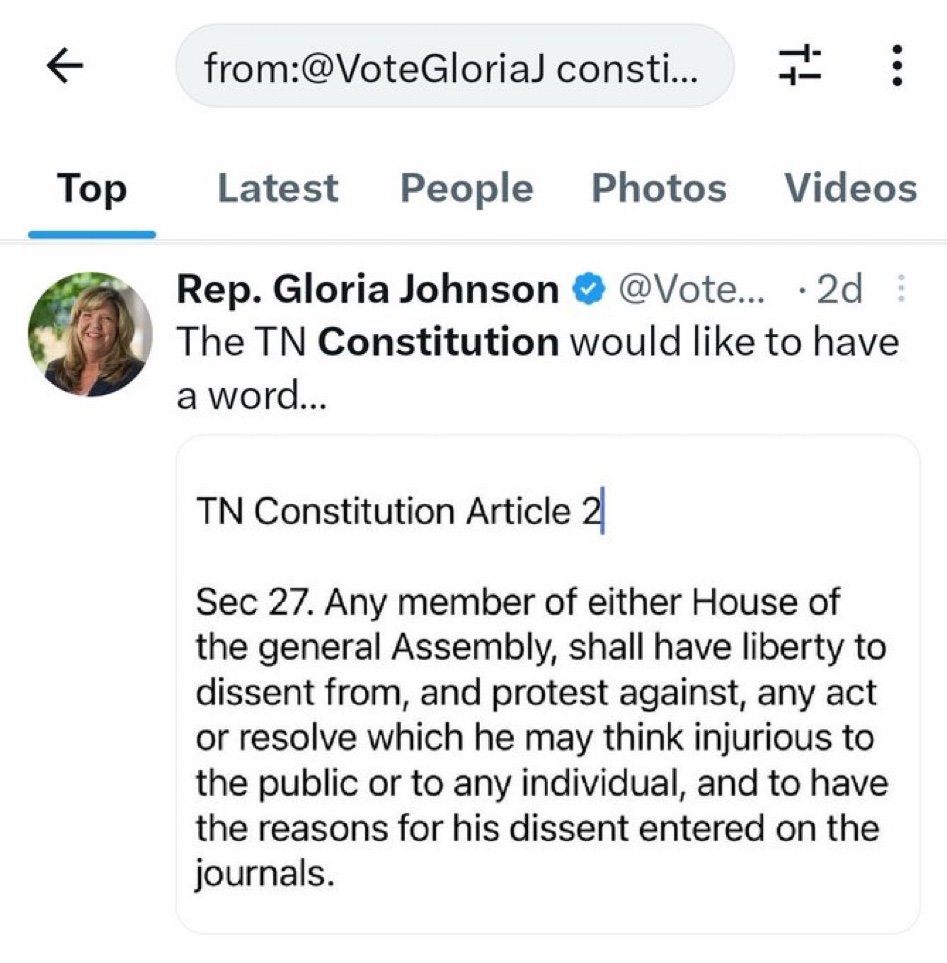
Rep. Gloria Johnson, one of the three Democrats, tweeted:

Heather Cox Richardson is a historian who writes on today’s issues with a critical lens. Here, she analyzes a very important election in Wisconsin that is key in reversing an unfairly gerrymandered state map and restoring abortion rights.

A key fight over democracy is currently taking place in Wisconsin. On April 4, voters in the state will choose a new judge for Wisconsin’s Supreme Court. That judge will determine the seven-person court’s majority, a majority that will either uphold or possibly strike down the state’s gerrymandered voting maps that are so heavily weighted toward Republicans as to make it virtually impossible for Democrats to win control of the legislature.

Political scientists judge Wisconsin to be the most gerrymandered state in the country. The state is divided pretty evenly between Democrats and Republicans, although the Democrats have won 13 of the past 16 statewide elections. But despite the state’s relatively even political split, the current district maps are so heavily tilted for Republicans that Democrats have to win the statewide vote by 12 points just to get a majority in the assembly: 50 of the 99 seats. Republicans, though, can win a majority with just 44% of the vote.

The process of changing Wisconsin into a stronghold of Republican power began in the 2010 elections, when Republicans launched Operation REDMAP to take over state legislatures before the redistricting process based on the 2010 census began. That year, the billionaire brothers Charles G. and David H. Koch pumped money into Wisconsin. Along with a strong talk radio media ecosystem, they helped to elect Governor Scott Walker to curb the power of public sector unions, which they blamed for what they considered excessive state spending.

The election of Governor Walker and a Republican legislature began the process of taking control of the state. Using granular voting data and sophisticated mapping software, the Republicans gerrymandered the state so severely that they retained control of the assembly going forward even though Democrats won significantly more votes.

As Ari Berman explained in Mother Jones, Republicans used that power to take away the bargaining rights of public sector unions in order to defund and demoralize one of the Democratic Party’s core constituencies. Berman quotes right-wing strategist Grover Norquist, who wrote that the Wisconsin policies were a national model. “If Act 10 is enacted in a dozen more states, the modern Democratic Party will cease to be a competitive power in American politics…. It’s that big a deal.” The assembly also passed at least 33 new laws during the Walker years to change election procedures and make it harder to vote.

When Democrat Tony Evers won election as governor in 2018, Democrats won all four statewide races. They also won 53% of the votes for state assembly—203,000 more votes than the Republicans did—but because of gerrymandering, the Democrats got just 36% of the seats in the legislature. The Republicans there immediately held a lame duck session and stripped powers from Evers and Democratic attorney general Josh Kaul. Then they passed new laws to restrict voting rights. The legislature went on to block Evers’s appointees and block his legislative priorities, like healthcare, schools, and roads.

Polls showed that voters opposed the lame duck session by a margin of almost 2 to 1, and by 2020, 82% of Wisconsin voters had passed referenda calling for fair district maps.

But when it came time to redistrict after the 2020 census, the Republican-dominated legislature carved up the state into an even more pro-Republican map than it had put into place before. Ultimately, the new maps gave Republicans 63 out of 99 seats in the assembly and 22 out of 23 in the state senate. They came within two assembly seats of having a supermajority that would enable them to override any vetoes by the governor, essentially nullifying him, although Evers had been reelected by 53.5% of the vote (a large margin for Wisconsin).

With gerrymandered districts virtually guaranteeing their reelection, Republicans are insulated from popular opinion. In the 2021–2022 session, they ignored the governor, refusing to confirm Evers’s appointees and going nearly 300 days without passing a single bill. They also ignored popular measures, refusing to let 98% of Democratic bills even be heard and refusing to address gun safety issues—although 81% of Wisconsinites wanted background checks for gun sales—or abortion rights, even though 83% of Wisconsin residents wanted at least some abortion rights protected after the Supreme Court’s overturning of Roe v. Wade last June put back into effect a law from 1849.

This radicalized Wisconsin assembly also mattered nationally when it became a centerpiece of Trump’s attempt to overturn the 2020 presidential election. Nearly 75% of the Republicans in it worked to cast doubt on that election. After an audit turned up “absolutely no evidence of election fraud”—according to a Wisconsin judge—they tried to take control of elections away from a bipartisan commission and turn it over to the legislature they control. Senator Ron Johnson led the effort, calling for Republicans to take control of the elections because, he said, Democrats can’t be expected to “follow the rules.” In the 2022 election, the Trump-endorsed Republican candidate for governor, Tim Michels, promised, “Republicans will never lose another election in Wisconsin after I’m elected governor.”

Their effort failed only because they fell two seats shy of the supermajority they needed.

By shaping the state maps and limiting the power of Democratic constituencies, Republicans have also taken control of the state supreme court, which sides with the Republican lawmakers’ attempts to cement their own power. Now voters have the chance to shift the makeup of that court. Doing so would make it possible that new challenges to the gerrymandered maps would succeed, returning fairness to the electoral system.

Wisconsin journalist Dan Shafer, who writes The Recombobulation Area, is following the race closely. His coverage reveals how the candidates’ framing of the election mirrors a larger debate about democracy. Theoretically, the election is nonpartisan, but Republicans paid former state supreme court justice Dan Kelly $120,000 to consult on Trump’s false elector scheme to overturn the 2020 presidential election, and he was on the payroll of the Republican National Committee until last December. In 2012 he defended the Republicans’ gerrymandered maps in court.

For her part, Milwaukee County judge Janet Protasiewicz has made it clear she opposes the gerrymandered maps. “Let’s be clear here: The maps are rigged. Absolutely positively rigged,” she said in a candidates’ forum in January. “They do not reflect the people in the state. They do not reflect accurate representation, either in the State Assembly or the State Senate. They are rigged, period. I don’t think it would sell to any reasonable person that the maps are fair.”

Shafer notes that supreme court terms are for ten years, so if the court does not shift in this election, it, along with the gerrymandered maps, will remain in place “for the foreseeable future.” The race ultimately comes down to checks and balances, he says. The court has not checked the legislature, which has entrenched one-party rule in Wisconsin.

“This isn’t to say the maps should be redrawn to instead benefit Democrats,” Shafer continues. “Far from it. It’s about fairness. Some years Democrats will win a majority, other years Republicans will win a majority. If one party isn’t doing their job, voters should be able to do something about it. It’s about crafting a system that reflects the people of Wisconsin and can be responsive to the state’s voters. We don’t have that right now. And that has to be the goal.”

Notes:

The Recombobulation Area

Wisconsin is the most gerrymandered state in the country. The race for Wisconsin Supreme Court could change that. 

The Recombobulation Area is a six-time TEN-TIME Milwaukee Press Club award-winning weekly opinion column and online publication written and published by veteran Milwaukee journalist Dan Shafer. Learn more about it here…

Read more

12 days ago · 13 likes · Dan Shafer

The Recombobulation Area

The race for Wisconsin Supreme Court kicks into gear at WisPolitics forum

The Recombobulation Area is a six-time Milwaukee Press Club award-winning weekly opinion column and online publication written and published by veteran Milwaukee journalist Dan Shafer. Learn more about it here…

Read more

3 months ago · 5 likes · 3 comments · Dan Shafer

ShareLIKECOMMENTSHARE

Read Letters from an American in the app

Listen to posts, join subscriber chats, and never miss an update from Heather Cox Richardson.

Get the iOS app
Get the Android app

© 2023 Heather Cox Richardson
548 Market Street PMB 72296, San Francisco, CA 94104 
Unsubscribe

Start writing

Virginia Governor Glen Youngkin sends his own children to an elite private school that never bans books and teaches critical race theory, But the governor ran on a platform of “parental rights,” which has unleashed censorship and book banning in the state’s public schools.

The schools of Spotsylvania have posted a list of 14 books that will be withdrawn to protect children from ideas their parents don’t like. Among the 14 are two by Nobel-prize winning author Toni Morrison.

The books were challenged for having “sexually explicit material” in them, according to a message to families from superintendent Mark Taylor.

The superintendent of Spotsylvania public schools has no prior experience in education. His appointment was made after hard-right conservatives won control of the school board. Aside from his lack of experience, Mark Taylor was controversial because of incendiary comments he made on social media. “They allegedly include memes mocking trans people and school shootings, racist innuendos and calls for parents to pull their children out of public schools.”

By the end of the week, the school district will remove:

All Boys Aren’t Blue” by George M. Johnson

Like a Love Story” by Abdi Nazemian

“Dime” and “America” by E.R. Frank

Sold” by Patricia McCormick

Out of Darkness” by Ashley Hope Perez

Beloved” and “The Bluest Eye” by Toni Morrison

Looking for Alaska” by John Green

The Perks of Being a Wallflower” by Stephen Chbosky

“Water for Elephants” by Sara Gruen

“Neanderthal Opens the Door to the Universe” by Preston Norton

More Happy Than Not” by Adam Silvera

“Nineteen Minutes” by Jodi PicoultSpotsylvania superintendent floats elimination of all school libraries

In a statement, Taylor pointed to a Virginia lawthat requires school districts to establish parental notification policies for instructional materials with sexually explicit materials, saying the 14 books fall under that category.

Taylor added that the division doesn’t have the resources to review whether the roughly 390,000 books in all school libraries have similar materials, so purging the 14 books from the shelves would be the only way to ensure they aren’t accessible….

Taylor noted in his message to families that the decision won’t stop teachers from including the pulled books in classroom assignments, which would have to be shared with parents under the law. According to the district, the books will be stored until they are donated.

What teacher will be brave enough or foolish enough to assign a banned book?

While traveling in the Midwest, I visited Illinois State University, which has an excellent teacher education program. A leader of that program recently wrote me while in a state of distress. One of her best students, she said, was just fired by her district. Why? One parent objected to a book in her classroom.

Who will want to teach when teachers’ lives and reputations can be jeopardized by one angry parent? Maybe that is the point: Demonize public schools and their teachers to build support for vouchers, where uncertified teachers are hired and the Bible is the beginning and end of all knowledge.

Here is an excerpt from the letter I received:

Tonight, I’m writing to you to share the story of the most amazing teacher I have ever worked with in my nearly 25 years in education–except she is no longer a teacher as of last Thursday. I know you have committed your career to fighting injustices like hers, so it is my hope that you might amplify her story in the fight against misinformation and teacher defamation.

As a teacher educator at Illinois State University, I met Sarah Bonner 10 years ago when she was in my action research capstone class as the final requirement for her master’s degree. During the year I worked with her, I was struck by her approach to education, and I encouraged her to continue working toward a doctorate degree. Since that time, I have had the opportunity to work closely with her, co-designing a framework that paired literature and inquiry as a way to expand 8th grade students’ in rural Illinois worldviews; co-teaching alongside her to maintain my connection to the classroom and to continue to evolve our work; guiding her in her dissertation work where she connected with teachers who were interested in transforming their own teaching; watching her mentor emerging, new, and experienced teachers; and witnessing the blossoming of students under her guidance–especially those who are often marginalized in largely conservative, small schools. I can honestly say that I have never had the opportunity to work with a more compassionate, innovative, and thought-provoking teacher. She’s by far a better teacher than I was when I was still in the middle school classroom, and working alongside her has pushed me to be an even better teacher educator than I was before.

For this reason, I cannot begin to describe the devastation that I experienced when I learned less than two weeks ago that not only was she being attacked by our local conservative “news” station, but that her district advised that she seek union representation to represent her while they investigated the story. She received this news on Wednesday, March 15. By Friday March 17 she learned that she was being put on paid leave the next week so they could investigate–and they hadn’t even talked with her yet.

What was the story? As a part of a book tasting day, Sarah consulted NCTE, ALA, and Good Reads to find award-winning and notable books that would reflect her students’ interests–and checked out nearly 100 books from the public library. One of those books was Juno Dawson’s “This Book Is Gay.” A student picked up the book, a sex education book for LGBTQ+ youth, snapped some pictures of its pages, and sent those pages home. Rather than approaching Sarah with questions or concerns, this child’s parents alerted the media outlet, and a witch-hunt began.

Suddenly, the wild and false allegations began: Sarah was requiring this book; the book was a regular part of her classroom library; she was sharing pornography with children; she was grooming children. And then, they went to her class website, which shared a link to Common Sense Media’s Netflix Documentary page, which so happened to feature Moneyshot, and now she was encouraging students to watch and learn about porn. Ironically, this film hadn’t even been released when she was last in the classroom. The story just kept growing until this award-winning teacher realized that she could not go back to that community again. And so, by this past Thursday, she had officially resigned. In just over a week, a teacher’s reputation, livelihood, and life was completely upended.

Sarah is fortunate brcause she’s got the deep knowledge and experience to bounce back and counter the current narrative. Unfortunately, this kind of experience is not unique, and too often teachers who aren’t equipped to handle it take huge hits. It’s impacting their mental health, their careers, their entire livelihoods. We have a narrative around a teacher shortage. We don’t have a teacher shortage—we have a shortage of respect and support for teachers. And we live in Illinois, a liberal state that requires LGBTQ+ history and contributions to be taught by 8th grade. Too many people are watching the antics happening in states like Florida and thinking those are outliers. They are not. Sarah is an award-winning teacher. She is a leader in and on the executive board of the National Council Teachers of English. And yet, she will no longer impact the lives of so many students.

Democracy is in peril as we continue to bow to pressures to restrict the books students can read. We cannot normalize allowing a few loud voices’ the power to destroy careers and lives. I have attached the statement she wrote and read to her board upon her resignation.

Here is Sarah Bonner’s statement to her school board:

Thank you to the Heyworth Board and Administrative team for allowing me to speak this evening. If you know anything about me as a professional, you know that this is not the way I would have chosen to be here tonight. Twenty years ago when I was given the keys to my very first classroom, I knew teaching was my calling. And, while I’ve taught in previous school districts over the years, Heyworth was the place that allowed me to become the professional I was meant to be.

Throughout my time here, I earned both my Masters and Doctorate degrees with the help of district tuition waivers. I became the National Council of Teachers of English (or NCTE) Media Literacy Teacher of the Year in 2018 along with the national Outstanding Middle Level Educator award the following year. I wrote and published a book through Teachers College Press to further the teaching field. Additionally, I hosted and supported numerous future teachers from Illinois State University as they began their journey into the classroom. Lastly – most importantly – I had the opportunity to connect with the best kids I’ve ever worked with in my career.


Our community – or even our nation – may never know the gravity of what teachers bear on a regular basis. For me, I not only worked tirelessly on designing and cultivating meaningful learning experiences for my students, but I also worked hard to maintain healthy relationships with students and families, upheld weekly and transparent communication among all shareholders, contributed regularly to the junior high teacher team, worked a second teaching job at Illinois State University to better support my family, served as the Middle Level Section Steering Committee Chairperson for NCTE, wrote a doctoral dissertation, published a book for teachers, along with being a partner, a mother, and a human wrestling with being newly diagnosed with multiple sclerosis.

With all of this weighing heavily on my plate, I depended on national communities like the American Library Association and NCTE as well as reading communities like Goodreads to help generate texts that engage all readers with a vast collection of interests. The activity my students and I participated in last week was made up of close to 100 different books recommended from these spaces. Given the nature of the lesson compressed with a heavy list of responsibilities, vetting each and every single text for explicit details was impossible. Should the book in question be available to students? Yes. However, should this specific book have been a part of the 100 choices during this class activity? No. Simply put, the title was on the ALA Rainbow Reading Awardee list and I picked it along with a few others because I knew students in my class had interests. To make students, families, community members feel unsafe was never the intention of my decision making.

While I’m saddened by how the events have played out over the last week, there’s a piece of me that isn’t surprised. Being an innovator in teaching means that boundaries, perspectives, and ideas need to be pushed. When I realized years ago that our kids who would receive these amazing scholarships to these Big 10 schools were coming back the following year because they couldn’t adjust to life outside of a rural small town, I knew I needed to do something. I knew I needed to disrupt traditional learning practices to embody the needs of today’s world. Our kids deserve learning experiences that prepare them for our world and not just our town. However, being a changemaker often comes with a cost…especially if you’re one of the only ones willing to take risks and think differently.


London’s favorite soccer coach, Ted Lasso – the man who makes us all believe in the power of believe – said it best ”You know, people have underestimated me my entire life. And for years, I never understood why. It used to really bother me. But then one day, I saw this quote by Walt Whitman. It said, “Be curious, not judgmental.” All of a sudden it hits me. Of all those that used to belittle me, not a single one of them was curious. They thought they had everything all figured out. So they judged everything, and they judged everyone. And I realized that their underestimating me… who I was had nothing to do with it. ‘Cause if they were curious, they would’ve asked questions.”
As I leave here tonight, I hope you will remember a few things:

  1. Sometimes things need to break in order to rebuild it stronger. Encourage
    curiosity. As you enter a space of healing, I hope the district and Heyworth community can find a place to listen and understand that you all want the best for our kids. Our teachers especially deserve to be heard and questioned in responsible ways.
  2. Remember to support your teachers moving forward. If I were them at this point, I would feel scared, unsafe, and paralyzed knowing that I could be next. Our teacher community needs reassurance that innovation is still supported and protected as time moves on.
  3. And, remember the good I brought to our kids and community by taking innovative risks in Language Arts. While I’ve been here, I have witnessed students stand up for other students with disabilities, fight against racism, organize trash clean ups, create documentaries that tell the untold stories of their community, advocate for safe spaces, strengthen their own beliefs, shape their own personal identities, and critically think about the world around them. With the work I’ve been able to do with students, I’m reminded on a daily basis that our kids will be the hope our future needs.

The Heyworth school district has lost a teacher who is dedicated to their children and her profession.

The New York Times published an article about a tenured professor at the University of Pennsylvania Law School, Amy Wax, who has frequently made statements that are racist, homophobic, sexist, xenophobic, the whole range of prejudices, not what you expect of someone who supposedly teaches students that everyone is equal in the eyes of the law.

Amy Wax, a law professor, has said publicly that “on average, Blacks have lower cognitive ability than whites,” that the country is “better off with fewer Asians” as long as they tend to vote for Democrats, and that non-Western people feel a “tremendous amount of resentment and shame.”

At the University of Pennsylvania, where she has tenure, she invited a white nationalist to speak to her class. And a Black law student who had attended UPenn and Yale said that the professor told her she “had only become a double Ivy ‘because of affirmative action,’” according to the administration.

Professor Wax has denied saying anything belittling or racist to students, and her supporters see her as a truth teller about affirmative action, immigration and race. They agree with her argument that she is the target of censorship and “wokeism” because of her conservative views.

All of which poses a conundrum for the University of Pennsylvania: Should it fire Amy Wax?

The university is now moving closer to answering just that question. After long resisting the call of students, the dean of the law school, Theodore W. Ruger, has taken a rare step: He has filed a complaint and requested a faculty hearing to consider imposing a “major sanction” on the professor…

For years, Mr. Ruger wrote in his 12-page complaint, Professor Wax has shown “callous and flagrant disregard” for students, faculty and staff, subjecting them to “intentional and incessant racist, sexist, xenophobic and homophobic actions and statements.”

The complaint said she has violated the university’s nondiscrimination policies and “standards of professional competence.”

The article goes on to cite the many times that Professor Wax has offended women, Blacks, gays, foreign students, or anyone else who does not agree with her idyllic view of the culture of the 1950s. Implicitly she means an era when Blacks were subservient, women were compliant wives, gays were in the closet, and foreigners were tourists.

What should the university do?

…many free speech groups, including the Academic Freedom Alliance, PEN America and the Foundation for Individual Rights and Expression, have criticized the dean and said that Professor Wax should not be fired because of her public statements.

My view: She should not be fired. Perhaps she should be admonished for behavior that is insulting to students, but her academic freedom and tenure protect her job.

Academic freedom protects not just the views that one likes, not just the views of the majority, but the views you hate. I might wish that Professor Wax were open-minded and wish that she had a keener sense of humanity, but I defend her right to be offensive, inconsiderate, and obnoxious. Students are not required to take her courses. Those who take her courses should challenge her views if they disagree.

But academic freedom must prevail.

Voltaire: “I may not agree with what you have to say, but I will defend to the death your right to say it.”

Julie Vassilatos, a parent activist and blogger in Chicago, writes here about the case for Brandon Johnson. She and others have written passionately against Paul Vallas, but here she explains why Brandon Johnson is well prepared to serve as Mayor. Because of his knowledge and experience, he not only knows the city’s budgetary issues well, but he is able to address the root causes of crime and the real needs of students.

She writes:

Friends, so many of us have been carrying on about the dangers of Paul Vallas so incessantly, you’d be forgiven for thinking that he’s running for mayor of Chicago unopposed.

But Vallas does have an opponent—one who is talented, thoughtful, experienced, and a real true Chicagoan raising his family on the west side: Brandon Johnson.

Johnson is getting a lot of heat from Vallas and his supporters right now. No lesser a personage than Darren Bailey, defeated far-right candidate for IL governor and unofficial endorser of Vallas, has announced that if Johnson is elected, it will be a “dark day” for Chicago. Yes. A dark day indeed. Get it?

I’m pretty sure Darren Bailey fans get it.

Then there’s FOP president/disgraced cop John Catanzara, who foresees that 1000 cops will walk off the job if Johnson wins, and there will be blood in the streets.

Vallas himself, who routinely speaks of Johnson in kind of Godzilla terms, has called him and the CTU a destructive force wreaking devastation on the city.

In addition to its coded race language, this election has rather inflated rhetoric.

I’m trying to keep mine toned down, or at least backed up by evidence. While it’s hard to pin “generational” devastation on Johnson or the CTU, it’s actually possible to do this for Vallas. He has set many destructive policies in motion in urban areas globally that have left decades of harm in their wake. Also financial calamity. But I and many others have told you all this over and over again. And this post is not about that guy.

This post is about Brandon Johnson.


Truth to tell, at the outset of the race I was slow to warm up to Johnson the candidate. But then I remembered that he was at the front lines of a struggle I will never forget—the 2013 mass school closures. So many folks did all we could do to try and stop that, well, generationally damaging policy. And those who led the way in that effort? I’d probably follow them into a fire.

But what about Brandon Johnson now? What are his credentials? Haven’t you, like me, read all that stuff about how he has no experience? How he’s never managed a budget? How he seems (unfathomably) to like crime and together with CTU wants our city to be unsafe, because….because….well, because reasons?

Well, maybe we need to look a little deeper than the media/social media blah blah blah.

In a recent mayoral forum Vallas asserted that “Brandon has run nothing.” Since Vallas hasn’t really lived here much I guess he may not know that Johnson has served on the Cook County Board of Commissioners since 2018 and has managed a great deal, including the $8.75B Cook County budget. The Cook County Board has wide ranging responsibilities, and if you’ve always wondered but never known what the Board does, you should take this time to educate yourself, starting at the Cook County Board website. Here’s a basic summary:

The Cook County Board of Commissioners oversees County operations and approves the budget of elected County officials including the Assessor, Board of Review Commissioners, County Clerk, Clerk of the Circuit Court, Recorder of Deeds, Sheriff, States Attorney and Treasurer.

The Commissioners also serve as the Board of the Cook County Forest Preserve District, a special purpose taxing district. The Board also sets policy, levies taxes, passes ordinances, approves all county purchases over $10,000, and adopts the annual budget for the entire county government.

That 2023 Cook County Budget was praised by the Civic Federation:

The Civic Federation supports the Cook County FY2023 Executive Budget Recommendation of $8.75 billion because it reflects strong financial management and puts the County in a good position moving forward post-pandemic. The County’s FY2023 proposed budget includes a strong level of reserves and positive revenue projections, without any increases in taxes or fees.

The budget gap is smaller than it’s been in years, supplemental payments to the pension fund have been made for the eighth year in a row, and the County’s fiscal position is “strong…following robust revenue performance and built-up reserves.” And observe that there are in this budget, no tax increases. (Here I note we can be grateful to Board President Toni Preckwinkle who has shepherded this budget for 13 years. And I note further, she has endorsed Johnson.)

Now let’s review the budgets Vallas has overseen.

In Philadelphia, Vallas managed a $2B budget and left a surprise $73M deficit on his way out the door. In the Louisiana Recovery District his budget was $176M. He got an extra $1.8B to work with from FEMA, and before he was done with the NOLA job he wandered repeatedly over to Haiti, missing weeks at a time of work in New Orleans (that’s beside the point, but I just thought you should know). And in Bridgeport CT, his budget was $232M. Of course he was pushed out of that job before he could really do much financial damage there.

For those of you keeping score, Vallas hasn’t ever drafted, managed, or implemented a budget even close to the size that Brandon Johnson has worked with as a member of the Cook County Board.

Before his County Board days, Johnson was a teacher. He taught middle school social studies at Jenner from 2007 to 2010 (years when most of his students were able to watch, right from school windows, wrecking balls demolishing their homes as the city brought down public housing), and then at Westinghouse for a year. He then became a CTU organizer and the leader of its Black Caucus. In those years he had a front row view on lots of turmoil in the district: school closures and turnarounds via the failed Renaissance 2010 initiative, the loss of Black teachers in the classroom as a result of closures and CPS policy choices, the 2012 teacher strike, the 2013 mass school closures, a churn of district CEOs, some of whom ended up in prison, illegal special education cuts, and rapid charter expansion.

While Johnson was organizing teachers and collaborating with parents in response to district policies that were crushing schools and services (and I do mean that literally, with at least one occasion of bulldozers bringing down a school library on a day when parents were instead expecting a meeting), he lived the experience of the folks who’ve been at the mercy of “education reform” for decades. He saw first hand what disinvestment has done to CPS students—resulting in teacher cuts, special ed cuts, after-school cuts, nursing cuts, and the whittling away of libraries, down to only 90 remaining in a total of 513 schools. He’s seen the violent legacy of closing the community anchor that is a public school. He’s watched, along with all of us, poor choices at the top—everything from grifting, self-dealing, and bribery, to no-bid contracts and cronyism—and how those things bust budgets and destroy trust. He stood with community members on a hunger strike to save a school, then joined in it himself. He’s seen the negative academic and social impacts of excessive testing, privatization, and vouchers. He’s seen these things from the perspective of 25,000 teachers and hundreds of thousands of public school families.

Vallas, meanwhile, has been the man who set those policies. He set them in motion right here in Chicago in 1995, and traveled the country and globe continuing to implement them from then until now.

He may talk a good game about Doing It All For The Children, but the fact of the matter is, Vallas has never had to stick around and watch the long term impacts of his policy decisions on The Children. Those impacts have caused years of student protests in Chile. Have kept special ed kids struggling for spots in schools in New Orleans. Have left Philadelphia in “constant crisis mode.” Led directly to our own CPS budget crisis.

Brandon Johnson has large scale urban management experience with a Board that’s closing budget gaps and overseeing a vast array of county services. He manages a bigger budget right now than Vallas ever has. And Johnson has face-to-face, personal experience with the folks who live and work and raise their children in Chicago. His years as a teacher and with CTU have given him the perspective of individuals and families on a hyper-local basis. His work has encompassed both the broad span of countywide planning and management, and the particular lens on particular people and particular struggles.

Brandon Johnson is obviously qualified for the job.

You can check out how his qualifications and vision work themselves into a platform on his website. It’s practical and passionate and outlines a vision for the city that benefits everyone, even those struggling folks who never seem to catch a break from city leaders.

Johnson understands we cannot solve violence without dealing with its root causes; more policing, surveilling, and arresting alone won’t do the trick. We can’t fix the schools without listening to communities, parents, and educators; we must reject the failed status quo of Vallas’s “education reform.” And we can’t expect our teachers and police to solve poverty and homelessness all on their own.

The choice we have before us, it seems to me, is whether we’re going to listen to the incessant hype about a “fix-it man”—who has never fixed anything. Or dig a little deeper ourselves and see that the mayor we need has been here all along, working to make our city better for his entire career, with poise and passion.

Are we going to listen to voices that allude to “dark days” and blood baths in the streets? Or are we going to listen to a man who has a vision for his city rooted in love and practical experience?

You pick, Chicago.