Archives for category: Parent Groups

If you read one article today, make it this one.

Kathryn Joyce is an outstanding journalist who has written several excellent articles about the far-right conspiracy to destroy public education. In this important article, published by both the Hechinger Report and Vanity Fair, she examines the rightwing takeover of public schools in Sarasota, Florida, by the extremist Moms for Liberty and their hero Governor DeSantis.

Joyce begins:

SARASOTA COUNTY, Fla. — On a Sunday afternoon in late May 2022, Zander Moricz, then class president of Sarasota County’s Pine View School, spent the moments before his graduation speech sitting outside the auditorium, on the phone with his lawyers. Over the previous month, the question of what he’d say when he stepped to the podium had become national news. That March, Florida Governor Ron DeSantis had signed the Parental Rights in Education Act, quickly dubbed the “Don’t Say Gay” law for its ban on all mention of gender identity and sexuality in K–3 classrooms and restriction of those discussions in higher grades as well. Moricz, a student LGBTQ+ activist, had led several protests against the act that spring and joined a high-profile lawsuit against the state. In early May, he charged on Twitter that Pine View’s administration had warned that if he mentioned his activism or the lawsuit at graduation, his microphone would be cut. (In a statement released last year, the school district confirmed that students are told not to express political views in their speeches.)

In the tumultuous weeks leading up to the ceremony, Pine View — Sarasota’s “gifted” magnet institution, consistently ranked one of the top 25 public high schools in the country — was besieged with angry calls and news coverage. Moricz stayed home for three weeks, he said, thanks to the rvolume of death threats he received, and people showed up at his parents’ work. When a rumor started that Pine View’s principal would have to wear a bulletproof vest to graduation, he recalled, “the entire campus lost their minds,” thinking “everyone’s going to die” and warning relatives not to come. His parents worried he’d be killed.

But after all the controversy, graduation day was a success. Moricz, now 19, delivered a pointedly coded speech about the travails of being born with curly hair in Florida’s humid climate: how he worried about the “thousands of curly-haired kids who are going to be forced to speak like this” — like he was, in code — “for their entire lives as students.” Videos of the speech went viral. Donations poured into Moricz’s youth-led nonprofit. That summer, he left to study government at Harvard.

Half-a-year later though, when Moricz came home, Sarasota felt darker.

“I’m wearing this hat for a reason,” he said when we met for coffee in a strip mall near his alma mater in early March. “Two years ago, if I was bullied due to my queerness, the school would have rallied around me and shut it down. If it happened today, I believe everyone would act like it wasn’t happening.”

These days, he said, queer kids sit in the back of class and don’t tell teachers they’re being harassed. A student at Pine View was told, Moricz said, that he couldn’t finish his senior thesis researching other states’ copycat “Don’t Say Gay” laws. (The school did not respond to a request for comment through a district spokesperson.) When Moricz’s nonprofit found a building to house a new youth LGBTQ+ center — since schools were emphatically no longer safe spaces — they budgeted for bulletproof glass.

“The culture of fear that’s being created is doing exactly what it’s supposed to do,” he said. And much of it was thanks to the Sarasota County School Board.

Over the last two years, education culture wars have become the engine of Republican politics nationwide, with DeSantis’s Florida serving as the vanguard of the movement. But within the state, Sarasota is more central still.

Its school board chair, Bridget Ziegler, cofounded the conservative activist group Moms for Liberty and helped lay the groundwork for “Don’t Say Gay.” After a uniquely ugly school board race last summer, conservatives flipped the board and promptly forced out the district’s popular superintendent. In early January, when DeSantis appointed a series of right-wing activists to transform Florida’s progressive New College into a “Hillsdale of the South” — emulating the private Christian college in Michigan that has become a trendsetting force on the right — that was in Sarasota too. In February, DeSantis sat alongside Ziegler’s husband and Moms for Liberty’s other cofounders to announce a list of 14 school board members he intends to help oust in 2024—Sarasota’s sole remaining Democrat and LGBTQ+ board member, Tom Edwards, among them. The next month, Ziegler proposed that the board hire a newly created education consultancy group with ties to Hillsdale College for what she later called a “‘WOKE’ Audit.” (Ziegler did not respond to interview requests for this article.)

The dizzying number of attacks has led to staffing and hiring challenges, the cancelation of a class, a budding exodus of liberals from the county, and fears that destroying public education is the ultimate endgame. In January, Ziegler’s husband, Christian — who chairs the Florida Republican Party — tweeted a celebratory declaration: “SARASOTA IS GROUND ZERO FOR CONSERVATIVE EDUCATION.”

It wasn’t hyperbole, said Moricz. “We say that Sarasota is Florida’s underground lab, and we’re its non-consenting lab rats.”

For as long as Florida has been grading schools and school districts — a late 1990s innovation that helped spark the “school reform” movement — Sarasota, with its 62 schools and nearly 43,000 students, has enjoyed an “A” rating. Perched on the Gulf Coast just south of Tampa, the county’s mix of powder-soft beaches and high-culture amenities — including an opera house, ballet and museums — have made it a destination for vacationers and retirees. And that influx has made Sarasota one of the richest counties in the state.

Since many of those retirees, dating back to the 1950s, have been white Midwestern transplants, it’s also made Sarasota a Republican stronghold and top fundraising destination for would-be presidential candidates. Both the last and current chairs of the state GOP — first State Senator Joe Gruters and now Christian Ziegler — live in the county. Sarasota arguably launched Donald Trump’s first presidential campaign, thanks to Gruters’s early support. These days, though, Sarasota isn’t just conservative, but at the leading edge of Florida’s turn to the hard right.

Partly that’s thanks to the Zieglers, who have become one of Florida’s premier power couples, with close ties to both Trump world and the DeSantis administration and a trio of daughters enrolled in local private schools. As founder of the digital marketing company Microtargeted Media, Christian did hundreds of thousands of dollars of work for pro-Trump PACs in 2021, the Sarasota Herald-Tribune reported. After being elected state GOP chair this February, he announced his goal was “to crush these leftist in-state Democrats” so thoroughly that “no Democrat considers running for office.” Although Bridget stepped down from Moms for Liberty shortly after its founding, she subsequently helped draftFlorida’s Parents’ Bill of Rights, which helped pave the way for DeSantis’s 2021 ban on mask mandates and ultimately last year’s “Don’t Say Gay” law. In 2022, the right-wing Leadership Institute hired her as director of school board programs, and built a 6,000-square-foot headquarters in Sarasota to serve as a national hub for conservative education activism. This winter, DeSantis also appointed her to a new board designed to punish the Disney Company for criticizing his anti-LGBTQ laws….

Last year, when Ziegler was up for reelection and two other board members were terming out, she ran as a unified slate with former school resource officer Tim Enos and retired district employee Robyn Marinelli. The candidates drew support from both DeSantis’s administration — which unprecedentedly endorseddozens of school board candidates across the state — and local members of the far-right. A PAC partially funded by The Hollow’s owner campaigned for the “ZEM” slate (a shorthand for the candidates’ surnames) by driving a mobile billboard around the county, calling one of their opponents a “LIAR” and “BABY KILLER” because she’d once worked for Planned Parenthood. Proud Boys hoisted ZEM signs on county streets and a mailer was sent out, castigating the liberal candidates as “BLM/PSL [Party of Socialism and Liberation]/ANTIFA RIOTERS, PLANNED PARENTHOOD BABY KILLERS, [who] WANT GROOMING AND PORNOGRAPHY IN OUR SCHOOLS.” (Enos and Marinelli did not respond to requests for comment for this article.)

Open the link and read all of the article. It is a devastating article about the takeover of the school board by hateful extremists whose tools are fear and divisiveness.

The respected Southern Poverty Law Center (SPLC) designated “Moms for Liberty” as an extremist group, along with a number of other astroturf anti-government organizations that popped up during the pandemic to protest masks and vaccines.

In its annual report on hate groups, SPLC named Moms for Liberty and 11 other “parent”groups as extremists who feed on racism, misogyny, homophobia, and bigotry:

Moms for Liberty joins the ranks of groups including the Oath Keepers, the Three Percenters and the United Constitutional Patriots, a self-styled militia that “patrols” the U.S.-Mexico border.

Other astroturf “parent” groups were identified as extremist by SPLC:

The 12 “parent’s rights” groups labeled by the SPLC as extremist groups: Moms for Liberty; Moms for America; Army of Parents; Courage is a Habit; Education First Alliance; Education Veritas; No Left Turn in Education; Parents Against CRT (PACT); Parents Defending Education; Parents Rights in Education; Purple for Parents Indiana and Parents Involved in Education.

Will Carless wrote in USA Today that Moms for Liberty “pitched itself as a potent grassroots movement of outraged parents, many of whom weren’t active in school politics until COVID-19 restrictions forced them to pay attention. It has sprouted local chapters in at least 40 states, claims more than 100,000 members and has the ear of the Republican establishment: Florida Gov. Ron DeSantis has championed their efforts to restrict teaching about race in schools and universities. Critics in Florida slam the group for turning schools into a political battlefield.”

Both DeSantis and Trump will address the annual conference of this two-year-old organization of hate-mongers.

Moms for Liberty and the other organizations are being designated as “anti-government extremist groups,” based on longstanding criteria, explained SPLC Intelligence Project Director Susan Corke. Corke said the grassroots conservative groups are part of a new front in the battle against inclusivity in schools, though they are drawing from ideas rooted in age-old white supremacy.

“[The movement] is primarily aimed at not wanting to include our hard history, topics of racism, and a very strong push against teaching anything having to do with LGBTQ topics in schools,” Corke said. ”We saw this as a very deliberate strategy to go to the local level…”

Despite the national profile, these organizations spread conspiracy theories and operate on the myth that educators are engaged in “Marxist indoctrination” of the nation’s children by imbuing them with dangerous ideas about equality and sexuality, the SPLC said.

While the movement may be reasonably new, it is founded on the same traditional racist, misogynist and homophobic views that brought people out to protest the desegregation of schools in the 1950s and ’60s, the SPLC argues.

Moms for Liberty does not report the names of its funders.

Maurice Cunningham is a retired professor of political science in Massachusetts. He is an expert on Dark Money in education issues. His revelations about the money behind a state referendum to expand the number of charters indefinitely in Massachusetts in 2016 helped to defeat the referendum. I wrote about his role in my book Slaying Goliath.

What Happened to Election Day at National Parents Union?

There I was on the edge of my seat in front of the television waiting for Steve Kornacki to break down the numbers in the election for the hotly contested highest offices in the National Parents Union. Could Keri Rodrigues be re-elected to another three year term? Might Alma Marquez, elected secretary-treasurer three years ago before mysteriously disappearinglaunch a comeback bid? Would the networks call a winner before my bedtime?

But no, nothing. No network call. No Steve Kornacki. No election at all.

That was a huge disappointment because on January 27, 2020, Beth Hawkins of The74 reported “Founders Keri Rodrigues and Alma Marquez were voted into three-year terms as inaugural president and secretary-treasurer, respectively.”

So I waited three years for the next election. If you can’t get reliable information about a Walton Family Foundation franchise like NPU from a Walton Family Foundation publication like The74, where can you look?

I’m kidding. I knew there would be no election, just like I knew the Hawkins piece was corporate puffery, and just as I knew there was no real election in 2020 where Rodrigues and Marquez “launch[ed] the National Parents Union on Jan. 16, when they … [held] an inaugural summit in New Orleans with 125 delegates from all 50 states, Washington, D.C., and Puerto Rico.” For one thing, Rodrigues signed NPU’s incorporation papers on April 4, 2019 as president. Then on the 2020 annual report Rodrigues signed as president with a term ending December 31, 2025. Tim Langan (later to marry Rodrigues, in 2022) replaced Marquez as treasurer. There has never been any accounting of what happened to the duly elected treasurer and apparently zero curiosity about her from the “125 delegates from all 50 states, Washington, D.C., and Puerto Rico” who presumably left New Orleans thinking they had elected her to a three year term.

Still, an election for a part-time job that pays $232,000 for twenty hours per week would seem attractive enough to draw some opposition. (Source: National Parents Union Form 990 tax return for 2021)

The $180,000 is from a related organization, the Walton Family Foundation franchise Massachusetts Parents Union, also a 20 hour per week gig. (Source: Massachusetts Parents United Form 990 tax return for 2021)

Reading over The74 article I’m struck by how important it was for the Waltons to portray NPU as something like a real union. But it isn’t. For one thing unions elect their leadership democratically. Rodrigues promised Fox News that NPU would “be creating a national parent council and a board of advisers. We will assemble delegates, agree on by-laws, vote on ratification, and form our union.” The parent council has never materialized, no by-laws have been made public, and ratificationwas about as valid as the treasurer’s vote. But they did appoint delegates! Then NPU killed off all the delegates. They were replaced with a 7 person parent “advisory council.” Keep your bags packed, councilors.

Who would vote if NPU did hold an election? Rodrigues recently tweeted “Just held our last @NationalParents Union leadership meeting where @TafshierCosby announced we have now grown to almost 1,000 affiliated organizations in all 50 states, Washington, D.C. and Puerto Rico.”

There are no parent organization affiliates. The only verifiable affiliated organizations are those, as I wrote in Dark Money and the Politics of School Privatization, that are in the charter school industry or related privatization fronts. Cosby is identified at the NPU website Senior Director of the NPU Center for Organizing and Partnerships and “also the CEO of Parent Impact.” Parent Impact is apparently part of the KIPP charter school business. Itwas recognized by the IRS as a tax exempt organization only on September 10, 2020. IRS placed Parent Impact on the auto-revocation list for not filing tax returns on May 15, 2021.

I didn’t let the popcorn go to waste on election night but I sure did miss Steve Kornacki.

Maurice T. Cunningham is author of Dark Money and the Politics of School Privatization. As a (now retired) educator in the UMass system, he is a union member.

The GOP is always in search of slogans that rile up their angry base and distract them from the fact that the Republicans have no new ideas or policies to improve anyone’s life, other than tax cuts for the 1%.

Thus, the GOP wants to ban “critical race theory” in the schools, even though it is taught as a graduate course in some law schools, not K-12. They want to ban books about race and gender. Their current slogan is “parental rights,” which means that parents must approve what is taught. “Parental rights” is an insanely slippery slope because parents do not agree. Some white parents want to ban Black history, but other parents—Black and white—don’t. Which parents get to control the curriculum?

The Miami Herald editorial board published an editorial criticizing the far-right extremists of “Moms for Liberty,” who have seized on the issue of “parental rights.”

The Miami Herald editorial board says that “parental rights” is not about “true education. It’s another shot fired in Florida’s culture wars.” This effort to replace the professional judgment of teachers with the grievances of rightwing extremists explains why the state of Florida has thousands of vacancies in teaching.

Perhaps there’s no more potent political strategy — and misnomer — than the appropriation by conservatives of the term “parental rights.”

Gov. DeSantis has announced he is targeting more than a dozen school board members in next year’s elections, including Miami-Dade County’s Luisa Santos, who’s considered liberal. The Republican vision for school boards is “pro-parent” and “pro-kids,” in the words of Republican Party of Florida Chair Christian Ziegler, the Herald reported.

Their narrative goes that to be “pro-parent” you must not want your children exposed to topics like “critical race theory,” or you only support a whitewashed version of this country’s history of racism. Being pro-kid means you don’t want them to learn that there are men who date men, women who date women and people who don’t identify with the gender assigned to them at birth. It means you want school libraries sanitized from content that might offend your sensibilities.

It means that there’s one way to look at America and education and anyone with a different opinion be damned, called names like leftist, communist, anti-American.

It’s as if only groups like Moms for Liberty represent what parents want. The group seems more preoccupied with banning books than concerned that too many kids in our schools cannot read at grade level. The leader of its Miami chapter once called the protests after the death of George Floyd at the hands of police “race wars” and repeated QAnon conspiracy theories on Instagram, Politico reported.

To be a parent, under this definition, means to be a conservative in the most extreme sense of the word. So much for the parents who want teachers to speak freely in the classroom. And what about Black parents who want their children’s life experiences to be reflected in school material and who worry their children will suffer from Florida’s attack on how educators can discuss race? They, too, have a right to recourse when their public schools fail to follow a state mandate that Black history be taught. The Herald reported this month that only 11 of Florida’s 67 school districts have developed a plan for teaching African-American studies, and that DeSantis and the Legislature have in the past rejected requests for more resources.

Very little is said about these parents in the so-called parental-rights movement. But, oh, watch out for teachers and librarians indoctrinating our children!

It’s undeniable that there are many parents who agree with DeSantis, who won reelection in November by a margin unheard of in Florida. Without a doubt, the momentum turned in favor of conservatives after parents of all political stripes became frustrated with school closures and mask mandates during the pandemic. If hindsight is 20-20, closing schools did do some damage, as evidenced by declining student achievement across the country. That has turned the assumption that school officials know best how to educate students on its head. Still, closing schools also likely saved many lives, which should count for something.

However, what should have led to a healthy debate on parental participation in education, unfortunately, has been co-opted by culture wars.

Politics 101 says that anger and frustration are the best motivators. People don’t usually organize to keep things as they are. There’s no organized movement to counter or redefine what parental rights mean. Where are the “Moms for the Truth” or “Dads for the Proper Teaching of History?”

The groups that do exist are getting overshadowed by groups like Moms for Liberty, which DeSantis and the media have propped up as the only valid version of parental dissatisfaction with public education.

DeSantis and the Republican Party aren’t hiding their agenda to transform school boards from local nonpartisan bodies into an arm of partisan politics. Opposition has all but been neutered as the Democratic Party has pretty much given up on Florida.

Without a clear opposing point of view on what parental rights means, the loudest voices will dominate. Soon, local control over K-12 will be replaced with a top-to-bottom remake of education that serves only one type of parent and one — blindered — way of thinking.

I am going to do something unusual with this topic, the topic being Florida Governor Ron DeSantis’ bold and disgusting effort to take control of what may and may not be taught in the schools of Florida.

I wrote this post. It will be followed by one written by Mercedes Schneider. We don’t disagree, but we provide different content. Read them both and add your thoughts.

In Florida, a “controversial topic” is any concept that governor Ron DeSantis doesn’t like. This is what he calls “freedom.” Schools are not free to teach anything he dislikes. Last week, the Florida Department of Education told districts to provide detailed information about the books and materials they were using to teach topics that offend DeSantis.

To readers, I apologize for writing so much about this tinpot dictator. But the reality is that he is leading the way towards purging the schools of content that would be standard fare in many other states, and other red states are following his lead.

The Miami-Herald reports:

The Florida Department of Education this week told school districts to produce detailed information about the programs and materials they use to address some of the state’s most hotly debated subjects.

In an email delivered late Tuesday, the department instructed superintendents to fill out a 34-question survey identifying titles of books and programs they have relating to sex education, social-emotional learning, culturally relevant teaching and diversity, and equity and inclusion, among other topics. It asked for specifics for student courses and employee training. The department requested names and examples from district and charter schools. And it gave the districts until Monday to respond. “It sounds very much like what they have done to the state university system,” said Pasco County Superintendent Kurt Browning.

In recent months, the administration of Gov. Ron DeSantis has asked universities and colleges to provide information about their work in diversity, equity and inclusion, and related to gender-affirming care.

DeSantis followed those requests with speeches criticizing many of the concepts and calling on the Legislature to end spending for such items. College presidents quickly announced they would end diversity programs. Legislation mirroring the governor’s agenda soon followed.

“What concerns me about the questions is they are all the hot-button topics and issues that are in the news,” Browning said, noting that the department did not explain its request. “What is it that they’re looking for?”

The department did not respond to calls and emails seeking added information. Superintendents across Florida said their staffs are working to submit all the items, which include uploaded examples in addition to lists of titles and data about the percentages of schools that use the materials and programs.

A spokeswoman for Miami-Dade Public Schools said Friday “district staff is currently in the process of compiling responses to the survey.” The Broward school district did not immediately respond to the Herald’s query. I

“We’ve never had to get this in-depth before,” said Bay County Superintendent Bill Husfelt, president of the state superintendents association. He suggested that politically involved parent and community groups such as Moms for Liberty have played a part in the rising demand for specifics about what books, curriculum and other materials the schools use. Moms for Liberty chapters across Florida have pressed school districts to remove books they claim contain pornography or other materials harmful to minors. The organization’s co-founders recently sat with DeSantis and other Republican officials to identify 14 sitting school board members statewide to target for removal in the 2024 elections, including Miami-Dade School Board member Luisa Santos.

“Politics has always been like this,” said Husfelt, who has led his North Florida district for 15 years. “But I don’t know that I’ve ever seen public education as involved as it is right now.”

Browning said he found it frustrating that the state appears to be targeting approaches such as positive behavior interventions and trauma-informed care, while at the same time requiring schools to address students’ mental health needs. “It seems like they are saying, ‘Do it, but you can’t use this and you can’t use that,’ ” he said.

“My question would be, ‘What is it you want me to use?’ There is nothing inherently evil in any of this stuff, in any of these topics that they are wanting information on.”

The state previously has made clear its disdain for social-emotional learning and culturally relevant teaching, banning it from math and social studies textbooks as they come up for adoption. It also has restricted lessons about human growth and development, which includes sex education.

Social-emotional learning is a strategy that aims to help students manage their emotions and develop empathy, among other traits. The state promoted it as a way to keep students safe after the mass shooting at Marjory Stoneman Douglas High School in Parkland.

Culturally relevant teaching attempts to present lessons in ways that better resonate with students of color. It was developed with the recognition that the teaching force in public schools is predominantly white while the majority of students are from other groups. In Florida, 57% of public school students are Black or Hispanic.

Andrew Spar, president of the Florida Education Association, said Floridians should recognize that the state’s efforts to remove such concepts from schools is “messing with kids.”

“Kids learn best when they feel safe, when they feel secure, when they have a connection to their teacher,” Spar said. “When you hear the governor talking about how we shouldn’t do [social-emotional learning] or culturally responsive teaching, what we’re saying is, we shouldn’t teach kids the way they learn.”

While many of the state’s survey questions relate to approaches that DeSantis and others have reviled, others focus on models that they have applauded. For instance, the survey asks about the use of the “whole child approach,” which has been embraced by classical education schools such as those supported by Hillsdale College in Michigan.

Browning expected the survey would be a precursor to legislation. “Isn’t everything?” he said.

Read more at: https://www.miamiherald.com/news/local/education/article272596280.html#storylink=cpy

The Network for Public Education posts regular features from the perspective of parents about their public schools. Some stories have a happy theme, some don’t. This post was written by Matt Gawkowski, a parent in Colorado who was very happy with the local public school. Then a slate of extremists took control of the local school board and created disruption. Matt became an activist. He had to.

I Never Thought I’d Become a Public School Activist. Then Extremists Took Over the School Board.

Matt Gawlowski

Like so many school districts across the country right now, rural Woodland Park, Colorado is being torn apart by politics. School board meetings are contentious, students are afraid and teachers are threatening to leave. Our community is fracturing.

It hasn’t always been this way. While Woodland Park is a politically conservative place, the schools have always felt isolated from politics. The political affiliation of parents, teachers and school board members didn’t matter because everyone worked together and took pride in the local schools. I was one such proud parent.

When I was asked to join the School Accountability Committee at my daughter’s school many years ago, I jumped at the chance. As a data nerd, I came away feeling deeply impressed by the school’s fiscal responsibility. When I sat in on a presentation by the superintendent at the time about the district budget, the fiscal conservative side of me was similarly dazzled. This was a school district that had its act together, I recall thinking.

Then in the fall of 2021, a group of four candidates who’d promoted themselves as ‘the conservative choice’ were elected to the school board. They quickly moved to transform the district, starting with the adoption of a sharply adversarial tone. In an email, one board member described teachers and their union as ‘the enemy.’ The founder of our local Christian bible college, an uncredited evangelical school that set up shop here several years ago, bragged about taking over the school board and announced that he’d sent a spy into the district to identify “homosexual books.”

And that was just the start. The new board approved a controversial charter school, one that the previous board had rejected, in part because enrollment in our rural district is declining. The rushed process not only violated open meeting laws but saddled the district with enormous consulting and legal fees. The board also terminated the previous superintendent’s contract, once again at great expense to the district, then chose controversial former school board member Ken Witt to serve as interim. Witt briefly served on the school board in Jefferson County but was recalled by voters after he accused the AP US history course of being insufficiently patriotic.

During a raucous meeting, the board voted to hire Witt over widespread opposition from students, parents, teachers and community members. The last member of the original school board, and the lone voice of reason in meetings, resigned. Students led two walkouts to protest and began showing up at board meetings to voice their opposition. The board blamed a teacher for the students’ actions and put her on administrative leave.

We fear that much worse is still to come. Radical curriculum reform (the board recently adopted the conservative American Birthright civics program, even after the state rejected it as too extreme), merit pay for teachers, and an effort to transform Woodland Park into an all-charter district will likely be on the agenda. Already, dozens of teachers have indicated that they’ll be leaving at the end of the school year. I am not opposed to honest, well-planned efforts to improve our district. But this board’s politically motivated actions have created massive disruption in the schools and the community.

My front row view of the battles taking place in my daughter’s school district has turned me into something I never thought I’d become: an activist. I certainly never thought I’d see the day when I’d be called a “hard left union lap dog wanna be thug,” as one director of the school board recently referred to me. In fact, I’m neutral on unions. A former registered Republican who once purchased a book by Rush Limbaugh I like low taxes, balanced budgets, and limited government. The truth is that I’d much rather just go back to being a dad and an introverted engineer, not the guy who is now an expert on submitting open records requests, and is a prominent voice in a Facebook group of similarly minded parents and community members.

I love our public schools and look at the country they have helped mold with pride. When I saw that the teachers and students in our local schools needed parents like me to speak up when they couldn’t, I had no choice but to step up. I hope that my story will inspire folks in communities where similar battles are raging to do the same.


Matt Gawlowski is a longtime parent in the Woodland Park RE-2 school district in Colorado. When not working as a mechanical engineer, you’ll find him outside trail running, backpacking, or skiing, depending on the season. You can follow him on Twitter and Instagram at @EspressoMatt or at http://supportwpschools.com

Lisa Graves and Alyssa Bowen recently reviewed the tax returns of some well-known “parent” groups and discovered what we suspected to be true. They are funded by Dark Money, specifically by billionaire Charles Koch, who longs to eliminate public education.

They write in Truthout:

Right-wing operatives are increasing their attacks on U.S. public education with an expanding number of legal complaints to censor books and target teachers on an array of issues —preventing them from teaching U.S. history accurately, treating LGBTQ+ students with the respect they deserve, and forming support groups for kids and teachers of color. These attacks will likely continue to escalate through 2024 as wedge issues intended to feed the right-wing voting base and lay the groundwork for redirecting funds from public schools to private recipients.

One of the main players in these attacks is Parents Defending Education (PDE), a dark money nonprofit group launched in 2021 in the midst of the Virginia state election cycle. Over the past two years, PDE has become a central actor in the right-wing assault on public schools across the nation. The group has trained local agitators to grab media attention, sued school districts for supposed anti-white discrimination, and railed against the teaching of social emotional learning, accurate U.S. history, and even ethnic studiesin schools.

Lawyers affiliated with PDE filed at least four complaints in January with the U.S. Department of Education claiming affinity groups for kids or teachers are illegal. These are just a few of the many complaints the group has filed over the past two years.

As dark money in education expert Maurice Cunningham has written, PDE’s “real goal” in filing lawsuits and complaints appears to be to “create media attention and promote chaos and disruption.” Then groups like PDE can claim the solution to the chaos is increased right-wing “parental supervision” over school boards. That supervision appears to involve a minority of vocal, politically motivated parents dictating what other people’s kids are taught or what they can read, based on whether such lessons or books are consistent with their right-wing religious beliefs and political opinions.

Illustration of Leonard Leo and a rain of judge's gavels

Groups Connected With Leonard Leo Have Funneled $31 Million to State Court Races

PDE’s speakers are often portrayed in the media as simply “concerned parents,” despite the group’s ties to the network of oil billionaire Charles Koch, far right politicians and school privatization efforts. Due to the timetables for the filing of nonprofit IRS forms, the amount PDE had raised to mount these attacks was unknown — until now.

PDE’s 2021 990 nonprofit IRS form shows that the group raised more than $3.1 million in its first year, even though many genuinely local grassroots efforts take years to raise that much money. That form does not reveal how much money PDE raised in 2022, during the congressional midterm elections; the amount it received to fuel its operations last year is likely even higher than 2021. The $3.1 million disclosed for 2021 also does not include any money raised that year by PDE Action, its (c)(4) advocacy arm.

Please open the link and keep reading this deep dive into astroturf parent groups funded by the far right billionaires.

Mimi Swartz, a writer for the Texas Monthly, explored the background, the funders, and the consequences of the well-coordinated campaign to privatize public schools—by defaming them and discrediting those who run for local school board seats. She focuses on the travails of one dedicated school board member, Joanna Day in Dripping Springs, Texas, who contended with insults and threats in her life.

The following is a small part of a long article, which I encourage you to read in full:

The motivations for these attacks are myriad and sometimes opaque, but many opponents of public education share a common goal: privatizing public schools, in the same way activists have pushed, with varying results, for privatization of public utilities and the prison system. Proponents of school privatization now speak of public schools as “dropout factories” and insist that “school choice” should be available to all. They profess a deep faith in vouchers, which would allow parents to send their children not just to the public schools of their choice but to religious and other private schools, at taxpayers’ expense.

But if privatizing public education is today cloaked in talk of expanded liberty, entrepreneurial competition, and improved schools for those who need them most, its history tells a different story. In 1956, two years after the U.S. Supreme Court handed down its landmark Brown v. Board of Education decision, a group of segregationist legislators in Texas, with support from retiring governor Allan Shivers, began concocting work-arounds for parents appalled by the prospect of racial integration of public schools. One idea: state-subsidized tuition at private schools. That never came to pass, but it was Texas’s first flirtation with vouchers.

Privatization proponents have since switched up their rhetoric, pitching vouchers as an opportunity for poor urban families to save their children from underperforming neighborhood schools. That hasn’t worked out either. In various experiments across the nation, funding for vouchers hasn’t come close to covering tuition costs at high-quality private schools, and many kids, deprived of the most basic tools, haven’t been able to meet the standards for admission.

School funding in Texas is based largely on attendance—as the saying goes, the money follows the child. Considerable evidence suggests that vouchers would siphon money from underfunded public schools and subsidize well-to-do parents who can already afford private tuition. Critics frequently cite a program in Milwaukee, where four out of ten private schools created for voucher students from 1991 to 2015 failed.

“I don’t think that vouchers serve any useful purpose at all,” said Scott McClelland, a retired president of H-E-B who now chairs Good Reason Houston, an education nonprofit. Ninety-one percent of Texas students attend public schools. “There isn’t enough capacity in the private school network to make a meaningful difference in their ability to serve economically disadvantaged students in any meaningful numbers, and it will divert funding away from public schools.”

In Texas, an unusual alliance of Democratic and rural Republican leaders has for decades held firm against voucher campaigns. The latter, of course, are all too aware that private schools aren’t available for most in their communities and that public schools employ many of their constituents. But the spread of far-right politics and the disruption of public schools during the pandemic created an opening for activists to sow discontent and, worse, chaos. “If they can make the public afraid of their public school, they will be more likely to support privatizing initiatives. Then that puts us back to where we used to be with segregation of public schools,” says former Granbury school board member Chris Tackett, who, with his wife Mendi, has become an outspoken advocate for public education and a relentless investigator of the attempts to undermine it.

They have their work cut out for them. In the past, just a few right-wing legislators pushed for privatization and were routinely ignored. After all, the state constitution spelled out “the duty of the Legislature of the State to establish and make suitable provision for the support and maintenance of an efficient system of public free schools.” But as times have changed, so has the interpretation of that guarantee.

Betsy DeVos, President Donald Trump’s former Education Secretary, set up shop in Dallas with her American Federation for Children to push against “government schools” in favor of “school choice.” Political PACs such as Patriot Mobile Action, an arm of a Christian wireless provider in North Texas, continue pouring millions into school board races and book bans to promote more religious education. Patriot has joined other recently formed PACs with inspirational names such as Defend Texas Liberty and Texans for Excellent Education, all of which supposedly support better public schools but are actually part of the privatization push. But by far the most powerful opponents of public schools in the state are West Texas oil billionaires Tim Dunn and the brothers Farris and Dan Wilks. Their vast political donations have made them the de facto owners of many Republican members of the Texas Legislature through organizations such as the now dissolved Empower Texans and the more recent Defend Texas Liberty, which the trio uses to promote restrictions on reproductive rights, voter access, and same-sex marriage. Almost as influential is the Texas Public Policy Foundation, where Dunn is vice board chair.

A November 2021 TPPF fund-raising letter, sent to supporters in advance of the Eighty-eighth Legislature convening, argued that “public education is GROUND ZERO” in the fight for freedom. “The policy team and board of the Texas Public Policy Foundation (TPPF) believe it is now or never,” it read, signaling that the long-standing and robust alliance against vouchers was unusually vulnerable. “The time is ripe to set Texas children free from enforced indoctrination and Big Government cronyism in our public schools.” The letter went on to herald a $1.2 million “Set the Captives Free” campaign to lobby legislators to save Texas schoolchildren from “Marxist and sexual indoctrination” funded by “far-Left elites for decades.”

Lieutenant Governor Dan Patrick, generously backed by Dunn, the Wilks brothers, and their organizations, has long been a proponent of privatizing public education (and of starving it through reductions in property taxes). He has made vouchers a primary legislative goal of the current session. Mayes Middleton, of Wallisville, a Republican state senator and former chair of the TPPF-aligned Texas House Freedom Caucus, filed a bill to create the “Texas Parental Empowerment Program,” proposing education savings accounts that are essentially a form of vouchers. Representative Matt Shaheen, of Plano, who is a member of the Texas Freedom Caucus, has introduced a measure that would guarantee state tax credits for those who donate to school-assistance programs—such as scholarships for kids wishing to go to private schools.

Governor Greg Abbott, knowing all too well the political headwinds that vouchers have faced, has long been wary of publicly supporting them, so he has undermined public schools in other ways. While campaigning early last year, he promised to amend the Texas constitution with a “parental bill of rights,” even though most, if not all, of those rights already existed. By then, “parental rights” had become a dog whistle to animate opponents of public education. (As the Texas Tribune put it: “Gov. Greg Abbott taps into parent anger to fuel reelection campaign.”)

During the recent intensifying crisis on the border, Abbott publicly floated a challenge to the state’s constitutional obligation to give all Texas children, including undocumented ones, a publicly funded education—a step his Republican predecessor, Rick Perry, had denounced years earlier as heartless. Then last spring, Abbott made headlines with his first full-throated public endorsement of a voucher program.

So here we are, with distrust in public schools advancing as fast as the latest COVID-19 variant. The forces behind the spread of this vitriol are no mystery. Those who would destroy public schools have learned to apply three simple stratagems: destabilize, divide, and, if that doesn’t work, open the floodgates of fear

Jeffrey Fleishman of the Los Angeles Times describes the assault on librarians by rightwing groups and parents who want to ban books. Across the country, but especially in red states, librarians are vilified as “the arm of Satan” by those who want to control what books are on the library shelves. If you want to read a concise summary of book-banning, read my book The Language Police, published by Knopf.

He writes:

In her time as a Texas school librarian, Carolyn Foote watched the image of her profession veer from “shrinking violets behind spectacles” cataloging titles to “pedophiles and groomers” out to pollute the minds of the nation’s youth.

“Librarians came from a climate of being so appreciated to hearing this message that we’re reviled,” said Foote, co-founder of Freadom Fighters, an advocacy group for librarians that has nearly 15,000 Twitter followers. “It was an astonishing turn of events.” A lot of librarians are asking themselves whether they want to remain in the profession, she added. “At least five people I know have retired early.”

Once a comforting presence at story circle and book fairs, librarians have been condemned, bullied and drawn into battles over censorship as school and library boards face intensifying pressure from conservatives seeking to ban books exploring racial and LGBTQ themes. Those voices have grown stronger in red states since the pandemic, when parental groups opposed to mask mandates expanded their sights and became more involved in how and what their children were taught.

Recent polls suggest most Americans are not in favor of banning books. But concentrated pressure by politically connected parental groups, said Peter Bromberg, a board member at EveryLibrary, a nonprofit library advisory group, “has librarians facing a great deal of stress. There are signs on people’s lawns calling librarians pedophiles.” They face pressure from principals and administrators over book displays, and “neighbors talk about them being an arm of Satan.”

Books are displayed at the Patmos Library

The Patmos Library in Jamestown, Mich., which lost public funding after a campaign by conservatives, forcing it to rely on donations.

(Joshua Lott / Washington Post via Getty Images)

Some librarians are fighting back; others have lost or left their jobs. The culture wars over books come at a time when about 27% of public libraries have reduced staff because of budget cuts and other reasons, according to a 2021 national survey. Lessa Kanani’opua Pelayo-Lozado, president of the American Library Assn., said librarians’ problems are compounded by attacks that are part of an effort “seeking to abolish diverse ideas and erode this country of freedom of expression. I see it as the dismantling of education.”

::

A number of school board meetings in recent years have become explosive and emblematic of the country’s political animosities. Parents yell, boo, shake fists and hold up sexually graphic images in dramas that play out on social media. Similar scenes have erupted at public libraries, including at the Patmos Library in western Michigan, where at least two librarians have quit amid pressure and harassment from residents demanding the removal of LGBTQ books and young adult graphic novels.

(Joshua Lott / Washington Post via Getty Images)

At the library’s December board meeting, librarian Jean Reicher denounced critics a week after the building closed early over fears for the staff’s safety. She said that signs around town labeled her a pedophile and that she’d received abusive phone calls and had iPhones pointed at her. Her emotional retort came a month after a campaign led by conservatives succeeded in defunding the library, forcing it to rely on donations.

“We have been threatened. We have been cursed,” said Reicher. “How dare you people. You don’t know me. You don’t know anything about me. You have said I’ve sexualized your children. I’m grooming your children.”

She raised her hands. Her anger welled.

“I have six grandkids out there,” she said, ticking off the offenses aimed at her. “I moved to this town 2½ years ago, and I regret it every day for the last year. This has been horrible,” she continued. “I wasn’t raised this way. I believe in God. I’m a Catholic. I’m a Christian. I’m everything you are.”

School and library boards are encountering demands from conservative lawmakers and parental groups, such as Moms for Liberty and Mama Bears Rising, and in a few instances the far-right extremist group the Proud Boys, to scour libraries of what they consider upsetting pornographic and LGBTQ depictions. Many conservatives criticize schools as overrun with progressive ideas that are confusing children about race and gender.

“By exposing our children to adult concepts such as gender identity we are asking them to carry a load that is much too heavy for them,” Kit Hart, a Moms for Liberty member, said in a video posted last year from a school board meeting in Carroll County, Md. “A 10-year-old should not be reduced to his sexuality.”

A video posted on the Moms for Liberty website shows another one of its members outlining her concerns at a public meeting in Mecklenburg, N.C.: “Parents beware of terms like social justice, diversity, equity, inclusion. Those inherently good things are being used to disguise a biased political agenda,” she said. “Our schools are becoming indoctrination camps and a breeding ground for hatred and division.”

Florida and other states have placed tougher restrictions on books that schools can stock. A Missouri law passed last year makes it a crime for a school to provide sexually explicit material to a student. After a discrimination complaint filed by the American Civil Liberties Union, the U.S. Education Department’s Office for Civil Rights is investigating a Texas school district after a superintendent directed librarians to remove LGBTQ-related books.

“We have been thrown to the forefront of the cultural wars whether we want to be there or not,” said Amanda Jones, a middle school librarian in Livingston Parish, La., who last year broke out in hives and fell into depression after she was threatened for speaking against censorship. “It’s not fun to be vilified in your small town or the country at large. It’s all related to their using political fear and outrage. And they’re using children to do it.”

Jones was skewered by conservative activists, including Citizens for a New Louisiana, after she warned at a library meeting that “hate and fear disguised as moral outrage have no place in Livingston Parish.” A picture of her appeared online with a red circle around her head — resembling a target — and she was called a pig and a supporter of teaching anal sex to 11-year-olds. Someone suggested she should be slapped.

Martha Hickson, a high school librarian in Annandale, N.J., endured similar stress and said she lost 12 pounds in one week after she was accused by a parent at a school board meeting of being a groomer by providing graphic novels and memoirs, such as “Gender Queer” by Maia Kobabe and “Lawn Boy” by Jonathan Evison, that could influence children toward “heinous acts.”

“What really stung was that my name was used in that context,” said Hickson, 63,who in 2020 received the American Assn. of School Librarians’ Intellectual Freedom Award. “It was devastating. I broke down and I couldn’t stop crying.” She couldn’t catch her breath, she said, and “couldn’t speak in full sentences. I cracked two teeth from grinding and was fitted with a night guard. I go to the pool now and swim three times a week. It washes the stress away.”

Jessica Brassington, head of the Texas-based Mama Bears Rising, which advocates for increased parental oversight in education, said her intent is not to rebuke librarians or teachers but to get stricter state guidelines on selecting school books in what she sees as a broader war against her Christian faith.

“We want to protect our children. We’ve seen the dark side of what can happen beyond the book. Suicide. Alienation,” said Brassington, whose organization has pressed for the removal of books in school districts and warned against children being indoctrinated by an “evil” sexual agenda. “We want to know what books are available to our children. … The parents are being bypassed.”

::

Calls to ban certain books in schools have arisen for generations among liberal and conservative parents, educators and activist groups. Classics such as Mark Twain’s “Adventures of Huckleberry Finn” and Maya Angelou’s “I Know Why the Caged Bird Sings” have been pulled from reading lists. Books deemed to be obscene such as “The Catcher in the Rye” and “Tropic of Cancer” were censored for decades. In the 1980s, well-funded and organized groups like the Christian right Moral Majority condemned books on secular humanism.

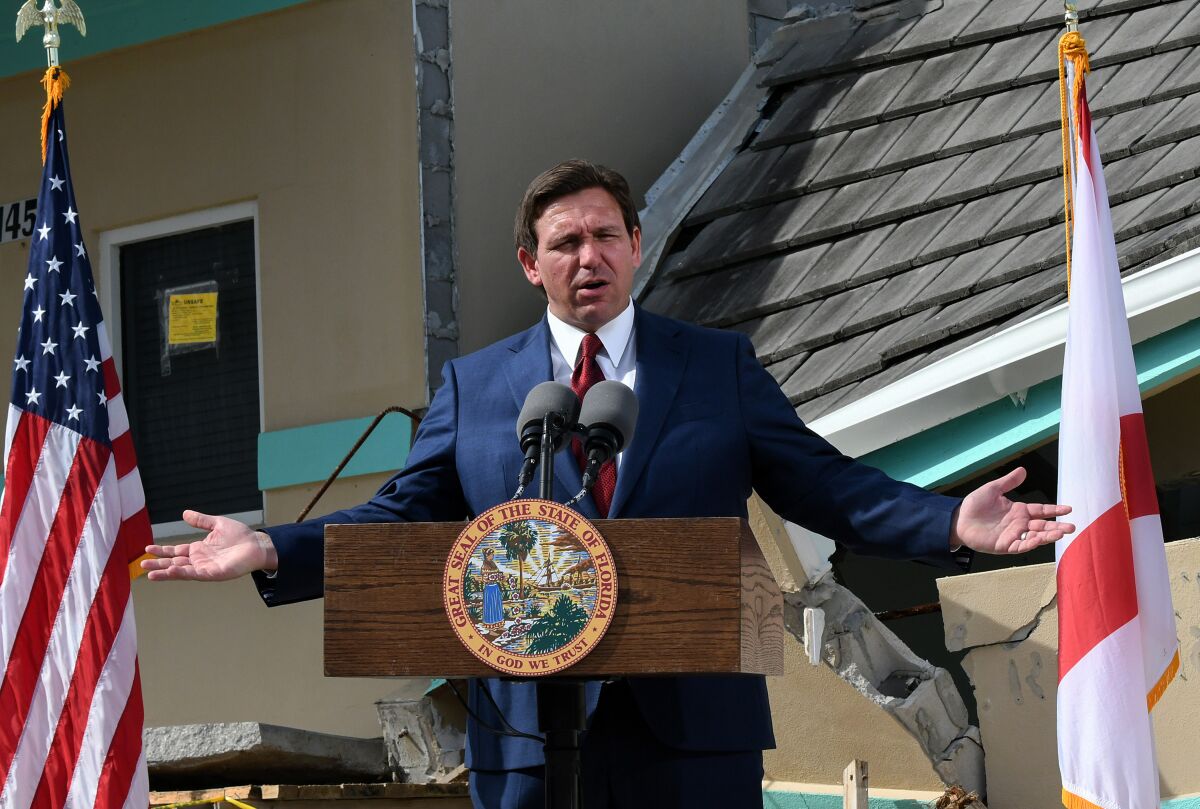
Florida Gov. Ron DeSantis speaks at a press conference

Florida Gov. Ron DeSantis has pushed laws to restrict school instruction on gender identity and sexual orientation.

(Paul Hennessy / SOPA Images/LightRocket via Getty Images)

Those battles echo today and have accelerated as religious conservatives and right-leaning politicians, including Florida Gov. Ron DeSantis, have backed bills to limit school instruction on gender identity and sexual orientation. Of the 1,648 titles banned in schools across the country in the 2021-22 school year, according to a PEN America study, 41% had prominent LGBTQ characters or explicitly explored LGBTQ themes.

“It’s hard to compare this to anything other than the Red Scare in the 1950s,” said Foote, a retired high school librarian of 29 years who was named a Champion of Change by President Obama. “There’s nothing else remotely close to this.”

Open the link and read the rest of the article. It might be behind a paywall. I subscribe to the Los Angeles Times. It’s a terrific newspaper.

Darcie Cimarusti served on the school board of Highland Park, New Jersey, from 2013 to 2022. She is the communications director of the Network for Public Education. This article appeared in the Bedford Gazette.

She writes:

I have been a local school board member since my daughters, now 11th-graders, were in second-grade. In that time, I have been involved in education policy discussions at the local, state and national levels on issues related to the rights of LGBTQ+ students, standardized testing and the privatization of public education. The rise of the so-called “parental rights” movement in public education has been one of the thorniest, most perplexing issues I have encountered.

There is no doubt that parents play a crucial role in the education of their children. Who would dare argue that they don’t? But in the face of the anti-critical race theory, anti-LGBTQ+, anti-social emotional learning, anti-diversity equity and inclusion juggernaut unleashed by heavily funded, right-leaning astroturf parent groups such as Moms for Liberty, it has become imperative that we have an honest discussion about how much say parents should have in what is (or is not) taught in our public schools.

My district, unlike many, is racially, ethnically and socioeconomically diverse, with 31 languages spoken in the homes of our students. Educating such a diverse student body presents many challenges and requires a nuanced approach to policy and practice that ensures all students have equal opportunities to learn, thrive and grow. While it is easy for school leaders to say they embrace diversity, equity and inclusion, it’s far too challenging to implement policies promoting those principles.

I have spent my time on the school board helping to develop systems that ensure decisions are made collaboratively and with as many voices at the decision-making table as possible. This means making space not only for administrators, teachers, parents and students but also ensuring that historically marginalized groups are represented.

Decisions that affect students should never be based on the whims of those with the most privilege or power and indeed not on who has the loudest voice in the room.

However, the latter has become the hallmark of parental rights activists. They attend meeting after meeting, berating, shouting down and even making death threats against school board members. During the pandemic, battles over masks erupted at podiums at far too many school board meetings across the country and quickly morphed into demands to ban books, censor curriculum and muzzle “woke” teachers that parents accused of “grooming” their children.

In the 2022 midterm elections, parental rights activists were on the ballot in numerous states. With the support and endorsement of Moms for Liberty, they ran campaigns to become school board members in districts in red, blue and purple states. Moms for Liberty operates county chapters that aim to serve as watchdogs “over all 13,000 school districts.” Chapters empower parents to “defend their parental rights” and “identify, recruit & train liberty-minded parents to run for school boards.”

The “anti-woke” agenda espoused by Moms for Liberty endorsed school board candidates who had the greatest successes in Florida, where Gov. Ron DeSantis proudly declared the state being “where woke goes to die.” But in many other parts of the country, parental rights candidates lost their elections, with even conservative political operatives acknowledging that many of their campaigns were “too hyperbolic.”

Chaos has already erupted in several districts where they succeeded and won board majorities, with newly formed, inexperienced boards firing superintendents or forcing them to resign. One board voted to ban the teaching of critical race theory just hours after being sworn in.

After a decade of experience as a school board member, there’s one thing I can say for sure: The majority of parents, teachers and community members do not respond well to instability and disruption in their local public schools. When school boards run amok and rash decisions make headlines, communities work quickly to restore calm. If parental rights school board majorities continue to govern recklessly, they will undoubtedly face a backlash from voters.

Creating and implementing sound school policies and practices that respect and affirm all students requires collaboration. It does not allow for the divisive, polarizing rhetoric and impetuous, rash decision-making that have become the calling cards of the so-called parental rights movement.