Archives for category: Corporate Reform

Ed Johnson is a systems thinker and consultant in Atlanta. He cares passionately about the public schools of his city and keeps watch over the actions of the Atlanta Public School Board. Johnson is an adherent of the work of W. Edwards Deming; he believes in thinking of about how to change systems, not in quick fixes or the panacea of the day. In this letter to the Atlanta Public School Board, he takes them to task for their commitment to 50CAN, a school privatization group that was started in Connecticut as ConnCAN and funded largely by the Sackler family.

Ed Johnson writes:

“Join GeorgiaCAN for an informative session on the vision of Atlanta Public Schools!  Gain insights from APS Board member [Dr.] Ken Zeff as he shares his perspective and engages in a parent discussion regarding APS’s vision.  Let’s unite as a community to ensure that our children and the APS community have the resources and support necessary to pave the way for a brighter future.”

—GeorgiaCAN

 We now know GeorgiaCAN is a state-level affiliate of 50CAN, do we not?

 We now know 50CAN stands for 50-State Campaign for Achievement Now, do we not?

 We now know GeorgiaCAN, as a 50CAN affiliate, pushes destroying public education and public schools with school choice, charter schools, and vouchers, do we not?

 We now know, in December 2019, we had AJC parroting and giving prominent voice to GeorgiaCAN spouting free market school choice ideology, do we not?

 We now know, in August 2023, we had Atlanta school board members Katie Howard, District 1, and Erika Mitchell, District 5 and current school board chair, involved with GeorgiaCAN, do we not?

 And we now know, in September 2023, we had The King Center giving the 50CAN CEO a platform for some inscrutable reason, do we not?

 So, let’s consider Ken Zeff in the way The King Center was considered last September:

 50CAN evolved from ConnCAN (Connecticut CAN).  ConnCAN was funded pretty much wholly by Sackler Family fortunes earned as ill-gotten profits from over-prescribed sales of Oxycontin by the family’s Purdue Pharma.  Because of such greed for profits, hundreds of thousands of people in the U.S. and worldwide have died, and continue to die, from opioid addiction.

 As with similar other organizations and their local operatives—for example, The City Fund and its local operatives, Ed Chang leading reformED Atlanta—it is fairly well-known that 50CAN and its state-level operatives aim to dismantle hence destroy public education as the common good that is foundational to sustaining democracy, so as to transform destroyed public schools into privatized and commodified schools composing competitive education marketplaces.  Think Milton Friedman and the “invisible hand of the market.”

 It is also fairly well-known that 50CAN, like similar other organizations, has advanced its aim to destroy public education by expressly targeting and catalyzing Black communities to demand school choice and charter schools that will magically deliver “achievement now.”

 In effect, 50CAN and such others “politrick” Black communities into facilitating their own destruction and that of their own children.  Again, while “It takes a village to raise a child,” it also takes a village to destroy a child.

 The usual assumption is that charter schools transformed from destroyed public schools are inherently better than “failing public schools.”  This is a lie, plain and simple.  It is impossible for charter schools to be inherently better or worse than “failing public schools.”  Because entropy is a fact of life, our public schools need improvement, have always needed improvement, and always will need improvement.  Reality offers charter schools no grace from the entropy fact of life.

 To assert that charter schools are inherently better than “failing public schools” is like asserting members of a certain group of human beings are inherently superior to members of other groups of human beings, based solely on expressions of variation in some few arbitrarily-chosen human physical features said to signify “race,” which is another lie.

 Charter schools do, however, appeal to certain retributive justice, behaviorally emulative, and selfish consumerist mindsets for which improvement-thinking has always been meaningless, at worst, and theoretical, at best.  50CAN knows this, and so uses it to catalyze Black communities to demand “achievement now.”  “Instant pudding,” the late, great systems thinker W. Edwards Deming (1900-1993) might say.

 Consequently, “Our children can’t wait!” has been a decades-long handy refrain that has always begged easy, quick, learningless change but never improvement with knowledge, which requires learning and unlearning.

 Unfortunately, systems thinking teaches through a nonviolence lens that the more often easy, quick, learningless change happens, the less improvement becomes possible; then, the less improvement becomes possible, the less sustainable democracy becomes; then, the less sustainable democracy becomes, the more societal dysfunctions develop and emerge, after a time, in Black communities and elsewhere; then, the more societal dysfunctions show up, the more the refrain, “Our children can’t wait!”

 It is all a destructively vicious, self-reinforcing feedback loop that 50CAN and similar other destroyers of public education are happy to catalyze in Black communities, in particular, and to support its playing out, if only continually, but continuously, ideally.

 With systems thinking, it really is not hard to understand why some out-of-control-for-the-worse aspects of violent crime in City of Atlanta involving ever more “Black” teenaged children and younger other persons in Black communities has become such a challenge.

 Currently, Atlanta’s culture predictably produces a homicide every 2.3 +/- 4.0 days, while predictably producing an aggravated assault every 3.7 +/- 10.7 hours.

 These are realities Atlanta Police Department data reveal when viewed through a Deming kind of systems thinking lens instead of through a financial accounting-style lens that invariably creates an incomplete or false narrative that the media and others then report as fact.

 Although some are quite capable to look below the performative surface, or show stage, of the proverbial iceberg and down into its greater depths to see and know Dr. Martin Luther King, Jr., was also a profound systems thinker, systems thinking seems generally absent in Black culture; certainly, children labeled “Black” seem never to learn about this deeper and critically important aspect of Dr. King.

 All too often the children learn to conserve racism and so-called white supremacy rather than learn to help humanity relieve itself of these scourges.  The children learn and internalize racial categorization, the false narrative at the heart of racial violence.  It seems the children never learn to internalize an understanding of human variation, the truth at the heart of nonracial nonviolence.

 It is quite puzzling that some fight and rail against racism, all the while conserving it and the “race” lie racism needs in order to exist, in truth.

 Therefore, a question for The King Center must be, why is The King Center giving a platform to 50CAN?

 50CAN and GeorgiaCAN, private organizations known to be about making “Beloved Community” a virtual impossibility, in all respects.

 Given this, we now know Dr. Ken Zeff lied when he swore, in taking the Oath of Office the Charter of the Atlanta Independent School System requires, “I will be governed by the public good and the interests of said school system,” do we not?

 Being involved with GeorgiaCAN necessarily and unavoidably means Dr. Ken Zeff exercises, well, the “choice” to be governed by a private goodand the interests of GeorgiaCAN, hence 50CAN.

 In a discussion during this month’s regularly scheduled school board meeting, Dr. Ken Zeff voluntarily professed quite enthusiastically to being a school choice proponent.

 Well, he was at least honest about it—something we might appreciate, when some other Atlanta Board of Education members have shown they are not so honest about their being in the school choice camp.


Ed Johnson

Advocate for Quality in Public Education

Atlanta GA | (404) 505-8176 | edwjohnson@aol.com

Jan Resseger reports on dramatic changes in Chicago, which has been a Petri dish for corporate school reform for at least two decades. The last mayoral election pitted Paul Vallas, an Uber reformer against Brandon Johnson, a teacher and member of the Chicago Teachers Union. Johnson is now beginning to unravel the damage done by Arne Duncan, Rahm Emanuel, and the business leadership.

Resseger writes:

Right now we are watching in real time as Chicago tries to figure out how to undo the consequences of a catastrophic, two-decades long experiment in marketplace school reform.

Chicago’s Board of Education has voted to implement an important first step in Mayor Brandon Johnson’s proposed school district overhaul: the elimination of student based budgeting.

Mayor Johnson seeks to restore equal opportunity across a school district that has become marked by magnet schools, charter schools, elite and selective public schools, struggling neighborhood schools, and neighborhoods without a a public high school or even a traditional public elementary school.

Johnson has prioritized major changes in the Chicago Public Schools, whose problems became especially obvious in June of 2013, when Mayor Rahm Emanuel closed 50 neighborhood public schools because, as he claimed, they were under-enrolled. Eve Ewing, a University of Chicago sociologist explains that, “80 percent of the students who would be affected were African American… and 87 percent of the schools to be closed were majority black.” (Ghosts in the Schoolyard, p. 54)

Chicago was an early experimenter with school reform. Brandon Johnson, the city’s elected mayor, leads Chicago’s schools as part of the 1994 mayoral governance plan imposed on the public schools by Mayor Richard M. Daley and the Illinois legislature. The Chicago Public Schools adopted universal, districtwide school choice, and the launch in 2004 of Renaissance 2010 (led by Arne Duncan) that involved the authorization of a mass of new charter schools and the subsequent closure of so-called failing neighborhood public chools. Chicago adopted a strategy called “portfolio school reform,” described in a National Education Policy Center brief: “The operational theory behind portfolio districts is based on a stock market metaphor—the stock portfolio under the control of a portfolio manager. If a stock is low-performing, the manager sells it.  As a practical matter, this means either closing the school or turning it over to an charter school….”

Then in 2014, Mayor Emanuel added a districtwide funding plan called student based budgeting. In a 2019 report, Roosevelt University professor Stephanie Farmer explained: “Student Based Budgeting fundamentally remade the approach to funding public schools. Student Based Budgeting is akin to a business model of financing public schools because funds are based on student-consumer demand and travel with the student-consumer to the school of their choice.  (The plan contrasts with)… the old public good approach to financing public schools that ensured a baseline of education professionals in each school.”

Because it is known that aggregate school test scores correlate primarily with poverty and wealth, it was predicable that student based budgeting would put schools in Chicago’s poorest neighborhoods on a race to the bottom, leading to schools with tragically limited programming for the city’s most vulnerable students and more school closures.  Farmer concludes: “Our findings show that Chicago Public Schools’ putatively color-blind Student Based Budgeting reproduces racial inequality by concentrating low budget public schools almost exclusively in Chicago’s Black neighborhoods. The clustering of low budget schools in low-income Black neighborhoods adds another layer of hardship in neighborhoods experiencing distress from depopulation, low incomes, and unaffordable housing.”

In late March of this year, WBEZ’s Sarah Karp reported that the Board of Education voted to launch a new plan to determine how much each school has to spend on teachers and programming: “Chicago Public Schools is officially moving away from a school funding formula that pitted schools against each other as they competed for students… District officials… announced (on March 21, 2024) they are implementing a formula that targets resources for individual schools based on the needs of students, such as socioeconomic status and health. They will abandon student based budgeting—a formula unveiled a decade ago under former Mayor Rahm Emanuel that provided a foundational amount of money based on how many students were enrolled…. Under the needs-based formula, every school will get at least four foundation positions, including an assistant principal, plus core and ‘holistic teachers.’… Schools will then get additional funding based on the opportunity index, which looks at barriers to opportunity including race, socioeconomic status, education, health and community factors.”

While undoing a market-based scheme for school funding and operations is clearly a moral imperative, the challenges appear daunting.  Karp continues: “This change was expected as Mayor Brandon Johnson and others have sharply criticized student based budgeting. However, it was unclear how it would play out, especially as the district faces a $391 million deficit for the next school year.  The shortfall is the result of federal COVID relief funds running out… District officials offered no information at a Board of Education meeting… on how the district will fill the budget hole.”

In addition to the threat of a serious financial shortfall, another challenge is the outcry from parents who have over the past two decades become a constituency for charter schools, magnet schools and selective high schools.  Mayor Johnson has tried to reassure parents: “(L)et me assure people that—whether its a selective enrollment school or magnet school—we will continue to invest in those goals… (A)ll I’m simply saying is that where education is working in particular at our selective enrollment schools and our magnet schools, my position is like any other parents in Chicago: that type of programming should work in all of our schools. And that has not been the case. Neighborhood schools have been attacked, they have been demonized, and they’ve been disinvested in, and Black and brown parents overwhelmingly send their children to those schools. So it’s not just demonizing and disinvesting in Black and brown schools, it’s demonizing and disinvesting in Black and brown people—and not under my administration.”

Although school choice plans like Chicago’s were originally premised on the idea of providing more choices for those who have few, in her profound book, Ghosts in the Schoolyard, Eve Ewing explains that families in Chicago do not have equal access in today’s school system based on school choice: “While choosing the best option from a menu of possibilities is appealing in theory, researchers have documented that in practice the ‘choice’ model often leaves black families at a disadvantage. Black parents’ ability to truly choose may be hindered by limited access to transportation, information, and time, leaving them on the losing end of a supposedly fair marketplace.” (Ghosts in the Schoolyard, p. 23) Families dealing with poverty and its challenges are more likely to select a neighborhood school within walking distance of their home.

Mayor Johnson and his school board are facing a fraught political battle in the midst of severe budget challenges. Chicago school reform has exacerbated inequality. The families whose children remain in traditional neighborhood schools that have been undermined by school choice and student based budgeting have watched their their schools lose staff and programs their children need. At the same time, families who have benefited from charter schools, magnet schools and selective-enrollment high schools have now become strong supporters of the programs they have come to take for granted.

Mayor Johnson has been very clear, however, about what the past two decades of portfolio school reform, school choice and student based budgeting have meant for Chicago: “What has happened in the city of Chicago is selective enrollment schools go after students who perform academically on paper.  It’s a very narrow view of education. Let’s also ensure that other areas of need are also highlighted and lifted up.  That’s arts, our humanities, technology, trades…  It’s not like we’re asking for anything radical. We’re talking about social workers, counselors, class sizes that are manageable. We’re talking about full wraparound services for treatment for families who are experiencing the degree of trauma that exists in this city.”

Forgive me for posting two reviews of my last book, which was published on January 20, 2020.

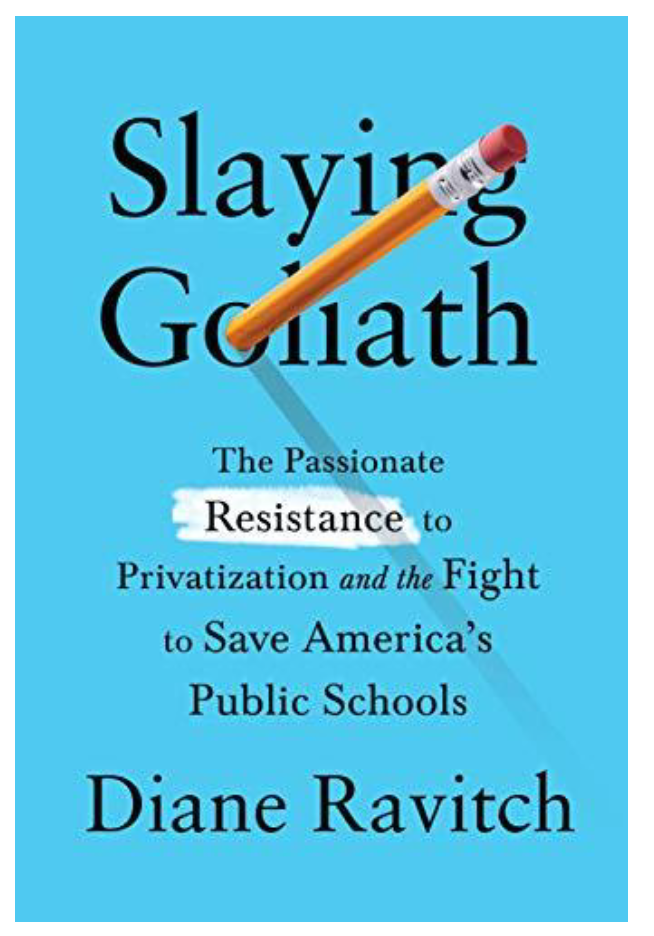
As I explained in the previous post, I did not see either of these reviews until long after they appeared in print. Slaying Goliath appeared just as COVID was beginning to make its mark, only a few weeks before it was recognized as a global pandemic. In writing the book, I wanted to celebrate the individuals and groups that demonstrated bravery in standing up to the powerful, richly endowed forces that were determined to privatize their public schools through charters or vouchers.

America’s public schools had educated generations of young people who created the most powerful, most culturally creative, most dynamic nation on earth. Yet there arose a cabal of billionaires and their functionaries who were determined to destroy public schools and turn them into privately-managed schools and to turn their funding over to private and religious schools.

Having worked for many years inside the conservative movement, I knew what was happening. I saw where the money was coming from, and I knew that politicians had been won over (bought) by campaign contributions.

Publishing a book at the same time as a global pandemic terrifies the world and endangers millions of people is bad timing, for sure.

But the most hurtful blow to me and the book was a mean-spirited review in The New York Times Book Review. The NYTBR is unquestionably the most important review that a book is likely to get. Its readership is huge. A bad review is a death knell. That’s the review I got. The reviewer, not an educator or education journalist, hated the book. Hated it. I found her review hard to read because she seemed to reviewing a different book.

I was completely unaware that Bob Shepherd reviewed the review. I didn’t see it until two or three years after it appeared. He wrote what I felt, but I, as the author, knew that it was very bad form to complain, and I did not.

So I happily post Bob Shepherd’s review of the review here.

I am almost four years late in discovering this review by two scholars for whom I have the greatest respect: David C. Berliner and Gene V. Glass.

I was happy to read this review because Slaying Goliath had a checkered fate. It was published in mid-January 2020. I went on a book tour, starting in Seattle. By mid-February, I made my last stop in West Virginia, where I met with teachers and celebrated the two-year anniversary of their strike, which shut down every school in the state.

As I traveled, news emerged of a dangerous “flu” that was rapidly spreading. It was COVID; by mid-March, the country was shutting down. No one wanted to read about the fight to save public schools or about its heroes. The news shifted, as it should have, to the panicked response to COVID, to the deaths of good people, to the overwhelmed hospitals and their overworked staff.

To make matters worse, the New York Times Book Review published a very negative review by someone who admired the “education reform” movement that I criticized. I thought of writing a letter to the editor but quickly dropped the idea. I wrote and rewrote my response to the review in my head, but not on paper.

Then, again by happenstance, I discovered that Bob Shepherd had reviewed the review of my book in The New York Times. He said everything that I wish I could have said but didn’t. His review was balm for my soul. Shepherd lacerated the tone and substance of the review, calling it an “uniformed, vituperative, shallow, amateurish ‘review.’” Which it was. His review of the review was so powerful that I will post it next.

Then, a few weeks ago, I found this review by Berliner and Glass.

The review begins:

Reviewed by Gene V Glass and David C. Berliner Arizona State University, United States

They wrote:

In a Post-Truth era, one must consider the source. 

In this case, the source is Diane Rose Silvers, the third of eight children of Walter Silverstein, a high school drop-out, and Ann Katz, a high school graduate. The Silvers were a middle-class Houston family, proprietors of a liquor store, and loyal supporters of FDR.

After graduation from San Jacinto High School, she enrolled in Wellesley College in September, 1956. Working as a “copy boy”for the Washington Post, Diane met Richard Ravitch, a lawyer working in the federal government and son of a prominent New York City family. They married on June 26,1960, in Houston, two weeks after Diane’s graduation from Wellesley. The couple settled in New York City, where Richard took employment in the family construction business. He eventually served as head of the Metropolitan Transit Authority and Lieutenant Governor in the 2000s, having been appointed by Democratic Governor David Paterson.

 Diane bore three sons, two of whom survived to adulthood. Diane and Richard ended their 26-year marriage in 1986. She had not been idle. For a period starting in 1961, Diane was employed by The New Leader, a liberal, anti-communist journal. She later earned a PhD in history of education from Columbia in 1975 under the mentorship of Lawrence Cremin.

Diane was appointed to the office of Assistant Secretary of Education, in the Department of Education by George H. W. Bush and later by Bill Clinton. In 1997, Clinton appointed her to the National Assessment Governing Board (NAGB), on which she served until 2004. 

Ravitch worked “… for many years in some of the nation’s leading conservative think tanks.

Read the full pdf here.

The Texas Education Agency, under Republican control, took over the entire Houston Independent School district last year because one high school—with disproportionate numbers of at-risk students—had low test scores for several years in a row. Even though that school, Wheatley High School, was showing marked signs of progress, State Commissioner Mike Morath, fired the elected school board and hired Mike Miles as superintendent with expansive powers and selected a hand-picked “board of managers.”

Morath, a software executive, was appointed by Governor Gregg Abbott, who surely enjoys punishing a mostly Black and Hispanic district that did not vote for him. Of course, Morath must know that state takeovers seldom lead to improvement. This is especially the case in a hostile takeover, like this one.

Houston Democrats are waking up and taking action. At last. How can they allow Gregg Abbott to do a hostile takeover of HISD and install a man with a grandiose sense of his own importance, a man who previously failed in Dallas? Given the Republican super-majority in the state and Abbott’s vengeful nature, there’s probably not much that can change his stranglehold over Houston’s public school students and teachers. But it’s always good to protest and make noise.

Several Houston-area Democratic legislators are calling for a formal hearing to address “potential violations of state law” in Houston ISD in the aftermath of the Texas Education Agency stripping elected leaders from the school district.

The lawmakers asked in a letter sent Friday that the House Committee on Public Education host a hearing to address reports of “unqualified, non-degree holding teachers” working in classrooms and a lack of accommodations for students with disabilities. They also requested independent research proving the benefits of state-appointed Superintendent Mike Miles’ New Education System

The request comes after the state takeover of HISD in March 2023 and the Texas Education Agency’s appointment of the Superintendent and nine members of the Board of Managers. Due to the takeover, the nine lawmakers who signed the letter said it is “imperative that the state assume full responsibility for HISD students and hold the board of managers accountable”

“As their duly elected State Representatives, we must hold a hearing to learn more about these concerning reports and efforts to subvert state laws and requirements,” the letter states.

Reps. Christina Morales, Ann Johnson, Jarvis Johnson, Penny Morales Shaw, Mary Ann Perez, Jon Rosentahl, Shawn Thierry, Hubert Vo and Gene Wu all signed the letter, which was addressed to Speaker of the Texas House Dade Phelan and the House education committee. Phelan and TEA did not immediately respond to a request for comment on the letter. 

“Teacher reports and parent concerns are uncovering troubling developments at our schools,” Morales wrote in a statement. “The community can no longer vote on who represents us on the school board, so we as the state representatives must hold the appointed board accountable.”

In a response to the letter, HISD said it was going to stay focused on “the critical work of serving students and families,” and it had already seen positive impacts for kids after implementing reforms.

“HISD has invited dozens of elected and community leaders into our schools to see the work happening first-hand,” the district wrote. “We are pleased to share our progress with any other leaders who want to better understand what’s happening in the schools.”

Miles has implemented the New Education System program, a controversial model that includes standardized curriculum, the conversion of libraries to Team Centers and courses focused on critical thinking and the “Science of Reading,” at 85 schools this year. The campuses also have longer hours, timed lessons, higher pay for educators and additional staff who support teachers.

“Teachers have expressed that some of our most at-risk students are not receiving the services and support that they legally have the right to receive,” lawmakers wrote. “They have also shared with us that their students feel discouraged and constantly berated by the continuous assessments and instructional method prescribed in the New Education System.”

According to the letter, the district has circumvented the law requiring teachers to obtain a bachelor’s degree, a certification and other requirements to work in a classroom by assigning certified teachers as the teacher of record for more than one classroom.

“These efforts are not only detrimental to the continued learning and development of our students, but also a violation of state law,” lawmakers said.

The Democratic lawmakers also said the district has shared plans with teachers and administrators to address a teacher shortage by hiring community college students as teacher apprentices and learning coaches. 

Under the NES model, teacher apprentices work with teachers to plan and implement lesson plans, provide instruction and support classroom management, and they can serve as the teacher when the primary instructor is absent. Learning coaches provide support to teachers by supervising students, making copies, grading papers and completing paperwork.

Back in 2010, Secretary of Education Arne Duncan rolled out his Race to the Top program to reform American education. The U.S. Department of Education offered a total of $5 billion to states. To be eligible to compete for a part of the huge prize money, states had to agree to authorize charter schools, to adopt the Common Core (not yet finished), and to evaluate teachers based on the test scores of their students.

The requirement to change teacher evaluation was heated. Duncan scoffed at critics, saying they were trying to protect bad teachers and didn’t want to know the truth.

Debate over this methodology was heated.

I was part of a group of education scholars who denounced this method of evaluating teachers in 2010.

In 2012, three noted scholars claimed that teachers who raised test scores raised students’ lifetime incomes; President Obama cited this study, led by Harvard economist Raj Chetty, in his State of the Union address. It seemed to be settled wisdom that teachers who raised test scores were great, and teachers who did not should be ousted.

In 2014, the American Statistical Association warned about the danger of evaluating teachers by the test scores of their students. The ASA statement said that most studies of this method find that teachers account for 1-14% of the variation in test scores. The greatest opportunity for improvement, they said, was to be found in system-level changes.

The Gates Foundation poured hundreds of millions of dollars into districts willing to test value-added methodology, and eventually gave up. Teachers were demoralized, teachers avoided teaching in low-income districts. Overall improvements were hard to find.

Arne Duncan was a true believer, as was his successor, John King, and they never were willing to admit failure.

Teachers never liked VAM. They knew that it encouraged teaching to the test. They knew that teachers in affluent districts would get higher scores than those in less fortunate districts. Sometimes they sued and won. But in most states, teachers continued to be evaluated in part by their students’ scores.

But in New York state, the era of VAM is finished. Dr. Betty Rosa, the chancellor of the New York State Board of Regents, reached an agreement with Melinda Person, president of New York State United Teachers, to draft a new way of evaluating teachers that moves away from students’ standardized test scores.

New York state education leaders and the teachers’ union have announced an agreement to change how New York school teachers and principals are evaluated, and move away from the mandated reliance on standardized test scores.

State Education Department Commissioner Betty Rosa and New York State United Teachers President Melinda Person hand-delivered their drafted legislation Wednesday to lawmakers to create a new system that doesn’t use students’ test performance to penalize educators. The state teacher evaluation system, known as the Annual Professional Performance Review, or APPR, was modified in the 2015 budget to place a greater importance on scores.

“It’s connecting research to practice and developing strategies to ensure that teachers have the best tools and principals to make sure our young people are getting the best quality education,” Rosa told reporters Wednesday in the Legislative Office Building.

When NYSUT elected president Person last year, she said her first task was to change the teacher evaluation system, and state lawmakers said with confidence Wednesday it will happen this session.

The proposed law, which has not officially been introduced in the Legislature, would remove the requirement to base evaluations on high-stakes tests. School districts would have eight years to transition, but could make the changes faster than the required deadline.

Person argued it will support new teachers who are often burdened by the required paperwork under the current model.

“This would be a fair and a just system that would support them in becoming better educators, which is ultimately what they want to do anyway,” Person said.

The proposal was negotiated in agreement with state superintendents, principals, school boards, the PTA, Conference of Big 5 School Districts and other stakeholders. The issue has been contentious for union and education leaders for years, and both state Education Committee chairs in the Legislature said they’re thrilled with the agreement. 

“That’s such a nice thing in Albany,” said Senate Education chair Shelley Mayer, a Democrat from Yonkers. “Who can do that? Who gets agreement? It’s very hard around here.

“It takes a woman to do it,” Assembly Education chair Michael Benedetto replied with a smile.

Benedetto, a Bronx Democrat, was a classroom teacher for decades and recalled how feedback helps educators develop when done in the proper way.

“It’s like anything else — we want stability in our lives, we want to know where we’re going, how we’re going to be rated and what we’re going to be rated on, as a teacher, as a professional,” the assemblyman said.

Lawmakers will review the proposal and draft legislation in the coming weeks.

Remembering how strident were the supporters of VAM, it’s kind of wonderful to hear the collective sigh of relief in Albany as it fades away.

Maurice Cunningham is a retired professor of political science at the University of Massachusetts. He became expert on the subject of Dark Money in education while covering a state referendum on charter school expansion in Massachusetts in 2016. He noted at the time that the funding on behalf of authorizing more charter schools came from billionaires, many of them out of state. He noticed that while the charter expansion was overwhelmingly opposed by PTAs and local school boards, one parent organization, the “National Parents Union,” supported it. He checked into the NPU’s financials and discovered it had received large grants from the Walton Foundation. Walton is one of the biggest funders of charters in the nation. The referendum went down to a decisive defeat. But NPU carries on, advancing the cause of privatization.

Cunningham is the author of Dark Money and the Politics of School Privatization.

NPU will hold its national conference starting April 9 in D.C. Maurice hopes that reporters will ask the following questions:

National Parents Union’s “#ParentPower2024.”

Some Questions for Journalists.

National Parents Union (NPU), a Koch and Walton funded phony “parents” groups, will hold its #ParentPower2024 meeting this week. For any journalists covering the meeting, here are some questions you should ask. 

1. A “union?” Can National Parents Union (NPU) name another “union” that accepts millions of dollars in donations from such notorious anti-union billionaires as the Walton family ($4,466,000 to affiliated Massachusetts Parents United (MPU) and NPU), John Arnold (his City Fund gave $1,028,500 in 2021-2022), and Charles Koch ($350,000 through a joint venture with the Waltons called the Vela Education Fund)?

2. All in the Family. Across NPU and the allied Massachusetts Parents United, Rodrigues and her husband Tim Langan compensated themselves $661,775 in 2022. What justifies paying them 22 percent of 2022 total revenues?

3. Organizing? NPU’s 2022 tax return lists $31,616 in expenditures for “community Organizing EV.” Why is so little spent on community organizing?

4. Sinking Financials. NPU and MPU went from $5,307,190 combined contributions in 2021 to $3,015,449 in 2022. What explains the steep decline in donations?

5. Rising Salaries. At NPU, despite contributions dropping in 2022 from 2021 levels, salaries rose from $1,729,503 to $2,035,201. Why?

6. Gravy Train Leaving the Station. NPU’s financial position is deteriorating while leadership compensation remains high. Why? 

7. Dueling Boards of Directors? NPU lists one set of board of directors on its website and an almost entirely different board as part of its annual report to the Massachusetts Secretary of State’s Corporations division. Which is the real board? 

8. I Came to Say I Cannot Stay, I Really Must Be Going. Since NPU was founded in 2020 at least twenty-twodifferent individuals have been listed as board members, some with tenures as short as a few months. Why does the board turn over so much? 

9. Three Card Monte. In 2020, MPU made a grant to NPU of $170,000 for “contributions held for National Parents Union, Inc.” In 2021, MPU made a grant to NPU of $959,837 for “contributions held for National Parents Union, Inc.” In 2022, MPU made a grant to NPU of $167,622 for “contributions held for National Parents Union, Inc.” Why are such large sums being funneled through MPU? Is MPU concealing NPU’s donors?

10. Ghost members. Recently Rodrigues tweeted that NPU has “1600 affiliated organizations” but there is no proof of that and NPU has never provided a public accounting of affiliates. The only independent study of NPU’s claims in 2020 showed members were in the charter school industry. Why has NPU never released a list of its “affiliated organizations?

11. Bonus Round. Rodrigues and co-founder Alma Marquez were “elected” as president and treasurer in January 2020 for three year terms. Those terms have ended, why has there been no election of new officers? Marquez disappeared in just a few months and was replaced with Rodrigues’s husband, Tim Langan. What happened to Marquez?

During the past few decades, we have seen the persistence of failed policies in education. Most of them were codified by No Child Left Behind and Race to the Top: give standardized tests; punish teachers and schools where scores are low or do not rise; reward teachers and schools where scores go up. Pay bonuses to teachers if their students’ scores go up. Tie teacher pay to student scores. Close schools with low scores. Turn low-scoring schools over to private management. Give vouchers to parents to send their children wherever they want.

All of these remedies failed. They encouraged cheating and gaming the system. They encouraged educators to avoid schools that enrolled the neediest students. They demoralized teachers who were idealistic and wanted to teach the joy of learning. Test prep became far more important than intellectual curiosity.

All of these are zombie policies. No matter how consistently they fail, policymakers won’t let go of them.

Merit pay is a policy that has been tried since the 1920s. It has never accomplished anything. I summarized the research on merit pay in my last three books: The Death and Life of the great American School System; Reign of Error; and Slaying Goliath. The research is overwhelming: merit pay doesn’t improve education and doesn’t even raise test scores. Yet in true zombie style, it never dies. It should.

John Thompson writes here about the revival of the merit pay zombie in Oklahoma:

As the “mass exodus” of teachers from Oklahoma schools continues, the legislature has rejected an across-the-board pay raise for teachers. Instead, several legislators are searching for a fix for the state’s “flawed” bonus system. If that doesn’t work, maybe Walters’ use of public money to spread his attacks on “on the radical left” will bring educators back to Oklahoma …

Seriously, Walters’ push for his vision of incentive pay prompted some education advocates to ask me to research performance pay. I sure appreciated the oportunity to reread new and older research on the subject.

Twenty-five years ago, I opposed performance pay because there were better ways to improve teacher quality. But I didn’t have major concerns; although its likely benefits would be small, I thought its downsides shouldn’t be a big deal. However, starting with No Child Left Behind and taking off with Race to the Top, test scores were weaponized, and the dangers of performance pay grew dramatically. Output-driven teachers’ salaries, joined at the hip with unreliable and invalid accountability metrics, promoted educational malpractice that undermined meaningful teaching and learning, increasing in-one-ear-out-the-other, worksheet-driven instruction. Teamwork was damaged, trust was compromised, the flight of educators from classroom increased, and the joy of student learning declined significantly.

During that time, I communicated frequently with data-driven analysts working for think tanks, who almost never had experience in urban schools. Their job was to provide evidence that performance pay, and other incentives and punishments, can work. They ignored educators and social scientists who tackled the real policy question – how will those experiments work? 

Sometimes, merit pay produced modest test score gains, but there was no way of determining whether those test scores revealed an increase or a drop in meaningful learning. Neither did they address the overall learning losses due to teachers being pressured to focus on metrics, as opposed to children. In 2012, a Rand study concluded, “most studies have found no effects on student outcomes.” By 2015, the U.S. Department of Education found that large incentives, such as $15,000 per teacher, may attract talent, but:

In addition to creating an environment that lends itself to narrowed pedagogical approaches and teaching to tests (and even cheating on them), this article suggests that merit pay schemes that require teachers to compete with one another may likely undermine positive collaboration.

Around the time of the 2018 Oklahoma teacher walk-out for higher pay, Denver threatened a strike to get rid of performance pay. Chalkbeat explained the complexity of balancing for larger or smaller payments to teachers in diverse classrooms. It went into depth answering the question, “How did a pay system that once seemed to hold so much promise bring teachers to their breaking point?”  The concise conclusion was, “lack of trust.”

Education Week studied the minimal effects of performance pay in Tennessee and Texas, which implemented expensive reward-and-punish, and often short-lived programs. The negative effects of the Houston plan, which State Superintendent Ryan Walters seems to support, are especially relevant for Oklahoma. The Houston teachers’ union president explained, “Performance pay demeans students and undermines teachers, so if the focus is on pay for performance, you’re incentivizing the test-and-punishment model.” Similarly, Education Week cited comprehensive studies that concluded that the relatively more effective programs “avoided an overemphasis on test scores.” But even many or most of the more successful programs were unlikely to survive.

Finally Education Week reported how the $200 million Bill and Melinda Gates Foundation merit pay experiments “did little to boost retention of high-performing teachers,” and it “had little effect on student achievement.”

At the peak of merit pay mandates, and now, Bixby Superintendent Rob Miller explained, “Teacher merit pay is one of the more persistent and seemingly indestructible zombie ideas related to education.” Miller said, “Merit pay for teachers has been tried again and again since the 1920s.” He cited cognitive and social science that explained why performance pay experiments were doomed to fail, as well as numerous evaluations of how it failed in the 21st century.  Miller now asks, “Is it fair to place the primary responsibility on teachers and schools for outcomes strongly affected by factors outside their control?” and answers, “Doing so damages school culture and teacher morale and obstructs meaningful dialogue about school improvement.”

At a time when Ryan Walters is threatening to put the worst of the failed policies of the last twenty years on steroids, I was struck by a recent column by Thomas Dee, a fervent believer in output-driven accountability. Even though he seems to think that teachers were to blame, Dee also seems to acknowledge that performance pay had disappointing results. Now he recommends:

It may be possible to achieve durable political support for a teacher evaluation system if that system focuses narrowly on identifying master teachers and providing them with training and extra pay to coach their peers but takes a more incremental approach toward dismissing underperforming teachers.

Dee’s latest almost brings me back to 25 years ago, before NCLB, when the schools I knew were improving, and a win-win approach to performance pay didn’t seem so problematic. At the urging of the union, the Oklahoma City Public School System briefly implemented the Toledo peer review plan, which included a fair and efficient plan for removing ineffective teachers. The best evidence is that the plan was a reliable method for improving classroom instruction. But, it and so many other promising programs were undercut by corporate school reform.

Maybe I’ll once again be open to a compromise involving constructively built, non-punitive merit pay incentives, once the destructive school cultures advanced by corporate school “reform” have disappeared. But, I won’t hold my breath.  

It has always been a goal of the billionaires who fund privatization to block accountability and democracy. Eli Broad once memorably said that he prefers to invest in districts under mayoral control so he doesn’t have to deal with the public. The public asks questions and wants to know who is making decisions about their children’s education. So much simpler to have one person to handle problems.

The charter school lobby has persistently fought public oversight and accountability. They are more than willing, even eager, to take public money. But they don’t like public officials asking questions about how the money was spent.

The big battle over public oversight is happening right now in Colorado. All the major right wing groups—the Koch machine, ALEC, Philip Anschutz (producer of “Waiting for Superman”) are there, battling against public schools.

On March 7, three Colorado legislators introduced a charter school accountability bill to establish improved guidelines for authorizing and renewing charter schools by local school districts. The bill would strengthen the authority that elected school boards have regarding their governance of charter schools, and it also provides citizens with expanded information about the operations of charter schools in their districts. 

According to its backers and public education advocacy groups, this is the first major legislation to prescribe more charter school accountability since the first Charter Schools Act was passed in 1993. Current state legislation often limits local control over the charter school approval process, funding requirements, and waivers from state legislation. Given that nearly two-thirds of the state’s 64 counties experienced an “absolute decline in the under-18 population over the last decade,” the charter school accountability bill would empower local school boards to address the overall enrollment needs of the district. While charter schools primarily utilize taxpayer dollars for their funding, many charter schools allow private interests to invest in their growth and development, which can create potential conflicts of interest.

Pro-charter school organizations don’t agree with this legislative effort to increase accountability as they believe this bill would “kill” charter schools. Republicans have been especially vocal in their opposition to this bill, even though the bill promotes increased local control over charter schools. The pro-charter organizations hired over 30 lobbyists to oppose the bill. Lobbying can be expensive, but the organizations opposing the bill have connections to several billionaire-funded foundations. 

The largest lobbying team hired to oppose the bill works for Americans for Prosperity, a conservative organization funded by the Koch network, whose goal is  to “destabilize and abolish public education.”American for Prosperity has been active in Colorado for years promoting vouchers and education savings accounts for families to use for any school of their choice. Last January, AFP joined with the American Legislative Exchange Council and the Heritage Foundation to form the Education Freedom Alliance, an organization that ALEC initiated to promote parents’ rights to use public money to attend a private, charter, home or public school of their choice. Funded with nearly $80 million primarily from the Koch Industries, the Americans for Prosperity political action group has also supported far-right candidates for decades.

American for Prosperity and Advance Colorado issued a press release on X stating the bill would “mark the beginning of the end of charter schools in Colorado,” and together, the two groups “would work overtime to make sure the bill was soundly defeated.” According to the Colorado Times Recorder, Advance Colorado is a conservative dark money group said to be funded by billionaire Phil Anschutz. Formerly known as Unite Colorado, Advance Colorado has “given over $17 million to support major Republican political groups and efforts in Colorado.” Colorado Dawnanother dark money group headed by State Board of Education member Steve Durham and Colorado state Sen. Paul Lundeen,  gave millions to Ready Colorado, which also has lobbyists opposing this bill.

Besides Americans for Prosperity and Ready Colorado,  these organizations have enlisted their lobbyists to defeat the billColorado Succeeds, the Colorado Children’s Campaign, Transform Education Now, Colorado League of Charter Schools ActionEducation Alliance of Colorado, and Education Reform Now Advocacy. Several of these organizations have access to deep pockets of money, and often the donors are not known. 

Colorado Succeeds, the Colorado League of Charter Schools, and Transform Education Now have received over $20 million from the Walton Family Foundation, which has given over $400 million to charter schools for decadesEducation Reform Now Advocacy is closely connected to Democrats for Education Reform, “which was started by Wall Street hedge fund managers,” according to Ballotpedia. Colorado Politics stated that “various reports say Education Reform Now has taken in millions from Rupert Murdoch and the Walton Family Foundation.” The Education Reform Now money also benefited the campaign coffers of 14 Democratic legislators, which may create a hurdle for the charter bill’s passage unless these legislators decide the bill’s merits warrant their support. 

The upcoming lobbying effort in Colorado’s legislature is not unique, as similar high-paid lobbying efforts occur wherever there is significant charter school legislation. In Nashville, a local news reporter exposed who 67 pro-charter lobbyists worked for during legislative hearings on several charter bills in 2022. In the video that accompanied his report, Phil Williams highlighted the direct connections that the pro-charter lobbyists have with billionaires. His investigative report documented that “Americans for Prosperity is linked to billionaire Charles Koch,” and they also “received funding from billionaire Bill Gates and the Walton family of Walmart fame.”  

As in Tennessee, the Colorado lobbyists will meet frequently with legislators to convince them this bill is not necessary. The legislators will need to weigh the benefits of the bill with the concerns of those who participate in a massive letter-writing campaign initiated by the lobbying organizations to oppose the legislation. The bill’s backers hope this will be the legislators’ opportunity to update 30-year-old legislation and begin to ensure increased local control and accountability for the millions of taxpayer dollars that fund the charter schools educating 15% of the state’s K-12 student population.

The Capital Prep Charter chain was created by Dr. Steve Perry. Dr. Perry hates teachers’ unions. He boasts that all the students in his charters graduate and go to college. His chain won the Yass Prize as a semi-finalist for its accomplishments. Jeff Yass is a billionaire in Pennsylvania who supports Trump, opposes abortion, and funds charter schools and vouchers. You may recall that Yass gave Texas Governor Greg Abbott $6 million to pass voucher legislation.

Capital Prep in Harlem is a Perry school that had the partnership and financial support of rapper Sean “Diddy” Combs. Things are not going so well for the students.

Students and families affiliated with Capital Prep, co-founded by Diddy, claim the entertainment mogul’s charter school did a disservice to children who attended.

Diddy co-launched the East Harlem school with Dr. Steve Perry in 2016, and in 2018 pledged $1 million for its expansion into the Bronx. However, last November Capital Prep cut ties with him amid his ongoing sexual assault lawsuits. 

Now adding to the mounting controversy around the Bad Boy Records founder, a new report from The Cut reveals many issues with Capital Prep, including the accusation that Diddy had no involvement with the school beyond photo ops, guest appearances, and the school’s grand opening in 2016.

Fourteen sources told The Cut about alleged frequent violence at Capital Prep, along with “unstable” leadership, and frequent teacher resignation. These issues were most apparent at the height of the pandemic during both virtual learning and when students, including those who were unhoused, returned for in-person classes in 2021. According to The Cut, teachers began to not show up for virtual classes, and by the end of 2020, 80 percent of teachers had left Capital Prep altogether.

When students did return to school after quarantine, some were enrolled in courses they had previously taken, or were “sitting in the cafeteria receiving no instruction for hours.” Dysfunction among teachers reflected on the student body, especially upperclassmen who were unable to transfer their credits or enroll in college due to ineligible transcripts.

“Darnell’s transcripts had classes he’d never taken, passing classes that he never took, failing classes that he was never in,” one parent, Shirley Payne, said about inaccuracies found on her son’s transcripts.

“I thought if Diddy is funding and attaching his name to something, it would be run very tightly, that he was going to give our kids what he didn’t have at that age,” parent Shakemia Harris said. Harris’ daughter Madison was enrolled at Capital Prep as an 11-year-old in 2017.

In addition to the many academic issues, violence during the school day was reportedly ongoing. Fights were rampant when the school nearly doubled in size, expanding to include a tenth grade, and again when Capital Prep relocated to 129th and Madison. Not only was the area more violent than its previous East 104th Street address, but Capital Prep began locking out students who were late, ultimately causing families to protest the disorderly conditions. In addition it violence between students, cops were called on students for things like uniform violations.