Archives for category: Corporate Reform

Journalist and former teacher Nora de la Cour writes in Jacobin about the Red State attacks on public schools, the schools that enroll 90% of America’s children.

She writes:

A new report ranks US states in terms of how well their legislatures are protecting public schools and the students who attend them. From expanding charters to launching illiberal attacks on kids and families, a worrying number of states failed the test.

State legislatures play an enormous role in making public school systems functional and safe. (SDI Productions / Getty Images)

On February 8, sixteen-year-old nonbinary sophomore Nex Benedict died of causes that have yet to be explained to the public. The day before, Nex had told a police officer they were beaten by three schoolmates in a bathroom at their Oklahoma high school. Sue Benedict, Nex’s grandmother and adoptive parent, told the Independent that Nex suffered from identity-based bullying, beginning shortly after Oklahoma governor Kevin Stitt signed a lawforcing trans students to use bathrooms that match the sex listed on their birth certificates.

In addition to the bathroom ban, Stitt has signed several other laws targeting trans youth. There are currently fifty-four other anti-LGBTQ bills before the Oklahoma legislature. While the exact cause of Nex’s death remains unverified, it’s clear that the violence preceding it occurred in an increasingly hostile environment for LGBTQ youth in the state of Oklahoma.

According to the American Medical Association and the National Institutes of Health, bathroom bans put vulnerable kids at risk for serious harm. And even when anti-LGBTQ laws don’t pass, researchindicates that young people are adversely affected by proposed legislation that puts their safety and humanity up for debate, fueling a climate of tension and suspicion which can exacerbate bullying behavior and mental health issues. Per 2019 data, majorities of LGBTQ kids have experienced harassment or bullying in school, leading to increased absences and potentially dire long-term consequences. But LGBTQ students in schools with LGBTQ-inclusive curriculum and policies are more likely to feel safe and report that their peers accept them.

In other words, adults — from educators to social media personalities to lawmakers — set a tone that appears to be highly determinative of whether school is a place where kids like Nex can safely be themselves.

This pattern is hardly restricted to LGBTQ issues. State-level legislation shapes the societies in which kids live and schools operate. For this reason “Public Schooling in America,” the latest data-packed national report card from the Network for Public Education (NPE), focuses on the extent to which each state legislature protects young people, both in and out of public school systems.

While the previous two NPE report cards have focused primarily on school privatization, this one goes further, connecting the dots between seemingly distinct attacks on public schooling that are advancing as part of the push for Christian nationalism: charter and voucher expansion, publicly funded homeschooling, defunding of public schools, and illiberal restrictions on kids and educators.

Using a points system based on how statehouses treat the above topics, NPE awarded “A” grades to five states, both red and blue, that demonstrate a strong commitment to students and democratically governed public schools: 1) North Dakota, 2) Connecticut, 3) Vermont, 4) Illinois, and 5) Nebraska. Seventeen states — all but two of which are governed by a Republican trifecta— earned “F” grades. The poorest scoring of these “F” states will come as no surprise to anyone paying attention to school privatization or the anti-LGBTQ laws curtailing kids’ and educators’ rights: 47) Arkansas, 48) North Carolina, 49) Utah, 50) Arizona, and 51) Florida.

Ultimately the report underscores a critical point: while schools are directly tasked with prioritizing child well-being and student safety, they don’t perform these duties in a vacuum. State legislatures play an enormous role in making public school systems functional and safe — or, in many cases, severely undermining them.

Privatization: Vouchers and Charters

Vouchers, which subtract taxpayer dollars from public education and turn them over to privately operated schools and service providers (including for-profit and religious schools), have notched considerable statehouse wins in recent years. In 2023 alone, seven states launched new voucher plans, while others made existing programs available to wealthy families who have never sent their kids to public schools.

Significantly, while voucher programs’ costs to taxpayers have mushroomed since 2000, bathing state budgets in red ink, overall private school enrollment actually decreased from 11.38 percent in 1999 to 9.97 percent in 2021. That’s because vouchers are mostpopular among privileged parents whose kids were already attending private schools. These privatization schemes may be propping up academically impoverished religious schools, but they are not incentivizing an exodus from public education.

Vouchers take various forms, including traditional vouchers or tuition grants, tuition tax-credit scholarship programs (TTCs), and education savings accounts (ESAs), which turn large sums of public money over to parents with virtually no strings attached. With all vouchers, and ESAs in particular, there are few or no safeguards to prevent fraud or ensure that kids are actually learning core subjects.

Vouchers are a preferred tool of religious extremists seeking state-funded Christian education, but most state constitutions have clauses prohibiting public funding of religious institutions. ESAs and TTCs are designed to evade these restrictions by funding families rather than schools (ESAs), or allowing people to donate to private school scholarships instead of paying their taxes (TTCs). Generally speaking, voucher-funded private schooling is rife with discrimination that would be illegal in public school systems. A 2023 report by the Education Voters of Pennsylvania, for example, found that 100 percent of surveyed voucher schools have policies that overtly discriminate against kids based on LGBTQ identity, disability status, academic ability, religion, pregnancy or abortion history, or other factors.

Vouchers have made splashier headlines than charter schools of late, as Republicans abandon the decades-old bipartisan education reform truce. But Christian nationalists have also been using charter schools to press their agenda, with a significant increase in right-wing “faith-friendly,” “classical,” or “back-to-basics” charter schools (and at least one officially religious church-run charter school on track to open in Oklahoma). Another in-depth report from NPE documents this rise, noting that these charter schools, which market themselves to conservative white families, are nearly twice as likely to be run by for-profit corporations as the charter sector at large.

The growth of online charter schools, which have terrible academic track records, and charter schools run for a profit has continued apace. Thirty-five states allow for-profit corporations to manage nonprofit charter schools, and in six states (Arizona, Florida, Michigan, Nevada, Ohio, and West Virginia), for-profits manage over 30 percentof all charter schools. Fraud and mismanagement result in the frequent shuttering of publicly funded charter schools, sometimes leaving families in the lurch mid–school year. Since 2019, NPE has been collecting news stories of charter school malfeasance and abrupt closures (charter churn). Thirteen states have racked up at least fifty such reports: California takes the prize for one hundred and eighty charter scandal stories, and Pennsylvania comes in second.

Though often cleverly referred to as “public,” charter schools are not equally accessible by all kids. In School’s Choice, researchers Wagma Mommandi and Kevin Welner show how charter schools use branding and promotional strategies to sway enrollment toward students with more resources and fewer needs than the general population.

In an even more blatant example of the nonpublic nature of charter schools, NPE points to the phenomenon of workplace charters. Under Florida law, such schools are permitted to restrict enrollment to the children of a specific firm’s employees — functioning as a form of labor discipline reminiscent of the last century’s coal “company towns.” At the Villages Charter School (VCS)’s six campuses, parental employment is verified monthly. If a VCS parent hates working at the Villages (a large, highly profitable retirement community) and wants to quit, they had better be prepared to upend their kids’ educational and social lives.

Homeschooling

The number of homeschooling families spiked during the COVID-19 pandemic and has continued to rise. Journalists at the Washington Post found a 51 percent increase over the past six years in states where it’s possible to track homeschooling trends. Once a practice found mainly among fundamentalist Christians in rural areas, it is now the fastest growing education sector.

Thirteen states directly subsidize homeschooling through vouchers or tax credits. A flourishing tech-based industry (including charter schools for homeschooling families) has emerged to cash in on these state subsidies, with parents putting taxpayer dollars to questionable uses. In Arizona, a proliferation of news stories has documented homeschooling families spending ESA money on things like LEGO sets, snowboarding trips, ninja training, and aeroponic indoor gardens. Very few states have regulations in place to ensure that homeschooled children are receiving basic academic instruction. In fact, most states allow parents to issue a diploma with no verification of student learning.

Culture warriors like Chaya Raichik have used the slippery concept of “grooming” to gin up fears about adults hurting kids in public schools. In reality, because public schools are governed by strict child safety laws including background checks and mandated reporting, they are much more likely to detect and prevent abuse than minimally regulated private schools and totally unregulated homes. Eleven states don’t even require parents to report that they’re homeschooling their kids, while fourteen more just require a onetime notice with no follow-up. Only Pennsylvania and Arkansas conduct any form of background check on homeschooling parents.

The Coalition for Responsible Home Education has cataloged about one hundred and eighty horrific stories of homeschooled children suffering and even dying from neglect, abuse, and torture in their educational settings. Nicole and Jasmine Snyder, for example, experienced things like having their heads bashed against a wall, being forced to stand in a dark hallway for long stretches, and having urine and feces smeared on their faces as punishment for potty accidents. They starved to death in 2016 and 2017, weighing five and ten pounds respectively. Because they were homeschooled, no one outside the family had any idea the abuse was happening. Their murders were not revealed until 2021.

Public School Financing

Researchers have clearly established the relationship between school funding and student learning outcomes. And because school funding enables everything from adequate staff-to-student ratios to heating, ventilation, and air conditioning (HVAC) systems to essential structural repairs, it’s undeniably a student safety issue.

To rank school funding, NPE looked at the following metrics from the Education Law Center, which issues an annual school funding report: funding levels (cost-adjusted, per-pupil revenue from state and local sources), funding distribution (how states allocate funds to high-needs schools serving economically disadvantaged students), and funding effort (the relationship between a state’s GDP and its investment in schools). They also looked at average teacher salaries, adjusted for each state’s cost of living.

The states that earned the most points for funding public education and narrowing resource discrepancies were New York, New Jersey, and Wyoming. Florida lost every single available point for school funding, while Arizona, Idaho, and Nevada lost all but one. Washington, DC, Maine, New Hampshire, and Vermont all stand out for having exceptionally low teacher pay despite relatively high per-pupil spending.

It’s important to recognize that numerous GOP-controlled states are in the process of defunding their public schools — through spending cuts and policies that drain public coffers by enabling skyrocketing voucher costs coupled with generous tax cuts for corporations and the wealthy. If this experiment is allowed to continue, it will ultimately disfigure the landscape of community life and civic participation.

Freedom to Teach and Learn

Because the right-wing attacks on students and educators have ramped up in conjunction with efforts to defund public schools and boost private alternatives, this NPE report card includes a new category, Freedom to Teach and Learn, which encompasses a range of factors pertaining to student safety and well-being: laws protecting LGBTQ students in public schools, corporal punishment bans, censorship and curriculum bans, collective bargaining for teachers, and teacher quality…..

[Please open the link to read the rest of this important article.]
John Thompson, historian and retired teacher in Oklahoma, explains what happened when “reformers,” led by Secretary of Educatuon Arne Duncan, advocated for school closures.

He writes:

When non-educators watch Abbott Elementary, the television comedy, they are likely to find it hilarious, but I suspect it takes a teacher to fully understand the accuracy of its portrayal of the weird corporate reforms imposed on Philadelphia schools. But, recent research helps explain why many of even the most fervent advocates for test-driven, competition-driven school turnarounds now acknowledge their failures (even though they don’t apologize for them.).

The third-year premiere of Abbott gave a shout out to the respected journal, Chalkbeat. And, Chalkbeat is again reporting on failed turnarounds in Philadelphia, Tennessee, and elsewhere, as well as why former supporters of school takeovers are repudiating the reward-and-punish method for rapid, transformative change.

Chalkbeat analyzed the Philadelphia mandate, the 2010 Renaissance Initiative. It “strove to turn around about 10% of Philadelphia’s low-performing district schools by ceding them to charter organizations that promised to do better.” By 2023, however, “the Renaissance charter schools as a group mostly performed worse in standardized tests for elementary and middle schoolers than the district averages.”

Donna Cooper, executive director of Children First explained, “The goal was to prove that charters would work with any kid, not just about parents who were highly motivated to enter a lottery, and to show that a neighborhood school turned over to a charter organization would do better than if run by the school district.” But, “As far as I can tell, the data didn’t result in that.”

Similarly, “Chris McGinley, who served on both the School Reform Commission that oversaw the district while it was under state control and the Board of Education,” said “‘It was a bad idea poorly implemented.’”

Chalkbeat quoted a second-grade teacher who said, “All the disruption was even more unsettling for her students, … many of whom have already had to deal with trauma in their lives. The staff turnover, she feared, reinforced feelings that adults weren’t there for them.” And a Renaissance principal now says, “He is not a fan of charter conversion as a school reform strategy.” “‘I think it’s offensive … ‘A lot of these measures were experimenting with communities of color.”’

According to the Chalkbeat analysis, “these schools started out well below district and state averages in English Language Arts and math performance,” but “none of the schools are performing particularly well today. For instance, one charter school’s “achievement scores have remained persistently low;” its “math proficiency is at 1%.” 

Next, Chalkbeat told the story of the “high hopes, hard lessons” of Tennessee’s winning federal Race to the Top grant application.” It recalled:

Unlike incremental academic gains associated with school improvement, school turnaround calls for dramatic gains in a short period of time.

But overall, the district has not improved student outcomes, has struggled to retain teachers, and failed to catapult schools out of Tennessee’s bottom 5% as promised. 

It explained “Other takeaways include the importance of giving families an early seat at the table when making changes and seeking more collaboration among state and local officials throughout the process.” And, because of “its heavy-handed takeover of neighborhood schools and broken promises on performance, the ASD also hasn’t endeared itself to a city with a highly charged racial history.”

The quotes from Tennessee’s Achievement School District (ASD) superintendent Chris Barbic were especially important. I’ve long been frustrated by the refusal of true-believers like Barbic who ignored the research which explained why those turnarounds were likely to fail. But Barbic says that “18 months in as he sat in a classroom and [he] saw the ASD’s systems weren’t working.”

Barbic told Chalkbeat, “’The way the ASD was set up, it had a lot more sticks than carrots.’” Moreover, “while the state-run district was positioned to act quickly, Barbic acknowledged ‘we were probably too aggressive on the sticks and not thinking about what other options there were besides doing nothing, using charters, or running the schools ourselves.’” He then “acknowledged that, ‘building grassroots support and collaborating with partners over time is ultimately more effective,’” and “’We’re in a world today where top-down just doesn’t work.’”

These massively funded bets on rapid turnarounds were based on the corporate reform hypothesis that creative destruction would lead to transformational improvements that could be scaled up. It earned the ridicule of Abbott Elementary, students, educators, and researchers. It’s good that more corporate reform advocates are admitting that their experiment failed. But that doesn’t undo the chaos which resulted in serious harm to the students it sought to help.

Today, however, the MAGA crowd is sowing discord and mistrust for political reasons. Extremists like Oklahoma’s State Superintendent Ryan Walters are using the worst of their punitive tactics to spread hatred. They are disrupting schools and other institutions in order to reelect Donald Trump. The rightwing seeks to burn down the barn without having any interest in rebuilding it. Their assault on public education is just one of their weapons for undermining democracy.

So, the history documented by Chalkbeat and satirized by Abbott Elementary is especially important today. It’s time to clearly spread the word about the inherent dangers of massive school closures and other punitive measures regardless of whether its goal is creative disruption, or disruption as a tool for destruction.

I served on the National Assessment Governing Board from 1998-2004. NAGB is the governing agency for NAEP, the federal test. I was appointed by President Bill Clinton. I learned about the inner workings of standardized testing, much of which made me skeptical of it.

I have often observed that critics of public schools assume that NAEP Proficient is the same as “grade level,” when in fact NAEP warns readers explicitly in every score report that NAEP Proficient is NOT “grade level.” In fact, NAEP Proficient represents mastery of what was tested, which I would characterize as an A or A-.

In 2010, when the anti-public school documentary “Waiting for ‘Superman’” was released, I reviewed it for The New York Review of Books and criticized it for confusing NAEP Proficiency with grade level, then claiming that most American kids can’t read, all because of their terrible public schools, their terrible teachers and those awful unions. The way to a better future, the documentary claimed, was charter schools. Not true. Even Secretary of Education Miguel Cardona has repeated this erroneous claim. Apparently neither he nor his speech writers reads NAEP reports with care and no one has briefed them.

I have explained this confusion on several occasions on the blog. I even called the Commissioner of the National Center on Education Statistics and proposed that NAEP Proficient be renamed “NAEP Mastery,” to clarify its meaning. She sounded enthusiastic about the idea (which came from a reader of this blog) but nothing changed.

I am very happy to see that Professor Paul Thomas at Furman University in South Carolina has launched a series called “Big lies in Education,” and this claim is one of the Big Lies. It is a lie because the fact that NAEP Proficient is not grade level is stated plainly in every release of NAEP scores.

Thomas begins:

One of the most bearish statistics for the future of the United States is this: Two-thirds of fourth graders in the United States are not proficient in reading,” wrote Nicholas Kristof in The New York Times.

Kristof’s piece in 2023 can be traced back to a similar claim by Emily Hanford in 2018: “More than 60 percent of American fourth-graders are not proficient readers, according to the National Assessment of Educational Progress, and it’s been that way since testing began in the 1990s,” including a surprisingly ineffective graphic.

Open the link to see this and other graphics.

The student reading proficiency Big Lie grounded in misrepresenting or misunderstanding NAEP is likely one of the most complicated Big Lies of Education.

In media and political rhetoric, first, the terms “reading proficiency” and “grade level reading” are commonly jumbled and used inappropriately as synonyms.

Achievement levels such as “basic” and “proficient,” such as used in NAEP for reading, are misleading and complicated for most people not familiar with technical terminology.

NAEP “basic” is approximately grade level (although even that claim is problematic since no standard exists in the US for “proficient” or “grade level”), and “proficient” on NAEP is high: 

Another important graph. Open the link.

Hanford’s and Kristof’s Big Lie, then, is a combination of blurring NAEP achievement levels with grade level reading achievement and manufacturing a reading crisis with that misinformation.

Ironically, NAEP grade 4 reading scores for a decade show that 2/3 of students are reading at or above grade level, the inverse of the false crisis claims of the media:

Open the link for the graph.

This is an excellent expose, which everyone should read. The claim that most kids read below grade level is foundational to the claim that public schools are in crisis. Its a Big Lie.

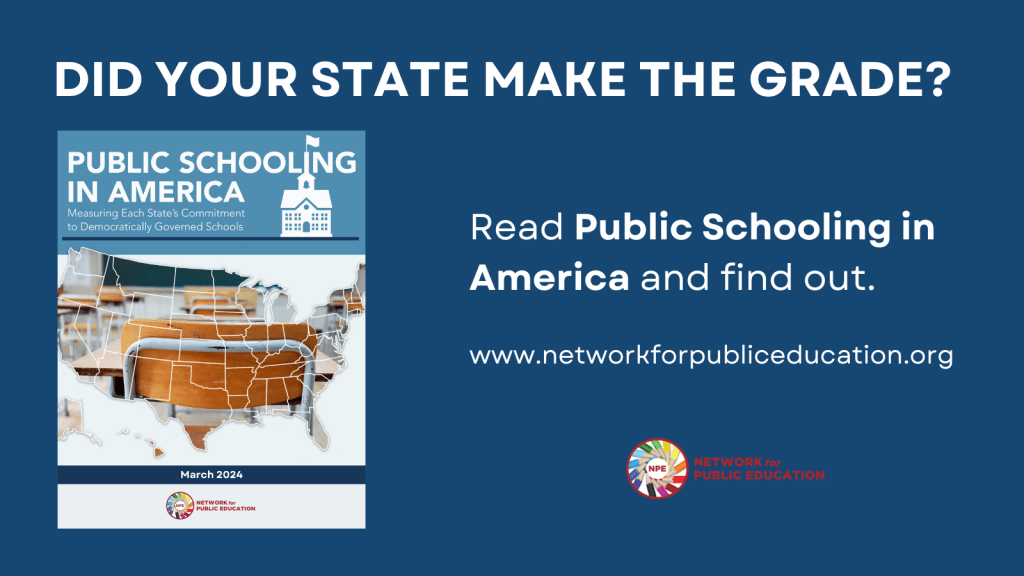
The Network for Public Education released a report card today grading the states on their support for democratically-governed public schools. Which states rank highest in supporting their public schools? Open the report to find out.

Measuring Each State’s Commitment to
Democratically Governed Schools

EXECUTIVE SUMMARY


Neighborhood public schools remain the first choice of the overwhelming majority of Ameri-
can families. Despite their popularity, schools, which are embedded in communities and gov-
erned by elected neighbors, have been the target of an unrelenting attack from the extreme
right. This has resulted in some state legislatures and governors defunding and castigating
public schools while funding alternative models of K-12 education.

This 2024 report, Public Schooling in America: Measuring Each State’s Commitment to
Democratically Governed Schools
, examines these trends, reporting on each state’s commit-
ment to supporting its public schools and the children who attend them.

What We Measure

We measure the extent of privatization in each state and whether charter and voucher laws
promote or discourage equity, responsibility, transparency, and accountability. We also rate
them on the strength of the guardrails they place on voucher and charter systems to protect
students and taxpayers from discrimination, corruption and fraud.

Recognizing that part of the anti-public school strategy is to defund public schools, we rate
states on how responsibly they finance their public schools through adequate and equitable
funding and by providing living wage salaries for teachers.

As the homeschool movement grows and becomes commercialized and publicly funded,
homeschooling laws deserve public scrutiny. Therefore, we rate states on laws that protect
children whose families homeschool.

Finally, we include a new expansive category, freedom to teach and learn, which rewards
states that reject book bans, and the use of unqualified teachers, intolerance of LGBTQ stu-
dents, corporal punishment, and other factors that impinge on teachers’ and students’ rights.

How does your state rank?

Several readers told me they were unable to access my conversation with Todd Scholl of the South Carolina Center for Educatot Wellness and Learning.

We talked about attacks on public schools, standardized testing, and privatization.

Todd sent these links:

The video can be found on the CEWL website at www.cewl.us. A direct link to the video can be found at https://youtu.be/Zm0Vi3S3RLM.

The board of the Los Angeles Unified School District adopted a new policy last week that will bar charter schools from “co-locating” in schools that enroll the most vulnerable students. This policy will provide stability to public schools that have been forced to give up classrooms and other facilities to privately-managed charters. Los Angeles and New York City both guarantee free public space to charter schools, which compels the host school to give up classrooms and other space that are not used 100% of the time.

The Los Angeles Daily News reported:

Charter schools will be barred from hundreds of Los Angeles Unified District school campuses under a new policy that is among the most restrictive of its kind.

The new rules, presented at a school board meeting Tuesday, Jan. 30, prevent charters from being sited in campuses that have been identified as serving vulnerable students, accounting for roughly 350 of about 770 school buildings in the district. Charter schools would still be offered space to operate in other LAUSD district school buildings.

The regulations prevent co-locations in low-performing schools, community schools that provide social services, and schools in the district’s Black Student Achievement Plan — immediately impacting about 21 charter schools — now co-located in those buildings — enrolling thousands of students who may need to move to new L.A. Unified campuses in the fall.

“This is one of those situations that, no matter what, we’re going to have some people dissatisfied on either side,” said L.A. school superintendent Alberto Carvalho, who created the new regulations at the direction of the district school board, an effort led by board president Jackie Goldberg and board member Rocio Rivas.

Carvalho said the new regulations are within the bounds of a 2000 state law compelling California districts to provide classroom space for charter schools. There are currently 50 charter schools co-located in 52 LAUSD school campuses, serving roughly 11,000 students. Thirteen additional charters have requested space for the upcoming school year.

“I believe that what has been presented may in many ways alleviate some of the issues,” he added. “However, we need to be vigilant and honest about unintended consequences of well intentioned policies.”

The new rules are a reversal for a city that historically has been friendly to charter schools and was immediately opposed by charter advocates, who threatened legal action in a letter to the school board as soon as the new policy was announced….

The long-simmering conflict over charter schools in Los Angeles reached a flashpoint in September when the board issued a resolution compelling Carvalho to create the policy and spelled out many of the specific components it should contain.

Secretary of Education Miguel Cardona has been nearly invisible these past three years, other than lamenting test scores. Veteran educator Nancy Bailey has some suggestions about how he could help kids, schools, and teachers right now. This post was reposted by the Network for Public Education.

The secretary keeps talking about raising the bar. Nancy Bailey has some thoughts about some bars he could work on. Reposted with permission.

She writes:

Education Secretary Cardona focuses on reducing absenteeism, tutoring, and after-school programs. And he refers to raising the bar, which sounds like A Nation at Risk talk.

Yet there are so many K12 issues that Cardona and the Biden administration could address, lead, and support the states and local school districts.

Here are some educational issues Cardona should drive this new year. If you have more, please share.

1. The Arts

Poor public schools have gone without the arts for years. Cardona should push for qualified art and music teachers for every school.

The arts help students struggling with mental health difficulties, and jobs exist in the arts.

Every child in K12 should have access to a vital arts program.

2. Career Education

Career-technical education is essential, but companies pushing their agendas into high schools to get workers raises concerns.

Tax dollars should help students decide what careers they want, giving them the chance to experience high school, not creating schools for corporate preparation.

3. Class Size

Reducing class sizes would help students with disabilities in inclusion classes and is essential for student safety. Cardona must endorse lowering class sizes and showcase schools that do.

If schools can’t lower every class (classes like P.E. wouldn’t be necessary), give students access to at least one small class where they are known.

Lowering class sizes in K-3rd grade would also help children get a good start. See the STAR Study.

4. Corporal Punishment

In 2023, The Washington Post reported that 15 states still permitted corporal punishment in schools (St. George, 2023). Like Florida, which vaguely gives a nod to it. Teens who wear the wrong kind of prom dress or misunderstandings resulting in paddling are examples.

Cardona deserves praise for standing against corporal punishment last year in schools, claiming educators should favor evidence-based approaches and that there should be no spanking, hitting, or paddling.

5. Data

Cardona must study and draw attention to child privacy laws which are currently inadequate.

In 2018, the NEPC published Educating All Our Children: Your Kids, Their Data, No Privacy by Linda McSpadden McNeil.

She stated:

When children’s privacy is violated in ways that are overt, visible, and knowable, the violation is unquestioned. It is unacceptable. In most cases, it is illegal.

So why is it different when the violation is hidden, opaque, electronic, commercial, and complicated?

6. High-Stakes Standardized Testing

President Biden promised teachers and parents he’d end harmful high-stakes standardized tests. Instead, he pushed assessments even during the pandemic.

Can Cardona show the American people who want these tests reduced or eliminated what, if anything, the Biden administration will finally do to end high-stakes standardized tests?

7. Lead in School Pipes

The Biden-Harris team promised to repair the lead pipes in homes and schools. They’re to be commended for this. It would be nice, however, if Cardona presented a report.

No amount of lead is O.K. for developing children, and it can lead to learning disabilities.

8. Reading

Reading has become a volatile issue, and Cardona has been mostly silent. Many commercial programs with little independent study, but nonetheless called the Science of Reading, are being pushed into classrooms.

The subject of reading deserves a better forum than short, often hostile debates on X.

Cardona should call for a new National Reading Panel to study programs and address reading instruction. The panel should include teachers who teach reading since they were left off the last panel. This panel should consider the concerns of the last NRP member, the only educator on the panel, Joanne Yatvin (Yatvin, 2002). Parents should also be given a voice on this panel. A new NRP would allow for a better collection of the research, old and the latest findings, and a review of the work of the last NRP.

9. Recess

Every public school in the nation should give children several unstructured breaks throughout the school day, supervised, on safe, well-designed playgrounds.

Driving students to work nonstop with mindfulness training or a dozen other excuses to bypass recess should not be permitted.

10. School Buildings

Americans need to know the status of their public school buildings. How are the HVAC systems and air quality? How many school facilities are still falling apart? Are public school buildings safe?

Are new schools being built to support teachers?

11. School Choice

The Biden administration discussed regulating charter schools (Lieberman, 2022). But concerns about vouchers, educational savings account, nonprofit and for-profit charters, and religion in schools needs to be better addressed.

In addition, the Biden administration should describe what they mean by community schools (often called charter schools), partnerships, and social impact bonds and how these schools are still public.

12. School Libraries and Librarians

It’s an abomination to drill children to learn to read in poor schools, and then not provide them a school library with a qualified school librarian.

Closing school libraries has been a disaster in many school districts, see Philadelphia as an example.

13. School Safety

The gun lobby is unfortunately influential, so despite shootings in this country, don’t hold your breath for meaningful gun laws. It was thoughtful of Cardona to visit Parkland.

In the meantime, school administrators must devise creative ways to make schools safe and identify students in their schools who need mental health help. See class size above.

14. Social-Emotional Learning

Concerns about the data collected on students includes social-emotional learning. Teachers always want their students to be socially and emotionally healthy, but social-emotional learning seems more about collecting unnecessary sensitive data about students.

Who is using this information and why?

15. Special Education

Parents are in danger of losing special education services. The All Handicapped Children’s Act reauthorized to IDEA should have evolved into a more inclusive and better programs for students with exceptional needs, but instead it has been hijacked by those who don’t want to pay for it.

Cardona should look into special education and create a task force to study it and determine exactly how much special education funding schools receive and the kind of services students receive. He might start with Tammy Kolbe’s work and the National Education Policy Center report Funding Special Education: Charting a Path that Confronts Complexity and Crafts Coherence.

16. Teacher Preparation

School reform has changed teacher preparation dramatically. There needs to be more effort to oversee these mostly fast-track nonprofit or for-profit programs often connected to charter schools.

Cardona should step up here to promote fully university-prepared teachers, and he should work with university education programs to improve their coursework and degree offerings. The United States Department of Education might provide scholarships to attract young people who want to pursue a teaching career in university education programs, not unknown nonprofits or charter school preparation.

Fast-track groups like Teach for America are a concern because they turn those without real qualifications into the system with little understanding of child development or what’s needed to teach well, and Grow Your Own programs are ill-defined.

17. Technology

While technology is useful to learning, a recent Columbia University study indicates that children read better with paper print not online.

The Guardian cites MIT neuroscientist John Gabrieli, skeptical about the promises of big tech and its salesmen.

Gabrieli states:

I am impressed how educational technology has had no effect on scale, on reading outcomes, on reading difficulties, on equity issues.

Is Cardona behind teachers or for replacing them with technology? Actions matter.

18. Third-Grade Retention

Third-grade retention is unnecessary. No child should be made to feel like a failure. Children can still learn to read in third grade, can still grow and become great learners. Speaking out on this issue would help end it.

References

St. George, D. (2023, August 10). In over 15 states, schools can still paddle students as punishment. The Washington Post. Retrieved from https://www.washingtonpost.com/education/2023/08/10/school-paddling-corporal-punishment/.

Yatvin, J. (2002). Babes in the Woods: The Wanderings of the National Reading Panel. Phi Delta Kappan, 83(5), 364–369. https://doi.org/10.1177/003172170208300509

Lieberman, M (2022). Lawmakers, Education Secretary Clash Over Charter School Rules. Education Week, https://www.edweek.org/policy-politics/lawmakers-education-secretary-clash-over-charter-school-rules/2022/04

Share this:

FacebookTwitterEmailShare

Readers wishing to comment on the content are encouraged to do so via the link to the original post.

Find the original post here:View original post

Guess what? Another massive scandal involving virtual charter schools. Not ho-hum because the money skimmed off is a lot: $44 million. The U.S. Attorney for the Southern District of Indiana said it was the biggest fraud case he had handled.

If you recall, the biggest virtual charter school fraud case ever happened in California, where the A3 charter chain skimmed off hundreds of millions of dollars. In Pennsylvania, Nick Trombetta, founder of the Pennsylvania Cyber Charter School, was sent to prison in 2018 for 20 months for fraud. Steven Ingersoll, the optometrist who founded four virtual charter schools in Bay City, Michigan, received a prison sentence of 40 months. And who can forget Ohio’s ECOT Man (Electronic Classroom of Tomorrow), who collected $1 billion from the state over 20 years, gave lots of campaign donations, but declared bankruptcy when the state auditor asked him to refund millions for phantom students?

We know all this. We know that students in virtual charter schools get low scores, have low graduation rates, collect generous public funding, but the money keeps flowing. Why?

New story: Indiana.

A federal grand jury returned indictments against the operators of two online charter schools in Indiana, the Indiana Virtual School (IVS) and the Indiana Virtual Pathways Academy (IVPA). The operators inflated their enrollments to collect state monies. Each defendant faces 10-20 years in federal prison for each count if convicted. The charges are conspiracy to commit wire fraud, wire fraud, and money laundering. The group received over $44 million from the state. Most of the students either never attended the schools or left but remained on the rolls.

FOX 59 in Indianapolis reported:

INDIANAPOLIS — Officials with the U.S. Attorney’s Office for the Southern District of Indiana released more information about a recent indictment brought forward in a multi-million dollar education-related fraud scheme.

According to the office, three men were officially indicted in relation to the scheme, including:

  • Tom Stoughton, 74, a Carmel resident who was indicted on 16 counts of wire fraud, 57 counts of money laundering and one count of conspiracy to commit wire fraud
  • Phillip Holden, 62, a Middletown resident who was indicted on 16 counts of wire fraud and one count of conspiracy to commit wire fraud
  • Percy Clark, 81, a Carmel resident and the former superintendent of Lawrence Township schools, who was indicted on 16 counts of wire fraud, 11 counts of money laundering and one count of conspiracy to commit wire fraud.

In addition, officials said that 61-year-old Christopher King, a Green Fork resident, pleaded guilty to one count of conspiracy to commit wire fraud.

According to previous reports, officials allege that the individuals named in the indictment received more than $44 million in funding from the Indiana Department of Education to operate two online charter schools: the Indiana Virtual School and the Indiana Virtual Pathways Academy.

Officials said that IVPA was an offshoot of IVS that was created in 2017 so IVS could avoid losing its charter with Daleville Community Schools. This comes after IVS reportedly received an F grade from the Indiana Department of Education.

The individuals listed in the indictment reportedly used fraudulent enrollment reporting methods to receive funding from the state that they were not owed nor supposed to be eligible for.

Between 2016 through 2019, the defendants submitted false numbers for more than 4,500 students they knew were not attending either school in order to receive state tuition reimbursement.

”The members of the conspiracy falsely claimed thousands of students were enrolled even though those students were not attending classes or receiving services,” Zachary Myers, the U.S. Attorney for the Southern District of Indiana, said.

The court documents state that the school did not unenroll students even if they were inactive, and reportedly pushed incomplete student applications through the enrollment process, both of which increased the enrollment numbers. This included students who had dropped out or those who never completed their application process, as well as students who never logged in for classes. It also included students who never knew they were reenrolled….

The two schools reportedly paid the state funds to fraudulent for-profit companies, the U.S. Attorney’s Office for the Southern District of Indiana claims. The companies were reportedly controlled and/or operated by Stoughton and the money was funneled through the companies to pay millions of dollars to Stoughton, Clark, King and others.

Myers said the defendants used the funds to purchase vehicles and boats, as well as pay for private school tuition. 

Herbert Stapleton, a special agent in charge with the FBI in Indianapolis, said that the cooperation with other agencies, including the State Board of Accounts in Indiana, was integral in starting this investigation and uncovering the potential fraud. 

Stapleton said that this case was “extremely complex,” including hundreds of thousands of records potentially relevant to the case that were analyzed and categorized. This included hundreds of interviews with fraudulently enrolled students and their parents, including an interview with parents whose student died but was still fraudulently enrolled at the school.

Tim Slekar has been active in the fight against privatization of public education for more than a decade. He has created videos, written articles, posted on blogs, and recently he has run a regular radio show. He’s always fighting for public schools, teachers, and students against the long and ugly arm of corporate reform.

He writes:

Dear Advocates for Democracy and Education,

As BustEDpencils expands to a daily radio show on Civic Media, we’re not just talking about education; we’re championing the cornerstone of a healthy democracy—robust public schools. Our show is a clarion call to defend and rejuvenate public education, the bedrock of informed citizenship and democratic engagement.

By tuning in daily, you’re not just listening; you’re actively participating in safeguarding our public schools. Each episode is a step towards a more informed, democratic society, where public education is celebrated and protected as a vital public good.

And we’re not stopping at the airwaves. We’re planning to bring the heart of our message into your communities with live appearances. These events will be more than just talks; they’ll be rallies for public education, celebrating its critical role in maintaining a thriving democracy.

Join this urgent mission. Tune in, engage, and prepare to welcome us into your community. Together, let’s ensure that public education remains a pillar of our democratic society.

In Solidarity for Public Education and Democracy,

Tim and Johnny

P.S. Every listener, every conversation, every community we visit is crucial in our fight to preserve and enhance public education. This journey is about more than just a radio show; it’s about nurturing the very roots of our democracy.

Timothy D. Slekar PhD
412-735-9720
timslekar@gmail.com
https://civicmedia.us/shows/busted-pencils

Leonie Haimson is a tireless advocate for better public schools and reduced class sizes. She leads a small but powerful organization called Class Size Matters. I am a member of her board (unpaid, of course, as she is).

CSM is powerful because Leonie is tireless. She attends meetings of the City Council, the Panel on Education Policy (I.e., the Board of Education); she testifies at City Council hearings and goes to Albany to testify when the education committees meet. She finds lawyers to work pro bono and files lawsuit to seek more funding for the schools. She works with parent groups to support or oppose the latest decision by the mayor. She meets with elected representatives. She writes op-Ed’s for the local press. She almost single-handedly collapsed Bill Gates’ inBloom, which hoped to collect personally identifiable information about every student in every state. She scrutizes the budget of the NYC public schools, even more intensely than those who are paid to do it. She once blocked a bad deal that saved the city $600 million, by exposing the sordid record of the contractor.

The elected officials in Albany are now considering whether to renew mayoral control of the public schools. Michael Bloomberg persuaded the Legislature to give him control soon after he was elected in 2001. He promised all sorts of miraculous improvements. He would be accountable, he said.

Leonie testified recently at a hearing on mayoral control and explained that mayoral control did not increase accountability. In fact, it decreased accountability. No one listened to parents. One of Bloomberg’s chancellors (his second, who lasted only 90 days) mocked parents who expressed their grievances at a public hearing.

The mayor hired a lawyer with no experience in education to be the schools’ chancellor. He did not trust educators and surrounded himself with people from the corporate sector.

The mayor had a majority of appointments on the city’s “Panel on Education Policy,” a toothless replacement for its Board of Education. When the members of the Panel threatened to reverse one of his decisions, he fired the disobedient appointees on the spot and replaced them with others who served his wishes.

The mayor could do whatever he wanted, regardless of the views of teachers, parents, students, communities. Beloved public schools that served the neediest of students were closed and replaced with small schools that did not accept the neediest of students. He opened scores of charter schools that were free to reject or exclude students they did not want, then crowed about their test scores. (Now a private citizen, Bloomberg continues to give hundreds of millions to charter schools; no big deal for him, as his assets exceed $60 billion).

Leonie stands on a solid foundation of knowledge, experience, and persistence. Sometimes I think she wins battles because the electeds don’t want her to pester them anymore.

She is the undisputed champion of reduced class sizes.

More power to her!