Archives for the month of: May, 2023

I served on the governing board of the National Assessment of Educational Progress (NAEP) for seven years. I was appointed by President Clinton. I learned quite a lot about standardized testing during that time. I enjoyed reading test questions and finding a few that had two right answers. Two subjects where I felt confident as a reviewer, in addition to reading, were history and civics.

I was momentarily dismayed, but not surprised, to learn that the NAEP scores in history and civics had declined, as they had in reading and math, after the disruptions and closings caused by the pandemic. This is not surprising, because fewer days of instruction translates into less learning.

So we know for sure that instructional time matters. You can’t learn what you weren’t taught.

But on second thought, I realized that in these days it is almost impossible to test history and civics and get a meaningful result.

Many states, all Republican-dominated, have censored history teaching. The legislatures don’t want students to learn “divisive concepts.” They don’t want anything taught that will make students “uncomfortable.” They don’t want “critical race theory” to be taught. These ideas have been spun out at length with other vague descriptions of what teachers are NOT allowed to teach.

The people who write test questions for NAEP history are not bound by these restrictions. They are most likely writing questions about “divisive concepts” and “uncomfortable” topics. They might even ask questions that legislators might think are tinged or saturated by critical race theory.

Given the number of states that ban the teaching of accurate, factual history, it’s seems to me impossible to expect students to be prepared to take an American history test.

Even more complicated is civics. A good civics exam might ask questions about the importance of the right to vote. It might ask questions written on the assumption that vote suppression and gerrymandering are undemocratic practices that were long ago banned by the courts. Yet courts are now allowing these baleful practices to stand. How can a student understand that a discredited practice is now openly endorsed in various state laws and have not been discredited by the courts?

Civics classes typically teach that one of the great strengths of American democracy is the peaceful transition of power from one President to another. How can they teach that idea when Trump partisans insist that he won the last election and was ousted in a coup? How can teachers explain the election process when Trump says it’s rigged (he said it before the 2016 election as well)? How can students answer questions about elections and the Electoral College when Trumpers believe they were corrupted in 2020?

How can teachers teach civics when almost every GOP leader asserts that the election was stolen?

How can civics be taught when public officials defy public opinion to allow any individual to buy guns without a background check or a permit. Having bought a gun, they may wear it openly in some states and carry it concealed in some other states. Students have been practicing in case an armed killer walks into their school during the day. They need only google to learn that a majority of the public favors gun control of varying kinds. Why, they might ask their teacher, doesn’t the legislature and Congress act to protect the lives of children?

Is it worse to teach lies or to teach the truth?

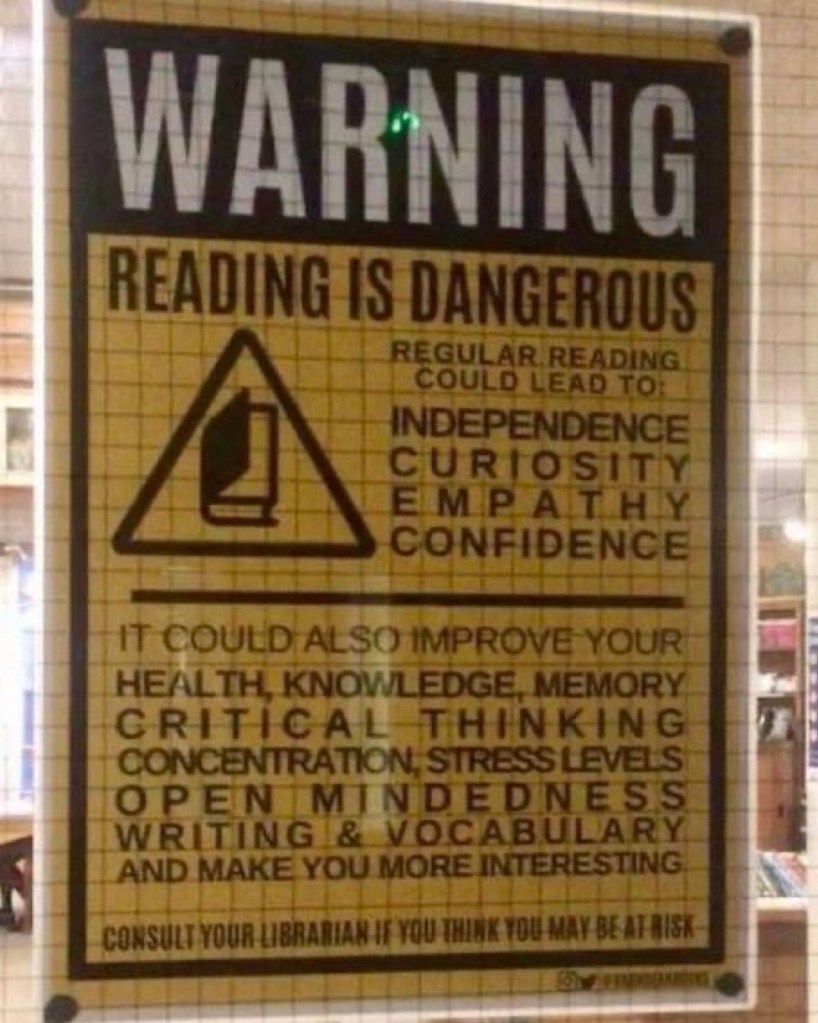
Read!

If you want to open your mind, read!

If you want to travel through time and space, read!

If you want to learn about other people and other cultures, read!

If you want to supercharge your creativity and imagination, read!

If you want to learn how other people see the world, read!

If you want to travel through time and space, read!

If you want to understand history, read!

Some people think these are dangerous activities. They want to control what students think. They censor books. They remove them from school libraries and public libraries. They forget that young people today have access to the Internet, which is not censored.

Live dangerously! Read books!

Greg B. is a regular commenter on the blog. He lives in Ohio. He is deeply knowledgeable about German history and literature. I enjoy his comments.

He wrote:

As much as many Americans crow about being the land of the free, etc., they don’t like to do the work of being citizens, much less engaged. With citizenship comes responsibility. When one is engaged with the history of this nation, one understands that the enslavement of Africans who were transported here and their descendants literally built this country. While we learn about elites, it was enslaving Americans that created capitalism and wealth for whites around the world. The descendants of those whites have benefitted immeasurably from the status quo and keeping status regardless of quo. Even those who weren’t direct descendants, yes even people who immigrated to the US in the 19th through 21st century have benefitted by virtue of not having immediately identifiable physical traits.

Those who continue to complain that they didn’t benefit from racism, who claim merit got them to where they are, conveniently forget that a large portion of the population never ever gets the chance to prove merit. And if they can, they are not promoted, they are paid less, and they are segregated to live in certain areas. Those who claim merit are scared of real competition; they like the game rigged, one that gives them advantages before they even start playing and excludes everyone else. They may claim equal opportunity, but they see in “woke” a threat to their status. Even poor whites in West Virginia and Utah don’t realize they’re being played as pawns.

For Black History Month, I reread a classic on enslavement and found these two nuggets that help explain it all: “The willingness of many white southerners to unite around the idea of hanging on to racial power made the South a swing region, and white southerners a defined interest group, willing to join whichever national party was willing to cater to its demands.” And, “…the unbending anger of former Confederates against Reconstruction morphed into their grandchildren’s suspicion of the New Deal, and the insistence of the part of white southern Democrats that measures against the Depression could do nothing to alleviate black poverty or lessen white supremacy.” That’s what they want to keep up.

Nostalgia for “The Lost Cause” and deep-seated racism keep white southerners tethered to a political party that keeps them poor.

North Carolina Representative Tricia Cotham ran for office as a Democrat. She pledged to oppose vouchers and restrictions on abortion. In April, she unexpectedly switched from Democrat to Republican. Her party switch gave the Republicans a supermajority in both houses of the General Assembly, the state legislature. This meant that the legislature now has the votes to override Democratic Governor Roy Cooper’s veto.

When the General Assembly recently passed a 12-week restriction on abortion, Governor Cooper vetoed the bill. With the vote of Rep. Cotham, the General Assembly overrode his veto. When she was a Democrat, she strongly supported women’s reproductive rights.

A few days ago, the General Assembly passed a universal voucher bill that provides vouchers to all students, rich and poor. Rep. Tricia Cotham sponsored the bill. The public schools of North Carolina will lose hundreds of millions of dollars. Every student currently enrolled in private and religious schools will get taxpayer dollars to subsidize their tuition.

Before her election, Cotham was a public school teacher, then a charter school lobbyist. After switching parties, she wasted no time in supporting a bill that removed oversight of charter schools from the State Board of Education, which is appointed by the Governor, and transferring it to a board appointed by the General Assembly.

The Washington Post reported:

Cotham, who represents part of Mecklenburg County, beat her Republican opponent by nearly 20 percentage points last year after a crowded Democratic primary. She ran on raising the minimum wage to at least $15 per hour, championing LGBTQ rights and expanding access to Medicaid, voting and affordable housing, according to her campaign website.

She switched parties, she said, because her fellow Democrats were mean to her and Planned Parenthood didn’t endorse her, despite her strong support for abortion rights.

Cotham’s mother Pat Cotham is a leading member of the North Carolina Democratic Party. She is on the executive council of the state party and a member of the Democratic National Committee.

As reported by Susan Runkunas in Jezebel, Cotham’s dejected staff members were baffled and disappointed. In the past, she was known as a passionate supporter of abortion rights. But then she supplied the one vote that Republicans needed to override the Governor’s veto. She supported gun control, but managed to be absent (along with two other Democrats) when her vote was needed to sustain his veto of a bill to eliminate the requirement of a permit to buy a handgun. .

Imagine campaigning for a Democratic politician—a thankless, low-paying job, especially at the state level—because you believe in what they stand for. The candidate gives powerful speeches about abortion rights that make you proud. You’re in a purple state, where every single seat in the legislature is critical to protecting abortion access. So you join the fight, help them win, and continue working for them in the legislature. Then inexplicably, in the middle of their term, that politician does an about-face, switches parties, and votes in favor of an extreme abortion ban, delivering Republicans the one vote they needed to override a veto and actually shutter clinics in the state.

Two (now former) aides to North Carolina State Rep. Tricia Cotham found themselves in that position earlier this month. Cotham, a Democrat until recently who was endorsed by EMILY’s List, had given speeches for years about abortion rights, sworn over and over to defend them, and even talked about her own medically necessary abortion. “My womb and my uterus is not up for your political grab,” she said in one particularly passionate 2015 speech.

Emily’s List has, of course, withdrawn its endorsement of the turncoat.

WRAL in North Carolina fact-checked her claims.

Carolyn K. Johnson writes about science and the business of healthcare for The Washington Post. She recently learned that her child had a rare and dangerous disease, and she became a warrior in a fight to get her private insurance company to cover the high price of the drug. She knows she had advantages unavailable to most parents, given her knowledge and access. What she shows is the fundamental unfairness of the American healthcare system. Another parent, without her background, might have been resigned to watching her child be permanently damaged or die.

Johnson wrote in The Washington Post:

When a salmon-colored rash flared on my 3-year-old son’s tummy one afternoon in August, I shrugged it off. The next time I asked Evan to lift up his shirt to take a photo, it was gone. When he stopped sleeping through the night, I thought it was a dreadful new developmental phase. But then on a Saturday, he stopped walking and spiked a 104-degree fever. A nurse gave me clear directions: “Get in your car, and start driving to the ER.”


After days in the hospital, the doctors had ruled out a long list of infections, as well as scary conditions like leukemia. That left them circling around a rare type of childhood arthritis called systemic onset juvenile idiopathic arthritis, or sJIA, in which the innate immune system, the body’s first line of defense against pathogens, goes haywire. Young children are tormented by daily spiking fevers, a fleeting rash and arthritis. Some develop a life-threatening immune activation syndrome. Untreated, destructive joint damage can occur. We were in shock.

But the doctors mentioned a drug that they’d probably want to try — anakinra, a biologic drug that blocks a key prong of the immune system and quells inflammation. Like most rare disease drugs, anakinra (also known by the trade name Kineret) was obscure, but I’m a health and science reporter and I’d heard of it. In 2020, I interviewed a pediatric rheumatologist, Randy Cron at the University of Alabama at Birmingham, who wanted to test whether anakinra could help people with severe covid-19.

Now, he told me that anakinra and similar biologics had transformed treatment for kids with sJIA. “Remarkably effective and safe,” he’d replied after I emailed him about our situation. “There may be a window of opportunity early during treatment to get the best long-term benefit.”

Anakinra was clearly the favored route back to health for Evan. We were determined to take advantage of any early “window of opportunity.” Unfortunately for us, our insurance company, Aetna, disagreed. We began a health journey that many people encounter when dealing with rare diseases, health insurance and pricey drugs.


Anakinra is expensive — on average, private health plans pay about $4,000 a month for it — so we needed to get approval before it would be covered. In early September, Aetna denied the request, requiring an additional test. Our doctors ordered the test and appealed.


In October, after another emergency room visit, daily spiking fevers, $2,000 of bloodwork and a growing feeling of despair about whether our son would ever be able to walk or play normally again, I received a letter from Aetna. It was a decision to “uphold the denial” to cover the drug, and it came from a team led by a urologist, a medical specialty that would not typically treat sJIA.


Aetna required that Evan try 30 days on drugs such as naproxen or ibuprofen, or two weeks on a steroid first to see if those worked. This type of decision isn’t unusual — nearly all insurance companies use this process, called step therapy, and it’s meant to save health-care dollars.

The idea is a logical one — to “step” up from inexpensive therapies to more expensive ones. It’s a guard rail to prevent unnecessary spending on drugs that cost more but may not offer much more benefit.

The painful irony was that we already had tried those medicines. A few days on ibuprofen and we were back in the ER. It failed to control Evan’s miserable fevers or assuage his knee pain. Steroids, which Evan was still taking, were only sort of helping.


We carried him between his bed and the living room couch, the only two places he was comfortable. We hand-fed him bites of food in bed. We went back to using diapers. One day, I tried to encourage Evan to walk, but watched in horror as I saw his knees buckle underneath him in slow motion, nearly falling backward down a flight of stairs. My mom came to help out, but left our house in tears after a few minutes.

In the midst of our August to October limbo, Evan received his first doses of anakinra through a free program offered by the drugmaker — and his symptoms dissipated. One of his rheumatologists had described this almost magical effect. Before the drug was standard treatment, one of her patients suffered from fevers for a full year. They had abated within hours of the first dose.


Patients vs. insurance companies

This isn’t a unique story about American health care, a single high-priced drug or just one insurance company. It is a tale of routine aggravation, inconvenience, futility and fear, but fortunately, not tragedy. Our battle was hair-raising but typical.

What’s different is that I have more tools, more time and more knowledge about how the system works than the average health-care consumer.


Before I came to The Washington Post, I covered science in Boston — the epicenter of the biotech industry and its sometimes miraculous, almost always high-priced drugs. I had been welcomed into the homes of families on diagnostic odysseys for children with rare and sometimes life-threatening illnesses. At The Post, my first job focused on the affordability of health care to consumers, particularly the weird economics behind drug prices.

I was also knowledgeable, even sympathetic, to the rationale behind insurance company policies that cause immense frustration to people. I’ve interviewed insurance and drug company executives, but I also did billing for a pediatric neuropsychology practice part-time after college.
I felt like I had been preparing for a situation like this for years.

Trying everything

Biologic drugs such as anakinra are produced in bioreactors by living cells. They’re given by injection or IV infusion and are much more expensive to produce than the familiar yellow jar of pills that people pick up at the pharmacy. Prices vary, but the monthly costs typically have a comma in them.

Insurance companies often put obstacles in the way of access to high-priced drugs. There are sensible reasons for this. Doctors aren’t incentivized to pick the most cost-effective care. They are the targets of aggressive marketing by pharmaceutical companies pushing new, more expensive drugs. Yet older, cheaper ones may work just as well.

Like other insurers, Aetna says that its step therapy program had been “designed to ensure patient access to clinically appropriate, evidence-based care” and is updated as new evidence becomes available.
So when the company denied the drug right off the bat in September, upset and worried as we were, we were also not surprised.

The doctors appealed the decision. We crossed our fingers. Evan’s fevers came under control while he was on high doses of steroids, but he refused to walk, couldn’t sleep at night, demanded meals at 1 a.m. and never seemed comfortable. He spent most of his time in bed, moaning. And we waited.

These insurance barriers are so common that drug companies sometimes provide initial doses of a drug for free, to bridge the time before insurance begins to cover it. Which is why, as we awaited action on our appeal, we were able to get three weeks’ worth of free drugs from Sobi, the drugmaker. It was enough though to get our little boy out of bed and eating dinner at the table for the first time in weeks.

These free drug programs are not a form of selfless charity. They offer immediate access to patients but also give drug companies cover, insulating them against critiques of the prices of their medicines.
“Once they hook you, they are going to go to the insurer and get the real dollars,” Ezekiel J. Emanuel, an architect of the federal Affordable Care Act and a professor at the University of Pennsylvania, told me.

Put more simply: Health care is a battlefield. Patients often become cannon fodder.

I knew all this. I expected it. Still, when our appeal was denied in October, I felt like I had been punched.


Several specialists told me that a short trial of ibuprofen — not 30 days — could be tried, but in their experience didn’t work in most children with this disease. Steroids are not recommended as an initial solo therapy by guidelines and, if used, are cautioned to be limited “to the lowest effective dosage for the shortest duration possible.”


“Your son was sick, but some of these kids die,” said Cron, who co-wrote the 2021 American College of Rheumatology guidelines on how to treat sJIA. He has also served as a consultant to Sobi, receiving $6,400 in fees in 2021. “So if you waited to put him on anakinra, that would not go well.”


The sludge effect


After I received that denial in October, I set aside chunks of time each day to make phone calls — primarily to my insurer, but also to a care manager at Sobi’s patient support program, Evan’s rheumatologists and a specialty pharmacy in Massachusetts that had sent us the free drugs.


Why was I notified of the denial nine days after the decision? Why did a urologist, who had probably never seen a child with sJIA, have the last word on how my son should be treated? I wanted another option besides filling out a second appeal form and faxing it into the void. I was terrified about what would happen when we used up our last dose in a few days.
I kept detailed notes about the calls. Jordan, Alicia, Joseph, Alex, Alexis, Julie, April, etc., were polite but largely unhelpful. My son’s doctor suggested screaming and crying to get better results.


This tip — a serious suggestion — pushed me over the edge. I called other rheumatologists to find out if what we were going through was unusual. No. Other doctors echoed what our own had told us: requests typically got denied right off the bat, but were often approved after an appeal — or two.

Put more simply: Health care is a battlefield. Patients often become cannon fodder. I knew all this. I expected it. Still, when our appeal was denied in October, I felt like I had been punched.

The struggle varied, depending on the insurer and the specific drug that the child needed, but it seemed especially cruel in this case, because “there isn’t a clear alternative that has a reasonable chance of being effective,” said Grant Schulert, a pediatric rheumatologist at Cincinnati Children’s Hospital.


“It’s something we spend a huge amount of largely uncompensated time on, as providers. And for patients, it delays significantly the time it takes to access care,” he added.


There is a name for what I was going through, which is also an accurate description of how I felt: sludge. The administrative burden of people dealing with their insurance adds up to about $21.6 billion a year in lost productivity, half of it during work hours, according to a paper from Jeffrey Pfeffer at Stanford Graduate School of Business.


Pfeffer said that, like me, he got interested in the problem when he ran into insurance barriers and realized how many advantages it took to succeed. “I have fancy doctors who know how to play the system,” Pfeffer said. “If you don’t have those resources, if you’re a less-educated human being with a crappy job and maybe African American or Latino, your ability to access the system is much less.”


I tweeted about my frustration, without mentioning most of the details — and got an outpouring of empathy. My Twitter profile identifies me as a Washington Post reporter, but I shared the story because it felt like a universal problem with American health care. Someone offered to ship doses from their personal stockpile of a similar drug. People inside insurance companies messaged me, offering personal contact information for executives. A person with Type 1 diabetes told me that due to her activism online, she had been labeled a “media threat” and now had the phone number of a person inside her insurance company to help get prescriptions covered.

Receiving health care shouldn’t require special favors. I interacted with Aetna as an ordinary health-care consumer, and kept trying 800 numbers.


After nearly three weeks on the anakinra doses supplied by Sobi, Evan’s doctors confirmed what we knew. He was so much better. Bloodwork showed his out-of-whack immune response was headed back in the right direction. After weeks of refusing to stand or walk across a room, he ran down the hallway and smiled behind his mask. We’d gone hiking.
It was great news, but we had only one syringe of anakinra left in the fridge.
Because getting anakinra covered had proved so difficult, our medical team had decided to shift gears a week before we even knew about the final denial. They decided to try, in parallel, to see if insurance would approve a different biologic drug called canakinumab that worked in a similar way but cost about four times as much. The doctors had started with anakinra, a fast-acting, once-a-day injection, to see if Evan responded. They’d preferred, based on his case, to start with a short-term daily shot, instead of canakinumab, which is given once a month and offers less flexibility.
Shortly after we lost the battle for anakinra, we qualified for a free first dose of canakinumab from Novartis, the company that makes that drug. But with only one syringe left in the fridge, there would be a gap. These drugs can’t just be picked up at the local pharmacy. Our free dose would be shipped to us from a pharmacy in Massachusetts, then we’d need a nurse to come to our house to administer it.
Our doctors mulled various options. Could we go to the ER to get a shot? What about going back on high-dose steroids? That afternoon, I took out our last syringe, and began squirting bits of the medicine into other syringes. It was not a recommended practice, but a way to stretch the supply.
Three days later, our first free dose of the new drug arrived. A nurse came on a Sunday at 8 p.m. to give it to Evan. His illness stayed at bay.
This is, in many ways, a story of a success in saving health-care dollars. For two months, our health insurance avoided paying for expensive drugs. The canakinumab was ultimately covered.
In January, after an editor suggested I write about the experience, I asked Aetna for their perspective.
“In reviewing the situation for your son, our team could have explained all requirements for step therapy more clearly in the first letter to you. Our initial decision was upheld on appeal, based on the information we had available at the time,” Aetna spokesman Ethan Slavin said in a statement. “We are working to clarify our communications process on these types of matters.”


Aetna said the canakinumab was approved because it was subject to different rules. “Your health care provider submitted the request as a continuation of existing care,” Aetna said in a statement. Reading between the lines: Evan was doing well on another biologic drug when the doctors made the request for the new one. He now qualified for the treatment, no thanks to our health insurance.

As a journalist, I often found prior authorization a difficult story to sell to an editor. The process caused families stress and delayed needed treatment. It drove doctors and nurses absolutely crazy. But it is a clumsily applied Band-Aid on a legitimate problem: high-priced drugs.

And as with us, a Rube Goldberg-like workaround often materialized.
The people who simply give up may not have the time, resources or sense of entitlement to keep fighting — or tell their stories to reporters.
In our case, we patched together two free drug programs and split up doses. It was incredibly precarious, time-consuming and tense. Other families face longer, harder fights. We were lucky. It was still horrible.


We don’t know what the future holds. Evan might need the medication long-term. He might need to try other drugs, if it stops working. He may be able to wean off it. What we do know: We’ll need to be ready for the next battle.

My struggle to get essential health care covered taught me how isolating the experience can be. We would like to collect these stories.

Have you struggled to get insurance to pay for high-priced drugs? Tell The Post your story here: wapo.st/insurerstories.
Paul Bonner is a retired educator. I’m very happy that he comments on the blog. He is wise.

He writes:

You can’t drive a Mercedes Benz while paying monthly payments for a Pinto. First, public school effectiveness would be positively impacted if we invested in teacher training, resource support, and profoundly better pay. Would this cost more than current outlays?

Certainly. In the fall of 2022, the Congress passed a defense spending bill that was 48 billion higher than requested by the Department of Defense, claiming we had seriously depleted arm stocks due to Ukraine. Currently over 50% of our defense spending goes to private corporate arms interests.

Four years ago General McChrystal said adequately funding our public schools is our biggest National Security concern.

So, if we are so willing to overspend for defense, why aren’t we willing to invest in the public schools? Exclusive private K-12 schools now charge $30,000 and up to provide quality instruction, small classes, and, basically, a liberal arts education.

According to the Education Data Initiative, the US averaged $13,700.00 per student in the public schools. This does not account for the inequality that exists because schools are predominately funded by property taxes.

We cannot get better schools with current spending. That’s the point. Public schools are an investment. The defense department is a privatization scheme run by CEO’s who make millions of dollars a year bilking the Federal Treasury. Which investment would make us safer?

The mainstream media has given ample coverage to the likelihood that Florida Governor Ron DeSantis is likely to announce his candidacy for the Republican nomination for president in the next week. The stories about him treat him as a normal elected officials. They do not reference his multiple efforts to censor ideas and people he doesn’t like; to ban teaching ideas he doesn’t like; to ban textbooks that include ideas he disagrees with; to persecute drag queens and gay people. The American people need to know who he is. DeSantis’ regime of censorship is a pathetic attempt by pasty-faced cowards to dumb down the students of Florida. They can’t succeed because everyone has access to the Internet and television, where they will learn about the lies the state is teaching them.

Scott Maxwell is a regular columnist for the Orlando Sentinel. He is fearless. In this post, he writes about Governor Ron DeSantis’ purge of knowledge he doesn’t like.

The headlines are as abundant as they are dystopian:

“Florida rejects, amends many social studies textbooks”

“An Entire Florida School District Has Banned a Kids’ Book on Segregation”

“Florida bans more than 40% of math books after review”

“350+ Books Banned in Florida School Districts Since Last July”

A knowledge purge is underway in Florida. The targets: History lessons that politicians want hidden. Perspectives that make parents uncomfortable. Truths that ideologues find inconvenient.

Basically, we have people who want to control the narrative. And they think it’s easier to do that if kids don’t know all the facts.

Now, it’s hard to get your hands around both the scope and the specifics of this purge, because education officials are censoring so much and revealing so little.

In the latest salvo, Gov. Ron DeSantis’ education department rejected 35 different social studies books — more than a third of all they reviewed.
Florida rejects some social studies books, forces ‘Take a Knee’ out of one

But to justify their actions, they released snippets from only six of the books they shunned or ordered altered. So you don’t have much to go on.
But let’s look at one of those six examples. It’s from an elementary school textbook that teaches children about patriotism.

DeSantis staffers approved passages that instructed students to learn the Pledge of Allegiance and encouraged parents to stress the significance of the national anthem. But they did not want kids hearing why they might see some Americans, especially athletes on TV, take a knee during the anthem.

Specifically, the Florida Department of Education ordered the textbook to remove a section that suggested parents — not teachers, mind you — use that lesson on patriotic traditions “as an opportunity to talk about why some citizens are choosing to ‘Take a Knee’ to protest police brutality and racism.” DeSantis staffers ordered that suggestion stricken.

A popular talking point for people who dislike athletes taking a knee is to describe them as “anti-American,” “anti-cop” or “unpatriotic.” And it’s easier to peddle that narrative if students don’t hear why the players themselves say they’re doing what they are.

Personally, I think there’s valid debate over taking a knee. I can see why some players would. I can see why many people would dislike them doing so. It’s not really that hard to understand the divide — if you listen to what people on both sides are saying.
But the new Florida model of education doesn’t want to share all sides. The censors say kids aren’t ready for these discussions. Really, though, it’s the adults who are scared their kids might hear a different perspective. They’re the snowflakes.

The DeSantis censors also axed a section about Black Lives Matter from a middle school textbook that presented both pro and con perspectives on the social movement. The passage described the killing of George Floyd, explained that social media gave rise to civic activism and then gave a brief explanation of why some people supported Black Lives Matter and an even lengthier description of why others opposed it.DeSantis’ education staffers ordered the entire section removed.

At least one of the passages DeSantis staffers removed looks justifiably flagged. It’s a section from a middle-school book that attempts to teach students what a socialist form of government is.
The first part does a fine job explaining that, in a socialist society, the government controls much of the means of production, but then says: “It keeps things nice and even and without unnecessary waste.” Um, what? That seems more like a pom-pom for socialism — and a pretty skewed one at that — than a civics lesson. Yank it out.

But here’s the problem: DeSantis staffers shared a reworked version of the textbook that met their approval. It removed the word “socialism” altogether, replacing it with “planned economies.”
I’m no fan of socialism, but I’d sure like students to have a correct understanding of what it is. Why? Because the vast majority of adults who scream about socialism absolutely do not. They somehow believe anything government-funded is “socialism” … and then turn into Cletus the Slack-jawed Yokel when you ask them if that means Medicare and highways are socialist as well.

I’d love to see students better informed than these adults. But that seems to be the last thing the grown-ups want.

Last year, before state officials were rejecting social studies textbooks, they were flagging math books for being allegedly too woke. A handful of people apparently believed liberal boogeymen had infiltrated the nation’s algebra-instructional complex. And the handful got their way.

Some of this censorship is silly, political theater. Some is a serious effort to indoctrinate.

One publisher, Penguin Randomhouse, sued the Escambia County school district last week over its book-banning. Other publishers agree to comply with whatever censorship orders they’re given as they’re more interested in selling textbooks than standing on any sort of educational principles.

Then there are all the school library books being banned in historic numbers, thanks to the Republican-led Legislature’s new book-banning bill — books about everything from the civil rights movement to nontraditional families.

School book challenges, already on rise, could escalate in Florida

The Lake County school district pulled a picture book about the true story of two male penguins in Central Park Zoo who raised a chick after the zookeeper gave them an egg. A Panhandle district removed a book about school segregation in the 1950s with the New Republic reporting the district concluded the subject matter was “difficult for elementary students to comprehend.”

I don’t think kids are the problem here. In fact, the local banning crusades are sometimes led by just one or two adults who not only want to shelter their own kids from ideas they find scary but want to keep books away from everyone else’s kids at school as well.

I thought of all this book-banning and history-censoring while attending a recent session on the rise of antisemitism at the Holocaust Memorial Resource and Education Center of Florida. One panelist said the best way to combat hatred, intolerance and ignorance is to ensure children hear unvarnished truths. He described it as “The criticality of giving truth to our kids.”

The leader of a Holocaust Center in South Florida made a similar point recently stressing: “The Holocaust, it didn’t start with guns and death camps. It started with words.”

Well, words are precisely what Florida is trying to ban, censor and distort. In unprecedented fashion.

smaxwell@orlandosentinel.com

Let’s start at the beginning.

The Founding Fathers did not mention the word “education” in the Constitution. They left it as a state responsibility. However, the Founding Fathers did not ignore education. They drafted and approved the Northwest Ordinances of 1785 and 1787. These documents assured that new states would enter the United States on an equal footing with existing states. The Northwest Ordinance of 1785 declared that new towns would consist of 36 plots. One plot—#16, in the center of town—was to be set aside for a public school. Nothing was said about setting aside a plot for religious schools or private schools. Those were left to private discretion. (To learn more on this topic, read Derek Black’s Schoolhouse Burning; Black is a professor of law.)

The Northwest Ordinance of 1787 forever banned slavery in the new states. And it included this provision: “Religion, morality, and knowledge being necessary to good government and the happiness of mankind, schools and the means of education shall forever be encouraged.”

Those today who seek to divert public funding to religious and private schools are repudiating the intentions of the Foundding Fathers.

The following tweets seem closer to understanding the wishes of the Founding Fathers than do the legislators of Arizona, Ohio, and other states that are using public funds to subsidize religious and private schools.

Bob Shepherd is a polymath and a daily reader of the blog. He has been involved in every aspect of educational publishing, and most recently, he was a teacher in Florida. He graciously offered to help me with two of my books—The Language Police and Slaying Goliath—by carefully editing them before they were turned in to the publisher. And we have never met!

He wrote on his own blog:

A few years back, a friend, someone whom I respect, challenged me on Facebook, saying that Trump might be a lot of things, but he wasn’t an actual Fascist. Well, I beg to differ. If it steps like a goose, . . .

Here are a few of the clear signs that, yes, Fascist is precisely the term to describe Trump, his supporters, and those who wish to assume the orange mantle:

Alliance with other Fascists/Authoritarians. D.T. allied himself with violent, extremist authoritarian nationalists around the globe—with, of course, his handler, Vladimir Putin, but also with Rodrigo Duterte, Narendra Modi, Jair Bolsonaro, Recep Erdoğan, Viktor Orbán and even, shockingly and weirdly, with Kim Jong-un. Hitler allied himself with extremist authoritarian nationalists around the globe—Mussolini of Italy, Hirohito of Japan, Tsar Boris III of Bulgaria, Horthy of Hungary, Antonescu of Romania, Tiso of Slovakia, and Pavelić‘of Croatia (see the Tripartite Pact signed in September of 1940 and joined later by other members of the Axis Powers).

Use of Violent Citizens’ Militias. D.T. supported and employed on numerous occasions armed, right-wing citizens’ militias, notably

a) at the March on Charlottesville by neo-Nazis who chanted “Jews will not replace us” and murdered an antifascist protestor;
b) when a group of these self-appointed militiamen invaded the Michigan Capitol and Legislature, armed, and plotted to kidnap and murder Michigan’s governor; AND
c) when several groups of these, including the Proud Boys and the Oath Keepers, broke into and ransacked the U.S. Capital, beat police officers, caused injuries that led to deaths, called for hanging the Vice President, and tried to overthrow the incoming government of the United States by preventing its certification.

Trump approved of all these actions by Citizens’ Militias, saying in the first instance that there were “Good people on both sides”—the Nazis and those opposing them–and in the latter instances that these were “patriots.” And, of course, he planned and stoked the last–the January 6th insurrection. In addition, he called on his Attorney General, Secretary of Defense, and Chairman of the Joint Chiefs to violate the Posse Comitatus Act and send federal troops to attack BLM protestors, which Barr sort of went along with his little green men (Esper and Milley, to their eternal credit, declined). Hitler, of course, infamously used citizens’ militias, the Sturmabteilung (the SA, or brownshirts), to provide protection at rallies, to attack enemies, and, with the SS, to carry out the infamous attacks on Jews during Kristallnacht. When asked to denounce white supremacy in a debate, Trump responded by saying, “Proud Boys—stand back and stand by.”

Monumentalism. D.T. loved monuments and monumental architecture and got a lot of political mileage out of riling up supporters of continuing to have on display in the public sphere commemorative statues of genocidal maniacs and enemies of the United States (Columbus; slave-owning men who led forces of insurrection during the Civil War). He organized a Republican Convention that was replete with monumental architecture and iconography. To do this, he violated the law by using the White House and its grounds as a political campaign/convention set. He called for absurdly expensive military parades of the kinds one sees in Communist China, North Korea. and Putin’s Russia. Trump called for building a massive “patriotic” sculpture garden. He held monumentalist nationalist events like the 4th of July military airshow at Mount Rushmore. Hitler, of course, employed Albert Speer to build monumentalist fascist architecture and devoted a great deal of his time to this.

The Cult of Personality. D.T. constantly referred to himself as “the best” or “the greatest” this or that and plastered his name on everything, from massive amounts of merch (Trump steaks, Trump straws, Trump flags) to buildings to letters accompanying Covid relief checks. He turned every discussion of every issue into one about himself and how great he is, even events that were supposed to be to honor Gold Star families or present information about how not to die from a virulent pandemic. Like a mob boss or any other Fascist leader, he required loyalty oaths and fired people who didn’t make them. At every cabinet meeting, cabinet members were expected to preface their remarks with long exhortations about the greatness of Trump (for an abject lesson in human self-abasement, go listen to a recording of one of these delivered by Mike Pence, to whom, of course, Trump showed no corresponding loyalty). He literally described himself as “the only” person who could solve the country’s problems. Clearly, Trump suffers from malignant narcissistic personality disorder. Conjure in your mind, if you have the stomach for it, a typical Trump rally. Trump created a cult of personality, just as all Fascist strongmen have done—Hitler, Mussolini, Franco, Mao, Pinochet, the Kim Dynasty of North Korea, etc. The difference, of course, is that Trump was merely a WANNABE Fascist strongman.

The Myth of the Return to Racial and National Greatness. D.T. constantly referred to a mythical Golden Age to which he would return the country and even made this his official slogan (“Make America Great Again,” or MAGA). This was, of course, precisely what Hitler did, calling for a return to a time of Aryan and German greatness–the major theme of his propaganda and writing and speeches.

The Racial Supremacy Myth/Use of Racism to Mobilize the Masses. D.T. constantly issued racist dog-whistles, from his ad attacking the innocent members of the Central Park Five to his Obama birtherism to his calling asylum seekers “caravans” and “hordes” of “rapists and murders” to his references to “s—thole countries” to his “Good people on both sides” to his planning of rallies at sites of racist violence (near the Alamo, Tulsa, etc.) to his suggestions that China purposefully engineered and released SARS-COV-2, which Trump variously referred to, in his racist way, as the “China flu,” the “Wuhan flu,” and so on. And, of course, Trump built his whole campaign, initially, on the racist idea that America was being taken over by immigrants and that in order to “have a country,” we would need to keep out the brown-skinned hordes. In fact, this is why Jeff Sessions, Steve Bannon, and Stephen Miller chose Trump to run in 2015 to begin with. See the Frontline documentary about this, Zero Tolerance (2019). Trump called for the Border Patrol to SHOOT innocent asylum seekers and screamed at his Secretary of Homeland Security for saying that she couldn’t do that. Hitler baked anti-Semitism into the Nazi ideology. Both leaders ran concentration camps targeting members of particular ethnic groups. Both committed horrific Crimes against Humanity (Hitler’s genocides; Trump’s kidnapping of immigrant children and separation of these from their parents).

Scapegoating and Call for the Elimination of Enemies Within. D.T. constantly referred and continues to refer to “enemies within” that have to be eliminated “or you’re not going to have a country anymore.” These he refers to as Socialists, the “Radical Left,” “Antifa,’ and so on. One of Trump’s favorite and most often used slurs is Enemy of the People, a phrase that goes all the way back to Roman times and was famously the title of a great play by Ibsen. Calling for the elimination of enemies within is, of course, exactly what Hitler did, blaming Germany’s troubles, such as its loss of World War I and its hyperinflation on “enemies within”—Jews and Socialists and Communists—who had “stabbed the country in the back.” But it was, of course, the extreme left-wing Fascist leaders in Russia and East Germany, during the Stalin Era, who made Enemy of the People a standard catchphrase in the 20th Century, but Trump is too ignorant to know this, to know that every time he calls Biden or Fauci or whomever an “Enemy of the People,” he is sounding just like the murderous Joseph Stalin. (And yes, you can have Fascists who come to it from the left.) And even if Trump did know this, it probably wouldn’t bother him in the least bit. Trump has expressly said that he was unhappy with “his” generals because they didn’t show him the deference that Hitler’s generals showed to Hitler. Of course, Trump doesn’t know, because he is profoundly ignorant, a bear of very little brain, that a number of those very generals tried to assassinate Hitler several times. LOL. Be careful what you wish for, Donnie!

The Fascist Rally. D.T.’s main method of communication with his base was the large-scale rally—precisely the sort of method used by Hitler, with Goebbels and Speer as organizers and Leni Riefenstahl to film these.

Indoctrination of the Young. Trump called for the creation of an overtly exceptionalist, nationalist curriculum. Hitler did the same (see, for example, the Nazi textbook on Aryan supremacy, Rasse und Seele) and also created his Hitler Youth, his League of German Girls, and his Lebensborn Program.

The National Supremacy Myth. Trump’s American Exceptionalism, Hitler’s Übermenschen and Deutschland über alles. Same diseased thought.

Eugenics and Genetic Determinism. D.T. constantly referred to his “good genes” and what he called his “racehorse theory” of what constituted a fine woman–one who was properly bred. Despite the fact of his almost total scientific ignorance, he was and is committed to a myths of Eugenics and genetic determinism–one of the central myths, of course, of Nazi ideology. And this myth, of course, supports the racial and national superiority myths.

The Erasure of the Concept of a Nation of Laws and Totalitarian Insistence That His Will Is the Law. Trump insisted, “I have an Article 2 that says I can do anything I like as President.” He seems to think that he could just magically wave his hand and declassify documents and that, at any rate, rules about preservation and secrecy didn’t apply to him because NO RULES apply to him. Trump treated agencies and departments of the government as HIS, insisting, for example, that “His” generals and “His” DOJ and “His” everything else be absolutely subservient, and he fired or attempted to fire anyone who disagreed with him about anything. Barr went along with basically turning the DOJ into Trump’s private law firm. Hitler, of course, had the Enabling Act, making his will and the law identical. This the Fascists like Trump and Hitler share with Absolute Monarchists, the idea that L’état, c’est moi. Belief in the absolute authority of the Glorious Leader (Trump thought his image should be carved onto Mount Rushmore) is what puts the “total” in Totalitarianism.

The Portrayal of Himself as the Ultra-Masculine Leader, the Archetype of the Masculine, the Strongman. Trump loves to talk about how tough he is and constantly made threats via Tweet, yelled at staff, tore up briefs, and actually threw things when he got mad. And he constantly degraded women, speaking of grabbing them by the genitals, bragging about being able to get away with sexual assault, yelling at his female Secretary of Homeland Security and calling her “Honey,” making disgusting remarks about female celebrities and reporters. He actually ran a freaking old school beauty pageant. He bragged about walking in on the women while they were dressing because as owner, he could get away with it. He was a big pal of Jeffrey Epstein’s. Of course, Trump didn’t have the physique to portray himself as a male sex symbol, so he tweeted out pictures of his face Photoshopped onto the body of fictional boxer Rocky Balboa and actually sold this image on his website. Over twenty-five women have accused him of sexual assault. He paid off a porn star and a Playboy bunny to keep quiet about affairs with him. And in these respects, Trump was in the mold of other Fascist leaders who promulgated hyper-masculinized images of themselves (along with a big dose of hyper-sexism)–think Mussolini and Pinochet and Berlusconi and of Hitler’s military garb and Putin’s shirtless, horseback photoshoots.

One could go on and on. In Trump one had and has ALMOST the complete Fascist package. The one element that was missing was the competence to pull it off. Trump is far too ignorant and stupid to have effected a Fascist revolution in America. The next guy will have all Trump’s Fascist tendencies but be smarter and more knowledgeable.

P.S.: It is extraordinarily important to call Fascism out when it rears its monstrous head, to call it what it is. Why? Because silence is complicity. It’s letting it happen again. It’s making the same mistake that Germans made back in 1932-33, expecting that it’s not going to be all that bad. That experience is behind us all now. We are supposed to know better. It CAN get that bad, that quickly. Been there, done that. In the middle of the last century, we fought a war to end this shit. Here we are seeing it again, right here, on our soil. Who would have imagined that we would have slid so far backward? These must be more than just words: Never again.

The editorial boards of the Orlando Sentinel and the South Florida Sun Sentinel published this commentary on Governor DeSantis’ campaign to demonize being “woke.” What does it mean to be woke? It means being aware of systemic injustice. Did systemic injustices occur in the past? Yes. Do they occur now? Yes. Should we banish teaching or learning about systemic injustices, as DeSantis demands? No. That would mean teaching lies. Can we blame teachers or schools for the drop in scores on NAEP (the National Assessment of Educational Progress) when politicians like DeSantis require teachers to teach their students lies?

The editorial says it’s good to be woke:

Have you noticed? Gov. Ron DeSantis doesn’t smile enough. His brand is anger, especially at anything he can ridicule as “woke.”

Disney is “woke.” Diversity is “woke.” His obsession to cleanse Florida classrooms of discussions of racism was the “Stop W.O.K.E. Act.”

He took over New College of Florida because it was “woke.” He suspended Tampa State Attorney Andrew Warren because his policies were “woke.”
Florida “is where woke goes to die,” he says. This four-letter word has lost much of its punch, purely from overuse.

But it really doesn’t matter whether people have any idea of what “woke” means — just that it sounds bad.

But what does it mean, really?

‘Systemic injustices’

As good an answer as any came from DeSantis’ general counsel, under questioning from Warren’s attorney in federal court.

“The belief there are systemic injustices in American society and the need to address them,” lawyer Ryan Newman replied, adding that DeSantis doesn’t share that belief.

He doesn’t? No society is without injustices. To pretend that ours is is ludicrous.

The term “woke” originated in Black culture almost a century ago. According to the Legal Defense Fund, it became an “in-group signal urging Black people to be aware of the systems that harm and otherwise put us at a disadvantage.”

Those are precisely the systems that DeSantis pretends don’t exist, and that he doesn’t want Florida schoolchildren and college students to learn anything about. His hijacking of the word “woke” is ironic, to say the least.

Obnoxious objectives

His objectives, like that of copycat Republican politicians, are threefold. One is to cater to bigoted and resentful white voters. Donald J. Trump taught them the effectiveness of that. No. 2: Breed a generation of future voters who will have learned nothing about racism’s history or continuing consequences.

The third objective, not quite so transparent but equally pernicious, is to desensitize the nation’s courts to systemic economic and political injustices, many of which afflict poor white people just as much as Black people. The Florida Supreme Court bought into this when it purged diversity guidelines from the Florida Bar’s continuing education criteria.

There hasn’t been such a cynical disinformation campaign since the Daughters of the Confederacy set out more than a century ago to reinvent the Civil War and Reconstruction. In that distorted looking glass, slavery had nothing to do with the war; it was the South fighting for freedom and the North fighting against it. That’s how children were to be taught.

Writing in The New York Times, Harvard Professor Henry Louis Gates Jr. described how the Daughters suppressed textbooks to the extent of rejecting any that described slaveholders as cruel. Slavery, wrote the Daughters’ historian, “was an education that taught the negro self-control, obedience and perseverance.”

“Undertaken by apologists for the former Confederacy with an energy and alacrity that was astonishing in its vehemence and reach, in an era defined by print culture, politicians and amateur historians joined forces to police the historical profession,” Gates wrote. “The so-called Lost Cause movement was, in effect, a take-no-prisoners social media war.”

The racism didn’t go away when the South lost the war and slaves were freed. It fostered sharecropping — slavery by another means. It rationalized Jim Crow laws, lynchings, inferior schools and a denial of the right to vote that persisted until 1965. It led to federal housing policies that confined Black people to urban ghettos. It was evident when Social Security initially excluded domestic and farm workers on the fiction that it would be too difficult to collect the taxes.

It remains glaring today in the statistic that Black Americans, who account for 13% of the population, are 27% of the people shot and killed by police. It was evident when the Tennessee House of Representatives expelled two Black members over a gun violence protest in their chamber, but not the Caucasian legislator who protested with them. It is apparent in the increasing re-segregation of public schools; profound racial disparities in income, health and mortality; and the persistence of fair housing and fair employment violations.

Exposure is essential

The remedy for injustice begins with exposure. It is essential. To conceal it is to be complicit in the injustice.

To teach American history through rose-colored glasses, as DeSantis intends, is to ignore the heroism and sacrifices that every generation has made toward fulfilling the belief that “all men are created equal.” That so many Americans have risen so often to that challenge speaks well of our nation, not poorly.

A federal judge has temporarily blocked one of DeSantis’ schemes — the law allowing educators and private businesses to be sued for making students and employees feel guilty about racism — but the destruction of the schools and universities goes on.

It’s up to the voters whether that continues. It’s better to be “woke” than silent any day.


The Orlando Sentinel Editorial Board includes Editor-in-Chief Julie , Opinion Editor Krys Fluker and Viewpoints Editor Jay Reddick. The Sun Sentinel Editorial Board consists of Editorial Page Editor Steve Bousquet, Deputy Editorial Page Editor Dan Sweeney, and Anderson. Send letters to insight@orlandosentinel.com.


© 2023 Orlando Sentinel