Jeffrey Fleishman of the Los Angeles Times describes the assault on librarians by rightwing groups and parents who want to ban books. Across the country, but especially in red states, librarians are vilified as “the arm of Satan” by those who want to control what books are on the library shelves. If you want to read a concise summary of book-banning, read my book The Language Police, published by Knopf.
He writes:
In her time as a Texas school librarian, Carolyn Foote watched the image of her profession veer from “shrinking violets behind spectacles” cataloging titles to “pedophiles and groomers” out to pollute the minds of the nation’s youth.
“Librarians came from a climate of being so appreciated to hearing this message that we’re reviled,” said Foote, co-founder of Freadom Fighters, an advocacy group for librarians that has nearly 15,000 Twitter followers. “It was an astonishing turn of events.” A lot of librarians are asking themselves whether they want to remain in the profession, she added. “At least five people I know have retired early.”
Once a comforting presence at story circle and book fairs, librarians have been condemned, bullied and drawn into battles over censorship as school and library boards face intensifying pressure from conservatives seeking to ban books exploring racial and LGBTQ themes. Those voices have grown stronger in red states since the pandemic, when parental groups opposed to mask mandates expanded their sights and became more involved in how and what their children were taught.
Recent polls suggest most Americans are not in favor of banning books. But concentrated pressure by politically connected parental groups, said Peter Bromberg, a board member at EveryLibrary, a nonprofit library advisory group, “has librarians facing a great deal of stress. There are signs on people’s lawns calling librarians pedophiles.” They face pressure from principals and administrators over book displays, and “neighbors talk about them being an arm of Satan.”
The Patmos Library in Jamestown, Mich., which lost public funding after a campaign by conservatives, forcing it to rely on donations.
(Joshua Lott / Washington Post via Getty Images)
Some librarians are fighting back; others have lost or left their jobs. The culture wars over books come at a time when about 27% of public libraries have reduced staff because of budget cuts and other reasons, according to a 2021 national survey. Lessa Kanani’opua Pelayo-Lozado, president of the American Library Assn., said librarians’ problems are compounded by attacks that are part of an effort “seeking to abolish diverse ideas and erode this country of freedom of expression. I see it as the dismantling of education.”
::
A number of school board meetings in recent years have become explosive and emblematic of the country’s political animosities. Parents yell, boo, shake fists and hold up sexually graphic images in dramas that play out on social media. Similar scenes have erupted at public libraries, including at the Patmos Library in western Michigan, where at least two librarians have quit amid pressure and harassment from residents demanding the removal of LGBTQ books and young adult graphic novels.
(Joshua Lott / Washington Post via Getty Images)
At the library’s December board meeting, librarian Jean Reicher denounced critics a week after the building closed early over fears for the staff’s safety. She said that signs around town labeled her a pedophile and that she’d received abusive phone calls and had iPhones pointed at her. Her emotional retort came a month after a campaign led by conservatives succeeded in defunding the library, forcing it to rely on donations.
“We have been threatened. We have been cursed,” said Reicher. “How dare you people. You don’t know me. You don’t know anything about me. You have said I’ve sexualized your children. I’m grooming your children.”
She raised her hands. Her anger welled.
“I have six grandkids out there,” she said, ticking off the offenses aimed at her. “I moved to this town 2½ years ago, and I regret it every day for the last year. This has been horrible,” she continued. “I wasn’t raised this way. I believe in God. I’m a Catholic. I’m a Christian. I’m everything you are.”
School and library boards are encountering demands from conservative lawmakers and parental groups, such as Moms for Liberty and Mama Bears Rising, and in a few instances the far-right extremist group the Proud Boys, to scour libraries of what they consider upsetting pornographic and LGBTQ depictions. Many conservatives criticize schools as overrun with progressive ideas that are confusing children about race and gender.
“By exposing our children to adult concepts such as gender identity we are asking them to carry a load that is much too heavy for them,” Kit Hart, a Moms for Liberty member, said in a video posted last year from a school board meeting in Carroll County, Md. “A 10-year-old should not be reduced to his sexuality.”
A video posted on the Moms for Liberty website shows another one of its members outlining her concerns at a public meeting in Mecklenburg, N.C.: “Parents beware of terms like social justice, diversity, equity, inclusion. Those inherently good things are being used to disguise a biased political agenda,” she said. “Our schools are becoming indoctrination camps and a breeding ground for hatred and division.”
Florida and other states have placed tougher restrictions on books that schools can stock. A Missouri law passed last year makes it a crime for a school to provide sexually explicit material to a student. After a discrimination complaint filed by the American Civil Liberties Union, the U.S. Education Department’s Office for Civil Rights is investigating a Texas school district after a superintendent directed librarians to remove LGBTQ-related books.
“We have been thrown to the forefront of the cultural wars whether we want to be there or not,” said Amanda Jones, a middle school librarian in Livingston Parish, La., who last year broke out in hives and fell into depression after she was threatened for speaking against censorship. “It’s not fun to be vilified in your small town or the country at large. It’s all related to their using political fear and outrage. And they’re using children to do it.”
Jones was skewered by conservative activists, including Citizens for a New Louisiana, after she warned at a library meeting that “hate and fear disguised as moral outrage have no place in Livingston Parish.” A picture of her appeared online with a red circle around her head — resembling a target — and she was called a pig and a supporter of teaching anal sex to 11-year-olds. Someone suggested she should be slapped.
Martha Hickson, a high school librarian in Annandale, N.J., endured similar stress and said she lost 12 pounds in one week after she was accused by a parent at a school board meeting of being a groomer by providing graphic novels and memoirs, such as “Gender Queer” by Maia Kobabe and “Lawn Boy” by Jonathan Evison, that could influence children toward “heinous acts.”
“What really stung was that my name was used in that context,” said Hickson, 63,whoin 2020 received the American Assn. of School Librarians’ Intellectual Freedom Award. “It was devastating. I broke down and I couldn’t stop crying.” She couldn’t catch her breath, she said, and “couldn’t speak in full sentences. I cracked two teeth from grinding and was fitted with a night guard. I go to the pool now and swim three times a week. It washes the stress away.”
Jessica Brassington, head of the Texas-based Mama Bears Rising, which advocates for increased parental oversight in education, said her intent is not to rebuke librarians or teachers but to get stricter state guidelines on selecting school books in what she sees as a broader war against her Christian faith.
“We want to protect our children. We’ve seen the dark side of what can happen beyond the book. Suicide. Alienation,” said Brassington, whose organization has pressed for the removal of books in school districts and warned against children being indoctrinated by an “evil” sexual agenda.“We want to know what books are available to our children. … The parents are being bypassed.”
::
Calls to ban certain books in schools have arisen for generations among liberal and conservative parents, educators and activist groups. Classics such as Mark Twain’s “Adventures of Huckleberry Finn” and Maya Angelou’s “I Know Why the Caged Bird Sings” have been pulled from reading lists. Books deemed to be obscene such as “The Catcher in the Rye” and “Tropic of Cancer” were censored for decades. In the 1980s, well-funded and organized groups like the Christian right Moral Majority condemned books on secular humanism.
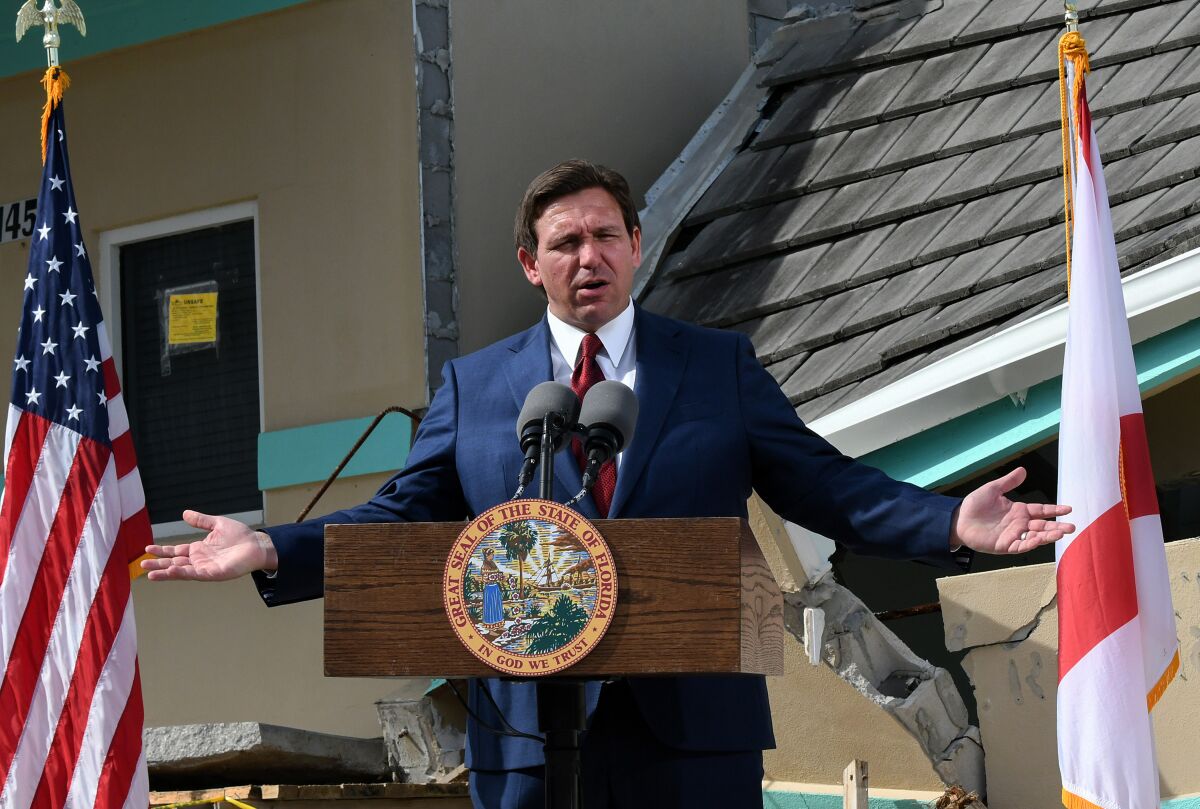
Florida Gov. Ron DeSantis has pushed laws to restrict school instruction on gender identity and sexual orientation.
(Paul Hennessy / SOPA Images/LightRocket via Getty Images)
Those battles echo today and have accelerated as religious conservatives and right-leaning politicians, including Florida Gov. Ron DeSantis, have backed bills to limit school instruction on gender identity and sexual orientation. Of the 1,648 titles banned in schools across the country in the 2021-22 school year, according to a PEN America study, 41% had prominent LGBTQ characters or explicitly explored LGBTQ themes.
“It’s hard to compare this to anything other than the Red Scare in the 1950s,” said Foote, a retired high school librarian of 29 years who was named a Champion of Change by President Obama. “There’s nothing else remotely close to this.”
Open the link and read the rest of the article. It might be behind a paywall. I subscribe to the Los Angeles Times. It’s a terrific newspaper.
In a taped conversation, a lobbyist for vouchers in Utah said what everyone suspected: “I can’t say this is a recall of public education, even though I want to destroy public education. I can’t say that. The Legislature can’t say that because they’ll be just scraped over the coals.”
She said the quiet part out loud.
She was supposed to say that vouchers would give every child a chance to get a better education.
She forgot to say that vouchers would enable EVERY child to get a great education “regardless of their zip code.”
She forgot her talking points.
She said what she and her team say when there are no reporters or recorders around. The goal is “to destroy public education.”
When the story was published, the lobbyist apologized for saying what she believed.
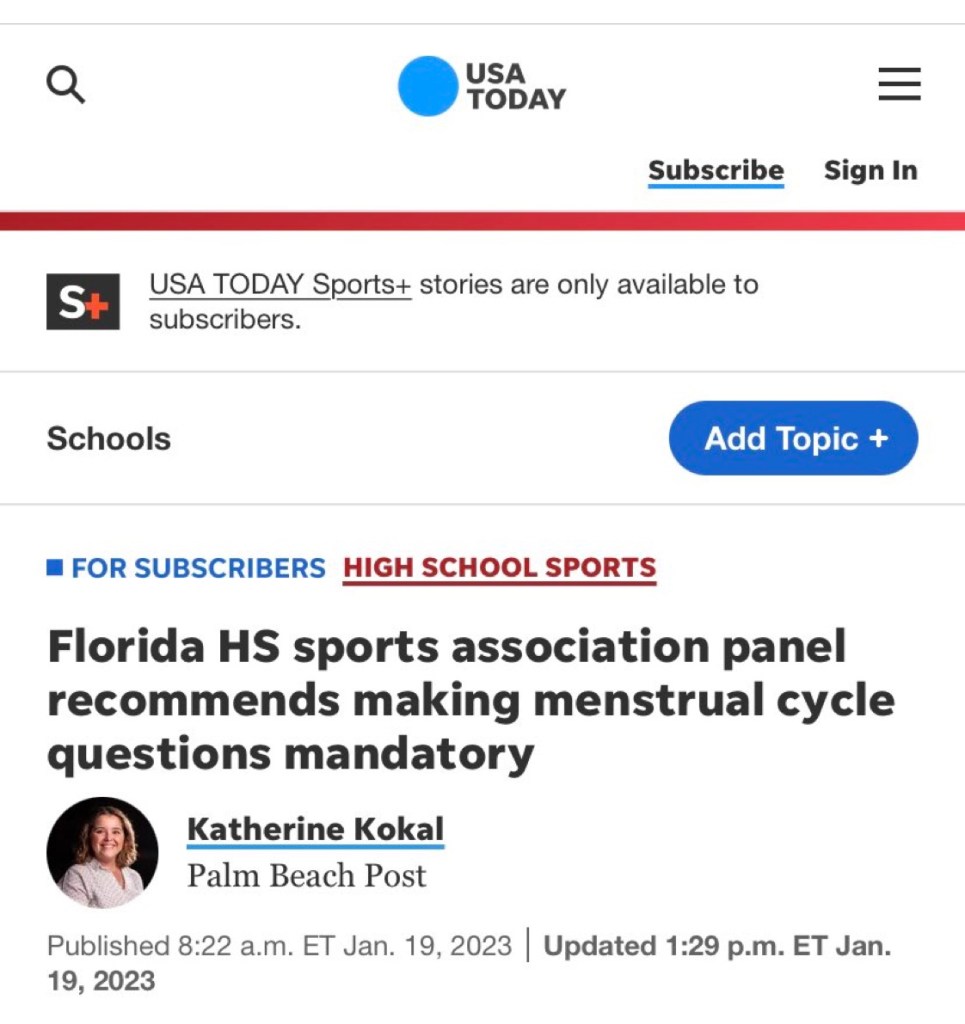
No freedom in Florida! The state where personal privacy goes to die! Soviet-style mind & body control! I’m guessing the purpose of this diktat is to check to make sure no trans women are competing in women’s sports. But there are worse things at stake her. Privacy. Freedom. An intrusive state, a government that counts your menstrual cycle. Gross!
Now that Florida is a red state, the legislature plans to offer vouchers to every student. The legislators expect to do maximum damage to public schools, which will inexorably lose funding and students. Nothing has been said about how to pay for the proposal. Voucher schools in the state are mostly religious and are completely unregulated. Neither their principals nor their teachers need to be credentialed. They are also free to discriminate on any grounds.
The Miami Herald reports:
Florida Republican lawmakers this year will consider offering every K-12 student thousands of dollars each year for their families to spend on education.
Parents would have access to state-funded accounts and use them to pay for private school tuition plus a wide variety of school-related expenses.
The proposal, if approved, would make the state’s school voucher program bigger than ever. But one key fact about the pitch remains elusive: its cost. It could total billions of dollars.
House Speaker Paul Renner said last week he plans to make the proposal, House Bill 1, a priority during the annual legislative session, which starts March 7.
The measure is already being fast-tracked. It will have its first committee hearing Thursday morning in Tallahassee.
So far, the measure carries no financial impact statement. That’s despite the knowledge that hundreds of thousands more children would be eligible for annual payments of about $8,000 each.
The cost, according to the staff analysis, is “indeterminate.” And that “is not reasonable,” said Norín Dollard, a senior research analyst at Florida Policy Institute, a nonpartisan organization that focuses on quality of life issues for Floridians. The group issued a report on voucher funding in September.
HUNDREDS OF THOUSANDS NEW STUDENTS WOULD BE ELIGIBLE
About 266,000 Florida children attend private schools without using any current state scholarship or voucher, Dollard notes. All would be eligible for education savings accounts under the proposal. In addition, approximately 150,000 children receive home schooling.
HB 1 would provide accounts to as many as 10,000 of them in the first year, with more to come in following years. Conservative back-of-the-napkin math suggests that if just 25% of the newly eligible students participate, and those currently in the program remain, the added cost would reach $600 million, Dollard said.
As participation grows, the total could approach $4 billion or more within five years, she added. If that’s the policy decision in leadership, so be it, Dollard said. But it needs to be funded somehow.
A RECURRING FINANCIAL OBLIGATION
State Rep. Anna Eskamani, D-Orlando, focused on that issue during a hastily called Monday evening Zoom meeting to discuss the measure with public education advocates.“
“We have very, very serious concerns,” Eskamani said during an interview. “This is an annual shift of money. Where is it coming from?”
When unveiling the measure at a news briefing, Renner said it was too early to know how much money might be needed. Much depends on how many children want to avail themselves of the vouchers, he said, and where the Legislature sets per-student funding for the year.
At the same time, Renner stressed his goal is to further open school choice so “no one is left out.” The bill would eliminate most eligibility restrictions, though it would prioritize children whose family income is at or below 185% of the federal poverty level — or $55,500 for a family of four.
It also would broaden uses of the money beyond private school tuition to include education expenses such as tutoring, testing and college courses. It would allow students to bank up to $24,000 for those uses, and further permit children already attending private schools without state support to request a share of the funds.
“To effectively deliver a quality education, policy makers and education advocates must accept that every student has unique learning needs, that education dollars belong to the student and not a system, and that public school choice offers every student an opportunity to customize their own education,” Renner said Tuesday, when asked about the associated costs.
A SPIKE IN PARTICIPATION IS EXPECTED
Dollard and others said they anticipate wide interest in participation, with much of it coming from families already paying for private schools. In Arizona, which has a similar education savings account program, the state reported 80% of applicants never attended public schools.
That flips the idea of money following the student on its head, Dollard suggested, because those students never had their education covered by state money in the first place.
School district finance officers said they understood the leadership’s position that the details aren’t firm enough to know the full financial impact.
But using the state’s most recent voucher expansion plan as a guide, they had concerns that this initiative would take money away from district budgets and leave them little ability to plan.
That’s what happened the last time the state expanded vouchers in 2021 with the taxpayer-funded Family Empowerment Scholarship. Officials touted the program as adding $200 million for vouchers, allowing 61,000 more children to afford private school.
Districts saw some money go out the door, but nothing like what happened in 2022. Halfway through the 2021-22 school year, school budget officers across the state learned that three times the amount of money they had set aside to send to voucher programs would be required, based on updated attendance figures from the state.
In some counties, such as Pasco, efforts to provide employee raises were derailed as the money officials expected to use was diverted to the vouchers. All told, the cost had grown to $1 billion.
The current year has provided similar sticker shock. The Legislature approved a budget with no specific amount set for the scholarships. By the second education funding calculation in July, the price tag had increased to $1.3 billion.
That meant the Miami-Dade County school district would have to send $225 million from its budget to the voucher program, for example, and the Hillsborough County school district would send $75 million.
When the third calculation came out this week, districts learned they would be losing even more. If the state lifts the eligibility restrictions, Pinellas County Schools chief finance officer Kevin Smith predicted, it will become even more difficult to predict the financial impact.
He suggested the state should at least consider taking the money out of the public education funding program and create a separate line item.
That way, schools would know what to expect and they could budget appropriately. In recent years, the DeSantis administration has taken the position that unexpected changes in enrollment can pose a financial strain on local school districts.
This is one of Peter Greene’s finest posts. He explains the real reason that Republicans have fallen in love with vouchers. They want to eliminate public schools and in time shift the financial burden of schools to parents, not taxpayers. One of the loudest voucher advocates, who got his doctorate from the University of Walton….the University of Arkansas’s so-called Department of Educational Reform, where they teach the doctrine of school choice, posted a photograph of himself and a woman whom I assume was his wife at a funeral, celebrating the death of public schools. When we go high, they go low.
Greene writes:
The new wave of voucher bills being rammed through red state legislatures all demonstrate a truth about school voucher policies– vouchers are not about choice. They’re about peeling people away from the public school system in order to defund and dismantle that system.
What makes me think so? Here it is. Sometimes it’s not about what people say, but about what they don’t say.
If the concern were really and truly choice for every student, then voucher fans would be addressing some of the real obstacles to school choice.This door doesn’t lead where they told you it would.
For one, they would be addressing discriminatory and exclusionary policies. Yet when have we ever heard a voucher supporter say, “These discriminatory policies have to stop. LGBTQ+ students deserve just as much school choice as any other students.”
The closest thing we ever get is “Well, then they can start an LGBTQ-friendly school of their own.” Yet when that happens, pro-voucher politicians target that school with terms like “perversion.” And of course in some states, such a school can never happen because talking about LGBTQ students or Black history has been outlawed. And voucher laws are written to hold the private school right to discriminate as it wishes inviolable.
If someone were serious about voucher based choice, they would also address cost. Vouchers are typically far too small to pay for tuition to top schools in the state. If voucher supporters were really interested in making sure that, as Jeb Bush says, “each and every…student can access the education of their choice,” there would be a robust discussion about how to bridge the gap between meager vouchers and expensive schools.
Yet we never hear voucher advocates saying, “We need to find the way to fully fund vouchers so that they provide a real choice to students.” Choice advocates like to point at the inequity of the public system–parent choice is limited by their ability to buy an expensive house in a wealthy neighborhood. But the current crop of voucher programs doesn’t change that a bit–a voucher offers little to change the fact that how much “freedom” you get depends on how wealthy you are.
It has been done. But when Croydon, NH set up a school choice program, a voucher-like system that bore the full cost of sending a student to the school of their choice, local libertarians tried to shut it down because they wanted lower taxes.
Voucher fans love the idea of school choice; they just don’t want to actually pay for it.
If these folks were serious about school choice via vouchers, we would have calls for oversight and accountability. It would make a choice system that much more attractive for parents to know that all the available options have been vetted and screened and will be held to some standards, just like shopping in a grocery store where you can rest easy in near-certainty that whatever you pick, it’s not going to actually poison your family.
And yet not only do voucher fans not call for oversight and accountability, but they actively block it with language that hammers home that nobody can tell vendors what to do or how to do it.
Voucherphiles like to call their system child-centered, but in fact it is vendor-centered, with “protections” for the service providers written into the law, and protections for the students non-existent. Parents are left to navigate an unregulated system of asymmetrical information that favors the businesses– not the families.
Please open the link and finish the post. And while you are at it, subscribe to Peter’s wonderful blog.
After especially awful massacres, the public expects Congress to take meaningful steps to limit access to guns. Sandy Hook. No action. Marjory Stoneman Douglas HS in Parkland, Florida. No action. The Pulse Nightclub. No action. The Las Vegas music festival massacre. No action. Uvalde. No action. The recent massacres in California? What do you think? Why no action? The Republicans block every attempt to enact meaningful restrictions.
CNN posted a summary of where America stands internationally a day before the killing of 11 people in Monterrey Oark, California.
CNN) – Monterey Park. Atlanta. Orlando. Las Vegas. Newtown. Parkland. San Bernardino. Uvalde.
Ubiquitous gun violence in the United States has left few places unscathed over the decades. Still, many Americans hold their right to bear arms, enshrined in the US Constitution, as sacrosanct. But critics of the Second Amendment say that right threatens another: The right to life.
I insert here that my understanding of the Second Amendment is that it pertains not to the right of every individual to “bear arms,” but to the maintenance and arming of a “well-regulated militia.”
For a time in the 1990s, the Supreme Court agreed, and let stand a decade-long ban on assault weapons.
The 2nd Amendment says:
A well regulated Militia, being necessary to the security of a free State, the right of the people to keep and bear Arms, shall not be infringed.
The CNN article continues:
There are 120 guns for every 100 Americans, according to the Switzerland-based Small Arms Survey (SAS). No other nation has more civilian guns than people.
The College Board has not released the syllabus for the AP African-American Studies course that the state of Florida wants to ban because, they say, it has “no educational value” and violates state law by invoking “critical race theory.”
Stanley Kurtz, a conservative academic, wrote a scathing critique in National Review, where he blasted the AP course as “Neo-Marxist” and intent on propagating a socialist-Marxist-Communist mindset. Google and you will find follow-up articles by Kurtz.
I taught the history of American education, and I wrote books that specifically included the history of the education of Black Americans. To write about the history, I read many of the authors cited in the AP course. None of those authors, like Frederick Douglass or Carter Woodson or W.E.B. DuBois or Booker T. Washington, should be excluded from a course like this.
I will say without hesitation that the course is not, as Florida officials claim, “leftwing indoctrination.” Very few Americans know anything about African history, so my guess is that 99% of that history will be new to every reader. I am not sure why DeSantis is upset by “intersectionality.” A reporter should ask him to define it. I saw no problem in the mention of the Black Lives Matter movement or the reparations movement, because they are part of history; they exist. Why ban them? The DeSantis team wants the AP course of study to be upbeat; to show the celebratory rightwing view of American history; to exclude authentic African American thinkers, like Kimberlé Crenshaw and Michelle Alexander.
True there is a topic on “Black Queer Studies” that must drive Ron DeSantis and his allies crazy. I doubt that any students will be turned gay by learning about the topic. But this topic alone will be sufficient to get the course banned in DeSantis’ state and probably other red states. It might get axed by the College Board, which is alert to its bottom line. If the pushback hurts revenue, the College Board is likely to beat a hasty retreat.
Kurtz is right on one count. He wrote that “A stunningly large portion of the APAAS curriculum is devoted to the history of black studies.” This is true. Students will learn a lot about the leading scholars of the field and their contributions. Much of the scholarship is about the scholarship. And much, rightly, is about the brutal exploitation and degradation of African peoples.
In discussions with students about their expectations for the course, students said there should be an “unflinching look at history and culture.” Of course. They don’t want a sanitized history. They also said “Emphasis should be placed on joy and accomplishments rather than trauma.” They felt that they had learned about slavery every year, and “students feel they have been inundated with trauma.” In this course, it’s hard to find the “joy and accomplishments” that students are hoping to learn about. It is unlikely that they will learn much about barrier-breaking individuals like Dr. Charles Drew; LBJ’s Housing Secretary Robert Weaver; Guy Bluford (the first Black astronaut) or Mae Jamison (the first Black female astronaut); Ralph Bunche (the first African American to win a Nobel Prize for his diplomacy); Leontyne Price, the great international opera star, born in Laurel, Mississippi, or the newest international opera star Michelle Bradley, born in Versailles, Kentucky; or even the first Black President, Barack Obama. Of the hundreds and thousands of African Americans who have achieved their dreams, not much is said. The students say they know a lot about Dr. King, Malcolm X, and Rosa Parks; they want more. And they should have the pleasure of learning the inspiring stories of African-Americans who shattered stereotypes and made history.
The College Board says this is a preliminary version of the ultimate AP exam. It’s a good start. Let’s see if it can survive the political maelstrom.
Within a day of the brutal hammer attack on Paul Pelosi, Nancy Pelosi’s 82-year-old husband, rightwing media began circulating scurrilous rumors. They said that the intruder did not break in, that he was invited in, and they claimed that the two men met in a gay bar, then quarreled.
The Capitol Police in D.C. had surveillance cameras around the property. Today they released the video of the intruder using a hammer to break the glass of the door or windows in the back of the house, then entering. This confirms the original account.
Capitol Police surveillance video from outside former Speaker Nancy Pelosi’s home in San Francisco, released publicly on Friday, shows the man who attacked her husband in October breaking in.
Before he does that, the attacker can be seen peering into the dark house, walking away and then returning with bags, which he rummages around in for more than two minutes.
Shortly after 2 a.m. local time — the time stamp on the video says 5:10 a.m., which would be consistent with the Eastern time zone, where the Capitol Police force is based — the assailant starts trying to smash a window or a door with what appears to be a hammer. It takes him about 30 seconds of repeated strikes to break through, at which point he climbs into the house and the footage ends.
The surveillance video shows two key things.
First, it indicates that the attacker was outside the Pelosis’ home for several minutes before he entered, meaning it might have been possible to prevent the attack had the Capitol Police been monitoring the surveillance camera in real time.
Second, it unequivocally dispels a baseless conspiracy theory that began circulating soon after the attack: that the suspect, David DePape, had not broken in but rather had been invited in and then got into a fight with Mr. Pelosi.
The New York Times reported on Nov. 1 that the Capitol Police were not monitoring the video feed from the Pelosi home in real time, and that costly minutes elapsed before Capitol officers saw the break-in.
We are on the edge of a spy scandal with major implications for how we understand the Trump administration, our national security, and ourselves.
On 23 January, we learned that a former FBI special agent, Charles McGonigal, was arrested on charges involving taking money to serve foreign interests. One accusation is that in 2017 he took $225,000 from a foreign actor while in charge of counterintelligence at the FBI’s New York office. Another charge is that McGonigal took money from Oleg Deripaska, a sanctioned Russian oligarch, after McGonigal’s 2018 retirement from the FBI. Deripaska, a hugely wealthy metals tycoon close to the Kremlin, “Putin’s favorite industrialist,” was a figure in a Russian influence operation that McGonigal had investigated in 2016. Deripaska has been under American sanctions since 2018. Deripaska is also the former employer, and the creditor, of Trump’s 2016 campaign manager, Paul Manafort.
The reporting on this so far seems to miss the larger implications. One of them is that Trump’s historical position looks far cloudier. In 2016, Trump’s campaign manager (Manafort) was a former employee of a Russian oligarch (Deripaska), and owed money to that same Russian oligarch. And the FBI special agent (McGonigal) who was charged with investigating the Trump campaign’s Russian connections then went to work (according to the indictment) for that very same Russian oligarch (Deripaska). This is obviously very bad for Trump personally. But it is also very bad for FBI New York, for the FBI generally, and for the United States of America.
Another is that we must revisit the Russian influence operation on Trump’s behalf in 2016, and the strangely weak American response. Moscow’s goal was to move minds and institutions such that Hillary Clinton would lose and Donald Trump would win. We might like to think that any FBI special agent would resist, oppose, or at least be immune to such an operation. Now we are reliably informed that a trusted FBI actor, one who was responsible for dealing with just this sort of operation, was corrupt. And again, the issue is not just the particular person. If someone as important as McGonigal could take money from foreigners while on the job at FBI New York, and then go to work for a sanctioned Russian oligarch he was once investigating, what is at stake, at a bare minimum, is the culture of the FBI’s New York office. The larger issue is the health of our national discussions of politics and the integrity of our election process.
For me personally, McGonigal’s arrest brought back an unsettling memory. In 2016, McGonigal was in charge of cyber counter-intelligence for the FBI, and was put in charge of counterintelligence at the FBI’s New York office. That April, I broke the story of the connection between Trump’s campaign and Putin’s regime, on the basis of Russian open sources. At the time, almost no one wanted to take this connection seriously. American journalists wanted an American source, but the people who had experienced similar Russian operations were in Russia, Ukraine, or Estonia. Too few people took Trump seriously; too few people took Russia seriously; too few people took cyber seriously; the Venn diagram overlap of people who took all three seriously felt very small. Yet there was also specific, nagging worry that my own country was not only unprepared, but something worse. After I wrote that piece and another, I heard intimations that something was odd about the FBI office in New York. This was no secret at the time. One did not need to be close to such matters to get that drift. And given that FBI New York was the office dealing with cyber counterintelligence, this was worrying
The reason I was thinking about Trump and Putin back in 2016 was a pattern that I had noticed in eastern Europe, which is my area of expertise. Between 2010 and 2013, Russia sought to control Ukraine using the same methods which were on display in 2016 in its influence operation in the United States: social media, money, and a pliable candidate for head of state. When that failed, Russia had invaded Ukraine, under the cover of some very successful influence operations. (If you find that you do not remember the Russian invasion of Ukraine in 2014, it is very possibly because you were caught in the froth of Russian propaganda, spread through the internet, targeted to vulnerabilities.) The success of that propaganda encouraged Russia to intervene in the United States, using the same methods and institutions. This is what I was working on in 2016, when a similar operation was clearly underway in the United States.
To this observer of Ukraine, it was apparent that Russia was backing Trump in much the way that it had once backed Ukrainian president Viktor Yanukovych, in the hopes of soft control. Trump and Yanukovych were similar figures: nihilistic, venal, seeking power to make or shield money. This made them vulnerably eager partners for Putin. And they had the same chief advisor: the American political consultant Paul Manafort. Russian soft control of Trump did not require endless personal meetings between the two principals. It just required mutual understanding, which was abundantly on display during the Trump presidency: think of the meeting between Putin and Trump in Helsinki in 2018, when the American president said that he trusted the Russian one and the Russian president said that he had supported the American one as a candidate. The acknowledgement of mutual debts was obvious already in 2016: Russian media talked up Trump, and Trump talked up Putin.
During Trump’s 2016 presidential campaign, the rapprochement between Trump and Putin could be effected through intermediaries. An obvious intermediary was Paul Manafort: first he worked for the Russian oligarch Deripaska as a consultant to teach the Kremlin how to influence Americans. Then he worked for Russia’s man in Ukraine Yanukovych, helping to get him elected. Finally Manafort worked for Trump, in the same capacity. You might remember Manafort’s ties to Russia as revealed by the press in 2016. He (and Jared Kushner, and Donald Trump, Jr.) met with Russians in June 2016 in Trump Tower. Manafort had to resign as Trump’s campaign manager that August after it become public he had received $12.7 million in cash while he was working Yanukovych and had not reported it.
By 2016, when he was Trump’s campaign manager, Manafort owed Deripaska millions of dollars. At the end of their political collaboration, they had entered into a murky investment, at the end of which Deripaska was pursuing Manafort in court. Manafort acknowledged the debt to Deripaska, in the sense that he treated his work for Trump as a way to pay it off. As Trump’s campaign manager, and as Deripaska’s debtor, Manafort wrote to offer Deripaska “private briefings” on Trump’s campaign. Through an intermediary, Manafort sent the Russians data from the Trump campaign, including campaign polling data about Americans that would be useful for influence operations. Manafort was asked to communicate a Russian plan for the partition of Ukraine to Trump. Manafort was hoping to pay Deripaska back in a currency other than money — in Manafort’s own words, “to get whole.” (These and other details are in Road to Unfreedom.)
Thinking our way back to 2016, keeping in mind Russia’s pattern of seeking soft control, recalling what we know now, let’s now reconsider how the FBI treated the Trump-Putin connection that year. After Trump became president, he and some other Republicans claimed that the FBI had overreached by carrying out any sort of investigation at all. Now that McGonigal has been arrested, Trump has claimed that this somehow helps his case. Common sense suggests the opposite. The man who was supposed to investigate Russian support of Trump then took money from a Russian oligarch close to Putin, who was at one remove from the Trump campaign at the time? That is not at all a constellation that supports Trump’s version of events. If the FBI special agent (McGonigal) who was investigating Trump’s connection to Russia was on the payroll of the Russian oligarch (Deripaska) to whom Trump’s campaign manager (Manafort) owed millions of dollars and provided information, that does not look good for Trump. It looks hideous —but not just for Trump.
Anne Applebaum once put the question the right way: why didn’t the FBI investigate Trump’s connections to Putin much earlier? In retrospect, it seems as though the FBI investigation of Trump’s campaign and its Russian connections in 2016 was not only late, but weirdly understated. Known as “Cross-Fire Hurricane,” it defined the issue of Russian influence narrowly, as a matter of personal contact between Trump campaign officials and Russians. Meanwhile, as that investigation was going on, Russia was in the middle of a major social media campaign which, according to the leading scholar of presidential communications, made it possible for Trump to be elected. And that larger influence campaign was not investigated by the FBI, let alone countered.
If anything, it looks as though the New York office of the FBI, wittingly or unwittingly, rather pushed in the same direction than resisted Russia’s pro-Trump influence operation. As no doubt everyone remembers, Russia was able to phish for emails from institutions and people around Clinton, and used some of them, out of context, to create harmful fictional narratives about her. Simultaneously, there was a concern about Clinton’s use of a private email server. In the popular mind, these two issues blurred together, with Trump’s help. Trump asked the Russians to break into Clinton’s email account, which they immediately tried to do. Nothing about Clinton’s emails proved to be of interest. The FBI closed an investigation in July 2016, saying that there was no basis for criminal charges against Clinton.
Then, weirdly, FBI director James Comey announced on 28 October 2016, just ten days before the election, that the investigation into Clinton’s emails had been reopened. This created a huge brouhaha that (as polls showed) harmed Clinton and helped Trump. The investigation was closed again after only eight days, on 6 November, with no charges against Clinton. But that was just two days before the election, and the damage was done. As I recall it, in the fury of those last forty-eight hours, no one noticed Comey’s second announcement, closing the investigation and clearing Clinton. I was canvassing at the time, and the people I spoke to were still quite excited about the emails. Why would the FBI publicly reveal an investigation on a hot issue involving a presidential candidate right before an election? It now appears that Comey made the public announcement because of an illicit kind of pressure from special agents in the FBI New York office. Comey believed that they would leak the investigation if he did not announce it.
In office, Trump knew that Russia had worked to get him elected, but the standard of guilt was placed so high that he could defend himself by saying that he personally had not colluded. The Mueller Report, which I still don’t believe many people have actually read, demonstrated that there was a multidimensional Russian influence campaign on behalf of Trump. The Trump administration countered by claiming that there was no evidence that Trump personally had been in contact with Putin personally. That defense was certainly misleading; but it was available in part because of the narrow scope of FBI investigations in 2016.
To be fair, FBI, along with Homeland Security, did investigate cyber. But this was after the election when it could make no difference; and in the report, cyber was defined narrowly, limited to phishing and the breach of systems. These are important issues, but they were not the main issue. What the phishing and breach of systems enabled was the main issue: a social media campaign that exploited emotions, including misogyny, to mobilize and demobilize voters.
Russia used the raw email in specific operations on Trump’s behalf, for example by rescuing him from the Access Hollywood tapes scandal. Right after it emerged that Trump advocated sexual assault, Russia released a fictional scandal connecting Clinton to the abuse of children. That allowed Trump’s followers to believe that whatever he did, she was worse; and the scandal was blunted. It verges on inconceivable that McGonigal was unaware of Russia’s 2016 influence campaign on behalf of Trump. He knew the players; he is now alleged to have been employed by one of them. Even I was aware of the Russia’s 2016 influence campaign. It became one of the subjects of my book Road to Unfreedom, which I finished the following year.
The Russian influence campaign was an issue for American counterintelligence. It is worth pausing to understand why, since it helps us to see the centrality of McGonigal and the meaning of this scandal. Intelligence is about trying to understand. Counterintelligence is about making that hard for others. Branching out from counterintelligence are the more exotic operations designed to make an enemy not only misunderstand the situation, but also act on the basis of misunderstandings, against the enemy’s own interests. Such operations, which have been a Russian (or Soviet) specialty for more than a century, go under the name of “provocation,” or “active measures,” or “maskirovka.” It is the task of counterintelligence to understand active measures, and prevent them from working. The Russian influence operation on behalf of Trump was an active measure that the United States failed to halt. The cyber element, the use of social media, is what McGonigal personally, with his background and in his position, should have been making everyone aware of. In 2016, McGonigal was section chief of the FBI’s Cyber-Counterintelligence Coordination Section. That October, he was put in charge of the Counterintelligence Division of the FBI’s New York office.
And it was just then, in October 2016, that matters began to spin out of control. There were two moments, late in the presidential campaign, that decided the matter for Donald Trump. The first was when Russian rescued him from the Access Hollywood scandal (7 October). The second was FBI director James Comey’s public announcement that he was reopening the investigation of Hillary Clinton’s emails (28 October). The reason Comey made that public announcement at that highly sensitive time, ten days before the election, was not that he believed the public needed to know, nor that the matter was likely of great consequence. On his account, it was that he believed that FBI New York office was going to leak it anyway. Rudolph Giuliani had apparently already been the beneficiary of leaks; claimed to know in advance of what he called a “surprise” that would help Donald Trump, namely Comey’s public announcement of the email investigation.
It looked at the time like Comey had been played by people in FBI New York who wanted Trump to win. Comey has now confirmed this, although his word choice might be different. And I did wonder, back then, if those special agents in New York, in turn, were being played. It was no secret at the timethat FBI special agents in New York did not like Hillary Clinton. Making emotional commitments public is asking to be exploited. For people working in counterintelligence, this is a particularly unwise thing to do. The nature of working in counterintelligence is that, if you are not very good, you will find yourself in the vortex of someone else’s active measure. Someone else will take advantage of your known vulnerabilities – your misogyny, perhaps, or your hatred of a specific female politician, or your entirely unjustified belief that a male politician is a patriotic messiah — and get you to do something that feels like your own decision.
Now that we are informed that a central figure in the New York FBI office was willing to take money from foreign actors while on the job, this line of analysis bears some reconsideration. Objectively, FBI New York was acting in concert with Russia, ignoring or defining narrowly Russia’s actions, and helping deliver the one-two punch to Clinton in October that very likely saved Trump. When people act in the interest of a foreign power, it is sometimes for money, it is sometimes because the foreign power knows something about them, it is sometimes for ideals, and it is sometimes for no conscious motive at all — what one thinks of as one’s own motives have been curated, manipulated, and directed. It seems quite possible — I raise it as a hypothesis that reasonable people would consider — that some mixture of these factors was at work at FBI New York in 2016.
All of these pieces of recent history must hang together in one way or another, and the fresh and shocking revelation of McGonigal’s arrest is a chance for us to try to see how. Again, if these allegations are true, they will soon be surrounded by other heretofore unknown facts, which should lead us to consider the problem of election integrity in a general way. As of right now, the circumstantial evidence suggests that we consider the possibility that the FBI’s reporting work in 2016, which resulted in a framing of the issue which was convenient for Trump and Russia, might have had something to do with the fact (per the indictments) that one of its lead agents was willing to takemoney from foreign actors while on the job. In connection with the leaks from FBI New York late in the 2016 campaign, which had the obvious effect of harming Clinton and helping Trump, McGonigal’s arrest also demands a broader rethink of the scale of the 2016 disaster. How much was FBI New York, wittingly and unwittingly, caught up in a Russian active measure?
The charges have not been proven. If they are, it would be a bit surprising if the two offenses with which McGonigal is now charged were isolated events. There is a certain danger, apparently, in seeing them this way, and letting bygones be bygones. A U.S. attorney presenting the case said that McGonigal “should have known better”; that is the kind of thing one says when a child gets a bellyache after eating too much cotton candy at the county fair; it hardly seems to correspond to the gravity of the situation.
Failing to understand the Russian threat in the 2010s was a prelude to failing to understand the Russian threat in 2020s. And today Americans who support Russia in its war of atrocity tend to be members of the Trump family or people closely aligned with Trump, such as Giuliani. The people who helped Trump then take part in the war on Ukraine now. Consider one of the main architects of Russia’s 2016 campaign to support Trump, Yevgeny Prigozhin. In 2016, his relevant position was as the head of the Internet Research Agency; they were the very people who (for example) helped spread the story about Clinton that rescued Trump from the Access Hollywood scandal. Without the Internet Research Agency covering his back, Trump would have had a much harder time in the 2016 election. Today, during the war in Ukraine, Prigozhin is now better known as the owner of Wagner, sending tens of thousands of Russian prisoners to kill and die.
The implications of the arrest go further. McGonigal had authority in sensitive investigations where the specific concern was that there was an American giving away other Americans to foreign governments. Untangling what that means will require a concern for the United States that goes beyond party loyalty. Unfortunately, some key political figures seem to be reacting to the news in the opposite spirit: suppressing the past, thereby destabilizing the future. Immediately after the McGonigal story broke, House Speaker Kevin McCarthy ejected Adam Schiff from the House intelligence committee, in a grand exhibition of indifference to national security. A veteran of that committee, Schiff has has taken the time to learn about Russia. It is grotesque to exclude him at this particular moment, in the middle of a war, and at the beginning of a spy scandal.
McCarthy’s recent move against Schiff also recalls 2016, sadly. Much as I did, House Speaker Kevin McCarthy had an inkling, back then, that something was wrong with Trump and Russia. He expressed his view that June that Donald Trump was the Republican most likely to be taking money from Vladimir Putin. This showed a fine political instinct, sadly unmatched by any ethical follow-through. McCarthy did not share his suspicion with his constituents, nor do anything to follow through. He made the remark it in a conversation with other Republican House members, who did not disagree with him, and who apparently came to the conclusion the the risk of an embarrassment to their party was more important than American national security. Republicans in the Senate, sadly, took a similar view. They deliberately marginalized a CIA investigation that did address the Russian influence campaign for Trump. In September 2016, Mitch McConnell made it clear to the Obama administration that the CIA’s findings would be treated as political if they were discussed in public. The Obama administration bowed to this pressure.
The Russian operation to get Trump elected in 2016 was real. We are still living under the specter of 2016, and we are closer to the beginning of the process or learning about it than we are to the end. Denying that it happened, or acting as though it did not happen, makes the United States vulnerable to Russian influence operations that are still ongoing, sometimes organized by the same people. It is easy to forget about 2016, and human to want to do so. But democracy is about learning from mistakes, and this arrest makes it very clear that we still have much to learn.
Jan Resseger looks behind the daily news and ties together fast-moving events in the red states. The sudden proliferation of voucher programs is no accident, she writes, nor is it a response to public demands. It is a carefully crafted, well-funded strategy to defund public schools, to smash teachers’ unions, and to implement a rightwing ideology that does not benefit students or improve education.
She writes:
This week in Iowa, Governor Kim Reynolds signed an Education Savings Account, universal voucher program into law. And last week in Utah, the same kind of voucher plan took the first step toward adoption when it was passed by Utah’s House of Representatives.
The Des Moines Register reports on Iowa’s new vouchers. The program will “phase in over three years and eventually allow all Iowa families to use up to $7,598 a year in an ‘education savings account’ for private school tuition. If any money is left over after tuition and fees, families could use the funds for specific educational expenses, including textbooks, tutoring, standardized testing fees, online education programs and vocational and life skills training. The $7,598 per private school student is the same amount of funding the state provides to public school students and is expected to rise in future years… The bill allows the Iowa Department of Education to contract with a third party to administer the education savings accounts, but the state has not yet issued a request for proposals from companies seeking to manage the funds.”
It would appear that the Iowa Legislature tried to calm the fears of the public school community by promising that, “Public school districts would also receive an additional $1,205 in funding for students receiving education savings accounts who live within the public school district’s boundaries.” But despite that promise, a drop in overall public school funding is expected: “By the fourth year, the (Legislative Services) agency estimates public school districts will receive $49.8 million in new per-student funds for private school students within the public district’s boundaries. The agency also expects a net decrease of $46 million in public school funding as a result of more students attending private schools.”
It is hard to keep track of all the states that now have school vouchers or are considering voucher programs and to know which states have the latest flavor of vouchers—Education Savings Accounts (ESAs). Most ESA programs, unlike Iowa’s, don’t even require that families use the vouchers at private schools. In most places, ESA’s can be used for educational programs, for educational tools and materials like books and computers, and for homeschooling. In some states families can use the money for so-called micro-schools in which families come together and hire a teacher to work with children in someone’s home.
Why is there so much so much legislative activity about expanding vouchers? Several factors are important to consider, and many of them were the subject of economist Gordon Lafer’s analysis in The One-Percent Solution. Lafer’s book focused on the public policy that flowed from state legislatures after the Tea Party wave election in 2010, but his observations are still on point as we begin 2023. Lafer enumerates all the reasons why far-right ideologues and big corporate moneyed interests seek to undermine and privatize public schools: “At first glance, it may seem odd that corporate lobbies such as the Chamber of Commerce, National Federation for Independent Business, or Americans for Prosperity would care to get involved in an issue as far removed from commercial activity as school reform. In fact, they have each made this a top legislative priority… The campaign to transform public education brings together multiple strands of the agenda… The teachers’ union is the single biggest labor organization in most states—thus for both anti-union ideologues and Republican strategists, undermining teachers’ unions is of central importance. Education is one of the largest components of public budgets, and in many communities the school system is the single largest employer—thus the goals of cutting budgets, enabling new tax cuts for the wealthy, shrinking the government, and lowering wage and benefit standards in the public sector all coalesce around the school system… There are always firms that aim to profit from the privatization of public services, but the sums involved in K-12 education are an order of magnitude larger than any other service, and have generated an intensity of corporate legislative engagement unmatched by any other branch of government. Finally, the notion that one’s kids have a right to a decent education represents the most substantive right to which Americans believe we are entitled, simply by dint of residence… (F)or those interested in lowering citizens’ expectations of what we have a right to demand from government, there is no more central fight than around public education. In all these ways, then, school reform presents something like the perfect crystallization of the corporate legislative agenda.” (The One-Percent Solution, pp 128-129)
It is hard for public school advocates to mobilize nationally against the expansion of vouchers. Voucher battles are fought state by state because public education and the funding of public education is a state-by-state issue. Advocates are likely to focus on public education legislation in their own state and not to pay attention to what’s happening elsewhere. And citizens are not likely to pay much attention to what is happening in the legislature. Once again, Gordon Lafer identifies the problem: “(M)any of the factors that strengthen corporate political influence are magnified in the states. First, far fewer people pay attention to state government, implying wider latitude for well-funded organized interests… Apart from labor unions and a handful of progressive activists, the corporate agenda… encounters little public resistance at the state level because hardly anyone knows about or understands the issues… So, too, corporate lobbies’ financial advantage is magnified in the states. Citizens United marked a sea change in state as well as federal politics.” (The One Percent Solution, pp. 34-36)
Christopher Lubienski, a professor of education policy at Indiana University who has studied the impact of school privatization and the politics around privatizing public schools, recently published a reminder that school privatization is driven by the power of the corporate agenda. Expansion of vouchers has never been an expression of voters’ overall preference: “School choice is continuing to expand across the United states…. But these successes often come in spite of overwhelming voter opposition to school choice programs… According to the pro-voucher organization EdChoice.org, the U.S. has over 75 publicly funded private school choice programs, including vouchers, and education savings accounts, as well as another 45 charter school programs. But all of these programs have been implemented by legislators, not the electorate… In fact, voters have been allowed to weigh in on school choice programs only nine times since 2000, and they almost always reject them, often by overwhelming margins. Only twice did school choice programs pass through the ballot box. In 2012, Georgia voters empowered their legislature with the ability to create charter schools. That same year… Washington voters passed a charter school referendum.”
Who are the far-right advocacy groups and think tanks powerfully promoting Education Savings Account vouchers? They include the usual suspects: the American Legislative Exchange Council and a state- by-state group of think tanks that are ALEC’s partners in the State Policy Network, EdChoice, the Goldwater Institute, the Heritage Foundation, and the Institute for Justice, which provides two model laws—“Education Savings Account Act: Publicly Funded,” and “Education Savings Account Act: Tax-Credit Funded“—so that state legislators can merely adapt a canned statute to their own state’s particular needs. SourceWatch reports corporate funding streams for these and other far-right think tanks that promote vouchers—funding from the Koch Brothers, the Bradley Foundation, and investments from the Donor’s Capital Fund, a powerful investor of corporate dark money since the 2010, U.S. Supreme Court ruling in Citizens United.
In the past two years, the campaign to undermine public schooling and promote the expansion of vouchers has developed a new strategy to convince parents that their children in public schools are being brainwashed by critical race theory and surrounded by discussion of gender and sexual orientation. In a new report published by the Network for Public Education this week, political scientist Maurice Cunningham traces the money behind what may appear to be a spontaneous emergence of parents’ groups—Parents Defending Education, Moms for Liberty, and No Left Turn in Education. Cunningham points to clues that these are not local grassroots groups of parents; their websites, for example, betray a big investment in communications. And while, for example, the founders of Parents Defending Education (PDE) claim to be a bunch of working moms, Cunningham explains: “PDE took in $3,178,272 in contributions and grants in 2021… Donor’s Trust, a dark money donor associated with the Koch network donated $20,250 to PDE in 2021. The Achelis & Bodman Foundation which funds voucher and charter school programs and targets public education, contributed $25,000. Searle Freedom Trust, another right-wing donor with ties to Donors Trust, contributed $250,000 in 2021. We don’t know all the names on the checks, but we do know that those checks had to be pretty large, that the attorneys and consultants sit at the hierarchy of right-wing operatives, and that the board members and staffers are connected to the highest levels of conservative donors including the Koch network.”
The same people who are promoting vouchers are working to scare parents with the huge, culture war campaign driven by identifiable funders and a mass of dark money supporting an education marketplace and undermining parents’ confidence in public schools. But as Christopher Lubienski, the scholar who has studied the effect of the privatization of public education reminds us, expanding vouchers has not improved the outcomes for our children: “(R)ecent research is repeatedly showing that… vouchers are not a good investment. Although publicly funded vouchers may be propping up some private schools that might otherwise go out of business, they are not really helping the people they purport to help. In fact… study after study shows that students using vouchers are falling behind where they would have been if they had remained in public schools. Thus, policymakers might think twice about defying voters on initiatives that actually cause harm to children.”
The political theorist Benjamin Barber warns that school choice does not really provide freedom for families: “We are seduced into thinking that the right to choose from a menu is the essence of liberty, but with respect to relevant outcomes the real power, and hence the real freedom, is in the determination of what is on the menu. The powerful are those who set the agenda, not those who choose from the alternatives it offers. We select menu items privately, but we can assure meaningful menu choices only through public decision-making.” (Consumed, p. 139)


 Diane Ravitch's blog