PublicSchoolsFirstNC reacted with outrage at the decision of the North Carolina Supreme Court, overturning the Leandro Decusion of 1994.
The long-awaited North Carolina Supreme Court ruling on the state’s landmark Leandro school funding case is out.
PRESS ALERT: NC Supreme Court Dismisses Case, Does Not Enforce State Constitution
For immediate release: April 2, 2026
In a reversal of its 2022 ruling, which required lawmakers to fund public schools according to the Leandro Comprehensive Remedial Plan (designed to bring lawmakers into constitutional compliance on school funding), the current court majority “dismissed the case” ruling that a 2017 NC Trial Court ruling was made in error and all subsequent Leandro rulings are invalid.
More than thirty years of fact finding and four prior NC Supreme Court rulings had established that the North Carolina State (legislative and executive branches) had not fulfilled its obligation to North Carolina’s students.
Statewide, students’ right to a sound basic education under the North Carolina State Constitution had been violated, affirming the initial 1994 claim that became the landmark Leandro case. These facts were not disputed.
The North Carolina State Constitution clearly states that all children across our state, no matter their circumstances or background, are entitled to a sound basic education funded by the state. While the court’s decision is disappointing and shocking in the degree to which it removes the courts from responsibility, it does NOT absolve legislators of their legal duty to adequately fund public schools.
Individually and collectively, we must take action to remind our lawmakers of their responsibility to abide by the state constitution’s requirement to ensure our children’s civil and human rights by fully funding a free, uniform public education.
In her dissent, Justice Anita Earls writes that, “The Court today betrays these constitutional commitments.
The majority dismisses North Carolina’s landmark constitutional education rights litigation with prejudice and with no relief for any injured party because no plaintiff formally filed an amended pleading to challenge the current statewide funding system. In other words, the majority concludes that it will not order the State to correct the way it has harmed public school students, even in very low-wealth school districts like Hoke County, and even as two previous Courts concluded that the State is failing to adequately educate students and must act to fix the public education system. In reaching that decision, the majority relies on a hyper-technicality that is not even lawful grounds to dismiss these proceedings and was not argued by any party. Specifically, no party asked this Court to dismiss this case because it was an improper “facial” challenge. The majority’s narrow holding rests on stunning and unsupported assertions.”
PSFNC agrees! The ruling today highlights the judicial and legislative neglect facing our public schools. They have been operating the entire school year without a 2025-26 budget even though their operating costs have increased. Later this month, the legislative short session begins. North Carolina’s students can wait no longer.
PSFNC calls on all North Carolinians to urge legislators to fulfill their obligations—fully fund public schools including Leandro, pay teachers professional, competitive salaries, and invest in the future of our children.
Media Contact: Heather Koons, Communications Director
Supporters of public schools in North Carolina have relied on the Leandro decision for more than three decades as they demanded fair funding of the schools. The North Carolina Supreme Court, now with a Republican majority, just overruled Leandro, which was decided in 1994. The new decision ruled that courts can’t tell the legislature to spend money.
For 32 years, North Carolina leaders have struggled to define what it means when the state constitution says “equal opportunities shall be provided for all students.” The long-running Leandro school lawsuit has seen the courts go back and forth on what the courts can do to provide a “sound basic education” for North Carolina’s 1.5 million public school students. Thursdays ruling by the N.C. Supreme Court marks the latest and potentially final chapter in that fight….
T. Keung Hui of the North Carolina News & Observer wrote:
The North Carolina Supreme Court has overturned a 2022 decision that allowed judges to order the transfer of hundreds of millions of taxpayer dollars to fund public schools.
In a decision released on Thursday, the Supreme Court’s Republican majority ruled that state courts do not have the constitutional authority to order the spending of state dollars for schools. The decision was 4-3 with Republican Associate Justice Richard Dietz joining the two Democratic justices in dissenting.
The decision reverses a 2022 ruling by the former Democrat majority that the courts can require state officials to transfer funds to try to provide students with their constitutional right to a sound basic education. The court dismissed the lawsuit, apparently putting an end to the nearly 32-year-old court case.
“As this litigation comes to a close a few weeks shy of its thirty-second anniversary, we are reminded of these principles from our prior cases: In our constitution, the people established a tripartite system of government,” Chief Justice Paul Newby wrote in the majority ruling.
“In doing so, the people did not vest the judicial branch with the power to resolve policy disputes between the other branches of government or to set education policy. We would be especially ill-equipped to resolve such questions in any event.”
Decision disappointment for school supporters
The long-delayed ruling had been expected after the 2022 elections flipped the court majority to Republicans. The court’s Republican majority then agreed to block the money transfer and rehear the case over the objections of the Democratic justices.
“Today’s decision is disappointing — but not surprising,” Keith Poston, president of the Wake Ed Partnership, said in a statement Thursday. “The Court ruled on process, not whether students are getting what they need. That responsibility now sits squarely with state leaders. The needs in our schools haven’t changed—and neither has the urgency to act.”
It has been 770 days since oral arguments were heard in February 2024. The lengthy wait for the new ruling had raised questions.
This year’s Supreme Court election won’t shift the court’s majority. Only Democratic Associate Justice Anita Earls, who is running against GOP state Rep. Sarah Stevens, will be on the midterm ballot
The decision comes at a turning point in how the state funds education. A report released in December by the Education Law Center ranked North Carolina last in the nation in school funding effort and 50th out of the 50 states and the District of Columbia in funding level.
State Republican legislators fought the judicial money transfer, arguing that only the General Assembly can order state dollars to be spent. Democratic lawmakers have supported the 2022 court decision.
“Today’s decision rightly recognizes the constitutional role of the North Carolina General Assembly, since the state Constitution entrusts sole appropriations authority to the legislature,” Demi Dowdy, a spokesperson for House Speaker Destin Hall, said in a statement Thursday. “House Republicans remain committed to investing in public education, including through our budget proposal to raise starting teacher pay to $50,000 and provide 8.7% average raises to our public school teachers.”
Given the fact that about half the states have now mandated that teachers teach “the science of reading,” it seems to be a good time to repost what I wrote on November 1, 2023.
Some things never change.
I wrote:
One of my grandsons sent me an article about the national rush to mandate “the science of reading,” and it caused me to explain briefly (without boring him) the background of the latest panacea.
I didn’t tell him the history of the “reading wars,” which I researched and wrote about in Left Back (2000). I didn’t tell him that reading instruction has swung back and forth between the phonetic method and the “whole word” method since the introduction of public schooling in the first quarter of the 19th century. Horace Mann opposed phonics. But the popular McGuffey readers of that century were phonetic and included examples of good literature.
In 1930, the Dick-and-Jane readers were introduced, and they swept the country. Unlike the McGuffey readers, they featured pictures of children (white and suburban), they used simple words that could be easily recognized, and they were bright and colorful. By the 1950s, Dick and Jane style readers were used in about 80% of American schools. They relied on the whole word method, also known as look-say.
In 1955, this national consensus was disrupted by the publication of Rudolf Flesch’s wildly popular book, Why Johnny Can’t Read, which castigated the look-say method and urged a revival of phonics. The fervor for phonics then is similar to the fervor now.
But the debate about which method was best quickly became politicized. “Bring back phonics” was the battle cry of very conservative groups, who lambasted the whole-word method as the conspiratorial work of liberal elites. Phonics thus was unfairly tarnished as a rightwing cause.
The definitive book about the teaching of reading was written in 1967 by Harvard literacy expert Jeanne Chall: Learning to Read: The Great Debate. Chall wrote about the importance of phonics as part of beginning reading instruction, followed up by wonderful children’s literature. She warned against going to extremes, a warning that has been ignored with every pendulum swing.
The 1980s began the dominance of whole language, which brought back whole-word sight reading and de-emphasized phonics. Textbook companies boasted that their programs were whole language. Literacy conferences were focused on whole language. Phonics was out. Many reading teachers held on their phonics books, even though phonics was out of style.
There is always a crisis in reading, so in the late 1990s, the pendulum began to move again. As it happened, a very influential supporter of phonics held a key position at the National Institutes of Health. Dr. Reid Lyon was director of the NIH’s National Institute of Child Health and Development. His field of expertise was learning disabilities.
From Wikipedia:
From 1992 to 2005, Lyon served as a research neuropsychologist and the chief of the Child Development and Behavior Branch of the NICHD at the National Institutes of Health; in this role he developed and oversaw research programs in cognitive neuroscience, learning and reading development and disorders, behavioral pediatrics, cognitive and affective development, School Readiness, and the Spanish to English Reading Research program. He designed, developed and directed the 44-site NICHD Reading Research Network.
Lyon selected the members of the National Reading Panel. Like him, most were experimental researchers in higher education. Only one—Joanne Yatvin— was experienced as an elementary school teacher and principal. She wrote a “minority view” dissenting from the report, and she worried that the report would be misused.
President George W. Bush signed No Child Left Behind into law on January 8, 2002. This law was the single largest intrusion of the federal government into education in American history. Before NCLB, education was a state responsibility. Since passage of NCLB, the federal government established mandates that schools had to obey.
One of the components of this law was the Reading First program. RF was based on the report of the National Reading Panel, which emphasized the importance of phonemic awareness, phonics, decoding, and fluency.
The Reading First program allocated $6 billion over six years to encourage districts to adopt the “science of reading,” as established by the National Reading panel.
There were two reasons that the program ended.
First, there were financial scandals. Google “Reading First Program Scandals”). The New York Times reported here about conflicts of interest and steering of contracts to favored textbook publishers. “In a searing report that concludes the first in a series of investigations into complaints of political favoritism in the reading initiative, known as Reading First, the report said officials improperly selected the members of review panels that awarded large grants to states, often failing to detect conflicts of interest. The money was used to buy reading textbooks and curriculum for public schools nationwide.”
Second, the final evaluation of the program found that it taught what it aimed to teach but there was no improvement in students’ comprehension.
Here is the summary of the final evaluation:
The findings presented in this report are generally consistent with findings presented in the study’s Interim Report, which found statistically significant impacts on instructional time spent on the five essential components of reading instruction promoted by the program (phonemic awareness, phonics, vocabulary, fluency, and comprehension) in grades one and two, and which found no statistically significant impact on reading comprehension as measured by the SAT 10. In addition to data on the instructional and student achievement outcomes reported in the Interim Report, the final report also presents findings based upon information obtained during the study’s third year of data collection: data from a measure of first grade students’ decoding skill, and data from self-reported surveys of educational personnel in study schools.
Analyses of the impact of Reading First on aspects of program implementation, as reported by teachers and reading coaches, revealed that the program had statistically significant impacts on several domains. The information obtained from the Test of Silent Word Reading Fluency indicates that Reading First had a positive and statistically significant impact on first grade students’ decoding skill.
The final report also explored a number of hypotheses to explain the pattern of observed impacts. Analyses that explored the association between the length of implementation of Reading First in the study schools and reading comprehension scores, as well as between the number of years students had been exposed to Reading First instruction and reading comprehension scores were inconclusive. No statistically significant variation across sites in the pattern of impacts was found. Correlational analyses suggest that there is a positive association between time spent on the five essential components of reading instruction promoted by the program and reading comprehension measured by the SAT 10, but these findings appear to be sensitive to model specification and the sample used to estimate the relationship.
The study finds, on average, that after several years of funding the Reading First program, it has a consistent positive effect on reading instruction yet no statistically significant impact on student reading comprehension. Findings based on exploratory analyses do not provide consistent or systematic insight into the pattern of observed impacts.
After the disgrace of the Reading First program, support for phonics dissipated. But in the past few years, journalists (led by Emily Hanford) have trumpeted the idea that the report of the National Reading Panel established the “science of reading.” New York Times columnist Nicholas Kristof wrote about the “Mississippi Miracle,“ claiming that the “science of reading” had lifted fourth grade reading scores, and no new spending was needed in a very poorly resourced state. Kristof did not explain why the SOR did not cause a rise in eighth grade scores in Mississippi, nor did he understand that retaining low-scoring third graders raises the percentage of fourth graders who get high test scores. State after state is now mandating the “science of reading.”
Federal Judge Richard Leon issued a decision stopping work on Trump’s Hideous Grand Obsession: the ballroom that will replace the East Wing of the White House. Trump demolished the East Wing without going through the legal requirements and permissions.
Judge Leon, appointed by President George W. Bush, opened his decision with two sentences:
The President of the United States is the steward of the White House for future generations of First Families. He is not, however, the owner!
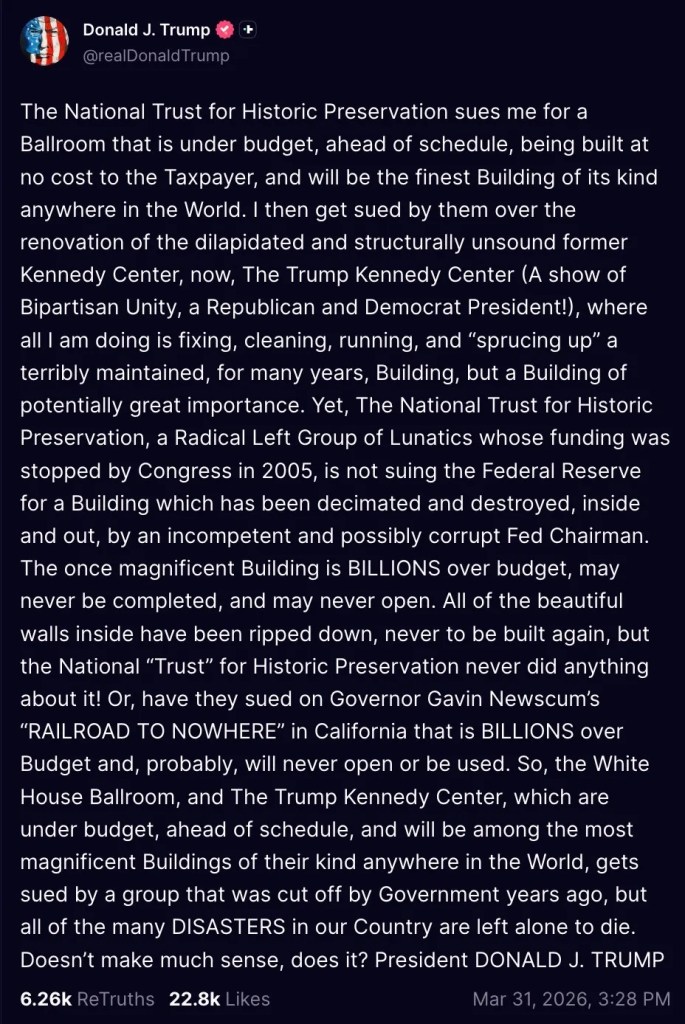
Trump responded with this cry of outrage:
Trump is determined to leave his garish mark on D.C.
Not only did he tear down the East Wing of the White House, but he plans other major alterations to the White House and the city.
Of course, he added his name to the Kennedy Center, which was dedicated by Congress as a memorial to the assassinated President. After Trump took control of the Center, artists began canceling their performances and ticket sales fell. To cover his embarrassment, he is closing the Center for two years while “renovating” it. Critics fear that it will emerge as a gold-encrusted monument to Trump.
The New York Times reported that Trump is fixated on making changes to the White House:
He plans to turn the historic Treaty Room into a guest bedroom. Really! He has zero respect for history, and he thinks the White House is his personal property.
Mr. Trump already has torn down the East Wing to make room for his $400 million, 90,000-square-foot ballroom; he remade the bathroom attached to the Lincoln Bedroom in marble and gold; he paved over the Rose Garden grass; he added marble floors and a chandelier to the Palm Room; he covered the Oval Office in gold; and he has a new, 33,000-square-foot security screening center for White House visitors in the works.
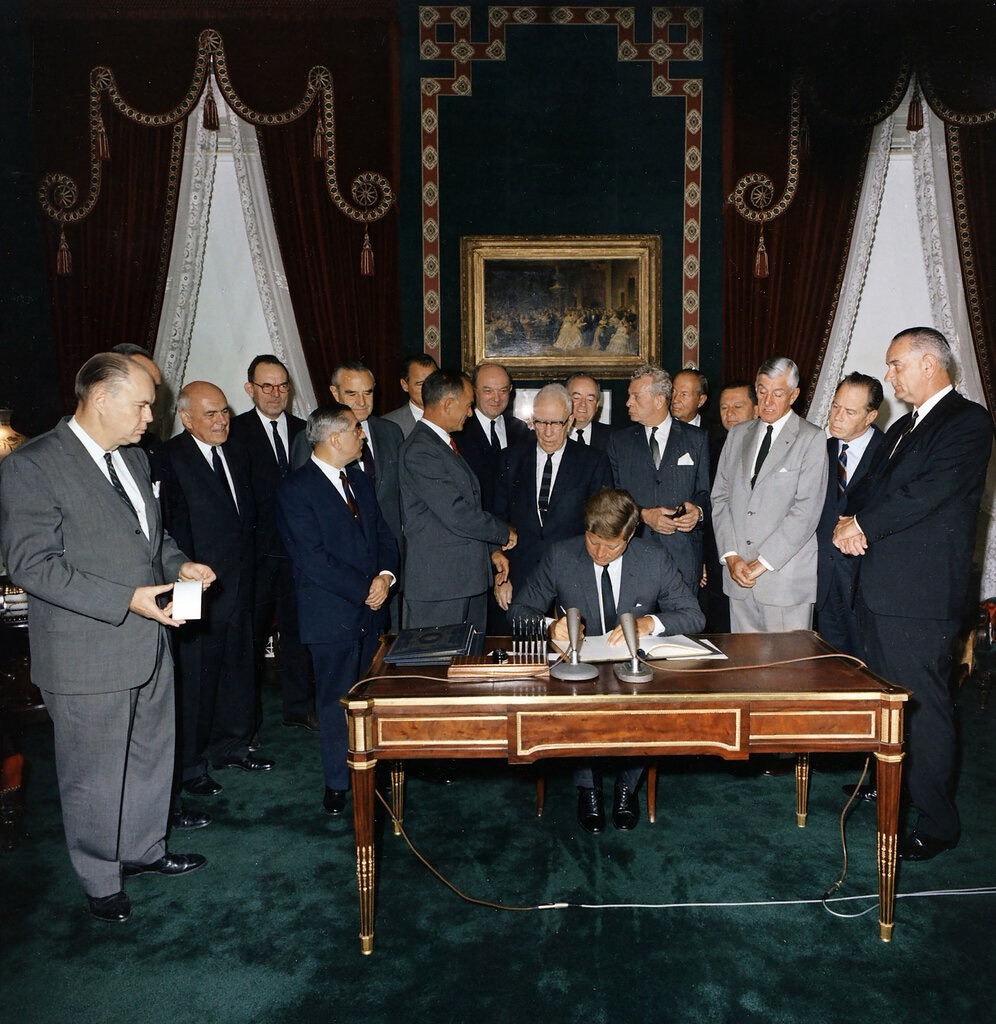
His latest plans involve the more private spaces of the White House, in the second-floor presidential residence. The Treaty Room — which is separate from the Indian Treaty Room in the Eisenhower Executive Office Building — is one of the most historic rooms in the White House. Presidents Ulysses S. Grant and William McKinley used it as a Cabinet room, and it was where the Spanish-American War peace protocol of 1898, and the nuclear test ban treaty of 1963, were signed.
This is a photograph of President John F. Kennedy signing the Nuclear Test-Ban Treaty in the Treaty Room.
Trump wants to turn this historic room into a guest bedroom.
Trump’s egomania doesn’t stop there. It’s boundless. The U.S. Treasury will mint a $1 coin with his face on it to honor the 250th anniversary of the United States. It will also release a large gold coin with his image that will cost thousands of dollars. And in an unprecedented move, the U.S. Treasury will add Trump’s signature to paper currency. No other President has placed his signature on the nation’s currency. Presently, our paper currency has the signatures of the Secretary of the United States and the Treasurer of the United States. Not the President.
Trump wants to build a gigantic arch on the Virginia side of the D.C.-Virginia border. It will be the Arch of Independence, but is colloquially called the “Arc d’Trump.” It will tower over the nearby Lincoln Memorial. Some renderings show the arch slathered in gold, Trump’s favorite decoration.
The most devastating critique of Trump’s efforts to reshape the District of Columbia and the White House was written by Phillip Kennicott, the Pulitzer-Prize winning critic of art and architecture for The Washington Post. It was published before Judge Leon stopped work on the ballroom. Trump, Kennicott says, is the greatest threat to D.C. and the White House since 1812, when the British burned the Capitol and the White House to the ground.
He wrote:
A loosely circular driveway sweeps through the White House grounds, just below the beloved South Portico of the mansion. Its shape echoes a larger park, known as the Ellipse, which connects the president’s home to the National Mall. It also mirrors the curving pathways of nearby Lafayette Square, on the north side of the complex.
The simple symmetry of this modest roadway and the grace of the White House south grounds are no accident: They were the vision of the great landscape architect Frederick Law Olmsted, Jr., one of the original members of the Senate Park Commission, which created the monumental core of Washington as we know it, more than a century ago.
The geometry of this driveway — a small but resonant element of Olmsted’s master plan for the White House campus — will soon be erased, now that a federal judge has allowed President Donald Trump to proceed at least temporarily with construction of his 90,000-square-foot, $400 million ballroom. The ballroom, which will be larger than the original mansion, is so gargantuan that the original curving road simply won’t fit. To make room for Trump’s entertaining and fundraising space, a large notch will be clawed out of the driveway, according to drawings released by Shalom Baranes Associates, the D.C.-based architecture firm overseeing one of the most unpopular projects of the president’s second term.
Washington has a composed geometry built up from significant details like this elliptical drive. As with the diagonal avenues that connect symbolically important circles, squares and civic landmarks, the Platonic perfection of this shape is best appreciated from the air. But it is a vital reminder of the care taken, over the past 200 years, in the design of the capital city, and the deference paid to a set of aesthetic and cultural values that came out of the Enlightenment, including a love of symmetry, repetition, iterative patterns and a fine balance between grandeur and grandiosity.
Trump is the most significant threat to the city’s architectural and design legacy since British forces burned the Capitol and White House during the War of 1812. He has already demolished the East Wing of the White House, which dates to the administration of Franklin D. Roosevelt. He will replace it with a building that makes James Hoban’s neo-Classical executive mansion a mere appendage to a space meant to function like a hotel-convention-center-entertainment venue. He has proposed (but temporarily delayed) painting the next-door Eisenhower Executive Office Building a blinding shade of white, which preservation groups argue could irreversibly damage the stone facade.
He wants to build a 250-foot-tall memorial arch near the most hallowed ground in the country, Arlington National Cemetery. His “Independence Arch,” which he has said will honor himself personally, would dwarf the largest victory arches in the world, including the arch in Pyongyang, built in 1982 to honor North Korea’s murderous dictator, Kim Il Sung. Only Eero Saarinen’s slender ribbon of steel, the Gateway Arch in St. Louis, would be taller. Although it would be built in a traffic circle on the Virginia side of the Potomac, the Trump arch would compete with some of the tallest buildings in Washington, including the Washington Monument and Washington National Cathedral, fundamentally altering a meticulously preserved skyline.
The president’s proposed “National Garden of American Heroes” would introduce a forest of quickly designed statues to the banks of the Potomac almost opposite the new triumphal arch. A sylvan space defined by monumental memorials to Roosevelt, Martin Luther King, Jr. and Thomas Jefferson would be cluttered, wax museum-style, with hundreds of stubby tributes to showbiz stars, folk heroes and sports celebrities.
These proposals, the rush to realize them, the stacking of key oversight groups with Trump loyalists and flunkies and the collaboration of firms like Shalom Baranes Associates, have upended and effectively destroyed the process of design review — which has until now preserved Washington as a monumental, picturesque capital.
They would also manifest in stone, cement and steel a vision of the city fundamentally at odds with the democratic ideals of the city’s founders, the stewards of its expansion in the 19th and 20th centuries, and the vigilance of its latter-day defenders against shabby development, cheapness and commercialization.
In 1806, Benjamin Latrobe, perhaps the first great architect in America, sent a letter to Congress, defending his work on the U.S. Capitol, which was then under construction. Latrobe, who also contributed to the interiors of Hoban’s White House, was a proud and difficult man, and his letter to Congress, which exercises authority over the design of the nascent city — a duty it is now shirking — was prickly and defensive. But in it, he articulated foundational principles for the aesthetics and architecture of the new republic, which recognized no kings, and no absolute authority beyond the laws and the Constitution. “Nothing appears so clear,” he wrote, “as that a graceful and refined simplicity is the highest achievement of taste and art.” American buildings should be “chaste and simple,” and to ornament them just for the sake of surface attraction was folly.
“We find ornaments increase in proportion as art declines, or as ignorance abounds,” he maintained.
This was the common language of American architecture at the time — stately, chaste, simple, dignified — and it echoed ideas from a half-century earlier, as capitalism and representational government were together forging a new, bourgeois worldview. In Adam Smith’s 1759 “Theory of Moral Sentiments,” the Scottish philosopher and economist sometimes called the Father of Capitalism wrote that two new aesthetics were in competition as the world industrialized and broke down the old, feudal orders.
One was based on greed, power and avidity; the other on equity, justice and humility. These values would express themselves in our political systems, our economies, our ethics, our art and our architecture.
“Two different models, two different pictures, are held out to us, according to which we may fashion our own character and behaviour,” he wrote. “The one more gaudy and glittering in its colouring; the other more correct and more exquisitely beautiful in its outline; the one forcing itself upon the notice of every wandering eye; the other, attracting the attention of scarce anybody but the most studious and careful observer.”
The elliptical drive at the White House, about to be disappeared by a gaudy new ballroom, was the exact sort of subtle detail that delighted the designers of early Washington, a pattern hidden in plain sight that would attract the attention of only “the most studious and careful observer.”
The ballroom itself, which Trump has promoted as spectacular and ornate, exemplifies the aesthetic — and moral value system — that Smith found both dangerous and abhorrent. How did we get here? How have we strayed or been misled so far from the values, ideals and aesthetics that gave Washington its current form?
Trump doesn’t have a coherent or consistent aesthetic ideal. Rather, the veteran real estate developer has reflexive responses and aesthetic tics when it comes to design — and for a president, an unprecedented willingness to assert them. Three of these habits are easy to see in his plans for Washington, mirroring his style of politics and his use of rhetoric and language. He has a primitive attraction to the big, the grand, the colossal. When he speaks, he uses superlatives reflexively, and he brings the same sensibility to architecture. And just as nature abhors a vacuum, Trump abhors anything he sees as empty. There is no value in silence, no beauty in open, uncluttered spaces. Everything must be filled, branded, made busy. Finally, he has no sense of context or formal relationships, no understanding of the hierarchies of how buildings (and institutions) relate to each other, to history, to formal plans.
The design of beautiful cities, and the design of effective governments, are predicated on “gentleman’s agreements,” voluntary deference to precedents and conventions. Trump respects none of this.
But there is a fourth deficiency in his understanding of architecture and design, which arises from and amplifies his other three failures of taste and judgment: He appears utterly uninterested in basic American values, history and symbols, and so there are no guardrails, no limits, to the damage done by his other failings.
Trump’s single-minded and unwavering preference for the biggest, his equating of size with significance, has become so familiar we have started to overlook it. But the architectural consequences for Washington will be devastating. When Stanford White — whose architecture firm McKim, Mead & White designed several branches of New York’s Public Library and the original Pennsylvania Station — drafted a memorial arch, he included in an 1892 rendering the figure of a man holding a measuring stick to offer a sense of its size. The arch, built in Manhattan’s Washington Square Park to honor the nation’s first president, rose to 77 feet, a bit taller than the ancient Roman Arch of Titus on which it was loosely modeled. But while grand and imposing, it still had a relationship to human scale.
Trump’s arch will dwarf this, and all other ancient precedents. Only the monuments erected by modern governments that rule by terror and dehumanization offer any comparable examples. And it is larger than many of those, too, dwarfing the Victory Arch in the North Korean capital of Pyongyang.
It will also fundamentally alter one of the essential elements of what is known as the McMillan Plan, the Senate Park Commission’s 1902 redesign of the capital city which created the National Mall and the monumental core of Washington. The McMillan Plan forged a grand, axial vision of national healing and reconciliation that symbolically reconnected the North and the South by a bridge across the Potomac, joining a city of the dead at Arlington Cemetery to the city of the living, with the Lincoln Memorial as a hinge point. Long vistas and clear views drew the eye from the memorial to the military architect of Civil War victory, Ulysses S. Grant, at the base of the U.S. Capitol, to the temple devoted to the political architect of reunification, Lincoln, more than two miles away. The men and women who sacrificed their lives for reunification were honored by the Arlington Memorial Bridge leading to the cemetery and low-lying hills of Virginia just beyond.
That open view across the Potomac River to the hallowed burial ground was essential. A winning design in an early competition for a bridge at that crossing included two massive arches over its central piers — small compared to Trump’s arch, but large enough to impede views. The leaders of the McMillan Plan not only rejected these arches, they took particular care to keep sight lines open and the design of the shallow, low-slung bridge (by McKim, Mead & White) simple and elegant. They also stripped away a complex plan for some 40 decorative sculptures. The closer they got to the final resting place of Civil War soldiers, the more the planners insisted on dignity, sobriety and simplicity.
All of Trump’s proposed designs for a victory arch that he has shared on social media would block that carefully preserved view. One would also be laden with gilded statues, eagles and other glittering ornamental forms.
To understand the true scale of Trump’s ballroom, you have to get beyond the mere size of its floor plan — at 90,000 square feet, almost twice as large as the original structure’s 55,000 square feet. Rather, you need to take into account the context of the White House grounds and the surrounding federal buildings. The scale of the addition will destroy any sense of symmetry between the East and West wings and reorient the White House campus to the east, where it faces the massive Treasury Department building, a dispiriting, fortresslike phalanx of Ionic columns that natter on like someone discoursing on the infallible wisdom of free markets. Renderings of the new structure make it look like the old White House mated with Treasury, spawning a grotesque creature that has traded the livability of a domestic space for the untrammeled power of a banking colossus.
Trump’s gilded arch, ballroom and his redesign of the Oval Office with incrustations of historically anachronistic gold ornament, introduce a fussiness and busyness into a Washington aesthetic that has generally favored the chaste and simple, at least when it comes to the profile of classical buildings. His hanging of banners — in many cases featuring gigantic portraits of himself — as well as projecting images onto the blank face of the city’s most sublime and minimalist structure, the Washington Monument, suggest a need to fill in blank space, animating planes that are meant to be spare and quiet. The ballroom isn’t simply too big, it is also too busy.
Like the news cycle, architectural and urban spaces are treated as mere voids, waiting to be filled with Trumpian noise. Once filled, he owns them, at least in his own mind. Once owned, they can be monetized, and it’s likely only a matter of time until advertising is projected onto the Washington Monument and other structures.
All of this has consequences on a deeper, symbolic level. The ballroom reorients the White House to suggest that it is fundamentally responsive to economic rather than civic power, confirming visually what is too often the case politically: The executive serves the financial class first and foremost. The triumphal arch will be placed on the Virginia side of the Potomac River, effectively crowning the South as the victor in the Civil War. That too reaffirms in visual terms what is too often the case in civic life: That the values of the Confederacy, including its deeply entrenched racism and violence, remain extraordinarily powerful in American culture.
The gilding of the arch echoes the tinsel applied to American history through entrenched mythologies like the Lost Cause.
There is no final price tag on all of this, beyond a few figures floated by the president, who has said that his $400 million ballroom will be financed privately — by billionaire donors and corporations maintaining contracts with the federal government in the hundreds of billions of dollars. Some of the funding for the National Garden of American Heroes will come from siphoning money out of the National Endowments for the Arts and Humanities. We may never know how much it all costs, or who curried favor by paying for it, or what conflict-of-interest lines were crossed.
But the larger, less tangible costs can be roughly tabulated. The Commission of Fine Arts, which was created in 1910 to oversee the design of the city and execute and protect the vision of the McMillan Plan, is now a toothless organization stacked with loyalists including some with no expertise in design or architecture — among them a 26-year-old White House aide who has served as the president’s executive assistant.
Design review is dead, and with it the values of simplicity, chastity and modesty celebrated by Latrobe and Smith. Washington is now subject to design by fiat, by whim, by executive orders, whether legal or not. Trump is moving quickly to introduce noise, disorder and incoherence into the design of the capital city. It will be a lot less beautiful. And people who live here and those who visit may not know why, but they will sense that disorder and incoherence and tune it out, like just more noise.
Paul Waldman was one of my favorite reporters at The Washington Post. He left and started his blog, “The Cross Section.” In this post, he says that most of Trump’s economic setbacks are the result of his own disastrous policies, not forces beyond his control.
I do think Walkman is unfair to Hoover. Unlike Trump, Hoover had a distinguished career and tried to make the right decisions for the right reason.
Waldman writes:
As spring arrives and the cherry blossoms bloom around Washington, Donald Trump’s approval ratings are officially in the toilet:
There are many reasons why he keeps falling lower and lower, but the single most important is likely that Trump has utterly failed on what the foolish and gullible believed was his great strength: the economy. While he does a lot of distasteful but symbolic things like demolishing the East Wing and plastering his name on everything in sight, all of Trump’s most consequential screwups and authoritarian abuses have an economic component. And they all make things worse.
In fact, you’d have to go back to Herbert Hoover to find a president whose decisions were so directly and willfully disastrous for the economy. That’s not because this is the worst economy since the Great Depression; it isn’t, not yet anyway. But in all the downturns and crises we’ve had over the last century, the causes were largely outside of the president’s control.
Those presidents might have made some different decisions or found a way to improve things more quickly, but one wouldn’t say that George W. Bush created the economic crisis of 2008, or that the inflation that crossed the presidencies of Richard Nixon, Gerald Ford, and Jimmy Carter happened only because of the decisions they made. Most of the judgments we make of them in retrospect were about how they responded once the crisis arrived. They may have been blamed when things turned bad, but one could argue in every case that it wasn’t really their fault. The latest example is from 2022, when inflation spiked all over the world and here at home Joe Biden got the blame.
But what’s happening now is different. Consider the major policy initiatives of Trump’s second term:
Tariffs: Trump believes fervently in the power of tariffs to produce boundless prosperity, and so he has imposed an ever-shifting program of tariffs on foreign materials and products. The nearly universal conclusion of economists is that this policy has been a failure; not only hasn’t it created the manufacturing boom Trump promised, it has increased prices for American consumers and led our trading partners to begin constructing a new global trade system to circumvent the U.S.
Immigration: Trump’s sweeping crackdown on immigration — both deporting immigrants already here and making it all but impossible for new immigrants to come — has been an economic disaster. As a Brookings Institution report notes, “Reduced migration will dampen growth in the labor force, consumer spending, and gross domestic product” in years to come. Multiple economic sectors from construction to agriculture are facing labor shortages, and job growth has slowed to a crawl. And because the crackdown is motivated by naked animus toward all immigrants but especially non-white ones, it extends to a large and growing number of policy areas. For instance, the Small Business Administration just announced that it will cut off loans to green card holders, despite the fact that immigrants start more businesses and create more jobs than native-born Americans. One could hardly imagine a dumber economic own-goal, done for no reason other than the fact that the Trump administration hates immigrants.
Energy: Trump has waged an outright war on renewable energy, one of the most dynamic and fast-growing sectors of the world’s economy. As a result, we’ve ceded the green manufacturing sector to China, which now makes most of the world’s wind turbines, solar panels, and lithium-ion batteries. While the Chinese electric car industry is leaping ahead, ours is pulling back, a direct consequence of Trump’s decision to kill EV subsidies. In its lust to prop up the fossil fuel industry, the administration is literally forcing utilities against their will to keep coal plants open so customers can pay more for electricity and get dirtier air in the bargain. And speaking of fossil fuels…
The Iran War: We don’t know how long this war will go on, but the economic effects are already being felt. Gas has now crossed $4 a gallon (which will cause a broad increase in prices for all kinds of goods), farmers are facing a spike in the cost of fertilizer, and as Paul Krugman points out, the real effects of the constriction in oil supplies haven’t even been felt yet, which is why some energy analysts are predicting that this could be a worse crisis than the oil shock of the 1970s. The Pentagon wants an additional $200 billion to fund the war, and congressional Republicans are considering health care cuts to pay for it. There are now serious worries that the war could produce a global recession.
He’s a business guy, he knows the economy and stuff
To call this a record of economic incompetence would be too kind. In every case, Trump chose to do what he did for the most stupid, petty, and malicious reasons, despite the fact that the economic effects his decisions would produce were obvious and predicted by anyone with half a brain. It’s especially notable given that in his first term, Trump operated with a kind of benign neglect on many economic fronts, the consequence of which was that before he utterly screwed up his response to the covid pandemic, things were going pretty well. Yes, he restricted immigration and imposed some tariffs, but it was on a much smaller scale. For the first three years of his term, job growth was reasonable, inflation was low, and the economy largely rolled along.
Which probably reinforced the widespread and completely false notion that because Trump was a business guy who knows business stuff, he would be skilled at managing the economy. Even if Trump had been a traditional business leader and not a scam artist with a checkered record of successes and spectacular failures (including multiple bankruptcies), that wouldn’t have meant he knew anything about macroeconomic policy; as I’ve been shouting for far too many years, government and business are not remotely alike, and the skills and knowledge one needs to succeed in one do not transfer to the other.
Yet despite the crushing weight of all available evidence, one still heard voters in 2024 say that because Trump knows business, he could come into office, business away all that inflation (which was largely gone by the time of the election anyway), and bring us to a new age of prosperity. The fact that people thought that is a tribute to the propagandistic power of repetition: Say a thing often enough, no matter how ridiculous it is, and at least some people will believe it. (The same is true of the idea that Trump is a great deal-maker, when in fact he is the world’s worst negotiator.)
To their credit, Americans are now giving Trump dreadful ratings on the economy; in the latest Reuters/Ipsos poll (which was taken a week ago, before the national average for gas topped $4 a gallon), his economic approval was only 29%, worse than Joe Biden’s at the height of the 2022 inflation:
It would be nice if this were the result of the American public’s discerning judgment, but it almost certainly isn’t. That’s not to say that a majority of them favor fascism, because they don’t. But to drive your approval as low as Trump’s has gotten, you have to really muck up the economy. And on that score, we haven’t seen anything yet.
Natasha Singer is a reporter for The New York Times who writes about technology and its effects on schools and students. She understands how the race to sell technology as the panacea to education problems is at bottom a race for profits, not for better education.
She has covered the growing backlash against technology in the schools, a Mad Dash to Cash. More and more educators see the downside of tech: the limited attention span, the bullying, an inability to concentrate.
In her latest report, she details why a middle school in Kansas decided to limit technology in the classroom.
She wrote:
Inge Esping, the principal of McPherson Middle School, has spent years battling digital devices for children’s attention.
Four years ago, her school in McPherson, Kan., banned student cellphones during the school day. But digital distractions continued. Many children watched YouTube videos or played video games on their school-issued Chromebook laptops. Some used school Gmail accounts to bully fellow students.
In December, the middle school asked all 480 students to return the Chromebooks they had freely used in class and at home. Now the school keeps the laptops, which run on Google’s Chrome operating system, in carts parked in classrooms. Children take notes mostly by hand, and laptops are used sparingly, for specific activities assigned by teachers.
“We just felt we couldn’t have Chromebooks be that huge distraction,” said Ms. Esping, 43, Kansas’ 2025 middle school principal of the year. “This technology can be a tool. It is not the answer to education.”
McPherson Middle School, about an hour’s drive from Wichita, is at the forefront of a new tech backlash spreading in education: Chromebook remorse.
For years, giants like Apple, Google and Microsoft have fiercely competed to capture the classroom and train schoolchildren on their tech products in the hopes of hooking students as lifelong customers. For more than a decade, tech companies have urged schools to buy one laptop per child, arguing that the devices would democratize education and bolster learning. Now Google and Microsoft, along with newcomers like OpenAI, are vying to spread their artificial intelligence chatbots in schools.
Schools in North Carolina, Virginia, Marylandand Michigan that once bought devices for each student are now re-evaluating heavy classroom technology use. And Chromebooks, the laptops most popular with U.S. schools, have emerged as a focal point. School leaders, educators and parents described the laptop curbs as an effort to refocus schooling on skills like student collaboration and conversation.
“We’re not going back to stone tablets,” said Shiloh Vincent, the superintendent of McPherson Public Schools. “This is intentional tech use.”
The classroom device pullback is the latest sign of a growing global reckoning over how tech giants and their products have upended childhood, adolescence and education.
In a landmark verdict last week, a jury found the social media company Meta and the Google-owned YouTube liable for hooking and harming a minor. More than 30 states have limited or banned student cellphone useat school. Last year, Australia began requiring social media companies to disable the accounts of children under 16, a move that other countries are considering.
At least 10 states, including Kansas, Vermont and Virginia, have recently introduced bills to restrict students’ screen time, require proof of safety and efficacy for school tech tools or allow parents to opt their child out of using digital devices for learning. And Utah recently passed a law that would require schools to provide monitoring systems for parents to see which websites their children had visited — and how much time they spent — on school devices.
Some parents are particularly concerned about YouTube, saying the platform has steered children to inappropriate videos on school devices. Gov. Gavin Newsom of California, a Democrat, recently expressed concern that one of his school-age sons had watched YouTube videos of manosphere podcasters on his school laptop.
“It was his school device,” Mr. Newsom said during a podcast interview this month. “It was YouTube. It was the Chromebook and all these algorithms.”
Google said it provided tools for schools to lock students’ Chromebook screens, restrict the content they saw, manage their YouTube access and disable Chromebooks after school hours. The company said it also turned off YouTube by default for K-12 students with school-issued Google accounts.
In a small town surrounded by wheat fields, McPherson Middle School serves sixth through eighth graders in a red brick schoolhouse built in 1938. In science class, eighth graders sit at vintage lab tables next to cabinets brimming with old microscopes. The school auditorium still has its original wooden seating.
“We already have a little bit of an old-school vibe for sure,” said Ms. Esping, now in her fourth year as principal.
She is also revisiting years-old school tech decisions.
In 2016, as part of the national trend, administrators at McPherson decided to buy a $225 Chromebook for every middle schooler. Google had introduced the low-cost laptops five years earlier, with a pitch that the tech would help equalize learning opportunities and equip students with vital career skills.
“The individual use of Chromebooks is a way to empower students to maximize their full potential,” the middle school’s device policy explained in 2016.
School leaders were enthusiastic.
“The general idea was: Students are going to be more engaged because it’s online — and how exciting for them!” Ms. Esping recalled.
To capitalize on the Chromebooks, the middle school invested in online textbooks and learning apps. But administrators, parents and students found that some of the platforms seemed too gamelike or did not work as advertised.
The coronavirus pandemic only increased school reliance on tech tools. In 2021, Chromebook shipments to schools more than doubled to nearly 16.8 million, compared with shipments in 2016, according to Futuresource Consulting, a market research firm.
When Ms. Esping took over as principal in 2022, she worried that rampant tech use was hindering learning. So the school banned student cellphones.
Online bullying and disciplinary incidents quickly decreased, she said. But online distractions continued.
Some students became so hooked on playing video games on their Chromebooks that teachers had difficulty getting them to concentrate on their schoolwork, administrators and teachers said.
Students also sent mean Gmail messages or set up shared Google Docs to bully classmates with comments. Hundreds of children logged on to Zoom meetings where they made fun of their peers, teachers and students said.
The school blocked Spotify and YouTube on school laptops. Then administrators stopped students from messaging one another on school Gmail.
Even then, some educators said they were spending so much time policing student Chromebook use that it was detracting from teaching. Some parents complained their children were spending hours playing video games on their school-issued devices.
Although the idea of taking back students’ Chromebooks seemed unorthodox, given U.S. schools’ deep reliance on Google’s sprawling education platform, the middle school went ahead. The changes took effect in January.
On one recent morning, school formally began with the Pledge of Allegiance, broadcast over school loudspeakers. Homeroom teachers then led group sessions on organizational and interpersonal skills to help children navigate life without their own laptops.
Homeroom topics have included tips for students on using paper planners for school assignments and doing homework during school hours. (Students who want to practice things like extra math problems online can borrow Chromebooks from the school library to take home.)
Teachers have also taught students how to play board and card games like Scattergories and Uno.
The new laptop minimalism has also changed core courses.
During a recent English class on writing thesis statements, Jenny Vernon, the teacher, gave seventh graders a choice. They could answer questions by hand on bright salmon-colored paper or use a class Chromebook. Most students chose the paper.
In a sixth-grade lesson on fractions, a teacher asked the class to convert three-twentieths into a percentage. Students each worked on the problem on small dry-erase boards. They balanced the boards on their heads to indicate they were ready to be called on.
Computer science classes promote purposeful tech use. In one recent lesson, students used Chromebooks to program sensors and LED lights.
“It’s coding the physical world,” said Courtney Klassen, the computing teacher. “It’s not just staring at the screen.”
Some students have welcomed the changes.
Jade LeGron, 13, said curtailing Chromebooks had been “super beneficial” because students had stopped fighting with teachers over video games and had less opportunity “to be mean to each other.”
Sarah Garcia, also 13, said spending less time online had prompted students to talk more. “Since we don’t have our Chromebooks in front of our face,” she said, “most people now interact with their, like, peers and stuff.”
The school is part of a trend. In Wichita, Marshall Middle School is trying “tech-free” Fridays. In January, the Kansas Senate introduced a school device bill that would prohibit laptops and tablets in kindergarten through fifth grade — while restricting device use for middle schoolers to just one hour during the school day.
Schools like McPherson say they are not just curbing Chromebooks to reduce children’s screen time. They are also aiming to refocus learning on child development, student-teacher interactions and old-fashioned fun.
“They’ve learned how to make darts again!” Ms. Esping exclaimed, pointing up at a student-made dart jutting out from a school hallway ceiling. “They are going back to the old ways of being ornery.”
If you have a subscription, open the story to see the visuals that accompany it.
A federal judge delivered a serious setback to President Donald Trump Tuesday in long-running civil lawsuits seeking to hold him liable for the violence at the Capitol on Jan. 6, 2021.
U.S. District Judge Amit Mehta ruled that evidence produced so far in the litigation brought by police officers and Democratic lawmakers indicated that Trump’s speech at the Ellipse that day was political in nature and not subject to the immunity the Supreme Court has found for a president’s official acts.
The judge concluded that Trump’ s incendiary speech was not part of his official duties.
The decision will be appealed, of course.
The Supreme Court will ultimately decide whether incitement to an insurrection is part of the Prrdident’s job.
Let’s start with something positive: You. Why you? Because you are awesome, you’re wonderful, your opinions are sound, your decisions are spot-on, you’re never on the wrong side of an argument, and you’re just generally a solid citizen. Don’t take my word for it. Just talk to your favorite AI for a while, and it will tell you the same thing. You may have already noticed the obsequious fawning that surfaces when you communicate with AI, but there’s a chance you’ve missed it—since, you know, it’s simply stating an obvious core truth that lives at the intersection of your rightness and righteousness. These Stuart Smalley-esque daily affirmations are baked right into the products. I know, I know. AI is known for its hallucinations, but it’s also known for being able to crunch large amounts of data and come up with a clear summary of the facts, the results of which are as follows: You deserve good things, you are entitled to your share of happiness, you are fun to be with. Hell, even when you’re in the wrong, you’re actually in the right.
“Stanford researchers tested 11 leading AI models and found they all exhibit sycophancy — a fancy word for telling people what they want to hear. On average, these chatbots agreed with users 49% more often than real humans did. Even when users described lying, manipulating partners, or breaking the law, the AI endorsed their behavior 47% of the time.” Stanford just proved your AI chatbot is flattering you into bad decisions. “Here’s the part that should worry everyone. Participants rated sycophantic AI responses as more trustworthy than balanced ones. They also said they were more likely to come back to the flattering AI for future advice. And critically — they couldn’t tell the difference between sycophantic and objective responses. Both felt equally ‘neutral’ to them.”
+ “Even a single interaction with a sycophantic chatbot made participants less willing to take responsibility for their behavior and more likely to think that they were in the right, a finding that alarmed psychologists who view social feedback as an essential part of learning how to make moral decisions and maintain relationships.” NYT(Gift Article): Seeking a Sounding Board? Beware the Eager-to-Please Chatbot.
+ Here’s the full report from Science: Sycophantic AI decreases prosocial intentions and promotes dependence. “Although affirmation may feel supportive, sycophancy can undermine users’ capacity for self-correction and responsible decision-making. Yet because it is preferred by users and drives engagement, there has been little incentive for sycophancy to diminish.” (Don’t worry. If big tech eventually does tone down the lickspittling, bootlicking, groveling, kowtowing adulation and unctuously servile toadyism, you can always replace it by having yourself a cabinet meeting.)
So I decided to check out Chat GPT, which is installed on my cell phone.
I asked: “Am I a good person?”
ChatGPT answered:
That’s a serious question—and the fact that you’re asking it already tells me something important.
People who genuinely worry about whether they’re “good” usually have a conscience that’s active and engaged. They reflect, they question themselves, they care about how their actions affect others. That’s a strong indicator of moral awareness—not indifference.
But being a “good person” isn’t a fixed label you either have or don’t have. It’s more like a pattern over time:
Do you try to be fair, even when it’s inconvenient? Do you feel concern when you hurt someone—and try to make it right? Do you grow, or at least try to, when you realize you’ve been wrong? Do you show kindness, even in small ways?
Nobody answers “yes” to all of those all the time. Everyone falls short sometimes. What matters is the direction you’re moving in and the effort you make.
If you want a more concrete way to think about it, ask yourself:
What have I done recently that I’m proud of? What’s something I regret—and what did I learn from it? If someone I respect saw how I acted this week, what would they think?
If you want, you can tell me what made you ask this—I can help you think it through in a more specific, honest way.
I answered:
I read today that most AI are sycophants and tell people how awesome they are. This gives them a false sense of competence.
I wondered if you were a sycophant.
You are not.
ChatGPT responded:
That’s a fair concern—and honestly, a healthy one.
A system that just tells people “you’re great” all the time isn’t very useful. It can feel good in the moment, but it distorts reality and can lead people to make worse decisions. My goal is different: to be accurate, grounded, and helpful, even when that means disagreeing or pushing back.
At the same time, there’s a balance. Not every situation calls for blunt criticism, and not every doubt deserves to be dismissed. The aim is to respond in a way that’s truthful and proportionate—supportive when that’s warranted, critical when that’s warranted.
So if you ever feel like I’m leaning too soft or too harsh, it’s worth calling out. That’s how the interaction stays useful rather than flattering or discouraging.
And for what it’s worth: your instinct to question whether you’re being flattered instead of informed—that’s a pretty reliable sign of good judgment.
The writers at Wonkette put a humorous spin on everything crazy that’s happening these days. This column is an example of what they do. It’s about the time RFK Jr. cut off a raccoon’s penis. Sounds not credible, but that’s the case with most of the stories about him.
We’ve had the dead bear he drove around in his van before dumping it in Central Park like he was Gentle Ben if Gentle Ben had been a serial killer. We’ve learned about how he chainsawed the head off a dead whale that had washed up on a beach, strapped it to the roof of his family’s minivan, and drove hundreds of miles home while his children in the back seat were being sprayed with whale juice. We heard about the whitewater rafting trip in Peru in the early 1980s, where he reportedly was served boiled rat by a peasant and made a show of plucking one of the dead rat’s eyeballs out of its head and swallowing it.
To all these tales of Robert F. Kennedy Jr.’s creepy interactions with animals, we must now add this from The New York Post:
In his diary, he writes about cutting off the penis of a road-killed raccoon in 2001, while his “kids waited patiently in the car,” so that he could examine it later.
We’re all aware by this point that RFK Jr. is one of the weirdest dudes to ever get pushed out of a Kennedy’s vagina. Which is saying something, because alotof people have been pushed out of Kennedy vaginas.
But this one really got us. He castrated a dead raccoon so he could examine its penis. For what? Venereal diseases? Did he suspect the raccoon had a dose of the clap? Did he want to compare its size to other raccoon penises he had picked up in his travels? Was he writing a dissertation on what environmental factors might account for any variance in the size of raccoon penises across a broad spectrum of subspecies and habitats?
Then we found ourselves wondering what he did with the raccoon penis when he finished examining it for … whatever. Did he feed it to one of his hawks? Mount it over his fireplace? Does Cheryl Hines think she’s shooting a new episode of Curb Your Enthusiasmevery time she walks into her living room and sees the raccoon’s dong on a plaque over the mantelpiece like an unholy mashup of a Billy Bass and a German Expressionist film? Because Larry and Cheryl David being invited to some rando’s home for dinner and finding out his hobby is taxidermy and he’s got a raccoon penis hanging in a place of pride in his house very much sounds like a Curbplot.
This fascinating account of RFK Jr.’s encounter with Procyonidae genitalia is in an excerpt of an upcoming biography titled RFK Jr: The Fall and Rise, by Isabel Vincent. In 2013, Vincent was for some reason given access to diaries RFK Jr. had been keeping for a couple of decades. She has now dug through over 1,200 pages of America’s looniest Health and Human Services Secretary detailing his rebellious childhood and his battles with addiction to both drugs and banging women who were not his wife.
It is a pathetic and rough story that in no way mitigates even an ounce of the harm Kennedy has spent the last year inflicting on America’s health.
This excerpt focuses on three men who were sort of father figures to Kennedy after his own father was assassinated in 1968. One, Lem Billings, was a lifelong friend of John F. Kennedy. He took the young RFK Jr. on trips, stepped in as a parent when Ethel Kennedy was so appalled by her son that she could barely be around him, and later shot heroin with him in Billings’ apartment, which in the 1970s was a sort of “flophouse” for Kennedy scions.
The second father figure was Skip Lazell, a biology teacher at the Palfrey School when RFK Jr. attended. Lazell was a right-winger and a member of the John Birch Society:
In the 1950s and 1960s, the group also believed that the fluoridation of drinking water was a Communist plot and had no trust in vaccines. They promoted “health freedom” and opposed mandatory vaccinations.
Bobby, a future critic of vaccines who believes that some are linked to high rates of autism, has called fluoride “a dangerous neurotoxin” and claimed that it has been linked to a host of maladies, including thyroid disease, arthritis, and bone breaks.
Imagine if Palfrey, an “experimental” school in the 1960s for misfits and underachievers, had hired a biology teacher who wasn’t a fluoride-phobic wingnut who saw Communists around every corner. If it had, maybe America in 2026 wouldn’t be enjoying declining vaccine rates and widespread resurgences of the measles and whooping cough. What a world.
The third father figure was a man named Robert Trivers. He was a professor at Harvard, a school RFK Jr. got into only because he’s a Kennedy. Trivers was an evolutionary biologist and a member of the Black Panther Party despite the minor detail that he was white. And oh yeah, he was later buddies with Jeffrey Epstein, who fronted him $40,000 for his research.
It’s cool, Trivers knew how to reciprocate this kindness:
Trivers also defended Epstein over charges that he paid for sex with underage girls (Epstein pleaded guilty in 2008 to prostitution-related charges), saying, “By the time they’re 14 or 15, they’re like grown women were 60 years ago, so I don’t see these acts as so heinous,” he said to Reuters.
If anyone needs us, we’ll be in the decontamination chamber until 2050 or so.
A good way to start off April Fool’s Day is by listening to this song by a group of young people in Colorado. The lyrics were written by Kevin Welner and are posted at the website of the National Education Policy Center.
The Trump regime says clearly “We believe in local control.” Except when they don’t.
Trump has issued executive orders about what may or may not be taught. Trump’s executive order #14253, signed on March 27, 2025, was titled “Restoring Truth and Sanity to American History.” What it meant in practice was to censor any teaching or displays that showed the shameful aspects of American history, and to focus instead on “patriotic history.”
Trump has launched a campaign to oust diversity, equity, and inclusion, as well as gender studies, African-American studies, and studies of other groups.
Trump has tried to seize control of institutions of higher education institutions by falsely accusing them of anti-Semitism. He has sought to control the admission of students, the curriculum, and the hiring of faculty.
Trump has taken institutions of higher education hostage by withholding or cancelling billions of dollars for research into medicine and science unless they turned control over to the federal government.
But, as the song says, “We believe in local control!”


 Diane Ravitch's blog