The Arkansas Legislature, controlled by Republicans, passed Governor Sarah Huckabee Sanders “education” bill, dubbed LEARNS, which authorizes vouchers. The first two hearings were held during school hours. The bill sailed through the legislature. The third hearing, where students were able to attend, was limited to a six-page amendment.
Students found clever ways to work around her brusque treatment but their objections were ignored.
“I’m sorry, you just don’t get to talk on the bill,” English told the students. “If you want to talk on this amendment, specifically things that are in this amendment, you’re free to do that, but you cannot speak on the bill….”
“I’d like to speak on the amendments, and how they do not go far enough to tear down and decimate this bill,” said student Ethan Walker, over repeated interruptions by English. “These petty little wording rearrangements don’t do anything to address how bad this bill actually is….”
Another student, sophomore Rhone Kuta, worked around English’s objections by referencing a specific line on a specific page, as the Republican chair repeatedly interrupted him.
“Where it deletes ‘and’ and substitutes ‘or,’ the reasons I believe this amendment is bad is, this should actually say we are deleting the voucher program on section 63 because the voucher program absolutely reallocates resources from the working class Americans and Arkansans and reallocates it to the upper class,” Kuta said.
The students showed themselves to be far more intelligent than their elected officials. They were treated shamefully. The bill was a fair accompli.
If you do only one thing today at my request, please watch the video in the Alternet post, where you will see an adult bullying high school students.
Historian Jack Schneider and journalist Jennifer Berkshire call out the hidden secret of vouchers: they steal from the public schools of the poor to fund the private and religious schools of the affluent. In state after state, 75-80% of the kids who use voucher money are already enrolled in nonpublic schools.
In an article in The Nation, Schneider and Berkshire write:
The assault on public education currently unfolding in state legislatures across the United States stands to annually transfer tens of billions of dollars from public treasuries to the bank accounts of upper-income families. Those dollars, which otherwise would have gone to public schools, will instead reimburse parents currently paying private school tuition. It’s a reverse Robin Hood scheme that Americans would hate if they fully understood what was going on.
That’s not the sales pitch, of course. As Betsy DeVos and her allies like to put it, their cause is “education freedom.” They want American families to have “options” beyond their local public schools. And their plan for creating those options is to push various forms of school vouchers. The money that otherwise would have gone to local schools, instead, would be given to families. Families could then take those dollars—sometimes loaded on an actual debit card—and spend them at whatever kind of school, or on whatever kind of educational product, they want.
There are many reasons to dislike this plan. Public schools are open to all, meaning that they can’t turn students away on the basis of characteristics like ability or identity. And public schools serve the public good. That’s why we fund them with our tax dollars—because we expect them to serve all of us.
Private schools, by contrast, can turn students away for nearly any reason, including that they have disabilities that make them more expensive to educate. As more states adopt programs that use taxpayer dollars to fund private schools, taxpayers are increasingly footing the bill for discrimination.
In Florida, for instance, a religious school that notified families this fall that LGBTQ students were no longer welcome and would be asked to leave immediately still receives more than $1.6 million a year in public funds through the state’s private school voucher program.
But school voucher plans are a raw deal not just for public schools and the students who attend them but also for taxpayers. Programs like the one jammed through by the Republican legislature in Iowa this week stand to immediately transfer massive amounts of cash directly from state treasuries to the families that least need it.
While proponents, like Iowa Governor Kim Reynolds, sold the plan as a way to give choices to poor and middle-class families, the program will chiefly subsidize the parents who already send their kids to private schools. The cost of that subsidy is significant—an estimated $340 million each year once the plan is fully phased in—and will be borne by the 500,000 students who attend the state’s underfunded public schools.
And it’s not just in Iowa that Republicans are pulling off this reverse Robin Hood maneuver. In Arizona, where lawmakers recently made all students eligible for school vouchers, 75 percent of the students who applied for the new subsidy never attended public school. The same dynamic is playing out in New Hampshire, where GOP legislators enacted an “education freedom” program over stiff public opposition. At Laconia Christian Academy, for instance, all but two families in the school took advantage of the program, pulling roughly half a million dollars out of the public treasury.
Please open the link and finish reading the entire article. It nails the essential outcome of vouchers, which may also be their purpose. They subsidize the students who never attended public schools at the expense of the public schools of the poor.
Dave Dewitt, editor-in-chief of the Ohio Capital Journal, wrote a blistering critique of the state’s political leadership, who place the interests of the private sector above the common good of the public.
Many Ohioans pay taxes for schools but don’t have school-age children. Their taxes are meant to fund quality public schools because having educated citizens is a public good. Sending their money to unaccountable for-profit, private, and religious schools is a terrible abuse.
Compelling taxpayers to support private interests at the expense of public ones is not only unethical, but unconstitutional when those private interests intertwine with religion. American taxpayers should never be forced to fund the efforts of religious institutions of any kind. Not one red cent.
“Families are eligible for EdChoice scholarships by either living in the boundaries of a low-performing school or by household income. Currently, a family of four can qualify for state money if the household income is at or below $69,375, or 250% of the Federal Poverty Guidelines. The limit would increase to 400% of the Federal Poverty Guidelines, which would be $111,000 for a family of four, under DeWine’s proposal. …”
EdChoice vouchers are distributed as checks given to private schools to help cover a student’s tuition. The scholarship amount is currently $5,500 for students in grades k-8 and $7,500 for grades 9-12. Republicans who control the legislature expanded vouchers in 2012, 2020, and 2021.
So vouchers are already available to low-income households and in low-performing districts, which means the only reason to increase the voucher threshold to 400% is for a massive sweetheart giveaway to private interests.
DeWine’s budget also would increase per-student building funding for all charter schools from $500 to $1,000 per student — a 100% bump — and provide an extra $3,000 for each economically disadvantaged student, or a student who qualifies for free or reduced lunch — up from $1,750 currently.
DeWine, Hancock notes, did not propose any extra per-student money for traditional public education.
Sadly, American public education was marked as a $500 billion a year opportunity for private profiteering some time ago, and Ohio has been leading the way.
Getty Images.
Over the past several decades, Ohio’s seen one boondoggle after another.
Contrary to what you may have heard, average student achievement has been increasing for half a century. Across 7 million tests taken by U.S. students born between 1954 and 2007, math scores have grown by 95 percent of a standard deviation, or nearly four years’ worth of learning. Reading scores have grown by 20 percent of a standard deviation during that time, nearly one year’s worth of learning.
The narrative of “failing public schools” has been manufactured by corrupt private school bloodsuckers looking to wet their beaks in the public school money pot.
Aside from its false pretenses, it undercuts funding and saps the ability of public schools to address real problems.
But initiatives like these are the very things money-strapped districts are forced to cut first, alongside practical necessities like busing or the teachers themselves.
But he seems to want to balance this politically with a massive giveaway of public dollars to private school interests and the religious zealots aligned with CCV, which is unacceptable.
Many Ohio taxpayers — even those who don’t have children or whose children are no longer school-age — are happy to help fund public schools.
We understand that quality public schools increase property values and make our communities attractive places to live, which helps them thrive.
We want our communities and our public schools to thrive.
What most Ohio taxpayers do not want is our public schools to continue to suffer as money and resources are siphoned away from them to prop up private, for-profit, and religious interests.
But when it comes to funding those interests, or fully and fairly funding Ohio’s public schools, Republican Statehouse leaders have continually legislated for the private interests.
The vultures have poll-tested their messaging, so they love to talk about “school choice,” “parents’ rights,” and “funding the students, not the system.”
This is a smooth evasion that attempts to elide the fact that the question isn’t about whether parents have a choice where to send their kids for schooling; everybody already does.
What these interests are asking for are endless direct state subsidies to their private enterprises and religious institutions.
And that’s what DeWine and these lawmakers stand prepared to keep giving them, on our dime and at the expense of our public schools.
Every Ohio public school faces a yearly audit, but no such requirement exists for private schools receiving public vouchers. Why not? If public money is continually funneled into these schools, why are they not subjected to the same auditing standards as public schools to make sure that money is actually going toward appropriate education of students?In an analysis of one proposed bill, the nonpartisan Legislative Services Commission found that two-thirds of kids getting vouchers in Ohio’s expansion program have never been in public schools.
So that means that these kids aren’t being “rescued” from public schools; they were never going to public schools in the first place. This is pure state subsidy of private school tuition. As the LSC puts it, these are “existing nonpublic school students that represent a new state responsibility.”
Do the private schools lead to greater academic success?
Given all this, what assurances are Ohioans being given that our money will not be misused as it has been in the past? If this money is coming out of public school funding, what guarantees do we have that our public schools will be fully funded under the new Fair Funding plan?
COLUMBUS, OH — JANUARY 31: Ohio Senate President Matt Huffman (R-Lima) takes questions from the press following State of the State Address, Jan. 31, 2023, in the Warren G. Harding Briefing Room at the Statehouse in Columbus, Ohio. (Photo by Graham Stokes for Ohio Capital Journal. Republish photo only with original story.)
Ohio Senate Republicans led by President Matt Huffman have made clear they want the full “Backpack Bill” pushed by the CCV. That would be the biggest win possible for the private interests. As this DeWine proposal is brought and negotiated between the House and Senate, it looks likely to become, essentially, “Backpack Bill Light.”
I’m not holding my breath for full, fair public school funding. Legislators repeatedly steamroll DeWine and there’s no reason to think they won’t on this. There’s only one pot. It’s meant for high-quality public schools. But they always turn their backs on our public schools in favor of the private interests.
I come from a family of educators: My mom, a longtime teacher and junior high school principal; my sister, a primary school special education teacher; my grandmother, a high school teacher; my other grandmother, a school librarian; my grandfather, a school teacher and later the dean of a Kent State University branch.
I grew up surrounded by public educators, both at school and at home. I grew up generally believing that we as a society agreed about the importance and value of public education.
It came as a great shock to me when I entered adulthood that there are incredibly well-funded private interests working every day to undermine and rob our public schools.
Then I started seeing one for-profit school scam after another in Ohio, and realized that our state government was actively stoking the grift.
When I ask the public educators I know for their thoughts, many tell me there’s a definite role for traditional charters and private schools for the maybe 10% of students best off at them, but it’s unconscionable to rob the other 90% of public school students and prioritize the 10%.
That seems reasonable.
Traditional charter and private schools have a place, but they must face just as much scrutiny and accountability and auditing as our public schools if they are to receive our money.
And propping up private schools should never, ever come at the expense of our already woefully unsupported public schools.
We need to dedicate ourselves to a positive vision of the wonderful beacons our public schools can be when we invest in them, when we support them, when we encourage them to be creative, and when we give them the resources and opportunity to thrive.
Public education is not failing. Ohio politicians are failing to prioritize and invest in public education.
Dan Rather and Elliott Kirschner write a blog called Steady. Their voice is always thoughtful, reasonable, informed, and…steady. I think that they, like me, are old enough to remember when we believed that overt racism was ebbing and that white supremacy was dead. Our hopes have been shattered since 2016. It takes the use of critical race theory to understand why we were so naive. Here is their take on the big Education story of the day:
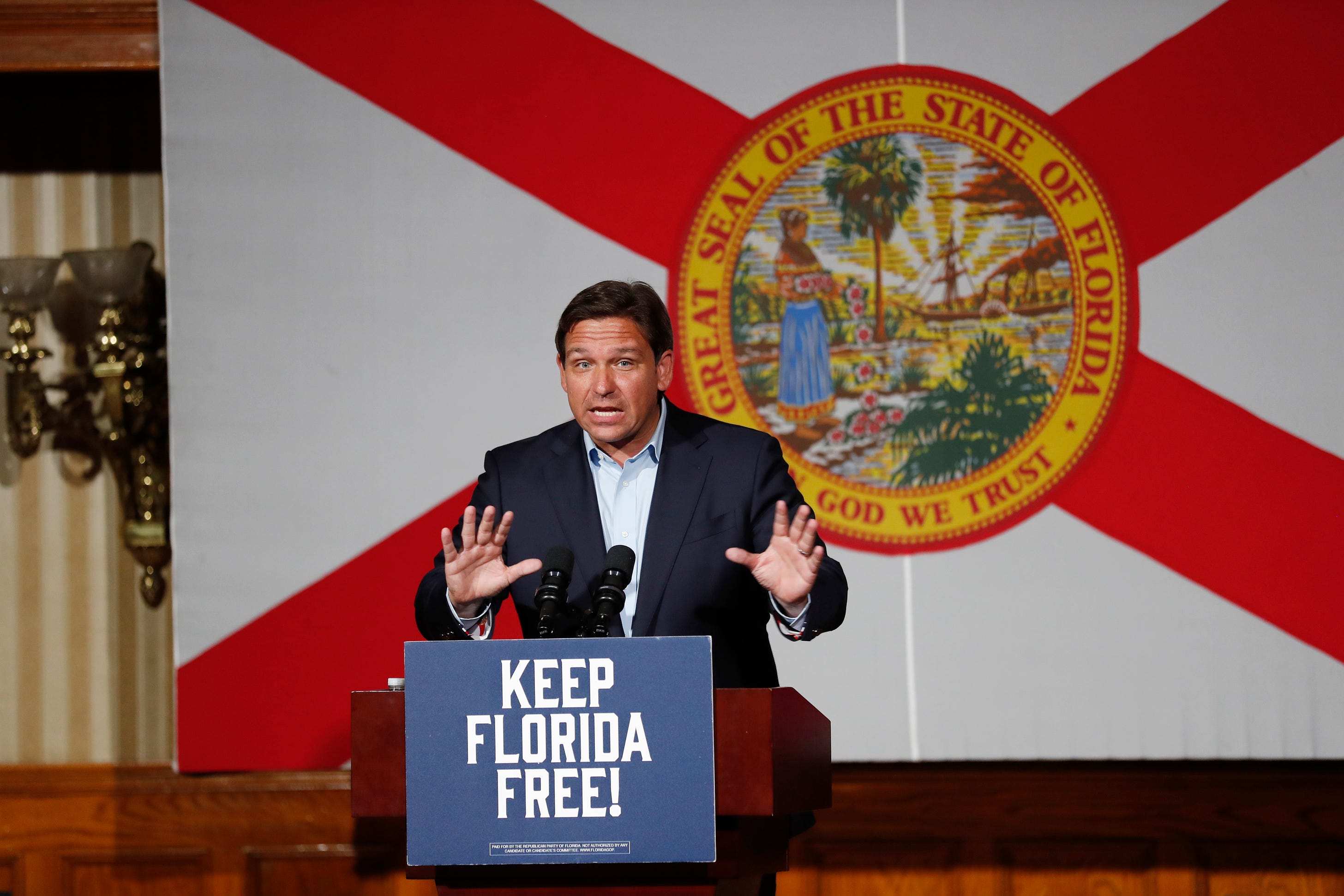
Photo credit: Octavio Jones
Editor’s note: this is an ironic banner in front of DeSantis. Florida is not free for those who don’t share his ideology. If you think racism exists today in Florida, you are not free to discuss it in school or college. You are free to agree with him.
Rather and Kirschner write:
Much of American history is entangled with racism and white supremacy. That is the reality of our beloved nation, no matter how much we wish it were not.
As we sit here nearly a quarter of the way through the 21st century, it is obvious that we need to have the maturity to look back to our past as well as ahead to the future. Can we do this with our eyes wide open? Will we study and learn from the lessons of history?
You can’t grapple with the truth if you hide it from view. Yes, our national narrative is an inspiring one — of freedom, rights, and new opportunities. But it is also a narrative of pain — of the bondage, rape, and murder of enslaved people. It is a story of mass death, broken treaties, and land stolen from Native people. And it is a story of persecution of the “other,” time and again.
The chasm between the noble promises of our founding documents and our historical realities continues to obstruct our national journey toward a more perfect union.
Yes, ours is a country that has facilitated exploration, innovation, and growth, but it is also one built upon families torn apart at the auction block, bodies whipped, and police dogs and fire hoses set against children.
Cities were redlined. Public schools were segregated. And despite our carefully cultivated national image as a meritocracy, throughout our history we have seen talent overlooked and our common humanity diminished on account of people’s race, religion, and sexual orientation.
The ripples of injustice continue to destabilize our society.
It shouldn’t be controversial to say any of this. But acknowledging these truths today is a political act, because it threatens the privileged narratives of those who seek to sugarcoat our past. These are men and women who serve their own ambitions by fortifying their cynical holds on power, delighting in division, feeding off fear, and applauding anger.
And that brings us to Florida’s Governor Ron DeSantis.
Listing all of his efforts to leverage the power of his office to attack equity, empathy, and justice would stretch this post immeasurably. But doing so would also jeopardize the central point: DeSantis is an opportunist. He is not weighing the merits of any one campaign. Rather, he wants headlines as a culture warrior standing up to “wokeness,” a term he has eagerly redefined to suit his own purposes. It allows him to sneer at and dismiss any attempt to reckon with American injustice.
DeSantis has focused his assaults on two of our society’s most traditionally marginalized groups: Black Americans and the LGBTQ community. While these populations have thus far felt the brunt of his targeting, we need to see clearly that his rhetoric is a threat to all who care about a democratic, peaceful, empathetic, and just America. Those of us with the greatest privilege should bear a special burden in rejecting this hate.
DeSantis’s pugilism has enabled him to consolidate power in Florida. Any opposition to his toxic initiatives must contend with the uncomfortable truth that voters validated his message and style via his landslide win in November. Now DeSantis thinks he can take his show on the road with a presidential bid. That remains to be seen. Florida has been trending Republican in recent years, and success there might not translate to the current battleground states, many of which saw big Democratic wins in the midterms.
All that being said, there is a great danger to framing this struggle primarily through the lens of electoral politics. This normalizes a discourse that should be rejected by society’s mainstream. Just as the outright bigotry of the past became socially unacceptable, so too should these latest attempts at divisiveness.
It should not surprise us that DeSantis is making schools — both K-12 and college — a central target. He wants to teach a distorted view of America. He wants to make dissenting speech not only suspect but even criminal. He wants to silence the voices of his critics and of critical thinking more generally. This is a playbook that has been followed by demagogues before to very dangerous ends.
It is essential that DeSantis not be covered by the press through a false equivalence paradigm. We can debate what we should teach and how to teach it. But we can’t replace the truth, as unsavory as it may be, with sanitized narratives that suit those already in power. This is a battle for the minds of the voters of the future. This is about what kind of nation we will become.
But DeSantis primarily cares about what kind of country we are now. He wants to appeal to fear because he thinks he can mine that fear for votes. That is his game plan. And he’s not hiding it. There can be no appeasement. DeSantis has already shown that he isn’t interested in deliberations or good faith compromise. Those would disrupt his approach of means to an end.
History illustrates that hatred can be taught, but so can empathy and justice. We are on a winding journey as a nation. And we have much farther to go. But we have made progress in the face of bigots and autocrats because people had the courage to forge the inequities of our past into a more equitable future.
This history, this truth, is what scares people like DeSantis the most. But it is one that can give us hope if we are determined not to look away.
NBC reports that North Dakota may impose a ban on sexually explicit books, especially those that refer to gender identity, on public libraries. Librarians who ignore the proposed ban will be subject to 30 days in jail. Since the bill was introduced by the House Majority Leader, it may pass.
Books containing “sexually explicit” content — including depictions of sexual or gender identity — would be banned from North Dakota public libraries under legislation that state lawmakers began considering Tuesday.
The GOP-dominated state House Judiciary Committee heard arguments but did not take a vote on the measure, which applies to visual depictions of “sexually explicit” content and proposes up to 30 days imprisonment for librarians who refuse to remove the offending books….
Library Director Christine Kujawa at Bismarck Veterans Memorial Public Library said the library has a book with two little hamsters on the cover. At the end of the book, the hamsters get married, and they are both male.
“It’s a cute book,” Kujawa said — but it would be considered pornography under the bill because the book includes gender identity.
Facing criminal charges for keeping books on shelves is “something I never thought I would have to consider during my career as a librarian,” Kujawa added.
In addition to banning depictions of “sexual identity” and “gender identity,” the measure specifies 10 other things that library books cannot visually depict, including “sexual intercourse,” “sexual preference” and “sexual perversion,” — though it does not define any of those terms. The proposal does not apply to books that have “serious artistic significance” or “materials used in science courses,” among other exceptions.
Thanks to Christine Langhoff for suggesting this article.
Trump’s Secretary of State Mike Pompeo just proved that he is the stupidest person in the world. He said in an interview that Randi Weingarten, President of the American Federation of Teachers, is “the most dangerous person in the world.”
More dangerous than the President of China, Xi Jinping, who is threatening the survival of Taiwan and re-imposing a repressive regime across China.
More dangerous than President Kim, the dictator of North Korea, who is threatening South Korea and the rest of the world, with his intercontinental ballistic missiles and nuclear weapons.
More dangerous than Russian dictator Vladimir Putin, who is trying to destroy the people of Ukraine by destroying their access to heat, light, and water as winter begins,in addition to raining deadly missiles on them.
No, Pompeo says, Randi is “the most dangerous person in the world.”
Why? Because she leads a teachers’ unions, and unions are evil.
Teachers too are evil, Pompeo believes, because the children of America can’t read, write, or do math.
He said,
“I tell the story often — I get asked ‘Who’s the most dangerous person in the world? Is it Chairman Kim, is it Xi Jinping?’ The most dangerous person in the world is Randi Weingarten,” Pompeo said.
“It’s not a close call. If you ask, ‘Who’s the most likely to take this republic down?’ It would be the teacher’s unions, and the filth that they’re teaching our kids, and the fact that they don’t know math and reading or writing,” the former top U.S. diplomat added.
Randi replied:
In a thread on Twitter, Weingarten said she didn’t know if the remarks should be considered “ridiculous or dangerous.”
“At the state department, Pompeo defended Middle East’s tyrants & undermined Ukraine. He was more focused on pleasing Trump than fighting 4 freedom, national security & democracy. To compare us to China means he must not know what his own department says,” she wrote.
“Maybe spend a minute in one of the classrooms with my members and their students and you will get a real lesson in the promise and potential of America.”
Pompeo’s blast is ridiculous and stupid. But it’s also dangerous for Randi. It makes her a target of extremists in search of targets. This country has a surfeit of lunatics with guns. Pompeo should pay the cost of personal security for her.
His uninformed, ignorant remarks are insulting to teachers.
I challenge him to name a non-union state that outperforms unionized states.
Every teacher should belong to the AFT or the NEA. They would have higher salaries, health care, pensions, and job security. They would have state and national organizations to protect them in state legislatures and Congress.
The teaching profession is under fire by ignorant politicians like Pompeo. Consequently, many experienced teachers have resigned, and there is a national teacher shortage.
The best way to support teachers and their noble profession is to improve their stature, their salaries, and their working conditions. The only way that will happen is if there are strong unions to stand up for teachers, who alone are powerless.
Only strong unions will fight for the profession against the hostility of bombastic fools like Pompeo.
Pompeo can’t tolerate strong women or strong unions.
Time to take a break from Education News and Ukraine to reflect on the most shameful day in U.S. history. We dare not forget, especially as the numbers of anti-democratic, neo-fascist, militant groups surface, and the U.S. Supreme Court strikes down reasonable restrictions on gun control.
In the last two years of Trump’s term in office, I followed him on Twitter. It was a usually horrifying experience to read whatever rant he posted at 6 a.m. But it was necessary, I thought, to be informed, to know what bizarre rages were percolating in his head, unfiltered by senior staff or caution. I recall the tweet he wrote when he said, “come to DC on January 6. Will be wild.” I knew something awful was brewing.
My television was on that day, and I watched his speech to his adoring throng and felt the sense of menace in the air. Like millions of others, I watched in horror as the mob attacked the thinly-guarded Capitol, broke through the lines, began attacking police officers, broke a window, stampeded the entrance, and climbed the walls of that august building.
I couldn’t help but think of the many times I had visited the Capitol to meet with an elected official or staff. Entry to the building is tightly guarded. Visitors wait patiently in line, waiting their turn to put their bags through a scanning machine, then to walk single file through a metal detector.
And here were hundreds or thousands of people streaming through the doors and the windows, or scaling the exterior walls, then running unimpeded through the halls.
I wrote that day, in a state of shock, about what I and millions of others had witnessed: “an attempted coup,” terrorism inspired by Trump.
The next day, as the dust settled, I wrote about what happened and about Trump’s failure to defend the Capitol:
As the rampage continued, Trump was silent. After a few hours of lawlessness, he released a video telling them to go home. He reiterated his lie that the election had been stolen. In the video, he also praised the crowd, who broke into the Capitol, trashed its elegant interior, ransacked the offices of members, terrorized fleeing elected, stole items from its rooms and posed for photographs in the legislative chambers. “We love you,” Trump said. “You’re very special.”
Yeah, very special thugs, looters, and terrorists.
It didn’t occur to me at the time that Trump’s loyal supporters would claim that the mob was created by Antifa and Black Lives Matter protesters. Why would Trump have told them that he loved them? Why would he have refused to send in help if he thought the mob was Antifa and BLM? Why would he say they were “special”? If he thought they were BLM and Antifa, I expect we would have seen a massive show of force, not silence.
It certainly didn’t occur to me that the Republican National Committee, to its eternal shame, would call the attack on the Capitol “legitimate political discourse.” Or that Republican members who rushed to safety and cowered in safe spaces would reflect on the day as just another protest or actually defend the insurrectionists as “patriots.”
On January 10, 2021, I wrote “Donald Trump Is a Traitor” and thought about what might have happened if the insurrectionists had succeeded.
What happened on January 6 was a failed coup. Many of Trump’s MAGA base joined the mob innocently.
But the mob was led by trained militia men, equipped to take hostages, prepared with flex cuffs, which police use to handcuff suspects.
The mob chanted “Hang Mike Pence.”
The mob knew the location of the secret Capitol offices of Democratic leaders.
They went looking for them.
Members of Congress exited the Chambers only a minute or two before the mob. If they had not escaped, there would have been mayhem.
The mob would have seized the leaders of Congress and VP Pence, handcuffed them, perhaps given them a show trial, perhaps executed them.
What then? Our democracy and our Constitution shredded. Would Trump declare himself President for Life?
What happened was terrifying. What might have happened would have been far, far worse.
Trump toadies are incorrigible. How to explain the members of Congress who emerged from their hiding place to vote to sustain Trump’s lies and to overturn a free and fair election? How to explain the perfidy of Senators Cruz and Hawley? How to explain the majority of House Republicans, who voted in support of a man who incited a coup against our democracy and our Constitution?
Now that I have watched the hearings of the January 6 Committee, I realize that the situation was even worse than I imagined on the day of the failed coup. I learned that Trump wanted to join the mob at the Capitol. Well, I’m sorry he didn’t, because there would now be no question about his culpability for inciting the insurrection, and he would be barred from ever seeking office again.
We learned that he watched the riot on television in his private dining room and did nothing to stop it for 187 minutes. He was hoping the mob would succeed and capture the Capitol. We know he did nothing to save the life of his Vice-President.
That led me to wonder: what if the mob had succeeded? There would have been no show trials. They would have executed Mike Pence and Nancy Pelosi. They would have murdered AOC and the Squad. They would have murdered any member of Congress who stood in the way of their hero Trump. In the chaos, the mob might have murdered some of their Republican allies. Accidents happen.
We now know that the mob was only 40 feet from Pence as he fled. We now know that Officer Eugene Goodman lured the mob away from the floor of the Senate long enough for it to be evacuated. Even Republicans were terrified. We saw video of mob sympathizer Josh Hawley sprinting away from the insurrectionists whom he incited earlier with a raised fist.
January 6, 2021, was the worst day in American history. It was the only time that the seat of our government was attacked by our fellow Americans. It was a rebellion against the Constitution and the rule of law. If ever there was a Day of infamy, a Day of Shame, a day in which our Constitution and our democracy hung in the balance, it was January 6.
The Ford Foundation decided to eliminate one of its best programs. This program has encouraged some of our most outstanding scholars of color. Who made this decision and why?
A millionaire foundation president constantly surrounded by controversy and verbal missteps (Google Darren Walker), a former University president who resigned, and the “cold” wealthy Apple tech heir just killed the most successful philanthropic diversity effort ever. Darren Walker, Francisco G. Cigarroa, and Laurene Powell Jobs are sunsetting the Ford Fellowship. For decades, this program has been addressing educator diversity in higher education and enhancing the contributions of faculty of color. Despite its unrivaled accomplishments— in an instant— one of the most successful diversity programs of all time— 6,102 fellows since the inception of the program in 1967— is now in the dustbin of history.
Educator diversity is one of the biggest challenges facing education today. It is an acute issue as students of color rarely encounter teachers of color in K-12 and then have the same experience in higher education. The last decade of research has shown that higher education hasn’t moved the needle and improved diversity in an appreciable way— but the Ford Fellowships clearly have. Mary Beth Gasman, a Professor at Rutgers University, said in the Washington Post that higher education has not solved this problem because colleges and universities “don’t want” faculty of color and now neither does the Ford Foundation.
In an email message to Ford Fellows, Darren Walker, Francisco G. Cigarroa, and Laurene Powell Jobs and the Ford Foundation board offered a couple of flawed reasons for killing the prestigious and impactful program. They argued that “winding down” the Ford Fellowships is acceptable because the Gates and Lumina foundations participate in higher education philanthropy. Leaving to the side the failures that the Gates Foundation has wrought on K-12 and Higher Education, it’s a straw man argument because unfortunately neither of these— nor any other foundation— are funding educator diversity in higher education in “meaningful and inspiring ways” as the Ford Foundation fellowships have done.
Walker, Cigarroa, and Jobs and the Ford Foundation board also engage a sleight of hand by mentioning that they will refocus on “social and racial justice.” What they neglect to mention is that the Ford Fellowship have supported the intellectual foundation of grassroots social and racial justice activism and movements. For example, while the program has encompassed many intellectual disciplines, this award has identified and supported some of the leading educational scholars and movement influencers such as Travis Bristol (Educator Diversity), Keffrelyn Brown (Culturally Relevant Pedagogy), Julian Vasquez Heilig (Community-Based Education Reform), Delores Delgado Bernal (Latinx students and schools), Daniel Solorzano (Critical Race Theory), Angela Valenzuela (Ethnic Studies), Chezare Walker (Black Youth and schools), Bryan Brayboy (Indigenous students and schools) and many more. I can only imagine how slighted the scholars of color supported by this fellowship may feel by this gross oversight of their widespread impact on social and racial justice. What Walker, Cigarroa, and Jobs and the Ford Foundation board don’t realize is that the fellowships are funding social and racial justice intellectual capital across the nation and globe. If they would have asked the Ford Fellows, they may have realized this. Furthermore, to set up a competitive and false dichotomy between funding Ford Fellowships and racial justice and movement building is insulting and demeaning for Ford Fellows and communities of color.
Killing the Ford Fellowships is not actually a “judgement call” as they say in their closing statement, but rather severe ignorance of the incredibly rich history of the Ford Fellowship. The closing of the Ford Fellowships just compounds Darren Walker’s ongoing errors, controversies, and missteps as a leader. Maybe for Darren Walker this “judgement call” is payback as the Ford Fellows created a movement and publicly protested his extensive support of prisons.
So, what is to be done? How do we hold the board members of the Ford Foundation representing Xerox, Ford, Davidson Kempner, Aluko & Oyebode, Cisco Systems, Sigma Impact, Mastercard and others accountable? Do you know how to reach out to them? Should Ford Fellows boycott the proposed 2023 conference? If Walker, Cigarroa, and Jobs and the Ford Foundation board were truly interested in movement building, the fellowship could have been reworked to encourage scholars to apply who are leaders and were identified as future leaders in social and racial justice. This new approach would add to the heritage of the Ford Fellowships and honor the legacy of leadership whose shoulders Walker, Cigarroa and Jobs and the Ford Foundation board stood on— but have now fallen off. By simply killing the Ford Fellowships, Darren Walker, Francisco G. Cigarroa, and Laurene Powell Jobs and the Ford Foundation board are destroying the intellectual foundation of social and racial justice movements and killing philanthropy’s most successful diversity program of all time. Shame on them.
Mark Leibovich is one of the most astute political journalists in the nation. Until last December, he was the chief national correspondent for The New York Times Magazine. He is now a senior editor at The Atlantic.
This article, “The Most Pathetic Men in America,” explains in vivid prose why Kevin McCarthy and Lindsey Graham worship at the feet of Donald Trump. They know he’s a fraud and a liar. They know he lost the election. But they slobber over him and crave his approval. Neither man has a shred of dignity or integrity. They are, quite simply, the most pathetic men in America.
Here is an excerpt:
Bottom line, Trump is an extremely tedious dude to have had in our face for seven years and running. My former New York Times colleague David Brooks wrote it best: “We’ve got this perverse situation in which the vast analytic powers of the entire world are being spent trying to understand a guy whose thoughts are often just six fireflies beeping randomly in a jar.”
Better objects of our scrutiny—and far more compelling to me—are the slavishly devoted Republicans whom Trump drew to his side. It’s been said before, but can never be emphasized enough: Without the complicity of the Republican Party, Donald Trump would be just a glorified geriatric Fox-watching golfer. I’ve interviewed scores of these collaborators, trying to understand why they did what they did and how they could live with it. These were the McCarthys and the Grahams and all the other busy parasitic suck-ups who made the Trump era work for them, who humored and indulged him all the way down to the last, exhausted strains of American democracy.
The GOP’s shame, ongoing, is underscored by the handful of brave Republicans willing to speak the truth about Trump in public, before the January 6 committee and on the panel itself. The question now is whether they have any hope of wresting some admirable remnant of their party back from Trump’s abyss before he wins the Republican nomination for president in 2024 or, yes, winds up back in the White House….
Consider again the doormat duo—McCarthy and Graham. I’ve known both men for years, at least in the weird sense that political reporters and pols “know” each other. They are a classically Washington type: fun to be around, starstruck, and desperate to keep their jobs or get better ones—to maximize their place in the all-important mix. On various occasions I have asked them, in so many words, how they could sidle up to Trump like they have. The answer, basically, is that they did it because it was the savviest course; because it was best for them. If Trump had one well-developed intuition, it was his ability to sniff out weakness in people—and, I suppose, in major political parties. Nearly all elected Republicans in Washington needed Trump’s blessing, and voters, to remain there. People like McCarthy and Graham benefited a great deal from making it work with Trump, or “managing the relationship,” as they say.
McCarthy knew that alienating Trump would blow up any chance he had of becoming speaker, which had become the singular objective of his “public service,” such as it was. He cultivated Trump from the start. The president came to refer to McCarthy as “my Kevin,” a term of ownership as much as affection. But “managing the relationship” was often a daily struggle, McCarthy conceded, when I interviewed him for The New York Times in his Bakersfield, California, district in April 2021. “He goes up and down with his anger,” McCarthy said of Trump. “He’s mad at everybody one day. He’s mad at me one day … This is the tightest tightrope anyone has to walk.”
Once, early in 2019, I asked Graham a version of the question that so many of his judgy old Washington friends had been asking him. How could he swing from being one of Trump’s most merciless critics in 2016 to such a sycophant thereafter? I didn’t use those exact words, but Graham got the idea. “Well, okay, from my point of view, if you know anything about me, it’d be odd not to do this,” he told me. “‘This,’” Graham specified, “is to try to be relevant.” Relevance: It casts one hell of a spell.
“I could get Trump on the phone faster than any staff person who worked for him could get him on the phone,” McCarthy bragged to me. There was always a breathless, racing quality to both men’s voices when they talked about the thrill ride of being one of Trump’s “guys.”
What would you do to stay relevant? That’s always been a definitional question for D.C.’s prime movers, especially the super-thirsty likes of McCarthy and Graham. If they’d never stooped this low before, maybe it’s just because no one ever asked them to.
There was international condemnation of right-wing policies in the U.S. today, when the European Parliament voted 324 to 155, with 38 abstaining, to condemn the Supreme Court’s recent decision in Dobbs v. Jackson Women’s Health, overturning the 1973 Roe v. Wadedecision recognizing the constitutional right to abortion. It also demanded that the European Union recognize the right to abortion in its charter, and to provide “safe, legal and free abortion services, pre-natal and maternal healthcare services, voluntary family planning, youth-friendly services, and HIV prevention, treatment and support, without discrimination.”