Archives for category: Republicans

The Florida legislature passed a universal voucher plan, meaning that the state will subsidize the tuition of every student, no matter their family income, Rich or poor. The state will hand out subsidies to rich families whose children go to elite private schools. All money deducted from public schools. Short-sighted and stupid, a giveaway to families who can afford private schools.

Currently, there are more than 400,000 students enrolled in private schools. About 80,000 may already have a voucher. Now, even those attending an exclusive school will be subsidized by the state. Homeschoolers will also be subsidized by the state, at least 20,000 in the fumigation year.

Most of the schools that take vouchers are religious and most are not accredited.

Likely new cost: 320,000 students already enrolled in private schools without a voucher plus 20,000 homeschooled kids x $7,800=$2.65 billion. And that’s without a single student now in public school asking for a voucher. A realistic estimate for the annual cost of Florida’s universal voucher would be at least $3 billion a year.

The Center for Budget and Policy Priotities notes that the Florida voucher funding is designed to reduce the funding of public schools, which currently enroll about 80-85% of the state’s children:

While voucher programs are often funded as line-item appropriations in state budgets or through private donations (which over time reduces the revenues available for education and other state priorities), this Florida voucher is actually designed to take money away from the state K-12 funding formula designated for public school districts.

Scott Maxwell of the Orlando Sentinel says that Florida’s universal voucher program is likely to blow a billion-dollar hole in the state budget. As I pointed out above, $1 billion is a low estimate. That hole in the budget will be closer to $3-4 billion, when you include the students whose parents can already afford to pay tuition.

He writes:

Florida lawmakers are about to take the biggest educational gamble in American history — financed with your tax dollars.

They want to offer every child in Florida the chance to use publicly funded vouchers at private schools that have virtually no regulation and offer no guarantee that the students will get educated.

Florida’s existing network of voucher schools is so infamously unchecked that the Orlando Sentinel has found schools employing teachers that don’t have high-school diplomas themselves. Some refuse to serve children with disabilities or gay parents. Others were such financial wrecks that they shut down in the middle of the school year, stranding students.

Flaw #1:

Voucher schools in Florida are unregulated. They can hire teachers who are not certified. They can hire teachers who never finished college. Voucher schools do not take state tests. They need not disclose their graduation rate or their curriculum. They are not overseen by state officials. Some voucher schools ignore safety codes, because they are not required to comply with them. The Orlando Sentinel conducted an investigation called “Schools Without Rules,” demonstrating that voucher schools take tax money without any oversight, transparency or accountability.

Flaw #2:

Voucher schools operate in secrecy. They are not required to report anything to the state.Not test scores, graduation rates, SAT scores, or anything else. Florida is operating on the principle of “Trust But Don’t Verify.” Public schools are held to tight accountability requirements. Voucher schools, none at all. If accountability is good for public schools, why is it unnecessary for voucher schools?

Flaw #3:

Voucher schools can discriminate against any group. Unlike public schools, voucher schools can discriminate on any grounds. They don’t have to accept students with disabilities, gay students, students who don’t speak English, or students from a religion they don’t like.

Flaw #4:

Legislators think that choice is the only accountability needed. If a parent is unhappy, make a different choice. The only choice that parents do not have is to stop paying their tax dollars to fund this sector.

There is another grievous flaw:

The Florida voucher program reduces funding for the schools that the overwhelming majority of students attend. Why does this make sense?

Maxwell says there are good voucher schools, and they should have no objection to accountability, transparency, and oversight. Maxwell recommends the following fixes for the state voucher program.

All voucher-eligible schools should be required to:

  1. Publish graduation rates and nationally accepted test scores.
  2. Hire teachers who are certified or at least have a college degree.
  3. Disclose all the curriculum being taught.
  4. Ban discrimination. (If discrimination is a key tenet of a religious organization’s belief system, they should fund that discrimination with their own money. Any group that receives public dollars should serve all the public.)

Maxwell does not address the two glaring defects of the voucher program:

1. 75-80% of the students who take vouchers already attend private schools. Why is it in the interest of Florida to pay their tuition?

2. About 60% of the students who switch from a public school to a voucher school will drop out within two years. The vast majority of voucher studies conclude that students lose ground academically when they take a voucher. Shouldn’t parents be warned of the risk that they are taking by accepting a voucher?

The statehouse in Nashville, Tennessee, was surrounded by parents and students demonstrating in favor of gun control and against the GOP-controlled legislature’s protection of guns. The protest follows the murder of three children and three staff members at the Coventry School in Nashville.

Three Democratic members of the legislature joined the protest, chanting with the protestors.

The GOP leadership threatened to expel the Democrats. The speaker of the House absurdly claimed that the three Democrats were encouraging an insurrection.

Parents and children held signs and shouted chants during a large protest at the Tennessee capitol last week following a deadly school shooting. And while no one was arrested or injured, Republican House Speaker Cameron Sexton is comparing the demonstration to the Jan. 6 insurrection.

During the House Floor session on Thursday — days after the Covenant School shooting — Reps. Gloria Johnson, D-Knox, Justin Pearson, D-Memphis, and Justin Jones, D-Nashville, stood up and chanted with protestors in the gallery.

Pearson and other Democrats attempted to acknowledge the large group of protesters during session, but were told to stick to the subject of the bill by Speaker Cameron.

“We listened to them and helped to elevate the issue that they are demanding justice for,” said Pearson.

House Speaker Cameron Sexton said their actions were more than a breach of decorum, comparing it to the January 6th insurrection in remarks to outlets.

“Two of the members; Representative Jones and Representative Johnson, have been very vocal about Jan. 6 and Washington, D.C., about what that was,” said Sexton. “What they did today was equivalent, at least equivalent, maybe worse depending on how you look at it, to doing an insurrection in the State Capitol.”

Sexton warned that there will likely be consequences for the trio.

“It could be removal of committees; it could be censorship; it could be expulsion from the General Assembly. Anywhere in between,” said Sexton.

Leaders in the Democratic caucus are defending their colleagues. Nashville Democrat John Ray Clemmons says he believes Speaker Sexton is exaggerating.

“You show me the broken windows, you show me anyone who went into the speaker’s office and put their chair up on his desk and trashed his office, you show me where a noose was hanging anywhere on the legislative plaza,” said Clemmons, citing damage committed during the Capitol riot, which resulted in five deaths before and after the event.

The three rebellious Democrats were stripped of their committee assignments. Their member badges were deactivated. Their telephones were disconnected.

In a press conference Monday, Jones says Sexton is more focused on politics than addressing last week’s mass shooting.

“We are members, who are standing in the well, telling our speakers and our colleagues that kids should not be murdered in school,” Jones said, “and rather than address that issue, the speaker has spent more time on Twitter this weekend talking about a fake insurrection than he did about the deaths of six people including 9-year-old children.”

It is not yet clear if the lawmakers will face expulsion. Sexton has not commented on whether they will face further discipline.

A tweet:

Three Tennessee Democrats have been stripped of their committee and subcommittee assignments by the Republican dominated legislature for speaking out against gun violence in the wake of the Nashville shooting that killed three children.

Democracy is dead in Tennessee.

@Sethaweitz

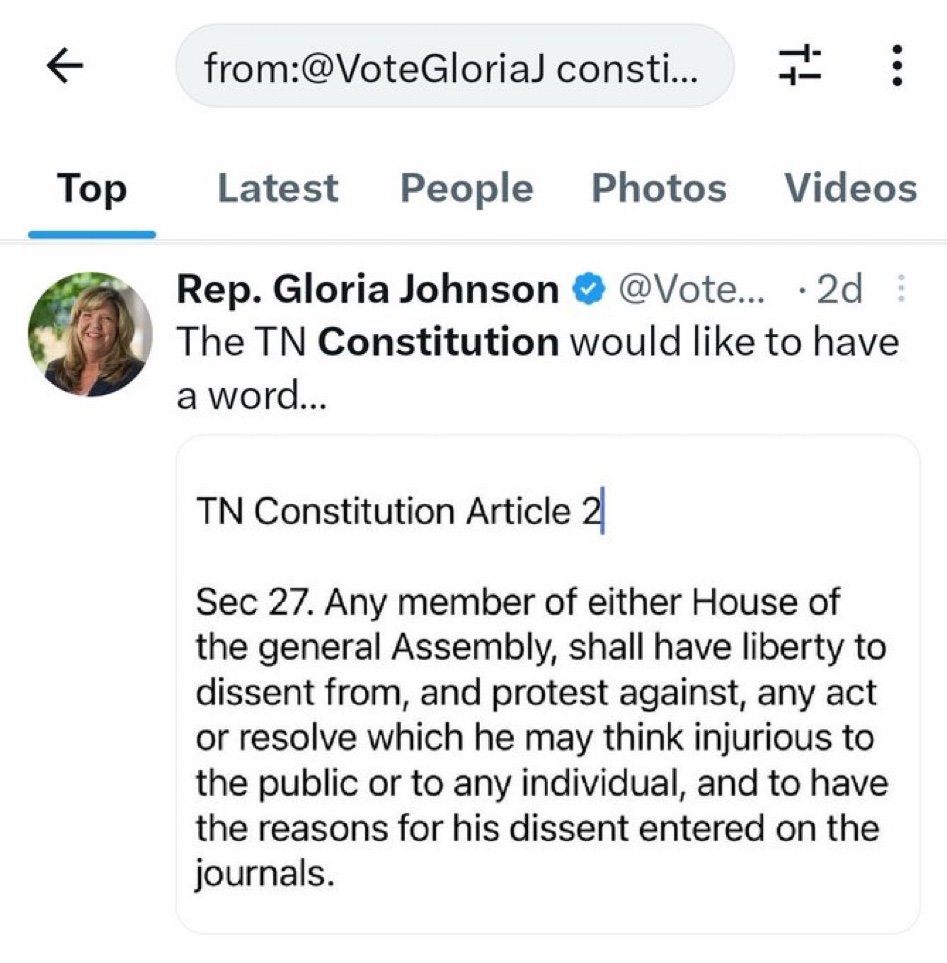
Rep. Gloria Johnson, one of the three Democrats, tweeted:

Virginia Governor Glen Youngkin sends his own children to an elite private school that never bans books and teaches critical race theory, But the governor ran on a platform of “parental rights,” which has unleashed censorship and book banning in the state’s public schools.

The schools of Spotsylvania have posted a list of 14 books that will be withdrawn to protect children from ideas their parents don’t like. Among the 14 are two by Nobel-prize winning author Toni Morrison.

The books were challenged for having “sexually explicit material” in them, according to a message to families from superintendent Mark Taylor.

The superintendent of Spotsylvania public schools has no prior experience in education. His appointment was made after hard-right conservatives won control of the school board. Aside from his lack of experience, Mark Taylor was controversial because of incendiary comments he made on social media. “They allegedly include memes mocking trans people and school shootings, racist innuendos and calls for parents to pull their children out of public schools.”

By the end of the week, the school district will remove:

All Boys Aren’t Blue” by George M. Johnson

Like a Love Story” by Abdi Nazemian

“Dime” and “America” by E.R. Frank

Sold” by Patricia McCormick

Out of Darkness” by Ashley Hope Perez

Beloved” and “The Bluest Eye” by Toni Morrison

Looking for Alaska” by John Green

The Perks of Being a Wallflower” by Stephen Chbosky

“Water for Elephants” by Sara Gruen

“Neanderthal Opens the Door to the Universe” by Preston Norton

More Happy Than Not” by Adam Silvera

“Nineteen Minutes” by Jodi PicoultSpotsylvania superintendent floats elimination of all school libraries

In a statement, Taylor pointed to a Virginia lawthat requires school districts to establish parental notification policies for instructional materials with sexually explicit materials, saying the 14 books fall under that category.

Taylor added that the division doesn’t have the resources to review whether the roughly 390,000 books in all school libraries have similar materials, so purging the 14 books from the shelves would be the only way to ensure they aren’t accessible….

Taylor noted in his message to families that the decision won’t stop teachers from including the pulled books in classroom assignments, which would have to be shared with parents under the law. According to the district, the books will be stored until they are donated.

What teacher will be brave enough or foolish enough to assign a banned book?

Carol Burris, executive director of the Network for Public Education, recently joined parents, students, and teachers at a rally in Austin, Texas, to protest the state’s decision to take control of the Houston Independent School District. The district is no longer “independent,” since the state asserted its control. And Republicans showed that they don’t really believe in “local control,” any more than they believe in “parents rights.”

As a graduate of HISD, I feel especially outraged by the state takeover on flimsy grounds. Governor Abbott and Commissioner Mike Morath are playing politics. These kids are the future of Texas. Why are they being used as pawns?

Burris wrote the following explanation of the state takeover. It appeared on Valerie Strauss’s “Answer Sheet” blog at the Washington Post website.

Strauss begins:

The administration of Texas Gov. Greg Abbott (R) announced this month that the state was taking over the public school district in Houston even though the Texas Education Agency last year gave the district a “B” rating. The district, the eighth-largest in the country, has nearly 200,000 students, the overwhelming majority of them Black or Hispanic, and opposition to the move in the city, which votes Democratic, has been strong.


Texas Education Agency Commissioner Mike Morath said the takeover was necessary because of the poor performance of some schools in the district — even though most of the troubled schools have made significant progress recently.


Here is the real story of the takeover, written by Carol Burris, an award-winning former New York school principal who is executive director of the Network for Public Education. The nonprofit alliance of organizations advocates the improvement of public education and sees charter schools — which are publicly funded but privately operated — as part of a movement to privatize public education.


By Carol Burris


Houston parents, teachers, and community leaders are protesting the decision by Texas Education Agency Commissioner Mike Morath to take over the Houston Independent School District. Some see the takeover as grounded in racism and retribution; others as big-government intrusion.


For Houston mom Kourtney Revels, the decision represents a hypocritical dismissal of parents by Gov. Greg Abbott (R). “How can Governor Abbott pretend to support parent empowerment and rights when he has just taken away the rights of over 200,000 parents in Houston ISD against their will and has not listened to our concerns or our voice?” she asked.

The takeover is the latest move in a long list of actions by Abbott’s administration to attack public school districts and expand privatized alternatives, including poorly regulated charter schools and now a proposed voucher program that would use public money for private and religious education. And critics see them all as connected.


State Rep. Ron Reynolds, a Houston Democrat, told the Houston Chronicle, that the takeover of the Houston district is part of Abbott’s attempt “to push” vouchers and charter schools, and to “promote and perpetuate the things that Governor Abbott believes and hears about, and that obviously isn’t diversity, equity and inclusion.”

The first takeover forum sponsored by the Texas Education Agency, which Morath leads, was described in the Houston Chronicle as “emotional and chaotic.” This week, the Greater Houston Coalition for Justice is leading a protest march before another TEA hearing. U.S. Rep. Sheila Jackson Lee (D), who represents the city, has asked the Biden administration to open a civil rights investigation into the takeover.

Background

The Houston Independent School District is Texas’s largest school district, with 284 schools and almost 200,000 students. It is also the eighth-largest district in the nation. Eight in 10 students come from economically disadvantaged families, and more than 1 in 3 students are not proficient in English. Fewer than 10 percent of the students are White.

The first attempted takeover of HISD by Morath was in 2019. The rationale for the takeover was school board misconduct and the seven negative ratings of Phillis Wheatley High School, one of the district’s 284 schools. Wheatley had been rated “academically acceptable” almost every other year until the YES Prep charter school opened nearby in 2011. During the 2021-2022 school year, Wheatley served 10 times as many Black students and more than twice as many students with disabilities as YES Prep, located just a five-minute drive away.

The district went to court to stop the takeover, and the debate wove through the courts until the Texas Supreme Court gave the green light for the takeover in January.

Almost four years have passed since the first takeover attempt, and the district has made impressive strides. The electorate replaced the 2019 school board, and a highly respected superintendent, Millard House, was appointed.

By every objective measure, the district is on a positive trajectory. The district is B-rated, and in less than two years, 40 of 50 Houston schools that had previously received a grade of D or F received a grade of C or better. Wheatley High School’s grade, the school that triggered that 2019 takeover attempt, moved from an F to a C, just two points from a B rating.

While there is a law that triggers a TEA response when a school repeatedly fails, the state Supreme Court did not mandate the takeover of the district. Under Texas law, Morath had two options — close the school or take over the district by appointing a new Board of Managers and a superintendent. He chose to strip local control. For those who have followed the decisions of Morath, his choice, the harsher of the two, comes as no surprise.

Mike Morath and charter schools

Mike Morath, a former software developer, was appointed education commissioner by Abbott in 2015. Morath had served a short stint on the Dallas school board, proposing that the public school district become a home-rule charter system, thus eliminating the school board and replacing it will a board appointed by then-Mayor Mike Rawlings, the former chief executive of Pizza Hut. Transformation into a charter system would also eliminate the rights and protections of Dallas teachers, making it easier to fire staff at will.

Morath and the mayor were supported in their quest to privatize the Dallas school system by a group ironically called Support Our Public Schools. While many of its donors remained anonymous, one did not — Houston billionaire John Arnold. Morath admitted encouraging the development of Support Our Public Schools and soliciting Arnold’s help in founding the organization.

Arnold, a former Enron executive and Houston resident, is a major donor and board member of the City Fund, a national nonprofit that believes in disruptive change and “nonprofit governing structures” for schools rather than traditional school boards. The City Fund touts New Orleans as the greatest school reform success. Arnold is joined on the board of the City Fund by billionaire and former Netflix CEO Reed Hastings, who has blamed public school woes on elected school boards and said 90 percent of all students should be in charter schools.

The plot to turn the Dallas school system into a charter system fizzled by January 2015. In December of that year, Abbott plucked Morath from the school board to become Texas education commissioner based on his record as a “change-agent.”

As commissioner, Morath has unilaterally approved charter schools at what many consider to be an alarming rate. Patti Everitt is a Texas education policy consultant who closely follows the decisions of the Texas Education Agency. Everitt noted that Morath “has the sole authority to approve an unlimited number of new charter campuses in Texas — without general public notice, no community meeting, and no vote by any democratic entity.” According to Everitt, he has used this power more frequently than his predecessors. “Since Mike Morath became Commissioner, data from TEA shows that he has approved 75 percent of all requests from existing charter operators to open new campuses, a total of 547 new campuses across the state,” she said.

In 2021, according to Everitt, Morath approved 11 new campuses for International Leadership of Texas Charter Schools, even though 28 percent of the chain’s schools had received D or F grades in prior ratings.


Georgina Cecilia Pérez served two terms on the Texas State Board of Education, from 2017 to 2022. During that time, she observed the Texas Education Agency up close. A 2017 state law provides financial incentives for districts to partner with open-enrollment charter schools, institutions of higher education, nonprofit organizations or government entities. She said that several charter partnerships with the Houston school district have been in the works waiting for the state takeover. She predicts Morath will approve them, “with no public vote.”


Abbott, Morath, and vouchers

Few were surprised this year when Abbott declared that establishing an Education Savings Account (ESA) voucher program would be one of his highest priorities this legislative session. ESA vouchers, the most controversial of all voucher programs, provide substantial taxpayer dollars, through an account or via a debit card, to private school and home-school parents to spend on educational services. Eight states presently have ESA vouchers, with three new programs in Arkansas, Iowa and Utah approved to begin in coming academic years. Other legislatures in red states, notably New Hampshire and Florida, are pushing for ESA program expansion.

Abbott had been reluctant to embrace vouchers — possibly because of a lot of opposition in Texas, especially in rural areas — causing some to speculate that his newly expressed support for them is linked to presidential ambitions. School choice is a pet cause of one potential rival for the Republican presidential nomination, Florida Gov. Ron DeSantis (R).

Two voucher bills are now weaving their way through the Texas Senate. S.B. 8 would give families a voucher of $8,000 per child a year and institute a parents’ “bill of rights” that allows parents to review public school curriculums through parent portals. A second bill, S.B. 176, would give private school and home-school families a $10,000-per-child annual voucher. Although Abbott has not endorsed either bill, he has made it clear that he supports a universal voucher program, promoting universal vouchers in speeches at some of the state’s most expensive private Christian schools.

Last year, Morath gave tacit support for vouchers, claiming that “there is no evidence” that vouchers would reduce public school funding. In February 2023, however, when questioned during a state Senate hearing, the commissioner admitted that voucher programs could have a negative fiscal impact on public schools.

That same month, his second-in-command, Deputy Commissioner Steve Lecholop, encouraged an unhappy parent from the Joshua Independent School District to work with the governor’s speechwriter to promote vouchers, saying it would be a great way to “stick it to” the school district.

The lack of success of district takeovers

Regardless of Abbott’s and Morath’s ultimate objective — whether it be flipping some or all of Houston’s public schools to charters — research on state takeovers has consistently shown that state takeovers nearly always occur in majority-minority districts and rarely improve student achievement. Student results in takeover districts, with only a few exceptions, have remained the same or decreased. That was the conclusion of a comprehensive cross-state study published in 2021. The study’s authors, Beth Schueler of the University of Virginia and Joshua Bleiberg of Brown University found “no evidence that takeover generates academic benefits.”

This intervention does not help students, and it mutes community voices, undermines democracy in Black and Hispanic communities, and pushes charter schools and other privatized alternatives to democratically governed schools.

An example is the takeover of Philadelphia’s public schools in 2001. Then-Gov. Tom Ridge (R) hired Edison Learning, a for-profit management company led by Chris Whittle, to study the district at the cost of $2 million. Edison Learning made a recommendation that it play a significant role in the reform and proposed running up to 70 schools. After community outrage, the number was reduced to 20. A few years later, the number of managed schools increased to 22. It was not long, however, before Edison Learning and the district were embroiled in a lawsuit concerning liability damages after a student was sexually assaulted in an Edison-operated school. By 2008, all for-profit management companies, including Edison, were gone. By 2017, the state takeover experiment ended.

Retired teacher Karel Kilimnik of Philadelphia had a first-row seat. She taught at a school taken over by the for-profit management company called Victory Co., which ran six schools under the School Reform Commission. The Reform Commission “promised academic and financial improvements that failed to materialize over their 16 years of control,” Kilimnik said. “Instead of improving the district, they opened the door to privatization and charter expansion and laid out the welcome mat for graduates of the uncertified Broad Superintendents Academy. They paved the way for the doomsday budget resulting in massive layoffs, larger class sizes, and the elimination of art and music.”

In his 2017 book, “Takeover,” New York University professor Domingo Morel concluded that, based on his extensive research, state takeovers are driven more by the desire of state actors to take political control away from Black and Hispanic communities than about school improvement. Recently in the Conversation, Morel described the seizure of the Houston school district as motivated by a need by the Republican establishment to thwart the growing empowerment of Black and Latinos as their numbers increase in Texas.

“The Houston public school system is not failing,” Morel said. “Rather, Republican Gov. Greg Abbott, Education Commissioner Mike Morath, and the Republican state legislature are manufacturing an education crisis to prevent people of color in Houston from exercising their citizenship rights and seizing political power.”

Allison Newport, a Houston mother of two Houston public school elementary students, agrees. “The commissioner should be congratulating Houston ISD and Wheatley High School for such incredible improvement in performance instead of punishing the students, parents, and teachers who worked so hard to make it happen.”
We have been waiting for Trump to begin attacking DeSantis. Trump released a statement today in which he tore down DeSantis, hitting him from the left and the right.

Trump’s line of attack:

DeSantis is an “average governor,” with no big accomplishments.

DeSantis has proposed “massive cuts in Social Security and Medicare.”

DeSantis was terrible on COVID, including lockdowns. Yet Florida had high rates of COVID and COVID deaths.

On crime, Florida is one of the worst in the nation.

On education, Florida compares poorly to other states.

DeSantis leads the nation in Public Relations.

Now, here is an example of the extremism and stupidity that has overtaken the Republican Party. A group of 21 Republican legislators in South Carolina want to impose the death penalty on any woman who gets an abortion. They assert that life begins at the instant of conception so any act that ends the life should require the murder of the woman who ended the pregnancy, even if the pregnancy was the result of rape or incest.

Let’s say that a 12-year-old girl is raped by a member of her family. She must carry the child of rape to term or be killed by the state. Meanwhile, her rapist walks free. Her life is worth nothing compared to that of the fetus.

It seems clear that the pro-life Freedom Caucus cares only about the lives of the unborn, not the lives of women who are pregnant. Why is one life more valuable than the other?

South Carolina Republican lawmakers are considering a bill that would make a person who has an abortion eligible for the death penalty.

The bill, titled the South Carolina Prenatal Equal Protection Act of 2023, would change the state’s criminal code and redefine “person” to include a fertilized egg at the point of conception.

According to the bill, the change would “ensure that an unborn child who is a victim of homicide is afforded equal protection under the homicide laws of the state.” Under South Carolina law, that includes the death penalty.

The bill provides exceptions for pregnant people who had an abortion if they were “compelled to do so by the threat of imminent death or great bodily injury” and also provides an exception if the abortion was done to save the life of the mother. There are no exceptions for rape or incest.

Rolling Stone wrote about this story as well.

Rep. Rob Harris, a sponsor of the bill, is a member of the Freedom Caucus. Asked if he saw any irony between being a member of the so-called “Freedom Caucus” while proposing such harsh restrictions on reproductive freedoms, Harris responded simply: “Murder of the pre-born is harsh.”

Our reader Carolmalaysia received a letter from the Indiana State Teachers Association, protesting two bills to undercut public schools, teachers and librarians. She signed the petition.

1.] TAKE ACTION: Tell legislators to prioritize public schools and reject private school voucher expansion in radical state budget

All kids, no matter where they live, should be able to pursue their dreams in a great public school. However, the currently proposed radical budget increases spending on private school vouchers by 70%, while increasing traditional public school funding, where 90% of Hoosier students attend, by only 5%.

The current budget would provide more than $1 billion for wealthy families making up to $220,000 to attend private school for free, while neighborhood public schools continue to struggle to provide enough resources for students and pay hard-working educators a competitive salary.

Urge lawmakers to prioritize public education and oppose this huge expansion of unaccountable private school vouchers in the budget. Ask them to increase their commitment to public schools.

2.] TAKE ACTION: TELL LEGISLATORS TO OPPOSE A BILL THAT WOULD REMOVE LEGAL PROTECTIONS FOR TEACHERS AND LIBRARIANS
02/17/2023

SB 12 is yet another culture war bill furthering a false narrative about our public schools. Rather than locally addressing issues over content, the bill would open teachers and librarians to criminal prosecution over educational materials. The bill would remove existing legal defenses schools and school libraries may use when locally determining educational materials. These matters will end up in litigation without administrative steps.

This bill has passed out of the Senate and is now under consideration by the House. Tell your representative to oppose SB 12.

Arizona has a Democratic Governor, Katie Hobbs, who beat election denier Kari Lake, by a small margin. Each house of the legislature has a small Republican majority, by one vote only. Yet the Republicans have decided to copy the zany extremist initiatives of Ron DeSantis of Florida. Some Republicans think it’s a risky bet.

From criminalizing drag shows to legalizing guns on college campuses, Republican lawmakers at the Arizona Capitol are proceeding like it’s a normal year for them, pushing forward with proposals that appeal to the furthest-right voters in the state.

They’re advancing election bills based on conspiracy theories and pushing back at critics, even silencing speakers for using the phrase “conspiracy theory.” Some proposed laws that were rejected in past years due to Republican opposition have made it further this year, even as they have less chance of becoming law.

Republicans expect Democratic Gov. Katie Hobbs to veto what they believe are good bills, hoping their commitment to far-right conservative values will help them in next year’s election.

It’s a risky strategy if they want to avoid seeing the Legislature flip to Democrats next year, according to some observers on both sides of the aisle.

“The party right now is tone-deaf,” said former Sen. Paul Boyer, a Republican from Glendale who served in the Legislature for five terms but didn’t run for reelection last year after some constituents and GOP peers pilloried him for failing to embrace election denialism. “They haven’t figured out that if they keep this up, we’re going to get massacred.”

Since he lost in 2020, former President Trump has repeatedly and falsely alleged that the election was rigged, stolen from him. Millions of his adherents believe him. Sowing disbelief in the fundamental fairness of the nation’s voting system may be Trump’s greatest crime, for which he will never be prosecuted. It is a clear violation of his oath of office, in which he solemnly swore that he would “”to the best of my ability, preserve, protect and defend the Constitution of the United States.”

But the Washington Post obtained a secret study commissioned by Trump to determine the scope of any election fraud. The study did not confirm the claims Trump made in public. The voter fraud discovered by his team could not verify his wild claims.

When Donald Trump called Georgia Secretary of State Brad Raffensperger on Jan. 2, 2021, in a now-infamous bid to overturn the 2020 election, he alleged that thousands of dead people had voted in the state.
“So dead people voted, and I think the number is close to 5,000 people. And they went to obituaries. They went to all sorts of methods to come up with an accurate number, and a minimum is close to about 5,000 voters,” he said, without citing his study.

But a report commissioned by his own campaign dated one day prior told a different story: Researchers paid by Trump’s team had “high confidence” of only nine dead voters in Fulton County, defined as ballots that may have been cast by someone else in the name of a deceased person. They believed there was a “potential statewide exposure” of 23 such votes across the Peach State — or 4,977 fewer than the “minimum” Trump claimed.In a separate failed bid to overturn the results in Nevada, Trump’s lawyers said in a court filing that 1,506 ballots were cast in the names of dead people and 42,284 voted twice. Trump lost the Silver State by about 33,000 votes.

The researchers paid by Trump’s team had “high confidence” that 12 ballots were cast in the names of deceased people in Clark County, Nev., and believed the “high end potential exposure” was 20 voters statewide — some 1,486 fewer than Trump’s lawyers said.

According to their research, the “low end potential exposure” of double voters was 45, while the “high end potential exposure” was 9,063. The judge tossed the Nevada case even as Trump continued to claim he won the state.

Are there penalties for lying?

Are there consequences for undermining public confidence in the democratic process of selecting those who govern us?

How do we hold accountable a president who violates his oath of office?

Most of us probably didn’t realize that the controversy over transgender athletes was a matter deserving Congressional action.

Should trans women be allowed to compete in women’s sports? Should trans men be allowed to compete in men’s sports? I assumed that the governing bodies of the sports would settle the matter.

But Republicans believe it is necessary to pass a federal law. They know the Senate won’t pass whatever law they write, so this is a symbolic gesture to their base, some of whom are terrified of trans people.

SPORTS BILL ADVANCES FOR FIRST TIME —Congressional Republicans are the closest they’ve ever been to passing legislation that would prohibit transgender women and girls from playing on sports teams that match their gender identity.

— The bill — H.R. 734 (118), the Protection of Women and Girls in Sports Act of 2023 — was introduced by Rep. Greg Steube (R-Fla.) several times, but was taken up by the House Education and Workforce Committee for the first time last week in a 16-hour markup. It would amend Title IX, the federal education law that bars sex-based discrimination, to define sex as based solely on a person’s reproductive biology and genetics at birth.

— The measure was recommended by the committee in a vote on party lines and is now primed for a vote on the House floor. While H.R. 5 (118), the Parents Bill of Rights Act, cleared the committee the same day and is slated for a vote in two weeks, House Majority Leader Steve Scalise’s office said they haven’t made any announcements on when they will take up the sports bill for a vote. House Republicans are expected to pass the bill with their slim majority, but it’s not likely that the Democrat-controlled Senate will allow the bill to move.

— The legislation will be a way for the GOP to force Democrats to go on record with their support for transgender students to play sports, a key part of the GOP’s 2022 midterm policy agenda. It is also a direct rebuke of the Biden administration’s proposed Title IX rule, which seeks to codify protections based on sexual orientation and gender identity. The Education Department is expected to unveil its final rule in May, though it said it would make a separate rule for sports.