Jeff Bryant writes often about education. He lives in North Carolina. In this article, he tries to solve the mystery of why Democratic state legislator Tricia Cotham switched sides and joined the Republican Party, giving them a supermajority in both houses of the General Assembly?
Cotham was a Democrat who had campaigned in promises to oppose school vouchers; to defend LGBT rights; and support abortion rights.
Once she gave the Republicans the decisive vote in the lower house, the Republicans had a veto-proof majority and were in a position to override any veto by Democratic Governor Roy Cooper.
Cotham, the new Republican, reversed her vote on everything she campaigned for or against. She supported Republicans’ efforts to reduce abortion rights; she endorsed school vouchers; and she sided with Republicans in their attack on trans youth.
In other words, she betrayed the people who voted for her and cast her lot with the hard-right Republicans who have aligned themselves with anti-progressive, anti-liberal, anti-Democrat policies.
Why? She said the Democrats were mean to her. She said they ignored her. She said she didn’t get the committee assignments she wanted. Are these good reasons to join forces with a party that has sought to destroy public education, demoralize teachers, and gerrymander the state to protect its advantages?
None of this made sense. A person doesn’t change their fundamental values because of hurt feelings.
Jeff investigated and determined that her decision was transactional. What did she get in exchange for double-crossing her constituents and her colleagues? Read his article to find out.
Paul Cobaugh is a military veteran who retired as a Chief Warrant Officer who worked in special operations in communications and narrative strategies. He writes a blog about national security called “Truths About Threats.”
This is a short TAT. After all, it is the weekend. This morning, a friend posted on LinkedIn, a copy of the letter Jim Jordan sent to AG, Merrick Garland. That is what pushed me to my keyboard before resuming chores. Endless words will be written after the historical indictment of a former president. I will bring you a very different perspective on that indictment that very few will address, as I wade into this national security nightmare the beginning of next week. In the meantime… please consider my brief thoughts below, not for my sake but for all of ours. “All politics are local.”
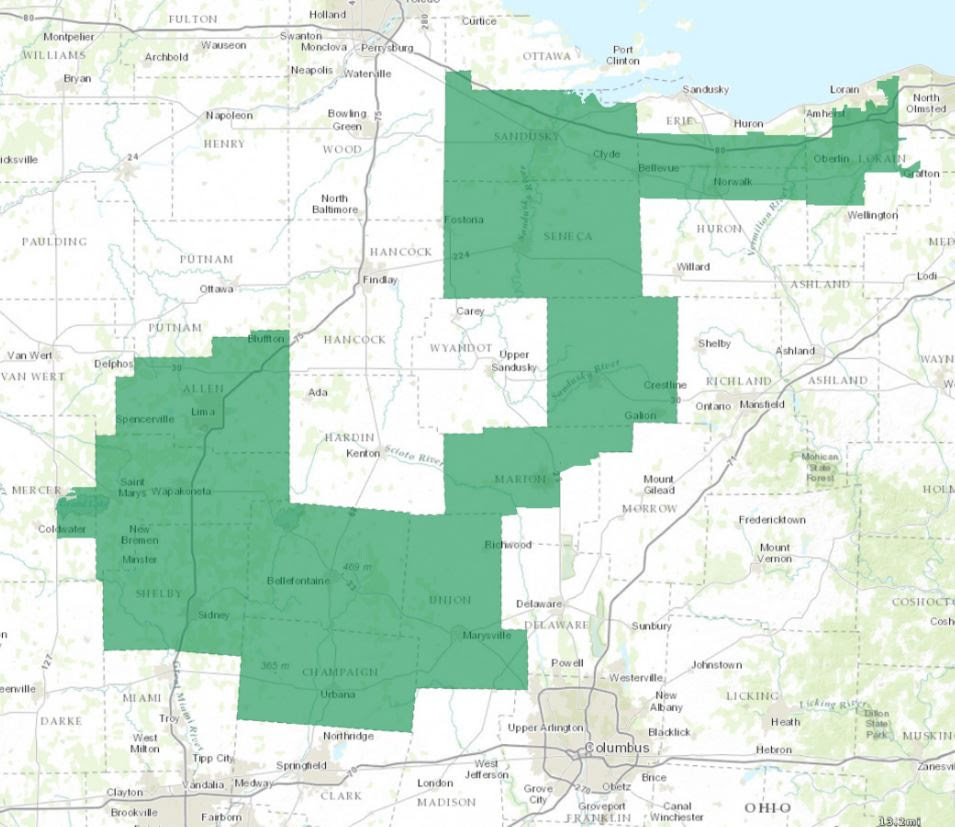
Now Jordan, is the rep of one of the most gerrymandered districts in the country. When I lived in Urbana, Ohio in the late 60’s and early 70’s, our local congressman was exceptionally well liked and respected. Clarence, “Bud” Brown represented what the Republican Party could have been, had they not deviated to scorched earth politics under the leadership and tutelage of Newt Gingrich. America has never been the same since. Don’t see this as an endorsement of the so-called, “other side” but as a statement of clear-eyed facts.
Jim Jordan’s, Ohio 4th Congressional District
This letter by Jordan to the AG, Merrick Garland shows in detail and Jordan’s own hand, the level of false narratives and utter dishonesty that keeps today’s MAGA-controlled GOP afloat. For those who have been warning about this and other indictments based on reality, research, and the opinions of elite experts, this is just another “hail Mary”, mis/ disinformation campaign designed to empower those who’ve proved that they will believe anything, if it suits their political identity. My personal and professional opinion of Jordan sees him as one of the most unethical and dangerous members of Congress.
What I once knew as a community of hardworking mostly rural Ohioans with remarkable grace, compassion and honesty, is now burdened by the weight of being sold snake oil by traitors and conmen who can’t even spell, “American values.” They largely operate on the traitorous narratives of FOX news. Fortunately there is still a solid core of great Americans in my home town but sadly, they are a minority. Even the Trumpists are some of the nicest people you will ever meet. The manipulation of their political identity by unethical, professional influencers, some domestic and some foreign, has resulted in Seditionists like Jordan and his ilk, leading the worst threat to our democracy since the Civil War.
The pain I feel for my hometown, is being played out all across America in small and large towns. The extraordinary work by U.S. Department of Justice, has thrown a hand grenade into their political identity. Now, with DOJ’s meticulously assembled public case being the news of the day, Jordan is launching a full-scale mis and disinformation campaign to support a known traitor. Not one person in Urbana would have tolerated this in my youth, despite being in one of the most reliable Republican Congressional districts in the nation.
Yes, I would also love to scream the words, “I told you so” but that will not heal America. Many Americans who were victimized by foreign and domestic malign influencers, are beginning to realize that they have been badly duped. Give them an open invite back into reality without the derision. They are family, friends and colleagues. Tragically, those who resist reality will likely never recover, because the level of indoctrination that leads to public displays of extremism, more often than not, is like rabies, mostly incurable.
It’s time for all Americans to realize that our fellow citizens are not enemies because they have different beliefs. Our Constitution, based on our founding principles, guarantees our right to our own beliefs, false or not. It’s really up to those who are willing to debate over facts and reality, to heal this nation for America’s sake, not a politcal party. It will be those who adhere to what it means to be a truly patriotic American, left, right or otherwise to put our nation, back on the path of progress, respectability and strength.
Truism: If you vote for honesty, integrity and our true American, founding principles… folks like Jim Jordan would never be in office. However you vote, we can never again allow any extremist movement to have so much say in our government, that they can once again threaten what so many have died to preserve.
The Oklahoma Statewide Virtual Charter School Board voted 3-2 to approve using state funds to support a new Catholic school this week. One of the board members voting “yes” was installed to their post last Friday, according to Tulsa World.
The board’s actions began creating the first religious charter school supported by taxpayer dollars in the United States. The online school, St. Isidore of Seville Catholic Virtual School, will be managed and operated by the Roman Catholic Archdiocese of Oklahoma City and the Diocese of Tulsa.
Oklahoma’s previous Attorney General, John O’Connor, issued a non-binding 15-page opinion in December 2022 suggesting that Oklahoma’s restriction of taxpayer funds from being used for religious schools would most likely be found unconstitutional by the United States Supreme Court.
Education Week reported, “O’Connor had concluded that recent U.S. Supreme Court decisions authorizing the inclusion of religious schools in choice programs such as tax credits for scholarship donations, and tuition assistance meant that the high court would likely not ‘accept the argument that, because charter schools are considered public for various purposes, that a state should be allowed to discriminate against religiously affiliated private participants who wish to establish and operate charter schools.’”
St. Isidore of Seville Catholic Virtual School’s application asked for $2.5 million to serve a potential 500 students in the first year. That will be $2.5 million taken away from public schools to support private religious education.
O’Connor’s successor, Gentner Drummond, withdrew the opinion earlier this year, stating, “Religious liberty is one of our most fundamental freedoms.”
Drummond continued: “It allows us to worship according to our faith, and to be free from any duty that may conflict with our faith. The opinion as issued by my predecessor misuses the concept of religious liberty by employing it as a means to justify state-funded religion.”
While some Christian conservatives, such as Oklahoma’s State Superintendent Ryan Walters, praised the board’s decision, other politicians and faith leaders criticized its actions, characterizing them as unconstitutional and a direct violation of the Establishment Clause.
After the 3-2 vote in favor of funding St. Isidore of Seville Catholic Virtual School, Drummond reiterated his opinion that this decision was improper. “The approval of any publicly funded religious school is contrary to Oklahoma law and not in the best interest of taxpayers,” he said.
“It’s extremely disappointing that board members violated their oath in order to fund religious schools with our tax dollars,” Drummond said. “In doing so, these members have exposed themselves and the State to potential legal action that could be costly.”
Clark Frailey, executive director for Pastors for Oklahoma Kids, commented: “By authorizing a public school that is explicitly affiliated with a particular religion, Oklahoma is endorsing that religion and entangling the government in religious affairs.”
“In addition,” Frailey continued, “the proposed school is to be funded by taxpayer dollars. This clearly misuses public dollars, as it would fund religious indoctrination of children.”
Historically, Oklahoma has been notoriously guilty of using taxpayer dollars to indoctrinate children with religious doctrines. Many times, Good Faith Media has called attention to the misguided and violent actions occurring at Chilocco Indian Agricultural Boarding School.
Thousands of Indigenous children were taken from their families and provided “Christian” education using taxpayer funding. Hiding behind a compassionate mission to educate Indigenous children, the actual objective was to assimilate them into white Protestant doctrines.
While no one suggests the Oklahoma Catholic Diocese is following this model, the dangers of using taxpayer dollars are ominous. Besides taking precious funding away from public education to fund private religious charters, using taxpayer money violates the religious liberty of others not wanting to support religious teachings.
Should taxpayers be forced to support religious teachings contradictory to their belief systems? Will there be any oversight of the use of taxpayer money used at religious schools?
Like public schools, do religious schools have to accept all students or can they discriminate? Will religious schools need curriculum to be approved? If so, who decides? Can any religious sect apply for funding?
Americans United for Separation of Church and State responded, “It’s hard to think of a clearer violation of the religious freedom of Oklahoma taxpayers and public-school families than the state establishing the nation’s first religious public charter school.”
AU went on to point out the unconstitutionality of the action: “State and federal law are clear: Charter schools are public schools that must be secular and open to all students. No public-school family should fear that their child will be required by charter schools to take theology classes or be expelled for failing to conform to religious doctrines. And the government should never force anyone to fund religious education.”
“Funding private religious schools with public dollars violates core legal principles protecting religious freedom for all,” said Amanda Tyler, executive director of BJC (Baptist Joint Committee for Religious Liberty).
Paul Brandeis Raushenbush, CEO of Interfaith Alliance, told The Independent that this would “open the floodgates for taxpayer-funded discrimination.” He added: “Taxpayer money should never be used to fund religious instruction, and it is now up to the state to at least ensure St. Isidore abides by the federal nondiscrimination protections guaranteed in public schools.”
The decision by the Oklahoma Statewide Virtual Charter School Board is clearly a disregard for the democratic principles established by the nation’s founders.
Thomas Jefferson’s words in his letter to the Baptists of Danbury, Connecticut, are as crucial today as they were in 1802: “I contemplate with sovereign reverence that act of the whole American people which declared that their legislature should ‘make no law respecting an establishment of religion, or prohibiting the free exercise thereof,’ thus building a wall of separation between Church & State.”
Monday’s national headline-making vote to give state sanctioning and Oklahoma taxpayer dollars to a Catholic school may have been invalid.
It turns out the state Attorney General’s Office believes that Oklahoma City businessman Brian Bobek is ineligible to serve on the Statewide Virtual Charter School Board until November.
But an email to that effect was not received by the board’s chairman and executive director until after Bobek cast the deciding vote Monday to approve state sponsorship for St. Isidore of Seville Catholic Virtual School.
Long-serving member Barry Beauchamp, a retired school superintendent from Lawton who had been allowed to continue serving after his term expired some months ago, was replaced abruptly on Friday by Oklahoma House Speaker Charles McCall.
Less than half an hour before Monday’s special board meeting began at noon, Deputy Attorney General Niki Batt sent an email to board Chairman Robert Franklin and Executive Director Rebecca Wilkinson saying that because Beauchamp had not vacated his seat, the law that created the Statewide Virtual Charter School Board doesn’t allow Bobek to take over the seat until November.
Franklin said that if Bobek was ineligible, his vote was invalid.
He is also concerned that a lengthy, written statement that Bobek read during Monday’s meeting, which included numerous legal citations, could have influenced the votes of other board members, including Scott Strawn, who was recently appointed to the board by Gov. Kevin Stitt.
Seven Oaks Classical School in Ellettsville received a 5-year extension to its operating charter recently. Well, not that recently. It happened in December 2022. Ellettsville and Monroe County residents may have missed it, though, because the extension was approved nearly 200 miles away.
It was approved by the three-member board of Grace Charters LLC, a nonprofit formed by Grace College and Theological Seminary to authorize charter schools, which are publicly funded and privately operated. The board met on the Grace College campus in Winona Lake, Indiana.
To meet legal requirements for public meetings, a notice was published in the local newspaper: the Warsaw Times-Union, which probably no one in Monroe County reads. One member of the public attended, according to minutes of the meeting: Seven Oaks headmaster Stephen Shipp.
The situation highlights the tension between public and private in Indiana charter schools. The Seven Oaks website says charter schools are “tuition-free, open-enrollment public schools.” But the school’s authorizer, which sets the terms of its operation and is supposed to hold it accountable, is a private, Christian college with no connection to the community where the school operates.
Seven Oaks is part of a network of charter schools aligned with Hillsdale College, a conservative and politically active private college in Michigan. The Hillsdale charter initiative once cast itself as part of a “war” to reclaim America from “100 years of progressivism” in education. Its president, Larry Arnn, led Donald Trump’s 1776 Commission and its promotion of “patriotic history.”
Grace College has also granted a charter to Valor Classical Academy, a Hillsdale-affiliated school that has stalled in its attempts to open in Hamilton or Marion County.
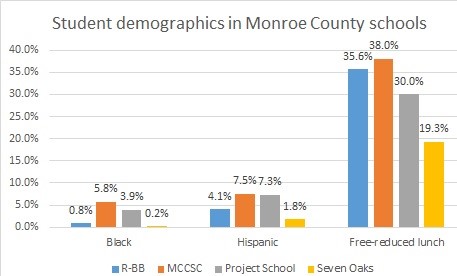
Along with the Hillsdale affiliation, there are other factors that distinguish Seven Oaks from public schools: for example, its demographic profile. Out of more than 500 students, one is Black and nine are Hispanic, according to state data. Fewer than 20% of students would qualify for free or reduced-price meals if they were provided. (The school doesn’t provide transportation or school lunches).
This chart shows the percentage of students who are Black, Hispanic and eligible for free or reduced-price meals in Monroe County public school districts (Monroe County and Richland-Bean Blossom community school corporations) and charter schools (Bloomington Project School and Seven Oaks Classical School).
The 24-page Seven Oaks charter extension reads like a standard agreement, with boilerplate language from state law and recommended practices for authorizing. It spells out the duties of each party, the expectations for the school, and the legal remedies if something goes wrong. An attached accountability plan includes out-of-date references to state assessments and, I’m told, is being revised.
The agreement says Grace College gets to keep 2.5% of the school’s state funding as an authorizer fee. That’s less than the 3% maximum that Indiana allows. In 2023-24, the college will net about $93,000.
Grace initially approved a charter for Seven Oaks in 2016 in one of Indiana’s first examples of what’s called authorizer shopping. The school’s founders applied to the Indiana Charter School Board, but it rejected their application. They reapplied but withdrew after a negative recommendation from the board’s staff. Then they took their plan to Grace College, which said yes to a 7-year charter.
At that time, private colleges could authorize charter schools in closed-door meetings with no public notice. Since 2017, they’ve had to use nonprofit authorizing agencies, such as Grace College’s Grace Charters LLC, that are subject to open-meetings and public-records laws. Even so, it can be hard to keep up. I started asking by email about the Seven Oaks charter extension in March; it took until late May to get copies of the December 2022 board minutes and the school’s extended charter agreement.
Transparency is one issue of having distant authorizers for charter schools, but there are others. The National Association Charter School Authorizers cautions against throwing the door wide open for higher education institutions, or HEIs, to authorize schools, as Indiana has done since 2011.
The respected Southern Poverty Law Center (SPLC) designated “Moms for Liberty” as an extremist group, along with a number of other astroturf anti-government organizations that popped up during the pandemic to protest masks and vaccines.
In its annual report on hate groups, SPLC named Moms for Liberty and 11 other “parent”groups as extremists who feed on racism, misogyny, homophobia, and bigotry:
Moms for Liberty joins the ranks of groups including the Oath Keepers, the Three Percenters and the United Constitutional Patriots, a self-styled militia that “patrols” the U.S.-Mexico border.
Other astroturf “parent” groups were identified as extremist by SPLC:
The 12 “parent’s rights” groups labeled by the SPLC as extremist groups: Moms for Liberty; Moms for America; Army of Parents; Courage is a Habit; Education First Alliance; Education Veritas; No Left Turn in Education; Parents Against CRT (PACT); Parents Defending Education; Parents Rights in Education; Purple for Parents Indiana and Parents Involved in Education.
Will Carless wrote in USA Today that Moms for Liberty “pitched itself as a potent grassroots movement of outraged parents, many of whom weren’t active in school politics until COVID-19 restrictions forced them to pay attention. It has sprouted local chapters in at least 40 states, claims more than 100,000 members and has the ear of the Republican establishment: Florida Gov. Ron DeSantis has championed their efforts to restrict teaching about race in schools and universities. Critics in Florida slam the group for turning schools into a political battlefield.”
Both DeSantis and Trump will address the annual conference of this two-year-old organization of hate-mongers.
Moms for Liberty and the other organizations are being designated as “anti-government extremist groups,” based on longstanding criteria, explained SPLC Intelligence Project Director Susan Corke. Corke said the grassroots conservative groups are part of a new front in the battle against inclusivity in schools, though they are drawing from ideas rooted in age-old white supremacy.
“[The movement] is primarily aimed at not wanting to include our hard history, topics of racism, and a very strong push against teaching anything having to do with LGBTQ topics in schools,” Corke said. ”We saw this as a very deliberate strategy to go to the local level…”
Despite the national profile, these organizations spread conspiracy theories and operate on the myth that educators are engaged in “Marxist indoctrination” of the nation’s children by imbuing them with dangerous ideas about equality and sexuality, the SPLC said.
While the movement may be reasonably new, it is founded on the same traditional racist, misogynist and homophobic views that brought people out to protest the desegregation of schools in the 1950s and ’60s, the SPLC argues.
Moms for Liberty does not report the names of its funders.
Edward B. Fiske was the education editor of the New York Times and editor of the Fiske Guide to Colleges. Helen F. Ladd is a nationally prominent economist of education and professor emeritus at Duke University. They are married, a power couple of American education. This article appeared on the website of WRAL in North Carolina.
Forty years ago this spring a national commission charged with evaluating the quality of American education issued a blistering report entitled “A Nation at Risk.” It cited a “rising tide of mediocrity” in the country’s schools and declared that the country’s failure to provide high quality education “threatens our very future as a Nation and a people.”
North Carolina leaders took this warning to heart. They began investing heavily in public education and even became a model for other states in areas such as early childhood education. Significantly, the state was making progress toward fulfilling its obligation under the North Carolina Constitution to provide a sound, basic education for all students.
The situation started to change, however, in 2012 when Republicans came to power and began an assault on public education that continues to this day.
When it comes to public education, North Carolina is now “A State at Risk.”
The Republican assault has taken multiple forms, starting with inadequate funding. North Carolina now ranks 50th in the country in school funding effort and 48th in overall funding. Despite widespread teacher shortages, the Republicans have kept teacher salaries low — $12,000 below the national average – and they have failed to provide adequate funding for the additional support staff that schools need.
In addition, they have permitted significant growth in the number of charter schools. Such schools divert much-needed funds from traditional public schools and make it difficult for local boards of education to operate coherent education systems.
The Republican-controlled Legislature is currently working hard to weaken public education by politicizing the process. Pending legislation would regulate how history and racism are taught, give a commission appointed mainly by lawmakers the job of recommending standards in K-12 subjects, and transfer authority to create new charter schools from the State Board of Education to a board appointed by the General Assembly.
The problem is about to get even worse. The Legislature is now poised to expand the earlier Opportunity Scholarship program, which had provided public funds for low income children to attend private schools, into a much larger universal voucher program that would make all children eligible regardless of family income – at an estimated cost of more than $2 billion over the next 10 years.
Given that private schools are operated by private entities typically with no public oversight and no obligation to serve all children, why in the world would it ever make sense to use taxpayer dollars to support private schools?
A common argument has been that voucher systems raise achievement levels of the children who used them. While some early studies of small scale means-tested voucher programs in places like Milwaukee showed small achievement gains in some cases, recent studies of larger voucher programs in places such as Ohio, Louisiana and Indiana consistently show large declines in average achievement — often because of the low quality of the private schools that accept vouchers.
Supporters also argue that vouchers provide more schooling options for children and that having more choices is a good thing. But in the context of education policy that need not be the case. Americans support public education – and make schooling mandatory – not only for the benefits it generates for individual children but also for collective benefits such as the creation of capable workers and informed citizens. What matters is the quality of education for all the state’s children.
An expanded voucher program would lead to a substantial outflow of funds from traditional public schools to privately operated schools, with the potential for a significant loss in the quality of our public schools, and subsequent vitality in the state’s economy.
A strong public education system – from elementary and secondary schools to the nation’s first public university, the University of North Carolina – has long been pivotal to our state’s cultural, political and economic success. We must stop the current assaults on public education and reaffirm our commitment to one of North Carolina’s great strengths.
Back in 1983 when the education system of the nation was “at risk,” President Ronald Reagan – who had earlier been lukewarm in his support of public education — took the warning seriously and began touring the country to talk about the problem. His successors from both parties then took up the cause and continued to make the case that a strong public education system is essential for a vibrant economy, and importantly, to make the policy changes needed to strengthen it.
Let’s hope that our current Republican leaders in this state can muster the wisdom and courage to follow the example of President Reagan and other leaders from both parties in pushing for strong public education. In the absence of such wisdom, we will indeed continue to be “A State at Risk.”
Oklahoma just gave its permission for the Roman Catholic Archdiocese of Oklahoma City and the Diocese of Tulsa to open an online charter school, supported by public funds. Governor Kevin Stitt and the state’s Superintendent of Schools Ryan Walters are hard-right Republicans. This decision is sure to go to the U.S. Supreme Court. No one knows how it will rule. Even charter lobbyists are concerned about this turn of events because they like to refer to charters as “public charter schools.” A religious charter, which teaches religion, is not a public school.
The nation’s first religious charter school was approved in Oklahoma on Monday, handing a victory to Christian conservatives, but opening the door to a constitutional battle over whether taxpayer dollars can directly fund religious schools.
The online school, St. Isidore of Seville Catholic Virtual School, would be run by the Roman Catholic Archdiocese of Oklahoma City and the Diocese of Tulsa, with religious teachings embedded in the curriculum, including in math and reading. Yet as a charter school — a type of public school that is independently managed — it would be funded by taxpayer dollars.
After a nearly three-hour meeting, and despite concerns raised by its legal counsel, the Oklahoma Statewide Virtual Charter School Board approved the school in a 3-to-2 vote, including a “yes” vote from a new member who was appointed on Friday.
The relatively obscure board is made up of appointees by Gov. Kevin Stitt, a Republican who supports religious charter schools, and leaders of the Republican-controlled State Legislature.
The approval — which is almost certain to be challenged in court — comes amid a broader conservative push to allow taxpayer dollars to go toward religious schools, including in the form of universal school vouchers, which have been approved in five states in the last year. The movement has been bolstered by recent rulings by the U.S. Supreme Court, which has increasingly signaled its support for directing taxpayer money to religious schools.
S.C. Gov. Henry McMaster doesn’t need to go into comedy anytime soon. He’s just not that funny.
What he needs to do is to go to apology school.
The governor, who often sounds like Foghorn Leghorn these days, had this to say to fellow Republicans last week at a state convention: “I look forward to the day that Democrats are so rare, we have to hunt them with dogs.”
Umm. Not funny, governor. Really not funny. Even if you claim you’ve been saying it for years, it has never been funny.
Democrats responded with outrage about McMaster’s dog-whistle of a comment.
“Yesterday, Governor Henry McMaster threatened me, my family and thousands of other Anderson County residents who are Democrats when he said he looks forward to the day he can ‘hunt us with dogs,’” said Chris Salley, chairman of the Anderson County Democratic Party, in a statement.
Charleston County Democratic Party Chairman Sam Skardonwent further: “We cannot continue to normalize threats of political violence from the leadership of the Republican Party. If the governor does not retract and apologize, S.C. State Law Enforcement Division should investigate this threat.”
One man who lived through apartheid in South Africa recalled on Facebook how many people in that country were silent about its system of segregation: “Their silence spoke volumes. If you do not stand up against racism, if you remain silent, you are part of the problem.”
But maybe McMaster, a former attorney general who should know about keeping the peace more than inciting it, thought what he said was hilarious. The governor of any state should know better, particularly in an America today more polarized by race, fear and hate than in years.
What our governor said was mean, mean-spirited and filled with racial undertones of South Carolina’s ugly past in which white elites subjugated enslaved Africans and actually did hunt them when they escaped. Or hanged them, such as when Charlestonians executed Denmark Vesey and 34 others for what was purported to be a planned slave uprising. Or they just plain lynched them after the Civil War to reignite fear to fuel horrible decades of home-grown Jim Crow apartheid.
It’s not a history of which to be proud.
But predictably, the spin-doctors and fixers played McMaster’s comment off as a light-hearted joke. That’s what the embarrassment playbook says to do – just foist anything out on a lazy public that the person saying the trash didn’t really mean it.
Here’s how the Washington Post reported on the remark: “In a statement Monday, a spokesman for McMaster said the governor had been saying the line at GOP conventions for years, adding that ‘everyday South Carolinians understand that it’s a joke.’”
The joke might have worked in the 1950s, which is where McMaster and his buddies seem to want us to return. But rather than continuing to brush off the remark, the governor needs to realize he represents all South Carolinians, not just the ones who may look like him.
To drive this point home: Just imagine what would happen if a blue state governor started talking about crucifying pro-life activists. And then said it was just a joke. I bet McMaster, Fox News and most Republicans would squeal like stuck pigs. The vitriol surely would be intergalactic.
So governor, let’s lay off the bad jokes, the over-the-top rhetoric and the increasingly hostile politics that continue to pull people apart. There’s not going to be any Kumbaya moment in South Carolina anytime soon, but you can stop throwing gas on the fire.
Andy Brack, recognized in 2022 as the best columnist in South Carolina, is editor and publisher of Statehouse Report and the Charleston City Paper. Have a comment? Send to: feedback@charlestoncitypaper.com.
Michelle Goldberg, a regular columnist for the New York Times, writes that the views of the Oklahoma City terrorist Timothy McVeigh are now in the mainstream of the Republican Party. He was a gun lover. He killed 168 people to strike a blow for his convictions. Now, almost the entire Republican Party embraces his vision of free access to guns.
She writes:
Timothy McVeigh, the right-wing terrorist who killed 168 people in the 1995 Oklahoma City bombing, cared about one issue above all others: guns. To him, guns were synonymous with freedom, and any government attempt to regulate them meant incipient tyranny.
“When it came to guns,” writes Jeffrey Toobin in “Homegrown,” his compelling new book about the Oklahoma City attack, “McVeigh did more than simply advocate for his own right to own and use firearms; he joined an ascendant political crusade, which grew more extreme over the course of his lifetime and beyond.”
Reading Toobin’s book, it’s startling to realize how much McVeigh’s cause has advanced in the decades since his 2001 execution. McVeigh, who was a member of the K.K.K. and harbored a deep resentment of women, hoped that blowing up the Alfred P. Murrah Federal Building would inspire an army of followers to make war on the government. This didn’t happen immediately, although, as the historian Kathleen Belew has written, there was a wave of militia and white supremacist violence in the bombing’s aftermath. But today, an often-inchoate movement of people who share many of McVeigh’s views is waging what increasingly looks like a low-level insurgency against the rest of us…
Mass shootings have become so frequent that we are no longer shocked when one happens. They have become background noise.
The reason that America endures a level of gun violence unique among developed countries, and that we can often do little about it, is so many politicians have views on guns that aren’t far afield from McVeigh’s. As Representative Jamie Raskin, a Democrat from Maryland, has pointed out, it’s become common to hear Republicans echo McVeigh’s insurrectionary theory of the Second Amendment, which holds that Americans must be allowed to amass personal arsenals in case they need to overthrow the government. As the MAGA congresswoman Lauren Boebert once put it, the Second Amendment “has nothing to do with hunting, unless you’re talking about hunting tyrants.”
The Republican Party’s fetishization of guns and its fetishization of insurrection — one that’s reached a hysterical pitch since Donald Trump’s presidency — go hand in hand. Guns are at the center of a worldview in which the ability to launch an armed rebellion must always be held in reserve. And so in the wake of mass shootings, when the public is most likely to clamor for gun regulations, Republicans regularly shore up gun access instead.…Today’s Republican Party can scarcely tolerate anything getting between an eager buyer and a deadly weapon.
It’s hard to think of a historical precedent for a society allowing itself to be terrorized in the way we have. The normalization of both right-wing terrorism and periodic mass shootings by deranged loners is possible only because McVeigh’s views have been mainstreamed. “In the nearly 30 years since the Oklahoma City bombing, the country took an extraordinary journey — from nearly universal horror at the action of a right-wing extremist to wide embrace of a former president (also possibly a future president) who reflected the bomber’s values,” wrote Toobin.
As it happens, in the hours after the Oklahoma City bombing, before the authorities knew who McVeigh was, he was pulled over during a routine traffic stop and then arrested for carrying a gun without a permit. In 2019, however, Oklahoma legalized permitless carry. Under the new law, McVeigh would have been let go.