PROVIDENCE — Four months after her large-scale research study seeking to contain the spread of HIV was canceled by the Trump administration, Dr. Amy Nunn received a letter: the grant has been reinstated.
The study, which is enrolling Black and Hispanic gay men, is set to resume after a June court order in favor of the American Public Health Association and other groups that sued the National Institutes of Health for abruptly canceling hundreds of scientific research grants.
The NIH said in a form letter to researchers in February and March that their studies “no longer effectuate agency priorities” because they included, among other complaints, reference to gender identity or diversity, equity and inclusion.
The order from US District Judge William Young in Massachusetts was narrow, reinstating nearly 900 grants awarded to the plaintiffs, not all of the thousands of grants canceled by NIH so far this year. Young called DEI an “undefined enemy‚” and said the Trump administration’s “blacklisting” of certain topics “has absolutely nothing to do with the promotion of science or research.”
The Trump administration is appealing the ruling, and the NIH continues to say they will block diversity, equity, and inclusion efforts, prompting ongoing fear from scientists that their studies could still be on the chopping block even as they restart.
“We feel like we’re tippy-toeing around,” said Nunn, who leads the Rhode Island Public Health Institute. “The backbone of the field is steadfast pursuit of the truth. People are trying to find workarounds where they don’t have to compromise the integrity of their science.”
Nunn said she renewed her membership to the American Public Health Association in order to ensure she’d be included in the lawsuit.
Despite DEI concerns, she plans to continue enrolling gay Black and Hispanic men in her study, which will include 300 patients in Rhode Island, Mississippi, and Washington, D.C.
Black and Hispanic men who have sex with other men contract HIV at dramatically higher rates than gay white men, a statistic Nunn aims to change.
The study was just getting underway, with 20 patients enrolled, when the work was shut down by the NIH in March. While Nunn’s clinic in Providence did not do any layoffs, the clinic in Mississippi — Express Personal Health — shut down, and the D.C. clinic laid off staff.
The four-month funding flip-flop could delay the results of the study by two years, Nunn said, depending on how quickly the researchers can rehire and train new staff. The researchers will also need to find a new clinic in Mississippi.
The patients — 100 each in Rhode Island, Mississippi, and D.C. — will then be followed for a year as they take Pre-Exposure Prophylaxis, or PrEP, to prevent them from contracting HIV.
The protocol that’s being studied is the use of a patient navigator for “aggressive case management.” That person will help the patient navigate costs, insurance, transportation to the clinic, dealing with homophobia and other barriers to staying on PrEP, which can be taken as a pill or a shot.
The study’s delay means “the science is aging on the vine,” Nunn said, as new HIV prevention drugs are rolled out. “The very thing that we’re studying might very well be obsolete by the time we’re able to reenroll all of this.”
The hundreds of reinstated grants include titles that reference race and gender, such as a study of cervical cancer screening rates in Latina women, alcohol use among transgender youth, aggressive breast cancer rates in Black and Latina women, and multiple HIV/AIDs studies involving LGBTQ patients.
“Many of these grants got swept up almost incidentally by the particular language that they used,” said Peter Lurie, the president of the Center of Science in the Public Interest, which joined the lawsuit. “There was an arbitrary quality to the whole thing.”
Lurie said blocking scientists from studying racial disparities in public health outcomes will hurt all Americans, not just the people in the affected groups.
“A very high question for American public health is why these racial disparities continue to exist,” Lurie said. “We all lose in terms of questions not asked, answers not generated, and opportunities for saving lives not implemented.”
The Trump administration is not backing down from its stance on DEI, even as it restores the funding. The reinstatement letters from the NIH sent to scientists this month include a condition that they must comply with Trump’s executive order on “biological truth,” which rescinded federal recognition of transgender identity, along with Title VI of the Civil Rights Act of 1964, which prohibits discrimination based on race, color and national origin.
Kenneth Parreno, an attorney for the plaintiffs, said he was told by Trump administration lawyers that new letters would be sent out without those terms.
But Andrew Nixon, a spokesperson for the Department of Health and Human Services, said Wednesday the administration “stands by its decision to end funding for research that prioritized ideological agendas over scientific rigor and meaningful outcomes for the American people.”
“HHS is committed to ensuring that taxpayer dollars support programs rooted in evidence-based practices and gold standard science — not driven by divisive DEI mandates or gender ideology,” Nixon said in any email to the Globe.
The Trump administration’s appeal is pending before the First Circuit Court of Appeals in Boston. A motion for a stay of Young’s decision was denied, and the Trump administration is appealing that ruling to the US Supreme Court.
The ongoing push to remove DEI from science has created fear in the scientific community, which relies on federal funding to conduct its research and make payroll.
“Scientific morale has taken a big hit,” Nunn said. “People are apprehensive.”
Indeed, major research institutions have faced mass funding cuts from the federal government since Trump took office. Brown University, the largest research institution in Rhode Island, had more than $500 million frozen until it reached an agreement with Trump on Wednesday.
In exchange for the research dollars to be released, Brown agreed not to engage in racial discrimination in admissions or university programming, and will provide access to admissions data to the federal government so it can assess compliance. The university also agreed not to perform any gender-affirming surgeries and to adopt Trump’s definitions of a male and female in the “biological truth” executive order.
While some have avoided speaking out, fearing further funding cuts, Nunn said she felt a “moral and ethical duty” to do so.
In recent decades, many universities have sought to increase racial and ethnic diversity in their student body and faculty. In addition to grades and test scores, they looked at many other factors, such as talents, life experiences, meeting challenges. This process meant that more students of color were admitted, while some students with higher test scores were rejected.
The Trump administration adamantly opposes this process, known as affirmative action. Its view is that scores on the SAT and ACT and grades should be the most important, if not the only criteria for admission. Those scores, to Trump officials, are synonymous with merit. Any deviation from their view will be grounds for investigating violations of civil rights laws.
As part of the settlements struck with two Ivy League universities in recent weeks, the Trump administration will gain access to the standardized test scores and grade point averages of all applicants, including information about their race, a measure that could profoundly alter competitive college admissions.
That aspect of the agreements with Columbia andBrown, which goes well beyond the information typically provided to the government, was largely overlooked amid splashier news that the universities had promised to pay tens of millions of dollars to settle claims of violations of federal anti-discrimination laws, including accusations that they had tolerated antisemitism.
The release of such data has been on the wish list of conservatives who are searching for evidence that universities are dodging a 2023 Supreme Court decision barring the consideration of race in college admissions, and will probably be sought in the future from many more of them.
But college officials and experts who support using factors beyond test scores worry that the government — or private groups or individuals — will use the data to file new discrimination charges against universities and threaten their federal funding.
The Trump administration is using every lever it can to push elite college admissions offices toward what it regards as “merit-based” processes that more heavily weigh grades and test scores, arguing that softer measures, such as asking applicants about their life challenges or considering where they live, may be illegal proxies for considering race.
The additional scrutiny is likely to resonate in admissions offices nationwide. It could cause some universities to reconsider techniques like recruitment efforts focused on high schools whose students are predominantly people of color, or accepting students who have outstanding qualifications in some areas but subpar test scores, even if they believe such actions are legal.
“The Trump administration’s ambition here is to send a chill through admissions offices all over the country,” said Justin Driver, a Yale Law School professor who just wrote a book about the Supreme Court and affirmative action and who said he believed that the administration’s understanding of the Supreme Court’s affirmative action decisionwas wrong. “They are trying to get universities to depress Black and brown enrollment.”
James Ryan, the president of the University of Virginia since 2018, announced his resignation under intense pressure from the Trump administration.
The Civil Rights Division of the Trump administration pressured the Board of Governors of the university to remove Ryan because of his support for diversity, equity, and inclusion.
They said that he pretended to comply with the federal demands to eliminate DEI but merely renamed them.
For the past half century, DEI was considered a hallmark of compliance with civil rights laws. DEI programs encouraged women and nonehites to enroll in higher education and to study the history of discrimination.
Under Trump, DEI has been reinterpreted to mean favoring those groups at the expense of white men and thus discriminating against white men.
The Trump administration has cut federal grants to universities that are slow or unwilling to dismantle DEI programs.
The demand to remove Mr. Ryan was made over the past month on several occasions by Gregory Brown, the deputy assistant attorney general for civil rights, to university officials and representatives, according to the three people briefed on the matter.
Mr. Brown, a University of Virginia graduate who, as a private lawyer, sued the school, is taking a major role in the investigation. He told a university representative as recently as this past week that Mr. Ryan needed to go in order for the process of resolving the investigation to begin, two of the people said.
Harmeet K. Dhillon, the Justice Department’s top civil rights lawyer, has also been involved in negotiations with the university. She received her law degree from the University of Virginia, where she was a student in the law school at the same time as Mr. Ryan…
Mr. Ryan, hired in 2018 as the university’s ninth president, has leaned into issues like making the school more diverse, increasing the number of first-generation students and encouraging students to do community service. But his approach, which he says will make the university “both great and good,” has rankled conservative alumni and Republican board members who accuse him of wanting to impose his values on students and claim he is “too woke.”
Before becoming the University of Virginia’s president, Mr. Ryan served as the dean of the Harvard Graduate School of Education, where he was praised for his commitment to D.E.I. programs. Harvard has been one of the Trump administration’s chief targets since it began its assault on higher education.
The administration’s attempt to assert federal influence over state university leadership decisions is also illustrative of how Mr. Trump’s political appointees continue to wield the Justice Department’s investigative powers to achieve policy goals long sought by a top Trump adviser, Stephen Miller.
Legal experts said they could think of few other instances in which an administration had demanded that a school have its president removed in order to resolve a Justice Department investigation.
“This is a tactic you would expect the government to use when it’s playing hard ball in a criminal case involving a corporation accused of serious wrongdoing or pervasive criminal activity,” said Daniel C. Richman, who is a law professor at Columbia University and a former federal prosecutor.
Benjamin R. Cremer is pastor at the United Methodist Church in Boise, Idaho. I read his essays regularly. He is truly a Christian. He preaches love, not hate. He knows and tries to exemplify the Beatitudes.
On June 19, 1865—two and a half years after the Emancipation Proclamation was signed—enslaved Black Americans in Galveston, Texas were finally informed of their freedom. This day, now known as Juneteenth, marks not just the delayed enforcement of a national promise, but the resilient hope and courage of a people who endured unspeakable injustice while still holding onto the belief that liberation would come.
As Christians, we must understand that Juneteenth is not just a historical footnote—it is a call to theological clarity and moral responsibility. Scripture consistently reveals a God who hears the cries of the oppressed (Exodus 3:7), who calls for justice to “roll on like a river” (Amos 5:24), and who sets the captives free (Luke 4:18). The story of God is a story of liberation—not just personal salvation, but also the dismantling of systems that crush the image of God in others.
Juneteenth challenges us to confront a difficult truth: that much of American Christianity was complicit in slavery, and that the legacy of that sin continues in our institutions, our policies, and yes—even in some of our pulpits. But the gospel does not shy away from hard truths. It invites us to repentance. To truth-telling. And to the costly work of reconciliation and repair.
In our time when people are heard saying “Illegal is illegal,” Juneteenth invites us to remember that slavery was once legal. Harboring a fugitive enslaved person was illegal. Black freedom illegal. “Illegal is illegal” has always been used to defend injustice. Legality ≠ morality. Justice calls us higher.This is not about shame. It’s about grace. Grace that tells the truth. Grace that restores what has been broken. Grace that refuses to be silent in the face of injustice.
Observing Juneteenth as Christians means celebrating the faith and dignity of Black Americans who have carried the gospel with courage even when the church failed to. It means honoring the day freedom was announced, and lamenting that it was so long withheld.
May we not be a people who forget. May we be a people who remember rightly, act justly, and walk humbly with our God (Micah 6:8).
If you are looking for a tangible way to get involved in communal justice work, I want to let you know about Be Love day, put on by the King Center. Be Love is a growing movement of courageous acts to achieve justice, which is based on these words from Dr. Martin Luther King, Jr.: “Justice at its best is love correcting everything that stands against love.” Be Love seeks to strategically define and unleash the true power of love to unite humanity, cultivate true peace, and create the Beloved Community. The movement is holding “Be Love Day” on July 9th. Click the link above to learn more.
Jan Resseger reviews Trump’s vigorous crusade to eliminate civil rights laws by inverting their meaning. These laws were passed to break the monopoly held by white men in hiring and promotions. But now, any program that favors women and nonwhites is treated as a crime. Universities and corporations that once featured their efforts to promote diversity, equity, and inclusion are now warned by the federal government that these efforts discriminate against white men and must be abolished.
Resseger writes:
When it comes to President Trump’s threatened tariffs and his foreign policy demands, we have all been reading about the phrase coined by a Financial Times reporter: “Trump always chickens out—TACO.” But when it comes to Trump’s attack on civil rights and racial justice in the nation’s public schools, the President has been doggedly persistent.
On May 22nd, The New Yorker’s Susan Glasser mused about the President’s Oval Office ambush of South African President Cyril Ramaphosa as capturing how things are going in “Washington a hundred and twenty-one days into Trump’s second term: a manufactured scene of outrage about a nonexistent ‘white genocide’ ” and “a reminder of how explicitly Trump has, in his second term, defined the goal of his Presidency as a sort of racial-justice quest for white people.” Glasser describes “a President who has terminated affirmative-action decrees that have been in place for the federal government since the nineteen-sixties, unleashed a wave of arrests and deportations aimed at illegal migrants of color, gutted federal civil-right-enforcement offices, and blamed D.E.I. for just about every evil at home and abroad.”
New York Times reporter Erica Green summarizes the Trump administration’s consistent work since the winter to attack racial justice and twist the meaning of the protection of civil rights: “In his drive to purge diversity efforts in the federal government and beyond, President Trump has expressed outright hostility to civil rights protections. He ordered federal agencies to abandon some of the core tenets of the Civil Rights Act of 1964, on the basis that they represented a ‘pernicious’ attempt to make decisions based on diversity rather than merit. But in recent weeks, Mr. Trump has turned to those same measures—not to help groups that have historically been discriminated against, but to remedy what he sees as the disenfranchisement of white men. The pattern fits into a broader trend… as Trump officials pick and choose which civil rights protections they want to enforce and for whom. Across the government, agencies that have historically worked to fight discrimination against Black people, women and other groups have pivoted to investigating institutions accused of favoring them.”
Beginning on Valentines Day, when Trump’s Acting Assistant Secretary of the U.S. Department of Education’s Office for Civil Rights (OCR), Craig Trainor sent all public school officials a “Dear Colleague” letter threatening their federal funding if they did not remove all diversity, equity, and inclusion from their schools, the Trump Administration turned its sights on U.S. public schools. In March, the administration closed seven of the nation’s twelve regional Office for Civil Rights locations that have traditionally investigated complaints filed by parents and families. At the same time the Office for Civil Rights abandoned its traditional practice of carefully investigating complaints and working with school districts to end discriminatory practices. Trump’s OCR turned to directed investigations aimed at punishing school districts failing to comply with the administration’s priorities and threatening loss of federal funding. In early April, the Department of Education threatened K-12 public school districts’ Title I funding unless school leaders (and statewide officials) signed a certificate that they were in full compliance with Title VI of the Civil Rights Act as well as in compliance with the administration’s broad, and many believe mistaken, interpretation of the 2023 Supreme Court decision in Students for Fair Admissions v. Harvard, which specifically banned affirmation in college admissions. The Trump administration has declared that the Students for Fair Admissions decision instead bans all DEI programming and policy.
School districts and state departments of education, along with teachers unions and civil rights organizations like the NAACP and the ACLU, have put the consequences of almost all of these threats on hold by filing injunctions, which have yielded temporary stays in most of these cases, but Education Secretary, Linda McMahon and her Department of Education keep on persisting by conducting more investigations and threatening punitive consequences for school districts persisting in efforts to help particular groups of students.
In mid-May, by executive order, President Trump banned the use of disparate impact as a standard for investigating Civil Rights investigations. For ProPublica, Jennifer Smith Richards and Judi Cohen reported: “Remaking the Office of Civil Rights isn’t just about increasing caseloads and reordering political priorities. The Trump administration now is taking steps to roll back OCR’s previous civil rights work. Last month, Trump issued an executive order that directs all federal agencies, including the Education Department, to stop enforcing cases involving policies that disproportionately affect certain groups—for example when Black students are disciplined more harshly than white students for the same infractions or when students with disabilities are suspended more than any other group even though they represent a small percentage of student enrollment.”
Smith Richards and Cohen examine how the Department’s Office for Civil Rights (OCR) has reduced its capacity to process complaints and changed its procedures in ways that bias investigations to reflect the Trump administration’s priorities: “The OCR, historically one of the government’s largest enforcers of the Civil Rights Act of 1964, has been known for being a neutral fact-finder. Its investigators followed a process to determine whether complaints from the public met legal criteria for a civil rights claim, then carried out investigations methodically. The vast majority of investigations were based on discrimination complaints from students and families, and a large share of those were related to disability discrimination… Investigations being publicized now have largely bypassed the agency’s civil rights attorneys… McMahon and OCR head, Craig Trainor created what amounts to a shadow division. The Trump administration has ordered more than a dozen investigations in the past three months on its own, not initiated by an outside complainant. These ‘directed investigations’ are typically rare; there were none during President Joseph Biden’s administration. The investigations have targeted schools with transgender athletes, gender-neutral bathrooms and initiatives that the administration views as discriminatory to white students.”
The ProPublica reporters spoke with OCR attorneys who anonymously describe what they believe are serious violations of departmental protocol: “McMahon and Trainor created ways to divert complaints and investigations away from the OCR’s legal experts entirely. The administration made an ‘End DEI’ portal that bypasses the traditional online complaint system and seeks only grievances about diversity, equity and inclusion in schools. Unlike the regular complaint system, the diversity portal submissions are not routed to OCR staff. ‘We have no idea where that portal goes, who it goes to, how they review the cases… said the attorney who said he struggles with being unable to help families.” In other instances, “Conservative groups with complaints about diversity or transgender students have been able to file complaints directly with Trainor and get quick results… America First Legal, a group founded by Trump deputy chief of staff, Steven Miller… emailed Trainor a few days after Trump’s… executive order… (that) directs schools to stop teaching about or supporting diversity, equity, and gender identity. ‘AFL respectfully requests that the Department of Education open investigations into the following public school districts in Northern Virginia for continuing violations of Title IX,’ the letter read, listing five districts that have policies welcoming to transgender students. Senior leadership in Washington opened the cases the following week. America First issued a press release headlined ‘VICTORY!’ “
Education Week‘s Brooke Schultz reports: “The U.S. Department of Education has announced or confirmed at least 100 investigations into school districts, colleges, and universities, and other entities as it emerges as a prime enforcer of President Donald Trump’s social agenda.” Here are some of Schultz’s examples: “(F)our school districts have drawn investigations from the department over a Black student success plan in Chicago, a students of color summit in New York, racial affinity groups in Illinois, and a selective Virginia high school’s admissions policy that the education Department says appears to be racially discriminatory… The first investigation Trump’s Education Department announced was a probe into the Denver district over a high school’s all-gender bathroom, which the agency suggested was a violation of Title IX, the federal law barring sex discrimination in schools that receive federal funds.”
Last Friday, in “Trump Administration Gives New York 10 Days to End Its Ban on Native American Mascots,” Education Week‘s Brooke Schultz reported on a Department of Education demand that clearly represents the Trump administration’s twisting and tangling the purpose and meaning of civil rights protection in public schools: an attack by the Trump Department of Education on a New York law banning Native American mascots in public schools. “The (U.S.) Education Department’s Office for Civil Rights argues that the state’s mascot policy, enacted in 2022, violates Title VI because it prohibits the use of Native American imagery but ‘allowed names, mascots, and logos that appear to have been derived from other racial or ethnic groups, such as the ‘Dutchmen’ and the ‘Huguenots.”… McMahon said in a statement Friday that the department would ‘not stand idly by as state leaders attempt to eliminate the history and culture of Native American tribes.”
Although McMahon seems to believe that the logo New York has banned in the Massapecqua School District connects with the history of American Indians in the region of the school district on Long Island, J.P. O’Hare of the New York Department of Education explained that neither the logo nor the term ‘Chief,’ was used by Native Americans in the area.
Schultz lets the president of the National Congress of American Indians, “the largest nonprofit representing Native nations which has long tracked and challenged the use of Native American mascots, Mark Macarro” correct Education Secretary McMahon’s bizarre misconception of racial justice and civil rights law: “Native people are not mascots… We have our own languages, cultures, and governments—our identities are not anyone’s mascot or costume. No political endorsement or misguided notion of ‘honoring’ us will change the fact that these mascots demean our people, diminish the enduring vibrancy of our unique cultures, and have no place in our country.”
Schultz adds: “Research has found that, for Native students, exposure to Native American mascots reduces self-esteem, their ability to imagine future accomplishments, and their belief that Native American communities can make a difference. For non-Native people, research shows that mascots are associated with negative thoughts and stereotypes about Native Americans… The portrayals are often outdated, whitewashed stereotypes, and aren’t grounded in realistic portrayals of Native people.”
The U.S. Navy and the other branches of the military were told by order of Trump and Hegseth to remove all books on the subjects of diversity, equity, and inclusion. In practice, this meant elimination of books about race, racism, and sexual orientation.
The 20 official search terms included in the May 9 memo included: affirmative action; allyship; anti-racism; critical race theory; discrimination; diversity in the workplace; diversity, equity, and inclusion; gender affirming care; gender dysphoria; gender expression; gender identity; gender nonconformity; gender transition; transgender military personnel; transgender people; transsexualism; transsexuals; and white privilege.
Using these identifiers, the Navy took 381 books out of circulation and off its shelves.
However, a second review restored all but about 20 of the titles.
In a major reversal, almost all the 381 books that the U.S. Naval Academy removed from the school’s libraries have been returned to the bookshelves after a new review using the Pentagon’s standardized search terms for diversity, equity and inclusion titles found about 20 books that need to be removed pending a future review by a Department of Defense panel, according to a defense official.
The reversal comes after a May 9 Pentagon memo set Wednesday as the date by which the military services were to submit and remove book titles from the libraries of their military educational institutions that touch on diversity, race, and gender issues using the Pentagon’s specific search terms.
Prior to the Pentagon memo standardizing search terms, the Navy used its own terms that identified 381 titles, including titles like “I Know Why the Caged Bird Sings” by Maya Angelou, “How to Be an Antiracist” by Ibram X. Kendi, “Bodies in Doubt” by Elizabeth Reis, and “White Rage” by Carol Anderson.
Frankly, I have no idea why the list of banned books was pared down from 381 to only 20. The news story doesn’t explain.
Here is the original list of banned books. Most are about race and racism. The others are about gender and sexuality.
If the military is strong enough to fight, aren’t they strong enough to read about challenging topics?
The Trump administration claims that it wants to reduce federal intervention into the nation’s public and private institutions. But it intervenes forcefully in both public and private sectors to punish anyone with different views. It has threatened to withhold federal funding for research from universities unless the targeted universities allow the federal government to supervise its curriculum, its hiring policies, and its admissions policies. And he threatened to stop the funding of any K12 school that continues DEI programs.
The Trump regime has created a nanny state.
From Day 1, Trump made clear that he would ban practices and policies intended to diversity, equity, and inclusion. He threatened to withhold federal funding of schools that ignored his order to eliminate DEI. He has taken complete control of the Kennedy Center, so as to block DEI programming, and he has appointed a woman with no credentials to remove DEI from the Smithsonian museums.
Who knows how the African American Museum will survive Trump’s DEI purge.
ABC News reported that a federal district judge has halted the DEI ban, at least in schools associated with one of the lawsuit’s plaintiffs, the NEA.
The Trump administration’s attempt to make federal funding to schools conditional on them eliminating any DEI policies erodes the “foundational principles” that separates the United States from totalitarian regimes, a federal judge said on Thursday.
In an 82-page order, U.S. District Judge Landya McCafferty partially blocked the Department of Education from enforcing a memo issued earlier this year that directed any institution that receives federal funding to end discrimination on the basis of race or face funding cuts.
“Ours is a nation deeply committed to safeguarding academic freedom, which is of transcendent value to all of us and not merely to the teachers concerned,” Judge McCafferty wrote, adding the “right to speak freely and to promote diversity of ideas and programs is…one of the chief distinctions that sets us apart from totalitarian regimes.”
“In this case, the court reviews action by the executive branch that threatens to erode these foundational principles,” she wrote.
The judge stopped short of issuing the nationwide injunction, instead limiting the relief to any entity that employs or contacts with the groups that filed the lawsuit, including the National Education Association and the Center for Black Educator Development.
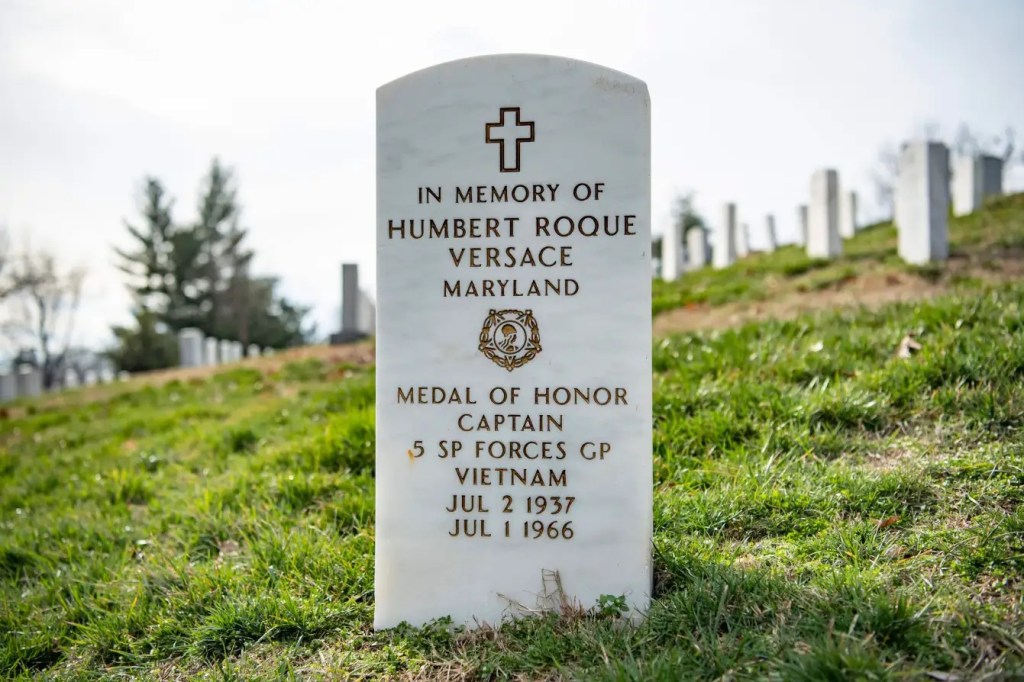
Matt White, writing in “Task & Purpose” describes the censorship that has been imposed on Arlington National Cemetery by Defense Secretary Pete Hegseth, implementing the Trump policy of removing all references to Diversity, Equity, and Inclusion. In practice, this policy seems to mean that all people should be described without reference to race, gender, or ethnic origin.
TOMBSTONE OF HUMBERT ROQUE VERSACE AT ARLINGTON NATIONAL CEMETERY, A SPECIAL FORCES OFFICER AND MEDAL OF HONOR RECIPIENT KILLED IN ACTION IN VIETNAM. THE CEMETERY RECENTLY REMOVED LINKS AND REFERENCE TO A PAGE OF “NOTABLE GRAVES” OF HISPANIC SERVICE MEMBERS WHICH INCLUDED THE PHOTO OF VERSACE’S GRAVE.
ARMY PHOTO
White writes:
Arlington National Cemetery is the most venerated final resting ground in the nation, overseen by silent soldiers in immaculate uniforms with ramrod-straight discipline. Across its hundreds of acres in Virginia, they watch over 400,000 graves of U.S. service members dating back to the Civil War, including two presidents, and more than 400 Medal of Honor recipients.
But in recent weeks, the cemetery’s public website has scrubbed dozens of pages on gravesites and educational materials that include histories of prominent Black, Hispanic and female service members buried in the cemetery, along with educational material on dozens of Medal of Honor recipients and maps of prominent gravesites of Marine Corps veterans and other services.
Cemetery officials confirmed to Task & Purpose that the pages were “unpublished” to meet recent orders by President Donald Trump and Secretary of Defense Pete Hegseth targeting race and gender-related language and policies in the military.
Also gone are dozens of academic lesson plans — some built for classroom use, others as self-guided walking tours — on Arlington’s history and those interred there. Among the documents removed or hidden from the cemetery’s “Education” section are maps and notes for self-guided walking tours to the graves of dozens of Medal of Honor recipients and other maps to notable gravesites for war heroes from each military service. Why information on recipients of the Medal of Honor — the nation’s highest award for combat valor — would be removed is unclear, but three of the service members whose graves were noted in the lessons were awarded the Medal of Honor decades after their combat actions following formal Pentagon reviews that determined they had been denied the award on racial grounds.
Like the “Notable Graves” lists, some of the lesson plans remain live but ‘walled-off’ on the cemetery’s website, with no way to reach them through links on the site. Task & Purpose located the de-linked pages by copying the original URL addresses from archived pages at Archive.org or by searching specifically for the pages on Google, which still lists them.
On at least one page that can still be accessed on search engines, language referring to civil rights or racial issues in the military appears to have been altered. A page on Black soldiers in World War II read in December that they had “served their country and fought for racial justice” but now only notes that memorials in the cemetery “honor their dedication and service.”
Altered language on a since-hidden page on African American History at Arlngton National Cemetery. In December, the page was home to over a dozen lesson plans, maps and fact-sheets intended for school groups and visitors. All of those documents have been “unpublished,” according to an Army spokesperson, but will be reposted after they are “updated.”
A spokesperson at Arlington National Cemetery — which is operated by the Army under the Army Office of Cemeteries — confirmed that the pages had been delisted or “unpublished” but insisted that the academic modules would be republished after they are “reviewed and updated.” The spokesperson said no schedule for their return could be provided.
“The Army has taken immediate steps to comply with all executive orders related to diversity, equity, inclusion, and accessibility (DEIA) personnel, programs, and policies,” an Army spokesperson at Arlington told Task & Purpose. “The Army will continue to review its personnel, policies, and programs to ensure it remains in compliance with law and presidential orders. Social media and web pages were removed, archived, or changed to avoid noncompliance with executive orders….”
The removal of the academic lessons hit hard for Civil War historian Kevin Levin, who first noted that Arlington had removed the pages on his substack newsletter. Levin lectures and writes on Civil War history and each year leads trips of history teachers — mostly high school and middle school teachers — through Arlington, so they can better teach students about the cemetery.
Levin noticed that the lessons were missing, he told Task & Purpose, when a teacher he works with tried to prepare a lesson for her students…
“I know the historians and the educators at Arlington, because they meet with our staff every year, and they’ve done a great job of creating lesson plans, they go out of their way to meet with teachers. And I know for a fact that a lot of our teachers are using these lesson plans,” Levin said. “I get the sense that this is being carried out in the sloppiest manner. I get the sense that we’re talking about people who are setting up algorithms and are looking for certain things. I don’t know if this is the end of it. I don’t think it is, I just don’t think these people, whoever is responsible, really knows what they’re doing.”
Levin said he hesitated to post about the missing documents because public exposure could reflect poorly on the professional historians who work at the cemetery and who are “exactly what you want from a federal agency that is responsible for interpreting the past….”
But the slash-and-burn approach to the website, he said, was too much.
“I’ll put it bluntly, this is a shitshow,” he said. “And this one hit home, so I did what I did.”
Trump often complained that the Biden administration had “weaponized” the Justice Department to persecute him. He has terminated everyone who had a role in the prosecution of federal charges against him. The boxes of classified documents that he took to Mar-a-Lago were returned to him.
So now he is actively politicizing the HR departments across the government. Most of those jobs were held by nonpartisan civil servants. They will be ousted and replaced with people loyal to Trump. The current occupants of these jobs are being punished for implementing the Biden administration’s DEI policies.
The Trump administration continued its efforts to politicize the upper echelons of the federal civil service Thursday, instructing agencies to reclassify chief human capital officer positions to allow political appointees to fill those roles.
The Office of Personnel Management sent a memo to agency heads Thursday recommending that all agencies where CHCOs are career-reserved positions—meaning only a career member of the Senior Executive Service can fill the post—request to change that designation to “SES general,” which allows either career executives or political appointees to assume the job. The federal government’s HR agency set a deadline of March 24 for agencies to comply.
In the memo, Acting OPM Director Charles Ezell argued that CHCO jobs have “become intensely politicized in recent years,” referring to the Biden administration’s efforts to boost diversity, equity, inclusion and accessibility.
“It is hard to imagine a more vivid example of advocacy of the ‘major controversial policies of the administration’ than an HR leader and policymaker implementing and embedding DEIA policies throughout their agency and the government more broadly,” Ezell wrote. “By contrast, President Trump campaigned vehemently against government DEI programs.”
Although only a portion of CHCO positions are actually career-reserved, federal agencies have moved toward employing nonpartisan civil servants in those roles over the last two decades because of the technical expertise required. The move to re-politicize the CHCO corps comes just weeks after the Trump administration took similar action regarding chief information officers across government.
The memo’s publication comes just days after Traci DiMartini, human capital officer for the Internal Revenue Service, was put on leave Monday for alleged “ineffective management” of the administration’s implementation of the deferred resignation program and purge of recently hired, transferred or promoted employees, as well as “insubordination” toward DOGE operatives.
“That they’re accusing human capital officers of being partisan because we implemented DEIA under the Biden administration is so counterproductive to their own argument,” DiMartini said. “Our job is to follow the law and help implement the policies and programs of whoever is in charge.”
To DiMartini and other CHCOs, the memo reads as a pretext to getting rid of officials who refuse to circumvent laws governing the civil service.
“They’re trying to politicize human capital,” DiMartini said. “They want to be able to hire only loyalists, ignore Title 5 [of the U.S. Code] and commit flagrant prohibited personnel practices. When you look at the Merit Systems Protections Board and what the civil protections are, we’re supposed to have a nonpartisan civil service, and we have been completely whipsawed.”
“I think I just got a reverse two-week notice,” one currently serving CHCO told Government Executive.
DiMartini said that she believes her impending termination—the agency has indicated that it will not allow her to retire—stems from two incidents. The first was a refusal to call employees, who she said were already putting in “60-70 hour” work weeks—into the office over the weekend to onboard a DOGE operative.
And the second was mentioning that OPM had directed the probationary purge across government in a meeting intended to calm IRS workers. Unbeknownst to her, an employee had recorded the conversation, and her comments appeared in filings of a lawsuit seeking to overturn the probationary firings.
DiMartini said that although she doesn’t plan to return to government, she will challenge her firing. She said she has never been disciplined in her 21 years of service, and wants to preserve her professional reputation.
“As an SES-er, it’s my job to stand up and be the buffer between politicals and career employees, and I’m just trying to do my goddamn job,” she said. “They have no idea who they picked a f***ing fight with.”
This article appeared in The New York Review of Books. As daily newspapers have shrunk or abandoned their book reviewing, the NYRB stands out as the nation’s leading journal of literature, the arts, and politics. It takes books seriously. This is an essay-review about the history of vouchers. I reviewed Josh Cowen’s outstanding book The Privateers, about the cabal that engineered the expansion of vouchers. I hope you will consider subscribing to the New York Review of Books and reading Josh Cowen’s important book.
For decades, the term “school choice”—and the programs it signifies, which divert public money to private schools—was widely and rightly dismissed as racist. Now it’s the law in thirty-three states.
Minnijean Brown, Thelma Mothershed, and Melba Pattillo, three of the first Black students to attend Little Rock Central High School, with Arkansas NAACP president Daisy Bates (third from left), 1957
Donald Trump promised that he will make public funds available to private as well as religious schools in every state, and this is what his party wants, too. Over the past quarter-century, Republicans have assailed America’s public schools by supporting vouchers, which divert money from public education systems to subsidize tuition at private and religious schools.
But most voters today do not favor vouchers. In fact, since 1967 no state referendum on vouchers has ever passed. In 2024 three states had referenda on the ballot, and vouchers were again defeated. Voters in two of those three states, Kentucky and Nebraska, cast ballots overwhelmingly for Trump—and in both states public funding for private schools was decisively rejected. The story of how Republican politicians have twisted this widespread popular opposition to vouchers into pervasive education policy across the country is one that requires a deeper historical view.
This opposition to public funding for private schools changed on May 17, 1954, when the Supreme Court ruled, in the Brown v. Board of Education decision, that de jure racial segregation in public schools was unconstitutional. The Court’s decision had little to do with school funding, but it set off a frantic search among white elected officials in the South to find, or create, a legal mechanism through which to protect racial segregation. The overwhelming majority of southern whites considered the prospect of racial integration repugnant, and their elected officials were determined to block it.
Until the mid-1950s most Americans believed that the government should not underwrite the cost of private and religious schooling. Catholic organizations had periodically sought public subsidies for their schools on grounds of fairness; as taxpayers, they said their schools were entitled to receive the same funds as public schools. But they were repeatedly rebuffed by Congress, the courts, and state legislatures; most state constitutions explicitly prohibited the use of public funds for religious school tuition.
Southern governors and legislators found the rationale and language they sought in the writings of Milton Friedman, a prominent libertarian economist at the University of Chicago, who in 1955 published an essay called “The Role of Government in Education.” The paper argued in favor of parents’ rights to choose any school they wanted, as well as educational freedom, the right for a child not to attend a neighborhood school—music to the ears of segregationists. Friedman said that the government should finance schools but should not be expected to administer them. He recommended that government distribute money—in the form of what he called vouchers—to parents for each of their school-age children, and that parents should be free to spend this allotment at any institution, whether its operations were for-profit or nonprofit, religious or secular, so long as the school met certain minimum educational standards defined by the local government.
If Black parents wanted their children to attend a segregated Black school, Friedman said, or if white parents wanted their children to attend a segregated white school, or if parents wanted their children to attend an integrated school—all should be equally free to do so. Competitive private enterprise and parental choice, he asserted, would promote a “healthy variety of schools” while making teachers’ salaries “responsive to market forces.” He predicted that private schools would “spring up to meet the demand.”
Southern governors used Friedman’s rhetoric and arguments to fight the implementation of the Brown decision. They adopted his endorsement of “freedom of choice” as well as his belief that private schools would provide a better education than “government schools”; indeed, advocates of vouchers began to refer to “public schools” as “government schools,” a term of derision that continues to appear in our ongoing debates about “school choice” today. As the historian Nancy MacLean demonstrated in “How Milton Friedman Exploited White Supremacy to Privatize Education,” a 2021 paper posted by the Institute for New Economic Thinking, Friedman taught southern leaders that the best way to protect Jim Crow schools was to use “race-neutral arguments” and to “embrace both an anti-government stance and a positive rubric of liberty, competition, and market choice.” As a result, seven states—Alabama, Mississippi, Louisiana, Virginia, North Carolina, South Carolina, and Georgia—enacted laws to subsidize the private school tuition of families fleeing the prospect of desegregated public schools.
In the following decades, existing private schools for white students expanded, and new private schools opened—“white flight academies” or “segregation academies”—to enroll students whose parents opposed racial integration. Often the enrollment of a single Black student in a previously all-white public school was enough to spur an exodus of white families. This happened in New Orleans in 1960 when six-year-old Ruby Bridges enrolled at the William Frantz Elementary School. She had to be escorted into the school each day by federal marshals, on the direct orders of the federal judge J. Skelly Wright. Each day Ruby withstood the screaming of angry white parents at the schoolhouse doors. And Ruby was the only child in her classroom; only a handful of white students remained in the school.
As late as 1965, less than 3 percent of Black children in the South attended schools with white children. Until then southern states engaged in a strategy of “massive resistance” to school integration, blocking the implementation of the Brown decision by providing “tuition tax credits” (a form of vouchers) so that white students could go to all-white private schools, by intimidating Black students so that they would not apply to attend white public schools, or by closing public schools altogether.
Virginia was at the forefront of this “massive resistance.” In 1959 its general assembly repealed the compulsory school attendance law and allowed localities to close their public schools. Prince Edward County was ordered by two courts to integrate its schools but chose instead to shutter its entire public school system. Officials provided tuition grants (vouchers) for white students to attend all-white private schools but made no such arrangements for Black children. Some Black families organized makeshift schools, but for five years there were no public schools for Black students in Prince Edward County. It wasn’t until 1968 that the Supreme Court outlawed Virginia’s tuition grants to private all-white schools.
After the passage of the Civil Rights Act in 1964 and the Elementary and Secondary Education Act in 1965, which made federal funding available to public schools, the federal government had the legal and financial tools to end resistance to integration. Federal courts across the South struck down laws authorizing public funding for vouchers and private schools, as well as any other state laws intended to block racial desegregation. The US Office of Education informed school districts across the South that they would not receive federal funding unless they desegregated promptly. Because of this well-known history, the term “school choice” was so closely associated with resistance to the Brown decision that it was widely and rightly dismissed as racist. It fell into disrepute for decades.
Now, seventy years after Brown, vouchers have not only been rehabilitated, since the 1990s they have been enacted in various forms in thirty-three states and the District of Columbia. Some of these programs are euphemistically called “education scholarships” or “tuition tax credits” or “education savings accounts,” but the fundamental principle is the same in all of them: public money pays for private school, even—in fact, most often—for religious schools. Republican-controlled legislatures in states such as Florida and Arizona enacted voucher programs that started small (in 1999 and 2011, respectively), intending to “save poor kids trapped in failing public schools” or supposedly only for children with disabilities. Over time these programs expanded, increasing the number of eligible students. Now both states have removed all limits, and every student, regardless of family income, is eligible for a tuition subsidy, at a cost to taxpayers that is expected to rise to $1 billion a year in Arizona and $4 billion in Florida.
Josh Cowen, a professor of education policy at Michigan State University, explains this remarkable turnaround of voucher policy in his superb book The Privateers: How Billiionaires Created a Culture War and Sold School Vouchers. Cowen has researched vouchers for most of his career. He worked with teams of academics who received millions of dollars in federal and philanthropic funds to study the results of voucher programs in different cities and states. Like many of his fellow researchers, he hoped that vouchers would provide better education for low-income students. But three years ago he published an article in The Hechinger Report, a nonpartisan education journal, in which he bluntly declared that vouchers were a failure.
Cowen explained that his initial enthusiasm for vouchers cooled as the evaluations were released. He participated in a study of Milwaukee’s vouchers from 2005 to 2010 that concluded that “there was very little difference on test scores” between students in public schools and carefully matched students in voucher schools. Furthermore, when low-income and Black students left voucher schools and returned to public schools, their academic performance in reading and math improved. At the same time that the Milwaukee study ended, a new report showed “shockingly bad early test score results for students in the Louisiana voucher program in the years following Hurricane Katrina.” Those poor results persisted and were replicated by studies in Ohio and Indiana.
The Privateers tells the story of how and why public policy on funding private and religious schools changed. As the consistent failure of state referenda shows, vouchers were never a popular idea; it was the politicians’ dependence on big campaign donors that made school choice a staple of Republican rhetoric. The widespread adoption of vouchers, Cowen explains, was basically a policy coup staged by billionaires who were libertarians or religious zealots or both. Cowen explains
how a small band of interconnected and insular groups of conservative advocates, tightly networked to some of the wealthiest and most influential players in right-wing US politics, invented a rationale for school privatization largely from nothing and out of nowhere.
He describes the agenda of that “network of scholars, lawyers, donors, and activists” as religious nationalism.
The main organizations in this movement to break down the wall of separation between church and state were two right-wing philanthropies, the John M. Olin Foundation and the Lynde and Harry Bradley Foundation, which funded both the Harvard professor of government Paul Peterson and the libertarian lawyer Clint Bolick. The Bradley Foundation, based in Milwaukee, supported the creation of the nation’s first publicly funded voucher program in that city in 1990 and played a crucial part in funding the three pillars of the voucher movement: research, policy advocacy, and litigation. Peterson became the point person for voucher research and advocacy; he also mentored a cohort of graduate students at Harvard who became the nation’s most prominent evaluators of voucher projects.
Bolick, who ran the libertarian Institute for Justice (funded by the billionaire Koch brothers), oversaw litigation and appeared on behalf of the Milwaukee and Cleveland voucher programs in state and federal courts. When more money was needed for research or litigation, members of a secretive right-wing group called the Council for National Policy were available to help; the CNPincluded the Koch brothers and the DeVos family, who used their fortune from the multilevel marketing company Amway to fund conservative candidates and think tanks and deployed their philanthropy to advance public funding of religious schools. Reviewing the players and their strategy, Cowen concludes that “there is nothing in education policymaking today that comes close to the conservative political apparatus accessed by and…even driving, at times, the creation of evidence on behalf of school vouchers.”
In 1990 the political scientists John Chubb and Terry Moe published Politics, Markets, and America’s Schools, in which they asserted that school choice would heal American education; the book was funded by the Olin and Bradley Foundations. Many seemed to have forgotten the racist origins of school choice. Chubb and Moe argued that small-d democratic politics was a handicap for public schools because it kept them in the grip of vested interests, like teachers’ unions and associations of school superintendents. The result of this stasis, they claimed, was poor academic performance. They maintained that “reformers would do well to entertain the notion that choice is a panacea.” School choice “all by itself,” they claimed, could transform American education. The book was a sensation in the education world because it offered a simple solution to complex problems and, of course, gave ideological and scholarly weight to the growing movement for charter schools and vouchers.
That same year, the Milwaukee voucher program started at the behest of the local Black leaders Howard Fuller, a militant social worker who became Milwaukee’s school superintendent, and Polly Williams, a state legislator. Fuller and Williams were disappointed by the academic performance of Black students in public schools. The Bradley Foundation, which was eager to see a demonstration of the success of vouchers in its hometown, quickly provided funding. The Milwaukee Parental Choice Program began as a project that enrolled 341 low-income students in seven private schools. By 1994 it had increased to 830 students in twelve schools.
The legislation authorizing the voucher program required that the students take a state test and that the results be evaluated by an independent researcher. The state superintendent, who opposed vouchers, appointed John Witte, a professor from the University of Wisconsin, to conduct the evaluation. When Witte eventually concluded that the program had minimal impact on students’ academic outcomes or attendance and that voucher recipients returned to public schools at high rates, voucher advocates denounced him as biased. Cowen says that Witte was fair and that his study was accurate.
The loudest voice deploring the negative evaluation of the Milwaukee voucher program was that of Peterson, who wrote a letter to TheNew York Times eviscerating the Witte study for minimizing the academic gains of the students and the importance of parental satisfaction. Cowen points out that Peterson was a political scientist with minimal experience in statistical evaluation. Peterson worked with his then graduate student Jay P. Greene on a study, funded by the Bradley and Olin Foundations, of the Milwaukee program. They concluded that, contrary to the state evaluation, vouchers produced significant academic benefits. The voucher system produced these positive results, they wrote, despite legislative burdens such as income limitations and the exclusion of religious schools.
Peterson and Greene’s favorable review persuaded the Republican-controlled Wisconsin legislature to renew and expand the voucher program in 1995 by including religious schools and increasing the number of participants to 15,000. The inclusion of religious schools led to a court battle that voucher advocates eventually won, litigated by Bolick and the high-powered lawyer Kenneth Starr, who later became famous for his part in the investigation of President Bill Clinton. The Bradley Foundation underwrote his firm’s fee of $300,000 for one month of work, Cowen writes.
Meanwhile the voucher push shifted to Ohio, where the Republican governor wanted Cleveland to be a model for the nation. The program was designed for low-income students, but—unlike in Milwaukee—it did not exclude religious schools; nearly all of the fifty-two participating schools were Catholic. The official evaluator, the Indiana University professor Kim Metcalf, found “few overall differences in student achievement,” but once again Peterson and Greene dismissed the official evaluation and produced their own report—this time funded by the Walton Family Foundation in addition to the Olin Foundation—which showed “large gains” for voucher students. Cowen notes that Peterson’s work was typically reported in newspaper editorials (usually the pro-voucher Wall Street Journal), not in peer-reviewed scholarly journals.
Cowen points out that Peterson’s research findings were more clearly directed toward the Supreme Court than toward other scholars: he filed an affidavit on behalf of the Cleveland program in the crucial 2002 case Zelman v. Simmons-Harris, which concerned the legality of public funding of religious schools. The Court decided 5–4 in favor of including religious schools in the voucher program—a significant reversal of numerous decisions upholding the separation of church and state. Justice Sandra Day O’Connor cited Peterson and Greene’s work in her concurring opinion.
Since that Supreme Court decision, vouchers have been sold to the public as a way to “save poor kids from failing schools.” School choice has been described as “the civil rights issue of our time” by Betsy DeVos, Ted Cruz, and Donald Trump. Republican elected officials adopted school choice as party dogma, and state after state enacted laws authorizing vouchers, despite a distinct lack of public support. Voters in Utah rejected vouchers in 2007, voters in Florida rejected vouchers in 2012, and voters in Arizona rejected vouchers in 2018, but the Republican leaders in all three states ignored the referenda and continued to expand voucher programs. Republican legislatures and state courts have also ignored explicit provisions in state constitutions that forbid the public funding of religious schools, claiming that the voucher goes to the parents, not to the religious schools where they pay for tuition. Where there’s a will, partisans find a way.
Voucher advocates continually promised academic gains, especially for the poorest students, but after 2010, as the voucher programs grew in scale, the academic results turned sharply negative. Cowen realized that poor kids were actually harmed by using them. Low-income students did not use vouchers to enroll in elite private schools, which mostly did not accept these students—either because they were behind academically or because the voucher was worth far less than the school’s tuition—but to enroll in religious schools whose teachers were uncertified or in pop-up private schools created to capture the government money. When the outcomes were disappointing, the right-wing foundations and Republican officials promoting vouchers moved the goalposts: test scores didn’t matter, they said, but graduation rates and parental satisfaction did. When the test scores and the graduation rates were surpassed by local public schools, the pro-voucher foundations, elected officials, and researchers shifted to a different rationale, one that was “always the underlying goal,” Cowen argues: to satisfy the “values” of parents. Just as segregationists in the 1950s invoked “the right of parents” to avoid integration, voucher advocates in the twenty-first century believe that parents “have the express right to use public dollars to self-segregate.”And these advocates claim that parents have the right to receive taxpayer support for their children to attend religious schools; denying them that “right,” they argue, infringes on religious freedom.
Cowen describes how he came to this understanding. From 2013 to 2016 two teams of researchers—one from MIT and another from the Walton-funded Department of Educational Reform at the University of Arkansas—reached the same dire conclusions about vouchers in Louisiana: they “caused unprecedented large, negative impacts on student achievement.” The Louisiana voucher students were mostly Black and low-income. They entered voucher schools at the fiftieth percentile in math; after a year in private school, they dropped to the twenty-sixth percentile. They improved in the second year but remained behind their peers in public schools. This was solid evidence from two separate groups of researchers “that voucher interventions actually caused damage” to the poor students they were supposed to help. Voucher advocates insisted that the experiment needed more time and that it was overregulated by the state.
The bad results kept rolling in: from Indiana, where independent evaluators documented negative outcomes in 2015; from Ohio in 2016, in a study funded by a conservative think tank; and from Washington, D.C., where evaluators found poor results in 2017 and 2018. Cowen concludes that
no explanation then or now has fully explained the learning loss displayed in locations so different as Louisiana, Indiana, Washington, and Ohio as does the simplest one: that for all of Milton Friedman’s purported brilliance, and for all the millions of dollars pumped into the effort by Betsy DeVos, Charles Koch, and the Bradley Foundation, the idea simply did not work. The bigger and more recent the voucher program is, the worse the results have been.
Republican-led states simply ignored the evidence that low-income students who used vouchers fell behind their peers in public schools, and they continued to enact the policies, thanks to large contributions from right-wing billionaires to the campaigns of like-minded state officials. Furthermore, several of the Republican-dominated states removed income restrictions and other limitations, thus abandoning the rhetoric of “saving poor kids from failing schools.” A dozen states currently have “universal” voucher programs, meaning that any family may apply for a voucher, without regard to their income. Tennessee enacted universal vouchers only weeks ago. Other states are likely to follow their lead.
Cowen reports that, with or without income restrictions, the majority of applicants to voucher programs were not trying to leave public schools; they were already attending private schools. This is the case in every state with vouchers. Right now between 65 and 80 percent of students who claim vouchers are using them to pay the tuition of private schools where they were already enrolled. Vouchers are also used in many states to pay the expenses of parents who teach their children at home. In Arizona, according to reports in The Arizona Republic and ProPublica, parents have used their “education savings accounts” to buy trampolines, swing sets, expensive Lego sets, horseback riding lessons, kayaks, trips to Disney World, chicken coops, skiing trips, cowboy roping lessons, and ice-skating lessons. Republican governor Doug Ducey led the campaign to make public funds available to all students in the state. His successor, Katie Hobbs, a Democrat, predicted in 2023 that the state’s voucher program could cost nearly $1 billion, with over 53 percent of all new funding paying for 8 percent of Arizona’s students.
Just as troubling to Cowen as the academic results of the voucher project is the publicly funded discrimination that these schools make possible. Right-wing rage in response to the pandemic enabled the eruption of the so-called culture wars over masking, vaccines, and teaching about race and sexuality in schools, as well as the presence of these topics in library books. In 2022 Christopher Rufo, the right-wing provocateur who first raised an alarm about “critical race theory” in public schools (few public school teachers had ever heard of the term; it refers to a course usually taught in law schools, if at all), called on conservatives in a speech at Hillsdale College to promote universal distrust in public schools in order to arrive at “universal school choice.” This distrust was fueled by right-wing groups, which made wild accusations about teachers allegedly “grooming” their students to be gay or Marxist, and about the curriculum allegedly turning students against their own country.
Vouchers appeal to those who want to escape lessons about racism, diversity, or gender equality. Religious and private schools that receive publicly funded vouchers are not bound by civil rights laws, and many openly bar the admission of LGBTQ+ students and the hiring of LGBTQ+ staff. Some bar students with disabilities. Some religious schools accept only students who are members of their own religion.
Trump issued an executive order on January 29 titled “Expanding Educational Freedom and Opportunities for Families,” which called for the diversion of federal funds to underwrite tuition at private and religious schools. He claimed that “rigorous research demonstrates that well-designed education-freedom programs improve student achievement and cause nearby public schools to improve their performance,” which according to Josh Cowen’s book The Privateers is not true. Trump issued the order on the same day as the release of the latest national test scores by the National Assessment of Educational Progress. Florida, which has a robust voucher program, experienced a sharp decline in its scores, the state’s lowest in twenty years on this test.
Cowen considers the manipulation of culture-war issues like race and gender to be a feature of vouchers, not a bug. Groups like Moms for Liberty and Parents Defending Freedom use the clarion call of “parents’ rights” to condemn the discussion of race and LGBTQ+ issues, as well as access to books about these subjects, in public schools. Such groups want to censor what is taught to all children, even those whose parents disagree with them and want their children to learn about race, gender, and sexuality. Imagine teachers in a segregated Black school being told by the state that they cannot teach accurate Black history. Why should those parents have no rights?
Cowen writes that the learning loss of poor children who used vouchers was larger than the learning loss caused by the pandemic, and at this point the evidence against their efficacy is overwhelming. Yet more states adopted vouchers in 2022 and 2023 than in any previous legislative sessions. Texas is the only large Republican-controlled state that has not enacted legislation to implement them, owing to the combined opposition of parent groups, Democrats, religious leaders who believe in the separation of church and state, and rural Republicans defending their district’s only public school. Yet Governor Greg Abbott has said that vouchers are his highest priority. He received millions of dollars from billionaires to defeat many of the rural Republicans who opposed vouchers. The issue will soon come to a vote in the legislature.
The reality is that when states offer charter schools and vouchers, public schools lose. Each time students leave for private alternatives, public schools must reduce their teaching staff, increase class sizes, and cut back on curricular offerings. States cannot afford to pay for three different school systems. Is the goal to eliminate public schools? That argument seems inherent to some who share Friedman-style thinking.
What does Cowen recommend?
Fund public schools. It really is that simple…. The more money we spend on schools, the better off children are, not simply academically, but in later-life outcomes like higher wages and fewer encounters with the criminal justice system.
Wealthy parents spend amply to educate their children—to make sure that they have certified teachers, small classes, a well-supplied library, and a curriculum that includes the arts and sciences as well as physical education and time for play. And, of course, wealthy children never go without food or medical care. We should give the same to all children.


 Diane Ravitch's blog