Archives for category: Network for Public Education

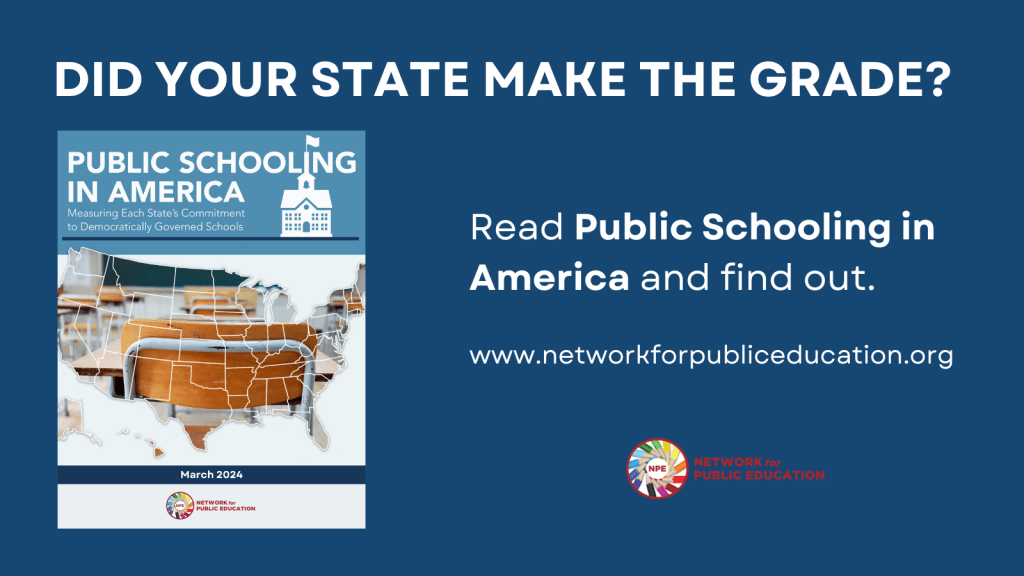
The Network for Public Education released a report card today grading the states on their support for democratically-governed public schools. Which states rank highest in supporting their public schools? Open the report to find out.

Measuring Each State’s Commitment to
Democratically Governed Schools

EXECUTIVE SUMMARY


Neighborhood public schools remain the first choice of the overwhelming majority of Ameri-
can families. Despite their popularity, schools, which are embedded in communities and gov-
erned by elected neighbors, have been the target of an unrelenting attack from the extreme
right. This has resulted in some state legislatures and governors defunding and castigating
public schools while funding alternative models of K-12 education.

This 2024 report, Public Schooling in America: Measuring Each State’s Commitment to
Democratically Governed Schools
, examines these trends, reporting on each state’s commit-
ment to supporting its public schools and the children who attend them.

What We Measure

We measure the extent of privatization in each state and whether charter and voucher laws
promote or discourage equity, responsibility, transparency, and accountability. We also rate
them on the strength of the guardrails they place on voucher and charter systems to protect
students and taxpayers from discrimination, corruption and fraud.

Recognizing that part of the anti-public school strategy is to defund public schools, we rate
states on how responsibly they finance their public schools through adequate and equitable
funding and by providing living wage salaries for teachers.

As the homeschool movement grows and becomes commercialized and publicly funded,
homeschooling laws deserve public scrutiny. Therefore, we rate states on laws that protect
children whose families homeschool.

Finally, we include a new expansive category, freedom to teach and learn, which rewards
states that reject book bans, and the use of unqualified teachers, intolerance of LGBTQ stu-
dents, corporal punishment, and other factors that impinge on teachers’ and students’ rights.

How does your state rank?

The Network for Public Education is the largest organization of volunteers and a tiny staff working every day to stop privatization of our public schools. The following is a message from our executive director, Carol Burris. Unlike the billionaire-funded advocacy groups for charters and vouchers, we need you! Contributions of any size are welcome!

What keeps NPE going are donors like you–friends of public education who are willing to make a one-time or monthly donation to invest in the continuance of our public schools.

We operate on a shoestring. But our reports, action alerts, advocacy, conferences, and webinars with Diane put us at the forefront of saving public education. Behind the scenes in fighting vouchers in Texas or making the case for Charter School Programs reform, NPE is the organization with a tiny budget but a mighty voice.

So please give to NPE this holiday season. You can make an online donation here, or, if you prefer to send a check, our address is:

The Network for Public Education, PO BOX 227, New York City, NY 10156.

At the recent conference of the Network for Public Education, one of the truly outstanding speakers was Dr. Marvin Dunn, professor emeritus at Florida International University. Dr. Dunn has written several books about Black history in Florida, most notably A History of Florida Through Black Eyes. I read that book and realized that Dr. Dunn was the right recipient for NPE’s annual “David Award,” which goes to someone who spoke out and acted on behalf of justice against the powerful, regardless of the personal risks.

Dr. Dunn is not only an author but an active preservationist of Black history. To make sure that the massacre at Rosewood, Florida, would never be forgotten, he bought five acres there and regularly brings students and teachers to learn about it. He tells the story of visiting his land with his son; a “neighbor” tried to run them over in his truck. Dr. Dunn filed a complaint with the police, and the man was convicted and sentenced to 10 years in prison. Dr. Dunn asked to have the sentence reduced, and it was dropped to only one year. The audience was impressed by his generosity of spirit. However, Dr. Dunn tweeted several weeks later that the now-released felon hung a toy skeleton where Dr. Dunn could see it. You don’t need to study Critical Race Theory to know that Racism lives.

I think you will agree that his remarks are highly inspiring.

If you missed the 10th annual conference of the Network for Public Education, you missed some of the best presentations in our ten years of holding conferences.

You missed the brilliant Gloria Ladson-Billings, Professor Emerita and formerly the Kellner Family Distinguished Professor of Urban Education in the Department of Curriculum and Instruction at the University of Wisconsin-Madison.

Ladson-Billings gave an outstanding speech that brought an enthusiastic audience to its feet. She spoke about controversial topics with wit, charm, wisdom, and insight.

Fortunately, her presentation was videotaped. If you were there, you will enjoy watching it again. If you were not there, you have a treat in store.

Thomas Ultican of California has become a regular attendee at the annual meetings of the Network for Public Education. He attended every keynote and many panels, and he reports here on what he heard.

Ultican wrote:

NPE met at the Capitol Hilton for a weekend conference beginning on Friday, October 27. The old hotel seemed well maintained. That first evening, Diane Ravitch interviewed James Harvey who was a key contributor to “A Nation at Risk.”We gathered in a large conference room which caused Mr. Harvey to comment, “I remember being at a meeting in this room fifty years ago when we heard that Alexander Butterfield had just testified that there were tapes of the oval office.” With that historical reference, the conference was off to a wonderful start.

A Nation at Risk” is seen as an unfair turning point that undermined public education. Mr. Harvey’s job was to synthesize the input from members of the National Commission on Excellence in Education, which was created by Secretary of Education Terrence Bell to produce the report. He shared with us that two famous academics on the panel, Nobel Prize winner Glen Seaborg and physicist Gerald Holton, were the driving forces for politicizing public education.

Diane Ravitch and James Harvey

That first night’s presentation was actually an added event for the benefit of us coming in on Friday afternoon. The conference had three keynote addresses, two panel discussions and seven breakout sessions. The difficult problem was choosing which of the six offerings in the breakout sessions to attend.

Pastors for Children

For session one, I attended “Mobilizing Faith Leaders as Public Education Allies.” The amazing founder of Pastors for Children, Charles Foster Johnson, and his two cohorts were well reasoned and did not proselytize us. Their movement really does seem to be about helping communities and not building their church. Among Johnson’s points were,

  • “Privatized religion teachers believe “God likes my tribe best.”
  • “We are the reason there is not a voucher program in Texas.”
  • “Conservatives and liberals come together over education.”
  • “Faith leaders have a different effect when lobbying politicians.”
  • “We are making social justice warriors out of fundamentalist Baptist preachers.”

Houston School Takeover

I have no intention of writing about each of the 7 sessions I attended, but the session on the Houston School District takeover needs mention.

Texas took-over Houston Independent School District (ISD) on June 1, 2023. It is the largest school district in the state and eighth largest in the country with more than 180,000 students attending 274 schools. The student demographics are 62% Hispanic, 22% African-American, 10% White and 4% Asian with 79% identified as economically disadvantaged.

In 2021, Millard House II was selected by a unanimous vote of the Houston ISD school board to be Superintendent. Under his leadership, Houston ISD was rated a B+ district and the school in one of Houston’s poorest neighborhoods that was used to excuse the takeover received a passing grade on Texas’s latest STAR testing. The take-over board replaced House with Mike Miles, a charter school operator from Colorado who previously only lasted 2 years of his five year contract to lead the Dallas ISD.

Ruth Kravetz talked at some length about the how angry Houstonians are and their effective grassroots organizing. Kravetz stated, “We want Mike Miles gone.” She noted that the local media started turning against the takeover when citizens were locked out of the first takeover board meetings. Kravetz intoned,

  • “Teachers no longer need a certificate or college degree to teach in Houston ISD.”
  • “Seven year-olds are not allowed to use restrooms during instructional times. They must wait.”
  • “People are being fired for ridiculous reasons. Five people were fired last week over a made up story.”
  • Expect more student action against the takeover.
  • “Rolling sickouts are coming.”

Jessica Campos is a mother in one of Houston’s poorest communities. She said her school is made up of 98% Mexicans with 68% of them being Spanish speakers. Jessica claims, “Our school community has been destroyed” and reported that all teachers were removed with many being replaced by uncertified teachers.

Daniel Santos (High School social studies teacher) said,

“It is all about dismantling our school district. We wear red-for-Ed every Wednesday and Mayor Turner lights up city hall in red.”

The Keynote Addresses

Gloria Ladson-Billings from the University of Wisconsin Madison delivered the first Keynote address on Saturday morning.

She mentioned that we were really dealing with 4 pandemics:

  1. Covid-19
  2. George Floyd murder
  3. Economic Shesession” (Large numbers of women were forced to leave the workforce.)
  4. Climate catastrophe

Professor Ladson-Billings claims the larger agenda is the complete eradication of public education in what she sees as an evolving effort.

  • The evacuation of the public spaces which are being privatized.
  • Affordable, Reliable and Dependable (public space keys) is being undermined.
  • Public housing is closing.
  • The last domino is public education!

Ladson-Billings says, “choice is a synonym for privatization.” There is money in the public and wealthy elites do not think the public should have it.

She noted, “We are in the business of citizen making.” We do not want to go back to normal because it was not that great.

Ladson-Billings ended on a positive note about the attack on public education in Florida, “All is not lost – people on the ground in Florida are working hard to reverse it.”

History Professor Marvin Dunn from Florida was our lunch time keynote speaker. Professor Dunn has been working hard to educate the children of Florida about the states racist past including giving guided tours of the site of the 1923 Rosewood Massacre of an African American community.

He noted that “Racism is in our national DNA” and shared that George Washington owned 500+ slaves. When he was 11 years-old, Washington was given his first slave. Still, 500 black soldiers were with him at the crossing of the Delaware river.

Another American icon mentioned by Professor Dunn was Thomas Jefferson. The third president of the United States was 41 years-old when first having sexual relations with Sally Hemings; she was 14.

Julian Vasquez Heilig, Josh Cowen and Jon Hale held a public discussion late in the afternoon on Saturday. The moderator, Heilig, made the point that instead of funding one system, now many states are funding three systems with the same amount of dollars.

Josh Cowen, from Michigan State University, noted that using evidence based data, since 2013, vouchers have been catastrophic. If we were using evidence informed education policy, vouchers would have died 5 years ago. Test score losses from voucher students are greater than those experienced in either Katrina or Covid-19. He also noted that 20% – 30% of children give up their voucher each year.

Cowen added don’t believe a word coming out of Iowa Governor Kim Reynolds’ mouth. She has instituted vouchers, opposed abortion and supported child labor. Reynolds is pushing Christian nationalism.

Jon Hale, from the University of Illinois says white architects of choice have a 70 year history. He says it was never about improving schools. The white supremacist movement sprung up after Brown versus the Board of Education in 1954…

What I Found

Several participants showed up kind of down in the mouth. However, by the end of the conference they were heading back home with new energy and resolve. Billionaires are spending vast sums of money trying to end public school because if public education goes then all of the commons will follow. Their big problem is that vast wealth and spending is not a match for the grassroots organizing that is happening throughout America.

Diane Ravitch, Carol Burris and the members of NPE have become a bulwark for democracy and public education.

In case you missed the Network for Public Education’s 10th annual conference, Jan Resseger gives you here a brief overview.

It was a well-planned conference with great speakers and panels. Every year, we say, “This was the best ever.” We said it again this time. How will we top this next year? The presentations of the keynote speakers were recorded and I will post them.

Jan Resseger writes:

It was while I was traveling home from last weekend’s Network for Public Education Conference that I realized I had not once heard Miguel Cardona’s name mentioned—even though the meeting was in Washington, D.C. Miguel Cardona is, of course, the U.S. Secretary of Education.

This year’s conference felt different than earlier conferences, when worries about federal policy brought by previous Secretaries of Education became a unifying focus. Rod Paige brought us “the Texas Miracle,” the test-and-punish model policy that spawned No Child Left Behind. Arne Duncan bribed the states with huge federal grants if they agreed to adopt his favorite Race to the Top priorities. And Betsy DeVos talked on and on about her favorite subject, school privatization.

Federal policy can be helpful or harmful for public schools. But with Miguel Cardona’s quiet management style and in the context of a badly divided Congress, any chance of our framing a collective narrative response to a nationwide policy has faded. It is, of course, true that a lot of awful remnants of the No Child Left Behind and the Race to the Top era, like the federal Charter Schools Program that continues to support privately operated charter schools, remain in federal law. The remains of Race to the Top also still clutter the laws from state to state. But except for the Network for Public Education’s dogged effort to end funding for the federal Charter Schools Program, the focus on federal advocacy at this year’s conference seemed to have become limited. Keynoters were clear, however, that the attack on absolutely essential Title I funding from House Republicans is being vigorously countered by the Biden administration and in the U.S. Senate.

At last weekend’s conference it was clear that today the most damaging education policy is emerging in the 50 state legislatures, a situation which creates a challenge for collective advocacy. While states like Wisconsin, Indiana, and Ohio are all facing school funding shortages and concurrent growth in the diversion of state dollars to school vouchers, state laws and state politics make it extremely challenging for advocates even in these three similar states to pull together a coherent and moving universal narrative that also accounts for each state’s wonky legislative differences. At last week’s conference, workshops on the implications of state policy informed participants about work to reform Pennsylvania’s charter schools; to defend public schools from Ron DeSantis’s attack on teaching inclusive history in Florida; to push back against state takeovers in Houston, Lorain, Ohio, and Nashville; to inform the public about school funding lost to tax abatements in Kansas, South Carolina, Louisiana, and Missouri; to press for the end of portfolio school reform in Denver; and to help parent and teachers union advocates work together to build support for investment in equitable public schools as they did during teachers’ strikes in Los Angeles and Oakland.

Opposing the Growth of School Privatization via Vouchers

In this year of explosive growth of private school tuition vouchers across the states, several workshops explored the evidence that vouchers don’t fulfill the promises of their proponents. Experts presented research findings demonstrating that parents sign away their children’s constitutional protections when they accept a voucher to send a child to a private school. One researcher described the result as “the outsourcing of discrimination.” Another presented peer-reviewed research showing that students’ test scores in both math and reading dropped significantly after they took a voucher to attend a private school, and that many return suddenly to the public school district when their voucher school forces them out for one reason or another or she school suddenly closes. Public schools are prohibited by law from routinely expelling students; private schools accepting vouchers often push out children with special needs or those who do not fit their school’s profile.

Several workshops examined the fiscal damage when states divert massive tax dollars to uncapped voucher and Education Savings Account programs, which are often unregulated and poorly managed. Public Funds Public Schools, a collaboration of the Education Law Center and the Southern Poverty Law Center, shared its website that tracks voucher schemes across the states and provides up to date resources for advocacy. Two workshops presented full-service Community Schools, which are likely to become any family’s best school choice as medical, family, and community services are located right inside the neighborhood public school.

Refusing to Be Distracted by the Far-Right Culture Wars

Another factor creating today’s difficult public education policy climate is the massive investment in racist and homophobic “culture war” disruption by billionaire philanthropists and dark money groups. In A Citizen’s Guide to School Privatization, a new resource just published on the Network for Public Education’s website, Massachusetts political science professor Maurice Cunningham traces the dangerous groups working together to rile up and divide parents and distract us all from more constructive efforts to strengthen public schooling and make our schools more inclusive. The result? “Chaos is the product. It’s a lot easier to break something than to build something or to improve upon it.”

In a workshop last weekend, Cunningham described some of the research he has published in his new, and well documented Citizen’s Guide, for example, the following about the national organization that basically funds and operates Moms for Liberty: “The Council for National Policy… brings together wealthy conservatives, many from the oil and gas realm; Christian evangelists with vast communications networks; and groups that can turn out groups like the National Rifle Association. The Council for National Policy is a central directorate passing down plans to ‘obedient franchises’ like Moms for Liberty. The key Council for National Policy members that oversee Moms for Liberty are the Leadership Institute and Heritage Foundation. They run the annual summits, provide the training and literature, and even sue the Biden administration on Moms for Liberty’s behalf.”

What About the Separation of Church and State?

One workshop last weekend brought researchers from Documented to explore the Christian Right organization, the Alliance for Defending Freedom, which has worked to develop a legal strategy to confront public schools around the idea that “public schools are indoctrinating children with a secular worldview that amounted to a godless religion.”

While private schools accepting vouchers have been quietly teaching religion for years and at the same time failing to protect the rights of their students, in a workshop last weekend three legal experts set out to clarify the issues posed by an explicitly religious charter school, St. Isidore of Seville Catholic Virtual School, which the Roman Catholic Archdiocese of Oklahoma City has proposed to open. The presenters explored the question legally: whether, as publicly funded private contractors, charter schools are “state actors.” The issue is so complex in terms of legal precedents that even among the presenters there was subtle disagreement.

Participants in this and another workshop I attended seemed concerned about the broader constitutional question of the separation of government and religion. Many seemed clearly to grasp the importance of the first Amendment’s Establishment Clause’s protection of church-state separation, and many were concerned and confused about the current U.S. Supreme Court’s reliance on the Free Exercise Clause instead. It seemed a good thing that staff from Americans United for Separation of Church and State were workshop presenters in this year’s Network for Public Education conference to help clarify the issues around the current U.S. Supreme Court’s interpretation of religious liberty.

Working for Racial Justice

Many of the leaders and powerful speakers at last week’s conference identified racism and its lingering role as the greatest factor undermining children’s experience in public school along with the unequal school funding from state to state that regularly disadvantages Black and Brown children. It is clear that today’s attacks on the honest teaching of American history, on critical race theory, and on “diversity, equity and inclusion” are a blatant attempt to marginalize Black, immigrant, and gay, lesbian, and transgender children and adolescents.

Last weekend we heard about and talked about what happens when Ron DeSantis and others attack “diversity, equity, and inclusion” efforts as “woke.” Their goal is to ensure that schools can remain segregated by race and economics so that parents can protect their children from exposure to diversity; that state school funding schemes remain inequitable by favoring wealthy suburbs; and that public schools can exclude the history and culture and identity of some children from the curriculum and ban books about these children. Promoting homophobia and “fear of the other” is central to this agenda. Speakers throughout the event traced the advent of school vouchers back to the segregation academies that were a response to Brown v. Board of Education.

Gloria Ladson-Billings, the retired Kellner Family Distinguished Professor of Urban Education at the University of Wisconsin, Madison, seemed the perfect person to launch the conference’s opening plenary in this year filled with attacks on efforts by schools to protect diversity, multicultural education and authentic welcome for all students. Ladson-Billings’ own website introduces her as “known for her work in the fields of culturally relevant pedagogy and critical race theory, and the pernicious effects of systemic racism and economic inequality on educational opportunities.” Keynoter, Dr. Marvin Dunn, Professor Emeritus in the Department of Psychology at Florida International University, described his project to lead students on tours of the site of the 1923 Rosewood Massacre of an African American community in Florida. Governor Ron DeSantis has attempted to suppress teaching about such events. A workshop highlighted the work of the Schott Foundation’s Opportunity to Learn Network along with the role of full-service Community Schools to house social, medical and community services to serve families and make them feel welcome and supported. Finally Jitu Brown and staff from the Journey for Justice Alliance introduced the Journey for Justice Alliance’s national Equity or Else Campaign for racial justice.

Remembering the Urgent Importance of Public Schooling for These Tough Times

Many of the event’s speakers called the growing attack on public education combined with rapid expansion of private school tuition vouchers and states’ investment in privately operated charter schools an existential threat to the primary institutions that anchor every small town, city neighborhood and suburb: the public schools that continue to educate the vast majority of our children and adolescents. As we strategize about how to push back against the threats to our public schools, however, the National Education Association’s Susan Nogan ended her workshop presentation with a reminder: “We must lead with our shared values.” Ladson-Billings opened the conference with a keynote entitled, “Regaining a ‘Public’ for Public Education.” Keynoter Julian Vasquez Heilig, Provost and Vice President for Academic Affairs at Western Michigan University declared, “Equity, inclusivity and democracy are what our public schools represent.” The American Federation of Teachers’ Randi Weingarten reminded a luncheon plenary: “Public school is the place where we do pluralism.”

I was reassured that despite a lot of worrying about threats to public education, speakers shared their confidence in the foundational principles underneath our American system of public schools. Public schools are publicly funded, universally available and accessible, and guaranteed by law to meet each child’s needs and protect all children’s rights. Public schooling represents not only individualist concern for one’s own children, but also a sense of obligation to all of the community’s children.

School privatization cannot move our society closer to these principles. Last week’s 10th Anniversary Network for Public Education Conference represented a commitment to work together to ensure greater equality of opportunity and to improve our public schools, but at the same time to affirm public education as the optimal educational institution for the investment of our efforts and tax dollars.

The Network for Public Education sent out an alert, warning that several members of the U.S. Senate were proposing a bill to enrich the sponsors of privately-managed charter schools.

The Texas AFT answered that alert with an appeal to Senator Jon Cornyn.

Tell Sen. Cornyn: Do Not Support More Charter School Program Waste, Fraud

Eight U.S. senators (including Texas Sen. John Cornyn) introduced a bill last week that was clearly written with the help of the charter school lobby. The Empower Charter School Educators to Lead Act would allow billionaire-funded nonprofits operating as “state entities” to keep more of a cut when dispersing Charter School Program (CSP) grants. The bill would also allow these “state entities” to award up to $100,000 to would-be charter entrepreneurs, including religious organizations, to pre-plan a charter school before they have even submitted an application to an authorizer.

Our partners at the Network for Public Education (NPE) urge you to send a letter to your senator to oppose the charter lobby’s bill today.

As the NPE has documented, CSP planning grants have led to enormous waste and fraud. Millions of CSP dollars have gone to school entrepreneurs who never opened a school — a fact confirmed by the Department of Education and the Government Accountability Office. That is why the NPE and other public education advocates supported the addition of modest guardrails in 2022 that provided guidance on how and when planning grants could be spent.

Clearly, that did not sit well with the charter lobby, led by the National Alliance for Public Charter Schools, which persuaded these eight senators to make it even easier to get funding to pre-plan a school.

There’s more. This bill would also increase the funding “state entities” can keep for themselves when they disperse grants. That cut is already at 10%, and this bill would raise it to a whopping 15%. Contact Sen. Cornyn today. Stop the charter school lobby’s new attempts to fleece American taxpayers and undermine public schools.

STOP THE SCAM!

Jan Resseger is a dedicated supporter of public schools. She has a deep understanding of the role that public schools play in building community and strengthening democracy. she is coming to the Network for Public Education conference in D.C. this weekend. There is still time for you to register!

Jan Resseger writes:

Many of us will be traveling to Washington, D.C. next weekend for the 10th Anniversary Conference of the Network for Public Education. We will have an opportunity to greet friends and colleagues, listen to experts examine today’s attack on public schooling, and strategize about confronting the opponents of our society’s historic system of free and universal public education.

As well-funded interests like Moms for Liberty try to invade local school boards, as the Heritage Foundation, EdChoice, the Bradley Foundation, Koch and Walton money, and Betsy DeVos’s American Federation for Children support a school voucher revolution across the state legislatures, and as state legislators in many places obsess over test scores without grasping the human work teachers and students must accomplish together, we will gather to strategize about strengthening support for the public schools that remain the central institution in most American towns and neighborhoods.

There will be keynotes from Gloria Ladson-Billings, former chair of urban education at the University of Wisconsin, Madison; Becky Pringle, President of the NEA; Randi Weingarten, President of the AFT; Diane Ravitch, and several other prominent speakers. Participants will also be able to choose from among more than 40 workshops:

  • sessions exploring strategies and messaging to fight school privatization—including reports from Indiana, Florida and Arizona on vouchers; sessions on problems with charter schools in Pennsylvania and Texas; and a workshop on constitutional issues around religions charter school;
  • workshops addressing the need to overcome far-right attempts to hijack school boards including the fake grassroots parents’ groups funded by far-right philanthropy; reports on advocates working in a number of communities to engage parents as local school board advocates; and several Florida school board members sharing their experiences as their school boards were taken over and politicized;
  • discussions exploring the long impact of test-and-punish school reform including workshops examining state takeovers in several districts including this year’s state seizure of the Houston, Texas Public Schools; and a session about efforts to rid the Denver Public Schools of Portfolio School Reform;
  • conversations helping advocates support the retention and recruitment of teachers in these difficult times when, after COVID, many have blamed teachers for test scores and discipline problems, and when teachers’ autonomy has been undermined and their salaries remain low;
  • sessions to develop skills for coalition building, one of them from California stressing the need to build joint parent-teachers union coalitions; another from Wisconsin on statewide parent organizing; and other workshops emphasizing coalition building with communities of faith to preserve the Constitutional protections for religious liberty;
  • conversations helping advocates better frame and articulate an agenda to undermine racism, protect a diverse curriculum, and focus on students’ needs;
  • workshops celebrating full-service, wraparound Community Schools and strategizing to expand the number of Community Schools; and
  • discussions of specific issues: support for early childhood education, the need to protect student privacy, and the danger of outsourcing the work of education support professionals to private contractors.

As a blogger and an Ohio resident who worries about the diversion of public school funding to our state’s new universal vouchers, however, I am also looking for some broader help than any one of these specific workshops can provide. While it is possible to identify the forces unraveling support for public education, I struggle to find adequate language to articulate why the public schools we have taken for granted for generations are so important. I will be grateful at this conference to listen as experts name the essential role of the public schools in our diverse, democratic society. I will be listening as presenters and advocates emphasize these core principles.

Here are three examples of people writing about or speaking about what public schooling can accomplish. First from the late political theorist Benjamin Barber is a rather complex but also important declaration about school privatization as an expression of radical individualism in contrast with public education as an institution in which the public can protect citizens’ rights: “Privatization is a kind of reverse social contract: it dissolves the bonds that tie us together into free communities and democratic republics. It puts us back in the state of nature where we possess a natural right to get whatever we can on our own, but at the same time lose any real ability to secure that to which we have a right. Private choices rest on individual power… personal skills… and personal luck. Public choices rest on civic rights and common responsibilities, and presume equal rights for all… With privatization, we are seduced back into the state of nature by the lure of private liberty and particular interest; but what we experience in the end is an environment in which the strong dominate the weak… the very dilemma which the original social contract was intended to address.” (Consumed, pp. 143-144)

Second, William Ayers updates John Dewey’s 1899 declaration in The School and Society: “What the best and wisest parent wants for his own child, that must the community want for all of its children.” Here is how, in an essay in the 2022, Public Education: Defending a Cornerstone of American Democracy, Ayers defines the kind of public education that every American child today ought to have: “Every child has the right to a free, high-quality education. A decent, generously staffed school facility must be in easy reach for every family. This is easy to envision: What the most privileged parents have for their public school children right now—small class sizes, fully trained and well compensated teachers, physics and chemistry labs, sports teams, physical education and athletic fields and gymnasiums, after-school and summer programs, generous arts programs that include music, theater, and fine arts—is the baseline for what we want for all children.” (Public Education: Defending a Cornerstone of American Democracy, p. 315)

Third, Jitu Brown, the Chicago community organizer who now leads the national Journey4Justice Alliance, will be a presenter again at this year’s Network for Public Education conference. My notes from one of the earlier conferences quote Brown rephrasing in another way Dewey’s formulation about what public schooling must accomplish: “We want the choice of a world class neighborhood school within safe walking distance of our homes. We want an end to school closings, turnarounds, phase-outs, and charter expansion.”

I am looking forward to next week’s conference. In addition to all the practical strategy sessions and great keynotes, I hope we will actively be sharing our continued confidence in the foundational values represented by our American system of public schools—publicly funded, universally available and accessible, and guaranteed by law to meet each child’s needs and protect all children’s rights. School privatization cannot move our society closer to these goals. Although we will need to work doggedly to ensure greater equality of opportunity and to continue to improve our public schools, they remain the optimal educational institution for the investment of our efforts and tax dollars.


https://janresseger.wordpress.com/2023/10/24/why-i-am-looking-forward-to-next-weekends-network-for-public-education-conference/

The next annual conference of the Network for Education (NPE) will take place very soon: October 28-29 in Washington, D.C. There are a large number of wonderful speakers and panels about the issues in U.S. education today. There is still time to sign up and join us.

Tom Ultican vividly remembers the first NPE conference he attended. It was unforgettable!

I traveled from San Diego to Chicago’s famous Drake Hotel for the Network for Public Education (NPE) conference in 2015. Karen Lewis, President of the Chicago Teachers’ Union and her union hosted the event and leaders of the National teachers unions, Lily Eskelsen García from the National Education Association and Randi Weingarten of the American Federation of Teachers were present.

Scholar author, Yong Zhao, was the day-one keynote speaker.

At the hotel early Friday evening, Anthony Cody, co-founder of NPE, standing on the entry stairs, greeted new arrivals. This tall man had developed a reputation as a renowned champion for public education. Steve Singer from Pennsylvania and T.C. Weber from Tennessee arrived right after me and I knew it was going to be special.

Karen Lewis was fresh-off leading a stunning victory by the Chicago teachers’ union. She had been planning to run for Mayor of Chicago but unfortunately was diagnosed with brain cancer. With her amazingly big heart, for the next several years, we communicated by telephone. It was stunning how she always had time for me even when sick. I miss her.

Day One

Next morning at breakfast, I met Professor Larry Lawrence, a lifelong education professional and friend of public education who just happens to live 20-miles up old Highway 101 from me. We became quite close. I wrote about Larry in my post, Breakfast with Professor Lawrence, laying out some of his awesome contributions to public education.

The first session kicked off with addresses by Chicago’s Jitu Brown and Newark student union leader, Tanisha Brown.

Jitu heads Journey for Justice and would become nationally recognized when he led a 34-day hunger strike, saving Chicago’s Dyett High School from Mayor Rahm Emanuel’s chopping block. He shared that once, a man from Chicago, claiming to be a community organizer, dipped his toe in the ocean and when it was cold, moved on. It was Barak Obama.

Tanisha Brown was part of a student movement to save Newark’s schools from being privatized and from, the authoritarian control of a former TFA member, Cami Anderson.

These two speakers got the conference off to a rousing start.

During graduate school at UCSD in 2001, I spent a lot of time looking at various reforms. Then, it meant improving education, not privatization. The work of Deborah Meyer particularly stood out. Her small class-size and student-centered efforts in both New York City and Boston were inspirational. Getting to meet her at this conference in Chicago was a special treat. She and her niece talked with me for almost an hour. NPE is one of the few places this could happen.

On the way to lunch, I encountered Annie Tan, a special education teacher, then working in Chicago. The tables were round and could seat more than 10 people. We found a table right next to the stage. It turned out that four people at our table were going to be holding the lunch-time discussion: Jennifer Berkshire, Julian Vasquez Heilig, Peter Greene and Jose Vilson.

Today, almost everyone in the fight to save public education knows Jennifer Berkshire but up until 2015, she was hiding her identity under the pseudonym, Edu-Shyster. Julian Vasquez Heilig is now the head of education at the University of Kentucky; then, he was a department chief at Sacramento State University in California. Peter Greene was a teacher blogger from rural Pennsylvania and known to some of us as the author of Crumuducation. Jose Vilson was a teacher blogger from New York City, with a large following.

Also at the table was Adell Cothorne, the Noyes Elementary school principal, famous for exposing Michelle Rhee’s DC cheating scandal.

I will always appreciate Annie Tan, leading me up to that table. It was interesting that Peter Greene, his wife, Jose Vilson and I all play the trombone. Everyone knows that trombone players are the coolest members of the band.

The main event was a presentation by Professor Yong Zhao. Everybody was impressed and highly entertained. He had just published Who’s Afraid of the Big Bad Dragon?: Why China Has the Best (and Worst) Education System in the World. His book and presentation thoroughly discredit standards and standards-based testing.

Zhao is a funny guy. In 2015, readiness was a big education issue for the billionaire boys club … readiness for college, high school and even kindergarten, were written about in all big money education publications.

He said kindergarten readiness should mean “kindergartens are ready for children.” What he wanted for his children was “out of my basement readiness” and shared a personal experience of being in a Los Angeles elevator with Kim Kardashian, observing she had “out of my basement readiness”!

Union Leaders

In 2015, Bill Gates spent lavishly to control the direction of public education, giving large handouts to education journalists, education schools and teachers unions, in support of his proposal for the national Common Core State Standards. Activists at the Chicago meeting wanted the teachers unions not to accept Gates money, the underlying issue facing Lily Eskelsen García and Randi Weingarten as they took the stage in the main room for a Q & A session moderated by Diane Ravitch.

Both García and Weingarten were excellent presenters, consummate professionals, who did not disappoint. Most of the hour, Ravitch asked questions about topics, like teacher tenure and the scurrilous attack on classroom teachers. Answers from both union leaders received big positive responses.

The last question of the day was about the unions taking donations from Bill Gates. García and Weingarten both swore that their unions would no longer accept his gifts. This was not entirely true but did lead to that outcome eventually.

I personally got a chance to speak with García about diversity, saying in southern Idaho where I grew up, it might have a larger percentage of Mormons than Utah. She joked that in the Salt Lake school district, diversity meant there were some Presbyterians in the class. Lily was genuine and warm.

Some Thoughts on NPE

Be careful about your travel itinerary… had to leave before the conference ended to catch the flight home, not realizing how much time was needed to get to the airport … will not make that mistake again.

The next NPE conference will be my sixth. That first one in Chicago awakened me to the crucial efforts Diane Ravitch, Carol Burris and the NPE board are making.

NPE is our most important organization in America fighting to preserve public education, the foundation of democracy. When we meet in Washington DC October 28 and 29, some of America’s most brilliant educators and leaders will be sharing information and firming up plans for our country. I hope you can be there.

Remember, the way public education fares directly affects how American democracy fares.

Please sign up now for the 10th Annual Conference of the Network for Public Education on October 28-29 in D.C.

We have a lineup of stellar speakers, including Randi Weingarten, Becky Pringle, and Dr. Marvin Dunn, the leading scholar of African American history in Florida.