The Network for Public Education sent out an alert, warning that several members of the U.S. Senate were proposing a bill to enrich the sponsors of privately-managed charter schools.
Tell Sen. Cornyn: Do Not Support More Charter School Program Waste, Fraud
Eight U.S. senators (including Texas Sen. John Cornyn) introduced a bill last week that was clearly written with the help of the charter school lobby. The Empower Charter School Educators to Lead Act would allow billionaire-funded nonprofits operating as “state entities” to keep more of a cut when dispersing Charter School Program (CSP) grants. The bill would also allow these “state entities” to award up to $100,000 to would-be charter entrepreneurs, including religious organizations, to pre-plan a charter school before they have even submitted an application to an authorizer.
As the NPE has documented, CSP planning grants have led to enormous waste and fraud. Millions of CSP dollars have gone to school entrepreneurs who never opened a school — a fact confirmed by the Department of Education and the Government Accountability Office. That is why the NPE and other public education advocates supported the addition of modest guardrails in 2022 that provided guidance on how and when planning grants could be spent.
Clearly, that did not sit well with the charter lobby, led by the National Alliance for Public Charter Schools, which persuaded these eight senators to make it even easier to get funding to pre-plan a school.
There’s more. This bill would also increase the funding “state entities” can keep for themselves when they disperse grants. That cut is already at 10%, and this bill would raise it to a whopping 15%. Contact Sen. Cornyn today. Stop the charter school lobby’s new attempts to fleece American taxpayers and undermine public schools.
Jan Resseger is a dedicated supporter of public schools. She has a deep understanding of the role that public schools play in building community and strengthening democracy. she is coming to the Network for Public Education conference in D.C. this weekend. There is still time for you to register!
Jan Resseger writes:
Many of us will be traveling to Washington, D.C. next weekend for the 10th Anniversary Conference of the Network for Public Education. We will have an opportunity to greet friends and colleagues, listen to experts examine today’s attack on public schooling, and strategize about confronting the opponents of our society’s historic system of free and universal public education.
As well-funded interests like Moms for Liberty try to invade local school boards, as the Heritage Foundation, EdChoice, the Bradley Foundation, Koch and Walton money, and Betsy DeVos’s American Federation for Children support a school voucher revolution across the state legislatures, and as state legislators in many places obsess over test scores without grasping the human work teachers and students must accomplish together, we will gather to strategize about strengthening support for the public schools that remain the central institution in most American towns and neighborhoods.
There will be keynotes from Gloria Ladson-Billings, former chair of urban education at the University of Wisconsin, Madison; Becky Pringle, President of the NEA; Randi Weingarten, President of the AFT; Diane Ravitch, and several other prominent speakers. Participants will also be able to choose from among more than 40 workshops:
sessions exploring strategies and messaging to fight school privatization—including reports from Indiana, Florida and Arizona on vouchers; sessions on problems with charter schools in Pennsylvania and Texas; and a workshop on constitutional issues around religions charter school;
workshops addressing the need to overcome far-right attempts to hijack school boards including the fake grassroots parents’ groups funded by far-right philanthropy; reports on advocates working in a number of communities to engage parents as local school board advocates; and several Florida school board members sharing their experiences as their school boards were taken over and politicized;
discussions exploring the long impact of test-and-punish school reform including workshops examining state takeovers in several districts including this year’s state seizure of the Houston, Texas Public Schools; and a session about efforts to rid the Denver Public Schools of Portfolio School Reform;
conversations helping advocates support the retention and recruitment of teachers in these difficult times when, after COVID, many have blamed teachers for test scores and discipline problems, and when teachers’ autonomy has been undermined and their salaries remain low;
sessions to develop skills for coalition building, one of them from California stressing the need to build joint parent-teachers union coalitions; another from Wisconsin on statewide parent organizing; and other workshops emphasizing coalition building with communities of faith to preserve the Constitutional protections for religious liberty;
conversations helping advocates better frame and articulate an agenda to undermine racism, protect a diverse curriculum, and focus on students’ needs;
workshops celebrating full-service, wraparound Community Schools and strategizing to expand the number of Community Schools; and
discussions of specific issues: support for early childhood education, the need to protect student privacy, and the danger of outsourcing the work of education support professionals to private contractors.
As a blogger and an Ohio resident who worries about the diversion of public school funding to our state’s new universal vouchers, however, I am also looking for some broader help than any one of these specific workshops can provide. While it is possible to identify the forces unraveling support for public education, I struggle to find adequate language to articulate why the public schools we have taken for granted for generations are so important. I will be grateful at this conference to listen as experts name the essential role of the public schools in our diverse, democratic society. I will be listening as presenters and advocates emphasize these core principles.
Here are three examples of people writing about or speaking about what public schooling can accomplish. First from the late political theorist Benjamin Barber is a rather complex but also important declaration about school privatization as an expression of radical individualism in contrast with public education as an institution in which the public can protect citizens’ rights: “Privatization is a kind of reverse social contract: it dissolves the bonds that tie us together into free communities and democratic republics. It puts us back in the state of nature where we possess a natural right to get whatever we can on our own, but at the same time lose any real ability to secure that to which we have a right. Private choices rest on individual power… personal skills… and personal luck. Public choices rest on civic rights and common responsibilities, and presume equal rights for all… With privatization, we are seduced back into the state of nature by the lure of private liberty and particular interest; but what we experience in the end is an environment in which the strong dominate the weak… the very dilemma which the original social contract was intended to address.” (Consumed, pp. 143-144)
Second, William Ayers updates John Dewey’s 1899 declaration in The School and Society: “What the best and wisest parent wants for his own child, that must the community want for all of its children.” Here is how, in an essay in the 2022, Public Education: Defending a Cornerstone of American Democracy, Ayers defines the kind of public education that every American child today ought to have: “Every child has the right to a free, high-quality education. A decent, generously staffed school facility must be in easy reach for every family. This is easy to envision: What the most privileged parents have for their public school children right now—small class sizes, fully trained and well compensated teachers, physics and chemistry labs, sports teams, physical education and athletic fields and gymnasiums, after-school and summer programs, generous arts programs that include music, theater, and fine arts—is the baseline for what we want for all children.” (Public Education: Defending a Cornerstone of American Democracy, p. 315)
Third, Jitu Brown, the Chicago community organizer who now leads the national Journey4Justice Alliance, will be a presenter again at this year’s Network for Public Education conference. My notes from one of the earlier conferences quote Brown rephrasing in another way Dewey’s formulation about what public schooling must accomplish: “We want the choice of a world class neighborhood school within safe walking distance of our homes. We want an end to school closings, turnarounds, phase-outs, and charter expansion.”
I am looking forward to next week’s conference. In addition to all the practical strategy sessions and great keynotes, I hope we will actively be sharing our continued confidence in the foundational values represented by our American system of public schools—publicly funded, universally available and accessible, and guaranteed by law to meet each child’s needs and protect all children’s rights. School privatization cannot move our society closer to these goals. Although we will need to work doggedly to ensure greater equality of opportunity and to continue to improve our public schools, they remain the optimal educational institution for the investment of our efforts and tax dollars.
The next annual conference of the Network for Education (NPE) will take place very soon: October 28-29 in Washington, D.C. There are a large number of wonderful speakers and panels about the issues in U.S. education today. There is still time to sign up and join us.
I traveled from San Diego to Chicago’s famous Drake Hotel for the Network for Public Education (NPE) conference in 2015. Karen Lewis, President of the Chicago Teachers’ Union and her union hosted the event and leaders of the National teachers unions, Lily Eskelsen García from the National Education Association and Randi Weingarten of the American Federation of Teachers were present.
Scholar author, Yong Zhao, was the day-one keynote speaker.
At the hotel early Friday evening, Anthony Cody, co-founder of NPE, standing on the entry stairs, greeted new arrivals. This tall man had developed a reputation as a renowned champion for public education. Steve Singer from Pennsylvania and T.C. Weber from Tennessee arrived right after me and I knew it was going to be special.
Karen Lewis was fresh-off leading a stunning victory by the Chicago teachers’ union. She had been planning to run for Mayor of Chicago but unfortunately was diagnosed with brain cancer. With her amazingly big heart, for the next several years, we communicated by telephone. It was stunning how she always had time for me even when sick. I miss her.
Day One
Next morning at breakfast, I met Professor Larry Lawrence, a lifelong education professional and friend of public education who just happens to live 20-miles up old Highway 101 from me. We became quite close. I wrote about Larry in my post, Breakfast with Professor Lawrence, laying out some of his awesome contributions to public education.
The first session kicked off with addresses by Chicago’s Jitu Brown and Newark student union leader, Tanisha Brown.
Jitu heads Journey for Justice and would become nationally recognized when he led a 34-day hunger strike, saving Chicago’s Dyett High School from Mayor Rahm Emanuel’s chopping block. He shared that once, a man from Chicago, claiming to be a community organizer, dipped his toe in the ocean and when it was cold, moved on. It was Barak Obama.
Tanisha Brown was part of a student movement to save Newark’s schools from being privatized and from, the authoritarian control of a former TFA member, Cami Anderson.
These two speakers got the conference off to a rousing start.
During graduate school at UCSD in 2001, I spent a lot of time looking at various reforms. Then, it meant improving education, not privatization. The work of Deborah Meyer particularly stood out. Her small class-size and student-centered efforts in both New York City and Boston were inspirational. Getting to meet her at this conference in Chicago was a special treat. She and her niece talked with me for almost an hour. NPE is one of the few places this could happen.
On the way to lunch, I encountered Annie Tan, a special education teacher, then working in Chicago. The tables were round and could seat more than 10 people. We found a table right next to the stage. It turned out that four people at our table were going to be holding the lunch-time discussion: Jennifer Berkshire, Julian Vasquez Heilig, Peter Greene and Jose Vilson.
Today, almost everyone in the fight to save public education knows Jennifer Berkshire but up until 2015, she was hiding her identity under the pseudonym, Edu-Shyster. Julian Vasquez Heilig is now the head of education at the University of Kentucky; then, he was a department chief at Sacramento State University in California. Peter Greene was a teacher blogger from rural Pennsylvania and known to some of us as the author of Crumuducation. Jose Vilson was a teacher blogger from New York City, with a large following.
Also at the table was Adell Cothorne, the Noyes Elementary school principal, famous for exposing Michelle Rhee’s DC cheating scandal.
I will always appreciate Annie Tan, leading me up to that table. It was interesting that Peter Greene, his wife, Jose Vilson and I all play the trombone. Everyone knows that trombone players are the coolest members of the band.
Zhao is a funny guy. In 2015, readiness was a big education issue for the billionaire boys club … readiness for college, high school and even kindergarten, were written about in all big money education publications.
He said kindergarten readiness should mean “kindergartens are ready for children.” What he wanted for his children was “out of my basement readiness” and shared a personal experience of being in a Los Angeles elevator with Kim Kardashian, observing she had “out of my basement readiness”!
Union Leaders
In 2015, Bill Gates spent lavishly to control the direction of public education, giving large handouts to education journalists, education schools and teachers unions, in support of his proposal for the national Common Core State Standards. Activists at the Chicago meeting wanted the teachers unions not to accept Gates money, the underlying issue facing Lily Eskelsen García and Randi Weingarten as they took the stage in the main room for a Q & A session moderated by Diane Ravitch.
Both García and Weingarten were excellent presenters, consummate professionals, who did not disappoint. Most of the hour, Ravitch asked questions about topics, like teacher tenure and the scurrilous attack on classroom teachers. Answers from both union leaders received big positive responses.
The last question of the day was about the unions taking donations from Bill Gates. García and Weingarten both swore that their unions would no longer accept his gifts. This was not entirely true but did lead to that outcome eventually.
I personally got a chance to speak with García about diversity, saying in southern Idaho where I grew up, it might have a larger percentage of Mormons than Utah. She joked that in the Salt Lake school district, diversity meant there were some Presbyterians in the class. Lily was genuine and warm.
Some Thoughts on NPE
Be careful about your travel itinerary… had to leave before the conference ended to catch the flight home, not realizing how much time was needed to get to the airport … will not make that mistake again.
The next NPE conference will be my sixth. That first one in Chicago awakened me to the crucial efforts Diane Ravitch, Carol Burris and the NPE board are making.
NPE is our most important organization in America fighting to preserve public education, the foundation of democracy. When we meet in Washington DC October 28 and 29, some of America’s most brilliant educators and leaders will be sharing information and firming up plans for our country. I hope you can be there.
Remember, the way public education fares directly affects how American democracy fares.
Please sign up now for the 10th Annual Conference of the Network for Public Education on October 28-29 in D.C.
We have a lineup of stellar speakers, including Randi Weingarten, Becky Pringle, and Dr. Marvin Dunn, the leading scholar of African American history in Florida.
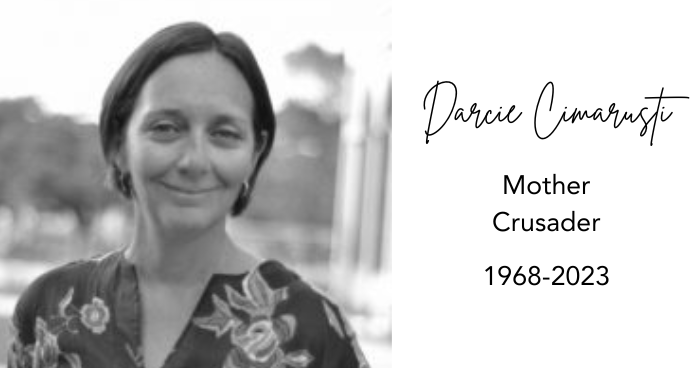
The Network for Public Education has lost a beloved friend and ally. Our communications director, Darcie Cimarusti, lost her valiant battle with ovarian cancer. Everyone who worked with her loved her for her spirit, her dedication, her kindness, and her courage.
NPE Mourns the Loss of Former Communications Director Darcie Cimarusti
Mother Crusader.
That is what Darcie Cimarusti called herself, and it was a title she earned again and again. As a mom, devoted spouse of a teacher, NPE Communications Director, and school board President, Darcie was devoted to public schools.
Darcie began her advocacy work by exposing the fraud and shenanigans of the charter schools that were draining resources from New Jersey public schools. She was delighted when her investigative work led to a story by Mike Winerip in The New York Times. Winerip gave Darcie credit for exposing the machinations and falsehoods put forth by a charter operator in pursuit of a Federal Charter School Program grant. In that article, Winerip characterized applications to the Federal Charter School Programs (CSP) as an invitation to “fiction writing.” Years later, when NPE investigated the CSP program, we came to understand that what Darcie uncovered was not a bug but rather a feature of the CSP.
Last July, even as she was battling ovarian cancer, Darcie did a masterful job of exposing the spread of Hillsdale charter schools in the Answer Sheet of the Washington Post. That important investigation inspired other reporters to take a closer look at the Barney Charter Schools initiative of the small conservative Christian college. She always worked behind the scenes connecting the dots between billionaires, charter schools, and profiteers. Her research was remarkable. As a graphic artist, she created memes, reports, and website designs that brought NPE advocacy messages to life.
On August 3, Darcie peacefully ended her battle with cancer, surrounded by her beautiful daughters, her husband David, her brothers, her father, and her extended family.
NPE President Diane Ravitch worked with Darcie from the beginning days of NPE. “Our dear friend Darcie was a crucial founder of NPE. While she worked hard as a parent and as a member of her local school board, Darcie always made the time to build NPE into a national voice for public schools. As “Mother Crusader,” Darcie spoke out fearlessly for the public schools her twins attended. She was a kind, thoughtful, dedicated, and fearless friend. We will miss her.”
Dear Mother Crusader, we will indeed miss you. We at NPE will ensure that your memory, good work, and legacy live on. Yours was a life well-lived.
The Network for Public Education sent out the following notice to its 350,000 members. Join NPE so you can be on our mailing list (no cost to join). The charter lobby wants your public school.
Dear Diane,In a rare moment of candor, Nina Rees, the President and CEO of the National Alliance for Public Charter Schools, said that her organization’s “personal goal” is to make all public schools “like charter schools” that would be “schools of choice.”
If Ms. Rees and her charter trade organization have their way:
Children would enter a lottery to attend their neighborhood school.
There would be an appointed private board, not an elected school board.
Teacher tenure and bargaining rights in most states would disappear.
The school could shut down based on test scores, enrollment, or even the private board’s whim. 25% of all charters shut down in their first 5 years.
In most states, the school could be managed by a for-profit corporation.
All of the above are the characteristics of charter schools. Every district in the nation would be a New Orleans–where schools open and close, and citizens have no voice in school governance.
That is why NPE fights so hard each year to ensure that the National Alliance does not get the funding increases it lobbies for from the federal Charter School Programs (CSP). We are so pleased to share the good news below.
The Center for Research on Education Outcomes (CREDO) just released another pro-charter school study, “CREDO also acknowledges the Walton Family Foundation and The City Fund for supporting this research.” It is not a study submitted for peer review and is so opaque that real scholars find the methodology and data sets difficult to understand. Carol Burris and her public school defenders at the Network for Public Education (NPE) have provided an in-depth critical review.
With the new CREDO study, Education Week’s Libby Stanford said that “charters have drastically improved, producing better reading and math scores than traditional public schools.’’ Rupert Murdoch’s Wall Street Journal declared charter schools are now “blowing away their traditional school competition.” Burris retorted with “despite the headlines, the only thing ‘blown away’ is the truth.”
Putting a CREDO Thumb on the Scale
CREDO uses massive data sets, unavailable to other researchers, getting minuscule differences which are statistically significant. No one can check their work. They employ a unique and highly discredited statistical approach called “virtual twins” to compare public school with charter school testing outcomes. Instead of reporting the statistical results in standard deviations, CREDO uses their “crazy pants” days of learning scheme.
NPE discovered that the “blowing away” public school results amounted to 0.011 standard deviations in math and 0.028 standard deviations in reading. The minuscule difference is “significant statistically but is meaningless from a practical standpoint” according to CREDO. In a 2009 report showing public schools with a small advantage, CREDO declared, “Differences of the magnitude described here could arise simply from the measurement error in the state achievement tests that make up the growth score, so considerable caution is needed in the use of these results.”To give these almost non-existent differences more relevance, CREDO reports them as “days of learning”instead of standard deviation. “Days of learning” is a method unique to CREDO and generally not accepted by scholars. They claim charter school math students get 6 more “days of learning” and English students, 16 days.
Please open Tom Ultican’s post to see why he considers the CREDO report to be “sloppy science” and “unfounded propaganda.”
It would be easy to assume that charter schools are in the education business, but in fact, many charter school companies appear to be in the real estate business instead.
In its new report, “Chartered for Profit II,” the Network for Public Education lays out the techniques for running a charter for profit, even if it is nominally non-profit, including the use of real estate deals.
One of the most common techniques for running a charter school for profit is to have the non-profit company run by a for-profit charter management organization.
In some states, there is no need to keep those two companies strictly separate. For example, in North Carolina, the non-profit Torchlight Academy was led by principal Cynthia McQueen. The for-profit company hired to run the school was Torchlight Academy Schools, LLC, whose CEO was Don McQueen, Cynthia’s husband. In addition, McQueen’s daughter was hired as special education director, and their son-in-law was awarded the contract for cleaning services for the school.
Those kinds of insider deals can involve real estate as well; the left hand buys a building, and then rents it to the right hand. The NPE report outlines how Glenn Way, a former Utah legislator, set up a charter school empire in Arizona. He and his wife established the American Leadership Academy chain of charter schools. At the same time, Way ran several real estate outfits, including Schoolhouse Development, that built and developed charter school properties. Way, like many other real estate businessmen in the charter school business, was able to use his real estate business to collect rent from his charter school business—all of it paid with taxpayer dollars.
“When Craig Harris of the Arizona Republic asked Way if such profiteering from taxpayer dollars intended for children should be allowed, he responded, ‘It’s [charter schooling] no different than building a Walmart, CVS, or Walgreens.’”
Florida’s Academica is yet another example. The company is owned by real estate developer Fernando Zulueta, who opened his first charter school as part of a housing development he had constructed. He expressed no burning desire to get children a great education; he just figured a school would make the housing development more attractive.
Zulueta and his brother have launched what journalist Jessica Bakeman called “an empire of charter schools.” Their headquarters are the home address of over 100 active corporations linked to various family members. Within this maze of corporations, charter facilities are sold off in ways that allow one arm of the octopus to cash in on the sale while another arm keeps earning management fees for the school.
The Academica chain is rapidly expanding in Nevada and other states.
Please open the link and read the rest of this excellent review of an important study of charter profiteering.


 In a
In a 


