Writing in The Atlantic, Anne Applebaum questions Trump’s ability to think through his decisions. Is he acting on a whim, an impulse? Does he remember today what he said the day before?
She writes:
Donald Trump does not think strategically. Nor does he think historically, geographically, or even rationally. He does not connect actions he takes on one day to events that occur weeks later. He does not think about how his behavior in one place will change the behavior of other people in other places.
He does not consider the wider implications of his decisions. He does not take responsibility when these decisions go wrong. Instead, he acts on whim and impulse, and when he changes his mind—when he feels new whims and new impulses—he simply lies about whatever he said or did before.
For the past 14 months, few foreign leaders have been able to acknowledge that someone without any strategy can actually be president of the United States. Surely, the foreign-policy analysts murmured, Trump thinks beyond the current moment. Surely, foreign statesmen whispered, he adheres to some ideology, some pattern, some plan. Words were thrown around—isolationism, imperialism—in an attempt to place Trump’s actions into a historical context. Solemn articles were written about the supposed significance of Greenland, for example, as if Trump’s interest in the Arctic island were not entirely derived from the fact that it looks very large on a Mercator projection.
This week, something broke. Maybe Trump does not understand the link between the past and the present, but other people do. They can see that, as a result of decisions that Trump made but cannot explain, the Strait of Hormuz is blocked by Iranian mines and drones. They can see oil prices rising around the world and they understand that it is difficult and dangerous for the U.S. Navy to solve this problem. They can also hear the president lashing out, as he has done so many times before, trying to get other people to take responsibility, threatening them if they don’t.
NATO faces a “very bad” future if it doesn’t help clear the strait, Trump told the Financial Times, apparently forgetting that the United States founded the organization and has led it since its creation in 1949. He has also said he is not asking but ordering seven countries to help. He did not specify which ones. “I’m demanding that these countries come in and protect their own territory, because it is their territory,” Trump told reporters aboard Air Force One on the way from Florida to Washington. “It’s the place from which they get their energy.” Actually it isn’t their territory, and it’s his fault that their energy is blocked.
But in Trump’s mind, these threats are justified: He has a problem right now, so he wants other countries to solve it. He doesn’t seem to remember or care what he said to their leaders last month or last year, nor does he know how his previous decisions shaped public opinion in their countries or harmed their interests. But they remember, they care, and they know.
Specifically, they remember that for 14 months, the American president has tariffed them, mocked their security concerns, and repeatedly insulted them. As long ago as January 2020, Trump toldseveral European officials that “if Europe is under attack, we will never come to help you and to support you.” In February 2025, he told Ukrainian President Volodymyr Zelensky that he had no right to expect support either, because “you don’t have any cards.” Trump ridiculed Canada as the “51st state” and referred to both the present and previous Canadian prime ministers as “governor.” He claimed, incorrectly, that allied troops in Afghanistan “stayed a little back, a little off the front lines,” causing huge offense to the families of soldiers who died fighting after NATO invoked Article 5 of the organization’s treaty, on behalf of the United States, the only time it has done so. He called the British “our once-great ally,” after they refused to participate in the initial assault on Iran; when they discussed sending some aircraft carriers to the Persian Gulf conflict earlier this month, he ridiculed the idea on social media: “We don’t need people that join Wars after we’ve already won!”
At times, the ugly talk changed into something worse. Before his second inauguration, Trump began hinting that he wouldn’t rule out using force to annex Greenland, a territory of Denmark, a close NATO ally. At first this seemed like a troll or a joke; by January 2026, his public and private comments persuaded the Danes to prepare for an American invasion. Danish leaders had to think about whether their military would shoot down American planes, kill American soldiers, and be killed by them, an exercise so wrenching that some still haven’t recovered. In Copenhagen a few weeks ago, I was shown a Danish app that tells users which products are American, so that they know not to buy them. At the time it was the most popular app in the country.
The economic damage is no troll either. Over the course of 2025, Trump placed tariffs on Europe, the United Kingdom, Japan, and South Korea, often randomly—or again, whimsically—and with no thought to the impact. He raised tariffs on Switzerland because he didn’t like the Swiss president, then lowered them after a Swiss business delegation brought him presents, including a gold bar and a Rolex watch. He threatened to place 100 percent tariffs on Canada should Canada dare to make a trading agreement with China. Unbothered by possible conflicts of interest, he conducted trade negotiations with Vietnam, even as his son Eric Trump was breaking ground on a $1.5 billion golf-course deal in that country.
Europeans might have tolerated the invective and even the trade damage had it not been for the real threat that Trump now poses to their security. Over the course of 14 months, he has, despite talking of peace, encouraged Russian aggression. He stopped sending military and financial aid to Ukraine, thereby giving Vladimir Putin renewed hope of victory. His envoy, Steve Witkoff, began openly negotiating business deals between the United States and Russia, although the war has not ended and the Russians have never agreed to a cease-fire. Witkoff presents himself to European leaders as a neutral figure, somewhere between NATO and Russia—as if, again, the United States were not the founder and leader of NATO, and as if European security were of no special concern to Americans. Trump himself continues to lash out at Zelensky and to lie about American support for Ukraine, which he repeatedly describes as worth $300 billion or more. The real number is closer to $50 billion, over three years. At current rates, Trump will spend that much in three months in the Middle East, in the course of starting a war rather than trying to stop one.
The result: Canadian Prime Minister Mark Carney has declared that Canada will not participate in the “offensive operations of Israel and the U.S., and it never will.” German Defense Minister Boris Pistorius says, “This is not our war, and we didn’t start it.” The Spanish prime minister refused to let the United States use bases for the beginning of the war. The U.K. and France might send some ships to protect their own bases or allies in the Gulf, but neither will send their soldiers or sailors into offensive operations started without their assent.
This isn’t cowardice. It’s a calculation: If allied leaders thought that their sacrifice might count for something in Washington, they might choose differently. But most of them have stopped trying to find the hidden logic behind Trump’s actions, and they understand that any contribution they make will count for nothing. A few days or weeks later, Trump will not even remember that it happened.
Timothy Snyder, scholar of European history, of tyranny and genocide, warns about the consequences of Trump threatening to wipe Iran and its ancient Persian civilization, off the earth. That’s genocide. Trump is an immoral monster.
“A whole civilization will die tonight, never to be brought back again.”
These are not the words of Hitler, or Stalin, or Mao, or Pol Pot, or Assad, or Putin. These are the words of the president of the United States, today.
Do not be distracted by circumstances. Of course there are emotions, personalities, politics, a war. None of this excuses that sentence. The reason we have a notion of genocide, and a convention on genocide, is to define certain actions as always and definitively wrong.
Are these “only words”? No, they cannot be “only words.” As any historian of mass atrocity knows, there is no such thing as “only words.” The notion of killing a whole civilization, once spoken, remains. It enables others to say similar things, as when another elected representative compared the entire country of Iran to a cancer that had to be removed.
Whatever happens tonight, the president, by saying such things, has already changed the world for the worse, and made acts of mass violence more likely. If we are Americans, he has also changed our country. He has changed us, because he represents us; we voted for him, or we didn’t vote and allowed him to come to power, or we didn’t do enough to stop him. These words are America’s words, until and unless Americans reject them.
Yes, there have been other genocides, and there are other politicians who endorse genocide. That makes the words of the president worse, not better. Yes, the United States has undertaken atrocities before. That makes it all the more important, all the more urgent, that we catch ourselves now. Neither the evil nor the good in our history determines who we are. It is what we do now.
If we do not say something ourselves about this horror, we allow ourselves to be changed.
Around the president there will be people, sadly, who work deliberately to normalize the language of genocide. There will be other politicians who find the right words to reject it. One can hope that there will be politicians who find the courage to remove the man who speaks genocide from office. And these words should lead to resignations by everyone who works closely with the president.
But we cannot count on politicians. This is ultimately up to us, the citizens: for our own sake, for the sake of the future of the country, for the sake of a possibility of new beginnings, we need to say something, to someone else, to ourselves: this is simply wrong.
Whatever happens tonight, or any other night in this war, is now legally defined by the president’s statement. In the practical application of the law of genocide, the Genocide Convention of 1948, the difficulty is usually in proving “the intent to destroy, in whole or in part, a national, ethnical, racial or religious group.” Henceforth the intent is on the record, in the published words of the president of the United States and the commander-in-chief of the armed forces about the death of “a whole civilization.”
We all have good ethical and political reasons to reject the president’s words. But those who serve in government, and in the armed forces, have been placed under the legal shadow of genocide by what Trump wrote. To bomb a bridge or a dam or a power plant or a desalinization facility, very likely a war crime in any event, could very well have a different legal significance, a genocidal one, if it takes place after the expression of genocidal intent by the commander and head of state.
The concept of genocide was created by a survivor and an observer of atrocities, Rafał Lemkin, so that we could see ourselves, judge ourselves, stop ourselves. But genocide is not only a concept. It is also a crime under international law, signed by the United States in 1948 as a convention, ratified by the United States as a treaty in 1988. That makes the words I have quoted here the law of the land.
The president speaks genocide. And so we too must speak. Not only about crimes, but about their legal punishment.
Trump stacked the Commission with lackies, some with no relevant experience.
After Judge Leon’s decision, Trump made clear that he would not be deterred. The ballroom, he insisted, was a matter of national security.
“Unless and until Congress blesses this project through statutory authorization, construction has to stop!” the judge wrote in his ruling, which was punctuated by 19 exclamation points.
The Justice Department has filed a notice of appeal, and Mr. Trump has shown a reluctance to bring the project to Congress, where it would face an uncertain fate.
Instead, he has pointed to a portion of the judge’s ruling that allowed “construction necessary to ensure the safety and security of the White House” to continue.
The president has begun arguing that the project is a matter of national security.
“We have bio defense all over,” Mr. Trump told reporters in the Oval Office this week. “We have secure telecommunications and communications all over. We have bomb shelters that we’re building. We have a hospital and very major medical facilities that we’re building. We have all of these things. So that’s called, I’m allowed to continue building.”
So the ballroom is actually part of the national defense system, and no court judgment will stop it.
I am reposting this commentary because the original post this morning did not include a link to the full post.
Denny Taylor is an accomplished scholar and author. She is Professor Emeritus of Literacy Studies at Hofstra University and has earned a long list of awards. She now has a Substack blog that is worth your time. In this post, she goes into detail about the origins of the “Science of Reading” and the poor quality of research on which it is based.
Taylor wrote this post to caution against a federal mandate based on flawed claims. Congress is currently considering HR 7890 Science of Reading Act of 2026. As she shows, it would be absurd if it passes. Congress should not tell teachers how to teach, nor should state legislatures.
The Science of Reading Act of 2026 – H. R. 7890is a catastrophic mistake for three reasons. First, it makes early 20th century phonics instruction the law of the land. Second, the NRP “5 pillars of reading instruction” are not based on science. Third, H. R. 7890does not prepare children to live and thrive in a digital society that is filled with unforeseen hazards and dangers. We must think anew and act anew – before it’s too late.
H. R. 7890 “Evidence-Based Literacy Instruction Aligned to the Science Of Reading” is Not Based On Science
The six-year qualitative as well as the quantitative forensic analyses provides evidence that the scientific foundation undergirding the teaching of reading in America’s public schools is irreparably flawed. The “evidence-based literacy instruction aligned to the Science of Reading” that is described in the new federal Science of Reading Act – 2026 (H. R. 7890) is a political construct not a scientific one.
Nevertheless, Congress is in the process of making “fidelity” to the “Science of Reading” the law in all 50 states.
H. R. 7890, the Science of Reading Act – 2026 was unanimously approved by the House Education and Work Force Committee on March 17, 2026. It will amend the Elementary and Secondary Education Act of 1965 to prioritize funds to promote the use of H. R. 7890. The legislation also aligns with U.S. Education Secretary Linda McMahon’s priorities for literacy improvement, but the Right-wing ideologs behind H. R. 7890 are far more formidable than McMahon.
H. R. 7890 Eliminates Reading and Writing Activities which Provide Opportunities for Children to Actively Engage with Meaningful Texts
The Science of Reading Act of 2026 will also officially prohibit the use of the “three-cueing” system in literacy instruction in U.S. public schools. My own pedagogical practices always begin with close observation of children who use many cues to read and write when they are not restricted by authoritarian “Science of Reading” laws that have already been enacted in most states.
H. R. 7890 will have the effect of eliminating reading and writing activities which provide opportunities for children to think. In such circumstances their thinking can be divergent and/or convergent, linear or lateral, abstract or concrete. Often it is meta-cognitive as they discuss with their teachers how they arrived at the meaning of a word. Often the clues are phonetic, and the sentence confirms their reasoning. All these pedagogical opportunities for teachers to support the learning of children are not understood by the public or by Congress. If they were, people would rally against passing the Science of Reading Act of 2026, and Congress would not pass H. R. 7890.
The Research Evidence for H. R. 7890 was Established Based on the False Findings of the 2000 National Reading Panel Report
Through dog whistles, lies, and tropes, the Right convinced people in many sectors of U.S. society that the “five pillars” of reading instruction that the NRP presented to Congress provided solid scientific evidence on how children should be taught to read. The publishers of reading programs that now call themselves technology companies, most prominently McGraw-Hill and HMH, marketed the findings of the NRP creating a bonanza in profits so large that Platinum Equity now owns McGraw-Hill and Veritas Capital now owns HMH.
Draw back the curtain and it is possible to document in minute detail how a false narrative about the National Reading Panel came to be accepted as the unquestionable scientific evidence for the massive changes in reading instruction that has taken place in U.S. public schools.
The “five pillars of reading instruction” and the Science of Reading have become embedded in the knowledge base of people in every sector of U.S. society. I asked AI “what are the five pillars of reading instruction?” AI responded:
The 5 pillars of reading instruction—phonemic awareness, phonics, fluency, vocabulary, and comprehension—are essential, evidence-based components for developing proficient readers. Defined by the National Reading Panel, these pillars provide a structured framework for teaching decoding, accuracy, and understanding in reading instruction.
The AI response is an accurate rendition of the official narrative that the nation has been deceived into believing through an Right wing initiatives gaining traction in the 1990s that have gaslighted the public through the use of dog whistles, lies and tropes. One of the think tanks on the Right that has had an unprecedented influence of how children are taught to read in public schools is the Thomas B. Fordham Institute (then the Thomas B. Fordham Foundation) advocated for a shift toward scientifically based reading research and explicit phonics instruction in 2002. The Fordham Institute established the National Council of Teacher Quality (NCTQ) that I have written about in previous Substack posts. NCTQ states that it is a “nonpartisan research and advocacy group.” Nothing could be further than the truth. NCTQ’s evaluations of U.S. teacher preparation programs, are flawed, unscientific, and ideologically driven.
Enforced by State Laws, the Five Pillars have Become the Structural Framework of Reading Instruction in Public Schools Across America
Once the Science of Reading Act of 2026 is signed into federal law one of the education goals of the Heritage Foundation will have been achieved. It is relevant that Mike Pence has been accused of “abandoning its principles” and transforming the Heritage Foundation from a traditional conservative organization into an enforcer for “big-government populism” and “America First” extremism. The forensic analysis has documented the initiative undertaken by the Right to control reading instruction in U.S. public schools, especially how Lindsey Burke has led the Right’s initiative to “reshape” public education. Burke spent 17 years at the Heritage Foundation where she was a principal author of the Education Section of Project 2025. She transitioned to the Department of Education where she serves as McMahon’s Deputy Chief of Staff for Policy and Programs. Burke is attributed by leaders on the Right with “reshaping” – her word — reading instruction in public schools. Parenthetically, Burke is also associated with the Thomas B. Fordham Institute and NCTQ. She is featured on the Fordham Institute website in a podcast entitled, “Trump’s education agenda, with Lindsey Burke” (January 31, 2024). NCTQ is the focus of the October 19, 2025, Substack post entitled, “NCTQ Pressures State Governments, Rejects Teacher Preparation Programs, Dictates To School Districts, Discredits Reading Researchers, Bans Their Books, And Vilifies Teachers.“
Federal Judge Richard Leon issued a decision stopping work on Trump’s Hideous Grand Obsession: the ballroom that will replace the East Wing of the White House. Trump demolished the East Wing without going through the legal requirements and permissions.
Judge Leon, appointed by President George W. Bush, opened his decision with two sentences:
The President of the United States is the steward of the White House for future generations of First Families. He is not, however, the owner!
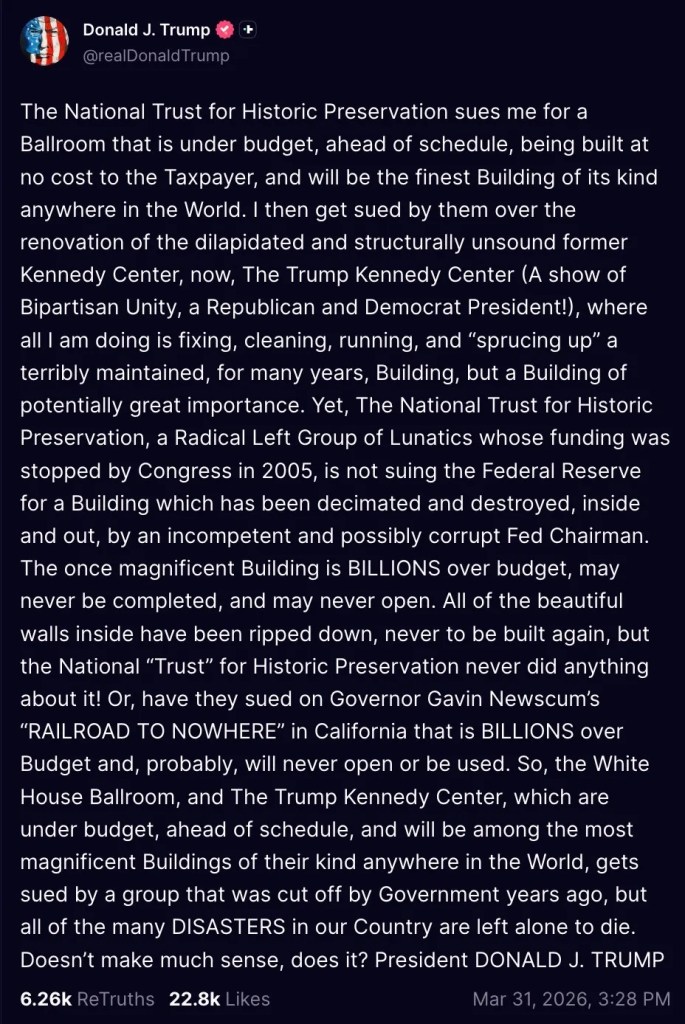
Trump responded with this cry of outrage:
Trump is determined to leave his garish mark on D.C.
Not only did he tear down the East Wing of the White House, but he plans other major alterations to the White House and the city.
Of course, he added his name to the Kennedy Center, which was dedicated by Congress as a memorial to the assassinated President. After Trump took control of the Center, artists began canceling their performances and ticket sales fell. To cover his embarrassment, he is closing the Center for two years while “renovating” it. Critics fear that it will emerge as a gold-encrusted monument to Trump.
The New York Times reported that Trump is fixated on making changes to the White House:
He plans to turn the historic Treaty Room into a guest bedroom. Really! He has zero respect for history, and he thinks the White House is his personal property.
Mr. Trump already has torn down the East Wing to make room for his $400 million, 90,000-square-foot ballroom; he remade the bathroom attached to the Lincoln Bedroom in marble and gold; he paved over the Rose Garden grass; he added marble floors and a chandelier to the Palm Room; he covered the Oval Office in gold; and he has a new, 33,000-square-foot security screening center for White House visitors in the works.
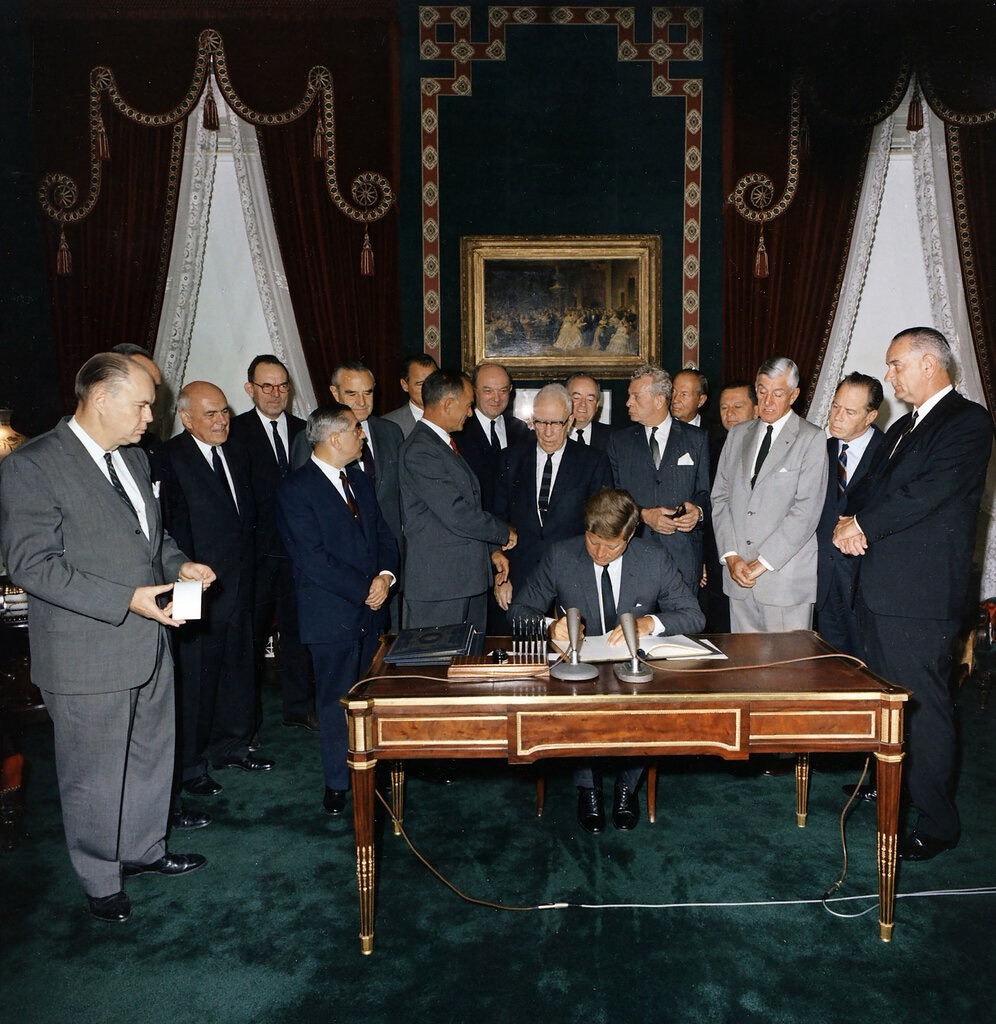
His latest plans involve the more private spaces of the White House, in the second-floor presidential residence. The Treaty Room — which is separate from the Indian Treaty Room in the Eisenhower Executive Office Building — is one of the most historic rooms in the White House. Presidents Ulysses S. Grant and William McKinley used it as a Cabinet room, and it was where the Spanish-American War peace protocol of 1898, and the nuclear test ban treaty of 1963, were signed.
This is a photograph of President John F. Kennedy signing the Nuclear Test-Ban Treaty in the Treaty Room.
Trump wants to turn this historic room into a guest bedroom.
Trump’s egomania doesn’t stop there. It’s boundless. The U.S. Treasury will mint a $1 coin with his face on it to honor the 250th anniversary of the United States. It will also release a large gold coin with his image that will cost thousands of dollars. And in an unprecedented move, the U.S. Treasury will add Trump’s signature to paper currency. No other President has placed his signature on the nation’s currency. Presently, our paper currency has the signatures of the Secretary of the United States and the Treasurer of the United States. Not the President.
Trump wants to build a gigantic arch on the Virginia side of the D.C.-Virginia border. It will be the Arch of Independence, but is colloquially called the “Arc d’Trump.” It will tower over the nearby Lincoln Memorial. Some renderings show the arch slathered in gold, Trump’s favorite decoration.
The most devastating critique of Trump’s efforts to reshape the District of Columbia and the White House was written by Phillip Kennicott, the Pulitzer-Prize winning critic of art and architecture for The Washington Post. It was published before Judge Leon stopped work on the ballroom. Trump, Kennicott says, is the greatest threat to D.C. and the White House since 1812, when the British burned the Capitol and the White House to the ground.
He wrote:
A loosely circular driveway sweeps through the White House grounds, just below the beloved South Portico of the mansion. Its shape echoes a larger park, known as the Ellipse, which connects the president’s home to the National Mall. It also mirrors the curving pathways of nearby Lafayette Square, on the north side of the complex.
The simple symmetry of this modest roadway and the grace of the White House south grounds are no accident: They were the vision of the great landscape architect Frederick Law Olmsted, Jr., one of the original members of the Senate Park Commission, which created the monumental core of Washington as we know it, more than a century ago.
The geometry of this driveway — a small but resonant element of Olmsted’s master plan for the White House campus — will soon be erased, now that a federal judge has allowed President Donald Trump to proceed at least temporarily with construction of his 90,000-square-foot, $400 million ballroom. The ballroom, which will be larger than the original mansion, is so gargantuan that the original curving road simply won’t fit. To make room for Trump’s entertaining and fundraising space, a large notch will be clawed out of the driveway, according to drawings released by Shalom Baranes Associates, the D.C.-based architecture firm overseeing one of the most unpopular projects of the president’s second term.
Washington has a composed geometry built up from significant details like this elliptical drive. As with the diagonal avenues that connect symbolically important circles, squares and civic landmarks, the Platonic perfection of this shape is best appreciated from the air. But it is a vital reminder of the care taken, over the past 200 years, in the design of the capital city, and the deference paid to a set of aesthetic and cultural values that came out of the Enlightenment, including a love of symmetry, repetition, iterative patterns and a fine balance between grandeur and grandiosity.
Trump is the most significant threat to the city’s architectural and design legacy since British forces burned the Capitol and White House during the War of 1812. He has already demolished the East Wing of the White House, which dates to the administration of Franklin D. Roosevelt. He will replace it with a building that makes James Hoban’s neo-Classical executive mansion a mere appendage to a space meant to function like a hotel-convention-center-entertainment venue. He has proposed (but temporarily delayed) painting the next-door Eisenhower Executive Office Building a blinding shade of white, which preservation groups argue could irreversibly damage the stone facade.
He wants to build a 250-foot-tall memorial arch near the most hallowed ground in the country, Arlington National Cemetery. His “Independence Arch,” which he has said will honor himself personally, would dwarf the largest victory arches in the world, including the arch in Pyongyang, built in 1982 to honor North Korea’s murderous dictator, Kim Il Sung. Only Eero Saarinen’s slender ribbon of steel, the Gateway Arch in St. Louis, would be taller. Although it would be built in a traffic circle on the Virginia side of the Potomac, the Trump arch would compete with some of the tallest buildings in Washington, including the Washington Monument and Washington National Cathedral, fundamentally altering a meticulously preserved skyline.
The president’s proposed “National Garden of American Heroes” would introduce a forest of quickly designed statues to the banks of the Potomac almost opposite the new triumphal arch. A sylvan space defined by monumental memorials to Roosevelt, Martin Luther King, Jr. and Thomas Jefferson would be cluttered, wax museum-style, with hundreds of stubby tributes to showbiz stars, folk heroes and sports celebrities.
These proposals, the rush to realize them, the stacking of key oversight groups with Trump loyalists and flunkies and the collaboration of firms like Shalom Baranes Associates, have upended and effectively destroyed the process of design review — which has until now preserved Washington as a monumental, picturesque capital.
They would also manifest in stone, cement and steel a vision of the city fundamentally at odds with the democratic ideals of the city’s founders, the stewards of its expansion in the 19th and 20th centuries, and the vigilance of its latter-day defenders against shabby development, cheapness and commercialization.
In 1806, Benjamin Latrobe, perhaps the first great architect in America, sent a letter to Congress, defending his work on the U.S. Capitol, which was then under construction. Latrobe, who also contributed to the interiors of Hoban’s White House, was a proud and difficult man, and his letter to Congress, which exercises authority over the design of the nascent city — a duty it is now shirking — was prickly and defensive. But in it, he articulated foundational principles for the aesthetics and architecture of the new republic, which recognized no kings, and no absolute authority beyond the laws and the Constitution. “Nothing appears so clear,” he wrote, “as that a graceful and refined simplicity is the highest achievement of taste and art.” American buildings should be “chaste and simple,” and to ornament them just for the sake of surface attraction was folly.
“We find ornaments increase in proportion as art declines, or as ignorance abounds,” he maintained.
This was the common language of American architecture at the time — stately, chaste, simple, dignified — and it echoed ideas from a half-century earlier, as capitalism and representational government were together forging a new, bourgeois worldview. In Adam Smith’s 1759 “Theory of Moral Sentiments,” the Scottish philosopher and economist sometimes called the Father of Capitalism wrote that two new aesthetics were in competition as the world industrialized and broke down the old, feudal orders.
One was based on greed, power and avidity; the other on equity, justice and humility. These values would express themselves in our political systems, our economies, our ethics, our art and our architecture.
“Two different models, two different pictures, are held out to us, according to which we may fashion our own character and behaviour,” he wrote. “The one more gaudy and glittering in its colouring; the other more correct and more exquisitely beautiful in its outline; the one forcing itself upon the notice of every wandering eye; the other, attracting the attention of scarce anybody but the most studious and careful observer.”
The elliptical drive at the White House, about to be disappeared by a gaudy new ballroom, was the exact sort of subtle detail that delighted the designers of early Washington, a pattern hidden in plain sight that would attract the attention of only “the most studious and careful observer.”
The ballroom itself, which Trump has promoted as spectacular and ornate, exemplifies the aesthetic — and moral value system — that Smith found both dangerous and abhorrent. How did we get here? How have we strayed or been misled so far from the values, ideals and aesthetics that gave Washington its current form?
Trump doesn’t have a coherent or consistent aesthetic ideal. Rather, the veteran real estate developer has reflexive responses and aesthetic tics when it comes to design — and for a president, an unprecedented willingness to assert them. Three of these habits are easy to see in his plans for Washington, mirroring his style of politics and his use of rhetoric and language. He has a primitive attraction to the big, the grand, the colossal. When he speaks, he uses superlatives reflexively, and he brings the same sensibility to architecture. And just as nature abhors a vacuum, Trump abhors anything he sees as empty. There is no value in silence, no beauty in open, uncluttered spaces. Everything must be filled, branded, made busy. Finally, he has no sense of context or formal relationships, no understanding of the hierarchies of how buildings (and institutions) relate to each other, to history, to formal plans.
The design of beautiful cities, and the design of effective governments, are predicated on “gentleman’s agreements,” voluntary deference to precedents and conventions. Trump respects none of this.
But there is a fourth deficiency in his understanding of architecture and design, which arises from and amplifies his other three failures of taste and judgment: He appears utterly uninterested in basic American values, history and symbols, and so there are no guardrails, no limits, to the damage done by his other failings.
Trump’s single-minded and unwavering preference for the biggest, his equating of size with significance, has become so familiar we have started to overlook it. But the architectural consequences for Washington will be devastating. When Stanford White — whose architecture firm McKim, Mead & White designed several branches of New York’s Public Library and the original Pennsylvania Station — drafted a memorial arch, he included in an 1892 rendering the figure of a man holding a measuring stick to offer a sense of its size. The arch, built in Manhattan’s Washington Square Park to honor the nation’s first president, rose to 77 feet, a bit taller than the ancient Roman Arch of Titus on which it was loosely modeled. But while grand and imposing, it still had a relationship to human scale.
Trump’s arch will dwarf this, and all other ancient precedents. Only the monuments erected by modern governments that rule by terror and dehumanization offer any comparable examples. And it is larger than many of those, too, dwarfing the Victory Arch in the North Korean capital of Pyongyang.
It will also fundamentally alter one of the essential elements of what is known as the McMillan Plan, the Senate Park Commission’s 1902 redesign of the capital city which created the National Mall and the monumental core of Washington. The McMillan Plan forged a grand, axial vision of national healing and reconciliation that symbolically reconnected the North and the South by a bridge across the Potomac, joining a city of the dead at Arlington Cemetery to the city of the living, with the Lincoln Memorial as a hinge point. Long vistas and clear views drew the eye from the memorial to the military architect of Civil War victory, Ulysses S. Grant, at the base of the U.S. Capitol, to the temple devoted to the political architect of reunification, Lincoln, more than two miles away. The men and women who sacrificed their lives for reunification were honored by the Arlington Memorial Bridge leading to the cemetery and low-lying hills of Virginia just beyond.
That open view across the Potomac River to the hallowed burial ground was essential. A winning design in an early competition for a bridge at that crossing included two massive arches over its central piers — small compared to Trump’s arch, but large enough to impede views. The leaders of the McMillan Plan not only rejected these arches, they took particular care to keep sight lines open and the design of the shallow, low-slung bridge (by McKim, Mead & White) simple and elegant. They also stripped away a complex plan for some 40 decorative sculptures. The closer they got to the final resting place of Civil War soldiers, the more the planners insisted on dignity, sobriety and simplicity.
All of Trump’s proposed designs for a victory arch that he has shared on social media would block that carefully preserved view. One would also be laden with gilded statues, eagles and other glittering ornamental forms.
To understand the true scale of Trump’s ballroom, you have to get beyond the mere size of its floor plan — at 90,000 square feet, almost twice as large as the original structure’s 55,000 square feet. Rather, you need to take into account the context of the White House grounds and the surrounding federal buildings. The scale of the addition will destroy any sense of symmetry between the East and West wings and reorient the White House campus to the east, where it faces the massive Treasury Department building, a dispiriting, fortresslike phalanx of Ionic columns that natter on like someone discoursing on the infallible wisdom of free markets. Renderings of the new structure make it look like the old White House mated with Treasury, spawning a grotesque creature that has traded the livability of a domestic space for the untrammeled power of a banking colossus.
Trump’s gilded arch, ballroom and his redesign of the Oval Office with incrustations of historically anachronistic gold ornament, introduce a fussiness and busyness into a Washington aesthetic that has generally favored the chaste and simple, at least when it comes to the profile of classical buildings. His hanging of banners — in many cases featuring gigantic portraits of himself — as well as projecting images onto the blank face of the city’s most sublime and minimalist structure, the Washington Monument, suggest a need to fill in blank space, animating planes that are meant to be spare and quiet. The ballroom isn’t simply too big, it is also too busy.
Like the news cycle, architectural and urban spaces are treated as mere voids, waiting to be filled with Trumpian noise. Once filled, he owns them, at least in his own mind. Once owned, they can be monetized, and it’s likely only a matter of time until advertising is projected onto the Washington Monument and other structures.
All of this has consequences on a deeper, symbolic level. The ballroom reorients the White House to suggest that it is fundamentally responsive to economic rather than civic power, confirming visually what is too often the case politically: The executive serves the financial class first and foremost. The triumphal arch will be placed on the Virginia side of the Potomac River, effectively crowning the South as the victor in the Civil War. That too reaffirms in visual terms what is too often the case in civic life: That the values of the Confederacy, including its deeply entrenched racism and violence, remain extraordinarily powerful in American culture.
The gilding of the arch echoes the tinsel applied to American history through entrenched mythologies like the Lost Cause.
There is no final price tag on all of this, beyond a few figures floated by the president, who has said that his $400 million ballroom will be financed privately — by billionaire donors and corporations maintaining contracts with the federal government in the hundreds of billions of dollars. Some of the funding for the National Garden of American Heroes will come from siphoning money out of the National Endowments for the Arts and Humanities. We may never know how much it all costs, or who curried favor by paying for it, or what conflict-of-interest lines were crossed.
But the larger, less tangible costs can be roughly tabulated. The Commission of Fine Arts, which was created in 1910 to oversee the design of the city and execute and protect the vision of the McMillan Plan, is now a toothless organization stacked with loyalists including some with no expertise in design or architecture — among them a 26-year-old White House aide who has served as the president’s executive assistant.
Design review is dead, and with it the values of simplicity, chastity and modesty celebrated by Latrobe and Smith. Washington is now subject to design by fiat, by whim, by executive orders, whether legal or not. Trump is moving quickly to introduce noise, disorder and incoherence into the design of the capital city. It will be a lot less beautiful. And people who live here and those who visit may not know why, but they will sense that disorder and incoherence and tune it out, like just more noise.
Given the fact that about half the states have now mandated that teachers teach “the science of reading,” it seems to be a good time to repost what I wrote on November 1, 2023.
Some things never change.
I wrote:
One of my grandsons sent me an article about the national rush to mandate “the science of reading,” and it caused me to explain briefly (without boring him) the background of the latest panacea.
I didn’t tell him the history of the “reading wars,” which I researched and wrote about in Left Back (2000). I didn’t tell him that reading instruction has swung back and forth between the phonetic method and the “whole word” method since the introduction of public schooling in the first quarter of the 19th century. Horace Mann opposed phonics. But the popular McGuffey readers of that century were phonetic and included examples of good literature.
In 1930, the Dick-and-Jane readers were introduced, and they swept the country. Unlike the McGuffey readers, they featured pictures of children (white and suburban), they used simple words that could be easily recognized, and they were bright and colorful. By the 1950s, Dick and Jane style readers were used in about 80% of American schools. They relied on the whole word method, also known as look-say.
In 1955, this national consensus was disrupted by the publication of Rudolf Flesch’s wildly popular book, Why Johnny Can’t Read, which castigated the look-say method and urged a revival of phonics. The fervor for phonics then is similar to the fervor now.
But the debate about which method was best quickly became politicized. “Bring back phonics” was the battle cry of very conservative groups, who lambasted the whole-word method as the conspiratorial work of liberal elites. Phonics thus was unfairly tarnished as a rightwing cause.
The definitive book about the teaching of reading was written in 1967 by Harvard literacy expert Jeanne Chall: Learning to Read: The Great Debate. Chall wrote about the importance of phonics as part of beginning reading instruction, followed up by wonderful children’s literature. She warned against going to extremes, a warning that has been ignored with every pendulum swing.
The 1980s began the dominance of whole language, which brought back whole-word sight reading and de-emphasized phonics. Textbook companies boasted that their programs were whole language. Literacy conferences were focused on whole language. Phonics was out. Many reading teachers held on their phonics books, even though phonics was out of style.
There is always a crisis in reading, so in the late 1990s, the pendulum began to move again. As it happened, a very influential supporter of phonics held a key position at the National Institutes of Health. Dr. Reid Lyon was director of the NIH’s National Institute of Child Health and Development. His field of expertise was learning disabilities.
From Wikipedia:
From 1992 to 2005, Lyon served as a research neuropsychologist and the chief of the Child Development and Behavior Branch of the NICHD at the National Institutes of Health; in this role he developed and oversaw research programs in cognitive neuroscience, learning and reading development and disorders, behavioral pediatrics, cognitive and affective development, School Readiness, and the Spanish to English Reading Research program. He designed, developed and directed the 44-site NICHD Reading Research Network.
Lyon selected the members of the National Reading Panel. Like him, most were experimental researchers in higher education. Only one—Joanne Yatvin— was experienced as an elementary school teacher and principal. She wrote a “minority view” dissenting from the report, and she worried that the report would be misused.
President George W. Bush signed No Child Left Behind into law on January 8, 2002. This law was the single largest intrusion of the federal government into education in American history. Before NCLB, education was a state responsibility. Since passage of NCLB, the federal government established mandates that schools had to obey.
One of the components of this law was the Reading First program. RF was based on the report of the National Reading Panel, which emphasized the importance of phonemic awareness, phonics, decoding, and fluency.
The Reading First program allocated $6 billion over six years to encourage districts to adopt the “science of reading,” as established by the National Reading panel.
There were two reasons that the program ended.
First, there were financial scandals. Google “Reading First Program Scandals”). The New York Times reported here about conflicts of interest and steering of contracts to favored textbook publishers. “In a searing report that concludes the first in a series of investigations into complaints of political favoritism in the reading initiative, known as Reading First, the report said officials improperly selected the members of review panels that awarded large grants to states, often failing to detect conflicts of interest. The money was used to buy reading textbooks and curriculum for public schools nationwide.”
Second, the final evaluation of the program found that it taught what it aimed to teach but there was no improvement in students’ comprehension.
Here is the summary of the final evaluation:
The findings presented in this report are generally consistent with findings presented in the study’s Interim Report, which found statistically significant impacts on instructional time spent on the five essential components of reading instruction promoted by the program (phonemic awareness, phonics, vocabulary, fluency, and comprehension) in grades one and two, and which found no statistically significant impact on reading comprehension as measured by the SAT 10. In addition to data on the instructional and student achievement outcomes reported in the Interim Report, the final report also presents findings based upon information obtained during the study’s third year of data collection: data from a measure of first grade students’ decoding skill, and data from self-reported surveys of educational personnel in study schools.
Analyses of the impact of Reading First on aspects of program implementation, as reported by teachers and reading coaches, revealed that the program had statistically significant impacts on several domains. The information obtained from the Test of Silent Word Reading Fluency indicates that Reading First had a positive and statistically significant impact on first grade students’ decoding skill.
The final report also explored a number of hypotheses to explain the pattern of observed impacts. Analyses that explored the association between the length of implementation of Reading First in the study schools and reading comprehension scores, as well as between the number of years students had been exposed to Reading First instruction and reading comprehension scores were inconclusive. No statistically significant variation across sites in the pattern of impacts was found. Correlational analyses suggest that there is a positive association between time spent on the five essential components of reading instruction promoted by the program and reading comprehension measured by the SAT 10, but these findings appear to be sensitive to model specification and the sample used to estimate the relationship.
The study finds, on average, that after several years of funding the Reading First program, it has a consistent positive effect on reading instruction yet no statistically significant impact on student reading comprehension. Findings based on exploratory analyses do not provide consistent or systematic insight into the pattern of observed impacts.
After the disgrace of the Reading First program, support for phonics dissipated. But in the past few years, journalists (led by Emily Hanford) have trumpeted the idea that the report of the National Reading Panel established the “science of reading.” New York Times columnist Nicholas Kristof wrote about the “Mississippi Miracle,“ claiming that the “science of reading” had lifted fourth grade reading scores, and no new spending was needed in a very poorly resourced state. Kristof did not explain why the SOR did not cause a rise in eighth grade scores in Mississippi, nor did he understand that retaining low-scoring third graders raises the percentage of fourth graders who get high test scores. State after state is now mandating the “science of reading.”
Donald Trump’s serial depredations and violations of the law and Constitution inspired a retired educator to write a new Declaration of Indepence, tailored to a new age.
Whereas the people of these United States of America have given their lives in defense of our country, let not the federal usurper attempt to crown himself king and return to the time of George III.
Our populace will rise up and demand a return to the rule of law and civil discourse on issues confronting us. Have no kingly proclamations discourage us from following the traditions and norms of our 249 years. We do not live in the time of the divine right of kings. Our government derives from the will of the people and our rights cannot be dissolved by a false monarch. The strength of our democracy always lies with the hopes of our populace.
In all of our country’s existence we have never faced such an evil. We are not accustomed to a fraud who would besmirch our constitution and attempt to rule with his own pronouncements. He has divided us into many differing camps and beliefs with his lies that he will continue to separate us.
His claims that we are being invaded by groups of nefarious cutthroats that are bent on taking over our country are untrue. He will then be able to declare martial law and use all of the levers of government to suppress all protest activities. Now is the time for all good men and women to come to the aid of their country.
He has not complied with the laws and disregards our judiciary.
He has enriched himself by accepting emoluments from foreign countries, princes and oligarchs.
He has deliberately favored states that voted for him and disavowed those who did not.
He has supported taxes that would enrich the wealthy and deprive the poor.
He has endeavored to make judges bend to his will.
He has plundered our economy and dissolved our relationship with our allies.
He has abducted our people in public places- schools, places of worship, and public buildings.
He has threatened our institutions of higher learning if they did not bend to his will.
He has erected a multitude of new offices in the federal government to dispose of thousands of dedicated public servants.
He has restricted the entry into our country of the brightest young people in the world.
He has aligned himself with our enemies and supports their tyranny.
He has installed a health secretary who is destroying our health system and our capability to do health research.
He has encouraged and pardoned 1500 people who tried to overthrow our government.
His sycophants mock our populace and threaten to jail them if they are not compliant with his wishes.
He is, at this time, transporting armies of masked hoodlums to complete the works of death, desolation and tyranny, already begun with circumstances of cruelty, perfidy, scarcely paralleled in the most barbarous ages, and totally unworthy as the head of a civilized nation.
At every stage of these oppressions, we have petitioned for redress of these grievances. We have asked in a most civilized manner. Our petitions have been answered in only the most desultory and vengeful actions. A president whose character is marked by every act which may define a tyrant is not fit to be the leader of our country.
We have been warning our legislative representatives of the danger of these usurpations. They are fearful of his retributions both political and personal. We have entered the justice system in the highest court of the land to create estoppel. Their decisions do not seem to impede the leader’s desire to remake our democracy into an autocracy. The monied interests have formed a choral group for the president. Their support and their largesse have given him impetus to continue his cruelty. No inhabitants of our land are safe from his reach. Children of any age have felt his sting and have been spirited away.
We, therefore, the people of the United States of America, in Assembly, appealing to the Supreme Judge of the world, and the populace, solemnly publish and declare, that these United States of America are and have a right that our allegiance to the current regime will be absolved if the governing bodies of our federal legislature refuse to restrain the president from his policy of revenge and destruction of our country. And for the support of this Declaration, with a firm reliance on the protection of divine providence, we mutually pledge to each other our lives, our fortunes and our sacred honor.
Attest.
Signed by Order and in behalf of the American People
An article by Patrick Wintour in The Guardian describes Iranian responses to Trump’s threat to bomb Iran’s power grid unless Iran opens the Strait of Hormuz.
This comment stood out:
One well-known Iranian reformist writer Ahmad Zeidabadi likened what could lie ahead to the post-apocalyptic novel Blindness by José Saramago in which the whole world gradually becomes blind. The normally constrained Zeidabadi described Trump’s attack as “the greatest threat posed against our country or any other country in the world throughout history”.
He said: “If electricity to 90 million people were to stop, homes and streets would be plunged into darkness, the elderly and the disabled would be trapped in residential towers and water, gas, gasoline and diesel would become scarce, followed soon by no food, no hygiene and no transportation.
He went on: “If the people of America or other countries do not stop this savage being, the Middle East will instantly become an unimaginable hell and then a barren and uninhabitable land.” He described Trump as a mad individual who was nonetheless “the main decision-maker of the world’s greatest military power”. The sense that the US is in the grip of a deranged figure is quite common among Iranians.
I was delighted to see that the very popular Heather Cox Richardson invited Josh Cowen to talk about the ominous spread of vouchers. HCR made clear that public schools are an essential element in building a society that is educated to sustain democracy.
The voucher movenent, on the other side, has turned into a means of building a society that sustains the white Christian nationalism of its funders.
It’s a valuable discussion, and I hope you will watch and listen.
When I wrote a history of public schools in the 20th century (Left Back: A Century of Failed School Reforms), I couldn’t help but notice a consistent pattern: an infatuation with fads and panaceas, not by teachers but by pundits and education professors.
Teachers struggled with large class sizes, obsolete textbooks, and low pay, but the buzz was all too often focused on the latest magical reform. At one extreme was militaristic discipline, at the other was the romantic idea of letting children learn when they wanted and whatever they wanted to. Phonics or whole language? Interest or effort?
Every reform had some truth in it, but the extremes must have been very frustrating to teachers. There is no single method that’s just right for every child all the time.
The latest fad is Ed-tech, the belief that children will learn more and more efficiently if they spend a large part of their time on a computer.
My views were influenced by something I read in 1984. The cover story of Forbes was about “The Coming Revolution in Education.” The stories in the issue was about the promise of technology. Curiously, the magazine’s technology editor wrote a dissent. In 1984 Forbes published an article about the promise of computers in the schools. He wrote: “The computer is a tool, like a hammer or a wrench, not a philosophers’ stone. What kind of transformation will computers generate in kids? Just as likely as producing far more intelligent kids is the possibility that you will create a group of kids fixated on screens — television, videogame or computer.” He predicted that “in the end it is the poor who will be chained to the computer; the rich will get teachers.”
For the past few decades, Ed-tech has been the miracle elixir that will solve all problems..
But now, writes Jennifer Berkshire, there is a backlash against Ed-tech among parents and teachers.
They may have realized that the most fervent promoters of Ed-tech are vendors of Ed-tech products.
Stories about parents rebelling against big tech are everywhere right now. They’re sick of the screens, the hoovering up of their children’s data, and they view AI and its rapid incursion into schools as a menace, not a ‘co-pilot’ for their kids’ education. This is a positive development, in my humble opinion, especially since the backlash against the tech takeover of schools crosses partisan lines. Meanwhile, pundits and hot takers are weighing in, declaring the era of edtech, not just a failure, but the cause of our failing schools.
Which raises a not insignificant question. Now that everyone who is anyone agrees that handing schools over to Silicon Valley was big and costly mistake, how did the nation’s teachers and students end up on the receiving end of this experiment in the first place? And here is where our story grows murky, dear reader. In fact, if you’re old enough to remember the absolute mania around ‘personalized learning’ that took hold during the Obama era, count yourself as fortunate. Because lots of the same influential, not to mention handsomely compensated, folks who were churning out ‘reports’about our factory-era schools 15 minutes ago, suddenly seemed cursed by failing memories.
The not-so-wayback-machine
If you need a refresher to summon forth the 2010-era ed tech frenzy, proceed directly to Audrey Watters’ unforgettable write-up: “The 100 Worst Ed-Tech Debacles of the Decade.” Watters’ has moved on to a new newsletter and AI refusal, but her once lonely voice as the ‘Cassandra’ of education technology remains as essential as ever. Her tally of “ed-tech failures and fuck-ups and flawed ideas” is studded with now tarnished silver bullets that promised to transform our factory-era schools into futuristic tech centers, making a pretty penny in the process: AltSchool, inBloom, Rocketship, Amplify, DreamBox, Summit… The names have changed or been forgotten but the throughline—a fundamental misunderstanding of schools and teaching combined with the promise of hefty returns—remains constant.
My own introduction to the ed tech hustle came back in 2015. Jeb Bush’s annual convening for his group, the Foundation for Excellence in Education, or FEE, to use its comically apt acronym, came to Boston. To which I said, ‘sign me up!’ Always an early adapter (see, for example, school vouchers in Florida), FEE was unabashedly pro technology, as I wrote in a story for the Baffler.
It’s one of FEE’s articles of faith that the solutions to our great educational dilemmas are a mere click away—if, that is, the schools and the self-interested dullards who run them would just accept the limitless possibilities of technology. Of course, these gadgets don’t come cheap. And this means that, like virtually all the other innovations touted by our postideological savants of education reform, the vision of a tech-empowered American student body calls for driving down our spending on teaching (labor costs account for the lion’s share of the $600 billion spent on public education in the United States each year) and pumping up our spending on gizmos.
In virtually every session I attended, someone would relate a story about a device that was working education miracles, followed by a familiar lament: if only the teachers, or their unions, or the education ‘blob’ would get out of the way.
False profits
In a recent piece for Fortune, reporter Sasha Rogelberg offers an interesting origin story for the tech takeover of public education. And you don’t need to read past the title to get where she’s going: ‘American schools weren’t broken until Silicon Valley used a lie to convince them they were—now reading and math scores are plummeting.’ I’d make the header even clunkier and add ‘the education reform industry’ to the mix. While the push to get tech into classrooms predates Obama-era education reform (check out Watters’ fantastic history of personalized learning, Teaching Machines, for the extended play version), it was the reformers’ zeal, when married to Silicon Valley’s profit optimization, would prove so irresistible.
In the last hundred years, the base of the United States economy has shifted from industry to knowledge—but the average American classroom operates in much the same way it always has: one teacher, up to thirty same-age students, four walls. This report from StudentsFirst argues that this one-size-fits-all approach doesn’t cut it in the modern world, in which mastery of higher-order knowledge and skills ought to matter more than time spent in front of a teacher—and that what we need is competency-based education. This approach, also known as the “personalized model,” is characterized by advancing students through school based on what they know and can do, using assessments to give them timely, differentiated support, made easier by the introduction of learning technology.
StudentsFirst, the hard-charging school reform org started by Michelle Rhee, has since been eaten by 50CAN, which now advocates for school vouchers, but the fare they offered up was standard. Indeed, here’s a fun activity for you. Revisit any prominent reform group, individual, or cause and you will find the same argument about our factory-era schools, followed, inevitably, by the same sales pitch for a tech-centric solution.
Race to the Top, Obama’s signature education reform initiative, didn’t just bribe cash-strapped states to overhaul their teacher evaluation systems. It also ‘encouraged’ states to shift their standardized tests online. And Arne Duncan and Obama’s Department of Education actively courted the tech industry, encouraging them to think of schools as a space ripe for disruption. “Many of today’s young people will be working at jobs that don’t currently exist,” warned the XQ Institute, the reform org started by Steve Jobs’ widow, Laurene Powell Jobs. Today Powell Jobs presides over the Atlantic, where new panic pieces regarding young, tech addled dumb dumbs appear seemingly every day.
Warning signs
My obsessive interest in the intersection of education and politics began back in 2012, when my adopted home state of Massachusetts came down with a serious—and well-funded—case of education reform fever. At a time when red states were crushing the collective bargaining rights of teachers (Wisconsin, anyone?), I was struck by how often reform-minded Democrats ended up repurposing the right’s anti-union, anti-teacher, anti-public-school rhetoric for their own righteous cause. Ed tech sat right smack in the center of this queasy juncture—beloved by liberal reformers, ensorcelled by press releases promising higher test scores, and conservatives who liked the idea of spending less on schools by replacing teachers with machines.
Recall, if you will, Rocketship charter schools, whose innovative blended learning model caused the test scores of its students—almost all poor and minority—to go up like a rocket. Richard Whitmire’s fawning 2013 book, On the Rocketship: How Top Charter Schools Are Pushing the Envelope, is a veritable time capsule of the era. Unlike the fusty Model-T schools of yore, Rocketship schools were tech forward. Students spent a chunk of each day in so-called Learning Labs, taking, retaking or practicing taking tests, a practice that had a measurable impact, especially since 50 percent of teachers’ pay was tied to test scores ascending. All that clicking also translated into dollar signs, wrote Whitmire. “A major cost-saving solution was for students to spend significant time working on laptops in large groups supervised by noncertified, lower-paid “instructional lab specialists.”
Rocketship has since fallen back to earth, in part because of stellar reporting like this from Anya Kamenetz, documenting the chain’s less savory practices. But it’s hard to overstate just how excited the reform world was about this stuff. Next time you hear an edu-pundit bemoaning the take over of kindergarten classrooms by big tech, remember that Rocketship got there first. “[K]indergarten teachers are spending less time making letter sounds,” co-founder Preston Smith told Kamenetz. And reformers couldn’t get enough.
Whodunit?
Investigative reporter Amy Littlefield has an intriguing-sounding new book out in which she uses the model of an Agatha Christie novel to suss out who killed abortion rights in the US. I imagine that taking a similar approach to the question of how big tech conquered public education would end up in Murder on the Orient Express territory. That’s the classic Christie whodunit in which everyone on the train ends up having ‘dunit.’ These days, there is a comical effort underway by reformers to distance themselves from the tech takeover—what train? I’ve never been on a train! But the idea that Silicon Valley had the cure for all that ailed the nation’s public schools was absolutely central to Obama-era education reform.
I’d locate the zenith of the reform/tech love affair in 2017 when New Schools Venture Fund, a reform org that funds all of the other orgs, laid down a challenge, or rather, a big bet. At its annual summit, backed by a who’s who of tech funders—Gates, Zuckerberg, Walton, NSVF called for big philanthropy to bet big on tech-based personalized learning. “The world has changed dramatically … and our schools have struggled to keep up,” then CEO Stacey Childress warned the crowd. But not all the news was bad. Going all in on education innovation would also pay off handsomely, claimed NSVF, producing an estimated 200 to 500 percent return on investment. And lest parents, teachers and students failed to adequately appreciate the various reimaginings they were in for, NSVF had an answer for that too: a $200 million ad campaign to “foster understanding and demand.”
As I was preparing to type a sentence about how poorly NSVF’s “Big Bet on the Future of American Education” has aged, a press release popped up in my inbox, announcing that Netflix founder Reed Hastings is joining forces with Democrats for Education Reform or DFER. “Just as Netflix replaced a one-size-fits-all broadcast model with something more personal and responsive, Hastings believes public education can make the same leap.”
AI is a once-in-a-thousand-year shift, and what happens in K-12 is at the center of it. The schools that figure out how to combine individualized software with teachers focused on social-emotional development are going to unlock something we’ve never seen before.
Of course, transforming “a school system in desperate need of reinvention” the way that Hastings reinvented home entertainment will require “governance innovation and political will.” No doubt an ad campaign is in the works too. And convincing education ‘consumers’ that individualized software = school is going to be a tough sell as the Great Big Tech Backlash accelerates.

 Diane Ravitch's blog