Indiana blogger Steve Hinnefeld writes about what happens when charter schools go shopping for an authorizer. He tells the story of a charter school that has been dropped by a series of authorizers, but picked up by a new one each time. Why would a new authorizer step in to take responsibility for a charter school that has been dropped by others? I’m not sure about how it works in Indiana, but in most states the authorizer gets a set percentage—typically 3%— of state tuition for each student. That adds up to a lot of money.
Hinnefeld writes:
Trine University came to the rescue eight years ago when Thea Bowman Leadership Academy was in danger of losing its charter and being shut down.
Now Trine has revoked the Gary, Indiana, school’s charter, citing academic and governance issues. But another private institution, Calumet College of St. Joseph, has stepped up.
“It’s funny how things have come full circle,” said Lindsay Omlor, executive director of Education One, Trine’s charter-school-authorizing office.
Today’s topic is authorizer shopping, what happens when charter schools jump from one authorizer to another to stay open or find a better deal. Thea Bowman looks to be taking the practice to a new level. It now has its third authorizer in less than a decade.
Back in 2016, the school’s original authorizer, Ball State University, declined to renew its charter, citing management and fiscal issues. The school turned first to the Indiana Charter School Board, which said no. But it found a willing partner in Trine University.
Now Trine has decided it’s done with the school. Its Education One board voted in December to revoke Thea Bowman’s charter. But school officials, perhaps expecting trouble, had already approached Calumet College. The board of CCSJ Charter Authority, the Calumet authorizing entity, approved a new charter in January.
Under a 2015 law intended to discourage authorizer-shopping, the new charter had to be approved by the State Board of Education. That happened Wednesday.
Thea Bowman is an established school that once served over 1,200 students in grades K-12. It now enrolls 840: Over 90% are Black and 75% qualify for free or reduced-price meals. Its proficiency rates on ILEARN, Indiana’s math and English/language arts test, are well below state averages. A 2022-23 review by Education One found it met standards for fiscal matters and school climate but not for academic and organizational performance.
The state board vote followed a hearing at which the executive directors of Education One and CCSJ Charter presented their findings. Two young women, both committed to school choice, charter schools and their view of high-quality authorizing, described Thea Bowman Leadership Academy in starkly different terms.
CCSJ’s Carrie Hutton took issue with Trine’s conclusion that the school was deficient in academics. Its test scores are improving, she said, and they are as good as or better than those at nearby charter schools and the Gary Community Schools district. She said the college will work with school staff to improve curriculum and add internships and college credit opportunities for students.
Her strongest point may have been that the charter school and the college are part of the same northwestern Indiana urban community. Calumet is in Hammond, next door to Gary, while Trine is in Angola, a two-hour drive to the east.
“They are our neighbors, and their graduates are our co-workers and students in our college,” Hutton said.
But Education One’s Omlor said the school has failed to meet performance targets, and governance issues have persisted. “I can confidently say that the school board lacks the capacity to govern a high-quality school that meets our standards,” she said.
She said the school has a 40% teacher turnover rate, and half its teachers are not fully licensed. She also took aim at CCSJ Charter, saying the authority “made many missteps” and failed to communicate and share information.
Tom Ultican, retired teacher in California, smells a scam in the making. The science behind “the Science of Reading” movement is not very scientific, he writes. Publishers and vendors are preparing to cash in on legislative mandates that force reading teachers to use only one method to teach reading despite the lack of evidence for its efficacy. Ultican zeroes in on the role of billionaire Laurene Powell Jobs as one of the key players in promoting SofR.
He writes:
Laurene Powell Jobs controls Amplify, a kids-at-screens education enterprise. In 2011, she became one of the wealthiest women in the world when her husband, Steve, died. This former Silicon Valley housewife displays the arrogance of wealth, infecting all billionaires. She is now a “philanthropist”, in pursuit of both her concerns and biases. Her care for the environment and climate change are admiral but her anti-public school thinking is a threat to America. Her company, Amplify, sells the antithesis of good education.
I am on Amplify’s mailing list. April third’s new message said,
“What if I told you there’s a way for 95% of your students to read at or near grade level? Maybe you’ve heard the term Science of Reading before, and have wondered what it is and why it matters.”
Spokesperson, Susan Lambert, goes on to disingenuously explain how the Science of Reading (SoR) “refers to the abundance of research illustrating the best way students learn to read.”
This whopper is followed by a bigger one, stating:
“A shift to a Science of Reading-based curriculum can help give every teacher and student what they need and guarantee literacy success in your school. Tennessee school districts did just that and they are seeing an abundant amount of success from their efforts.”
A shift to SoR-based curriculum is as likely to cause harm as it is to bring literacy success. This was just a used-car salesman style claim. On the other hand, the “abundance of success” in Tennessee is an unadulterated lie. National Assessment of Education Progress (NAEP) tracks testing over time and is respected for education testing integrity. Tennessee’s NAEP data shows no success “from their efforts.” Their reading scores since 2013 have been down, not a lot but do not demonstrate an “abundance of success”.
NAEP Data Plot 2005 to 2022
Amplify’s Genesis
Larry Berger and Greg Dunn founded Wireless Generation in 2000 to create the software for lessons presented on screens. Ten years later, they sold it to Rupert Murdoch and his News Corporation for $360 million. Berger pocketed $40 million and agreed to stay on as head of curriculum. Wireless Generation was rebranded Amplify and Joel Klein was hired to run it.
Murdoch proposed buying a million I-pads to deliver classroom instruction. However, the Apple operating system was not flexible enough to run the software. The android system developed at Google met their needs. They purchased the Taiwanese-made Asus Tablets, well regarded in the market place but not designed for the rigors of school use. Another issue was that Wireless Generation had not developed curriculum but Murdoch wanted to beat Pearson and Houghton Mifflin to the digital education market place … so they forged ahead.
In 2012, the corporate plan was rolling along until the wheels came off. In Guilford County, North Carolina, the school district won a Race to the Top grant of $30 million dollars which it used to experiment with digital learning. The district’s plancalled for nearly 17,000 students in 20 middle schools to receive Amplify tablets. When a charger for one of the tablets overheated, the plan was halted. Only two months into the experiment, they found not only had a charger malfunctioned but another 175 chargers had issues and 1500 screens were kid-damaged.
This was the beginning of the end.
By August of 2015, News Corporation announced it was exiting the education business. The corporation took a $371 million dollar write-off. The next month, they announced selling Amplify to members of its staff. In the deal orchestrated by Joel Klein, who remained a board member, Larry Berger assumed leadership of the company.
Three months later, Reuters reported that the real buyer was Laurene Powell Jobs. She purchased Amplify through her LLC, the Emerson Collective. In typical Powell Jobs style, no information was available for how much of the company she would personally control.
Because Emerson Collective is an LLC, it can purchase private companies and is not required to make money details public. However, the Waverley Street Foundation, also known as the Emerson Collective Foundation, is a 501 C3 (EIN: 81-3242506) that must make money transactions public. Waverly Street received their tax exempt status November 9, 2016.
Navigating tells readers that it helps teachers move away from ineffective legacy practices and start making shifts to evidence-based practices. The claim that “legacy practices” are “ineffective” is not evidence-based. The other assertion that SoR is evidence-based has no peer-reviewed research backing it.
Sally Riordan is a Senior Research Fellow at the University College London. In Britain, they have many of the same issues with reading instruction. In her recent research, she noted:
“In 2023, however, researchers at the University of Warwick pointed out something that should have been obvious for some time but has been very much overlooked – that following the evidence is not resulting in the progress we might expect.
“A series of randomised controlled trials, including one looking at how to improve literacy through evidence, have suggested that schools that use methods based on research are not performing better than schools that do not.”
In Symposium, we see quotes from Kareem Weaver who co-founded Fulcrum in Oakland, California and is its executive director. Weaver also was managing director of the New School Venture Fund, where Powell Jobs served on the board. He works for mostly white billionaires to the detriment of his community. (Page 15)
Both Symposium and Navigating have the same quote, “Our friends at the Reading League say that instruction based on the Science of Reading ‘will elevate and transform every community, every nation, through the power of literacy.”’
Who is the Reading League and where did they come from?
Dr. Maria Murray is the founder and CEO of The Reading League. It seems to have been hatched at the University of Syracuse and State University of New York at Oswego by Murray and Professor Jorene Finn in 2017. That year, they took in $11,044 in contributions (EIN: 81-0820021) and in 2018, another $109,652. Then in 2019, their revenues jumped 20 times to $2,240,707!
Jorene Finn worked for Cambria Learning Group and was a LETRS facilitator at Lexia. That means the group had serious connections to the corporate SoR initiative before they began.
With Amplify’s multiple citations of The Reading League, I speculated that the source of that big money in 2019 might have been Powell Jobs. Her Waverly Street Foundation (AKA Emerson Collective Foundation) only shows one large donation of $95,000,000 in 2019. It went to the Silicon Valley Community Foundation (EIN: 20-5205488), a donor-directed dark money fund.
There is no way of following that $95 million.
The Reading League Brain Scan Proving What?
Professor Paul Thomas of Furman University noted the League’s over-reliance on brain scans and shared:
“Many researchers in neurobiology (e.g., Elliott et al., 2020; Hickok, 2014; Lyon, 2017) have voiced alarming concerns about the validity and preciseness of brain imaging techniques such as functional magnetic resonance imaging (fMRI) to detect reliable biomarkers in processes such as reading and in the diagnosis of other mental activity….
“And Mark Seidenberg, a key neuroscientist cited by the “science of reading” movement, offers a serious wcaution about the value of brain research: “Our concern is that although reading science is highly relevant to learning in the classroom setting, it does not yet speak to what to teach, when, how, and for whom at a level that is useful for teachers.”
“Beware The Reading League because it is an advocacy movement that is too often little more than cherry-picking, oversimplification, and a thin veneer for commercial interests in the teaching of reading.”
The push to implement SoR is a new way to sell what Amplify originally called “personalized learning.”This corporate movement conned legislators, many are co-conspirators, into passing laws forcing schools and teachers to use the SoR-related programs, equipment and testing.
SoR is about economic gain for its purveyors and not science based.
Forgive me for posting two reviews of my last book, which was published on January 20, 2020.
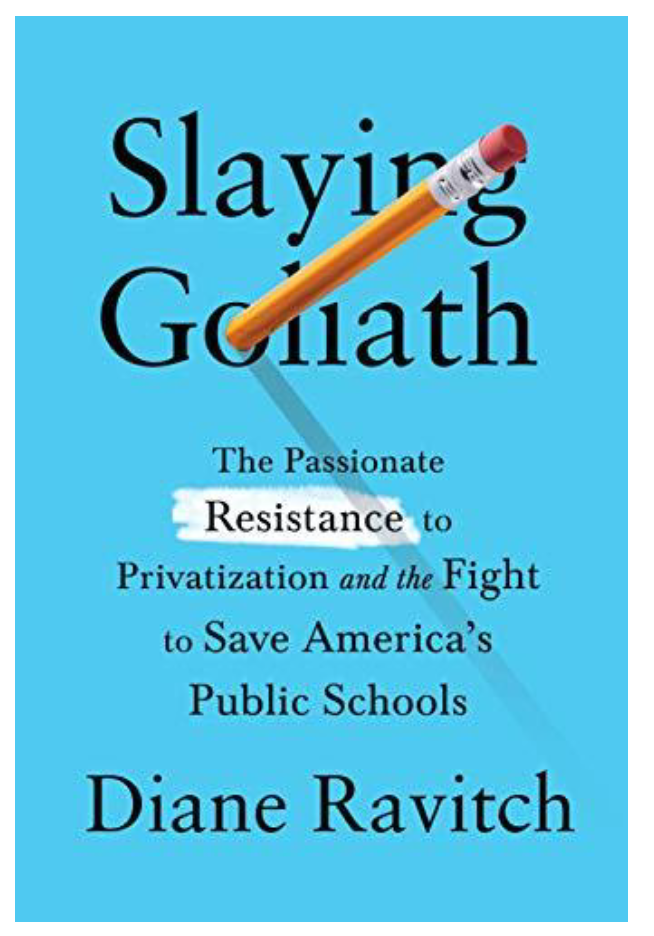
As I explained in the previous post, I did not see either of these reviews until long after they appeared in print. Slaying Goliath appeared just as COVID was beginning to make its mark, only a few weeks before it was recognized as a global pandemic. In writing the book, I wanted to celebrate the individuals and groups that demonstrated bravery in standing up to the powerful, richly endowed forces that were determined to privatize their public schools through charters or vouchers.
America’s public schools had educated generations of young people who created the most powerful, most culturally creative, most dynamic nation on earth. Yet there arose a cabal of billionaires and their functionaries who were determined to destroy public schools and turn them into privately-managed schools and to turn their funding over to private and religious schools.
Having worked for many years inside the conservative movement, I knew what was happening. I saw where the money was coming from, and I knew that politicians had been won over (bought) by campaign contributions.
Publishing a book at the same time as a global pandemic terrifies the world and endangers millions of people is bad timing, for sure.
But the most hurtful blow to me and the book was a mean-spirited review in The New York Times Book Review. The NYTBR is unquestionably the most important review that a book is likely to get. Its readership is huge. A bad review is a death knell. That’s the review I got. The reviewer, not an educator or education journalist, hated the book. Hated it. I found her review hard to read because she seemed to reviewing a different book.
I was completely unaware that Bob Shepherd reviewed the review. I didn’t see it until two or three years after it appeared. He wrote what I felt, but I, as the author, knew that it was very bad form to complain, and I did not.
I am almost four years late in discovering this review by two scholars for whom I have the greatest respect: David C. Berliner and Gene V. Glass.
I was happy to read this review because Slaying Goliath had a checkered fate. It was published in mid-January 2020. I went on a book tour, starting in Seattle. By mid-February, I made my last stop in West Virginia, where I met with teachers and celebrated the two-year anniversary of their strike, which shut down every school in the state.
As I traveled, news emerged of a dangerous “flu” that was rapidly spreading. It was COVID; by mid-March, the country was shutting down. No one wanted to read about the fight to save public schools or about its heroes. The news shifted, as it should have, to the panicked response to COVID, to the deaths of good people, to the overwhelmed hospitals and their overworked staff.
To make matters worse, the New York Times Book Review published a very negative review by someone who admired the “education reform” movement that I criticized. I thought of writing a letter to the editor but quickly dropped the idea. I wrote and rewrote my response to the review in my head, but not on paper.
Then, again by happenstance, I discovered that Bob Shepherd had reviewed the review of my book in The New York Times. He said everything that I wish I could have said but didn’t. His review was balm for my soul. Shepherd lacerated the tone and substance of the review, calling it an “uniformed, vituperative, shallow, amateurish ‘review.’” Which it was. His review of the review was so powerful that I will post it next.
Then, a few weeks ago, I found this review by Berliner and Glass.
The review begins:
Reviewed by Gene V Glass and David C. Berliner Arizona State University, United States
They wrote:
In a Post-Truth era, one must consider the source.
In this case, the source is Diane Rose Silvers, the third of eight children of Walter Silverstein, a high school drop-out, and Ann Katz, a high school graduate. The Silvers were a middle-class Houston family, proprietors of a liquor store, and loyal supporters of FDR.
After graduation from San Jacinto High School, she enrolled in Wellesley College in September, 1956. Working as a “copy boy”for the Washington Post, Diane met Richard Ravitch, a lawyer working in the federal government and son of a prominent New York City family. They married on June 26,1960, in Houston, two weeks after Diane’s graduation from Wellesley. The couple settled in New York City, where Richard took employment in the family construction business. He eventually served as head of the Metropolitan Transit Authority and Lieutenant Governor in the 2000s, having been appointed by Democratic Governor David Paterson.
Diane bore three sons, two of whom survived to adulthood. Diane and Richard ended their 26-year marriage in 1986. She had not been idle. For a period starting in 1961, Diane was employed by The New Leader, a liberal, anti-communist journal. She later earned a PhD in history of education from Columbia in 1975 under the mentorship of Lawrence Cremin.
Diane was appointed to the office of Assistant Secretary of Education, in the Department of Education by George H. W. Bush and later by Bill Clinton. In 1997, Clinton appointed her to the National Assessment Governing Board (NAGB), on which she served until 2004.
Ravitch worked “… for many years in some of the nation’s leading conservative think tanks.
Back in 2010, Secretary of Education Arne Duncan rolled out his Race to the Top program to reform American education. The U.S. Department of Education offered a total of $5 billion to states. To be eligible to compete for a part of the huge prize money, states had to agree to authorize charter schools, to adopt the Common Core (not yet finished), and to evaluate teachers based on the test scores of their students.
The requirement to change teacher evaluation was heated. Duncan scoffed at critics, saying they were trying to protect bad teachers and didn’t want to know the truth.
In 2012, three noted scholars claimed that teachers who raised test scores raised students’ lifetime incomes; President Obama cited this study, led by Harvard economist Raj Chetty, in his State of the Union address. It seemed to be settled wisdom that teachers who raised test scores were great, and teachers who did not should be ousted.
In 2014, the American Statistical Association warned about the danger of evaluating teachers by the test scores of their students. The ASA statement said that most studies of this method find that teachers account for 1-14% of the variation in test scores. The greatest opportunity for improvement, they said, was to be found in system-level changes.
The Gates Foundation poured hundreds of millions of dollars into districts willing to test value-added methodology, and eventually gave up. Teachers were demoralized, teachers avoided teaching in low-income districts. Overall improvements were hard to find.
Arne Duncan was a true believer, as was his successor, John King, and they never were willing to admit failure.
Teachers never liked VAM. They knew that it encouraged teaching to the test. They knew that teachers in affluent districts would get higher scores than those in less fortunate districts. Sometimes they sued and won. But in most states, teachers continued to be evaluated in part by their students’ scores.
But in New York state, the era of VAM is finished. Dr. Betty Rosa, the chancellor of the New York State Board of Regents, reached an agreement with Melinda Person, president of New York State United Teachers, to draft a new way of evaluating teachers that moves away from students’ standardized test scores.
New York state education leaders and the teachers’ union have announced an agreement to change how New York school teachers and principals are evaluated, and move away from the mandated reliance on standardized test scores.
State Education Department Commissioner Betty Rosa and New York State United Teachers President Melinda Person hand-delivered their drafted legislation Wednesday to lawmakers to create a new system that doesn’t use students’ test performance to penalize educators. The state teacher evaluation system, known as the Annual Professional Performance Review, or APPR, was modified in the 2015 budget to place a greater importance on scores.
“It’s connecting research to practice and developing strategies to ensure that teachers have the best tools and principals to make sure our young people are getting the best quality education,” Rosa told reporters Wednesday in the Legislative Office Building.
When NYSUT elected president Person last year, she said her first task was to change the teacher evaluation system, and state lawmakers said with confidence Wednesday it will happen this session.
The proposed law, which has not officially been introduced in the Legislature, would remove the requirement to base evaluations on high-stakes tests. School districts would have eight years to transition, but could make the changes faster than the required deadline.
Person argued it will support new teachers who are often burdened by the required paperwork under the current model.
“This would be a fair and a just system that would support them in becoming better educators, which is ultimately what they want to do anyway,” Person said.
The proposal was negotiated in agreement with state superintendents, principals, school boards, the PTA, Conference of Big 5 School Districts and other stakeholders. The issue has been contentious for union and education leaders for years, and both state Education Committee chairs in the Legislature said they’re thrilled with the agreement.
“That’s such a nice thing in Albany,” said Senate Education chair Shelley Mayer, a Democrat from Yonkers. “Who can do that? Who gets agreement? It’s very hard around here.
“It takes a woman to do it,” Assembly Education chair Michael Benedetto replied with a smile.
Benedetto, a Bronx Democrat, was a classroom teacher for decades and recalled how feedback helps educators develop when done in the proper way.
“It’s like anything else — we want stability in our lives, we want to know where we’re going, how we’re going to be rated and what we’re going to be rated on, as a teacher, as a professional,” the assemblyman said.
Lawmakers will review the proposal and draft legislation in the coming weeks.
Remembering how strident were the supporters of VAM, it’s kind of wonderful to hear the collective sigh of relief in Albany as it fades away.
During the past few decades, we have seen the persistence of failed policies in education. Most of them were codified by No Child Left Behind and Race to the Top: give standardized tests; punish teachers and schools where scores are low or do not rise; reward teachers and schools where scores go up. Pay bonuses to teachers if their students’ scores go up. Tie teacher pay to student scores. Close schools with low scores. Turn low-scoring schools over to private management. Give vouchers to parents to send their children wherever they want.
All of these remedies failed. They encouraged cheating and gaming the system. They encouraged educators to avoid schools that enrolled the neediest students. They demoralized teachers who were idealistic and wanted to teach the joy of learning. Test prep became far more important than intellectual curiosity.
All of these are zombie policies. No matter how consistently they fail, policymakers won’t let go of them.
Merit pay is a policy that has been tried since the 1920s. It has never accomplished anything. I summarized the research on merit pay in my last three books: The Death and Life of the great American School System; Reign of Error; and Slaying Goliath. The research is overwhelming: merit pay doesn’t improve education and doesn’t even raise test scores. Yet in true zombie style, it never dies. It should.
John Thompson writes here about the revival of the merit pay zombie in Oklahoma:
As the “mass exodus” of teachers from Oklahoma schools continues, the legislature has rejected an across-the-board pay raise for teachers. Instead, several legislators are searching for a fix for the state’s “flawed” bonus system. If that doesn’t work, maybe Walters’ use of public money to spread his attacks on “on the radical left” will bring educators back to Oklahoma …
Seriously, Walters’ push for his vision of incentive pay prompted some education advocates to ask me to research performance pay. I sure appreciated the oportunity to reread new and older research on the subject.
Twenty-five years ago, I opposed performance pay because there were better ways to improve teacher quality. But I didn’t have major concerns; although its likely benefits would be small, I thought its downsides shouldn’t be a big deal. However, starting with No Child Left Behind and taking off with Race to the Top, test scores were weaponized, and the dangers of performance pay grew dramatically. Output-driven teachers’ salaries, joined at the hip with unreliable and invalid accountability metrics, promoted educational malpractice that undermined meaningful teaching and learning, increasing in-one-ear-out-the-other, worksheet-driven instruction. Teamwork was damaged, trust was compromised, the flight of educators from classroom increased, and the joy of student learning declined significantly.
During that time, I communicated frequently with data-driven analysts working for think tanks, who almost never had experience in urban schools. Their job was to provide evidence that performance pay, and other incentives and punishments, canwork. They ignored educators and social scientists who tackled the real policy question – how will those experiments work?
Sometimes, merit pay produced modest test score gains, but there was no way of determining whether those test scores revealed an increase or a drop in meaningful learning. Neither did they address the overall learning losses due to teachers being pressured to focus on metrics, as opposed to children. In 2012, a Rand study concluded, “most studies have found no effects on student outcomes.” By 2015, the U.S. Department of Education found that large incentives, such as $15,000 per teacher, may attract talent, but:
In addition to creating an environment that lends itself to narrowed pedagogical approaches and teaching to tests (and even cheating on them), this article suggests that merit pay schemes that require teachers to compete with one another may likely undermine positive collaboration.
Around the time of the 2018 Oklahoma teacher walk-out for higher pay, Denver threatened a strike to get rid of performance pay. Chalkbeat explained the complexity of balancing for larger or smaller payments to teachers in diverse classrooms. It went into depth answering the question, “How did a pay system that once seemed to hold so much promise bring teachers to their breaking point?” The concise conclusion was, “lack of trust.”
Education Week studied the minimal effects of performance pay in Tennessee and Texas, which implemented expensive reward-and-punish, and often short-lived programs. The negative effects of the Houston plan, which State Superintendent Ryan Walters seems to support, are especially relevant for Oklahoma. The Houston teachers’ union president explained, “Performance pay demeans students and undermines teachers, so if the focus is on pay for performance, you’re incentivizing the test-and-punishment model.” Similarly, Education Week cited comprehensive studies that concluded that the relatively more effective programs “avoided an overemphasis on test scores.” But even many or most of the more successful programs were unlikely to survive.
Finally Education Week reported how the $200 million Bill and Melinda Gates Foundation merit pay experiments “did little to boost retention of high-performing teachers,” and it “had little effect on student achievement.”
At the peak of merit pay mandates, and now, Bixby Superintendent Rob Miller explained, “Teacher merit pay is one of the more persistent and seemingly indestructible zombie ideas related to education.” Miller said, “Merit pay for teachers has been tried again and again since the 1920s.” He cited cognitive and social science that explained why performance pay experiments were doomed to fail, as well as numerous evaluations of how it failed in the 21st century. Miller now asks, “Is it fair to place the primary responsibility on teachers and schools for outcomes strongly affected by factors outside their control?” and answers, “Doing so damages school culture and teacher morale and obstructs meaningful dialogue about school improvement.”
At a time when Ryan Walters is threatening to put the worst of the failed policies of the last twenty years on steroids, I was struck by a recent column by Thomas Dee, a fervent believer in output-driven accountability. Even though he seems to think that teachers were to blame, Dee also seems to acknowledge that performance pay had disappointing results. Now he recommends:
It may be possible to achieve durable political support for a teacher evaluation system if that system focuses narrowly on identifying master teachers and providing them with training and extra pay to coach their peers but takes a more incremental approach toward dismissing underperforming teachers.
Dee’s latest almost brings me back to 25 years ago, before NCLB, when the schools I knew were improving, and a win-win approach to performance pay didn’t seem so problematic. At the urging of the union, the Oklahoma City Public School System briefly implemented the Toledo peer review plan, which included a fair and efficient plan for removing ineffective teachers. The best evidence is that the plan was a reliable method for improving classroom instruction. But, it and so many other promising programs were undercut by corporate school reform.
Maybe I’ll once again be open to a compromise involving constructively built, non-punitive merit pay incentives, once the destructive school cultures advanced by corporate school “reform” have disappeared. But, I won’t hold my breath.
Michelle Davis writes a blog called TurnLeftTexas. Texas used to elect Democrats. Texas used to elect Democrats like Lyndon B. Johnson, Ralph Yarborough, and Ann Richards. Now the state is ruby red. What happened?
I’ve often said Texas Democrats are a whole other breed. We have to be, after the decades of abuse we’ve suffered from the opposing party. For those who watch the legislative sessions and follow our lawmakers on social media, we know that Texas Democrats have been David, staring down Goliath.
They say that Texas is the right-wing sandbox, the place where far-right institutions spend millions to test their fascist-aligned ideas. Radical legislation like the abortion ban, the DEI ban, or the ban on gender-affirming care are all being rolled out in Texas as testing grounds so that right-wing institutions can take these radical policies nationwide.
Texas Democrats never get enough credit for the work they put in while in Austin. Texas Democratic Lawmakers are literally on the front lines of democracy, fighting to block awful GOP policies and keep Texans from harm. Whether calling points of order, filibustering, or breaking quorum, Texans know that we can rely on most Texas Democrats to stand tall with a heart and a spine.
With so much at stake in this election cycle, you must ask yourself, “Is it enough?”
Of course, it isn’t “all Democrats.” Too often, from too many districts in all corners of the states, people are saying that they live in blue areas, have a Democrat as representation, and are telling people that their elected official isn’t showing up.
Some elected Democrats are doing great; they show up and have a high turnout for elections. Again, this isn’t “all Democrats,” but the occurrences of Democrats not showing up in Texas are widespread.
It shouldn’t surprise you that people talk. Precinct chairs talk to grassroots organizers, political clubs talk to the city council, and commissioners’ court talks to various political candidates. If you aren’t showing up to your local Democratic events, engaging with your local grassroots organizers, and communicating with your local precinct chairs, you’re not doing enough.
The political chatter from South Texas to North Texas, from East to West, is that not enough elected Democrats are doing enough to turn out the vote when they are in safe blue districts. And they aren’t doing enough to help other Democrats get elected.
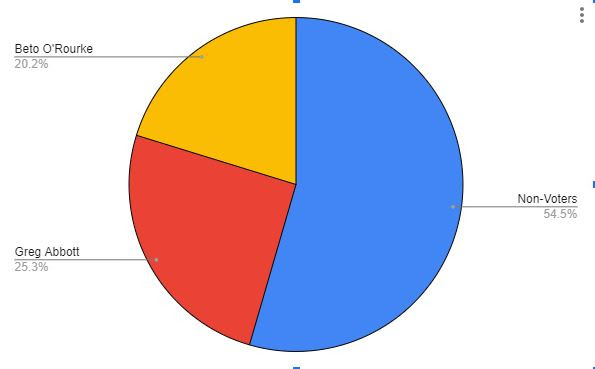
Why is there voter apathy in Texas?
This is an important question that many intelligent people are spending a lot of money on trying to change. I think it’s a complex issue that includes generations of voter oppression, lack of infrastructure, and lack of engagement, among other things.
One thing Beto O’Rourke always used to say was, “There’s no one coming in to save us.”
He was right. Texas is royally screwed as long as Republicans are leading the charge. No one is going to save us from that other than ourselves. We are the ones we’ve been waiting for. We have the numbers on our side and must convince them of them.
You know who I mean when I say “them.”
It will take all of us, and if you have already been elected in a safe blue district and you have no opponent, it will take you, too. It will take helping your neighboring districts and getting your own voters to show up.
Of all people, Texas Democrats know how far-right the Republicans have moved in recent years. You know the threats we face.
Too much is at stake.
If Democrats in Texas do not make gains this year, the first thing Texans may lose is our right to vote. We already saw several of the ALEC-backed authoritative legislation that came through the 88th Legislature and how Republicans have already tested the waters on stripping Texans of their rights to vote. Banning specific poll locations, like on college campuses, or massive data purges on the voting rolls are all real possibilities if Republicans can’t be stopped.
What about our rights to freedom of expression and privacy? The GOP has already banned certain forms of art in Texas. Why do you think they’ll stop there?
Republicans passed a bill to give protesters at least 10 years if they are protesting a pipeline. The rights to freedom of assembly are at risk.
We already have an abortion ban and travel restrictions on women; IVF and birth control are next.
The civil rights of all marginalized groups are at risk.
We change this by changing the culture of not voting.
We need to do many things to change the culture of not voting. Still, as Democrats who have already been elected, you serve as a leader in your community. It would be best to actively work to foster a culture of engagement, participation, and voting within your communities. Your role isn’t just legislating but inspiring, educating, and actively participating in the democratic process.
Your presence in the community should be a constant, not just during election cycles. Attend local events, hold town halls, and visit schools and community centers to discuss the issues that matter most to your constituents. Your visibility and accessibility can bridge the gap between the electorate and the political process, making democracy feel more tangible and immediate to the people you serve.
Knowledge is power, and too many people feel disconnected from the political process because they don’t understand how it affects their daily lives. Lead educational initiatives that demystify the legislative process, explain the importance of local elections, and highlight the impact of specific policies on the community. Work with schools, universities, and community groups to develop programs that engage young people and first-time voters early.
Grassroots movements and community organizations are the lifeblood of democratic engagement. Support these groups with endorsements by actively participating in their events, sharing their successes, and facilitating connections that can amplify their impact. Empower these organizations with resources and platforms to reach a wider audience.
As an elected Democrat, you have a unique opportunity and responsibility to lead the charge in changing the culture around voting and civic engagement.
By being accessible, engaging in education, and supporting grassroots movements, you can inspire a wave of active, informed participation that strengthens the foundations of our democracy. Remember, leadership is not just about holding a position; it’s about the action you take and the example you set for others to follow.
To change Texas, it’s going to take all of us. We believe in you and need your help.
Josh Cowen of Michigan State University is a veteran voucher scholar. He has been doing voucher research for nearly two decades. For years, he was hopeful about the outcomes for students. He recently realized that the results were appalling. Students who took vouchers and left their public school actually lost ground academically. The real benefits of vouchers went to students who were already enrolled in private schools; their family, which could afford the tuition, won a subsidy from the state. In some states, even wealthy parents won a state subsidy for their children. vouchers do not help poor students; instead, they are harmed.
If you’ve ever run a small business or talked to a business owner, you might have heard the phrase “under promise, over deliver” as a strategy for customer service.
Unfortunately, when it comes to school voucher plans like those being considered by Pennsylvania lawmakers this spring, what happens is the opposite of a sound investment: a lot of overpromising ahead of woeful under-delivery.
As an expert on school vouchers, I think about the idea of what’s promised in the rhetoric vs. what actually happens when the realcost sets in. To hear voucher lobbyists tell it — usually working for billionaires like Betsy DeVos, or Pennsylvania’s own Jeff Yass — all that’s needed to move American education forward is a fully privatized market of school choice, where parents are customers and education is the product.
One promise that never holds up is the idea that states can afford to create voucher systems that underwrite private tuition for some children, while still keeping public school spending strong.
Other states that have passed or expanded voucher systems have rarely been able to sustain new investments in public schools. Even when those voucher bills also came with initial increases in public education funding. Six out of the last seven states to pass such bills have failed to keep up with just the national average in public school investment.
But for children and families — especially those who have been traditionally underserved by schools at different points in U.S. history — the cost of school vouchers goes beyond the price for taxpayers.
Although most voucher users in other states (about 70%) were, in fact, in private schools first, the academic results for the kids who transfer are disastrous. Statewide vouchers have led to some of the largest academic declines in the history of education research — drops in performance that were on par with how COVID-19 or Hurricane Katrina affected student learning.
Although school vouchers have enjoyed fits and starts of bipartisan support from time to time, today’s push for universal voucher systems across the country is almost entirely the product of conservative politics. All 12 states that created or expanded some form of a voucher system in 2023 voted for Donald Trump in 2020. Of those that passed voucher laws since the COVID-19 pandemic hit in 2020, only two (Arizona and New Hampshire) voted for Joe Biden that election year.
In states like Arkansas and Iowa, voucher laws either immediately followed or immediately preceded extreme new restrictions on reproductive care, a weakening of child labor laws, and other conservative policy priorities.
And this isn’t just about electoral politics. The right-wing origins of school vouchers have real day-to-day implications for who gets to use them and who is left out. We know from states like Florida, Indiana, and Wisconsin that the latest voucher bills allow schools to discriminate against certain children if schools can claim they do so for religious reasons.
Who pays that particular price? Examples include students with disabilities and children and parents from LGBTQ families, who may be asked to leave or not even admitted at all. And that’s because when it comes to vouchers, it’s not really school choice at all. Families don’t get their choice of schools; instead, schools get their choice of which families to admit.
And the price tag for all of this usually comes in wildly over budget anyway. The big culprit for those cost overruns goes back to who actually gets a voucher. Because most voucher users were in private schools first— paid by the private sector before — voucher costs are actually new expenditures taxpayers have to make. In the worst-case scenario, Arizona, vouchers cost more than 1,000% beyond what their advocates first promised.
Despite claims some supporters make that vouchers are part of an efficient education market, the result is really the opposite of any strategy a successful business would recognize.
To put it plainly: The promises rarely pan out, and eventually, the check comes due.
The ASD was launched by the Obama-Duncan Race to the Top on the theory that charter schools were a magic solution to low test scores. Duncan awarded $500 million to Tennessee, one of the first RTTT winners; $100 million was allocated to the ASD.
The ASD gathered the lowest-performing public schools in the state and clustered them into a new, all-charter district. Chris Barbic, leader of YES Prep charter schools in Houston, was selected to lead the ASD. He boldly predicted that within five years, the ASD schools would rank among the top 25% in the state. ASD started with six schools and eventually expanded to 33..
Blogger Gary Rubinstein has followed ASD over the years, with growing disillusionment. None of the ASD schools ever broke into the top 25%.
The state has spent more than $1 billion to help the ASD.
Chalkbeat wrote a few weeks ago that the Legislature is ready to throw in the towel:
After a decade of painful takeovers of neighborhood schools, contentious handoffs to charter networks, and mostly abysmal student performance, Tennessee’s Achievement School District appears to be on its way out.
Several of the GOP-controlled legislature’s top Republicans are acknowledging that the state’s most ambitious and aggressive school turnaround model has failed — and should be replaced eventually with a more effective approach.
Meanwhile, Democrats continue to push for legislation designed to end the so-called ASD, created under a 2010 state law aimed, in part, at transforming low-performing schools.
“I expect we will move in a different direction,” Sen. Bo Watson, the powerful chairman of his chamber’s finance committee, recently told reporters.
The Hixson Republican called the charter-centric school turnaround model an “innovative” idea that fell flat, at least in Tennessee. It would be foolish, Watson added, to keep spending money on an initiative that isn’t working and already has cost the state more than $1 billion — a sentiment echoed by Lt. Gov. Randy McNally and House Speaker Cameron Sexton.
But if the legislature decides to shutter the ASD and Gov. Bill Lee signs off, important questions remain about how Tennessee will support thousands of students in its lowest-performing schools.
There are currently 4,600 students enrolled in ASD schools, 12 in Memphis and one in Nashville.
Initially, the ASD attracted some of the nation’s biggest charter chains.
Evaluations showed that students in ASD schools gained no more in tested subjects than students in schools that received no interventions at all.
Now Tennessee must revise its contract with the federal government to revise its plans to help the lowest performing students.
Chalk up another loss for the “Disruption Doctrine” imposed by Bo Child Left Behind and Race to the Top. One can only imagine the difference that might have been made if the same sums were invested in full-service community schools and reduced class sizes.
What’s especially amusing about the video is the archival footage of Trump, boasting about the success of a venture he just launched and praising himself for his latest venture. It’s the best, the most, the greatest. Then it goes bust. As you watch, you realize that his greatest talent is as a pitchman, the guy who gets you to buy or invest in his latest moneymaking scheme. He is the guy selling snake oil to cure everything that ails you. They did not include “Trump University,” surely a major fraud and a financial disaster. Trump claimed that those who enrolled in his online “university” would learn how to get rich, learning his secrets. He hoodwinked widows and vets. Trump was ordered to repay $25 million to people who registered for his fake university.





 Diane Ravitch's blog