Archives for category: DeSantis

Over the past few days, I have received a number of hostile tweets, comments on my blog, and Instagram comments, accusing me of hypocrisy because I support public schools but sent my own sons (now ages 60 and 55) to private school. I am touched, even baffled, that anyone is upset by decisions that I made half a century ago.

It was easy to see who inspired these denunciations of me: Christina Pushaw, who is one of Ron DeSantis’ closest aides, and Chris Rufo, the man who led the phony crusade against critical race theory. They seem to think they unearthed a dark secret. That’s absurd. I’m guessing that Governor DeSantis doesn’t like what I write about him in my posts and tweets. I’m flattered.

The question of where my middle-aged sons went to schools is a nothing-burger. For the past decade, my blog bio has said that my two sons went to private school.

Pushaw and Rufo were outraged that I tweeted during “school choice week”:

“The best choice is your local public school. It welcomes everyone. It unifies community. It is the glue of democracy.”

They tweeted their “discovery” that my sons went to private school. The outrage of these two prominent right wingers generated two articles attacking me as a hypocrite.

One appeared on a news site called MEAA.com, titled:

“Who is Diane Ravitch? ‘Hypocrite’ NYU prof who sent her children to private school urges parents to pick public schools”

The article quotes Pushaw’s tweets, as well as tweets from others responding indignantly to my alleged hypocrisy.

The Daily Mail in the U.K. published an unintentionally hilarious article with this title:

“NYU education professor tells parents to send their kids to public school – before being forced to admit she send hers to private schools

It was never a secret that my sons went to private school. I was never “forced to admit” that fact.

Why did I send them to a private school?

After college, I married a New Yorker in 1960 whose family had a long tradition of attending private schools. My husband enrolled in the private Lincoln School in 1936! Like him, our sons went to private schools. When I started my career as a writer, I was conservative. I wrote articles in publications like The Wall Street Journal, Commentary, and The Public Interest. I opposed affirmative action, identity politics, and the Equal Rights Amendment. I believed, like Governor DeSantis, that the law should be colorblind.

However, I was never a racist. I was never contemptuous of public schools, because I had graduated from them and was grateful for the education and teachers I had, and the opportunities they opened for me.

In 1975, I earned a Ph.D. In the history of American Education from Columbia University. I was an adjunct professor at Teachers College from 1976 to 1991, when I left to work in the first Bush administration as Assistant Secretary of Education for Research and serve as Counselor to Secretary of Education Lamar Alexander.

After my stint in the Bush administration, I rejoined the board of the conservative Thomas B. Fordham Foundation and was invited to be a Senior Fellow at the Manhattan Institute (which now employs Chris Rufo) and at the Hoover Institution. All three are very conservative and support school choice, as did I. I even went to Albany on behalf of the Manhattan Institute and testified on behalf of charter legislation in 1998.

When I came back to New York City, Teachers College asked me not to return because of my conservative views. I was hired as an adjunct at New York University, where I was a faculty member from 1995 to 2020, when I retired.

In 2007, after a long and deep immersion in the conservative education world, I began to change my views. I began to realize, based on frank conversations within the conservative think tanks, that charters were no better and possibly worse than public schools unless they cherrypicked their students; that clever entrepreneurs and grifters were using some of them to make millions; that voucher schools were usually ineffective, had uncertified staff, and did not save poor kids; that standardized tests are not valid measures of learning; that the emphasis on tests was actually ruining education by narrowing the curriculum and encouraging teaching to the tests.

The more I reflected on the poor outcomes of conservative policies, the more I doubted the ideas I had long espoused. In 2008, I began writing a book in which I renounced my conservative views. I rejected high-stakes testing, school choice, merit pay, evaluating teachers by their students’ test scores, and the entire corporatist school “reform” agenda.

The book—The Death and Life of the Great American School System: How Testing and Choice Are Undermining Education (Basic Books)—was published in 2010, and it became a national bestseller. My change of mind and change of heart were widely reported in the national media.

Today, I am no longer a conservative. I support equal opportunity and equal justice for all Americans. I am sensitive, as I always have been, to the unjust and inhumane treatment that Black Americans have suffered. I endorse critical race theory, because it is a way of studying and evaluating why racism persists in our society and devising ways to eliminate it. Racism and other forms of hatred are a cancer in our society, and we must end them.

And so, Ms. Pushaw and Mr. Rufo, I hope I have answered your question. I enrolled my youngest child in a private school in 1965 and my second child in 1970 because I was a conservative. A lot happened to me in the years between 1965 and 2023, more than I can put into a tweet. I hope you understand why today I am a passionate advocate for public schools and an equally passionate opponent of public funding for private choices.

From my life experiences and many years as a scholar of education, I have concluded that the public school teaches democracy in a “who sits beside you” way; it teaches students to live and work with others who are different from them. The public school, I realized, is the foundation stone of our diverse society. It deserves public support and funding.

Dan Rather and Elliott Kirschner write a blog called Steady. Their voice is always thoughtful, reasonable, informed, and…steady. I think that they, like me, are old enough to remember when we believed that overt racism was ebbing and that white supremacy was dead. Our hopes have been shattered since 2016. It takes the use of critical race theory to understand why we were so naive. Here is their take on the big Education story of the day:

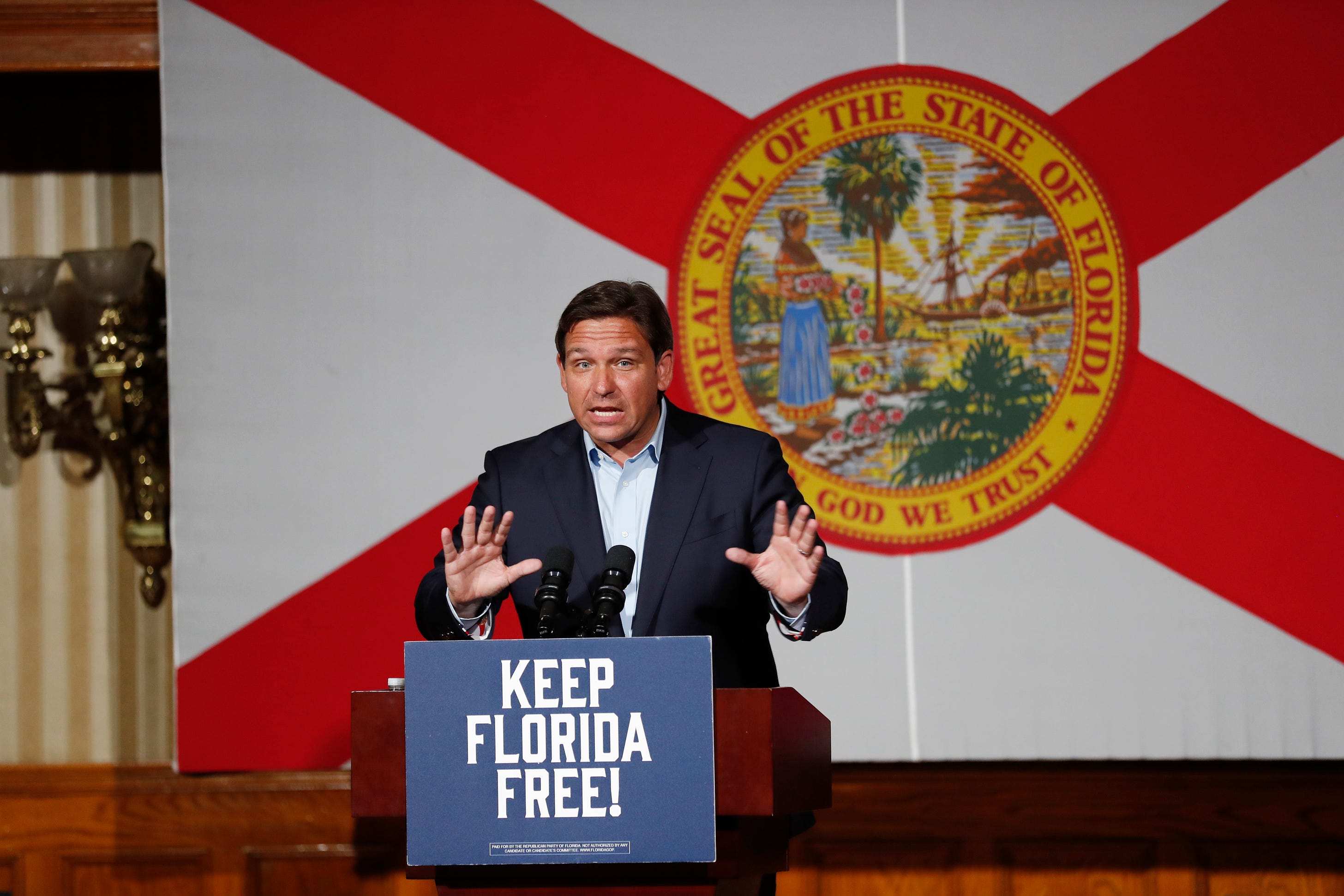
Photo credit: Octavio Jones

Editor’s note: this is an ironic banner in front of DeSantis. Florida is not free for those who don’t share his ideology. If you think racism exists today in Florida, you are not free to discuss it in school or college. You are free to agree with him.

Rather and Kirschner write:

Much of American history is entangled with racism and white supremacy. That is the reality of our beloved nation, no matter how much we wish it were not.

As we sit here nearly a quarter of the way through the 21st century, it is obvious that we need to have the maturity to look back to our past as well as ahead to the future. Can we do this with our eyes wide open? Will we study and learn from the lessons of history?

You can’t grapple with the truth if you hide it from view. Yes, our national narrative is an inspiring one — of freedom, rights, and new opportunities. But it is also a narrative of pain — of the bondage, rape, and murder of enslaved people. It is a story of mass death, broken treaties, and land stolen from Native people. And it is a story of persecution of the “other,” time and again.

The chasm between the noble promises of our founding documents and our historical realities continues to obstruct our national journey toward a more perfect union.

Yes, ours is a country that has facilitated exploration, innovation, and growth, but it is also one built upon families torn apart at the auction block, bodies whipped, and police dogs and fire hoses set against children.

Cities were redlined. Public schools were segregated. And despite our carefully cultivated national image as a meritocracy, throughout our history we have seen talent overlooked and our common humanity diminished on account of people’s race, religion, and sexual orientation.

The ripples of injustice continue to destabilize our society.

It shouldn’t be controversial to say any of this. But acknowledging these truths today is a political act, because it threatens the privileged narratives of those who seek to sugarcoat our past. These are men and women who serve their own ambitions by fortifying their cynical holds on power, delighting in division, feeding off fear, and applauding anger.

And that brings us to Florida’s Governor Ron DeSantis.

Listing all of his efforts to leverage the power of his office to attack equity, empathy, and justice would stretch this post immeasurably. But doing so would also jeopardize the central point: DeSantis is an opportunist. He is not weighing the merits of any one campaign. Rather, he wants headlines as a culture warrior standing up to “wokeness,” a term he has eagerly redefined to suit his own purposes. It allows him to sneer at and dismiss any attempt to reckon with American injustice.

DeSantis has focused his assaults on two of our society’s most traditionally marginalized groups: Black Americans and the LGBTQ community. While these populations have thus far felt the brunt of his targeting, we need to see clearly that his rhetoric is a threat to all who care about a democratic, peaceful, empathetic, and just America. Those of us with the greatest privilege should bear a special burden in rejecting this hate.

DeSantis’s pugilism has enabled him to consolidate power in Florida. Any opposition to his toxic initiatives must contend with the uncomfortable truth that voters validated his message and style via his landslide win in November. Now DeSantis thinks he can take his show on the road with a presidential bid. That remains to be seen. Florida has been trending Republican in recent years, and success there might not translate to the current battleground states, many of which saw big Democratic wins in the midterms.

All that being said, there is a great danger to framing this struggle primarily through the lens of electoral politics. This normalizes a discourse that should be rejected by society’s mainstream. Just as the outright bigotry of the past became socially unacceptable, so too should these latest attempts at divisiveness.

It should not surprise us that DeSantis is making schools — both K-12 and college — a central target. He wants to teach a distorted view of America. He wants to make dissenting speech not only suspect but even criminal. He wants to silence the voices of his critics and of critical thinking more generally. This is a playbook that has been followed by demagogues before to very dangerous ends.

It is essential that DeSantis not be covered by the press through a false equivalence paradigm. We can debate what we should teach and how to teach it. But we can’t replace the truth, as unsavory as it may be, with sanitized narratives that suit those already in power. This is a battle for the minds of the voters of the future. This is about what kind of nation we will become.

But DeSantis primarily cares about what kind of country we are now. He wants to appeal to fear because he thinks he can mine that fear for votes. That is his game plan. And he’s not hiding it. There can be no appeasement. DeSantis has already shown that he isn’t interested in deliberations or good faith compromise. Those would disrupt his approach of means to an end.

History illustrates that hatred can be taught, but so can empathy and justice. We are on a winding journey as a nation. And we have much farther to go. But we have made progress in the face of bigots and autocrats because people had the courage to forge the inequities of our past into a more equitable future.

This history, this truth, is what scares people like DeSantis the most. But it is one that can give us hope if we are determined not to look away.

I wrote today’s 9 a.m. post about the College Board capitulating to conservative critics. I wrote it without seeing the revised curriculum because I was in an airplane all day. Late last night, I opened an email and discovered that Michael Hiltzik of the Los Angeles Times had written a similar but more informative column, because he was able to do the comparison that I had not done. He pointed out that the rightwing attacks on the AP African American Studies course began in September, and the very names and topics that the right and DeSantis had condemned were either excised or made optional in the revised course.

He wrote:

One might have expected a leading national educational institution to have the gumption to push back against right-wingers like Florida Gov. RonDeSantis when they try to stick their noses into decisions about how to teach important subjects.

Sadly, no.

On Wednesday, the College Board issued its final curriculum for what should have been a ground-breaking high school course in African American studies. The College Board called the course “an unflinching encounter with the facts and evidence of African American history and culture.”

The final curriculum appears suspiciously to have been tailored to objections raised by DeSantis, Florida’s culture warrior Republican governor, and other right-wingers, after the board issued a draft version in December.

DeSantis, through his secretary of Education, called the draft “inexplicably contrary to Florida law” and forbade its use in Florida schools. The state’s education secretary, Manny Diaz Jr., attacked it for being “filled with Critical Race Theory and other obvious violations of Florida law.”

The arch-conservative National Review labeled the course part of “a new and sweeping effort to infuse leftist radicalism into America’s K–12 curriculum.”

The curriculum is part of College Board’s Advanced Placement program, which gives college-bound high schoolers exposure to university-level coursework.

The board says AP courses are “aimed at enabling students to develop as independent thinkers and to draw their own conclusions.”

To be fair, the board’s actions related to the African American Studies course are as good a workshop in allowing students to draw their own conclusions as one might hope. Any reasonably bright AP student is likely to see this affair as a demonstration of abject cowardice.

Disgustingly, the College Board released the final curriculum on the first day of Black History Month, as though trawling for praise for its unflinching devotion to truth. The board took pains to deny that the alterations in the draft curriculum had anything to do with criticism from DeSantis, the National Review or the right wing generally.

“No states or districts have seen the official framework that is released, much less provided feedback on it,” the board said. “This course has been shaped only by the input of experts and long-standing AP principles and practices.”

Raise your hand if you believe the College Board. Me neither.

The board said the final version had been completed in December. DeSantis issued his rejection of the course on Jan. 19. But criticism of the course outline had been circulating in conservative quarters for months — the National Review’s attack, for instance, was published on Sept. 12.

A preliminary, unflinching examination of the differences between the draft and the final version can only raise suspicions that the College Board refashioned the African American studies course to assuage the conservatives.

State Senator Manny Diaz Jr. posted a tweet on January 20 listing the state’s concerns about the AP course.

As a template, let’s use the list of “concerns” issued by Diaz on Jan. 20.

Diaz complained about the inclusion in the draft curriculum of writers and social activists Kimberlé Crenshaw, Angela Davis, Roderick Ferguson, Leslie Kay Jones, bell hooks , and Robin D.G. Kelley. Every single one of them has been excised from the final version.

Diaz’s list objected to the treatment, or even inclusion, of topics including the reparation debate, movements such as Black Lives Matter, Black Queer studies and “intersectionality,” which places racism and discrimination in a broadly social context.

Those topics have all been downgraded from required topics to “sample project topics” — that is, optional topics that fall outside requirements and won’t appear on the AP test. Those topics, the curriculum says, “can be refined by states and districts.”

Here’s a safe bet: None of them will be taught in Florida schools.

DeSantis has made no secret of his determination to turn Florida education into a shallow pool redolent of white supremacy by avoiding any hint that American society and politics have been infused with racism and class discrimination.

The shame of the College Board’s rewriting of its AP course is that it effectively places DeSantis and his henchmen in the position of dictating educational standards to the rest of the country.

There was scant political pushback against DeSantis when he rejected the draft curriculum, other than a letter from Illinois Gov. JB Pritzker, a Democrat, warning the College Board that his state would “reject any curriculum modifications designed to appease extremists like the Florida Governor and his allies.”

Pritzker observed, properly, that “ignoring and censoring the accurate reporting of history will not change the realities of the country in which we live.” (Like DeSantis, Pritzker is being talked up as a potential presidential candidate in 2024.)

Now that the final curriculum has been published and its dilutions can be closely scrutinized, perhaps the scope of the College Board’s capitulation will become clearer.

But the College Board has already flunked this all-important test of character. As we’ve noted before, acts of cowardice in the face of DeSantis’ goonish bullying won’t appease him, but will only encourage him.

As he works to destroy the independence and quality of the Florida K-12 and university systems, parents elsewhere around the country can take perverse satisfaction in knowing that students will emerge from Florida schools without the skill to compete with their own kids in intelligent society.

But if institutions like the College Board continue to let DeSantis transmit his virus of ignorance beyond Florida’s borders, no one will be safe from the contagion.

When I first had a chance to read the College Board’s AP African American Studies syllabus, I predicted that the College Board was likely to beat a hasty retreat if its bottom line was jeopardized. I have not yet seen the revised edition, but the media is reporting that certain hot topics and prominent names were deleted to make the course palatable to Ron DeSantis and other conservative governors.

The New York Times reported:

After heavy criticism from Gov. Ron DeSantis, the College Board released on Wednesday an official curriculum for its new Advanced Placement course in African American Studies — stripped of much of the subject matter that had angered the governor and other conservatives.

The College Board purged the names of many Black writers and scholars associated with critical race theory, the queer experience and Black feminism. It ushered out some politically fraught topics, like Black Lives Matter, from the formal curriculum.

And it added something new: “Black conservatism” is now offered as an idea for a research project.

This last addition was a direct concession to criticism from the conservative National Review, which assailed the AP course as Neo-marxist indoctrination that left out the voices of African American conservative writers and scholars.

The Times’ story continues:

But the study of contemporary topics — including Black Lives Matter, incarceration, queer life and the debate over reparations — is downgraded. The subjects are no longer part of the exam, and are simply offered on a list of options for a required research project.

And even that list, in a nod to local laws, “can be refined by local states and districts.”

The expunged writers and scholars include Kimberlé W. Crenshaw, a law professor at Columbia, which touts her work as “foundational in critical race theory”; Roderick Ferguson, a Yale professor who has written about queer social movements; and Ta-Nehisi Coates, the author who has made the case for reparations for slavery. Gone, too, is bell hooks, the writer who shaped discussions about race, feminism and class.

After the curriculum was released, Professor Crenshaw said that even if her name and others had been taken out of the curriculum because secondary sources — theorists or analysts — were being eliminated in favor of facts and lived experience, the decision sent a troubling message. “I would have made a different choice,” she said. “Even the appearance of bowing to political pressure in the context of new knowledge and ideas is something that should not be done.”

But she said she was also disappointed because she had believed the course would capitalize on a hunger of young students to learn “ways of thinking about things like police brutality, mass incarceration and continuing inequalities.”

Instead, she said, “the very same set of circumstances that presented the need for the course also created the backlash against the content that people don’t like.”

David Blight, a professor of American history at Yale University, said Wednesday that he had written an endorsement of the new curriculum, at the College Board’s request, and that he believed it had much to offer not just about history but also about Black poetry, art and the origins of the blues, jazz and hip-hop. But he withdrew his endorsement on Wednesday, after learning that some sections had been cut.

“I withdrew it because I want to know when and how they made these decisions to excise these people, because that’s also an attack on their academic freedom,” Dr. Blight said.

PEN America, a free speech organization, echoed that concern. While the College Board had said the changes were not political, the board “risked sending the message that political threats against the teaching of particular types of content can succeed in silencing that content,” said Jeremy C. Young, senior manager of free expression and education at PEN America…

Dr. Gates, who was a consultant to the curriculum, said he was “sorry that the College Board’s policy is not to require secondary sources in its curricula.” He teaches Harvard’s introduction to African American studies, “and academic subjects such as ‘Intersectionality’ and critical race theory, the 1619 Project, reparations for slavery, Black homophobia and antisemitism are fair game, of course, for such a class,” he said in an email. The 1619 Project is an initiative by The New York Times.

The College Board insists it made its changes in December before DeSantis denounced the syllabus.

But the conservative attack on the syllabus began last September, when Stanley Kurtz received a leaked copy and wrote a scathing critique in The National Review called “Neo-Marxing the College Board with AP African American Studies.”

He wrote in September:

A new and sweeping effort to infuse leftist radicalism into America’s K–12 curriculum has begun. The College Board — the group that runs the SAT test and the Advanced Placement (AP) program — is pilot-testing an AP African American Studies course. While the College Board has withheld the course’s curriculum framework from the public, I have obtained a copy.

Although K–12 teachers and academic consultants working with the College Board have publicly denied that AP African American Studies (APAAS) either pushes an ideological agenda or teaches critical race theory, those denials are false. APAAS clearly proselytizes for a socialist transformation of the United States, although its socialism is heavily inflected by attention to race and ethnicity. Even if there were no laws barring such content, states and local school districts would have every right to block APAAS as antithetical to their educational goals. In any case, APAAS’s course content does run afoul of the new state laws barring CRT. To approve APAAS would be to gut those laws.

Kurtz followed with additional articles in The National Review lambasting the course as radical leftist indoctrination that violated state laws prohibiting the teaching of critical race theory. He applauded DeSantis’s attack on the course.

Although the College Board insisted that it’s revisions had nothing to do with the conservative pushback and was completely nonpolitical, Kurtz laughed:

Here’s the reality. The College Board is in a panic. Its repeated attempts to keep the APAAS curriculum secret have failed. That curriculum has now been widely published, and the teacher’s guide has been exposed here at NRO as well. My sources tell me that at least one other red state is seriously considering pulling out of the course. More red states are likely doing the same. The College Board knows that if it doesn’t stop the bleeding, the red states will be lost.

The College Board knew it had a problem months before DeSantis condemned the course. Could it take the risk of offering a course that would be rejected by red states that had already banned “critical race theory?”

The Times pointed out:

Acceptance for the new curriculum is important to the College Board, a nonprofit, because A.P. courses are a major source of revenue. The board took in more than $1 billion in program service revenue in 2019, of which more than $490 million came from “AP and Instruction,” according to its tax-exempt filing.

The College Board is a nonprofit but it pays hefty salaries. According ito Forbes, its Chief Executive Officer David Coleman (the architect of the Common Core standards) was paid $1.8 million in salary in 2018 (the last year that figures were available), and its president received more than $1 million. The company holds over $1 billion in assets.

Could they risk publishing a course that might be rejected by every red state? Maybe. But would they? Clearly, it was decided that it was easier to drop the controversial names and topics than to offend powerful conservative figures who might hurt their revenues.

Robert Hubbell writes a thoughtful, informative blog. I’m posting this as part of my personal project to understand the new face of white supremacy. White supremacy has always been there, simmering below the surface. Trump invited them to show their faces and step into the daylight. They did, and DeSantis is sending them signals that he wants to be their champion.

Florida Governor Ron DeSantis has set his anti-education sites on Florida’s state colleges. Through a series of political and legal maneuvers, he has ceded control over Florida’s state colleges to ultra-conservative culture warriors like Christopher Rufo. In short order, DeSantis has announced that he will rid Florida state colleges and universities of curricula not “rooted in Western tradition” or that “compels belief in critical race theory or related concepts such as intersectionality.”

Amid the torrent of reporting on Ron DeSantis’s attack on critical race theory and intersectionality, the quiet part is often left unsaid. So let me say it: DeSantis’s educational agenda is code for racism and white supremacy. (Other parts of his agenda seek to erase the dignity and humanity of LGBTQ people.) DeSantis’s invocation of “Western tradition” is meant to suppress knowledge regarding the people (and contributions) of Asia, Africa, South America, Oceania, and the Indigenous Peoples of the Americas. See Talking Points Memo, DeSantis Makes 2024 Ambitions Clear As He Pours Gasoline On His ‘Woke’ Education Fire.

Given DeSantis’s generalized ignorance, his call to focus on “Western tradition” is a slippery slope that will inevitably lead to the discussion of unpleasant truths about America. For example, the enslavement of Black people was a “tradition” in North America for 246 years—and the abolition of that evil practice is relatively recent (155 years ago). So, a college course that honestly addresses the Western “traditions” of North America should include an examination that the role of slavery played in the economic, social, and political development of America.

But DeSantis isn’t stopping at converting Florida’s colleges and universities into re-education camps in the worst traditions of the USSR. He is seeking to up-end centuries of “Western tradition” embodied in the Constitution and the English common law: the requirement of a unanimous jury to impose capital punishment. DeSantis has floated the idea that a less-than-unanimous jury verdict can impose a sentence of death—an unconstitutional proposal designed to inflict the death penalty on more Black and Latino Americans. See Vox, Ron DeSantis wants to make it much easier for the state to kill people.

DeSantis is willing to do all this because he wants to capture Trump’s loyal base—which is the only hope that DeSantis has of becoming a credible candidate. As Trump becomes mired in criminal prosecutions, DeSantis will become emboldened and radicalized beyond his already extremist views. Doing so ignores the lessons of the 2022 midterms: persuadable Americans are done with Trump and his MAGA extremism. Like all military generals, Ron DeSantis is fighting the last war (the presidential election of 2020) and has failed to heed the tectonic shift that occurred in the midterms.

Florida Governor Ron DeSantis issued a statement about his higher education agenda. He intends to expunge all references to or studies of diversity, equity, inclusion and “critical race theory,” the study of institutionalized racism from the curriculum of the state’s colleges and universities. He also wants to place the hiring of new faculty in the hands of college presidents and boards of trustees, whom he controls. The hiring of new faculty typically is in the hands of the faculty, not the president or the board of trustees.

DeSantis claims that he is furthering “civil discourse and intellectual freedom” by suppressing the ideas he disagrees with. He believes that the only studies that belong on a college campus are the achievements and thoughts of white men.

He has flipped the script, accusing those who defend the freedom to teach and learn of “suppressing” free thought. It is he who is suppressing intellectual freedom.

In Florida, faculty are free to express Governor DeSantis’ views. They are not free to express dissent from the party line. That is not freedom.

Ron DeSantis is the ultimate arbiter of truth in Florida. None dare challenge him if they teach in a public school, college, or university. There’s a word for this ideology: fascism.

“Today, Governor Ron DeSantis announced legislation for the 2023 Session to further elevate civil discourse and intellectual freedom in higher education, further pushing back against the tactics of liberal elites who suppress free thought in the name of identity politics and indoctrination. Among its many provisions, the legislation will ensure Florida’s public universities and colleges are grounded in the history and philosophy of Western Civilization; prohibit DEI, CRT (CRITICAL RACE THEORY), and other discriminatory programs and barriers to learning; and course correct universities’ missions to align education for citizenship of the constitutional republic and Florida’s existing and emerging workforce needs.”

“In Florida, we will build off of our higher education reforms by aligning core curriculum to the values of liberty and the Western tradition, eliminating politicized bureaucracies like DEI, increasing the amount of research dollars for programs that will feed key industries with talented Florida students, and empowering presidents and boards of trustees to recruit and hire new faculty, including by dedicating record resources for faculty salaries,” said Governor Ron DeSantis.

“This 2023 legislative proposal builds on reforms made during the 2022 Legislative Session through Senate Bill 7044 to dismantle accreditation agency monopolies, increase tenured faculty accountability, and make the transition between a Florida state college and university more seamless. Specifically, the 2023 proposal raises the standards of learning and civil discourse of public higher education in Florida by:

Requiring the State University System Board of Governors (BOG) and State Board of Education (SBOE) to review and realign general education core courses to make sure they provide historically accurate, foundational and career relevant education, not suppress or distort significant historical events or include a curriculum that teaches identity politics;

Prohibiting higher education institutions from using any funding, regardless of source, to support DEI, CRT, and other discriminatory initiatives;

Requiring institutions’ presidents and boards of trustees to take ownership of hiring and retention decisions, without interference from unions and faculty committees;

Allowing institutions’ presidents and boards of trustees to conduct a post-tenure review of a faculty member at any time with cause;

Prohibiting postsecondary institutions from using discriminatory political filters, including political loyalty oaths and DEI statements, in the hiring process.”

“Requiring preeminent state research universities to include annual research expenditures of $50 million or more for STEM-related occupations, businesses, or industry partners in Florida that are employing Florida residents;

Requiring the Board of Governors (BOG) to align universities’ missions to education for citizenship of the constitutional republic and Florida’s existing and emerging workforce needs;

Providing additional responsibilities and clarifications for FSU’s Florida Institute of Politics, including renaming it the Florida Institute for Governance and Civics; and Providing additional responsibilities and clarifications for FIU’s Adam Smith Center for the Study of Economic Freedom.”

The New York Times reported on DeSantis’s aggressive attack on higher education as part of his cynical use of culture war tactics, which build his base nationally.

The DeSantis-controlled board of New College fired its president, English professor Patricia Okker, who was appointed in 2021.

While expressing her love for both the college and its students, Dr. Okker called the move a hostile takeover. “I do not believe that students are being indoctrinated here at New College,” she said. “They are taught, they read Marx and they argue with Marx. They take world religions, they do not become Buddhists in February and turn into Christians in March.”

Governor DeSantis also announced on Tuesday that he had asked the Legislature to immediately free up $15 million to recruit new faculty and provide scholarships for New College….

The shake-up of New College, which also included the election of a new board chairwoman, may be ongoing and dramatic, given the new six board members appointed by Mr. DeSantis.

They include Christopher Rufo, a senior fellow at Manhattan Institute who is known for his vigorous attacks on “critical race theory,” an academic concept that historical patterns of racism are ingrained in law and other modern institutions.

At the time of his appointment, Mr. Rufo, who lives and works in Washington State, tweeted that he was “recapturing” higher education.

Another new board member is Eddie Speir, who runs a Christian private school in Florida. He had recommended in a Substack posting before the meeting that the contracts of all the school’s faculty and staff be canceled.

The other new appointees include Matthew Spalding, dean of the Washington, D.C., campus of Hillsdale College, a private college in Michigan known for its conservative and Christian orientations. An aide to the governor has said that Hillsdale, which says it offers a classical education, is widely regarded as the governor’s model for remaking New College.

In addition to the governor’s six new appointees, the university system’s board of governors recently named a seventh member, Ryan T. Anderson, the head of a conservative think tank, the Ethics and Public Policy Center, which applies the Judeo-Christian tradition to contemporary questions of law, culture, and politics. His selection was viewed as giving Mr. DeSantis a majority vote on the 13-member board.

The plan seems clear: Fire faculty who teach “identity” courses or anything “woke,” drive away the students, who wanted the progressive approach that New College offered, and turn the college into the Florida branch of Hillsdale College.

Governor Ron DeSantis hates the fact that there is a progressive public college called New College that openly teaches diversity, equity, inclusion, feminist studies, ethnic studies, and gay studies. That’s WOKE, and he vowed to crush anything WOKE.

He named 6 conservatives to the 13-member board, and the board of the state university system added another, meaning that Rightwingers are in charge. A hard-right board needs a hard-right president, and they got one.

Their first meeting was this afternoon, and they are expected to appoint former State Commissioner of Education Richard Corcoran as the new president. From the following story, it appears that no one bothered to let the current president of the New College know that she was being shown the door.

DeSantis is showing how to stamp out ideas he doesn’t like, with power, not subtlety. Is he a fascist or is he pretending?

A new board of trustees at New College of Florida intends to name Richard Corcoran as its next President.

Corcoran, a former House Speaker, served as Gov. Ron DeSantis’ first Education Commissioner.

Carlos Trujillo, president and founder of Continental Strategy, revealed the plans in a letter to clients and colleges.

“We are beyond excited to announce that one of our Partners, former Department of Education Commissioner Richard Corcoran, will be returning to higher education to serve as the Interim — and hopeful permanent — President of the New College of Florida, in Sarasota,” Trujillo wrote.

“This move comes as part of Gov. DeSantis ongoing work to refocus the university on providing the most value to its students and their parents.”

Corcoran was a founding partner for the consulting firm.

The news comes hours before the first board meeting since DeSantis appointed six new trustees on the 13-member board. The State University System Board of Governors also appointed a new trustee with a similar conservative think tank background.

Of note, work of Corcoran’s apparent hire comes before any news of current President Patricia Okker’s future with the school. Eddie Speir, co-founder of Inspiration Academy, wrote a blog post this weekend promising to call for Okker to be renamed as interim President and to terminate all faculty and staff before deciding who still fit in the new vision for the college.

While Florida’s Sunshine Law requires all decisions by the board to be made in publicly noticed meetings, Trujillo treats the matter like a done deal.

“The selection of Richard distinguishes our firm as a leader in innovation and strategic solutions for the clients we serve. We look forward to finding new synergies that can better serve our current clients and ensure their goals are made a reality,” his letter reads.

The Miami Herald reported today on Governor DeSantis’ plans to cleanse higher education in the state. Conservatives are creating “civics” institutes as a vehicle for patriotic indoctrination, not as a means to think critically about how to improve democracy. Censorship, which DeSantis practices, would be condemned in any genuine civics class.

Gov. Ron DeSantis on Tuesday announced a package of major reforms to Florida’s higher education system, including tighter controls on faculty tenure, the establishment of “civics institutes” at three universities and prohibitions on diversity, equity and inclusion programs.

Speaking at a news conference in Bradenton, the governor unveiled a plan that would allow university boards of trustees and presidents to conduct reviews of tenured faculty members “at any time,” in addition to the periodic reviews that now take place. Regarding university presidents in particular, he proposes “reestablishing their authority over the hiring process.”

Currently, according to a flier distributed by the governor’s staff, “faculty committees can tie the hands of university presidents and bind them to only consider a small pool of recommended candidates.”

And under a heading in the flier that reads “Education not indoctrination,” he proposes changes in standards and course content “to ensure higher education is rooted in the values of liberty and western tradition.” His plan would require schools to “prioritize graduating students with degrees that lead to high-wage jobs, not degrees designed to further a political agenda.”

The proposal also would prohibit state schools from “supporting campus activities or programs that promote divisive concepts like DEI and CRT.” The letters refer to diversity, equity and inclusion programs and critical race theory.

In addition, he proposes establishing “world-class civics institutes” at the University of Florida, Florida International University and Florida State University. The institutes, according to the flier, would develop courses and curricula “that can be used to educate the next generation on the values of liberty and constitutionalism.”

The flier included information on the governor’s higher education budget proposals as well. He proposes $100 million for “recruitment and retention of highly qualified faculty at state universities” and $15 million for faculty and student recruitment at New College of Florida, where he recently appointed six conservative members to the board of trustees.

The New College board meets Tuesday for the first time since the appointments.

Read more at: https://www.miamiherald.com/article271870522.html#storylink=cpy

Keith Benson is a teacher in Camden, New Jersey. He is also President of the Camden Educators Association, an author, and a member of the board of the Network for Public Education. He wrote the following article for the Newark Star-Ledger. He reminds us that when Republican governors and ideologues talk about “parental rights,” they assume that only white parents have parental rights. Black parents too have parental rights, and black and white and Latino and Asian students—all students— have the right to learn accurate, factual history.

To make sense of America’s fixation with the (non)existence of critical race theory (CRT) in schools and the ways by which CRT became a partisan flashpoint, we must consider this phenomenon as a contemporary manifestation of what Emory University professor Carol Anderson calls, “white rage.”

With corporate news media refusing to unequivocally point out that CRT, a complex legal theory, is not taught in K-12 schools but is taught in some graduate schools of education and law schools, allowed predominantly white grievants and Republican politicians to shapeshift CRT into anything American history-adjacent that offended their whitewashed sensibilities.

Republican lawmakers like Ron DeSantis and Glen Youngkin, along with a host of conservative pundits, Greg Abbott (Texas), and Sarah Huckabee Sanders (Arkansas), and astroturf “parent groups,” don’t want American children – which does include Black children – to learn, and in some cases making it illegal to be taught this history at all.

The decrying of CRT is part of a long American tradition of white backlash that is aided by a well-funded conservative messaging apparatus skilled in amplifying white rage for political gain based on misinformation in efforts to protect whiteness and the societal benefits it provides white Americans.

By exhaustively covering anti-CRT rallies at suburban school board meetings following President Joe Biden’s convincing defeat of Donald Trump in 2020, mass media platformed white grievance in response to an imaginary issue.

A complicit media apparatus, however, is not the only bad actor advancing CRT propaganda. As the organized effort attacking CRT is also bolstered by some of the same education reform advocates who champion school choice as the answer for, ironically, urban Black parents to receive a “better” education.

White backlash, the concept that greater equity achieved through increased political representation or economic opportunity for non-white ethnic groups results in a loss of social status among white Americans, has been ubiquitous throughout our nation’s history.

The passing of the Second Amendment, the amendment conservatives hold so dear – that they are willing to sacrifice the lives of students and school staff to preserve it in its entirety – was passed to pacify slave states by permitting them to arm militias consisting exclusively of white men, to crush efforts by enslaved Black people, if they chose to fight for their freedom as exhibited in the Stono Rebellion (1739) and Haitian Revolution (1791).

The enacting of Black Codes immediately following Emancipation and the formation of the Ku Klux Klan, the nation’s first terrorist organization, founded soon after Black Americans gained access to the franchise; the establishment of school choice resulting from the Brown (1954) decision where white parents refused to integrate southern public schools, and instead began an alternative schooling system in protest of white tax dollars going toward educating Black children are not examples of CRT, but historic examples of how white rage impacts our society today.

In its place, Republican lawmakers are calling for the teaching of white supremacist “classical” “patriotic” history and social studies curriculum that uncritically celebrates American history that lionizes the “founding fathers,” and uncritically champions capitalism.

Aside from conservatives and lawmakers’ commitment to derail students’ understanding of history, is the collection of individual groups like the Center on Educational Excellence, National Charter School Alliance, and National Parents Union who supported those Republican governors’ rise to power in advocacy, or in their silence against lawmakers’ campaign of miseducation

For decades, education reform advocates, consisting primarily of wealthy ideologues and representatives from the business community, publicly lamented the shortcomings in public education as evidenced by test scores and graduation rates.

They argued that privatizing education in the form of school vouchers, charter schooling, online education, and now homeschooling are answers to “underperforming” public schools — a message targeted principally toward Black parents.

While much could be unpacked regarding the nonsensical nature of that argument, through massive funding of “think tanks” and foundations, combined with sustained lobbying of lawmakers of both parties, the goal of shifting collective responsibility of educating all of America’s children through its public schools to that of a private endeavor where parents focus only on what impacts their child directly, has been achieved.

Significant expanses of the country see their public institutions deliberately dismantled and replaced with more voucher and corporate charter schools.

Where is the prominent pushback from the reform community from the likes of KIPP, Teach For America, the Broad Foundation, Democrats for Education Reform, and National Charter Schools Conference, to the deliberate miseducation of America’s students, including the Black students to whom these organizations appealed for decades?

As Republican lawmakers endeavor to pass more choice legislation while simultaneously mandating the whitewashing of American history, we have to ask: Do Black parents have a choice in the type of history their child will learn, or is the concern for Black parents’ choice matter only to conservatives and reformers when weaponized to attack public education?

Keith E. Benson is the author of Education Reform and Gentrification in the Age of #CamdenRising: Public Education and Urban Redevelopment in Camden, NJ (2018) available on Peter Lang Publishing at www.peterlang.com. He is the President of the Camden Education Association, a board member of the Network for Public Education and co-founder of Working Together, LLC.

Jeffrey Fleishman of the Los Angeles Times describes the assault on librarians by rightwing groups and parents who want to ban books. Across the country, but especially in red states, librarians are vilified as “the arm of Satan” by those who want to control what books are on the library shelves. If you want to read a concise summary of book-banning, read my book The Language Police, published by Knopf.

He writes:

In her time as a Texas school librarian, Carolyn Foote watched the image of her profession veer from “shrinking violets behind spectacles” cataloging titles to “pedophiles and groomers” out to pollute the minds of the nation’s youth.

“Librarians came from a climate of being so appreciated to hearing this message that we’re reviled,” said Foote, co-founder of Freadom Fighters, an advocacy group for librarians that has nearly 15,000 Twitter followers. “It was an astonishing turn of events.” A lot of librarians are asking themselves whether they want to remain in the profession, she added. “At least five people I know have retired early.”

Once a comforting presence at story circle and book fairs, librarians have been condemned, bullied and drawn into battles over censorship as school and library boards face intensifying pressure from conservatives seeking to ban books exploring racial and LGBTQ themes. Those voices have grown stronger in red states since the pandemic, when parental groups opposed to mask mandates expanded their sights and became more involved in how and what their children were taught.

Recent polls suggest most Americans are not in favor of banning books. But concentrated pressure by politically connected parental groups, said Peter Bromberg, a board member at EveryLibrary, a nonprofit library advisory group, “has librarians facing a great deal of stress. There are signs on people’s lawns calling librarians pedophiles.” They face pressure from principals and administrators over book displays, and “neighbors talk about them being an arm of Satan.”

Books are displayed at the Patmos Library

The Patmos Library in Jamestown, Mich., which lost public funding after a campaign by conservatives, forcing it to rely on donations.

(Joshua Lott / Washington Post via Getty Images)

Some librarians are fighting back; others have lost or left their jobs. The culture wars over books come at a time when about 27% of public libraries have reduced staff because of budget cuts and other reasons, according to a 2021 national survey. Lessa Kanani’opua Pelayo-Lozado, president of the American Library Assn., said librarians’ problems are compounded by attacks that are part of an effort “seeking to abolish diverse ideas and erode this country of freedom of expression. I see it as the dismantling of education.”

::

A number of school board meetings in recent years have become explosive and emblematic of the country’s political animosities. Parents yell, boo, shake fists and hold up sexually graphic images in dramas that play out on social media. Similar scenes have erupted at public libraries, including at the Patmos Library in western Michigan, where at least two librarians have quit amid pressure and harassment from residents demanding the removal of LGBTQ books and young adult graphic novels.

(Joshua Lott / Washington Post via Getty Images)

At the library’s December board meeting, librarian Jean Reicher denounced critics a week after the building closed early over fears for the staff’s safety. She said that signs around town labeled her a pedophile and that she’d received abusive phone calls and had iPhones pointed at her. Her emotional retort came a month after a campaign led by conservatives succeeded in defunding the library, forcing it to rely on donations.

“We have been threatened. We have been cursed,” said Reicher. “How dare you people. You don’t know me. You don’t know anything about me. You have said I’ve sexualized your children. I’m grooming your children.”

She raised her hands. Her anger welled.

“I have six grandkids out there,” she said, ticking off the offenses aimed at her. “I moved to this town 2½ years ago, and I regret it every day for the last year. This has been horrible,” she continued. “I wasn’t raised this way. I believe in God. I’m a Catholic. I’m a Christian. I’m everything you are.”

School and library boards are encountering demands from conservative lawmakers and parental groups, such as Moms for Liberty and Mama Bears Rising, and in a few instances the far-right extremist group the Proud Boys, to scour libraries of what they consider upsetting pornographic and LGBTQ depictions. Many conservatives criticize schools as overrun with progressive ideas that are confusing children about race and gender.

“By exposing our children to adult concepts such as gender identity we are asking them to carry a load that is much too heavy for them,” Kit Hart, a Moms for Liberty member, said in a video posted last year from a school board meeting in Carroll County, Md. “A 10-year-old should not be reduced to his sexuality.”

A video posted on the Moms for Liberty website shows another one of its members outlining her concerns at a public meeting in Mecklenburg, N.C.: “Parents beware of terms like social justice, diversity, equity, inclusion. Those inherently good things are being used to disguise a biased political agenda,” she said. “Our schools are becoming indoctrination camps and a breeding ground for hatred and division.”

Florida and other states have placed tougher restrictions on books that schools can stock. A Missouri law passed last year makes it a crime for a school to provide sexually explicit material to a student. After a discrimination complaint filed by the American Civil Liberties Union, the U.S. Education Department’s Office for Civil Rights is investigating a Texas school district after a superintendent directed librarians to remove LGBTQ-related books.

“We have been thrown to the forefront of the cultural wars whether we want to be there or not,” said Amanda Jones, a middle school librarian in Livingston Parish, La., who last year broke out in hives and fell into depression after she was threatened for speaking against censorship. “It’s not fun to be vilified in your small town or the country at large. It’s all related to their using political fear and outrage. And they’re using children to do it.”

Jones was skewered by conservative activists, including Citizens for a New Louisiana, after she warned at a library meeting that “hate and fear disguised as moral outrage have no place in Livingston Parish.” A picture of her appeared online with a red circle around her head — resembling a target — and she was called a pig and a supporter of teaching anal sex to 11-year-olds. Someone suggested she should be slapped.

Martha Hickson, a high school librarian in Annandale, N.J., endured similar stress and said she lost 12 pounds in one week after she was accused by a parent at a school board meeting of being a groomer by providing graphic novels and memoirs, such as “Gender Queer” by Maia Kobabe and “Lawn Boy” by Jonathan Evison, that could influence children toward “heinous acts.”

“What really stung was that my name was used in that context,” said Hickson, 63,who in 2020 received the American Assn. of School Librarians’ Intellectual Freedom Award. “It was devastating. I broke down and I couldn’t stop crying.” She couldn’t catch her breath, she said, and “couldn’t speak in full sentences. I cracked two teeth from grinding and was fitted with a night guard. I go to the pool now and swim three times a week. It washes the stress away.”

Jessica Brassington, head of the Texas-based Mama Bears Rising, which advocates for increased parental oversight in education, said her intent is not to rebuke librarians or teachers but to get stricter state guidelines on selecting school books in what she sees as a broader war against her Christian faith.

“We want to protect our children. We’ve seen the dark side of what can happen beyond the book. Suicide. Alienation,” said Brassington, whose organization has pressed for the removal of books in school districts and warned against children being indoctrinated by an “evil” sexual agenda. “We want to know what books are available to our children. … The parents are being bypassed.”

::

Calls to ban certain books in schools have arisen for generations among liberal and conservative parents, educators and activist groups. Classics such as Mark Twain’s “Adventures of Huckleberry Finn” and Maya Angelou’s “I Know Why the Caged Bird Sings” have been pulled from reading lists. Books deemed to be obscene such as “The Catcher in the Rye” and “Tropic of Cancer” were censored for decades. In the 1980s, well-funded and organized groups like the Christian right Moral Majority condemned books on secular humanism.

Florida Gov. Ron DeSantis speaks at a press conference

Florida Gov. Ron DeSantis has pushed laws to restrict school instruction on gender identity and sexual orientation.

(Paul Hennessy / SOPA Images/LightRocket via Getty Images)

Those battles echo today and have accelerated as religious conservatives and right-leaning politicians, including Florida Gov. Ron DeSantis, have backed bills to limit school instruction on gender identity and sexual orientation. Of the 1,648 titles banned in schools across the country in the 2021-22 school year, according to a PEN America study, 41% had prominent LGBTQ characters or explicitly explored LGBTQ themes.

“It’s hard to compare this to anything other than the Red Scare in the 1950s,” said Foote, a retired high school librarian of 29 years who was named a Champion of Change by President Obama. “There’s nothing else remotely close to this.”

Open the link and read the rest of the article. It might be behind a paywall. I subscribe to the Los Angeles Times. It’s a terrific newspaper.