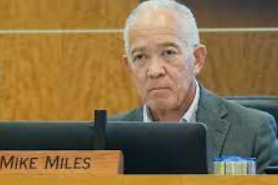
Mercedes Schneider summarizes the checkered career of Mike Miles, who was put in charge of the Houston Independent School District by State Commissioner Mike Morath, who was appointed by hard-right Republican Governor Greg Abbott. Abbott wants to punish Houston for not voting for him. What better punishment than to install Mike Miles as superintendent?
On June 01, 2023, the Texas Education Agency (TEA) appointed Mike Miles as the new HISD superintendent.
Miles is the golden-child product of market-based, ed-reform leadership. As reported in his LinkedIn bio, Miles holds no college degrees in teaching (engineering; slavic languages and literature; international affairs and policy). He has never been a classroom teacher, never a site-based administrator, yet he was a district superintendent in Colorado for six years (2006-11) and superintendent of Dallas ISD for three.
Though he does not mention it in his LinkedIn bio, Miles was a member of the Class of 2011 at the Broad Superintendents Academy A 2011 EdWeek article on Broad superintendents includes the criticism that they “use corporate-management techniques to consolidate power, weaken teachers’ job protections, cut parents out of decisionmaking, and introduce unproven reform measures.”
Indeed.
In 2015, Miles abruptly resigned from Dallas ISD amid being, as WFAA.com states, “at the center of controversy since he took the position nearly three years ago,” which apparently included questions about misdirecting funding intended for at-risk students and the subsequent exit of the Dallas ISD budget director. (Also calling Miles “a lightening rod for controversy,” WFAA.com offers this timeline of Miles’ unsettling tenure in Dallas.)
Following his Dallas ISD exit, in 2016, he founded a charter school chain, Third Future Schools, which has locations in Colorado, Texas, and Louisiana. For two years (2017-19), Miles was a senior associate in an education consulting firm, FourPoint Education Partners.
Nancy and I co-authored a book that serves as a glossary about fads and “reforms.”
She begins her new article:
School reform continues to privatize and destroy public schools. August marks ten years since I began blogging. Within that time I have written two books and co-authored a third with Diane Ravitch. I’m proud of all this writing but Losing America’s Schools: The Fight to Reclaim Public Education is the book title that especially stands out today.
Many Americans still don’t understand or value their ownership of public schools, and how they’re losing one of the country’s great democraticinstitutions. Instead of working together to build up local schools, to iron out difficulties, they’re willing to end them.
Thank you for reading my blog, commenting, and for those of you who have written posts. I am amazed at the wonderful educators, parents, students, and policymakers I have met. I have appreciated debate.
Here are some of the main education issues still of concern.
The Arts
School arts programs help children thrive. Those with mental health challenges benefit. Students might find art jobs. Sadly, many poor public schools ditched the arts. Some schools might get Arts Partnerships or entrepreneurships (Hansen, 2019). These programs aren’t always consistent. Public schools must offer well-rounded and fully resourced K-12 arts programs.
Assessment
Assessment is important for teachers to understand students. But high-stakes standardized tests push a narrow, one-size-fits-all agenda used to drive parents to private schools which, on the other extreme, have little accountability. Tests have been harmful to students.
Controversy originally surrounded Common Core State Standards, promoted by the Bill and Melinda Gates Foundation in 2010, but Common Core continues to drive profiteering, especially in online programs.
A massively well-financed campaign of billionaires and politically powerful advocacy organizations that seeks to replace our current system of public education which, for all its many flaws, is probably the most democratic institution we have and one that has done far more to address inequality, offers hope, and provide opportunity than the country’s financial, economic, political, and media institutions with a market-based, non-unionized, privately managed system.
Corporations and Politicians
Corporations and politicians continue to work to end public schools and drive teachers out, transferring tax dollars to nonprofit and for-profit entities.
Nancy covers many more topics that have been harmful to public education.
Open the link and read her article in its entirety.
Tom Ultican writes about the Delaware disaster. Delaware went all in for neoliberal school reform, being one of the first winners of a Race to the Top award, and has seen its academic performance decline. It’s time to switch gears, he says, and let teachers teach without threats and fear. He writes that the Delaware story should be a lesson for the nation on the failure of No Child Left Behind and Race to the Top ideology —both representative of neoliberal school reform. This is one of Tom’s very best posts. Open the link and read it all!
He begins:
An unholy alliance between neoliberal Democrats and education reform oligarchs is harming Delaware public education. This is a lesson for the rest of the nation.
A new charter school law introduced to reduce principal professionalism is the latest example. Data clearly shows for almost two decades, top-down education reform has been ineffective and seriously damaged a once exemplary system.
In March, the Delaware Professional Standards Board recommended charter school certification requirements match public school rules. Kendall Massett, executive director of the Delaware Charter Schools Network, immediately responded, “All Delaware charter schools are led by highly qualified administrators.” She said charter school principals have a different role than public school leaders and need to be excellent marketeers to raise funds and drive enrollment.
Did she mean charter school principals don’t need to be professional educators?
For the Standards Board recommendation to take effect, adoption by the State Board of Education is required. Before they acted, Senate President Pro Tem David P. Sokola introduced senate bill 163 to relax certification rules for charter school principals.
The heart of Democrat Sokola’s legislation says:
“The bill creates new subsections in Section 507(c) of Title 14 of the Delaware Code to define the licensure and certification requirements more clearly within Chapter 5 of Title 14. Finally, the bill requires the Secretary of Education to work with the Delaware Charter Schools Network to create a qualified alternative licensure and certification pathway for charter school administrators engaged in the instruction of students (Instructional Administrators).”
Teachers’ union leader, Mike Matthews, wrote to the Senate Executive Committee:
“I was disheartened to see that SB 163 — a bill that will actually deprofessionalize the education profession — was introduced by Senator Sokola. I was even more disappointed — and concerned — to see it filed in the Senate Executive Committee instead of the Senate Education Committee where it belongs. Why was that?”
The Bill was passed by the State Senate and is currently awaiting action in the House Administration Committee. The House Education Committee, like its counterpart in the Senate, is not involved.
Neoliberal Education Reform
A Delaware Live headline howls, “School test scores dismal again despite new math, reading plans.” Two decades of 4th and 8th grade reading and math data on the National Assessment of Education Progress (NAEP) support the headline. NAEP is often referred to as the nation’s education report card. The above graphs beg the question,“what happened in 2010?”
Long-term NAEP data showed that from 1971 until 2002, there was steady growth in math and reading. The steady growth ended concurrent with the adoption of the bipartisan Kennedy-Bush education reform called No Child Left Behind. The graphs illustrate this phenomenon.
Why did Delaware’s scores start falling?
In 2010 educator and blogger, Susan Ohanian, reported,
“Delaware and Tennessee came out on top in round one of RTTT: Delaware got $100 million (about $800 per student), and Tennessee $500 million (about $500 per student). Since these states radically changed their education strategies to receive what amounts to 7 percent of their total expenditures on elementary and secondary education, the feds are getting a lot of bang for the buck.”
The $4.5 billion dollar Obama-era Race To The Top (RTTT) program was administered by Education Secretary Arne Duncan. Grants were given to states that complied with three key elements: (1) Evaluate teachers based on student test scores (2) Close and turn into charter schools public schools that continue to get low test scores (3) In low-test score schools, the principal and half of the staff are to be fired and replaced. In addition, states were encouraged to create more privately-managed charter schools.
Education historian and former Assistant US Secretary of Education Diane Ravitch predicted the program’s utter failure when it was announced:
“All of these elements are problematic. Evaluating teachers in relation to student test scores will have many adverse consequences. It will make the current standardized tests of basic skills more important than ever, and even more time and resources will be devoted to raising scores on these tests. The curriculum will be narrowed even more than under George W. Bush’s No Child Left Behind, because of the link between wages and scores. There will be even less time available for the arts, science, history, civics, foreign language, even physical education. Teachers will teach to the test. There will be more cheating, more gaming the system.”
For more than a century, brilliant educators have been skeptical of top-down coerced education reform like those from Duncan, Obama, Bush and Kennedy. Alfred North Whitehead published his essay, “The Aims of Education” in 1917, stating:
“I suggest that no system of external tests which aims primarily at examining individual scholars can result in anything but educational waste.” (Page 13)
“But the first requisite for educational reform is the school as a unit, with its approved curriculum based on its own needs, and evolved by its own staff. If we fail to secure that, we simply fall from one formalism into another, from one dung-hill of inert ideas into another.” (Page 13)
Former McKinsey Consultant and Democrat with neoliberal inclinations, Jack Markell, was elected Delaware Governor in 2009. His first major victory was winning the RTTT grant. He said:
“What’s really important today is where we go from here; whether we have the will to put our children first and move forward with reforms to improve our schools so that Delaware children can successfully compete for the best jobs in an increasingly competitive global economy. That won’t be easy, but we have proven in these past few months that it can be done. I would like to thank all those who worked with us in support of our application and look forward to moving ahead to improve our schools.”
Markell praised then Senate Education Committee Chair, David Sokola, for his work on the RTTT grant proposal, the same Senator who just introduced legislation to soften certification requirements for charter school principals.
Since the RTTT announcement, Delaware has gone from consistently scoring above the national average on all NAEP testing to dropping well below.
Oklahoman John Thompson writes about the conflict enveloping the Tulsa public schools: Ryan Walters, the extremist Secretary of Education, wants to take over Tulsa’s public schools. Opposition to Walters’ plans by Tulsa’s parents and political leaders is growing. State takeovers if school districts have historically failed but Walters doesn’t appear to know it.
For instance, Walters said at a Moms for Liberty event, “Tulsa Public Schools is getting money from the Chinese communist government,” He said, “They funneled it through a nonprofit — I mean, money-laundered it through a nonprofit in Texas.”
But then Walters said he “had been in regular communication with Houston [HISD] about their school takeover.” According to HTUL news, he has said “there’s currently a standards team and textbook committee to gather information on possible vendors like Hillsdale College and PragerU.”
Immediately afterwards, journalists, educators, and public school supporters studied the history of Broad Foundation takeovers in Dallas and the HISD. Even better, they spoke out in ways I had never seen in Oklahoma’s edu-politics. For example, TPS board member, Jennettie Marshall, “said during the board’s 90-minute discussion of the district’s accreditation status. ‘We are under attack. If you’re not keeping up with Houston, … if we continue the course we’re on, that’s where we’re headed. That shouldn’t be.’”
Just as important, the Tulsa World balanced its excellent reporting with editorials and publishing letters to the editors. The following 13 headlines were cited in just one day, August 18, 2023, of the paper’s E-Edition:
The first thing that stands out stands out about the World’s coverage is its excellent journalism, and its fact-checking of Walters. The first thing that stands out from the World’s opinion pieces and letters to the editor is the strong wording when opposing Walters’ threat to the Tulsa Public Schools. The letters opposed Walters’ “antics;” his “personal agenda;” his “political rhetoric;” how he “has no specific plans for Tulsa schools, only insults;” and how he “harms students across the state; as well as how he should “help improve schools, not tear down;” and how the mayor “must be more forceful defending Tulsa schools.”
The editorials criticize the “silence” of political leaders, who belatedly pushed back against Walters, saying the “TPS needs partners, champions and advocates to improve — not political firebombs and quiet bystanders.” Another argued that Walters’ “political rhetoric” hurts the retention of good teachers; and that it hurts the city. Ginnie Graham described the chaos that she witnessed when enrolling her child in school, and explained:
The TPS administrators are completely overwhelmed by the firehose of misinformation, distortions and lies coming at them. Their time is monopolized by people seemingly hell-bent on tearing down the district, rather than offering a helping hand or even sitting down for an informative discussion.
Your TPS Board of Education has a plan. Walters does, too, but not one that works on behalf of Tulsans.
I didn’t sign up for this takeover and neither did you. As a community, we must stop it: www.protecttps.com
Moreover, the World reported on powerful philanthropists, like the Schusterman and the Kaiser foundations, who have publicly opposed Walters takeover threats. Then, Mayor G.T. Bynum came out against the takeover. The resistance has even reached the point where the World editorialized, “conservative lawmakers must speak up.” And now, Gov. Kevin Stitt has distanced himself from the extremist (Walters) who he appointed and then repeatedly supported. The World reported, Stitt said he “believes the State Board of Education will not overreact when considering accreditation for Tulsa Public Schools.” Stitt now says, “I don’t know what takeover is, what they are talking about. I believe in local control. I think the local board needs to address that.”
When I first learned about Walters’ new threats, I worried, “If we don’t recognize the extent of the threats of a HISD-style takeover, he might unite the worst of the corporate reform privatizers, with his Moms for Liberty extremism, and impose irreparable damage on the TPS and other school systems.” But, “If we unite, the damage that Walters is promising to inflict on the TPS, and the Tulsa metropolitan area as a whole, could undermine his extremist campaigns.”
It looks to me, that Tulsans and other Oklahomans are pushing back, making it more likely that Walters will lose this fight
Dan Rather and Elliot Kirschner wrote in their blog Steady about the importance of saving public education from the forces trying to destroy and privatize it. They remind us and the general public that public schools unite us; privatization is inherently divisive. It is ironic that the red states are implementing voucher plans as the evidence about the failure of vouchers and the null effects of charter schools grows stronger. (The boldfacing of passages in their essay was added by me).
It is back to school. Students of all ages flock to campuses and classrooms. Fleeting memories of summer are quickly replaced by tests and textbooks.
Getting into the swing of a new semester has always included an adjustment period, but this is a particularly difficult time for many of our nation’s students and their parents, guardians, teachers, and others entrusted with the education of young minds.
The pandemic wreaked havoc with the emotional, intellectual, and social development of America’s youth. Dismal test scores provide depressing data of yawning learning deficits. Talk to anyone in or around schools and you hear stories of setbacks and struggle — heaps of qualitative data suggesting a staggering scale of generational loss. As usual, those who were already the most marginalized have paid the heaviest price. The pandemic exacerbated existing disruptions and placed greater strain on finances and time, particularly in large urban districts and small rural ones tasked with educating children from families struggling economically.
We like to tell ourselves that the United States is a great meritocracy, but wealth and levels of family education continue to play outsized roles in dictating a child’s likelihood of academic success long before she learns her ABCs. The simple truth is that kids come to school from widely different circumstances, and these influence their ability to thrive, independent of whatever innate intelligence or drive they may possess. The pandemic made these differences more acute.
The United States does possess a system (or more accurately, a collection of thousands of systems) that, if nurtured and respected, could foster greater equality of opportunity. And it is exactly the institution that is now struggling the most: public education. America’s public schools were once the envy of the world as engines of opportunity and upward mobility. If the nation had the will, they could return to that status once again.
Our public schools certainly weren’t perfect in the past, especially during legal racial segregation, when the lie of “separate but equal” (separate is never equal) helped enshrine white supremacy. The segregated schools of the Jim Crow Deep South were a shameful injustice and a stain on our national identity. They were inconsistent with our founding documents, which spoke eloquently about equality among people. Of course there was (and remains, to some extent) de facto segregation throughout America based on who lives in what neighborhoods. Well-financed suburban schools were often part of the draw of “white flight” from urban districts.
The very ethos of public education should be one of inclusion for America’s diverse population. It should be a place where children of different backgrounds come together to learn both from teachers and from each other. Our schools should be places that allow students to wrestle with what it means to be part of this great country, including understanding America’s uneven and often bloody road to greater equality.
Sadly, in recent years, we have seen a grave regression from these noble goals. Our schools and school districts have become fiercely contested frontlines in an era of stepped-up culture wars. As reactionary political forces target what we teach our children, it is no accident that truth, empathy, and our democratic values have become casualties.
A chief concern is how and what we teach about our history, particularly the Black experience, and race and ethnicity more generally. We have written here before about the shameful whitewashing of racial violence and injustice, including slavery, by Florida Governor Ron DeSantis. But this effort is not limited to him or that state. There is a national movement to not tell the full — and unfortunately tragic — reality of race in American history and how it continues to shape the nation.
Another serious concern is the othering of LGBTQ+ students and teachers. After years of progress, we see a wave of intolerance spread across America, including in our schools.
Few institutions in American life are as essential to the continuation of our democracy as the public schools. In a time of ascendent autocracy, attacks on our schools — how they are run, what they teach, what books they have in their libraries — are among the most pernicious, pathetic, and painful assaults on the health of our nation.
Several months back, Texas Monthly ran a striking piece of journalism with the headline, “The Campaign to Sabotage Texas’s Public Schools.” It tells a story that extends beyond the raucous school board meetings and book banning campaigns that have gotten the most attention. There is a movement afoot, and not just in Texas, to destroy public schools more generally, to privatize education through vouchers and other means.
In this context, the various culture fights become battles in a larger war over the very future and viability of public education:
Taken individually, any of these incidents may seem like a grassroots skirmish. But they are, more often than not, part of a well-organized and well-funded campaign executed by out-of-town political operatives and funded by billionaires in Texas and elsewhere. “In various parts of Texas right now, there are meetings taking place in small and large communities led by individuals who are literally providing tutorials—here’s what you say, here’s what you do,” said H. D. Chambers, the recently retired superintendent of Alief ISD, in southwest Harris County. “This divisiveness has been created that is basically telling parents they can’t trust public schools. It’s a systematic erosion of the confidence that people have in their schools.
The ideal of quality, integrated public schools for all children in the United States epitomizes the promise of our country’s founding as a place of equality and opportunity for all. It thus makes sense that would-be autocrats and protectors of privilege would seek to undermine our public schools by whatever means necessary. We must see this as what it is: as much a threat to the nation as was the violent storming of our Capitol.
The future of the United States depends on an educated and empathetic citizenry. It requires us to share a sense of common purpose and recognize our common humanity. It requires an environment that allows every child to thrive and see themselves included in the American story. It requires quality public education. Full stop.
A historic battle to save this institution and the very idea of good public schools has been underway for some time. It is now intensifying. Attention must be paid.
John Thompson, historian and retired teacher, believes that Ryan Walters, the state superintendent, may take control of Tulsa Public Schools, despite the fact that he has no idea how to improve them and that state takeovers have seldom (if ever) improved any schools. It’s ironic that Walters is eager to fire Tulsa superintendent Deborah Gist, since Gist received national plaudits for threatening to seize control of the impoverished Central Falls school district in 2010 when she was state superintendent in Rhode Island.
Thompson writes:
We’ve known that State Superintendent Ryan Walters was rapidly ramping up his attacks on public education, especially the Tulsa Public Schools (TPS), but the intensity of his assaults keeps growing at a frightening rate. Even though I’ve been worrying that Walters would combine the destructive rightwing extremists’ venom with the worst of the discredited neo-liberal corporate privatization reforms, it sounds like on August 24, he may do it in the worse possible way. Rather than remove the TPS’s accreditation and/or its superintendent, Walters may order a rushed takeover of the district patterned after the recent takeover of Houston’s schools.
As Nondoc reported on Tuesday, on Saturday Walters said at a Moms for Liberty event, “Tulsa Public Schools is getting money from the Chinese communist government,” He said, “They funneled it through a nonprofit — I mean, money-laundered it through a nonprofit in Texas.” On Monday, “Walters appeared at the Tulsa County Republican Party headquarters to discuss the district,” saying that it must “Reorient finances to serve students, increase reading proficiency scores to the state average, and lift its schools off of the state F-list.” “Now,” Nondoc reports, “state board members could choose to place TPS on full probation.” Moreover, Walters has “also declined to rule out a non-accreditation vote on TPS, though it is unclear how that action would play out for a district of 33,000 students after the school year has already started.”
Clearly, the removal of Superintendent Deborah Gist is a major priority. Ironically, Walters is challenging the honesty of TPS administrators as his “administration of federal GEER funds is being investigated by FBI agents and the Oklahoma Attorney General’s Office, according to people with direct knowledge of the inquiry.”
Even worse, Walters says he is regularly consulting with the Texas education commissioner, Mike Morath, about “strategies Texas used in its takeover of HISD.” The new Houston superintendent, Mike Miles, has long relied on mass exiting of teachers, and he’s already ordered educators at 28 schools to reapply for their jobs, and ordered the closures of many “reformed” schools’ libraries. So, it is no surprise that the President of the Tulsa Classroom Teachers Association, Shawna Mott-Wright, says that “the uncertainty over the district’s future already has some teachers stepping away from their jobs.”
In response, TPS board member, Jennettie Marshall, “said during the board’s 90-minute discussion of the district’s accreditation status. ‘We are under attack. If you’re not keeping up with Houston, … if we continue the course we’re on, that’s where we’re headed. That shouldn’t be.’” She warned, “We can’t afford to lose our educators, support groups and people who provide wraparound services. We can’t afford for this district to lose its accreditation.”
To understand why Walters’ new attack could be an existential threat to public education in Tulsa, one should listen to Nancy Bailey’s analysis of such takeovers:
State takeovers aren’t new. Nor are they known for innovation, but for creating school voids, cutting services, and firing key staff, promising to close learning gaps. Takeovers usually only weaken schools, breaking them up and leaving communities with fewer and poorer schools.
Moreover, the Hechinger Report cited a study by Brown University and the University of Virginia which “looked at all 35 state takeovers between 2011 and 2016. ‘On average, we find no evidence that takeover generates academic benefits.’” But the Hechinger Report added, “Race, meanwhile, plays a role in the likelihood of a district being taken over.”
The HIDC takeover campaign sped up in 2018 when “four of Houston’s 274 schools, all of them in the city’s economically distressed north and east sides, hadn’t met the standards for four years running.” By the time the takeover was ordered, “all but one of the district’s four failing schools was meeting state standards” but a rule change caused Phillis Wheatley High School to “narrowly” miss the mark. By 2021-22, Phyllis Wheatley had already improved from an F to a high C grade. Persisting in the takeover thus added support to researchers who concluded, “Now red-state governors increasingly use the takeovers to undermine the political power of cities, particularly those governed by Black and Hispanic leaders.”
We must also remember the history of the disastrous reigns of non-educator Mike Miles, a Broad Foundation corporate reform trainee, who Texas commissioner Morath placed in charge of Houston. When Miles was selected, apparently nobody asked about “the 26% drop in high school enrollment during the 6 years he was superintendent over Harrison School District Two in Colorado.” In Dallas, Miles set a target of “at least 75 percent of the schools are ‘partially proficient’ in four areas that focus on classroom instruction.” One of many reasons why that goal was impossible was “the loss of 6000 teachers in just three years.” His dictatorial mindset was illustrated by Miles ordering the removal by the police of a board member visiting a middle school where he had “replaced the principal, two assistant principals and 10 teachers.”
Dallas student outcomes had been increasing before Miles took over but student performance largely stagnated during his administration. As the Dallas Morning News reported, his tenure was marked by “disruptions, scandals, clashes.”
Now, Houston is facing the same situation where “sweeping changes include longer instructional days, lessons scripted by planners, not teachers, and new evaluations for educators that tie pay to academic performance.” The focus will be on math and reading. Cameras will be placed in each classroom to monitor behavior. Not surprisingly, Nancy Bailey notes that as the “HISD is losing qualified teachers, school libraries, and librarians,” it is “advertising for 350 long-term substitutes who don’t require a college degree.” She presciently concludes, “Watch as these kinds of reforms become prevalent in other school districts if they haven’t already.”
I have long had serious problems with Superintendent Gist, but I would have never called her “Woke Barbie” as her opponents have. To me, this is similar to the situation when Democrats joined with former Rep. Liz Cheney in defending our democracy. And, if we unite, the damage that Walters is promising to inflict on the TPS, and the Tulsa metropolitan area as a whole, could undermine his extremist campaigns. On the other hand, if we don’t recognize the extent of the threats of a HISD-style takeover, he might unite the worst of the corporate reform privatizers, with his Moms for Liberty extremism, and impose irreparable damage on the TPS and other school systems.
Thom Hartmann is an insightful, incisive journalist and blogger. In this terrifying post, he describes what to expect if the Republican Party wins the presidency.
Please read and react.
Thom Hartmann
So, yeah, let’s take seriously the existential threat a GOP president represents to our nation, the nations of the world, and all life on Earth. The stakes have literally never been higher…
Hartmann writes:
Every day that goes by, even with yesterday’s newest indictment, looks more and more like Donald Trump will be the GOP’s standard bearer in 2024. After all, his popularity stood at 44 percent when NY DA Alvin Bragg indicted him; it then rose to 49 percent when he was indicted in the documents crime; following his conviction for raping E. Jean Caroll it rose to 54 percent among Republicans.
But even if he’s not the candidate, Republican primary voters will demand a candidate with the same affection for Putin and other dictators; the same disdain for racial, religious, and gender minorities; the same abusive attitude toward women and girls; the same faux embrace of Confederate and hillbilly values and hatred of city-dwellers and college graduates; the same cavalier attitude toward guns and fossil fuels.
There’s also the growing possibility that Trump or another MAGA Republican could win the White House. Yesterday, both the New York Times and CNN reported on polls showing that Trump and Biden are right now at a dead heat.
And even if Trump collapses in the polls as the result of the indictments, which is unlikely (Netanyahu is under indictment for bribery and some pretty terrible stuff and he just got re-elected), there are numerous other Republicans who would love to take his place.
And no matter who it is, if they are MAGA inclined, Trump has shown them where there are levers of power and corruption that are consequential in ways that they never dreamed of before him.
Joe Biden, at 81, faces multiple possible personal scenarios that could pull him out of the race. No Labels and the Green Party’s candidates (presumably Joe Manchin and Cornell West) could pull enough votes from Biden to hand the election to Trump as Jill Stein did in three swing states in 2016 (she pulled more votes in each of those states than Trump’s margin of victory).
The prosecution of Trump (which almost certainly won’t be resolved before the election — and it’s not even remotely possible that appeals would be resolved by then — because of Garland’s dithering for two years) could backfire politically and make him into a popular martyr even with Republicans who disliked him before.
And don’t discount the impact Putin throwing millions of rubles into social media can have: his previous fleet of trolls overwhelming social media helped get Trump elected in 2016 and drove Brits to make the crazy decision to separate from the European Union.
So, it’s important to examine what a second Trump or 2025 MAGA presidency would look like, what effect it would have on America and the world, and how it will impact average Americans.
Forewarned, after all, is forearmed, and all these predictions are based on past behavior and public statements:
Women make up 51 percent of the American populace but they won’t be spared by a MAGA presidency.
MAGA voters celebrate Trump’s “proof of manhood” through his multiple sexual assaults, from his alleged rape of 13-year-old Katie Johnson (with Jeffrey Epstein) to the adult E. Jean Carroll and more than 20 others. He publicly bragged that he just “grabs them by the…” whenever he wants, and Republicans — including more than half of all white women voters — ran to the polls to mark his name on their ballots.
The MAGA base supports bans on abortion: the white nationalist part of that base is fervent about having more white babies (and middle class white women are the most likely to get abortions when they’re legal, according to these people).
Catholics and evangelicals even support bans on birth control, an issue that’s already been floated by Clarence Thomas on the Supreme Court and in several state legislatures. Fully 195 Republican members of the House of Representatives voted against protecting birth control from state bans. And all of the Republicans on the Court are conservative Catholics (Gorsuch attends his wife’s church, but was raised Catholic).
Additionally, MAGA Republicans support ending no-fault divorce and limiting alimony, putting women back under husband’s thumbs; lowering the marriage age for girls to as low as 12, as Republicans have already attempted in Idaho, Wyoming, Tennessee, Missouri, and Louisiana; and seizing and monitoring the health and doctor’s records of all childbearing-age women to catch early pregnancies so those women can be detained or surveilled “for their own good” (yes, it’s already happened).
The LGBTQ+ community will come under assault in ways not seen for decades.
Like in Germany in 1933, the trans communitywill be the first to come under assault, a process that’s already begun as Red state after Red state enacts laws banning gender-affirming healthcare. Drag queens are already criminalized in multiple states.
Gays and lesbians won’t be far behind; Republicans are already trying to outlaw gay marriage and adoption. Three-quarters of all House Republicans voted against a Democratic bill protecting gay marriage; all but one Republican on the House Appropriations Committee voted for a Republican bill that would allow states to ban gay and lesbian parents from adopting.
Stochastic terrorism against the LGBTQ+ community will explode, and, in a throwback to the 1980s (when Reagan refused to say the word “AIDS” for 8 long years as tens of thousands, including close friends of mine, died) and before, rural law enforcement will often yawn when queer people are assaulted or even murdered.
Terror against racial and religious minorities will become routine.
The last time Trump was president and sanctioned a “very fine people on both sides” climate of hate and bigotry, incidents of lone-wolf terrorism exploded. Jews executed at Pittsburgh’s Tree of Life synagogue; Blacks gunned down in a supermarket in Buffalo and executed at Mother Emmanuel church in Charleston; Hispanics slaughtered in El Paso. All of the killers cited or wrote what were essentially MAGA or MAGA-aligned propaganda instruments as part of their motivation.
When minority communities rise up in indignation and step out into the streets to demand protection from roving bands of street Nazis, armed vigilantes will threaten and even kill them with impunity. As I noted yesterday, Kyle Rittenhouse is now lionized by Republicans and three states have passed into law provisions that hold people who kill protestors with their cars free from prosecution.
American support for democracy around the world will end and Putin will destroy Ukraine.
During his first four years, Trump did everything he could to ridicule and minimize our democratic allies and suck up to strongman dictators around the world.
He tried to blackmail Ukraine’s president and then withheld defensive weapons from that country when Zelenskyy refused to go along.
He told the world that he trusts Putin more than America’s intelligence services. After meeting privately with Putin, he demanded a list of all of America’s spies and their stations around the world; within months, the CIA reported that their assets were being murderedwith an unprecedented speed and efficiency.
He or his son-in-law conveyed top-secret documents to the brutal murderer MBS in Saudi Arabia that enabled him to stage a coup and seize control of that nation, a gift for which the Trump family has already received at least $2.5 billion with more coming every day.
Trump has now said that he will end the Ukraine war “in 24 hours.” His strategy? As Mike Pence (who would know) said, “The only way you’d solve this war in a day is if you gave Vladimir Putin what he wanted.”
Putin’s allies, in fact, have told the press that his main strategy for seizing all of Ukraine is to wait for Trump to re-take the White House (and, of course, he’ll do everything he can to make that happen). And just last week, in Erie, Pennsylvania, Trump came right out and saidthat he’d end all arms support to Ukraine on day one.
Seeing that America will no longer defend democracies, China will take Taiwan and North Korea may well attack South Korea. It could trigger a nuclear World War III, although instead of America being the “bulwark of freedom” as we were in the 1940s, that burden will fall to Europe, Japan, and Australia.
Reagan’s Republican War on Workers will resume and even pick up steam.
The Heritage Foundation already has a 900+ page plan to change the American government, stripping the DOJ, FBI, FCC and the Fed of their independence while ending most union rights and effectively outlawing strikes.
Billionaires will receive more tax cuts, Social Security and Medicare will be fully privatized, and public schools will be replaced with vouchers for private, segregated, religious academies as has already happened under Republican administrations in Arizona and Florida.
The EPA and other regulatory agencies that protect workers, consumers, and the environment will be gutted to the point of impotence in the face of corporate and billionaire assaults.
Efforts to mitigate the climate emergency will be rolled back and fossil fuel extraction and use will explode.
The world just lived through the hottest month in human history; ocean waters off Florida are at the temperature Jacuzzi recommends for their hot tubs; the world’s oceans are dying and winter sea ice isn’t forming in Antarctica.
Right now we humans are adding heat to the atmosphere (because of higher levels of greenhouse gasses) at a rate identical to 345,600 Hiroshima bombs going off in our atmosphere every day: four nuclear bombs per second, every second, minute, and hour of every day.
In response, our planet is screaming at us.
Fossil fuel billionaires and their shills, however, are unconcerned as they continue to fund climate denial nonprofits and Republican politicians who claim it’s all a hoax. They apparently believe their vast wealth will insulate them from the most dire effects.
And they’re probably right: a third of poverty-stricken Bangladesh was underwater this year, as drought, floods, wildfires, heat domes, bomb cyclones, tornadoes, derechos, and typhoons ravaged America with unprecedented ferocity. Increasingly, those without the financial means to withstand weather disasters are killed or wiped out, losing their family homes and often their livelihoods.
Scientists tell us we may have as few as fiveyears, and certainly not more than 20, to end our use of fossil fuels and fully transition to clean renewables. Even within the five-year window it’s technically feasible, but if Trump or another MAGA Republican is elected, civilization-ending weather and the death of much of humanity is virtually assured.
We must wake up America.
So, yeah, let’s take seriously the existential threat a MAGA president represents to our nation, the nations of the world, and all life on Earth. The stakes have literally never been higher.
Alec MacGillis of ProPublica wrote recently in Raw Story about the feeding frenzy that accompanied Big Tech’s sales pitch: the tech industry claims that its hardware and software can cure learning loss. The salesmen dazzle teachers and administrators with promises and swag. The irony, as the story points out, is that “learning loss” was associated with remote learning, lack of personal interaction with their teachers. Why not more of the same that exacerbated the problem?
For the nation’s schoolchildren, the data on pandemic learning loss is relentlessly bleak, with education researchers and economists warning that, unless dramatic action is taken, students will suffer a lifelong drop in income as a result of lagging achievement. “This cohort of students is going to be punished throughout their lifetime,” noted Eric Hanushek, the Stanford economist who did the income study, in ProPublica’s recent examination of the struggle to make up for what students missed out on during the era of remote learning.
For the burgeoning education technology sector, however, the crisis has proven a glimmering business opportunity, as a visit to the industry’s annual convention revealed. The federal government has committed $190 billion in pandemic recovery funds to school districts since 2020, and education technology sales people have been eagerly making the case that their products are just what students and teachers need to make up lost ground.
“We’re huge in learning loss,” said Dan DiDesiderio, a Pittsburgh-area account manager for Renaissance Learning, a top seller of educational software and assessments. He was talking up his company’s offerings in the giant exposition hall of the Philadelphia Convention Center, where dozens of other vendors and thousands of educators gathered for three days late last month at the confab of the International Society for Technology in Education. For DiDesiderio, who was a school administrator before joining Renaissance, this meant explaining how schools have been relying on Renaissance products to help students get back on track. “During COVID, we did see an increase across the board,” he said.
Renaissance is far from the only player in the ed tech industry that is benefiting from the surge in federal funding, and the industry enjoyed a huge wave of private funding as the federal tap opened: The annual total of venture capital investments in ed tech companies rose from $5.4 billion to $16.8 billion between 2019 and 2021 before tailing off.
The largest chunk of the federal largess, $122 billion that was included in the American Rescue Plan signed by President Joe Biden in March 2021, requires that schools put at least 20% toward battling learning loss, and companies are making the case that schools should spend the money on their products, in addition to intensive tutoring, extended-day programs and other remedies. “The pandemic has created a once-in-a-lifetime economic opportunity for early stage companies to reach an eager customer base,” declared Anne Lee Skates, a partner at venture capital firm Andreessen Horowitz, in a recent article. (Her firm has invested in ed tech companies.) The federal funds “are the largest one-time infusion of funds in education from the federal government with almost no strings attached.”
Five days before the convention, the National Center for Education Statistics had released the latest devastating numbers: The decline in math scores for 13-year-olds between the 2019-20 and 2022-23 school years was the largest on record, and for the lowest-performing students, reading scores were lower than they were the first time data was collected in 1971.
But the mood was festive in Philadelphia. The educators in attendance, whose conference costs are generally covered by their district’s professional development funds, were excited to try out the new wave of nifty gadgets made possible by the advances in artificial intelligence and virtual reality. “For a lot of us, it’s like coming to Disneyland,” said one teacher from Alabama.
One could also detect the slightly urgent giddiness of a big bash in its final stages. Schools need to spend most of their recovery funds by 2024, and many have already allocated much of that money, meaning that this golden opportunity would soon close. And summer is the main buying season, with the fiscal year starting July 1 and with educators wanting their new tools delivered in time for school to start in the fall.
Hanging over the proceedings was an undeniable irony: The extent of learning loss was closely correlated to the amount of time that students had spent doing remote learning, on a screen, rather than receiving direct instruction, and here companies were offering more screen-based instruction as the remedy. Few of the companies on hand were proposing to replace the classroom experience entirely with virtual instruction, but to the degree that their offerings recalled the year-plus of Zoom school, it could be a bit awkward. “A lot of people don’t like us, because we can do remote-school stuff,” said Michael Linacre, a salesperson for StarBoard Solution, before demonstrating one of the cool things a StarBoard whiteboard could do: He jotted 1+2= with his finger and up popped 3. “There’s a mixed feeling about that now.”
Most of the vendors were not about to let that awkwardness get in their way, though, as they cajoled teachers to listen to their pitch, often with the lure of free swag.
Gary Rubinstein has been a teacher since 1991. Four of those years were spent teaching in Houston. Gary has been watching what’s happening since Mike Miles arrived and was taken aback when Miles imposed sweeping changes on the district without spending time getting to know it. Miles’ “reforms,” Gary predicts, are heading for trouble. Those reforms come out of the “corporate reform” playbook. Maybe Miles took a page or two from the Broad Academy guidelines, applicable in all situations.
Gary writes:
With around 200,000 students, Houston Independent School District (HISD) is the 8th largest school district in the United States. For years there was talk about the state possibly taking over the district and this finally happened on June 1, 2023. The board was fired and replaced by Texas Education Agency (TEA) appointees. Mike Miles, who founded a charter school network called Third Future Schools and was previously the head of Dallas Schools for three years, was hired as the new HISD superintendent. While most people new to a job like this would take some time to get the ‘lay of the land,’ Miles instantly proposed some radical, and in my estimation, terrible, reforms which I will outline in this post.
He identified the three lowest performing high schools in HISD: Wheatley, Kashmere, and North Forest. Those three schools together with the 26 middle and elementary schools that feed into those high schools were to become part of a new ‘New Education System’ known as NES. This NES is the latest ‘turnaround’ district. Over the past 20 years there have been several of these, the most prominent are the Recovery School District (RSD) in New Orleans, set up after Hurricane Katrina in 2003 and the Achievement School District (ASD) in Tennessee, created in 2011 with Race To The Top money. There was also Michigan’s Education Achievement Authority (EAA) in 2011 as well as a few more that have popped up around the country. To my knowledge, there has never been a successful takeover of this sort in the history of this country. The EAA has been shut down, the RSD has been merged back into the New Orleans school system and the ASD has floundered, never having any success at all in improving the test scores of the schools it took over. It is funny/sad to see this hopeful panel discussion by the leaders of these districtsbefore it was known how badly they would fail. (I’ve written a lot about the ASD, but here is something I wrote summarizing the history of these turnaround efforts.)
These turnaround efforts sometimes have school closures or staffs at schools having to reapply for their jobs and often have the schools converted into charters. For the HISD NES model, the schools are not getting taken over by charters but teachers do have to reapply for their jobs. Teachers at these schools will get raises and opportunities for bonuses with test score based merit pay. Other changes that will happen at these 29 schools are a restructuring of the teacher role where the teacher is like a ‘surgeon’ doing the most important part of the job while other tasks like grading, lesson planning, and discipline are done by others. Also, you may have read about elsewhere, libraries at these schools are converted into discipline centers where students are sent to watch a live streamed version of the lesson on a computer screen.
The reason that no turnaround effort like this has ever worked is that it is based on faulty assumptions about what the cause of the low test scores are at those schools so any solution based on those assumptions is doomed to fail. It is like trying to treat a broken leg by giving a patient a complete blood transfusion.
As someone who has been teaching since 1991 – and my first four years were in HISD actually, looking at the list of changes makes me shudder. Anyone who ever taught can see how most of these changes will make the schools worse but I want to summarize some of them here.
All teachers have to reapply for their jobs – When students come back and learn that many of their favorite teachers were not hired back, this can be very traumatic. There is no guarantee that the teachers who replace those who weren’t hired back, even if those teachers have been successful at a different school, will necessarily be a good fit at this school. This uncertain improvement coupled with guaranteed disruption is a pretty big risk. Why not first see how the current staff does with these new supports?
Please open the link to finish this important article.
Gary reviews the other major elements of Miles’s prepackaged plan and explains why they are unlikely to make a difference. They haven’t worked before, why will they work now? As Gary writes, takeovers typically fail because they are based on fake assumptions and prepackaged cures.
ALEC has about 2,000 state legislators as members. ALEC writes model legislation on the environment, education, gun rights, and every other topic likely to be considered by state legislatures. The members take the model legislation back to their home state and introduce it after writing in the name of their state. ALEC is against gun control, against public schools, against environmental protections, etc. ALEC is funded by major corporations and acts as a voice for corporations that want no government regulation.
Erik Gunn is the deputy editor of the Wisconsin examiner, which first published this report.
Wisconsin State Reps. Francesca Hong and Kristina Shelton aren’t exactly the typical lawmakers to belong to the American Legislative Exchange Council — ALEC for short.
Hong, of Madison, and Shelton, of Green Bay, are staunch Democrats who have consistently voted against bills advancing the policies of the sort ALEC promotes. While the organization is legally nonpartisan and a tax-exempt nonprofit, it has become widely known as the birthplace of right-wing legislative proposals that find a home mainly with Republican state lawmakers around the country.
Last week, however, the two second-term Assembly members were in Orlando for ALEC’s annual meeting. It was Shelton’s second visit and Hong’s third. When they posted about their participation on social media, some followers wondered what they were doing in a crowd so ideologically at odds with their own political stances.
“I think it’s important to understand the agenda of the opposition,” Hong says. “And our current political reality requires us to know what the motivation is of our colleagues and where they’re getting model legislation from [along with] talking points, candidate training. These are all things that are available at ALEC.”
“It gives us an understanding of what’s to come,” adds Shelton — in the form of future legislation that members of the Republican majority might introduce. “And it helps us prepare as Democrats, organizing our own legislation and messaging. There’s no better way to prepare than to hear it directly from the folks on the other side….”
Hong and Shelton view themselves as carrying on a tradition among progressive Wisconsin lawmakers in joining ALEC, attending its events and going back home to report what they see and hear. Their predecessors are former state Rep. Mark Pocan, now a member of Congress, and former state Rep. Chris Taylor, now an appeals court judge.
Their name tags for the ALEC event simply identify them as Wisconsin state representatives, and Hong and Shelton say they don’t go out of their way to out themselves as Democrats — but they aren’t undercover, either…
As paying ALEC members (dues are $200 a year; conference fees are $750), they can’t be excluded on ideological grounds because of the group’s nonpartisan legal status, says Hong, who adds she has asked ALEC for its guest list “multiple times” but never received it.
Membership includes the opportunity to join two subject-matter task forces. Hong chose energy and environment as well as taxation and federalism. Shelton’s two were health and human development and education and workforce. Those sessions are where the details of proposed model legislation from the organization are outlined. They are also where the role of big business is most evident in helping to shape the organization’s proposals….
On education, Shelton says, the organization has heavily promoted school privatization proposals, including education savings accounts and universal private school vouchers, such as were included in a sweeping education bill in Arkansas, the LEARNS Act, enacted earlier this year.
“They’re no longer interested in sort of nibbling around the edges on school vouchers,” Shelton says. “They’re going all in — removing the income limits, moving to those education savings accounts, wildly expanding public investment for religious schools … [and] dismantling any sort of bureaucratic accountability measures.”
Hong says the education proposals have also been made with reference to the difficulties that employers have had filling job openings.
“The framing of it didn’t come off as full, ‘We’re attacking public schools,’” Hong says. “This is how we’re going to get more workers is to essentially make schooling and education’s sole purpose is to be producing workers.”
On economic and social policy, a persistent talking point was “about making poor people rich, not rich people poor,” she adds, while government assistance is “dragging down the economy” and “morally wrong.”
“They’re really digging into that narrative and saying that growing government to help those people is going to be the end of time,” Hong says.
To be sure, ALEC is just one of many organizations, from the AFL-CIO to the Sierra Club, that pursue policy change, sometimes constructing model legislation for that purpose. The difference, Shelton says, is that the group’s agenda doesn’t appear to her to be about policy so much as about political power.
“I think what’s different here is a sort of militant approach by those on the conservative right to not be as interested in actually solving the problems in the critical issues of working people,” she says, “but rather creating legislation to drive issues that they see as winning at the ballot box.”
Even so, a prevailing theme was diminishing the role of government and freeing corporations and business, the two Wisconsin Democrats say.




 Diane Ravitch's blog