Archives for category: Censorship

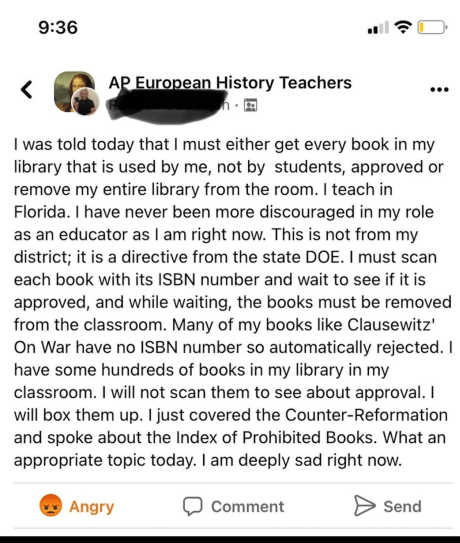
Please, don’t make make America Florida! Fascism starts with book censorship. In this case, a world history must remove his personal books because they are not on the state’s approved list. A book without an ISBN number can’t be in the list. We may assume that The Constitution, the Bible, and The Federalist Papers do not have ISBN numbers.

Rob Rogers created an excellent TikTok video that shows where Chris Rufo fits into the war on public schools. Rufo invented the “critical race theory” hysteria out of whole cloth. He’s proud of his malicious role in “laying siege to the institutions.” Of course, Ron DeSantis appointed him to the board of New College as part of a rightwing takeover of that once highly esteemed liberal arts college that welcomed free-thinkers. To people like DeSantis and Rufo, free thinking is anathema.

To get the full Rufo treatment, watch his speech at Hillsdale College from April 2022.

I try to imagine a world in which everyone thought as Rufo wants them to: ban the artists, the creatives, the innovators, the dissenters, the dreamers, the people who think differently. I don’t want to live in that world. It feels like North Korea.

Michael Hiltzik, columnist for the Los Angeles Times, finds a pattern in the Republican attacks on the schools and universities. Their hostility to teaching Black history, their encouragement of book banning, their strategic defunding of higher education, their treatment of teaching about race, gender, and climate change as “indoctrination”—together point to a goal: the dumbing down of American young people.

Republicans say they want to get rid of “indoctrination” but they are busily erasing free inquiry and critical thinking. What do they actually want? Indoctrination.

He reminds us of the immortal words of former President Donald J. Trump: “I love the uneducated.” Republicans do not want students to think critically about racism or the past. They do not want them to reflect on anything that makes them “uncomfortable.” They want to shield them from “divisive concerns.” They want them to imbibe a candy-coated version of the past, not wrestle with hard truths.

He writes:

For reasons that may not be too hard to understand, Republicans and conservatives seem to be intent on turning their K-12 schools, colleges and universities into plantations for raising a crop of ignorant and unthinking students.

Donald Trump set forth the principle during his 2016 primary campaign, when he declared, “I love the poorly educated.”

In recent months, the right-wing attack on public education has intensified. The epicenter of the movement is Florida under Republican Gov. Ron DeSantis, where the faculty and course offerings of one of America’s leading liberal arts colleges, New College, have been eviscerated purportedly to wipe out what DeSantis calls “ideological indoctrination.”

The state’s K-12 schools have been authorized to supplement their curricula with animated cartoons developed by the far-right Prager University Foundation that flagrantly distort climate science and America’s racial history, the better to promote fossil fuels, undermine the use of renewable energy and paint a lily-white picture of America’s past.

Then there’s West Virginia, which is proposing to shut down nearly 10% of its academic offerings, including all its foreign language programs. The supposed reason is a huge budget deficit, the harvest of a systematic cutback in state funding.

In Texas, the State Library and Archives Commission is quitting the American Library Assn., after a complaint by a Republican state legislator accusing the association of pushing “socialism and Marxist ideology.”

In Arkansas, state education officials told schools that they may not award credit for the Advanced Placement course in African American history. (Several school districts said they’d offer students the course anyway.) This is the course that Florida forced the College Board to water down earlier this year by alleging, falsely, that it promoted “critical race theory.”

I must interject here that I’m of two minds about this effort. On the one hand, an ignorant young electorate can’t be good for the republic; on the other, filling the workforce with graduates incapable of critical thinking and weighed down by a distorted conception of the real world will reduce competition for my kids and grandkids for jobs that require knowledge and brains.

Let’s examine some of these cases in greater depth.

Prager University, or PragerU, isn’t an accredited institution of higher learning. It’s a dispenser of right-wing charlatanism founded by Dennis Prager, a right-wing radio host. The material approved for use in the schools includes a series of five- to 10-minute animated videos featuring the fictional Leo and Layla, school-age siblings who travel back in time to meet historical figures.

One encounter is with Frederick Douglass, the Black abolitionist. The goal of the video is to depict “Black lives matter” demonstrations as unrestrained and violent — “Why are they burning a car?” Leo asks while viewing a televised news report. The animated Douglass speaks up for change achieved through “patience and compromise.”

This depiction of Douglass leaves experts in his life and times aghast. Douglass consistently railed against such counsel. Of the Compromise of 1850, which brought California into the union but strengthened the Fugitive Slave Act — arguably the most detested federal law in American history — he stated that it illustrated how “slavery has shot its leprous distillment through the life blood of the nation.” In 1861, he thundered that “all compromises now are but as new wine to old bottles, new cloth to old garments. To attempt them as a means of peace between freedom and slavery, is as to attempt to reverse irreversible law.”

Patience? The video depicts Douglass quoting from an 1852 speech to a Rochester anti-slavery society in which he said “great streams are not easily turned from channels, worn deep in the course of ages.”

But it doesn’t include lines from later in the speech, reproaching his audience for prematurely celebrating the progress of abolition: “Your celebration is a sham; your boasted liberty, an unholy license; your national greatness, swelling vanity; … all your religious parade and solemnity, … mere bombast, fraud, deception, impiety, and hypocrisy — a thin veil to cover up crimes which would disgrace a nation of savages.”

Another video in the series parrots the fossil fuel industry’s talking points against wind and solar power: Standing over the corpse of a bird supposedly slain by flying into a wind turbine, the schoolkids’ interlocutor states, “Like many people … you’ve been misled about renewable energy, and their impact on the environment…. Windmills kill so many birds, it’s hard to track how many…. Wind farms and solar farms disrupt huge amounts of natural habitat.”

Acid rain, pollution, global warming — those consequences of fossil fuel energy aren’t mentioned. The video ends with a pitch for nuclear power, never mind the unsolved question of what to do with its radioactive waste products.

PragerU’s sedulous attack on renewables perhaps shouldn’t be much a surprise: Among its big donors is the Wilks family, which derives its fortune from fracking and which approved “future payment” of $6.25 million to PragerU in 2013.

As for New College, its travails under the DeSantis regime have been documented by my colleague Jenny Jarvie, among many others.

In a nutshell, the Sarasota institution possessed a well-deserved reputation as one of the nation’s outstanding havens for talented, independent-minded students. Then came DeSantis. He summarily replaced its board of trustees with a clutch of right-wing stooges including Christopher Rufo, known for having concocted the panic over critical race theory out of thin air and then marketed it as a useful culture war weapon to unscrupulous conservative politicians, including DeSantis.

Rufo and his fellows fired the university president and installed a sub-replacement-level GOP timeserver, Richard Corcoran, in her place. Faculty and students have fled. Students who stayed behind and were in the process of assembling their course schedules for the coming year are discovering at the last minute that the courses are no longer offered because their teachers have been fired or quit.

Instead of ambitious scholars committed to open inquiry, Corcoran has recruited athletes to fill out the student body, even though the college has no athletic fields for many of them to play on. According to USA Today, New College now has 70 baseball players, nearly twice as many as the University of Florida’s Division I NCAA team.

More to the point, the average SAT and ACT scores and high-school grade point averages have fallen from the pre-Corcoran level, while most of the school’s merit-based scholarships have gone to athletes. New College, in other words, has transitioned from a top liberal arts institution into a school that places muscle-bound underachievers on a pedestal. DeSantis calls this “succeeding in its mission to eliminate indoctrination and re-focus higher education on its classical mission.”

Finally, West Virginia University. Under its president, Gordon Gee — who previously worked his dubious magic at Brown Universityand Ohio State University, among other places — the school built lavish facilities despite declining enrollments. The construction program at the land grant university contributed to a $45-million deficit for the coming year, with expectations that it would rise to $75 million by 2028.

But the main problem was one shared by many other public universities — the erosion of public funding. As the West Virginia Center on Budget and Policy points out, “if West Virginia lawmakers had simply kept higher education funding at the same levels as a decade ago, West Virginia University would have an estimated additional $37.6 million in state funding for [fiscal year] 2024, closing the majority of this year’s budget gap.”

The decision on which programs to shutter at WVU points to a shift in how public university trustees see the purpose of their schools, trying to align them more with economic goals set by local industries rather than the goal of providing a well-rounded education to a state’s students. Trustees in some states, including North Carolina and Texas, have injected themselves into academic decisions traditionally left to administrators, often for partisan political reasons.

When it comes to interference in educational policies by conservatives, such as what’s happened in Florida, Texas and Arkansas, there’s no justification for taking these measures at face value — that is, as efforts to remove “indoctrination” from the schools. The truth is that the right-wing effort serves the purposes of white supremacists and advocates of anti-LGBTQ+ discrimination — they’re moving to inject indoctrination that conforms more to their own ideologies.

Take the attack on critical race theory, or at least the version retailed by Rufo and his ilk. “The right has reduced CRT to an incendiary dog whistle,” the Black scholar Robin D.G. Kelley of UCLA has observed, by caricaturing a four-decade-long scholarly effort to analyze “why antidiscrimination law not only fails to remedy structural racism but further entrenches racial inequality” into “a racist plot to teach white children to hate themselves, their country, and their ‘race.’”

(The inclusion of Kelley’s work in the AP African American Studies course was cited as a “concern” by Florida officials in their rationale for rejecting the course; Kelley’s work was suppressed by the College Board in its effort to make the course more acceptable to the state Department of Education.)

These attacks are couched in the vocabulary of “parents’ rights” and student freedom, but they don’t serve the students at all, nor do they advance the rights of parents interested in a good, comprehensive education for their children, as opposed to one dictated by the most narrow-minded ideologues in their state.

Where will it end? Florida’s ham-fisted educational policies won’t produce graduates with the intellectual equipment to succeed in legitimate universities, much less in the world at large. The only university many will be qualified to attend will be Prager U, and that won’t be good for anyone.
A fascinating discussion was recently published, involving Richard Delgado, Aja Martinez, and Victor Ray, all of whom have written about critical race theory.

Richard Delgado coordinated the conversation.

It begins:

Three authors of books out on Critical Race Theory—Richard Delgado, Aja Martinez, and Victor Ray—discuss the cultural and legal landscape in a post-2020 world. From receiving hate mail, to fielding calls to ban teaching CRT in schools, these authors’ experiences and research offers insight into current debates around teaching race in America.

Lit Hub: You have all recently published books about Critical Race Theory. Right around the time your books came out, white nationalists responded to calls by the previous president and others to destroy the movement. Have you experienced personal backlash from anti-Crit forces on the right?

Richard Delgado: In the early years of the movement, the late eighties and early nineties, I received very little. And that which I did receive was relatively polite and scholarly, as with an article in Stanford Law Review that charged me and other race-crits with undermining rationality and the search for truth and replacing them with stories and personal reflections.

Around the time that the fourth edition of Jean’s and my book went under production, we started receiving a lot of hate mail, most of it from people who had apparently not read the book in any of its editions but knew what they thought about it because Fox News told them so. Some of the hate mail was vicious and personal. One anonymous emailer informed Jean that she was a traitor to the white race for sleeping with me.

Aja Martinez: Similar to Richard, when I was a graduate student starting out with my work as a CRT scholar with a dissertation on CRT’s storytelling methodology, counterstory, the majority of the backlash I received was from liberal academics who said one of two things: 1) “why are you studying race and racism? Obama is President”; or 2) “CRT and counterstory isn’t real/rigorous research.” That’s pretty much the steady resistance and backlash I received for the most of my career.

Everything changed in 2020. My book, Counterstory: The Rhetoric and Writing of Critical Race Theory was published in May 2020; in September, President Trump issued his “Executive order on Combating Race and Sex Stereotyping.” This ban effectively shined a national (and even international—I was asked to speak on this topic with Lithuanian Public Radio!) spotlight on CRT and in many ways placed targets on those of us who are identifiable culprits responsible for supposedly pushing CRT’s “different vision of America.” That vision (also supposedly) teaches Americans to hate America.

Please read this interesting conversation among three scholars who dared to challenge conventional wisdom and found their work at the center of a national maelstrom.

On August 20, the New York Times published a story about how Ron DeSantis joined the “ruling class” but now campaigns against it. His story is shot through with hypocrisy. He paints himself as the public school kid from middle-class Dunedin, Florida, surrounded by snobs from private schools who looked down on him. Yet now as governor, he treats public schools and their teachers with contempt and expanded vouchers to pay billions of taxpayer dollars for kids to go to private schools, including high-income families.

Why is he, the public school kid, subsidizing private and religious schools? Why is he so hostile to public schools? He complains that public schools indoctrinate their students yet he’s willing to send kids to religious schools whose purpose is indoctrination. Why does he subsidize the tuition of rich kids who go to private schools? Aren’t those the kind of kids who treated him with condescension?

Early last year, Gov. Ron DeSantis nestled into his chair onstage in Naples, Fla., to explain to an audience of the would-be conservative elite his journey through the reigning liberal one they hoped to destroy. His host was Larry P. Arnn, the president of Hillsdale College, a small Christian school in southern Michigan that has become an academic hub of the Trump-era right. His subject was Yale University, where Mr. DeSantis was educated and where, as he tells it, he first met the enemy.

The story begins:

“I’m a public school kid,” Mr. DeSantis told the audience, unspooling a story that he has shared in recent years with aides, friendly interviewers, donors, voters and readers of his memoir, “The Courage to Be Free.” “My mom was a nurse, my dad worked for a TV ratings company, installing the metering devices back then. And I show up in jean shorts and a T-shirt.” The outfit “did not go over well with the Andover and Groton kids” — sometimes it is Andover and Groton, sometimes it is Andover and Exeter, sometimes all three — who mocked his lack of polish.

Worse than Yale’s snobbery was its politics: College was “the first time that I saw unadulterated leftism,” he told the Republican Jewish Coalition this March. “We’re basically being told the Soviet Union was the victim in the Cold War.” Teachers and students alike “rejected God, and they hated our country,” he assured the audience in Naples. “When I get people that submit résumés,” he said, “quite frankly, if I got one from Yale I would be negatively disposed.”

Then there are the parts of the story he doesn’t tell: How his new baseball teammates at Yale — mostly fellow athletic recruits from the South and West who likewise viewed themselves as Yale outsiders — were among those who teased him about his clothes, and how he would nevertheless adopt their insular culture as his own. How he joined one of Yale’s storied “secret societies,” those breeding grounds of future senators and presidents, but left other members with the impression that he would have preferred to be tapped by a more prestigious one. How he shared with friends his dream of going to Harvard Law School — not law school, Harvard Law School — and successfully applied there, stacking one elite credential neatly onto another, and co-founded a tutoring firm that touted “the only LSAT prep courses designed exclusively by Harvard Law School graduates.” How his Yale connections helped him out-raise rivals as a first-time candidate for Congress, and how he featured his Ivy credentials — “a political scarlet letter as far as a G.O.P. primary went,” Mr. DeSantis likes to say — on his campaign websites, sometimes down to the precise degree of honors earned. And how that C.V. helped sell him to an Ivy-obsessed President Donald J. Trump, whose 2018 endorsement helped propel Mr. DeSantis to the governor’s office in Florida, where his Yale baseball jersey is displayed prominently on the wall next to his desk…

For Mr. DeSantis and his allies, the culture wars are the central struggle of American public life, and schools are the most important battleground where they will be fought. “Education is our sword,” Mr. DeSantis’s then education commissioner, Richard Corcoran, explained to a Hillsdale audience in 2021. And Mr. DeSantis is the man to wield it — a self-made striver who was “given nothing,” as he told the audience attending his campaign kickoff in Iowa in May. “These elites are not enacting an agenda to represent us. They’re imposing their agenda on us, via the federal government, via corporate America and via our own education system.”

DeSantis has aggressively taken political control of Florida’s schools and universities, passing laws that limit or eliminate what may be taught about gender and race. He has encouraged parent vigilantes to scour classrooms and libraries for books on controversial topics and ban them. His ally, radical conservative Chris Rufo, is quoted in the article:

“The goal of the university is not free inquiry,” Christopher Rufo, a conservative activist and one of the new trustees [of New College], said during a recent appearance in California. Instead, he argued, conservatives need to deploy state power to retake public institutions wherever they can.

“The universities are not overly politicized. The universities are overly ideologized and insufficiently politicized,” Mr. Rufo said. “We should repoliticize the universities and understand that education is at heart a political question.”

At Yale, DeSantis joined Delta Kappa Epsilon (Dekes), which was known for its vicious hazing of pledges. As an upper-class member, DeSantis was known for bullying pledges and forcing them to engage in pranks like dropping their pants and exposing their genitals, while the older members mocked their private parts.

The story says that DeSantis took a course on the Cold War taught by the esteemed scholar John Lewis Gaddis, who was an outspoken critic of the Soviet Union. In other words, DeSantis lied about being exposed to pro-Soviet views of the Cold War.

DeSantis portrayed Harvard Law School, where he studied, as a bastion of left wing thought. But the Dean of the law school when DeSantis arrived belonged to the conservative Federalist Society. And he was not the only member of that group on the faculty.

A 2005 survey of The Harvard Law Review, published in the Federalist Society’s flagship publication, The Harvard Journal of Law & Public Policy, found that staff members “identifying themselves as left-of-center did not comprise even a majority.”

DeSantis neglects to mention that he was an active member of the Harvard Law School’s Federalist Society. He prefers to play the victim.

When he ran for Congress and then for governor, he tapped his Yale and Harvard networks to raise money.

But then he discovered there was even more political advantage for him if he played the role of the enemy of the ruling class.

How better to attack the ruling class than to destroy the public schools that enabled him to enter Yale? If this makes no sense, neither does DeSantis’ fable about being victimized at Yale and Harvard.

Katherine Stewart has written several important books about the insidious Right and their radical, racist views. In this article in The New Republic, she looks at an influential reactionary organization, the Claremont Institute, and traces its ideological forebears. From crackpots to intellectual gurus, she traces the Right’s fascination with manliness, racism, anti-Semitism, and its longing for a world led by a new Caesar, a strong man who will protect other men from rapacious women and immigrants.

It’s a long read but worth your time. Stewart looks at the Fascist underbelly of conservatism, and it’s repulsive.

Oklahoman John Thompson writes about the conflict enveloping the Tulsa public schools: Ryan Walters, the extremist Secretary of Education, wants to take over Tulsa’s public schools. Opposition to Walters’ plans by Tulsa’s parents and political leaders is growing. State takeovers if school districts have historically failed but Walters doesn’t appear to know it.

Thompson writes:

Oklahoma Secretary of Education Ryan Walters has a history of threatening the accreditation of the Tulsa Public schools, promising to fire its superintendent, Deborah Gist, and driving “Diversity, Equity, and Inclusion” (DEI) out of the classes, as well as mandating his ideology-driven curriculums. Walters’ attacks grew dramatically as he responded to the news in June that he might be in danger because his department’s “administration of federal GEER funds is being investigated by FBI agents and the Oklahoma Attorney General’s Office, according to people with direct knowledge of the inquiry.”

For instance, Walters said at a Moms for Liberty event, “Tulsa Public Schools is getting money from the Chinese communist government,” He said, “They funneled it through a nonprofit — I mean, money-laundered it through a nonprofit in Texas.”

But then Walters said he “had been in regular communication with Houston [HISD] about their school takeover.” According to HTUL news, he has said “there’s currently a standards team and textbook committee to gather information on possible vendors like Hillsdale College and PragerU.”

Immediately afterwards, journalists, educators, and public school supporters studied the history of Broad Foundation takeovers in Dallas and the HISD. Even better, they spoke out in ways I had never seen in Oklahoma’s edu-politics. For example, TPS board member, Jennettie Marshall, “said during the board’s 90-minute discussion of the district’s accreditation status. ‘We are under attack. If you’re not keeping up with Houston, … if we continue the course we’re on, that’s where we’re headed. That shouldn’t be.’”

Just as important, the Tulsa World balanced its excellent reporting with editorials and publishing letters to the editors. The following 13 headlines were cited in just one day, August 18, 2023, of the paper’s E-Edition:

Letter: Many good things, successes happening in Tulsa Public Schools

Letter: State School Board needs to show support for Tulsa community, stop antics of top official

Letter: Tulsa Mayor G.T. Bynum must be more forceful defending Tulsa schools

Letter: Tulsa Superintendent Deborah Gist deserves credit for leading through times of crisis

Letter: State Education Department ought to help improve schools, not tear down

Letter: State superintendent has no specific plans for Tulsa schools, only insults


Letter: State superintendent’s attack on Tulsa schools harms students across the state

Letter: Tulsa clergy leaders urge state to build bridges with TPS, not hurl rocks

Letter: Oklahoma education crisis comes from state superintendent pushing a personal agenda

Editorial: Silence is no way to improve schools or defend representative democracy

Editorial: Losing control of Tulsa schools to state bureaucrats bad for city and students

Ginnie Graham: Manufactured crisis in schools takes time away for big-picture discussions

Opinion: Set aside political rhetoric, provide Tulsa schools help to keep good teachers

The first thing that stands out stands out about the World’s coverage is its excellent journalism, and its fact-checking of Walters. The first thing that stands out from the World’s opinion pieces and letters to the editor is the strong wording when opposing Walters’ threat to the Tulsa Public Schools. The letters opposed Walters’ “antics;” his “personal agenda;” his “political rhetoric;” how he “has no specific plans for Tulsa schools, only insults;” and how he “harms students across the state; as well as how he should “help improve schools, not tear down;” and how the mayor “must be more forceful defending Tulsa schools.”

The editorials criticize the “silence” of political leaders, who belatedly pushed back against Walters, saying the “TPS needs partners, champions and advocates to improve — not political firebombs and quiet bystanders.” Another argued that Walters’ “political rhetoric” hurts the retention of good teachers; and that it hurts the city. Ginnie Graham described the chaos that she witnessed when enrolling her child in school, and explained:

The TPS administrators are completely overwhelmed by the firehose of misinformation, distortions and lies coming at them. Their time is monopolized by people seemingly hell-bent on tearing down the district, rather than offering a helping hand or even sitting down for an informative discussion.

And TPS School Board Chair Stacey Woolley closes her editorial with:

Your TPS Board of Education has a plan. Walters does, too, but not one that works on behalf of Tulsans.

I didn’t sign up for this takeover and neither did you. As a community, we must stop it: www.protecttps.com

Moreover, the World reported on powerful philanthropists, like the Schusterman and the Kaiser foundations, who have publicly opposed Walters takeover threats. Then, Mayor G.T. Bynum came out against the takeover. The resistance has even reached the point where the World editorialized, “conservative lawmakers must speak up.” And now, Gov. Kevin Stitt has distanced himself from the extremist (Walters) who he appointed and then repeatedly supported. The World reported, Stitt said he “believes the State Board of Education will not overreact when considering accreditation for Tulsa Public Schools.” Stitt now says, “I don’t know what takeover is, what they are talking about. I believe in local control. I think the local board needs to address that.”

When I first learned about Walters’ new threats, I worried, “If we don’t recognize the extent of the threats of a HISD-style takeover, he might unite the worst of the corporate reform privatizers, with his Moms for Liberty extremism, and impose irreparable damage on the TPS and other school systems.” But, “If we unite, the damage that Walters is promising to inflict on the TPS, and the Tulsa metropolitan area as a whole, could undermine his extremist campaigns.”

It looks to me, that Tulsans and other Oklahomans are pushing back, making it more likely that Walters will lose this fight

Peter Greene writes with outrage about the firing of a teacher in Georgia whose crime was to read a book to her fifth-grade students. One parent objected to the book.

He writes:

The story of  Katherine Rinderle has dragged out over the summer and has now come to a predictable and yet unjustifiable conclusion. This is just wrong.

The short version of the story is that Rinderle read Scott Stuart’s “My Shadow Is Purple” to her fifth graders, after they selected it for their March book. A parent complained. The Cobb County School District suspended her and the superintendent announced a recommendation to terminate her. A tribunal appointed by the board recommended that she not be fired. The board just fired her anyway.  

This is a bullshit decision.

Was this one of those graphic books with blatant displays of sex stuff? No. This is the most bland damn thing you could hand a kid. I would read it to my six year olds without hesitation. 

A child plays with action figures and dolls, likes dancing and sports and ponies and planes and trains and glitter, and, in the climactic event, wants to go to the school dance in an outfit that has a suit-ish top and a skirt-ish bottom. Discouraged by the insistence that they must choose either blue or pink at the dance, the purple-shadowed child decidesd to leave, but then an assortment of friends declare their shadows are a wide variety of colors, and a happy ending ensues. “No color’s stronger and no color’s weak.”

That’s it. That’s the book. (I’ve attached a read-aloud video at the bottom so you can see for yourself.) There’s nothing about sex, barely a mention of gender, and the message is simply that there are other ways to be beyond stereotypical male or female roles. 

That’s the book that this woman lost her job over. 

Georgia has, of course, a “divisive concepts” law with appropriately vague language so that teachers can live in fear that they could lose their jobs over anything that some parent thinks is divisive and disturbing. Meanwhile, the boardwas trying to argue its bullshit decision, by hinting that Rinderle is a big old troublemaker:

Without getting into specifics of the personnel investigation, the District is confident that this action is appropriate considering the entirety of the teacher’s behavior and history. However, as this matter is ongoing, further comment is unavailable. The District remains committed to strictly enforcing all Board policy, and the law.

Sure. So Georgia’s teachers have been sent a clear message about staying in line and not bringing up anything remotel;y controversial ever.

And now the children of Cobb County in particular and Georgia in general have been sent an important message– if you’re different, that’s not okay, and if someone suggests that it’s okay, well, that’s illegal. Shame on Cobb County’s school board. Shame on the state of Georgia. And if you’re so sure that these kind of reading restrictions are only about protecting children from graphic pornography, take a look at this and think again.

Open the link to see the read-aloud video.

PEN America is very busy trying to keep abreast of the states banning books. Thanks to reactionary Governor Kim Reynolds, Iowa has taken the lead in banning classics as well as books about sexuality and race.

Earlier this week, the Urbandale, Iowa, school district ordered its educators to remove a list of nearly 400 titles if found in district schools and classrooms. After public pressure including an open letter from PEN America, the district dropped its objections to many of the titles and released a new list of 65 books it identified in its libraries that it said violate state law, according to documents obtained by the Iowa anti-censorship group Annie’s Foundation.

Those books include Margaret Atwood’s The Handmaid’s Tale, John Green’s The Fault in Our Stars, Zora Neale Hurston’s Their Eyes Were Watching God, Aldous Huxley’s Brave New World, James Joyce’s Ulysses and dozens of others. This is still a jaw-dropping number of titles to be ordered removed from schools, with serious questions about how these titles were chosen and evaluated.

See the list of 65 books from the Urbandale, Iowa, school district.

The original PEN America article:

PEN America has sent an open letter to an Iowa school district calling on district leaders to reverse an order to remove a list of nearly 400 titles if found in district schools and classrooms.

Urbandale Community School District releaseda list of nearly 400 titles deemed to be in potential violation of newly enacted state legislation, Senate File 496. The list includes classics like The Catcher in the Rye by J.D. Salinger, Catch-22 by Joseph Heller, and The Bluest Eye by Toni Morrison; children’s books like Mayor Pete, an illustrated biography of Pete Buttigieg by Rob Sanders; several YA novels like The Hate U Give by Angie Thomas and Looking for Alaska by John Green; and other texts from authors as celebrated and as far-ranging as James Baldwin, James Joyce, and Albert Camus.

While not every book on the list is necessarily currently available in Urbandale schools, those that are must be removed, and, seemingly, cannot be assigned or purchased.

WHICH BOOKS WERE BANNED FROM SCHOOLS IN URBANDALE, IOWA?

According to a report in the Des Moines Register, nearly 400 books have been identified for removal from Urbandale schools. The list includes:

  • Literary classics like The Catcher in the Ryeby J.D. Salinger, Ulysses by James Joyce, I Know Why the Caged Bird Sings by Maya Angelou, As I Lay Dying by William Faulkner,Maus by Art Spiegelman, Are You There God?, It’s Me Margaret by Judy Blume, The Handmaid’s Tale by Margaret Atwood,Madame Bovary by Gustave Flaubert, 1984by George Orwell, Brave New World by Aldous Huxley, A Farewell to Arms by Ernest Hemingway, and Catch 22 by Joseph Heller.
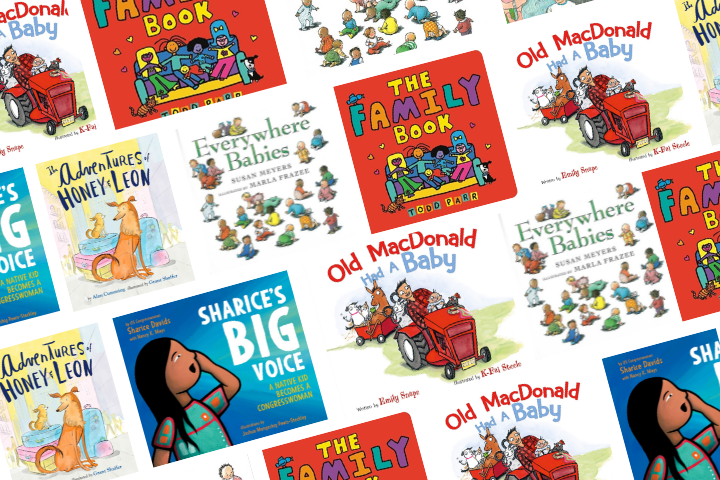
  • Children’s picture books like Mayor Pete, about the U.S. Secretary of Transportation Pete Buttigieg, Sharice’s Big Voice, about U.S. Rep. Sharice Davids, The Adventures of Honey & Leon, about actor Alan Cumming’s two dogs and books about families likeEverywhere Babies by Susan Meyers, The Family Book by Todd Parr, and Old MacDonald Had A Baby by Emily Snape.
  • Contemporary young adult books by award-winning authors such as The Hate U Give by Angie Thomas, I Am Not Your Perfect Mexican Daughter by Erika Sánchez, The Sun and Her Flowers by Rupi Kaur, Looking for Alaska, The Fault in Our Stars, and Paper Towns by John Green, Last Night at The Telegraph Club by Malinda Lo, All Boys Aren’t Blue by George Johnson, and Gender Queer by Maia Kobabe.
  • Works by renowned authors James Baldwin, Charles Baudelaire, Albert Camus, Nikki Giovanni, Toni Morrison, Henry Miller, Robert Cormier, Neil Gaiman, Roxane Gay, Zora Neale Hurston, Khaled Hosseini, Alice Walker, and Tony Kushner.

See the full list of books flagged for removal from Urbandale, Iowa, school libraries under the new law.

WHAT IS IOWA’S SENATE FILE 496?

Iowa Gov. Kim Reynolds signed Senate File 496into law in May 2023. The law has numerous provisions, based on a requirement that schools adopt what it calls an “age appropriate, multicultural and gender-fair approach” by schools and school districts.

The law includes:

  • A “Don’t Say Gay” provision, modeled on legislation passed in Florida in 2022, that applies to Kindergarten to 6th grade: “A school district shall not provide any program, curriculum, test, survey, questionnaire, promotion, or instruction relating to gender identity or sexual orientation to students in kindergarten through grade six.”
  • A directive to include “age appropriate” materials in classrooms and libraries. The law defines “age-appropriate” as “topics, messages, and teaching methods suitable to particular ages or age groups of children and adolescents, based on developing cognitive, emotional, and behavioral capacity typical for the age or age group.” The law also states that “’Age-appropriate’ does not include any material with descriptions or visual depictions of a sex act as defined in section 702.17.” This is a reference to Iowa criminal code, including a definition of sex acts and sexual activity that was not originally written to apply to written or visual materials.
  • A mandate for districts to develop policies for parents/guardians to to review all instructional materials, to file objections to challenge these materials, and a public listing of all books in school district libraries
  • A prohibition on students from serving on review committees that “determine, or provide recommendations related to, whether a material in a school library should be removed” after it has been challenged. Additionally, parents and guardians who challenge a book or library material are guaranteed confidentiality.
  • The potential for disciplinary action against educators found in violation of its provisions, particularly concerning “age appropriate” materials in school libraries, including the possibility of losing their licenses.

WHY WERE BOOKS BANNED FROM SCHOOLS IN URBANDALE, IOWA?

In the absence of state guidance on how to implement the new law, the Urbandale Community School has taken what it calls thebroadest possible interpretation of the law, in order to protect educators from disciplinary action. But in doing so, they have threatened the freedom to read for the district’s 4,000+ students.

Per the district’s statement, the list of books was curated from “a review of quarantined books from other states who had passed similar laws.” The district noted that the list is not “all-inclusive” nor represents books available in the district’s schools and classrooms.

One senior at Urbandale High Schooldescribed to a local NBC affiliate that the bans would impact her ability to complete her coursework. “I’m involved in a lot of AP and college-level courses and so for me, I was in AP Lit[erature] last year and so I read some amazing books…going forward [I’m] taking Advanced Comp[osition] this year. And so I won’t be able to study 1984 or The Color Purple and a lot of those books that are so important and so critical for those curriculums.”

The list, and the law that prompted it, comes amid a national wave of book bans andeducational gag orders that limit what can be said in the classroom, especially about race and LGBTQ+ topics.

WHAT CAN BE DONE?

PEN America invites the public to send its letter to school district officials, calling on them to reverse the policy, and to retain all reading materials so students can begin the school year with full access to literature in their classrooms.

The letter is also intended to signal to other school districts, parents, educators, librarians, and students that the government overreach stemming from Gov. Reynolds’ legislation is an affront to students’ bedrock rights.

Send the PEN America letter to Urbandale school officials

If you thought Betsy DeVos was bad, wait ‘til you meet Erika Donalds! She is adored by both Ron DeSantis and Donald Trump. She hates public schools and spreads lies about them. Sadly for DeSantis, she has cast her lot with Trump.

Kiera Butler wrote about the rise of Erika Donalds in Mother Jones. She begins:

On a hot afternoon in June, some 700 seated attendees of the annual summit of the conservative parents’ rights group Moms for Liberty bowed their heads in prayer. The Moms had waited in a security line that spanned two floors of the Philadelphia Marriott to get here, and even during this somber moment, the giddiness in the ballroom was palpable as they geared up for the highlight of the conference: a speech by former President Donald Trump.

Up at the dais, wearing a shiny green satin T-shirt that stood out against a row of American flags, Moms for Liberty advisory board member and wife of Rep. Byron Donalds (R-Fla.) Erika Donalds offered an invocation. “Lord, you have elevated this organization to do your good work in this country,” she said. “We’re grateful that the truth is being exposed, that parents are being able to see what’s really going on in education in our country.”

Presumably, Donalds was referring to the litany of complaints about public schools that had emerged in the conference breakout sessions: how they were corrupting children with lessons about institutional racism, gender diversity, and sex ed. Trump, when he finally took the stage, put a finer point on these forces of corruption, decrying the “radical left, the Marxists and communists” who had supposedly taken over American education. Then, he thanked Donalds by referring to her as “Byron’s wonderful wife.” He went on, “Where is she? I hope she’s here somewhere because she is an incredible person!”DeSantis helped position Donalds as an educational power player in the state. In return, Donalds has had an outsize influence on Florida’s educational policy.

Trump’s hour-and-a-half speech was a meandering affair, but the Moms were rapt: They booed when he accused President Joe Biden of arranging his indictment, and whooped when he complained about “the 87 different genders that the left says are out there.” But possibly the loudest applause of all came when he returned to the topic of education. “By the way I want to move our education system back to the states,” he said. The audience exploded. “You hear that, Erika?”

That Donalds received two separate Trump shout-outs was noteworthy because, well, she’s not all that famous, at least not outside of her home state. A former school board member from Collier County, Florida, she now runs a local network of charter schools—you’re more likely to have heard of her congressman husband, a Black archconservative who has been touted as a potential Trump running mate in 2024. Trump’s praise of Donalds was even more striking given that she was, until recently, a golden child of one of Trump’s Republican opponents. Over the last decade, Florida Gov. Ron DeSantis helped position Erika Donalds as an educational power player in the state, elevating her work and appointing her to key committees. In return, Donalds has had an outsize influence on Florida’s educational policy, says Sue Legg, a retired University of Florida professor of education who has followed Florida’s move toward conservatism in education.

But in recent months, as DeSantis’ political fortunes shifted, Donalds appears to have dropped the governor and instead hitched her star to Trump’s wagon. Legg believes it’s possible that Donalds may be on the list of possible Trump picks for the next secretary of education, the role previously filled by charter-school crusader Betsy DeVos. In addition to her school-choice advocacy, DeVos threateneddesegregation efforts, rolled back Obama-era protection for transgender students, and has openly called for the dismantling of the Department of Education. “Betsy DeVos was a disaster,” says Legg. “I think Erika Donalds could be worse.”

A fourth-generation Floridian born in 1980, Donalds grew up middle class in Tampa. Her current passion for education wasn’t on display in her early life; in a 2015 interview with the News-Press, she recalled being a mediocre high school student, buckling down only after she learned she would be thrown off the basketball team if she couldn’t get her grades up. With the help of her churchgoing grandparents, she raised her GPA and narrowly qualified for admission to Florida State University, where she excelled, graduating magna cum laude in 2002 with a degree in accounting. It was at Florida State that she met her husband, Byron, who became a Christian after attending Erika’s evangelical church. The pair got married shortly after graduation and moved to the affluent town of Naples in Southwest Florida’s Collier County. Erika went on to earn a master’s degree in accounting from Florida Atlantic University, then to work her way up in an investment firm, an experience that would later serve her well when she became a charter-school entrepreneur.

In 2013, when the second of Erika and Byron’s three sons was in elementary school, the couple began to question the public school that their children attended. During his speech at this year’s Moms for Liberty summit, Byron Donalds recalled his son struggling with math homework that followed the instructional method endorsed by the federal Common Core education program under Obama, which many conservatives see as an example of federal government overreach. “I remember it like it was yesterday,” said Byron. “He’s sitting at the kitchen table. He’s got tears in his eyes crying. ‘This is how they’re teaching me.’ And I said, ‘Son, I don’t know what they’re teaching you. But I promise you this. In the real world, you get fired over doing math like that.’” The Donaldses promptly pulled their son out of their neighborhood public school and enrolled him in private school.

That experience seems to have made a strong impression on Erika Donalds; she soon began advocating for school choice, an educational policy movement that champions charter schools and private school tuition vouchers as alternatives to public schools. In 2013, she helped found a group called Parents’ Rights of Choice for Kids (Parents ROCK), whose members, foreshadowing the current parents’ rights movement, railed against what they saw as government intrusion into the sacred relationship between parents and children. In a July 2013 Facebook post, the group wrote, “We are fighting so hard for all of these parents, and many more who are still unaware that their parental rights have been snatched away by an overreaching school district, hungry for more money and control.”

There is speculation that Erika Donalds might be Trump’s choice for Secretary of Education. Assuming, that is, that he is not incarcerated.