Carol Burris, executive director of the Betwork for Public Education, writes in The Progressive that it should be illegal to run a charter school for profit, just as it is illegal to run a public school for profit. Since the charter school lobby claims that charter schools are “public schools,” they should insist on banning for-profit charters.
Please open the link. This is an important article.
Burris writes:
From insider deals to real estate flips, the problems with charter schools run by for-profit corporations can’t be ignored. And growth in this sector is accelerating as operators use lax regulations and complicated corporate schemes to harvest public dollars from publicly-funded charter schools.
Those are the findings of a new report, Chartered for Profit II: Pandemic Profiteering, from the Network for Public Education (NPE), the organization I lead. We determined that for-profit corporations operate nearly 17 percent of all charter schools. And because many are online schools with high enrollments, one in five charter school students attended a for-profit run charter during the 2021-2022 school year.
In some states, the percentage of students in for-profit-run schools is staggering. More than 50 percent of all Florida charter school students are in schools run by for-profit companies; in Ohio, the percentage tops 60 percent. In Michigan, a startling 72 percent of all of the state’s charter school students attend a school run by one of forty-five corporations.
And this is not in the best interest of children. Students of charters run for profit graduate at lower rates and have more adverse academic outcomes as the number of charter services managed by for-profit operators increases. That conclusion, by the way, comes from a report published by the pro-charter Thomas B. Fordham Institute, an Ohio charter school sponsor.
Students of charters run for profit graduate at lower rates and have more adverse academic outcomes.
Some of these schools are part of large national chains. Four of the five largest for-profit chains now run their schools with sweeps contracts, meaning that 90 percent or more of the public dollars coming into the school are “swept” into for-profit-controlled bank accounts. The largest, Academica, which runs a private online international school that gives out American high school diplomas, manages 205 charter schools in nine states. Thirteen for-profit chains run twenty or more schools or campuses. Nearly half of all 110 for-profit operators in the United States run only one or two schools. These micro-education management organizations exist solely to shield financial transactions and owner profits from the public.
The charter industry downplays the prevalence of charter schools being run for profit because the mission of for-profit companies is to maximize profits, which puts the focus on financial gain, not students.
Oklahoma State Superintendent Ryan Walters seems to have absorbed all his talking points from ALEC, the rightwing bill mill or he may just be trying to duplicate whatever Florida Governor Ron DeSantis is doing. All the talking points are there about critical race theory, “diversity, equity, and inclusion,” the “science of reading,” the fear of students turning transgender or being recognized as such, the readiness to censor anything that mentions sexuality or gender, and of course, vouchers for home schoolers and religious schools.
Superintendent Walters adds another item to his “reform” agenda: pay for performance, which has been tried for a century and never worked anywhere. It is hard to find an educational program that has been more thoroughly discredited, especially in the past dozen years. Performance these days equals test scores, and the teachers in the most affluent schools always come out in top, while those who teach the most vulnerable children are always on the bottom. No need to reinvent that broken wheel. Even Republican legislators know instinctively that “performance,” defined as test scores favors those in the whitest, most advantaged schools.
John Thompson, historian and former teacher, writes:
Last week, rightwing Oklahoma Secretary of Education Ryan Walters tried to “Shove ‘Choice’ Down the Throats of Unwilling Schools and Parents,” but he received serious pushback by influential Republicans for ignoring legislative norms in budget-making. This week, Walters’ revealed more of his plans to divide and conquer public schools, while ramping up the stakes for educators who don’t comply with ambiguous and weird mandates. The response by numerous Republicans, however, seems to indicate that a bipartisan effort against Walters’ and Gov. Kevin Stitt’s extremism is growing.
Walters started the Board of Education meeting, where his budget was presented with a prayer, which included a “reference to his school choice goals.” He then condemned “a loud and vocal crowd, a minority for sure, that say that all that is needed to fix the problems in education is to toss more money and to leave everything alone.” Walters then promised:
“There will be school choice. We will ensure that indoctrination and CRT (critical race theory) are eliminated in our state. We will also make sure that our kids are safe. There will be no boys in the girls bathrooms. There will be no pornography in our schools. We will make sure all of our vendors and the schools are focused on education and not diversity, equity and inclusion.”
Then, Walters met with rural superintendents in Atoka, the home of the Republican Speaker of the House Charles McCall, who has opposed voucher expansion. Walters explained that his “incentive pay plan that would reward a select few highly rated teachers in each school with up to $10,000 on top of their salaries.”
Walters then complained that:
“Tulsa has done so poor that if you took Tulsa Public Schools out of what we’re doing, we’re in the top half nationally. If you take Tulsa and OKC out, we’re in the top 15.”
So, the Tulsa World reported that Walters said:
“He would be open to pushing for Tulsa Public Schools to be broken up into smaller schools because of academic results there he says are dismal and parents who complain they are locked in because they can’t afford private school tuition and suburban schools bursting at the seams.”
At the same time, Walters’ allies are revealing more options for punishing educators who don’t comply with confusing mandates. While Walters seems to be backing off from his suggestion that all federal education funds be rejected, Sen. David Bullard filed a bill to “develop a ten-year plan to phase out the acceptance and use of federal funds for the support of K-12 education.” Sen. Shane Jett would “add seven more prohibited topics to House Bill 1775, which bans eight race and gender concepts from K-12 schools.” Jett and Rep. Terry O’Donnell seek to ban “teaching about sexual orientation and gender identity to elementary-age children,” And Jett “would outlaw any school policies that respect or promote ‘self-asserted sex-based identity narratives,’” as well as hosting “drag queen story time.”
Moreover, Sen. Cody Rogers “would prohibit school employees from calling students by names or pronouns that differ from the students’ birth certificates, unless having received written consent from the child’s parent.” Rep. Danny Williams would completely ban sex education from public schools.
And the Tulsa World reported, the Oklahoma State Regents for Higher Education responded to Walters’ “urgent request” to audit spending on diversity, equity and inclusion, or DEI, programs. The Regents, “scrambled hundreds of employees to compile a 10-year review of its spending history on and current materials used for … DEI programs.” They found that DEI spending was “a third of 1%” of the budget.
But, on the eve of submitting his budget to the legislature, Walters, as well as his ally Gov. Stitt, faced more bad news. As the Oklahoman reports, Attorney General Gentner Drummond, who defeated Stitt’s appointee, John O’Conner, announced an “investigation into misspent education funds” which “hung over the state Capitol on Wednesday.” As an investigation by Oklahoma Watch and The Frontier found, Connors’ lawsuit led “some critics to question whether the lawsuit was an honest attempt to recoup the funds.” Consequently, The Oklahoman reported, “some high-ranking lawmakers appeared hesitant to heed funding requests from Oklahoma’s new state superintendent because of his alleged part in the controversy.” The reason was it was “a mix of Walters’s and Gov. Kevin Stitt’s staff, not a state agency [that] was overseeing the program.”
The Republican Chair of the House Appropriations and Budget subcommittee for Education, Mark McBride, said (and Speaker Charles McCall confirmed) he had been authorized to investigate the lawsuit, and was wrong in not doing so. But now, as Nondoc reports, A.G. Drummond said he “would pursue accountability for state officials, potentially including Walters owing to his prior role as director of an organization tasked with dispersing the funds.” (for what it’s worth McCall, a likely candidate for governor, attended the budget presentation.)
The Tulsa World added that Stitt had blamed the parent company of ClassWallet for the “unflattering audit of federal pandemic relief funds under Stitt’s control.” But, the audit was critical of how the Stitt administration spent $31 million to provide pandemic relief for students’ educational needs.”
Nondoc further explained that Walters’ presentation to the committee “took the opportunity with some of the lawmakers’ questions to expound on campaign rhetoric, including addressing questions regarding his ‘liberal indoctrination’ comments and past declarations to get federal funding out of Oklahoma public education.” And, his two-point plan, funding “science of reading” and pay-for-performance, drew plenty of criticism.
Republican Rhonda Baker, chair of the Common Education Committee, told Walters, “We have, as a legislative body, voted on the science of reading.” She added, “We’ve been very supportive of that, and we have made sure that there has been funding for that, so none of that is new. What is challenging, though, … is that we are not keeping teachers.”
Moreover, Democrat Rep. Andy Fugate said Walters performance pay plan would backfire by drawing teachers away from high-challenge schools and finding schools where “it’s easiest to teach.” Similarly, McBride said:
“Merit pay, I’m OK with it if you work in the oil field or some industry, but in education I just don’t see it working. … If you’ve got a classroom of troubled youth, how do you compare that to the classroom over here where the teacher’s got all the A and B students? It’s just almost impossible to me to evaluate that.”
I’ve heard mixed appraisals as to whether Walters really believes his own words. Regardless, as his ideology-driven claims become more extreme, it seems more likely that there will be more bipartisan pushback against Walters, Stitt, and MAGA true-believers. And, who knows, maybe it will open the door to Republican Adam Pugh’s bill, based on discussions with hundreds of superintendents and education leaders and over a thousand educators, that “would spend $241 million on teacher pay raises, guarantee 12 weeks of maternity leave for teachers and offer $15 million in scholarships to future educators who pledge to work in high-poverty schools,” while bestowing respect on teachers.
Dave Dewitt, editor-in-chief of the Ohio Capital Journal, wrote a blistering critique of the state’s political leadership, who place the interests of the private sector above the common good of the public.
Many Ohioans pay taxes for schools but don’t have school-age children. Their taxes are meant to fund quality public schools because having educated citizens is a public good. Sending their money to unaccountable for-profit, private, and religious schools is a terrible abuse.
Compelling taxpayers to support private interests at the expense of public ones is not only unethical, but unconstitutional when those private interests intertwine with religion. American taxpayers should never be forced to fund the efforts of religious institutions of any kind. Not one red cent.
“Families are eligible for EdChoice scholarships by either living in the boundaries of a low-performing school or by household income. Currently, a family of four can qualify for state money if the household income is at or below $69,375, or 250% of the Federal Poverty Guidelines. The limit would increase to 400% of the Federal Poverty Guidelines, which would be $111,000 for a family of four, under DeWine’s proposal. …”
EdChoice vouchers are distributed as checks given to private schools to help cover a student’s tuition. The scholarship amount is currently $5,500 for students in grades k-8 and $7,500 for grades 9-12. Republicans who control the legislature expanded vouchers in 2012, 2020, and 2021.
So vouchers are already available to low-income households and in low-performing districts, which means the only reason to increase the voucher threshold to 400% is for a massive sweetheart giveaway to private interests.
DeWine’s budget also would increase per-student building funding for all charter schools from $500 to $1,000 per student — a 100% bump — and provide an extra $3,000 for each economically disadvantaged student, or a student who qualifies for free or reduced lunch — up from $1,750 currently.
DeWine, Hancock notes, did not propose any extra per-student money for traditional public education.
Sadly, American public education was marked as a $500 billion a year opportunity for private profiteering some time ago, and Ohio has been leading the way.
Getty Images.
Over the past several decades, Ohio’s seen one boondoggle after another.
Contrary to what you may have heard, average student achievement has been increasing for half a century. Across 7 million tests taken by U.S. students born between 1954 and 2007, math scores have grown by 95 percent of a standard deviation, or nearly four years’ worth of learning. Reading scores have grown by 20 percent of a standard deviation during that time, nearly one year’s worth of learning.
The narrative of “failing public schools” has been manufactured by corrupt private school bloodsuckers looking to wet their beaks in the public school money pot.
Aside from its false pretenses, it undercuts funding and saps the ability of public schools to address real problems.
But initiatives like these are the very things money-strapped districts are forced to cut first, alongside practical necessities like busing or the teachers themselves.
But he seems to want to balance this politically with a massive giveaway of public dollars to private school interests and the religious zealots aligned with CCV, which is unacceptable.
Many Ohio taxpayers — even those who don’t have children or whose children are no longer school-age — are happy to help fund public schools.
We understand that quality public schools increase property values and make our communities attractive places to live, which helps them thrive.
We want our communities and our public schools to thrive.
What most Ohio taxpayers do not want is our public schools to continue to suffer as money and resources are siphoned away from them to prop up private, for-profit, and religious interests.
But when it comes to funding those interests, or fully and fairly funding Ohio’s public schools, Republican Statehouse leaders have continually legislated for the private interests.
The vultures have poll-tested their messaging, so they love to talk about “school choice,” “parents’ rights,” and “funding the students, not the system.”
This is a smooth evasion that attempts to elide the fact that the question isn’t about whether parents have a choice where to send their kids for schooling; everybody already does.
What these interests are asking for are endless direct state subsidies to their private enterprises and religious institutions.
And that’s what DeWine and these lawmakers stand prepared to keep giving them, on our dime and at the expense of our public schools.
Every Ohio public school faces a yearly audit, but no such requirement exists for private schools receiving public vouchers. Why not? If public money is continually funneled into these schools, why are they not subjected to the same auditing standards as public schools to make sure that money is actually going toward appropriate education of students?In an analysis of one proposed bill, the nonpartisan Legislative Services Commission found that two-thirds of kids getting vouchers in Ohio’s expansion program have never been in public schools.
So that means that these kids aren’t being “rescued” from public schools; they were never going to public schools in the first place. This is pure state subsidy of private school tuition. As the LSC puts it, these are “existing nonpublic school students that represent a new state responsibility.”
Do the private schools lead to greater academic success?
Given all this, what assurances are Ohioans being given that our money will not be misused as it has been in the past? If this money is coming out of public school funding, what guarantees do we have that our public schools will be fully funded under the new Fair Funding plan?
COLUMBUS, OH — JANUARY 31: Ohio Senate President Matt Huffman (R-Lima) takes questions from the press following State of the State Address, Jan. 31, 2023, in the Warren G. Harding Briefing Room at the Statehouse in Columbus, Ohio. (Photo by Graham Stokes for Ohio Capital Journal. Republish photo only with original story.)
Ohio Senate Republicans led by President Matt Huffman have made clear they want the full “Backpack Bill” pushed by the CCV. That would be the biggest win possible for the private interests. As this DeWine proposal is brought and negotiated between the House and Senate, it looks likely to become, essentially, “Backpack Bill Light.”
I’m not holding my breath for full, fair public school funding. Legislators repeatedly steamroll DeWine and there’s no reason to think they won’t on this. There’s only one pot. It’s meant for high-quality public schools. But they always turn their backs on our public schools in favor of the private interests.
I come from a family of educators: My mom, a longtime teacher and junior high school principal; my sister, a primary school special education teacher; my grandmother, a high school teacher; my other grandmother, a school librarian; my grandfather, a school teacher and later the dean of a Kent State University branch.
I grew up surrounded by public educators, both at school and at home. I grew up generally believing that we as a society agreed about the importance and value of public education.
It came as a great shock to me when I entered adulthood that there are incredibly well-funded private interests working every day to undermine and rob our public schools.
Then I started seeing one for-profit school scam after another in Ohio, and realized that our state government was actively stoking the grift.
When I ask the public educators I know for their thoughts, many tell me there’s a definite role for traditional charters and private schools for the maybe 10% of students best off at them, but it’s unconscionable to rob the other 90% of public school students and prioritize the 10%.
That seems reasonable.
Traditional charter and private schools have a place, but they must face just as much scrutiny and accountability and auditing as our public schools if they are to receive our money.
And propping up private schools should never, ever come at the expense of our already woefully unsupported public schools.
We need to dedicate ourselves to a positive vision of the wonderful beacons our public schools can be when we invest in them, when we support them, when we encourage them to be creative, and when we give them the resources and opportunity to thrive.
Public education is not failing. Ohio politicians are failing to prioritize and invest in public education.
This report was released about a major court decision in Pennsylvania that will affect millions of children:
For immediate release: Feb. 7, 2023 Contact: Jonathan McJunkin, Public Interest Law Center, 570-337-1969, jmcjunkin@pubintlaw.org; Paul Socolar, Education Law Center-PA, 215-372-1650, psocolar@elc-pa.org
A Historic Victory for Petitioners in School Funding Lawsuit
Today, Commonwealth Court Judge Renée Cohn Jubelirer ruled that Pennsylvania’s school funding system is unconstitutional and must be reformed.
In a 786-page decision, the court found that “All witnesses agree that every child can learn. It is now the obligation of the Legislature, Executive Branch, and educators, to make the constitutional promise a reality in this Commonwealth.”
The court order calls for the “respondents, comprised of the Executive and Legislative branches of government and administrative agencies with expertise in the field of education, the first opportunity, in conjunction with Petitioners, to devise a plan to address the constitutional deficiencies identified herein.”
The court rebuffed respondents’ argument that the current system is adequate, saying “In the 21st century, students need more than a desk, chair, pen, paper, and textbooks.”
The Education Law Center and Public Interest Law Center issued the following joint statement earlier today:
“Today’s decision declaring Pennsylvania’s school funding system unconstitutional is a historic victory for Pennsylvania’s public school children. It will change the future for millions of families, so that children are no longer denied the education they deserve. The court recognized that our schools require adequate funding to meet our constitution’s mandate. It’s time for our state legislature to fund public schools in every corner of Pennsylvania so all students, whether or not they live in a wealthy community, can receive the quality public education guaranteed in our state constitution.”
“The court’s decision recognizes what we showed during trial: Every year, hundreds of thousands of children in public schools in lower-wealth communities across Pennsylvania are being denied the basic resources needed for a quality education because the state is not adequately or equitably funding our schools,” said ELC legal director Maura McInerney. “The court’s order directs the state to change the way it funds our public schools from the current two-tiered system divided by local wealth to one that provides sufficient resources for all children.”
“This is a huge victory. Educators know that every child can learn, and they know the kinds of support that their students need to reach their potential,” said Dan Urevick-Ackelsberg, senior attorney at the Public Interest Law Center. “Our clients and others in low-wealth districts in Pennsylvania also know that for too long, they have had to triage their students’ needs, leaving some students behind because of the state’s failure to provide adequate funding for public education. Today’s decision makes it clear that this inequitable status quo cannot continue, and that every child in Pennsylvania has a fundamental right to receive a comprehensive, effective, and contemporary public education.”
“Education is the great equalizer — the key that opens the door to life-changing opportunities and world-changing ideas,” said Katrina Robson, partner at O’Melveny & Myers LLP. “No child should be left with their hand up, begging for but denied that opportunity. We are gratified by the judge’s ruling, which will help ensure that all children in Pennsylvania have equitable access to quality education. And we are proud of the legal team that worked tirelessly—for years—to help achieve this critically important result.”
Here is the language of the court order:
1. The Education Clause, article III, section 14 of the Pennsylvania Constitution, requires that every student receive a meaningful opportunity to succeed academically, socially, and civically, which requires that all students have access to a comprehensive, effective, and contemporary system of public education;
2. Respondents have not fulfilled their obligations to all children under the Education Clause in violation of the rights of Petitioners;
3. Education is a fundamental right guaranteed by the Pennsylvania Constitution to all school-age children residing in the Commonwealth;
4. Article III, section 32 of the Pennsylvania Constitution imposes upon Respondents an obligation to provide a system of public education that does not discriminate against students based on the level of income and value of taxable property in their school districts;
5. Students who reside in school districts with low property values and incomes are deprived of the same opportunities and resources as students who reside in school districts with high property values and incomes;
6. The disparity among school districts with high property values and incomes and school districts with low property values and incomes is not justified by any compelling government interest nor is it rationally related to any legitimate government objective; and
7. As a result of these disparities, Petitioners and students attending low-wealth districts are being deprived of equal protection of law.
The case William Penn School District et al. v. Pennsylvania Department of Education et al. was filed in 2014 by six Pennsylvania school districts (William Penn, Greater Johnstown, Lancaster, Panther Valley, Shenandoah Valley, and Wilkes-Barre Area), the Pennsylvania Association of Rural and Small Schools, the NAACP-PA State Conference, and a group of public school parents. They filed suit in Pennsylvania Commonwealth Court against state legislative leaders, state education officials, and the governor for failing to uphold the General Assembly’s constitutional obligation to provide a “thorough and efficient” system of public education. Petitioners also assert that the massive inequality this system fuels between poor and wealthy school districts discriminates against students in low-wealth communities, violating their right to equal protection in the state Constitution.
The school districts and other petitioners in the case are represented by the Education Law Center – PA, the Public Interest Law Center, and O’Melveny. During a four-month trial before Judge Cohn Jubelirer that concluded in March, witnesses explained in detail the deficiencies of the current system and the extreme, egregious disparities between school districts in Pennsylvania.
For more on the case, William Penn School District et al. v. PA Dept. of Education et al., visit FundOurSchoolsPA.org, a joint online project of the Education Law Center-PA and the Public Interest Law Center.
The Public Interest Law Center uses high-impact legal strategies to advance the civil, social, and economic rights of communities in the Philadelphia region facing discrimination, inequality, and poverty. We use litigation, community education, advocacy, and organizing to secure their access to fundamental resources and services in the areas of public education, housing, health care, employment, environmental justice and voting. For more information, visit www.pubintlaw.org or follow on Twitter @PubIntLawCtr.
The Education Law Center-PA (ELC) is a nonprofit, legal advocacy organization with offices in Philadelphia and Pittsburgh, dedicated to ensuring that all children in Pennsylvania have access to a quality public education. Through legal representation, impact litigation, community engagement, and policy advocacy, ELC advances the rights of underserved children, including children living in poverty, children of color, children in the foster care and juvenile justice systems, children with disabilities, English learners, LGBTQ students, and children experiencing homelessness. For more information, visit elc-pa.org or @edlawcenterpa on Twitter.
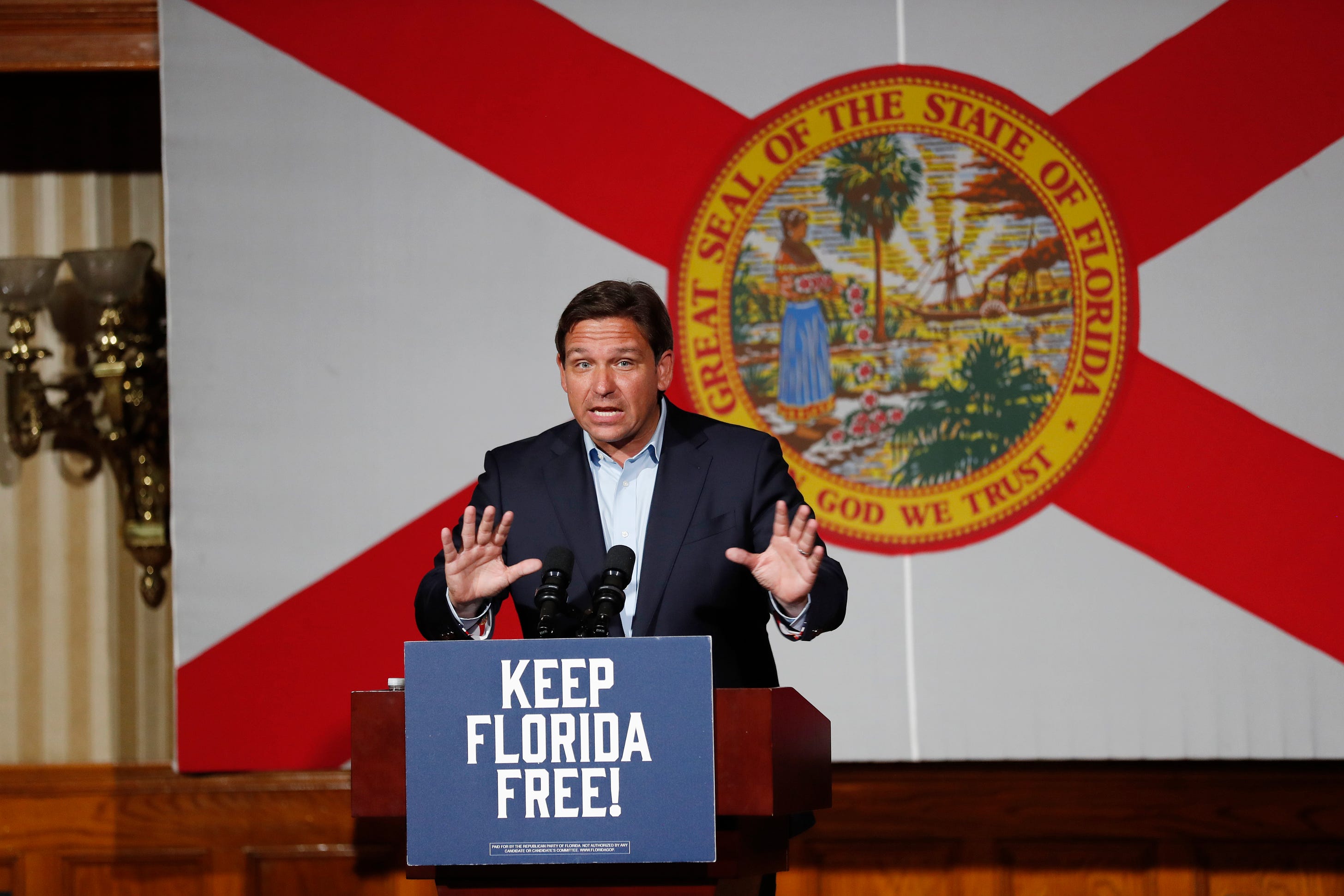
Florida has become a Petri dish for potential fascism. DeSantis has made war on African Americans, on gays, on transgender people, on drag queens, on public schools, on higher education, even on private corporations (Disney). He likes to stand behind signs that declare Florida is “free,” but no one is free to disagree with him. That’s not freedom.
Now DeSantis has proposed to create a military force that answers only to him. To call out the National Guard, he must get federal permission. That’s not good enough for him. He wants a Florida state guard. Some other states have them, but they are not in the hands of a would-be dictator whose vanity knows no limits.
CNN reports:
St, Petersburg, Florida (CNN) — Florida Gov. Ron DeSantis wants to reestablish a World War II-era civilian military force that he, not the Pentagon, would control.
DeSantis pitched the idea Thursday as a way to further support the Florida National Guard during emergencies, like hurricanes. The Florida National Guard has also played a vital role during the pandemic in administering Covid-19 tests and distributing vaccines.
But in a nod to the growing tension between Republican states and the Biden administration over the National Guard, DeSantis also said this unit, called the Florida State Guard, would be “not encumbered by the federal government.” He said this force would give him “the flexibility and the ability needed to respond to events in our state in the most effective way possible.” DeSantis is proposing bringing it back with a volunteer force of 200 civilians, and he is seeking $3.5 million from the state legislature in startup costs to train and equip them.
States have the power to create defense forces separate from the national guard, though not all of them use it. If Florida moves ahead with DeSantis’ plan to reestablish the civilian force, it would become the 23rd active state guard in the country, DeSantis’ office said in a press release, joining California, Texas and New York. These guards are little-known auxiliary forces with origins dating back to the advent of state militias in the 18th century. While states and the Department of Defense share control of the National Guard, state guards are solely in the power of a governor.
Will DeSantis use his state guard to break up peaceful demonstrations? Will he send it to drag shows to close them down? Will he it to harass teachers accused of being woke? The possibilities are frightening.
Oklahoma Governor Kevin Stitt wants voters to believe that his push for vouchers comes from the “grassroots.” Not true. The last time vouchers came to a vote in the legislature, they were defeated by Republicans, especially rural Republicans who understand the importance of their public school.
Ben Felder of The Oklahoman got copies of internal correspondence and learned that the voucher campaign is funded by the Walton Family Foundation and organizations created by Charles Koch.
Is Governor Stitt believes that the people of Iklahoma want vouchers, why doesn’t he put it to a vote? Why let out-of-state billionaires defund the already underfunded public schools of Oklahoma. Take it to the people! Let them decide!
Two of the reddest states in the nation had the largest numbers of people signing up for Obamacare. This reflects the size of their population but also their needs. Their governors may rant against the federal government and its programs, but actions speak louder than words. The public wants what the politicians deride. Yet the public elects the people who deny their basic needs.
Florida led the way with the highest number of people in the country who signed up for health insurance under the Affordable Care Act, with more than 3.2 million people enrolling, or 20 percent of the country’s totals.
A record 16.3 million people nationwide signed up for plans on the federal health insurance exchange during the open enrollment period, which began Nov. 1 and ended on Jan. 15, the Centers for Medicare & Medicaid Services reported Wednesday.
In Florida, enrollment ballooned to 3.2 million, a 19% jump over last year’s open enrollment period under the health law, commonly known as Obamacare.
The 3.2 million represents 20 percent of all enrollees nationwide, even though Florida, the third most populous state in the country with 22 million people, accounts for only about 7 percent of the U.S. population…
For University of Miami professor Dr. Olveen Carrasquillo, an expert on the Affordable Care Act, Florida’s enrollment spike is likely an indication ofoutreach efforts, a lack of jobs that provide health coverage, and that Florida is one of 11 states that did not expand Medicaid eligibility through the Affordable Care Act (ACA).
About 425,000 adults in Florida don’t have health insurance because they are too poor to qualify for coverage under the ACA and the state hasn’t expanded Medicaid, according to the Center on Budget and Policy Priorities. More than half of those adults are Hispanic or Black.
“It shows that there’s a major need for health insurance in our state,” said Carrasquillo, who serves as UM’s dean for Clinical and Translational Research and is also co-director of the Clinical Translational Science Institute.
Almost a million Floridians could lose their Medicaid coverage starting in April once the federal COVID-19 emergency comes to an end, and because Florida didn’t expand its Medicaid eligibility.
Floridians fall into this coverage gap because their incomes fall above the state’s eligibility for Medicaid but below the federal poverty line, making them ineligible for Medicaid, a health insurance program run jointly by the federal government and states.
They would also be ineligible for coverage within the Affordable Care Act marketplace. To qualify for Medicaid in Florida, parents must earn less than 31 percent of the federal poverty line, or less than $6,807 for a family of three, the Center on Budget and Policy Priorities estimates.
Texas has the second-highest enrollment in Affordable Care Act plans among states that used the federal marketplace, with 2.4 million enrollees, according to the Centers for Medicare & Medicaid Services.
When Republican Matt Bevin was Governor of Kentucky, the state legislature passed a bill in 2017 authorizing charter schools. The law mandated that Louisville open a charter school. When it came time to set up a funding mechanism for charters, Democratic Governor Andy Beshear vetoed it.
When it came time to open a charter school, no one applied. The usual chains were not interested in opening a charter without funding.
Last year, Kentucky lawmakers demanded that school district leaders in Louisville seek and approve at least one application for a charter school in 2023.
Just one problem: No one applied.
Jefferson County Public Schools’ charter school information portal shows just one group formally notified the district of their intent to apply. The group, however, did not end up actually doing that.
Kentucky Department of Education spokesperson Toni Konz Tatman similarly confirmed Thursday no one applied to open a charter school in Northern Kentucky – the second location mandated to have a charter. District leaders in that region get until July 1, 2024 under state law.
Dan Rather and Elliott Kirschner write a blog called Steady. Their voice is always thoughtful, reasonable, informed, and…steady. I think that they, like me, are old enough to remember when we believed that overt racism was ebbing and that white supremacy was dead. Our hopes have been shattered since 2016. It takes the use of critical race theory to understand why we were so naive. Here is their take on the big Education story of the day:
Photo credit: Octavio Jones
Editor’s note: this is an ironic banner in front of DeSantis. Florida is not free for those who don’t share his ideology. If you think racism exists today in Florida, you are not free to discuss it in school or college. You are free to agree with him.
Rather and Kirschner write:
Much of American history is entangled with racism and white supremacy. That is the reality of our beloved nation, no matter how much we wish it were not.
As we sit here nearly a quarter of the way through the 21st century, it is obvious that we need to have the maturity to look back to our past as well as ahead to the future. Can we do this with our eyes wide open? Will we study and learn from the lessons of history?
You can’t grapple with the truth if you hide it from view. Yes, our national narrative is an inspiring one — of freedom, rights, and new opportunities. But it is also a narrative of pain — of the bondage, rape, and murder of enslaved people. It is a story of mass death, broken treaties, and land stolen from Native people. And it is a story of persecution of the “other,” time and again.
The chasm between the noble promises of our founding documents and our historical realities continues to obstruct our national journey toward a more perfect union.
Yes, ours is a country that has facilitated exploration, innovation, and growth, but it is also one built upon families torn apart at the auction block, bodies whipped, and police dogs and fire hoses set against children.
Cities were redlined. Public schools were segregated. And despite our carefully cultivated national image as a meritocracy, throughout our history we have seen talent overlooked and our common humanity diminished on account of people’s race, religion, and sexual orientation.
The ripples of injustice continue to destabilize our society.
It shouldn’t be controversial to say any of this. But acknowledging these truths today is a political act, because it threatens the privileged narratives of those who seek to sugarcoat our past. These are men and women who serve their own ambitions by fortifying their cynical holds on power, delighting in division, feeding off fear, and applauding anger.
And that brings us to Florida’s Governor Ron DeSantis.
Listing all of his efforts to leverage the power of his office to attack equity, empathy, and justice would stretch this post immeasurably. But doing so would also jeopardize the central point: DeSantis is an opportunist. He is not weighing the merits of any one campaign. Rather, he wants headlines as a culture warrior standing up to “wokeness,” a term he has eagerly redefined to suit his own purposes. It allows him to sneer at and dismiss any attempt to reckon with American injustice.
DeSantis has focused his assaults on two of our society’s most traditionally marginalized groups: Black Americans and the LGBTQ community. While these populations have thus far felt the brunt of his targeting, we need to see clearly that his rhetoric is a threat to all who care about a democratic, peaceful, empathetic, and just America. Those of us with the greatest privilege should bear a special burden in rejecting this hate.
DeSantis’s pugilism has enabled him to consolidate power in Florida. Any opposition to his toxic initiatives must contend with the uncomfortable truth that voters validated his message and style via his landslide win in November. Now DeSantis thinks he can take his show on the road with a presidential bid. That remains to be seen. Florida has been trending Republican in recent years, and success there might not translate to the current battleground states, many of which saw big Democratic wins in the midterms.
All that being said, there is a great danger to framing this struggle primarily through the lens of electoral politics. This normalizes a discourse that should be rejected by society’s mainstream. Just as the outright bigotry of the past became socially unacceptable, so too should these latest attempts at divisiveness.
It should not surprise us that DeSantis is making schools — both K-12 and college — a central target. He wants to teach a distorted view of America. He wants to make dissenting speech not only suspect but even criminal. He wants to silence the voices of his critics and of critical thinking more generally. This is a playbook that has been followed by demagogues before to very dangerous ends.
It is essential that DeSantis not be covered by the press through a false equivalence paradigm. We can debate what we should teach and how to teach it. But we can’t replace the truth, as unsavory as it may be, with sanitized narratives that suit those already in power. This is a battle for the minds of the voters of the future. This is about what kind of nation we will become.
But DeSantis primarily cares about what kind of country we are now. He wants to appeal to fear because he thinks he can mine that fear for votes. That is his game plan. And he’s not hiding it. There can be no appeasement. DeSantis has already shown that he isn’t interested in deliberations or good faith compromise. Those would disrupt his approach of means to an end.
History illustrates that hatred can be taught, but so can empathy and justice. We are on a winding journey as a nation. And we have much farther to go. But we have made progress in the face of bigots and autocrats because people had the courage to forge the inequities of our past into a more equitable future.
This history, this truth, is what scares people like DeSantis the most. But it is one that can give us hope if we are determined not to look away.
Charlie Sykes used to be a conservative Republican. Then Trump became President, and Sykes became a Never Trumper (maybe before the election, I’m not sure). Charlie and other Never Trumpers and their friends created a website called The Bulwark. It is consistently interesting. Charlie wrote the following post.
He wrote:
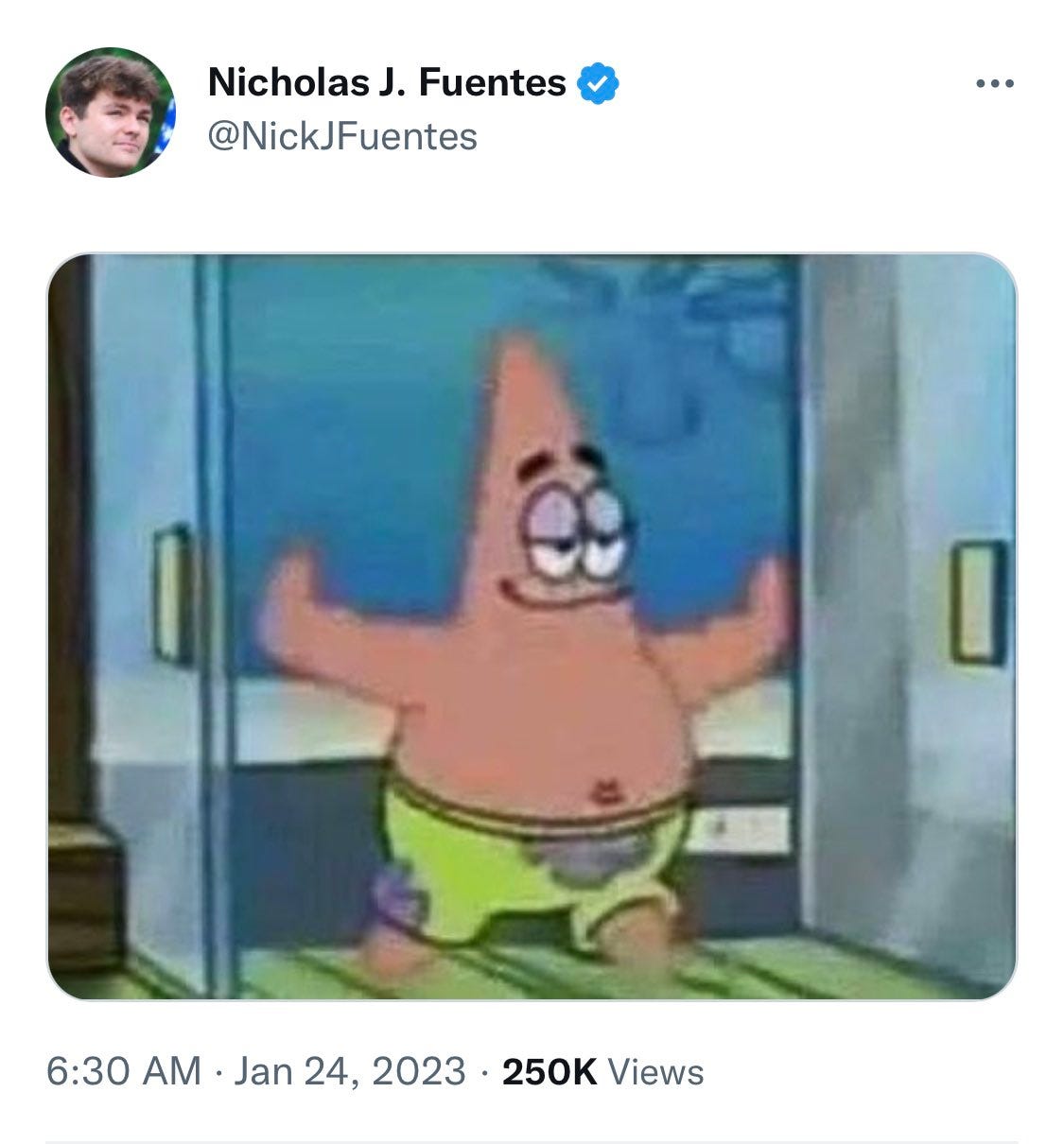
When Twitter banned neo-Nazi Nick Fuentes back in December 2021, the site’s Head of Safety and Integrity, Yoel Roth said, “Hateful conduct has no place here.”
But Roth is gone, Elon Musk is in charge, and the Nazis are back.
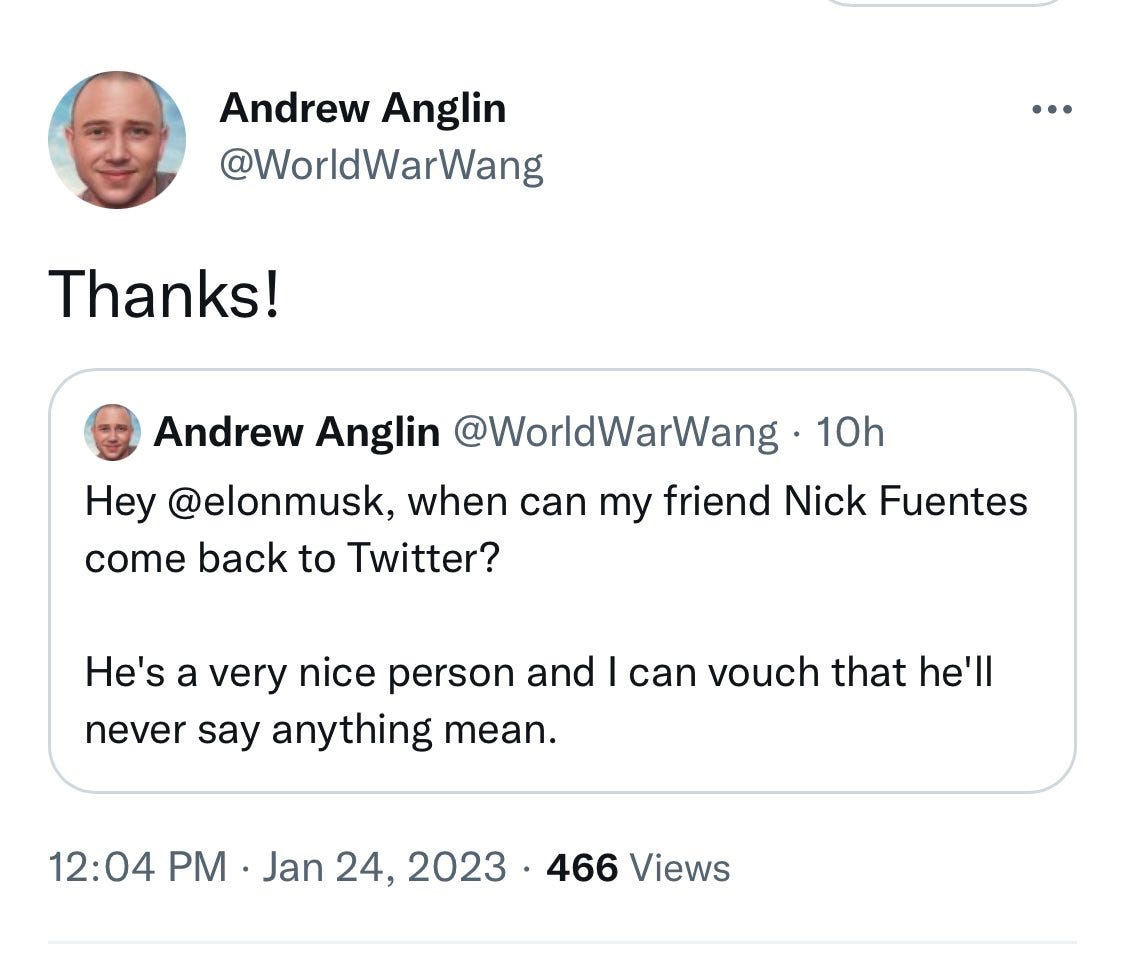
Fuentes, last seen here as Donald Trump’s dinner guest, was reinstated just hours after another actual Nazi, Andrew Anglin— who once described his approach as “Non-ironic Nazism masquerading as ironic Nazism” — asked Musk to bring his friend back on Twitter.
Anglin tweeted Musk that the Holocaust-denying, Jew-baiting Fuentes is “a very nice person and I can vouch that he’ll never say anything mean.”
Anglin is an ideological descendant of men such as George Lincoln Rockwell, who created the American Nazi Party in the late 1950s, and William Luther Pierce, who founded the National Alliance, a powerful white-nationalist group, in the 1970s. Anglin admires these predecessors, who saw themselves as revolutionaries at the vanguard of a movement to take back the country. He dreams of a violent insurrection.
But where Rockwell and Pierce relied on pamphlets, the radio, newsletters, and in-person organizing to advance their aims, Anglin has the internet. His reach is exponentially greater, his ability to connect with like-minded young men unprecedented.
Since then, Anglin has tried to rebrand himself as just a garden-variety American Nationalist, but this is mostly eye-wash for clueless billionaires. Notes the Anti-Defamation League:
In an effort to validate their leap from neo-Nazis to flag-waving American patriots, he and his followers equate American nationalism to white nationalism by claiming America was founded on anti-Semitic and racist principles.
**
Anglin is also one of the most vicious trolls on the far-right. I wrote about him in my book, “How the Right Lost Its Mind,” describing the explosion of harassment aimed at Jewish critics of Donald Trump at the time.
Many of the worst instances of harassment were connected to a website known as the Daily Stormer and its founder, a neo-Nazi activist named Andrew Anglin.
I first became aware of the site when I received, via email, a photoshopped image of my picture inside a gas chamber. A smiling Donald Trump wearing a German military uniform is poised to press the red “gas” button. The photoshopping tool had been created by the website and was widely used to troll both Jewish and non-Jewish critics of the Trump campaign.
The site takes its name from the German Nazi newspaper Der Stürmer,which was notorious for the viciousness of its anti-Semitic caricatures of Jews. After World War II, Der Stürmer’s publisher, Julius Streicher, was executed for crimes against humanity.
Anglin created the site in 2013 as an updated version of his previous website, which he called Total Fascism. As of this writing, the new website features pictures of Ronald Reagan and Donald Trump and the slogan “Daily Stormer— The World’s Most Goal-Oriented Republican Website.”
It is important to emphasize again that the Alt Right is a mansion with many rooms and some very real divisions. Anglin, for example, is not a fan of Milo Yiannopoulos, who is depicted on the Daily Stormer with a cartoon of the Jewish nose superimposed on his face and is referred to as “Filthy Rat Kike Milo.”
But Anglin is also interested in emphasizing the common ground among the various disparate groups and interests that make up the white nationalist movement. In his own guide to the Alt Right, Anglin notes that the movement included various factions, but that they had all been led “toward this center-point where we have all met. The campaign of Donald Trump is effectively the nexus of that centerpoint.”
Impressed by Trump’s rhetoric on illegal immigrants, Anglin endorsed Trump in 2015 and urged the readers of the Daily Stormer to “vote for the first time in our lives for the one man who actually represents our interests.”
After Trump called for barring Muslims from the country, the site declared: “Heil Donald Trump— The Ultimate Savior.” But Anglin’s greatest accomplishment was the creation of what he calls his “Troll Army,” which he uses to attack political opponents, deployed to great effect in early 2016.
After GQ magazine published a profile of Melania Trump by writer Julia Ioffe, the future First Lady took to Facebook to denounce the piece as “yet another example of the dishonest media and their disingenuous reporting.” Anglin quickly mobilized his Troll Army, posting an article headlined: “Empress Melania Attacked by Filthy Russian Kike Julia Ioffe in GQ!”
The post featured a picture of Ioffe wearing a Nazi-era yellow star with the word “Jude” and a call to action from Anglin:
“Please go ahead and send her a tweet and let her know what you think of her dirty kike trickery. Make sure to identify her as a Jew working against White interests, or send her the picture with the Jude star from the top of this article.”
The result was a torrent of abuse, including death threats against the journalist.
On Twitter, she was sent pictures of Jews being shot in the head and pictures of her wearing concentration camp stripes. When she answered her phone, a caller began playing a recording of a speech by Adolf Hitler.
“The irony of this is that today,” Ioffe told the British newspaper the Guardian, “I was reminded that 26 years ago today my family came to the US from Russia. We left Russia because we were fleeing antisemitism. It’s been a rude shock for everyone.”
The response from the GOP nominee was also troubling. When Trump was asked by CNN’s Wolf Blitzer about the anti-Semitic attacks and death threats, the future president pointedly refused to condemn them, pleading ignorance and saying, “I don’t have a message to the fans. A woman wrote an article that was inaccurate.”
Trump’s refusal to denounce the Troll Army was greeted with delight by Anglin, who immediately posted: “Glorious Leader Donald Trump Refuses to Denounce Stormer Troll Army.” He exulted:
“Asked by the disgusting and evil Jewish parasite Wolf Blitzer to denounce the Stormer Troll Army, The Glorious Leader declined. The Jew Wolf was attempting to Stump the Trump, bringing up Stormer attacks on Jew terrorist Julia Ioffe. Trump responded to the request with “I have no message to the fans” which might as well have been “Hail Victory, Comrades!””