Archives for category: Accountability

Governor Ron DeSantis hates the fact that there is a progressive public college called New College that openly teaches diversity, equity, inclusion, feminist studies, ethnic studies, and gay studies. That’s WOKE, and he vowed to crush anything WOKE.

He named 6 conservatives to the 13-member board, and the board of the state university system added another, meaning that Rightwingers are in charge. A hard-right board needs a hard-right president, and they got one.

Their first meeting was this afternoon, and they are expected to appoint former State Commissioner of Education Richard Corcoran as the new president. From the following story, it appears that no one bothered to let the current president of the New College know that she was being shown the door.

DeSantis is showing how to stamp out ideas he doesn’t like, with power, not subtlety. Is he a fascist or is he pretending?

A new board of trustees at New College of Florida intends to name Richard Corcoran as its next President.

Corcoran, a former House Speaker, served as Gov. Ron DeSantis’ first Education Commissioner.

Carlos Trujillo, president and founder of Continental Strategy, revealed the plans in a letter to clients and colleges.

“We are beyond excited to announce that one of our Partners, former Department of Education Commissioner Richard Corcoran, will be returning to higher education to serve as the Interim — and hopeful permanent — President of the New College of Florida, in Sarasota,” Trujillo wrote.

“This move comes as part of Gov. DeSantis ongoing work to refocus the university on providing the most value to its students and their parents.”

Corcoran was a founding partner for the consulting firm.

The news comes hours before the first board meeting since DeSantis appointed six new trustees on the 13-member board. The State University System Board of Governors also appointed a new trustee with a similar conservative think tank background.

Of note, work of Corcoran’s apparent hire comes before any news of current President Patricia Okker’s future with the school. Eddie Speir, co-founder of Inspiration Academy, wrote a blog post this weekend promising to call for Okker to be renamed as interim President and to terminate all faculty and staff before deciding who still fit in the new vision for the college.

While Florida’s Sunshine Law requires all decisions by the board to be made in publicly noticed meetings, Trujillo treats the matter like a done deal.

“The selection of Richard distinguishes our firm as a leader in innovation and strategic solutions for the clients we serve. We look forward to finding new synergies that can better serve our current clients and ensure their goals are made a reality,” his letter reads.

Republicans in Texas are obsessed with voter fraud. Trump won the state in 2020, as did the Republican Governor, Lieutenant Governor, Attorney General, and other statewide offices. Apparently Republican legislators think it’s suspicious that Democratic candidates won any votes at all. So they are launching a fusillade of bills to make it harder to vote.

Michael Hardy of The Texas Monthly reports:

For decades, Texas has maintained one of the worst voter-turnout rates in the country. Less than 61 percent of eligible Texans voted in the 2020 presidential election, placing us forty-third out of fifty states. (In Minnesota, the highest-turnout state, nearly 80 percent of eligible voters participated.) In November, 42.5 percent of eligible Texans cast ballots in the midterm election, placing us thirty-ninth in the nation. Embarrassed by these dismal figures, Texas political leaders will spend the Eighty-eighth Legislature passing laws to encourage more participation in the democratic process.

Just kidding! Instead of removing obstacles to voting, Republican legislators are introducing a slew of new bills that could disrupt elections and further depress turnout. GOP lawmakers say the bills are designed to prevent fraud and ensure election integrity. But several of the proposals—such as a bill by Republican representative Bryan Slaton, of Royse City, that would shorten the early-voting period from two weeks to one week—have no obvious rationale other than to make voting less convenient. (Slaton did not respond to an interview request.) Indeed, this and many other bills seem to proceed from the assumption that too many Texans are taking advantage of their constitutional right to select their leaders. Narrowing the franchise has long been a national Republican priority, although politicians are seldom as explicit as former president Donald Trump, who warned that 2020 voting reforms proposed by congressional Democrats would lead to “levels of voting that if you’d ever agreed to it, you’d never have a Republican elected in this country again.”

Trump’s concern was probably unfounded. There’s no consensus among political scientists on whether higher turnout benefits one party over another. Indeed, rising turnout in recent Texas elections has simply led to more Republican victories. The Texas GOP, it would appear, has little to fear from more election participation. But that doesn’t seem to have dampened the party’s enthusiasm for making it harder to vote. On the contrary: fueled by Trump’s false claims of a stolen election, Texas Republicans have become obsessed with the specter of voter fraud. Attorney General Ken Paxton has spent at least $2.2 million on an Ahab-like quest to find incidents of voter fraud. Between January 2020 and September 2022, he opened nearly four hundred investigations into potential election crimes yet secured only five election-related convictions.

In 2021, Governor Greg Abbott signed Senate Bill 1, a far-reaching “election integrity and security” package, into law. The measure prohibited 24-hour voting and drive-through voting, pandemic-inspired innovations in Harris County that drove up turnout in 2020. It also imposed confusing new vote-by-mail requirements, including forcing each voter to write the ID number with which they registered to vote—either their driver’s license number or the last four digits of their Social Security number—on the ballot. (If they forgot which ID they used to register and picked the wrong one, they were out of luck.) Failure to meet the new requirements led to an unprecedented 12 percent of mail-in ballots being rejected in last year’s primary. (The rejection rate fell for the general election, as Texas voters learned to include both their driver’s license and Social Security numbers.) The bill, Abbott proclaimed in 2021, would “make it easier to vote and harder to cheat.” The same year, Texas secretary of state John Scott launched a “full forensic audit” of the 2020 presidential election in four large Texas counties. The audit, which wrapped up in December 2022, found significant administrative dysfunction in Harris County, but no evidence of widespread voter fraud. Scott, who resigned in December after a little more than a year on the job, has urged “Stop the Steal” activists to accept President Biden’s victory in 2020, blaming their concerns on “a lack of information.”

But as noted philosopher Donald Rumsfeld liked to say, absence of evidence is not evidence of absence. Just as Saddam Hussein’s possession of weapons of mass destruction was an article of faith in the Bush White House, the existence of widespread election fraud has become an article of faith for many in the Texas GOP. To cite just one example, Republican representative Steve Toth, of the Woodlands, author of a bill requiring unique electronic codes for absentee ballots, has accused Democrats of using paper ballots to commit voter fraud and defended MyPillow CEO Mike Lindell’s crusade to prove that the 2020 presidential election was stolen. At its summer convention, the Texas GOP adopted a platform calling President Joe Biden’s victory illegitimate and urging politicians to focus on “election integrity.” To this end, Republican lawmakers have filed more than a dozen bills designed to root out supposed electoral chicanery. To be sure, Democrats have filed plenty of their own election bills, most of them intended to encourage voter registration and make it easier to cast a ballot. But with Republicans controlling the House, Senate, and Governor’s Mansion, there is little chance of the Democratic bills becoming law. Nor will every Republican-authored bill ultimately pass.

With those caveats out of the way, here’s a preview of the major voting bills filed so far in the Eighty-eighth Legislature.

HB 52 & HB 1243 / SB 166

Authors: Representatives David Spiller (R-Jacksboro) and Cole Hefner (R-Mount Pleasant) / Senator Bryan Hughes (R-Mineola)

Purpose: Increases penalty for voter fraud from a Class A misdemeanor to a felony.

Background: In 2021, Governor Abbott signed SB 1, the controversial voting bill that Democrats attempted to block by fleeing to Washington, D.C. The bill eventually passed, but not before a conference committee added a provision lowering the offense of voting illegally from a second-degree felony to a Class A misdemeanor. Less than a month later, after receiving blowback from fellow Republicans, Abbott called on lawmakers to make voter fraud a felony again. These bills answer his call. Class A misdemeanors are punishable by up to a year in jail, while a second-degree felony is punishable by up to twenty years in prison.

HB 125

Author: Representative Bryan Slaton (R-Royse City)

Purpose: Requires district attorneys, under penalty of removal from office, to enforce state election laws.

Background: Republicans have accused the Democratic district attorneys in large cities such as Dallas and Austin of failing to pursue election fraud with sufficient vigor. Attorney General Ken Paxton has sought to prosecute election cases himself, but in September, the Texas Court of Criminal Appeals ruled that he must receive permission from local prosecutors to pursue such cases.

HB 161

Author: Representative Steve Toth (R-The Woodlands)

Purpose: Requires each absentee ballot to include a unique electronic code to verify its authenticity.

Background: For years, right-wing activists have claimed that voting by mail is uniquely vulnerable to election fraud. Former president Trump urged his supporters to vote in person, and he cast efforts to encourage voting by mail during the COVID-19 pandemic as a way for Democrats to steal the election. This bill appears designed to prevent voters from photocopying absentee ballots—a phenomenon for which there is no evidence.

HB 549 / SB 220

Authors: Representative Valoree Swanson (R-Spring) / Senator Paul Bettencourt (R-Houston)

Purpose: Establishes a cadre of “election marshals”—law enforcement officers appointed by the Secretary of State to investigate election fraud. Calls for regional task forces of judges to adjudicate allegations of election fraud on and before Election Day.

Background: This bill is one of numerous GOP proposals in the current Legislature inspired by Florida governor Ron DeSantis. In this case, the new office of election marshal appears modeled after Florida’s Office of Election Crimes and Security, which has charged 20 Floridians (out of 11 million voters in 2020) with voting illegally since it was established last year. The Texas bill prohibits judges from overseeing election challenges in their own counties, apparently under the assumption that these judges would be biased against the candidates challenging the election.

Open the link and read about more bills that are supposedly necessary to protect “election integrity” but whose actual result will suppress the vote by confusing voters and making the process of voting more complicated than at present.

Libby Stanford of Education Week reports on the sudden explosion of voucher legislation in Republican-controlled states. She quotes a spokesman for the Heritage Foundation, who says that school choice is expanding because of parent dissatisfaction with public schools.

But this acceleration is not a consequence of parental dissatisfaction, as the spokesman claims. It is the result of a well-organized, well-orchestrated, lavishly-funded campaign to defame public schools, led by the religious right and such organizations as the Koch network, the Heritage Foundation, The American Legislative Exchange Council, Betsy DeVos’ American Federation for Children, and the front groups they fund, such as Moms for Liberty and Parents Defending Freedom. ALEC undoubtedly prepared model legislation and handed it out to their far-right allies in state legislatures.

None of these funders or their puppet groups are mentioned in the article. It is no accident that multiple red states are debating bills to enact vouchers for private and religious groups or that 75-80% of the voucher funding in every state will end up in the bank accounts of families whose children never attended public schools. The legislation should be characterized as a handout to families whose children never attended public school.

It doesn’t take much digging to understand that the crusade against “critical race theory” (which is taught in graduate classes in law and education, not in K-12), against any mention of homosexuality, against “dangerous” books in school libraries, against fictional children who need litter boxes in the classroom because they think they are cats or dogs—is absurd propaganda designed to discredit public schools and pave the way for public funding of religious schools, which freely discriminate against students and families and openly indoctrinate their students into their dogma.

Instead of identifying the Heritage Foundation as a major player in the war to destroy public education, Stanford quotes its spokesman, who spouts the line that school choice is the result of parent dissatisfaction. What she does not mention is that voucher supporters maneuver to avoid public referenda because they know the public is opposed to vouchers. Right wingers go to great lengths to avoid the word “vouchers” and to quash referenda, because they are afraid of the voters.

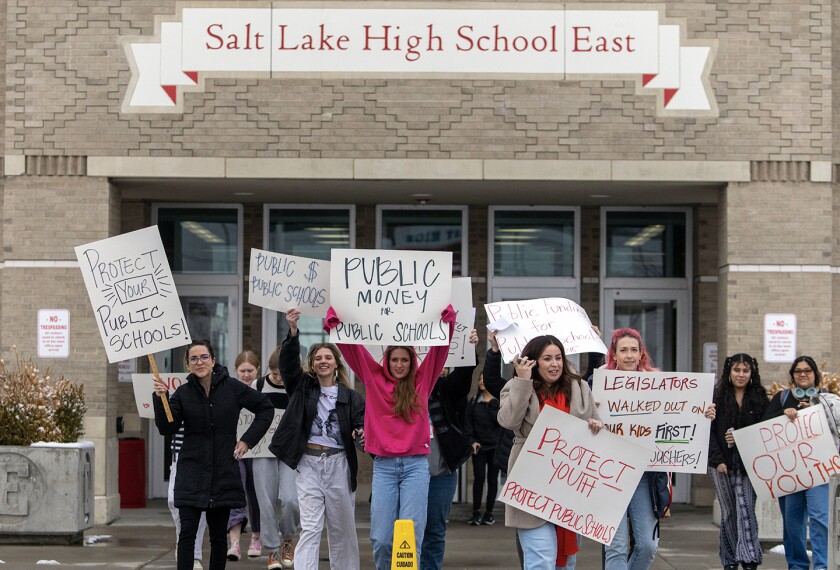
Students and teachers from East High School in Salt Lake City walk out of school to protest the HB15 voucher bill, on Wednesday, Jan. 25, 2023. Several years of pandemic restrictions and curriculum battles have emboldened longtime advocates of funneling public funds to private and religious schools in statehouses throughout the country.

Students and teachers from East High School in Salt Lake City walk out of school on Jan. 25, 2023, to protest legislation that would create private-school vouchers in the state. Several years of pandemic restrictions and curriculum battles have emboldened longtime advocates of funneling public funds to private and religious schools in statehouses throughout the country.

Rick Egan/The Salt Lake Tribune via AP

Stanford begins:

Emboldened by frustrations with pandemic-era policies and battles over what schools are teaching, conservative parents and politicians have accelerated a push for school choice policies that would funnel public funds into private schools.

Though school choice has been debated for decades, the movement is in a unique moment as advocates use parent concerns over COVID-era mask requirements; curriculum addressing race, gender, and sexuality; and library book content to bolster their argument that families should have more options outside of traditional public schools. And the school choice proposals states are considering—and, in some cases, have already passed—are more sweeping than previous iterations.

Already this year, lawmakers in at least 11 states—Idaho, Iowa, Kansas, Missouri, Nebraska, North Dakota, Oklahoma, South Carolina, Texas, Utah, and Virginia—have introduced and, in some cases, passed school choice bills. Although they vary in scope, many of the bills would establish or expand private school voucher and education savings account programs that give families public funds to pay for tuition at private schools, cover the costs of homeschooling, or pay for other schooling expenses.

The resurgence of school choice action shouldn’t come as a surprise. During the 2022 midterm election cycle, 19 Republican gubernatorial candidates advocated for school choice, mostly in the form of vouchers and education savings accounts, on campaign websites. This year, seven governors so far have talked about school choice policies in their state of the state addresses, according to the Education Commission of the States.

The policies are a result of parents’ declining satisfaction with schools following the pandemic, said Jonathan Butcher, an education policy analyst for the Heritage Foundation, a conservative think tank that advocates for school choice policies.

John Thompson, a retired teacher and historian in Oklahoma, has written frequently about events in his state for this blog. Here, he describes the political coercion that determined right-wingers are promoting in Oklahoma and calling it “choice.” From his description, some Republican legislators are worried about “liberal indoctrination,” transgender students using the “wrong” bathroom, litter boxes for children who think they are cats (this seems to be a QAnon idea), and the danger of “social-emotional learning.” Apparently students in Oklahoma have no social or emotional issues.

Ryan Walters, Oklahoma’s newly elected, extreme rightwing Secretary of Education, first says that “the state should have the ‘most comprehensive school choice in the country.’” Secondly, Walters pushes the rightwing Michigan-based Hillsdale College curriculum; he doesn’t want to allow schools to choose to retain research-based curriculums that he identifies as “liberal indoctrination.” As Clark Frailey, executive director of Pastors for Oklahoma Kids, says, Walters seems to be pushing for “Christian Dominionism,” which is “based on the philosophy that Christianity is at the core of America’s foundation and all institutions need to align with that viewpoint. If people won’t convert, then a government religion must be forced upon them.”

Two voucher programs for private schools and homeschools have been filed. The most interesting one is Sen. Shane Jett’s Oklahoma Parent Empowerment Act for Kids (PEAK). Even extremely conservative Republicans legislators worry that vouchers would undermine the finances of their rural schools. Jett seems to be offering a carrot and a stick to those vulnerable constituencies. He would impose vouchers only in counties with a population of more than 10,000 people. But, vouchers would be offered in counties with fewer than 10,000 residents if they are served by a “trigger district.”

The Oklahoman then reports:

Jett defined a “trigger district” as a public school system that allows or tolerates House Bill 1775 violations, use of school bathrooms according to gender identity, anthropomorphic behavior known as “furries,” disparagement of the oil and gas industry, lesson plans promoting social-emotional learning and animal rights activism, among other topics.

In other words, the bill would coerce schools into “choosing” to comply with the entire extremist agenda. But that begs the question about how educators would choose to deal with today’s threats to public education. Republican Sen. Adam Pugh’s newly revealed plan for school improvement was based on meetings with 200 public school superintendents; every college president in Oklahoma; and “hundreds, if not thousands” teachers and parents and advocacy groups.  Based on these listening sessions, Pugh did not propose vouchers.

Pugh’s plan would raise teacher pay so the minimum starting salary was $40,000, “with graduated raises to the minimum salary schedule based on longevity.” The estimated cost would be $241 million, which is less than the cost of Sen. Julie Daniels’ voucher bill ($275 million). They would  also create an “Oklahoma Teacher Corps” and a teacher mentoring system;  provide certain teachers at least 12 weeks of maternity leave; update the school funding formula, and pass Pugh’s seven other constructive reforms. 

As Pugh explained, “I hope this plan will demonstrate to teachers that we’re serious about the work that you do, and we appreciate how you pour your heart and your soul into educating kids, as we need you to stay in the classroom, and we need more of you.”

But, the Stillwater News Press offers an equally important response:

While that offers us a bit of a sigh of relief, Oklahomans should be aware that the push [to] move taxpayer money into private schools isn’t going anywhere. It’s a well-funded campaign and the state’s administrators and board members have been handpicked to make that a top priority.

I’m afraid I agree with the Stillwater News. Pugh’s bills raise hope. But Oklahoma Republicans will continue to coerce schools into compliance with their extremist privatization and Christian Dominionism ideologies – and call it “choice.”

On the other hand, more Republicans sound like they are getting fed up by Walters and his minions. This week, the Secretary of Education was supposed to present a budget to a legislative subcommittee for planning purposes, but a letter obtained by the Tulsa World shows that Walters seems to be prioritizing “ridding public education of ‘liberal indoctrination.’” Walters’ “spokesman” said he “has requested additional information on diversity, equity, inclusion programs (DEI) to fully understand the extent of indoctrination happening in higher education.”

The letter said:

Please provide a full outline and review of every dollar that has been spent over the last 10 years on diversity, equity, inclusion. Additionally, I want an overview of your staffing and the colleges underneath your oversight as the Chancellor of Oklahoma Higher Regents within every DEI program … and expenditures,” Walters wrote on letterhead of the Office of the Secretary of Education. “Lastly, please provide a copy of the materials that are being used in any of these programs.”

Neither has Walters followed legislative norms for presenting a public education budget. As Nondoc reported, Walters said he instituted a hiring freeze and a spending freeze for the State Department of Education when he took office and all related decisions require his approval. And, in addition to demanding vouchers, he has insisted on any teacher pay raise being performance-based. Above all, Walters said he would be bringing a completely different budget than the one his predecessor drafted. 

Republican Toni Hasenbeck (R-Elgin) responded saying, “district superintendents had expressed concern for ‘the next four years’” because of Walters’ campaign comments. Rep. Dell Kerbs, (R-Shawnee) commented, “I don’t need elevator speeches. I need details.” Subcommittee Chairman Mark McBride (R-Moore) understood the argument that performance pay could be a part of teacher pay, but he said that Walters’ plan went too far. And then he tried to get Walters back to the normative procedures which the subcommittee follows for helping craft funding priorities.

McBride “interrupted Walters,” and asked, “Are you saying the budget will totally change — you’re presenting a budget that’s not going to be the same budget, and you’re going to totally change it?”

Nondoc reported that “McBride seemed confused and paused for a moment.” When Walters tried to change the subject, [McBride] interrupted him and asked why Walters was presenting a budget that would not exist in a week. Walters again changed the subject and, as Nondoc reported, “McBride interrupted him again, asking him to stay on topic presenting monetary figures rather than discussing policy and slipping into “campaign rhetoric.” McBride said, “With all due respect, I need the performance review for last year. That’s what you’re here to present.” Then, after that interruption, Walters stopped his presentation.

 After the meeting, Matt Langston, Walters’s “spokesman” (a paid GOP consultant based in Texas) said, “Not one person in Oklahoma is surprised that Democrats are unhappy with the political theater that was orchestrated today.” According to Langston:

They do not want transparency, accountability or even basic reform because they are used to playing in the shadows. Union bosses, whining and liberal tears will not stop education reform, and the superintendent is looking forward to next week’s actual budget hearing.

Stay tuned! When Walters reveals his budget, chaos and vitriol will increase, and we’ll see whether Walters really believes he can implement his promise or “suggestion,” that “received some pushback from lawmakers in 2022,” a ten-year plan to reject all federal spending on education …

For Immediate Release: For more information, contact: Carol Burris, NPE Executive Director, 718-577-3276, cburris@networkforpubliceducation.org

PRO-VOUCHER SPECIAL INTERESTS WORK TO FUNNEL PUBLIC FUNDS INTO UNACCOUNTABLE AND EXTREMIST NETWORKS

The Network for Public Education (NPE) calls for the immediate cessation of ESA voucher payments to homeschoolers and all other non-school-based “individualized” instruction programs based on the discovery of an online homeschooling network whose primary purpose is to teach young children to be Nazis. According to the report in the Huffington Post, its numbers thus far are in the thousands, but the greater threat is how its existence exposes the dangers of publicly-subsidized vouchers designed to fund extremist beliefs.  Such programs, including so-called micro-schools, operate with almost no curricular supervision or public fiscal oversight, allowing them to legally indoctrinate children with a distorted hate-filled curriculum directly supported by public funds.

NPE President Diane Ravitch stated, “Our nation fought a World War to defeat Nazism. Public funds should not be used to propagate hatred of our fellow citizens. Public education exists to foster mutual respect among all citizens. Our public dollars should be used to teach the shared values of democracy, especially the rule of law, the equality of every person, the importance of free and fair elections, and the value of education in pursuing a life of dignity and purpose.”

Seven states now fund programs solely supervised by families with no control over whether a sound academic curriculum is taught. Eight states have introduced legislation that would either start or expand such programs. 

“These ESA voucher programs, which are mislabeled as scholarships and saving accounts, have been subject to fraud and abuse,” said Dr. Carol Burris, NPE executive director. “NPE has long held concerns that funded at-home programs might teach children misinformation or a radical curriculum of hate. This Neo-Nazi homeschool network now confirms our deepest fears.”

Many ESA voucher laws do not require the parent to present evidence that the student has learned anything to receive thousands of dollars in public funds.

In states that have adopted voucher plans, the academic results for students who left public schools are “disastrous,” says Josh Cowen, a professor at Michigan State University and a veteran voucher researcher. In addition, 75-80% of voucher funding goes to students already enrolled in private or religious schools. 

NPE also calls on every state to carefully review its homeschool laws. Eleven states do not require homeschoolers to report that their child is homeschooled, making a mockery of state compulsory education laws. No states have laws that would prevent the teaching of hate curricula.

“As more states adopt laws that fund unregulated radical schooling arrangements, we must ensure that children’s emotional and physical well-being are guarded. While we cannot protect children from those parents who would fill their minds and hearts with hate, we can at least ensure that our tax dollars are not supporting such instruction,” Burris concluded.

The use of public funds to support extremist and anti-social agendas, unfortunately, has a long track record for the privatization community, especially as today’s unpopular modern school vouchers being pushed in legislatures across the country have evolved from the segregationist reaction to the Brown v Board of Education Supreme Court ruling.

The Network for Public Education (NPE) was founded in 2013 by Diane Ravitch and Anthony Cody. Its mission is to protect, preserve, promote, and strengthen public schools for current and future generations of students. We share information and research on vital issues that concern the future of public education. For more information, please visit: networkforpubliceducation.org

This post appeared on the Network for Public Education blog. It shows the common theme of vouchers in other states: They subsidize the students who are already enrolled in private schools. The legislation was signed into law by Governor Kim Reynolds.

Ed Tibbetts: Few Iowa families will have more choices with GOP ‘school choice’ plan

Ed Tibbetts substacks at Along the Mississippi. In this op-ed for the Iowa Capital Dispatch, he looks at the true cost of Kim Reynolds’ voucher plan.

He writes:

Iowa Gov. Kim Reynolds says her plan to use taxpayer money to pay for private schooling gives people a choice to educate their kids where they want.

But that’s not what her plan says. Just look at the details: Only certain families with kids in public schools will get that choice.

What this plan really does is pay people who already are sending their kids to private schools.

Like many voucher programs, this one really sticks it to rural taxpayers.

Forty-one counties in Iowa have no private schools, according to the group Common Good Iowa. Another 23 counties only have one private school.

What choice do those kids and their parents have?

Not much.

What Reynolds’ plan really does is take their tax money and send it to families who live somewhere else.

But while this program may have an impact on taxpayers, its impact on students will be meager.

Rural or urban, though, even the governor’s own proposal acknowledges relatively few people will get this money. About 33,000 Iowa kids go to private schools now, and the governor says when her plan is phased in, that number will nudge up to about 38,000.

That’s not much of a change: Just 5,000 kids.

Meanwhile, approximately 500,000 Iowa kids will remain in underfunded public schools.

Do the math: Her plan only pays for 1% of Iowa kids to go from public to private school, but the costs balloon to roughly $340 million a year when phased in – or 9% of the basic state aid going to public schools now.

And like the several voucher plans being rocketed through red state legislatures right now, the Iowa plan is being fast-tracked–quick, before the voters notice!

The plan also is being moved quickly. That’s because the governor knows the longer this lingers, the better people will be able to grasp the consequences. The longer a light is shined on it, the more people realize this plan isn’t supposed to enable them to make a choice, but to pay for people who already have made it.

In the meantime, it sucks money away from the vast majority of public-school students who will remain in classrooms where districts already struggle with rising costs while the state turns a blind eye; in schools where our state spends less per pupil than most other states in the country; in schools where teachers whose salaries lag will eventually go to places where their skills are better rewarded and they aren’t scorned in service of the culture wars.

Read the full piece here. 

You can view the post at this link : https://networkforpubliceducation.org/blog-content/ed-tibbetts-few-iowa-families-will-have-more-choices-with-gop-school-choice-plan/

Now that Florida is a red state, the legislature plans to offer vouchers to every student. The legislators expect to do maximum damage to public schools, which will inexorably lose funding and students. Nothing has been said about how to pay for the proposal. Voucher schools in the state are mostly religious and are completely unregulated. Neither their principals nor their teachers need to be credentialed. They are also free to discriminate on any grounds.

The Miami Herald reports:

Florida Republican lawmakers this year will consider offering every K-12 student thousands of dollars each year for their families to spend on education.

Parents would have access to state-funded accounts and use them to pay for private school tuition plus a wide variety of school-related expenses.

The proposal, if approved, would make the state’s school voucher program bigger than ever. But one key fact about the pitch remains elusive: its cost. It could total billions of dollars.

House Speaker Paul Renner said last week he plans to make the proposal, House Bill 1, a priority during the annual legislative session, which starts March 7.

The measure is already being fast-tracked. It will have its first committee hearing Thursday morning in Tallahassee.

So far, the measure carries no financial impact statement. That’s despite the knowledge that hundreds of thousands more children would be eligible for annual payments of about $8,000 each.

The cost, according to the staff analysis, is “indeterminate.” And that “is not reasonable,” said Norín Dollard, a senior research analyst at Florida Policy Institute, a nonpartisan organization that focuses on quality of life issues for Floridians. The group issued a report on voucher funding in September.

HUNDREDS OF THOUSANDS NEW STUDENTS WOULD BE ELIGIBLE

About 266,000 Florida children attend private schools without using any current state scholarship or voucher, Dollard notes. All would be eligible for education savings accounts under the proposal. In addition, approximately 150,000 children receive home schooling.

HB 1 would provide accounts to as many as 10,000 of them in the first year, with more to come in following years. Conservative back-of-the-napkin math suggests that if just 25% of the newly eligible students participate, and those currently in the program remain, the added cost would reach $600 million, Dollard said.

As participation grows, the total could approach $4 billion or more within five years, she added. If that’s the policy decision in leadership, so be it, Dollard said. But it needs to be funded somehow.

A RECURRING FINANCIAL OBLIGATION

State Rep. Anna Eskamani, D-Orlando, focused on that issue during a hastily called Monday evening Zoom meeting to discuss the measure with public education advocates.“

“We have very, very serious concerns,” Eskamani said during an interview. “This is an annual shift of money. Where is it coming from?”

When unveiling the measure at a news briefing, Renner said it was too early to know how much money might be needed. Much depends on how many children want to avail themselves of the vouchers, he said, and where the Legislature sets per-student funding for the year.

At the same time, Renner stressed his goal is to further open school choice so “no one is left out.” The bill would eliminate most eligibility restrictions, though it would prioritize children whose family income is at or below 185% of the federal poverty level — or $55,500 for a family of four.

It also would broaden uses of the money beyond private school tuition to include education expenses such as tutoring, testing and college courses. It would allow students to bank up to $24,000 for those uses, and further permit children already attending private schools without state support to request a share of the funds.

“To effectively deliver a quality education, policy makers and education advocates must accept that every student has unique learning needs, that education dollars belong to the student and not a system, and that public school choice offers every student an opportunity to customize their own education,” Renner said Tuesday, when asked about the associated costs.

A SPIKE IN PARTICIPATION IS EXPECTED

Dollard and others said they anticipate wide interest in participation, with much of it coming from families already paying for private schools. In Arizona, which has a similar education savings account program, the state reported 80% of applicants never attended public schools.

That flips the idea of money following the student on its head, Dollard suggested, because those students never had their education covered by state money in the first place.

School district finance officers said they understood the leadership’s position that the details aren’t firm enough to know the full financial impact.

But using the state’s most recent voucher expansion plan as a guide, they had concerns that this initiative would take money away from district budgets and leave them little ability to plan.

That’s what happened the last time the state expanded vouchers in 2021 with the taxpayer-funded Family Empowerment Scholarship. Officials touted the program as adding $200 million for vouchers, allowing 61,000 more children to afford private school.

Districts saw some money go out the door, but nothing like what happened in 2022. Halfway through the 2021-22 school year, school budget officers across the state learned that three times the amount of money they had set aside to send to voucher programs would be required, based on updated attendance figures from the state.

In some counties, such as Pasco, efforts to provide employee raises were derailed as the money officials expected to use was diverted to the vouchers. All told, the cost had grown to $1 billion.

The current year has provided similar sticker shock. The Legislature approved a budget with no specific amount set for the scholarships. By the second education funding calculation in July, the price tag had increased to $1.3 billion.

That meant the Miami-Dade County school district would have to send $225 million from its budget to the voucher program, for example, and the Hillsborough County school district would send $75 million.

When the third calculation came out this week, districts learned they would be losing even more. If the state lifts the eligibility restrictions, Pinellas County Schools chief finance officer Kevin Smith predicted, it will become even more difficult to predict the financial impact.

He suggested the state should at least consider taking the money out of the public education funding program and create a separate line item.

That way, schools would know what to expect and they could budget appropriately. In recent years, the DeSantis administration has taken the position that unexpected changes in enrollment can pose a financial strain on local school districts.

Read more at: https://www.miamiherald.com/news/local/education/article271630112.html#storylink=cpy
This is one of Peter Greene’s finest posts. He explains the real reason that Republicans have fallen in love with vouchers. They want to eliminate public schools and in time shift the financial burden of schools to parents, not taxpayers. One of the loudest voucher advocates, who got his doctorate from the University of Walton….the University of Arkansas’s so-called Department of Educational Reform, where they teach the doctrine of school choice, posted a photograph of himself and a woman whom I assume was his wife at a funeral, celebrating the death of public schools. When we go high, they go low.

Greene writes:

The new wave of voucher bills being rammed through red state legislatures all demonstrate a truth about school voucher policies– vouchers are not about choice. They’re about peeling people away from the public school system in order to defund and dismantle that system.

What makes me think so? Here it is. Sometimes it’s not about what people say, but about what they don’t say.

If the concern were really and truly choice for every student, then voucher fans would be addressing some of the real obstacles to school choice.This door doesn’t lead where they told you it would.

For one, they would be addressing discriminatory and exclusionary policies. Yet when have we ever heard a voucher supporter say, “These discriminatory policies have to stop. LGBTQ+ students deserve just as much school choice as any other students.”

The closest thing we ever get is “Well, then they can start an LGBTQ-friendly school of their own.” Yet when that happens, pro-voucher politicians target that school with terms like “perversion.” And of course in some states, such a school can never happen because talking about LGBTQ students or Black history has been outlawed. And voucher laws are written to hold the private school right to discriminate as it wishes inviolable.

If someone were serious about voucher based choice, they would also address cost. Vouchers are typically far too small to pay for tuition to top schools in the state. If voucher supporters were really interested in making sure that, as Jeb Bush says, “each and every…student can access the education of their choice,” there would be a robust discussion about how to bridge the gap between meager vouchers and expensive schools.

Yet we never hear voucher advocates saying, “We need to find the way to fully fund vouchers so that they provide a real choice to students.” Choice advocates like to point at the inequity of the public system–parent choice is limited by their ability to buy an expensive house in a wealthy neighborhood. But the current crop of voucher programs doesn’t change that a bit–a voucher offers little to change the fact that how much “freedom” you get depends on how wealthy you are.

It has been done. But when Croydon, NH set up a school choice program, a voucher-like system that bore the full cost of sending a student to the school of their choice, local libertarians tried to shut it down because they wanted lower taxes.

Voucher fans love the idea of school choice; they just don’t want to actually pay for it.

If these folks were serious about school choice via vouchers, we would have calls for oversight and accountability. It would make a choice system that much more attractive for parents to know that all the available options have been vetted and screened and will be held to some standards, just like shopping in a grocery store where you can rest easy in near-certainty that whatever you pick, it’s not going to actually poison your family.

And yet not only do voucher fans not call for oversight and accountability, but they actively block it with language that hammers home that nobody can tell vendors what to do or how to do it.

Voucherphiles like to call their system child-centered, but in fact it is vendor-centered, with “protections” for the service providers written into the law, and protections for the students non-existent. Parents are left to navigate an unregulated system of asymmetrical information that favors the businesses– not the families.

Please open the link and finish the post. And while you are at it, subscribe to Peter’s wonderful blog.

After especially awful massacres, the public expects Congress to take meaningful steps to limit access to guns. Sandy Hook. No action. Marjory Stoneman Douglas HS in Parkland, Florida. No action. The Pulse Nightclub. No action. The Las Vegas music festival massacre. No action. Uvalde. No action. The recent massacres in California? What do you think? Why no action? The Republicans block every attempt to enact meaningful restrictions.

CNN posted a summary of where America stands internationally a day before the killing of 11 people in Monterrey Oark, California.

CNN) – Monterey Park. Atlanta. Orlando. Las Vegas. Newtown. Parkland. San Bernardino. Uvalde.

Ubiquitous gun violence in the United States has left few places unscathed over the decades. Still, many Americans hold their right to bear arms, enshrined in the US Constitution, as sacrosanct. But critics of the Second Amendment say that right threatens another: The right to life.

I insert here that my understanding of the Second Amendment is that it pertains not to the right of every individual to “bear arms,” but to the maintenance and arming of a “well-regulated militia.”

For a time in the 1990s, the Supreme Court agreed, and let stand a decade-long ban on assault weapons.

The 2nd Amendment says:

A well regulated Militia, being necessary to the security of a free State, the right of the people to keep and bear Arms, shall not be infringed.

The CNN article continues:

There are 120 guns for every 100 Americans, according to the Switzerland-based Small Arms Survey (SAS). No other nation has more civilian guns than people.

More guns than people!

Read the article.

Within a day of the brutal hammer attack on Paul Pelosi, Nancy Pelosi’s 82-year-old husband, rightwing media began circulating scurrilous rumors. They said that the intruder did not break in, that he was invited in, and they claimed that the two men met in a gay bar, then quarreled.

The Capitol Police in D.C. had surveillance cameras around the property. Today they released the video of the intruder using a hammer to break the glass of the door or windows in the back of the house, then entering. This confirms the original account.

This is the video.

Capitol Police surveillance video from outside former Speaker Nancy Pelosi’s home in San Francisco, released publicly on Friday, shows the man who attacked her husband in October breaking in.

Before he does that, the attacker can be seen peering into the dark house, walking away and then returning with bags, which he rummages around in for more than two minutes.

Shortly after 2 a.m. local time — the time stamp on the video says 5:10 a.m., which would be consistent with the Eastern time zone, where the Capitol Police force is based — the assailant starts trying to smash a window or a door with what appears to be a hammer. It takes him about 30 seconds of repeated strikes to break through, at which point he climbs into the house and the footage ends.

The surveillance video shows two key things.

First, it indicates that the attacker was outside the Pelosis’ home for several minutes before he entered, meaning it might have been possible to prevent the attack had the Capitol Police been monitoring the surveillance camera in real time.

Second, it unequivocally dispels a baseless conspiracy theory that began circulating soon after the attack: that the suspect, David DePape, had not broken in but rather had been invited in and then got into a fight with Mr. Pelosi.

The New York Times reported on Nov. 1 that the Capitol Police were not monitoring the video feed from the Pelosi home in real time, and that costly minutes elapsed before Capitol officers saw the break-in.