Archives for category: Walton Foundation

Fifteen years ago, I wrote a book about the the danger that school choice and testing posed to public schools. Its title: The Death and Life of the Great American School System: How Testing and Choice Are Undermining Education. I named a few of the billionaires funding the attacks on public schools, teachers, and unions–Bill Gates, Eli Broad, and the Walton family–calling them “The Billionaire Boys Club.” Little did I know that they were the tip of the billionaire iceberg.

My hope in 2010 was that public school supporters would block the privatization of their schools. Public schools are as American as apple pie. I wanted the public to wake up, rally around their public schools, and repel the hedge fund managers and billionaires who were funding the privatization movement.

I was too optimistic.

The attacks escalated, fueled by the political power that money buys. The major media bought the corporate reform narrative hook, line, and sinker.

Neoliberal corporate reform brought us high-stakes standardized testing, A-F ratings for schools, charter schools, school closings, and rating teachers by the test scores of their students. And cheating scandals. All to get higher test scores, which never happened.

Now, Jennifer Berkshire asks on her blog The Education Wars whether it’s all over for public schools. Jennifer appreciates the importance of public schools as community builders and civic institutions that serve the common good.

Please read her smart take on the state of public education today:

I won’t lie. If you’re a member of Team Public Education, as I am, it has been a tough summer. And if you, like me, have been sounding the alarm about the dangers of school privatization, it’s impossible to ignore the sense that the future we’ve been warning about has arrived. Five years ago, education historian Jack Schneider and I wrote a book called A Wolf at the Schoolhouse Door: the Dismantling of Public Education and the Future of School that culminated in a sort of “Black Mirror” chapter called “education a la carte.” In it, we described how the ultimate vision of school privatization advocates wasn’t simply to shift the nation’s youngsters into private schools, but to ‘unbundle’ education into a vast array of products for consumers to purchase on Amazon-like exchanges. Lest you think we were exaggerating, turn your attention to Florida, where, as Sue Woltanski documents, project unbundle has arrived with a vengence.

Florida, as usual, is slightly ahead of the curve. But the accelerating collapse of public schools in the state, chronicled in this recent New York Times story, pushed along by the now universal school voucher program, will soon be coming to a state near you. The NYT piece, by the way, was just one of many ‘are public schools over?’ stories to drop in recent weeks. The Washington Post version headed to peer in the window of the GOP vision for education. Spoiler: it entails replacing public schools with “a marketplace of school options.” Then, of course, there was the annual PDK survey of attitudes towards public education, which found both sinking approval of the nation’s schools (with the usual exception for local schools) and rising warmth towards the idea of private school vouchers. As legal scholar Derek Black put it, “The deep well of faith in public education has a disastrous leak.”

To understand what’s happening, I’m going to pause here to spend some time with yet another of the ‘are public schools through?’ stories, Chandler Fritz’s eye-opening new feature for Harper’s“The Homemade Scholar.” Fritz, a teacher and writer who pens the “Arizona Room” newsletter, took a job at a private religious microschool in order to get a close up view of Arizona’s education marketplace, what he describes as “a new frontier in American education.” I recommend paying attention to this piece because 1) Fritz is a terrific writer and 2) he provides real insights into the appeal of vouchers, or as they’re billed in AZ, education savings accounts—something my own writing rarely reckons with. 

Fritz finds a grab bag of reasons that students and parents are drawn to this particular microschool, most of which will be familiar to you: a hunger for ‘customization,’ the desire for religious instruction, the appeal of a small setting, conservative backlash against public education. But there’s another reason we don’t hear as much about—the opposition to the standardized testing that shapes every aspect of what’s left of our public schools. Fritz’s piece is long (the audio version clocks in at nearly an hour), and infuriating in parts, but his observations regarding the attitudes of these ‘education consumers’ towards standardized tests get straight to the point: they hate them.

Bad math

A similar theme pops up in Dana Goldstein’s recent portrayal of the impact of vouchers on schools in Florida’s Orange County. While three quarters of the schools in the district earned an ‘A’ or a ‘B’ on the state’s school accountability report card, parents are eager to free their kids from the burden of taking the state tests, something Florida education watchdog Billy Townsend has been tartly observing for years. Now, I mention opposition to standardized testing here because, even in our deeply divided times, it is a cause that unites parents across virtually any line of division. If you don’t believe me, head down to Texas, where, in addition to re-gerrymandering the state’s electoral maps, legislators have also been pretending to address the popular revolt against the STAAR Test.

But there’s another reason to revisit the antipathy to testing. While you’ve been distracted by the relentless tide of bad and worse news, what’s left of the education reform movement has been busy reemerging, zombie style, seemingly without having learned a single thing about why it flopped in the first place. There are overt signs of the zombie’s return—like Democrats for Education Reform trying to rally the party around a vision of education ‘abundance,’ or Andrew Cuomo, flailing in the NYC mayoral race, now rebranding himself as the education reform candidate with a pledge to shut down failing schools and replace them with new ‘schools of promise.’ Then there’s the pundit-level narrative taking shape in which education reform was working just great until the teachers unions ruined everything and/or Democrats lost their nerve.

This version of events, encapsulated in this recent David Brooks column, goes like this:

School reform was an attempt to disrupt the caste system, to widen opportunity for the less privileged. Presidents Bill Clinton and Barack Obama angered core Democratic constituencies like teachers unions in order to expand opportunity down the income scale. But now Democrats have basically given up. Joe Biden didn’t devote much energy to education reform. Kamala Harris ran for president without anything like a robust education reform agenda.

Brooks goes on to cite Michael Petrilli on the ‘Southern surge,’ the rise in test scores in Mississippi, Alabama, Louisiana and Tennessee (but not Florida) that has education reformers so excited. Kelsey Piper, authoress at the brand new outlet the Argument, is excited too. In her back-and-forth with leftist policy analyst Matt Bruenig over the question of whether giving parents cash benefits poor children, Piper comes down squarely on the side of fixing the schools.

I think school reform after school reform has served every conceivable interest group except students (who do not vote) and so have failed to meaningfully increase literacy and numeracy, even though we now have a road map for how to genuinely let every child thrive.

If you guessed that the ‘road map’ referred to here is Mississippi, you would be correct. Mississippi, by the way, is a national leader in child poverty levels, an honor that the state, which just eliminated its income tax, seems determined to hold on to.

Proxy war

Such ‘if only the band would get back together’ takes somehow miss what a flop much of our recent version of education reform turned out to be. Here’s a partial list. The backlash to Common Core on the right didn’t just help to usher in Donald Trump but played a role in transforming the GOP from the party of big business (which was all in on pushing the Common Core standards) to one dominated by aggrieved populists. And the over selling of college tapped into a well of resentment so deep that the entire system of higher education is now threatened. Then there is the relentless push to narrow the purpose of school down to standardized testing and workforce prep, a bipartisan cause that, as I argue in a forthcoming essay in the Baffler, has now been abandoned by the right in favor of education that prizes ‘virtue’ over vocation, even as many Democrats continue to beat the ‘career readiness’ drum.

I’m not the only one to point this out, by the way. Teacher-turned-writer Nora De La Cour makes a compelling case that the appeal of so-called classical charter schools is due in part to the damage done to public education by neoliberal education reform. Students at these rapidly spreading classical schools encounter the ‘great books.’ Their public school peers get “decontextualized excerpts in corporate-produced test prep materials,” writes De La Cour.

Which brings me to the main point of this piece. (Finally!) Part of what’s so frustrating about our current moment is that by leaning into a deeply unpopular vision for public schools—test them, close them, make them compete—a certain brand of Democrat is essentially incentivizing parents to seek out test-free alternatives. Consider too that we’re in the midst of a fierce intraparty debate over what Democrats need to do to win. For the education reform wing of party, the answer to the question is to go hard at teachers unions and double down on school accountability, while also embracing school vouchers. 

While this vision is inherently contradictory, it’s also a loser with voters. There may be no single less appealing sales pitch than ‘we’re going to close your school.’ Just ask former Chicago mayor Rahm Emmanuel, who was so unpopular in the city’s minority neighborhoods after shuttering 50 schools that he couldn’t run for reelection. As voucher programs expand rapidly, we’re about to enter a new era of school closures. If you don’t believe me, just check out this statement from a CATO Institute spox in response to that WaPo story on Arizona:

It’s tough for some families when their school—public or private—closes. Kids miss their friends, teachers worry about their jobs, parents have to adjust their transportation plans. But stories bemoaning public schools losing enrollment due to school choice policies are missing the point. Should parents who want a different option for their children be forced to stay in their assigned school in order to prop it up? Of course not. Public schools had a virtual monopoly on enrollment for decades, but no school can serve the unique needs of all the children who happen to live near it. As we continue down the path of more educational freedom, some schools will rise to the challenge and others will close. We shouldn’t sacrifice children’s futures in an effort to save schools that aren’t meeting their needs.

Close readers will note the moving goal posts—that we’ve moved from school choice as a means of escaping ‘failing schools’ to escaping any kind of school. But the bottom line is that we’re just supposed to accept that ‘education freedom’ means that lots of schools will be closing. Or take the ‘back to the future’ sales pitch for microschools, in which parents “form pods in church basements, barns, and any space they can find. Teachers are launching microschools in their garages.” This vision of what proponents like to call ‘permissionless education’ is one many parents, indeed entire communities, will find difficult to make sense of. It also seems like a gimme for Democrats who are trying to differentiate themselves from the right’s hostility to public schools. 

I want to end on a hopeful note, because I’ve depressed us all enough by now, but also because there are some hopeful signs out there. While the education reform zombie may be reemerging, well funded as ever, a growing number of Democrats are showing us what it sounds like to run as an unabashed advocate for public schools. There’s Graham Platner, the challenger to Susan Collins in Maine, who calls out the endless attacks on public schools and teachers as “the tip of the assault on all things public.” Or how about Nathan Sage in Iowa, who puts the defense of public education at the center of his populist platform:

Public schools are the heart of our Democracy, and Republicans are tearing them down brick by brick, while treating our heroic public school teachers like dirt. They are underfunding our public schools and are diverting billions of taxpayer dollars to private schools and into the pockets of billionaires behind them.

To this list I could add Josh Cowen and Abdul El-Sayed in Michigan, or Catelin Drey in Iowa, who, if she pulls off a win in today’s special election to fill a state senate seat in a district that Trump carried by 11 points, will end the GOP’s supermajority in that chamber. Drey, by the way, is running as a pro-public-education-candidate and an outspoken opponent of Iowa’s controversial universal school voucher program. Plenty of influential Democrats will insist that that message is a loser. That the way for Democrats to win is to run against public schools—to talk about what failures they are, why we need to get tougher on them, and how maybe we don’t actually need them after all. I think they’re wrong, and that voters agree.

Drey did win in Iowa, decisively, proving that a pro-public education stand is a winning message. Drey won 55% of the vote in a district that Trump carried. Her victory broke the Republican supermajority in the state senate.

The Walton Family Foundation, which is the second largest funder of privately-run charter schools (first is the U.S. Department of Education, which dispenses $400 million a year to charters), wanted to create positive press about charter schools in Alaska. So they commissioned a study by two charter advocates, who produced the positive results Walton wanted.

Beth Zirbes teaches math and statistics in a high school in Fairbanks, Alaska. With her friend Mike Bronson, she reviewed the data in the state records and reached a different conclusion: charter schools are no better than neighborhood public schools, even though the charter students are more advantaged. Their article, with a link to their study, was published by the Anchorage Daily News.

What’s impressive about this study is that a high school math teacher bested a Harvard professor of political science. It just goes to show: Don’t be overly impressed by the author’s academic credentials. And, never believe any charter or voucher research funded by foundations that fund charters and vouchers.

Would you believe a study claiming that cigarettes do not cause cancer if the study was funded by Philip Morris or some other tobacco vendor?

Zirbes and Bronson wrote:

The governor has claimed in several newspaper pieces that Alaska charter schools are more effective than neighborhood schools, and that the charters should be modeled more widely. He’d seen reports by Paul E. Peterson and M. Danish Shakeel, sponsored by the Walton Family Foundation, showing that Alaska charter schools held top rank academically among other states on a federal test.

We value the good performance of many charter school students, but we were skeptical that charter schools were necessarily more effective at lifting students up. So we looked at state data to find out how much of the charter schools’ better scores might be attributed to the schools themselves versus what the students bring to the schools. Read our full report here.

The state’s data showed the governor’s takeaway was incorrect. He was wrong that Peterson’s study showed the superior effectiveness of Alaskan charter schools over neighborhood schools. First, Peterson’s study did not even look at neighborhood schools. Second, after we accounted for numbers of students poor enough to be eligible for reduced-price or free lunches, we found that charter schools and neighborhood schools did not statistically differ in their English language proficiency scores. Instead, the percentage of proficient students in both charter and neighborhood schools was closely related to family income.

Alaska charter schools, on average, are distinguished by high proportions of white students, higher family income and fewer English language learners. Alaska charter school student bodies, in general, don’t even resemble Lower 48 charter schools, let alone Alaskan neighborhood schools. Unfortunately, Alaskan charter students do resemble other Alaskan public schools in that a majority of them score below the state standards in reading and math.

The graph shows a decline in percentages of third to ninth-grade participating students who scored proficient or better on the state’s 2019 PEAKS assessment of English language arts with increasing school percentages of students poor enough to be eligible for free or reduced-priced lunch, in other words economically disadvantaged. Each point shows a public school in Alaska school districts having charter schools. Neighborhood schools are considered non-charter, brick-and-mortar schools including alternative and lottery schools managed by a school district. Data are from the Department of Education and Early Development.

A recent Heritage report warns that parents can’t trust charter schools because so many of them are just as “woke” as public schools. Some are even more woke than public schools.

The report, written by Jay Greene, Ian Kingsbury, and Jason Bedrick, asserts that the major philanthropic foundations supporting charter schools—the Walton Family Foundation and the Gates Foundation—are also woke. This is where it gets crazy. Walton is woke? The anti-union, rightwing Waltons?

The solution the authors prefer is a fully funded voucher system, where schools are not regulated by the state and do not need money from woke philanthropies like Walton or Gates. That way, parents who are racist, homophobic, and sexist can find a school that teaches their values.

They begin:

There is a loose set of political and social values that can succinctly be labeled as “woke.” These woke values tend to be characterized by a departure from traditional American and classical-liberal values of individual responsibility and equal treatment in favor of emphasizing differentiated treatment by group identity and social rather than individual justice. Of course, there is a constituency of parents who favor an education infused with these woke values—but they tend to be a distinct minority. As past research suggests, when parents have more control over the education of their own children, that education tends to be less woke.

Given that parental empowerment is associated with less woke education, one might expect that charter schools—which are chosen by parents rather than strictly assigned based on the location of a family’s home—are less woke than nearby public schools operated by school districts. But school choice could produce more woke options if those choices are highly regulated and controlled by distant regulators and philanthropists. School districts still retain a fair amount of responsiveness to the preferences of the communities they serve given their democratic governance.

Charter schools, on the other hand, might become less responsive to the preferences of local parents if they have to please state authorizers to be established and remain open and if they are overly dependent on national philanthropies to subsidize their operations. Those charter schools may have to adopt woke values to gain permission to open from the public authorities that grant them their charter and to receive funding, especially for capital expenses, from large donors with progressive values.

Parents may nevertheless choose woke charter schools, either because they are among the minority that hold those values or because safety and quality of instruction may induce parents to select a school that is otherwise at odds with their values. By contrast, policies that permit private school choice with vouchers or K–12 education savings accounts do not require permission from an authorizer for schools to open their doors and therefore are less likely to require capital funds from donors since they often already have school buildings. That means that private schools are typically more directly accountable to parents than charter schools and so are more likely to reflect the values of the families they serve.

It is an open question whether highly constrained and regulated types of school choice, like charter schools, are actually less responsive to parental preferences regarding values than are public district schools, which are also regulated and insulated from parental control by unions and the imperfections of democratic governance.

The purpose of this Backgrounder is to examine whether, on average, charter schools embrace a woke education more strongly than do nearby public schools operated by school districts. By analyzing key words in student handbooks as a proxy for wokeness, the authors find that charter schools actually tend to be more woke than traditional district schools. The authors consider how regulatory and donor capture of charter schools could be reduced so that this type of school choice could be more responsive to parental preferences regarding the values emphasized in the education of their own children.

They conclude:

School choice should empower parents to obtain an education for their own children that is consistent with their values. That is still occurring with private school choice, but with charter school choice it is falling short. Regulatory and financial constraints need to be removed from charter schools so they can better align with the values preferences of parents. In states and localities where charter schools have not been able to be more responsive to parents, private school choice is the better path for avoiding the woke capture of school choice.

Voucher advocates are justly frightened of state referenda. They claim that “polls show” that vouchers have public support. They don’t. The voucher forces know that every state referendum about sending public money to private schools has failed. In state after state, vouchers have been turned down by voters, typically by large margins.

I wrote a few days ago that concerned citizens in Arkansas were trying to collect enough signatures to get a referendum on the ballot for voucher school accountability. They were outmatched by big money. More than $1 million in spending defeated $8,217.

Supporters of public schools in Arkansas wanted the state to hold voucher schools to the same accountability standards as public schools. Why not? The voucher lobby has boasted for years about the superiority of private and religious schools. But the lobby goes to great lengths to shield those wonderful private schools from taking the same tests as public schools! The evidence is in: when poor kids use vouchers, they fall behind their peers in public schools. In Arkansas right now, almost all the voucher money is going to kids who never attended public schools.

Despite the efforts of some 1,200 volunteers in Arkansas, they collected only about 70,000 of the 90,704 signatures needed to put the referendum on the ballot this November. They promise to try again in 2026.

The anti-voucher group is called For AR Kids, which includes the Arkansas Conference of the NAACP, Arkansas Education Association, Arkansas Public Policy Panel, Citizens First Congress, Arkansas Retired Teachers Association and Stand Up Arkansas.

Opposition to the referendum was funded by the multibillionaire Walton family and the multibillionaire Jeff Yass from Philadelphia.

The Arkansas Advocate reported:

The measure faced opposition from Arkansans for Students and Educators and Stronger Arkansas, two ballot question committees with close ties to the governor. Additionally, the measure was opposed by Family Council Action Committee 2024, which like Stronger Arkansas also opposes the proposed abortion and medical marijuana amendments.

Arkansans for Students and Educators and Stronger Arkansas have received a total of $986,000 and $375,000, respectively, in campaign contributions, according to June financial disclosure documents. Meanwhile, For AR Kids received a total of $8,217 from donors.

Bottom line: the billionaires spent about $1.3 million to protect voucher schools free of any accountability.

The anti-voucher group had $8,217 to spend in hopes of getting the same standards for voucher schools and public schools.

Unfair. Unethical. Shameful.

The board of the Pasadena Unified School District debated whether charter schools should share in the receipts of a new tax. The board voted 4-3 not to include the charters. The three members who voted in favor of including the charters said that the votes of the parents of 2,000 charter students would help meet the 2/3 majority needed to pass the tax. The four who voted “no” held that charters are independent of the district and should not benefit from its taxes. The members opposing the sharing said that the charters could affiliate with the district but they choose not to.

The Pasadena school board considered a resolution to approve an education parcel tax for the ballot in the November 2024 election. The resolution was moved for approval and seconded. The board discussed and voted down an amendment in the ballot language to add charters as beneficiaries of the measure.

Board President Kim Kenne and Members Patrick Cahalan and Tina Fredericks voted to add charter schools as beneficiaries of the parcel tax on the November ballot.

Member Cahalan appreciated the public comments from charter supporters whose families have students in both regular PUSD schools and charter schools. The district’s survey about the November measures showed the potential support for passing this measure and the facilities bond is very close to the ⅔ needed for passage. He wanted the support of the approximately 2000 charter school parents to get it over the threshold. He proposed a board resolution to spell out the sharing of monies…

Those voting against the amendment were Michelle Richardson-Bailey, Patrice Marshall McKenzie, Yarma Velazquez and Jennifer Hall Lee.

Vice President Hall Lee spoke about having charters in the district authorized by other entities, not PUSD, like the L.A. County Board of Education. She spoke of the history of charters. While initially founded to help the public schools, they have become competitors and have become anti-union. She said she is a union-supporter, and she believes there is competition between charters and PUSD schools, like in Altadena. She spoke against the argument that charters are needed to be cutting edge options. PUSD is recognized in state education circles as a cutting edge district of excellence. Later in the meeting she mentioned that members of the California Charter Schools Association (CCSA) were present earlier. She found that CCSSA is funded by the Walton family, and a director of CCSA is also an employee of Walton Enterprises. The wealth of the Walton family is problematic when the CCSA threatens legal action against the district.

Member Marshall McKenzie introduced herself to the charter supporters in attendance, who had referred to her by a shorter version of her name not used by her. She spoke about her deep roots in the community and in PUSD public schools; her parents attended PUSD schools. She spoke of her university training in state public universities, her full commitment to public education as democratic, a creator of society, a lever of economic mobility, and a center of community. These things are really important to her and are why she ran to be on the board of education. She was not prepared to entertain or accept any amendments tonight, as those are longer conversations.

Member McKenzie said that she was clear on the nature of charters as separate Local Education Agencies (LEAs), which have the ability to raise money from their parents, and which get their own Average Daily Attendance (ADA) money from the State. These funds do not go to PUSD. She pushed back on the charter supporters’ comments about inclusion and building community, saying, “If you are willing to convert your charters to be affiliated charters or dependent charters, let’s have that conversation about how we build community and how we serve all of the students in the area of the Pasadena Unified School District because now we’re all public schools.” She said she has been consistent on this point.

Member McKenzie made the same argument back in 2019 at the joint meeting of the City Council and the PUSD Board, when charters wanted some of the Measure J sales tax monies. At the time she said, “Since charters are their own LEA, that would be like PUSD giving Measure J money to Glendale Unified. We would not do that. So why would we give these dollars away as well?  I just don’t understand the logic in that.  So right or wrong, I’m going to be consistent in my position on that.” She struggles with the situational alliance with PUSD. “When it’s convenient for you, you want to be PUSD kids, you want to be public school kids, and when it’s not convenient for you, you’re very happy to divest… I feel like right now you’re not with us; it’s for your personal benefit and not for the greater good of the community.”

Like Vice-President Hall Lee, she referred to the origin of charter schools as being the center of innovation and providing flexibility for educators in curriculum development and with staffing, but charters have gone far away from those principles in the current charter and school landscape. “We simply just cannot afford to fund two systems out of one pot of money, and what you’re asking us to do is to dilute this one small pot of money even smaller.” She referred to the parcel tax amount being small compared to PUSD’s state funding and budget challenges. Yet she said she was very supportive of the bond and the parcel tax as a voter and a property owner who is happy to make the investment in public education. She reiterated that charters could have the same flexibility in curriculum development and staffing and special programs if they were PUSD-affiliated charters, but if they aren’t willing to have that conversation, she stated that she’s  not willing to go down this road of sharing funding. Member McKenzie ended by saying she can’t support the amendment without a longer dialogue and a building of community with those in charters.

Regarding the argument about losing the votes of many parents with children at both a charter and a PUSD high school, Member Velazquez said, “They have the choice to support our public high schools. I support our PUSD teachers; I support our PUSD staff. I am a proud CFA (California Faculty Association, the faculty union for the CSU system) member. I am a proud educator in the public education system in this beautiful state of California. I am a ‘NO’ on the amendment.”

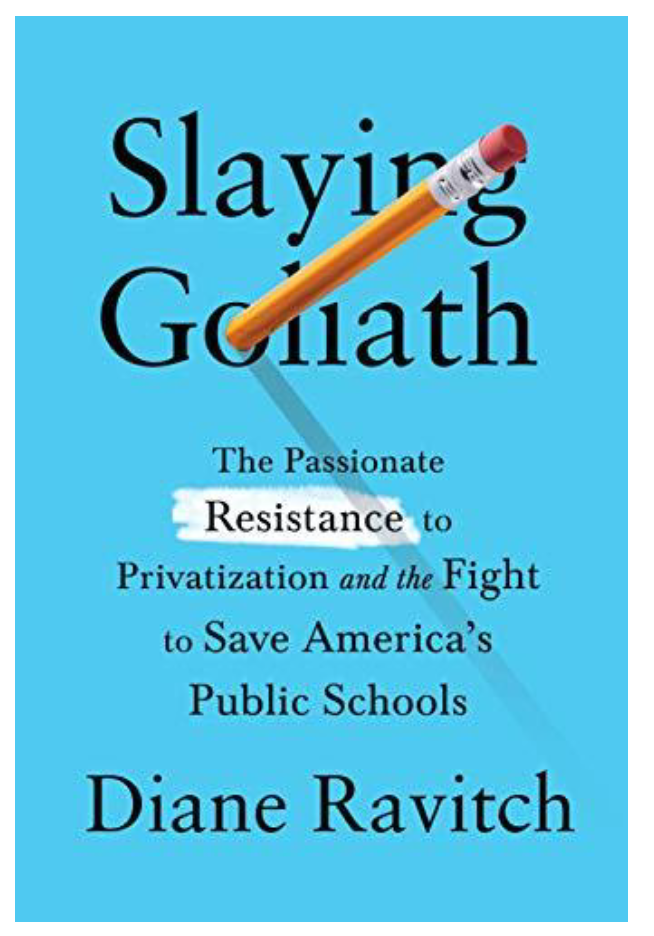
Forgive me for posting two reviews of my last book, which was published on January 20, 2020.

As I explained in the previous post, I did not see either of these reviews until long after they appeared in print. Slaying Goliath appeared just as COVID was beginning to make its mark, only a few weeks before it was recognized as a global pandemic. In writing the book, I wanted to celebrate the individuals and groups that demonstrated bravery in standing up to the powerful, richly endowed forces that were determined to privatize their public schools through charters or vouchers.

America’s public schools had educated generations of young people who created the most powerful, most culturally creative, most dynamic nation on earth. Yet there arose a cabal of billionaires and their functionaries who were determined to destroy public schools and turn them into privately-managed schools and to turn their funding over to private and religious schools.

Having worked for many years inside the conservative movement, I knew what was happening. I saw where the money was coming from, and I knew that politicians had been won over (bought) by campaign contributions.

Publishing a book at the same time as a global pandemic terrifies the world and endangers millions of people is bad timing, for sure.

But the most hurtful blow to me and the book was a mean-spirited review in The New York Times Book Review. The NYTBR is unquestionably the most important review that a book is likely to get. Its readership is huge. A bad review is a death knell. That’s the review I got. The reviewer, not an educator or education journalist, hated the book. Hated it. I found her review hard to read because she seemed to reviewing a different book.

I was completely unaware that Bob Shepherd reviewed the review. I didn’t see it until two or three years after it appeared. He wrote what I felt, but I, as the author, knew that it was very bad form to complain, and I did not.

So I happily post Bob Shepherd’s review of the review here.

I am almost four years late in discovering this review by two scholars for whom I have the greatest respect: David C. Berliner and Gene V. Glass.

I was happy to read this review because Slaying Goliath had a checkered fate. It was published in mid-January 2020. I went on a book tour, starting in Seattle. By mid-February, I made my last stop in West Virginia, where I met with teachers and celebrated the two-year anniversary of their strike, which shut down every school in the state.

As I traveled, news emerged of a dangerous “flu” that was rapidly spreading. It was COVID; by mid-March, the country was shutting down. No one wanted to read about the fight to save public schools or about its heroes. The news shifted, as it should have, to the panicked response to COVID, to the deaths of good people, to the overwhelmed hospitals and their overworked staff.

To make matters worse, the New York Times Book Review published a very negative review by someone who admired the “education reform” movement that I criticized. I thought of writing a letter to the editor but quickly dropped the idea. I wrote and rewrote my response to the review in my head, but not on paper.

Then, again by happenstance, I discovered that Bob Shepherd had reviewed the review of my book in The New York Times. He said everything that I wish I could have said but didn’t. His review was balm for my soul. Shepherd lacerated the tone and substance of the review, calling it an “uniformed, vituperative, shallow, amateurish ‘review.’” Which it was. His review of the review was so powerful that I will post it next.

Then, a few weeks ago, I found this review by Berliner and Glass.

The review begins:

Reviewed by Gene V Glass and David C. Berliner Arizona State University, United States

They wrote:

In a Post-Truth era, one must consider the source. 

In this case, the source is Diane Rose Silvers, the third of eight children of Walter Silverstein, a high school drop-out, and Ann Katz, a high school graduate. The Silvers were a middle-class Houston family, proprietors of a liquor store, and loyal supporters of FDR.

After graduation from San Jacinto High School, she enrolled in Wellesley College in September, 1956. Working as a “copy boy”for the Washington Post, Diane met Richard Ravitch, a lawyer working in the federal government and son of a prominent New York City family. They married on June 26,1960, in Houston, two weeks after Diane’s graduation from Wellesley. The couple settled in New York City, where Richard took employment in the family construction business. He eventually served as head of the Metropolitan Transit Authority and Lieutenant Governor in the 2000s, having been appointed by Democratic Governor David Paterson.

 Diane bore three sons, two of whom survived to adulthood. Diane and Richard ended their 26-year marriage in 1986. She had not been idle. For a period starting in 1961, Diane was employed by The New Leader, a liberal, anti-communist journal. She later earned a PhD in history of education from Columbia in 1975 under the mentorship of Lawrence Cremin.

Diane was appointed to the office of Assistant Secretary of Education, in the Department of Education by George H. W. Bush and later by Bill Clinton. In 1997, Clinton appointed her to the National Assessment Governing Board (NAGB), on which she served until 2004. 

Ravitch worked “… for many years in some of the nation’s leading conservative think tanks.

Read the full pdf here.

Maurice Cunningham is a retired professor of political science at the University of Massachusetts. He became expert on the subject of Dark Money in education while covering a state referendum on charter school expansion in Massachusetts in 2016. He noted at the time that the funding on behalf of authorizing more charter schools came from billionaires, many of them out of state. He noticed that while the charter expansion was overwhelmingly opposed by PTAs and local school boards, one parent organization, the “National Parents Union,” supported it. He checked into the NPU’s financials and discovered it had received large grants from the Walton Foundation. Walton is one of the biggest funders of charters in the nation. The referendum went down to a decisive defeat. But NPU carries on, advancing the cause of privatization.

Cunningham is the author of Dark Money and the Politics of School Privatization.

NPU will hold its national conference starting April 9 in D.C. Maurice hopes that reporters will ask the following questions:

National Parents Union’s “#ParentPower2024.”

Some Questions for Journalists.

National Parents Union (NPU), a Koch and Walton funded phony “parents” groups, will hold its #ParentPower2024 meeting this week. For any journalists covering the meeting, here are some questions you should ask. 

1. A “union?” Can National Parents Union (NPU) name another “union” that accepts millions of dollars in donations from such notorious anti-union billionaires as the Walton family ($4,466,000 to affiliated Massachusetts Parents United (MPU) and NPU), John Arnold (his City Fund gave $1,028,500 in 2021-2022), and Charles Koch ($350,000 through a joint venture with the Waltons called the Vela Education Fund)?

2. All in the Family. Across NPU and the allied Massachusetts Parents United, Rodrigues and her husband Tim Langan compensated themselves $661,775 in 2022. What justifies paying them 22 percent of 2022 total revenues?

3. Organizing? NPU’s 2022 tax return lists $31,616 in expenditures for “community Organizing EV.” Why is so little spent on community organizing?

4. Sinking Financials. NPU and MPU went from $5,307,190 combined contributions in 2021 to $3,015,449 in 2022. What explains the steep decline in donations?

5. Rising Salaries. At NPU, despite contributions dropping in 2022 from 2021 levels, salaries rose from $1,729,503 to $2,035,201. Why?

6. Gravy Train Leaving the Station. NPU’s financial position is deteriorating while leadership compensation remains high. Why? 

7. Dueling Boards of Directors? NPU lists one set of board of directors on its website and an almost entirely different board as part of its annual report to the Massachusetts Secretary of State’s Corporations division. Which is the real board? 

8. I Came to Say I Cannot Stay, I Really Must Be Going. Since NPU was founded in 2020 at least twenty-twodifferent individuals have been listed as board members, some with tenures as short as a few months. Why does the board turn over so much? 

9. Three Card Monte. In 2020, MPU made a grant to NPU of $170,000 for “contributions held for National Parents Union, Inc.” In 2021, MPU made a grant to NPU of $959,837 for “contributions held for National Parents Union, Inc.” In 2022, MPU made a grant to NPU of $167,622 for “contributions held for National Parents Union, Inc.” Why are such large sums being funneled through MPU? Is MPU concealing NPU’s donors?

10. Ghost members. Recently Rodrigues tweeted that NPU has “1600 affiliated organizations” but there is no proof of that and NPU has never provided a public accounting of affiliates. The only independent study of NPU’s claims in 2020 showed members were in the charter school industry. Why has NPU never released a list of its “affiliated organizations?

11. Bonus Round. Rodrigues and co-founder Alma Marquez were “elected” as president and treasurer in January 2020 for three year terms. Those terms have ended, why has there been no election of new officers? Marquez disappeared in just a few months and was replaced with Rodrigues’s husband, Tim Langan. What happened to Marquez?

It has always been a goal of the billionaires who fund privatization to block accountability and democracy. Eli Broad once memorably said that he prefers to invest in districts under mayoral control so he doesn’t have to deal with the public. The public asks questions and wants to know who is making decisions about their children’s education. So much simpler to have one person to handle problems.

The charter school lobby has persistently fought public oversight and accountability. They are more than willing, even eager, to take public money. But they don’t like public officials asking questions about how the money was spent.

The big battle over public oversight is happening right now in Colorado. All the major right wing groups—the Koch machine, ALEC, Philip Anschutz (producer of “Waiting for Superman”) are there, battling against public schools.

On March 7, three Colorado legislators introduced a charter school accountability bill to establish improved guidelines for authorizing and renewing charter schools by local school districts. The bill would strengthen the authority that elected school boards have regarding their governance of charter schools, and it also provides citizens with expanded information about the operations of charter schools in their districts. 

According to its backers and public education advocacy groups, this is the first major legislation to prescribe more charter school accountability since the first Charter Schools Act was passed in 1993. Current state legislation often limits local control over the charter school approval process, funding requirements, and waivers from state legislation. Given that nearly two-thirds of the state’s 64 counties experienced an “absolute decline in the under-18 population over the last decade,” the charter school accountability bill would empower local school boards to address the overall enrollment needs of the district. While charter schools primarily utilize taxpayer dollars for their funding, many charter schools allow private interests to invest in their growth and development, which can create potential conflicts of interest.

Pro-charter school organizations don’t agree with this legislative effort to increase accountability as they believe this bill would “kill” charter schools. Republicans have been especially vocal in their opposition to this bill, even though the bill promotes increased local control over charter schools. The pro-charter organizations hired over 30 lobbyists to oppose the bill. Lobbying can be expensive, but the organizations opposing the bill have connections to several billionaire-funded foundations. 

The largest lobbying team hired to oppose the bill works for Americans for Prosperity, a conservative organization funded by the Koch network, whose goal is  to “destabilize and abolish public education.”American for Prosperity has been active in Colorado for years promoting vouchers and education savings accounts for families to use for any school of their choice. Last January, AFP joined with the American Legislative Exchange Council and the Heritage Foundation to form the Education Freedom Alliance, an organization that ALEC initiated to promote parents’ rights to use public money to attend a private, charter, home or public school of their choice. Funded with nearly $80 million primarily from the Koch Industries, the Americans for Prosperity political action group has also supported far-right candidates for decades.

American for Prosperity and Advance Colorado issued a press release on X stating the bill would “mark the beginning of the end of charter schools in Colorado,” and together, the two groups “would work overtime to make sure the bill was soundly defeated.” According to the Colorado Times Recorder, Advance Colorado is a conservative dark money group said to be funded by billionaire Phil Anschutz. Formerly known as Unite Colorado, Advance Colorado has “given over $17 million to support major Republican political groups and efforts in Colorado.” Colorado Dawnanother dark money group headed by State Board of Education member Steve Durham and Colorado state Sen. Paul Lundeen,  gave millions to Ready Colorado, which also has lobbyists opposing this bill.

Besides Americans for Prosperity and Ready Colorado,  these organizations have enlisted their lobbyists to defeat the billColorado Succeeds, the Colorado Children’s Campaign, Transform Education Now, Colorado League of Charter Schools ActionEducation Alliance of Colorado, and Education Reform Now Advocacy. Several of these organizations have access to deep pockets of money, and often the donors are not known. 

Colorado Succeeds, the Colorado League of Charter Schools, and Transform Education Now have received over $20 million from the Walton Family Foundation, which has given over $400 million to charter schools for decadesEducation Reform Now Advocacy is closely connected to Democrats for Education Reform, “which was started by Wall Street hedge fund managers,” according to Ballotpedia. Colorado Politics stated that “various reports say Education Reform Now has taken in millions from Rupert Murdoch and the Walton Family Foundation.” The Education Reform Now money also benefited the campaign coffers of 14 Democratic legislators, which may create a hurdle for the charter bill’s passage unless these legislators decide the bill’s merits warrant their support. 

The upcoming lobbying effort in Colorado’s legislature is not unique, as similar high-paid lobbying efforts occur wherever there is significant charter school legislation. In Nashville, a local news reporter exposed who 67 pro-charter lobbyists worked for during legislative hearings on several charter bills in 2022. In the video that accompanied his report, Phil Williams highlighted the direct connections that the pro-charter lobbyists have with billionaires. His investigative report documented that “Americans for Prosperity is linked to billionaire Charles Koch,” and they also “received funding from billionaire Bill Gates and the Walton family of Walmart fame.”  

As in Tennessee, the Colorado lobbyists will meet frequently with legislators to convince them this bill is not necessary. The legislators will need to weigh the benefits of the bill with the concerns of those who participate in a massive letter-writing campaign initiated by the lobbying organizations to oppose the legislation. The bill’s backers hope this will be the legislators’ opportunity to update 30-year-old legislation and begin to ensure increased local control and accountability for the millions of taxpayer dollars that fund the charter schools educating 15% of the state’s K-12 student population.

A secret recording of a lobbyist’s meeting in 2016 showed the true face of the voucher movement in Tennessee and elsewhere.

The lobbyist, an official with Betsy DeVos’s Tennessee Federation for Children, made clear that Republican legislators who opposed vouchers would face harsh retribution. He pledged that anti-voucher Republican legislators would be challenged in a primary by well-funded opponents committed to pass vouchers. Money would come in from out-of-state billionaires and millionaires to knock off Republicans who voted against vouchers.

The story came from NewsChannel 5 in Nashville.

NASHVILLE, Tenn. (WTVF) — A secret recording reveals how ultra-wealthy forces have laid the groundwork for the current debate in the Tennessee legislature over school vouchers by using their money to intimidate, even eliminate, those who dared to disagree.

In the recording obtained by NewsChannel 5 Investigates from a 2016 strategy session, Nashville investment banker Mark Gill discusses targeting certain anti-voucher lawmakers for defeat as a form of “public hangings.” At the time, Gill was a member of the board of directors for the pro-voucher group Tennessee Federation for Children.

Using their vast resources to defeat key incumbents, Gill argues, would send a signal to other lawmakers in the next legislative session…

Tennessee Gov. Bill Lee has teed up the issue this year with a plan for school vouchers that would send hundreds of millions of taxpayer dollars to private schools.

It follows a years-long effort by school privatization forces to elect lawmakers who would vote their way and to destroy those who would not.

In the 2016 recording, Mark Gill discusses the prospect of turning against Republican Rep. Eddie Smith from Knoxville because Smith had voted against a bill designed to cripple the ability of teacher groups to have dues deducted from teachers’ paychecks.

Gill has served on the Tennessee Board of Regents overseeing the state’s community and technical colleges since 2019.

“Think about it,” Gill says.

“What better way to say to people, OK, you want us to fall on our sword for you, to spend thousands of dollars — which I did personally — to get you elected, and you come up here and do this sh*t. Let me just show you what the consequences of that are,” Gill says…

At the time, Gill was also considering targeting Republican Judd Matheny from Tullahoma because Matheny was viewed as being too close to Tennessee teachers and would be a good “scalp” to hang on the school privatizers’ efforts.

“He also has, I think, put himself in a position where his scalp could be very valuable to all school reformers,” Gill says, noting Matheny’s relationship with the Tennessee Education Association. “He is one of the people who has bought the TEA line that you need to side with the TEA because of the teachers and that’s your safest route.”

The reporter for NewsChannel 5 played the recording for J.C. Bowman, leader of the Professional Educators of Tennessee.

Bowman was stunned.

“Judd Matheny was a conservative — a big Second Amendment guy. Some of the names they mention in there — conservative all the way through. So you are going to eat your own…”

NewsChannel 5 Investigates noted to Bowman that Gill was not talking about convincing lawmakers that the Tennessee Federation for Children was right on the issue of school vouchers.

“No, they are not even making that comparison,” the teacher lobbyist agreed.

“If you put this issue on the ballot — and that’s what I would say, put it on the ballot — vouchers would lose.”

A March 2022 NewsChannel 5 investigation revealed how the battle over education in Tennessee is largely financed by out-of-state billionaires and millionaires.

Last fall, NewsChannel 5 Investigates obtained a proposal — submitted to a foundation controlled by the billionaire Walton family of Walmart fame — detailing a plan by school privatization forces to spend $3.7 million in 2016 on legislative races in Tennessee.

That same year, The Tennessean reported on an Alabama trip where Gill had hosted five pro-voucher lawmakers for a three-day weekend at his Gulf Shores condo.

“I don’t think anybody is going to get unseated without some substantial independent expenditures coming in there,” Gill says, acknowledging that wealthy special interests would need to spend a lot of money to knock off lawmakers who did not vote their way.

That strategy was apparent in 2022 when Republicans Bob Ramsey and Terri Lynn Weaver were targeted and defeated. 

Weaver was among those Republicans who in 2019 refused to bow to pressure to vote for school vouchers.

And like these ads taken out against Bob Ramsey, Weaver also faced attacks from school privatization forces for supposedly being a corrupt career politician — attacks funded by so-called dark money.

“Tremendous amounts of money, much of which is outside money, [the] money was not from my district,” Weaver said. “They slander you. They want to win — and they’ll do anything to do it.”

Bowman said Gill’s strategy represents “the absolute destruction of people.”

We wanted to know, “Is there anyone on the public education side of the debate playing this sort of hardball politics?”

“None that I know of,” Bowman said. “I know of nobody playing that.”

To read the complete article and to listen to the recording, open the link.