Archives for category: Vouchers

Jan Resseger, warrior for children, wrote this post about the deceptive sales pitch for vouchers. For at least thirty years, we have heard again and again that vouchers will “save poor kids from failing public schools.” Maybe someone believed it, but now we know: Vouchers do not save poor kids from “failing” public schools.

As voucher researcher Joshua Cowen has explained, kids who use a voucher to leave public schools fall behind their public school peers academically. In addition, public funds are now flowing freely to schools that openly discriminate against kids on the basis of religion, LGBT status, special education status, or any grounds they choose. They also subsidize home schoolers and evangelical schools that openly indoctrinate their students.

Now we begin to understand who benefits most from vouchers: families whose children never attended public schools. Families whose kids are already enrolled in religious and private schools. Wealthy families.

Jan Resseger writes:

This year may go down as the year of the school voucher. Seven states passed new voucher programs and ten states expanded private school tuition vouchers in 2023. This year’s trend was marked by an especially disturbing development: many of the state legislatures turned school privatization into an entitlement for the children of the wealthy.

For POLITICO, Andrew Atterbury recently highlighted the explosion of private school vouchers across more than a dozen states this year, “fueled, in part, by groups like the American Federation for Children—founded by former Trump administration Education Secretary Betsy DeVos.” But while advocates used to promote vouchers as a way to expand opportunity for poor children, many of these states are making wealthy children eligible: “That dynamic—the wealthy benefiting from vouchers while the poor are stuck—appears to be playing out nationally. While school choice is especially popular for families with incoming kindergarteners, data shows students who are accessing thousands of dollars in taxpayer funds are often already enrolled in private schools. In Florida, 84,505, or 69 percent, of these new voucher recipients were already enrolled in private school. A much smaller group—16,096, or 13 percent of voucher students—left their public schools to enter the program. Another 22,294 students began kindergarten with a scholarship… More than half of the voucher funding in Arizona is going to students previously enrolled in private school, homeschooling or other non-public options… In a similar trend, nearly all students participating in the $32.5 million Arkansas voucher program—95 percent—were either entering kindergarten, or enrolled in a private school the previous year.”

And what about family income? “Nearly half of new enrollees to Florida’s expanded scholarship program—53,828 students—are above the previous income thresholds for scoring Florida’s scholarships…. In Arizona, 45 percent of scholarship applicants came from the wealthiest quarter of students in the state.”

When Ohio’s legislature expanded school vouchers as part of the state budget, the state did so by raising the income eligibility level—creating a government-funded entitlement for all families no matter how high their income.

NPR’s George Shillcock reports that, according to November 29, 2023 data, while, “the Ohio Legislative Services Commission initially estimated the EdChoice Voucher program would cost $397 million this fiscal year for the new vouchers… the numbers are now out and show over 66,000 families applied to the new program costing $412 million this year alone. In total, over 90,000 families applied to the school voucher program… including renewals from previous years and the Cleveland Scholarship Program, costing more than $580 million.”

Blogger and former member of the Ohio House of Representatives, Steve Dyer examines which families are benefiting from Ohio’s 2023 school voucher entitlement: “According to state data, more new EdChoice Expansion Voucher high school recipients come from families making more than $150,000 a year than families making less than $120,000 a year… There are more new vouchers flowing to subsidize private high school students whose families make as much as $250,000 a year… than there are flowing to subsidize private high school students whose families make less than 1/2 that much. An astounding $1.3 million of your tax dollars went to subsidize the private school tuition of families who make more than $250,000 a year!” Data is not available to document how many of Ohio’s new vouchers are being awarded to simply cover tuition for children already enrolled in private schools.

No state has established a new tax to pay for its new voucher program. States expanding their investment in vouchers will pay for the private school vouchers at the expense of their public schools, thereby dismantling the one public institution with the capacity to serve the educational needs and protect the rights of all children. Private schools, on the other hand, may select their students and push out those whose test scores lag or who struggle with behavior problems; may charge tuition above the value of the voucher; may neglect to provide school transportation or free school lunch for children who cannot afford the school’s lunch; and in many states are not required to hire certified teachers. Public schools serve children everywhere, including the rural counties and small towns with too few school-aged children to have any private schools where students might use a voucher.

The Ohio Education Association’s president Scott DeMauro reminds taxpayers what only a strong system of public schools can accomplish: “The reason that it is so important to have a strong, fully funded public school system is because only public schools have the responsibility and the duty to serve all students, regardless of their race, their gender, their family income, regardless of who they are or their abilities.” While public schools are far from perfect, dogged educators and advocates have achieved progress over the past half century improving racial equity, equalizing school funding across communities, developing programming for English language learners, and developing the capacity for public schools to serve children with specific disabilities.

At the same time many states are enacting voucher expansions that serve comfortable and wealthy families, funding for federal programs that support poor children seems unusually fragile in Congress. In 2021, as part of COVID relief, Congress expanded the Child Tax Credit and made it fully available to America’s poorest families, but child poverty doubled at the end of 2022, when Congress cancelled those reforms.

Congress avoided a government shutdown in early December by passing a continuing budget resolution to protect existing funding into the New Year. But after the holidays, a severely divided Congress must pass the federal budget for the current fiscal year. Here are merely some of the programs to protect poor children that are at risk:

  • Federal COVID-era support for child care providers expired in September. Despite President Biden’s October 25th request to Congress for $16 billion in supplemental funding to keep vulnerable child care centers operational, the request awaits action in Congress after the new year.
  • The Center on Budget and Policy Priorities describes threats to funding the Special Supplemental Nutrition Program for Women, Infants, and Children: “Unfortunately, WIC is facing a funding shortfall for the first time in decades due to higher-than-expected participation and food costs, jeopardizing access to this highly effective program and risking disproportionate harm for Black and Hispanic families… With a shortfall looming and no assurance that additional funding is coming, states may soon take steps to try to slow enrollment and reduce spending.”
  • The controversial education budget proposed in the Republican dominated U.S. House Education Committee (but never voted on by the full House of Representatives) included an 80 percent cut in funding for Title I, the massive program dating back to the War on Poverty, that provides additional funding for school districts serving concentrations of children living in poverty. The level of funding for Title I will be determined when Congress acts on the 2024 budget.

The expansion of school vouchers across Red state legislatures is a symptom of a much larger problem. Perhaps, however, the shocking explosion of this government entitlement for the wealthy will force us to ask ourselves what kind of society forgets its obligation to to its most vulnerable children.

The authors of The School Voucher Illusion: Exposing the Pretense of Equity encapsulate the meaning of this year’s school voucher expansion: “As currently structured, voucher policies in the United States are unlikely to help the students they claim to support. Instead, these policies have often served as a facade for the far less popular reality of funding relatively advantaged (and largely White) families, many of whom already attended—or would attend—private schools without subsidies. Although vouchers are presented as helping parents choose schools, often the arrangements permit the private schools to do the choosing… Advocacy that began with a focus on equity must not become a justification for increasing inequity. Today’s voucher policies have, by design, created growing financial commitments of taxpayer money to serve a constituency of the relatively advantaged that is redefining their subsidies as rights—often in jurisdictions where neighborhood public schools do not have the resources they need.” (The School Voucher Illusion: Exposing the Pretense of Equity, p. 290)
Commonweal is a liberal Catholic magazine. It publishes thoughtful articles without deference to Church dogma. This article is an excellent example; Luke Mayville of Idaho explains why vouchers are bad for the common good, bad for society. This is a bold stance to take in a Catholic publication. The usual deep-pocketed voucher advocacy groups pumped money into Idaho to promote universal vouchers (vouchers for all without income limits). They were unsurpringly opposed by the Idaho Education Association and the Democratic Party, which saw the danger to public schools. Even State Senate Republicans opposed them because of concerns about cost and accountability.

Luke Mayville explains the secret of Idaho’s success in rejecting vouchers: grassroots organizing.

Mayville writes:

Ever since Milton Friedman’s 1955 essay “The Role of Government in Education,” economic libertarians have dreamed of privatizing America’s system of public schools. In place of a school system that is publicly funded, democratically governed, and accessible to all, policy entrepreneurs have sought to transform American education into a commodity—something to be bought and sold in a free market.

In the push to privatize education, the tip of the spear has always been school vouchers—policies that extract funds from public schools in order to subsidize private-school tuition. Milwaukee established the nation’s first voucher program in 1990. In the following twenty-five years, voucher experiments were rolled out in fits and starts, often meeting with stiff public resistance. Voucher advocates gained significant footholds in Ohio, Washington D.C., Indiana, and elsewhere, but lacked the power to fundamentally transform the nation’s public-school system.

The cause has gained unprecedented momentum during the past five years. In their book A Wolf at the School House Door (2020), Jennifer Berkshire and Jack Schneider sounded the alarm about “an increasingly potent network of conservative state and federal elected officials, advocacy groups, and think tanks…backed by deep-pocketed funders,” all of them committed to dismantling public education as an institution. The new assault on public education intensified in the pandemic era, as voucher advocates seized the opportunity of mass school closures to propose—and in many cases enact—sweeping privatization schemes. In states across the country, the voucher agenda went hand in hand with efforts to sow distrust in public education by claiming, usually without evidence, that schools had become centers for critical race theory, “gender ideology,” and other forms of “social-justice indoctrination.” Meanwhile, voucher proponents were energized by landmark decisions of the United States Supreme Court, most notably Espinoza v. Montana in 2020 and Carson v. Makin in 2022, both of which appeared to remove constitutional obstacles to the use of public dollars for private religious education.

The nationally coordinated push to privatize public education is one of the most corrosive developments in American life. While Catholics and members of other faith communities have rightly cherished private parochial education, they, too, have strong reasons to support America’s public schools even if their own children do not attend them. It is an essential feature of the mission of public education to affirm the dignity of every child and to prepare each child to be a full participant in civic and economic life. As Berkshire and Schneider put it, public education “is our collective effort to realize for all young people their full human potential, regardless of circumstance.”

Fortunately, the coordinated attack on public education has met strong resistance from educators, students, parents, and citizens in several states across the country. During the 2023 legislative session here in Idaho, legislators presented a long series of voucher bills. One proposal sought to enact universal “education savings accounts” (ESAs) that would be available to every Idaho family—including the affluent. Other bills proposed tax-credit schemes or more targeted approaches. Every single proposal failed. Remarkably, Idaho remains voucher-free even as the voucher movement has enacted sweeping legislation in Arizona, Florida, West Virginia, Iowa, Arkansas, and elsewhere.

Grassroots organizing has been indispensable in Idaho’s fight against vouchers. A strong coalition of educators, parents, and advocacy organizations—including Reclaim Idaho, an organization I cofounded—has proved to be an effective counterweight to the voucher movement’s deep-pocketed lobbying efforts.

A recent poll by the Idaho Statesman found that public opinion in Idaho is dead set against vouchers, with 63 percent opposed and just 23 percent in support. The mission of organizers has been to translate widespread public opposition into effective political action. To that end, we’ve organized in communities across this vast state and helped citizens become defenders of public schools and sharp critics of voucher schemes. We’ve helped local advocates understand and articulate the arguments against vouchers that resonate most with the public: that vouchers are fiscally reckless, costing far more than advertised; that voucher programs tend to diminish student achievement and discriminate against students with disabilities; and that voucher programs are especially harmful for rural communities where no private-school options exist.

In local efforts to resist vouchers, grassroots organizing can harness the power of personal stories. The voucher movement has attempted to tell their own personalized story by evoking images of poor, marginalized children who’ve been “trapped” in failing public schools. The promise of “school choice” is to give struggling parents the choice to move their children into private schools that better fit their needs. However, as more states adopt voucher programs, the vast majority of voucher funds are flowing not to students who’ve left public schools but to private-school students who were never in public schools to begin with. A total of 89 percent of voucher funds in New Hampshire, 80 percent in Arizona, and 75 percent in Wisconsin have gone to students already enrolled in private schools, and these students disproportionately belong to affluent families living in suburban and urban areas.

The “school choice” story is mostly a fiction, and grassroots organizing can refocus the conversation on personal stories that paint the full picture. When people get organized on the voucher issue, the question can suddenly shift from “Do families deserve more choice?” to “Why would we pull scarce funds from our public schools—especially in rural areas—in order to subsidize tuition for affluent suburban families?” During testimony before the Idaho Senate Education Committee on a bill to create universal ESAs, a public-school supporter named Sheri Hughes phoned in to testify remotely from Challis—a mountain town of 922 people located 190 miles from the state capital. “I know the power and strength of consolidated public money for education, especially in rural Idaho,” Hughes said. She told the committee that her grandfather had served on the Challis school board and helped build the town’s first high school, that her mother—also a school-board member—helped get the high school rebuilt after the 1983 Challis earthquake. “Based on Arizona’s ESA Voucher experience,” Hughes went on, “the money proposed to be removed off the top of Idaho’s education funding budget would take an estimated 17–20 percent of funding away from Challis schools—in an area with no private alternative choices, and where home-school students still access public-school resources for proctoring, band, sports, special ed, and other extracurricular activities.”

Please open the link and learn how Idaho parents and teachers and citizens organized to beat back the out-of-state money behind vouchers.

This is a remarkable investigative article in the Missouri Independent by Annelise Hanshaw about the Herzog Foundation, which is spending its fortune on eliminating public schools and spreading “Christ-centered” schools.

Every state should have a journal like the Missouri Independent to sponsor independent investigative journalism.

The article contains some remarkable graphics about the linkages among rightwing groups, the foundation and the Republican Party. I won’t reproduce them, so please open the link and read the article and see the graphics. And read the story in full.

Hanshaw writes:

The headquarters of the Herzog Foundation sits on the edge of Smithville, in an 18,000-square-foot stone and glass building on a corner lot across the street from a cornfield on a gravel-lined highway.

Few Missourians have likely heard of the Stanley M. Herzog Charitable Foundation, or the organization’s namesake. But the unassuming locale masks what has been described as the “epicenter of the school-choice movement.”

Stan Herzog’s political largesse bankrolled a generation of conservative candidates and causes in Missouri, pouring through a constellation of political action committees and nonprofits. When he died in 2019, he set aside $300 million to start a foundation dedicated to expanding the reach of Christian education.

That mission kicked into overdrive in 2021, when Missouri lawmakers created a tax credit to support scholarships to help low-income students and those with disabilities attend private schools. Since then, a subsidiary of the Herzog Foundation has distributed almost half of the scholarships in the state.

And while the foundation thrives in Missouri, it also spreads its message nationwide.

It champions rallies across the country, holds workshops and bankrolls Christian-school-building packages. Former U.S. Secretary of Education Betsy DeVos spoke at the Herzog Foundation’s launch, and former U.S. Secretary of State Mike Pompeo gave a presentation at the foundation’s headquarters this February.

The foundation is barred from direct electoral activity because it is a charity, but businesses and political entities connected to Herzog continue pouring money into campaigns — spending more than $3.6 million on campaigns for state office since Herzog’s 2019 death , according to Missouri Ethics Commission filings.

It’s a recipe that gives the Herzog Foundation considerable stature in Missouri politics, as the push to expand Herzog’s education agenda continues to pick up steam.

“As far as education goes in Republican Party politics, they’re one of the major influencers in the state,” said Jean Evans, American Federation for Children’s Missouri state lead [Betsy DeVos’s organization].

“The Herzog family has been prolific donors to the Republican Party for a long time,” Evans added. “Stan Herzog passed away, but they’ve continued to support candidates and political causes. And now the Herzog Foundation is involved.”

But the foundation is not without its critics, who claim its real goal is the destruction of public education in Missouri and across the country.

“Herzog and other groups like Herzog have made it their goal to funnel money from taxpayers to private institutions,” said Rep. Maggie Nurrenbern, a Clay County Democrat who is running for a seat in the Missouri Senate.

“We’re going to continue to see more legislation pushed by groups like Herzog to dismantle public schools as we know them,” she said…

Herzog laid the groundwork for the Herzog Foundation in 2016, but it didn’t launch until after his death, when he set aside nearly $325 million for his mission, giving entrusted parties 20 years to spend his endowment.

Leading the foundation is Todd Graves, a former U.S. attorney and chairman of the Missouri Republican Party whose brother is U.S. Rep. Sam Graves.

Kristen Blanchard Ansley is the secretary and treasurer. She is a former executive director of the Missouri Republican Party, and over the years has been involved in numerous PACs and nonprofits that poured Herzog’s money into state and local campaigns.

In December 2021, the leaders of the Stanley M. Herzog Charitable Foundation established another nonprofit called the Herzog Tomorrow Foundation. It was created specifically to distribute tax dollars set aside by Missourians under the new scholarship program created by lawmakers.

The program works by allowing Missourians — both individuals and businesses — to donate to educational assistance organizations in return for a tax credit equal to the donation, as long as it’s 50% or less of their tax burden.

When the General Assembly passed legislation in 2021 to create the program, the fiscal note indicated that the tax credits would take up to $75 million from the state’s general revenue annually.

Herzog Tomorrow Foundation’s application to participate in the program says its goal is to “catalyze and accelerate the development of quality Christ-centered K-12 education.”

It is allowed to take a percentage of the scholarship funds to cover administrative costs: 10% of the first $250,000, 8% of the next $500,000 and 3% of funds raised thereafter.

But the administrative fees don’t appear to be the motivating factor for becoming an educational assistance organization. According to Chris Vas, scholarship director at Herzog Tomorrow Foundation, the organization donated $800,000 back to the program “to ensure that every eligible student who applied for a scholarship received one….”

Of the 1,313 students with scholarships in the first year, Herzog Tomorrow Foundation handled 598 of them, according to the treasurer’s office.

Vas testified in a House committee hearing in March that the foundation raised $3.1 million from 165 donors.

He said 20% of scholarship recipients had an individualized education plan, an accommodation plan and set of goals for students with disabilities. An additional 60% qualified for free or reduced lunch, and the rest were from families with incomes below 200% the free or reduced lunch threshold.

The foundation partnered with 80 schools statewide, of which 65 had a religious affiliation.

Influence

In the Stanley M. Herzog Charitable Foundation’s 2020 tax filing, the organization’s attorney stated that the foundation did not “attempt to influence any national, state or local legislation” and did not “participate or intervene in any political campaign.”

Vas said in an email that the foundation also “does not play any role in the legislative process.”

But while the foundation is prohibited from interfering in politics, Herzog’s money has long helped bankroll a web of politically active nonprofits and political action committees — most of which are tied to the foundation’s current leadership team.

Graves, in addition to being partner of a law firm that represented former Missouri Gov. Eric Greitens, Tea Party Patriots and witnesses in the federal January 6 probe, serves on three committees led by Leonard Leo, a Federalist Society co-chair that former president Donald Trump enlisted to help choose conservative judges.

Many of the political nonprofits and PACs funded with Herzog’s money list Graves’ law firm as their address.

[Open the link and see the graphic here identifying the connections.]

Ansley is a board member of Cornerstone 1791, which also goes by “Liberty Alliance USA.” Vas serves as Cornerstone 1791’s executive director.

Cornerstone 1791 has spent a majority of its expenditures paying Robidoux Services LLC. In 2020, it spent nearly $250,000 for “management, operations and consulting services.”

Robidoux Services has no online presence. Graves is its registered agent, and its office is the Graves Garrett LLC office, according to the business’s paperwork. Vas did not respond to a question asking what Robidoux Services is.

Other expenditures include a $1,105 contribution to “Don’t Tread on MO PAC,” a political action committee with Vas as treasurer, and $1,075 to “Excelsior PAC,” which Vas became treasurer of two years later.

In October 2022, Excelsior PAC spent $15,000 on mailers opposing state Rep. Ashley Aune. Axiom Strategies created the mailing, designing an image of Aune riding a bicycle with U.S. Rep. Alexandria Ocasio-Cortez.

“Radical liberal Ashley Aune wants to bring AOC-style politics to Jefferson City,” the postcard says.

Aune told The Independent her Platte County seat was eyed by Republicans as a district that could turn red.

“I was really surprised because it was just so far-fetched and kind of funny,” she said, recalling when she saw the postcard. “It’s not lost on me that A.O.C. and I are two Hispanic-identifying women, and we were being demonized.”

Ansley, Vas and Elliot also sit on the board of the Missouri Alliance for Freedom, a political nonprofit that has spent $770,000 since 2017, and American Democracy Alliance, a nonprofit that mostly donates to other nonprofits connected to Herzog.

Last year, a political action committee called “Let’s Go Brandon” poured money into the county executive race in Jefferson County to defeat former state Sen. Paul Wieland.

Wieland had drawn the ire of Graves when he vocally opposed his nomination for the University of Missouri Board of Curators a year earlier. And the money Let’s Go Brandon spent attacking Wieland came from an attorney who has long been close to Graves named Michael Ketchmark and Herzog Contracting Corporation.

Vas served as treasurer of Let’s Go Brandon while also working as the Herzog Foundation’s content director. He did not answer The Independent’s question asking why his PAC campaigned against Wieland.

He is also treasurer of Don’t Tread on Missouri PAC and Excelsior PAC.

Herzog companies have contributed $2.16 million to Missouri committees since 2017, when the state established campaign contribution limits….

[Open the link and see the graphic here to see Herzog’s contributions.]

At the end of 2021, the Herzog Foundation had nearly $364 million in assets, up $7.4 million from the previous year.

Although Stan Herzog gave 20 years to spend his endowment, investment income should sustain the foundation beyond that timeline.

With a resume of training events, awards, podcasts and speaker series — the foundation is likely expanding its programs.

The Herzog Tomorrow Foundation, the nonprofit that distributes Missourians’ tax dollars as an educational assistance organization, filed a business name with the secretary of state: “American Christian Education Alliance.”

In January, the nonprofit applied for two trademarks. The trademark registration is intended to cover “charitable fundraising” and “financial administration of education grant programs developed for students seeking a Christian education.”

Vas said ACE Alliance is a “project of the Herzog Tomorrow Foundation.”

“Its focus is to build a nationwide coalition of Christian education supporters,” he said.

Even before Missouri’s tax credit program was implemented, lawmakers were considering expanding it. While those efforts stalled, proponents are expected to try again when the legislature reconvenes in January.

“The MOScholars program has allowed low-income students and students with (individualized education plans) to attend the school of their dreams. We are extremely proud to participate in the program and help the next generation achieve the education that they deserve,” Vas said. “Our only hope is that we can help more kids in the future.”

Writing in the Washington Spectator, veteran voucher researcher Josh Cowen reports that 2023 was a good year for some very bad ideas, many supported by prominent rightwingers and Dark Money, whose sources are hidden.

He finds it unsurprising that the voucher movement works closely with book banners and efforts to humiliate LGBT youth.

Cowen is a professor of education policy at Michigan State University who has studied vouchers since 2005.

He writes:

Over the past 12 months, the decades-long push to divert tax dollars toward religious education has reached new heights. As proclaimed by EdChoice—the advocacy group devoted to school vouchers—2023 has been the year these schemes reached “escape velocity.” In strictly legislative terms, seven states passed new voucher systems, and ten more expanded existing versions. Eleven states now run universal vouchers, which have no meaningful income or other restrictions.

But these numbers change quickly. As late as the last week of November, the Republican governor of Tennessee announced plans to create just such a universal voucher system.

To wit: successful new voucher and related legislation has come almost exclusively in states won by Donald Trump in 2020. And even that Right-ward bent required substantial investment—notably by heiress and former U.S. Education Secretary Betsy DeVos and the Koch network—in state legislative campaigns to oust voucher opponents. Instructively, many of those opponents were often GOP legislators representing rural districts with few private schools to benefit.

As a scholar who has studied voucher systems—including through research funded by conservative organizations—I have been watching these developments with growing concern. It can all be difficult to make sense of, so let’s walk through it.

Vouchers Hurt Kids, Defund Public Schools and Prop-Up Church Budgets

First, why are these new voucher schemes such bad public policy? To understand the answer, it’s important to know that the typical voucher-accepting school is a far cry from the kind of elite private academy you might find in a coastal city or wealthy suburban outpost. Instead, they’re usually sub-prime providers, akin to predatory lenders in the mortgage sector. These schools are either pop-ups opening to cash in on the new taxpayer subsidy, or financially distressed existing schools desperate for a bailout to stay open. Both types of financially insecure schools often close anyway, creating turnover for children who were once enrolled.

And the voucher results reflect that educational vulnerability: in terms of academic impacts, vouchers have some of the worst results in the history of education research—on par or worse than what COVID-19 did to test scores.

Those results are bad enough, but the real issue today is that they come at a cost of funding traditional public schools. As voucher systems expand, they cannibalize states’ ability to pay for their public education commitments. Arizona, which passed universal vouchers in 2022, is nearing a genuine budget crisis as a result of voucher over-spending. Six of the last seven states to pass vouchers have had to slow spending on public schools relative to investments made by non-voucher states.

That’s because most new voucher users were never in the public schools—they are new financial obligations for states. The vast majority of new voucher beneficiaries have been students who were already in private school beforehand. And for many rural students who live far from the nearest private school, vouchers are unrealistic in the first place, meaning that when states cut spending on public education, they weaken the only educational lifeline available to poorer and more remote communities in some places. That’s why even many GOP legislators representing rural districts—conservative in every other way—continue to fight against vouchers.

Vouchers do, however, benefit churches and church schools. Right-wing advocacy groups have been busy mobilizing Catholic school and other religious school parents to save their schools with new voucher funding. In new voucher states, conservatives are openly advocating for churches to startup taxpayer-funded schools. That’s why vouchers eventually become a key source of revenue for those churches, often replacing the need to rely on private donations. It’s also why many existing religious schools raise tuition almost immediately after vouchers pass.

The Right-Wing War on Public Schools

Victories for these voucher bills is nothing short of an ascendent Right-wing war on public education. And the link to religious nationalism energizes much of that attack.

Voucher bills have dovetailed almost perfectly with new victories for other priorities of the Religious Right. Alongside vouchers, anti-LGBTQ+ legislation has also increased: 508 new bills in 2023 alone, according to the American Civil Liberties Union. As has a jump in legislation restricting book access in schools and libraries, with more than half of those bans targeting books on topics related to race and racism, or containing at least one LGBTQ+ character.

It is also important to note the longstanding antipathy that Betsy DeVos, the Koch Network, and other long-term voucher backers have toward organized labor—including and especially in this case, teachers’ unions. And that in two states that passed vouchers this year—Iowa and Arkansas—the governors also signed new rollbacks to child labor protections at almost the exact same time as well.

To close the 2022 judicial session, the Supreme Court issued its latest expansion of voucher jurisprudence in Carson v. Makin, holding that states with private school voucher programs may not exclude religious providers from applying tax dollars specifically to religious education. That ruling came just 72 hours before the Court’s decision in Dobbs v. Jackson removed reproductive rights from federal constitutional protections.

To hear backers of vouchers, book bans, and policies targeting transgender students in school bathrooms tell it, such efforts represent a new movement toward so-called “parents’ rights” or “education freedom,” as Betsy DeVos describes in her 2022 memoir. But in truth this latest push was a long time coming. DeVos is only one part of the vast network of Right-wing donors, activists, and organizations devoted to conservative political activism.

That network, called the Council for National Policy, includes representatives from the Heritage Foundation, the influential Right-wing policy outfit; multiple organizations funded by Charles Koch; the Leadership Institute, which trains young conservative activists; and a number of state policy advocacy groups funded by a conservative philanthropy called the Lynde and Harry Bradley Foundation.

It was the Bradley Foundation that seeded much of the legal work in the 1990s defending early voucher programs in state and federal courts. Bradley helped to fund the Institute for Justice, a legal group co-founded by a former Clarence Thomas staffer named Clint Bolick after a personal donation from Charles Koch. The lead trial attorney for that work was none other than Kenneth Starr, who was at the time also in the middle of his infamous pursuit of President Bill Clinton.

In late 2023, the Institute for Justice and the voucher-group EdChoice announced a new formal venture, but that partnership is just a spin on an older collaboration, with the Bradley Foundation as the tie that binds. EdChoice itself, when it was called the Milton and Rose D. Friedman Foundation, helped fund the data analysis cited by Institute lawyers at no less than the Supreme Court ahead of its first decision approving vouchers in Zelman v. Simmons-Harris (2002).

From these vantage points, 2023 was a long time coming indeed.

And heading into 2024, the voucher push and its companion “parents’ rights” bills on schoolbooks and school bathrooms show no sign of weakening.

Prior to his political career, the new Speaker of the U.S. House of Representatives, Mike Johnson, was an attorney with the Alliance Defending Freedom. That group, which itself has deep ties to Betsy DeVos’s family, has led the legal charge to rollback LBGTQ+ equality initiatives. It was also involved “from the beginning,” as its website crows, in the anti-abortion effort that culminated with Dobbs.

The Heritage Foundation has created a platform called Project 2025, which serves as something of a clearinghouse for what would be the legal framework and policy agenda for a second Trump Administration. Among the advisors and funders of Project 2025 are several organizations linked to Charles Koch, Betsy DeVos, and others with ties to the Council for National Policy. The Project’s education agenda includes dismantling the U.S. Department of Education—especially its oversight authority on anti-discrimination issues—and jumpstarting federal support for voucher programs.

A dark money group called The Concord Fund has launched an entity called Free to Learn, ostensibly organized around opposition to the teaching of critical race theory in public schools. In reality, these are active players in Republican campaign attacks around a variety of education-related culture war issues. The Concord Fund is closely tied to Leonard Leo, the Federalist Society chief, Council of National Policy member, and architect of the Roe takedown. Through the Leo connection, the Concord Fund was also instrumental in confirming Donald Trump’s judicial nominations from Brett Kavanaugh on downward.

And so while the 2023 “parents’ rights” success has been largely a feature of red state legislatures, the 2022 Carson ruling and the nexus between Leonard Leo, the Alliance Defending Freedom, and the Institute for Justice itself underscore the importance of the federal judiciary to Right-wing education activism.

Long-term, the goal insofar as school privatization is concerned appears to be nothing short of a Supreme Court ruling that tax-subsidized school vouchers and homeschool options are mandatory in every state that uses public funding (as all do) to support education. The logic would be, as Betsy DeVos herself previewed before leaving office, that public spending on public schools without a religious option is a violation of Free Exercise protections.

Such a ruling, in other words, would complete the destruction of a wall between church and state when it comes to voucher jurisprudence. Earlier Court decisions have found that states may spend tax dollars on school vouchers but, as the Right’s ultimate goal, the Supreme Court would determine that states must.

Closer on the horizon, we can expect to see each of these Right-wing groups acting with new energy as the 2024 campaign season heats up. The president of the Heritage Foundation—himself yet another member of the Council for National Policy—has recently taken over the think tank’s political arm, called Heritage Action. At the start of the year, investigative reporting linked Heritage Action to earlier voter suppression initiatives, signaling potential tactics ahead.

And the money is going to flow—they have all said as much. After Heritage’s merger of its policy and political arms, Betsy DeVos’s American Federation for Children followed suit by creating the AFC Victory Fund—a new group to spearhead its own campaign activity.

Their plan includes a $10 million base commitment to ramp up heading into 2024. “Coming off our best election cycle ever,” AFC’s announcement declared, “the tectonic plates have shifted decisively in favor of educational freedom, and we’re just getting started.” And, they warned:

“If you’re a candidate or lawmaker who opposes school choice and freedom in education – you’re a target.”

In that threat lies the reality of the latest voucher push, and of this moment of so-called parents’ rights. None of this is a grassroots uprising. “Education freedom” is a top-down, big-money operation, tied to every other political priority of religious nationalism today.

But coming at the end of this past year’s legislative successes, AFC’s warnings are also a very clear statement of what is yet to come. The push to privatize American education is only just getting started.

Vouchers have turned into a campaign to subsidize the tuition of affluent parents while cutting the funding of public schools. This does not augur well for the health and future of our nation.

A quarter-century after the launch of vouchers in Milwaukee, we now know a lot that we didn’t know then. The sales pitch was always humanitarian: vouchers, said its rightwing advocates, would “save poor kids from failing schools.” Except they didn’t. We now know, writes Peter Greene, that vouchers do not save poor kids from failing schools. They are a subsidy for students who were already in private and religious schools. Maybe that was their purpose all along.

One other thing we have learned about vouchers: the first voucher program is for low-income kids, but it is the camel’s nose under the tent. The income restrictions will be raised again and again, and more groups of eligible students will be eligible for vouchers. And one day, there will be vouchers for everyone, without regard to income or need.

He writes:

Voucher program after voucher program is launched with the same promise–this program will rescue disadvantaged students from public schools that can’t get the job done. But now that they’ve been around for a few years, we can see pretty clearly what they actually do.

They expand.

They subsidize private school costs for families that were already in private schools.

Arizona’s program is growing into a state budget buster. New Hampshire’s state subsidy for private school tuition is mushrooming in just three years, and roughly 90% of the students using vouchers are still students who were already in private school. Iowa’s program cost looks to be tremendous, with 19,000 students approved for vouchers.

Arkansas is joining the crowd, and provides a fine example of how these programs grow and who they actually benefit.

Arkansas’s voucher program was set up to start with disabled and low-income students. One immediate effect has been a boom in the Fake Your Way To Disability industry in Arkansas, where options to “prove” your eligibility include “a note from your doctor.” And the Arkansas Times has learned that many students qualifying for vouchers didn’t not even clear that low bar. It’s a bit of a Catch-22, as students often have difficulty getting admitted to a private school if they have an IEP, 504 plan, or disability. Still, almost half of Arkansas’s voucher students were approved based on some sort of claim of disability.

That may contribute to Arkansas’s numbers– of its voucher users, 95% did not attend a public school last year.

And the program is only slated to expand as the bars for qualifying are lowered even further.

Proponents of vouchers, like Governor Reynolds of Iowa, point at the expansion and huge cost runs as signs that families were “hungry for educational freedom.” Well, no. What it shows is that families like free money from the state to help pay for the expenses they have already freely chosen for their children.

Please open the link to finish the article.

Leonard Leo is one of the most powerful people in the nation. Get to know him. He led the conservative lawyer’s group The Federalist Society. He personally prepared the list of judges for Trump’s selection to the Supreme Court. He can take credit for the appointment of dozens of federal judges in district courts and appellate courts. In tribute to his effectiveness, a Chicago businessman gifted him with $1.6 billion to use as he wished to advance conservatism.

Politico reports that Leonard Leo’s latest cause is promoting religious charter schools, which would be fully funded by the public. The target, which he hopes to demolish, is separation of church and state.

At issue is the Roman Catholic Archdiocese of Oklahoma’s push to create the St. Isidore of Seville Catholic Virtual School, which would be the nation’s first religious school entirely funded by taxpayers. The school received preliminary approval from the state’s charter school board in June. If it survives legal challenges, it would open the door for state legislatures across the country to direct taxpayer funding to the creation of Christian or other sectarian schools.

Brett Farley, executive director of the Catholic Conference of Oklahoma, acknowledges that public funding of St. Isidore is at odds with over 150 years of Supreme Court decisions. He said the justices have misunderstood Thomas Jefferson’s intent when he said there should be a wall separating church and state, but that the current conservative-dominated court seems prepared to change course.

“Jefferson didn’t mean that the government shouldn’t be giving public benefits to religious communities toward a common goal,” he said. “The court rightly over the last decade or so has been saying, ‘No, look, we’ve got this wrong and we’re gonna right the ship here.’ ”

Behind the effort to change the law are Christian conservative groups and legal teams who, over the past decade, have been beneficiaries of the billion-dollar network of nonprofits largely built by Leo, the Federalist Society co-chairman.

Leo’s network organized multi-million-dollar campaigns to support the confirmation of most of the court’s six conservative justices. Leo himself served as adviser to President Donald Trump on judicial nominations, including those of Justices Neil Gorsuch, Brett Kavanaugh and Amy Coney Barrett…

“The Christian conservative legal movement, which has its fingerprints all over what’s going on in Oklahoma, is a pretty small, tight knit group of individuals,” said Paul Collins, a legal studies and politics professor at the University of Massachusetts Amherst. “They recognize the opportunity to get a state to fund a religious institution is a watershed moment,” said Collins, author of Friends of the Supreme Court: Interest Groups and Judicial Decision Making, adding that“They have a very, very sympathetic audience at the Supreme Court. When you have that on the Supreme Court you’re going to put a lot of resources into bringing these cases quickly.”

In Oklahoma, the legal team representing the state’s virtual charter school board, the Alliance Defending Freedom, helped develop arguments that led to the end of Roe v. Wade. It is significantly funded by donor-advised funds that allow their patrons to keep their identities secret but which receive large amounts of money from Leo-aligned groups.

They include Donors Trust, often called the “dark money ATM” of the conservative movement. In recent years, Donors Trust has been the largest single beneficiary of Leo’s primary dark money group, the Judicial Education Project. Donors Trust, in turn, gave $4 million to Leo’s Federalist Society in 2022, according to the IRS filings.

Since 2020, when Leo received a $1.6 billion windfall from Chicago electronics magnate Barre Seid, among the largest contributions to a political advocacy group in history, other groups funded by Leo’s network have become substantial contributors to ADF. For instance, Schwab Charitable Fund, which has given at least $4 million to ADF, received $153 million in 2021 from a new Leo-aligned nonprofit that received the Seid funding.

ADF Senior Counsel Phil Sechler said in an emailed statement that his group is defending the board “in order to ensure people of faith are not treated like second-class citizens.” Sechler, who said he “cannot predict” whether the case will land at the Supreme Court, did not comment on the group’s funding.

St. Isidore is represented by the Notre Dame Religious Liberty Initiative, a legal clinic created by the law school at the University of Notre Dame. At Notre Dame, law professor Nicole Stelle Garnett has worked with St. Isidore from the start of its application process.

In the same timeframe, Garnett joined the board of the Federalist Society, where Leo is co-chairman. She also joined the advisory council of a Catholic University law school initiative funded by a $4.25 million anonymous gift directed by Leo, according to a March 2021 press release. Justice Samuel Alito is its honorary chairman.

The Notre Dame clinic’s director is another alumni of Leo’s network, Stephanie Barclay, an attorney who spent multiple years at another legal nonprofit named after a Catholic martyr where Leo sits on the board: the Becket Fund for Religious Liberty.

The clinic itself was announced a few monthsbefore the confirmation of Barrett, who was a Notre Dame law professor for 15 years. The June, 2020, announcement of the clinic’s creation stated that Barclay would take a leave of absence to clerk for Gorsuch during the same time period — 2021 and 2022 — that the group was working with the Oklahoma archdiocese on its St. Isidore application. In June of 2022, the court also overturned Roe; a month later, the clinic funded a trip for Justice Alito to be feted at a gala in Rome.

Clinic spokeswoman Kate Monaghan Connolly declined to say if Barclay has done any work on behalf of St. Isidore, including before, during or after her clerkship. The clinic declined comment on its funders.

The clinic “has defended the freedom of religion or belief for all people across a wide variety of projects,” including Jews, Muslims, Sikhs and an Apache tribe, said Monaghan.

As St. Isidore and its allies readied for legal battle, Farley said, Notre Dame brought in a corporate team at the law firm Dechert LLP, including Michael McGinley, who worked on selecting judicial nominees at the Trump White House at the time Leo was advising the president. McGinley clerked for Gorsuch when he was a 10th Circuit appeals judge and for Alito at the Supreme Court. He accompanied Gorsuch to his confirmation hearings. He is not employed by Notre Dame, said Connolly. He is working “pro bono” for St. Isidore, Farley said….

Those backing the St. Isidore application face a formidable array of critics and opponents. Charter schools are required by Oklahoma statute to be non-sectarian, and in its application, the archdiocese says the school would be part of the “evangelizing mission of the Church.”

Oklahoma Attorney General Gentner Drummond, a Republican, says the proposed school violates both the U.S. and the state Constitution, and he is suing to stop it. Separately, a group of 10 plaintiffs including public school parents and faith leaders represented by groups including Americans for Separation of Church and State filed a lawsuit warning that the creation of the school will erode a pillar of American democracy: the wall of separation between church and state.

The plaintiffs in that case are calling on the Oklahoma judge presiding over it, C. Brent Dishman, to recuse himself. Dishman sits on the board of the College of the Ozarks, an evangelical college that was represented by ADF in a suit against the Biden administrationover transgender bathroom policy.

The school’s detractors say the national implications of the dispute are not getting enough attention. They include Melissa Abdo, a practicing Catholic and school board member in Jenks, Oklahoma, and Robert Franklin, a Republican-appointed member of a state virtual charter school board who last summer voted against the school’s application.

If the law were to allow public funding of religious schools, legislatures in conservative states would come under immediate pressure to help bail out troubled religious school systems: Catholic and Protestant churches are shuttering due to significant declines in church attendance and financial support as Americans become increasingly secular.

The 1.8 million-student Catholic education system received a lifeline through the Supreme Court’s 2022 decision in the case of Carson v. Makin, which required states with voucher systems to help students afford private schools to allow the money to be spent on religious academies. The influx of public money was already helping the Catholic Church to stave off parish closings, according to a 2017 National Bureau of Economic Research studythat called vouchers “a dominant source of funding for many churches.”

“It’s not about the 500 kids. The game is to get this to the Supreme Court,” said Franklin. “If the court approves this, it changes everything” about public education in America, he said.

“It’s been extremely unsettling,” said Franklin, noting that the state already has six virtual schools to serve children of all faiths and that some of the school’s biggest backers, including Oklahoma Gov. Kevin Stitt, had previously bashed virtual learning as ineffective.

Please open the link to read the full article.

This is a 2-minute video by Trae Crowder.

Or here on Facebook.

Please watch it and enjoy!

Adam Friedman of Tennessee Outlook wrote about the flood of dark money pouring into Tennessee to defeat legislators who oppose school choice, both moderate Republicans and Democrats. The biggest money is coming from Charles Koch (Americans for Prosperity).

The Center for Budget and Policy Priorities in D.C. issues reports on high-profile issues. This one should be in the hands of every legislator, school board member, and policymaker. It succinctly explains why states should not authorize vouchers.

Iris Hinh and Whitney Tucker wrote this report, which was published in June 2023. One conclusion is clear: vouchers inflict damage on public schools, attended by the vast majority of children, while helping affluent families. .

Hinh and Tucker write:

K-12 school vouchers are typically funded through state revenues and give families a set amount of money per eligible student to cover a portion of private school tuition. These vouchers divert money away from public schools, sometimes by directly re-routing education funding to private schools, and other times indirectly by making it harder to pay teachers, buy new textbooks, and provide quality after-school programming. The support for public schools is high: families overwhelmingly support their schools, and many teachers and other advocates for public education oppose vouchers.[1]

In the past few months, state lawmakers have expanded and created a record number of school voucher programs with little to no limits on eligibility. This will deplete available state revenues for public education and other critical services and do little to expand opportunity for students.

Regardless of whether school vouchers directly or indirectly divert funding from public schools to private education, state K-12 funding formulas depend on some metric of student count to allocate per-pupil funding. Some school districts can absorb some of the cuts with layoffs and reduced spending on textbooks and supplies. But fixed expenses such as air conditioning, school buses, and building maintenance can lead to funding shortfalls and layoffs.

In early 2023, these states created or expanded their school voucher policies:

  • Nebraska passed the state’s first voucher program, a K-12 tuition tax credit initially capped at $25 million annually, though the cap could rise to $100 million a year depending on demand for tax credits. Individuals and businesses can donate up to half of their taxes owed (with a maximum of $100,000); donations are funneled to scholarship granting organizations (SGOs), which pay private school tuition and other eligible expenses on behalf of students and their families. The tax credits reduce tax liability and thus, decrease the state revenues available for investments in public services, including public schools. Public school advocates are planning to challenge the bill on the 2024 ballot.
  • ArkansasLEARNS Act created, among other harmful policies for public education and teachers, an education savings account (ESA) program, which will phase in universal eligibility by the 2025-2026 school year and provide state-funded vouchers for families to use toward private school tuition and several other allowable expenses (like homeschooling, exam fees, and tutoring).
  • Florida broadened eligibility requirements to make its existing ESA program available to all students (rather than only students with disabilities or those from low-income families), with an estimated cost of $4 billion in the first year of implementation.
  • Iowa created an ESA that is initially targeted to families with lower incomes. But it will expand over time to include all students by the 2025-2026 school year and cost over $340 million per year when fully in effect.
  • South Carolina expanded the state ESA, lifting household income eligibility to 400 percent of the federal poverty level beginning in 2026-2027, but placing a 15,000-student cap on the program.
  • Utah created an ESA starting in the 2024-2025 school year that is available to all students but gives priority to students based on their household’s income.

Other states should not follow the paths of these states. For one, school vouchers primarily benefit wealthier students, families, and businesses. States with existing voucher programs — Arizona, Missouri, New Hampshire, and Wisconsin — have reported that most families who benefitted were already covering the costs of private schools and homeschooling prior to the voucher becoming available.

Wealthy people and companies also benefit when vouchers take the newer form of K-12 tuition tax credits. People and companies who donate to SGOs are allowed to opt out of paying tax to fund public needs and instead fund tuition scholarships at private K-12 schools. This tax incentive can provide state credits — up to 100 percent of the donation — to families with incomes over $200,000 and even allows businesses to profit from claiming federal expense deductions and avoiding capital gains tax.

Vouchers can also increase the likelihood that students experience discrimination and harm. Private schools are not required to offer the same federal civil rights protections for students as public schools. In fact, many voucher bills explicitly require families to waive students’ protections and rights under the federal Individuals with Disabilities Education Act for educational services that students with disabilities may need to learn.

Further, vouchers do not necessarily expand opportunities for students with the greatest needs. Students from families with low incomes often face barriers to navigating the voucher application and private school admission processes. Smaller, rural areas often rely on their local public schools as community hubs and primary sources of employment. Private schools can more easily push students out without recourse based on how they style their hair, what they wear, test scores, and subjective disciplinary action.

Voucher costs often grow beyond what is projected and thus, reduce overall revenues for other state spending. A recent study of school voucher programsin seven states shows how state voucher spending from 2008 to 2019 increased by hundreds of millions of dollars annually, while K-12 spending for public education declined despite public school enrollment increases. Arizona became the first state to implement a universal voucher program in 2022, and as of mid-March 2023, the ESA program is expected to cost the state at least $345 million more than initial projections for the first year. New Hampshire’s voucher program was estimated to cost $130,000 in 2021 and it now costs $14.7 million. And a few private schools in Iowa are already raising tuition only a few months after the new voucher program passed in January of this year.

Some state lawmakers understood the great cost at the expense of public services and stopped multiple school voucher bills this year. For example, 16 House Republicans broke with their party to defeat Georgia’s universal voucher proposal in the final hours of session. And Idaho Senate Republicans raised concerns about the long-term cost of a universal ESA bill, which also applied to subsequent voucher bills.

As some states continue to debate school vouchers during legislative sessions, state lawmakers should understand that their actions now and in the future will have large fiscal and harmful consequences for public education and student opportunities.

Another state that did NOT pass vouchers was Texas, even though Governor Greg Abbott called four special sessions of the legislature. Rural Republicans refused both bribes and threats and voted against vouchers because they wanted to protect their community schools.

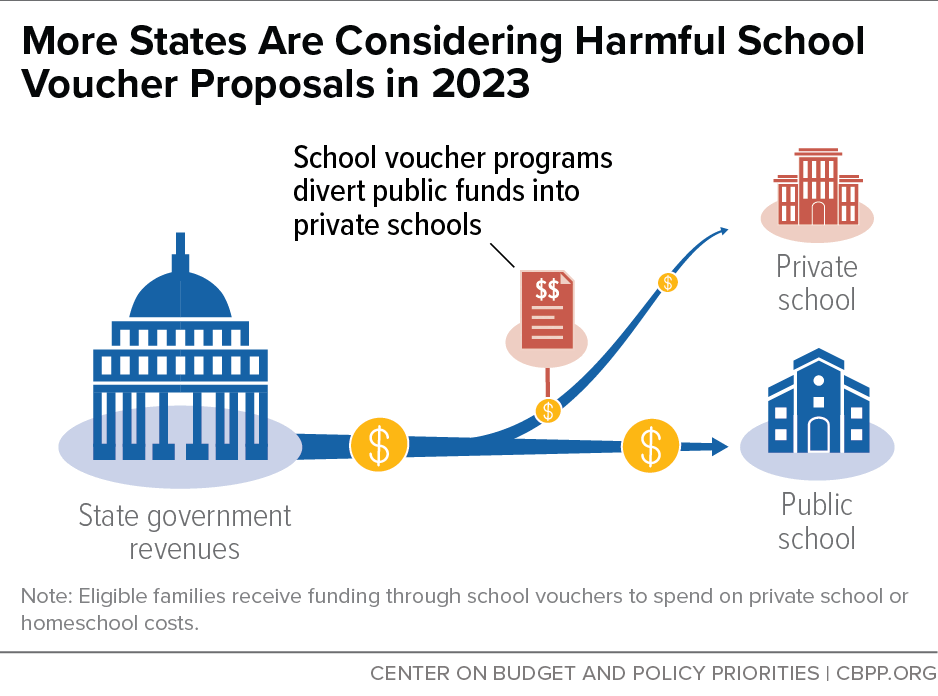
More States Are Considering Harmful School Voucher Proposals in 2023

The graph above appeared in an earlier version of this report, published in March 2023.

The following post by Jess Piper was reposted by the Network for Public Education. Jess Piper is a fearless rural mom in Missouri who supports public schools.

New post on Network for Public Education.

Jess Piper: Poisoned Water in Missouri Public Schools? Let The Kids Eat Cake.

Jess Piper is a powerful defender of public education on TikTok and other social platforms. In this post, she talks about a recent run-in with Jean Evans, head of Betsy DeVos’s advocacy group in Missouri.

As a former public school teacher, with 16 years in the classroom, and an outspoken advocate for rural public schools, I have had more than my fair share of dealings with Jean. A few stand out in particular: one in which she said that “educational freedom” in rural Missouri is not a brick and mortar building staffed with certified teachers, but one in which rural kids could attend online schools and hire private tutors. That sure would free up some time for these kiddos to go to work, am I right?

Yes, she knows there is no school choice in rural Missouri, but our kids don’t deserve it anyway. I mean, we are just hayseeds out here and what do we expect?

That response is very indicative of the thought pattern for the grifters who want to privatize public schools…whose intentions are to siphon taxpayer money to private hands. But, what I loathe, yet enjoy, so much about Jean Evans is her ability — no, her insistence— on saying the quiet part out loud.

Yes, she works for a billionaire to defund Missouri schools. Yes, she is willing to say that defunding rural schools will displace children and close their schools.

But, what else is she willing to say publicly?

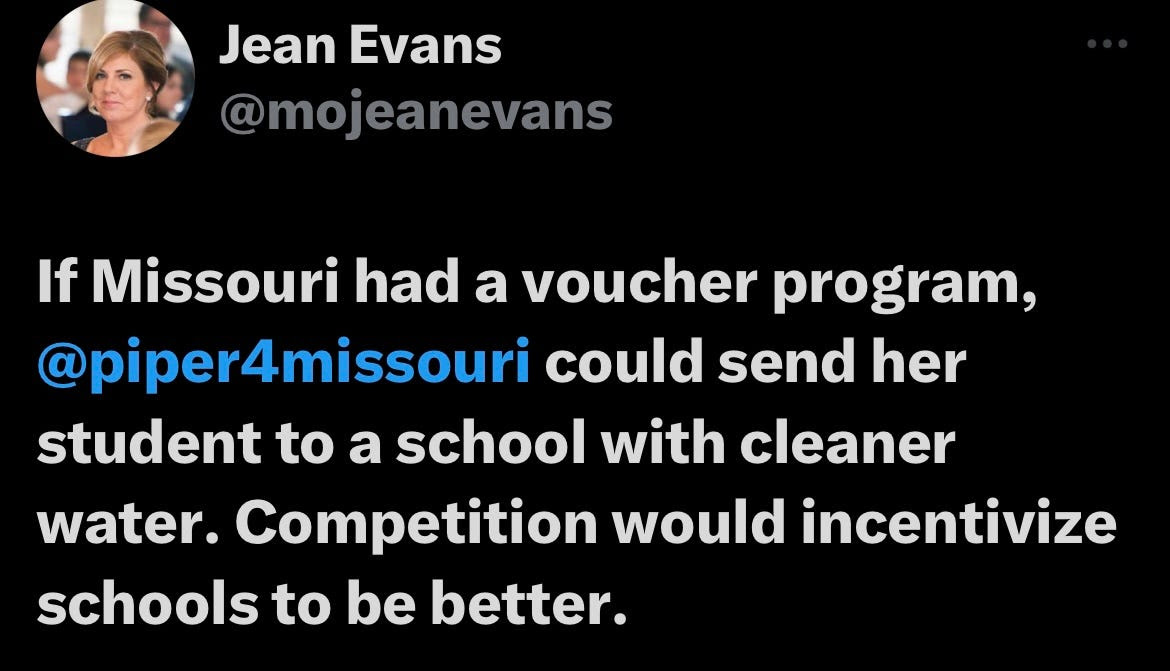
She was willing to tell me that the rural kids at my local public school would be deserving of clean drinking water if only Missouri would pass a voucher program. One may wonder if Jean herself snacked on too many lead paint chips as a child?

It all started with a letter from my local school reporting on the findings of lead in the water at the school. Most water sources were within EPA levels of lead in the water—not particularly great news, but I suspect most old schoolhouses reported much of the same. One faucet, in the nurse’s office, reported an elevated level more than four times the recommended limit. The school is addressing the water faucet and is attempting remediation. No children will drink this water.

I tweeted the findings and reminded my Twitter audience that over 80% of Missouri children test positive for lead in their blood. Jean responded by tweeting this:

Yes, if only we would expand Missouri’s current ESA scheme to defund schools and agree to a full-on voucher scheme, maybe the kids in my town wouldn’t be drinking poisoned water? If only rural folks would acquiesce to closing our schools and going along with the plan to keep our rural kids at home for online learning, and the occasional visit from a tutor, our kids wouldn’t be drinking lead.

Read the full post here.You can view the post at this link : https://networkforpubliceducation.org/blog-content/jess-piper-poisoned-water-in-missouri-public-schools-let-the-kids-eat-cake/